-
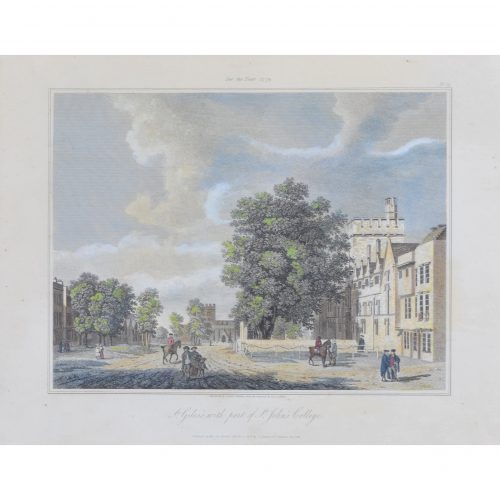
Joseph Constantine Stadler (1755 - 1828) after Michael Angelo Rooker (1743/6 - 1801)
St Giles's with a part of St John's College (1813)
Engraving with later hand-colouring 25 x 32 cm An engraving of St Giles, including the famous St Giles Church, with the front of St John's to the right. Joseph Constantine Stadler was a prolific German émigré engraver of images after his contemporaries. Stadler's engravings are wide-ranging in subject matter and include landscapes, seascapes and portraits, as well as military, sporting and decorative subjects. Stadler was employed by the leading print publisher of the time, John Boydell. Stadler lived in Knightsbridge when he died at the age of 73. Michael Angelo Rooker ARA was an English oil and watercolour painter of architecture and landscapes, illustrator, and engraver. Condition: good. Some gentle age toning. If you are interested, please email info@manningfineart.co.uk or call us on 07929 749056. Click here for other views of St John’s College, Oxford. -
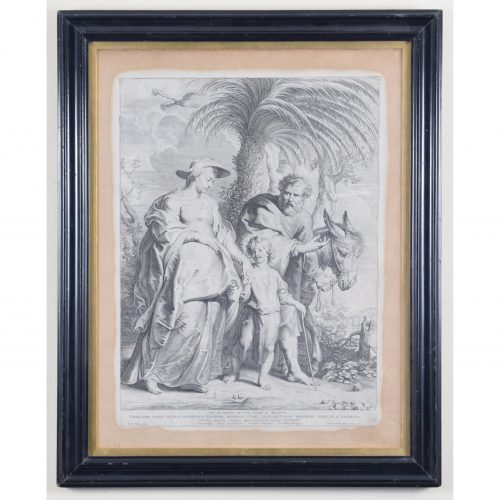
Lucas Vorsterman (1595 - 1675) after Peter Paul Rubens (1577 - 1640)
The Flight into Egypt (1620)
Engraving 30 x 45 cm Rare. We have only been able to trace one copy at auction, 2019, Izegem, Belgium. A copy of this print is held by the British Museum (R,3.50). Mary, Joseph, and the infant Christ escape into Egypt on a donkey. Lucas Vorsterman was a Baroque engraver. He worked with the artists Peter Paul Rubens and Anthony van Dyck, as well as for patrons such as Thomas Howard, 21st Earl of Arundel and Charles I of England. Condition: mounted to old paper; trimmed to platemarks; two areas of repair in region of Mary's left hand and Christ's right knee (see photo). In old ebonised frame. If you are interested, please email info@manningfineart.co.uk or call us on 07929 749056. -
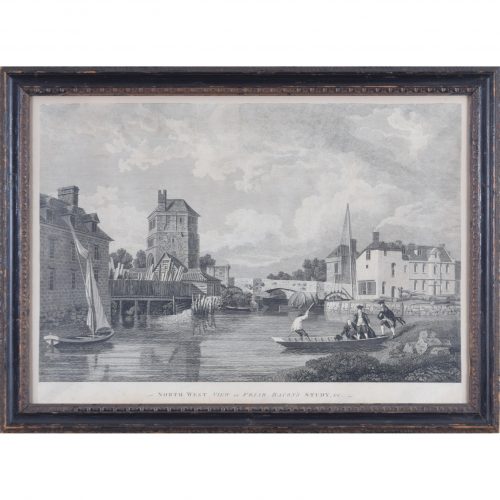
after Michael Angelo Rooker (1743/6 - 1801)
North West view of Friar Bacon's Study, and Folly Bridge
Engraving 30 x 45 cm Friar Bacon's Study was built as a watchtower in the thirteenth century. The name is 'merely traditional, and not in any Record to be found', according to the 1773 text 'The Antient and Present State of the City of Oxford'; it is said to have been used by the Franciscan Friar Roger Bacon as an astronomical observatory. For hundreds of years after Friar Bacon's use of it, the tower was a notable landmark in Oxford, and Samuel Pepys visited it in 1668: 'So to Friar Bacon's study: I up and saw it, and gave the man a shilling. Oxford mighty fine place.' The Study was often considered a folly, and the bridge is now known as Folly Bridge. Rooker painted the tower in 1780 - around the same time as the tower was demolished - and James Basire produced an engraving of his painting in 1787, to be used as the frontispiece for the Oxford Almanack. The Oxford Almanack was an annual almanack published by the Oxford University Press for the University of Oxford from 1674 through 2019 (when printing sadly ceased due to "dwindling interest"). The almanack traditionally included engravings or lithographs of the University and information about the upcoming year. Other almanack artists have included Michael Burghers, J. M. W. Turner, and John Piper. Basire and Dayes collaborated on several views of Oxford during the courses of their careers. Michael Angelo Rooker ARA was an English oil and watercolour painter of architecture and landscapes, illustrator, and engraver. Rooker's original painting currently hangs in Worcester College. Condition: good; in handsome (worn) antique Hogarth frame. If you are interested, please email info@manningfineart.co.uk or call us on 07929 749056. Click here for other non-collegiate views of Oxford. -
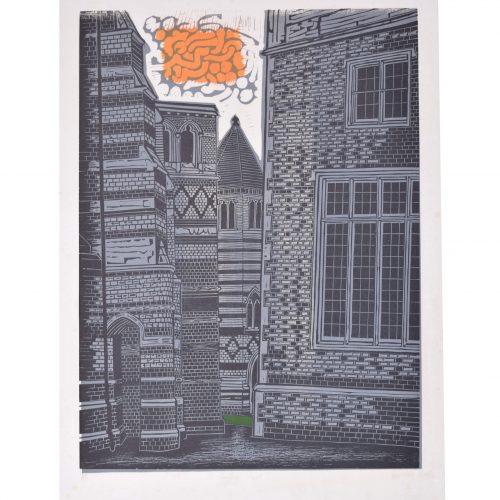
Walter Hoyle (1922 - 2000)
Rugby School
Linocut 62 x 46 cm Signed, titled, and inscribed A/P in pencil. Possibly unique. Hoyle's view of Rugby School. The school's architecture is depicted in shades of blue and grey, with an orange patch of sun in the cloudy sky above. A green garden peeks out from between the buildings, which lean gently away from one another. Hoyle trained at Beckenham School of Art and the Royal College of Art. At the latter he was strongly influenced by Edward Bawden, one of Britain’s greatest linocut printers. Bawden had been commissioned by the 1951 Festival of Britain to produce a mural for the South Bank, and chose Hoyle to assist on account of his great talent. Hoyle moved to Great Bardfield in Essex, becoming a part of the Great Bardfield group of artists; diverse in style, they created figurative work, in stark contrast to the abstract art of the St Ives artists at the opposite end of the country. Hoyle taught at St Martin’s School of Art from 1951-60, the Central School of Arts and Crafts from 1960-64, and the Cambridge School of Art from 1964-1985, during which time he launched Cambridge Print Editions. His work is held in the collections of the Tate Gallery, the Victoria and Albert Museum, The British Museum, Kettle’s Garden and the Fry Art Gallery. Condition: enerally very good; a few handling marks and a little spotting to the margins. If you are interested, please email info@manningfineart.co.uk or call us on 07929 749056. -
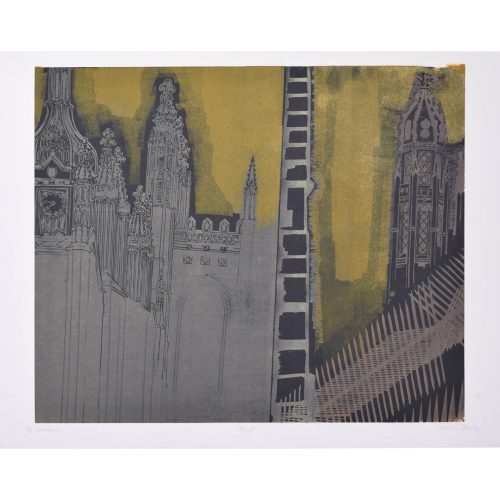
Walter Hoyle (1922 - 2000)
King's College, Cambridge (Cambridge Series 1956 - 66)
Linocut 46 x 56 cm Signed, titled, and numbered 5/5 in pencil. Hoyle's view of King's College, Cambridge, against a shadowy yellow sky. Hoyle trained at Beckenham School of Art and the Royal College of Art. At the latter he was strongly influenced by Edward Bawden, one of Britain’s greatest linocut printers. Bawden had been commissioned by the 1951 Festival of Britain to produce a mural for the South Bank, and chose Hoyle to assist on account of his great talent. Hoyle moved to Great Bardfield in Essex, becoming a part of the Great Bardfield group of artists; diverse in style, they created figurative work, in stark contrast to the abstract art of the St Ives artists at the opposite end of the country. Hoyle taught at St Martin’s School of Art from 1951-60, the Central School of Arts and Crafts from 1960-64, and the Cambridge School of Art from 1964-1985, during which time he launched Cambridge Print Editions. His work is held in the collections of the Tate Gallery, the Victoria and Albert Museum, The British Museum, Kettle’s Garden and the Fry Art Gallery. Provenance: the artist's wife. Condition: very good; few handling marks to margin, a horizontal crease about half way down that was likely in the paper prior to printing. If you are interested, please email info@manningfineart.co.uk or call us on 07929 749056. Click here for other views of King's College, Cambridge. -
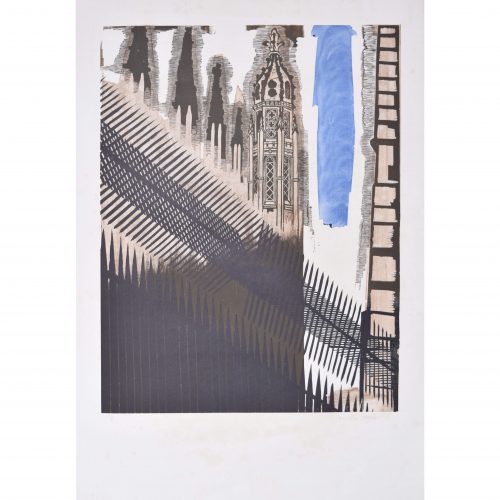
Walter Hoyle (1922 - 2000)
King's College, Cambridge (Cambridge Series 1956 - 66)
Linocut 56 x 43 cm Signed and inscribed A/P in pencil. Possibly unique. Hoyle's view of King's College, Cambridge, with a slice of blue sky behind. Hoyle trained at Beckenham School of Art and the Royal College of Art. At the latter he was strongly influenced by Edward Bawden, one of Britain’s greatest linocut printers. Bawden had been commissioned by the 1951 Festival of Britain to produce a mural for the South Bank, and chose Hoyle to assist on account of his great talent. Hoyle moved to Great Bardfield in Essex, becoming a part of the Great Bardfield group of artists; diverse in style, they created figurative work, in stark contrast to the abstract art of the St Ives artists at the opposite end of the country. Hoyle taught at St Martin’s School of Art from 1951-60, the Central School of Arts and Crafts from 1960-64, and the Cambridge School of Art from 1964-1985, during which time he launched Cambridge Print Editions. His work is held in the collections of the Tate Gallery, the Victoria and Albert Museum, The British Museum, Kettle’s Garden and the Fry Art Gallery. Provenance: family of the artist. Condition: generally very good; a few handling marks and a little age toning to the margins. Vertical impressins within and below the blue vertical area which are probably part of the artist's working technique. If you are interested, please email info@manningfineart.co.uk or call us on 07929 749056. Click here for other views of King's College, Cambridge. -
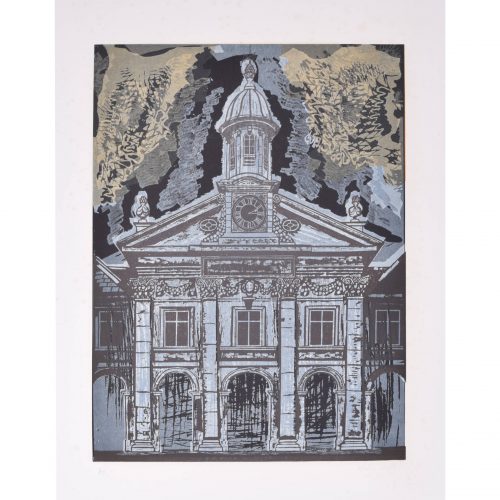
Walter Hoyle (1922 - 2000)
Emmanuel College, Cambridge (Cambridge Series 1956 - 66)
Linocut 55 x 43 cm Signed and inscribed A/P in pencil. Hoyle's view of Emmanuel's Front Court bleaches the gold of the chapel's Ketton Stone into an icy blue, and situates it beneath a tempestuous yellow sky. Hoyle trained at Beckenham School of Art and the Royal College of Art. At the latter he was strongly influenced by Edward Bawden, one of Britain’s greatest linocut printers. Bawden had been commissioned by the 1951 Festival of Britain to produce a mural for the South Bank, and chose Hoyle to assist on account of his great talent. Hoyle moved to Great Bardfield in Essex, becoming a part of the Great Bardfield group of artists; diverse in style, they created figurative work, in stark contrast to the abstract art of the St Ives artists at the opposite end of the country. Hoyle taught at St Martin’s School of Art from 1951-60, the Central School of Arts and Crafts from 1960-64, and the Cambridge School of Art from 1964-1985, during which time he launched Cambridge Print Editions. His work is held in the collections of the Tate Gallery, the Victoria and Albert Museum, The British Museum, Kettle’s Garden and the Fry Art Gallery. Provenance: family of the artist. Condition: generally very good; a few handling marks and areas of discolouration to extreme margins, extraneous ink to right hand side, and a very small brown spot to very top right beyond the blue sky. If you are interested, please email info@manningfineart.co.uk or call us on 07929 749056. Click here for other views of Emmanuel College, Cambridge. -
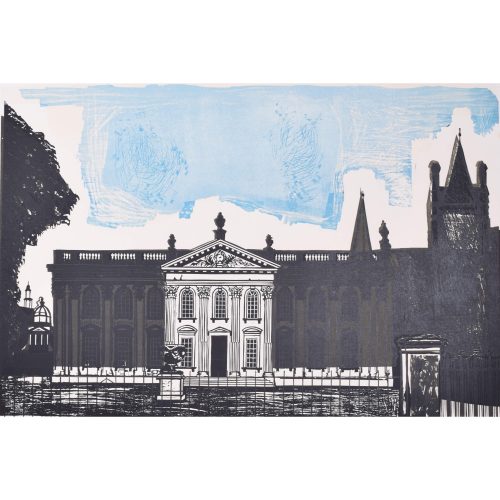
Walter Hoyle (1922 - 2000)
Senate House, Cambridge (Cambridge Series 1956 - 66)
Linocut 46 x 70 cm Trial print aside from the series, with different colourway. Senate House, under a lively blue sky. Hoyle trained at Beckenham School of Art and the Royal College of Art. At the latter he was strongly influenced by Edward Bawden, one of Britain’s greatest linocut printers. Bawden had been commissioned by the 1951 Festival of Britain to produce a mural for the South Bank, and chose Hoyle to assist on account of his great talent. Hoyle moved to Great Bardfield in Essex, becoming a part of the Great Bardfield group of artists; diverse in style, they created figurative work, in stark contrast to the abstract art of the St Ives artists at the opposite end of the country. Hoyle taught at St Martin’s School of Art from 1951-60, the Central School of Arts and Crafts from 1960-64, and the Cambridge School of Art from 1964-1985, during which time he launched Cambridge Print Editions. His work is held in the collections of the Tate Gallery, the Victoria and Albert Museum, The British Museum, Kettle’s Garden and the Fry Art Gallery. Provenance: family of the artist. Condition: generally very good; a few handling marks and areas of discolouration to extreme margins, extraneous ink to right hand side, and a very small brown spot to very top right beyond the blue sky. If you are interested, please email info@manningfineart.co.uk or call us on 07929 749056. Click here for other general views of Cambridge. -
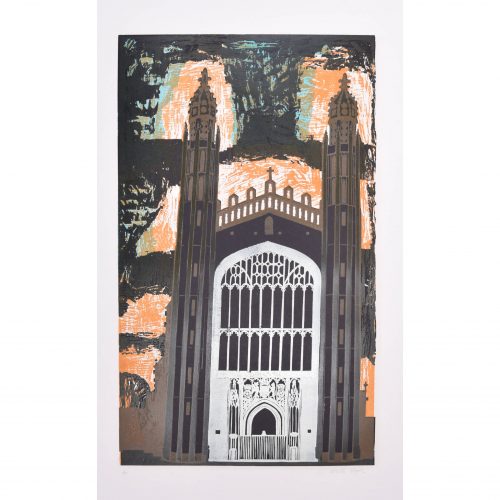
Walter Hoyle (1922 - 2000)
King's College Chapel, Cambridge (Cambridge Series 1956 - 66)
Linocut 72 x 41 cm Signed and inscribed A/P in pencil. Hoyle depicts King's College Chapel as both indomitable and delicate. The bold composition sees the chapel's spires surrounded by a fiery orange light against the black night of the background; at the same time, the western facade looks like it could have been cut from paper, or crafted from lace. Hoyle trained at Beckenham School of Art and the Royal College of Art. At the latter he was strongly influenced by Edward Bawden, one of Britain’s greatest linocut printers. Bawden had been commissioned by the 1951 Festival of Britain to produce a mural for the South Bank, and chose Hoyle to assist on account of his great talent. Hoyle moved to Great Bardfield in Essex, becoming a part of the Great Bardfield group of artists; diverse in style, they created figurative work, in stark contrast to the abstract art of the St Ives artists at the opposite end of the country. Hoyle taught at St Martin’s School of Art from 1951-60, the Central School of Arts and Crafts from 1960-64, and the Cambridge School of Art from 1964-1985, during which time he launched Cambridge Print Editions. His work is held in the collections of the Tate Gallery, the Victoria and Albert Museum, The British Museum, Kettle’s Garden and the Fry Art Gallery. Provenance: family of the artist. Condition: generally very good; a few handling marks to margins. If you are interested, please email info@manningfineart.co.uk or call us on 07929 749056. Click here for other views of King's College, Cambridge. -
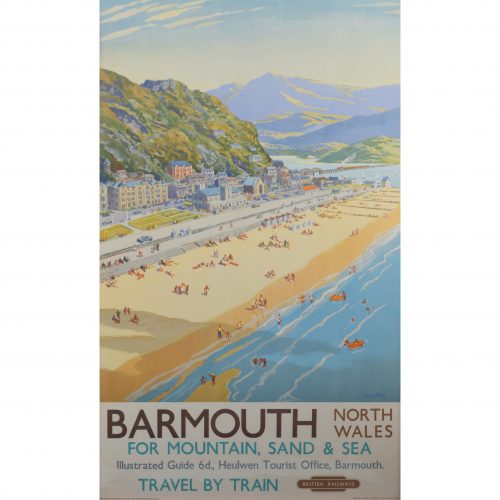
Harry Arthur Riley (1895 - 1966)
Barmouth, North Wales, for Mountain, Sand & Sea
Original vintage poster 100 x 60 cm Riley's vintage poster extols the virtues of visiting sunny Barmouth - the scene depicts dozens of attractively (if perhaps unrealistically) tanned holidaymakers, a bright blue sea, and a pretty coastal town. The poster was part of a series produced for British Railways, designed to encourage rail travel to beauty spots across Britain. Principally known as a commercial artist, Harry Riley RI’s iconic poster designs of the 1920s - 1960s and his bright, joyful and idyllic depictions of British seaside holiday destinations, such as Morecambe, Plymouth, Weston-Super-Mare and Ilfracombe, were used to advertise the British rail network and have come to define Post-War British leisure and travel. He was also known for this work with airliners such as BOAC and Qantas. Although not an easily identifiable name within the echelons of the mid-20th century commercial art scene, Riley’s works pay testament to a highly skilled and prolific artist whose visual style fittingly captures the idealistic and amber-tinted vision of early 1960s glamour that the era’s commercial and travel sectors strove to embody. Harry Riley studied at St Martin's School of Art and was soon commissioned to produce commercial art and poster designs for companies such as Selfridges and Fortnum & Mason. He became a member of the Royal Institute of Painters in Watercolour and worked as a cartoonist for the Daily Mail, later becoming President of the London Sketch Club. The bright and bold style of his art for British Railways has become instantly recognisable today and is an illustration of travel, leisure, and idealism in post-war Britain. Condition: colours good. Backed to board. If you are interested, please email info@manningfineart.co.uk or call us on 07929 749056. Click here for other original vintage travel posters. -
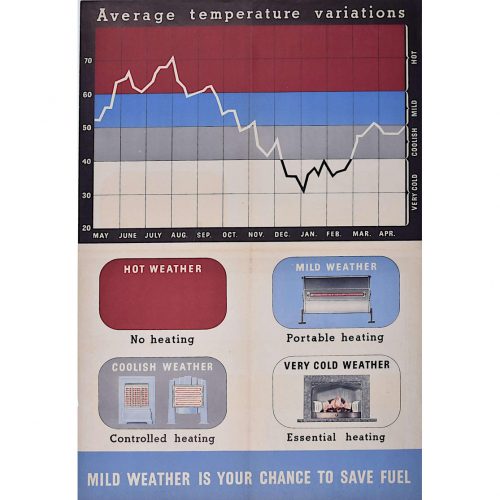
Beverley Pick (1916 - 1995/6)
Mild Weather is Your Chance to Save Fuel (circa 1944)
Original vintage poster 30 x 20 in Poster published for the Ministry of Information. In this series of ten posters, "Mrs Housewife" shows us how to save fuel at home as part of the Home Front war effort. This poster advises that less heating, and thus less fuel, is required during mild weather. Beverley Pick was born in the Netherlands. He spent the Second World War designing posters for the Ministry of Information, many of them in a highly modern photographic style. He was a member of the Society of Industrial Artists, and created varied posters for commercial and industrial organisations, including the British Overseas Airways Corporation and British European Airways, after the war. Condition: folds as issued; slight edge wear. Otherwise generally very good. If you are interested, please email info@manningfineart.co.uk or call us on 07929 749056. Click here for other original vintage Home Front posters. -
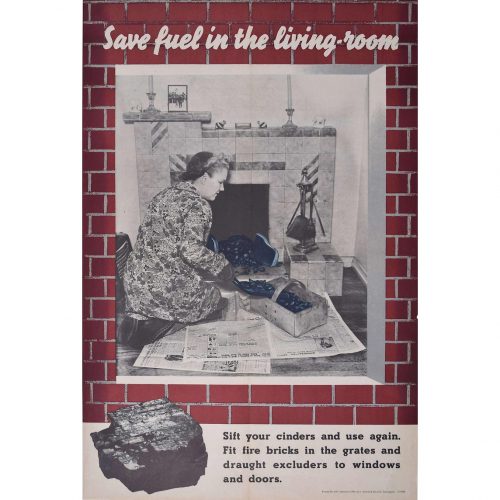
Beverley Pick (1916 - 1995/6)
Save Fuel in the Living Room (circa 1944)
Original vintage poster 30 x 20 in Poster published for the Ministry of Information. In this series of ten posters, "Mrs Housewife" shows us how to save fuel at home as part of the Home Front war effort. The character's hair and dress are fantastically 1940s. Beverley Pick was born in the Netherlands. He spent the Second World War designing posters for the Ministry of Information, many of them in a highly modern photographic style. He was a member of the Society of Industrial Artists, and created varied posters for commercial and industrial organisations, including the British Overseas Airways Corporation and British European Airways, after the war. Condition: folds as issued; slight edge wear. Otherwise generally very good. If you are interested, please email info@manningfineart.co.uk or call us on 07929 749056. Click here for other original vintage Home Front posters. -
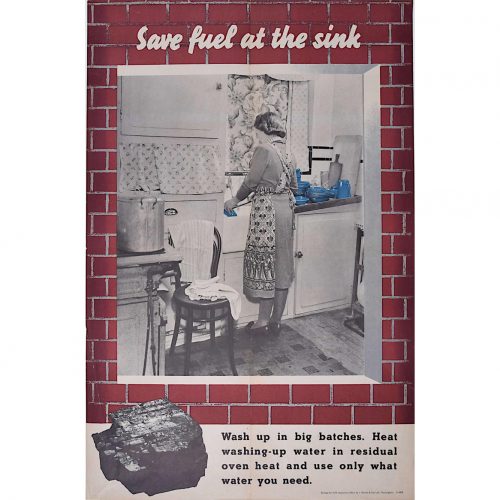
Beverley Pick (1916 - 1995/6)
Save Fuel at the Sink (circa 1944)
Original vintage poster 30 x 20 in Poster published for the Ministry of Information. In this series of ten posters, "Mrs Housewife" shows us how to save fuel at home as part of the Home Front war effort. The character's hair and dress, and the style of her kitchen, are fantastically 1940s. Beverley Pick was born in the Netherlands. He spent the Second World War designing posters for the Ministry of Information, many of them in a highly modern photographic style. He was a member of the Society of Industrial Artists, and created varied posters for commercial and industrial organisations, including the British Overseas Airways Corporation and British European Airways, after the war. Condition: folds as issued; slight edge wear. Otherwise generally very good. If you are interested, please email info@manningfineart.co.uk or call us on 07929 749056. Click here for other original vintage Home Front posters. -
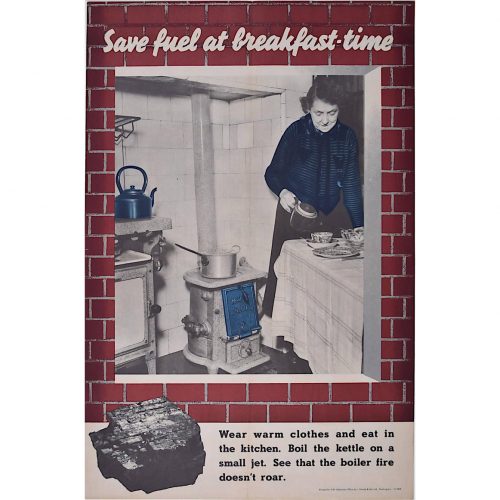
Beverley Pick (1916 - 1995/6)
Save Fuel at Breakfast Time (circa 1944)
Original vintage poster 30 x 20 in Poster published for the Ministry of Information. In this series of ten posters, "Mrs Housewife" shows us how to save fuel at home as part of the Home Front war effort. The character's kitchen, kettle, and cooking accoutrements are fantastically 1940s. Beverley Pick was born in the Netherlands. He spent the Second World War designing posters for the Ministry of Information, many of them in a highly modern photographic style. He was a member of the Society of Industrial Artists, and created varied posters for commercial and industrial organisations, including the British Overseas Airways Corporation and British European Airways, after the war. Condition: folds as issued; slight edge wear. Otherwise generally very good. If you are interested, please email info@manningfineart.co.uk or call us on 07929 749056. Click here for other original vintage Home Front posters. -
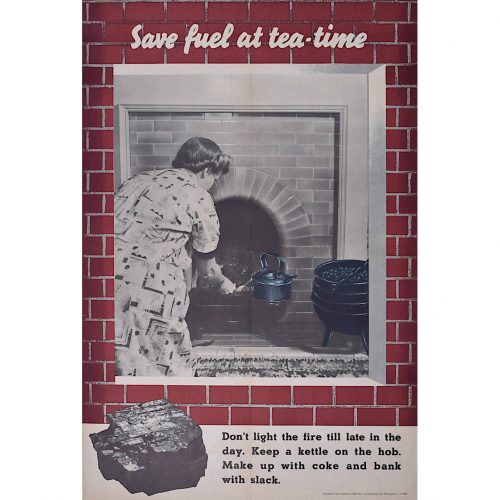
Beverley Pick (1916 - 1995/6)
Save Fuel at Tea Time (circa 1944)
Original vintage poster 30 x 20 in Poster published for the Ministry of Information. In this series of ten posters, "Mrs Housewife" shows us how to save fuel at home as part of the Home Front war effort. The character's hair and dress are fantastically 1940s. Beverley Pick was born in the Netherlands. He spent the Second World War designing posters for the Ministry of Information, many of them in a highly modern photographic style. He was a member of the Society of Industrial Artists, and created varied posters for commercial and industrial organisations, including the British Overseas Airways Corporation and British European Airways, after the war. Condition: folds as issued; slight edge wear. Otherwise generally very good. If you are interested, please email info@manningfineart.co.uk or call us on 07929 749056. Click here for other original vintage Home Front posters. -
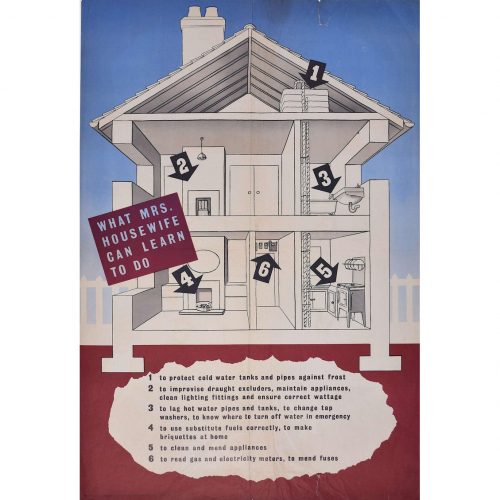
Beverley Pick (1916 - 1995/6)
What Mrs Housewife Can Learn To Do (circa 1944)
Original vintage poster 30 x 20 in Poster published for the Ministry of Information. This series of ten posters illustrates how housewives ought to save fuel at home as part of the Home Front war effort. Here, we are presented with a list of six tasks, including insulating water tanks and reading electricity meters, which a housewife should learn to do. Beverley Pick was born in the Netherlands. He spent the Second World War designing posters for the Ministry of Information, many of them in a highly modern photographic style. He was a member of the Society of Industrial Artists, and created varied posters for commercial and industrial organisations, including the British Overseas Airways Corporation and British European Airways, after the war. Condition: folds as issued, slight edge wear, and short closed edge tear. Otherwise generally very good. If you are interested, please email info@manningfineart.co.uk or call us on 07929 749056. Click here for other original vintage Home Front posters. -
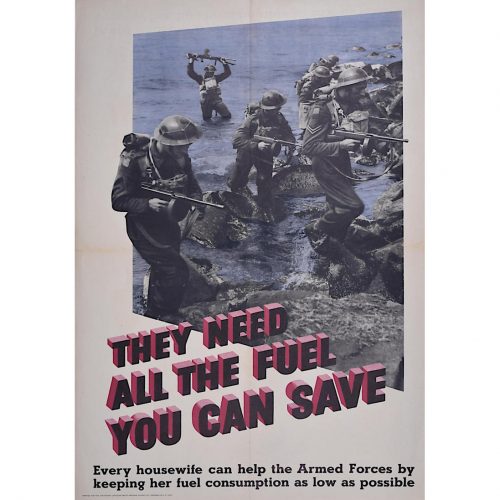
Beverley Pick (1916 - 1995/6)
They Need All the Fuel You Can Save (circa 1944)
Original vintage poster 30 x 20 in Poster published for the Ministry of Information. This series of ten posters illustrates how housewives ought to save fuel at home as part of the Home Front war effort. Here, the poster reminds us that less fuel used at home means more fuel available for the Armed Forces (pictured here during the D-Day landings, disembarking from a landing craft). Beverley Pick was born in the Netherlands. He spent the Second World War designing posters for the Ministry of Information, many of them in a highly modern photographic style. He was a member of the Society of Industrial Artists, and created varied posters for commercial and industrial organisations, including the British Overseas Airways Corporation and British European Airways, after the war. Condition: folds as issued; slight edge wear. Otherwise generally very good. If you are interested, please email info@manningfineart.co.uk or call us on 07929 749056. Click here for other original vintage Home Front posters. -
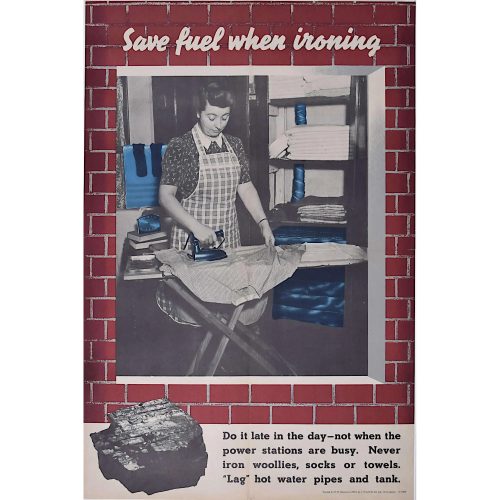
Beverley Pick (1916 - 1995/6)
Save Fuel when Ironing (circa 1944)
Original vintage poster 30 x 20 in Poster published for the Ministry of Information. In this series of ten posters, "Mrs Housewife" shows us how to save fuel at home as part of the Home Front war effort. The character's hair, clothes, and tiny iron are fantastically 1940s. Beverley Pick was born in the Netherlands. He spent the Second World War designing posters for the Ministry of Information, many of them in a highly modern photographic style. He was a member of the Society of Industrial Artists, and created varied posters for commercial and industrial organisations, including the British Overseas Airways Corporation and British European Airways, after the war. Condition: folds as issued; slight edge wear. Otherwise generally very good. If you are interested, please email info@manningfineart.co.uk or call us on 07929 749056. Click here for other original vintage Home Front posters. -
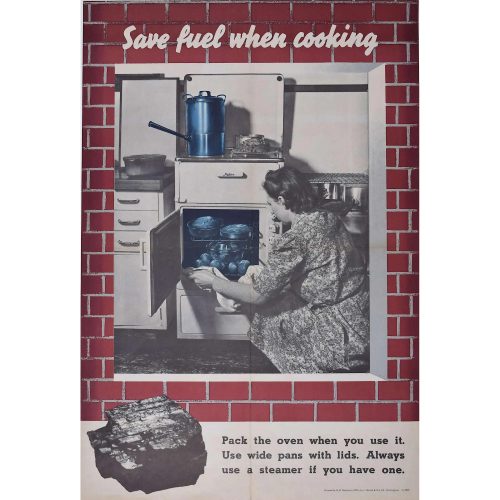
Beverley Pick (1916 - 1995/6)
Save Fuel when Cooking (circa 1944)
Original vintage poster 30 x 20 in Poster published for the Ministry of Information. In this series of ten posters, "Mrs Housewife" shows us how to save fuel at home as part of the Home Front war effort. The character's hair and dress, and the style of her kitchen, are fantastically 1940s. Beverley Pick was born in the Netherlands. He spent the Second World War designing posters for the Ministry of Information, many of them in a highly modern photographic style. He was a member of the Society of Industrial Artists, and created varied posters for commercial and industrial organisations, including the British Overseas Airways Corporation and British European Airways, after the war. Condition: folds as issued; slight edge wear. Otherwise generally very good. If you are interested, please email info@manningfineart.co.uk or call us on 07929 749056. Click here for other original vintage Home Front posters. -
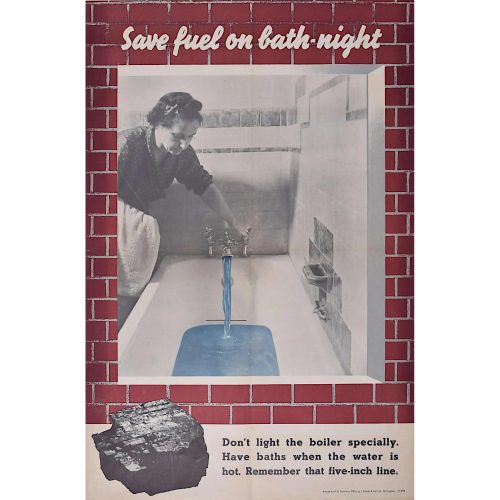
Beverley Pick (1916 - 1995/6)
Save Fuel on Bath Night (circa 1944)
Original vintage poster 30 x 20 in Poster published for the Ministry of Information. In this series of ten posters, "Mrs Housewife" shows us how to save fuel at home as part of the Home Front war effort. The character's hair and dress, and the style of the bath (with a line drawn on it to remind bathers to use no more than five inches of water), are fantastically 1940s. Beverley Pick was born in the Netherlands. He spent the Second World War designing posters for the Ministry of Information, many of them in a highly modern photographic style. He was a member of the Society of Industrial Artists, and created varied posters for commercial and industrial organisations, including the British Overseas Airways Corporation and British European Airways, after the war. Condition: folds as issued; slight edge wear. Otherwise generally very good. If you are interested, please email info@manningfineart.co.uk or call us on 07929 749056. Click here for other original vintage Home Front posters. -
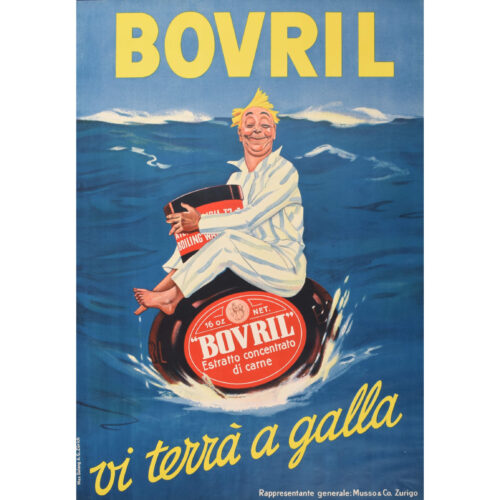
Herbert Harris (1888 - 1962)
Bovril - vi terra a galla ("Bovril keeps you afloat")
Lithograph 128 x 90 cm An original vintage poster advertising Bovril. The poster was designed in 1920 by notable poster artist Herbert Harris for the advertising agency S H Bentley. It originally read 'Bovril prevents that sinking feeling' in English. Bovril, says the poster, is the ultimate comfort, and will keep you going in adversity. The Italian version of the poster, published in the 1930s, instead supplied "Bovril - vi terra a galla" - "Bovril keeps you afloat". German and French versions with appropriate idioms were also produced; these European versions of the poster were Musso & Co. and designed by the Max Dalang Atelier, both in Zurich. Condition: generally very good; repaired tear from edge approx 4" long towards bottom on left side, essentially invisible. If you are interested, please email info@manningfineart.co.uk or call us on 07929 749056. Click here for other original vintage posters. -
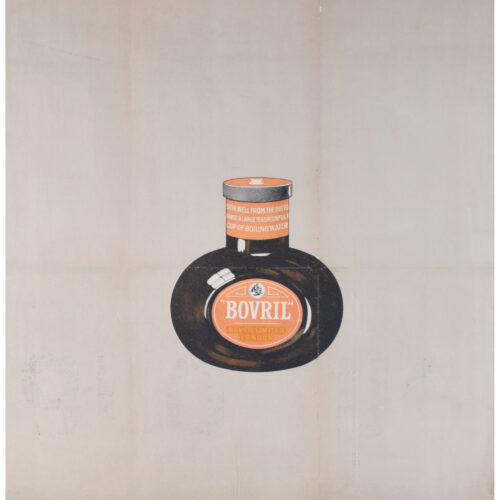
Bovril
Lithograph 75 x 73 cm An original advertisement for Bovril, featuring the brand's uniquely shaped amber glass bottle. One of the instructions for preparing the meat paste into a liquid is 'Stir Well from the Bottom', which went on to become a recognisable tagline for Bovril. Condition: old folds as issued; otherwise generally good. If you are interested, please email info@manningfineart.co.uk or call us on 07929 749056. Click here for other original vintage posters. -
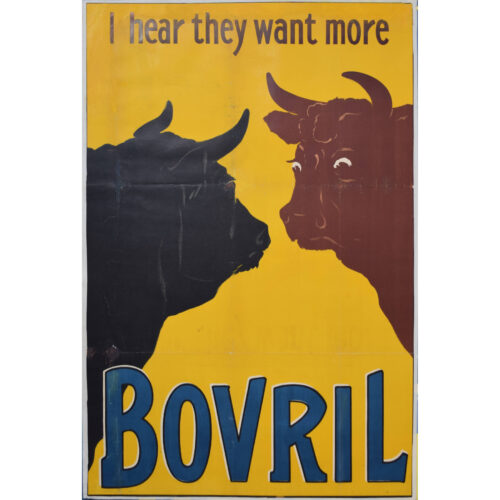
Ernest Bertram
I Hear They Want More Bovril (1903)
Lithograph 117 x 79 cm An original poster advertising Bovril. The darkly funny poster features the Bovril bulls, which appeared on many posters advertising the brand, dismayed to hear that more of the meat paste is required - perhaps requiring a contribution from them. Condition: backed to linen; old creases and losses touched in with gouache: three areas approx 1" square near and vertically above 'B' of Bovril, and also to top margin. Generaly presents well, however. If you are interested, please email info@manningfineart.co.uk or call us on 07929 749056. Click here for other original vintage posters. -
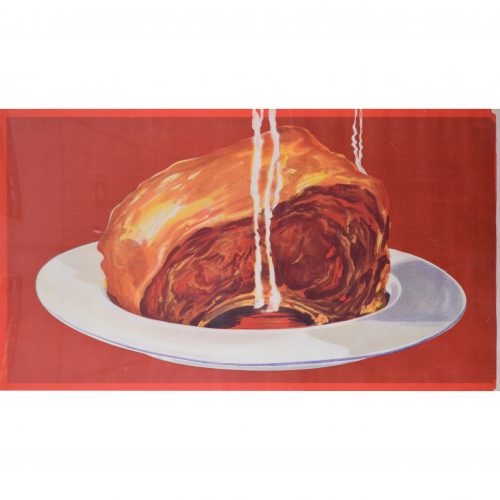
Rib of Beef
Original vintage poster 56 x 97 cm An original poster produced by Bisto to to advertise their gravy granules. With no lettering, the deep red poster is a bold and compelling advert which relies on the public's understanding that Bisto is the only choice. Condition: backed to linen, very good; a few repaired tears to right side. If you are interested, please email info@manningfineart.co.uk or call us on 07929 749056. Click here for other original vintage posters. -
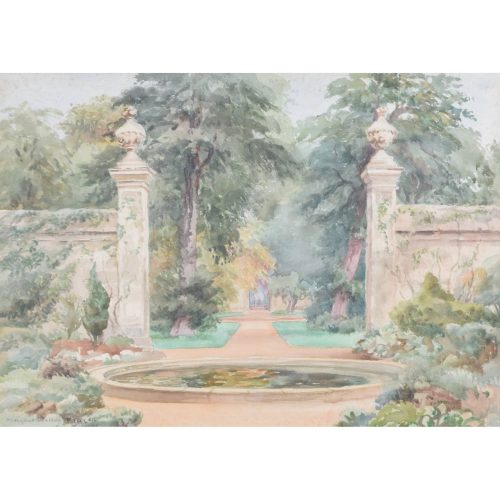
Margaret Waller (1916 - 1997)
The Oxford University Botanic Garden
Watercolour 35 x 51 cm Signed lower left. A watercolour depicting the serenity of Oxford's Botanic Garden. Koi swim just below the surface of the round pond and the garden stretches into the distance through a pair of stone arches. Margaret Waller was a mid-century artist and Fellow of the Institute of Arts and Letters. Condition: generally good; a little spotting to the sky. 'FIAL' added to signature later. If you are interested, please email info@manningfineart.co.uk or call us on 07929 749056. Click here for other non-collegiate views of Oxford. -
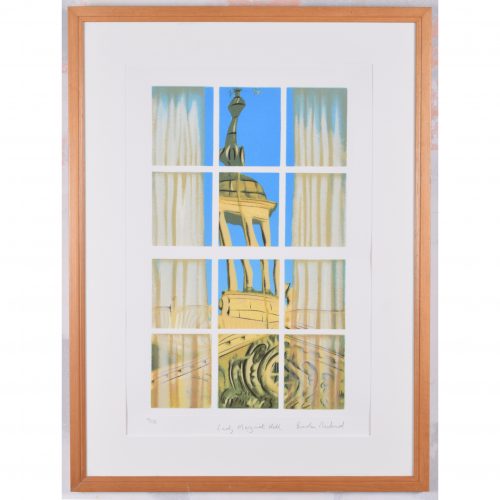
Brendan Neiland (b. 1941) R.A. (Expelled)
Lady Margaret Hall
Screenprint 46 x 27 cm Signed, titled, and numbered 42/175 in pencil. A screenprint of the cupola atop Lady Margaret Hall's Talbot Building. Reflected architecture is one of Neiland’s most recurring themes. Neiland's work is widely exhibited in major museums and galleries worldwide including, in Britain, the Victoria and Albert Museum, The Tate Gallery London, The Collections of the British Council, and the Arts Council of Great Britain. He is represented by the Redfern Gallery and has had numerous shows internationally, including at the Galerie Belvedere in Singapore, who represent him in Singapore and the Far East. Condition: very good. If you are interested, please email info@manningfineart.co.uk or call us on 07929 749056. Click here for other views of Lady Margaret Hall. -
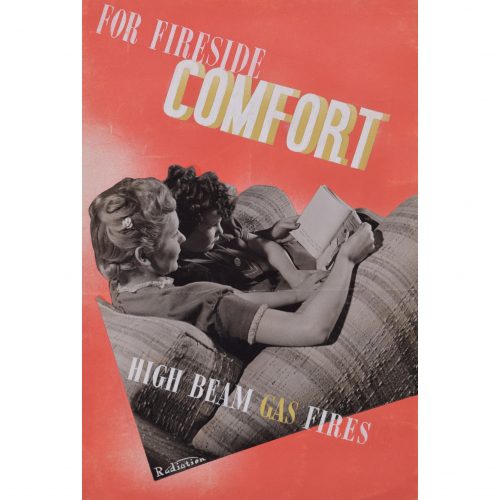
Brownbridge (flourished 1930s - 1940s)
For Fireside Comfort, High Beam Gas Fires brochure design
Gouache, mixed media art, and collage 21.5 x 14 cm From a small archive of works by Brownbridge, a member of the Society of Industrial Artists. A design for a brochure advertising Radiation's high beam gas fires. Brownbridge's design combines a photograph of a mother and child with hand-painted text; the red and yellow colour palette project warmth and cosiness. The mother's hair is fantastically 1930s, and she reads a copy of 'Patsy Ann: Her Happy Times' by Mona Reed King (first published in 1935) to her son. Society of Industrial Artists correspondance (photographed above) is not included; please enquire separately. Condition: generally very good; lacking 'The Serene' collaged photograph. If you are interested, please email info@manningfineart.co.uk or call us on 07929 749056. Click here for other designs by Brownbridge. -
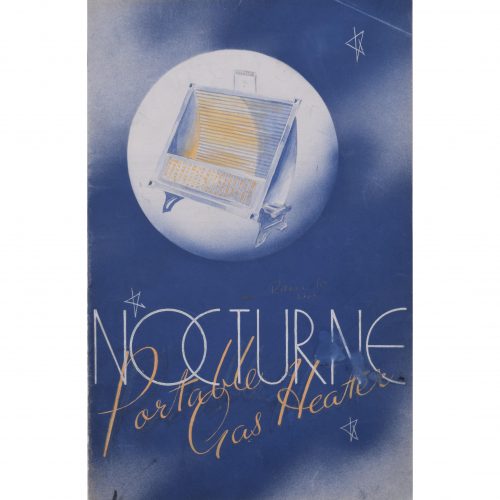
Brownbridge (flourished 1930s - 1940s)
Nocturne Portable Gas Heater brochure design
Gouache and mixed media art 21.5 x 14 cm From a small archive of works by Brownbridge, a member of the Society of Industrial Artists. A marvellous gouache design for a brochure advertising the Nocturne portable gas heater. The art deco text surrounded by stars and image of the innovative gas heater superimposed on the moon combine to make this a thoroughly modern piece of 1930s design. Society of Industrial Artists correspondance (photographed above) is not included; please enquire separately. Condition: generally very good; some damage to reverse. If you are interested, please email info@manningfineart.co.uk or call us on 07929 749056. Click here for other designs by Brownbridge. -
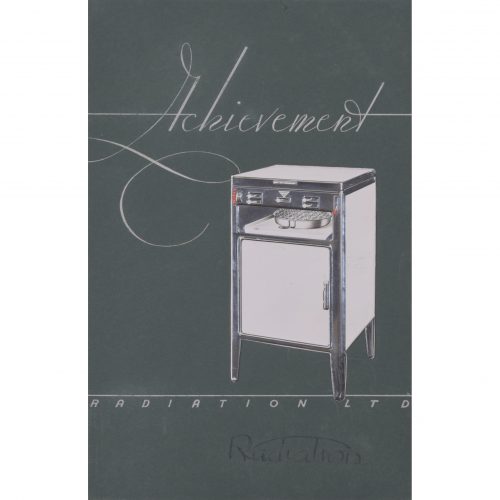
Brownbridge (flourished 1930s - 1940s)
Achievement Radiation gas cookers brochure design
Pen and collage 21.5 x 14 cm From a small archive of works by Brownbridge, a member of the Society of Industrial Artists. Brownbridge's bold design advertises Radiation cookers (innovative gas cookers which were sold in Britain in the 1920s and 1930s). Shiny white against a dark background, the Radiation cooker seems impossibly glamorous and inviting. Society of Industrial Artists correspondance (photographed above) is not included; please enquire separately. Condition: generally very good. If you are interested, please email info@manningfineart.co.uk or call us on 07929 749056. Click here for other designs by Brownbridge. -
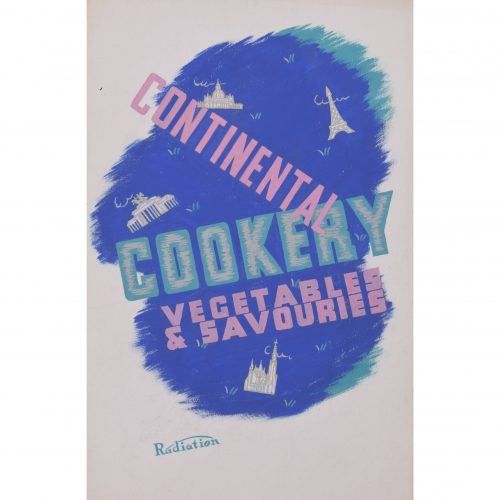
Brownbridge (flourished 1930s - 1940s)
Continental Cookery Radiation cooker brochure design
Gouache 21.5 x 14 cm From a small archive of works by Brownbridge, a member of the Society of Industrial Artists. A beautiful original gouache design for a brochure of continental recipes, created to advertise Radiation cookers (innovative gas cookers which were sold in Britain in the 1920s and 1930s). Brownbridge's brightly-coloured design includes boldly slanted text in pink and turquoise, set over a deep blue background; he also highlights architectural gems of Europe, such as the Eiffel Tower. By cooking with a Radiation cooker, the cover suggests, you too can experience the cultural and culinary delights of Europe from the comfort of your own home. Society of Industrial Artists correspondance (photographed above) is not included; please enquire separately. Condition: generally very good. If you are interested, please email info@manningfineart.co.uk or call us on 07929 749056. Click here for other designs by Brownbridge. -
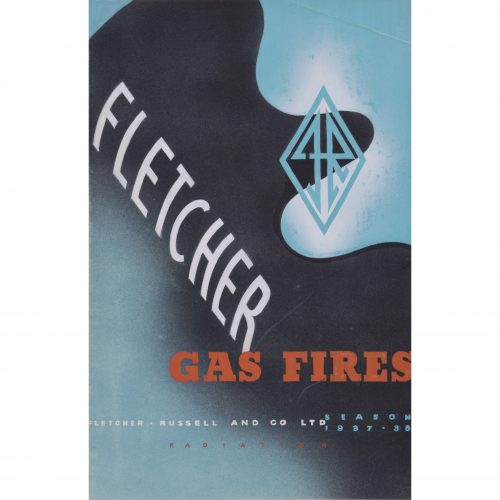
Brownbridge (flourished 1930s - 1940s)
Fletcher Gas Fires brochure design (1937)
Lithographic brochure 21.5 x 14 cm From a small archive of works by Brownbridge, a member of the Society of Industrial Artists. An original gouache design for a brochure advertising Fletcher Russell and Co. gas fires. The futuristic style of the boldly blue-, black-, and orange-coloured poster, as well as the dynamic diamond-shaped badge containing the initials F and R (for Fletcher and Russell) combine to make this a highly modern piece of 1930s design. Society of Industrial Artists correspondance (photographed above) is not included; please enquire separately. Condition: generally very good; gentle crease to top right corner. If you are interested, please email info@manningfineart.co.uk or call us on 07929 749056. Click here for other designs by Brownbridge. -
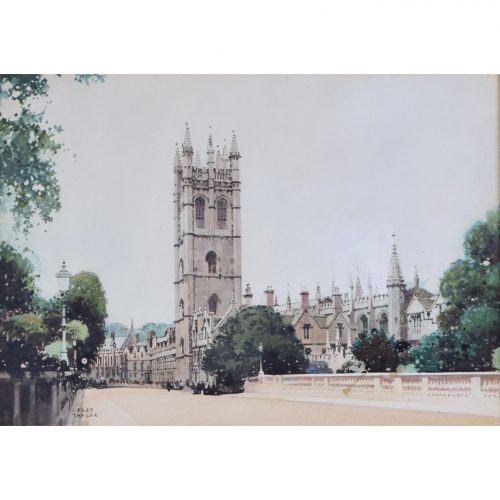
Fred Taylor (1875 - 1963)
Magdalen Tower from Magdalen Bridge
Watercolour 25 x 37 cm Signed lower left. Fred Taylor captures the indomitable features of Magdalen Tower. The spire rises into a pale sky as undergraduates stream past the entrance to the Porter's Lodge. An old-fashioned car drives up the High.This watercolour of Magdalen was a design for the front cover of a guidebook about Oxford.Fred Taylor was a London-born painter and poster designer. He studied at the Académie Julian in Paris, and Goldsmiths’ in London, later travelling to Italy on a scholarship to study art. He produced many poster designs for railway and shipping firms and was an official camoufleur during the Second World War. He exhibited at the Royal Academy.Condition: very good. If you are interested, please email info@manningfineart.co.uk or call us on 07929 749056. Click here for other views of Magdalen College, Oxford. -
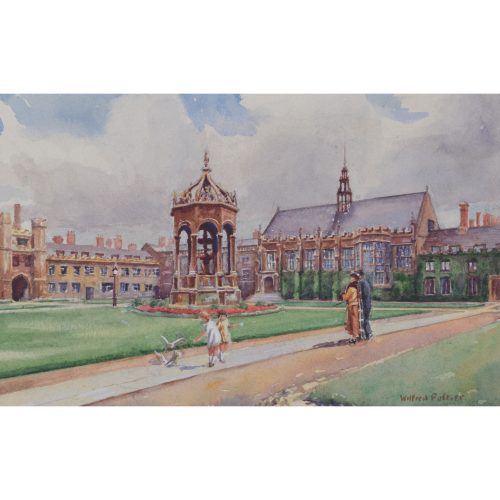
Wilfred Pettitt (1904 - 1978)
Great Court, Trinity College, Cambridge
Watercolour 17 x 27 cm A smartly-dressed couple and their two children enjoy the sunny and immaculately-lawned Great Court of Trinity College, Cambridge. The man and woman admire the ornate fountain which stands sentinel in the middle of the court (it, along with the rest of Great Court, was erected by by Thomas Nevile, master of the college in the early 17th century). Their children, perhaps oblivious to the architectural majesty around them, amuse themselves by playing with the pigeons. Wilfred Stanley Pettitt was born in Great Yarmouth, and studied at the Great Yarmouth School of Art and the Norwich School of Art. In 1928 he showed at the Royal Academy Royal Academy for the first time, and his work was also exhibited by the Royal Society of British Artists and the Royal Cambrian Academy. In 1944 Pettitt became one of the founding members of the Norwich Twenty Group (a group of Norfolk artists who intended to raise the standards of local professional art). He died in Eastbourne in 1978. Condition: mounted to board; otherwise very good. If you are interested, please email info@manningfineart.co.uk or call us on 07929 749056. Click here for other views of Trinity College, Cambridge. -
Out of stock
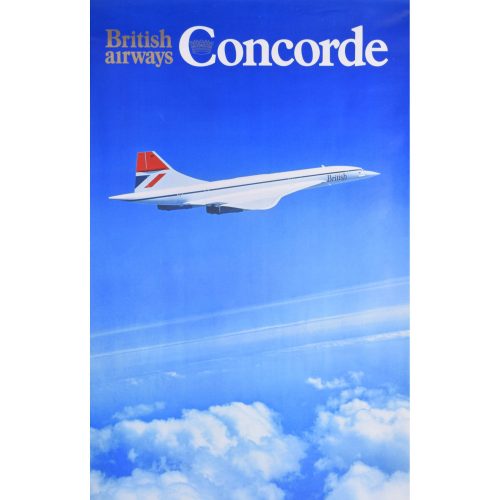
Concorde
Original vintage poster 102 x 64 cm A striking poster advertising the glamorous Concorde aircraft for British Airways. Concorde entered service in 1976 with Air France from Paris-Roissy and British Airways from London Heathrow. Condition: very good. If you are interested, please email info@manningfineart.co.uk or call us on 07929 749056. -
Out of stock
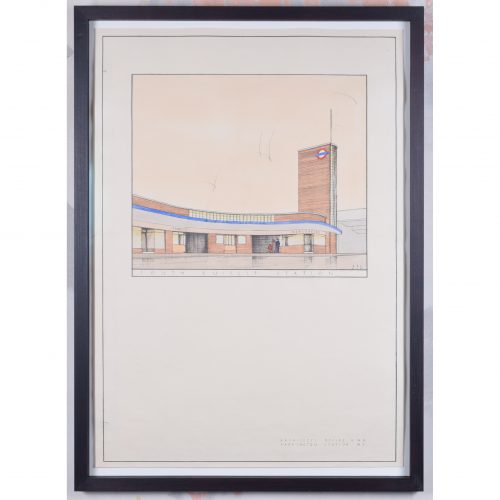
Brian Bannatyne Lewis (1906 - 1991)
South Ruislip Station (1938)
Pen, ink and watercolour 70 x 50 cm Initialled and dated 8 3 38. A 1938 design for the new South Ruislip tube station, commissioned by the Great Western Railway (GWR) for its proposed western extension to the Central Line. The design's Art Deco lettering befits London Transport's aesthetic in the 1930s. Lewis brings his designs to life by including smartly-dressed characters entering and leaving the stations. The Central line opened in 1900, between Shepherd's Bush and Bank; it extended westwards to Ealing Broadway in 1920. Two years after the formation of London Transport in 1933, an extensive New Works Programme began, proposing a westwards extension of the line to Denham. Brian Lewis created designs for nine stations in early 1938, but the Second World War broke out before they could be built. By the time the extension had been built, Lewis was no longer chief architect of the GWR - the stations were modified and completed by Frederick Francis Charles Curtis instead. The extension to Greenford opened in 1947 and finally reached West Ruislip in 1948. Denham never actually became part of the tube line, owing to the establishment of the green belt. Brian Lewis was born in Tasmania, attended school in Melbourne, and subsequently obtained a Diploma in Architecture in 1928 from the University of Melbourne. He then moved to the UK to study at the Liverpool School of Architecture, winning scholarships in each of his three years of study to fund extensive European travel. He married a fellow Liverpool architectural student, Hilary Archer. After moving to London, he took up employment with the GWR in their architects’ office; he also lectured at a local polytechnic, and moonlighted with his wife at home on mainly residential commissions – rather different projects from the hotels and stations which GWR commissioned from him. He exhibited frequently at the Royal Academy of Arts, showing superb measured drawings of historic buildings. In the Second World War he enlisted with the Second Imperial Australian Force, serving in the Middle East, then transferred to the Royal Australian Engineers where he became a Captain. In 1943 he was sent to London to help GWR repair bomb damage. Lewis became Chief Architect of GWR in 1945 (following the retirement of the noted Percy Emerson Culverhouse), and the first Chair of Architecture at Melbourne University in 1947. He also became the consulting architect for the major buildings of the Australian National University in Canberra, producing an imaginative site plan and designing University House, which was awarded the Sulman medal in 1954. He also designed the Risdon Prison Complex in 1960. He retired in 1971 to paint watercolours and write his memoirs. Condition: generally very good; a few handling marks and two holes from filing. Handsomely framed. If you are interested, please email info@manningfineart.co.uk or call us on 07929 749056. Click here to view the other station designs in the set. -
Out of stock
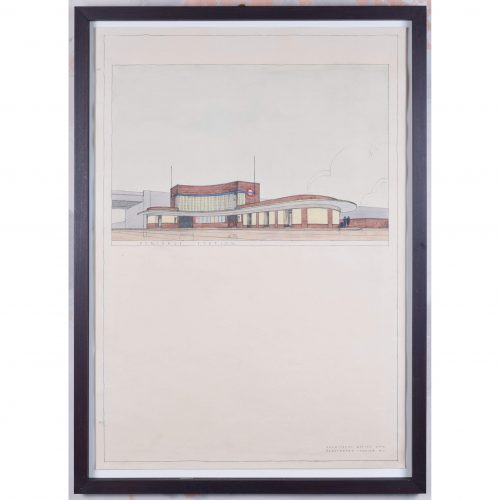
Brian Bannatyne Lewis (1906 - 1991)
Perivale Station (1938)
Pen, ink and watercolour 70 x 50 cm A 1938 design for the new Perivale tube station, commissioned by the Great Western Railway (GWR) for its proposed western extension to the Central Line. The design's Art Deco lettering befits London Transport's aesthetic in the 1930s. Lewis brings his designs to life by including smartly-dressed characters entering and leaving the stations. The Central line opened in 1900, between Shepherd's Bush and Bank; it extended westwards to Ealing Broadway in 1920. Two years after the formation of London Transport in 1933, an extensive New Works Programme began, proposing a westwards extension of the line to Denham. Brian Lewis created designs for nine stations in early 1938, but the Second World War broke out before they could be built. By the time the extension had been built, Lewis was no longer chief architect of the GWR - the stations were modified and completed by Frederick Francis Charles Curtis instead. The extension to Greenford opened in 1947 and finally reached West Ruislip in 1948. Denham never actually became part of the tube line, owing to the establishment of the green belt. Brian Lewis was born in Tasmania, attended school in Melbourne, and subsequently obtained a Diploma in Architecture in 1928 from the University of Melbourne. He then moved to the UK to study at the Liverpool School of Architecture, winning scholarships in each of his three years of study to fund extensive European travel. He married a fellow Liverpool architectural student, Hilary Archer. After moving to London, he took up employment with the GWR in their architects’ office; he also lectured at a local polytechnic, and moonlighted with his wife at home on mainly residential commissions – rather different projects from the hotels and stations which GWR commissioned from him. He exhibited frequently at the Royal Academy of Arts, showing superb measured drawings of historic buildings. In the Second World War he enlisted with the Second Imperial Australian Force, serving in the Middle East, then transferred to the Royal Australian Engineers where he became a Captain. In 1943 he was sent to London to help GWR repair bomb damage. Lewis became Chief Architect of GWR in 1945 (following the retirement of the noted Percy Emerson Culverhouse), and the first Chair of Architecture at Melbourne University in 1947. He also became the consulting architect for the major buildings of the Australian National University in Canberra, producing an imaginative site plan and designing University House, which was awarded the Sulman medal in 1954. He also designed the Risdon Prison Complex in 1960. He retired in 1971 to paint watercolours and write his memoirs. Condition: generally very good; a few handling marks and two holes from filing. Handsomely framed. If you are interested, please email info@manningfineart.co.uk or call us on 07929 749056. Click here to view the other station designs in the set. -
Out of stock
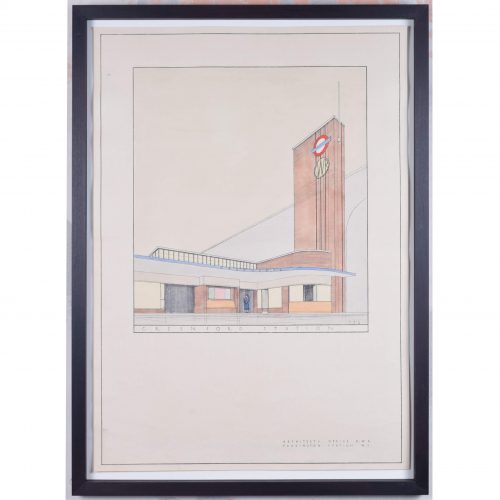
Brian Bannatyne Lewis (1906 - 1991)
Greenford Station (1938)
Pen, ink and watercolour 70 x 50 cm Initialled and dated 7 3 38. A 1938 design for the new Greenford tube station, commissioned by the Great Western Railway (GWR) for its proposed western extension to the Central Line. The design's Art Deco lettering befits London Transport's aesthetic in the 1930s. Lewis brings his designs to life by including smartly-dressed characters entering and leaving the stations. The Central line opened in 1900, between Shepherd's Bush and Bank; it extended westwards to Ealing Broadway in 1920. Two years after the formation of London Transport in 1933, an extensive New Works Programme began, proposing a westwards extension of the line to Denham. Brian Lewis created designs for nine stations in early 1938, but the Second World War broke out before they could be built. By the time the extension had been built, Lewis was no longer chief architect of the GWR - the stations were modified and completed by Frederick Francis Charles Curtis instead. The extension to Greenford opened in 1947 and finally reached West Ruislip in 1948. Denham never actually became part of the tube line, owing to the establishment of the green belt. Brian Lewis was born in Tasmania, attended school in Melbourne, and subsequently obtained a Diploma in Architecture in 1928 from the University of Melbourne. He then moved to the UK to study at the Liverpool School of Architecture, winning scholarships in each of his three years of study to fund extensive European travel. He married a fellow Liverpool architectural student, Hilary Archer. After moving to London, he took up employment with the GWR in their architects’ office; he also lectured at a local polytechnic, and moonlighted with his wife at home on mainly residential commissions – rather different projects from the hotels and stations which GWR commissioned from him. He exhibited frequently at the Royal Academy of Arts, showing superb measured drawings of historic buildings. In the Second World War he enlisted with the Second Imperial Australian Force, serving in the Middle East, then transferred to the Royal Australian Engineers where he became a Captain. In 1943 he was sent to London to help GWR repair bomb damage. Lewis became Chief Architect of GWR in 1945 (following the retirement of the noted Percy Emerson Culverhouse), and the first Chair of Architecture at Melbourne University in 1947. He also became the consulting architect for the major buildings of the Australian National University in Canberra, producing an imaginative site plan and designing University House, which was awarded the Sulman medal in 1954. He also designed the Risdon Prison Complex in 1960. He retired in 1971 to paint watercolours and write his memoirs. Condition: generally very good; a few handling marks and two holes from filing. Handsomely framed. If you are interested, please email info@manningfineart.co.uk or call us on 07929 749056. Click here to view the other station designs in the set. -
Out of stock
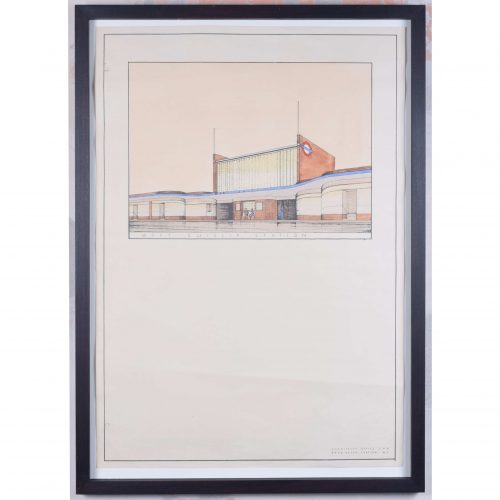
Brian Bannatyne Lewis (1906 - 1991)
West Ruislip Station (1938)
Pen, ink and watercolour 70 x 50 cm A 1938 design for the new West Ruislip tube station, commissioned by the Great Western Railway (GWR) for its proposed western extension to the Central Line. The design's Art Deco lettering befits London Transport's aesthetic in the 1930s. Lewis brings his designs to life by including smartly-dressed characters entering and leaving the stations. The Central line opened in 1900, between Shepherd's Bush and Bank; it extended westwards to Ealing Broadway in 1920. Two years after the formation of London Transport in 1933, an extensive New Works Programme began, proposing a westwards extension of the line to Denham. Brian Lewis created designs for nine stations in early 1938, but the Second World War broke out before they could be built. By the time the extension had been built, Lewis was no longer chief architect of the GWR - the stations were modified and completed by Frederick Francis Charles Curtis instead. The extension to Greenford opened in 1947 and finally reached West Ruislip in 1948. Denham never actually became part of the tube line, owing to the establishment of the green belt. Brian Lewis was born in Tasmania, attended school in Melbourne, and subsequently obtained a Diploma in Architecture in 1928 from the University of Melbourne. He then moved to the UK to study at the Liverpool School of Architecture, winning scholarships in each of his three years of study to fund extensive European travel. He married a fellow Liverpool architectural student, Hilary Archer. After moving to London, he took up employment with the GWR in their architects’ office; he also lectured at a local polytechnic, and moonlighted with his wife at home on mainly residential commissions – rather different projects from the hotels and stations which GWR commissioned from him. He exhibited frequently at the Royal Academy of Arts, showing superb measured drawings of historic buildings. In the Second World War he enlisted with the Second Imperial Australian Force, serving in the Middle East, then transferred to the Royal Australian Engineers where he became a Captain. In 1943 he was sent to London to help GWR repair bomb damage. Lewis became Chief Architect of GWR in 1945 (following the retirement of the noted Percy Emerson Culverhouse), and the first Chair of Architecture at Melbourne University in 1947. He also became the consulting architect for the major buildings of the Australian National University in Canberra, producing an imaginative site plan and designing University House, which was awarded the Sulman medal in 1954. He also designed the Risdon Prison Complex in 1960. He retired in 1971 to paint watercolours and write his memoirs. Condition: generally very good; a few handling marks and two holes from filing. Handsomely framed. If you are interested, please email info@manningfineart.co.uk or call us on 07929 749056. Click here to view the other station designs in the set. -
Out of stock
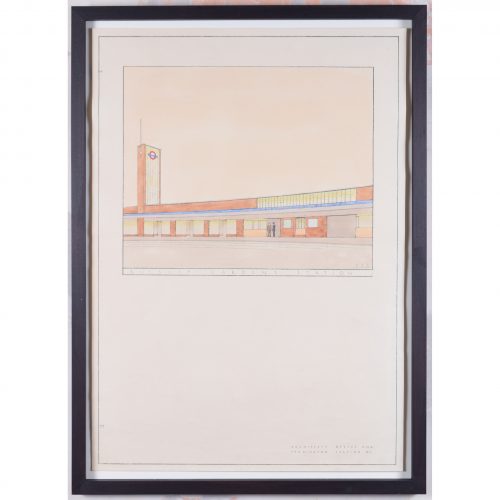
Brian Bannatyne Lewis (1906 - 1991)
Ruislip Gardens Station (1938)
Pen, ink and watercolour 70 x 50 cm Initialled and dated 4 3 38. A 1938 design for the new Ruislip Gardens tube station, commissioned by the Great Western Railway (GWR) for its proposed western extension to the Central Line. The design's Art Deco lettering befits London Transport's aesthetic in the 1930s. Lewis brings his designs to life by including smartly-dressed characters entering and leaving the stations. Ruislip Gardens Station, when built, did not adhere to this design. The Central line opened in 1900, between Shepherd's Bush and Bank; it extended westwards to Ealing Broadway in 1920. Two years after the formation of London Transport in 1933, an extensive New Works Programme began, proposing a westwards extension of the line to Denham. Brian Lewis created designs for nine stations in early 1938, but the Second World War broke out before they could be built. By the time the extension had been built, Lewis was no longer chief architect of the GWR - the stations were modified and completed by Frederick Francis Charles Curtis instead. The extension to Greenford opened in 1947 and finally reached West Ruislip in 1948. Denham never actually became part of the tube line, owing to the establishment of the green belt. Brian Lewis was born in Tasmania, attended school in Melbourne, and subsequently obtained a Diploma in Architecture in 1928 from the University of Melbourne. He then moved to the UK to study at the Liverpool School of Architecture, winning scholarships in each of his three years of study to fund extensive European travel. He married a fellow Liverpool architectural student, Hilary Archer. After moving to London, he took up employment with the GWR in their architects’ office; he also lectured at a local polytechnic, and moonlighted with his wife at home on mainly residential commissions – rather different projects from the hotels and stations which GWR commissioned from him. He exhibited frequently at the Royal Academy of Arts, showing superb measured drawings of historic buildings. In the Second World War he enlisted with the Second Imperial Australian Force, serving in the Middle East, then transferred to the Royal Australian Engineers where he became a Captain. In 1943 he was sent to London to help GWR repair bomb damage. Lewis became Chief Architect of GWR in 1945 (following the retirement of the noted Percy Emerson Culverhouse), and the first Chair of Architecture at Melbourne University in 1947. He also became the consulting architect for the major buildings of the Australian National University in Canberra, producing an imaginative site plan and designing University House, which was awarded the Sulman medal in 1954. He also designed the Risdon Prison Complex in 1960. He retired in 1971 to paint watercolours and write his memoirs. Condition: generally very good; a few handling marks and two holes from filing. Handsomely framed. If you are interested, please email info@manningfineart.co.uk or call us on 07929 749056. Click here to view the other station designs in the set. -
Out of stock
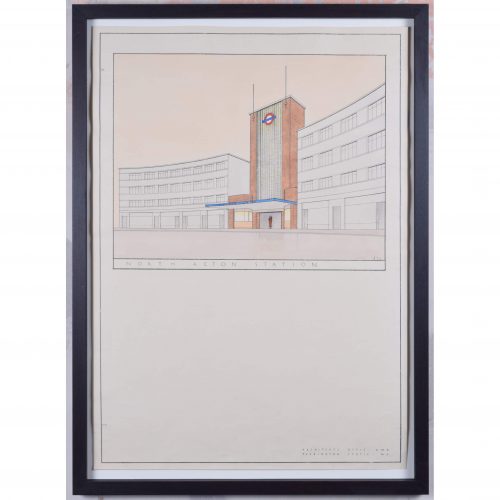
Brian Bannatyne Lewis (1906 - 1991)
North Acton Station (1938)
Pen, ink and watercolour 70 x 50 cm Initialled and dated 26 2 38. A 1938 design for the new North Acton tube station, commissioned by the Great Western Railway (GWR) for its proposed western extension to the Central Line. The design's Art Deco lettering befits London Transport's aesthetic in the 1930s. Lewis brings his designs to life by including smartly-dressed characters entering and leaving the stations. The Central line opened in 1900, between Shepherd's Bush and Bank; it extended westwards to Ealing Broadway in 1920. Two years after the formation of London Transport in 1933, an extensive New Works Programme began, proposing a westwards extension of the line to Denham. Brian Lewis created designs for nine stations in early 1938, but the Second World War broke out before they could be built. By the time the extension had been built, Lewis was no longer chief architect of the GWR - the stations were modified and completed by Frederick Francis Charles Curtis instead. The extension to Greenford opened in 1947 and finally reached West Ruislip in 1948. Denham never actually became part of the tube line, owing to the establishment of the green belt. Brian Lewis was born in Tasmania, attended school in Melbourne, and subsequently obtained a Diploma in Architecture in 1928 from the University of Melbourne. He then moved to the UK to study at the Liverpool School of Architecture, winning scholarships in each of his three years of study to fund extensive European travel. He married a fellow Liverpool architectural student, Hilary Archer. After moving to London, he took up employment with the GWR in their architects’ office; he also lectured at a local polytechnic, and moonlighted with his wife at home on mainly residential commissions – rather different projects from the hotels and stations which GWR commissioned from him. He exhibited frequently at the Royal Academy of Arts, showing superb measured drawings of historic buildings. In the Second World War he enlisted with the Second Imperial Australian Force, serving in the Middle East, then transferred to the Royal Australian Engineers where he became a Captain. In 1943 he was sent to London to help GWR repair bomb damage. Lewis became Chief Architect of GWR in 1945 (following the retirement of the noted Percy Emerson Culverhouse), and the first Chair of Architecture at Melbourne University in 1947. He also became the consulting architect for the major buildings of the Australian National University in Canberra, producing an imaginative site plan and designing University House, which was awarded the Sulman medal in 1954. He also designed the Risdon Prison Complex in 1960. He retired in 1971 to paint watercolours and write his memoirs. Condition: generally very good; a few handling marks and two holes from filing. Handsomely framed. If you are interested, please email info@manningfineart.co.uk or call us on 07929 749056. Click here to view the other station designs in the set. -
Out of stock
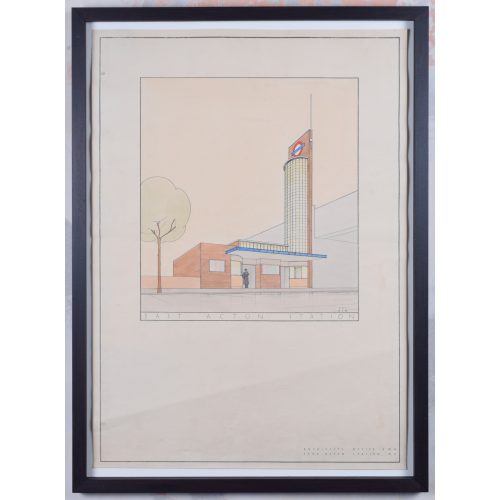
Brian Bannatyne Lewis (1906 - 1991)
East Acton Station (1938)
Pen, ink and watercolour 70 x 50 cm Initialled and dated 28 2 38. A 1938 design for the new East Acton tube station, commissioned by the Great Western Railway (GWR) for its proposed western extension to the Central Line. The design's Art Deco lettering befits London Transport's aesthetic in the 1930s. Lewis brings his designs to life by including smartly-dressed characters entering and leaving the stations. The Central line opened in 1900, between Shepherd's Bush and Bank; it extended westwards to Ealing Broadway in 1920. Two years after the formation of London Transport in 1933, an extensive New Works Programme began, proposing a westwards extension of the line to Denham. Brian Lewis created designs for nine stations in early 1938, but the Second World War broke out before they could be built. By the time the extension had been built, Lewis was no longer chief architect of the GWR - the stations were modified and completed by Frederick Francis Charles Curtis instead. The extension to Greenford opened in 1947 and finally reached West Ruislip in 1948. Denham never actually became part of the tube line, owing to the establishment of the green belt. Brian Lewis was born in Tasmania, attended school in Melbourne, and subsequently obtained a Diploma in Architecture in 1928 from the University of Melbourne. He then moved to the UK to study at the Liverpool School of Architecture, winning scholarships in each of his three years of study to fund extensive European travel. He married a fellow Liverpool architectural student, Hilary Archer. After moving to London, he took up employment with the GWR in their architects’ office; he also lectured at a local polytechnic, and moonlighted with his wife at home on mainly residential commissions – rather different projects from the hotels and stations which GWR commissioned from him. He exhibited frequently at the Royal Academy of Arts, showing superb measured drawings of historic buildings. In the Second World War he enlisted with the Second Imperial Australian Force, serving in the Middle East, then transferred to the Royal Australian Engineers where he became a Captain. In 1943 he was sent to London to help GWR repair bomb damage. Lewis became Chief Architect of GWR in 1945 (following the retirement of the noted Percy Emerson Culverhouse), and the first Chair of Architecture at Melbourne University in 1947. He also became the consulting architect for the major buildings of the Australian National University in Canberra, producing an imaginative site plan and designing University House, which was awarded the Sulman medal in 1954. He also designed the Risdon Prison Complex in 1960. He retired in 1971 to paint watercolours and write his memoirs. Condition: generally very good; a few handling marks and two holes from filing. Handsomely framed. If you are interested, please email info@manningfineart.co.uk or call us on 07929 749056. Click here to view the other station designs in the set. -
Out of stock
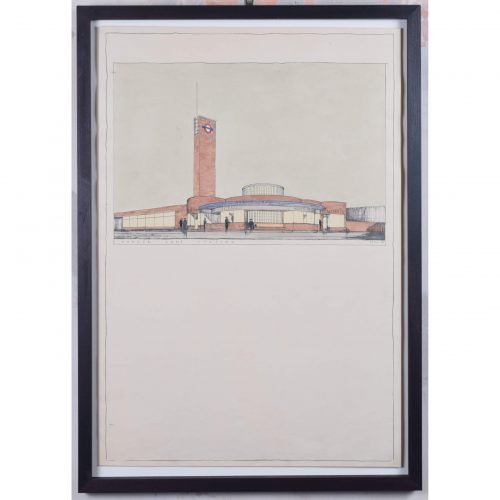
Brian Bannatyne Lewis (1906 - 1991)
Hanger Lane Station (1938)
Pen, ink and watercolour 70 x 50 cm Inscribed 'BB Lewis' lower right. A 1938 design for the new Hanger Lane tube station, commissioned by the Great Western Railway (GWR) for its proposed western extension to the Central Line. The design's Art Deco lettering befits London Transport's aesthetic in the 1930s. Lewis brings his designs to life by including smartly-dressed characters entering and leaving the stations. The Central line opened in 1900, between Shepherd's Bush and Bank; it extended westwards to Ealing Broadway in 1920. Two years after the formation of London Transport in 1933, an extensive New Works Programme began, proposing a westwards extension of the line to Denham. Brian Lewis created designs for nine stations in early 1938, but the Second World War broke out before they could be built. By the time the extension had been built, Lewis was no longer chief architect of the GWR - the stations were modified and completed by Frederick Francis Charles Curtis instead. The extension to Greenford opened in 1947 and finally reached West Ruislip in 1948. Denham never actually became part of the tube line, owing to the establishment of the green belt. Brian Lewis was born in Tasmania, attended school in Melbourne, and subsequently obtained a Diploma in Architecture in 1928 from the University of Melbourne. He then moved to the UK to study at the Liverpool School of Architecture, winning scholarships in each of his three years of study to fund extensive European travel. He married a fellow Liverpool architectural student, Hilary Archer. After moving to London, he took up employment with the GWR in their architects’ office; he also lectured at a local polytechnic, and moonlighted with his wife at home on mainly residential commissions – rather different projects from the hotels and stations which GWR commissioned from him. He exhibited frequently at the Royal Academy of Arts, showing superb measured drawings of historic buildings. In the Second World War he enlisted with the Second Imperial Australian Force, serving in the Middle East, then transferred to the Royal Australian Engineers where he became a Captain. In 1943 he was sent to London to help GWR repair bomb damage. Lewis became Chief Architect of GWR in 1945 (following the retirement of the noted Percy Emerson Culverhouse), and the first Chair of Architecture at Melbourne University in 1947. He also became the consulting architect for the major buildings of the Australian National University in Canberra, producing an imaginative site plan and designing University House, which was awarded the Sulman medal in 1954. He also designed the Risdon Prison Complex in 1960. He retired in 1971 to paint watercolours and write his memoirs. Condition: generally very good; a few handling marks and two holes from filing. Handsomely framed. If you are interested, please email info@manningfineart.co.uk or call us on 07929 749056. Click here to view the other station designs in the set. -
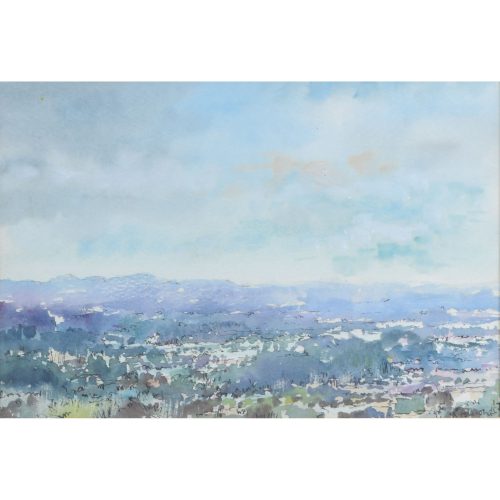
K Edmonds
Countryside Scene
Watercolour 24 x 35 cm Signed lower right. A blue- and green-hued landscape, where earth blends into sky. Condition: very good. If you are interested, please email info@manningfineart.co.uk or call us on 07929 749056. -

John Piper (1903 - 1992)
Radcliffe Camera
Lithograph 53 x 35.5 cm John Piper's view of the Radcliffe Camera in Radcliffe Square. John Piper CH was an English painter, printmaker, and designer of stained-glass windows. His work often focused on the British landscape, especially churches and monuments, and included tapestry designs, book jackets, screen-prints, photography, fabrics and ceramics. Condition: very good. If you are interested, please email info@manningfineart.co.uk or call us on 07929 749056. Click here for other views of Oxford. -
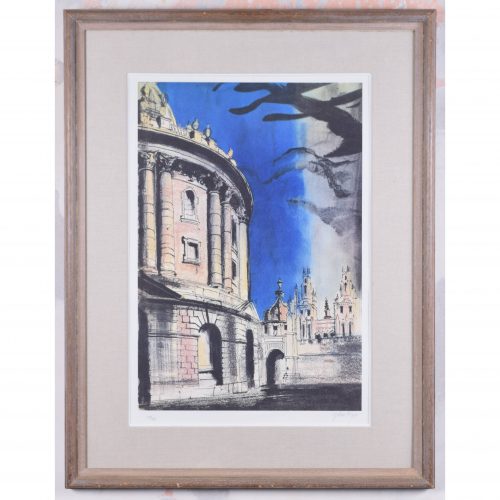
John Piper (1903 - 1992)
Radcliffe Camera
Lithograph 53 x 35.5 cm Numbered 110/1150 lower left and signed lower right in pencil. John Piper's view of the Radcliffe Camera in Radcliffe Square. John Piper CH was an English painter, printmaker, and designer of stained-glass windows. His work often focused on the British landscape, especially churches and monuments, and included tapestry designs, book jackets, screen-prints, photography, fabrics and ceramics. Condition: very good. Attractively framed; frame included for mainland UK shipping only. If you are interested, please email info@manningfineart.co.uk or call us on 07929 749056. Click here for other views of Oxford. -
Out of stock
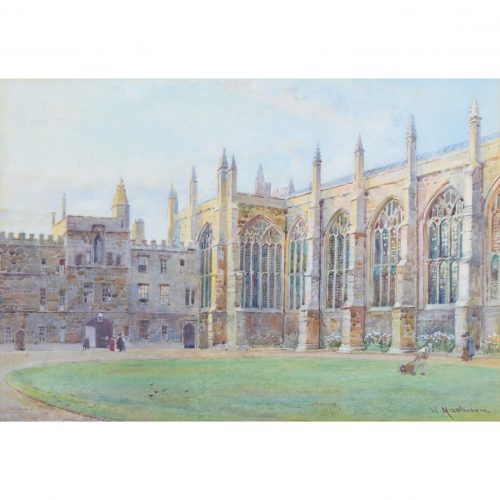
William Matthison (1853-1926)
New College, Oxford: Front Quad
Watercolour 35 x 52 cm Signed lower right. A charming watercolour of New College's Front Quad complete with members of the college in academic dress, wandering birds, and a gardener mowing the grass. William of Wykeham, who founded New College in 1379, was an ambitious builder. His vision for the college was of a Chapel, Hall, Library, and rooms for tutors and students to work and live in, all of which would be built around a quadrangle. This was the first time a college had been set in this way, and it became a model for colleges worldwide. Matthison was born near Birmingham and attended King Edward’s School in the city. He learnt drawing at the Birmingham Central School of Art and then became a pupil of Birmingham artist Edward Watson. He became a professional artist in 1875 and moved to Oxfordshire a few years after; this was where he had the opportunity to produce many of the Oxford views for which he is known today. In 1902 he moved to Park Town in Oxford and was commissioned by Robert Peel to paint more than seventy views of the University of Oxford, which were subsequently made into postcards. Priced at seven for a shilling, they were only available from E Cross of Pembroke Street (a long-since closed business). Raphael Tuck & Sons also commissioned him to produce postcard scenes of Cambridge. Matthison’s views of Oxford were later printed in Fifty Watercolour Drawings of Oxford, published in 1912 by Alden & Co. Condition: generally very good; a few spots to sky. If you are interested, please email info@manningfineart.co.uk or call us on 07929 749056. Click here for other views of New College, Oxford. -
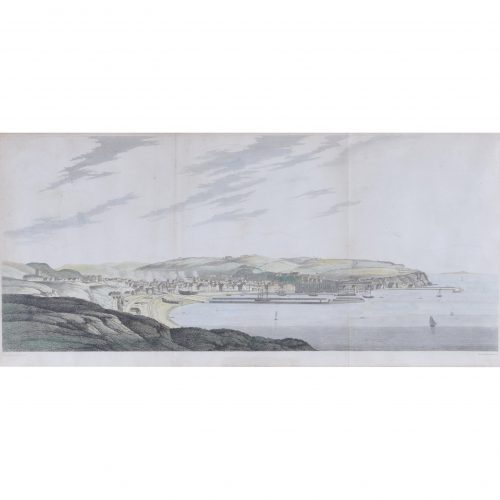
Elizabeth Byrne (1777 - 1849) after Joseph Farington RA (1747 - 1821)
North View of Whitehaven, Cumbria
Hand-coloured engraving 27.5 x 56.5 cm A view of the cliffs and port of Whitehaven in Cumbria. Joseph Farington RA was an 18th-century English landscape painter and diarist. He drew a north and south view of Whitehaven, which were engraved by Elizabeth Byrne in the early 19th century. Byrne was a London-born etcher and landscape painter, who was taught by her father, the etcher William Byrne. She and her father contributed etchings to the 'Magna Britannia' and 'Britannia depicta', books illustrating the most interesting views in various English counties, published by Samuel Lysons in the late 1810s. Condition: good. Two folds and some light age toning. If you are interested, please email info@manningfineart.co.uk or call us on 07929 749056. -
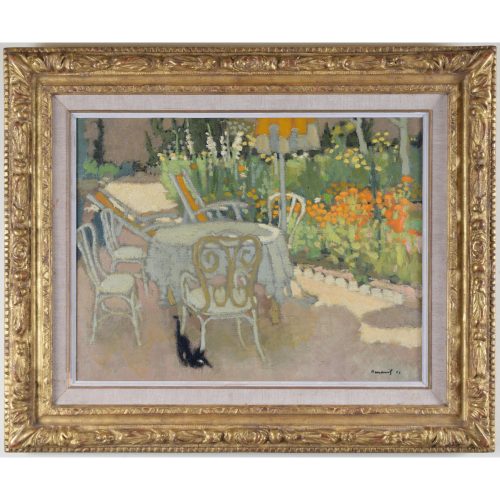
Michel Dureil (1929 - 2011)
La Table du Jardin / Garden Table with a Black Cat
Oil on canvas 35 x 44 cm A black cat stretches beside a typical French table, observed by bright orange flowers. Orange cushions and an orange sun-umbrella complete the scene. Condition: very good. If you are interested, please email info@manningfineart.co.uk or call us on 07929 749056. -
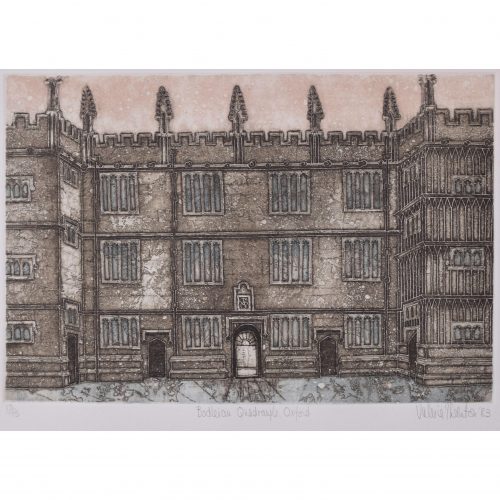
Valerie Thornton (1931-1991)
Bodleian Quadrangle, Oxford (1983)
Etching 24 x 35 cm Numbered 13/75 lower left, titled below, and signed and dated lower right, all in pencil. A very good example of Thornton's recognisable and unusual etching style. Her work is deeply concerned with material, and many of her etchings focus on eroded stone, emotive landscapes, and weathered architecture. Here, Thornton draws out the exceptional texture of the Bodleian Library's local stone. Valerie Thornton was a British etcher and printmaker. She was born in London, but was evacuated to Canada with her two brothers during World War II. She returned to London in 1944 and studied at the Byam Shaw School of Art in 1949. From 1950 to 1953 Thornton studied under P.F. Millard at the Regent Street Polytechnic, then spent eight months at Atelier 17 in Paris. In the early 1960s, she moved to New York and worked at Pratt Graphic Art Centre. In 1955, she succeeded Howard Hodgkin as assistant art teacher at Charterhouse School and in 1965 she became a founding member of the Print Makers Council. In 1970 she became a Fellow of the Royal Society of Painters-Etchers and Engravers. Thornton was a member of The Regent Street Group (a group of nine artists who studied together at the Regent Street Polytechnic in the early 1950s). The group also included Susan Horsfield, Renate Meyer, Michael Lewis, Ken Symonds, Philip Le Bas, and Peter Riches. Thornton's work is included in a number of major public collections including the Victoria and Albert Museum, the British Museum, and the Tate. Thornton died in 1991 in Chelsworth, Suffolk. Condition: generally very good. If you are interested, please email info@manningfineart.co.uk or call us on 07929 749056. Click here for more works by Valerie Thornton. -
Out of stock
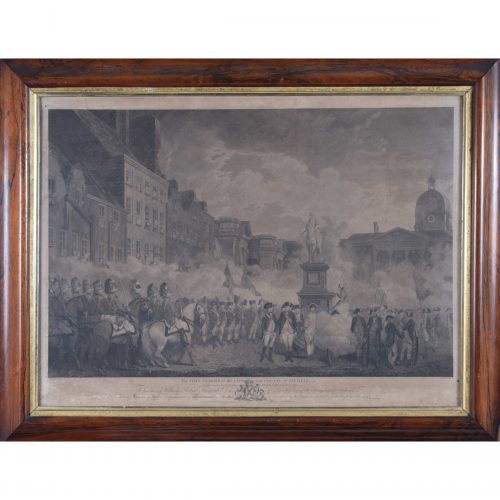
Joseph Collyer (1748 - 1827) after Francis Wheatley (1747 - 1801)
The Volunteers of the City and County of Dublin
Monochrome print 28 x 31 cm A monochrome print depicting Dublin regiments of the Irish Volunteers meeting on College Green. Francis Wheatley depicted the scene in oils in 1779, and Joseph Collyer engraved it in 1781. Wheatley went to Dublin in 1779 and established himself there as a portrait-painter; this view of the Dublin Volunteers became the basis for a best-selling print bought by numerous Irish Patriots. Volunteers were local Irish militias raised by community initiative in Ireland in 1778. Their original purpose was to guard against invasion and to preserve law and order at a time when British soldiers were withdrawn from Ireland to fight abroad during the American Revolutionary War and the government failed to organise its own militia. Taking advantage of Britain's preoccupation with its rebelling American colonies, the Volunteers were able to pressure Westminster into conceding legislative independence to the Dublin parliament. Francis Wheatley was an English portrait and landscape painter who studied at the Royal Academy, and won several prizes from the Society of Arts. He was elected an associate of the Royal Academy in 1790, and an academician in the following year. Joseph Collyer was a British engraver. In 1770 where he exhibited at the Royal Academy for the first time; he was elected an associate engraver of the Royal Academy, and appointed portrait engraver to Queen Charlotte in 1786. Condition: fair. Some browning and staining. In handsome rosewood frame. If you are interested, please email info@manningfineart.co.uk or call us on 07929 749056. -
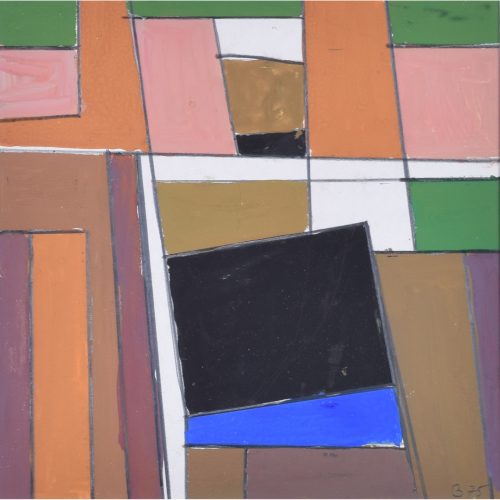
John Barnicoat MA ARCA (1924 - 2013) Harbour (1975)
Tempera on card 26 x 26 cm Initialled B and dated '75. John Barnicoat was a painter of oils and works on paper using tempera, conté, acrylic, pen, and ink. He was brought up in Cornwall and educated at King’s College, Taunton. He joined the Royal Naval Volunteer Reserves and took part in D-Day, aged 29. He went on to read history at Lincoln College, Oxford, and also studied at the Ruskin School of Drawing. He attended the Royal College of Art in the early 1950s, eventually becoming the Senior Tutor at the RCA Painting School between 1976 and 1980. He was the head of Falmouth School of Art 1972 - 1976 and Head of the Chelsea School of Art 1980 - 1989. He wrote 'Posters: a Concise History' in 1972, and organised and curated exhibitions in the UK and Russia on the art of poster design. From 1989 onwards he produced numerous drawings and oils of the bridges of London, women’s heads, acrylic and conté works on paper, and pen and wash drawings of women dressing. His work is represented in both government and private collections, and was recently shown at The Belgrave Gallery, St Ives (2017 - 2022). Provenance: the artist's estate. Condition: generally very good; in hand-finished frame. If you are interested, please email info@manningfineart.co.uk or call us on 07929 749056. Click here for other Modern British original paintings. -
John Piper (1903 - 1992)
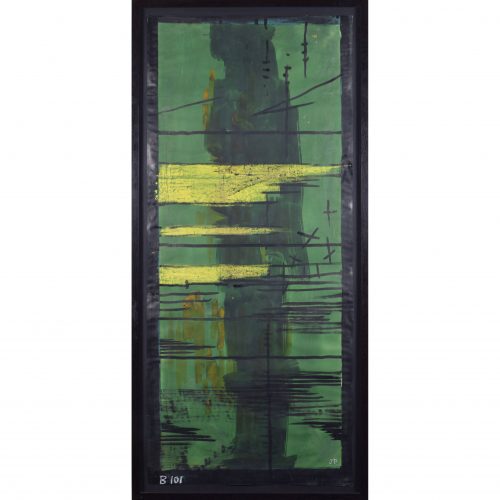
Cartoon for Baptistry Chapel Window, Coventry Cathedral
Gouache and mixed media art 127 x 54 cm Labelled B101 by the artist and initialled. A gouache design for one of the Coventry Cathedral Baptistry Window panels. John Piper was commissioned to design the Baptistry Window in 1955, in partnership with glassmaker Patrick Reyntiens. The window is made of 198 panels of stained glass and is 26 metres high.Piper commented in his book “Stained Glass: Art or Anti-Art?” that ‘The function, the flesh and blood and bones of stained glass – its whole being – is to gratify light and to intensify atmosphere in a room or building, not necessarily to provide colour – or a message.’ The ambiguous post-war tenor of the design is striking: the khaki palette, the soldier-like figure, and the landscape evoking a 20th century theatre of war.
John Piper CH was an English painter, printmaker, and designer of stained-glass windows. His work often focused on the British landscape, especially churches and monuments, and included tapestry designs, book jackets, screen-prints, photography, fabrics and ceramics. Condition: very good. Four pin holes and a small handling mark mid left. If you are interested, please email info@manningfineart.co.uk or call us on 07929 749056. Click here for other works by John Piper. -
after Dorothy Wilding (1893 - 1976)
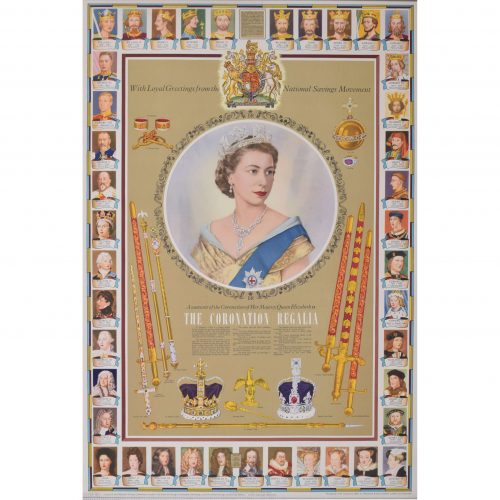
The Coronation Regalia (1953)
Original vintage poster 75 x 50 cm Issued by the National Savings Committee, London, the Scottish Savings Committee, Edinburgh, and the Ulster Savings Committee, Belfast. Crown Copyright Reserved. Printed for H.M. Stationery Office by Waterloo & Sons Limited, London and Dunstable. A fantastic piece of royalist British history. The famous portrait photographer Dorothy Wilding captured Queen Elizabeth II at her Coronation in 1952 - the photograph, used as the centrepiece of this poster, was also used on Britain's postage stamps until 1967. This particular poster was designed to be a Coronation souvenir, and features all the regalia and trappings of the United Kingdom's coronation ceremony, including crown, sword, orb, and sceptres, to name a few. The poster's margins are decorated with portraits of Britain's monarchs past, dating back to William the Conqueror. The National Savings Movement was a government-backed savings movement which began during the First World War to finance the government's wartime deficit. Savings products promoted by the movement typically offered a low level of return but the safety of a government guarantee. Various poster designs were issued by the movement to encourage ordinary people to save - we have several different designs in stock. Condition: generally very good. If you are interested, please email info@manningfineart.co.uk or call us on 07929 749056. Click here for other National Savings posters. -
Ernest Wallcousins (1882-1976)
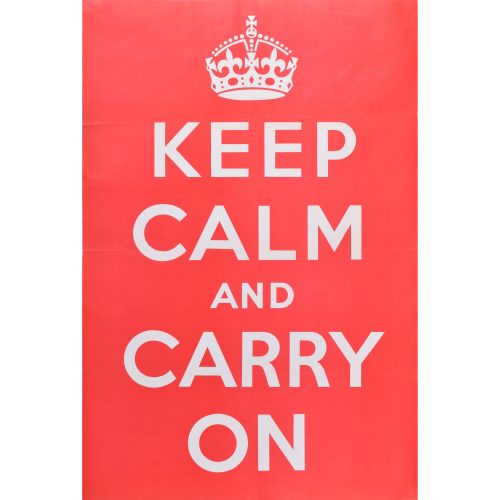
Keep Calm and Carry On
Ministry of Information Original poster, 1939 76 x 50 cm ('Double Crown' size) Very rare - we have traced copies in the Imperial War Museum collection but no other public collection. Scroll down for further information. Condition: A/A- Generally excellent, with three folds and a small crease as visible in photograph and tiny loss to left edge of middle fold. Deliberately not backed this to linen or over-restored as it is important that it does not look like a modern reproduction. If you are interested email info@manningfineart.co.uk or call us on 07929 749056. -
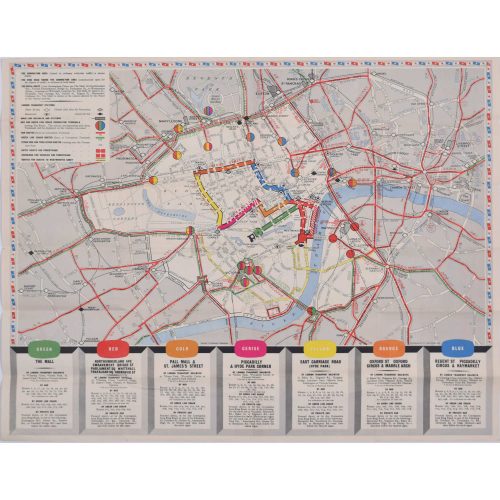
Coronation Arrangements - Map of London (1953)
Lithograph 45 x 60 cm (unfolded) Published by London Transport for the Coronation of Elizabeth II, this delightfully-coloured map illustrates the route taken by the Queen when she was crowned in 1953. Condition: generally very good. If you are interested, please email info@manningfineart.co.uk or call us on 07929 749056. -
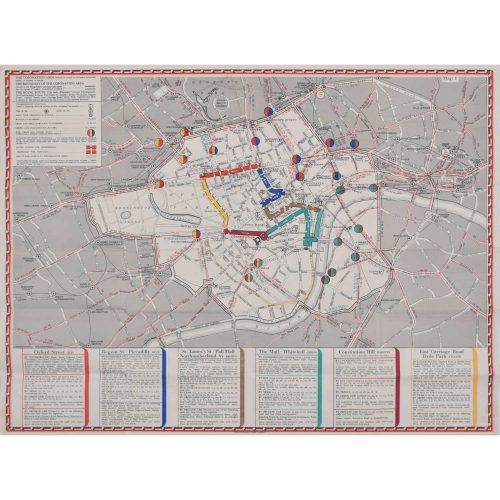
Coronation Arrangements - Map of London (1937)
Lithograph 45 x 60 cm (unfolded) Published by London Transport for the Coronation of George VI, this map illustrates the route the King took in 1936. And best of all, it's just (almost!) as useful in today's London. Condition: generally very good. If you are interested, please email info@manningfineart.co.uk or call us on 07929 749056. -
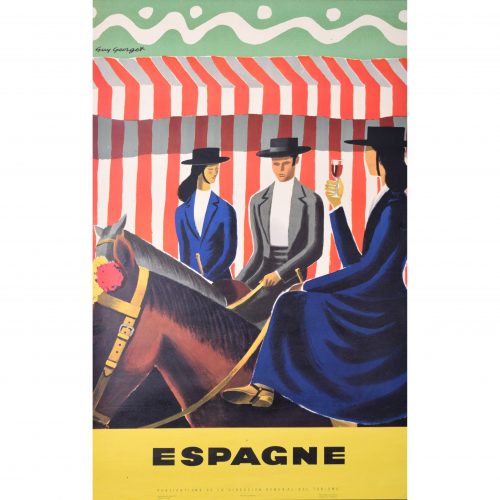
Guy Georget (1911 - 1992)
Espagne - Riders
Original vintage poster 100 x 62 cm One of Georget's fantastic posters designed for the Spanish tourist board. Three riders in traditional dress, with the ladies riding side-saddle, and one with sherry in hand, pose mounted in front of a red and white striped background. The bold, bright colours make the poster typically Georget. Guy Georget was a commercial designer; most of his poster designs were published in the late 1940s. Hired by the tourist boards in their post-war spree of tourism encouragement, Georget designed posters influenced by the styles of Pablo Picasso and Georges Braque. Condition: generally very good; a few tiny repaired edge tears. If you are interested, please email info@manningfineart.co.uk or call us on 07929 749056. Click here for more original vintage travel posters. -
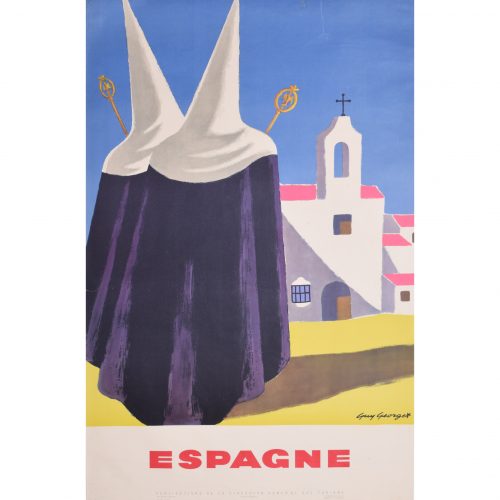
Guy Georget (1911 - 1992)
Espagne - Pilgrims
Original vintage poster 100 x 62 cm One of the fantastic posters Georget designed for the Spanish tourist board. Two pilgrims progress towards a typically Spanish church; Georget makes uses vibrant tones of bright blue, pink, and yellow to illustrate the scene. Guy Georget was a commercial designer; most of his poster designs were published in the late 1940s. Hired by the tourist boards in their post-war spree of tourism encouragement, Georget designed posters influenced by the styles of Pablo Picasso and Georges Braque. Condition: generally very good; a few repaired edge tears including one at the top c. 80mm, one to left side c. 25 mm. If you are interested, please email info@manningfineart.co.uk or call us on 07929 749056. Click here for more original vintage travel posters. -
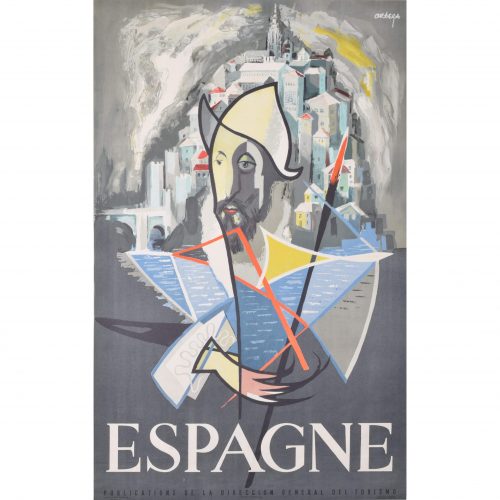
José Ortega (1921 - 1990)
"Don Quixote" Espagne
Original vintage poster c. 1960 99 x 65 cm Printed in Barcelona for the Publications de la Direccion General del Turismo. Ortega's poster is an abstract depiction Don Quixote (the Spanish hero written by Miguel de Cervantes), complete with his distinctive hat and spear. Ortega designed the poster for the Spanish tourist board, using an illustrious figure from Spain's literary heritage to encourage people to visit Spain. José García Ortega was born in Arroba de los Montes and was a member of the Communist Party. He worked as a painter and sculptor, studying at the Círculo de Bellas Artes in Madrid. In 1953 he went to France to study art, funded by a French government scholarship. He returned to Spain throughout the 1950s and 1960s, and became a commercially successful artist. Some of his most famous designs include the posters which the Spanish tourist board commissioned from him circa 1960. Condition: generally very good. If you are interested, please email info@manningfineart.co.uk or call us on 07929 749056. Click here for more original vintage travel posters. -
Out of stock

R C Meaux
Tignes - Ski Artistique (1990)
Original vintage poster 80 x 53 cm An original vintage poster printed in colour in 1990 by L’Avenir Graphic. The poster was designed to promote the 1992 Olympic Winter Games in Albertville. A similar design was also used for a limited edition French postage stamp in 1992. Condition: very good. If you are interested, please email info@manningfineart.co.uk or call us on 07929 749056. Click here for more original vintage ski posters. -
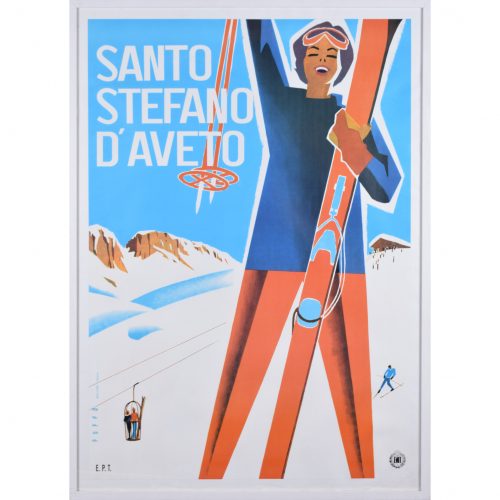
Mario Puppo (1905 - 1977)
Santo Stefano d'Aveto
Original vintage poster 97 x 68 cm Produced circa 1955 for Italian Railways. Mario Puppo's poster advertising the Italian ski resort of Santo Stefano d'Aveto. The figure of a skier reaches upward in triumph; behind her, a vintage ski lift makes its way up the mountain and a blue-clad skier tackles the piste. Mario Puppo was born in Levanto, Italy, and worked in a studio in Chiavari. He designed leaflets advertising skiing and beach resorts, which gained popularity in the 1930s. By the 1940s his poster designs were being featured in the Milan Advertising Graphics show. Throughout the 1940s he designed covers for catalogues, leaflets, playbills, music scores and records, as well as producing more travel posters for public and private Italian companies. Condition: backed to linen; frame included for UK mainland only (excluding Cornwall, Highlands and Islands - where further shipping charges may apply). If you are interested, please email info@manningfineart.co.uk or call us on 07929 749056. Click here for more original vintage posters. -
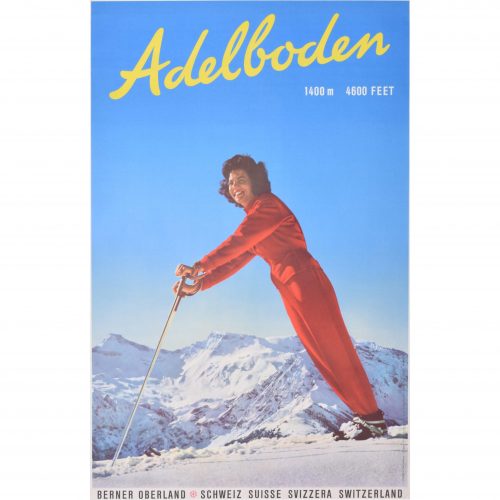
Adelboden
Original vintage poster 104 x 63 cm A fantastic original vintage poster advertising the Swiss ski resort of Adelboden, tucked away in the Bernese Oberland. Printed in Switzerland by Brügger AG. The photograph was taken by the Swiss photographers Emanuel Gyger and Arnold Klopfenstein. The pair were renowned for their captivating skiing images. Condition: generally very good. If you are interested, please email info@manningfineart.co.uk or call us on 07929 749056. Click here for more original vintage skiing posters. -
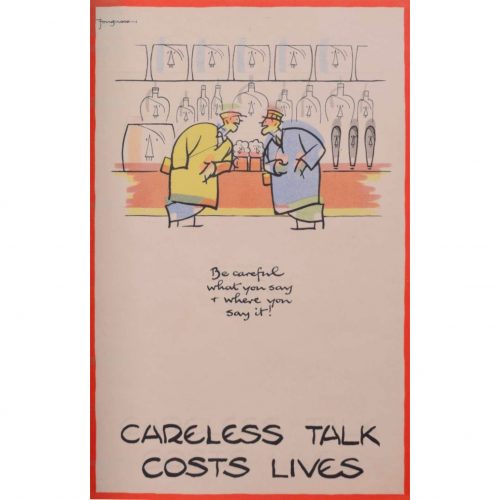
Cyril Kenneth Bird ‘Fougasse’ (1887 - 1965)
Careless Talk Costs Lives (circa 1940)
Lithographic poster 32 x 20 cm (12.5 x 8 in) Version printed on thinner paper. Fougasse was a British cartoonist. He was art editor of Punch between 1937 and 1949, and subsequently editor until 1953. He is best known for his ‘Careless Talk Costs Lives’ series of posters, and the other posters for the Ministry of Information and London Transport. As the Second World War progressed, the Ministry of Information’s poster campaign had become less and less effective. There were posters instructing the population to save old clothes for rags, turn off the lights, save food, dig for victory, watch out for spies, and keep calm and carry on. With this instruction overload, the population had ceased paying attention to the posters. Fougasse noticed this, and offered his services unpaid to the Ministry of Information, with a view to bringing a touch of humour to the posters. His amusing designs with pithy captions, reminiscent of newspaper cartoons, helped to get the Ministry's messages across in a novel way. Fougasse's distinctive poster style, with the red border, was subsequently adopted by other Ministry artists. Condition: if you’d like to know more, please email info@manningfineart.co.uk or call us on 07929 749056. -
Out of stock
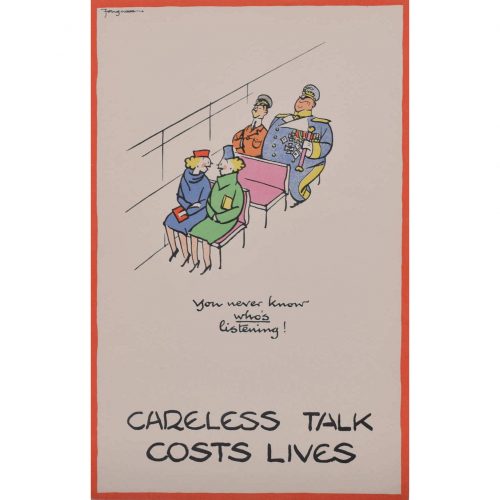
Cyril Kenneth Bird ‘Fougasse’ (1887 - 1965)
Careless Talk Costs Lives (circa 1940)
Lithographic poster 32 x 20 cm (12.5 x 8 in) Version printed on thinner paper. Fougasse was a British cartoonist. He was art editor of Punch between 1937 and 1949, and subsequently editor until 1953. He is best known for his ‘Careless Talk Costs Lives’ series of posters, and the other posters for the Ministry of Information and London Transport. As the Second World War progressed, the Ministry of Information’s poster campaign had become less and less effective. There were posters instructing the population to save old clothes for rags, turn off the lights, save food, dig for victory, watch out for spies, and keep calm and carry on. With this instruction overload, the population had ceased paying attention to the posters. Fougasse noticed this, and offered his services unpaid to the Ministry of Information, with a view to bringing a touch of humour to the posters. His amusing designs with pithy captions, reminiscent of newspaper cartoons, helped to get the Ministry's messages across in a novel way. Fougasse's distinctive poster style, with the red border, was subsequently adopted by other Ministry artists. Condition: if you’d like to know more, please email info@manningfineart.co.uk or call us on 07929 749056. -
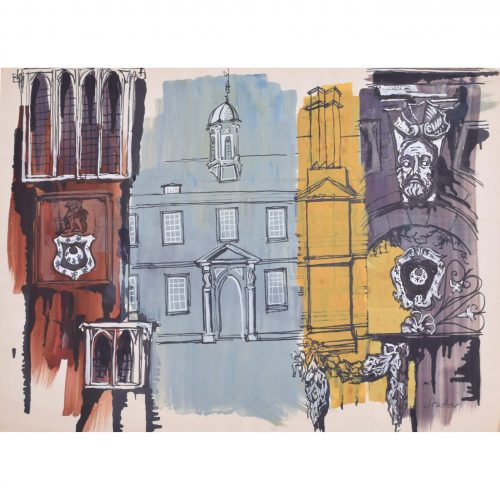
Margaret Souttar (1914 - 1987)
Trinity Hall, Cambridge V
Acrylic paint 56 x 72 cm Signed lower right. Souttar was a Scottish painter and printmaker known for her images of town- and cityscapes. In the early 1960s, she was commissioned to produce a series of prints of the Cambridge colleges. She captures the modernity and optimism of 1960s Cambridge; the fact that a female artist was commissioned to create the prints reflects the changing attitudes of the University towards women. Trinity Hall was one of the first Cambridge colleges to admit women as students – it did not do so until 1976. Provenance: the artist's studio sale. Condition: generally very good. If you are interested, please email info@manningfineart.co.uk or call us on 07929 749056. Click here for other views of Trinity Hall. -
Out of stock
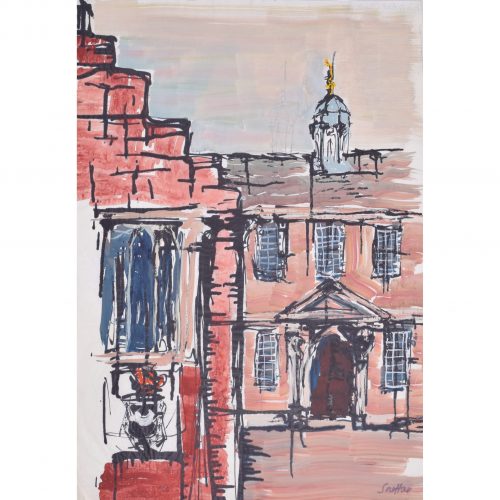
Margaret Souttar (1914 - 1987)
Trinity Hall, Cambridge IV
Acrylic paint 62 x 92 cm Signed lower right. Souttar was a Scottish painter and printmaker known for her images of town- and cityscapes. In the early 1960s, she was commissioned to produce a series of prints of the Cambridge colleges. She captures the modernity and optimism of 1960s Cambridge; the fact that a female artist was commissioned to create the prints reflects the changing attitudes of the University towards women. Trinity Hall was one of the first Cambridge colleges to admit women as students – it did not do so until 1976. Provenance: the artist's studio sale. Condition: generally very good; on thin paper - some crinkling to paper as a result of being painted. Further sketch to reverse. If you are interested, please email info@manningfineart.co.uk or call us on 07929 749056. Click here for other views of Trinity Hall. -
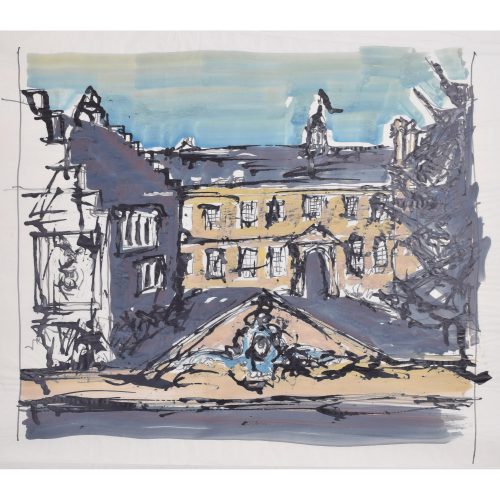
Margaret Souttar (1914 - 1987)
Trinity Hall, Cambridge II
Acrylic paint 56 x 65 cm cm Souttar was a Scottish painter and printmaker known for her town- and cityscapes. In the early 1960s, she was commissioned to produce a series of prints of the Cambridge colleges. She captures the modernity and optimism of 1960s Cambridge; the fact that a female artist was commissioned to create the prints reflects the changing attitudes of the University towards women. Trinity Hall was one of the first Cambridge colleges to admit women as students – it did not do so until 1976.6. Provenance: the artist's studio sale. Condition: generally very good, some crinkling as a result of using water-based paints on thin paper. If you are interested, please email info@manningfineart.co.uk or call us on 07929 749056. Click here for other views of Trinity Hall. -
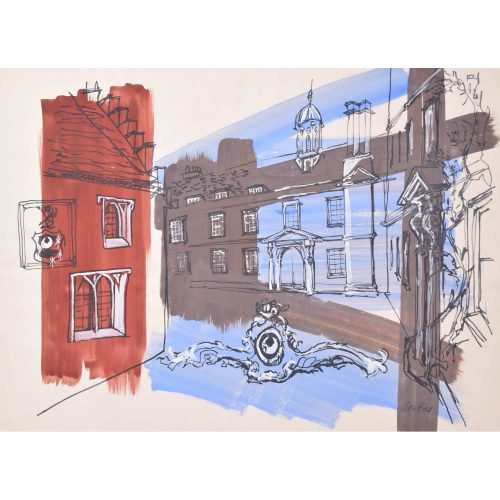
Margaret Souttar (1914 - 1987)
Trinity Hall, Cambridge I
Acrylic paint 55 x 76 cm Signed in pencil lower right. Souttar was a Scottish painter and printmaker known for her images of town- and cityscapes. In the early 1960s, she was commissioned to produce a series of prints of the Cambridge colleges. She captures the modernity and optimism of 1960s Cambridge; the fact that a female artist was commissioned to create the prints reflects the changing attitudes of the University towards women. Trinity Hall was one of the first Cambridge colleges to admit women as students - it did not do so until 1976. Provenance: the artist's studio sale. Condition: generally very good, a few handling marks. If you are interested, please email info@manningfineart.co.uk or call us on 07929 749056. Click here for other views of Trinity Hall. -
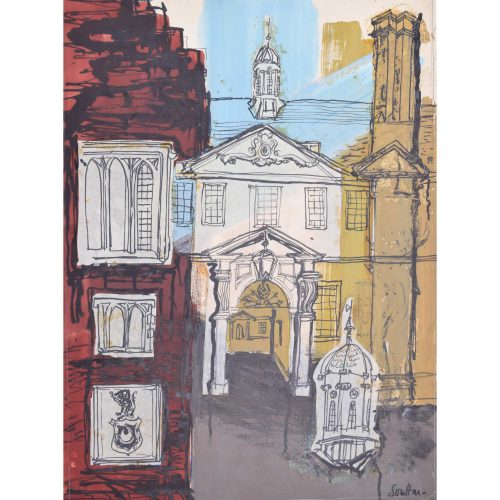
Margaret Souttar (1914-1987)
Trinity Hall, Cambridge
Acrylic on paper 76 x 56 cm Signed lower right. Souttar was a Scottish painter and printmaker known for her images of town- and cityscapes. In the early 1960s, she was commissioned to produce a series of prints of the Cambridge colleges. She captures the modernity and optimism of 1960s Cambridge; the fact that a female artist was commissioned to create the prints reflects the changing attitudes of the University towards women. Trinity Hall was one of the first Cambridge colleges to admit women as students - it did not do so until 1976. Provenance: the artist's studio sale. Condition: generally very good; some small glue stains around collaging. If you are interested, please email info@manningfineart.co.uk or call us on 07929 749056. Click here for other views of Trinity Hall. -
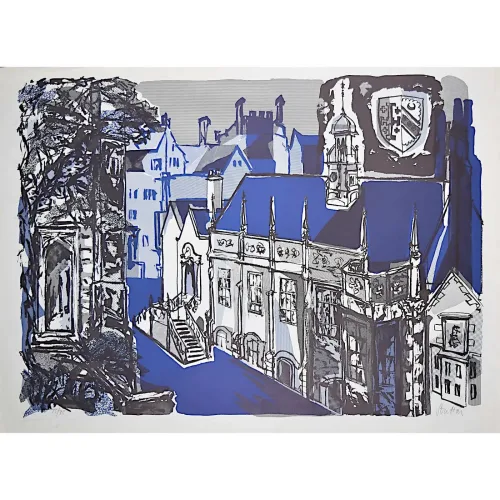
Margaret Souttar (1914 - 1987)
Selwyn College, Cambridge
Lithograph 77 x 56 cm Signed in pencil lower right. Souttar was a Scottish painter and printmaker known for her images of town- and cityscapes. In the early 1960s, she was commissioned to produce a series of prints of the Cambridge colleges. She captures the modernity and optimism of 1960s Cambridge; the fact that a female artist was commissioned to create the prints reflects the changing attitudes of the University towards women. Selwyn College was one of the first Cambridge colleges to admit women as students - it did not do so until 1976. Provenance: the artist's studio sale. Condition: generally very good. If you are interested, please email info@manningfineart.co.uk or call us on 07929 749056. Click here for other views of Selwyn College, Cambridge. -
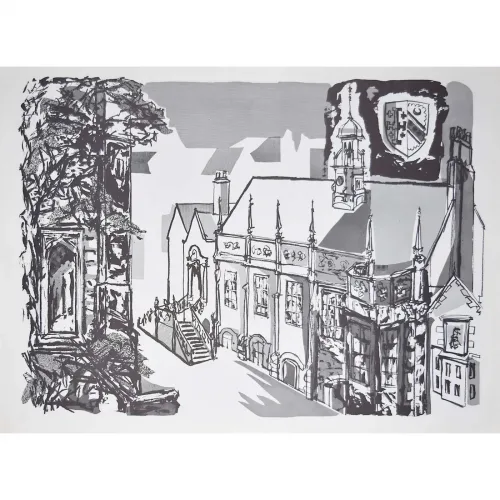
Margaret Souttar (1914 - 1987)
Selwyn College, Cambridge
Lithograph 77 x 56 cm Souttar was a Scottish painter and printmaker known for her images of town- and cityscapes. In the early 1960s, she was commissioned to produce a series of prints of the Cambridge colleges. She captures the modernity and optimism of 1960s Cambridge; the fact that a female artist was commissioned to create the prints reflects the changing attitudes of the University towards women. Selwyn College was one of the first Cambridge colleges to admit women as students - it did not do so until 1976. Provenance: the artist's studio sale. Condition: generally very good. If you are interested, please email info@manningfineart.co.uk or call us on 07929 749056. Click here for other views of Selwyn College, Cambridge. -
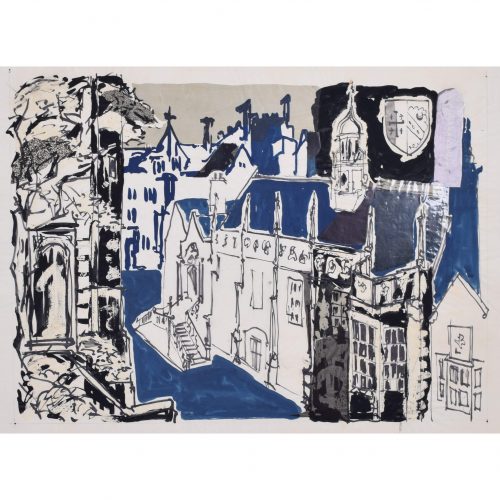
Margaret Souttar (1914 - 1987)
Selwyn College, Cambridge III
Acrylic 51 x 70 cm (image); sheet 67 x 98 cm Inscribed left Selwyn Cambridge '61, with annotations by the artist concerning colour. Souttar was a Scottish painter and printmaker known for her images of town- and cityscapes. In the early 1960s, she was commissioned to produce a series of prints of the Cambridge colleges. She captures the modernity and optimism of 1960s Cambridge; the fact that a female artist was commissioned to create the prints reflects the changing attitudes of the University towards women. These views highlight the layers of history and architectural styles which make up a Cambridge college. Provenance: the artist's studio sale. Condition: generally very good; some crinkling as a result of using water-based paints on thin paper. If you are interested, please email info@manningfineart.co.uk or call us on 07929 749056. Click here for other views of Selwyn College, Cambridge. -
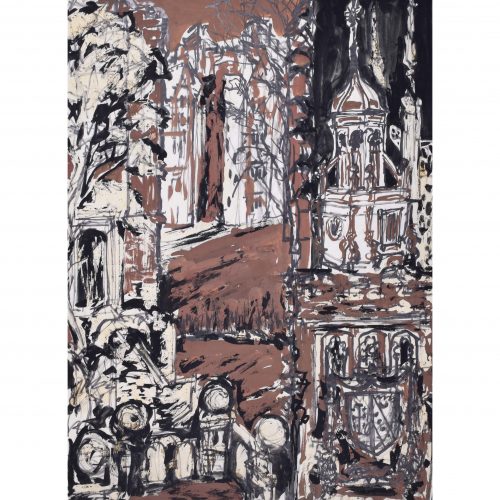
Margaret Souttar (1914 - 1987)
Selwyn College, Cambridge II
Acrylic 71 x 52 cm Souttar was a Scottish painter and printmaker known for her images of town- and cityscapes. In the early 1960s, she was commissioned to produce a series of prints of the Cambridge colleges. She captures the modernity and optimism of 1960s Cambridge; the fact that a female artist was commissioned to create the prints reflects the changing attitudes of the University towards women. These views highlight the layers of history and architectural styles which make up a Cambridge college. Provenance: the artist's studio sale. Condition: generally very good; some crinkling as a result of using water-based paints on thin paper; a little creasing to edges. If you are interested, please email info@manningfineart.co.uk or call us on 07929 749056. Click here for other views of Selwyn College, Cambridge. -
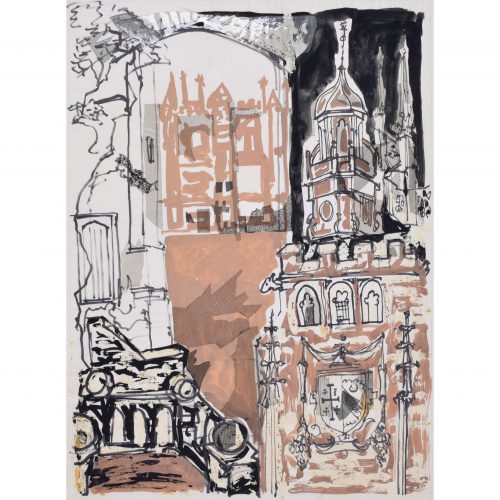
Margaret Souttar (1914 - 1987)
Selwyn College, Cambridge I
Acrylic 70 x 51 cm Souttar was a Scottish painter and printmaker known for her images of town- and cityscapes. In the early 1960s, she was commissioned to produce a series of prints of the Cambridge colleges. She captures the modernity and optimism of 1960s Cambridge; the fact that a female artist was commissioned to create the prints reflects the changing attitudes of the University towards women. These views highlight the layers of history and architectural styles which make up a Cambridge college. Provenance: the artist's studio sale. Condition: generally very good; some crinkling as a result of using water-based paints on thin paper; a little creasing to edges. If you are interested, please email info@manningfineart.co.uk or call us on 07929 749056. Click here for other views of Selwyn College, Cambridge. -
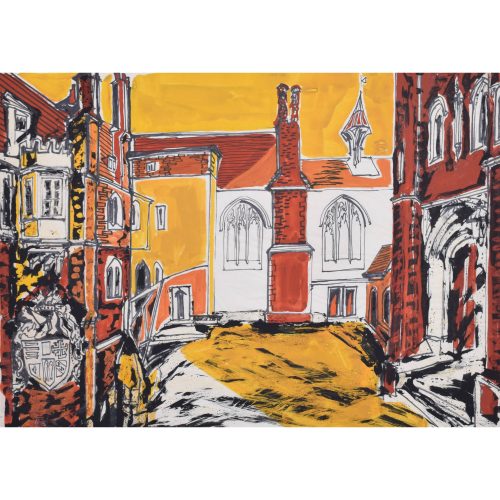
Margaret Souttar (1914 - 1987)
Queens' College, Cambridge II
Acrylic paint 55 x 75 cm Souttar was a Scottish painter and printmaker known for her images of town- and cityscapes. In the early 1960s, she was commissioned to produce a series of prints of the Cambridge colleges. She captures the modernity and optimism of 1960s Cambridge; the fact that a female artist was commissioned to create the prints reflects the changing attitudes of the University towards women. These views highlight the layers of history and architectural styles which make up a Cambridge college. Provenance: the artist's studio sale. Condition: generally very good; some crinkling as a result of using water-based paints on thin paper; slight toning to paper in some areas. If you are interested, please email info@manningfineart.co.uk or call us on 07929 749056. Click here for other views of Queens' College, Cambridge. -
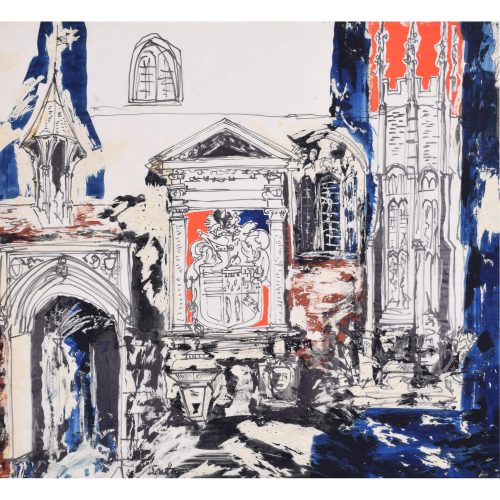
Margaret Souttar (1914 - 1987)
Queens' College, Cambridge I
Acrylic paint 67 x 74 cm Signed below. Souttar was a Scottish painter and printmaker known for her images of town- and cityscapes. In the early 1960s, she was commissioned to produce a series of prints of the Cambridge colleges. She captures the modernity and optimism of 1960s Cambridge; the fact that a female artist was commissioned to create the prints reflects the changing attitudes of the University towards women. These views highlight the layers of history and architectural styles which make up a Cambridge college. Provenance: the artist's studio sale. Condition: generally very good, on thin paper; some crinkling to paper as a result of being painted. Possible slight discolouration around pediment. If you are interested, please email info@manningfineart.co.uk or call us on 07929 749056. Click here for other views of Queens' College, Cambridge. -
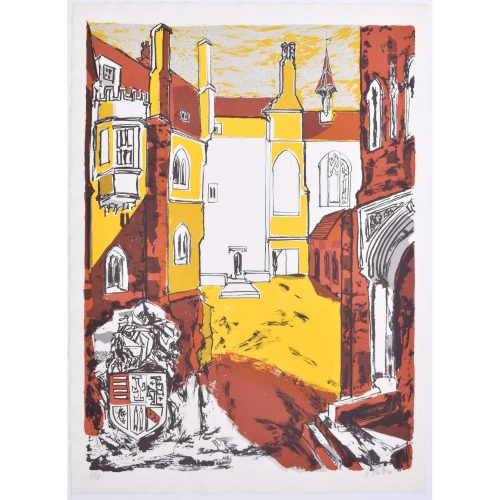
Margaret Souttar (1914 - 1987)
Queens' College, Cambridge
Lithograph 72 x 56 cm Numbered 169/178 lower left, and signed lower right, in pencil. Souttar was a Scottish painter and printmaker known for her images of town- and cityscapes. In the early 1960s, she was commissioned to produce a series of prints of the Cambridge colleges. She captures the modernity and optimism of 1960s Cambridge; the fact that a female artist was commissioned to create the prints reflects the changing attitudes of the University towards women. These views highlight the layers of history and architectural styles which make up a Cambridge college. Provenance: the artist's studio sale. Condition: generally very good. If you are interested, please email info@manningfineart.co.uk or call us on 07929 749056. Click here for other views of Queens' College, Cambridge. -
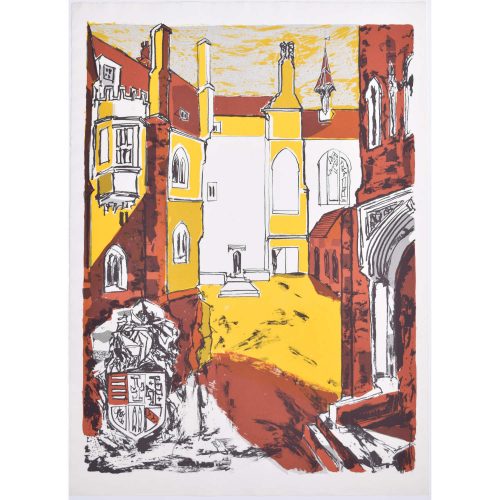
Margaret Souttar (1914 - 1987)
Queens' College, Cambridge
Lithograph 72 x 56 cm Proof print aside from the numbered edition of 178. Souttar was a Scottish painter and printmaker known for her images of town- and cityscapes. In the early 1960s, she was commissioned to produce a series of prints of the Cambridge colleges. She captures the modernity and optimism of 1960s Cambridge; the fact that a female artist was commissioned to create the prints reflects the changing attitudes of the University towards women. These views highlight the layers of history and architectural styles which make up a Cambridge college. Provenance: the artist's studio sale. Condition: generally very good. If you are interested, please email info@manningfineart.co.uk or call us on 07929 749056. Click here for other views of Queens' College, Cambridge. -
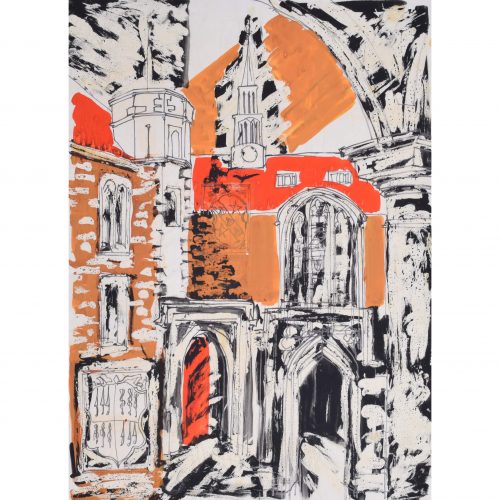
Margaret Souttar (1914 - 1987)
Magdalene College, Cambridge V
Acrylic paint 75 x 55 cm Signed lower left; titled in margin upper left. Souttar was a Scottish painter and printmaker known for her images of town- and cityscapes. In the early 1960s, she was commissioned to produce a series of prints of the Cambridge colleges. She captures the modernity and optimism of 1960s Cambridge; the fact that a female artist was commissioned to create the prints reflects the changing attitudes of the University towards women. These views highlight the layers of history and architectural styles which make up a Cambridge college. Provenance: the artist's studio sale. Condition: generally very good; some crinkling as a result of using water-based paints on thin paper; slight toning to paper in some areas. If you are interested, please email info@manningfineart.co.uk or call us on 07929 749056. Click here for other views of Magdalene College, Cambridge. -
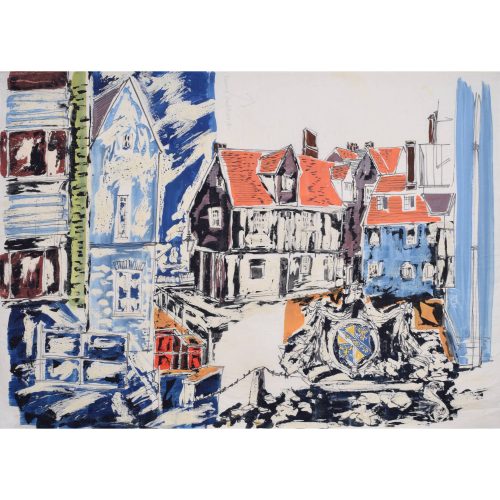
Margaret Souttar (1914 - 1987)
Magdalene College, Cambridge IV
Acrylic paint 70 x 100 cm Signed lower left; titled in margin upper left. Souttar was a Scottish painter and printmaker known for her images of town- and cityscapes. In the early 1960s, she was commissioned to produce a series of prints of the Cambridge colleges. She captures the modernity and optimism of 1960s Cambridge; the fact that a female artist was commissioned to create the prints reflects the changing attitudes of the University towards women. These views highlight the layers of history and architectural styles which make up a Cambridge college. Provenance: the artist's studio sale. Condition: generally very good; some crinkling as a result of using water-based paints on thin paper; a little creasing to edges. If you are interested, please email info@manningfineart.co.uk or call us on 07929 749056. Click here for other views of Magdalene College, Cambridge. -
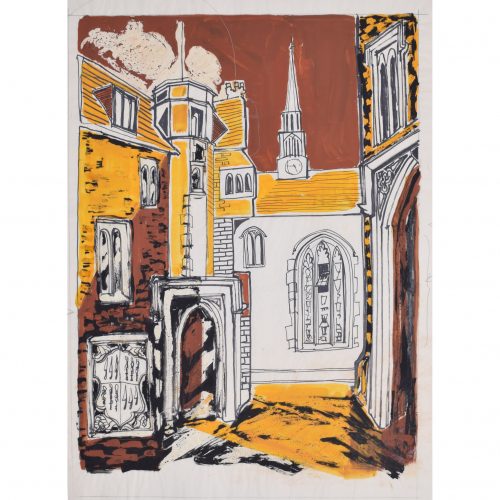
Margaret Souttar (1914 - 1987)
Magdalene College, Cambridge III
Acrylic paint 75 x 55 cm Signed lower left; titled in margin upper left. Souttar was a Scottish painter and printmaker known for her images of town- and cityscapes. In the early 1960s, she was commissioned to produce a series of prints of the Cambridge colleges. She captures the modernity and optimism of 1960s Cambridge; the fact that a female artist was commissioned to create the prints reflects the changing attitudes of the University towards women. These views highlight the layers of history and architectural styles which make up a Cambridge college. Provenance: the artist's studio sale. Condition: generally very good; some crinkling as a result of using water-based paints on thin paper. If you are interested, please email info@manningfineart.co.uk or call us on 07929 749056. Click here for other views of Magdalene College, Cambridge. -
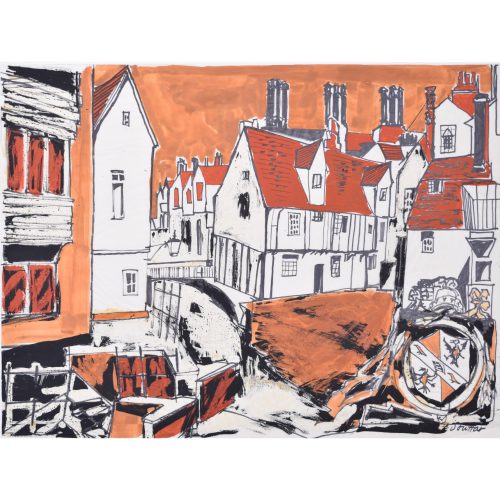
Margaret Souttar (1914 - 1987)
Magdalene College, Cambridge II
Acrylic paint 54 x 72 cm Signed lower right. Souttar was a Scottish painter and printmaker known for her images of town- and cityscapes. In the early 1960s, she was commissioned to produce a series of prints of the Cambridge colleges. She captures the modernity and optimism of 1960s Cambridge; the fact that a female artist was commissioned to create the prints reflects the changing attitudes of the University towards women. These views highlight the layers of history and architectural styles which make up a Cambridge college. Provenance: the artist's studio sale. Condition: generally very good; painted on thin paper which has crinkled as a part of the artist's working technique. If you are interested, please email info@manningfineart.co.uk or call us on 07929 749056. Click here for other views of Magdalene College, Cambridge. -
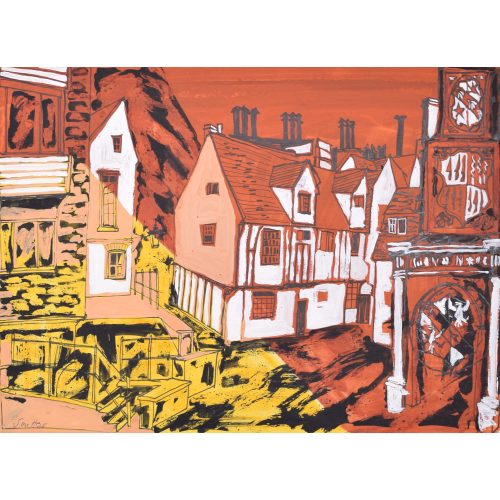
Margaret Souttar (1914 - 1987)
Magdalene College, Cambridge I
Acrylic paint 49 x 66 cm Signed lower left; titled in margin upper left. Souttar was a Scottish painter and printmaker known for her images of town- and cityscapes. In the early 1960s, she was commissioned to produce a series of prints of the Cambridge colleges. She captures the modernity and optimism of 1960s Cambridge; the fact that a female artist was commissioned to create the prints reflects the changing attitudes of the University towards women. These views highlight the layers of history and architectural styles which make up a Cambridge college. Provenance: the artist's studio sale. Condition: generally very good. If you are interested, please email info@manningfineart.co.uk or call us on 07929 749056. Click here for other views of Magdalene College, Cambridge. -
Out of stock
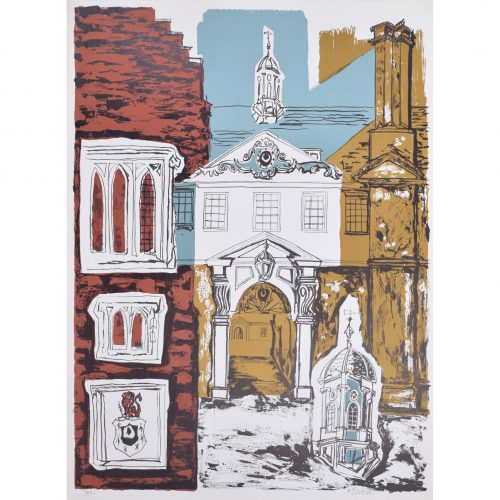
Margaret Souttar (1914 - 1987)
Trinity Hall, Cambridge with Blue Sky
Lithograph 76 x 56 cm Numbered 3/50, and signed lower right, in pencil. Souttar was a Scottish painter and printmaker known for her images of town- and cityscapes. In the early 1960s, she was commissioned to produce a series of prints of the Cambridge colleges. She captures the modernity and optimism of 1960s Cambridge; the fact that a female artist was commissioned to create the prints reflects the changing attitudes of the University towards women. Trinity Hall was one of the first Cambridge colleges to admit women as students - it did not do so until 1976. Provenance: the artist's studio sale. Condition: generally very good, the odd very short tear and handling mark affecting outer few millimetres of margin. If you are interested, please email info@manningfineart.co.uk or call us on 07929 749056. Click here for other views of Trinity Hall. -
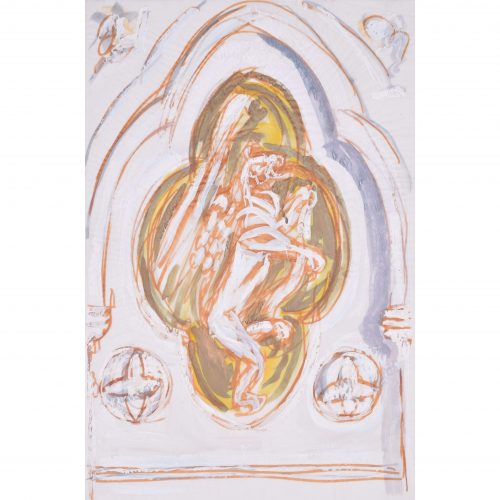
Margaret Souttar (1914 - 1987)
Emmanuel College, Cambridge Lion Rampant (1960)
Acrylic paint 74 x 50 cm Signed and dated lower right. Souttar was a Scottish painter and printmaker known for her images of town- and cityscapes. In the early 1960s, she was commissioned to produce a series of prints of the Cambridge colleges. She captures the modernity and optimism of 1960s Cambridge; the fact that a female artist was commissioned to create the prints reflects the changing attitudes of the University towards women. These views highlight the layers of history and architectural styles which make up a Cambridge college. Provenance: the artist's studio sale. Condition: generally very good; some crinkling as a result of using water-based paints on thin paper. If you are interested, please email info@manningfineart.co.uk or call us on 07929 749056. Click here for other views of Emmanuel College, Cambridge. -
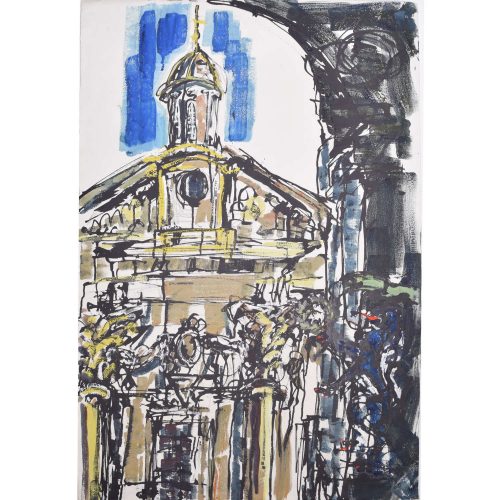
Margaret Souttar (1914 - 1987)
Emmanuel College, Cambridge with Lion Rampant (1960)
Acrylic paint 102 x 69 cm Signed and dated lower right. Souttar was a Scottish painter and printmaker known for her images of town- and cityscapes. In the early 1960s, she was commissioned to produce a series of prints of the Cambridge colleges. She captures the modernity and optimism of 1960s Cambridge; the fact that a female artist was commissioned to create the prints reflects the changing attitudes of the University towards women. These views highlight the layers of history and architectural styles which make up a Cambridge college. Provenance: the artist's studio sale. Condition: generally very good. If you are interested, please email info@manningfineart.co.uk or call us on 07929 749056. Click here for other views of Emmanuel College, Cambridge. -
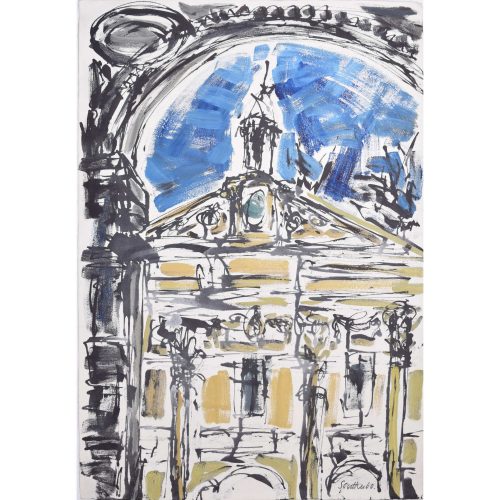
Margaret Souttar (1914 - 1987)
Emmanuel College, Cambridge (1960)
Acrylic paint 102 x 69 cm Signed and dated lower right. Souttar was a Scottish painter and printmaker known for her images of town- and cityscapes. In the early 1960s, she was commissioned to produce a series of prints of the Cambridge colleges. She captures the modernity and optimism of 1960s Cambridge; the fact that a female artist was commissioned to create the prints reflects the changing attitudes of the University towards women. These views highlight the layers of history and architectural styles which make up a Cambridge college. Provenance: the artist's studio sale. Condition: generally very good. If you are interested, please email info@manningfineart.co.uk or call us on 07929 749056. Click here for other views of Emmanuel College, Cambridge. -
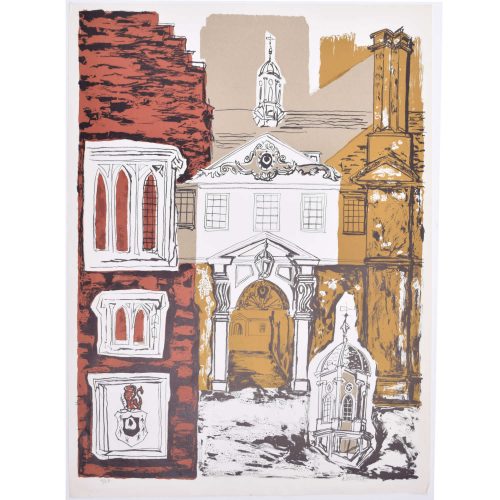
Margaret Souttar (1914 - 1987)
Trinity Hall, Cambridge
Lithograph 76 x 56 cm Signed and numbered 4/50 in pencil. Souttar was a Scottish painter and printmaker known for her images of town- and cityscapes. In the early 1960s, she was commissioned to produce a series of prints of the Cambridge colleges. She captures the modernity and optimism of 1960s Cambridge; the fact that a female artist was commissioned to create the prints reflects the changing attitudes of the University towards women. Trinity Hall was one of the first Cambridge colleges to admit women as students - it did not do so until 1976. Provenance: the artist's studio sale. Condition: generally very good; a few handling marks. If you are interested, please email info@manningfineart.co.uk or call us on 07929 749056. Click here for other views of Trinity Hall. -
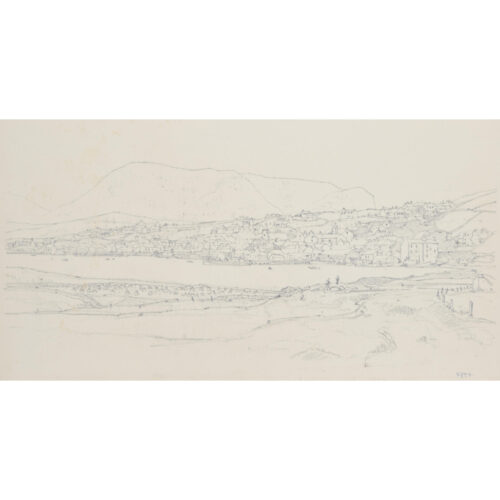
Claude Muncaster (1903 - 1974)
Stromness, Orkney
Pencil drawing 23 x 53 cm A drawing of Stromness, Orkney, with two figures in the foreground. The buildings seem tiny in comparison to the huge cliffs overlooking the town. Claude Grahame Muncaster, RWS ROI RBA SMA was the son of Oliver Hall RA. He was born Grahame Hall (his father was the Royal Academician Oliver Hall, who taught his son to paint from an early age) but adopted the name Claude Muncaster in 1922, hoping to strike out on his own and dissociate his career from that of his father. His career as a landscape painter began when he was fifteen; he spent the 1920s and 30s travelling the world with his sketchbook by boat. Muncaster’s primary choice of subject matter came from a genuine love of the sea. He made several long-distance sea voyages, including one around the Horn as a deckhand in the windjammer Olivebank in 1931, which he described in ‘Rolling Round the Horn’, published in 1933. Armed with a sketchbook, his aim was to be able to ‘paint ships and the sea with greater authority’. This he certainly achieved, perfectly capturing the limpid first light of morning over the Port of Aden, the choppy rain-grey waters of the Bay of Biscay and a streak of sunlight through gathering storm clouds at dusk in Exeter. He became an Associate of the Royal Watercolour Society in 1931 and was a founder member, and later President, of the Royal Society of Marine Artists. When the Second World War broke out, Muncaster joined the Royal Naval Reserves, training as a navigator before going on to advise on the camouflage of ships. He also worked as an official war artist. In ‘Still Morning at Aden’ (1944) he depicts Allied warships in this safe anchorage in the Middle East; the back is stamped with Admiralty approval. In 1946-7 he was commissioned by the Queen to produce watercolours of the royal residences (some of which are available below); the Duke of Edinburgh, in a foreword to a biography of Muncaster, recalls looking at these and considering the artist’s ‘unerring instinct for a subject’, his sense of atmosphere. Other commissions included large panoramas of the Thames and of Bradford. His career also included work as an etcher, illustrator, writer, lecturer and broadcaster, and his paintings can be found in the Royal Academy, Tate, National Maritime Museum Cornwall, National Railway Museum and Royal Air Force Museum. He was a frequent guest at Sandringham for the rest of his life. If you are interested, please email info@manningfineart.co.uk or call us on 07929 749056. Click here for other works by the artist. -
Out of stock
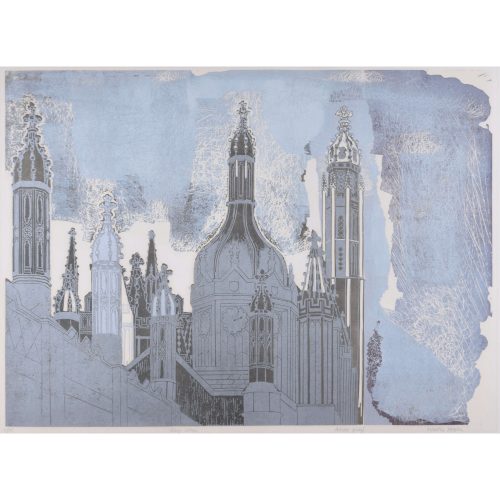
Walter Hoyle (1922 - 2000)
King's College, Cambridge (Cambridge Series 1956 - 66)
Linocut 61 x 80 cm Numbered 37/75 lower left, titled below, marked as artist's proof, and signed lower right, all in pencil. A blue- and grey-hued linocut of King's. A version of this print, owned by the Government Art Collection, hangs in the British Embassy in Tunis. Hoyle trained at Beckenham School of Art and the Royal College of Art. At the latter he was strongly influenced by Edward Bawden, one of Britain’s greatest linocut printers. Bawden had been commissioned by the 1951 Festival of Britain to produce a mural for the South Bank, and chose Hoyle to assist on account of his great talent. Hoyle moved to Great Bardfield in Essex, becoming a part of the Great Bardfield group of artists; diverse in style, they created figurative work, in stark contrast to the abstract art of the St Ives artists at the opposite end of the country. Hoyle taught at St Martin’s School of Art from 1951-60, the Central School of Arts and Crafts from 1960-64, and the Cambridge School of Art from 1964-1985, during which time he launched Cambridge Print Editions. His work is held in the collections of the Tate Gallery, the Victoria and Albert Museum, The British Museum, Kettle’s Garden and the Fry Art Gallery. Provenance: ex the Arthur Andersen collection. Condition: generally very good; some gentle and even age toning to paper. If you are interested, please email info@manningfineart.co.uk or call us on 07929 749056. Click here for other views of King's College, Cambridge. -
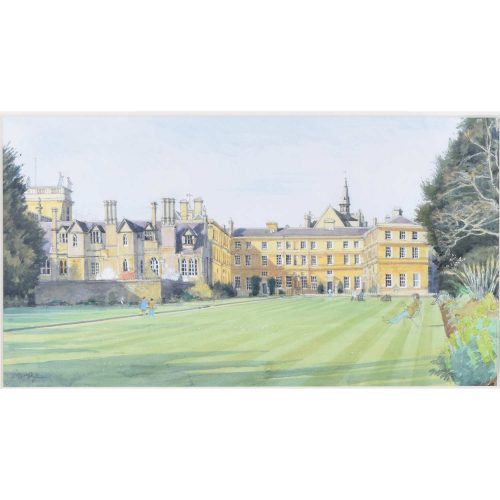
John Doyle (born 1928)
Trinity College, Oxford
Watercolour 24 x 46 cm Signed lower left. Doyle's striking portrayal of Trinity's architecture, complete with undergraduates variously strolling, sitting, and reading in the foreground. Afternoon sun slants over the immaculately mown lawns. John Doyle was born in London and works in watercolours, pastels, and oils. He studied at the Maidstone School of Art in his 30s, later showing at the Royal Academy Summer Exhibition. Much of his work focuses on landscape and architecture; he has produced a series of views of Oxford and its colleges. Condition: excellent. If you’d like to know more, please email info@manningfineart.co.uk or call us on 07929 749056. Click here for more views of Trinity College, Oxford. -
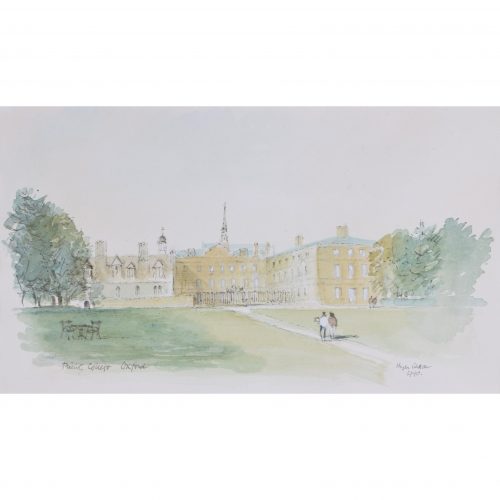
Hugh Casson (1910 - 1999)
Trinity College, Oxford (1990)
Watercolour 20 x 33 cm (38 x 50 cm framed) Casson's marvellous watercolour of Trinity and its perfectly manicured lawns, adorned with strolling undergraduates. Sir Hugh Casson was educated at Eastbourne College; St John’s College, Cambridge; and the Bartlett School of Architecture. Trained in the 1930s in the early modernist style, he taught at the Cambridge School of Architecture. After employment as a camoufleur during World War 2 by the Air Ministry, in 1948 he was appointed as director of architecture for the Festival of Britain. A close friend of the Royal Family, he undertook designs for the 1953 coronation, designed the interior of the Royal Yacht Britannia (“The overall idea was to give the impression of a country house at sea”), and taught the young Charles III to paint in watercolours. Amongst his architectural achievements are the Elephant House at London Zoo, the 1978 redevelopment of Bristol Docks, the Raised Staff Building for The University of Cambridge, and a building for the Royal College of Art. He published a number of illustrated books, of which Casson’s Oxford and Casson’s Cambridge are probably the best known. A limited edition series of prints was produced from the paintings. Condition: excellent. If you’d like to know more, please email info@manningfineart.co.uk or call us on 07929 749056. Click here for other views of Trinity College, Oxford. -
Out of stock
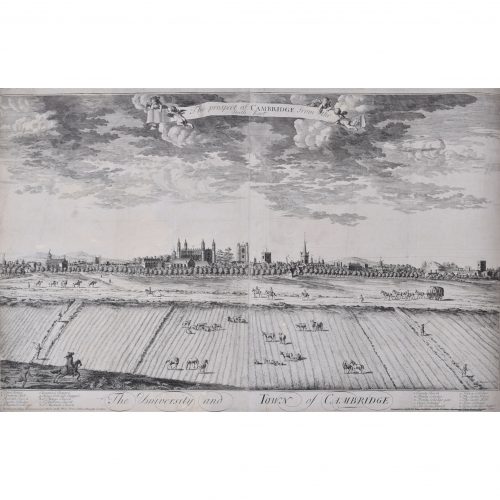
Johannes Kip (1652 - 1722) after R Whitehand
Prospect of Cambridge from the South East (1724)
Engraving 57 x 88 cm A view of the city of Cambridge, replete with college spires, by Johannes ''Jan'' Kip, the Dutch draughtsman, engraver and print dealer. The engraving illustrates an 18th century Cambridge defined by livestock and farmhands, as well as its University. The largest and best view of Cambridge, extremely rare - we have not traced any other copies at auction. Condition: good. Previously folded, occasional small losses and the odd slightly toned patch; two joined sheets. Trimmed to within platemark; very rare. If you’d like to know more, please email info@manningfineart.co.uk or call us on 07929 749056. -
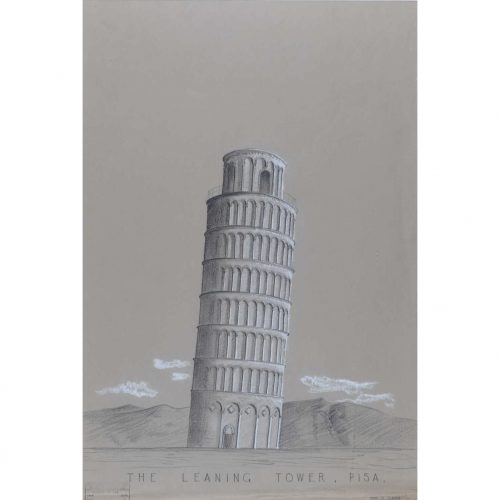
John D Paxton
The Leaning Tower, Pisa
Pencil and white chalk 75 x 50 cm Stamped bottom left indistinctly "Edinburgh School of Art, School of Architecture". An architectural drawing of Pisa's famous Leaning Tower. -
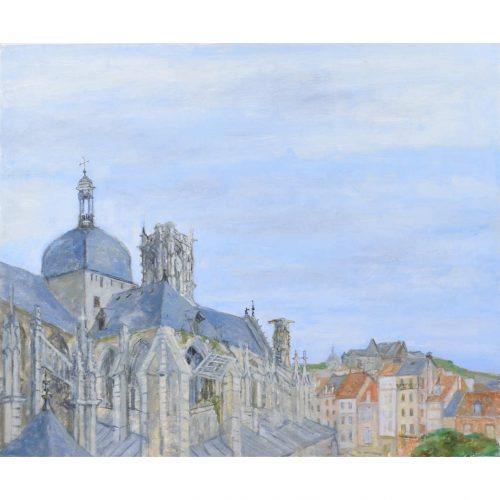
Richard Beer (1928 - 2017)
Dieppe Cathedral
Oil on canvas 66 x 76 cm A mountaintop cathedral and surrounding houses; broad blue sky fills the rest of the canvas. This oil painting is a fantastic example of Beer's focus on architecture, the central and recurring theme of his pictorial idiom. Born in London in 1928, just too late to serve in the Second World War, Richard Beer studied between 1945 - 1950 at the Slade School. Subsequently, a French Government scholarship allowed him to spend time in Paris at Atelier 17, working under Stanley William Hayter (1901 - 1988), one of the most significant print makers of the 20th Century – having spent the War in New York, advising as a camofleur, Hayter only returned to Paris in 1950. Subsequently Beer studied at the École des Beaux Arts, Paris. Working for John Cranko, choreographer for the Royal Ballet, Beer designed the sets and costumes for his The Lady and the Fool at Covent Garden, subsequently working for him following his move in 1961 to Stuttgart Ballet. Additionally he produced book illustrations and designed book jackets. Beer later taught print-making at the Chelsea School of Art, where he was a popular teacher. Probably his greatest work was a collaboration with John Betjeman to produce a portfolio of prints of ten Wren Churches in the City for Editions Alecto, copies of which are in The Government Art Collection. That collection contains a total of 54 prints by Beer, and the Tate Gallery’s collection holds seven. His Oxford series was also produced for Editions Alecto as was a series of predominantly architectural views in Southern Europe. Most of his prints are of architectural subjects. Condition: excellent. If you’d like to know more, please email info@manningfineart.co.uk or call us on 07929 749056. Click here for other views by Richard Beer.