-
Out of stock

R C Meaux
Tignes - Ski Artistique (1990)
Original vintage poster 80 x 53 cm An original vintage poster printed in colour in 1990 by L’Avenir Graphic. The poster was designed to promote the 1992 Olympic Winter Games in Albertville. A similar design was also used for a limited edition French postage stamp in 1992. Condition: very good. If you are interested, please email info@manningfineart.co.uk or call us on 07929 749056. Click here for more original vintage ski posters. -
Out of stock
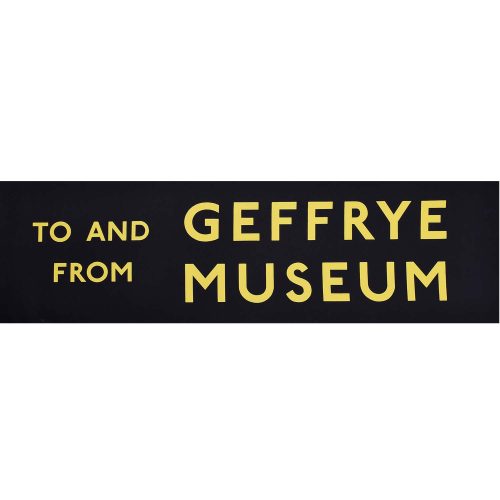
To and From Geffrye Museum Routemaster Bus Slipboard Poster c1970
Screenprint poster 64x19cm Printed for London Transport for use on Routemaster or RT busses. Geffrye Museum is the museum of the home. If you are interested email info@manningfineart.co.uk or call us on 07929 749056. Condition: Good. -

To and From White City Routemaster Bus Slipboard Poster c1970
Screenprint poster 64x19cm Printed for London Transport for use on Routemaster or RT busses. If you are interested email info@manningfineart.co.uk or call us on 07929 749056. Condition: Good. -
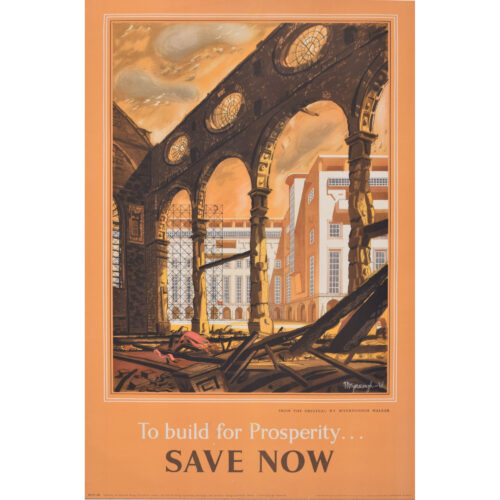
Raymond Myerscough Walker (1908 - 1984)
To Build for Prosperity - Save Now
Original vintage poster 74 x 49 cm Issued by the National Savings Committee London, the Scottish Savings Committee Edinburgh, and the Ulster Savings Committee Belfast. Printed For HM Stationery Office By Thomas Forman and Sons Ltd, Nottingham. This posters makes use of Myerscough Walker's original painting of a church bombed in the Blitz, with new buildings being constructed behind. Even in the face of war and destruction, Britain builds itself up to prosper - and, by saving, so can we. Myerscough Walker was an architectural draughtsman. He trained at Leeds School of Art and went on to the Architectural Association in London. In 1931 he won the Tite prize and was celebrated in his career for his skill as a draughtsman – as well as architect, writer, artist, sculptor and stage designer. He worked with Berhold Lubetkin, the significant modernist architect, for several years. Condition: generally very good; the odd gentle crease. Not backed. If you are interested, please email info@manningfineart.co.uk or call us on 07929 749056. Click here for other original vintage posters. -

Tom Carr (1909-1999)
Braes of Derwent Hunt
Pencil drawing 25 x 22 cm Thomas Carr OBE was an Irish artist. He was associated with the Euston Road School in the 1930s and had a long career as a painter of domestic scenes and landscapes. He studied at the Slade School of Art before moving to Italy to spend a year in Settignano, near Florence. Upon his return to London, Carr established himself as a painter and was exhibited at various well-known galleries of the time, including Zwemmer Gallery and Storran Gallery. Carr enjoyed success throughout his career and despite having settled in Newcastle, County Down in 1939, he regularly exhibited at the Royal Academy and was a member of the Royal Ulster Academy, the New English Art Club, the Royal Watercolour Society. Carr was awarded the MBE in 1974 and received an OBE in 1993 for his services to art in Northern Ireland. This pencil drawing is likely a study for one of his paintings of the Braes of Derwent Hunt, and therefore occupies a unique place in his oeuvre, showing the artistic processes behind his work. -

John Hill (1770 - 1850) after Augustus Charles Pugin (1762 - 1832) St Aldate's From Carfax (1813)
Aquatint with original hand colouring 27 x 21 cm Published by Rudolph Ackermann (1764 - 1834). An engraving of St Aldate's, overlooked by Christ Church's pale and magnificent Tom Tower. John Hill was born in London in 1770, and was an engraver's apprentice. He worked in aquatint and largely produced book illustration aquatints. He went to America in 1816 and produced the notable Picturesque Views of American Scenery amongst other books of prints. Augustus Charles Pugin was an Anglo-French artist and architectural draughtsman. Pugin produced views of London, jointly creating the illustrations for the 'Microcosm of London' published by Rudolph Ackermann in 1811, followed by plates for Ackermann's books about Westminster Abbey, Oxford and Cambridge universities, and Winchester College. His later works included illustrations for Specimens of Gothic Architecture (1821–1823), The Royal Pavilion at Brighton (1826), Architectural Antiquities of Great Britain (1826), Specimens of the Architectural Antiquities of Normandy (1827), Illustrations of the Public Buildings of London (1825 to 1828), Paris and its Environs (1829 to 1831), and Examples of Gothic Architecture (1831). He also produced a book of furniture designs called Gothic Furniture, and assisted architects with detailing for their gothic designs. He ran a drawing school at his house in Bloomsbury. Ackermann was an Anglo-German bookseller, inventor, lithographer, publisher and businessman. He attended the Latin school in Stollberg, but his wish to study at the university was made impossible by lack of financial means, and he therefore became a saddler like his father. He worked as a saddler and coach-builder in different German cities, moved from Dresden to Basel and Paris, and then, 23 years old, settled in London. He established himself in Long Acre, the centre of coach-making in London and close to the market at Covent Garden. Ackermann then moved to Little Russell Street where he published Imitations of Drawings of Fashionable Carriages (1791) to promote his coach-making. Other publications followed. In 1795 he established a print-shop and drawing-school at 96 Strand. Here Ackermann set up a lithographic press and began a trade in prints. He later began to manufacture colours and thick carton paper for landscape and miniature painters. Within three years the premises had become too small and he moved to 101 Strand, in his own words "four doors nearer to Somerset House", the seat of the Royal Academy of Arts. Between 1797 and 1800 Ackermann rapidly developed his print and book publishing business, encompassing many different genres including topography, caricature, portraits, transparencies and decorative prints. During the Napoleonic wars, Ackermann was an energetic supporter of the Allied cause and made significant contributions to British propaganda through his publication of anti-Napoleonic prints and military manuals. He became a naturalised British citizen in March 1809. As one of the pioneers of modern publishing methods, Ackermann developed an international distribution network for his publications and came to have significant commercial interests in South America. The business he founded in London flourished throughout the 19th century under the management of his descendants. He was buried at St. Clement Danes in the Strand, London. In 2020, the St. Louis Mercantile Library wrote that: "Ackermann excelled in the creation of landscape and architectural engravings. He created beautiful illustrations of the city of London, his adopted home, as well as two volumes of classic views of Westminster Abbey, along with exquisite views of river scenes. One of our favorite collections are four massive volumes of lovingly illustrated exterior and interior landmarks of Oxford and Cambridge Universities created just over two hundred years ago. These publications show Ackermann’s hand at every turn of the page along with the team of assistant designers and engravers he employed to create these works. Perhaps they were a way by which the artist could lay to rest his own regret at not being able to attend [an Oxbridge] college himself in a fondly depicted idyll to learning which these prints so aptly represent." Condition: Generally very good.If you would like to know more, please email info@manningfineart.co.uk or call us on 07929 749056.
-
 Mabel Oliver Rae (1868-1956) Tom Tower, Oxford c.1920 Etching 12 x 9 cm Signed in pencil below. Mabel Oliver Rae was born in Cambridge, Cambridgeshire, and trained at the Slade School of Fine Art between 1888 and 1890. Rae is known for her skilled etchings of various rural scenes and townscapes, particularly those of the colleges of Oxford and Cambridge. She signed works with the pseudonym 'M.Oliver Rae', a ruse to conceal the fact she was a female artist, so as not to reduce her chances with commercial dealers and agents. This particular etching depicts a lovely view of Tom Tower, Oxford. Condition: Generally very good, small tear to bottom right and slight age toning to paper.
If you would like to know more, please email info@manningfineart.co.uk or call us on 07929 749056.
For other views of Christ Church, Oxford, click here. -
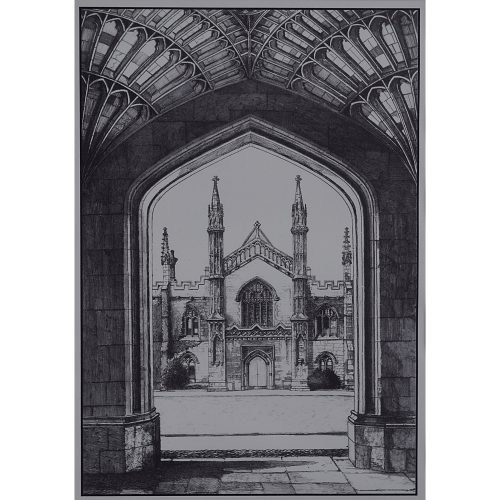
Tony Broderick (British, late 20th Century) Corpus Christi College Cambridge
Print 35x25cm A Lincoln-based artist, known for his portrayal of Lincoln and also of the Cambridge Colleges. If you are interested email info@manningfineart.co.uk or call us on 07929 749056. Condition: Excellent. -
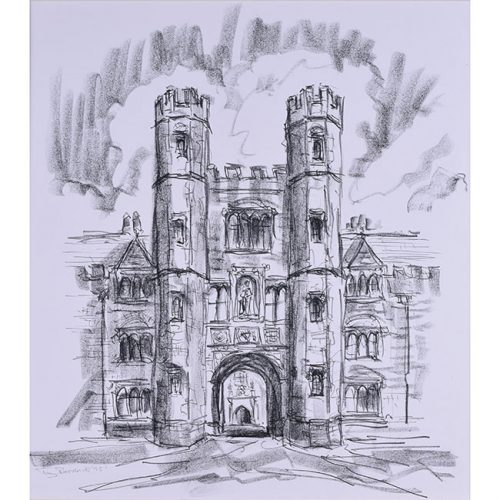
Tony Broderick
Shrewsbury Tower St. John's College Cambridge
Conte drawing 35x32cm If you are interested email info@manningfineart.co.uk or call us on 07929 749056. -
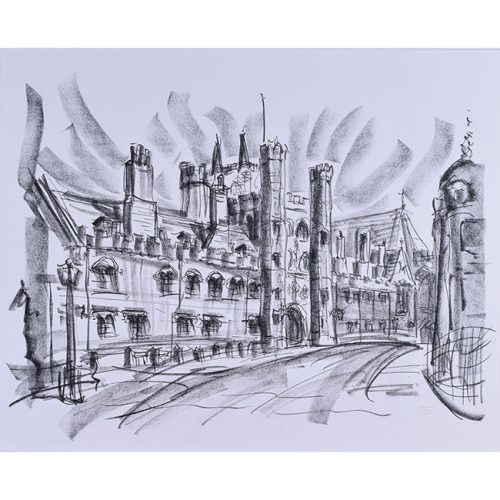
Tony Broderick
St. John's Great Gate, Cambridge
Conte drawing 33x42cm If you are interested email info@manningfineart.co.uk or call us on 07929 749056. -
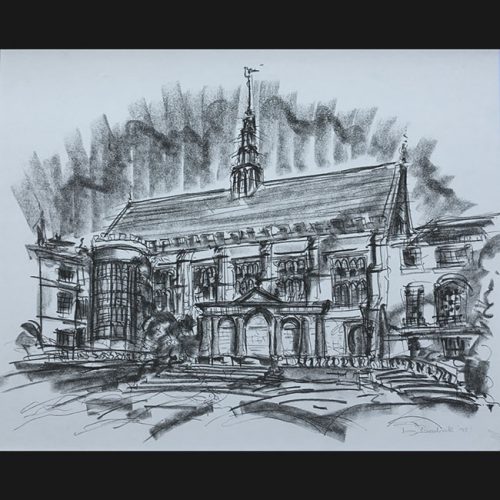
Tony Broderick
Trinity College, Cambridge, Hall from exterior
Conte drawing 37x47cm If you are interested email info@manningfineart.co.uk or call us on 07929 749056. -
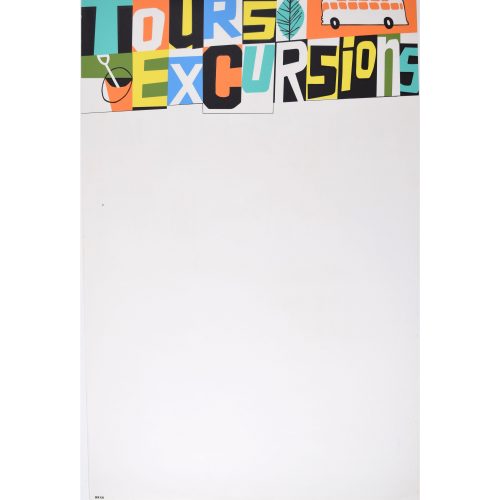
Anonymous Tours and Excursions
Original Coach Poster 75x50cm Cool and crazy mid-century lettering. Poster with area for completion with details of a coach tour. If you are interested email info@manningfineart.co.uk or call us on 07929 749056. Condition: Excellent. -

Julian Trevelyan (1910 - 1988)
Tower Bridge
Etching & Aquatint 47 x 34 cm Numbered 47/75 lower left and signed lower right, both in pencil. Nephew of the historian G M Trevelyan, Julian Trevelyan was educated at Bedales and then at Trinity College, Cambridge, where he read English. After moving to Paris, Trevelyan studied engraving at Stanley William Hayter’s school, working alongside artists such as Max Ernst, Joan Miro and Pablo Picasso. He married the potter Ursula Darwin in 1934, and in 1935 they moved to Hammersmith, buying Durham Wharf beside the River Thames which was Trevelyan’s studio – and home – for the rest of his life. His wartime service was – like so many artists – as a camoufleur. A Royal Engineer from 1940-43, he served in North Africa and Palestine, forcing the German Afrika Korps to use resources against a dummy army whilst real tanks were disguised as more harmless equipment. In the desert, nothing could be hidden - but it could be disguised. Following the dissolution of his marriage in 1950, he married the painter Mary Fedden. Teaching at Chelsea School of Art, Trevelyan eventually became head of the Etching Department and his pupils included David Hockney and Peter Ackroyd. Condition: generally very good. If you are interested, please email info@manningfineart.co.uk or call us on 07929 749056. Click here for other works by Julian Trevelyan. -
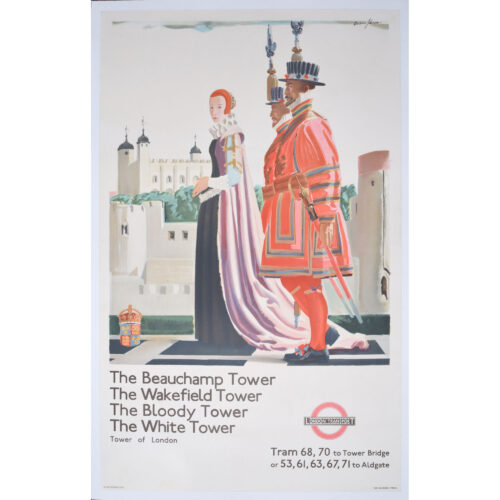
Andrew Johnson (1893 - 1973)
The Tower of London (1935)
Lithograph 102 x 64 cm A copy of this poster is held by the London Transport Museum (1983/4/4178). Queen Elizabeth I, accompanied by two Yeomen Warders, surveys the white stone of the Tower of London. Johnson's design encourages us to use London Transport (now Transport for London) to visit the Tower in all its historic glory. Andrew Johnson was born in Portsmouth and studied at the Central School of Art and Design (now Central St Martin's) in London. He worked as a poster designer for several advertising agencies. He designed posters for BP, Shell, the London and North Eastern Railway, Southern Railway, The Times, and General Motors (to name but a few). He made advertising graphics in New York in the late 1920s and later founded Grainger Johnson (a poster design company) with Tom Grainger. He was a member of the British Society of Poster Designers and several of his designs are held by the London Transport Museum. Condition: backed to linen; excellent. If you are interested, please email info@manningfineart.co.uk or call us on 07929 749056. Click here for other original vintage posters. -
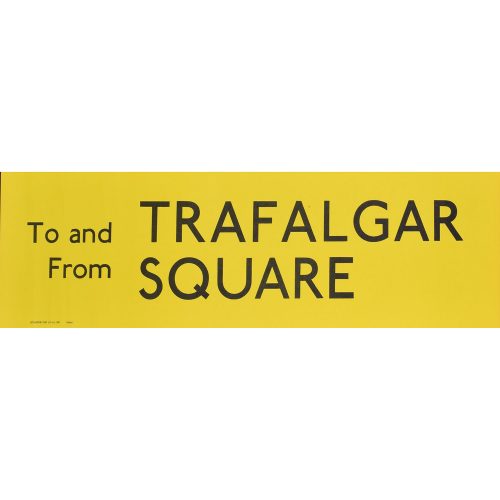
Trafalgar Square Routemaster Slipboard Poster c1970
Screenprint poster 64x19cm Printed for London Transport for use on Routemaster or RT busses. If you are interested email info@manningfineart.co.uk or call us on 07929 749056. -

Julian Trevelyan (1910 - 1988)
Trafalgar Square
Etching & Aquatint 35 x 48 cm Numbered 27/75 lower left and signed lower right, both in pencil. Nephew of the historian G M Trevelyan, Julian Trevelyan was educated at Bedales and then at Trinity College, Cambridge, where he read English. After moving to Paris, Trevelyan studied engraving at Stanley William Hayter’s school, working alongside artists such as Max Ernst, Joan Miro and Pablo Picasso. He married the potter Ursula Darwin in 1934, and in 1935 they moved to Hammersmith, buying Durham Wharf beside the River Thames which was Trevelyan’s studio – and home – for the rest of his life. His wartime service was – like so many artists – as a camoufleur. A Royal Engineer from 1940-43, he served in North Africa and Palestine, forcing the German Afrika Korps to use resources against a dummy army whilst real tanks were disguised as more harmless equipment. In the desert, nothing could be hidden - but it could be disguised. Following the dissolution of his marriage in 1950, he married the painter Mary Fedden. Teaching at Chelsea School of Art, Trevelyan eventually became head of the Etching Department and his pupils included David Hockney and Peter Ackroyd. This particular edition shows a vibrant print of a classic view of Trafalgar Square, notably including Nelson's Column and the iconic fountains. Condition: generally very good. If you are interested, please email info@manningfineart.co.uk or call us on 07929 749056. Click here for other works by Julian Trevelyan. -

Mick Brownfield Trains Don't Stop at St Pancras
Lithograph 100 x 65 cm Signed in plate The year is 1980. You get off the train at St Pancras, stars in your eyes, Big Ben, St Paul's, Tower Bridge almost in sight. You continue your adventure and you set your eyes on Mick Browfield's futuristic poster 'Trains don't stop at St Pancras.' Brownfield designed this poster to greet and encourage passengers not to end their journey there, but instead to use the Victoria, Metropolitan, Circle, Piccadilly or Northern lines to travel further, perhaps to the West End or into the City. It is visually striking, with each train line emerging out of the arches of the iconic St Pancras station. The poster also features the Underground roundel, positioned in the sky as a sun or satellite, suggesting the universal nature of the Underground. Interestingly, the roundel was also used in this way in by Man Ray in 1938, and by Misha Black and John Barker in 1947. Condition: Generally very good.If you would like to know more, please email info@manningfineart.co.uk or call us on 07929 749056.
-

Printed for H.M. Stationery Office, c.1943
If your journey is REALLY necessary and you can choose your times… travel between 10 and 4
Issued by the Ministry of War Transport and the Ministry of Labour and National Service 18×75 cm (7″ x 30″) in unissued condition If you are interested email info@manningfineart.co.uk or call us on 07929 749056. -
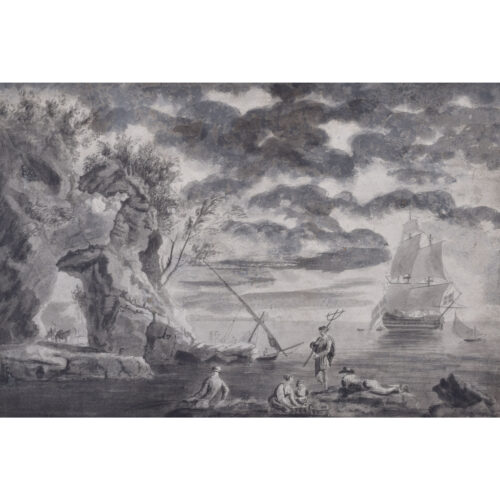
John Cantiloe Joy (1805 - 1859) / William Joy (1803 - 1865) (attributed)
Trident on the Shore
Pencil and wash 28 x 42 cm A 19th century engraving of a ship near a shore. Various figures, including one wielding a trident, appear in the foreground. John Cantiloe Joy and William Joy were brothers who worked together as English marine artists. During the 1820s, the brothers' paintings were exhibited at the Norwich Society of Artists, the Royal Society of British Artists, the Royal Academy and at the British Institution. They belonged to the Norwich School of painters which specialised in maritime scenes and views of rural Norfolk and Norwich. Condition: generally very good; mounted to board. If you are interested, please email info@manningfineart.co.uk or call us on 07929 749056. -
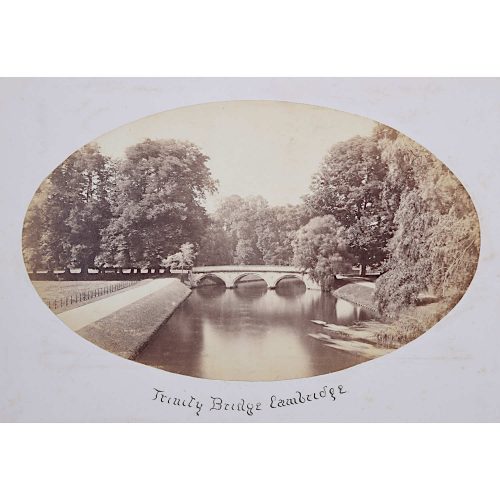
Trinity Bridge, Cambridge
Albumen print of a photograph, circa 1850 Mounted to board and inscribed 'Trinity Bridge Cambridge'. Trinity Bridge is a stone built tripled-arched road bridge across the River Cam. It was built from Portland stone in 1765 to the designs of James Essex to replace an earlier bridge built in 1651, and is a Grade I listed building. Trinity College is a constituent college of the University of Cambridge, and was founded in 1546 by King Henry VIII. Trinity is one of the oldest and largest colleges in Cambridge, with the largest financial endowment of any college at either Cambridge or Oxford. Trinity has some of the most distinctive architecture within Cambridge, with its Great Court reputed to be the largest enclosed courtyard in Europe. Condition: generally very good. If you’d like to know more, please email info@manningfineart.co.uk or call us on 07929 749056. -
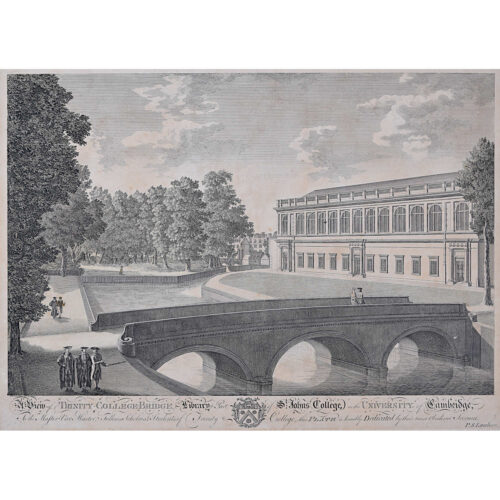
Peter Spendelowe Lamborn (1722 - 1774)
Trinity College Bridge and Library and Part of St John's College, in the University of Cambridge
Engraving 37 x 52 cm Peter Spendelowe Lamborn was an English engraver and miniature painter. He studied engraving under Basire and worked in Cambridge, where he obtained some note as an engraver. Condition: generally good; some discolouration to paper, surface dirt particularly to margins. Mounted to board and previously mounted with plate mark under mount. If you are interested, please email info@manningfineart.co.uk or call us on 07929 749056. Click here for other views of Cambridge. -
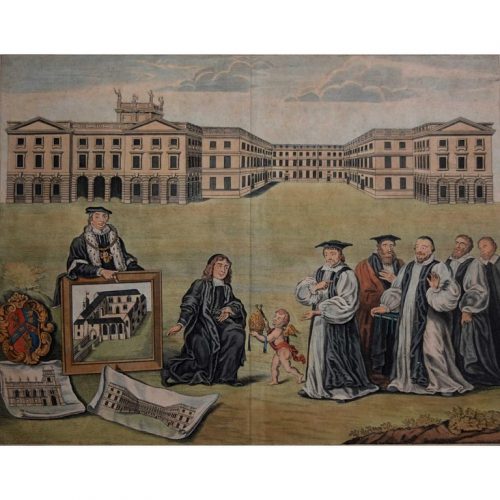
Artist unknown The Founder and Benefactors of Trinity College
Early 18th century Hand coloured engraving 36.5 x 47.5 cm Rare - we have been unable to identify another copy of this print. This beautifully tinted engraving was originally produced for the 1732 Oxford University Almanack. The founder of Trinity College, Sir Thomas Pope, is pictured holding an image based on John Bereblock’s 1566 engraving; it depicts the quadrangle known today as Durham Quad. Also pictured are Ralph Bathurst (President of Trinity 1664-1704), the archbishop of Canterbury, Gilbert Sheldon; the bishop of Worcester, Robert Skinner, and the bishop of Chester, Nicholas Stratford. Perhaps what is most notable about this engraving is, however, the background of the college landscape. By 1732 Trinity was well underway in developing a highly elaborate garden, with geometric paths, an avenue of limes, yew hedges trimmed to resemble panelling, and so on. None of this is represented here and the quadrangle is instead exponentially extended. Although these plans ultimately never came to fruition, ideas of a vast expansion persisted throughout the reign of George II and the plans were replicated in the Almanack for 1756. Complete with vibrant colours and sharp lines, this rare engraving offers a unique historical insight into the transformation of and ambitions for Trinity College, Oxford. Condition:Generally good with some spotting and slight overall toning. Trimmed to just within platemark at top and bottom. If you are interested email info@manningfineart.co.uk or call us on 07929 749056. -
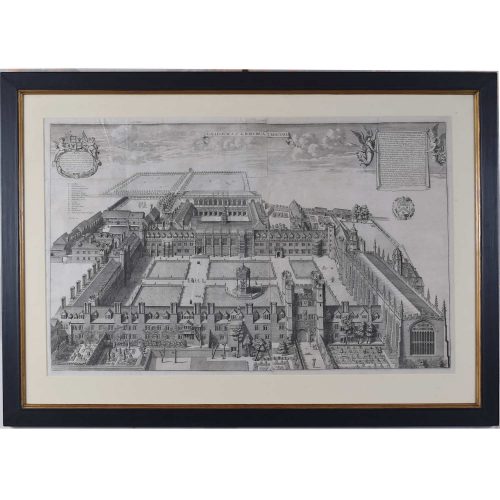
David Loggan (1634 - 1692)
Trinity College, Cambridge (1690)
Engraving 80 x 50 cm Loggan was born to English and Scottish parents, and was baptised in Danzig in 1634. After studying engraving in Danzig with Willem Hondius (1598-1652 or 1658), he moved to London in the late 1650s, going on to produce the engraved title-page for the folio 1662 Book of Common Prayer. He married in 1663 and moved to Nuffield in Oxfordshire in 1665. Loggan was appointed Public Sculptor to the nearby University of Oxford in the late 1660s, having been commissioned to produce bird’s-eye views of all the Oxford colleges. He lived in Holywell Street as he did this. The 'Oxonia Illustrata' was published in 1675, with the help of Robert White (1645 - 1704). Following its completion, Loggan began work on his equivalent work for Cambridge; the 'Cantabrigia Illustrata' was finally published in 1690, when he was made engraver to Cambridge University. The 'Oxonia Illustrata' also includes an engraving of Winchester College (Winchester and New College share William of Wykeham as their founder) whilst the 'Cantabrigia Illustrata' includes one of Eton College (which shares its founder, Henry VIII, with King’s College). Bird’s-eye views from this era required a particular talent as an architectural perspectivist; it was not until 1783 that it became possible for artists to ascend via hot air balloons and view the scenes they were depicting from above. Loggan thus had to rely on his imagination in conceiving the views. Loggan’s views constitute the first accurate depictions of the two Universities, in many ways unchanged today. Whilst the Oxford engravings were produced in reasonable numbers and ran to a second edition by Henry Overton (on thicker paper and with a plate number in Roman numerals in the bottom right-hand corner), those of Cambridge were printed in much smaller numbers. The Dutchman Pieter van der Aa published some miniature versions of the engravings for James Beverell’s guidebook to the UK, 'Les Delices de la Grande Bretagne' (circa 1708). The contemporary artist Andrew Ingamells has produced a highly-acclaimed series of etchings which bring Loggan’s original vision up to date. Condition: generally very good; printed on two sheets, folds as issued. A few creases to top area. As a multi-folded plate in the published book, Trinity has normally suffered and is normally trimmed closely and has damage; this particular example has instead good margins outside the platemark and without damage to the folds. A very good copy of Trinity. If you’d like to know more, please email info@manningfineart.co.uk or call us on 07929 749056. -

Pieter van der Aa (1659 - 1733), after David Loggan (1634 - 1692)
Trinity College, Cambridge (1727)
Engraving 13 x 17 cm An eighteenth-century view of Trinity College, Cambridge, engraved by Pieter van der Aa after David Loggan, the noted engraver, draughtsman, and painter. Pieter van der Aa of Leiden was a Dutch publisher best known for preparing maps and atlases, though he also printed editions of foreign bestsellers and illustrated volumes. He is noted for the many engravings he produced after David Loggan's series of Oxford and Cambridge colleges and costumes. In 1727 Van Der Aa illustrated "Les Delices de la Grande Bretagne & de L'Irelande" by James Beeverell, the book in which this engraving appears. Condition: very good. If you are interested, please email info@manningfineart.co.uk or call us on 07929 749056. Click here for other views of Trinity College, Cambridge -

Pieter van der Aa (1659 - 1733), after David Loggan (1634 - 1692)
Trinity College, Cambridge (1727)
Engraving 13 x 17 cm An eighteenth-century view of Neville's Court in Trinity College, Cambridge, engraved by Pieter van der Aa after David Loggan, the noted engraver, draughtsman, and painter. Pieter van der Aa of Leiden was a Dutch publisher best known for preparing maps and atlases, though he also printed editions of foreign bestsellers and illustrated volumes. He is noted for the many engravings he produced after David Loggan's series of Oxford and Cambridge colleges and costumes. In 1727 Van Der Aa illustrated "Les Delices de la Grande Bretagne & de L'Irelande" by James Beeverell, the book in which this engraving appears. Condition: very good. If you are interested, please email info@manningfineart.co.uk or call us on 07929 749056. Click here for other views of Trinity College, Cambridge -

Pieter van der Aa (1659 - 1733), after David Loggan (1634 - 1692)
Trinity College, Cambridge (1727)
Engraving 13 x 17 cm An eighteenth-century view of the Bishop's Hostel in Trinity College, Cambridge, engraved by Pieter van der Aa after David Loggan, the noted engraver, draughtsman, and painter. Pieter van der Aa of Leiden was a Dutch publisher best known for preparing maps and atlases, though he also printed editions of foreign bestsellers and illustrated volumes. He is noted for the many engravings he produced after David Loggan's series of Oxford and Cambridge colleges and costumes. In 1727 Van Der Aa illustrated "Les Delices de la Grande Bretagne & de L'Irelande" by James Beeverell, the book in which this engraving appears. Condition: very good. If you are interested, please email info@manningfineart.co.uk or call us on 07929 749056. Click here for other views of Trinity College, Cambridge -

Pieter van der Aa (1659 - 1733), after David Loggan (1634 - 1692)
Trinity College, Cambridge (1727)
Engraving 13 x 17 cm An eighteenth-century view of Trinity College, Cambridge, engraved by Pieter van der Aa after David Loggan, the noted engraver, draughtsman, and painter. Pieter van der Aa of Leiden was a Dutch publisher best known for preparing maps and atlases, though he also printed editions of foreign bestsellers and illustrated volumes. He is noted for the many engravings he produced after David Loggan's series of Oxford and Cambridge colleges and costumes. In 1727 Van Der Aa illustrated "Les Delices de la Grande Bretagne & de L'Irelande" by James Beeverell, the book in which this engraving appears. Condition: very good. If you are interested, please email info@manningfineart.co.uk or call us on 07929 749056. Click here for other views of Trinity College, Cambridge -
 John Bluck (early 19th century) after William Westall (1781 - 1850) Quadrangle of Trinity College, Cambridge (1815) Aquatint with original hand colouring 18 x 28 cm Published by Rudolph Ackermann (1764 - 1834). William Westall was a British landscape artist. He was born in Hertford and enrolled at the Royal Academy schools in 1799. He later became the draughtsman for a voyage to Australia and the South Seas. After being shipwrecked, he travelled to Canton in China and to India, staying in Bombay for several months. He returned to England in 1805 but later set off for Madeira and Jamaica. He became a member of the Society of Painters in Water Colours (1811) and an associate of the Academy (1812). Following a mental breakdown, he regularly visited the Lake District and published ‘Views of the Valley and Vale of Keswick’ (1820). His series of aquatints of the Thames, the great universities, and England's public schools for Ackermann are among his most popular works. John Bluck was an aquatint engraver, mainly of topographical views, but also of marine and sporting subjects after his contemporaries. He produced plates for numerous publications. Rudolph Ackermann was an Anglo-German bookseller, inventor, lithographer, publisher and businessman. In 1795 he established a print-shop and drawing-school at 96 Strand. Here Ackermann set up a lithographic press and began a trade in prints. He later began to manufacture colours and thick carton paper for landscape and miniature painters. Within three years the premises had become too small and he moved to 101 Strand, in his own words "four doors nearer to Somerset House", the seat of the Royal Academy of Arts. Between 1797 and 1800 Ackermann rapidly developed his print and book publishing business, encompassing many different genres including topography, caricature, portraits, transparencies and decorative prints. Condition: Generally very good; slight toning to within platemark.
If you would like to know more, please email info@manningfineart.co.uk or call us on 07929 749056.
-

Joseph Constantine Stadler (1755 - 1828) after William Westall (1781 - 1850) Colonnade under Trinity Library (1815)
Aquatint with original hand colouring 20 x 27 cm Published by Rudolph Ackermann (1764 - 1834). An engraving of the colonnade below Trinity's library, peopled with figures in academic dress and their companions. Engraved for Ackermann's 'A History of the University of Cambridge, Its Colleges, Halls and Public Buildings'. Joseph Constantine Stadler was a prolific German émigré engraver of images after his contemporaries - here, 18th-century English landscape painter and diarist Joseph Farington. Stadler's engravings are wide-ranging in subject matter and include landscapes, seascapes and portraits, as well as military, sporting and decorative subjects. Stadler was employed by the leading print publisher of the time, John Boydell. Stadler lived in Knightsbridge when he died at the age of 73. William Westall was a British landscape artist. He was born in Hertford and enrolled at the Royal Academy schools in 1799. He later became the draughtsman for a voyage to Australia and the South Seas. After being shipwrecked, he travelled to Canton in China and to India, staying in Bombay for several months. He returned to England in 1805 but later set off for Madeira and Jamaica. He became a member of the Society of Painters in Water Colours (1811) and an associate of the Academy (1812). Following a mental breakdown, he regularly visited the Lake District and published ‘Views of the Valley and Vale of Keswick’ (1820). His series of aquatints of the Thames, the great universities, and England's public schools for Ackermann are among his most popular works. Rudolph Ackermann was an Anglo-German bookseller, inventor, lithographer, publisher and businessman. In 1795 he established a print-shop and drawing-school at 96 Strand. Here Ackermann set up a lithographic press and began a trade in prints. He later began to manufacture colours and thick carton paper for landscape and miniature painters. Within three years the premises had become too small and he moved to 101 Strand, in his own words "four doors nearer to Somerset House", the seat of the Royal Academy of Arts. Between 1797 and 1800 Ackermann rapidly developed his print and book publishing business, encompassing many different genres including topography, caricature, portraits, transparencies and decorative prints. -
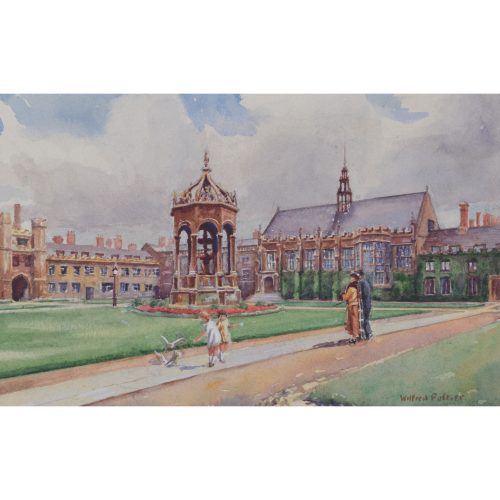
Wilfred Pettitt (1904 - 1978)
Great Court, Trinity College, Cambridge
Watercolour 17 x 27 cm A smartly-dressed couple and their two children enjoy the sunny and immaculately-lawned Great Court of Trinity College, Cambridge. The man and woman admire the ornate fountain which stands sentinel in the middle of the court (it, along with the rest of Great Court, was erected by by Thomas Nevile, master of the college in the early 17th century). Their children, perhaps oblivious to the architectural majesty around them, amuse themselves by playing with the pigeons. Wilfred Stanley Pettitt was born in Great Yarmouth, and studied at the Great Yarmouth School of Art and the Norwich School of Art. In 1928 he showed at the Royal Academy Royal Academy for the first time, and his work was also exhibited by the Royal Society of British Artists and the Royal Cambrian Academy. In 1944 Pettitt became one of the founding members of the Norwich Twenty Group (a group of Norfolk artists who intended to raise the standards of local professional art). He died in Eastbourne in 1978. Condition: mounted to board; otherwise very good. If you are interested, please email info@manningfineart.co.uk or call us on 07929 749056. Click here for other views of Trinity College, Cambridge. -

Joseph Constantine Stadler (1755 - 1828) after William Westall (1781 - 1850) Trinity Library from St John's Gardens (1814)
Hand-coloured aquatint 24 x 29 cm Published by Rudolph Ackermann (1764 - 1834). An engraving of the gates of the Wren Library of Trinity College Cambridge, from over the river. Joseph Constantine Stadler was a prolific German émigré engraver of images after his contemporaries - here, 18th-century English landscape painter and diarist Joseph Farington. Stadler's engravings are wide-ranging in subject matter and include landscapes, seascapes and portraits, as well as military, sporting and decorative subjects. Stadler was employed by the leading print publisher of the time, John Boydell. Stadler lived in Knightsbridge when he died at the age of 73. William Westall was a British landscape artist. He was born in Hertford and enrolled at the Royal Academy schools in 1799. He later became the draughtsman for a voyage to Australia and the South Seas. After being shipwrecked, he travelled to Canton in China and to India, staying in Bombay for several months. He returned to England in 1805 but later set off for Madeira and Jamaica. He became a member of the Society of Painters in Water Colours (1811) and an associate of the Academy (1812). Following a mental breakdown, he regularly visited the Lake District and published ‘Views of the Valley and Vale of Keswick’ (1820). His series of aquatints of the Thames, the great universities, and England's public schools for Ackermann are among his most popular works. Rudolph Ackermann was an Anglo-German bookseller, inventor, lithographer, publisher and businessman. In 1795 he established a print-shop and drawing-school at 96 Strand. Here Ackermann set up a lithographic press and began a trade in prints. He later began to manufacture colours and thick carton paper for landscape and miniature painters. Within three years the premises had become too small and he moved to 101 Strand, in his own words "four doors nearer to Somerset House", the seat of the Royal Academy of Arts. Between 1797 and 1800 Ackermann rapidly developed his print and book publishing business, encompassing many different genres including topography, caricature, portraits, transparencies and decorative prints. Condition: Generally very good.If you would like to know more, please email info@manningfineart.co.uk or call us on 07929 749056.
-
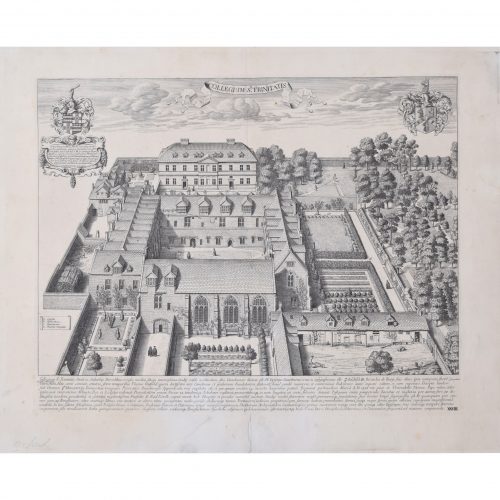
David Loggan (1634 - 1692)
Trinity College, Oxford (1705)
Engraving 32 x 41 cm Loggan's view of Trinity from the second edition of the 'Oxonia Illustrata'. Loggan was born to English and Scottish parents, and was baptised in Danzig in 1634. After studying engraving in Danzig with Willem Hondius (1598-1652 or 1658), he moved to London in the late 1650s, going on to produce the engraved title-page for the folio 1662 Book of Common Prayer. He married in 1663 and moved to Nuffield in Oxfordshire in 1665. Loggan was appointed Public Sculptor to the nearby University of Oxford in the late 1660s, having been commissioned to produce bird’s-eye views of all the Oxford colleges. He lived in Holywell Street as he did this. The 'Oxonia Illustrata' was published in 1675, with the help of Robert White (1645 - 1704). Following its completion, Loggan began work on his equivalent work for Cambridge; the 'Cantabrigia Illustrata' was finally published in 1690, when he was made engraver to Cambridge University. The 'Oxonia Illustrata' also includes an engraving of Winchester College (Winchester and New College share William of Wykeham as their founder) whilst the 'Cantabrigia Illustrata' includes one of Eton College (which shares its founder, Henry VIII, with King’s College). Bird’s-eye views from this era required a particular talent as an architectural perspectivist; it was not until 1783 that it became possible for artists to ascend via hot air balloons and view the scenes they were depicting from above. Loggan thus had to rely on his imagination in conceiving the views. Loggan’s views constitute the first accurate depictions of the two Universities, in many ways unchanged today. Whilst the Oxford engravings were produced in reasonable numbers and ran to a second edition by Henry Overton (on thicker paper and with a plate number in Roman numerals in the bottom right-hand corner), those of Cambridge were printed in much smaller numbers. The Dutchman Pieter van der Aa published some miniature versions of the engravings for James Beverell’s guidebook to the UK, 'Les Delices de la Grande Bretagne' (circa 1708). The contemporary artist Andrew Ingamells has produced a highly-acclaimed series of etchings which bring Loggan’s original vision up to date. Condition: generally very good; second edition. If you’d like to know more, please email info@manningfineart.co.uk or call us on 07929 749056. -
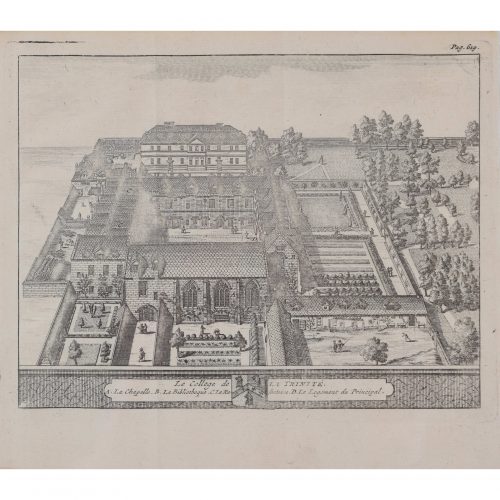
Pieter van der Aa (1659-1733), after David Loggan (1634–1692)
Trinity College, Oxford (1727)
Engraving 12 x 16 cm An eighteenth-century view of Trinity College, engraved by Pieter van der Aa after David Loggan, the noted engraver, draughtsman, and painter who specialised in engravings of Oxford and Cambridge. Pieter van der Aa of Leiden was a Dutch publisher best known for preparing maps and atlases, though he also printed editions of foreign bestsellers and illustrated volumes. He is noted for the many engravings he produced after David Loggan's series of Oxford and Cambridge colleges and costumes. In 1727 Van Der Aa illustrated "Les Delices de la Grande Bretagne & de L'Irelande" by James Beeverell, the book in which this engraving appears. Condition: a good impression. If you’d like to know more, please email info@manningfineart.co.uk or call us on 07929 749056. -
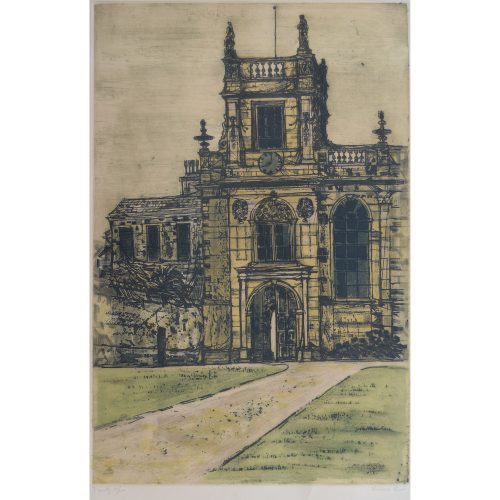
Richard Beer (1928 - 2017)
Trinity College, Oxford (1964 / 65)
Etching and aquatint 42.5 x 58 cm Numbered 27 / 100. Published by Editions Alecto. A copy of this print, owned by the Government Art Collection, is currently in the British Embassy in Saudi Arabia. Richard Beer was a painter and printmaker who focused on architecture and landscapes. He studied at the Slade School of Art from 1945 to 1950 and then studied at the École des Beaux Arts in Paris on a French Government Scholarship. He then worked and studied at Atelier 17, an art school and studio run by the artist Stanley William Hayter (arguably one of the most significant printmakers of the 20th century). The atelier was highly influential in the study and promotion of 20th-century printmaking, and it was here that Beer developed his etching skills. Beer then went on to work for the Royal Ballet choreographer John Cranko, designing the sets and costumes for "The Lady and the Fool" at the Royal Opera House in Covent Garden. He also produced several book illustrations and book jacket designs. Beer taught printmaking at the Chelsea School of Art for 40 years and was also a founding member of the Printmakers' Council. He travelled widely through Italy, France, Spain, and Morocco, sketching prolifically and painting rural and architectural landscapes. Beer would then make etchings and paintings in his Primrose Hill studio, inspired by the landscapes he had sketched and seen while travelling. Probably his greatest work was a collaboration with John Betjeman to produce a portfolio of prints of ten Wren Churches in the City of London for Editions Alecto, copies of which are in The Government Art Collection. That collection contains a total of 54 prints by Beer, and the Tate Gallery’s collection holds another seven. His series of Oxford architectural engravings was also produced for Editions Alecto, as was a series of predominantly architectural views in Southern Europe. If you are interested, please email info@manningfineart.co.uk or call us on 07929 749056. Click here for other views of Trinity College, Oxford. -
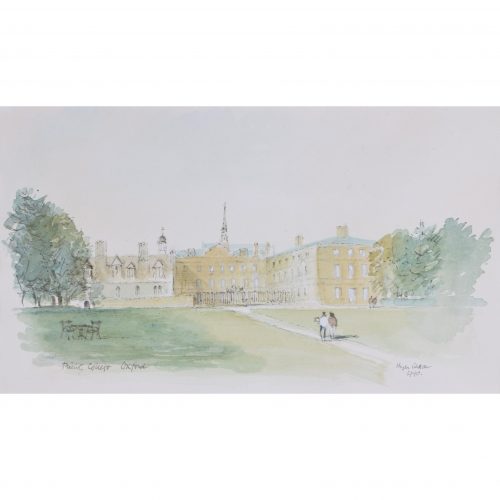
Hugh Casson (1910 - 1999)
Trinity College, Oxford (1990)
Watercolour 20 x 33 cm (38 x 50 cm framed) Casson's marvellous watercolour of Trinity and its perfectly manicured lawns, adorned with strolling undergraduates. Sir Hugh Casson was educated at Eastbourne College; St John’s College, Cambridge; and the Bartlett School of Architecture. Trained in the 1930s in the early modernist style, he taught at the Cambridge School of Architecture. After employment as a camoufleur during World War 2 by the Air Ministry, in 1948 he was appointed as director of architecture for the Festival of Britain. A close friend of the Royal Family, he undertook designs for the 1953 coronation, designed the interior of the Royal Yacht Britannia (“The overall idea was to give the impression of a country house at sea”), and taught the young Charles III to paint in watercolours. Amongst his architectural achievements are the Elephant House at London Zoo, the 1978 redevelopment of Bristol Docks, the Raised Staff Building for The University of Cambridge, and a building for the Royal College of Art. He published a number of illustrated books, of which Casson’s Oxford and Casson’s Cambridge are probably the best known. A limited edition series of prints was produced from the paintings. Condition: excellent. If you’d like to know more, please email info@manningfineart.co.uk or call us on 07929 749056. Click here for other views of Trinity College, Oxford. -
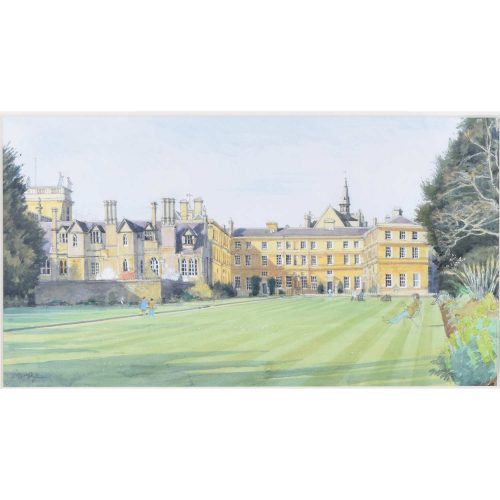
John Doyle (born 1928)
Trinity College, Oxford
Watercolour 24 x 46 cm Signed lower left. Doyle's striking portrayal of Trinity's architecture, complete with undergraduates variously strolling, sitting, and reading in the foreground. Afternoon sun slants over the immaculately mown lawns. John Doyle was born in London and works in watercolours, pastels, and oils. He studied at the Maidstone School of Art in his 30s, later showing at the Royal Academy Summer Exhibition. Much of his work focuses on landscape and architecture; he has produced a series of views of Oxford and its colleges. Condition: excellent. If you’d like to know more, please email info@manningfineart.co.uk or call us on 07929 749056. Click here for more views of Trinity College, Oxford. -

Joseph Constantine Stadler (1755 - 1828) after William Westall (1781 - 1850) Trinity Gate (1815)
Aquatint with original hand colouring 25 x 21 cm Published by Rudolph Ackermann (1764 - 1834). Trinity's towering gate, complete with the College's arms. Engraved for Ackermann's 'History of Cambridge'. Joseph Constantine Stadler was a prolific German émigré engraver of images after his contemporaries - here, 18th-century English landscape painter and diarist Joseph Farington. Stadler's engravings are wide-ranging in subject matter and include landscapes, seascapes and portraits, as well as military, sporting and decorative subjects. Stadler was employed by the leading print publisher of the time, John Boydell. Stadler lived in Knightsbridge when he died at the age of 73. William Westall was a British landscape artist. He was born in Hertford and enrolled at the Royal Academy schools in 1799. He later became the draughtsman for a voyage to Australia and the South Seas. After being shipwrecked, he travelled to Canton in China and to India, staying in Bombay for several months. He returned to England in 1805 but later set off for Madeira and Jamaica. He became a member of the Society of Painters in Water Colours (1811) and an associate of the Academy (1812). Following a mental breakdown, he regularly visited the Lake District and published ‘Views of the Valley and Vale of Keswick’ (1820). His series of aquatints of the Thames, the great universities, and England's public schools for Ackermann are among his most popular works. Rudolph Ackermann was an Anglo-German bookseller, inventor, lithographer, publisher and businessman. In 1795 he established a print-shop and drawing-school at 96 Strand. Here Ackermann set up a lithographic press and began a trade in prints. He later began to manufacture colours and thick carton paper for landscape and miniature painters. Within three years the premises had become too small and he moved to 101 Strand, in his own words "four doors nearer to Somerset House", the seat of the Royal Academy of Arts. Between 1797 and 1800 Ackermann rapidly developed his print and book publishing business, encompassing many different genres including topography, caricature, portraits, transparencies and decorative prints. Condition: Generally very good; slight toning to within platemarkIf you would like to know more, please email info@manningfineart.co.uk or call us on 07929 749056.
-
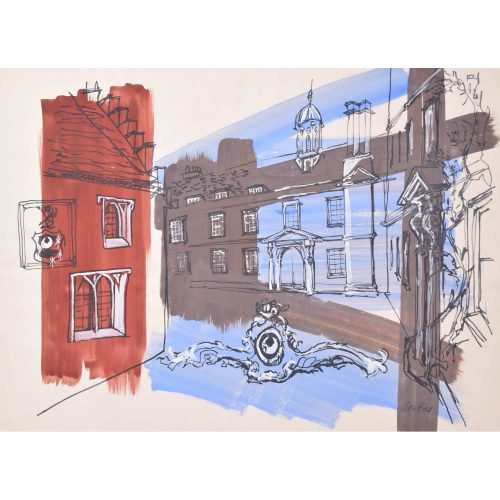
Margaret Souttar (1914 - 1987)
Trinity Hall, Cambridge I
Acrylic paint 55 x 76 cm Signed in pencil lower right. Souttar was a Scottish painter and printmaker known for her images of town- and cityscapes. In the early 1960s, she was commissioned to produce a series of prints of the Cambridge colleges. She captures the modernity and optimism of 1960s Cambridge; the fact that a female artist was commissioned to create the prints reflects the changing attitudes of the University towards women. Trinity Hall was one of the first Cambridge colleges to admit women as students - it did not do so until 1976. Provenance: the artist's studio sale. Condition: generally very good, a few handling marks. If you are interested, please email info@manningfineart.co.uk or call us on 07929 749056. Click here for other views of Trinity Hall. -
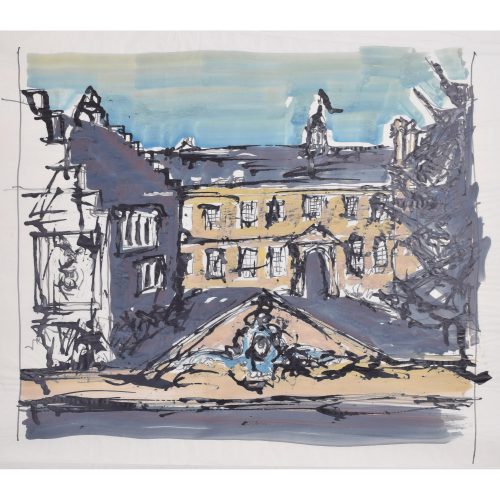
Margaret Souttar (1914 - 1987)
Trinity Hall, Cambridge II
Acrylic paint 56 x 65 cm cm Souttar was a Scottish painter and printmaker known for her town- and cityscapes. In the early 1960s, she was commissioned to produce a series of prints of the Cambridge colleges. She captures the modernity and optimism of 1960s Cambridge; the fact that a female artist was commissioned to create the prints reflects the changing attitudes of the University towards women. Trinity Hall was one of the first Cambridge colleges to admit women as students – it did not do so until 1976.6. Provenance: the artist's studio sale. Condition: generally very good, some crinkling as a result of using water-based paints on thin paper. If you are interested, please email info@manningfineart.co.uk or call us on 07929 749056. Click here for other views of Trinity Hall. -
Out of stock
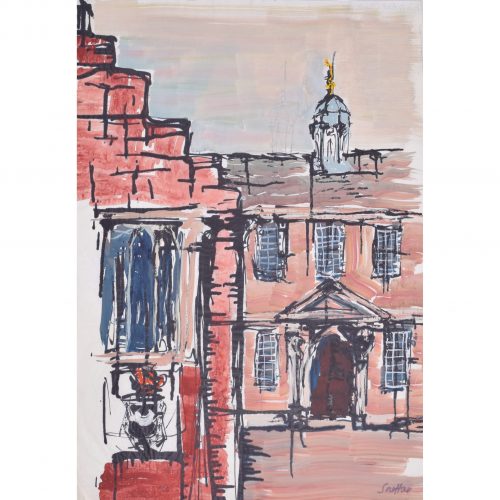
Margaret Souttar (1914 - 1987)
Trinity Hall, Cambridge IV
Acrylic paint 62 x 92 cm Signed lower right. Souttar was a Scottish painter and printmaker known for her images of town- and cityscapes. In the early 1960s, she was commissioned to produce a series of prints of the Cambridge colleges. She captures the modernity and optimism of 1960s Cambridge; the fact that a female artist was commissioned to create the prints reflects the changing attitudes of the University towards women. Trinity Hall was one of the first Cambridge colleges to admit women as students – it did not do so until 1976. Provenance: the artist's studio sale. Condition: generally very good; on thin paper - some crinkling to paper as a result of being painted. Further sketch to reverse. If you are interested, please email info@manningfineart.co.uk or call us on 07929 749056. Click here for other views of Trinity Hall. -
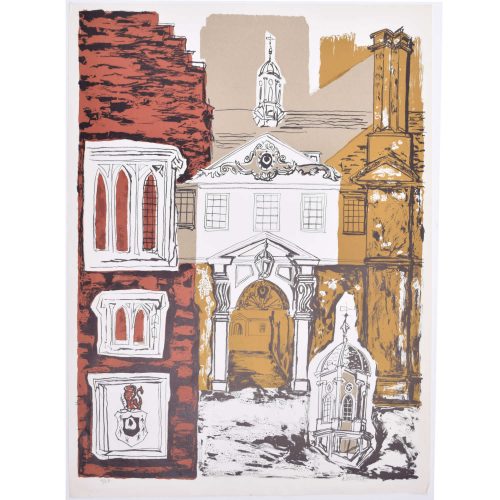
Margaret Souttar (1914 - 1987)
Trinity Hall, Cambridge
Lithograph 76 x 56 cm Signed and numbered 4/50 in pencil. Souttar was a Scottish painter and printmaker known for her images of town- and cityscapes. In the early 1960s, she was commissioned to produce a series of prints of the Cambridge colleges. She captures the modernity and optimism of 1960s Cambridge; the fact that a female artist was commissioned to create the prints reflects the changing attitudes of the University towards women. Trinity Hall was one of the first Cambridge colleges to admit women as students - it did not do so until 1976. Provenance: the artist's studio sale. Condition: generally very good; a few handling marks. If you are interested, please email info@manningfineart.co.uk or call us on 07929 749056. Click here for other views of Trinity Hall. -
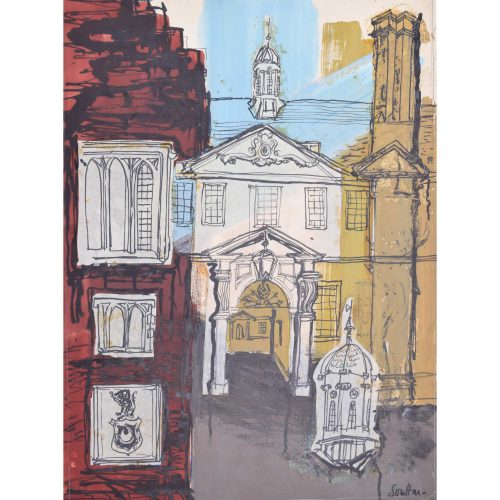
Margaret Souttar (1914-1987)
Trinity Hall, Cambridge
Acrylic on paper 76 x 56 cm Signed lower right. Souttar was a Scottish painter and printmaker known for her images of town- and cityscapes. In the early 1960s, she was commissioned to produce a series of prints of the Cambridge colleges. She captures the modernity and optimism of 1960s Cambridge; the fact that a female artist was commissioned to create the prints reflects the changing attitudes of the University towards women. Trinity Hall was one of the first Cambridge colleges to admit women as students - it did not do so until 1976. Provenance: the artist's studio sale. Condition: generally very good; some small glue stains around collaging. If you are interested, please email info@manningfineart.co.uk or call us on 07929 749056. Click here for other views of Trinity Hall. -
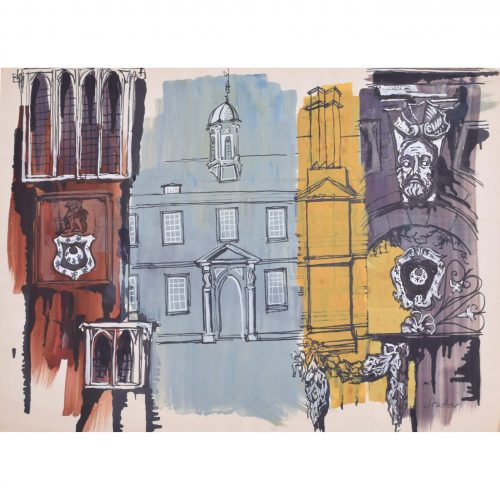
Margaret Souttar (1914 - 1987)
Trinity Hall, Cambridge V
Acrylic paint 56 x 72 cm Signed lower right. Souttar was a Scottish painter and printmaker known for her images of town- and cityscapes. In the early 1960s, she was commissioned to produce a series of prints of the Cambridge colleges. She captures the modernity and optimism of 1960s Cambridge; the fact that a female artist was commissioned to create the prints reflects the changing attitudes of the University towards women. Trinity Hall was one of the first Cambridge colleges to admit women as students – it did not do so until 1976. Provenance: the artist's studio sale. Condition: generally very good. If you are interested, please email info@manningfineart.co.uk or call us on 07929 749056. Click here for other views of Trinity Hall. -
Out of stock
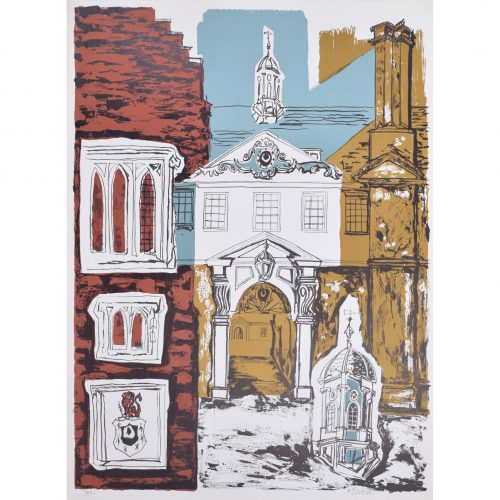
Margaret Souttar (1914 - 1987)
Trinity Hall, Cambridge with Blue Sky
Lithograph 76 x 56 cm Numbered 3/50, and signed lower right, in pencil. Souttar was a Scottish painter and printmaker known for her images of town- and cityscapes. In the early 1960s, she was commissioned to produce a series of prints of the Cambridge colleges. She captures the modernity and optimism of 1960s Cambridge; the fact that a female artist was commissioned to create the prints reflects the changing attitudes of the University towards women. Trinity Hall was one of the first Cambridge colleges to admit women as students - it did not do so until 1976. Provenance: the artist's studio sale. Condition: generally very good, the odd very short tear and handling mark affecting outer few millimetres of margin. If you are interested, please email info@manningfineart.co.uk or call us on 07929 749056. Click here for other views of Trinity Hall.