-
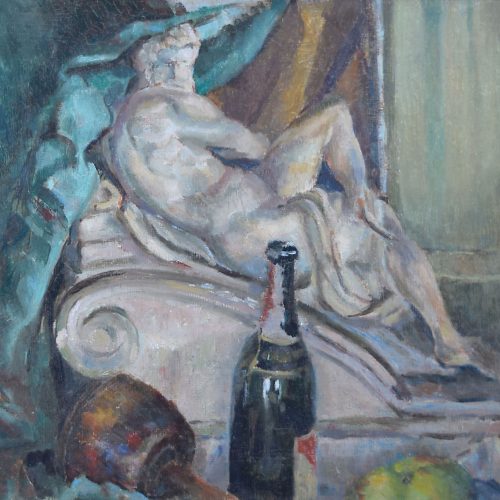 Sir Terry Frost (1915-2003) Bottle and Statue Oil on board c. 1947 38 x 46cm A distinctive still life featuring bottle, statue, and drapery. Terry Frost was a prominent British abstract artist. Frost is most noted for his simplistic abstract forms and unusual colour; he worked alongside the St Ives group and as Barbara Hepworth's assistant for several years, his artistic style being heavily influenced by them. In 1992 he became a Royal Academician, and he was made Sir Terry Frost in 1998. Bottle and Statue highlights Frost's unique compositional skill. His brushwork makes the statue seem like a real nude, who, framed by turquoise and ochre draperies, examines the still life in the foreground. An early work, painted shortly after the War and prior to his adoption of abstraction. For other works by Frost and biographical details please click here. Condition: A little craquelure in the oil above the statue's head.
 -
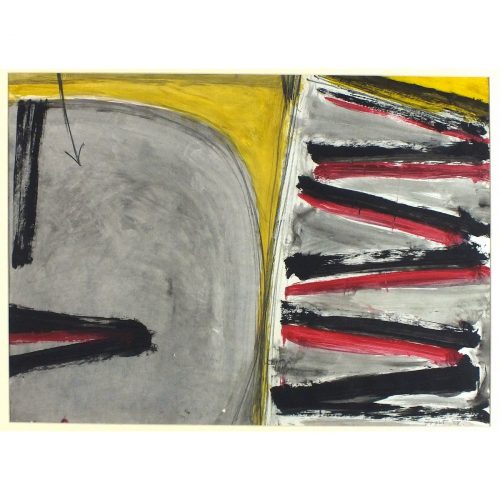
Terry Frost (1915-2003)
Autumnal Landscape in Red, Black and Yellow
Watercolour 40 x 58 cm Signed and dated 1958 Framed in hand-finished grey 'Nicholson' butt-jointed frame. Click here for biographical details and other works by the artist. If you are interested email info@manningfineart.co.uk or call us on 07929 749056. In 1954 Frost moved to Leeds to become Gregory Fellow at the University. This began a period when he painted yellow and black and white paintings, inspired by the Yorkshire landscape. In 1958 he joined the London group and then moved to St Ives. This painting dates to this era. -
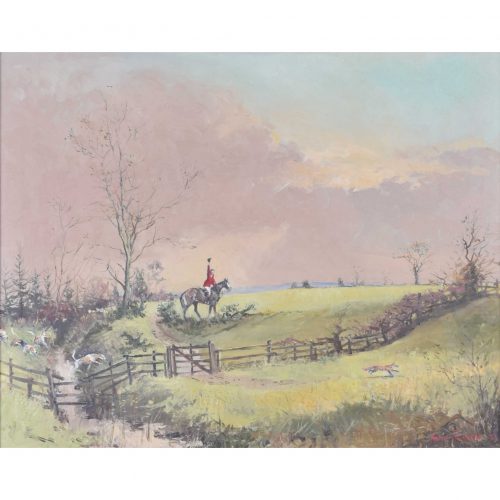
Robin Furness (born 1933)
The Three O'Clock Fox - Dobinson's Covert (1972)
Oil on canvas 40 x 50 cm Signed lower right. A delightful oil painting of the Raby Hunt at Bedburn by Robin Furness, former MFH of the Bedale Hunt and noted painter of hunting scenes. Condition: very good. If you’d like to know more, please email info@manningfineart.co.uk or call us on 07929 749056. -

James Basire & John Carter The Abbey Church of St Albans
Engraving 62 x 46 cm This engraving was originally published by the Society of Antiquaries of London, an organisation dedicated to studying and preserving historical monuments. Recognising St Albans Cathedral as one of England's most significant medieval structures, the society commissioned a series of engravings by James Basire--based on drawings by the architectural draughtsman John Carter. In doing so, the Antiquaries hoped to preserve and disseminate knowledge of England’s architectural heritage. Condition: Generally very good.If you would like to know more, please email info@manningfineart.co.uk or call us on 07929 749056.
-

Engraved by F. L. Griggs, drawn by Sir Muirhead Bone The Ashmolean and Balliol College, Oxford
Lithograph 31 x 47 cm Frederick Landseer Maur Griggs was a British etcher, draughtsman, and illustrator known for his highly detailed and atmospheric depictions of the English countryside. Born in Hitchin, Hertfordshire, in 1876, he trained at the Slade School of Fine Art in London before working as an illustrator for The Highways and Byways book series. Griggs became one of the leading figures of the British etching revival in the early 20th century. His works, often depicting medieval-inspired landscapes and architectural scenes, evoke a deep sense of nostalgia and romanticism. His meticulous technique and ability to capture mood through fine lines and shading earned him a place in the Royal Academy and the Royal Society of Painter-Etchers. Later in life, he settled in Chipping Campden, where he dedicated himself to preserving traditional English architecture. His etchings remain celebrated for their poetic detail and craftsmanship. Griggs passed away in 1938, leaving behind a legacy as one of Britain’s finest etchers. This lithograph of an etching he completed of the Ashmolean and Balliol College showcases both his strong sense of architectural perspective and his ability to masterfully capture the atmosphere of a scene: scholars walk by in gowns, city dwellers trundle down the wide Oxford streets on their bikes, one person advertises a play taking place in Oxford at the time. This is not a mere architectural drawing, but is rather a living breathing city scape, though black-and-white it is full of the colour of urban life. Condition: Generally very good.If you would like to know more, please email info@manningfineart.co.uk or call us on 07929 749056.
-
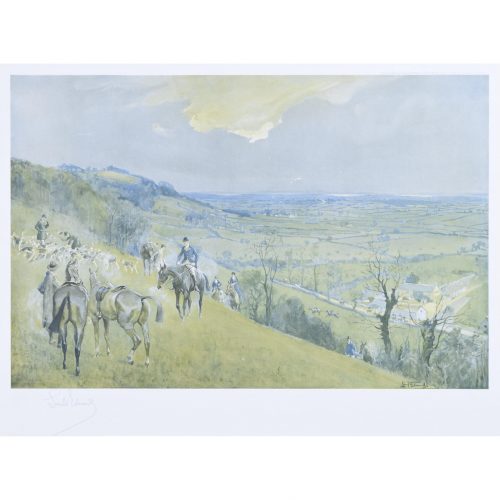
Lionel Edwards (1878 - 1966)
The Beaufort Hunt. Kill Above Sodbury Vale. (1925)
Lithograph 38 x 52 cm Signed in plate lower right and in pencil lower left outside the plate. Printed and Published by Eyre and Spottiswoode. A Lionel Edwards lithograph depicting the Beaufort - part of the artist's 1925 'Hunting Countries' series. The Beaufort's hunt dress is peculiar to the country in that the Huntsman and Whippers-In wear green and the subscribers a blue coat with buff facings. The earliest records of hounds being kennelled at Badminton date back to 1640 when the then Marquis of Worcester hunted mainly deer, but hare and fox as well. Dukes of Beaufort have either hunted hounds themselves or have been in the Mastership since the title was created in 1682 and the hounds, kennels and stables still belong to them. The 10th Duke was master from 1924 to 1984 and so great was his contribution to foxhunting he became universally known as "Master". The Beaufort is one of the few remaining private packs. Lionel Edwards was a British artist who specialised in pictures of country life, particularly horses, and provided illustrations for Country Life. He is best known for his hunting scenes but also painted pictures of horse racing, shooting and fishing. Condition: generally very good; some fading to the clouds. If you are interested, please email info@manningfineart.co.uk or call us on 07929 749056. Click here for other hunting pictures. -
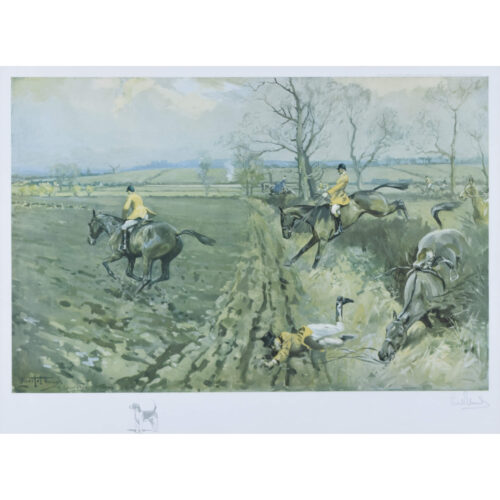
Lionel Edwards (1878 - 1966)
The Belvoir Hunt (1928)
Lithograph 31 x 51 cm Signed and dated in plate lower left, and in pencil outside plate lower left. A Lionel Edwards lithograph depicting the Belvoir - part of the artist's 'Hunting Countries' series. The Belvoir Hunt, sometimes known as the Duke of Rutland's Hounds, dates from 1750 and became a foxhound pack in 1762. Since then, the kennels have been located at Belvoir Castle. Lionel Edwards was a British artist who specialised in pictures of country life, particularly horses, and provided illustrations for Country Life. He is best known for his hunting scenes but also painted pictures of horse racing, shooting and fishing. Condition: print good; original handsome period frame; small area of loss to top of frame. If you are interested, please email info@manningfineart.co.uk or call us on 07929 749056. Click here for other hunting pictures. -
Out of stock
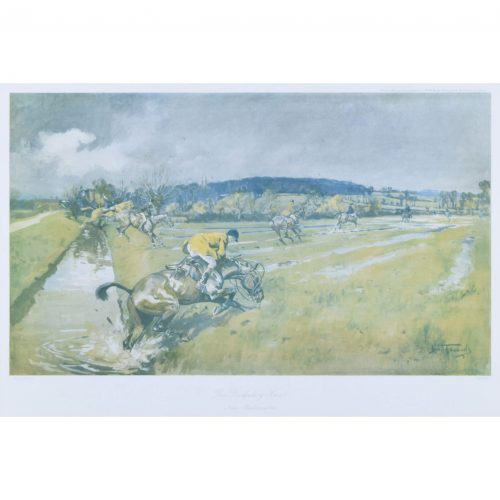
Lionel Edwards (1878 - 1966)
The Berkeley Hunt - Near Rockhampton (1925)
Lithograph 34 x 51 cm Signed in plate lower right. In original 3/4" black frame. A Lionel Edwards lithograph depicting the Berkeley - part of the artist's 1925 'Hunting Countries' series. The yellow coats with green collars and the running fox on the lapel are worn by the Masters and Hunt Staff and are unique in hunting circles, representing the outdoor livery of the Berkeley family; the ladies' colours of navy and maroon represent the indoor livery. The Berkeley is the oldest pack in the country and is one of the very few that are still family owned. The Fifth Earl of Berkeley could hunt his hounds from Berkeley Castle to Berkeley Square in London and had six kennels along the route. The season would start in Berkeley and progress to each of his kennels to London and then in stages back again to Gloucestershire. The present kennels date from the early 18th century and are home to around 90 hounds. Lionel Edwards was a British artist who specialised in pictures of country life, particularly horses, and provided illustrations for Country Life. He is best known for his hunting scenes but also painted pictures of horse racing, shooting and fishing. Condition: print generally good; the odd tiny spot in top left area. In original 3/4" black frame - some scratches to frame. If you are interested, please email info@manningfineart.co.uk or call us on 07929 749056. Click here for other hunting pictures. -
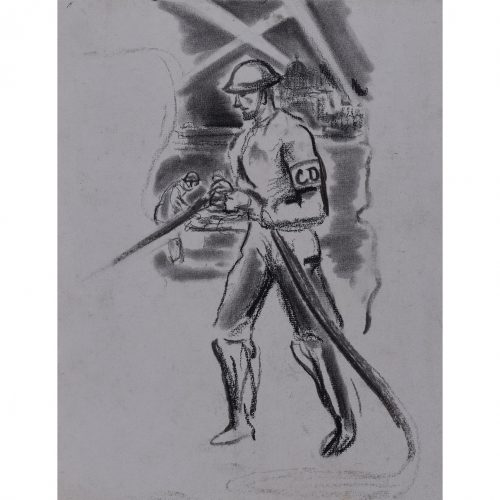
The Blitz: A Civil Defence Firefighter In Action before St Paul's Cathedral with Search Lights and Stretcher Bearers
Charcoal c. 1940 30x24cm A World War II Civil Defence firefighter, with 'CD' armband operates a fire hose as stretcher bearers work behind him, St Paul's cathedral being illuminated by searchlights. A typical night-time scene from London during the 1940 Blitz. If you are interested email info@manningfineart.co.uk or call us on 07929 749056. -

M R A Hollis The Old Bluecoat School
Pencil drawing 56 x 77 cm Professor Malcolm A Hollis was a chartered surveyor, arbitrator and professor of Building Pathology. He produced this architectural sketch while studying at the Liverpool College of Building. The work is characterised by clean lines and a strong sense of architectural perspective. His appreciation of architecture and attention to detail particularly shine through, however, in his careful depiction of the plaster mouldings on the columns. The Bluecoat School is the oldest building in both central Liverpool and the city's UNESCO World Heritage Site. It was originally built in 1717 to house the Blue Coat School for Orphans. After almost 200 years, the school moved to a different premises in 1906 and in 1907 the Sandon Studios Society, a breakaway from University of Liverpool’s School of Applied Art, moved into the vacant building, establishing one of the first dedicated art centres in the world. It continues to serve this purpose today and celebrated its 300 year anniversary in 2017. -

Messrs Stearn The 69th Boat Race at Hammersmith, 1912
Albumen print 16 x 21 cm This photograph depicts Oxford and Cambridge neck and neck at Hammersmith in the 1912 Oxford-Cambridge boat race. This event turned into a dramatic showdown. Oxford went into the race as reigning champions, having won the previous year's race. The 1912 race took a disastrous turn, however, as the event on the 30th of March ended in Cambridge sinking, Oxford waterlogged and the event being declared a 'no-race.' In the subsequent re-row on the following Monday, the race was won by Oxford by six lengths. Condition: A few soft creases and an old fold towards left edge.If you would like to know more, please email info@manningfineart.co.uk or call us on 07929 749056.
-

A. E. Halliwell (1905-1987) The Boat Race
Gouache 28 x 32 cm c.1930 Signed on separate piece mounted to reverse of frame Provenance: Family of the artist A.E. Halliwell (1905–1986) was a British artist, illustrator, and designer best known for his vibrant poster designs created for British railway companies during the mid-20th century. Born in Southport, Halliwell developed a strong foundation in art and design early in life. He studied at the Southport School of Art from 1923 to 1926 before graduating to the Royal College of Art in London and subsequently practising as a professional designer from the 1930s. Following his studies, Halliwell married Doris Doyle in Strood Kent, and went on to have a significant teaching career himself, most notably as a lecturer at the Central School of Arts and Crafts (later part of Central Saint Martins), where he influenced a new generation of designers and illustrators. Halliwell is perhaps best remembered for his vibrant and engaging poster designs created for British railway companies during the 1930s. His work was characterised by a bright, graphic style that balanced charm with clarity, often depicting idealised scenes of British holiday destinations—from sunny seaside towns to tranquil countryside vistas. Beyond posters, his artistic output included book illustration, commercial design, and stage costume sketches, showcasing his versatility across mediums. His posters continue to remain enduring symbols of a golden age of British travel and design and are displayed in major collections including the London Transport Museum and the V & A. This vibrant Underground poster design by A.E. Halliwell captures the rhythmic energy of the annual Boat Race with stylised, synchronised abstracted rowers and undulating water patterns. Using bold lines, mirrored symmetry, and a cool palette of blues and greens, Halliwell creates a dynamic sense of movement and celebration, perfectly evoking the spectacle and tradition of the iconic sporting event. Condition: Generally very good.If you would like to know more, please email info@manningfineart.co.uk or call us on 07929 749056.
-
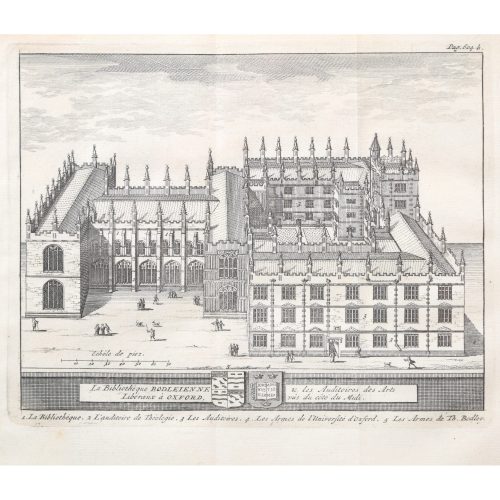
Pieter van der Aa (1659-1733), after David Loggan (1634–1692)
The Bodleian Library, Oxford (1727)
Engraving 12 x 16 cm An eighteenth-century view of the beautiful Bodleian Library, engraved by Pieter van der Aa after David Loggan, the noted engraver, draughtsman, and painter. Pieter van der Aa of Leiden was a Dutch publisher best known for preparing maps and atlases, though he also printed editions of foreign bestsellers and illustrated volumes. He is noted for the many engravings he produced after David Loggan's series of Oxford and Cambridge colleges and costumes. In 1727 Van Der Aa illustrated "Les Delices de la Grande Bretagne & de L'Irelande" by James Beeverell, the book in which this engraving appears. Condition: a good impression. If you’d like to know more, please email info@manningfineart.co.uk or call us on 07929 749056. -
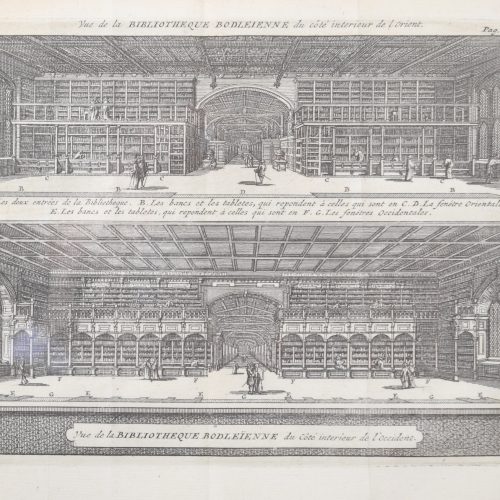
Pieter van der Aa (1659-1733), after David Loggan (1634–1692)
The Bodleian Library, University of Oxford
Engraving (1727) 12 x 16 cm An eighteenth-century view of the interior of the Bodleian Library, engraved by Pieter van der Aa after David Loggan, the noted engraver, draughtsman, and painter. Pieter van der Aa of Leiden was a Dutch publisher best known for preparing maps and atlases, though he also printed editions of foreign bestsellers and illustrated volumes. He is noted for the many engravings he produced after David Loggan's series of Oxford and Cambridge colleges and costumes. In 1727 Van Der Aa illustrated "Les Delices de la Grande Bretagne & de L'Irelande" by James Beeverell, the book in which this engraving appears. Condition: a good impression. If you are interested, please email info@manningfineart.co.uk or call us on 07929 749056. -

Colin Moss (1914 - 2005)
The Cedars, Kensington
Watercolour and gouache 57 x 40 cm Signed and dated '50 lower right. Moss' view of the Cedars, complete with passers-by and a stormy, jagged sky. Colin Moss was a noted British painter, draughtsman, printmaker, and teacher who served as a camoufleur during the Second World War. Moss was born in Ipswich but grew up in Plymouth following the death of his father at the Battle of Passchendaele in 1917. Moss studied at the Plymouth Art School from 1930 to 1934 and then went on to the Royal College of Art, where he studied under Gilbert Spencer and Charles Mahoney. He worked on murals for the British Pavilion at the 1939 New York World's Fair. During the war, Moss made a series of watercolours depicting his time as a camoufleur. He had designed the camouflage scheme for Stonebridge Power Station in Wembley, and produced several watercolours of the camouflaged structure. These pictures, as well as several others painted during his WWII deployment, are now held by the Imperial War Museum, having been purchased by the War Artists' Advisory Committee. In 1947 Moss' military service ended, and he became a teacher at the Ipswich School of Art. He had solo exhibitions at the Kensington Art Gallery in 1951 and the Zwemmer Gallery in 1955, and his work began to be acquired by the national collections. He became a founder member of the New Ipswich Art Group in 1958, and the Six in Suffolk Group in 1976. In the 1970s he exhibited at the Royal Academy and the Royal Watercolour Society, and retrospective exhibitions of his work were held at various British art galleries throughout the 1980s. He continued to hold numerous solo exhibitions after his retirement, and taught artists Brian Eno and Maggi Hambling. Provenance: "Britain in Watercolours" exhibition. Condition: excellent. If you’d like to know more, please email info@manningfineart.co.uk or call us on 07929 749056. -

James Basire & Robert Blemmell Schnebbelie The Chancel of Chatham Church, Kent
Engraving 48 x 33 cm This engraving was originally published by the Society of Antiquaries of London, an organisation dedicated to studying and preserving historical monuments. The society commissioned a series of architectural engravings by James Basire, this one based on a drawing the English painter and illustrator Robert Blemmell Schnebbelie. In doing so, the Antiquaries hoped to preserve and disseminate knowledge of England’s architectural heritage. This engraving depicts the Chancel of Chatham Church, Kent, 'as it appeared the 13th March 1788.' Across three figures, Schnebbelie depicts the dismantling of the church, illustrating the ornate finds uncovered by the workers and their pickaxes. Condition: Generally very good.If you would like to know more, please email info@manningfineart.co.uk or call us on 07929 749056.
-
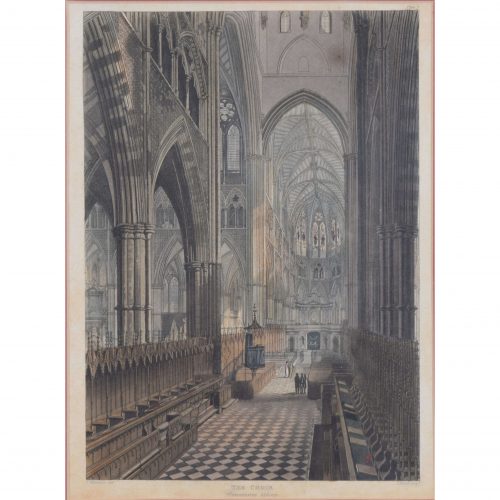
J Black (early 19th century) after Frederick Mackenzie (1788 - 1854)
The Choir, Westminster Abbey (1812)
Hand-coloured aquatint 28 x 19 cm Published by Rudolph Ackermann (1764 - 1834). An engraving of the vast and soaring interior of Westminster Abbey. Mackenzie's drawing was engraved by Black and published by Ackermann in his 1812 "History of Westminster Abbey". The Abbey is an historic, mainly Gothic church in the City of Westminster, London, just to the west of the Palace of Westminster. It is one of the United Kingdom's most notable religious buildings and since Edward the Confessor, a burial site for English and, later, British monarchs. Since the coronation of William the Conqueror in 1066, all coronations of English and British monarchs have occurred in Westminster Abbey. Sixteen royal weddings have occurred at the abbey since 1100. According to a tradition first reported circa 1080, a church was founded at the site (then known as Thorney Island) in the seventh century, in the time of Mellitus, Bishop of London. Construction of the present church began in 1245 on the orders of Henry III. Frederick Mackenzie (1788 - 1854) was a British watercolourist and architectural draughtsman. He first exhibited at the Royal Academy in 1804, and contributed eleven drawings between that year and 1828. He contributed to the Society of Painters in Water Colours exhibitions from 1813, becoming an associate in 1822, and a full member the following year. From 30 November 1831 till his death he was treasurer to the society. In later life Mackenzie was no longer commissioned to illustrate books. Rudolph Ackermann was an Anglo-German bookseller, inventor, lithographer, publisher and businessman. In 1795 he established a print-shop and drawing-school at 96 Strand. Here Ackermann set up a lithographic press and began a trade in prints. He later began to manufacture colours and thick carton paper for landscape and miniature painters. Within three years the premises had become too small and he moved to 101 Strand, in his own words "four doors nearer to Somerset House", the seat of the Royal Academy of Arts. Between 1797 and 1800 Ackermann rapidly developed his print and book publishing business, encompassing many different genres including topography, caricature, portraits, transparencies and decorative prints. Condition: good. Some age toning. If you’d like to know more, please email info@manningfineart.co.uk or call us on 07929 749056. -

Joseph Constantine Stadler (1755 - 1828) after Frederick Mackenzie (1788 - 1854) The Clarendon Printing House, Theatre & Museum (1814)
Aquatint with original hand colouring 21 x 27 cm Published by Rudolph Ackermann (1764 - 1834). Frederick Mackenzie (circa 1788 - 1854) was a British watercolourist and architectural draughtsman. He first exhibited at the Royal Academy in 1804, and contributed eleven drawings between that year and 1828. He contributed to the Society of Painters in Water Colours exhibitions from 1813, becoming an associate in 1822, and a full member the following year. From 30 November 1831 until, his death he was treasurer to the society. In later life Mackenzie was no longer commissioned to illustrate books. Joseph Constantine Stadler was a prolific German émigré engraver of images after his contemporaries - here, 18th-century English landscape painter and diarist Joseph Farington. Stadler's engravings are wide-ranging in subject matter and include landscapes, seascapes and portraits, as well as military, sporting and decorative subjects. Stadler was employed by the leading print publisher of the time, John Boydell. Stadler lived in Knightsbridge when he died at the age of 73. Rudolph Ackermann was an Anglo-German bookseller, inventor, lithographer, publisher and businessman. In 1795 he established a print-shop and drawing-school at 96 Strand. Here Ackermann set up a lithographic press and began a trade in prints. He later began to manufacture colours and thick carton paper for landscape and miniature painters. Within three years the premises had become too small and he moved to 101 Strand, in his own words "four doors nearer to Somerset House", the seat of the Royal Academy of Arts. Between 1797 and 1800 Ackermann rapidly developed his print and book publishing business, encompassing many different genres including topography, caricature, portraits, transparencies and decorative prints. Condition: Generally very good.If you would like to know more, please email info@manningfineart.co.uk or call us on 07929 749056.
-
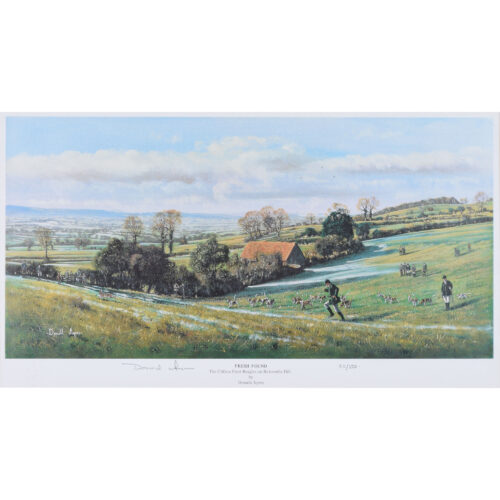
Donald Ayres (b. 1936)
The Clifton Foot Beagles on Butcombe Hill
Lithograph 24 x 44 cm Signed and numbered 423/500. A lithograph of the Clifton Foot Beagles, now the Chilmark and Clifton Foot Beagles. Donald Ayres is a landscape painter specialising in country sports such as hunting, shooting, and fishing. His work has been exhibited in most of the major commercial galleries in Britain, as well as many in Europe and America. Condition: very good. If you are interested, please email info@manningfineart.co.uk or call us on 07929 749056. Click here for other hunting pictures. -
Ken Messer (1931 - 2018)
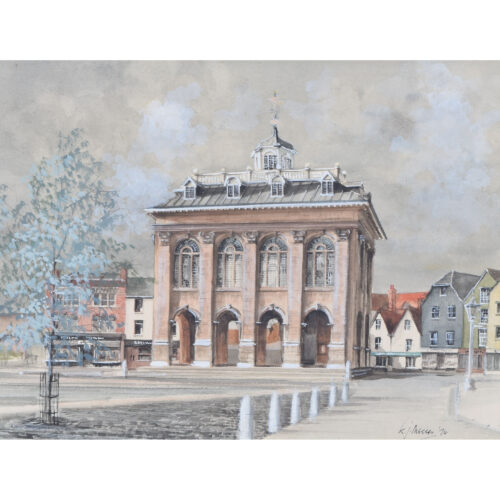
The County Hall, Abingdon (1974)
Watercolour 24 x 32 cm Signed and dated lower right. The painter and draughtsman Ken Messer is closely related to Oxford and its architecture in several ways. Born in Newport, South Wales, he was educated at the City of Oxford High School for Boys in Oxford, and then spent six years working as an accountant in Oxford. He then joined British Overseas Airways Corporation (BOAC) as a steward, flying internationally. Injury due to a car accident during the 1960s meant that he joined the design department of Pergamon Press in Oxford at the age of 33. Six years later, he was appointed to the position of studio manager, in charge of art and design. In 1974, Messer left Pergamon Press to become a freelance graphic designer. He started painting more watercolours, becoming a full-time artist. During the 1980s, his ink drawings were regularly published in the Oxford Times. He has sometimes been called "The Oxford Artist" because of his large number of works depicting Oxford. He and his wife Dilys lived at first in Richmond upon Thames and then in Abingdon, just south of Oxford. Messer's work has been shown at the Mall Galleries for the annual exhibitions of the Royal Institute of Painters in Water Colours annual exhibitions. Condition: very good. If you are interested, please email info@manningfineart.co.uk or call us on 07929 749056. -

Val Doone The Crooked Spire, Chesterfield
76 x 51 cm Lithograph Published by the Travel Association of Great Britain and N.Ireland this beautiful photographic image encouraged travel to Chesterfield and the United Kingdom more generally. This poster was part of a broader series released in 1947/48 by the British Travel Association to coincide with the 1948 Olympic Games in London in an effort to bring international tourism back to the United Kingdom after the Second World War. Val Doone was an English photographer active during the early to mid-20th century, renowned for capturing quintessential British landscapes and scenes. He often produced material for the tourism boards and, over the years, proved his ability to capture the allure of British landscapes to entice tourism. Condition: Generally excellent, the odd very minor handling mark.If you would like to know more, please email info@manningfineart.co.uk or call us on 07929 749056.
-
David Loggan (1634 - 1692)
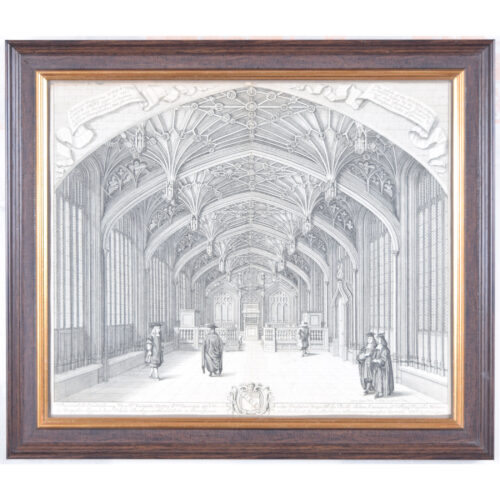
The Divinity School, Oxford (1675)
Engraving 33 x 41 cm David Loggan's view of Oxford's medieval Divinity School, which was once the beating heart of theological studies at the University. Of particular interest here is the trompe l'oeil scroll of torn paper which frames the view. Loggan was born to English and Scottish parents, and was baptised in Danzig in 1634. After studying engraving in Danzig with Willem Hondius (1598-1652 or 1658), he moved to London in the late 1650s, going on to produce the engraved title-page for the folio 1662 Book of Common Prayer. He married in 1663 and moved to Nuffield in Oxfordshire in 1665. Loggan was appointed Public Sculptor to the nearby University of Oxford in the late 1660s, having been commissioned to produce bird’s-eye views of all the Oxford colleges. He lived in Holywell Street as he did this. The 'Oxonia Illustrata' was published in 1675, with the help of Robert White (1645-1704). Following its completion, Loggan began work on his equivalent work for Cambridge; the 'Cantabrigia Illustrata' was finally published in 1690, when he was made engraver to Cambridge University. The 'Oxonia Illustrata' also includes an engraving of Winchester College (Winchester and New College share William of Wykeham as their founder) whilst the 'Cantabrigia Illustrata' includes one of Eton College (which shares its founder, Henry VIII, with King’s College). Bird’s-eye views from this era required a particular talent as an architectural perspectivist; it was not until 1783 that it became possible for artists to ascend via hot air balloons and view the scenes they were depicting from above. Loggan thus had to rely on his imagination in conceiving the views. Loggan’s views constitute the first accurate depictions of the two Universities, in many ways unchanged today. Whilst the Oxford engravings were produced in reasonable numbers and ran to a second edition by Henry Overton (on thicker paper and with a plate number in Roman numerals in the bottom right-hand corner), those of Cambridge were printed in much smaller numbers. The Dutchman Pieter van der Aa published some miniature versions of the engravings for James Beverell’s guidebook to the UK, 'Les Delices de la Grande Bretagne' (circa 1708). The contemporary artist Andrew Ingamells (born 1956) has produced a highly-acclaimed series of etchings which bring Loggan’s original vision up to date. Condition: trimmed within platemark and mounted to board, otherwise in very good condition. If you are interested, please email info@manningfineart.co.uk or call us on 07929 749056. Click here for other general views of Oxford. -
Out of stock
William Williams (Welsh, active 1724 - 1733)
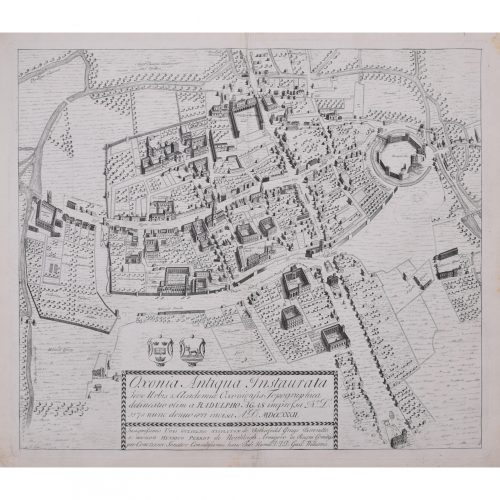
The First Map of Oxford (1733)
Engraving 47 x 54 cm In 1578, Ralph Agas drew the first ever map of Oxford, studded with the first colleges of the University. In 1733 it was engraved by William Williams for publication in the Oxonia Depicta, a book of illustrations depicting similar views as David Loggan's volume of engravings. Ralph Agas was an English surveyor and cartographer. He was born in Suffolk and lived there throughout his life, although he travelled regularly to London. He began to practise as a surveyor in about 1566, and has been described as "one of the leaders of the emerging body of skilled land surveyors". regular work consisted of drawing up local estate maps and surveys for a variety of clients. He was one of the first estate surveyors to move beyond the traditional practice of compiling purely written descriptions of landed property, and to supplementing them with measured maps. Condition: generally very good; a few marks to margins. Central fold as issued. If you’d like to know more, please email info@manningfineart.co.uk or call us on 07929 749056. Click here for other general views of Oxford. -
Lucas Vorsterman (1595 - 1675) after Peter Paul Rubens (1577 - 1640)
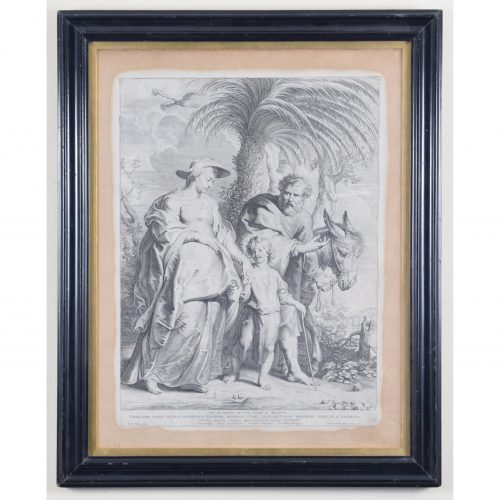
The Flight into Egypt (1620)
Engraving 30 x 45 cm Rare. We have only been able to trace one copy at auction, 2019, Izegem, Belgium. A copy of this print is held by the British Museum (R,3.50). Mary, Joseph, and the infant Christ escape into Egypt on a donkey. Lucas Vorsterman was a Baroque engraver. He worked with the artists Peter Paul Rubens and Anthony van Dyck, as well as for patrons such as Thomas Howard, 21st Earl of Arundel and Charles I of England. Condition: mounted to old paper; trimmed to platemarks; two areas of repair in region of Mary's left hand and Christ's right knee (see photo). In old ebonised frame. If you are interested, please email info@manningfineart.co.uk or call us on 07929 749056. -
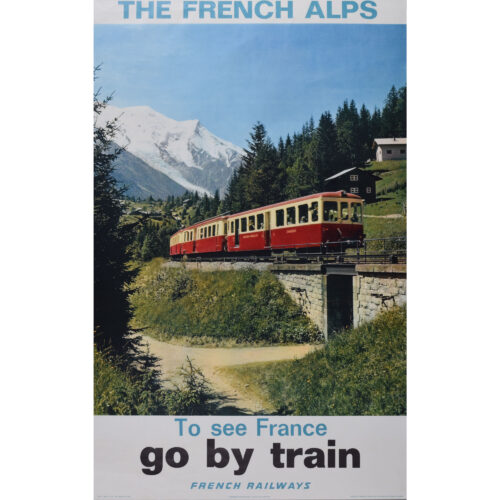
The French Alps - To See France, Go by Train (1966)
Original vintage poster 100 x 66 cm This French Railways poster encourages tourism to the French Alps, where the railway views are (and always have been) particularly charming. Condition: generally very good. If you are interested, please email info@manningfineart.co.uk or call us on 07929 749056. Click here for other original vintage travel posters. -
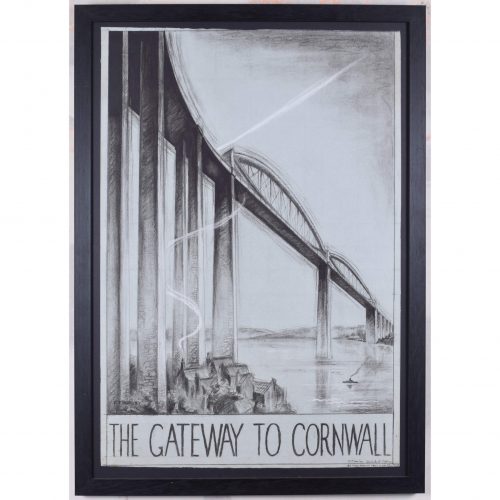
Ronald T Horley (active 1930s - 1940s)
The Gateway to Cornwall
Charcoal heightened with white 76 x 53 cm Signed and inscribed lower right 'Architect's Office, 83 Marlborough Place NW8 Marylebone'. The Great Western Railway commissioned a series of posters promoting train travel around the UK. This charcoal drawing of the Royal Albert Bridge at Saltash is the artist's original design for a poster encouraging rail travel to Devon and Cornwall. The bridge is known fondly as the 'Gateway to Cornwall'. The Royal Albert Bridge was designed by Isambard Kingdom Brunel. Surveying started in 1848 and construction commenced in 1854. The first main span was positioned in 1857 and the completed bridge was opened by Prince Albert on 2 May 1859. Condition: generally very good; a few isolated spots to bottom left corner. Click here for other original vintage travel posters and designs. -
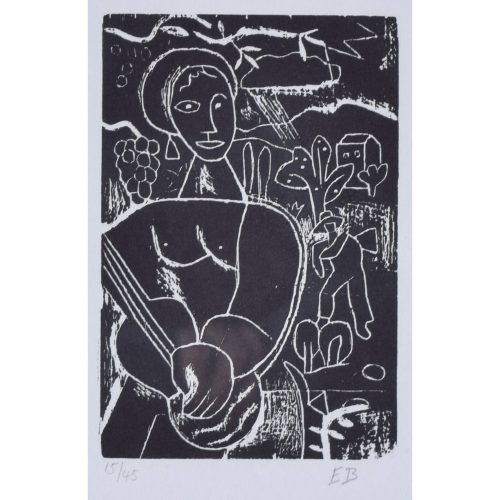
Edward Burra (1905 - 1976)
The Guitar Player
(1928 - 1929, this edition published 1971) Woodcut 15 x 10 cm; sheet size 34 x 24 cm Numbered 15/45 lower left and initialled EB lower right. Burra's woodcut of a female guitar player surrounded by a landscape of cacti. A bunch of grapes is pendent beside her triangular earring, and a male figure in a wide-brimmed hats stands in the field nearby. Edward Burra was an English painter, draughtsman, and printmaker. He travelled to Italy in 1925, the same year he met the noted British Surrealist Paul Nash, and both of these influences are evident in this woodcut. Nash introduced Burra to woodcut-making in 1928, the same year that Burra began this woodcut series. His first solo show was held at the Leicester Galleries in April 1929, and he exhibited with the English Surrealists in the 1930s. Condition: Excellent. If you’d like to know more, please email info@manningfineart.co.uk or call us on 07929 749056. -
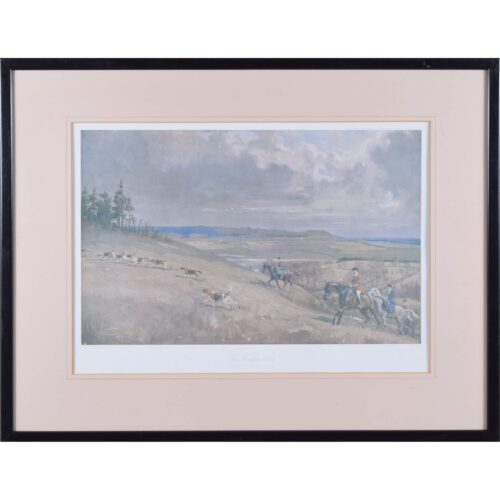
Lionel Edwards (1878 - 1966)
The Hertfordshire Hunt (1927)
Lithograph 36 x 50 cm Signed and dated in plate lower left. A Lionel Edwards lithograph depicting the Hertfordshire - part of the artist's 'Hunting Countries' series. The Hertfordshire Hunt was founded circa 1775 by the Countess of Salisbury, of Hatfield House. Lionel Edwards was a British artist who specialised in pictures of country life, particularly horses, and provided illustrations for Country Life. He is best known for his hunting scenes but also painted pictures of horse racing, shooting and fishing. Condition: print generally good; a couple of tiny scuffs to surface. Modern frame. If you are interested, please email info@manningfineart.co.uk or call us on 07929 749056. Click here for other hunting pictures. -
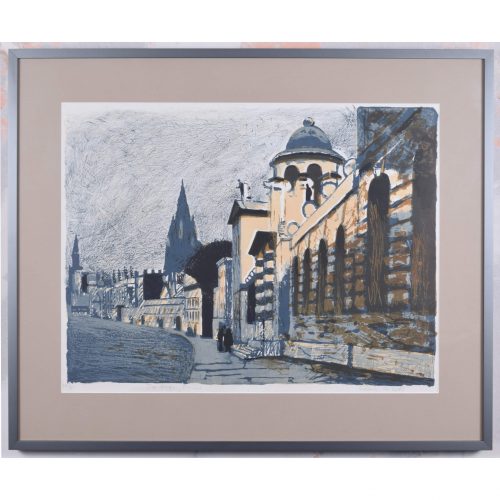
Edwin La Dell (1914-1970)
The High, Oxford
Lithograph 49 x 64 cm Signed, titled, and number 28/80 in pencil. A beautiful depiction of the golden Headington stone of Queen's College on the High Street, Oxford. The cupola above the college's entrance, and, in the background, the shadowy spire of the University Church of St Mary the Virgin, rise into the blustery sky. La Dell studied at the Sheffield School of Art, where he won a scholarship to the Royal College of Art. From 1934 to 1940 John Nash was the head of printmaking there, and taught La Dell. La Dell himself became head of lithography there in 1948, and remained in post until his death. During the war La Dell was an official war artist and a camofleur, but he is probably best known for his lithographs of Oxford and Cambridge that he published himself. His works are widely held in the public collections, including the Royal Academy and the Government Art Collection, the latter of which holds many of his views of Cambridge. Condition: very good. If you are interested, please email info@manningfineart.co.uk or call us on 07929 749056. Click here for other views of Queen's College, Oxford. -

The Holy Land - National Savings (1950)
Original vintage poster 100 x 76 cm This informative poster was produced to advertise the National Savings scheme and distributed to schools, where it might encourage from the classroom wall both knowledge of the Holy Land's sites and financial responsibility. Condition: generally very good; previously folded; pin holes to corners; tiny loss to top left corner; and a little creasing to very edges. If you are interested, please email info@manningfineart.co.uk or call us on 07929 749056. Click here for other original vintage National Savings posters. -

James Basire & Robert Blemmell Schnebbelie The Holy Sepulchre at Heckington in Lincoln
Engraving 45 x 30 cm This engraving was originally published by the Society of Antiquaries of London, an organisation dedicated to studying and preserving historical monuments. Recognising it as one of England's most significant medieval structures, the society commissioned a series of architectural engravings in 1810 by James Basire, this one based on a drawing the English painter and illustrator Robert Blemmell Schnebbelie. In doing so, the Antiquaries hoped to preserve and disseminate knowledge of England’s architectural heritage. This engraving depicts the Holy Sepulchre at Heckington in the County of Lincoln. It illustrates the remarkable Easter Sepulchre at St Andrew's Church, Heckington. This carved structure features striking Gothic tracery, religious figures, and scenes related to Christ’s resurrection, all captured excellently by Basire's precision in engraving. Condition: Generally very good.If you would like to know more, please email info@manningfineart.co.uk or call us on 07929 749056.
-

James Basire & Robert Blemmel Schnebbelie The Holy Sepulchre at Northwold in the county of Norfolk
Engraving 45 x 60 cm This engraving was originally published by the Society of Antiquaries of London, an organisation dedicated to studying and preserving historical monuments. The society commissioned a series of architectural engravings by James Basire, this one based on a drawing by the English painter and illustrator Robert Blemmel Schnebbelie. In doing so, the Antiquaries hoped to preserve and disseminate knowledge of England’s architectural heritage. This particular edition depicts the Holy Sepulchre at Northwold in Norfolk. This sepulchre probably dated to the late 15th century and was used for the Deposition and Resurrection rituals on Good Friday and Easter Sunday-- an in depth commentary on such sepulchre in Norfolk was written by Veronica Sekules for the University of Missouri. Condition: Generally very good.If you would like to know more, please email info@manningfineart.co.uk or call us on 07929 749056.
-

William Bunbury, engraved by James Bretherton The Hopes of the Family
Hand coloured engraving 26 x 36 cm c.1790 This engraving, titled "The Hopes of the Family – An Admission at the University", is satirical work by William Bunbury. The scene portrays a young man being presented for admission to the University of Cambridge. Although the title suggests that the boy is expected to achieve great things, his appearance and and general demeanour hint at incompetence or lack of enthusiasm, thus introducing an ironic paradox. This caricatural scene dates from the late 18th century, a period when William Bunbury, alongside James Gillray, Thomas Rowlandson, and Isaac Cruikshank, was producing humorous and often politically charged works. Their engravings frequently lampooned figures of authority, including politicians, clergy, and university officials. This engraving is therefore illustrative of its time, clearly representing broader trends in the unique convergence between art and politics. William Bunbury was an English caricaturist and illustrator known for his humorous depictions of 18th-century social life. Born in 1750 into an aristocratic family, he studied at St. Catharine’s College, Cambridge, where he developed a passion for art. Unlike many professional artists of his time, Bunbury was a gentleman amateur, meaning he pursued art for personal enjoyment rather than financial necessity. Though not as politically charged as contemporaries like James Gillray or Thomas Rowlandson, Bunbury’s style was more lighthearted and observational. His illustrations of rural life, student antics, and military themes were especially popular, influencing later British caricature. Although he passed away in 1811, he left a legacy of caricatures that wittily captured the unique humour and manners of Georgian England. Condition: Generally very good, slight age toning.If you would like to know more, please email info@manningfineart.co.uk or call us on 07929 749056.
-

A. E. Halliwell (1905-1987) The Jewel that is London
Airbrush and gouache 26 x 33 cm c.1930 Provenance: Family of the artist A.E. Halliwell (1905–1986) was a British artist, illustrator, and designer best known for his vibrant poster designs created for British railway companies during the mid-20th century. Born in Southport, Halliwell developed a strong foundation in art and design early in life. He studied at the Southport School of Art from 1923 to 1926 before graduating to the Royal College of Art in London and subsequently practising as a professional designer from the 1930s. Following his studies, Halliwell married Doris Doyle in Strood Kent, and went on to have a significant teaching career himself, most notably as a lecturer at the Central School of Arts and Crafts (later part of Central Saint Martins), where he influenced a new generation of designers and illustrators. Halliwell is perhaps best remembered for his vibrant and engaging poster designs created for British railway companies during the 1930s. His work was characterised by a bright, graphic style that balanced charm with clarity, often depicting idealised scenes of British holiday destinations—from sunny seaside towns to tranquil countryside vistas. Beyond posters, his artistic output included book illustration, commercial design, and stage costume sketches, showcasing his versatility across mediums. His posters continue to remain enduring symbols of a golden age of British travel and design and are displayed in major collections including the London Transport Museum. This eye-catching poster design by A. E. Halliwell features an image of Big Ben lit up against the night sky, painted at the centre of a diamond with the inscription 'The jewel that is London. Illuminations every night during September.' The angular geometric shapes and bold colour gradients of yellow, blue, and black give the piece a modernist sparkle, evoking both glamour and excitement. With playful typography and a whimsical pun ("Travel by Underground – Alight at Westminster"), the poster cleverly combines elegance with charm to promote London’s September illuminations as a must-see spectacle. Condition: Generally very good.If you would like to know more, please email info@manningfineart.co.uk or call us on 07929 749056.
-

Kerry Lee (1903 - 1988) The Life of William Shakespeare and Map of Stratford-upon-Avon
Original vintage poster 46 x 60 cm Published by Pictorial Maps Limited, Kerry Lee's own company c.1965 This edition of the map was produced around 1965. It depicts a map of Stratford-upon-Avon with several well known landmarks including the Royal Shakespeare Theatre on the waterfront. As is typical for Lee's maps, however, this map has a unique charm as it not only illustrates the geography of the town, but also the history, recounting the life of Stratford-upon-Avon's most famous export, William Shakespeare. Lee scrawls a chronology of Shakespeare's life over any and every free green space, referring to the playwright affectionately as 'Will.' Lee also frames the map with scenes from Shakespeare's most famous plays, including Romeo and Juliet, The Tempest and Macbeth. Well known as a creator of pictorial maps of British cities from the mid 20th century, he generally draws a self-portrait in the bottom corner by his signature - as here, where he is seen painting (mustachioed and bearded, and clad in a green tunic) with his ever-faithful dog Jim. Educated at Reading Schools of Arts and Science, the Slade and the Sorbonne in Paris, he subsequently assisted his step-father, an architect named Mr Harvey, as draftsman. Following the Depression Lee set up 'Associated Artists' at Blandford Studios off Baker Street, with a group of other commercial artists. During World War 2 he was based in Hertfordshire creating detailed cut-away drawings of German aircraft, and after the war - still at Blandford Studios - published a series of pictorial maps, both those for British Rail and also his own publications. -
Out of stock

M R A Hollis The Local History Society Presents Prehistoric Animals
Vintage poster Gouache 38 x 55 cm Professor Malcolm A Hollis was a chartered surveyor, arbitrator and professor of Building Pathology. This poster very clearly stands apart from his other architectural sketches. It is playful and bold, depicting a stegosaurus. -
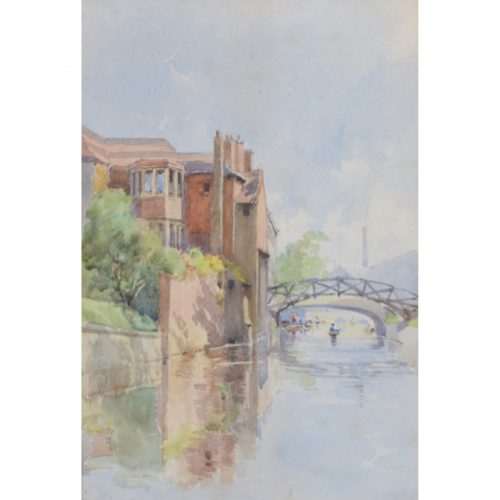
The Mathematical Bridge, Queens' College, Cambridge
Watercolour 27 x 18 cm A delightful watercolour of Cambridge's famous Mathematical Bridge. Figures punt under the bridge and the buildings of Queens are reflected in the serene waters of the River Cam. Kate Hillman of the Cambridge University Engineering Department notes that: "One of the most recognisable structures on the Cam, Queens' College bridge was originally built in 1749 by James Essex the Younger. Since then it has been rebuilt twice to the original design of William Etheridge, once in 1866 and again in 1905. In 1866 the bridge deck was changed from a stepped design to the current sloped deck. In 1905 a complete rebuild of the bridge was required due to weathering of the original oak structure. stories have suggested that a group of students (or professors, depending on the storyteller) disassembled the bridge to discover how it stood up and then couldn't put it back together. The bridge was supposedly then rebuilt using rather prominent bolts." Condition: very good; gilt frame has some age. If you’d like to know more, please email info@manningfineart.co.uk or call us on 07929 749056. -
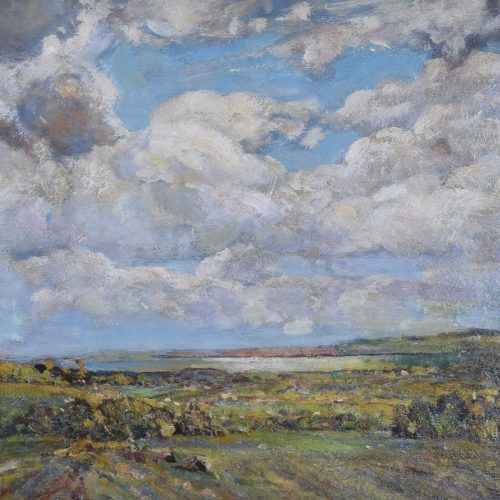
William Alison Martin (1878-1936) The Menai Straits
Oil on board 44 x 59 cm Signed lower right. Framed. A beautifully handled scene, with spectacular skies and rich colours in the landscape, showing the soft rolling hills of Anglesea and North Wales (Martin's native part of the country). -
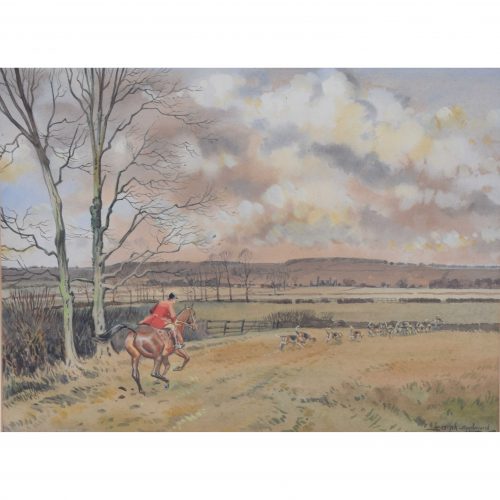
John Appleyard (1908 - 1960)
The Middleton Hunt at Sherriff Hutton
Watercolour 28 x 37 cm Signed lower right. The Huntsman and hounds of North Yorkshire's Middleton Hunt. Condition: very good. If you’d like to know more, please email info@manningfineart.co.uk or call us on 07929 749056. -

George Bissill (1896-1973) The New Inn, Willersey
Pencil sketch 25 x 35 cm Born in 1896, George Bissill was a British miner, painter and furniture designer. Raised in the mining village of Langley Mill, Derbyshire, Bissill became a miner at the age of 13, before leaving to join the war effort in 1915. Upon his return from the war after being gassed, Bissill chose to become a pavement artist outside the newly erected Bush House in Aldwych, painting from his memory and his sketch book the uncompromising underground world he had inhabited. In 1935 he moved to the countryside near Newbury, where he lived and worked as a landscape painter, art restorer and dealer until his death in 1973. This painting forms part of a larger collection, 'unseen since they were taken from George Bissil's studio in 1983' and restored by Kate Pattinson. A series of planned exhibitions were cancelled due to Covid, but two shows, one in Oxford and one in Ilkeston, did take place. Through such exhibitions, Pattinson hoped to 'restore the reputation of an artist who, through mighty endeavour, conquered the art world in the 1920s with his powerful, authentic and experimental pictures.' Bissill's paintings are also held in a number of important public collections, including the Tate Gallery, National Museum of Ireland and the Manchester Art Gallery. This pencil sketch depicts a view down the Main Street in Willersey, Gloucestershire. Rolling hills and trees are discernible in the background, while the sign of the New Inn is sketched into the foreground. The history of the New Inn stretches back to the 17th century and still remains operational today, having conserved the original charm of the building with its beams, flagstone floor and log burning fire-- a true gem of the Cotswolds. -

M R A Hollis The Old Bluecoat School
Pencil drawing 56 x 77 cm Professor Malcolm A Hollis was a chartered surveyor, arbitrator and professor of Building Pathology. He produced this architectural sketch while studying at the Liverpool College of Building. The study depicts a frontal view of the Bluecoat School, showcasing its grand 18th-century architecture and is characterised by clean lines and a strong sense of architectural perspective. The Bluecoat School is the oldest building in both central Liverpool and the city's UNESCO World Heritage Site. It was originally built in 1717 to house the Blue Coat School for Orphans. After almost 200 years, the school moved to a different premises in 1906 and in 1907 the Sandon Studios Society, a breakaway from University of Liverpool’s School of Applied Art, moved into the vacant building, establishing one of the first dedicated art centres in the world. It continues to serve this purpose today and celebrated its 300 year anniversary in 2017. -
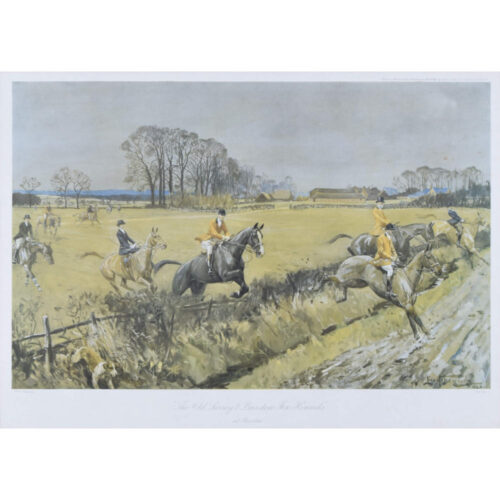
Lionel Edwards (1878 - 1966)
The Old Surrey and Burstow Fox Hounds - at Burstow (1926)
Lithograph 36 x 51 cm Signed and dated in plate lower right. In original 3/4" black frame. A Lionel Edwards lithograph depicting the Old Surrey and Burstow - part of the artist's 'Hunting Countries' series. The Old Surrey and Burstow (now the Old Surrey, Burstow and West Kent Hunt) has been hunting from Felbridge since 1909. The Burstow dates as a foxhound pack from 1866, having previously existed as a harrier pack. Lionel Edwards was a British artist who specialised in pictures of country life, particularly horses, and provided illustrations for Country Life. He is best known for his hunting scenes but also painted pictures of horse racing, shooting and fishing. Condition: print generally good; the odd tiny spot in top right corner. In original 3/4" black frame; some scratches to frame. If you are interested, please email info@manningfineart.co.uk or call us on 07929 749056. Click here for other hunting pictures. -

Joseph Skelton (1783 - 1871) after George Vertue (1684 - 1756) Oxford Almanack 1744
Engraving 51 x 44 cm A historic engraving featured in the 1744 Oxford Almanack. This almanac was published annually by the Oxford University Press for the University of Oxford from 1674 to 2019. These almanacs traditionally included engravings and information about Oxford University, including the Heads of Colleges and a university calendar. As was therefore typical for the engravings featured in these collections, this work depicts Pembroke's august founders and early architecture, which later formed part of the artist's 1828 'Pietas Oxoniensis, or Records of Oxford Founders'. George Vertue FSA was an English engraver and antiquary. He was apprenticed to a heraldic engraver in France, then worked for the Flemish engraver Michael Vandergucht before setting up on his own. He was also a student of the English portrait painter and copyist Thomas Gibson. He became the official engraver to the Society of Antiquaries when it was founded in 1717, and his patrons included several British aristocrats. He is buried in Westminster Abbey. Joseph Skelton was an a topographical and antiquarian engraver. He lived in Oxford for a time and became a Fellow of the Society of Antiquaries of London. His Oxford publications include the Oxonia Antiqua Illustrata; Antiquities of Oxfordshire, from drawings by F. Mackenzie; and the Pietas Oxoniensis, or Records of Oxford Founders. Condition: Modern restrike with printer's mistakes: small ill-printed area lower left, two 6" long creases to right side.If you would like to know more, please email info@manningfineart.co.uk or call us on 07929 749056.
-

A. E. Halliwell (1905-1987) The Boat Race
Gouache 32 x 50 cm Initialled and dated Dec 1928 lower right A.E. Halliwell (1905–1986) was a British artist, illustrator, and designer best known for his vibrant poster designs created for British railway companies during the mid-20th century. Born in Southport, Halliwell developed a strong foundation in art and design early in life. He studied at the Southport School of Art from 1923 to 1926 before graduating to the Royal College of Art in London and subsequently practising as a professional designer from the 1930s. Following his studies, Halliwell married Doris Doyle in Strood Kent, and went on to have a significant teaching career himself, most notably as a lecturer at the Central School of Arts and Crafts (later part of Central Saint Martins), where he influenced a new generation of designers and illustrators. Halliwell is perhaps best remembered for his vibrant and engaging poster designs created for British railway companies during the 1930s. His work was characterised by a bright, graphic style that balanced charm with clarity, often depicting idealised scenes of British holiday destinations—from sunny seaside towns to tranquil countryside vistas. Beyond posters, his artistic output included book illustration, commercial design, and stage costume sketches, showcasing his versatility across mediums. His posters continue to remain enduring symbols of a golden age of British travel and design and are displayed in major collections including the London Transport Museum and the V & A. This dynamic poster design by A.E. Halliwell captures the intensity of the Oxford-Cambridge Boat Race with a bold aerial perspective of the two rowing crews slicing through stylised blue and white water--Oxford in dark blue on the left, Cambridge in light blue on the right. The rhythmic composition and simplified forms emphasise speed, coordination, and competition, using a limited colour palette to striking modernist effect. Condition: Generally very good.If you would like to know more, please email info@manningfineart.co.uk or call us on 07929 749056.
-
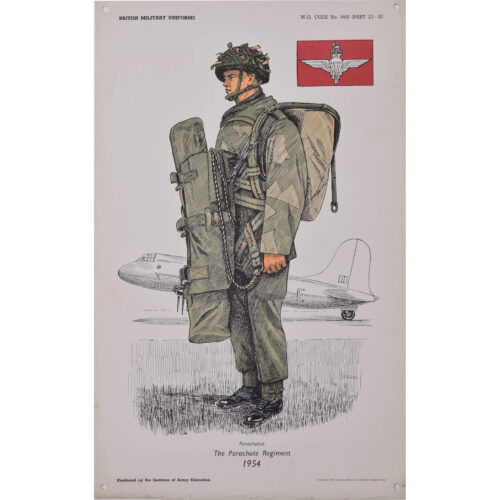
The Parachute Regiment Parachutist 1954 uniform
Lithograph 50 x 31 cm Produced for the Institute of Army Education. Printed for HM Stationery Office by I A Limited, Southall 51. These posters were produced by the Institute of Army Education, likely for display in barracks. Created in the 1950s, they illustrate the 'vintage' uniforms worn by the Corps during the First World War. Condition: punched holes to corners as issued; otherwise generally very good. If you are interested, please email info@manningfineart.co.uk or call us on 07929 749056. Click here for other original vintage Institute of Army Education uniform posters.