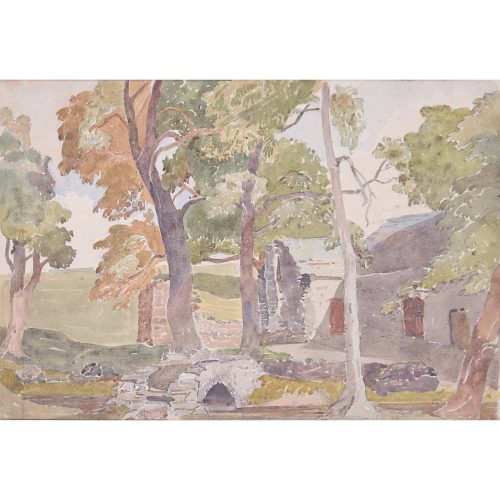
-
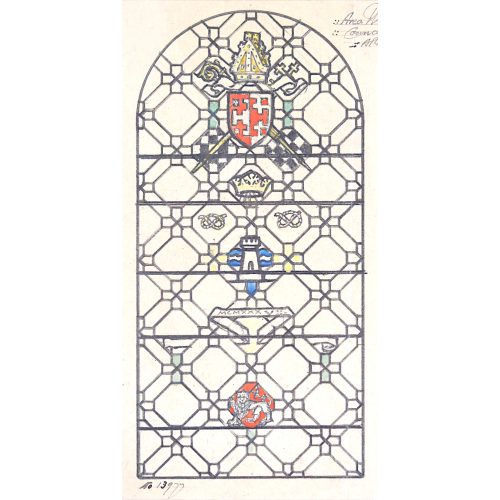
Florence Camm (1874-1960) Design for stained glass for Council with Castle and Lion Crown and Mitre
Watercolour 18.5x9.5 cm Dated 1935 Design for TW Camm & Co., Smethwick, Birmingham no. 13979 The Camms were stained glass designers who exhibited 48 times at the Royal Academy and also exhibited at The Walker Art Gallery in Liverpool, The Royal Scottish Academy and Royal Birmingham Society of Artists. Following the death of her father, Florence Camm became chief designer at TW Camm with many commissions both nationally and internationally. Florence Camm was the daughter of Thomas William Camm (1839-1912) who founded the stained glass business T W Camm in High Street Smethwick. From 1892-1911 she studied at The Birmingham Municipal School of Art which, unusually for the time, encouraged girls to attend the life drawing classes – drawing fully nude female models and partially draped male models – thus explaining Camm’s skill with the human figure. Students were encouraged to execute their drawings for designs, thus giving them the skills to set up as manufacturers in Birmingham’s Jewellery Quarter. The arts and crafts designer Henry Payne was an influential tutor for Camm, being one of the most influential teachers at the BMSA who was working as a stained glass designer at the time; one of his most notable commissions was a painted mural illustrating Tudor History for the Houses of Parliament in 1908. Following the death of TW Camm, Florence and her brothers – Walter and Robert – took over the business and Florence did most of the designing. If you are interested email info@manningfineart.co.uk or call us on 07929 749056. Condition: In conservation mount and in plastic sleeve for protection. -

Angela Stones (1914-1995) Helianthus
Oil on canvasboard 44x55cm Signed lower left Stones was a member of an artistic dynasty. Her mother Dorothy Bradshaw (1893-1983) studied under Jack Merriott - the artist famous for his British Rail posters, and her son, Christopher Assheton-Stones (1947-1999) was probably the foremost pastel artist of his time. Here a generous use of impasto captures the texture of a Helianthus - Sunflower. A suggestion perhaps of surrealism in choice of colours helps with the mid-century feel of the painting. If you are interested email info@manningfineart.co.uk or call us on 07929 749056. Condition: Good. -
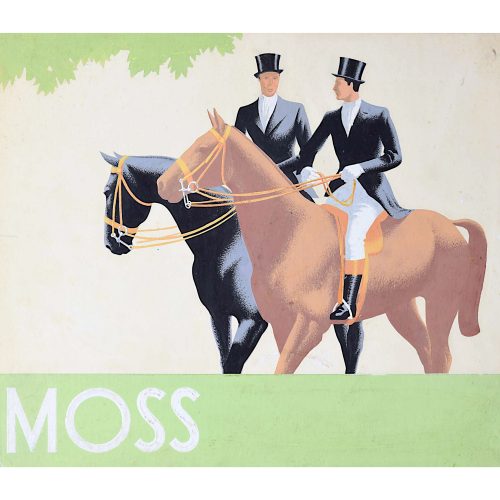
Anonymous Moss Gouache original design for poster
30x33cm c. 1930s Sadly the artist is unknown, but this rather good example of commercial artwork cleverly places the images of two impeccably dressed horse riders upon tremendously handsome horses. If you are interested email info@manningfineart.co.uk or call us on 07929 749056. Condition: Generally good condition, a few old losses as may be seen in picture. -
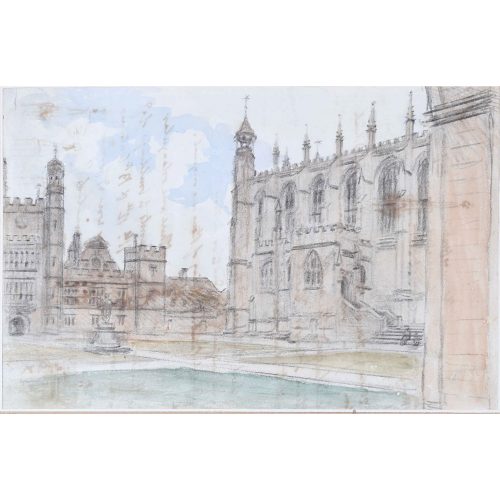
Dr William Crotch (1775-1847) Eton College Chapel
13x20cm Pencil and colour wash Extensively inscribed to reverse Dated 10.20am August 1 1832 Provenance: Spink, King Street, London Composer and organist (a child prodigy, playing the organ of the Chapel Royal at the age of three-and-a-half) Crotch is most famous for probably beint the composter of the Westminster Chimes - struck by Big Ben inter alia. In 1797 he became Heatehr Professor of Music at Oxford University, becoming DMus in 1799. John Malchair, the musician and artist, became a friend whilst he was in Oxford, and so with his guidance Crotch took up sketching. He also took Malchair's habit of recording the date and time of his picture passing this habit to John Constable upon meeting him in London in 1805. He became first Principal of the Royal Academy of Music, a post he held for ten years until he resigned His works are well represented in many public and private collections. The Tate holds three of his works. If you are interested email info@manningfineart.co.uk or call us on 07929 749056. Condition: Good. -
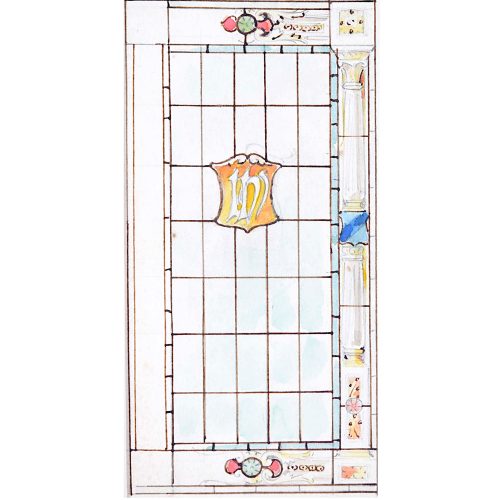
Florence Camm (1874-1960) Design for church stained glass window with 'IHS' roundel
Watercolour 17x9 cm Design for TW Camm & Co., Smethwick, Birmingham With 'IHS' Roundel - 'Iesus Hominum Salvator' ('Jesus Saviour of Mankind') The Camms were stained glass designers who exhibited 48 times at the Royal Academy and also exhibited at The Walker Art Gallery in Liverpool, The Royal Scottish Academy and Royal Birmingham Society of Artists. Following the death of her father, Florence Camm became chief designer at TW Camm with many commissions both nationally and internationally. Florence Camm was the daughter of Thomas William Camm (1839-1912) who founded the stained glass business T W Camm in High Street Smethwick. From 1892-1911 she studied at The Birmingham Municipal School of Art which, unusually for the time, encouraged girls to attend the life drawing classes – drawing fully nude female models and partially draped male models – thus explaining Camm’s skill with the human figure. Students were encouraged to execute their drawings for designs, thus giving them the skills to set up as manufacturers in Birmingham’s Jewellery Quarter. The arts and crafts designer Henry Payne was an influential tutor for Camm, being one of the most influential teachers at the BMSA who was working as a stained glass designer at the time; one of his most notable commissions was a painted mural illustrating Tudor History for the Houses of Parliament in 1908. Following the death of TW Camm, Florence and her brothers – Walter and Robert – took over the business and Florence did most of the designing. If you are interested email info@manningfineart.co.uk or call us on 07929 749056. Condition: In conservation mount and in plastic sleeve for protection. -

Hans Schleger 'Zero' (1898-1976) London Transport Coach Stop Request Poster
Screenprint poster c. 1970 16x18 cm Printed for London Transport These posters were designed to be used as temporary stops when the usual stop required amendment for instance owing to road works or similar events. Printed on paper they were designed to be posted up at the alternative site, possibly over a different sort of stop (bus stop, coach stop, request stop, etc.). Working with Edward Johnson's special typeface created for London Transport, Hans Schleger - or Zero as he signed himself - adopted the famous roundel used by London Underground for use at Bus Stops. Born in Germany, Schleger was an influential graphic designer. After serving during the First World War, he studied at the Berlin Kunstgewerbeschule, being taught by Emil Orlik. The same year Walter Gropius founded the Bauhaus at Weimar and Schleger learned the same principles of breaking down the barriers between architecture, design, fine art and craft. A firm believer in the Bauhaus principles of simplicity in design and reduction to essentials, these may be seen in the clean lines of the roundel. In 1924 he moved to New York, applying Modernism to American advertising, and then returned to Berlin in 1929 working for the British advertising agency Crawfords, where he met Edward McKnight Kauffer who introduced him to Jack Beddington the head of advertising at Shell Mex BP. Following the rise of Hitler he emigrated to London where he produced a series of posters for Shell Mex. During World War 2 he worked for the British Government. In 1950 he taught at the Chicago Institute of Design which had been founded by Moholy-Nagy, thus bringing him back to his Bauhaus origins. Subsequently he designed the trademarks of John Lewis Partnership, Penguin, Deutsche Bank and the Edinburgh Festival. If you are interested email info@manningfineart.co.uk or call us on 07929 749056. Condition: In unissued condition. Mounted. -
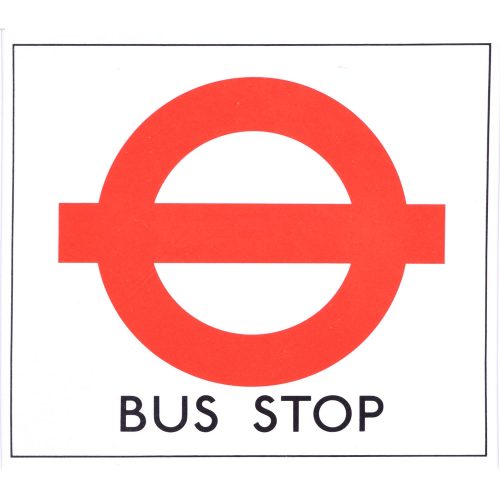
Hans Schleger 'Zero' (1898-1976) London Transport Bus Stop Poster
Screenprint poster c. 1970 16x17.8 cm Printed for London Transport These posters were designed to be used as temporary stops when the usual stop required amendment for instance owing to road works or similar events. Printed on paper they were designed to be posted up at the alternative site, possibly over a different sort of stop (bus stop, coach stop, request stop, etc.). Working with Edward Johnson's special typeface created for London Transport, Hans Schleger - or Zero as he signed himself - adopted the famous roundel used by London Underground for use at Bus Stops. Born in Germany, Schleger was an influential graphic designer. After serving during the First World War, he studied at the Berlin Kunstgewerbeschule, being taught by Emil Orlik. The same year Walter Gropius founded the Bauhaus at Weimar and Schleger learned the same principles of breaking down the barriers between architecture, design, fine art and craft. A firm believer in the Bauhaus principles of simplicity in design and reduction to essentials, these may be seen in the clean lines of the roundel. In 1924 he moved to New York, applying Modernism to American advertising, and then returned to Berlin in 1929 working for the British advertising agency Crawfords, where he met Edward McKnight Kauffer who introduced him to Jack Beddington the head of advertising at Shell Mex BP. Following the rise of Hitler he emigrated to London where he produced a series of posters for Shell Mex. During World War 2 he worked for the British Government. In 1950 he taught at the Chicago Institute of Design which had been founded by Moholy-Nagy, thus bringing him back to his Bauhaus origins. Subsequently he designed the trademarks of John Lewis Partnership, Penguin, Deutsche Bank and the Edinburgh Festival. If you are interested email info@manningfineart.co.uk or call us on 07929 749056. Condition: In unissued condition. Mounted. -
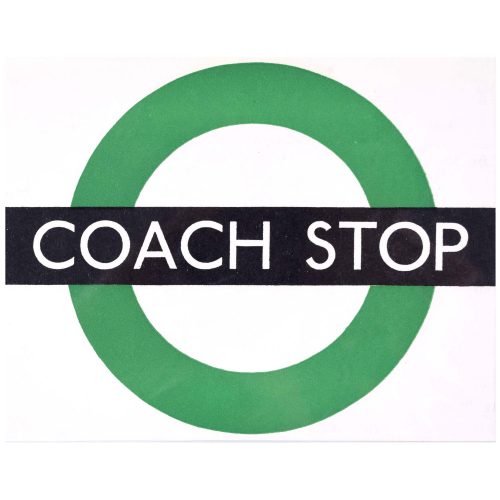
Hans Schleger 'Zero' (1898-1976) London Transport Coach Stop Poster
Screenprint poster c. 1970 16x20 cm Printed for London Transport These posters were designed to be used as temporary stops when the usual stop required amendment for instance owing to road works or similar events. Printed on paper they were designed to be posted up at the alternative site, possibly over a different sort of stop (bus stop, coach stop, request stop, etc.). Working with Edward Johnson's special typeface created for London Transport, Hans Schleger - or Zero as he signed himself - adopted the famous roundel used by London Underground for use at Bus Stops. Born in Germany, Schleger was an influential graphic designer. After serving during the First World War, he studied at the Berlin Kunstgewerbeschule, being taught by Emil Orlik. The same year Walter Gropius founded the Bauhaus at Weimar and Schleger learned the same principles of breaking down the barriers between architecture, design, fine art and craft. A firm believer in the Bauhaus principles of simplicity in design and reduction to essentials, these may be seen in the clean lines of the roundel. In 1924 he moved to New York, applying Modernism to American advertising, and then returned to Berlin in 1929 working for the British advertising agency Crawfords, where he met Edward McKnight Kauffer who introduced him to Jack Beddington the head of advertising at Shell Mex BP. Following the rise of Hitler he emigrated to London where he produced a series of posters for Shell Mex. During World War 2 he worked for the British Government. In 1950 he taught at the Chicago Institute of Design which had been founded by Moholy-Nagy, thus bringing him back to his Bauhaus origins. Subsequently he designed the trademarks of John Lewis Partnership, Penguin, Deutsche Bank and the Edinburgh Festival. If you are interested email info@manningfineart.co.uk or call us on 07929 749056. Condition: In unissued condition. Mounted. -
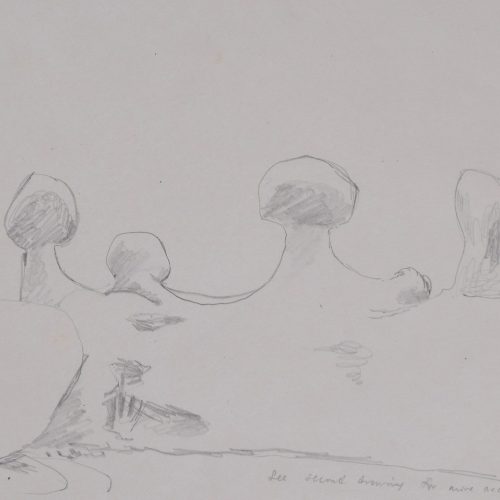
Clifford Ellis (1907-1985) Broad Chalke, Wiltshire
20x33cm Carbon pencil Provenance: the family of the artist, by descent. Born in Bognor in Sussex and trained at St Martin’s School of Art and Regent Street Polytechnic, Ellis was a graphic artist and illustrator who is best known for the posters he produced for London Transport during the 1930s. He generally collaborated with his wife Rosemary – whom he married in 1931 – on their posters. The General Post Office, Shell, and The Empire Marketing Board were also clients for their posters. They signed their posters C&RE, their initials being in alphabetical order and they are readily recognisable by their ebullient use of colour and form. Employed during the war as a camoufleur, along with so many other artists, Clifford was also an official war artist, serving with the Grenadier Guards. Rosemary, meanwhile, was an artist for the Recording Britain project. Following the war they trained art teachers at Bath Academy of Art. They also designed a series of nearly one hundred book jackets for Collins New Naturalist series, published between 1945 and 1982 and were always fascinated by animals and natural history, as with this sketch. If you are interested email info@manningfineart.co.uk or call us on 07929 749056. Condition: Generally very good. -
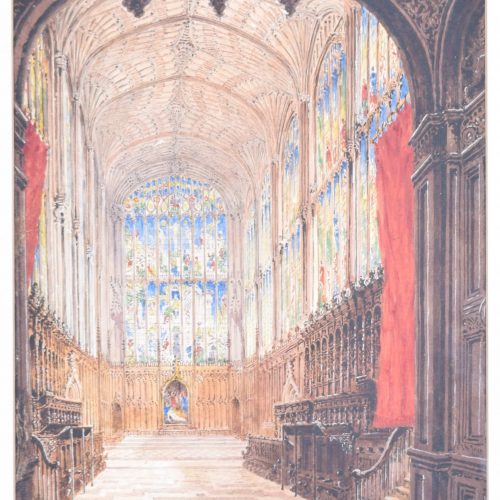
Joseph Murray Ince (1806-1859) King's College Chapel, Cambridge
Watercolour 27.5x21 In a fine hand-finished gilt frame. Provenance (label to reverse) Christopher Wood Gallery Signed lower right 'J M Ince 1844' Brought up in Radnorshire, in Wales, Ince studied under David Cox from 1823-1826, and then exhibited at the Royal Academy. He was a drawing master at Cambridge University during the 1830s, during which period he painted many views of the Colleges of both Oxford and Cambridge, returning to Radnorshire in 1835. His works are in the collections of major galleries including the Tate, The V&A and The Fitzwilliam Museum in Cambridge. This is a particularly fine interior painting of the venue for the famous annual Service of Nine Lessons and Carols. If you are interested email info@manningfineart.co.uk or call us on 07929 749056. Condition: In a fine hand-finished gilt frame. Generally very good condition. -
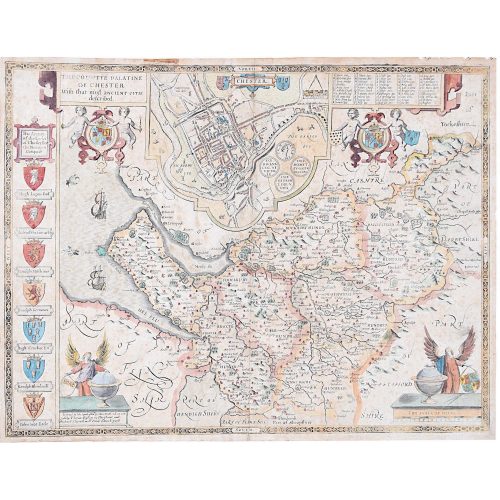
John Speed/Speede (1551/2-1629) The Countye Palatine of Chester with that most ancient citie
39x51cm Engraving Probably the most famous early English mapmaker, John Speed's early life is somewhat of an enigma. He is believed to have trained as a rolling-press printer, but he was at heart an historian granted a sinecure in the Customs House by Queen Elizabeth to indulge his passion, later becoming a Fellow of the Society of Antiquaries. His first maps were historical, of the Holy Land 'Canaan as it was Possessed both in Abraham and Israels Dayes' and of England and Ireland recording 'all their Civill Warres since the Conquest'. In 1611 he published his 'Hostory of Great Britaine' which he regarded as his magnum opus, but it was the companion atlas 'Theatre of the Empire of Great Britaine' that - as the first printed atlas of Great Britain - sealed his reputation. William Rogers engraved the first map, 'the County Palatine of Chester' in about 1600, but following his untimely death the task of engraving was passed to Jodocus Hondius of Amsterdam. By 1612 the atlas was complete, the maps famed for their decorative elements. Many have town plans - Brtiain's first series of such plans - and descriptive text was printed to the reverse until the 1676 edition. Later printings (up until 1770) were issued without this text. By 1627 it has become a part of a world atlas 'Prospect of the Most Famous Parts of the World'. During the 17th century the plates passed through the hands of a series of publishers, the 1676 edition (as here) of Thomas Bassett and Richard Chiswell being regarded as its high point with the inclusion for the first time of a series of important maps. If you are interested email info@manningfineart.co.uk or call us on 07929 749056. Condition: Trimmed and other small losses outside platemark. Some toning and spotting to paper as usual. Later but well undertaken hand-colouring. Old tape mark to top outside platemark. Generally good condition. -

John Speed/Speede (1551/2-1629) The County of Surrey Described and Divided into Hundreds
Engraving with later hand colouring and text to the reverse Dated to 1650 36 x 49 cm Probably the most famous early English mapmaker, John Speed's early life is somewhat of an enigma. He is believed to have trained as a rolling-press printer, but he was at heart an historian granted a sinecure in the Customs House by Queen Elizabeth to indulge his passion, later becoming a Fellow of the Society of Antiquaries. His first maps were historical, of the Holy Land 'Canaan as it was Possessed both in Abraham and Israels Dayes' and of England and Ireland recording 'all their Civill Warres since the Conquest'. In 1611 he published his 'Hostory of Great Britaine' which he regarded as his magnum opus, but it was the companion atlas 'Theatre of the Empire of Great Britaine' that - as the first printed atlas of Great Britain - sealed his reputation. William Rogers engraved the first map, 'the County Palatine of Chester' in about 1600, but following his untimely death the task of engraving was passed to Jodocus Hondius of Amsterdam. By 1612 the atlas was complete, the maps famed for their decorative elements. Many have town plans - Britain's first series of such plans - and descriptive text was printed to the reverse until the 1676 edition. Later printings (up until 1770) were issued without this text. By 1627 it has become a part of a world atlas 'Prospect of the Most Famous Parts of the World'. During the 17th century the plates passed through the hands of a series of publishers, the 1676 edition of Thomas Bassett and Richard Chiswell being regarded as its high point with the inclusion for the first time of a series of important maps. For the first half of the eighteenth century they were firmly established in the hands of the Overton family. This particular edition originally featured in The Theatre Of The Empire Of Great Britaine. It features attractive inset views of the long-since destroyed Richmond and Nonsuch Palaces, compass rose, scale of miles, coats of arms and decorative strapwork. Its hand colouring also lends a bright charm to this map, highlight the fields and adding vibrancy to the coats of arms. If you are interested email info@manningfineart.co.uk or call us on 07929 749056. Condition: Generally very good, glued to mount (sold with frame), few creases -
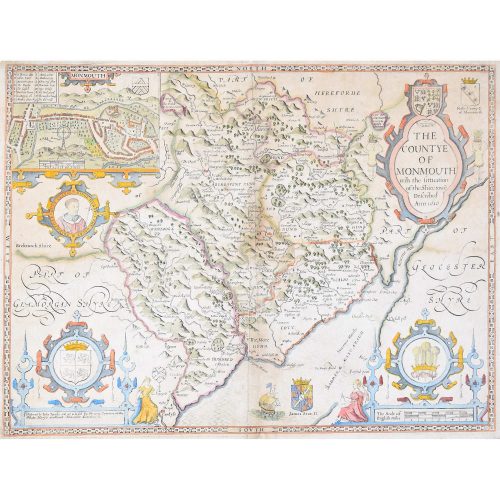
John Speed/Speede (1551/2-1629) The Countye of Monmouthshire
Performed by John Speede assisted by William Smyth. And are to be sold by Henry Overton at the White Horse without Newgate London. Printed 1710-1743 Probably the most famous early English mapmaker, John Speed's early life is somewhat of an enigma. He is believed to have trained as a rolling-press printer, but he was at heart an historian granted a sinecure in the Customs House by Queen Elizabeth to indulge his passion, later becoming a Fellow of the Society of Antiquaries. His first maps were historical, of the Holy Land 'Canaan as it was Possessed both in Abraham and Israels Dayes' and of England and Ireland recording 'all their Civill Warres since the Conquest'. In 1611 he published his 'Hostory of Great Britaine' which he regarded as his magnum opus, but it was the companion atlas 'Theatre of the Empire of Great Britaine' that - as the first printed atlas of Great Britain - sealed his reputation. William Rogers engraved the first map, 'the County Palatine of Chester' in about 1600, but following his untimely death the task of engraving was passed to Jodocus Hondius of Amsterdam. By 1612 the atlas was complete, the maps famed for their decorative elements. Many have town plans - Britain's first series of such plans - and descriptive text was printed to the reverse until the 1676 edition. Later printings (up until 1770) were issued without this text. By 1627 it has become a part of a world atlas 'Prospect of the Most Famous Parts of the World'. During the 17th century the plates passed through the hands of a series of publishers, the 1676 edition of Thomas Bassett and Richard Chiswell being regarded as its high point with the inclusion for the first time of a series of important maps. For the first half of the eighteenth century they were firmly established in the hands of the Overton family. If you are interested email info@manningfineart.co.uk or call us on 07929 749056. Condition: Small losses outside platemark just reaching platemark at top, with some toning to paper as usual. Later but well undertaken hand-colouring. Generally good condition. -
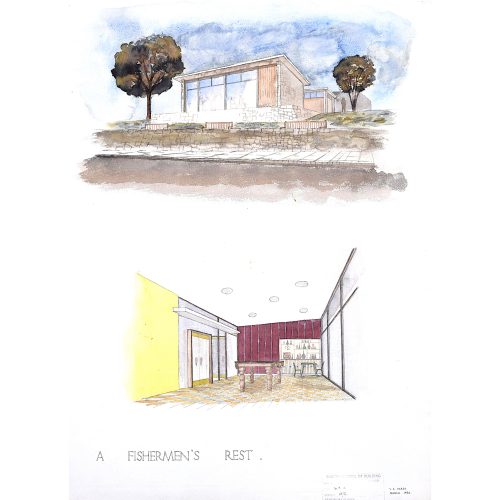
V A Hards (British, c. 1930-c. 2012) Design for Modernist Fisherman's Hut
Watercolour on wove Signed and dated March 1956 and stamped for Brixton School of Building. 77x55cm Hards was educated at Brixton School of Building and Woolwich Polytechnic between 1948 and 1956, during which period he produced some very competent work including this rather fun modernist brutalist design for a fisherman's hut, not designed to blend in with the scenery. Brixton School of Building was incorporated into the Polytechnic of the South Bank - now London South Bank University. To view more of his work we have listed, scroll down to 'View more from this seller' and click on 'View all from this seller' and then search for 'Hards'. If you are interested email info@manningfineart.co.uk or call us on 07929 749056. Condition: Good. Some edge wear and isolated spots. -
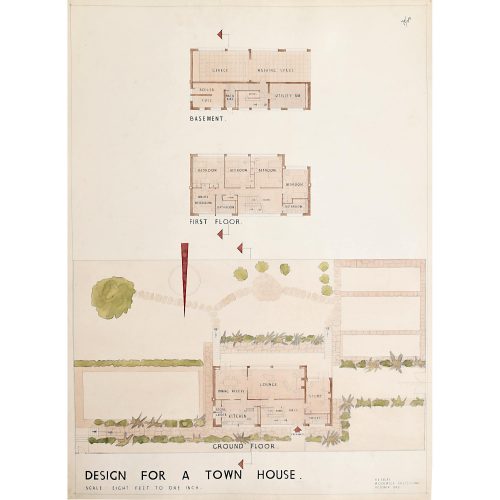
V A Hards (British, c. 1930-c. 2012) Design for Modernist Town House
Watercolour on wove Signed and dated October 1949 and inscribed Woolwich Polytechnic. 77x55cm Hards was educated at Brixton School of Building and Woolwich Polytechnic between 1948 and 1956, during which period he produced some very competent work including this rather fun modernist brutalist design for a town house. Brixton School of Building was incorporated into the Polytechnic of the South Bank - now London South Bank University. If you are interested email info@manningfineart.co.uk or call us on 07929 749056. Condition: Some edge wear and isolated spots. -
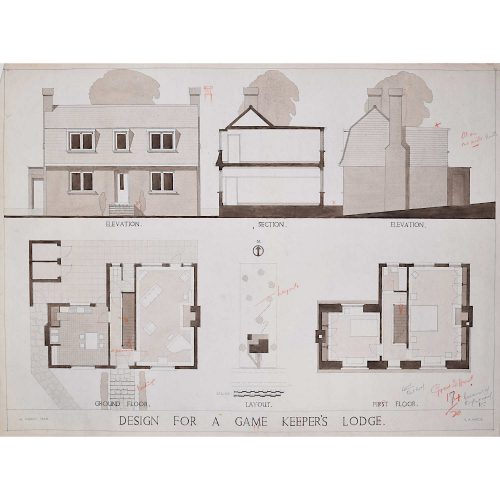
V A Hards (British, c. 1930-c. 2012) Design for Modernist Game Keeper Lodge
Watercolour on wove Signed and dated March 1948 55x77cm Hards was educated at Brixton School of Building and Woolwich Polytechnic between 1948 and 1956, during which period he produced some very competent work including this rather fun modernist design for a monumental fountain in a grand park. Brixton School of Building was incorporated into the Polytechnic of the South Bank - now London South Bank University. If you are interested email info@manningfineart.co.uk or call us on 07929 749056. Condition: Some edge wear and isolated spots . -
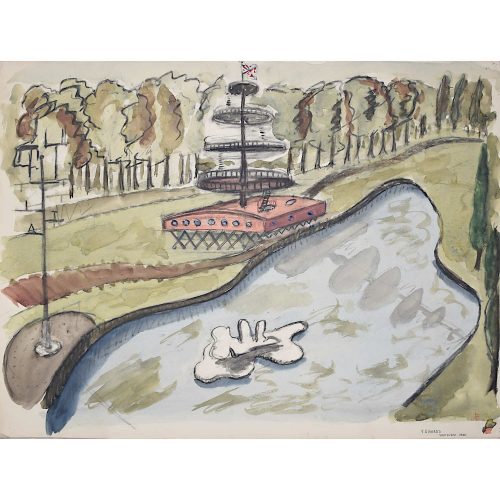
V A Hards (British, c. 1930-c. 2012) Design for Monumental Fountain
Watercolour on wove Signed and dated 1955 55x77cm Hards was educated at Brixton School of Building and Woolwich Polytechnic between 1948 and 1956, during which period he produced some very competent work including this rather fun modernist design for a monumental fountain in a grand park. Brixton School of Building was incorporated into the Polytechnic of the South Bank - now London South Bank University. If you are interested email info@manningfineart.co.uk or call us on 07929 749056. Condition: Some edge wear and isolated spots. -
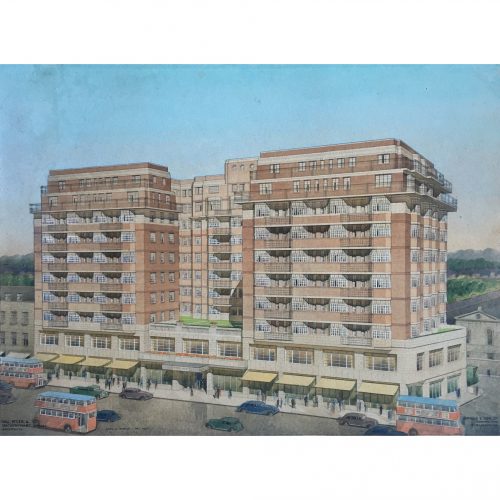
Cyril Farey (1888-1954)
Design for Princes Court Knightsbridge (1947)
Pencil and watercolour 56x76cm Inscribed (lower left) ‘Val Myer & Watson-Hart F.F.R.I.B.A. Architects’; (centre) ‘Cyril A Farey Del 1947’; and (right) ‘Griggs & Son, Ltd Contractors of Westminster’. Opposite Harrods, on Knightsbridge, this design for a fine block of apartments shows Farey at his most expressive. The Mediterranean blue sky is unmistakable, and the plethora of buses and cars assisting the many people to go about their daily activity. -
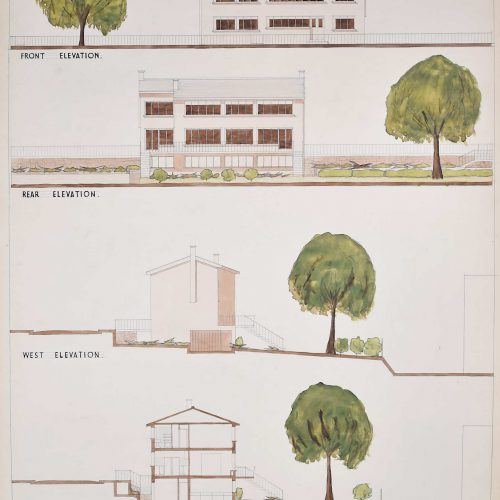
V A Hards (British, c. 1930-c. 2012) Design for Modernist Town House
Watercolour on wove Signed and dated October 1949 and inscribed Woolwich Polytechnic. 77x55cm Hards was educated at Brixton School of Building and Woolwich Polytechnic between 1948 and 1956, during which period he produced some very competent work including this rather fun modernist brutalist design for a town house. Brixton School of Building was incorporated into the Polytechnic of the South Bank - now London South Bank University. If you are interested email info@manningfineart.co.uk or call us on 07929 749056. Condition: Some edge wear and isolated spots. -
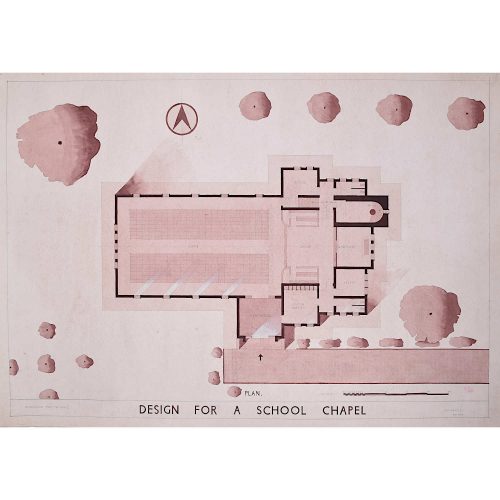
V A Hards (British, c. 1930-c. 2012) Design for Modernist School Chapel
Watercolour on wove Signed and dated November 1948 and marked 35/40 55x77cm Hards was educated at Brixton School of Building and Woolwich Polytechnic between 1948 and 1956, during which period he produced some very competent work including this rather fun modernist design for a riverside tearoom. Brixton School of Building was incorporated into the Polytechnic of the South Bank - now London South Bank University. If you are interested email info@manningfineart.co.uk or call us on 07929 749056. Condition: Some edge wear and isolated spots. -
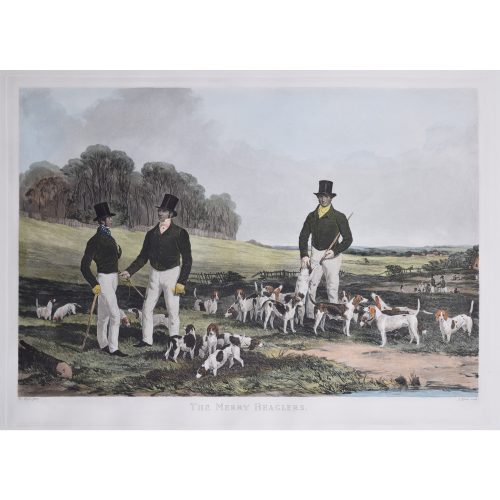
John Harris after Harry Hall The Merry Beaglers
Restrike print - c. mid twentieth century 48x65cm Aquatint with hand colouring The most famous beagling print there is, after the 1845 painting. If you are interested email info@manningfineart.co.uk or call us on 07929 749056. -
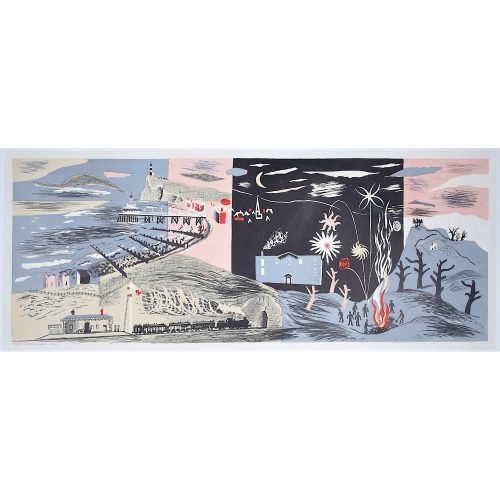
John Piper C.H. (British 1903-1992) Nursery Frieze II
500 x 1250 mm Lithograph 1936 One of Piper's many seascapes, Frieze II is an exercise in abstract capriccio. Piper draws together the muted grey, pink, and blue of the lithograph's fragmented background with foreground details in black, white, and bright red, picking out particular moments of the frieze for the viewer. The lighthouse has no keeper; the beach and the pier are empty; the train has neither passengers nor driver. The church at the top of the rocky hill is a brilliant cubist borrowing, showing both the West end and the North side simultaneously - and it has no congregation. The only human figures present in the frieze are those collected around the bonfire, watching the flames and the show of fireworks. The scene is at once devoid of people and intensely human. Piper was just 24 when he made Frieze II. If you are interested, please email info@manningfineart.co.uk or call us on 07929 749056. Condition: Generally very good, backed to linen with small - and largely not visible - areas of restoration. -
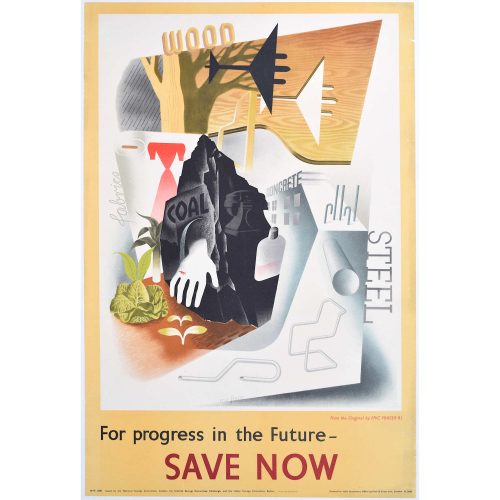
Eric Fraser For Progress in the Future Save Now
75x51cm Original Vintage Poster Issued by the National Savings Committee If you are interested email info@manningfineart.co.uk or call us on 07929 749056. Condition: Backed to linen, small edge tears to right side as visibile in image. -
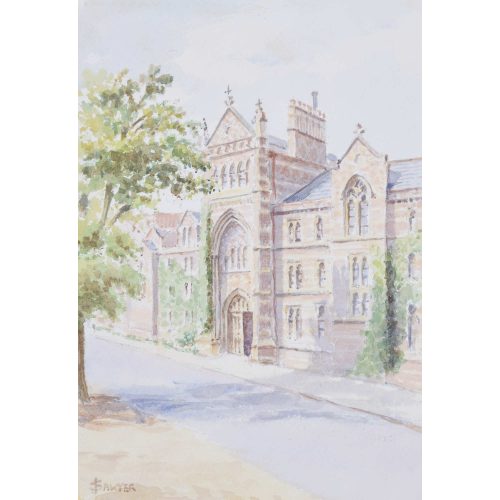
J Sawyer (British, 20th Century) Keble College, Oxford
watercolour 25x17cm If you are interested email info@manningfineart.co.uk or call us on 07929 749056. -
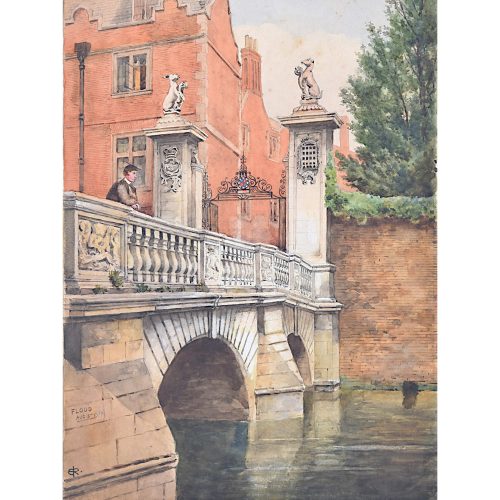
'ER' Monogrammist St John's College Cambridge, the Wren Bridge from the River Cam
Watercolour c. 1900 35x25cm A highly accomplished watercolour of the Kitchen Bridge at St John's College. The artist has clearly had a change of heart, and visibly moved the person standing on the bridge, bringing a sense of movement to what is otherwise a still painting. Moreover the richness of the colour he has chosen for the brickwork brings a further element of surprise to the viewer. If you are interested email info@manningfineart.co.uk or call us on 07929 749056. Condition: Mounted to board, the occasional tiny spot to the sky as visible in photograph. -
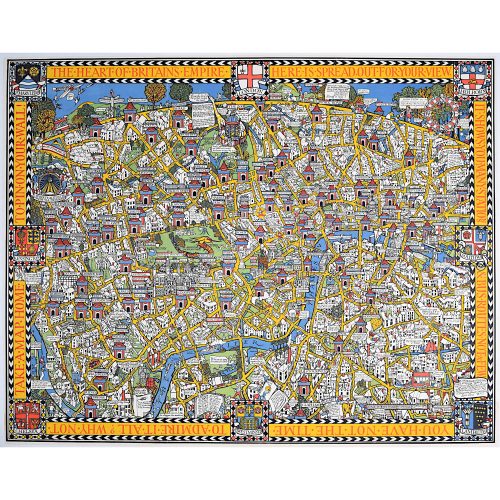
Macdonald (Max) Gill (1884-1947) Wonderground Map of London (c. 1924, after 1914 original edition)
Lithographic poster 75x94cm In the present work, in the top left-hand corner it reads 'On to Wembley' making reference to the British Empire Exhibition of 1924. Gill's original 1914 poster was hugely popular and reprinted with updates to feature topical events. Born in Brighton, Max Gill was the second son in a family of thirteen children; his elder brother was Eric Gill, the typographer and sculptor. Both Gills exhibited significant talent at a young age. Max Gill’s first map was made for a school map-drawing project following which he entered maps into competitions in boys’ magazines. In 1903 he moved to London as assistant to the ecclesiastical architects Sir Charles Nicholson and Hubert Corlette. By 1908 he had started his own architectural practice, but in 1909 Sir Edwin Lutyens commissioned Gill to paint a “wind dial” map for Nashdom, a large house in Buckinghamshire. The wind dial was set over the fireplace and attached to a weather vane on the roof, allowing the occupant to know the direction of the wind from the comfort of the house. He produced seven further wind dials including for Lutyens’s Lindisfarne Castle and for the Allhusen Room at Trinity College, Cambridge. Although he continued to practice as an architect, Frank Pick commissioned him to create seven pictorial maps for the Underground, the first being the famous 1913 ‘Wonderground Map of London Town.’ In 1917 he joined the Imperial War Graves Commission’s headstone design committee, designing the typeface and regimental badges. Gill’s memorials for the fallen in the First World War include for Balliol and Worcester Colleges and Christ Church in Oxford. During the 1920s and 30s Gill undertook many commercial commissions for advertising materials. The Empire Marketing Board and Shell-Mex as well as further maps for the Underground. He designed in 1922 the first diagrammatic map of the Underground which provided the foundation for Beck’s more famous map. By the 1930s his major works were murals. Those of the Arctic and Antarctic on the ceilings of the Scott Polar Research Institute in Cambridge are beautiful, but the most impressive is the map of the North Atlantic in the first-class dining room of the Queen Mary (maiden voyage: 1936, now moored at Long Beach, California). During the Second World War he created a series of propaganda posters for the Ministry of Information. -
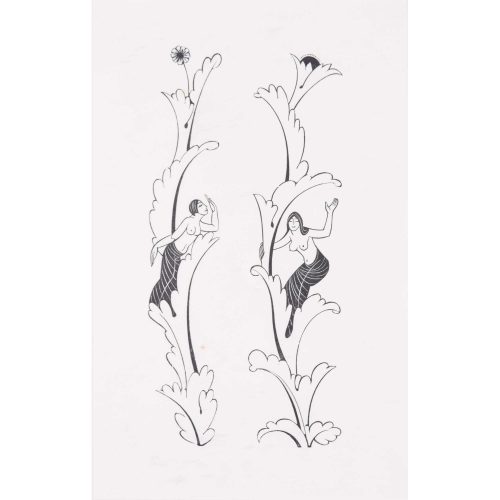
Eric Gill (1882-1940) Canterbury Tales Border - Two nudes i
Woodblock Print Published Hague & Gill 1934 23x21cm Condition: very good Click here for biographical details and other prints by Gill. If you are interested email info@manningfineart.co.uk or call us on 07929 749056. -
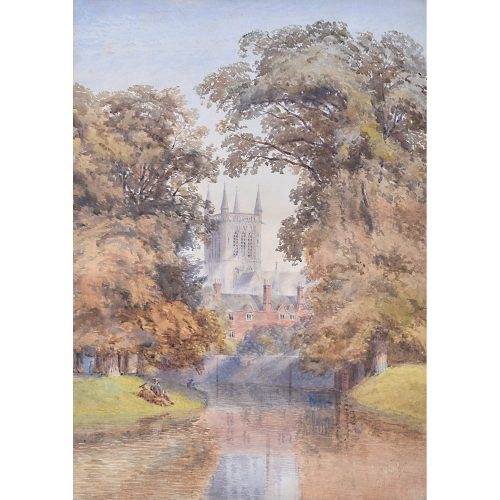
Anonymous (British, c. 1900) St John's College Cambridge from the River, Scholars Before
39x28cm Watercolour Scholars loll on the bank of the River Cam as they do today, and presumably have done ever since the foundation of the college in 1511. A dreamy view of one of the prettiest views in Cambridge. Condition: generally very good, slight staining to very margins, outside mount area. -
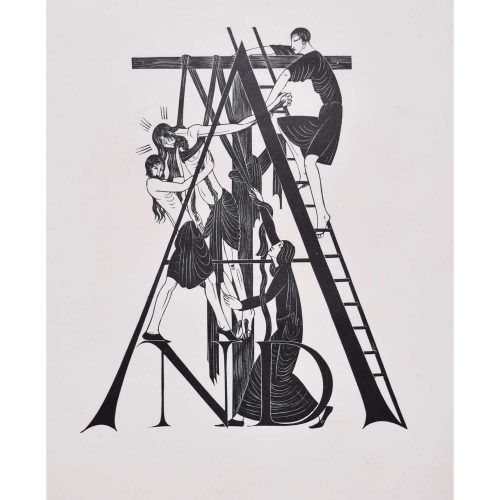
Eric Gill (1882-1940) The Deposition from the Cross
Woodblock Print Published Hague & Gill 1934 23x21cm Christ's body is taken down from the Cross, Mary assists by holding the ropes, and two men - Joseph of Arimathea and Nicodemus climb the ladder - one of the instruments of the passion. Click here for biographical details and other prints by Gill. If you are interested email info@manningfineart.co.uk or call us on 07929 749056. -
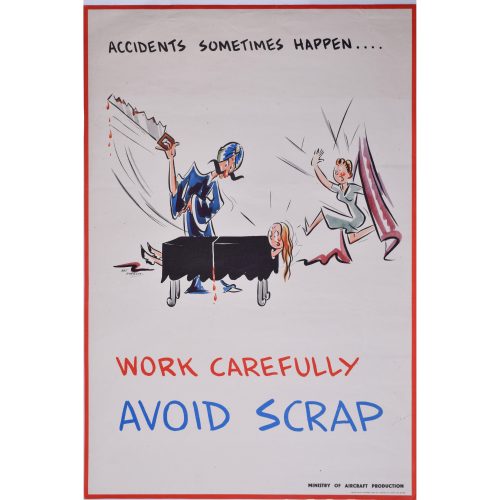
Nat Harrison
Accidents Sometimes Happen... Work Carefully Avoid Scrap
Original poster c. 1943 Printed for HMSO by J Weiner Ltd, London for the Ministry of Aircraft Production Produced by the Bayly-Souster advertising agency, Fleet Street Provenance the estate of Ernest Bendell-Bayly The waste-not-want-not campaign of World War 2 in the UK had to tackle waste at all levels. Here workers in aircraft factories are encouraged to work carefully in order to avoid creating products that had to be scrapped. Not only were the raw materials scrapped, but also the valuable hours of workers' time involved. When Lord Beaverbrook commenced his term as Minister of Aircraft Production in May 1940 it was an industry beset with problems. Aircraft parts were produced in sufficient numbers, but assembly into flyable aircraft proved more challenging – the Castle Bromwich Spitfire factory had not produced a single completed aircraft by this point. Moreover the RAF central depots had large supplies of aircraft that had not been issued to squadrons. Once this was all brought under Beaverbrook’s control, aircraft production increased rapidly. During the Battle of Britain, the British production of fighter aircraft was two-and-a-half times that of Germany. Britain had 644 operable fighters at the start of July 1940 – when the Battle of Britain began – against the German 725. By the end of October 1940, when the German offensive finished, British fighter aircraft had – despite significant losses – increased to 732 whilst the Germans were left with just 275. To achieve this great productivity increase the Ministry was run on informal grounds; few notes were kept; staff members had few formal roles. Essential to the success were motivational posters in the aircraft factories. If you are interested email info@manningfineart.co.uk or call us on 07929 749056. -
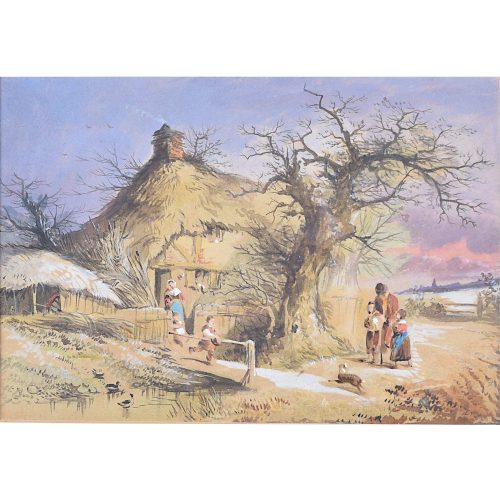
Attributed to Joseph Murray Ince (1806-1859) Outside Welsh Border Cottage - Winter
Watercolour 10.5x17.5cm Brought up in Radnorshire, in the Welsh Borders, Ince studied under David Cox from 1823-1826, and then exhibited at the Royal Academy. He was a drawing master at Cambridge University during the 1830s, during which period he painted many views of the Colleges of both Oxford and Cambridge, returning to Radnorshire in 1835. His works are in the collections of major galleries including the Tate, The V&A and The Fitzwilliam Museum in Cambridge. Click to view other works by Ince. -
Out of stock
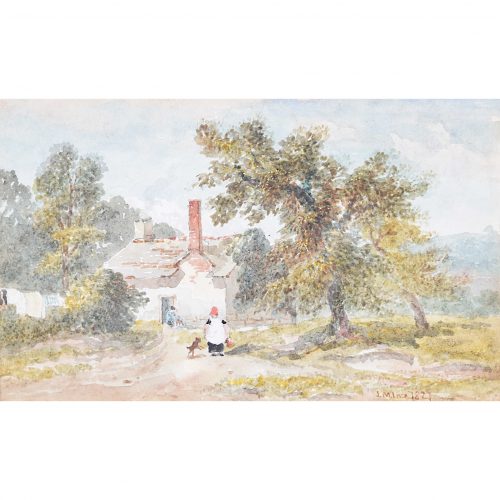
Joseph Murray Ince (1806-1859) Outside Welsh Border Cottage - Summer
Watercolour 10.5x17.5cm Provenance (label to reverse) Fine Art Society 1971 Signed lower right 'J M Ince 1827' Brought up in Radnorshire, in the Welsh Borders, Ince studied under David Cox from 1823-1826, and then exhibited at the Royal Academy. He was a drawing master at Cambridge University during the 1830s, during which period he painted many views of the Colleges of both Oxford and Cambridge, returning to Radnorshire in 1835. His works are in the collections of major galleries including the Tate, The V&A and The Fitzwilliam Museum in Cambridge. -
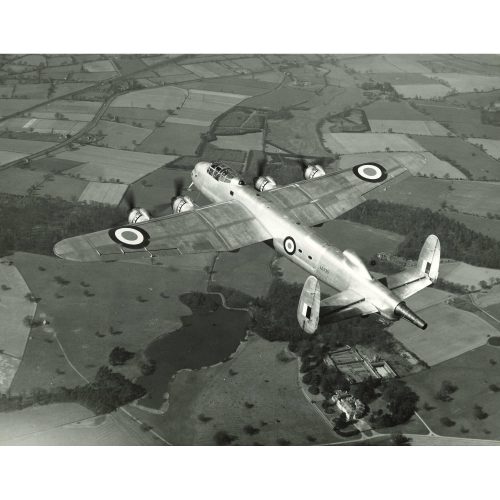
Charles E Brown (1896-1982)
Testbed Avro Lancaster Bomber LL735
Silver Gelatin Black & White Photographic Print 19x25cm Stamped to reverse "6231-3 Copyright photograph by Charles E Brown, 14, Longfellow Road, Worcester Park, Surrey, Derwent 4396." The Lancaster bomber needs no introduction as the most famous and important bomber of the Second World War. Here however LL735, a Mk II, is is fitted with a fifth engine, a jet engine. The air intake may be seen above the fuselage and the engine itself replaces the rear gun turret. In 1943 LL735 was fitted with the Metropolitan-Vickers F2/1 Beryl jet engine, and in 1945 it trialed the F2/4 jet engine. This photograph would have been particularly secret at the time it was taken. Charles E Brown was a famous photographer of aircraft whose father was a butcher in Wimbledon, London. Young Charles was given a camera for his 14th birthday and in 1911 photographed an Edwardian gentleman in trouble landing his balloon in neighbouring Southfields. This photograph was published in the Daily Mirror - the fee being half a crown - and Brown was encouraged to join the Daily Mirror's photography department upon leaving school at 16. Towards the end of the First World War he served with the Royal Air Force at their official London Photographic Centre. Following the war, he took to photographing trains, and captured a famous photograph of a Southern Railway locomotive that was used for the following ten years in railway posters. The income from this allowed him to pursue his passion of aviation photography in the 1920s and 1930s, from which commissions from the Air Ministry and Fleet Air Arm followed. During the war his work included commissions for Aeronautics magazine. Provenance: from the collection of Philip J R Moyes, author of many books on the RAF, most notably The Pictorial History which ran to several volumes. -
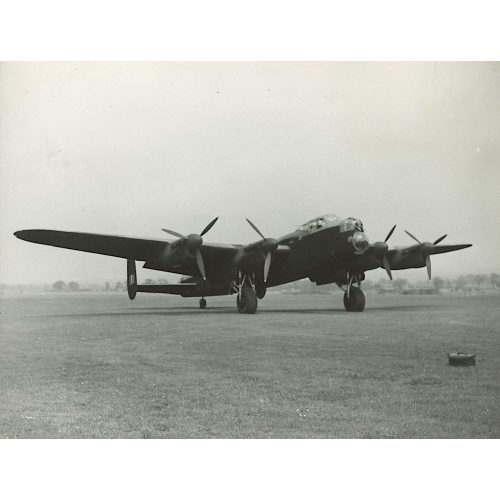
LANCASTER BOMBER AT AN AIRFIELD
Silver Gelatin Photograph for Flight Magazine 15.5x20cm Stamped to reverse "Flight Ref no 18300S Copyright Due Acknowledgment is required if this photograph is reproduced" Almost uniquely, from this series of photographs we have listed, we have been unable to trace another copy of this online. Provenance: from the collection of Philip J R Moyes, author of many books on the RAF, most notably The Pictorial History which ran to several volumes. Inscribed with his initials to reverse, though this has subsequently been concealed with liquid paper. -
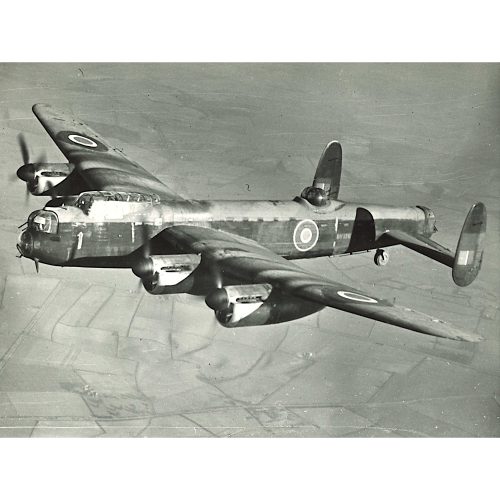
DV170 Lancaster Bomber in flight
Silver Gelatin Photograph 15x20cm Stamped to reverse "Rolls Royce Ltd Hucknall Neg no s76 Copyright Reserved" c. 1940s DV170 was built as a Mk III and converted to Mk VI. Used by Rolls Royce for Merlin trials series 65, 85, 38, 68, 100, 102 & 621 300+ f/hrs testing. Dismantled (probably at Hucknall), by road to Newton 10 December 1947, scrapped by 58 Maintenance Unit. Shown here with 4 Merlin 102s in Avro Tudor power plants with unshrouded exhausts. Provenance: from the collection of Philip J R Moyes, author of many books on the RAF, most notably The Pictorial History which ran to several volumes. -
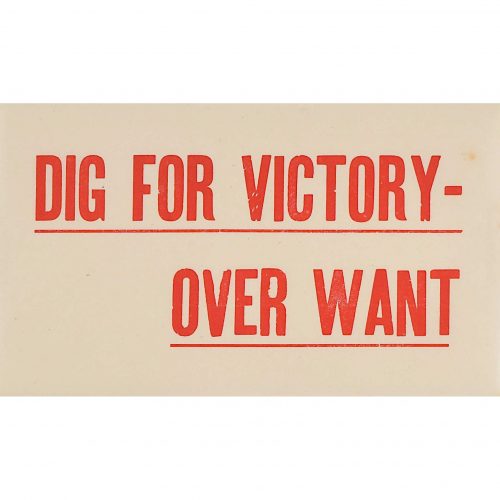
Dig for Victory over Want World War II public information
11x18cm for His Majesty's Stationery Office HMSO On gummed paper Printed on gummed paper, this was designed to be widely propagated, so that the public information message would not get lost. With food having to be shipped over the U-Boat infested Atlantic putting sailors' lives and ships at risk, every scrap of food that could be grown at home saved lives and allowed munitions to be transported instead. Therefore the Government started a large public information campaign to Dig for Victory - encouraging people to dig up their gardens and grow food. If you are interested email info@manningfineart.co.uk or call us on 07929 749056. -
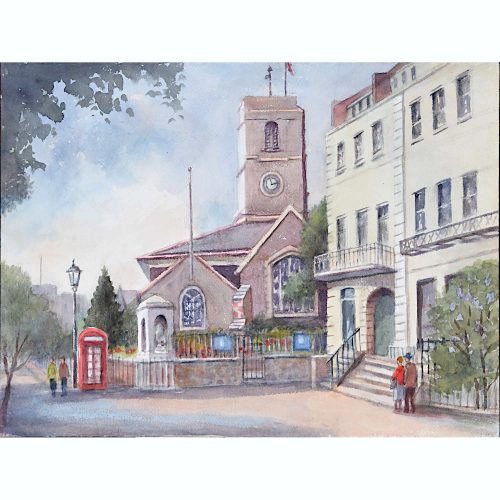
Angela Stones (1914-1995) Chelsea Old Church
Watercolour 31x41 cm Stones was a member of an artistic dynasty. Her mother Dorothy Bradshaw (1893-1983) studied under Jack Merriott - the artist famous for his British Rail posters, and her son, Christopher Assheton-Stones (1947-1999) was probably the foremost pastel artist of his time. If you are interested email info@manningfineart.co.uk or call us on 07929 749056. -
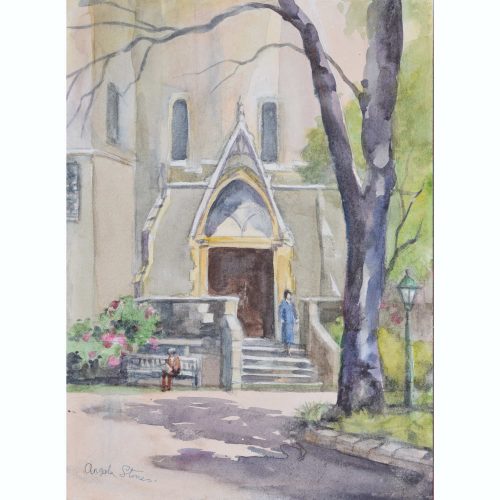
Angela Stones (1914-1995) Holy Trinity Brompton Church
Watercolour 31x41 cm Signed 'Angela Stones' Stones was a member of an artistic dynasty. Her mother Dorothy Bradshaw (1893-1983) studied under Jack Merriott - the artist famous for his British Rail posters, and her son, Christopher Assheton-Stones (1947-1999) was probably the foremost pastel artist of his time. If you are interested email info@manningfineart.co.uk or call us on 07929 749056. -
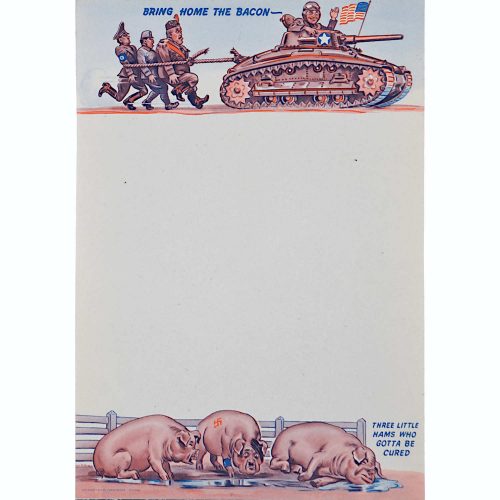
Porto-Service, Chicago Bring Home the Bacon - three little hams who gotta be cured!
Lithograph 26.5x18cm 1942 What better writing paper to send to a serving serviceman than that encouraging him to fight. Porto-Service of Chicago published a series of illustrated writing resources for sweethearts and friends to write to their brave servicemen, in this case teasing the three Axis dictators. Lavishly produced and printed, the Americans brought some much-needed colour and glamour to dull war-torn Britain. If you are interested email info@manningfineart.co.uk or call us on 07929 749056. -
Out of stock
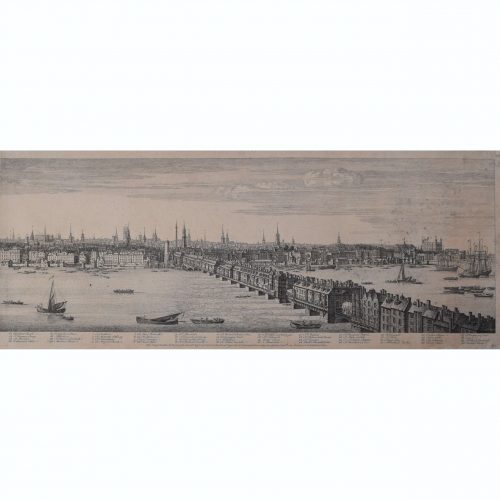
Samuel Buck (1696-1779) & Nathaniel Buck (active 1724-59) Panorama of the River Thames from Westminster Bridge to London Bridge
Published September 1749 30x404 cm Engraving Scroll down for further description. If you are interested email info@manningfineart.co.uk or call us on 07929 749056. -
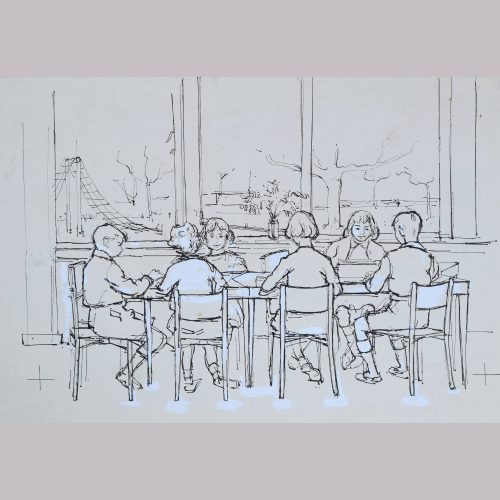
Peter Collins ARCA (1923-2001) The Schoolroom
Pen, ink and whitening 19x27cm Provenance: The Artist's Studio A stongly-painted image, with a wonderful sense of the light available in a new, post-war classroom. The schoolboys wear short trousers and - together with schoolgirls - are engrossed in a task. Click here for other items by the artist and for biographical details. If you are interested email info@manningfineart.co.uk or call us on 07929 749056. -
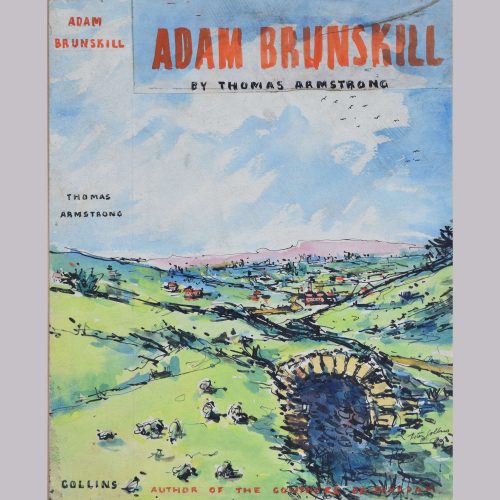
Peter Collins ARCA (1923-2001) Adam Brunskill Book Jacket Design
for Collins publishers (no relation) Watercolour and collage 22x17cm Provenance: The Artist's Studio Sale Signed lower right Peter Collins Typical Collins, with his bright colours and captivating scene, very reminiscent of his travel posters. This was a proposal for the dust jacket, in the end a slightly different design by Collins was chosen for the first edition. A great one for the Adam Brunskill fans! Click here for other items by the artist and for biographical details. If you are interested email info@manningfineart.co.uk or call us on 07929 749056. -
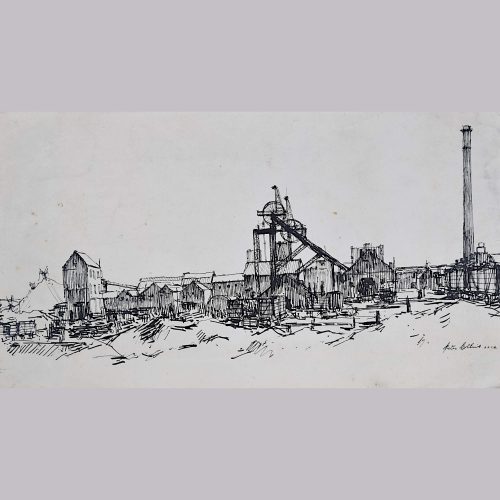
Peter Collins ARCA (1923-2001) Colliery Mining Scene
Pen, ink 20x35cm Provenance: The Artist's Studio The use of pen ank ink creates a powerful image, emphasising the stark nature of the colliery. Yet the scene is softened by the presence of figures, dwarfed against the mighty machinery. The strong vertical lines on the timber-clad buildings emphasise the vertical lines of the pit machinery, and suggest the depths of the earth to which the mine reaches; yet at the same time the horizontal nature of the drawing provides a contrast. Click here for other items by the artist and for biographical details. If you are interested email info@manningfineart.co.uk or call us on 07929 749056. -
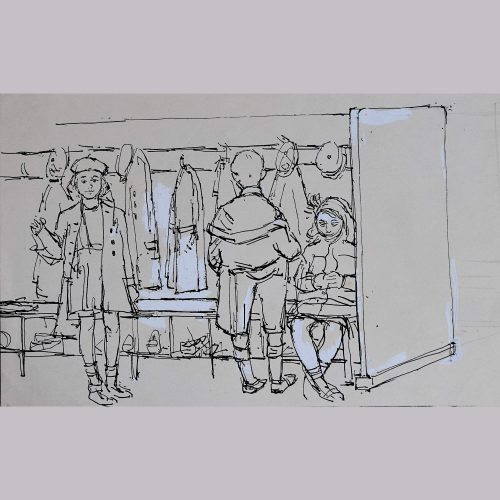
Peter Collins ARCA (1923-2001) School Children in a Cloakroom
Pen, ink and whitening 15x24cm Provenance: The Artist's Studio A stongly-painted image, ensuite with Collins' schoolroom scene that we have listed with a wonderful sense of the light available in a new, post-war school. The schoolboy wears short trousers and - together with schoolgirls - is engaged in the task of time immemorial of waiting in the cloakroom. Shoes are stacked under the benches and coats hang from the hooks. Click here for other items by the artist and for biographical details. If you are interested email info@manningfineart.co.uk or call us on 07929 749056. -
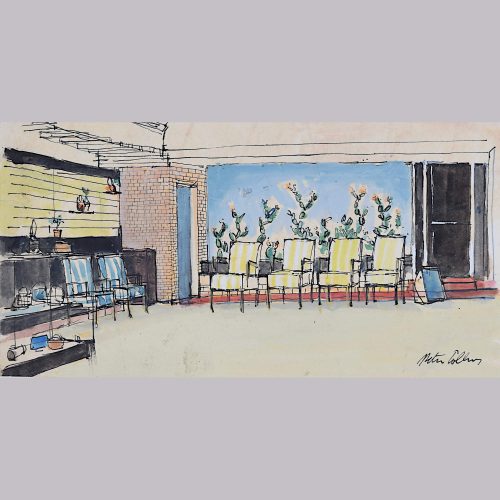
Peter Collins ARCA (1923-2001) Mid Century Modern Lounge Interior
Pen, ink and watercolour 10.5x20.5cm Signed Peter Collins lower right Provenance: The Artist's Studio A stongly-painted image, with a wonderful sense of the light and brightness of a modernist interior. Whether the scene on the back wall is intended to be an extraordinary wallpaper, or whether the view to the garden, we do not know. But the viewer is encouraged to take a seat in an interior that at the time will have felt modern yet comfortable. Click here for other items by the artist and for biographical details. If you are interested email info@manningfineart.co.uk or call us on 07929 749056. -
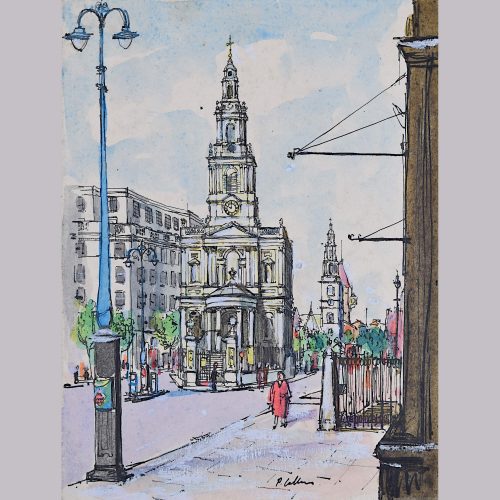
Peter Collins ARCA (1923-2001) St Mary le Strand Church
Watercolour 17 x 21 cm Signed lower right. Provenance: The artist's studio. Typical Collins, with his bright colours and captivating scene, reminiscent of his travel posters, here a passerby in red walks purposely towards the foreground. Click here for other items by the artist and for biographical details. If you are interested email info@manningfineart.co.uk or call us on 07929 749056. -

Peter Collins ARCA (1923-2001) Design for BEA Holiday Brochure 1966 BEA Panorama Holidays
Mixed media on paper 30x21cm Provenance: The Artist's Studio As a graphic designer, Collins produced many brochures such as these. With his fondness for life drawing, he was perhaps a natural choice for the bikini-clad inhabitants of the pages of a holiday brochure. Click here for other items by the artist and for biographical details. If you are interested email info@manningfineart.co.uk or call us on 07929 749056. -
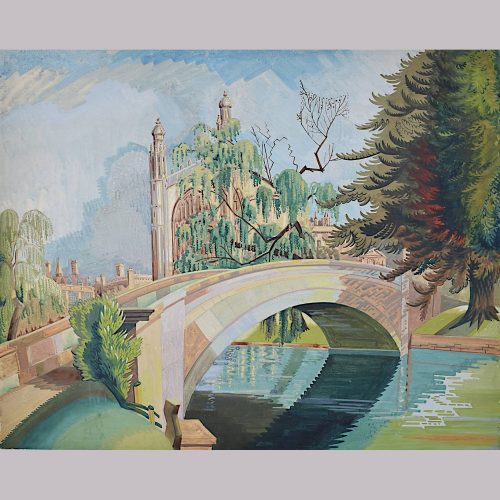
Anonymous King's College Cambridge with the River Cam and Bridge to foreground
51x63.5cm Watercolour Probably 1920s A fine, and large, view of King's College. The artist paints in an art deco style, picking out the stones of the bridge in different colours, the colours all having a heightened sense of reality. Born from cubism, the art deco era is characterised by a fragmented, geometric character particularly evident here. It gives the impression of a shimmering dream. The twenties was an incredible period of change, moving from heavy elaborate styles to a pared back and sleek style expressing more dynamism, an interest in dimension and abstraction. If you are interested email info@manningfineart.co.uk or call us on 07929 749056. -
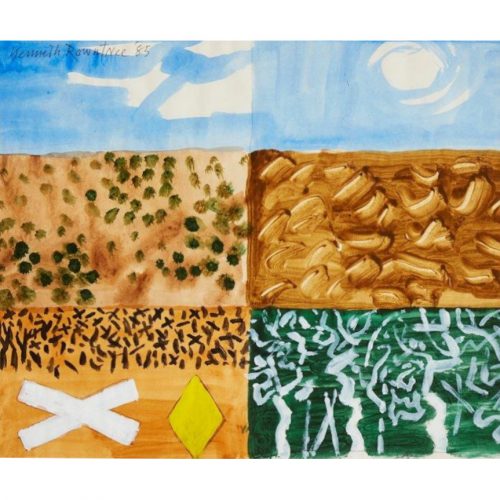
Kenneth Rowntree
Abstract Australian Landscape
Watercolour 27.5 x 33cm Signed (top left) and dated 'Kenneth Rowntree '85' Provenance: Anderson & Garland Studio sale of Kenneth Rowntree lot 263 Tuesday 8 September 2009 For biographical details and other works by Rowntree click here. Rowntree visited Australia in 1984/85. In this painting he picks up various vignettes from the Australian landscape in six separate blocks. Two relate to the sky, with almost-unbroken blue skies stretching from horizon to horizon, three relate to desert areas, with a whole array of different textures, and one is a luscious green. In one of the desert scenes he has picked out two road signs, in typical Rowntree fashion, reducing them to their simplest form. In her essay Kenneth Rowntree: A Strange Simplicity (published in Kenneth Rowntree A Centenary Exhibition Published by Moore-Gwyn Fine Art and Liss Llewellyn Fine Art, on behalf of the artist’s estate, on the occasion of the centenary of Kenneth Rowntree’s birth) Alexandra Harris makes reference to this painting noting:Later, in 1986, just when the young David Hockney was collaging the signs and road-markings of Route 138 in Pearblossom Highway, Rowntree was in Australia painting yellow diamond-shaped road-signs as bright icons in open country. Wherever he went, Rowntree captured both the unfamiliarity of places and their relationship to things he knew. Heading into the Australian outback, he painted a road-sign as he would paint a rail signal at Clare in Suffolk or nautical markers at Swansea.
Hockney's 1986 Pearblossom Highway may be seen here in the Getty and it is worth noting that Rowntree was in fact painting the yellow sign in 1985, so a year before Hockney. If you are interested email info@manningfineart.co.uk or call us on 07929 749056. -
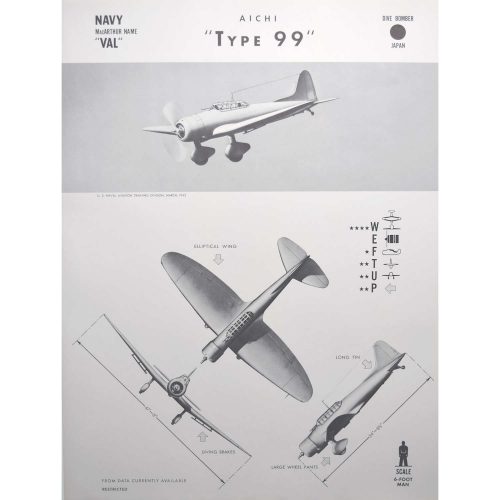
1942 MacArthur name "Val" Aichi "Type 99"
World War II Japanese dive bomber plane
Original aeroplane identification poster, 1942 63 x 47 cm A particularly unusual style of aeroplane identification poster, owing to the very arty images. Most such posters rely on very plain silhouettes, this series - and we have many in this series - have a much more arty approach to the task with shading and an interesting angle view. The Aichi D3A Type 99 Carrier Bomber (Allied reporting name "Val") was a World War II carrier-borne dive bomber. It was the primary dive bomber of the Imperial Japanese Navy (IJN) and was involved in almost all IJN actions, including the attack on Pearl Harbor. The Aichi D3A was the first Japanese aircraft to bomb American targets in the war, commencing with Pearl Harbor and U.S. bases in the Philippines, such as the Clark Air Force Base. They sank more Allied warships than any other Axis aircraft. If you'd like to know more, please email info@manningfineart.co.uk or call us on 07929 749056. -
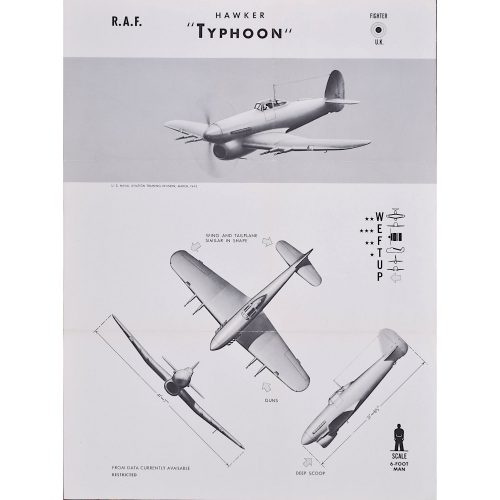
US Naval Aviation Training Division
RAF Hawker Typhoon World War 2 US airplane
Original aeroplane identification poster, 1942 63x47cm A particularly unusual style of aeroplane identification poster, owing to the very arty images. Most such posters rely on very plain silhouettes, this series - and we have several in this series (click here) - have a much more arty approach to the task with shading and an interesting angle view. The Typhoon is a single-seat fighter-bomber nicknamed the 'Tiffy'. Designed as a replacement for the Hawker Hurricane it never completely satisfied this expectation. However it was the only RAF fighter capable of catching the Fw 190 at low altitudes when the latter came into service in 1941. It became one of the most effective ground-attack aircraft of the Second World War. 3317 were produced and only one complete Typhoon still exists which belongs to the Royal Air Force Museum in Hendon. If you are interested email info@manningfineart.co.uk or call us on 07929 749056. -
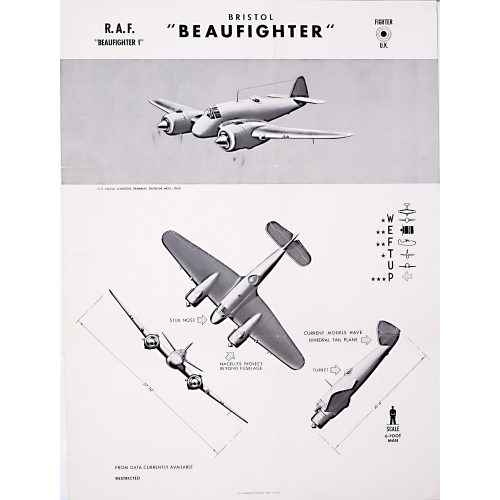
US Naval Aviation Training Division
RAF Bristol Beaufighter World War 2 US airplane
Aeroplane identification poster, 1942 63 x 47 cm A particularly unusual style of aeroplane identification poster, owing to the very arty images. Most such posters rely on very plain silhouettes, this series - and we have several in this series (click here) - have a much more arty approach to the task with shading and an interesting angle view. The Beaufighter is a multi-role aircraft conceived originally as a heavy fighter variant of the Bristol Beaufort. As an effective night fighter it came into service during the Battle of Britain, having the space for radar it became a highly effective night fighter. The de Havilland Mosquito, being somewhat faster, took over in the latter part of 1942. The Beaufighter saw service in all theatres during World War II, serving through to the Greek civil war in 1946. 5,928 were built but no flying examples exist today, although The Fighter Collection at Duxford is currently restoring an aircraft (made from multiple aircraft). If you are interested, please email info@manningfineart.co.uk or call us on 07929 749056. -
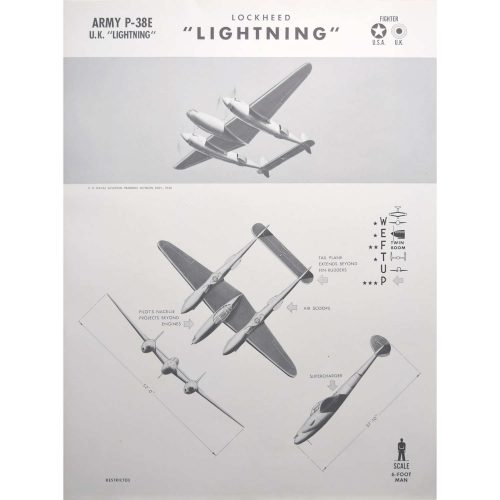
Army P-38E Lockheed "Lightning"
Aeroplane identification poster, published 1942 63 x 47 cm A particularly unusual style of aeroplane identification poster, owing to the very arty images. Most such posters rely on very plain silhouettes, this series - and we have several in this series; view them here - have a much more arty approach to the task with shading and an interesting angle view. The Lockheed P-38 Lightning was an American single-seated, twin piston-engined fighter aircraft that was used during World War II. The Lightning was originally designed as a bomber-interceptor and was never intended to be a fighter. Weight was kept to a minimum and it was far more advanced and faster than its U.S. counterparts, the Bell P-39 Airacobra and Curtiss P-40 Warhawk (original Airacobra and Warhawk posters from the same 1942 series are also available in our storefront). It caught the attention of the US Army Air Corps (USAAC) very quickly. The Lightning shot down more Japanese aeroplanes than any other fighter during World War II. When first introduced in 1939, the Lightning was able to fly a steady course at 413 mph (665 km/h), making it the fastest production aeroplane in the world. It remained one of the fastest climbers right up to the end of the WW II. Condition: generally very good. If you are interested, please email info@manningfineart.co.uk or call us on 07929 749056. -
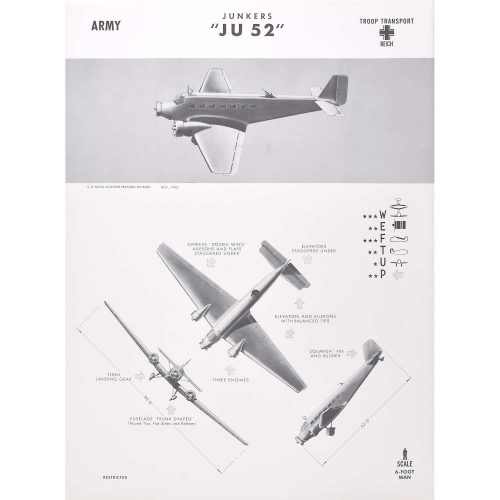
Junkers "JU 52"
Aeroplane identification poster, published 1942 63 x 47 cm A particularly unusual style of aeroplane identification poster, owing to the very arty images. Most such posters rely on very plain silhouettes, this series - and we have several in this series; view them here - have a much more arty approach to the task with shading and an interesting angle view. The Junkers Ju 52/3m (nicknamed Tante Ju ("Aunt Ju") and Iron Annie) was a transport aircraft that was designed and manufactured by German aviation company Junkers. Development of the Ju 52 commenced during 1930, headed by German aeronautical engineer Ernst Zindel. Its maiden flight was on 13 October 1930. Following the rise of Nazi Germany, thousands of Ju 52s were procured as a staple military transport of the nation. The Ju 52 was in production between 1931 and 1952. In a civilian role, it flew with over 12 airlines, including Swissair and Deutsche Luft Hansa, as both a passenger carrier and a freight hauler. In a military role, large numbers flew with the Luftwaffe, being deployed on virtually all fronts of the Second World War as a troop and cargo transport; it was also briefly used as a medium bomber. Additionally, the type was deployed by other nation''s militaries in conflicts such as the Spanish Civil War, the Chaco War, and the Portuguese Colonial War. During the postwar era, the Ju 52 had a lengthy service life with numerous military and civilian operators; large numbers were still in use by the 1980s. Even in the 21st century, several aircraft have remained operational, typically used for purposes such as heritage aviation displays and aerial sightseeing. Condition: generally very good. If you are interested, please email info@manningfineart.co.uk or call us on 07929 749056. -
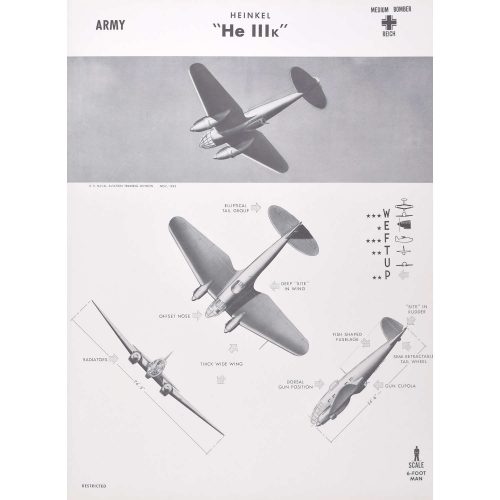
Heinkel "He 111K"
Aeroplane identification poster, published 1942 63 x 47 cm A particularly unusual style of aeroplane identification poster, owing to the very arty images. Most such posters rely on very plain silhouettes, this series - and we have several in this series; view them here - have a much more arty approach to the task with shading and an interesting angle view. The Heinkel He 111 was a German bomber aircraft designed by Siegfried and Walter Günter at Heinkel Flugzeugwerke in 1934. Through development it was described as a "wolf in sheep''s clothing"; due to restrictions placed on Germany after the First World War prohibiting bombers, it masqueraded as a civil airliner, although from conception the design was intended to provide the nascent Luftwaffe with a fast medium bomber. Perhaps the best-recognised German bomber due to the distinctive, extensively glazed "greenhouse" nose of later versions, the Heinkel He 111 was the most numerous Luftwaffe bomber during the early stages of World War II. The bomber fared well until the Battle of Britain, when its weak defensive armament was exposed. Nevertheless, it proved capable of sustaining heavy damage and remaining airborne. As the war progressed, the He 111 was used in a wide variety of roles on every front in the European theatre. It was used as a strategic bomber during the Battle of Britain (and has a prominent role in the film "Battle of Britain"), a torpedo bomber in the Atlantic and Arctic, and a medium bomber and a transport aircraft on the Western, Eastern, Mediterranean, Middle Eastern, and North African Front theatres. The He 111 was constantly upgraded and modified, but became obsolete during the latter part of the war. Condition: generally very good. If you are interested, please email info@manningfineart.co.uk or call us on 07929 749056. -
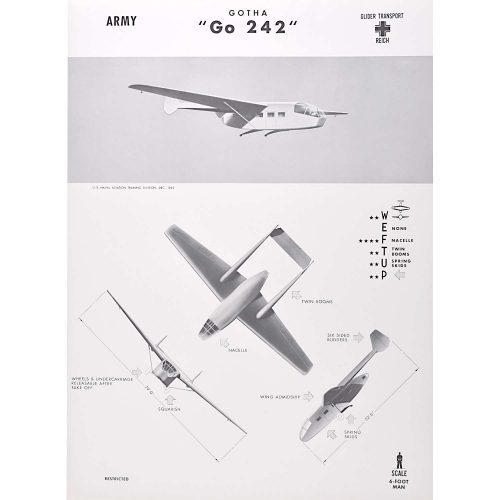
Army Gotha "Go 242"
Aeroplane identification poster, published 1942 63 x 47 cm A particularly unusual style of aeroplane identification poster, owing to the very arty images. Most such posters rely on very plain silhouettes, this series - and we have several in this series; view them here - have a much more arty approach to the task with shading and an interesting angle view. The Gotha Go 242 was a transport glider used by the Luftwaffe during World War II. It was designed by Albert Kalkert in response to the request for a heavy transport glider to replace the DFS 230 which was then in service. The requirement was for a glider capable of carrying 20 fully laden troops, or equivalent cargo. Two prototypes flew in 1941 and the type quickly entered production, with a total of 1,528 being built. In service, Go 242s were towed into the air by Heinkel He 111s or Junkers Ju 52s. Most saw service in the Mediterranean, North Africa and Aegean. Ju 87D-2s had strengthened rear fuselage and combined tailwheel and hook for towing the Go 242. Today, there are two surviving 242s - one in the Musée de la Resistance du Vercors in Valence, France, and the other in the Technik Museum and Luftwaffenmuseum der Bundeswehr in Berlin, Germany. Condition: generally very good. If you are interested, please email info@manningfineart.co.uk or call us on 07929 749056. -
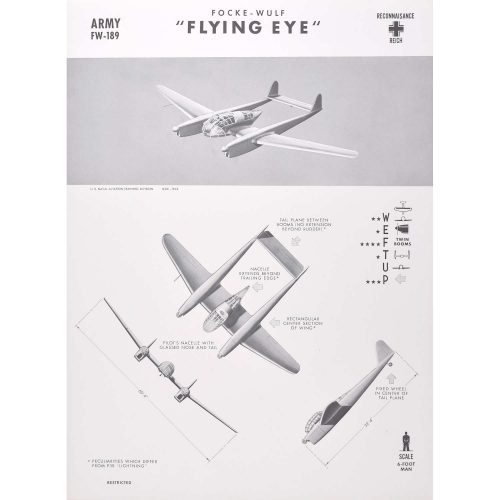
Army FW-189 "Flying Eye"
Aeroplane identification poster, published 1942 63 x 47 cm A particularly unusual style of aeroplane identification poster, owing to the very arty images. Most such posters rely on very plain silhouettes, this series - and we have several in this series; view them here - have a much more arty approach to the task with shading and an interesting angle view. The Focke-Wulf Fw 189 Uhu ("Eagle Owl") was a German twin-engine, twin-boom, three-seat tactical reconnaissance and army cooperation aircraft. It first flew in 1938, entered service in 1940 and was produced until mid-1944. It was nicknamed the “Flying Eye.” Patrolling the vast flatlands of Ukraine and Belarus, the Flying Eye was used extensively on the Eastern Front with great success. It was nicknamed "Rama" ("frame") by Soviet forces, in reference to its distinctive tailboom and stabiliser shapes, which gave it its characteristic quadrangular appearance. Despite its low speed, the Fw 189's manoeuvrability made it a difficult target for attacking Soviet fighters. When attacked, the Flying Eye was often able to out-turn enemy fighters by simply flying in a tight circle. Condition: generally very good. If you are interested, please email info@manningfineart.co.uk or call us on 07929 749056. -
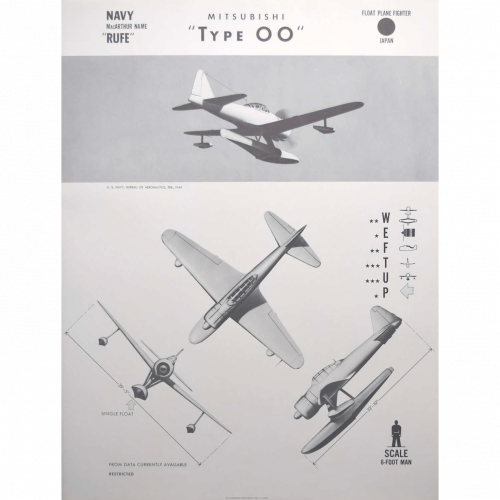
"Rufe" Mitsubishi "Type OO"
Aeroplane identification poster, published 1942 63 x 47 cm A particularly unusual style of aeroplane identification poster, owing to the very arty images. Most such posters rely on very plain silhouettes, this series - and we have several in this series; view them here - have a much more arty approach to the task with shading and an interesting angle view. This Japanese floatplane, known to the Allies as a "Rufe", was developed from the Mitsubishi A6M Type 0 - the famous ''Zero'' figher, mainly to support amphibious operations and defend remote bases. It was based on the A6M-2 Model 11 fuselage, with a modified tail and added floats. A total of 327 were built, including the original prototype. The aircraft was deployed in 1942 and was only used in operations taking place in the Aleutians and Solomon Islands. Such seaplanes were effective in harassing American patrol torpedo boats at night. They could also drop flares to illuminate the American boats which were vulnerable to destroyer gunfire, and depended on cover of darkness. Condition: generally very good. If you are interested, please email info@manningfineart.co.uk or call us on 07929 749056. -
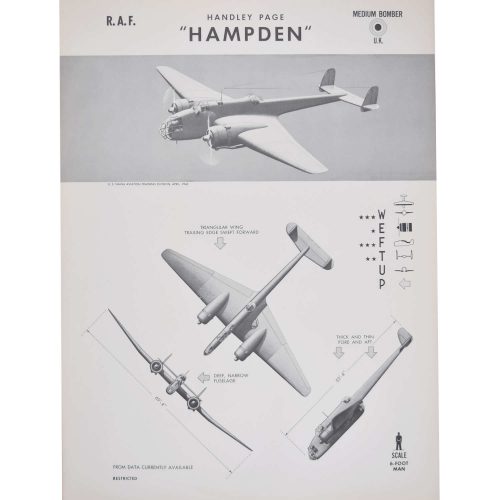
Royal Air Force Handley Page "Hampden" Bomber
Aeroplane identification poster, published 1943 63 x 47 cm A particularly unusual style of aeroplane identification poster, owing to the very arty images. Most such posters rely on very plain silhouettes, this series - and we have several in this series; view them here - have a much more arty approach to the task with shading and an interesting angle view. The Handley Page HP.52 Hampden is a British twin-engine medium bomber that was operated by the Royal Air Force (RAF). It was part of the trio of large twin-engine bombers procured for the RAF, joining the Armstrong Whitworth Whitley and Vickers Wellington. The Hampden was powered by Bristol Pegasus radial engines but a variant known as the Handley Page Hereford had in-line Napier Daggers. The Hampden served in the early stages of the Second World War, bearing the brunt of the early bombing war over Europe, taking part in the first night raid on Berlin and the first 1,000-bomber raid on Cologne. When it became obsolete, after a period of mainly operating at night, it was retired from RAF Bomber Command service in late 1942. By 1943, the rest of the trio were being superseded by the larger four-engined heavy bombers such as the Avro Lancaster. Condition: generally very good. If you are interested, please email info@manningfineart.co.uk or call us on 07929 749056. -
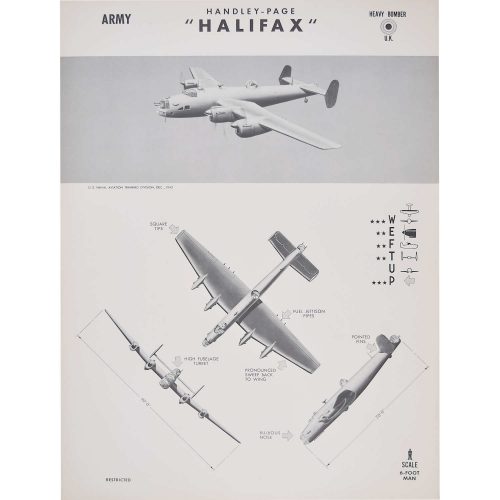
Handley-Page "Halifax"
Aeroplane identification poster, published 1942 63 x 47 cm A particularly unusual style of aeroplane identification poster, owing to the very arty images. Most such posters rely on very plain silhouettes, this series - and we have several in this series; view them here - have a much more arty approach to the task with shading and an interesting angle view. The Halifax bomber was a twin-engined bomber that entered service with the RAF in 1940. Viewed by Arthur ''Bomber'' Harris as inferior to the Lancaster, on account of its smaller payload, the crews preferred it. 1,833 aircraft were lost in service with Bomber Command, across a total of 82,733 operations. Only three survive, one at the Yorkshire Air Museum in Elvington (based on a fuselage that had been in use at a chicken farm following a crash near Stornoway), one at the National Air Force Museum of Canada (which was discovered in 1991 in Norway and subsequently restored), and one at the RAF Museum in London (that crash landed in Norway following an attack on the German battleship Tirpitz; rediscovered in 1971, it has been left unrestored). Condition: generally very good. If you are interested, please email info@manningfineart.co.uk or call us on 07929 749056. -
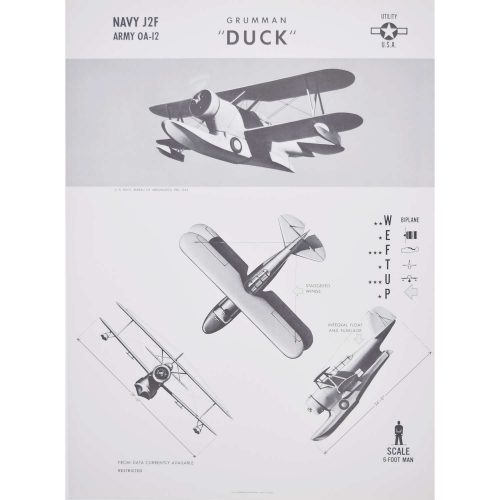
Navy and Army Grumman "Duck"
Aeroplane identification poster, published 1942 63 x 47 cm A particularly unusual style of aeroplane identification poster, owing to the very arty images. Most such posters rely on very plain silhouettes, this series - and we have several in this series; view them here - have a much more arty approach to the task with shading and an interesting angle view. The Grumman J2F Duck was an American single-engine amphibious biplane. It was used by each major branch of the U.S. armed forces from the mid-1930s until just after World War II, primarily for utility and air-sea rescue duties. It was also used by the Argentine Navy, who took delivery of their first J2F in 1937. Apart from general utility and light transport duties, its missions included mapping, reconnaissance, anti-submarine patrol, air-sea rescue work, photographic surveys, and target tug. Condition: generally very good. If you are interested, please email info@manningfineart.co.uk or call us on 07929 749056. -
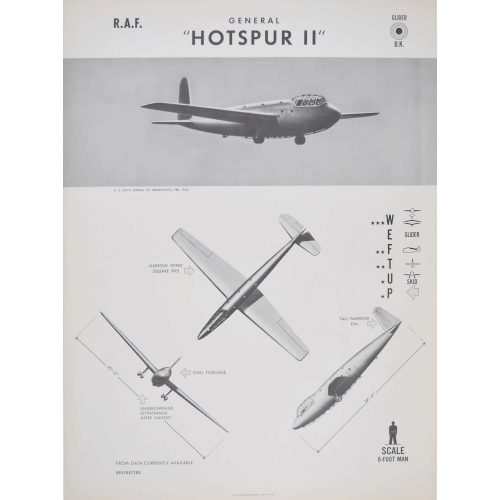
1942 RAF General Hotspur II
Aeroplane identification poster, published 1942 63 x 47 cm A particularly unusual style of aeroplane identification poster, owing to the very arty images. Most such posters rely on very plain silhouettes, this series - and we have several in this series; view them here - have a much more arty approach to the task with shading and an interesting angle view. A particularly unusual style of aeroplane recognition poster, owing to the very arty images. Most such posters rely on very plain silhouettes, this series - and we have several in this series - have a much more arty approach to the task with shading and an interesting angle view. The General Aircraft GAL.48 Hotspur was a military glider designed and built by the British company General Aircraft Ltd during World War II. When the British airborne establishment was formed in 1940 by order of Prime Minister Winston Churchill, it was decided that gliders would be used to transport airborne troops into battle. General Aircraft Ltd were given a contract by the Ministry of Aircraft Production in June 1940 to design and produce an initial glider for use by the airborne establishment, which resulted in the Hotspur. Conceived as an "assault" glider which necessitated a compact design and no more than eight troops carried, tactical philosophy soon favoured larger numbers of troops being sent into battle aboard gliders. Due to this, the Hotspur was mainly relegated to training where it did excel and it became the basic trainer for the glider schools that were formed. The Hotspur was named after Sir Henry Percy, a significant captain during the Anglo-Scottish wars who was also known as "Hotspur". A Hotspur Mark II (HH268) replica is on display at the Museum of Army Flying in Hampshire, England. The front fuselage of a Hotspur was preserved at the Parachute Regiment And Airborne Forces Museum in Aldershot prior to the museum''s 2007 closing, in anticipation of a move to the Imperial War Museum Duxford. Condition: generally very good. If you are interested, please email info@manningfineart.co.uk or call us on 07929 749056. -
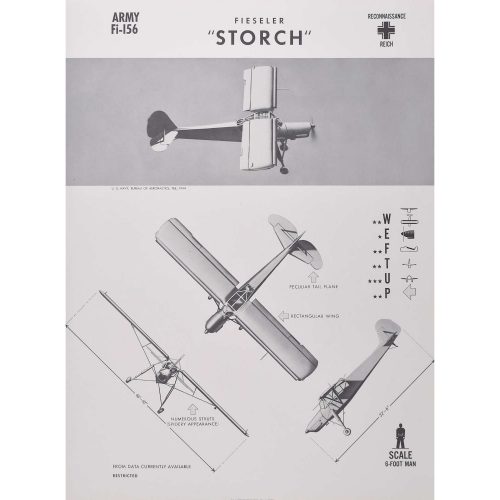
Army Fi-156 Fieseler "Storch"
Aeroplane identification poster, published 1944 63 x 47 cm A particularly unusual style of aeroplane identification poster, owing to the very arty images. Most such posters rely on very plain silhouettes, this series - and we have several in this series; view them here - have a much more arty approach to the task with shading and an interesting angle view. The Fieseler Fi 156 Storch, meaning "stork", was a small German liaison aircraft built by Fieseler before and during World War II. It was notable for its excellent short-takeoff-and-landing performance and low stall speed of 31 mph.The Douglas Skymaster was a four-engine transport aircraft used by the United States Army Air Forces in World War II and the Korean War. Like the Douglas C-47 Skytrain (the Skytrain poster from the same series is also available in our storefront), the Skymaster was derived from a civilian airliner, the Douglas DC-4. The Storch was deployed in all European and North African theatres of World War II. In addition to its liaison function, a number were used to fly a battalion of Infantry Regiment Grossdeutschland behind enemy lines during the invasion of Belgium. In 1943, the Storch played a role in Operation Eiche, the rescue of deposed Italian dictator Benito Mussolini from a boulder-strewn mountain-top near the Gran Sasso. Even though the mountain was surrounded by Italian troops, German commando Otto Skorzeny and 90 paratroopers used gliders to land on the peak and quickly captured it. However, the problem of how to get back off remained. A Focke-Achgelis Fa 223 helicopter was sent, but it broke down en route. Instead, pilot Heinrich Gerlach flew over in a Storch. After Mussolini and Skorzeny had boarded the aircraft, the Storch took off to 250 ft, even though the aircraft was overloaded. A Storch was the last aircraft shot down by the Allies on the Western Front. Condition: generally very good. If you are interested, please email info@manningfineart.co.uk or call us on 07929 749056. -
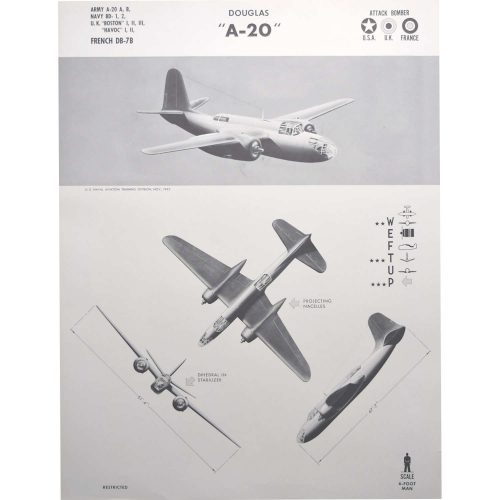
Army A-20 A, B, Navy BD- 1, 2, UK "Boston" I, II, III, "Havoc" I, II, French DB-7B Douglas "A-20"
Aeroplane identification poster, published 1942 63 x 47 cm A particularly unusual style of aeroplane identification poster, owing to the very arty images. Most such posters rely on very plain silhouettes, this series - and we have several in this series; view them here - have a much more arty approach to the task with shading and an interesting angle view. The Douglas A-20 was a medium bomber, attack aircraft, night intruder, night fighter, and reconnaissance aircraft of World War II. Designed to meet an Army Air Corps requirement for a bomber, it was ordered by France for their air force before the USAAC decided it would also meet their requirements. French DB-7s were the first to see combat. The A-20 served with several Allied air forces, principally the United States Army Air Forces (USAAF), the Soviet Air Forces (VVS), Soviet Naval Aviation (AVMF), and the Royal Air Force (RAF) of the United Kingdom. A total of 7,478 aircraft were built, of which more than a third served with Soviet units. It was also used by the air forces of Australia, South Africa, France, and the Netherlands during the war. Condition: generally very good. If you are interested, please email info@manningfineart.co.uk or call us on 07929 749056. -
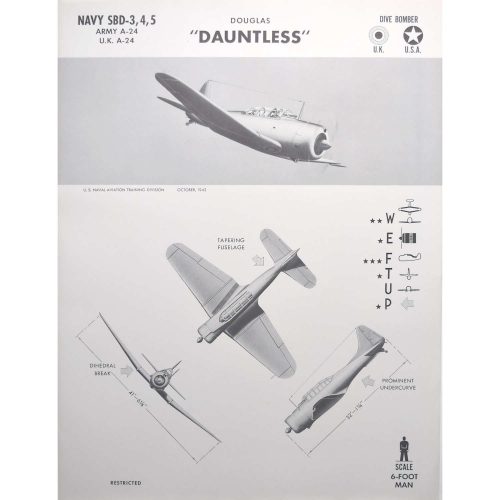
Navy SBD-3, 4, 5, Army A-24 Douglas "Dauntless"
Aeroplane identification poster, published 1942 63 x 47 cm A particularly unusual style of aeroplane identification poster, owing to the very arty images. Most such posters rely on very plain silhouettes, this series - and we have several in this series; view them here - have a much more arty approach to the task with shading and an interesting angle view. The Douglas SBD Dauntless was a World War II American naval scout plane and dive bomber that was manufactured by Douglas Aircraft from 1940 through 1944. The SBD ("Scout Bomber Douglas") was the United States Navy''s main carrier-based scout/dive bomber from mid-1940 through mid-1944. The SBD was also flown by the United States Marine Corps, both from land air bases and aircraft carriers. The SBD is best remembered as the bomber that delivered the fatal blows to the Japanese carriers at the Battle of Midway in June 1942. During Midway, four squadrons of Dauntless dive bombers attacked and sank or fatally damaged all four Japanese fleet carriers present, disabling three of them in the span of just six minutes (Akagi, Kaga, and Sōryū) and, later in the day, Hiryū. During its combat service, the SBD proved to be an excellent naval scout plane and dive bomber. It possessed long range, good handling characteristics, manoeuvrability, potent bomb load, great diving characteristics from the perforated dive brakes, good defensive armament, and ruggedness. Condition: generally very good. If you are interested, please email info@manningfineart.co.uk or call us on 07929 749056. -
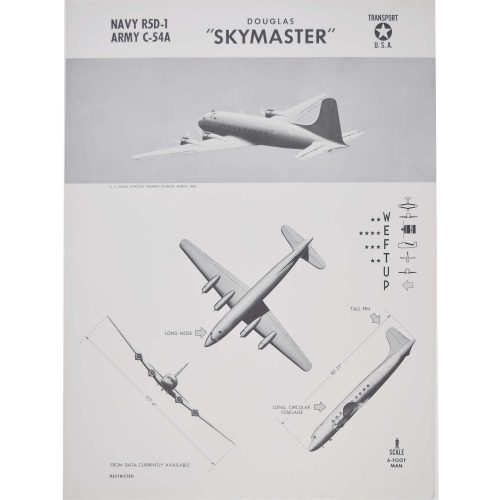
1942 Navy R5D-1 Army C-54A Douglas "Skymaster"
Aeroplane identification poster, published 1942 63 x 47 cm A particularly unusual style of aeroplane identification poster, owing to the very arty images. Most such posters rely on very plain silhouettes, this series - and we have several in this series; view them here - have a much more arty approach to the task with shading and an interesting angle view. The Douglas Skymaster was a four-engine transport aircraft used by the United States Army Air Forces in World War II and the Korean War. Like the Douglas C-47 Skytrain (the Skytrain poster from the same series is also available in our storefront), the Skymaster was derived from a civilian airliner, the Douglas DC-4. To meet military requirements, the first civil production aircraft had four additional auxiliary fuel tanks in the main cabin which reduced the passenger seats to 26. The following batch of aircraft, designated C-54A, were built with a stronger floor and a cargo door with a hoist and winch. The first C-54A was delivered in February 1943. Skymasters used by the United States Navy were designated Douglas R5D. As well as being used for cargo transport, the C-54 also carried presidents, prime ministers, and military staff. Dozens of variants of the C-54 were employed in a wide variety of non-combat roles such as air-sea rescue, scientific and military research, and missile tracking and recovery. During the Berlin Airlift it hauled coal and food supplies to West Berlin. After the Korean War it continued to be used for military and civilian uses by more than 30 countries. Condition: generally very good. If you are interested, please email info@manningfineart.co.uk or call us on 07929 749056. -
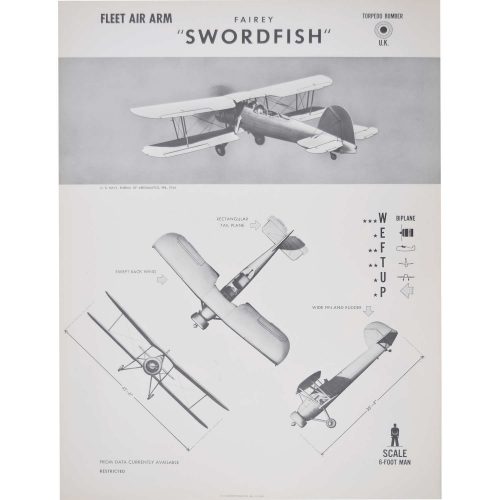
Fairey Swordfish
Aeroplane identification poster, published 1942 63 x 47 cm A particularly unusual style of aeroplane identification poster, owing to the very arty images. Most such posters rely on very plain silhouettes, this series - and we have several in this series; view them here - have a much more arty approach to the task with shading and an interesting angle view. The Fairey Swordfish is a biplane torpedo bomber designed by the Fairey Aviation Company. Originating in the early 1930s, the Swordfish, nicknamed "Stringbag", was operated by the Fleet Air Arm of the Royal Navy, it was also used by the Royal Air Force (RAF), as well as several overseas operators, including the Royal Canadian Air Force (RCAF) and the Royal Netherlands Navy. It was initially operated primarily as a fleet attack aircraft. During its later years, the Swordfish became increasingly used as an anti-submarine and training platform. The type was in frontline service throughout the Second World War. Despite being obsolete by 1939, the Swordfish achieved some spectacular successes during the war. Notable events included sinking one battleship and damaging two others of the Regia Marina (the Italian Navy) during the Battle of Taranto, and the famous attack on the Bismarck, which contributed to her eventual demise. By the end of the war, the Swordfish held the distinction of having caused the destruction of a greater tonnage of Axis shipping than any other Allied aircraft. The Swordfish remained in front-line service until V-E Day, having outlived multiple aircraft that had been intended to replace it in service. Condition: generally very good. If you are interested, please email info@manningfineart.co.uk or call us on 07929 749056. -
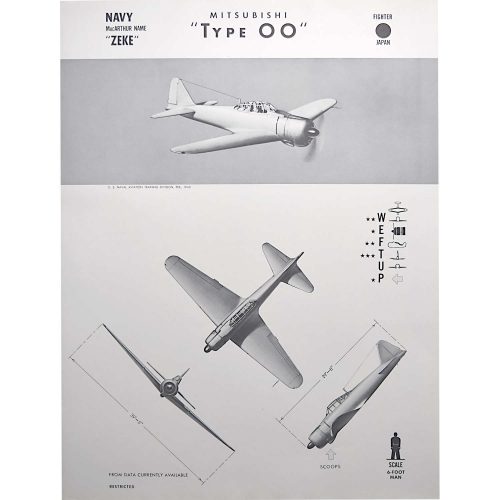
US Naval Aviation Training Division
MacArthur name "Zeke" or Zero Mitsubishi "Type 00" - Japanese fighter plane
Aeroplane identification poster, published 1943 63 x 47 cm A particularly unusual style of aeroplane identification poster, owing to the very arty images. Most such posters rely on very plain silhouettes, this series - and we have several in this series; view them here - have a much more arty approach to the task with shading and an interesting angle view. The Mitsubishi A6M "Zero" was a long-range carrier-based fighter aircraft formerly manufactured by Mitsubishi Aircraft Company, a part of Mitsubishi Heavy Industries, and was operated by the Imperial Japanese Navy from 1940 to 1945. The official Allied reporting name was "Zeke", although the name "Zero" (from Type 0) was used colloquially by the Allies as well. The Zero was considered to have been the most capable carrier-based fighter in the world when it was introduced early in World War II, combining excellent manoeuvrability and very long range. The Imperial Japanese Navy Air Service (IJNAS) also frequently used it as a land-based fighter. In early combat operations, the Zero gained a reputation as a dogfighter, achieving an outstanding kill ratio of 12 to 1, but by mid-1942 a combination of new tactics and the introduction of better equipment enabled Allied pilots to engage the Zero on generally equal terms. The Zero continued to serve in a front-line role until the end of the war in the Pacific; during the final phases, it was also adapted for use in kamikaze operations. Japan produced more Zeros than any other model of combat aircraft during the Second World War. Condition: generally very good. If you are interested, please email info@manningfineart.co.uk or call us on 07929 749056. -
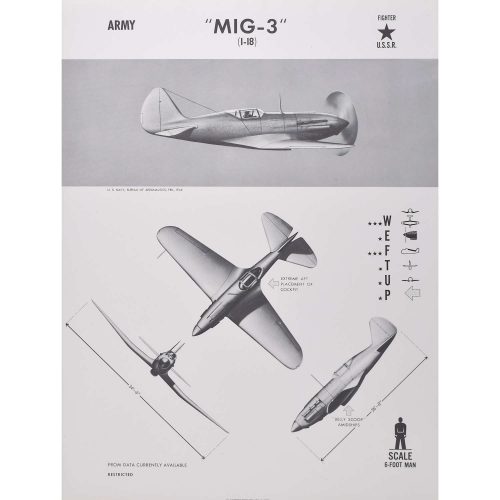
US Naval Aviation Training Division
MIG-3
Aeroplane identification poster, published 1942 63 x 47 cm A particularly unusual style of aeroplane identification poster, owing to the very arty images. Most such posters rely on very plain silhouettes, this series - and we have several in this series; view them here - have a much more arty approach to the task with shading and an interesting angle view. The Mikoyan-Gurevich MIG-3 was a Soviet fighter and interceptor aircraft used during World War II. It was a development of the MIG-1 by the Experimental Design Department of Factory No. 1 to remedy problems found during the MIG-1's development and operations. On 22 June 1941, at the beginning of Operation Barbarossa, some 981 MIG-3s were in service with the Soviet Air Forces, the Soviet Air Defence Forces, and Soviet Naval Aviation. The MIG-3 was difficult to fly in peacetime and much more so in combat. Originally designed as a high-altitude fighter-interceptor, combat over the Eastern Front was generally at lower altitudes, where it was inferior to the German Messerschmitt Bf 109 (a poster of which is available in our storefront) as well as most of its Soviet contemporaries. It was also pressed into service as a fighter-bomber during the autumn of 1941 but it was equally unsuited for this. The losses suffered in combat were very high, in percentage the highest among all the VVS fighters, with 1,432 shot down. Condition: generally very good. If you are interested, please email info@manningfineart.co.uk or call us on 07929 749056. -
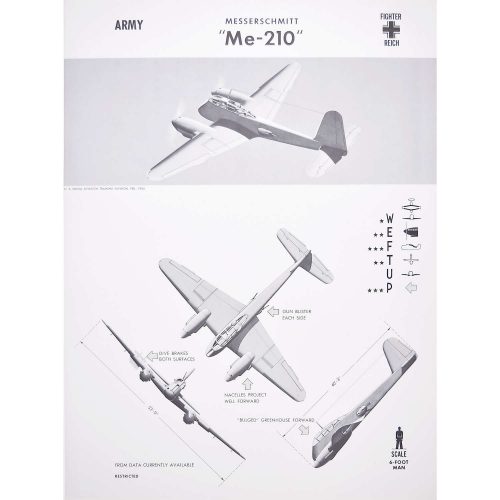
US Naval Aviation Training Division
Messerschmitt BF 210
Aeroplane identification poster, published 1942 63 x 47 cm A particularly unusual style of aeroplane identification poster, owing to the very arty images. Most such posters rely on very plain silhouettes, this series - and we have several in this series; view them here - have a much more arty approach to the task with shading and an interesting angle view. The Messerschmitt Me 210 was a two-seater German heavy fighter and ground-attack aircraft of World War II. Initial development of the 210 was started by Messerschmitt in 1938 at the request of the Luftwaffe. Condition: generally very good. If you are interested, please email info@manningfineart.co.uk or call us on 07929 749056. -
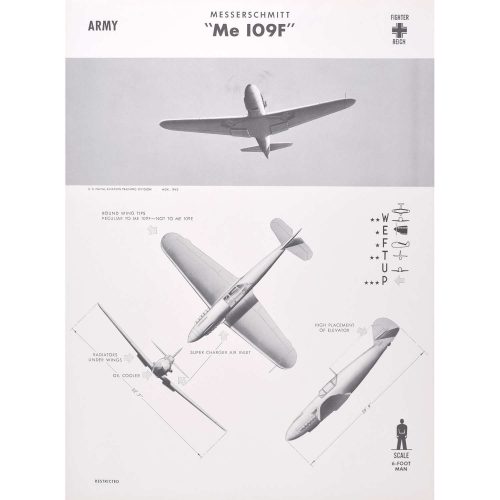
US Naval Aviation Training Division
Messerschmitt BF 109
Aeroplane identification poster, published 1942 63 x 47 cm A particularly unusual style of aeroplane identification poster, owing to the very arty images. Most such posters rely on very plain silhouettes, this series - and we have several in this series; view them here - have a much more arty approach to the task with shading and an interesting angle view. The Messerschmitt Bf 109 is a German World War II fighter aircraft that was, along with the Focke-Wulf Fw 190, the backbone of the Luftwaffe's fighter force. The Bf 109 first saw operational service in 1937 during the Spanish Civil War and was still in service at the dawn of the jet age at the end of World War II in 1945. It was one of the most advanced fighters when it first appeared, with an all-metal monocoque construction, a closed canopy, and retractable landing gear. It was powered by a liquid-cooled, inverted-V12 aero engine. It was called the Me 109 by Allied aircrew and some German aces, even though this was not the official German designation. It was designed by Willy Messerschmitt and Robert Lusser who worked at Bayerische Flugzeugwerke during the early to mid-1930s. It was conceived as an interceptor, although later models were developed to fulfil multiple tasks, serving as bomber escort, fighter-bomber, day-, night-, all-weather fighter, ground-attack aircraft, and reconnaissance aircraft. It was supplied to several states during World War II and served with several countries for many years after the war. The Bf 109 is the most produced fighter aircraft in history, with a total of 33,984 airframes produced from 1936 to April 1945. Some of the Bf 109 production took place in Nazi concentration camps through slave labor. The Bf 109 was flown by the three top-scoring fighter aces of all time, who claimed 928 victories among them while flying with Jagdgeschwader 52, mainly on the Eastern Front. The highest-scoring, Erich Hartmann, was credited with 352 victories. The aircraft was also flown by Hans-Joachim Marseille, the highest-scoring ace in the North African Campaign who shot down 158 enemy aircraft. It was also flown by many aces from other countries fighting with Germany, notably the Finn Ilmari Juutilainen, the highest-scoring non-German ace. Pilots from Italy, Romania, Croatia, Bulgaria, and Hungary also flew the Bf 109. Through constant development, the Bf 109 remained competitive with the latest Allied fighter aircraft until the end of the war. Condition: generally very good. If you are interested, please email info@manningfineart.co.uk or call us on 07929 749056. -
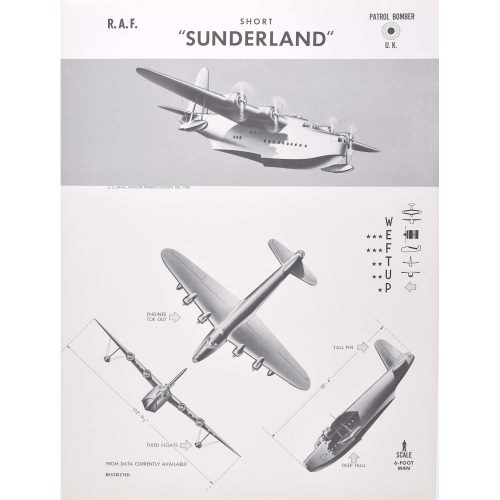
US Naval Aviation Training Division
Short Sunderland
Aeroplane identification poster, published 1942 63 x 47 cm A particularly unusual style of aeroplane identification poster, owing to the very arty images. Most such posters rely on very plain silhouettes, this series - and we have several in this series; view them here - have a much more arty approach to the task with shading and an interesting angle view. The Avro Lancaster is a British Second World War heavy bomber. It was designed and manufactured by Avro as a contemporary of the Handley Page Halifax, both bombers having been developed to the same specification, as well as the Short Stirling, all three aircraft being four-engined heavy bombers adopted by the Royal Air Force (RAF) during the same wartime era. The Short Sunderland was a British flying boat patrol bomber, developed and constructed by Short Brothers for the Royal Air Force (RAF). The aircraft took its service name from the town (latterly, city) and port of Sunderland in North East England. The Sunderland was one of the most powerful and widely used flying boats throughout the Second World War. In addition to the RAF, the type was operated by other Allied military air wings, including the Royal Australian Air Force (RAAF), Royal Canadian Air Force (RCAF), South African Air Force (SAAF), Royal New Zealand Air Force (RNZAF), French Navy, Norwegian Air Force, and the Portuguese Navy. During the conflict, the Sunderland was heavily involved in Allied efforts to counter the threat posed by German U-boats in the Battle of the Atlantic. On 17 July 1940, a RAAF Sunderland (of No. 10 Squadron) performed the type's first unassisted U-boat kill. The Sunderland also played a major role in the Mediterranean theatre, performing maritime reconnaissance flights and logistical support missions. During the evacuation of Crete, shortly after the German invasion of the island, several aircraft were used to transport troops. Numerous unarmed Sunderlands were also flown by civil operator British Overseas Airways Corporation (BOAC), traversing routes as far afield as the Pacific Ocean. Condition: generally very good, occasional handling marks. If you are interested, please email info@manningfineart.co.uk or call us on 07929 749056. -
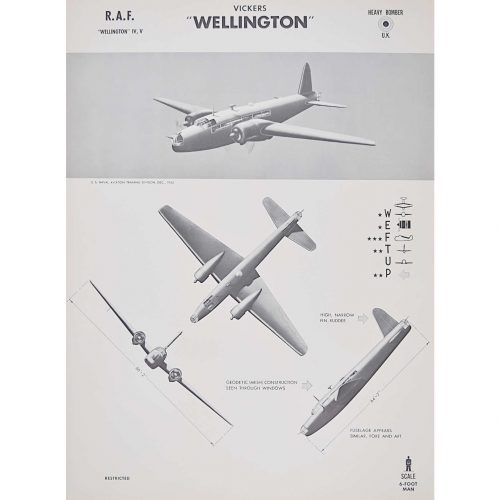
US Naval Aviation Training Division
Vickers Wellington
Aeroplane identification poster, 1942 63 x 47 cm A particularly unusual style of aeroplane identification poster, owing to the very arty images. Most such posters rely on very plain silhouettes, this series - and we have several in this series; view them here - have a much more arty approach to the task with shading and an interesting angle view. The Vickers Wellington was a British twin-engined, long-range medium bomber. It was designed during the mid-1930s at Brooklands in Weybridge, Surrey. Led by Vickers-Armstrongs' chief designer Rex Pierson; a key feature of the aircraft is its geodetic airframe fuselage structure, which was principally designed by Barnes Wallis. Development had been started in response to Air Ministry Specification B.9/32, issued in the middle of 1932, for a bomber for the Royal Air Force. This specification called for a twin-engined day bomber capable of delivering higher performance than any previous design. Other aircraft developed to the same specification include the Armstrong Whitworth Whitley and the Handley Page Hampden. During the development process, performance requirements such as for the tare weight changed substantially, and the engine used was not the one originally intended. The Wellington was used as a night bomber in the early years of the Second World War, performing as one of the principal bombers used by Bomber Command. During 1943, it started to be superseded as a bomber by the larger four-engined "heavies" such as the Avro Lancaster. The Wellington continued to serve throughout the war in other duties, particularly as an anti-submarine aircraft. It holds the distinction of having been the only British bomber that was produced for the duration of the war, and of having been produced in a greater quantity than any other British-built bomber. The Wellington remained as first-line equipment when the war ended, although it had been increasingly relegated to secondary roles. The Wellington was one of two bombers named after Arthur Wellesley, 1st Duke of Wellington, the other being the Vickers Wellesley. A larger heavy bomber aircraft designed to Specification B.1/35, the Vickers Warwick, was developed in parallel with the Wellington; the two aircraft shared around 85% of their structural components. Many elements of the Wellington were also re-used in a civil derivative, the Vickers VC.1 Viking. If you are interested, please email info@manningfineart.co.uk or call us on 07929 749056. -
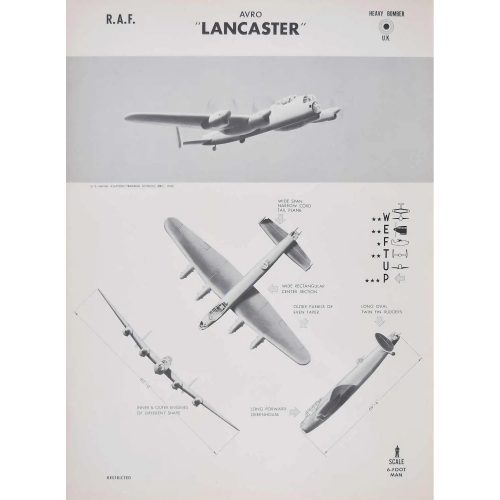
US Naval Aviation Training Division
Avro Lancaster
Aeroplane identification poster, published 1942 63 x 47 cm A particularly unusual style of aeroplane identification poster, owing to the very arty images. Most such posters rely on very plain silhouettes, this series - and we have several in this series; view them here - have a much more arty approach to the task with shading and an interesting angle view. The Avro Lancaster is a British Second World War heavy bomber. It was designed and manufactured by Avro as a contemporary of the Handley Page Halifax, both bombers having been developed to the same specification, as well as the Short Stirling, all three aircraft being four-engined heavy bombers adopted by the Royal Air Force (RAF) during the same wartime era. The Lancaster has its origins in the twin-engine Avro Manchester which had been developed during the late 1930s in response to the Air Ministry Specification P.13/36 for a capable medium bomber for "world-wide use". Originally developed as an evolution of the Manchester (which had proved troublesome in service and was retired in 1942), the Lancaster was designed by Roy Chadwick and powered by four Rolls-Royce Merlins and in one version, Bristol Hercules engines. It first saw service with RAF Bomber Command in 1942 and as the strategic bombing offensive over Europe gathered momentum, it was the main aircraft for the night-time bombing campaigns that followed. As increasing numbers of the type were produced, it became the principal heavy bomber used by the RAF, the Royal Canadian Air Force (RCAF) and squadrons from other Commonwealth and European countries serving within the RAF, overshadowing the Halifax and Stirling. A long, unobstructed bomb bay meant that the Lancaster could take the largest bombs used by the RAF, including the 4,000 lb (1,800 kg), 8,000 lb (3,600 kg) and 12,000 lb (5,400 kg) blockbusters, loads often supplemented with smaller bombs or incendiaries. The "Lanc", as it was known colloquially, became one of the most heavily used of the Second World War night bombers, "delivering 608,612 long tonnes of bombs in 156,000 sorties". The versatility of the Lancaster was such that it was chosen to equip 617 Squadron and was modified to carry the Upkeep "bouncing bomb" designed by Barnes Wallis for Operation Chastise, the attack on German Ruhr valley dams. Although the Lancaster was primarily a night bomber, it excelled in many other roles, including daylight precision bombing, for which some Lancasters were adapted to carry the 12,000 lb (5,400 kg) Tallboy and then the 22,000 lb (10,000 kg) Grand Slam earthquake bombs (also designed by Wallis). This was the largest payload of any bomber in the war. In 1943, a Lancaster was converted to become an engine test bed for the Metropolitan-Vickers F.2 turbojet. Lancasters were later used to test other engines, including the Armstrong Siddeley Mamba and Rolls-Royce Dart turboprops and the Avro Canada Orenda and STAL Dovern turbojets. Postwar, the Lancaster was supplanted as the main strategic bomber of the RAF by the Avro Lincoln, a larger version of the Lancaster. The Lancaster took on the role of long range anti-submarine patrol aircraft (later supplanted by the Avro Shackleton) and air-sea rescue. It was also used for photo-reconnaissance and aerial mapping, as a flying tanker for aerial refuelling and as the Avro Lancastrian, a long-range, high-speed, transatlantic passenger and postal delivery airliner. In March 1946, a Lancastrian of BSAA flew the first scheduled flight from the new London Heathrow Airport. Condition: generally very good, occasional handling marks. If you are interested, please email info@manningfineart.co.uk or call us on 07929 749056. -
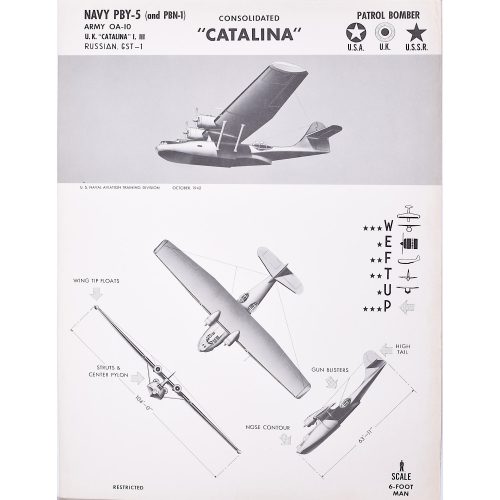
US Naval Aviation Training Division
Consolidated PBY Catalina World War 2 US airplane
Aeroplane identification poster, 1942 63 x 47 cm A particularly unusual style of aeroplane identification poster, owing to the very arty images. Most such posters rely on very plain silhouettes, this series - and we have several in this series (click here) - have a much more arty approach to the task with shading and an interesting angle view. The PBY Catalina is a flying boat used extensively during World War 2 in anti-submarine patrols, air-sea rescue, patrol bombing and convoy escort. It served militarily until the 1980s and was still being used in the 2010s as a waterbomber for firefighting. The RCAF called it the Canso. If you are interested, please email info@manningfineart.co.uk or call us on 07929 749056. -
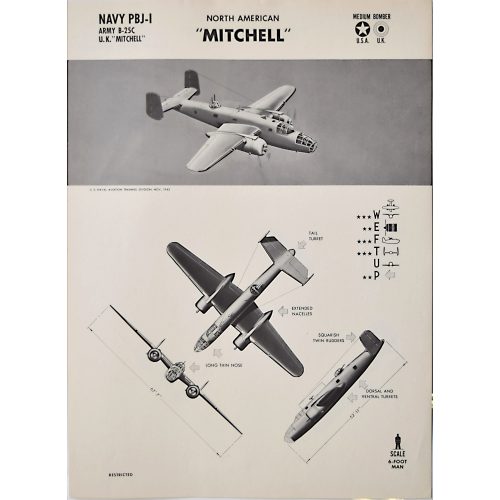
US Naval Aviation Training Division
B-25 Bomber North American Mitchell World War 2 US airplane
Original aeroplane identification poster, 1942 63 x 47 cm A particularly unusual style of aeroplane identification poster, owing to the very arty images. Most such posters rely on very plain silhouettes, this series - and we have several in this series - have a much more arty approach to the task with shading and an interesting angle view. Manufactured by North American Aviation and named in honour of Major General William 'Billy' Mitchell, a pioneer of US military aviation its first flight was in 1940 but it remained in service until 1979 (in the Indonesian air force). A particularly durable aircraft, one from the 321st Bomb Group was nicknamed 'Patches' on account of its (by the end of the war) 400 patched holes which had been painted with bright-yellow zinc chromate primer. Having completed over 300 missions and belly-landed six times the airframe was so distorted that 'straight-and-level' flight involved 8 degrees of left aileron trim and 6 degrees of right rudder causing the aircraft to 'crab' sideways through the air. Over one hundred B-25 Mitchells survive, with about 45 still airworthy. Seventeen flyable aircraft (and one hulk which was sacrificed to a crash scene) starred in the 1970 film 'Catch 22' fifteen of which still exist. If you are interested, please email info@manningfineart.co.uk or call us on 07929 749056. -
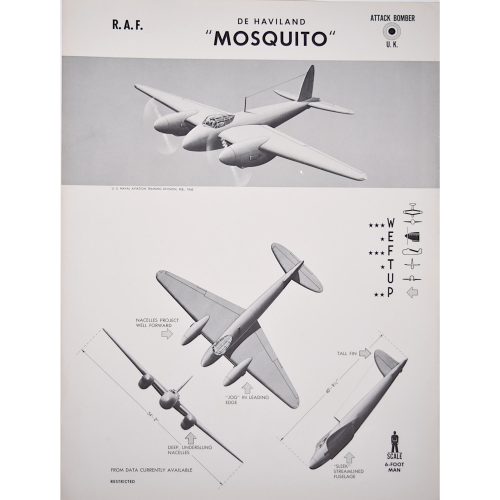
US Naval Aviation Training Division
DH Mosquito World War 2 US airplane
Original aeroplane identification poster, 1943 63 x 47 cm The Mosquito, the 'wooden wonder', was made entirely from wood to counteract metal shortages. Being wooden, it was very light, and when powered by two Merlin engines could outrun any German aeroplane, hence its use for Photographic Reconnaissance. Goering is reputed to have said: "In 1940 I could at least fly as far as Glasgow in most of my aircraft, but not now! It makes me furious when I see the Mosquito. I turn green and yellow with envy. The British, who can afford aluminium better than we can, knock together a beautiful wooden aircraft that every piano factory over there is building, and they give it a speed which they have now increased yet again. What do you make of that? There is nothing the British do not have. They have the geniuses and we have the nincompoops. When the war is over I shall buy a British radio set. Then at least I shall have something that works." If you are interested, please email info@manningfineart.co.uk or call us on 07929 749056. -
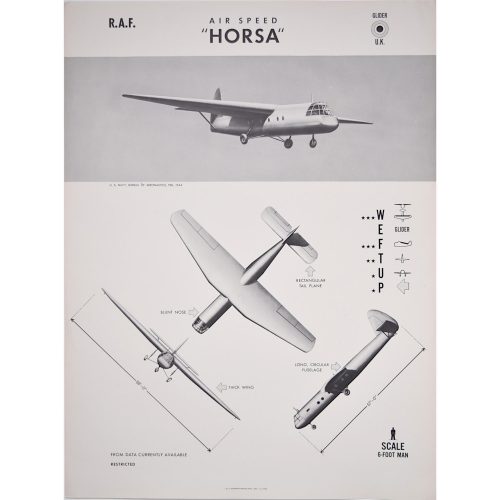
US Naval Aviation Training Division
Airspeed Horsa Glider World War 2 US airplane
Original aeroplane identification poster, 1943 63 x 47 cm In the days before helicopters it was gliders that allowed troops to be delivered to the ground. Essentially disposable aircraft (though obviously recovered where possible) they were light-weight and able to land in open fields where an aeroplane could not. Their ability to carry small tanks and other vehicles gave them a great advantage over simple paratroopers. Deployed to great effect in the D-Day Normandy landings and in the Market Garden advance, they were also widely used in Burma to supply the Chindits. One of the most terrifying methods of air transport during the War was the 'glider snatch'. A glider that had been used to deliver supplies or troops was reloaded with the wounded and then a passing aeroplane would pick up a rope attached to the front of the glider and snatch it into the air. The Horsa was a large glider, capable of accommodating 20-25 fully equipped paratroopers, and was first introduced in 1941. Made almost exclusively from wood - metal being in short supply - it was built by furniture factories. Between 3,799 and 5,000 Horsas were built - the varying numbers being down to the fact that many gliders were assembled at Maintenance Units rather than at the furniture factories (which lacked airfields). If you are interested, please email info@manningfineart.co.uk or call us on 07929 749056. -
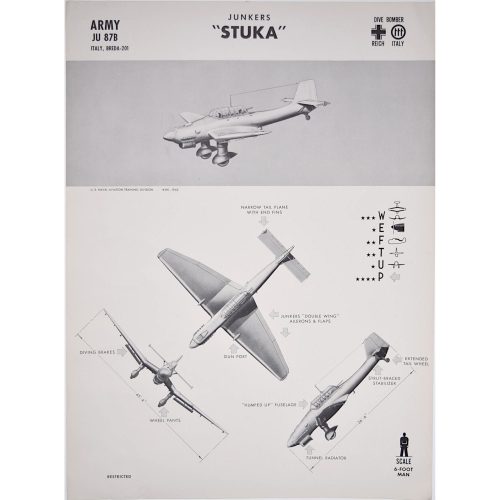
US Naval Aviation Training Division
Junkers Ju87 Stuka Dive Bomber - World War II aeroplane
Original aeroplane identification poster, 1943 63x47cm A particularly unusual style of aeroplane identification poster, owing to the very arty images. Most such posters rely on very plain silhouettes, this series - and we have several in this series (click here) - have a much more arty approach to the task with shading and an interesting angle view. Making its combat debut in 1937 with the Condor Legion during the Spanish Civil War it had a very distinctive silhouette as may be seen here. Essential to the rapid conquest of Norway, the Netherlands, Belgium and France in 1940 the Stuka was very effective against ground targets but vulnerable to fighter aircraft. It remained in service until the end of the War. If you are interested email info@manningfineart.co.uk or call us on 07929 749056. -
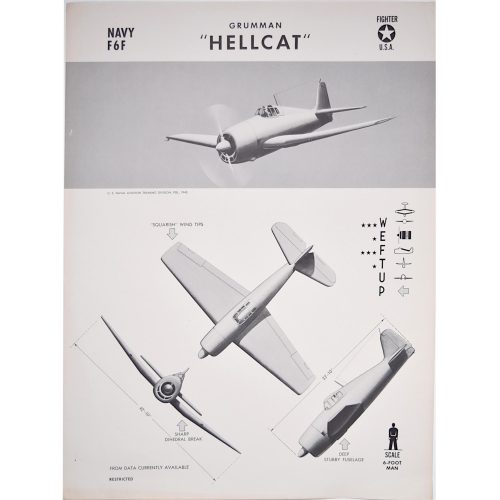
US Naval Aviation Training Division
Grumann F6F Hellcat World War 2 US airplane
Original aeroplane identification poster, 1943 63 x 47 cm The Grumman Hellcat was developed for the US Navy for the latter half of World War 2, becoming the dominant carrier-based aircraft being able to outperform the A6M Mitsubishi Zero. 12,275 were built in just over two years, being credited with 5,223 enemy kills - more than any other Allied naval aircraft. If you are interested, please email info@manningfineart.co.uk or call us on 07929 749056. -
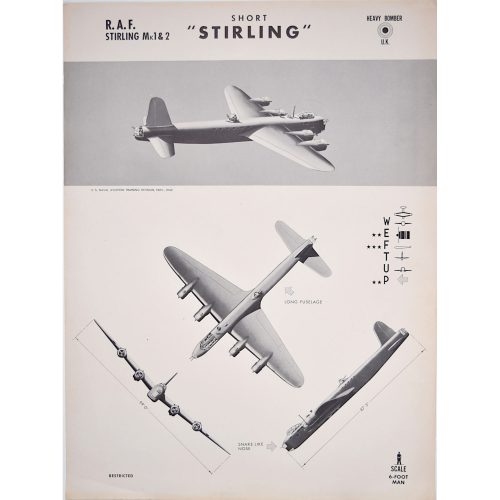
US Naval Aviation Training Division
Short Stirling World War 2 US airplane
Aeroplane identification poster, 1943 63 x 47 cm A particularly unusual style of aeroplane identification poster, owing to the very arty images. Most such posters rely on very plain silhouettes, this series - and we have several in this series (click here) - have a much more arty approach to the task with shading and an interesting angle view. Designed by Short Brothers, this was the RAF's first four-engined bomber entering service in 1941. Pilots liked its handling characteristics but the altitude ceiling was a matter of criticism and it was relegated to second-line duties in 1943 when the Halifax and Lancaster were available in sufficient numbers. It was subsequently used for mining harbours, as a glider tug and a supply aircraft. If you are interested, please email info@manningfineart.co.uk or call us on 07929 749056. -
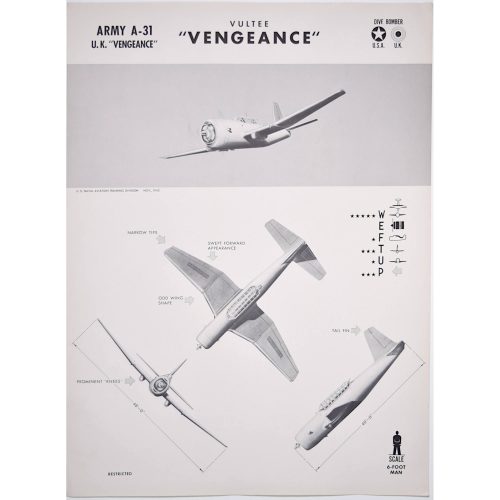
US Naval Aviation Training Division
1943 Vultee Vengeance World War 2 US airplane
Aeroplane identification poster, 1943 63 x 47 cm A particularly unusual style of aeroplane identification poster, owing to the very arty images. Most such posters rely on very plain silhouettes, this series - and we have several in this series (click here) - have a much more arty approach to the task with shading and an interesting angle view. Designed in 1940 as a single-engined dive bomber for the French Armée de l'Air, with deliveries scheduled for October 1940. With the fall of France in June 1940 the order was cancelled, but the British Royal Air Force ordered 200 of these dive bombers having been impressed by the Stuka. It was a reliable aircraft, stable in flight and in a dive. It was much used in Burma, this forgotten theatre of the war being regarded as a repository for otherwise unpopular and unwanted equipment, but where it proved very effective in bombing Japanese positions. If you are interested, please email info@manningfineart.co.uk or call us on 07929 749056. -
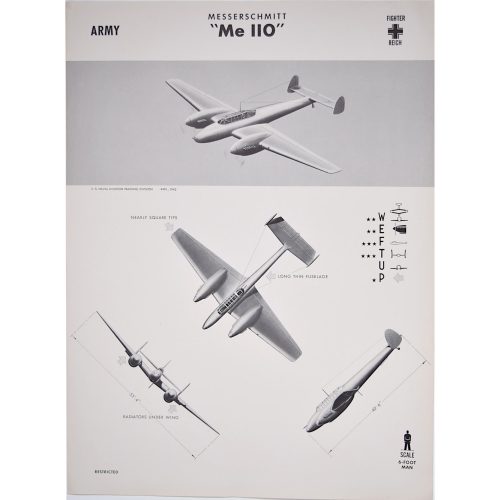
US Naval Aviation Training Division
Messerschmitt Bf 110 - World War II aeroplane
Aeroplane identification poster, 1943 63x47cm A particularly unusual style of aeroplane identification poster, owing to the very arty images. Most such posters rely on very plain silhouettes, this series - and we have several in this series (click here) - have a much more arty approach to the task with shading and an interesting angle view. A two-engined heavy fighter and fighter-bomber developed in German in the 1930s which saw service until the end of the war in 1945. It was a formidable radar-equipped night fighter with the top night-fighter ace Major Heinz-Wolfgang Schnaufer claiming 121 victories from 164 sorties. If you are interested email info@manningfineart.co.uk or call us on 07929 749056. -
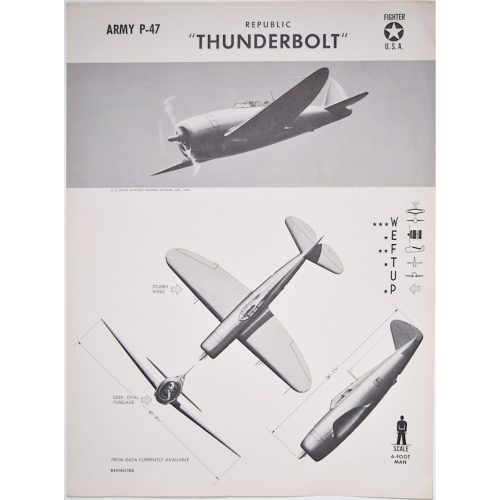
US Naval Aviation Training Division
Republic P47 Thunderbolt World War 2 US airplane
Aeroplane identification poster, 1943 63 x 47 cm A particularly unusual style of aeroplane identification poster, owing to the very arty images. Most such posters rely on very plain silhouettes, this series - and we have several in this series (click here) - have a much more arty approach to the task with shading and an interesting angle view. The Thunderbolt was produced between 1941 and 1945 as a fighter-bomber ground-attack airplane. POwered by a Pratt & Whitney R-2800 Double-Wasp engine it was successful both in European and Pacific theatres as one of the main USAAF fighters of the Second World War. Many remain airworthy, it being a popular 'warbird'. If you are interested, please email info@manningfineart.co.uk or call us on 07929 749056. -
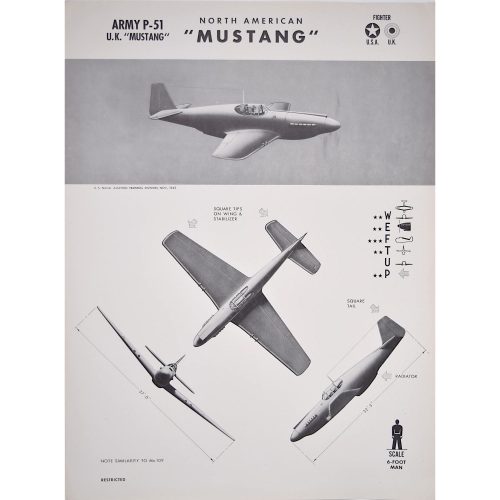
US Naval Aviation Training Division
North American Mustang P-51 World War 2 US airplane
Aeroplane identification poster, 1943 63x47cm A particularly unusual style of aeroplane identification poster, owing to the very arty images. Most such posters rely on very plain silhouettes, this series - and we have several in this series (click here) - have a much more arty approach to the task with shading and an interesting angle view. The Mustang is a long-range single-seat fighter/fighter-bomber that saw service during both the Second World War and Korean War. It was designed in 1940 by North American Aviation when they were commissioned to build Curtiss P-40 fighters under licence for the British Royal Air Force. Rather than build an old design, they designed this new aeroplane; the prototype was rolled out 102 days after the contract was signed. Powered by a Rolls-Royce Merlin engine over 15,000 were built with their most important role being escorting bombers over Germany. During World War II Mustang pilots accounted for a claimed 4,950 enemy aircraft. Today many survive and are a very popular 'warbird'. If you are interested email info@manningfineart.co.uk or call us on 07929 749056. -
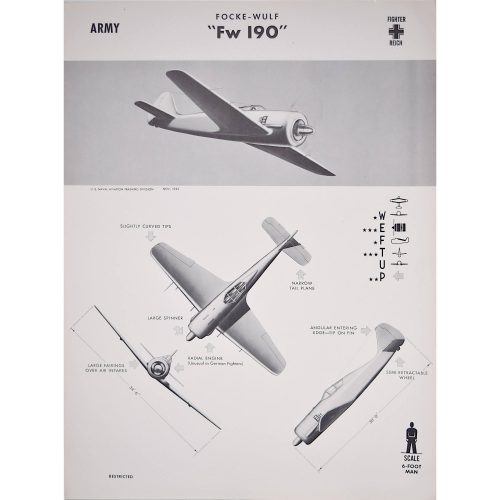
US Naval Aviation Training Division
Luftwaffe Focke-Wulf Fw190 - World War II aeroplane
Aeroplane identification poster, 1943 63 x 47cm A particularly unusual style of aeroplane identification poster, owing to the very arty images. Most such posters rely on very plain silhouettes, this series - and we have several in this series (click here) - have a much more arty approach to the task with shading and an interesting angle view. The Würger (in English, Shrike) is a single-seat single-engined fighter airplane widely used during World War II by the Germans. Designed in 1936 over 20,000 were built, beginning operations in August 1941 outclassing the Spitfire Mk V - remaining so until the Spitfire Mk IX was introduced. Both the French Air Force and French Navy purchased and operated the Fw 190 following the end of the war. Today some 28 examples survive, plus 20 modern reproductions. If you are interested, please email info@manningfineart.co.uk or call us on 07929 749056. -
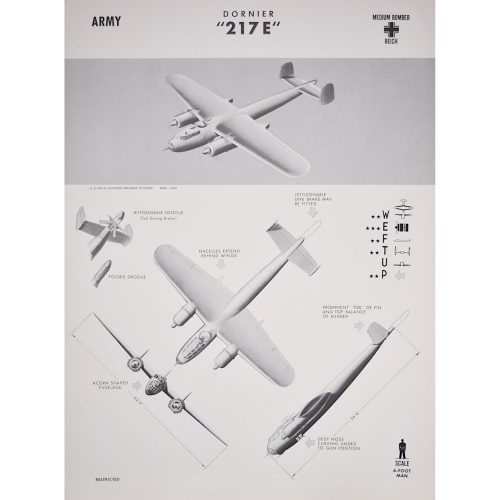
US Naval Aviation Training Division
Luftwaffe Dornier Do 217 Medium/Heavy Bomber
Aeroplane identification poster, 1943 63x47cm A particularly unusual style of aeroplane identification poster, owing to the very arty images. Most such posters rely on very plain silhouettes, this series - and we have several in this series (click here) - have a much more arty approach to the task with shading and an interesting angle view. A two-engined heavy bomber developed in German in the late 1930s for short-range bombing and as a more powerful development of the Do 17 - the flying pencil. It saw service until the end of the war in 1945. A versatile aircraft it was used as a night fighter, torpedo bomber, strategic bomber and reconnaissance aircraft. No complete example survives to this day despite a production of 1,925. If you are interested email info@manningfineart.co.uk or call us on 07929 749056. -
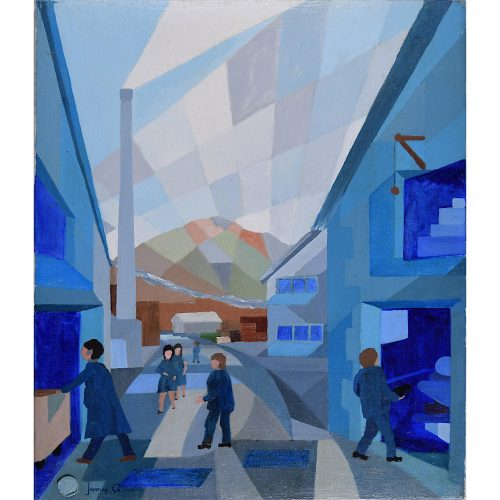
James Gowan (1923, Glasgow - 2015, London) The Blue Mill at Backbarrow
62x52cm Oil on Canvas For biographical details and other paintings by Gowan click here. The present work exhibits many of the characteristics obvious in his architectural works. There is a very strong architectural composition. The landscape and sky are approached in almost cubist fashion, reminiscent of the Toblerone-shaped roof of the Leicester Building, whilst the figures have a carefree feel to them. Backbarrow was the place where the blue pigment ultramarine (or dolly blue - used to return brilliant whiteness to yellowed fabrics) was produced in an old mill building by the Lancashire Ultramarine Company. Dust from the production gave the entire village a blue tint until production ceased in 1981. The factory is now a hotel and it maintains a display of machinery used in the factory. If you are interested email info@manningfineart.co.uk or call us on 07929 749056. -
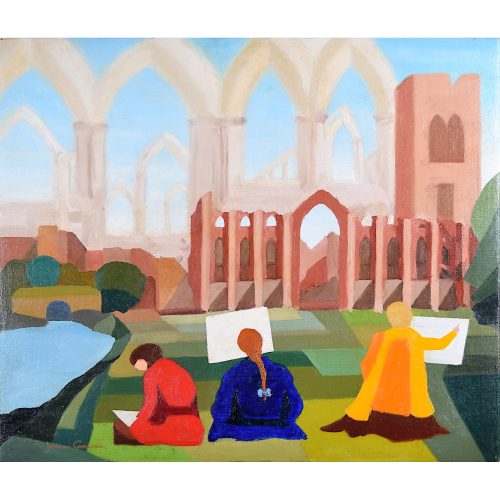
James Gowan (1923, Glasgow - 2015, London) Fountains Abbey (1973)
52x62cm Oil on Canvas Signed 'James Gowan' lower left Inscribed to reverse 'Fountains Abbey 1973 James Gowan No 199' For biographical details and other paintings by Gowan click here. The present work exhibits many of the characteristics obvious in his architectural works. There is a very strong architectural composition. The landscape and sky are approached in almost cubist fashion, reminiscent of the Toblerone-shaped roof of the Leicester Building, whilst the figures have a carefree feel to them. And here indeed are the gothic towers and flying butresses that we know inspired Gowan when designing the Leicester Engineering Building, being captured by the brightly-dressed members of an art class, splashes of primary colour in an already colourful landscape. If you are interested email info@manningfineart.co.uk or call us on 07929 749056. -
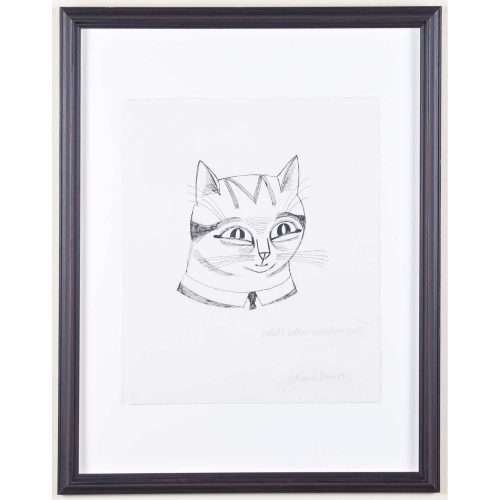
Edward Bawden (1903-1989)
White Collar Worker Cat
Pen and ink 27 x 23 cm Signed and inscribed lower right. Bawden developed a love of cats at a young age, copying Louis Wain's cat pictures. In his later years, his drawings of cats became yet more frequent; his cat Emma featured in much of his work. In an interview with House and Garden in 1987 he said: "No cat will suffer being lifted up and dropped into an empty space intended for her to occupy; that procedure led inevitably to Emma, tail up, walking away at once, so I had to wait patiently until Emma had enjoyed a good meal of Coley and was ready to choose her daily sleeping place, wherever it might be. I would then spring into action." Doubtless he found it easier to draw an imaginary cat, such as this one. For other cats - and other works - by Bawden, please click here. If you are interested, please email info@manningfineart.co.uk or call us on 07929 749056. -
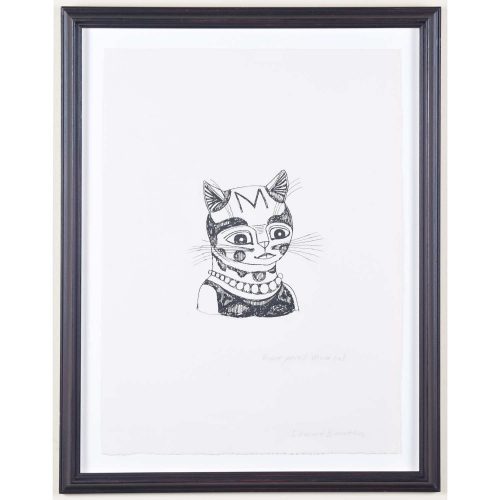
Edward Bawden (1903-1989)
House Proud Mum Cat
Pen and ink 38 x 27 cm Signed and inscribed lower right. Bawden developed a love of cats at a young age, copying Louis Wain's cat pictures. In his later years, his drawings of cats became yet more frequent; his cat Emma featured in much of his work. In an interview with House and Garden in 1987 he said: "No cat will suffer being lifted up and dropped into an empty space intended for her to occupy; that procedure led inevitably to Emma, tail up, walking away at once, so I had to wait patiently until Emma had enjoyed a good meal of Coley and was ready to choose her daily sleeping place, wherever it might be. I would then spring into action." Doubtless he found it easier to draw an imaginary cat, such as this one. For other cats - and other works - by Bawden, please click here. If you are interested, please email info@manningfineart.co.uk or call us on 07929 749056. -
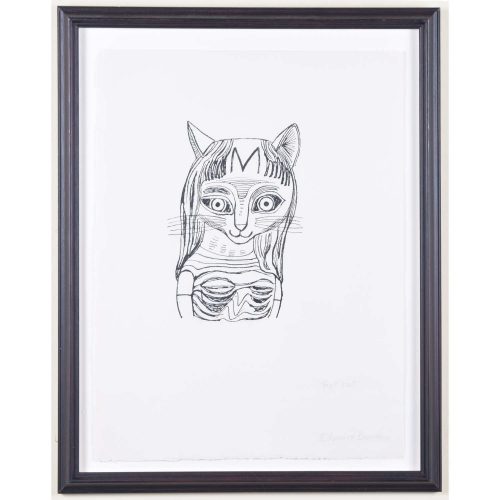
Edward Bawden (1903-1989)
Hot Cat
Pen and ink 38 x 27 cm Signed and inscribed lower right. Bawden developed a love of cats at a young age, copying Louis Wain's cat pictures. In his later years, his drawings of cats became yet more frequent; his cat Emma featured in much of his work. In an interview with House and Garden in 1987 he said: "No cat will suffer being lifted up and dropped into an empty space intended for her to occupy; that procedure led inevitably to Emma, tail up, walking away at once, so I had to wait patiently until Emma had enjoyed a good meal of Coley and was ready to choose her daily sleeping place, wherever it might be. I would then spring into action." Doubtless he found it easier to draw an imaginary cat, such as this one. For other cats - and other works - by Bawden, please click here. If you are interested, please email info@manningfineart.co.uk or call us on 07929 749056. -

Edward Bawden (1903-1989)
Dandy Boy Cat
Pen and ink 38 x 27 cm Signed and inscribed lower right. Bawden developed a love of cats at a young age, copying Louis Wain's cat pictures. In his later years, his drawings of cats became yet more frequent; his cat Emma featured in much of his work. In an interview with House and Garden in 1987 he said: "No cat will suffer being lifted up and dropped into an empty space intended for her to occupy; that procedure led inevitably to Emma, tail up, walking away at once, so I had to wait patiently until Emma had enjoyed a good meal of Coley and was ready to choose her daily sleeping place, wherever it might be. I would then spring into action." Doubtless he found it easier to draw an imaginary cat, such as this one. For other cats - and other works - by Bawden, please click here. If you are interested, please email info@manningfineart.co.uk or call us on 07929 749056. -
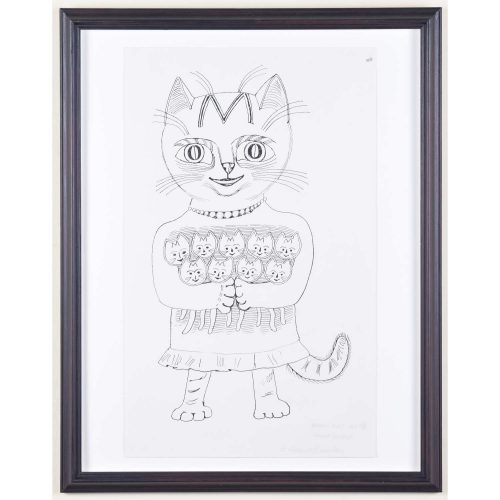
Edward Bawden (1903-1989)
Mum Cat with Nine Lives
Pen and ink 38 x 27 cm Signed and inscribed lower right. Bawden developed a love of cats at a young age, copying Louis Wain's cat pictures. In his later years, his drawings of cats became yet more frequent; his cat Emma featured in much of his work. In an interview with House and Garden in 1987 he said: "No cat will suffer being lifted up and dropped into an empty space intended for her to occupy; that procedure led inevitably to Emma, tail up, walking away at once, so I had to wait patiently until Emma had enjoyed a good meal of Coley and was ready to choose her daily sleeping place, wherever it might be. I would then spring into action." Doubtless he found it easier to draw an imaginary cat, such as this one. For other cats - and other works - by Bawden, please click here. If you are interested, please email info@manningfineart.co.uk or call us on 07929 749056. -
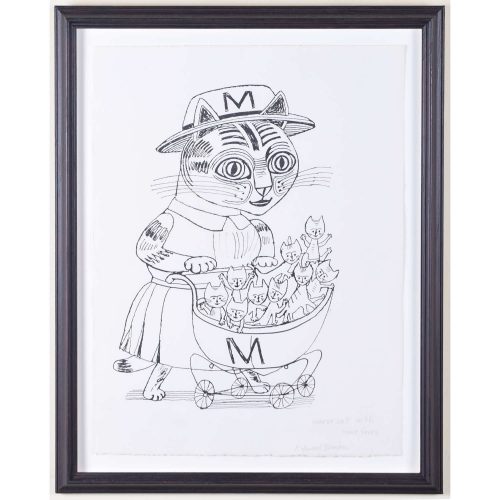
Edward Bawden (1903-1989)
Nurse Cat with Nine Lives
Pen and ink 38 x 27 cm Signed and inscribed lower right. Bawden developed a love of cats at a young age, copying Louis Wain's cat pictures. In his later years, his drawings of cats became yet more frequent; his cat Emma featured in much of his work. In an interview with House and Garden in 1987 he said: "No cat will suffer being lifted up and dropped into an empty space intended for her to occupy; that procedure led inevitably to Emma, tail up, walking away at once, so I had to wait patiently until Emma had enjoyed a good meal of Coley and was ready to choose her daily sleeping place, wherever it might be. I would then spring into action." Doubtless he found it easier to draw an imaginary cat, such as this one. For other cats - and other works - by Bawden, please click here. If you are interested, please email info@manningfineart.co.uk or call us on 07929 749056.