Welcome to the shop. You are most welcome to browse, navigate using the menu above, or search the website.

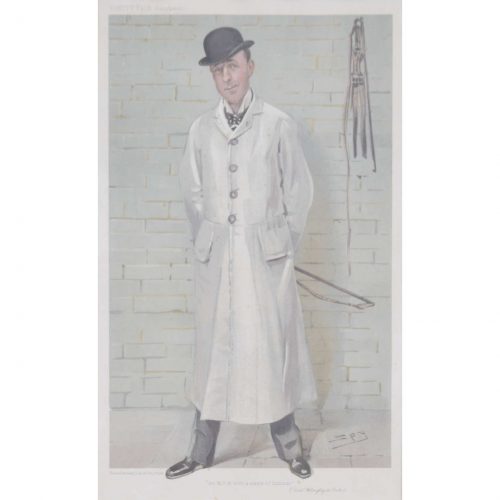
 

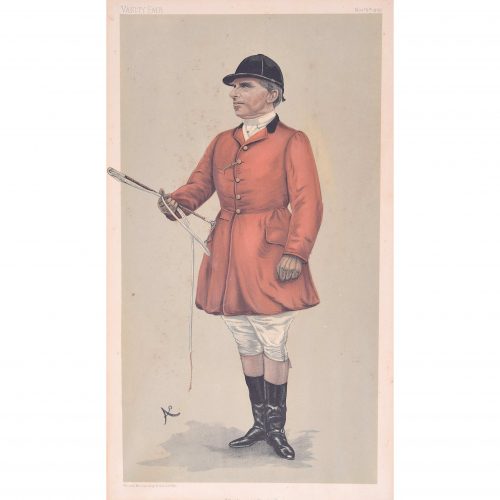
  • Sir Leslie 'Spy' Ward for Vanity Fair Magazine

    An MFH with a sense of humour (1905)

      Lithograph 36 x 21 cm Published in Vanity Fair on 23rd November 1905. The 'MFH with a sense of humour' depicted here is Richard Greville Verney, 19th Baron Willoughby de Broke (1869 - 1923), British peer, Conservative politician, and Master of Foxhounds. Verney was the son of Colonel Henry Verney, 18th Baron Willoughby de Broke and Geraldine Smith-Barry, and was educated at Eton College and New College, Oxford. The historian George Dangerfield described Verney as "a genial and sporting young peer, whose face bore a pleasing resemblance to the horse. ... He had quite a gift for writing, thought clearly, and was not more than two hundred years behind his time." He wrote a book on foxhunting called "Hunting the Fox", which was published in 1921 and remains an acclaimed text on the sport today. Verney represented Rugby, Warwickshire, as an MP from 1895–1900. In 1902 he succeeded his father as 19th Baron Willoughby de Broke. Condition: very good. If you’d like to know more, please email info@manningfineart.co.uk or call us on 07929 749056.
  • Roland "Ao" / "Armadillo" L'Estrange for Vanity Fair Magazine 'Berks and Bucks': Sir Robert Rodney Wilmot

    5 November 1903 Lithograph 21 x 37 cm   Depicting Sir Robert Rodney Wilmot, in red hunting clothes and whip, of the Berks & Bucks Draghounds at their opening meet. Wilmot was educated at Eton and Oxford, and his hobbies famously included croquet. The Vanity Fair magazine of 1868 to 1914 was subtitled 'A Weekly Show of Political, Social and Literary Wares'. Founded by Thomas Gibson Bowles, who aimed to expose the contemporary vanities of Victorian society, it featured regular full-page, colour lithographs of famous (or infamous) contemporary figures. It is for these caricatures that the original Vanity Fair is best known today. If you are interested, please email info@manningfineart.co.uk or call us on 07929 749056. Condition: Good. Mounted to board, some age toning.
  • 'Bisto for all Meat Dishes'

      Original vintage poster 55 x 202 cm This original vintage poster is an excellent opportunity to acquire a piece of British advertising history. Bisto is an instantly recognisable brand today, and has been throughout the 20th century; the catchphrase on the poster here, "Bisto for all meat dishes" was used in the 1950s. The first Bisto product, in 1908, was a meat-flavoured gravy powder which rapidly became a bestseller in the UK. It was added to gravies to thicken them and give a richer taste and aroma. Invented by Messrs Roberts & Patterson, it was named "Bisto" because it "Browns, Seasons and Thickens in One". As of 2005, Bisto Gravy Granules had a British market share of over 70%. Nearly all British grocery outlets stock a Bisto product.
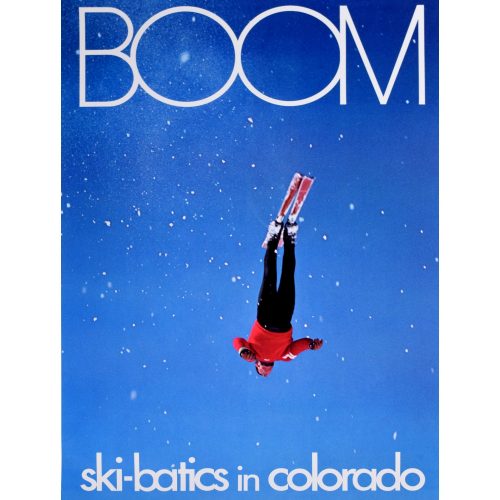
  • 'BOOM' skibatics in Colorado Poster (c.1970)

    67 x 53 cm Original Vintage Poster Printed by LooArt Press, Colorado Springs, Colorado. Features a photograph of acrobatic skier by Steve Knowlton. Direct from the surplus stock of the printers, LooArt Press, which closed in the early 1970s. In generally excellent condition.
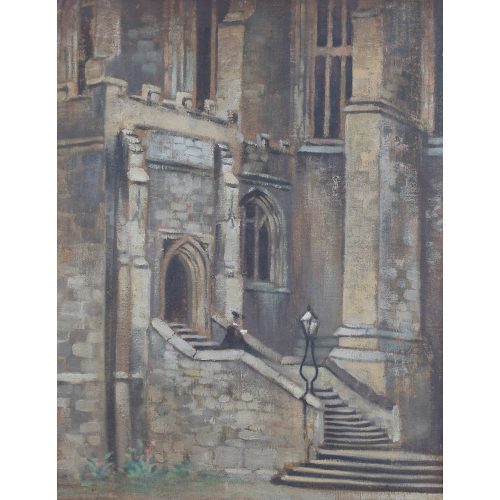
  • 'Eton College, a scholar on the steps' (early 20th century)

    Oil on canvas 62 x 49 One of our favourite paintings. A lone scholar descends the Chapel steps, a human focal point in an oil painting primarily concerned with the College's fine architecture. A blur of green and red sprouts at the bottom of the wall - flowers. In a handsome period hardwood frame. Condition: very good.
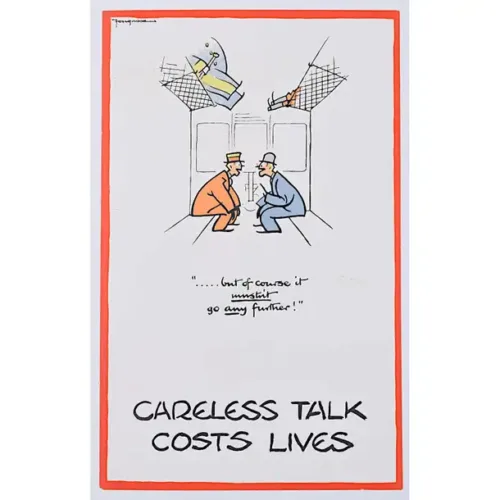
  • Cyril Kenneth Bird ‘Fougasse’ (1887 - 1965)

    Careless Talk Costs Lives (circa 1940)

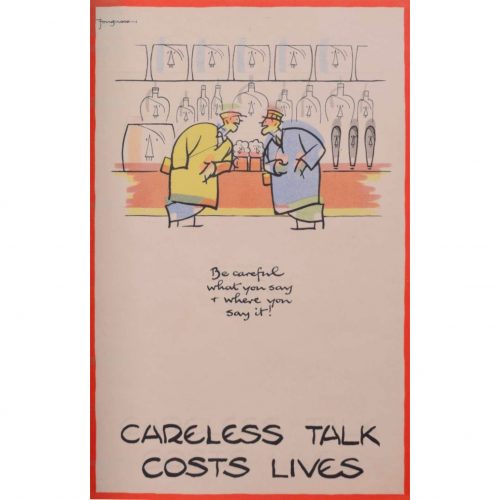
      Lithographic poster 32 x 20 cm (12.5 x 8 in) Version printed on thicker paper. "But of course it mustn't go any further" - in the luggage compartments above two gossiping men, Mussolini and Hitler are hiding. Fougasse reminds us that we ought not to discuss secrets which could be of use to them. Fougasse was a British cartoonist. He was art editor of Punch between 1937 and 1949, and subsequently editor until 1953. He is best known for his ‘Careless Talk Costs Lives’ series of posters, and the other posters for the Ministry of Information and London Transport. As the Second World War progressed, the Ministry of Information’s poster campaign had become less and less effective. There were posters instructing the population to save old clothes for rags, turn off the lights, save food, dig for victory, watch out for spies, and keep calm and carry on. With this instruction overload, the population had ceased paying attention to the posters. Fougasse noticed this, and offered his services unpaid to the Ministry of Information, with a view to bringing a touch of humour to the posters. His amusing designs with pithy captions, reminiscent of newspaper cartoons, helped to get the Ministry's messages across in a novel way.
    Fougasse's distinctive poster style, with the red border, was subsequently adopted by other Ministry artists.
    Condition: backed to linen; generally excellent. If you are interested, please email info@manningfineart.co.uk or call us on 07929 749056. Click here for other works by the artist.
  • Cyril Kenneth Bird ‘Fougasse’ (1887 - 1965)

    Careless Talk Costs Lives (circa 1940)

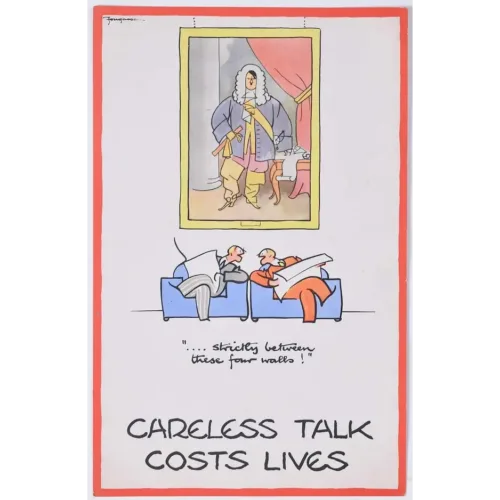
      Lithographic poster 32 x 20 cm (12.5 x 8 in) "Strictly between these four walls" - here, in the painting hanging behind two gossiping men in gentleman's club, hide Mussolini and Hitler. Fougasse reminds us that we ought not to discuss secrets which could be of use to them. Fougasse was a British cartoonist. He was art editor of Punch between 1937 and 1949, and subsequently editor until 1953. He is best known for his ‘Careless Talk Costs Lives’ series of posters, and the other posters for the Ministry of Information and London Transport. As the Second World War progressed, the Ministry of Information’s poster campaign had become less and less effective. There were posters instructing the population to save old clothes for rags, turn off the lights, save food, dig for victory, watch out for spies, and keep calm and carry on. With this instruction overload, the population had ceased paying attention to the posters. Fougasse noticed this, and offered his services unpaid to the Ministry of Information, with a view to bringing a touch of humour to the posters. His amusing designs with pithy captions, reminiscent of newspaper cartoons, helped to get the Ministry's messages across in a novel way.
    Fougasse's distinctive poster style, with the red border, was subsequently adopted by other Ministry artists.
    Condition: good. If you are interested, please email info@manningfineart.co.uk or call us on 07929 749056. Click here for other works by the artist.
  • Cyril Kenneth Bird ‘Fougasse’ (1887 - 1965)

    Careless Talk Costs Lives (circa 1940)

    Lithographic Poster Collection 31 x 40 cm each [62 x 80 cm overall]
    "Strictly between you and me..."; "...but for Heaven's sake, don't say I told you!"; "Don't forget the walls have ears!" - This collection of posters brings together a series of Fougasse's snappy slogans, all to the backdrop of various Hitlers hiding under tables, melding with the wallpaper, and even replacing the historical figures in the traditional portrait featured. Through this public information messaging, Fougasse aimed to remind his contemporaries not to discuss secrets which may be of use to the enemy. Fougasse was a British cartoonist. He was art editor of Punch between 1937 and 1949, and subsequently editor until 1953. He is best known for his ‘Careless Talk Costs Lives’ series of posters, and the other posters for the Ministry of Information and London Transport. As the Second World War progressed, the Ministry of Information’s poster campaign had become less and less effective. There were posters instructing the population to save old clothes for rags, turn off the lights, save food, dig for victory, watch out for spies, and keep calm and carry on. With this instruction overload, the population had ceased paying attention to the posters. Fougasse noticed this, and offered his services unpaid to the Ministry of Information, with a view to bringing a touch of humour to the posters. His amusing designs with pithy captions, reminiscent of newspaper cartoons, helped to get the Ministry's messages across in a novel way. Fougasse's distinctive poster style, with the red border, was subsequently adopted by other Ministry artists.
    Condition: Very good; slight age toning. This is the version on thin paper. If you are interested, please email info@manningfineart.co.uk or call us on 07929 749056. Click here for other works by the artist.
  • Cyril Kenneth Bird ‘Fougasse’ (1887 - 1965)

    Careless Talk Costs Lives (circa 1940)

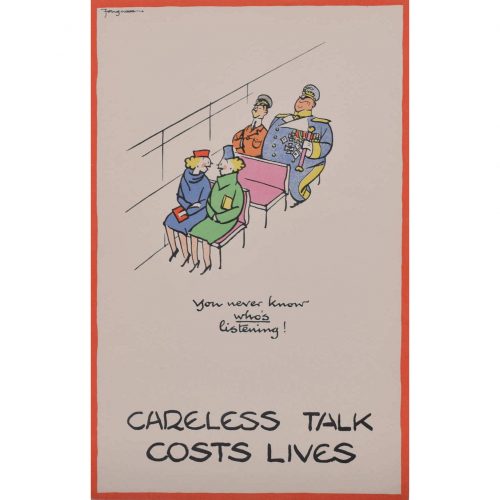
      Lithographic poster 32 x 20 cm (12.5 x 8 in) Version printed on thinner paper. Fougasse was a British cartoonist. He was art editor of Punch between 1937 and 1949, and subsequently editor until 1953. He is best known for his ‘Careless Talk Costs Lives’ series of posters, and the other posters for the Ministry of Information and London Transport. As the Second World War progressed, the Ministry of Information’s poster campaign had become less and less effective. There were posters instructing the population to save old clothes for rags, turn off the lights, save food, dig for victory, watch out for spies, and keep calm and carry on. With this instruction overload, the population had ceased paying attention to the posters. Fougasse noticed this, and offered his services unpaid to the Ministry of Information, with a view to bringing a touch of humour to the posters. His amusing designs with pithy captions, reminiscent of newspaper cartoons, helped to get the Ministry's messages across in a novel way. Fougasse's distinctive poster style, with the red border, was subsequently adopted by other Ministry artists. Condition: if you’d like to know more, please email info@manningfineart.co.uk or call us on 07929 749056.
  • Out of stock

    Cyril Kenneth Bird ‘Fougasse’ (1887 - 1965)

    Careless Talk Costs Lives (circa 1940)

      Lithographic poster 32 x 20 cm (12.5 x 8 in) Version printed on thinner paper. Fougasse was a British cartoonist. He was art editor of Punch between 1937 and 1949, and subsequently editor until 1953. He is best known for his ‘Careless Talk Costs Lives’ series of posters, and the other posters for the Ministry of Information and London Transport. As the Second World War progressed, the Ministry of Information’s poster campaign had become less and less effective. There were posters instructing the population to save old clothes for rags, turn off the lights, save food, dig for victory, watch out for spies, and keep calm and carry on. With this instruction overload, the population had ceased paying attention to the posters. Fougasse noticed this, and offered his services unpaid to the Ministry of Information, with a view to bringing a touch of humour to the posters. His amusing designs with pithy captions, reminiscent of newspaper cartoons, helped to get the Ministry's messages across in a novel way. Fougasse's distinctive poster style, with the red border, was subsequently adopted by other Ministry artists. Condition: if you’d like to know more, please email info@manningfineart.co.uk or call us on 07929 749056.
  • Cyril Kenneth Bird ‘Fougasse’ (1887 - 1965)

    Become a Rugby Referee

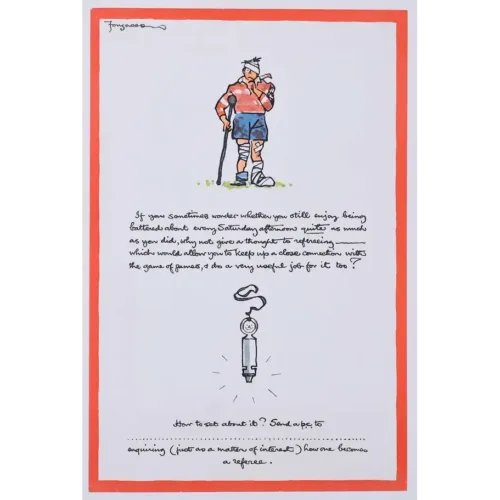
      Lithographic poster 32 x 26 cm "If you sometimes wonder whether you still enjoy being battered about on a Sunday afternoon quite as much as you did, why not give a thought to refereeing - which would allow you to keep up a connection with the game of games, and do a very useful job for it too." Fougasse was a British cartoonist. He was art editor of Punch between 1937 and 1949, and subsequently editor until 1953. He is best known for his ‘Careless Talk Costs Lives’ series of posters, and the other posters for the Ministry of Information and London Transport. As the Second World War progressed, the Ministry of Information’s poster campaign had become less and less effective. There were posters instructing the population to save old clothes for rags, turn off the lights, save food, dig for victory, watch out for spies, and keep calm and carry on. With this instruction overload, the population had ceased paying attention to the posters. Fougasse noticed this, and offered his services unpaid to the Ministry of Information, with a view to bringing a touch of humour to the posters. His amusing designs with pithy captions, reminiscent of newspaper cartoons, helped to get the Ministry's messages across in a novel way.
    Fougasse's distinctive poster style, with the red border, was subsequently adopted by other Ministry artists.
    Condition: backed to linen; generally excellent. If you are interested, please email info@manningfineart.co.uk or call us on 07929 749056. Click here for other works by the artist.
  • James Riddell (1909-2000) 'Join the University Ski Club'

    Original vintage poster Lithograph 31 x 50 cm This charming poster was designed by professional skier James Riddell for the 1934/35 Varsity trip, bringing students from Oxford and Cambridge University together for the annual Varsity ski racing, held in Klosters. Riddell, a Cambridge alumnus, played a key role in the early days of skiing as a competitive sport and holiday industry. In his early days, he was a skiing champion: his accolades include winning the Kandahar Club's Muerren Inferno, still the longest and most demanding of amateur downhill races, and acting as vice-president at the 1936 Winter Olympics at Garmisch-Partenkirchen. After his professional skiing career, Ridell became an accomplished author, writing novels including 'The Ski Runs of Switzerland' (1957), 'The Ski Runs of Austria '(1958), 'Ski Holidays in the Alps' (1961) and 'Ski Lore and Disorder' (1962). He quit skiing in his 70s but continued to return to his much-loved Muerren, the Kandahar Club's Swiss Alpine headquarters, where he spent time painting watercolours. This poster is a fine example of art-deco art. The simplified, streamlined depiction of skiers with strong, curving lines reflects the influence of Art Deco’s geometric and dynamic design approach. The limited colour palette of blue, white, and red gives a striking and vibrant look. The lettering, with its outlined and shadowed appearance, is characteristic of the era's emphasis on bold, decorative typography. Finally, the flowing lines in the background and the dramatic positioning of the skiers create a feeling of speed and action, a hallmark of 1930s graphic design. The overall effect is dynamic, eye-catching and extremely memorable. Condition: Generally very good. Colours are excellent and the paper shows only a little sign of age.

    If you would like to know more, please email info@manningfineart.co.uk or call us on 07929 749056.

  • 'Join your Neighbours in the Civil Defence'

    Original vintage recruitment poster 38 x 26 cm Printed for HM Stationery Office by Stafford & Co Ltd Netherfield, Nottingham. There was no World War Two activity to which the population could not be encouraged by the use of a poster. First established in 1935, the Civil Defence Department was essential for maintaining order during air raids. Pictured here is a man in Civil Defence uniform walking along a residential street with a row of houses, exuding satisfaction at having protected the community from another night of bombing. Condition: Generally very good.

    If you would like to know more, please email info@manningfineart.co.uk or call us on 07929 749056.

  • 'Samivel' Paul Gayet-Tancrède (1907 - 1992) L'alliance de l'homme et de la montagne

    Original vintage poster 100 x 62 cm A man sits atop a grassy hill, taking in the nature around him and looking down into the valley below. He is surrounded by the white peaks of the French alps in the Parc national de la Vanoise. Nearby a sparrow has settled on a small boulder amongst the mountain flowers. The scene is bucolic and calls to mind traditional depictions of mountain life in the likes of Heidi. Samivel was a writer, an artist, a photographer, an explorer, and more. In 1948 he accompanied Paul Émile Victor on the first French Greenland expedition, making three documentary films in the process. His friends included Théodore Monod and Gilbert André - the latter the mayor of Bonneval-sur-Arc and one of the founders of the Vanoise National Park - and with them and others he spent his whole life aiming for the protection of the imperilled countryside. The graphic artist side of him had a life-long fascination with high mountains, and his illustrated books and series of posters of the French Alps have long been popular.
  • Charles "Snaffles" Johnson Payne (1884 - 1967)

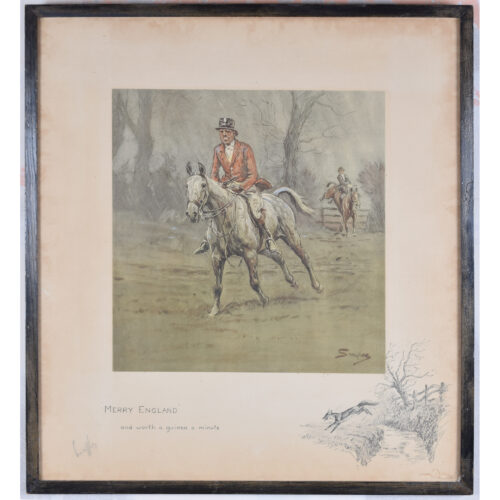
    "Merry England and worth a guinea a minute"

    Lithograph 44 x 41 cm Signed in pencil lower left. Snaffles was one of the foremost sporting artists of his era, publishing many popular prints such as these: hunting pictures, racing scenes, and military subjects. Snaffles' distinctive drawing style is emphasised by his 'remarque' - sketches in the margin - and his witty titles. Condition: generally good; some age toning to backing paper. In original half-inch black frame. If you are interested, please email info@manningfineart.co.uk or call us on 07929 749056. Click here for other hunting pictures.
  • Original Winston Churchill Poster

    Lithograph 51 x 40 cm c.1940-1945 "Never in the field of human conflict have so many owed so much to so few." The summer of 1940 saw the Battle of Britain reach its peak. Churchill delivered this speech to the House of Commons on the 20th of August 1940. The Battle of Britain had reached its peak that summer and when Churchill famously stated "Never in the field of human conflict have so many owed so much to so few", he was paying tribute to the enormous efforts made by the fighter pilots and bomber crews to establish air superiority over England. At the end of June 1940, the Luftwaffe had a large numerical superiority over the Royal Air Force, with around 2,550 planes compared to the only 750 planes of the RAF. As a result, the pilots who fought in the victorious Battle of Britain were known as "the few." This speech figures among Churchill's most famous, standing alongside "we shall fight on the beaches", "their finest hour", and "blood, toil, tears, and sweat" in the history books. This poster features the famous quote in bold lettering with a faint outline of Churchill's face in the background. The insignia of the Royal Air Force dominates the top of the poster, linking the speech to its context within the Battle of Britain. Condition: Generally very good, backed to linen.

    If you would like to know more, please email info@manningfineart.co.uk or call us on 07929 749056.
  • Charles "Snaffles" Johnson Payne (1884 - 1967)

    "Oh! To Be In England Now That April's There"

    Lithograph 51 x 67 cm Signed in pencil lower left. Snaffles was one of the foremost sporting artists of his era, publishing many popular prints such as these: hunting pictures, racing scenes, and military subjects. Snaffles' distinctive drawing style is emphasised by his 'remarque' - sketches in the margin - and his witty titles. Condition: generally very good; crease to top left corner; slight unevenness to bottom edge; a few scratches to frame.
  • Anonymous, c.1850

    'The handsome Ritualistic Priest, arrayed in purple and fine linen irresistible with the "Devout Women"' Caricature

    Pen, ink and watercolour 20 x 24 cm By repute this item was found in the rooms of John Keble (1792-1866) at the Hermitage Hotel in Eastbourne after his death in 1866, together with another caricature watercolour of the 'Cotton-ia Worcester-ienisis' which we also have for sale. Condition: Generally very good, slight toning to paper.
  • 'Samivel' Paul Gayet-Tancrède (1907-1992)

    Du Léman à La Méditerranée, La Grande Traversée des Alpes Françaises

    ('From Lake Geneva to the Mediterranean, La Grande Traversée of the French Alps') Imprimé en France - Printed in France 1975 Original Vintage Ski Poster 99x62cm Condition: excellent With the ever-popular topic of mountains for climbing and skiing, Samivel here draws a snow-covered col in the mountains. La Grande Traversée is a long-distance walking route from Thonon les Bains to Nice, set up in the early 1970s. Samivel was a writer, an artist, a photographer, an explorer and more. In 1948 he accompanied Paul Émile Victor on the first French Greenland expedition, making three documentary films in the process. His friends included Théodore Monod and Gilbert André - the latter the mayor of Bonneval-sur-Arc and one of the founders of the Vanoise National Park - and with them and others he spent his whole life aiming for the protection of the imperilled countryside. The graphic artist side of him had a life-long fascination with high mountains, and his illustrated books and series of posters of the French Alps have long been popular. Click here to see other posters by Samivel. If you are interested email info@manningfineart.co.uk or call us on 07929 749056.
  • 'Samivel' Paul Gayet-Tancrède (1907-1992)

    Chamonix Mont Blanc, France - au centre d'un monde de cristal

    Imprimé en France pour l'office du tourisme de Chamonix par l'imprimerie generale a Grenoble Original Vintage Ski Poster 99x62cm Condition: excellent With the ever-popular topic of mountains for climbing and skiing, Samivel here draws one of the Aiguille or Aiguillettes - needles - in Chamonix which are famous for climbers. Samivel was a writer, an artist, a photographer, an explorer and more. In 1948 he accompanied Paul Émile Victor on the first French Greenland expedition, making three documentary films in the process. His friends included Théodore Monod and Gilbert André - the latter the mayor of Bonneval-sur-Arc and one of the founders of the Vanoise National Park - and with them and others he spent his whole life aiming for the protection of the imperilled countryside. The graphic artist side of him had a life-long fascination with high mountains, and his illustrated books and series of posters of the French Alps have long been popular. Click here to see other posters by Samivel. If you are interested email info@manningfineart.co.uk or call us on 07929 749056.
  • Take Care! Official Secrets Act WW2 Poster (c.1940)

    Lithographic poster 18 x 51 cm Printed for the HM Stationary Office by Gothic Press, London.  
  • Out of stock

    Sir Leslie "Spy" Ward for Vanity Fair Magazine 'The Huntsman': Thomas Firr

    1 November 1884 Lithograph 21 x 37 cm   Depicting Thomas Firr, Huntsman of the Quorn, on the day of the season's opening meet. The illustrated volume 'Tom Firr of the Quorn: Huntsman Extraordinary' details Firr's days with the hunt, and considers him 'the greatest huntsman in England'. He was huntsman to the Quorn for 27 years from 1872 to 1899. The Quorn Hunt has a claim to be the oldest hunt in the country, having been founded in 1696 by Mr Thomas Boothby of Tooley Park, Leicestershire. Tooley Park lies about eight miles southwest of Leicester, just to the north of the Hinckley road. The hunt takes its name from the village of Quorn, where the hounds were kennelled from 1753 to 1904. If you are interested, please email info@manningfineart.co.uk or call us on 07929 749056. Condition: Good. Mounted to board, some age toning.
  • Rosemary Anne Sisson (1923-2017) 'The Splendid Outcast', stage designs

    20 x 28 cm Watercolour (set of three) Cesar Borgia has ambitious plans and one of them is to take over the Kingdom of Naples...What follows in 'the Splendid Outcast' is a sordid love story. Marriages slip into affairs, affairs turn into assassinations, lust transforms to greed... Sisson wrote this play in 1960. The stage designs that followed in 1961 are vibrant, marked with the warm tones one might expect in a play set in Renaissance period Italy. Although a writer by craft, Sisson also proves herself adept with a brush and palette, executing playful mise-en-abimes as she incorporates miniature works of art into her stage designs. The abundance of windows and light in these watercolours also gestures to a world beyond her play, quite literally breathing a breath of fresh air and life into these works. Rosemary Anne Sisson was born in 1923 in Middlesex to the well-known Shakespeare scholar Charles Jasper Sisson, Lord Northcliffe. She developed a reputation as an acclaimed writer and playwright and was subsequently described by playwright Simon Farquhar in 2014 as being "one of television's finest period storytellers."
  • Winston Churchill 'We shall never surrender.'

    Original vintage poster 50 x 34 cm 'We shall not flag or fail, we shall go on to the end. We shall fight on the seas and oceans, we shall fight with growing confidence and growing strength in the air. We shall defend our Island, whatever the cost may be; we shall fight on the beaches, we shall fight on the landing grounds, we shall fight in the fields and in the streets, we shall fight in the hills. We shall never surrender.' Winston Churchill's 'We Shall Fight on the Beaches' speech, delivered to the House of Commons on June 4, 1940, is one of the most famous speeches of World War II. It was given in the wake of the Dunkirk evacuation (Operation Dynamo), where over 300,000 British and Allied troops were successfully rescued from France as German forces advanced. In this speech, Churchill had to describe a great military disaster, and warn of a possible invasion attempt by Nazi Germany, without casting doubt on eventual victory. The simple repetition and rhythm are unforgettable and helped to cement Churchill's reputation as an exceptional wartime leader.
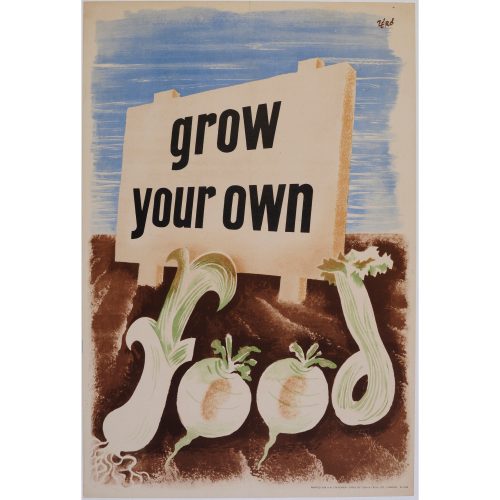
  • 'Zero' Hans Schleger (1898-1976) Grow Your Own Food

    Lithographic poster c. 1940 Printed by Fosh & Kosh Limited for HMSO 76x51cm A copy of this poster is in the collection of the Imperial War Museum. Click here for biographical details and other posters by Hans 'Zero' Schleger. Provenance: the estate of the artist. If you are interested email info@manningfineart.co.uk or call us on 07929 749056.
  • 'Zero' Hans Schleger

    London Transport Bus Stop Poster

    Lithographic poster 16x14" Printed for London Transport If you are interested email info@manningfineart.co.uk or call us on 07929 749056.
  • 'Zero' Hans Schleger

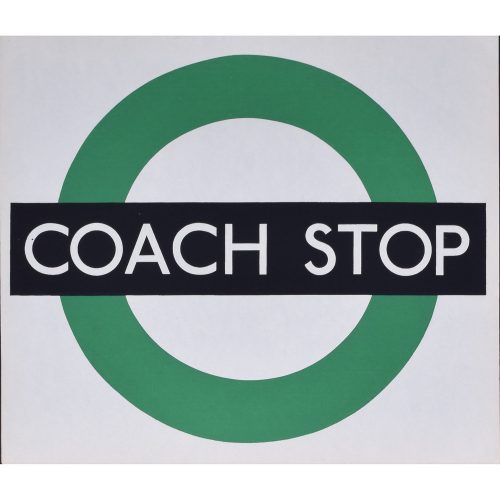
    London Transport Coach Stop/ Bus Stop Poster

    Screenprint poster c. 1970s 16x14" Printed for London Transport Includes hand-finished black frame. If you are interested email info@manningfineart.co.uk or call us on 07929 749056.
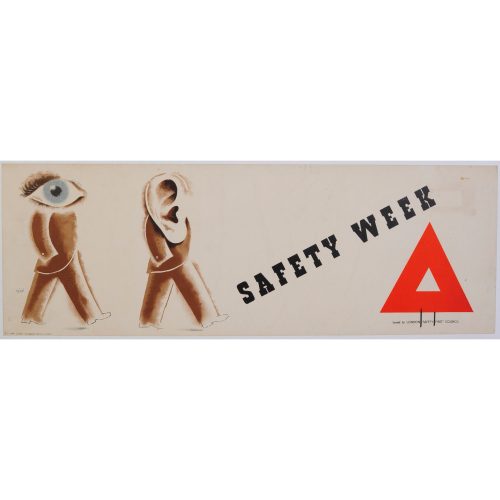
  • 'Zero' Hans Schleger Safety Week

    Lithographic panel poster 1937 Published by London 'Safety First' Council Printed by Dangerfield Printing Company Ltd A copy of this poster is in the collection of the London Transport Museum. Click here for biographical details and other posters by Hans 'Zero' Schleger. Provenance: the estate of the artist. If you are interested email info@manningfineart.co.uk or call us on 07929 749056.
  • 'Zero' Hans Schleger

    Transport for London Coach Stop Poster

    Screenprint poster c. 1970s 16×14″ Printed for London Transport Includes hand-finished black frame.   If you are interested email info@manningfineart.co.uk or call us on 07929 749056.
  • 10' National Savings Certificates

      Original vintage poster 73 x 49 cm An original vintage WW2 poster encouraging Britons to save via the National Savings scheme. Condition: generally very good; a couple of creases. Not backed. If you are interested, please email info@manningfineart.co.uk or call us on 07929 749056. Click here for other original vintage National Savings posters.
  • Лауреаты Государственных Премий [State Prizewinners] Moscow 1971 28 x 44 cm This folio introduces to the population of Soviet Russia the dozen winners of the State Prizes in 1971 for Literature, Art, and Architecture. "The awarding of the State Prizes of the USSR in 1971 to a large contingent of our creative intelligentsia is new evidence of the constant concern of the Communist Party of the Soviet Union for the further development of literature and art."  
  • Darton and Harvey (publisher)

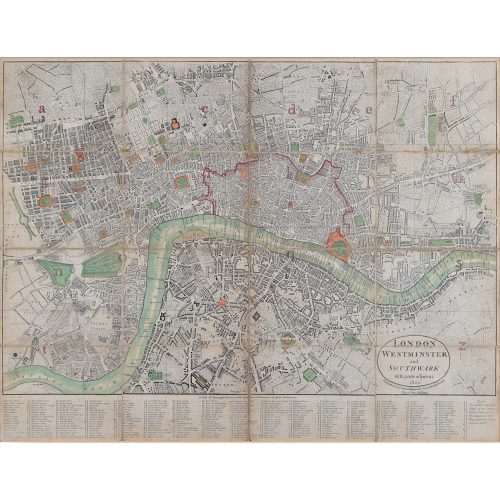
    Map of London, Southwark, and parts adjacent (1800)

      Engraving 42 x 56 cm Condition: generally very good; backed to linen with some evidence of use.
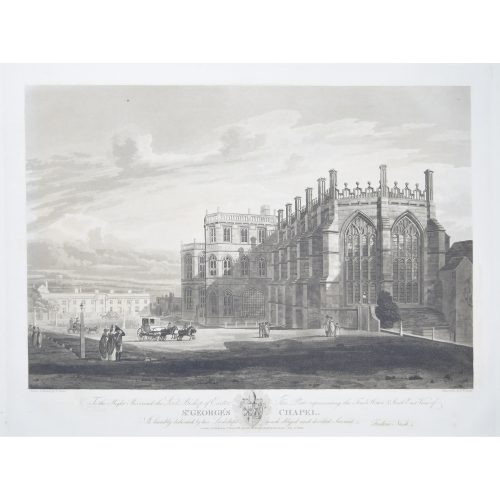
  • Frederick Nash (1782-1856) Drawn and etched

    Engraved by F C Lewis

    South East View of St George's Chapel, Windsor

    To the Right Reverend the Lord Bishop of Exeter London Published by F Nash, No 6 Asylum Buildings, Westminster Road July 12 1804 39.5x52cm Frederick Nash was born in Lambeth. Initially studying architectural drawing under Thomas Malton he subsequently enrolled at the Royal Academy of Arts. From 1801 to 1809 he worked with the antiquarians John Britton and Edward Wedlake Brayley, subsequently becoming a member of the Society of Painters in Watercolours - a group of painters who had left the Royal Academy following complaints of under-recognition of their works. Latterly primarily a landscape painter he toured the rivers of Germany.
  • Frederick Nash (1782-1856) Drawn and etched

    Engraved by F C Lewis

    South East View of St George's Chapel, Windsor

    To the Right Reverend the Lord Bishop of Exeter London Published by F Nash, No 6 Asylum Buildings, Westminster Road July 12 1804 39.5x52cm Frederick Nash was born in Lambeth. Initially studying architectural drawing under Thomas Malton he subsequently enrolled at the Royal Academy of Arts. From 1801 to 1809 he worked with the antiquarians John Britton and Edward Wedlake Brayley, subsequently becoming a member of the Society of Painters in Watercolours - a group of painters who had left the Royal Academy following complaints of under-recognition of their works. Latterly primarily a landscape painter he toured the rivers of Germany.
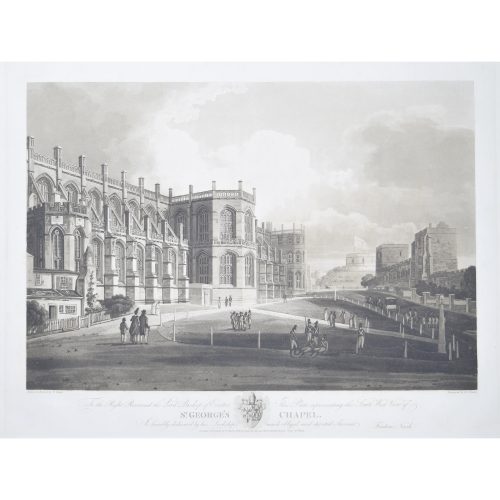
  • Frederick Nash (1782-1856) Drawn and etched

    Engraved by F C Lewis

    South West View of St George's Chapel, Windsor

    To the Right Reverend the Lord Bishop of Exeter London Published by F Nash, No 6 Asylum Buildings, Westminster Road July 12 1804 39.5x52cm Frederick Nash was born in Lambeth. Initially studying architectural drawing under Thomas Malton he subsequently enrolled at the Royal Academy of Arts. From 1801 to 1809 he worked with the antiquarians John Britton and Edward Wedlake Brayley, subsequently becoming a member of the Society of Painters in Watercolours - a group of painters who had left the Royal Academy following complaints of under-recognition of their works. Latterly primarily a landscape painter he toured the rivers of Germany.
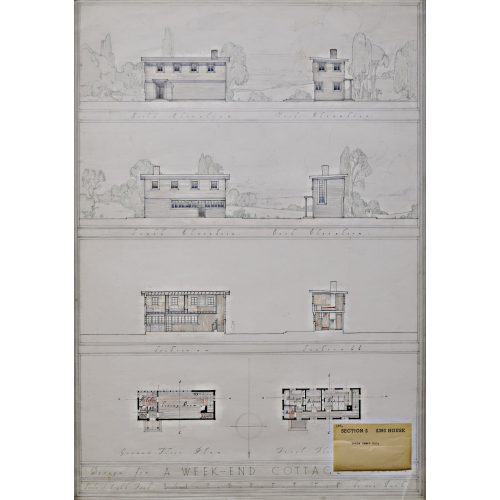
  • Louis Osman (1914-1996)

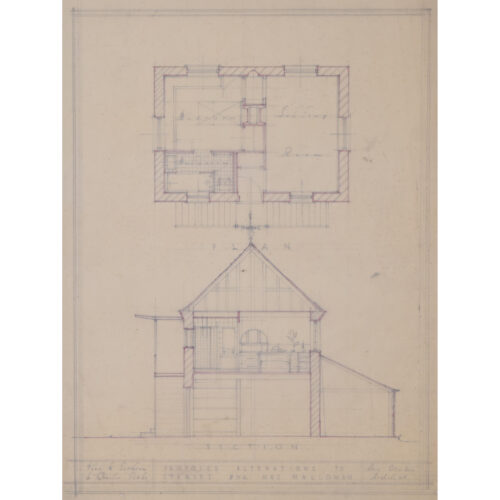
    A £350 Modernist House Weekend Cottage - Architectural drawing

    75x52cm Watercolour and pencil Inscribed Provenance: from the artist's estate Click for biographical details and other works by Osman. From Osman's time as an architectural student at the Bartlett School of Architecture. The examiner has graded the piece to the face. Osman was even more an artist than an architect, which shows with the quality of the shading and calligraphy. If you are interested email info@manningfineart.co.uk or call us on 07929 749056.    
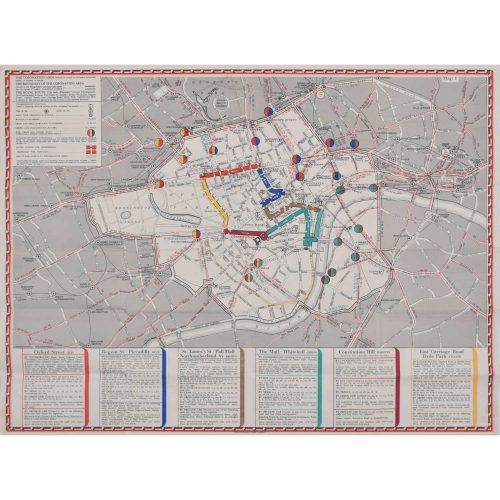
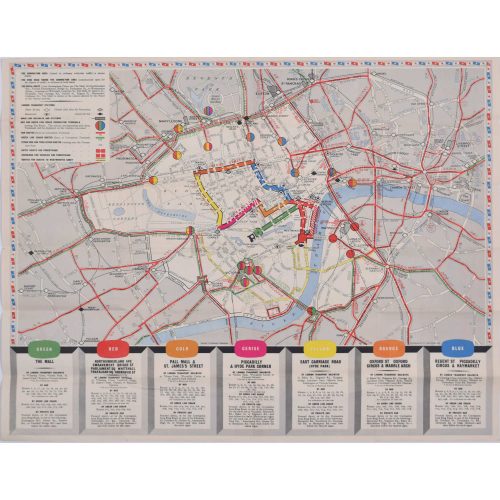
  • Coronation Arrangements - Map of London (1937)

      Lithograph 45 x 60 cm (unfolded) Published by London Transport for the Coronation of George VI, this map illustrates the route the King took in 1936. And best of all, it's just (almost!) as useful in today's London. Condition: generally very good. If you are interested, please email info@manningfineart.co.uk or call us on 07929 749056.
  • 'Zero' Hans Schleger London Underground Railways Pocket Map 1938 No. 2 Lithograph 14.5 x 20.5 cm An early edition of London Transport's iconic map, precursor to all other similar maps of other transport systems worldwide. The 1938 edition was designed by Hans Schleger, unlike the 1933 - first published - edition of Harry Beck. Beck was furious that his design had been given to Schleger and by 1941 responsibility returned to Beck. Hans Schleger was born in Germany. After the First World War, he studied at the Berlin Kunstgewerbeschule. After working in Berlin, he moved to New York in 1924 and began to work as a graphic designer. He returned to Berlin in 1929 and began working for the British advertising agency Crawfords, where he met Edward McKnight Kauffer, who introduced him to Jack Beddington (the head of advertising at Shell Mex BP). He moved to London following the rise of Hitler and produced a series of posters for Shell Mex. During the Second World War he worked for the British Government. He later taught at the Chicago Institute of Design and subsequently designed the trademarks of the John Lewis Partnership, Penguin, Deutsche Bank, and the Edinburgh Festival. Beck, on the other hand, was a technical draughtsman who worked for the London Metro Signal Office. After being fired, he created the first diagrammatic Tube map in 1931. Having submitted it to the Publicity Office at London Transport, it was rejected. However an updated proposal was accepted, being published in January 1933 in an edition of 700,000 pocket maps - most of which were consigned to the dustbin within hours, days or weeks. Those that survive are rare. Immediately popular it was adopted and similar maps have been used ever since by London Transport - and indeed many other rail systems worldwide. Beck was inspired whilst creating an electrical circuit diagram to apply the same concept to the Underground system, in the understanding that passengers on the network were more interested in how the lines related to each other, than in how they related to the topography of the city. Beck worked on the map in his spare time, and was - depending on the story you believe - either not paid for his work, or was paid a mere five or ten guineas. These days his work is acknowledged on all published London Transport maps.  
  • Ernest Wallcousins (1882-1976) Keep Calm and Carry On (Medium size)

    Ministry of Information Lithographic poster, 1939 50 x 37 cm ('Crown' size) Very rare - we have traced copies in the Imperial War Museum collection but no other public collection. Provenance: part of a small stock of posters cleared from a police station in Suffolk in the 1940s. These posters were generally sent out to police stations in groups of six or twelve. Shortly after the war, during a clear-out of the police station, these posters were put aside to be disposed of. A young police constable requested permission to take them home, and permission was granted. They spent the following nearly eight decades, surviving house moves and a long-suffering wife, sitting in a drawer. Following the policeman's death, his family have allowed the posters to be sold. As the small stock of posters at this police station came in all three sizes (small at 38 x 25 cm; medium at 38 x 50 cm; large at 75 x 50 cm) we are able to offer all three for sale today. An instantly-recognisable brand today, this poster was reserved for use in the event of the German invasion. Once it became obvious that they were not going to invade, these posters were sent back for recycling. As they were never used, the survivors are incredibly rare. Of public collections only the Imperial War Museum – which has a very extensive collection of wartime posters – has a copy of this poster. The story of the poster is well known these days, but bears repeating. In 1939, with invasion an ever-present threat, HM Government commissioned three posters with snippets designed to encourage the population. Bearing a crown at the top, it was clearly intended to be a message from the King: “Your Courage, Your Cheerfulness, Your Resolution, Will Bring Us Victory” was displayed widely, with hundreds of thousands being printed; similarly “Freedom is in Peril Defend it with all Your Might.” The third poster – “Keep Calm and Carry On” – was distributed, but was to be held back and only used in the event of invasion. In the event the poster campaign was not a great success, with the people regarding it as an instruction from the powers-that-be that it was the people, not the leaders, who were going to be the ones doing the hard work. As the invasion never happened, Hitler’s armies being otherwise occupied elsewhere in the world, and the Spitfire achieving victory in the Battle of Britain, the Keep Calm posters were never used. Owing to the shortage of raw materials, the paper was recycled and there the story should have ended. However, in 2000, the owner of Barter Books in Alnwick discovered a copy of the poster in the bottom of a box of books. They hung it up in their shop and started producing reproductions, and the poster has become an internationally recognised image, reproduced on mugs, t-shirts, and adapted into such uplifting slogans as “Keep Calm and Drink Tea”. A much more successful series of propaganda was created by ‘Fougasse’ – Cyril Bird. Picture editor of Punch from 1937-1949, then editor until 1953, he noted that the best sort of advertising would make people smile. He worked unpaid for the Ministry of Information during the war, producing cartoons with a short word of advise. His Careless Talk Costs Lives series of posters are amongst the most famous of the propaganda campaigns of the Second World War.
  • Ernest Wallcousins (1882-1976) Keep Calm and Carry On (Small size)

    Ministry of Information Lithographic poster, 1939 37 x 25 cm ('Crown Folio' size) Very rare - we have traced copies in the Imperial War Museum collection but no other public collection. Provenance: part of a small stock of posters cleared from a police station in Suffolk in the 1940s. These posters were generally sent out to police stations in groups of six or twelve. Shortly after the war, during a clear-out of the police station, these posters were put aside to be disposed of. A young police constable requested permission to take them home, and permission was granted. They spent the following nearly eight decades, surviving house moves and a long-suffering wife, sitting in a drawer. Following the policeman's death, his family have allowed the posters to be sold. As the small stock of posters at this police station came in all three sizes (small at 38 x 25 cm; medium at 38 x 50 cm; large at 75 x 50 cm) we are able to offer all three for sale today. An instantly-recognisable brand today, this poster was reserved for use in the event of the German invasion. Once it became obvious that they were not going to invade, these posters were sent back for recycling. As they were never used, the survivors are incredibly rare. Of public collections only the Imperial War Museum – which has a very extensive collection of wartime posters – has a copy of this poster. The story of the poster is well known these days, but bears repeating. In 1939, with invasion an ever-present threat, HM Government commissioned three posters with snippets designed to encourage the population. Bearing a crown at the top, it was clearly intended to be a message from the King: “Your Courage, Your Cheerfulness, Your Resolution, Will Bring Us Victory” was displayed widely, with hundreds of thousands being printed; similarly “Freedom is in Peril Defend it with all Your Might.” The third poster – “Keep Calm and Carry On” – was distributed, but was to be held back and only used in the event of invasion. In the event the poster campaign was not a great success, with the people regarding it as an instruction from the powers-that-be that it was the people, not the leaders, who were going to be the ones doing the hard work. As the invasion never happened, Hitler’s armies being otherwise occupied elsewhere in the world, and the Spitfire achieving victory in the Battle of Britain, the Keep Calm posters were never used. Owing to the shortage of raw materials, the paper was recycled and there the story should have ended. However, in 2000, the owner of Barter Books in Alnwick discovered a copy of the poster in the bottom of a box of books. They hung it up in their shop and started producing reproductions, and the poster has become an internationally recognised image, reproduced on mugs, t-shirts, and adapted into such uplifting slogans as “Keep Calm and Drink Tea”. The artist, Wallcousins, was an illustrator, official war artist of the Second World War, and painted the official victory portrait of Winston Churchill. A much more successful series of propaganda was created by ‘Fougasse’ – Cyril Bird. Picture editor of Punch from 1937-1949, then editor until 1953, he noted that the best sort of advertising would make people smile. He worked unpaid for the Ministry of Information during the war, producing cartoons with a short word of advise. His Careless Talk Costs Lives series of posters are amongst the most famous of the propaganda campaigns of the Second World War.
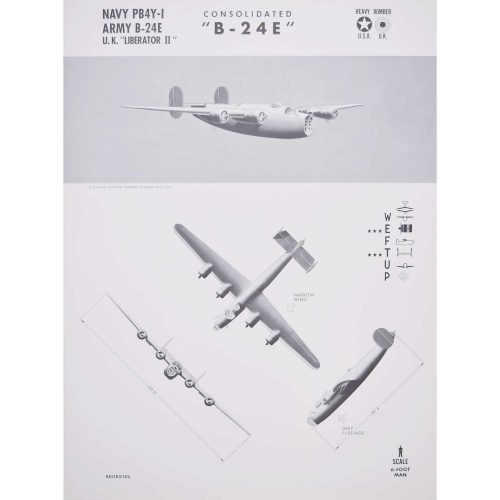
  • Navy and Army Consolidated Aircraft "B-24E" "Liberator II"

      US Naval Aviation Training Division Original aeroplane recognition poster (1942) 63 x 47 cm A particularly unusual style of aeroplane identification poster, owing to the very arty images. Most such posters rely on very plain silhouettes, this series - and we have several in this series; view them here - have a much more arty approach to the task with shading and an interesting angle view. The Consolidated B-24 Liberator is an American heavy bomber, designed by Consolidated Aircraft of San Diego, California. Early RAF Liberators were the first aircraft to cross the Atlantic Ocean as a matter of routine. The B-24 was used extensively in World War II. It served in every branch of the American armed forces as well as several Allied air forces and navies, and was used in every theatre of war operations. In comparison with its contemporaries, the B-24 was relatively difficult to fly and had poor low-speed performance; it also had a lower ceiling and was less robust than the Boeing B-17 Flying Fortress. While aircrews tended to prefer the B-17, General Staff favoured the B-24 and procured it in huge numbers for a wide variety of roles. At approximately 18,500 units – including 8,685 manufactured by Ford Engine Company – it holds records as the world's most produced bomber, heavy bomber, multi-engine aircraft, and American military aircraft in history. Condition: Generally very good, occasional handling marks. If you’d like to know more, please email info@manningfineart.co.uk or call us on 07929 749056.
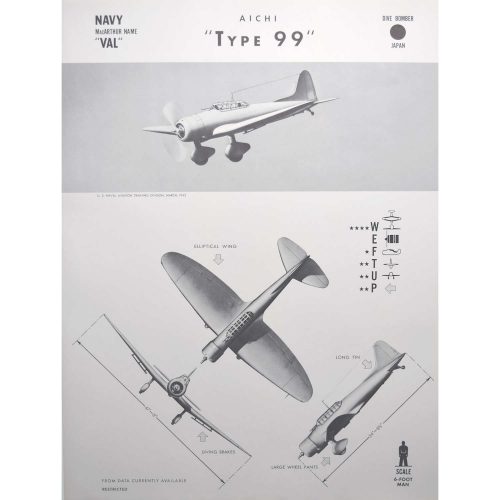
  • 1942 MacArthur name "Val" Aichi "Type 99"

    World War II Japanese dive bomber plane

      Original aeroplane identification poster, 1942 63 x 47 cm A particularly unusual style of aeroplane identification poster, owing to the very arty images. Most such posters rely on very plain silhouettes, this series - and we have many in this series - have a much more arty approach to the task with shading and an interesting angle view. The Aichi D3A Type 99 Carrier Bomber (Allied reporting name "Val") was a World War II carrier-borne dive bomber. It was the primary dive bomber of the Imperial Japanese Navy (IJN) and was involved in almost all IJN actions, including the attack on Pearl Harbor. The Aichi D3A was the first Japanese aircraft to bomb American targets in the war, commencing with Pearl Harbor and U.S. bases in the Philippines, such as the Clark Air Force Base. They sank more Allied warships than any other Axis aircraft. If you'd like to know more, please email info@manningfineart.co.uk or call us on 07929 749056.
  • US Naval Aviation Training Division

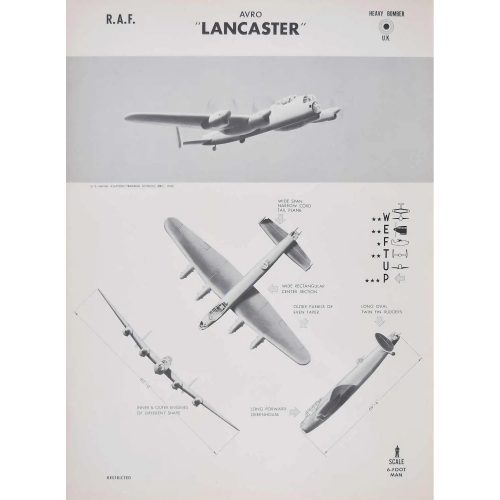
    Avro Lancaster

      Aeroplane identification poster, published 1942 63 x 47 cm A particularly unusual style of aeroplane identification poster, owing to the very arty images. Most such posters rely on very plain silhouettes, this series - and we have several in this series; view them here - have a much more arty approach to the task with shading and an interesting angle view. The Avro Lancaster is a British Second World War heavy bomber. It was designed and manufactured by Avro as a contemporary of the Handley Page Halifax, both bombers having been developed to the same specification, as well as the Short Stirling, all three aircraft being four-engined heavy bombers adopted by the Royal Air Force (RAF) during the same wartime era. The Lancaster has its origins in the twin-engine Avro Manchester which had been developed during the late 1930s in response to the Air Ministry Specification P.13/36 for a capable medium bomber for "world-wide use". Originally developed as an evolution of the Manchester (which had proved troublesome in service and was retired in 1942), the Lancaster was designed by Roy Chadwick and powered by four Rolls-Royce Merlins and in one version, Bristol Hercules engines. It first saw service with RAF Bomber Command in 1942 and as the strategic bombing offensive over Europe gathered momentum, it was the main aircraft for the night-time bombing campaigns that followed. As increasing numbers of the type were produced, it became the principal heavy bomber used by the RAF, the Royal Canadian Air Force (RCAF) and squadrons from other Commonwealth and European countries serving within the RAF, overshadowing the Halifax and Stirling. A long, unobstructed bomb bay meant that the Lancaster could take the largest bombs used by the RAF, including the 4,000 lb (1,800 kg), 8,000 lb (3,600 kg) and 12,000 lb (5,400 kg) blockbusters, loads often supplemented with smaller bombs or incendiaries. The "Lanc", as it was known colloquially, became one of the most heavily used of the Second World War night bombers, "delivering 608,612 long tonnes of bombs in 156,000 sorties". The versatility of the Lancaster was such that it was chosen to equip 617 Squadron and was modified to carry the Upkeep "bouncing bomb" designed by Barnes Wallis for Operation Chastise, the attack on German Ruhr valley dams. Although the Lancaster was primarily a night bomber, it excelled in many other roles, including daylight precision bombing, for which some Lancasters were adapted to carry the 12,000 lb (5,400 kg) Tallboy and then the 22,000 lb (10,000 kg) Grand Slam earthquake bombs (also designed by Wallis). This was the largest payload of any bomber in the war. In 1943, a Lancaster was converted to become an engine test bed for the Metropolitan-Vickers F.2 turbojet. Lancasters were later used to test other engines, including the Armstrong Siddeley Mamba and Rolls-Royce Dart turboprops and the Avro Canada Orenda and STAL Dovern turbojets. Postwar, the Lancaster was supplanted as the main strategic bomber of the RAF by the Avro Lincoln, a larger version of the Lancaster. The Lancaster took on the role of long range anti-submarine patrol aircraft (later supplanted by the Avro Shackleton) and air-sea rescue. It was also used for photo-reconnaissance and aerial mapping, as a flying tanker for aerial refuelling and as the Avro Lancastrian, a long-range, high-speed, transatlantic passenger and postal delivery airliner. In March 1946, a Lancastrian of BSAA flew the first scheduled flight from the new London Heathrow Airport. Condition: generally very good, occasional handling marks. If you are interested, please email info@manningfineart.co.uk or call us on 07929 749056.
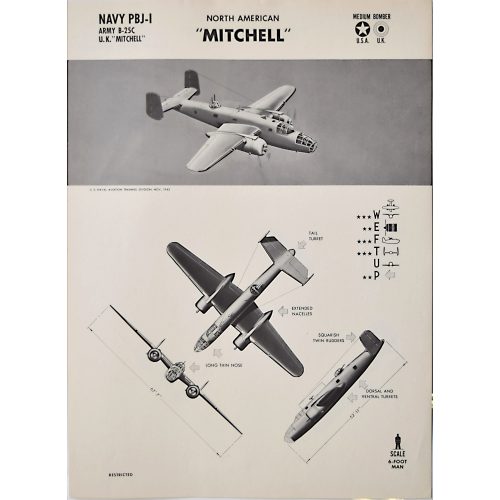
  • US Naval Aviation Training Division

    B-25 Bomber North American Mitchell World War 2 US airplane

    Original aeroplane identification poster, 1942 63 x 47 cm A particularly unusual style of aeroplane identification poster, owing to the very arty images. Most such posters rely on very plain silhouettes, this series - and we have several in this series - have a much more arty approach to the task with shading and an interesting angle view. Manufactured by North American Aviation and named in honour of Major General William 'Billy' Mitchell, a pioneer of US military aviation its first flight was in 1940 but it remained in service until 1979 (in the Indonesian air force). A particularly durable aircraft, one from the 321st Bomb Group was nicknamed 'Patches' on account of its (by the end of the war) 400 patched holes which had been painted with bright-yellow zinc chromate primer. Having completed over 300 missions and belly-landed six times the airframe was so distorted that 'straight-and-level' flight involved 8 degrees of left aileron trim and 6 degrees of right rudder causing the aircraft to 'crab' sideways through the air. Over one hundred B-25 Mitchells survive, with about 45 still airworthy. Seventeen flyable aircraft (and one hulk which was sacrificed to a crash scene) starred in the 1970 film 'Catch 22' fifteen of which still exist. If you are interested, please email info@manningfineart.co.uk or call us on 07929 749056.
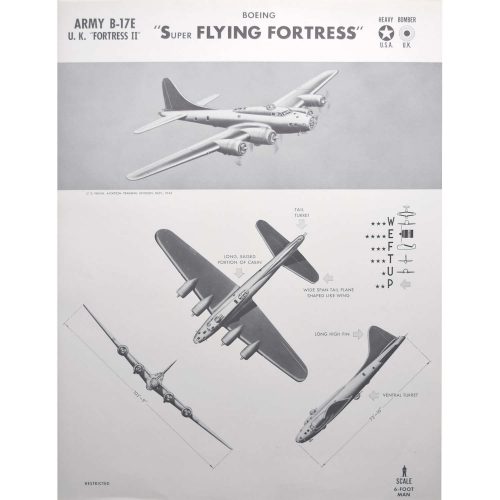
  • B-17E Boeing "Super Flying Fortress"

      World War II US and UK heavy bomber plane Original aeroplane recognition poster (1942) 63 x 47 cm A particularly unusual style of aeroplane identification poster, owing to the very arty images. Most such posters rely on very plain silhouettes, this series - and we have several in this series; view them here - have a much more arty approach to the task with shading and an interesting angle view. The Boeing B-17 Flying Fortress is a four-engined heavy bomber developed in the 1930s for the United States Army Air Corps. From its introduction in 1938, the B-17 Flying Fortress evolved through numerous design advances, becoming the third-most produced bomber of all time. The B-17 was primarily employed by the United States Army Air Forces in the daylight strategic bombing campaign of World War II against German industrial, military and civilian targets. The B-17 also participated to a lesser extent in the Pacific War, early in World War II, where it conducted raids against Japanese shipping and airfields. In 1935 it was simply known as the Model 299. Seattle Times reporter Richard Smith dubbed the new plane, with its many machine-gun mounts, the “Flying Fortress,” and Boeing quickly adopted and trademarked the name. Condition: generally very good, occasional handling marks. If you’d like to know more, please email info@manningfineart.co.uk or call us on 07929 749056.
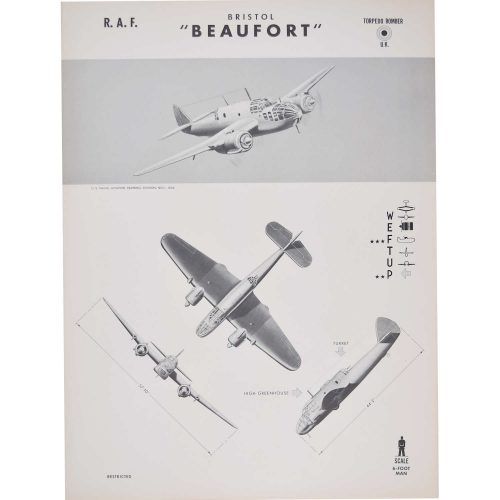
  • Bristol Beaufort Torpedo Bomber

    US Naval Aviation Training Division Original aeroplane recognition poster (1942) 63 x 47 cm A particularly unusual style of aeroplane identification poster, owing to the very arty images. Most such posters rely on very plain silhouettes, this series - and we have several in this series; view them here - have a much more arty approach to the task with shading and an interesting angle view. The Bristol Beaufort (manufacturer designation Type 152) was a British twin-engined torpedo bomber designed by the Bristol Aeroplane Company, and developed from experience gained designing and building the earlier Blenheim light bomber. At least 1,180 Beauforts were built by Bristol and other British manufacturers. The Australian government''s Department of Aircraft Production (DAP) also manufactured variants of the Beaufort. These are often known collectively as the DAP Beaufort. More than 700 Australian-built Beauforts saw service with the Royal Australian Air Force in the South West Pacific theatre, where they were used until the end of the war. Beauforts first saw service with Royal Air Force Coastal Command and then the Royal Navy Fleet Air Arm from 1940. They were used as torpedo bombers, conventional bombers and mine-layers until 1942, when they were removed from active service and were then used as trainer aircraft until being declared obsolete in 1945. Beauforts also saw considerable action in the Mediterranean; Beaufort squadrons based in Egypt and on Malta helped interdict Axis shipping supplying Rommel's Deutsches Afrikakorps in North Africa. Although it was designed as a torpedo-bomber, the Beaufort was more often used as a medium day bomber. The Beaufort also flew more hours in training than on operational missions and more were lost through accidents and mechanical failures than were lost to enemy fire. The Beaufort was adapted as a long-range heavy fighter variant called the Beaufighter, which proved to be very successful and many Beaufort units eventually converted to the Beaufighter. Condition: good. If you’d like to know more, please email info@manningfineart.co.uk or call us on 07929 749056.
  • US Naval Aviation Training Division

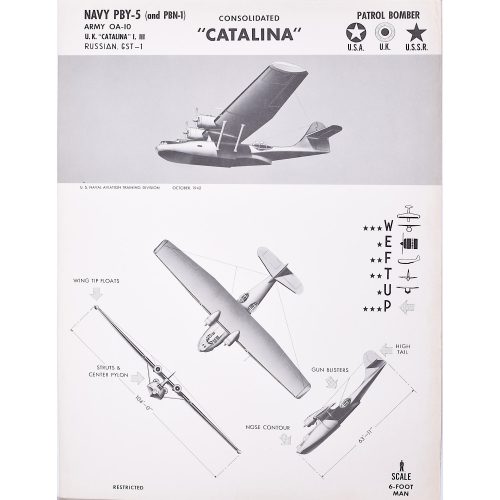
    Consolidated PBY Catalina World War 2 US airplane

    Aeroplane identification poster, 1942 63 x 47 cm A particularly unusual style of aeroplane identification poster, owing to the very arty images. Most such posters rely on very plain silhouettes, this series - and we have several in this series (click here) - have a much more arty approach to the task with shading and an interesting angle view. The PBY Catalina is a flying boat used extensively during World War 2 in anti-submarine patrols, air-sea rescue, patrol bombing and convoy escort. It served militarily until the 1980s and was still being used in the 2010s as a waterbomber for firefighting. The RCAF called it the Canso. If you are interested, please email info@manningfineart.co.uk or call us on 07929 749056.
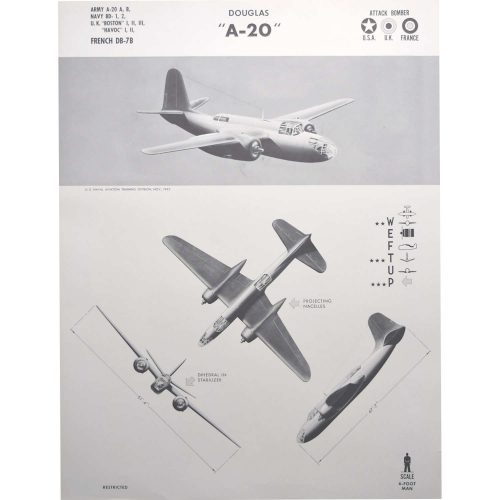
  • Army A-20 A, B, Navy BD- 1, 2, UK "Boston" I, II, III, "Havoc" I, II, French DB-7B Douglas "A-20"

      Aeroplane identification poster, published 1942 63 x 47 cm A particularly unusual style of aeroplane identification poster, owing to the very arty images. Most such posters rely on very plain silhouettes, this series - and we have several in this series; view them here - have a much more arty approach to the task with shading and an interesting angle view. The Douglas A-20 was a medium bomber, attack aircraft, night intruder, night fighter, and reconnaissance aircraft of World War II. Designed to meet an Army Air Corps requirement for a bomber, it was ordered by France for their air force before the USAAC decided it would also meet their requirements. French DB-7s were the first to see combat. The A-20 served with several Allied air forces, principally the United States Army Air Forces (USAAF), the Soviet Air Forces (VVS), Soviet Naval Aviation (AVMF), and the Royal Air Force (RAF) of the United Kingdom. A total of 7,478 aircraft were built, of which more than a third served with Soviet units. It was also used by the air forces of Australia, South Africa, France, and the Netherlands during the war. Condition: generally very good. If you are interested, please email info@manningfineart.co.uk or call us on 07929 749056.
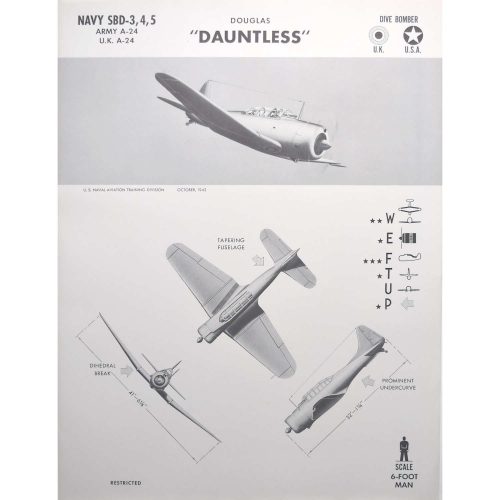
  • Navy SBD-3, 4, 5, Army A-24 Douglas "Dauntless"

      Aeroplane identification poster, published 1942 63 x 47 cm A particularly unusual style of aeroplane identification poster, owing to the very arty images. Most such posters rely on very plain silhouettes, this series - and we have several in this series; view them here - have a much more arty approach to the task with shading and an interesting angle view. The Douglas SBD Dauntless was a World War II American naval scout plane and dive bomber that was manufactured by Douglas Aircraft from 1940 through 1944. The SBD ("Scout Bomber Douglas") was the United States Navy''s main carrier-based scout/dive bomber from mid-1940 through mid-1944. The SBD was also flown by the United States Marine Corps, both from land air bases and aircraft carriers. The SBD is best remembered as the bomber that delivered the fatal blows to the Japanese carriers at the Battle of Midway in June 1942. During Midway, four squadrons of Dauntless dive bombers attacked and sank or fatally damaged all four Japanese fleet carriers present, disabling three of them in the span of just six minutes (Akagi, Kaga, and Sōryū) and, later in the day, Hiryū. During its combat service, the SBD proved to be an excellent naval scout plane and dive bomber. It possessed long range, good handling characteristics, manoeuvrability, potent bomb load, great diving characteristics from the perforated dive brakes, good defensive armament, and ruggedness. Condition: generally very good. If you are interested, please email info@manningfineart.co.uk or call us on 07929 749056.
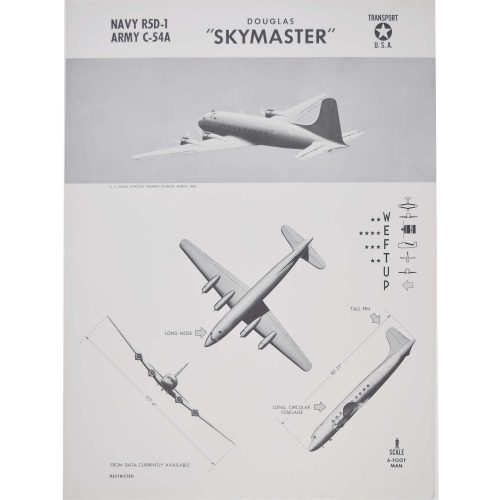
  • 1942 Navy R5D-1 Army C-54A Douglas "Skymaster"

      Aeroplane identification poster, published 1942 63 x 47 cm A particularly unusual style of aeroplane identification poster, owing to the very arty images. Most such posters rely on very plain silhouettes, this series - and we have several in this series; view them here - have a much more arty approach to the task with shading and an interesting angle view. The Douglas Skymaster was a four-engine transport aircraft used by the United States Army Air Forces in World War II and the Korean War. Like the Douglas C-47 Skytrain (the Skytrain poster from the same series is also available in our storefront), the Skymaster was derived from a civilian airliner, the Douglas DC-4. To meet military requirements, the first civil production aircraft had four additional auxiliary fuel tanks in the main cabin which reduced the passenger seats to 26. The following batch of aircraft, designated C-54A, were built with a stronger floor and a cargo door with a hoist and winch. The first C-54A was delivered in February 1943. Skymasters used by the United States Navy were designated Douglas R5D. As well as being used for cargo transport, the C-54 also carried presidents, prime ministers, and military staff. Dozens of variants of the C-54 were employed in a wide variety of non-combat roles such as air-sea rescue, scientific and military research, and missile tracking and recovery. During the Berlin Airlift it hauled coal and food supplies to West Berlin. After the Korean War it continued to be used for military and civilian uses by more than 30 countries. Condition: generally very good. If you are interested, please email info@manningfineart.co.uk or call us on 07929 749056.
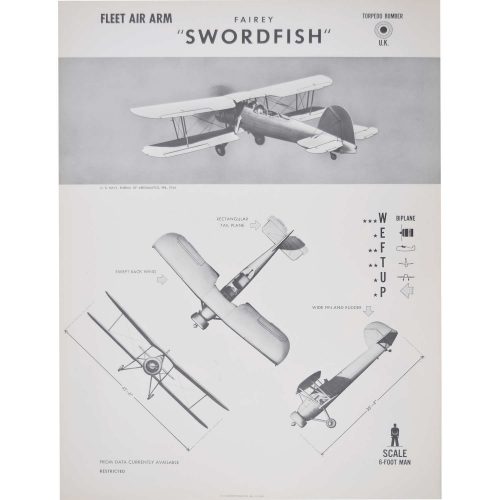
  • Fairey Swordfish

      Aeroplane identification poster, published 1942 63 x 47 cm A particularly unusual style of aeroplane identification poster, owing to the very arty images. Most such posters rely on very plain silhouettes, this series - and we have several in this series; view them here - have a much more arty approach to the task with shading and an interesting angle view. The Fairey Swordfish is a biplane torpedo bomber designed by the Fairey Aviation Company. Originating in the early 1930s, the Swordfish, nicknamed "Stringbag", was operated by the Fleet Air Arm of the Royal Navy, it was also used by the Royal Air Force (RAF), as well as several overseas operators, including the Royal Canadian Air Force (RCAF) and the Royal Netherlands Navy. It was initially operated primarily as a fleet attack aircraft. During its later years, the Swordfish became increasingly used as an anti-submarine and training platform. The type was in frontline service throughout the Second World War. Despite being obsolete by 1939, the Swordfish achieved some spectacular successes during the war. Notable events included sinking one battleship and damaging two others of the Regia Marina (the Italian Navy) during the Battle of Taranto, and the famous attack on the Bismarck, which contributed to her eventual demise. By the end of the war, the Swordfish held the distinction of having caused the destruction of a greater tonnage of Axis shipping than any other Allied aircraft. The Swordfish remained in front-line service until V-E Day, having outlived multiple aircraft that had been intended to replace it in service. Condition: generally very good. If you are interested, please email info@manningfineart.co.uk or call us on 07929 749056.
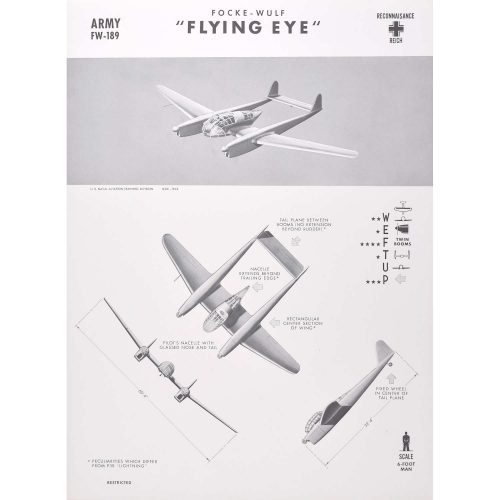
  • Army FW-189 "Flying Eye"

      Aeroplane identification poster, published 1942 63 x 47 cm A particularly unusual style of aeroplane identification poster, owing to the very arty images. Most such posters rely on very plain silhouettes, this series - and we have several in this series; view them here - have a much more arty approach to the task with shading and an interesting angle view. The Focke-Wulf Fw 189 Uhu ("Eagle Owl") was a German twin-engine, twin-boom, three-seat tactical reconnaissance and army cooperation aircraft. It first flew in 1938, entered service in 1940 and was produced until mid-1944. It was nicknamed the “Flying Eye.” Patrolling the vast flatlands of Ukraine and Belarus, the Flying Eye was used extensively on the Eastern Front with great success. It was nicknamed "Rama" ("frame") by Soviet forces, in reference to its distinctive tailboom and stabiliser shapes, which gave it its characteristic quadrangular appearance. Despite its low speed, the Fw 189's manoeuvrability made it a difficult target for attacking Soviet fighters. When attacked, the Flying Eye was often able to out-turn enemy fighters by simply flying in a tight circle. Condition: generally very good. If you are interested, please email info@manningfineart.co.uk or call us on 07929 749056.
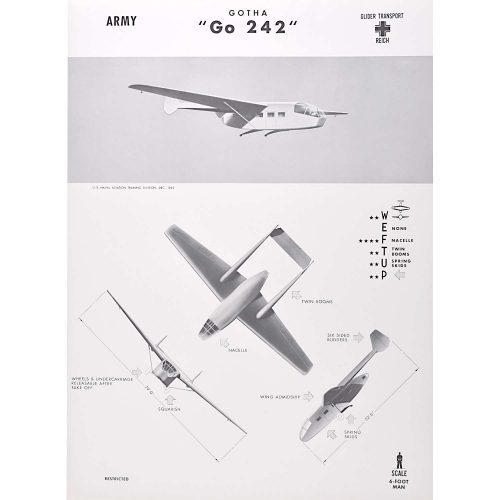
  • Army Gotha "Go 242"

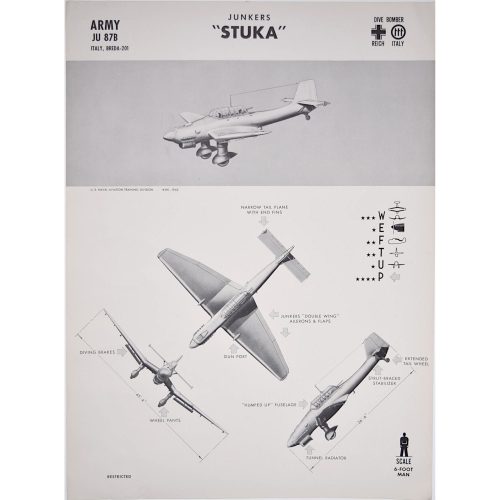
      Aeroplane identification poster, published 1942 63 x 47 cm A particularly unusual style of aeroplane identification poster, owing to the very arty images. Most such posters rely on very plain silhouettes, this series - and we have several in this series; view them here - have a much more arty approach to the task with shading and an interesting angle view. The Gotha Go 242 was a transport glider used by the Luftwaffe during World War II. It was designed by Albert Kalkert in response to the request for a heavy transport glider to replace the DFS 230 which was then in service. The requirement was for a glider capable of carrying 20 fully laden troops, or equivalent cargo. Two prototypes flew in 1941 and the type quickly entered production, with a total of 1,528 being built. In service, Go 242s were towed into the air by Heinkel He 111s or Junkers Ju 52s. Most saw service in the Mediterranean, North Africa and Aegean. Ju 87D-2s had strengthened rear fuselage and combined tailwheel and hook for towing the Go 242. Today, there are two surviving 242s - one in the Musée de la Resistance du Vercors in Valence, France, and the other in the Technik Museum and Luftwaffenmuseum der Bundeswehr in Berlin, Germany. Condition: generally very good. If you are interested, please email info@manningfineart.co.uk or call us on 07929 749056.
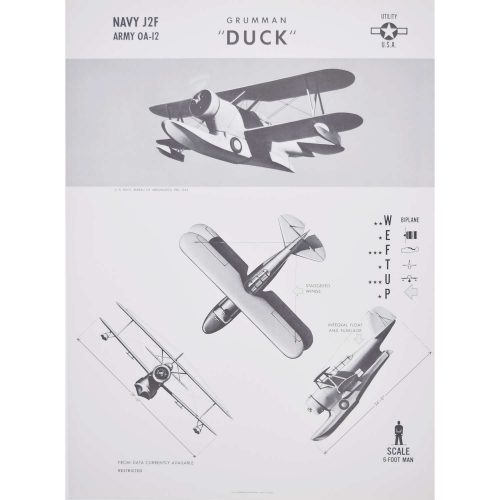
  • Navy and Army Grumman "Duck"

      Aeroplane identification poster, published 1942 63 x 47 cm A particularly unusual style of aeroplane identification poster, owing to the very arty images. Most such posters rely on very plain silhouettes, this series - and we have several in this series; view them here - have a much more arty approach to the task with shading and an interesting angle view. The Grumman J2F Duck was an American single-engine amphibious biplane. It was used by each major branch of the U.S. armed forces from the mid-1930s until just after World War II, primarily for utility and air-sea rescue duties. It was also used by the Argentine Navy, who took delivery of their first J2F in 1937. Apart from general utility and light transport duties, its missions included mapping, reconnaissance, anti-submarine patrol, air-sea rescue work, photographic surveys, and target tug. Condition: generally very good. If you are interested, please email info@manningfineart.co.uk or call us on 07929 749056.
  • Handley-Page "Halifax"

      Aeroplane identification poster, published 1942 63 x 47 cm A particularly unusual style of aeroplane identification poster, owing to the very arty images. Most such posters rely on very plain silhouettes, this series - and we have several in this series; view them here - have a much more arty approach to the task with shading and an interesting angle view. The Halifax bomber was a twin-engined bomber that entered service with the RAF in 1940. Viewed by Arthur ''Bomber'' Harris as inferior to the Lancaster, on account of its smaller payload, the crews preferred it. 1,833 aircraft were lost in service with Bomber Command, across a total of 82,733 operations. Only three survive, one at the Yorkshire Air Museum in Elvington (based on a fuselage that had been in use at a chicken farm following a crash near Stornoway), one at the National Air Force Museum of Canada (which was discovered in 1991 in Norway and subsequently restored), and one at the RAF Museum in London (that crash landed in Norway following an attack on the German battleship Tirpitz; rediscovered in 1971, it has been left unrestored). Condition: generally very good. If you are interested, please email info@manningfineart.co.uk or call us on 07929 749056.
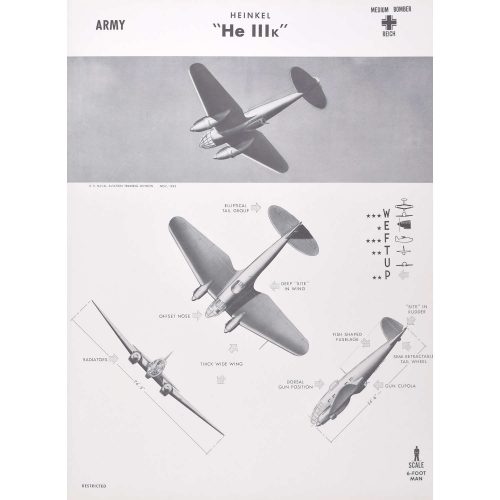
  • Heinkel "He 111K"

      Aeroplane identification poster, published 1942 63 x 47 cm A particularly unusual style of aeroplane identification poster, owing to the very arty images. Most such posters rely on very plain silhouettes, this series - and we have several in this series; view them here - have a much more arty approach to the task with shading and an interesting angle view. The Heinkel He 111 was a German bomber aircraft designed by Siegfried and Walter Günter at Heinkel Flugzeugwerke in 1934. Through development it was described as a "wolf in sheep''s clothing"; due to restrictions placed on Germany after the First World War prohibiting bombers, it masqueraded as a civil airliner, although from conception the design was intended to provide the nascent Luftwaffe with a fast medium bomber. Perhaps the best-recognised German bomber due to the distinctive, extensively glazed "greenhouse" nose of later versions, the Heinkel He 111 was the most numerous Luftwaffe bomber during the early stages of World War II. The bomber fared well until the Battle of Britain, when its weak defensive armament was exposed. Nevertheless, it proved capable of sustaining heavy damage and remaining airborne. As the war progressed, the He 111 was used in a wide variety of roles on every front in the European theatre. It was used as a strategic bomber during the Battle of Britain (and has a prominent role in the film "Battle of Britain"), a torpedo bomber in the Atlantic and Arctic, and a medium bomber and a transport aircraft on the Western, Eastern, Mediterranean, Middle Eastern, and North African Front theatres. The He 111 was constantly upgraded and modified, but became obsolete during the latter part of the war. Condition: generally very good. If you are interested, please email info@manningfineart.co.uk or call us on 07929 749056.
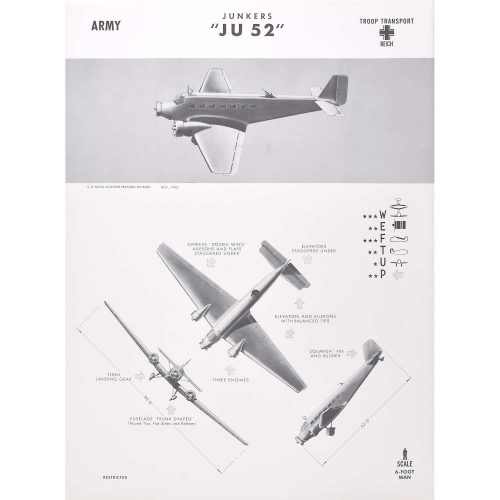
  • Junkers "JU 52"

      Aeroplane identification poster, published 1942 63 x 47 cm A particularly unusual style of aeroplane identification poster, owing to the very arty images. Most such posters rely on very plain silhouettes, this series - and we have several in this series; view them here - have a much more arty approach to the task with shading and an interesting angle view. The Junkers Ju 52/3m (nicknamed Tante Ju ("Aunt Ju") and Iron Annie) was a transport aircraft that was designed and manufactured by German aviation company Junkers. Development of the Ju 52 commenced during 1930, headed by German aeronautical engineer Ernst Zindel. Its maiden flight was on 13 October 1930. Following the rise of Nazi Germany, thousands of Ju 52s were procured as a staple military transport of the nation. The Ju 52 was in production between 1931 and 1952. In a civilian role, it flew with over 12 airlines, including Swissair and Deutsche Luft Hansa, as both a passenger carrier and a freight hauler. In a military role, large numbers flew with the Luftwaffe, being deployed on virtually all fronts of the Second World War as a troop and cargo transport; it was also briefly used as a medium bomber. Additionally, the type was deployed by other nation''s militaries in conflicts such as the Spanish Civil War, the Chaco War, and the Portuguese Colonial War. During the postwar era, the Ju 52 had a lengthy service life with numerous military and civilian operators; large numbers were still in use by the 1980s. Even in the 21st century, several aircraft have remained operational, typically used for purposes such as heritage aviation displays and aerial sightseeing. Condition: generally very good. If you are interested, please email info@manningfineart.co.uk or call us on 07929 749056.
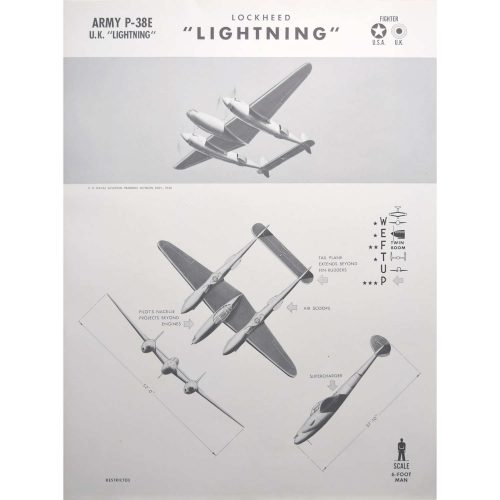
  • Army P-38E Lockheed "Lightning"

      Aeroplane identification poster, published 1942 63 x 47 cm A particularly unusual style of aeroplane identification poster, owing to the very arty images. Most such posters rely on very plain silhouettes, this series - and we have several in this series; view them here - have a much more arty approach to the task with shading and an interesting angle view. The Lockheed P-38 Lightning was an American single-seated, twin piston-engined fighter aircraft that was used during World War II. The Lightning was originally designed as a bomber-interceptor and was never intended to be a fighter. Weight was kept to a minimum and it was far more advanced and faster than its U.S. counterparts, the Bell P-39 Airacobra and Curtiss P-40 Warhawk (original Airacobra and Warhawk posters from the same 1942 series are also available in our storefront). It caught the attention of the US Army Air Corps (USAAC) very quickly. The Lightning shot down more Japanese aeroplanes than any other fighter during World War II. When first introduced in 1939, the Lightning was able to fly a steady course at 413 mph (665 km/h), making it the fastest production aeroplane in the world. It remained one of the fastest climbers right up to the end of the WW II. Condition: generally very good. If you are interested, please email info@manningfineart.co.uk or call us on 07929 749056.
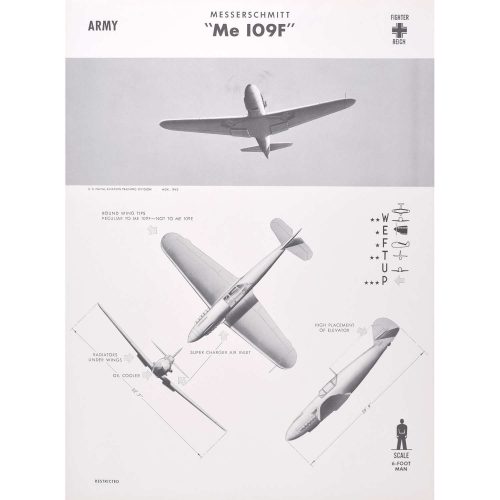
  • US Naval Aviation Training Division

    Messerschmitt BF 109

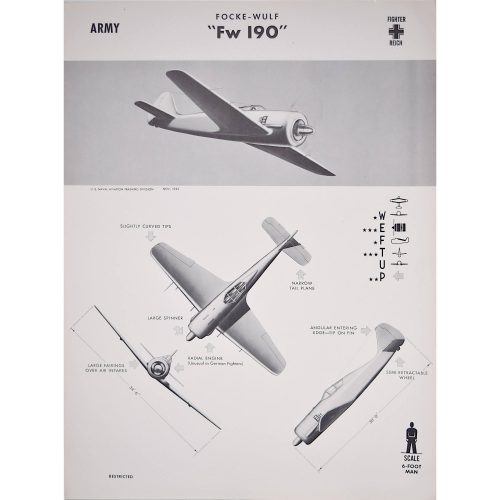
      Aeroplane identification poster, published 1942 63 x 47 cm A particularly unusual style of aeroplane identification poster, owing to the very arty images. Most such posters rely on very plain silhouettes, this series - and we have several in this series; view them here - have a much more arty approach to the task with shading and an interesting angle view. The Messerschmitt Bf 109 is a German World War II fighter aircraft that was, along with the Focke-Wulf Fw 190, the backbone of the Luftwaffe's fighter force. The Bf 109 first saw operational service in 1937 during the Spanish Civil War and was still in service at the dawn of the jet age at the end of World War II in 1945. It was one of the most advanced fighters when it first appeared, with an all-metal monocoque construction, a closed canopy, and retractable landing gear. It was powered by a liquid-cooled, inverted-V12 aero engine. It was called the Me 109 by Allied aircrew and some German aces, even though this was not the official German designation. It was designed by Willy Messerschmitt and Robert Lusser who worked at Bayerische Flugzeugwerke during the early to mid-1930s. It was conceived as an interceptor, although later models were developed to fulfil multiple tasks, serving as bomber escort, fighter-bomber, day-, night-, all-weather fighter, ground-attack aircraft, and reconnaissance aircraft. It was supplied to several states during World War II and served with several countries for many years after the war. The Bf 109 is the most produced fighter aircraft in history, with a total of 33,984 airframes produced from 1936 to April 1945. Some of the Bf 109 production took place in Nazi concentration camps through slave labor. The Bf 109 was flown by the three top-scoring fighter aces of all time, who claimed 928 victories among them while flying with Jagdgeschwader 52, mainly on the Eastern Front. The highest-scoring, Erich Hartmann, was credited with 352 victories. The aircraft was also flown by Hans-Joachim Marseille, the highest-scoring ace in the North African Campaign who shot down 158 enemy aircraft. It was also flown by many aces from other countries fighting with Germany, notably the Finn Ilmari Juutilainen, the highest-scoring non-German ace. Pilots from Italy, Romania, Croatia, Bulgaria, and Hungary also flew the Bf 109. Through constant development, the Bf 109 remained competitive with the latest Allied fighter aircraft until the end of the war. Condition: generally very good. If you are interested, please email info@manningfineart.co.uk or call us on 07929 749056.
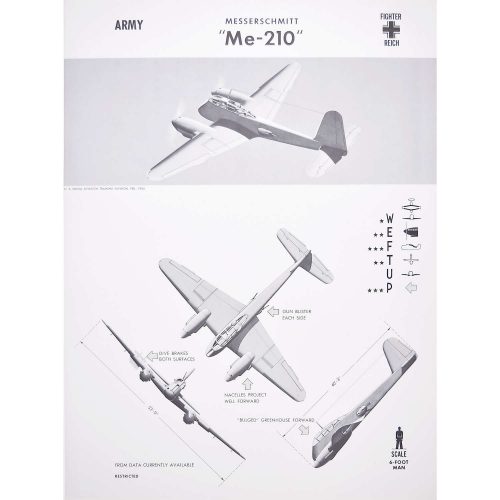
  • US Naval Aviation Training Division

    Messerschmitt BF 210

      Aeroplane identification poster, published 1942 63 x 47 cm A particularly unusual style of aeroplane identification poster, owing to the very arty images. Most such posters rely on very plain silhouettes, this series - and we have several in this series; view them here - have a much more arty approach to the task with shading and an interesting angle view. The Messerschmitt Me 210 was a two-seater German heavy fighter and ground-attack aircraft of World War II. Initial development of the 210 was started by Messerschmitt in 1938 at the request of the Luftwaffe. Condition: generally very good. If you are interested, please email info@manningfineart.co.uk or call us on 07929 749056.
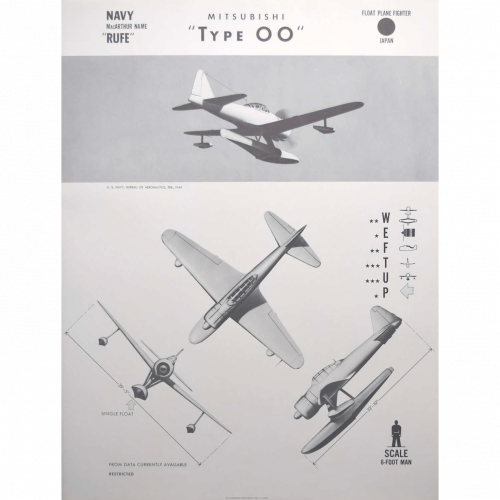
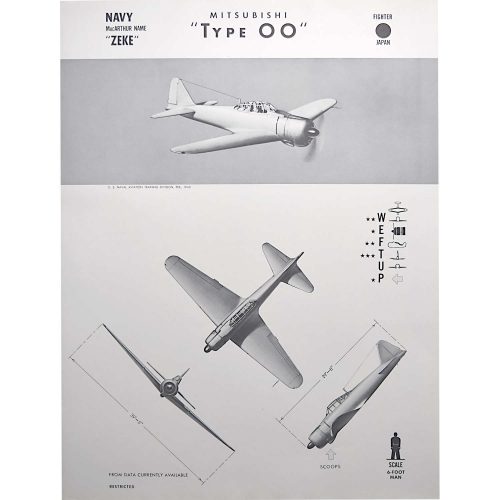
  • "Rufe" Mitsubishi "Type OO"

      Aeroplane identification poster, published 1942 63 x 47 cm A particularly unusual style of aeroplane identification poster, owing to the very arty images. Most such posters rely on very plain silhouettes, this series - and we have several in this series; view them here - have a much more arty approach to the task with shading and an interesting angle view. This Japanese floatplane, known to the Allies as a "Rufe", was developed from the Mitsubishi A6M Type 0 - the famous ''Zero'' figher, mainly to support amphibious operations and defend remote bases. It was based on the A6M-2 Model 11 fuselage, with a modified tail and added floats. A total of 327 were built, including the original prototype. The aircraft was deployed in 1942 and was only used in operations taking place in the Aleutians and Solomon Islands. Such seaplanes were effective in harassing American patrol torpedo boats at night. They could also drop flares to illuminate the American boats which were vulnerable to destroyer gunfire, and depended on cover of darkness. Condition: generally very good. If you are interested, please email info@manningfineart.co.uk or call us on 07929 749056.
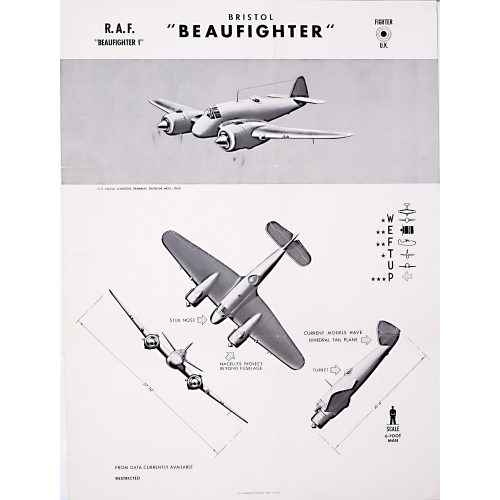
  • US Naval Aviation Training Division

    RAF Bristol Beaufighter World War 2 US airplane

    Aeroplane identification poster, 1942 63 x 47 cm A particularly unusual style of aeroplane identification poster, owing to the very arty images. Most such posters rely on very plain silhouettes, this series - and we have several in this series (click here) - have a much more arty approach to the task with shading and an interesting angle view. The Beaufighter is a multi-role aircraft conceived originally as a heavy fighter variant of the Bristol Beaufort. As an effective night fighter it came into service during the Battle of Britain, having the space for radar it became a highly effective night fighter. The de Havilland Mosquito, being somewhat faster, took over in the latter part of 1942. The Beaufighter saw service in all theatres during World War II, serving through to the Greek civil war in 1946. 5,928 were built but no flying examples exist today, although The Fighter Collection at Duxford is currently restoring an aircraft (made from multiple aircraft). If you are interested, please email info@manningfineart.co.uk or call us on 07929 749056.
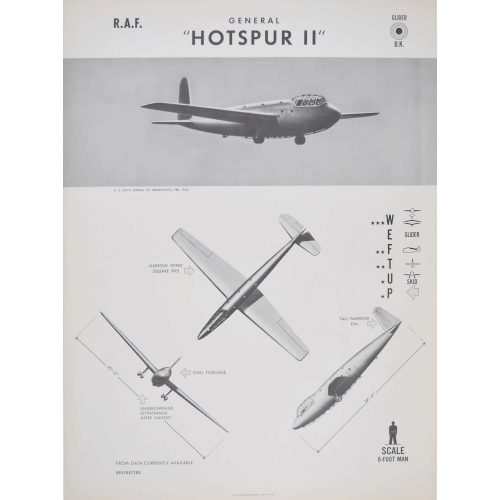
  • 1942 RAF General Hotspur II

      Aeroplane identification poster, published 1942 63 x 47 cm A particularly unusual style of aeroplane identification poster, owing to the very arty images. Most such posters rely on very plain silhouettes, this series - and we have several in this series; view them here - have a much more arty approach to the task with shading and an interesting angle view. A particularly unusual style of aeroplane recognition poster, owing to the very arty images. Most such posters rely on very plain silhouettes, this series - and we have several in this series - have a much more arty approach to the task with shading and an interesting angle view. The General Aircraft GAL.48 Hotspur was a military glider designed and built by the British company General Aircraft Ltd during World War II. When the British airborne establishment was formed in 1940 by order of Prime Minister Winston Churchill, it was decided that gliders would be used to transport airborne troops into battle. General Aircraft Ltd were given a contract by the Ministry of Aircraft Production in June 1940 to design and produce an initial glider for use by the airborne establishment, which resulted in the Hotspur. Conceived as an "assault" glider which necessitated a compact design and no more than eight troops carried, tactical philosophy soon favoured larger numbers of troops being sent into battle aboard gliders. Due to this, the Hotspur was mainly relegated to training where it did excel and it became the basic trainer for the glider schools that were formed. The Hotspur was named after Sir Henry Percy, a significant captain during the Anglo-Scottish wars who was also known as "Hotspur". A Hotspur Mark II (HH268) replica is on display at the Museum of Army Flying in Hampshire, England. The front fuselage of a Hotspur was preserved at the Parachute Regiment And Airborne Forces Museum in Aldershot prior to the museum''s 2007 closing, in anticipation of a move to the Imperial War Museum Duxford. Condition: generally very good. If you are interested, please email info@manningfineart.co.uk or call us on 07929 749056.
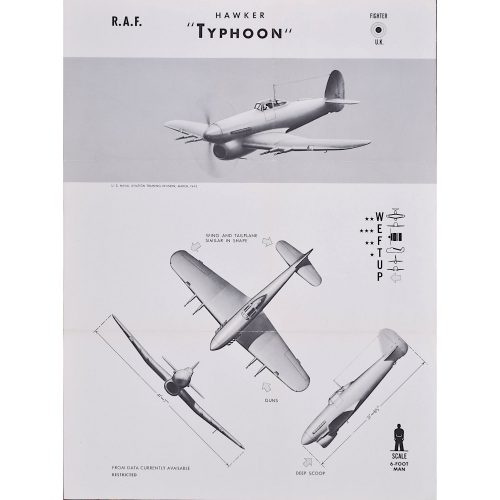
  • US Naval Aviation Training Division

    RAF Hawker Typhoon World War 2 US airplane

    Original aeroplane identification poster, 1942 63x47cm A particularly unusual style of aeroplane identification poster, owing to the very arty images. Most such posters rely on very plain silhouettes, this series - and we have several in this series (click here) - have a much more arty approach to the task with shading and an interesting angle view. The Typhoon is a single-seat fighter-bomber nicknamed the 'Tiffy'. Designed as a replacement for the Hawker Hurricane it never completely satisfied this expectation. However it was the only RAF fighter capable of catching the Fw 190 at low altitudes when the latter came into service in 1941. It became one of the most effective ground-attack aircraft of the Second World War. 3317 were produced and only one complete Typhoon still exists which belongs to the Royal Air Force Museum in Hendon. If you are interested email info@manningfineart.co.uk or call us on 07929 749056.
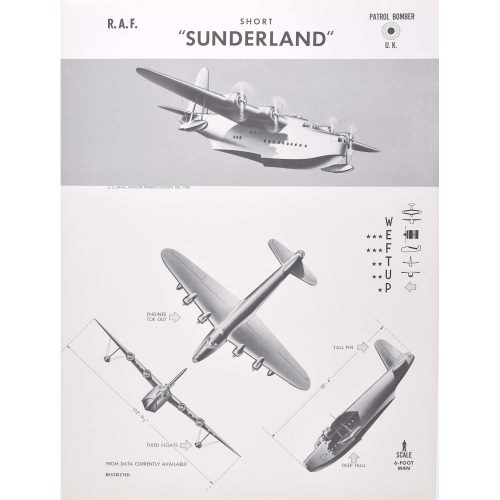
  • US Naval Aviation Training Division

    Short Sunderland

      Aeroplane identification poster, published 1942 63 x 47 cm A particularly unusual style of aeroplane identification poster, owing to the very arty images. Most such posters rely on very plain silhouettes, this series - and we have several in this series; view them here - have a much more arty approach to the task with shading and an interesting angle view. The Avro Lancaster is a British Second World War heavy bomber. It was designed and manufactured by Avro as a contemporary of the Handley Page Halifax, both bombers having been developed to the same specification, as well as the Short Stirling, all three aircraft being four-engined heavy bombers adopted by the Royal Air Force (RAF) during the same wartime era. The Short Sunderland was a British flying boat patrol bomber, developed and constructed by Short Brothers for the Royal Air Force (RAF). The aircraft took its service name from the town (latterly, city) and port of Sunderland in North East England. The Sunderland was one of the most powerful and widely used flying boats throughout the Second World War. In addition to the RAF, the type was operated by other Allied military air wings, including the Royal Australian Air Force (RAAF), Royal Canadian Air Force (RCAF), South African Air Force (SAAF), Royal New Zealand Air Force (RNZAF), French Navy, Norwegian Air Force, and the Portuguese Navy. During the conflict, the Sunderland was heavily involved in Allied efforts to counter the threat posed by German U-boats in the Battle of the Atlantic. On 17 July 1940, a RAAF Sunderland (of No. 10 Squadron) performed the type's first unassisted U-boat kill. The Sunderland also played a major role in the Mediterranean theatre, performing maritime reconnaissance flights and logistical support missions. During the evacuation of Crete, shortly after the German invasion of the island, several aircraft were used to transport troops. Numerous unarmed Sunderlands were also flown by civil operator British Overseas Airways Corporation (BOAC), traversing routes as far afield as the Pacific Ocean. Condition: generally very good, occasional handling marks. If you are interested, please email info@manningfineart.co.uk or call us on 07929 749056.
  • US Naval Aviation Training Division

    Vickers Wellington

      Aeroplane identification poster, 1942 63 x 47 cm A particularly unusual style of aeroplane identification poster, owing to the very arty images. Most such posters rely on very plain silhouettes, this series - and we have several in this series; view them here - have a much more arty approach to the task with shading and an interesting angle view. The Vickers Wellington was a British twin-engined, long-range medium bomber. It was designed during the mid-1930s at Brooklands in Weybridge, Surrey. Led by Vickers-Armstrongs' chief designer Rex Pierson; a key feature of the aircraft is its geodetic airframe fuselage structure, which was principally designed by Barnes Wallis. Development had been started in response to Air Ministry Specification B.9/32, issued in the middle of 1932, for a bomber for the Royal Air Force. This specification called for a twin-engined day bomber capable of delivering higher performance than any previous design. Other aircraft developed to the same specification include the Armstrong Whitworth Whitley and the Handley Page Hampden. During the development process, performance requirements such as for the tare weight changed substantially, and the engine used was not the one originally intended. The Wellington was used as a night bomber in the early years of the Second World War, performing as one of the principal bombers used by Bomber Command. During 1943, it started to be superseded as a bomber by the larger four-engined "heavies" such as the Avro Lancaster. The Wellington continued to serve throughout the war in other duties, particularly as an anti-submarine aircraft. It holds the distinction of having been the only British bomber that was produced for the duration of the war, and of having been produced in a greater quantity than any other British-built bomber. The Wellington remained as first-line equipment when the war ended, although it had been increasingly relegated to secondary roles. The Wellington was one of two bombers named after Arthur Wellesley, 1st Duke of Wellington, the other being the Vickers Wellesley. A larger heavy bomber aircraft designed to Specification B.1/35, the Vickers Warwick, was developed in parallel with the Wellington; the two aircraft shared around 85% of their structural components. Many elements of the Wellington were also re-used in a civil derivative, the Vickers VC.1 Viking. If you are interested, please email info@manningfineart.co.uk or call us on 07929 749056.
  • Porto-Service, Chicago Bring Home the Bacon - three little hams who gotta be cured!

    Lithograph 26.5x18cm 1942 What better writing paper to send to a serving serviceman than that encouraging him to fight. Porto-Service of Chicago published a series of illustrated writing resources for sweethearts and friends to write to their brave servicemen, in this case teasing the three Axis dictators. Lavishly produced and printed, the Americans brought some much-needed colour and glamour to dull war-torn Britain. If you are interested email info@manningfineart.co.uk or call us on 07929 749056.
  • 1943 Blohm und Voss "Ha. 138B"

      World War II German Reich reconnaissance plane Original aeroplane recognition poster (1943) 63 x 47 cm A particularly unusual style of aeroplane identification poster, owing to the very arty images. Most such posters rely on very plain silhouettes, this series - and we have several in this series; view them here - have a much more arty approach to the task with shading and an interesting angle view. Condition: generally very good, occasional handling marks. If you’d like to know more, please email info@manningfineart.co.uk or call us on 07929 749056.
  • US Naval Aviation Training Division

    Luftwaffe Dornier Do 217 Medium/Heavy Bomber 

    Aeroplane identification poster, 1943 63x47cm A particularly unusual style of aeroplane identification poster, owing to the very arty images. Most such posters rely on very plain silhouettes, this series - and we have several in this series (click here) - have a much more arty approach to the task with shading and an interesting angle view. A two-engined heavy bomber developed in German in the late 1930s for short-range bombing and as a more powerful development of the Do 17 - the flying pencil. It saw service until the end of the war in 1945. A versatile aircraft it was used as a night fighter, torpedo bomber, strategic bomber and reconnaissance aircraft. No complete example survives to this day despite a production of 1,925. If you are interested email info@manningfineart.co.uk or call us on 07929 749056.
  • US Naval Aviation Training Division

    Luftwaffe Focke-Wulf Fw190 - World War II aeroplane

    Aeroplane identification poster, 1943 63 x 47cm A particularly unusual style of aeroplane identification poster, owing to the very arty images. Most such posters rely on very plain silhouettes, this series - and we have several in this series (click here) - have a much more arty approach to the task with shading and an interesting angle view. The Würger (in English, Shrike) is a single-seat single-engined fighter airplane widely used during World War II by the Germans. Designed in 1936 over 20,000 were built, beginning operations in August 1941 outclassing the Spitfire Mk V - remaining so until the Spitfire Mk IX was introduced. Both the French Air Force and French Navy purchased and operated the Fw 190 following the end of the war. Today some 28 examples survive, plus 20 modern reproductions. If you are interested, please email info@manningfineart.co.uk or call us on 07929 749056.
  • US Naval Aviation Training Division

    Grumann F6F Hellcat World War 2 US airplane

    Original aeroplane identification poster, 1943 63 x 47 cm The Grumman Hellcat was developed for the US Navy for the latter half of World War 2, becoming the dominant carrier-based aircraft being able to outperform the A6M Mitsubishi Zero. 12,275 were built in just over two years, being credited with 5,223 enemy kills - more than any other Allied naval aircraft. If you are interested, please email info@manningfineart.co.uk or call us on 07929 749056.
  • US Naval Aviation Training Division

    Junkers Ju87 Stuka Dive Bomber - World War II aeroplane

    Original aeroplane identification poster, 1943 63x47cm A particularly unusual style of aeroplane identification poster, owing to the very arty images. Most such posters rely on very plain silhouettes, this series - and we have several in this series (click here) - have a much more arty approach to the task with shading and an interesting angle view. Making its combat debut in 1937 with the Condor Legion during the Spanish Civil War it had a very distinctive silhouette as may be seen here. Essential to the rapid conquest of Norway, the Netherlands, Belgium and France in 1940 the Stuka was very effective against ground targets but vulnerable to fighter aircraft. It remained in service until the end of the War. If you are interested email info@manningfineart.co.uk or call us on 07929 749056.
  • US Naval Aviation Training Division

    Messerschmitt Bf 110 - World War II aeroplane

    Aeroplane identification poster, 1943 63x47cm A particularly unusual style of aeroplane identification poster, owing to the very arty images. Most such posters rely on very plain silhouettes, this series - and we have several in this series (click here) - have a much more arty approach to the task with shading and an interesting angle view. A two-engined heavy fighter and fighter-bomber developed in German in the 1930s which saw service until the end of the war in 1945. It was a formidable radar-equipped night fighter with the top night-fighter ace Major Heinz-Wolfgang Schnaufer claiming 121 victories from 164 sorties. If you are interested email info@manningfineart.co.uk or call us on 07929 749056.
  • US Naval Aviation Training Division

    North American Mustang P-51 World War 2 US airplane

    Aeroplane identification poster, 1943 63x47cm A particularly unusual style of aeroplane identification poster, owing to the very arty images. Most such posters rely on very plain silhouettes, this series - and we have several in this series (click here) - have a much more arty approach to the task with shading and an interesting angle view. The Mustang is a long-range single-seat fighter/fighter-bomber that saw service during both the Second World War and Korean War. It was designed in 1940 by North American Aviation when they were commissioned to build Curtiss P-40 fighters under licence for the British Royal Air Force. Rather than build an old design, they designed this new aeroplane; the prototype was rolled out 102 days after the contract was signed. Powered by a Rolls-Royce Merlin engine over 15,000 were built with their most important role being escorting bombers over Germany. During World War II Mustang pilots accounted for a claimed 4,950 enemy aircraft. Today many survive and are a very popular 'warbird'. If you are interested email info@manningfineart.co.uk or call us on 07929 749056.
  • US Naval Aviation Training Division

    Airspeed Horsa Glider World War 2 US airplane

    Original aeroplane identification poster, 1943 63 x 47 cm In the days before helicopters it was gliders that allowed troops to be delivered to the ground. Essentially disposable aircraft (though obviously recovered where possible) they were light-weight and able to land in open fields where an aeroplane could not. Their ability to carry small tanks and other vehicles gave them a great advantage over simple paratroopers. Deployed to great effect in the D-Day Normandy landings and in the Market Garden advance, they were also widely used in Burma to supply the Chindits. One of the most terrifying methods of air transport during the War was the 'glider snatch'. A glider that had been used to deliver supplies or troops was reloaded with the wounded and then a passing aeroplane would pick up a rope attached to the front of the glider and snatch it into the air. The Horsa was a large glider, capable of accommodating 20-25 fully equipped paratroopers, and was first introduced in 1941. Made almost exclusively from wood - metal being in short supply - it was built by furniture factories. Between 3,799 and 5,000 Horsas were built - the varying numbers being down to the fact that many gliders were assembled at Maintenance Units rather than at the furniture factories (which lacked airfields). If you are interested, please email info@manningfineart.co.uk or call us on 07929 749056.
  • Royal Air Force Bristol Blenheim

    US Naval Aviation Training Division Original aeroplane recognition poster (1942) 63 x 47 cm A particularly unusual style of aeroplane identification poster, owing to the very arty images. Most such posters rely on very plain silhouettes, this series - and we have several in this series; view them here - have a much more arty approach to the task with shading and an interesting angle view. The Bristol Blenheim is a British light bomber aircraft designed and built by the Bristol Aeroplane Company which was used extensively in the first two years of the Second World War. Condition: Generally very good, occasional handling marks or folds. If you’d like to know more, please email info@manningfineart.co.uk or call us on 07929 749056.
  • Royal Air Force Handley Page "Hampden" Bomber

      Aeroplane identification poster, published 1943 63 x 47 cm A particularly unusual style of aeroplane identification poster, owing to the very arty images. Most such posters rely on very plain silhouettes, this series - and we have several in this series; view them here - have a much more arty approach to the task with shading and an interesting angle view. The Handley Page HP.52 Hampden is a British twin-engine medium bomber that was operated by the Royal Air Force (RAF). It was part of the trio of large twin-engine bombers procured for the RAF, joining the Armstrong Whitworth Whitley and Vickers Wellington. The Hampden was powered by Bristol Pegasus radial engines but a variant known as the Handley Page Hereford had in-line Napier Daggers. The Hampden served in the early stages of the Second World War, bearing the brunt of the early bombing war over Europe, taking part in the first night raid on Berlin and the first 1,000-bomber raid on Cologne. When it became obsolete, after a period of mainly operating at night, it was retired from RAF Bomber Command service in late 1942. By 1943, the rest of the trio were being superseded by the larger four-engined heavy bombers such as the Avro Lancaster. Condition: generally very good. If you are interested, please email info@manningfineart.co.uk or call us on 07929 749056.
  • US Naval Aviation Training Division

    Republic P47 Thunderbolt World War 2 US airplane

    Aeroplane identification poster, 1943 63 x 47 cm A particularly unusual style of aeroplane identification poster, owing to the very arty images. Most such posters rely on very plain silhouettes, this series - and we have several in this series (click here) - have a much more arty approach to the task with shading and an interesting angle view. The Thunderbolt was produced between 1941 and 1945 as a fighter-bomber ground-attack airplane. POwered by a Pratt & Whitney R-2800 Double-Wasp engine it was successful both in European and Pacific theatres as one of the main USAAF fighters of the Second World War. Many remain airworthy, it being a popular 'warbird'. If you are interested, please email info@manningfineart.co.uk or call us on 07929 749056.
  • US Naval Aviation Training Division

    DH Mosquito World War 2 US airplane

    Original aeroplane identification poster, 1943 63 x 47 cm The Mosquito, the 'wooden wonder', was made entirely from wood to counteract metal shortages. Being wooden, it was very light, and when powered by two Merlin engines could outrun any German aeroplane, hence its use for Photographic Reconnaissance. Goering is reputed to have said: "In 1940 I could at least fly as far as Glasgow in most of my aircraft, but not now! It makes me furious when I see the Mosquito. I turn green and yellow with envy. The British, who can afford aluminium better than we can, knock together a beautiful wooden aircraft that every piano factory over there is building, and they give it a speed which they have now increased yet again. What do you make of that? There is nothing the British do not have. They have the geniuses and we have the nincompoops. When the war is over I shall buy a British radio set. Then at least I shall have something that works." If you are interested, please email info@manningfineart.co.uk or call us on 07929 749056.
  • US Naval Aviation Training Division

    Short Stirling World War 2 US airplane

    Aeroplane identification poster, 1943 63 x 47 cm A particularly unusual style of aeroplane identification poster, owing to the very arty images. Most such posters rely on very plain silhouettes, this series - and we have several in this series (click here) - have a much more arty approach to the task with shading and an interesting angle view. Designed by Short Brothers, this was the RAF's first four-engined bomber entering service in 1941. Pilots liked its handling characteristics but the altitude ceiling was a matter of criticism and it was relegated to second-line duties in 1943 when the Halifax and Lancaster were available in sufficient numbers. It was subsequently used for mining harbours, as a glider tug and a supply aircraft. If you are interested, please email info@manningfineart.co.uk or call us on 07929 749056.
  • US Naval Aviation Training Division

    1943 Vultee Vengeance World War 2 US airplane

    Aeroplane identification poster, 1943 63 x 47 cm A particularly unusual style of aeroplane identification poster, owing to the very arty images. Most such posters rely on very plain silhouettes, this series - and we have several in this series (click here) - have a much more arty approach to the task with shading and an interesting angle view. Designed in 1940 as a single-engined dive bomber for the French Armée de l'Air, with deliveries scheduled for October 1940. With the fall of France in June 1940 the order was cancelled, but the British Royal Air Force ordered 200 of these dive bombers having been impressed by the Stuka. It was a reliable aircraft, stable in flight and in a dive. It was much used in Burma, this forgotten theatre of the war being regarded as a repository for otherwise unpopular and unwanted equipment, but where it proved very effective in bombing Japanese positions. If you are interested, please email info@manningfineart.co.uk or call us on 07929 749056.
  • Army Fi-156 Fieseler "Storch"

      Aeroplane identification poster, published 1944 63 x 47 cm A particularly unusual style of aeroplane identification poster, owing to the very arty images. Most such posters rely on very plain silhouettes, this series - and we have several in this series; view them here - have a much more arty approach to the task with shading and an interesting angle view. The Fieseler Fi 156 Storch, meaning "stork", was a small German liaison aircraft built by Fieseler before and during World War II. It was notable for its excellent short-takeoff-and-landing performance and low stall speed of 31 mph.The Douglas Skymaster was a four-engine transport aircraft used by the United States Army Air Forces in World War II and the Korean War. Like the Douglas C-47 Skytrain (the Skytrain poster from the same series is also available in our storefront), the Skymaster was derived from a civilian airliner, the Douglas DC-4. The Storch was deployed in all European and North African theatres of World War II. In addition to its liaison function, a number were used to fly a battalion of Infantry Regiment Grossdeutschland behind enemy lines during the invasion of Belgium. In 1943, the Storch played a role in Operation Eiche, the rescue of deposed Italian dictator Benito Mussolini from a boulder-strewn mountain-top near the Gran Sasso. Even though the mountain was surrounded by Italian troops, German commando Otto Skorzeny and 90 paratroopers used gliders to land on the peak and quickly captured it. However, the problem of how to get back off remained. A Focke-Achgelis Fa 223 helicopter was sent, but it broke down en route. Instead, pilot Heinrich Gerlach flew over in a Storch. After Mussolini and Skorzeny had boarded the aircraft, the Storch took off to 250 ft, even though the aircraft was overloaded. A Storch was the last aircraft shot down by the Allies on the Western Front. Condition: generally very good. If you are interested, please email info@manningfineart.co.uk or call us on 07929 749056.
  • US Naval Aviation Training Division

    MacArthur name "Zeke" or Zero Mitsubishi "Type 00" - Japanese fighter plane

      Aeroplane identification poster, published 1943 63 x 47 cm A particularly unusual style of aeroplane identification poster, owing to the very arty images. Most such posters rely on very plain silhouettes, this series - and we have several in this series; view them here - have a much more arty approach to the task with shading and an interesting angle view. The Mitsubishi A6M "Zero" was a long-range carrier-based fighter aircraft formerly manufactured by Mitsubishi Aircraft Company, a part of Mitsubishi Heavy Industries, and was operated by the Imperial Japanese Navy from 1940 to 1945. The official Allied reporting name was "Zeke", although the name "Zero" (from Type 0) was used colloquially by the Allies as well. The Zero was considered to have been the most capable carrier-based fighter in the world when it was introduced early in World War II, combining excellent manoeuvrability and very long range. The Imperial Japanese Navy Air Service (IJNAS) also frequently used it as a land-based fighter. In early combat operations, the Zero gained a reputation as a dogfighter, achieving an outstanding kill ratio of 12 to 1, but by mid-1942 a combination of new tactics and the introduction of better equipment enabled Allied pilots to engage the Zero on generally equal terms. The Zero continued to serve in a front-line role until the end of the war in the Pacific; during the final phases, it was also adapted for use in kamikaze operations. Japan produced more Zeros than any other model of combat aircraft during the Second World War. Condition: generally very good. If you are interested, please email info@manningfineart.co.uk or call us on 07929 749056.
  • US Naval Aviation Training Division

    MIG-3

      Aeroplane identification poster, published 1942 63 x 47 cm A particularly unusual style of aeroplane identification poster, owing to the very arty images. Most such posters rely on very plain silhouettes, this series - and we have several in this series; view them here - have a much more arty approach to the task with shading and an interesting angle view. The Mikoyan-Gurevich MIG-3 was a Soviet fighter and interceptor aircraft used during World War II. It was a development of the MIG-1 by the Experimental Design Department of Factory No. 1 to remedy problems found during the MIG-1's development and operations. On 22 June 1941, at the beginning of Operation Barbarossa, some 981 MIG-3s were in service with the Soviet Air Forces, the Soviet Air Defence Forces, and Soviet Naval Aviation. The MIG-3 was difficult to fly in peacetime and much more so in combat. Originally designed as a high-altitude fighter-interceptor, combat over the Eastern Front was generally at lower altitudes, where it was inferior to the German Messerschmitt Bf 109 (a poster of which is available in our storefront) as well as most of its Soviet contemporaries. It was also pressed into service as a fighter-bomber during the autumn of 1941 but it was equally unsuited for this. The losses suffered in combat were very high, in percentage the highest among all the VVS fighters, with 1,432 shot down. Condition: generally very good. If you are interested, please email info@manningfineart.co.uk or call us on 07929 749056.
  • Coronation Arrangements - Map of London (1953)

      Lithograph 45 x 60 cm (unfolded) Published by London Transport for the Coronation of Elizabeth II, this delightfully-coloured map illustrates the route taken by the Queen when she was crowned in 1953. Condition: generally very good. If you are interested, please email info@manningfineart.co.uk or call us on 07929 749056.
  • after Dorothy Wilding (1893 - 1976)

    The Coronation Regalia (1953)

      Original vintage poster 75 x 50 cm Issued by the National Savings Committee, London, the Scottish Savings Committee, Edinburgh, and the Ulster Savings Committee, Belfast. Crown Copyright Reserved. Printed for H.M. Stationery Office by Waterloo & Sons Limited, London and Dunstable. A fantastic piece of royalist British history. The famous portrait photographer Dorothy Wilding captured Queen Elizabeth II at her Coronation in 1952 - the photograph, used as the centrepiece of this poster, was also used on Britain's postage stamps until 1967. This particular poster was designed to be a Coronation souvenir, and features all the regalia and trappings of the United Kingdom's coronation ceremony, including crown, sword, orb, and sceptres, to name a few. The poster's margins are decorated with portraits of Britain's monarchs past, dating back to William the Conqueror. The National Savings Movement was a government-backed savings movement which began during the First World War to finance the government's wartime deficit. Savings products promoted by the movement typically offered a low level of return but the safety of a government guarantee. Various poster designs were issued by the movement to encourage ordinary people to save - we have several different designs in stock. Condition: generally very good. If you are interested, please email info@manningfineart.co.uk or call us on 07929 749056. Click here for other National Savings posters.
  •  The Royal Dragoons - Men in Armour

    c. 1960 Lithographic poster 76x51cm A soldier, headphones to his ear, binoculars in his hand, and beret on his head is shown before a tank, an army helicopter, and an armoured vehicle. Worsley was a war artist during World War II who was captured by the Germans and then an illustrator for Eagle comic. Click here for further biographical details and other posters by Worsley. If you are interested email info@manningfineart.co.uk or call us on 07929 749056.
  • John Barnicoat MA ARCA (1924 - 2013)

    Untitled abstract composition (1968)

    Tempera on board 27 x 26 cm Initialled and dated lower right. John Barnicoat was a painter of oils and works on paper using tempera, conté, acrylic, pen, and ink. He was brought up in Cornwall and educated at King’s College, Taunton. He joined the Royal Naval Volunteer Reserves and took part in D-Day, aged 29. He went on to read history at Lincoln College, Oxford, and also studied at the Ruskin School of Drawing. He attended the Royal College of Art in the early 1950s, eventually becoming the Senior Tutor at the RCA Painting School between 1976 and 1980. He was the head of Falmouth School of Art 1972 - 1976 and Head of the Chelsea School of Art 1980 - 1989. He wrote 'Posters: a Concise History' in 1972, and organised and curated exhibitions in the UK and Russia on the art of poster design. From 1989 onwards he produced numerous drawings and oils of the bridges of London, women’s heads, acrylic and conté works on paper, and pen and wash drawings of women dressing. His work is represented in both government and private collections, and was recently shown at The Belgrave Gallery, St Ives (2017 - 2022). Condition: very good. If you’d like to know more, please email info@manningfineart.co.uk or call us on 07929 749056.
  • David Loggan (1634-1692)

    Christ's College, Cambridge 

    Engraving 40 x 46 cm Loggan was born to English and Scottish parents, and was baptised in Danzig in 1634. After studying engraving in Danzig with Willem Hondius (1598-1652 or 1658), he moved to London in the late 1650s, going on to produce the engraved title-page for the folio 1662 Book of Common Prayer. He married in 1663 and moved to Nuffield in Oxfordshire in 1665. Loggan was appointed Public Sculptor to the nearby University of Oxford in the late 1660s, having been commissioned to produce bird’s-eye views of all the Oxford colleges. He lived in Holywell Street as he did this. The 'Oxonia Illustrata' was published in 1675, with the help of Robert White (1645-1704). Following its completion, Loggan began work on his equivalent work for Cambridge; the 'Cantabrigia Illustrata' was finally published in 1690, when he was made engraver to Cambridge University. The 'Oxonia Illustrata' also includes an engraving of Winchester College (Winchester and New College share William of Wykeham as their founder) whilst the 'Cantabrigia Illustrata' includes one of Eton College (which shares its founder, Henry VIII, with King’s College). Bird’s-eye views from this era required a particular talent as an architectural perspectivist; it was not until 1783 that it became possible for artists to ascend via hot air balloons and view the scenes they were depicting from above. Loggan thus had to rely on his imagination in conceiving the views. Loggan’s views constitute the first accurate depictions of the two Universities, in many ways unchanged today. Whilst the Oxford engravings were produced in reasonable numbers and ran to a second edition by Henry Overton (on thicker paper and with a plate number in Roman numerals in the bottom right-hand corner), those of Cambridge were printed in much smaller numbers. The Dutchman Pieter van der Aa published some miniature versions of the engravings for James Beverell’s guidebook to the UK, 'Les Delices de la Grande Bretagne' (c. 1708). The contemporary artist Andrew Ingamells (b.1956) has produced a highly-acclaimed series of etchings which bring Loggan’s original vision up to date. This particular edition represents an aerial view of Christ's College Cambridge. It was re-engraved by Edinburgh printmakers workshop, published by Christ's College Cambridge in 1997, and features an EPW blindstamp. Condition: Generally very good. If you are interested, please email info@manningfineart.co.uk or call us on 07929 749056. For other views of Christ's College, Cambridge. 
  • Raymond Weston

    Fabric design

      Gouache 32 x 37 cm Label to reverse. A fabric design for a dress, produced by a student at the Loughborough College of Art. The colours and forms suggest a mid-century design; the label to the reverse indicates that it would have been machine printed on silk, to be made into a dress. Condition: generally very good. If you are interested, please email info@manningfineart.co.uk or call us on 07929 749056.
  • Anonymous 79th Armoured Division, D-Day to the Rhine

    Lithograph c. 1945 20 x 62 cm This World War II pictorial map chronicles the 79th Armoured Division, a division of the British Army that was created in the lead-up to the Normandy invasion and commanded by Major General Percy Hobart (1885-1957). The map stretches along the coast of Western Europe, from Brest to Dusseldorf, extending north across the English Channel to show the southern coast of England. Various battles are loactaed with the badge of the division, including D-Day. The title cartouche includes information about some of the equipment used by the division, such as the so-called Crocodiles (a tank with a flamethrower), Kangaroos (an armoured personnel carrier with a self-propelled gun), and Buffaloes (a tracked amphibious landing vehicle). Beneath the cartouche are illustrations of British soldiers throughout history and a table at the bottom right indicates the strength of the division before crossing the Rhine. Other examples of this map were originally published in 'The Story of the 79th Division', a history of the unit published after the war.
  • The Ninth (Queen's Royal Lancers) Officer 1899 uniform

      Lithograph 50 x 31 cm Produced for the Institute of Army Education. Printed for HM Stationery Office by I A Limited, Southall 51. These posters were produced by the Institute of Army Education, likely for display in barracks. Created in the 1950s, they illustrate the 'vintage' uniforms worn by the Corps during the First World War. Condition: punched holes to corners as issued; otherwise generally very good. If you are interested, please email info@manningfineart.co.uk or call us on 07929 749056. Click here for other original vintage Institute of Army Education uniform posters.
  • James Basire & William Turner Davey A Chimney Piece in the Bishop's Palace at Exeter

    Engraving 45 x 60 cm This engraving was originally published by the Society of Antiquaries of London, an organisation dedicated to studying and preserving historical monuments. The society commissioned a series of architectural engravings by James Basire, this one based on a drawing by the English artist and engraver William Turner Davey. In doing so, the Antiquaries hoped to preserve and disseminate knowledge of England’s architectural heritage. This engraving depicts an ornate chimney piece in the Bishop's Palace at Exeter. It features a number of crests and Basire's masterful engraving technique expertly captures the fine masonry of the piece. Condition: Generally very good.

    If you would like to know more, please email info@manningfineart.co.uk or call us on 07929 749056.

  • George Pyne

    A Cricket Match at Jesus College, Cambridge

      Watercolour 21 x 32 cm A well-executed watercolour of a cricket match at Jesus College Cambridge, featuring a view over the college grounds and Cambridge in the background. George Pyne was related to two founders of the Society of Painters in Watercolours – William Henry Pyne was his father, and John Varley his father-in-law. Pyne trained as an architectural draughtsman and lived in Oxford from the 1850s until his death in 1884, specialising in views of the city and its colleges. His Oxford pictures are both architecturally-minded and romantically creative, often combining intensely detailed depictions of college buildings with imagined pedestrian scenes. Pyne was also noted for his views of Cambridge and Eton, and for his drawing manuals ‘A Rudimentary and Practical Treatise on Perspective for Beginners’ (1848) and ‘Practical Rules on Drawing for the Operative Builder, and Young Student in Architecture’ (1854); the latter texts offer an insight into his method of depicting architecture and its surroundings. Condition: generally very good, available in a nice gilt frame. If you’d like to know more, please email info@manningfineart.co.uk or call us on 07929 749056. For other views of Jesus College, click here. 
  • A E Agar (artist) Original passenger list brochure for Shaw Savill Albion Line, c. 1940s or 1950s.

    24x34cm (approx) Provenance: the artist's estate As new, unissued printer's proof. Could be trimmed to the brochure size if desired. Fine image of ocean liner to front cover, map - via Panama Canal - to back cover. From the great age of Ocean Liners. If you are interested email info@manningfineart.co.uk or call us on 07929 749056. Condition: Excellent.
  • Out of stock

    A E Agar (artist) Original advertising poster for Shaw Savill Albion Line, c. 1940s or 1950s.

    51x38cm Provenance: the artist's estate Fine image of ocean liner. From the great age of Ocean Liners. If you are interested email info@manningfineart.co.uk or call us on 07929 749056. Condition: Good.
  • S Clapham (active 1940 - 1960)

    A Heraldic Primer

      Gouache and pencil 53 x 67 cm A delightful, brightly-coloured study of the various elements of heraldic shields. Condition: good; a few short and neatly-repaired marginal tears. If you are interested, please email info@manningfineart.co.uk or call us on 07929 749056. Click here for other works by the artist.
  • Out of stock

    A J Meyer (British, fl 1900-1930) Dulwich College

    Etching 22x30cm Sadly little is known of Meyer, an accomplished artist and particularly producer of etchings. He was one of many artists to join the craze for etchings started by Whistler and that died out after the 1929 Wall Street crash. If you are interested email info@manningfineart.co.uk or call us on 07929 749056. Condition: Mounted to board; generally good to very good.
  • Leslie Macdonald "Max" Gill (1884 - 1947)

    A Map of the Colne Valley Cloth District (1946)

      Engraving with later hand-colouring 32 x 48 cm Signed in the plate and dated 1946. Produced for Huddersfield and District Woollen Export Group. Gill's vibrant and detailed map depicts the Colne Valley District. The Colne Valley was a loom-weaving area which played a significant role in the development of the Industrial Revolution when water-powered textile mills were brought in. Born in Brighton, Max Gill was the second son in a family of thirteen children; his elder brother was Eric Gill, the typographer and sculptor. Both Gills exhibited significant talent at a young age. Max Gill’s first map was made for a school map-drawing project following which he entered maps into competitions in boys’ magazines. In 1903 he moved to London as assistant to the ecclesiastical architects Sir Charles Nicholson and Hubert Corlette. By 1908 he had started his own architectural practice, but in 1909 Sir Edwin Lutyens commissioned Gill to paint a “wind dial” map for Nashdom, a large house in Buckinghamshire. The wind dial was set over the fireplace and attached to a weather vane on the roof, allowing the occupant to know the direction of the wind from the comfort of the house. He produced seven further wind dials including for Lutyens’s Lindisfarne Castle and for the Allhusen Room at Trinity College, Cambridge. Although Gill continued to practice as an architect, Frank Pick commissioned him to create seven pictorial maps for the Underground, the first being the famous 1913 ‘Wonderground Map of London Town.’ In 1917 he joined the Imperial War Graves Commission’s headstone design committee, designing the typeface and regimental badges. Gill’s memorials for the fallen in the First World War include for Balliol and Worcester Colleges and Christ Church in Oxford. During the 1920s and 30s Gill undertook many commercial commissions for advertising materials. The Empire Marketing Board and Shell-Mex as well as further maps for the Underground. He designed in 1922 the first diagrammatic map of the Underground which provided the foundation for Beck’s more famous map. By the 1930s his major works were murals. Those of the Arctic and Antarctic on the ceilings of the Scott Polar Research Institute in Cambridge are beautiful, but the most impressive is the map of the North Atlantic in the first-class dining room of the Queen Mary (maiden voyage: 1936, now moored at Long Beach, California). During the Second World War he created a series of propaganda posters for the Ministry of Information. Condition: very good. In new hand-finished frame. If you are interested, please email info@manningfineart.co.uk or call us on 07929 749056. Click here for other decorative maps.
  • S Clapham (active 1940 - 1960)

    A Modernist Church

      Pencil 29 x 43 cm A design for an octagonal church in the modernist mid-century style. Clapham was an architect based in Stockwell in London. Condition: generally very good. If you are interested, please email info@manningfineart.co.uk or call us on 07929 749056. Click here for other works by the artist.
  • George Bissill (1896-1973) Four Gloucestershire Cottages

    Pencil sketch 28 x 38 cm Born in 1896, George Bissill was a British miner, painter and furniture designer. Raised in the mining village of Langley Mill, Derbyshire, Bissill became a miner at the age of 13, before leaving to join the war effort in 1915. Upon his return from the war after being gassed, Bissill chose to become a pavement artist outside the newly erected Bush House in Aldwych, painting from his memory and his sketch book the uncompromising underground world he had inhabited. In 1935 he moved to the countryside near Newbury, where he lived and worked as a landscape painter, art restorer and dealer until his death in 1973. This painting forms part of a larger collection, 'unseen since they were taken from George Bissil's studio in 1983' and restored by Kate Pattinson. A series of planned exhibitions were cancelled due to Covid, but two shows, one in Oxford and one in Ilkeston, did take place. Through such exhibitions, Pattinson hoped to 'restore the reputation of an artist who, through mighty endeavour, conquered the art world in the 1920s with his powerful, authentic and experimental pictures.' Bissill's paintings are also held in a number of important public collections, including the Tate Gallery, National Museum of Ireland and the Manchester Art Gallery. This pencil sketch depicts a series of four Gloucestershire cottages in Southrop and East Leach. Interestingly a more traditional cottage scene is also drawn to the reverse. Due to the handwriting on this piece not matching Bissill's own, it is likely that Bissill only contributed to this drawing, perhaps most notably in the tree to the right of the cottage. Born in 1896, George Bissill was a British miner, painter and furniture designer. Raised in the mining village of Langley Mill, Derbyshire, Bissill became a miner at the age of 13, before leaving to join the war effort in 1915. Upon his return from the war after being gassed, Bissill chose to become a pavement artist outside the newly erected Bush House in Aldwych, painting from his memory and his sketch book the uncompromising underground world he had inhabited. In 1935 he moved to the countryside near Newbury, where he lived and worked as a landscape painter, art restorer and dealer until his death in 1973. This sketch forms part of a larger collection, 'unseen since they were taken from George Bissil's studio in 1983' and restored by Kate Pattinson. A series of planned exhibitions were cancelled due to Covid, but two shows, one in Oxford and one in Ilkeston, did take place. Through such exhibitions, Pattinson hoped to 'restore the reputation of an artist who, through mighty endeavour, conquered the art world in the 1920s with his powerful, authentic and experimental pictures.' Bissill's paintings are also held in a number of important public collections, including the Tate Gallery, National Museum of Ireland and the Manchester Art Gallery. This pencil sketch depicts a series of four Gloucestershire cottages in Southrop and East Leach. Interestingly a more traditional cottage scene is also drawn to the reverse. Due to the handwriting on this piece not matching Bissill's own, it is likely that Bissill only contributed to this drawing, perhaps most notably in the tree to the right of the cottage.
  • Out of stock

    John Cromby (20th century)

    A Passenger Ship in Liverpool Harbour

      Oil on board 34 x 59 cm Signed lower right. A liner steers between a bright blue sky and a deep blue sea. Small steamships sail nearby, and seagulls wind their way among the various vessels. In the background, Liverpool's skyline is silhouetted. Cromby was a Liverpool-based artist, renowned for his paintings of Liverpool docks. Condition: excellent. If you’d like to know more, please email info@manningfineart.co.uk or call us on 07929 749056.
  • Richard Dighton (1795-1880) A View from Brazen Nose College (1808)

    Hand coloured engraving 28 x 22 cm Richard Dighton (1795–1880) was a prominent English artist and caricaturist, best known for his elegant profile portraits of early 19th-century society figures. The son of caricaturist Robert Dighton, he developed a distinctive style that balanced satire with sophistication, moving away from the exaggerated grotesquery of earlier caricatures. His finely drawn etchings and later lithographs and watercolours captured the refined yet often pompous airs of Regency London’s fashionable elite—politicians, lawyers, military men, and dandies alike. With clean lines, elongated forms, and a sharp eye for personality, Dighton’s work offers a witty yet insightful glimpse into the characters of his time. His legacy lived on through his sons, who continued in the family’s artistic tradition. This hand-coloured engraving portrays a rotund academic in full scholarly robes, captured in Dighton’s signature profile style. With a stern expression, powdered wig, and traditional cap, the figure stands in a dignified pose, one hand placed on his chest. The simple background and muted tones draw attention to the character’s form and posture, blending gentle satire with respectful observation of academic life. Condition: Generally very good.

    If you would like to know more, please email info@manningfineart.co.uk or call us on 07929 749056.
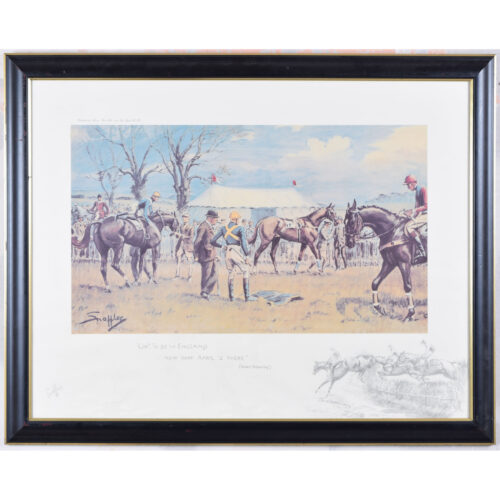
  • Richard Dighton (1795-1880) A View from Merton College (1808)

    Hand coloured engraving 28 x 22 cm Richard Dighton (1795–1880) was a prominent English artist and caricaturist, best known for his elegant profile portraits of early 19th-century society figures. The son of caricaturist Robert Dighton, he developed a distinctive style that balanced satire with sophistication, moving away from the exaggerated grotesquery of earlier caricatures. His finely drawn etchings and later lithographs and watercolours captured the refined yet often pompous airs of Regency London’s fashionable elite—politicians, lawyers, military men, and dandies alike. With clean lines, elongated forms, and a sharp eye for personality, Dighton’s work offers a witty yet insightful glimpse into the characters of his time. His legacy lived on through his sons, who continued in the family’s artistic tradition. This engraving captures the quirky elegance of an Oxford academic in Dighton’s signature caricature style. The tall, gaunt figure is shown in profile, dressed in flowing academic robes and a square cap, with exaggerated features and a solemn, slightly comic expression. Set against a minimal background, the figure stands out as a gently satirical yet respectful portrait of university life in the early 19th century. Condition: Generally very good.

    If you would like to know more, please email info@manningfineart.co.uk or call us on 07929 749056.
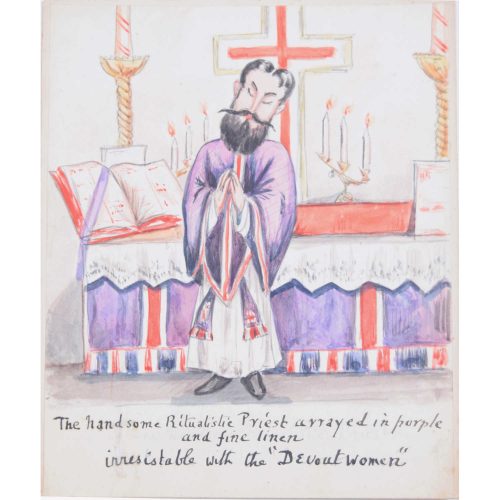
  • Richard Dighton (1795-1880) A View from St John's College (1809)

    Hand coloured engraving 28 x 22 cm Richard Dighton (1795–1880) was a prominent English artist and caricaturist, best known for his elegant profile portraits of early 19th-century society figures. The son of caricaturist Robert Dighton, he developed a distinctive style that balanced satire with sophistication, moving away from the exaggerated grotesquery of earlier caricatures. His finely drawn etchings and later lithographs and watercolours captured the refined yet often pompous airs of Regency London’s fashionable elite—politicians, lawyers, military men, and dandies alike. With clean lines, elongated forms, and a sharp eye for personality, Dighton’s work offers a witty yet insightful glimpse into the characters of his time. His legacy lived on through his sons, who continued in the family’s artistic tradition. This hand-coloured engraving is a quintessential example of Dighton's signature style—capturing character through exaggerated yet elegant profile. The figure, likely an academic or clergyman, is portrayed in full stride, dressed in a long, dark academic gown, white stockings, and buckled shoes. Dighton masterfully exaggerates the man's posture and expression, giving a sense of motion, personality, and perhaps even a touch of comic solemnity as he emphasises the man's eccentric presence and stylised mannerisms. The fine line work and subtle water colour washes blur the line, however, between caricature and portraiture, making this not just a humorous rendering, but also a social observation of Cambridge life in the early 19th century.
  • Abram Games (1914-1996)

    Guinness 5  Million Daily 

    Original vintage poster 152 x 102 cm This advertising poster dates from the early 1960s. It features a playful use of text, with the correct orientation of the poster varying depending on whether you first read 'Guinness' or '5 Million daily.' In a further act of advertising mischief, it also disguises a simple illustration of a pint of Guinness within the text. This masterful use of typography is typical of his broader practice, as his works are characterised by his use of striking colour, bold graphic ideas, and beautifully integrated typography. Throughout the 20th century, Abram Games distinguished himself as one of the greatest British graphic designers of the time and his oeuvre now offers a scintillating record of social history. Other notable works of his include the 'Blonde Bombshell’ ATS poster of 1941 and the 'Festival Star', designed for the 1951 Festival of Britain. If you are interested, please email info@manningfineart.co.uk or call us on 07929 749056.
  • M R Webb Abstract Form

    21 x 26 cm Signed to lower right Provenance: Family of A. E. Halliwell Little is known about M R Webb beyond the fact that he studied under A E Halliwell, though the fact that Halliwell collected this painting suggests that he thought highly of his student. This abstract composition provides few clues as to what exactly it is depicting... Is it an Underground roundel? Perhaps some kind of animal, a cockerel maybe? Webb leaves it to his viewer to decide. In any case, the colours and swirling forms offer a sense of motion and excitement in this dynamic piece. Condition: Generally very good.

    If you would like to know more, please email info@manningfineart.co.uk or call us on 07929 749056.

  • John Barnicoat MA ARCA (1924 - 2013) Harbour (1975)

      Tempera on card 26 x 26 cm Initialled B and dated '75. John Barnicoat was a painter of oils and works on paper using tempera, conté, acrylic, pen, and ink. He was brought up in Cornwall and educated at King’s College, Taunton. He joined the Royal Naval Volunteer Reserves and took part in D-Day, aged 29. He went on to read history at Lincoln College, Oxford, and also studied at the Ruskin School of Drawing. He attended the Royal College of Art in the early 1950s, eventually becoming the Senior Tutor at the RCA Painting School between 1976 and 1980. He was the head of Falmouth School of Art 1972 - 1976 and Head of the Chelsea School of Art 1980 - 1989. He wrote 'Posters: a Concise History' in 1972, and organised and curated exhibitions in the UK and Russia on the art of poster design. From 1989 onwards he produced numerous drawings and oils of the bridges of London, women’s heads, acrylic and conté works on paper, and pen and wash drawings of women dressing. His work is represented in both government and private collections, and was recently shown at The Belgrave Gallery, St Ives (2017 - 2022). Provenance: the artist's estate. Condition: generally very good; in hand-finished frame. If you are interested, please email info@manningfineart.co.uk or call us on 07929 749056. Click here for other Modern British original paintings.
  • Colin Fifield (1940-2022) Abstract landscape

    Watercolour 26 x 36 cm Colin Fifield was a British artist specialising in painting and pottery. He trained at the Camberwell School of Arts and Crafts before specialising in painting and etching at the Slade School of Art. Over the course of his long career, Fifield displayed a variety of interests, ranging from landscape paintings in oils, watercolours and acrylics to pen and ink drawings. Many of his paintings take inspiration from the landscapes of Kent in South East England, featuring the bucolic pastures and fields. This painting is characteristic of Fifield's artistic output. He playfully depicts a rural landscape scene, incorporating wavy shapes and bright colours. In doing so, he brings the painting to life. The waves through the long crops and grasses evoke the wind breezing through them. The hazy clouds in the sky seem to be moving, and a man-- simplistic in form--walks down the country-lane, appreciating the tranquility of the moment.
  • Adelboden

      Original vintage poster 104 x 63 cm A fantastic original vintage poster advertising the Swiss ski resort of Adelboden, tucked away in the Bernese Oberland. Printed in Switzerland by Brügger AG. The photograph was taken by the Swiss photographers Emanuel Gyger and Arnold Klopfenstein. The pair were renowned for their captivating skiing images. Condition: generally very good. If you are interested, please email info@manningfineart.co.uk or call us on 07929 749056. Click here for more original vintage skiing posters.
  • Out of stock

    Adelboden

    Lithograph 100 x 65 cm A fantastic original vintage poster advertising the Swiss ski resort of Adelboden, tucked away in the Bernese Oberland. Printed in Switzerland by the historic printing house A. Trüb & Cie, the poster showcases Adelboden’s stunning alpine scenery, with green meadows, wooden chalets, a waterfall, and snow-capped mountains in the background. The poster also evokes a sense of glamour, as an elegantly dressed woman watches over the pristine lido and idyllic landscape. Condition: Few very short repaired edge tears, no longer than 10mm.

    If you would like to know more, please email info@manningfineart.co.uk or call us on 07929 749056.
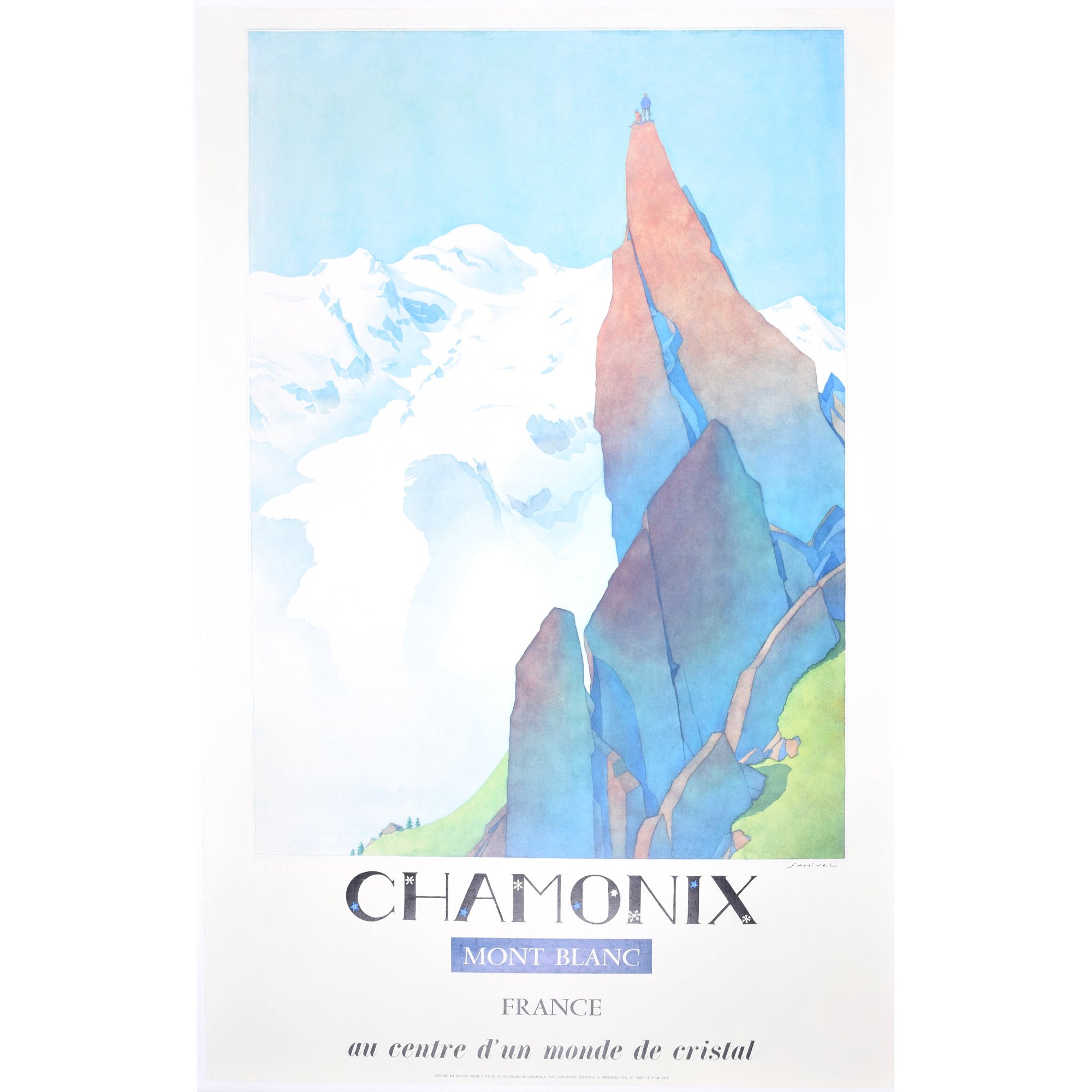
  • Adriaen Collaert (c. 1560-1618) after Maerten de Vos (1532 - 1603) "Pastores venerunt festinantes; et inuenerunt Mariam et Ioseph, et infantem positum in praesepio" - Luke 2

    Engraving, From Vita, Passio, et Resurrectio Iesu Christi first published 1598, this a later edition published by Joannes Galle (1600-1676) 16.5x21.8cm From the Gospel of Luke, Chapter 2 Verse 16 - And the shepherds came with haste, and found Mary, and Joseph, and the babe lying in a manger. Adriaen Collaert was born in Antwerp between 1555 and 1565, becoming wijnmeester of the Guild of St Luke in 1580 - a title reserved for the sons of guild members. The guild of St Luke was generally the city guild for artists. Working for Philip Galle, a Dutch publisher best known for his old master prints, he married Galle's daughter Justa. After learning the principles of engraving in the Netherlands, he spent some years in Italy improving his skill. Upon returning to Flanders he engraved, in accomplished fashion, a great number of plates. His brother, Jan Collaert II, his son, Jan Baptist Collaert II and a grandson were all printmakers. These particular plates are after paintings by Maerten de Vos, a Flemish painter and draughtsman. His father was Pieter de Vos, from whom he learned. From 1550 - 1558 he travelled in Italy, visiting Rome and Venice and becoming master of the Antwerp Guild of St Luke upon his return in 1558. After 1575 he was mainly engaged in producing print designs. If you are interested email info@manningfineart.co.uk or call us on 07929 749056. Condition: Trimmed to plate margins, generally good condition commensurate with age, slight age toning and handling marks as evident from image.
  • Adriaen Collaert (c. 1560-1618) after Maerten de Vos (1532 - 1603) 5. "Postquam consummati sunt dies octo ut circuncideretur puer; vocatum est nomen eius Iesus" - Luke 2

    Engraving, From Vita, Passio, et Resurrectio Iesu Christi first published 1598, this a later edition published by Joannes Galle (1600-1676) 16.5x21.8cm From the Gospel of Luke, Chapter 2 Verse 21 - And when eight days were accomplished for the circumcising of the child, his name was called Jesus. Adriaen Collaert was born in Antwerp between 1555 and 1565, becoming wijnmeester of the Guild of St Luke in 1580 - a title reserved for the sons of guild members. The guild of St Luke was generally the city guild for artists. Working for Philip Galle, a Dutch publisher best known for his old master prints, he married Galle's daughter Justa. After learning the principles of engraving in the Netherlands, he spent some years in Italy improving his skill. Upon returning to Flanders he engraved, in accomplished fashion, a great number of plates. His brother, Jan Collaert II, his son, Jan Baptist Collaert II and a grandson were all printmakers. These particular plates are after paintings by Maerten de Vos, a Flemish painter and draughtsman. His father was Pieter de Vos, from whom he learned. From 1550 - 1558 he travelled in Italy, visiting Rome and Venice and becoming master of the Antwerp Guild of St Luke upon his return in 1558. After 1575 he was mainly engaged in producing print designs. If you are interested email info@manningfineart.co.uk or call us on 07929 749056. Condition: Trimmed to plate margins, generally good condition commensurate with age, slight age toning and handling marks as evident from image.
  • Adriaen Collaert (c. 1560-1618) Cornelius Galle (1576-1650) after Maerten de Vos (1532 - 1603) 2. Ingressus angelus, ad eam dixit, Aue gratia plana, Dominus tecum, benedicta tu in mulieribus. Luke. 1.   

    Engraving From Vita, Passio, et Resurrectio Iesu Christi first published 1598, this a later edition published by Joannes Galle (1600-1676) 17.5x22cm Hand-finished black frame included (UK shipping only) From the Gospel of Luke, chapter 1 "And the angel came in unto her, and said, Hail, thou that art highly favoured, the lord is with thee". Adrian Collaert was born in Antwerp between 1555 and 1565, becoming wijnmeester of the Guild of St Luke in 1580 - a title reserved for the sons of guild members. The guild of St Luke was generally the city guild for artists. Working for Philip Galle, a Dutch publisher best known for his old master prints, he married Galle's daughter Justa. After learning the principles of engraving in the Netherlands, he spent some years in Italy improving his skill. Upon returning to Flanders he engraved, in accomplished fashion, a great number of plates. His brother, Jan Collaert II, his son, Jan Baptist Collaert II and a grandson were all printmakers. These particular plates are after paintings by Maerten de Vos, a Flemish painter and draughtsman. His father was Pieter de Vos, from whom he learned. From 1550 - 1558 he travelled in Italy, visiting Rome and Venice and becoming master of the Antwerp Guild of St Luke upon his return in 1558. After 1575 he was mainly engaged in producing print designs. If you are interested email info@manningfineart.co.uk or call us on 07929 749056. Condition: Trimmed to plate margins, generally good condition commensurate with age, slight age toning and handling marks as evident from image.
  • Adriaen Collaert (c. 1560-1618) John de Barbe (1578–1649) after Maerten de Vos (1532 - 1603) 19. Accesserunt ad eum discipuli eius, et suscitaverunt eum, dicentes, Domine, salua nos, perimus. Matth. 8.

    Engraving From Vita, Passio, et Resurrectio Iesu Christi first published 1598, this a later edition published by Joannes Galle (1600-1676) 17.5x22cm From the Gospel of Matthew, chapter 8 "Then His disciples came to Him and awoke Him, saying, “Lord, save us! We are perishing!” Adrian Collaert was born in Antwerp between 1555 and 1565, becoming wijnmeester of the Guild of St Luke in 1580 - a title reserved for the sons of guild members. The guild of St Luke was generally the city guild for artists. Working for Philip Galle, a Dutch publisher best known for his old master prints, he married Galle's daughter Justa. After learning the principles of engraving in the Netherlands, he spent some years in Italy improving his skill. Upon returning to Flanders he engraved, in accomplished fashion, a great number of plates. His brother, Jan Collaert II, his son, Jan Baptist Collaert II and a grandson were all printmakers. These particular plates are after paintings by Maerten de Vos, a Flemish painter and draughtsman. His father was Pieter de Vos, from whom he learned. From 1550 - 1558 he travelled in Italy, visiting Rome and Venice and becoming master of the Antwerp Guild of St Luke upon his return in 1558. After 1575 he was mainly engaged in producing print designs. If you are interested email info@manningfineart.co.uk or call us on 07929 749056. Condition: Trimmed to plate margins, generally good condition commensurate with age, slight age toning and handling marks as evident from image.
  • Adriaen Collaert (c. 1560-1618) John de Barbe (1578–1649) after Maerten de Vos (1532 - 1603) 18. Socrus simonis tenebatur magnis febribus; et rogauerunt illum pro ea. Et stans super illum imperauit febri; et dimiset illum. Luke. 4.

    Engraving From Vita, Passio, et Resurrectio Iesu Christi first published 1598, this a later edition published by Joannes Galle (1600-1676) 17.5x22cm From the Gospel of Luke, chapter 4 "Simon’s mother-in-law was very sick. She had a high fever. They asked Jesus to do something to help her. He stood very close to her and ordered the sickness to go away". Adrian Collaert was born in Antwerp between 1555 and 1565, becoming wijnmeester of the Guild of St Luke in 1580 - a title reserved for the sons of guild members. The guild of St Luke was generally the city guild for artists. Working for Philip Galle, a Dutch publisher best known for his old master prints, he married Galle's daughter Justa. After learning the principles of engraving in the Netherlands, he spent some years in Italy improving his skill. Upon returning to Flanders he engraved, in accomplished fashion, a great number of plates. His brother, Jan Collaert II, his son, Jan Baptist Collaert II and a grandson were all printmakers. These particular plates are after paintings by Maerten de Vos, a Flemish painter and draughtsman. His father was Pieter de Vos, from whom he learned. From 1550 - 1558 he travelled in Italy, visiting Rome and Venice and becoming master of the Antwerp Guild of St Luke upon his return in 1558. After 1575 he was mainly engaged in producing print designs. If you are interested email info@manningfineart.co.uk or call us on 07929 749056. Condition: Trimmed to plate margins, generally good condition commensurate with age, slight age toning and handling marks as evident from image.
  • Adriaen Collaert (c. 1560-1618) Jacob de Bye (1581–1640) after Maerten de Vos (1532 - 1603) 23. Dicit iesus Surge tolle grabatum tuum, et ambula. Et statim sanus factus est, et sustulit grabatum suum et ambulabat. John. 5.

    Engraving From Vita, Passio, et Resurrectio Iesu Christi first published 1598, this a later edition published by Joannes Galle (1600-1676) 17.5x22cm From the Gospel of John, chapter 5 "He says Rise, take up your bed and walk. He immediately became well, and picked up his bed and walked.” Adrian Collaert was born in Antwerp between 1555 and 1565, becoming wijnmeester of the Guild of St Luke in 1580 - a title reserved for the sons of guild members. The guild of St Luke was generally the city guild for artists. Working for Philip Galle, a Dutch publisher best known for his old master prints, he married Galle's daughter Justa. After learning the principles of engraving in the Netherlands, he spent some years in Italy improving his skill. Upon returning to Flanders he engraved, in accomplished fashion, a great number of plates. His brother, Jan Collaert II, his son, Jan Baptist Collaert II and a grandson were all printmakers. These particular plates are after paintings by Maerten de Vos, a Flemish painter and draughtsman. His father was Pieter de Vos, from whom he learned. From 1550 - 1558 he travelled in Italy, visiting Rome and Venice and becoming master of the Antwerp Guild of St Luke upon his return in 1558. After 1575 he was mainly engaged in producing print designs. If you are interested email info@manningfineart.co.uk or call us on 07929 749056. Condition: Trimmed to plate margins, generally good condition commensurate with age, slight age toning and handling marks as evident from image.
  • Adriaen Collaert (c. 1560-1618) Jacob de Bye (1581–1640) after Maerten de Vos (1532 - 1603) 22. Ecce mulier quat sanguinis fluxum patiebatur duodecim annis, accessit retro, et tetigit fimbriam vestimenti eius. Matth. 9.

    Engraving From Vita, Passio, et Resurrectio Iesu Christi first published 1598, this a later edition published by Joannes Galle (1600-1676) 17.5x22cm From the Gospel of Matthew, chapter 9 "And suddenly, a woman who had a flow of blood for twelve years came from behind and touched the hem of His garment.” Adrian Collaert was born in Antwerp between 1555 and 1565, becoming wijnmeester of the Guild of St Luke in 1580 - a title reserved for the sons of guild members. The guild of St Luke was generally the city guild for artists. Working for Philip Galle, a Dutch publisher best known for his old master prints, he married Galle's daughter Justa. After learning the principles of engraving in the Netherlands, he spent some years in Italy improving his skill. Upon returning to Flanders he engraved, in accomplished fashion, a great number of plates. His brother, Jan Collaert II, his son, Jan Baptist Collaert II and a grandson were all printmakers. These particular plates are after paintings by Maerten de Vos, a Flemish painter and draughtsman. His father was Pieter de Vos, from whom he learned. From 1550 - 1558 he travelled in Italy, visiting Rome and Venice and becoming master of the Antwerp Guild of St Luke upon his return in 1558. After 1575 he was mainly engaged in producing print designs. If you are interested email info@manningfineart.co.uk or call us on 07929 749056. Condition: Trimmed to plate margins, generally good condition commensurate with age, slight age toning and handling marks as evident from image.
  • Adriaen Collaert (c. 1560-1618) John de Barbe (1578–1649) after Maerten de Vos (1532 - 1603) 15. Iesus fatigatus ex itinere, sedebat sic supra fontem. Uenit mulier de Samaria haurire aquam. Dicit ei Iesus, Da mihi bibere. John 4. 

    Engraving From Vita, Passio, et Resurrectio Iesu Christi first published 1598, this a later edition published by Joannes Galle (1600-1676) 17.5x22cm Hand-finished black frame included (UK shipping only) From the Gospel of John, chapter 4 "Jesus, being wearied from his journey, was sitting thus on the well. A Samaritan woman came to draw water. Jesus said to her, “Will you give me a drink?” Adrian Collaert was born in Antwerp between 1555 and 1565, becoming wijnmeester of the Guild of St Luke in 1580 - a title reserved for the sons of guild members. The guild of St Luke was generally the city guild for artists. Working for Philip Galle, a Dutch publisher best known for his old master prints, he married Galle's daughter Justa. After learning the principles of engraving in the Netherlands, he spent some years in Italy improving his skill. Upon returning to Flanders he engraved, in accomplished fashion, a great number of plates. His brother, Jan Collaert II, his son, Jan Baptist Collaert II and a grandson were all printmakers. These particular plates are after paintings by Maerten de Vos, a Flemish painter and draughtsman. His father was Pieter de Vos, from whom he learned. From 1550 - 1558 he travelled in Italy, visiting Rome and Venice and becoming master of the Antwerp Guild of St Luke upon his return in 1558. After 1575 he was mainly engaged in producing print designs. If you are interested email info@manningfineart.co.uk or call us on 07929 749056. Condition: Trimmed to plate margins, generally good condition commensurate with age, slight age toning and handling marks as evident from image.
  • Jean Baptist Barbé (1578?-1649) Adriaen Collaert (c. 1560-1618) after Maerten de Vos (1532 - 1603) 12. Accedens tentator dixit ei fi lius, Dei es, dic vt lapides isti panes fiant. Matt. 4.

    Engraving From Vita, Passio, et Resurrectio Iesu Christi first published 1598, this a later edition published by Joannes Galle (1600-1676) 16.5x21.8cm From the Gospel of Matthew, chapter 4 "If thou be the Son of God, command that these stones be made bread" Adriaen Collaert was born in Antwerp between 1555 and 1565, becoming wijnmeester of the Guild of St Luke in 1580 - a title reserved for the sons of guild members. The guild of St Luke was generally the city guild for artists. Working for Philip Galle, a Dutch publisher best known for his old master prints, he married Galle's daughter Justa. After learning the principles of engraving in the Netherlands, he spent some years in Italy improving his skill. Upon returning to Flanders he engraved, in accomplished fashion, a great number of plates. His brother, Jan Collaert II, his son, Jan Baptist Collaert II and a grandson were all printmakers. These particular plates are after paintings by Maerten de Vos, a Flemish painter and draughtsman. His father was Pieter de Vos, from whom he learned. From 1550 - 1558 he travelled in Italy, visiting Rome and Venice and becoming master of the Antwerp Guild of St Luke upon his return in 1558. After 1575 he was mainly engaged in producing print designs. If you are interested email info@manningfineart.co.uk or call us on 07929 749056. Condition: Trimmed to plate margins, generally good condition commensurate with age, slight age toning and handling marks as evident from image.
  • Jean Baptist Barbé (1578?-1649) Adriaen Collaert (c. 1560-1618) after Maerten de Vos (1532 - 1603) 11. Verit Iesus a Galilaea in Iordanem ad Iohannem, vt baptifartur ab eo. Matthew. 3.

    Engraving From Vita, Passio, et Resurrectio Iesu Christi first published 1598, this a later edition published by Joannes Galle (1600-1676) 16.5x21.8cm From the Gospel of Matthew, chapter 3 "Then Jesus came from Galilee to the Jordan to be baptized by John." Adriaen Collaert was born in Antwerp between 1555 and 1565, becoming wijnmeester of the Guild of St Luke in 1580 - a title reserved for the sons of guild members. The guild of St Luke was generally the city guild for artists. Working for Philip Galle, a Dutch publisher best known for his old master prints, he married Galle's daughter Justa. After learning the principles of engraving in the Netherlands, he spent some years in Italy improving his skill. Upon returning to Flanders he engraved, in accomplished fashion, a great number of plates. His brother, Jan Collaert II, his son, Jan Baptist Collaert II and a grandson were all printmakers. These particular plates are after paintings by Maerten de Vos, a Flemish painter and draughtsman. His father was Pieter de Vos, from whom he learned. From 1550 - 1558 he travelled in Italy, visiting Rome and Venice and becoming master of the Antwerp Guild of St Luke upon his return in 1558. After 1575 he was mainly engaged in producing print designs. If you are interested email info@manningfineart.co.uk or call us on 07929 749056. Condition: Trimmed to plate margins, generally good condition commensurate with age, slight age toning and handling marks as evident from image.
  • Adriaen Collaert (c. 1560-1618) John de Barbe (1578–1649) after Maerten de Vos (1532 - 1603) 14. Cum fecisset quasi flagellum de funiculis, omnes eiecit de templo, oues quoq et boues, et numulariorum effudit aes, et mensas subuertit. John. 2.

    Engraving From Vita, Passio, et Resurrectio Iesu Christi first published 1598, this a later edition published by Joannes Galle (1600-1676) 17.5x22cm Hand-finished black frame included (UK shipping only) From the Gospel of John, chapter 2 "So he made a whip out of cords, and drove all from the temple courts, both sheep and cattle; he scattered the coins of the money changers and overturned their tables”. Adrian Collaert was born in Antwerp between 1555 and 1565, becoming wijnmeester of the Guild of St Luke in 1580 - a title reserved for the sons of guild members. The guild of St Luke was generally the city guild for artists. Working for Philip Galle, a Dutch publisher best known for his old master prints, he married Galle's daughter Justa. After learning the principles of engraving in the Netherlands, he spent some years in Italy improving his skill. Upon returning to Flanders he engraved, in accomplished fashion, a great number of plates. His brother, Jan Collaert II, his son, Jan Baptist Collaert II and a grandson were all printmakers. These particular plates are after paintings by Maerten de Vos, a Flemish painter and draughtsman. His father was Pieter de Vos, from whom he learned. From 1550 - 1558 he travelled in Italy, visiting Rome and Venice and becoming master of the Antwerp Guild of St Luke upon his return in 1558. After 1575 he was mainly engaged in producing print designs. If you are interested email info@manningfineart.co.uk or call us on 07929 749056. Condition: Trimmed to plate margins, generally good condition commensurate with age, slight age toning and handling marks as evident from image.
  • Adriaen Collaert (c. 1560-1618) Theodoor Galle (1571–1633) after Maerten de Vos (1532 - 1603) 26.  Est puer vnus hic qui habet quinq panes ordeaceos, et duos: sed haec quid funt tantos? Iohn. 6.

    Engraving From Vita, Passio, et Resurrectio Iesu Christi first published 1598, this a later edition published by Joannes Galle (1600-1676) 17.5x22cm From the Gospel of John, chapter 6 "There is a lad here, which hath five barley loaves, one, and two, but what are these for so many?” Adrian Collaert was born in Antwerp between 1555 and 1565, becoming wijnmeester of the Guild of St Luke in 1580 - a title reserved for the sons of guild members. The guild of St Luke was generally the city guild for artists. Working for Philip Galle, a Dutch publisher best known for his old master prints, he married Galle's daughter Justa. After learning the principles of engraving in the Netherlands, he spent some years in Italy improving his skill. Upon returning to Flanders he engraved, in accomplished fashion, a great number of plates. His brother, Jan Collaert II, his son, Jan Baptist Collaert II and a grandson were all printmakers. These particular plates are after paintings by Maerten de Vos, a Flemish painter and draughtsman. His father was Pieter de Vos, from whom he learned. From 1550 - 1558 he travelled in Italy, visiting Rome and Venice and becoming master of the Antwerp Guild of St Luke upon his return in 1558. After 1575 he was mainly engaged in producing print designs. If you are interested email info@manningfineart.co.uk or call us on 07929 749056. Condition: Trimmed to plate margins, generally good condition commensurate with age, slight age toning and handling marks as evident from image.
  • Adriaen Collaert (c. 1560-1618) Jan Collaert (1545–1628) after Maerten de Vos (1532 - 1603) 21. Ait Paralytico, Surge, tolle lectum, et vade in domum tuam. Et surrexit, et abijt in doman suam. Matth. 9.

    Engraving From Vita, Passio, et Resurrectio Iesu Christi first published 1598, this a later edition published by Joannes Galle (1600-1676) 17.5x22cm From the Gospel of Matthew, chapter 9 "Get up, pick up your mat, and go home. And the man got up and went home.” Adrian Collaert was born in Antwerp between 1555 and 1565, becoming wijnmeester of the Guild of St Luke in 1580 - a title reserved for the sons of guild members. The guild of St Luke was generally the city guild for artists. Working for Philip Galle, a Dutch publisher best known for his old master prints, he married Galle's daughter Justa. After learning the principles of engraving in the Netherlands, he spent some years in Italy improving his skill. Upon returning to Flanders he engraved, in accomplished fashion, a great number of plates. His brother, Jan Collaert II, his son, Jan Baptist Collaert II and a grandson were all printmakers. These particular plates are after paintings by Maerten de Vos, a Flemish painter and draughtsman. His father was Pieter de Vos, from whom he learned. From 1550 - 1558 he travelled in Italy, visiting Rome and Venice and becoming master of the Antwerp Guild of St Luke upon his return in 1558. After 1575 he was mainly engaged in producing print designs. If you are interested email info@manningfineart.co.uk or call us on 07929 749056. Condition: Trimmed to plate margins, generally good condition commensurate with age, slight age toning and handling marks as evident from image.
  • Jean Baptist Barbé (1578?-1649) Adriaen Collaert (c. 1560-1618) after Maerten de Vos (1532 - 1603) 10. Post triduum invenerunt illum in templo in medio doctorum, audientem illos, et interrogante eos. Luc. 2

    Engraving From Vita, Passio, et Resurrectio Iesu Christi first published 1598, this a later edition published by Joannes Galle (1600-1676) 16.5x21.8cm From the Gospel of Luke, Chapter 2 After three days they found him in the temple among the doctors, listening to them and asking them questions. Adriaen Collaert was born in Antwerp between 1555 and 1565, becoming wijnmeester of the Guild of St Luke in 1580 - a title reserved for the sons of guild members. The guild of St Luke was generally the city guild for artists. Working for Philip Galle, a Dutch publisher best known for his old master prints, he married Galle's daughter Justa. After learning the principles of engraving in the Netherlands, he spent some years in Italy improving his skill. Upon returning to Flanders he engraved, in accomplished fashion, a great number of plates. His brother, Jan Collaert II, his son, Jan Baptist Collaert II and a grandson were all printmakers. These particular plates are after paintings by Maerten de Vos, a Flemish painter and draughtsman. His father was Pieter de Vos, from whom he learned. From 1550 - 1558 he travelled in Italy, visiting Rome and Venice and becoming master of the Antwerp Guild of St Luke upon his return in 1558. After 1575 he was mainly engaged in producing print designs. If you are interested email info@manningfineart.co.uk or call us on 07929 749056. Condition: Trimmed to plate margins, generally good condition commensurate with age, slight age toning and handling marks as evident from image.
  • Theodoor Galle (c. 1571-1633) Jean Baptiste Barbe (1578-1649) after Maerten de Vos (1532 - 1603) 28.  Adducunt Scibe et Pharisaei mulierem in adulterio deprehensam. Iesus autem inclinans se deorsum, digito scribebat in terra. Iohn. 8.

    Engraving From Vita, Passio, et Resurrectio Iesu Christi first published 1598, this a later edition published by Joannes Galle (1600-1676) 17.5x22cm From the Gospel of John, chapter 8 "The scribes and the Pharisees brought a woman who had been caught in adultery, and placing her in the midst they said to him, “Teacher, this woman has been caught in the act of adultery". Jesus bent down and wrote with his finger on the ground.” Adrian Collaert was born in Antwerp between 1555 and 1565, becoming wijnmeester of the Guild of St Luke in 1580 - a title reserved for the sons of guild members. The guild of St Luke was generally the city guild for artists. Working for Philip Galle, a Dutch publisher best known for his old master prints, he married Galle's daughter Justa. After learning the principles of engraving in the Netherlands, he spent some years in Italy improving his skill. Upon returning to Flanders he engraved, in accomplished fashion, a great number of plates. His brother, Jan Collaert II, his son, Jan Baptist Collaert II and a grandson were all printmakers. These particular plates are after paintings by Maerten de Vos, a Flemish painter and draughtsman. His father was Pieter de Vos, from whom he learned. From 1550 - 1558 he travelled in Italy, visiting Rome and Venice and becoming master of the Antwerp Guild of St Luke upon his return in 1558. After 1575 he was mainly engaged in producing print designs. If you are interested email info@manningfineart.co.uk or call us on 07929 749056. Condition: Trimmed to plate margins, generally good condition commensurate with age, slight age toning and handling marks as evident from image.
  • Adriaen Collaert (c. 1560-1618) Jacob de Bye (1581-1640) after Maerten de Vos (1532 - 1603) 3. Exurgens maria abjit in montana cum festinatione in ciuitatem Iuda et intrauit in domum Zacharie, et salutauit Elisabeth . Luc 1. 

    Engraving From Vita, Passio, et Resurrectio Iesu Christi first published 1598, this a later edition published by Joannes Galle (1600-1676) 17.5x22cm Hand-finished black frame included (UK shipping only) From the Gospel of Luke, chapter 1 "And Mary arose in those days, and went into the hill country with haste, into a city of Juda. And entered into the house of Zacharias, and saluted Elizabeth". Adrian Collaert was born in Antwerp between 1555 and 1565, becoming wijnmeester of the Guild of St Luke in 1580 - a title reserved for the sons of guild members. The guild of St Luke was generally the city guild for artists. Working for Philip Galle, a Dutch publisher best known for his old master prints, he married Galle's daughter Justa. After learning the principles of engraving in the Netherlands, he spent some years in Italy improving his skill. Upon returning to Flanders he engraved, in accomplished fashion, a great number of plates. His brother, Jan Collaert II, his son, Jan Baptist Collaert II and a grandson were all printmakers. These particular plates are after paintings by Maerten de Vos, a Flemish painter and draughtsman. His father was Pieter de Vos, from whom he learned. From 1550 - 1558 he travelled in Italy, visiting Rome and Venice and becoming master of the Antwerp Guild of St Luke upon his return in 1558. After 1575 he was mainly engaged in producing print designs. If you are interested email info@manningfineart.co.uk or call us on 07929 749056. Condition: Trimmed to plate margins, generally good condition commensurate with age, slight age toning and handling marks as evident from image.
  • Adriaen Collaert (c. 1560-1618) Cornelius Galle (1576-1650) after Maerten de Vos (1532 - 1603) 24. aria accepit libram unguenti nardi pistici, pretiosti, et vnxit pedes Iefu; et extersit pedes eius capillis suis. John. 12.   

    Engraving From Vita, Passio, et Resurrectio Iesu Christi first published 1598, this a later edition published by Joannes Galle (1600-1676) 17.5x22cm Hand-finished black frame included (UK shipping only) From the Gospel of John, chapter 12 " Mary therefore took a pound of expensive ointment made from pure nard, and anointed the feet of Jesus and wiped his feet with her hair". Adrian Collaert was born in Antwerp between 1555 and 1565, becoming wijnmeester of the Guild of St Luke in 1580 - a title reserved for the sons of guild members. The guild of St Luke was generally the city guild for artists. Working for Philip Galle, a Dutch publisher best known for his old master prints, he married Galle's daughter Justa. After learning the principles of engraving in the Netherlands, he spent some years in Italy improving his skill. Upon returning to Flanders he engraved, in accomplished fashion, a great number of plates. His brother, Jan Collaert II, his son, Jan Baptist Collaert II and a grandson were all printmakers. These particular plates are after paintings by Maerten de Vos, a Flemish painter and draughtsman. His father was Pieter de Vos, from whom he learned. From 1550 - 1558 he travelled in Italy, visiting Rome and Venice and becoming master of the Antwerp Guild of St Luke upon his return in 1558. After 1575 he was mainly engaged in producing print designs. If you are interested email info@manningfineart.co.uk or call us on 07929 749056. Condition: Trimmed to plate margins, generally good condition commensurate with age, slight age toning and handling marks as evident from image.
  • Adriaen Collaert (c. 1560-1618) Cornelius Galle (1576-1650) after Maerten de Vos (1532 - 1603) 17. Duc in altum, et laxate retia vestra in capturam piscium. Et cum hoc fecissent, concluserunt piscium multitudium copiosum. Luke. 5.   

    Engraving From Vita, Passio, et Resurrectio Iesu Christi first published 1598, this a later edition published by Joannes Galle (1600-1676) 17.5x22cm Hand-finished black frame included (UK shipping only) From the Gospel of Luke, chapter 5 "Put out into the deep and let down your nets for a catch. When they had done this, they enclosed a great quantity of fish". Adrian Collaert was born in Antwerp between 1555 and 1565, becoming wijnmeester of the Guild of St Luke in 1580 - a title reserved for the sons of guild members. The guild of St Luke was generally the city guild for artists. Working for Philip Galle, a Dutch publisher best known for his old master prints, he married Galle's daughter Justa. After learning the principles of engraving in the Netherlands, he spent some years in Italy improving his skill. Upon returning to Flanders he engraved, in accomplished fashion, a great number of plates. His brother, Jan Collaert II, his son, Jan Baptist Collaert II and a grandson were all printmakers. These particular plates are after paintings by Maerten de Vos, a Flemish painter and draughtsman. His father was Pieter de Vos, from whom he learned. From 1550 - 1558 he travelled in Italy, visiting Rome and Venice and becoming master of the Antwerp Guild of St Luke upon his return in 1558. After 1575 he was mainly engaged in producing print designs. If you are interested email info@manningfineart.co.uk or call us on 07929 749056. Condition: Trimmed to plate margins, generally good condition commensurate with age, slight age toning and handling marks as evident from image.
  • Adriaen Collaert (c. 1560-1618) Jacob de Bye (1581-1640) after Maerten de Vos (1532 - 1603) 20. Daemones rogabant eum dicentes ; si eijcis nos, mitte nos in gregem porcorum. Et ait illis, ite. Matth. 8.

    Engraving From Vita, Passio, et Resurrectio Iesu Christi first published 1598, this a later edition published by Joannes Galle (1600-1676) 16.5x21.8cm Hand-finished black frame included (UK shipping only) From the Gospel of Matthew, chapter 8 "The demons begged Jesus, “If you drive us out, send us into the herd. He said to them, “Go!" Adriaen Collaert was born in Antwerp between 1555 and 1565, becoming wijnmeester of the Guild of St Luke in 1580 - a title reserved for the sons of guild members. The guild of St Luke was generally the city guild for artists. Working for Philip Galle, a Dutch publisher best known for his old master prints, he married Galle's daughter Justa. After learning the principles of engraving in the Netherlands, he spent some years in Italy improving his skill. Upon returning to Flanders he engraved, in accomplished fashion, a great number of plates. His brother, Jan Collaert II, his son, Jan Baptist Collaert II and a grandson were all printmakers. These particular plates are after paintings by Maerten de Vos, a Flemish painter and draughtsman. His father was Pieter de Vos, from whom he learned. From 1550 - 1558 he travelled in Italy, visiting Rome and Venice and becoming master of the Antwerp Guild of St Luke upon his return in 1558. After 1575 he was mainly engaged in producing print designs. If you are interested email info@manningfineart.co.uk or call us on 07929 749056. Condition: Trimmed to plate margins, generally good condition commensurate with age, slight age toning and handling marks as evident from image.
  • Adriaen Collaert (c. 1560-1618) Jacob de Bye (1581–1640) after Maerten de Vos (1532 - 1603) 25. Videns Iesus turbas, ascendit in montem; et cum sedisset, accesserunt ad eum discipuli eius, et aperiens os suum, docebat eos. Matth. 5.

    Engraving From Vita, Passio, et Resurrectio Iesu Christi first published 1598, this a later edition published by Joannes Galle (1600-1676) 17.5x22cm From the Gospel of Matthew, chapter 5 "And seeing the multitudes, He went up on a mountain, and when He was seated His disciples came to Him.” Adrian Collaert was born in Antwerp between 1555 and 1565, becoming wijnmeester of the Guild of St Luke in 1580 - a title reserved for the sons of guild members. The guild of St Luke was generally the city guild for artists. Working for Philip Galle, a Dutch publisher best known for his old master prints, he married Galle's daughter Justa. After learning the principles of engraving in the Netherlands, he spent some years in Italy improving his skill. Upon returning to Flanders he engraved, in accomplished fashion, a great number of plates. His brother, Jan Collaert II, his son, Jan Baptist Collaert II and a grandson were all printmakers. These particular plates are after paintings by Maerten de Vos, a Flemish painter and draughtsman. His father was Pieter de Vos, from whom he learned. From 1550 - 1558 he travelled in Italy, visiting Rome and Venice and becoming master of the Antwerp Guild of St Luke upon his return in 1558. After 1575 he was mainly engaged in producing print designs. If you are interested email info@manningfineart.co.uk or call us on 07929 749056. Condition: Trimmed to plate margins, generally good condition commensurate with age, slight age toning and handling marks as evident from image.
  • Adriaen Collaert (c. 1560-1618) Jacob de Bye (1685-?) after Maerten de Vos (1532 - 1603) 27.  Assumit Iesus Petrum et Iacobum et Ioannem fratrem eius, et ducit illos in montem excelsum seorsum; et transfiguratus est eos. Matth. 17.

    Engraving From Vita, Passio, et Resurrectio Iesu Christi first published 1598, this a later edition published by Joannes Galle (1600-1676) 17.5x22cm From the Gospel of Matthew, chapter 17 "After six days Jesus took with him Peter, James and John the brother of James, and led them up a high mountain by themselves. There he was transfigured before them.” Adrian Collaert was born in Antwerp between 1555 and 1565, becoming wijnmeester of the Guild of St Luke in 1580 - a title reserved for the sons of guild members. The guild of St Luke was generally the city guild for artists. Working for Philip Galle, a Dutch publisher best known for his old master prints, he married Galle's daughter Justa. After learning the principles of engraving in the Netherlands, he spent some years in Italy improving his skill. Upon returning to Flanders he engraved, in accomplished fashion, a great number of plates. His brother, Jan Collaert II, his son, Jan Baptist Collaert II and a grandson were all printmakers. These particular plates are after paintings by Maerten de Vos, a Flemish painter and draughtsman. His father was Pieter de Vos, from whom he learned. From 1550 - 1558 he travelled in Italy, visiting Rome and Venice and becoming master of the Antwerp Guild of St Luke upon his return in 1558. After 1575 he was mainly engaged in producing print designs. If you are interested email info@manningfineart.co.uk or call us on 07929 749056. Condition: Trimmed to plate margins, generally good condition commensurate with age, slight age toning and handling marks as evident from image.
  • Jean Baptist Barbé (1578?-1649) Adriaen Collaert (c. 1560-1618) after Maerten de Vos (1532 - 1603) 6. "Procidentes adoravuerunt eum, et apertis thesauris suis obtulerunt ei munera, aurum, thus, et myrrham" - Matth 2

    Engraving From Vita, Passio, et Resurrectio Iesu Christi first published 1598, this a later edition published by Joannes Galle (1600-1676) 16.5x21.8cm From the Gospel of Matthew, Chapter 2 Verse 11 - and fell down and worshipped him: and when they had opened their treasures, they presented unto him gifts; gold, and frankincense and myrrh. The star hangs over the stable door, as the three Magi present their treasures to Our Lord, sitting upon Mary's knee, St Joseph in attendance behind. Adriaen Collaert was born in Antwerp between 1555 and 1565, becoming wijnmeester of the Guild of St Luke in 1580 - a title reserved for the sons of guild members. The guild of St Luke was generally the city guild for artists. Working for Philip Galle, a Dutch publisher best known for his old master prints, he married Galle's daughter Justa. After learning the principles of engraving in the Netherlands, he spent some years in Italy improving his skill. Upon returning to Flanders he engraved, in accomplished fashion, a great number of plates. His brother, Jan Collaert II, his son, Jan Baptist Collaert II and a grandson were all printmakers. These particular plates are after paintings by Maerten de Vos, a Flemish painter and draughtsman. His father was Pieter de Vos, from whom he learned. From 1550 - 1558 he travelled in Italy, visiting Rome and Venice and becoming master of the Antwerp Guild of St Luke upon his return in 1558. After 1575 he was mainly engaged in producing print designs. If you are interested email info@manningfineart.co.uk or call us on 07929 749056. Condition: Trimmed to plate margins, generally good condition commensurate with age, slight age toning and handling marks as evident from image.
  • Adriaen Collaert (c. 1560-1618) John de Barbe (1578–1649) after Maerten de Vos (1532 - 1603) 8. Ioseph consurgens accepit puerum et matrem eius nocte; et secessit in Aegyptum. Matth. 2.

    Engraving From Vita, Passio, et Resurrectio Iesu Christi first published 1598, this a later edition published by Joannes Galle (1600-1676) 17.5x22cm Hand-finished black frame included (UK shipping only) From the Gospel of Matthew, chapter 2 "Joseph arose, he took the young child and his mother by night; and left for Egypt". Adrian Collaert was born in Antwerp between 1555 and 1565, becoming wijnmeester of the Guild of St Luke in 1580 - a title reserved for the sons of guild members. The guild of St Luke was generally the city guild for artists. Working for Philip Galle, a Dutch publisher best known for his old master prints, he married Galle's daughter Justa. After learning the principles of engraving in the Netherlands, he spent some years in Italy improving his skill. Upon returning to Flanders he engraved, in accomplished fashion, a great number of plates. His brother, Jan Collaert II, his son, Jan Baptist Collaert II and a grandson were all printmakers. These particular plates are after paintings by Maerten de Vos, a Flemish painter and draughtsman. His father was Pieter de Vos, from whom he learned. From 1550 - 1558 he travelled in Italy, visiting Rome and Venice and becoming master of the Antwerp Guild of St Luke upon his return in 1558. After 1575 he was mainly engaged in producing print designs. If you are interested email info@manningfineart.co.uk or call us on 07929 749056. Condition: Trimmed to plate margins, generally good condition commensurate with age, slight age toning and handling marks as evident from image.
  • Adrian Collaert (1560–1618) Theodoor Galle (c. 1571-1633) after Maerten de Vos (1532 - 1603) 31. Et inuenit Iesus afellum, et sedit super eum, sicut scriptum est; Noli timere filia Syon, Ecce Rex tuus venit, sedens super pullion asine. Iohn. 12. 

    Engraving From Vita, Passio, et Resurrectio Iesu Christi first published 1598, this a later edition published by Joannes Galle (1600-1676) 17.5x22cm From the Gospel of John, chapter 12 "Finding a young donkey, Jesus sat on it, as it is written: Fear not, daughter of Zion; Behold, your King is coming, Sitting on a donkey’s colt." Adrian Collaert was born in Antwerp between 1555 and 1565, becoming wijnmeester of the Guild of St Luke in 1580 - a title reserved for the sons of guild members. The guild of St Luke was generally the city guild for artists. Working for Philip Galle, a Dutch publisher best known for his old master prints, he married Galle's daughter Justa. After learning the principles of engraving in the Netherlands, he spent some years in Italy improving his skill. Upon returning to Flanders he engraved, in accomplished fashion, a great number of plates. His brother, Jan Collaert II, his son, Jan Baptist Collaert II and a grandson were all printmakers. These particular plates are after paintings by Maerten de Vos, a Flemish painter and draughtsman. His father was Pieter de Vos, from whom he learned. From 1550 - 1558 he travelled in Italy, visiting Rome and Venice and becoming master of the Antwerp Guild of St Luke upon his return in 1558. After 1575 he was mainly engaged in producing print designs. If you are interested email info@manningfineart.co.uk or call us on 07929 749056. Condition: Trimmed to plate margins, generally good condition commensurate with age, slight age toning and handling marks as evident from image.
  • Jean Baptist Barbé (1578?-1649) Adriaen Collaert (c. 1560-1618) after Maerten de Vos (1532 - 1603) 13. nuptia facta sunt in cana galilaeae; et erat mater Iefu ibi. Vocatus eft autem et Iefus, et difcipuli eius ad nuptias. Ioan. 2.

    Engraving From Vita, Passio, et Resurrectio Iesu Christi first published 1598, this a later edition published by Joannes Galle (1600-1676) 16.5x21.8cm From the Gospel of John, chapter 2 "On the third day a wedding took place at Cana in Galilee. Jesus’ mother was there, and Jesus and His disciples had also been invited to the wedding. When the wine ran out, Jesus’ mother said to Him, “They have no more wine." Adriaen Collaert was born in Antwerp between 1555 and 1565, becoming wijnmeester of the Guild of St Luke in 1580 - a title reserved for the sons of guild members. The guild of St Luke was generally the city guild for artists. Working for Philip Galle, a Dutch publisher best known for his old master prints, he married Galle's daughter Justa. After learning the principles of engraving in the Netherlands, he spent some years in Italy improving his skill. Upon returning to Flanders he engraved, in accomplished fashion, a great number of plates. His brother, Jan Collaert II, his son, Jan Baptist Collaert II and a grandson were all printmakers. These particular plates are after paintings by Maerten de Vos, a Flemish painter and draughtsman. His father was Pieter de Vos, from whom he learned. From 1550 - 1558 he travelled in Italy, visiting Rome and Venice and becoming master of the Antwerp Guild of St Luke upon his return in 1558. After 1575 he was mainly engaged in producing print designs. If you are interested email info@manningfineart.co.uk or call us on 07929 749056. Condition: Trimmed to plate margins, generally good condition commensurate with age, slight age toning and handling marks as evident from image.
  • Adrian Heath Abstract Study III (1975)

    Acrylic and pencil on paper 22 x 22cm Heath was born in Burma in 1920 and arrived in England aged five. In 1938 he studied art under Stanhope Forbes at Newlyn and later at the Slade School of Art. While serving in WWII, he was captured and placed in a prisoner-of-war camp in Bavaria. Heath attempted to escape from the camp but was recaptured and placed in solitary confinement; this isolation proved crucial to the development of his artistic style, as he spent much of his time there experimenting with abstract forms. When released from confinement, Heath befriended a fellow prisoner of war: Terry Frost. Together they explored the methods of painting which they had developed during their time in the camps, and following the war both became celebrated artists. We have several Terry Frost pieces available too. In 1949 and 1951, Heath returned to Cornwall. He spent time with artists like Ben Nicholson, Victor Pasmore, and Anthony Hill, and became the main link between the emerging St Ives School of artists and the British Constructivist movement back in London. He is further credited with promoting British abstract art through informal exhibitions in his studio on Fitzroy Street, as well as his manifesto-like text entitled 'Abstract Art: Its Origins and Meaning', which was published in 1953. Over time, Heath's paintings of abstract geometry and symmetry became increasingly dynamic and heavily textured, the result of layering paint on paint over the course of several days. This study features a muted colour palette and abstract asymmetric form. If you'd like to know more, please email info@manningfineart.co.uk or call us on 07929 749056. Condition: Good. Signed lower right.  
  • Adrian Heath Abstract Study I (1970)

    Gouache & ink 35x33cm Heath was born in Burma in 1920 and arrived in England aged five. In 1938 he studied art under Stanhope Forbes at Newlyn and later at the Slade School of Art. While serving in WWII, he was captured and placed in a prisoner-of-war camp in Bavaria. Heath attempted to escape from the camp but was recaptured and placed in solitary confinement; this isolation proved crucial to the development of his artistic style, as he spent much of his time there experimenting with abstract forms. When released from confinement, Heath befriended a fellow prisoner of war: Terry Frost. Together they explored the methods of painting which they had developed during their time in the camps, and following the war both became celebrated artists. We have several Terry Frost pieces available too. In 1949 and 1951, Heath returned to Cornwall. He spent time with artists like Ben Nicholson, Victor Pasmore, and Anthony Hill, and became the main link between the emerging St Ives School of artists and the British Constructivist movement back in London. He is further credited with promoting British abstract art through informal exhibitions in his studio on Fitzroy Street, as well as his manifesto-like text entitled 'Abstract Art: Its Origins and Meaning', which was published in 1953. Over time, Heath's paintings of abstract geometry and symmetry became increasingly dynamic and heavily textured, the result of layering paint on paint over the course of several days. Here, his colour palette surrenders to the compelling geometry of the painting's abstract forms. If you'd like to know more, please email info@manningfineart.co.uk or call us on 07929 749056. Condition: Good.  
  • Louis Osman FRIBA (1914 - 1996)

    Proposed alterations for Stables for Mrs Mallowan (Agatha Christie)

      Pencil on tracing paper 41 x 30 cm Signed in red crayon lower right. A smart architectural design to improve famed author Agatha Christie's stable block. Christie became Lady Mallowan when she married her second husband, Sir Max Edgar Lucien Mallowan. The church was bombed in 1941 and gutted by fire; subsequently, the church was a ruin open to the sky for over 20 years. It was saved by Lady Parker of Waddington, who formed the Friends of St John's in 1962 to raise money and restore the church to its former glory - a reconstruction in the style of the church's original architect, Thomas Archer. Osman was as much an artist as an architect. This is likely a portfolio piece from his time studying at the Bartlett School of Architecture, and is as such a piece of architectural history as well as a beautiful Osman design. Osman was awarded a First Class degree and the Donaldson Medal of the RIBA (for the best result in his year group) by the Bartlett, and then went on to the Slade School of Art. He subsequently trained with Sir Albert Richardson - we also have several Richardson works in our collection. After the war, Osman busied himself as an architect. His work included contributions to Westminster Abbey, and Lincoln, Exeter, Ely, and Lichfield Cathedrals, Staunton Harold Church in Ashby de la Zouch for the National Trust, and of course his folly: the Grade I listed Elizabethan manor house, Canons Ashby in Northamptonshire, now a National Trust property. At Canons Ashby he established a workshop and had a team of silversmiths and goldsmiths working for him. In 1976 he made the gold enamelled coffin that holds the copy of the Magna Carta on view in the United States Capitol, Washington, DC. Condition: generally very good. If you’d like to know more, please email info@manningfineart.co.uk or call us on 07929 749056.
  • Air France Vacances - Espagne

    Original vintage poster 100 x 66 cm This Air France poster encourages French tourists to travel to Spain. Pictured is a woman dressed in traditional Spanish dress, holding a flag with the insignia of the airline. Conditi0n: Generally very good; small repaired areas to two top corners, approx 1 sq cm, small old tape stains to reverse at bottom corners. If you are interested, please email info@manningfineart.co.uk or call us on 07929 749056. Click here for other original vintage travel posters.
  • Air France Vacances - Allemagne

      Original vintage poster 100 x 66 cm This Air France poster encourages French tourists to travel to Germany. Pictured is the Römer in Frankfurt, a medieval building which has served as the town's city hall for over six hundred years. Condition: generally very good; a few little edge creases top right. If you are interested, please email info@manningfineart.co.uk or call us on 07929 749056. Click here for other original vintage travel posters.
  • Anonymous Air Raid Charcoal sketch 34 x 43 cm At first glance, this charcoal sketch seems fairly innocuous, after all it seems to simply depict a series of parked military vehicles at an operational centre. Look more closely, however, and you will notice the fleet of German bombers flying in formation, swooping through the air. Look even closer and you will notice the clusters of lines radiating outwards: bombs are falling, buildings are being hit and dust is clouding the air. The base has been hit no less than four times and the chaos seems to stretch beyond the narrow frames of this sketch as the bombers fly into the horizon. Condition: generally very good.

    If you would like to know more, please email info@manningfineart.co.uk or call us on 07929 749056.
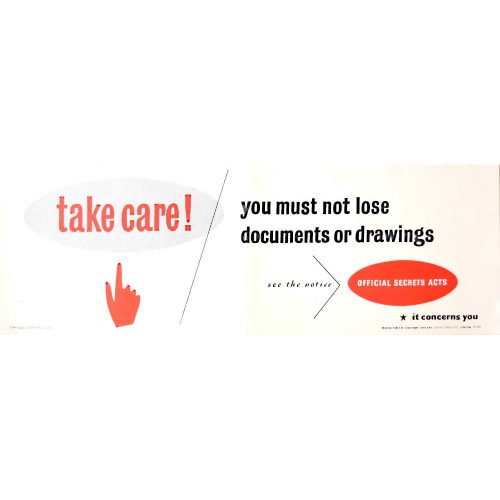
  • Akbar's Tomb, Agra

      Watercolour 13 x 20 cm
    A 20th century watercolour by an unknown artist of Akbar's Tomb, Agra, the mausoleum of the Mughal emperor Akbar. We have three other Indian architectural views by the same artist available.
    Condition: generally very good; one or two small scratches as visible in photographs. If you are interested, please email info@manningfineart.co.uk or call us on 07929 749056. Click here for other works from the same series.
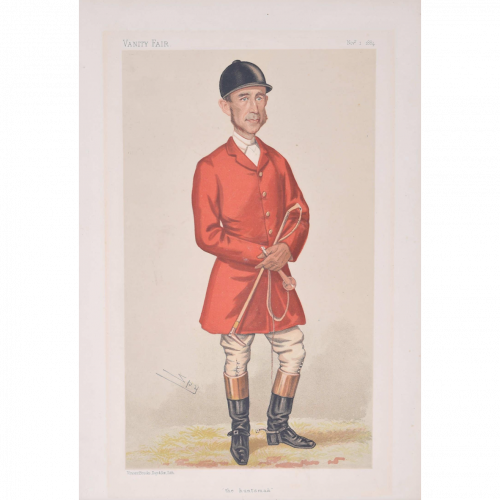
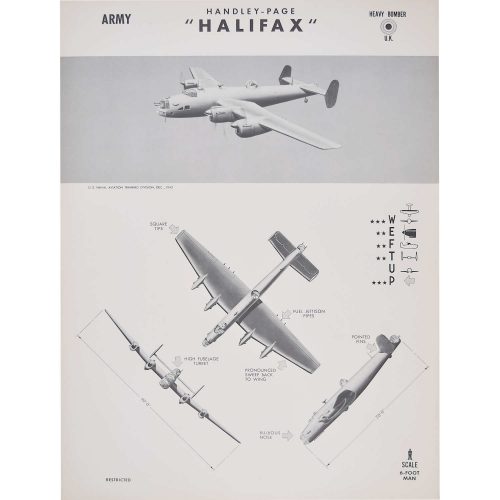
Go to Top