-
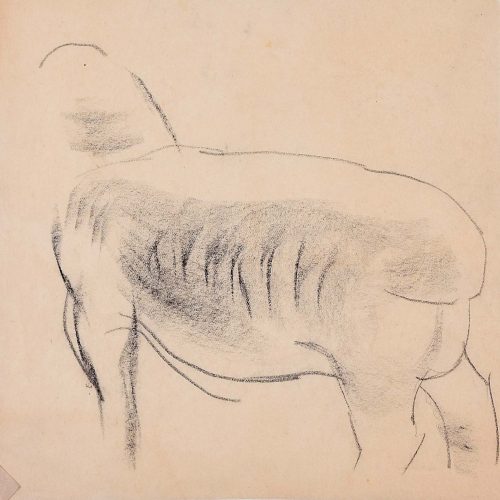
Clifford Ellis (1907-1985) Sheep
18x18cm Charcoal Provenance: the family of the artist, by descent.Click here for biographical details and other works by the artist. Clifford and Rosemary Ellis were famous as a husband and wife team for their fascination with nature and their vibrant and charming depictions of animals. They were the natural artists to be commissioned by Collins for their ‘New Naturalists’ series of books, which have become famous and highly collectable more for the dust jackets designed by the Ellises than for the – otherwise excellent – content. This painting is from a recently discovered series of paintings and drawings, never before seen by the general public, dating from the 1940s and 1950s. If you are interested email info@manningfineart.co.uk or call us on 07929 749056. Condition: Generally very Good. -
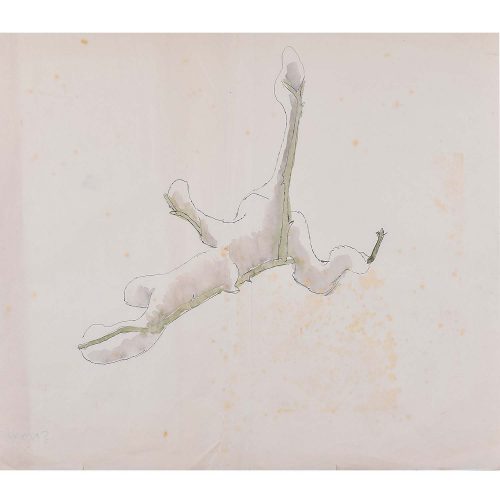
Clifford Ellis (1907-1985) Snow Laden Branch
44.5x51cm Watercolour and Pen Provenance: the family of the artist, by descent.Click here for biographical details and other works by the artist. Clifford and Rosemary Ellis were famous as a husband and wife team for their fascination with nature and their vibrant and charming depictions of animals. They were the natural artists to be commissioned by Collins for their ‘New Naturalists’ series of books, which have become famous and highly collectable more for the dust jackets designed by the Ellises than for the – otherwise excellent – content. This painting is from a recently discovered series of paintings and drawings, never before seen by the general public, dating from the 1940s and 1950s. If you are interested email info@manningfineart.co.uk or call us on 07929 749056. Condition: Generally very Good. -
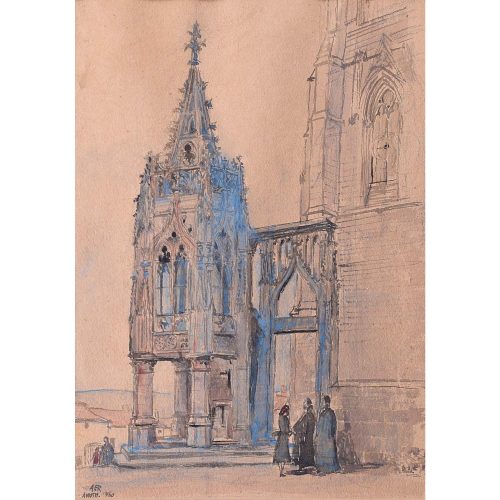
Prof Sir Albert Richardson PRA Avioth La Recevresse
1960 Watercolour 29.5x20cm Signed with initials and dated lower left Avioth is in the Meuse region of France, on the Belgian border. The city was founded in the twelfth century, when a villager miraculously found a wooden statue of the Virgin Mary in a thorn bush. A chapel built on the site soon became a place of pilgrimage and the church on the site - dedicated to Notre Dame - was created a Basilica by Pope John Paul II in 1983. Beside the Basilica stands the Recevresse, a piece of stone lacework. Its original function is unknown; it was more recently a place where pilgrims' offerings were received. It was registered as a historical monument in 1840 by the French authorities. Sir Albert Edward Richardson K.C.V.O., F.R.I.B.A, F.S.A., P.R.A. (1880-1964) was a traditionalist, renowned for his distaste of modern architecture. Rooted firmly in the classical period, he lived a Georgian life, refusing to have electricity in his Georgian house – until his wife finally insisted. Professor of Architecture at UCL’s Bartlett School of Architecture from 1929-1955, this was evacuated to Cambridge during the war and he became a fellow of St Catharine’s College. Amongst his other achievements, Richardson was President of the RA, editor of Architect’s Journal and founder of the Georgian Group. If you are interested email info@manningfineart.co.uk or call us on 07929 749056. Condition: Good. -
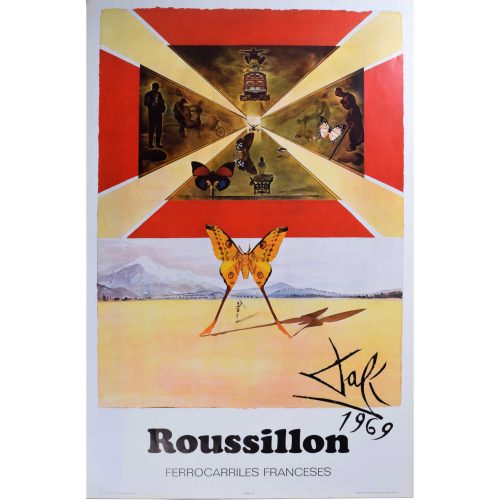
Salvador Dali (1904-1989)
Rousillon Original Poster for French National Railways SNCF (1969)
98 x 62 cm Lithographic posterThis is one example of the seven posters Surrealist painter Salvador Dali (1904-1989) designed for the French National Railways in the late 1960s and early 1970s - click here for the others.Condition: Generally very good - a little creasing to the very edges. -
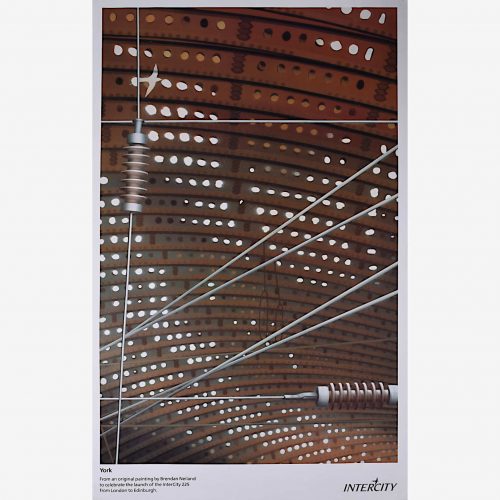
Brendan Neiland (b.1941)
York Intercity Poster
Original Vintage Poster - lithograph 102x64cm (40×25 inches) each 1991 Click here for biographical details and other works by the artist. If you are interested email info@manningfineart.co.uk or call us on 07929 749056. -
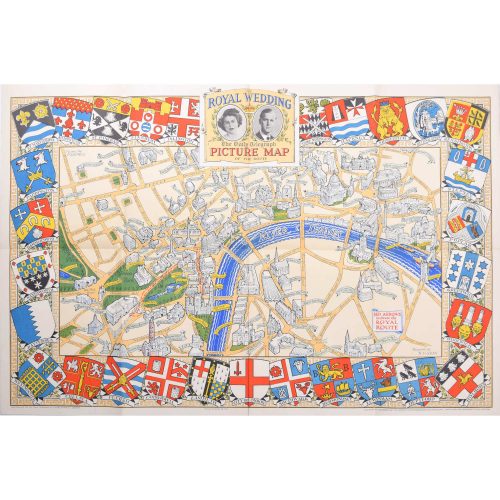
N. V. Gray
The Royal Wedding: Picture Map of the Route through London (1947)
Lithograph 50 x 76 cm Produced by H.A. & W.L. Pitkin Ltd for the Daily Telegraph and published by Geographia Ltd., of Hutchinson & Co. Signed in plate lower right. Complete with slip showing the genealogy of the two parties. Princess Elizabeth (later Her Majesty Queen Elizabeth II) and Prince Philip married on Thursday 20th November 1947 at Westminster Abbey in London. This map, commissioned and sold by the Daily Telegraph newspaper, was designed by N. V. Gray. It depicts the route the carriage processions took on the way to the Abbey; Princess Elizabeth and her father King George Vi travelled in the magnificent Irish State Coach. Crests of London's boroughs border this delightfully coloured map. If you’d like to know more, please email info@manningfineart.co.uk or call us on 07929 749056. -
Out of stock
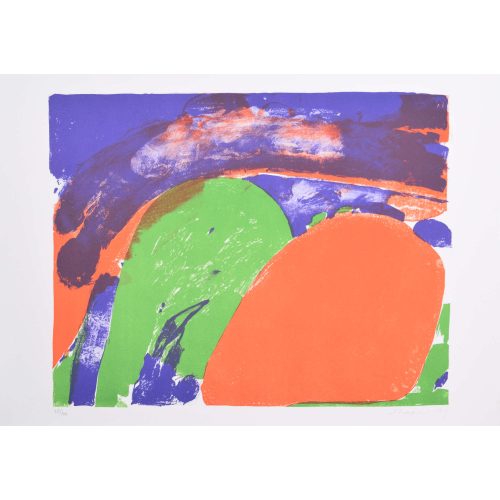
Shmuel Shapiro (1924 - 1983) Two Lovers (1966)
Original lithograph on handmade Barcham Green paper 34 x 44 cm (sheet size 40 x 57 cm) Signed, dated, and numbered 75/100 in pencil. Published and printed at the Curwen Studio, London, in 1966. Shapiro was an American Jewish artist. This typically emotive but unusually colourful work conveys the passion that accompanies true love, with the green and orange forms pressing desperately against one another. An example of this lithograph is held in the Tate Gallery's permanent print collection. Provenance: acquired directly from the Curwen Archive. Condition: excellent. If you’d like to know more, please email info@manningfineart.co.uk or call us on 07929 749056. -
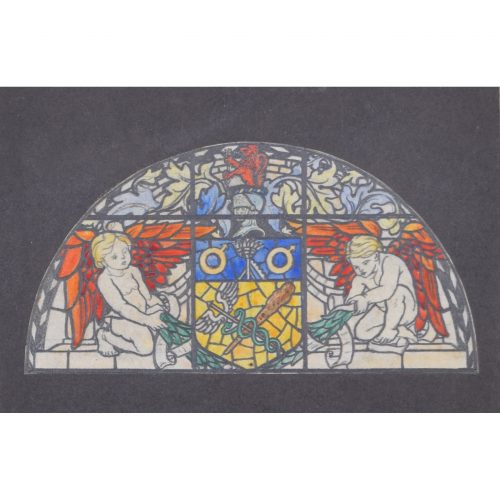
Thomas William Camm (1839 – 1912)
Stained glass window design for an arched panel
Watercolour 7 x 13 cm Design for TW Camm & Co., Smethwick, Birmingham. Numbered 13080. From the Camm studio sale. The Camms were stained glass designers who exhibited 48 times at the Royal Academy and also exhibited at The Walker Art Gallery in Liverpool, The Royal Scottish Academy, and the Royal Birmingham Society of Artists. Thomas William Camm's work was widely acclaimed, with his studio winning medals in Paris in 1878, in Sydney in 1879 and in Turin in 1911. In 1915, the American architect Ralph Adams Cram wrote that 'at the present moment a large number of artists in England are producing work of most singular beauty and perfection. Amongst these I have no hesitation in placing Mr. Camm easily as the first'. Following the death of her father, Florence Camm became the chief designer at TW Camm. Condition: very good; in oak frame. If you’d like to know more, please email info@manningfineart.co.uk or call us on 07929 749056. -
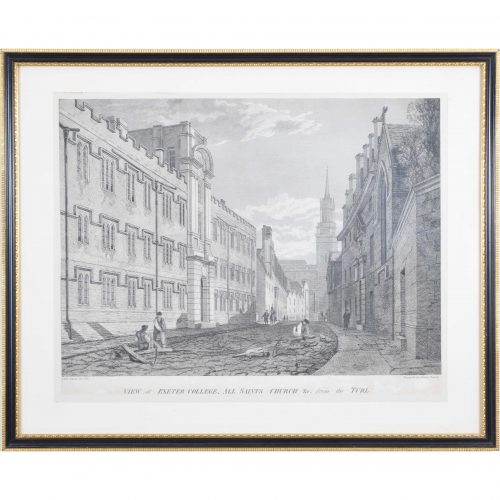
James Basire II (1769 - 1822) after JMW Turner (1775 - 1851)
View of Exeter College, All Saints Church &c. from the Turl
Engraving 35 x 46 cm A view of Exeter College, Oxford from Turl Street. Labourers cobble the road. The spire of what was All Saints Church, now Lincoln College's library, overlooks the scene. Turner's drawing was reproduced as a lithograph in 1800, to be published in the “Oxford Almanack”. The Oxford Almanack was an annual almanack published by the Oxford University Press for the University of Oxford from 1674 through 2019 (when printing sadly ceased due to “dwindling interest”). The almanack traditionally included engravings or lithographs of the University and information about the upcoming year. Other almanack artists have included Michael Burghers and John Piper. Basire and Dayes collaborated on several views of Oxford during the courses of their careers. Joseph Mallord William Turner RA, known in his time as William Turner, was an English Romantic painter, printmaker and watercolourist. He is known for his expressive colouring, imaginative landscapes and turbulent, often violent, marine paintings. He left behind more than 550 oil paintings, 2,000 watercolours, and 30,000 works on paper. He was championed by the leading English art critic John Ruskin from 1840, and is today regarded as having elevated landscape painting to an eminence rivalling history painting. James Basire II was a British engraver, son of James Basire I, also a celebrated engraver. In 1802 he became Engraver to the Society of Antiquaries. Condition: trimmed within plate mark and mounted to paper. If you’d like to know more, please email info@manningfineart.co.uk or call us on 07929 749056. Other views of Exeter College, Oxford are available here. -
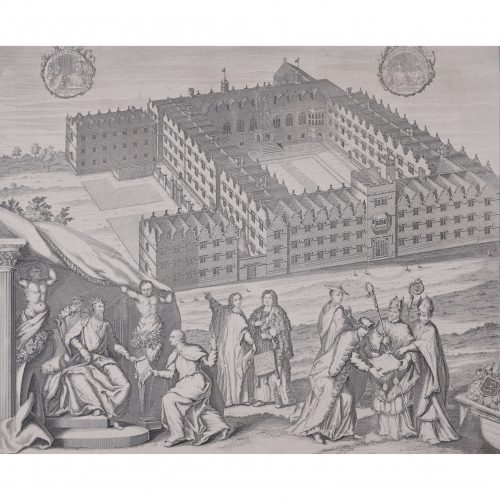
Oriel College, Oxford (1736)
Engraving 35 x 43 cm This fantasia on Oriel, featuring a sublime rendering of the College's architecture and a parade of sound Oriel men, was featured in the 1736 edition of the Oxford Almanack. The Oxford Almanack was an annual almanack published by the Oxford University Press for the University of Oxford from 1674 through 2019 (when printing sadly ceased due to "dwindling interest"). The almanack traditionally included engravings or lithographs of the University and information about the upcoming year. Other almanack artists have included Michael Burghers, J. M. W. Turner, and John Piper. Basire and Dayes collaborated on several views of Oxford during the courses of their careers. Floreat Oriel! Condition: good. Trimmed. If you’d like to know more, please email info@manningfineart.co.uk or call us on 07929 749056. Click here for more views of Oriel. -
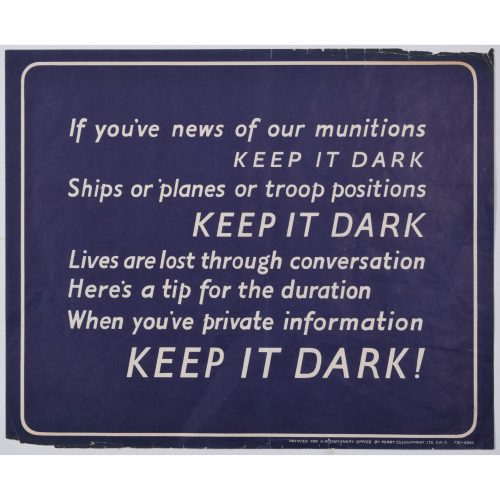
Keep It Dark (1939 - 1945)
Lithographic poster 25 x 31 cm Sponsored by Her Majesty's Stationery Office; printed by Perry Colourprint. A copy of this poster is held by the Imperial War Museum. This poster, bearing lyrics designed to be sung to the tune of "She'll be coming round the mountain", was designed for the Ministry of Information during the Second World War. It urges the population to avoid talking carelessly about details of Britain's operational movements, which might unwittingly end up in the wrong hands. Condition: good. Some small losses to extreme margins. If you’d like to know more, please email info@manningfineart.co.uk or call us on 07929 749056. -
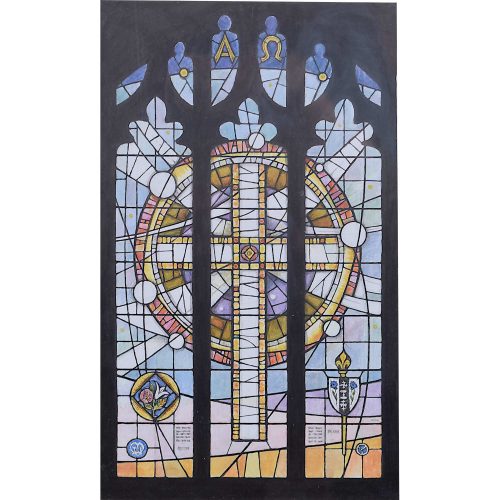
Jane Gray (b.1931)
Christ Church, Charnock Richard, Lancashire, Design for Stained Glass Window (1988)
Watercolour 25.5 x 15.5 cm Signed, dated and studio stamp verso.Christ Church was built in 1860 at the heart of the 13th century country village of Charnock Richard. Alongside its stained glass windows, the church boasts historic tile work and an exceptional marble memorial to the original benefactor’s wife, Frances Darlington.
Provenance: the artist’s studio sale. Condition: very good. If you are interested, please email info@manningfineart.co.uk or call us on 07929 749056. For other works by Jane Gray and more information about her, please click here. -
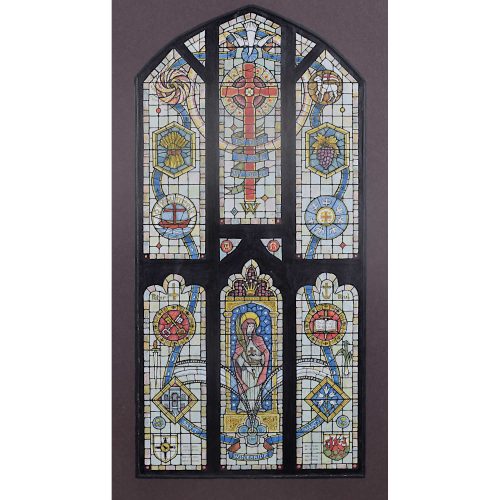
Jane Gray (b.1931)
Shrewsbury Abbey, Design for Stained Glass Window Dedicated to St Winefride (1990)
Watercolour 39 x 19 cmSigned, dated and studio stamp verso.
The red sandstone Abbey that resides over Shrewsbury is a welcoming landmark to visitors entering the town and dates back to the Norman era. Despite many renovations and alterations over the years, the medieval and Victorian elements marry remarkably naturally in this grand yet dignified place of worship. Shrewsbury abbey is home to several notable tombs and monuments as well as the remnants of a medieval shrine to St Winefride who was once venerated there. The central light at the top depicts the Trinity, where the Holy Spirit is represented by a dove, God by a vortex (left) and Christ by a lamb (right). The trinity remain linked throughout the design by a blue ribbon decorated with crosses and water droplets. St Winefride’s spiritual strength is represented by the large, central red cross, and her initial rests at its foot. In the left light, beneath the vortex, is corn, and to the right, grapes, both symbols uniting to form a timeless reference to the Eucharist. Below is the ship, a symbol of thee Ecumenical church, and on the right are seven doves representing the seven gifts of the holy spirit: wisdom, counsel, fortitude, knowledge, piety, and fear of the Lord. Two small roundels with Alpha and Omega (‘I am the beginning and the end’ as God notes in the Book of Revelations) unify the upper and lower windows in the design. The central lower light depicts St Winefride, set against a starry backdrop, holding the Martyr’s Palm and Cross beneath her martyr’s crown. The water that is said to have spewed forth from her decapitated head is symbolically illustrated in the fountain at her feet that flows into the adjacent lights. Further symbols to Saint Winefride adorn both the left and right lights. The crossed keys and inverted cross (left light) represent Saint Peter, and the sword, book, and anchor rounded cross represent Saint Paul, the saints to whom Shrewsbury Abbey is dedicated. The window was installed in 1992.
Provenance: the artist’s studio sale. Literature: Jane Gray, Playing with Rainbows. (Shropshire: Ellingham Press, 2011), pp.47, 81. Condition: very good. If you are interested, please email info@manningfineart.co.uk or call us on 07929 749056. For other works by Jane Gray and more information about her, please click here. -
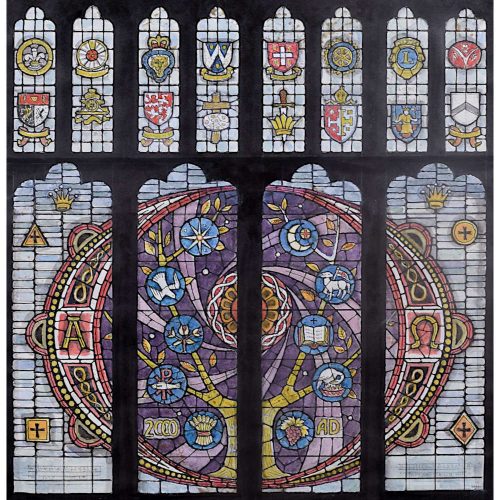
Jane Gray (b.1931)
St Oswald’s Church, Oswestry, Shropshire, Design for Stained Glass Window (2001)
Watercolour 28 x 27 cmSigned, dated and studio stamp verso.
St Oswald’s Church in Oswestry, Shropshire has been a place of worship for nearly 1000 years and commands a prominent position in the Town Centre. The church has a rich history, with William Morgan, who famously translated the whole Bible into Welsh, appointed Vicar of Oswestry in 1599, and the renowned Victorian architect G E Street substantially renovating the church between 1872-74. The church and town receive their names from Saint Oswald, the Christian King of Northumbria, who was killed at the Battle of Maserfield in 642 AD by the pagan King of Mercia, a mere 400 metres from the site of the present church. One of Oswald’s severed arms was allegedly snatched by a raven and dropped “a bowshot” away, causing a well to spring up that would be visited for centuries for healing and still exists today. The present-day name of Oswestry is a corruption of the original name Oswald’s Tree, which derives from Oswald's body being nailed to a tree in mock crucifixion. In Gray’s design, a large O fills the central four windows, a continuum (symbolising eternity) depicted at its centre, and a tree branching out across the central lights. Within them are also small roundels representing groups connected with Oswestry, including: Cambrian Railways, Round Table, Royal British Legion, Shropshire County Council, Oswestry Town Council, Rotary International, Lions International, Women’s Royal Voluntary Service, Orthopaedic Hospital, Royal Artillery, and Oswestry Borough Council. This window was installed and dedicated in 2004.
Provenance: the artist’s studio sale. Literature: Jane Gray, Playing with Rainbows. (Shropshire: Ellingham Press, 2011), pp.63, 88-9. Condition: very good. If you are interested, please email info@manningfineart.co.uk or call us on 07929 749056. For other works by Jane Gray and more information about her, please click here. -
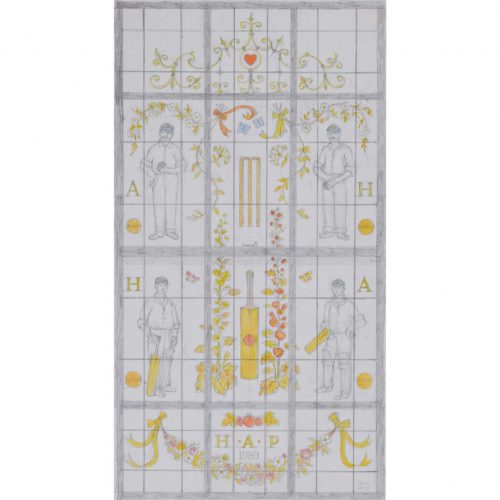
Jane Gray (b.1931)
Stained Glass Window Design for Harold Pinter and Antonia Fraser (1980)
Watercolour and pencil 30.5 x 16 cmSigned lower right corner. Dated on backboard.
Harold Pinter and Antonia Fraser married in London in November 1980, five years after they first met, and only a few months after Gray commenced designing this impressive stained glass window for their house at 52 Campden Hill Square in London. Her notes surrounding the design give insights into her process and the themes and imagery she wished the design to contain such as: Harold and Antonia’s initials, cricket, hollyhocks, butterflies, medallions of test matches.
Provenance: the artist’s studio sale. Condition: very good. If you are interested, please email info@manningfineart.co.uk or call us on 07929 749056. For other works by Jane Gray and more information about her, please click here. -
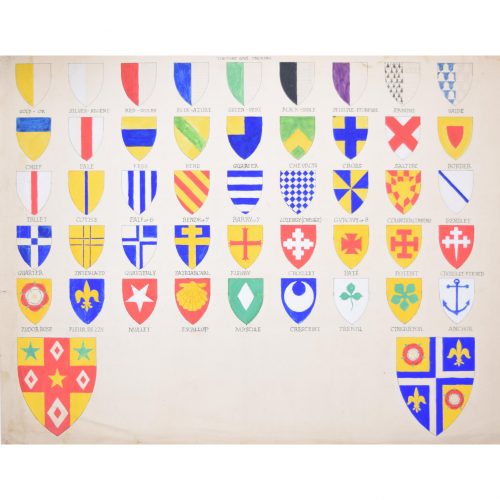
S Clapham (active 1940 - 1960)
A Heraldic Primer
Gouache and pencil 53 x 67 cm A delightful, brightly-coloured study of the various elements of heraldic shields. Condition: good; a few short and neatly-repaired marginal tears. If you are interested, please email info@manningfineart.co.uk or call us on 07929 749056. Click here for other works by the artist. -
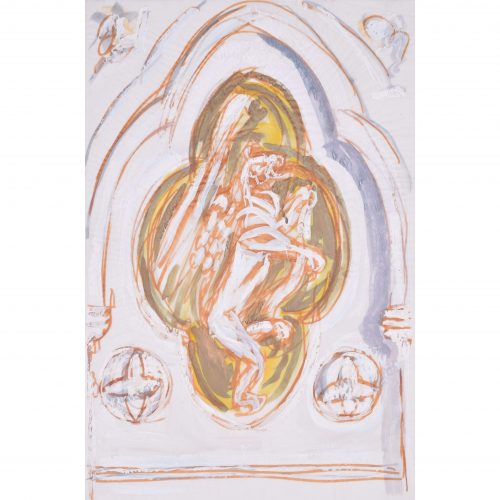
Margaret Souttar (1914 - 1987)
Emmanuel College, Cambridge Lion Rampant (1960)
Acrylic paint 74 x 50 cm Signed and dated lower right. Souttar was a Scottish painter and printmaker known for her images of town- and cityscapes. In the early 1960s, she was commissioned to produce a series of prints of the Cambridge colleges. She captures the modernity and optimism of 1960s Cambridge; the fact that a female artist was commissioned to create the prints reflects the changing attitudes of the University towards women. These views highlight the layers of history and architectural styles which make up a Cambridge college. Provenance: the artist's studio sale. Condition: generally very good; some crinkling as a result of using water-based paints on thin paper. If you are interested, please email info@manningfineart.co.uk or call us on 07929 749056. Click here for other views of Emmanuel College, Cambridge. -
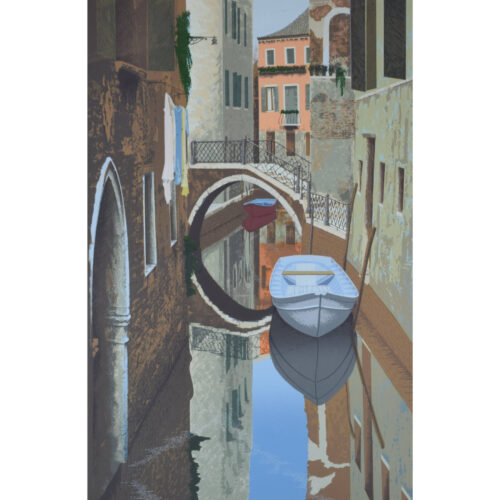
Graham Bannister (born 1954)
A Venetian Canal
Screenprint 76 x 50 cm A screenprint of one of Venice's canals, crossed by an iron-railed bridge. Drying clothes hang from a canalside window as two moored gondolas bob gently. The stone buildings of Venice stretch up to the sky and are reflected back by the calm waters. Graham Bannister specialises in printmaking and trained at the Brillig Art Centre in Bath in the 1970s. He is known for his views of Venice's waterways. Condition: very good. If you are interested, please email info@manningfineart.co.uk or call us on 07929 749056. Click here for more pictures of Italy. -
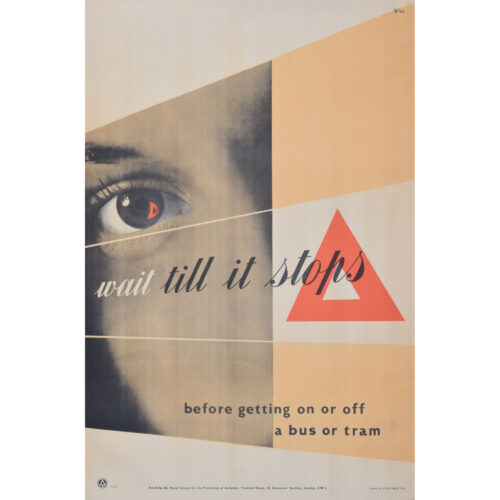
"Zero" Hans Schleger (1898 - 1976)
Wait till it stops before getting on or off a bus or tram
Original vintage poster 76 x 49 cm Hans Schleger was born in Germany. After the First World War, he studied at the Berlin Kunstgewerbeschule. After working in Berlin, he moved to New York in 1924 and began to work as a graphic designer. He returned to Berlin in 1929 and began working for the British advertising agency Crawfords, where he met Edward McKnight Kauffer, who introduced him to Jack Beddington (the head of advertising at Shell Mex BP). He moved to London following the rise of Hitler and produced a series of posters for Shell Mex. During the Second World War he worked for the British Government. He later taught at the Chicago Institute of Design and subsequently designed the trademarks of the John Lewis Partnership, Penguin, Deutsche Bank, and the Edinburgh Festival. Condition: generally very good, the odd gentle crease; not backed. If you are interested, please email info@manningfineart.co.uk or call us on 07929 749056. Click here for other original vintage posters. -
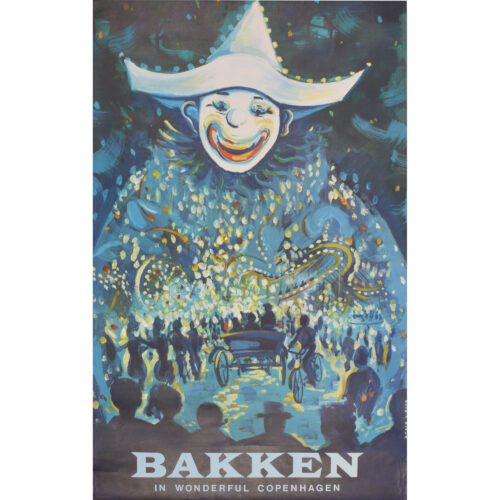
Henrik Bloch (born 1931)
Bakken in Wonderful Copenhagen (1965)
Original vintage poster 100 x 63 cm Bakken (short for Dyrehavsbakken) is the world's oldest amusement park, located just out of Copenhagen. This poster was designed to promote tourism to Copenhagen and Denmark more widely, and features a pierrot clown smiling above a happy crowd of Bakken visitors. Condition: generally very good; a few very short edge tears and a little soft creasing bottom right. Not backed. If you are interested, please email info@manningfineart.co.uk or call us on 07929 749056. Click here for more original vintage posters. -

T B Miller St John's College, Oxford (1908)
Watercolour 35 x 25 cm Signed and dated 'after ? 1908' lower left and titled lower right in pencil (in artist's hand). Condition: generally very good; mounted to card. If you are interested, please email info@manningfineart.co.uk or call us on 07929 749056. Click here for other views of St John’s College, Oxford. -

Charles Henri Toussaint (1849 - 1911)
Christ's College, Cambridge (1880)
Etching 21 x 17 cm Signed and dated 1880 in plate. An attractive etching of the Fellows' Garden at Christ's College, Cambridge. Charles Henri Toussaint was a French painter, illustrator and engraver known for his prints of architecture in Paris, historic towns in France, and English cities of architectural interest (including Oxford and Cambridge). He gained recognition at the Paris Salon in 1874. Condition: very good. If you are interested, please email info@manningfineart.co.uk or call us on 07929 749056. Click here for other views of Christ's College, Cambridge. -
 Лауреаты Государственных Премий [State Prizewinners] Moscow 1971 28 x 44 cm This folio introduces to the population of Soviet Russia the dozen winners of the State Prizes in 1971 for Literature, Art, and Architecture. "The awarding of the State Prizes of the USSR in 1971 to a large contingent of our creative intelligentsia is new evidence of the constant concern of the Communist Party of the Soviet Union for the further development of literature and art."
 -

Louis Osman
Lumley Castle - sketch I
Pen, ink, pencil and coloured wash 63 x 48 cm Louis Osman (30 January 1914 – 11 April 1996) was an architect, artist, goldsmith, silversmith and medallist. Few people matched his creations as a goldsmith, and consequently he was chosen to make the crown for the Investiture of the Prince of Wales in 1968. Many of his other works are in public collections in the UK and worldwide. After Hele’s school in Exeter he studied at the Bartlett School of Architecture – part of University College London – from 1931. Also attending the Slade, he left the Bartlett being awarded the top first, which brings with it the Donaldson Medal of the RIBA. Following the war he was busy as an architect, works including for Westminster Abbey, and Lincoln, Exeterm, Ely and Lichfield Cathedrals. Staunton Harold Church in Ashby de la Zouch for the National Trust, and of course his own folly, the Grade I listed Elizabethan manor house, Canons Ashby in Northamptonshire – which was given to the National Trust in 1981 when Osman was not able to keep the tenancy any longer. These architectural sketches showcase Osman's ideas for the refit of Lumley Castle. Located in the North-East of England, Lumley Castle was originally built in 1389 and today is a four star hotel and wedding venue that belongs to the Earl of Scarborough. Thomas Lumley was an eighteenth century soldier and statesman, and the third Earl of Scarborough. Condition: Very good, slight toning to paper Provenance: From the artist's estate. Click here for other works by Louis Osman. -

Louis Osman
Lumley Castle - sketch II
Pen, ink, pencil and coloured wash 44 x 45 cm Louis Osman (30 January 1914 – 11 April 1996) was an architect, artist, goldsmith, silversmith and medallist. Few people matched his creations as a goldsmith, and consequently he was chosen to make the crown for the Investiture of the Prince of Wales in 1968. Many of his other works are in public collections in the UK and worldwide. After Hele’s school in Exeter he studied at the Bartlett School of Architecture – part of University College London – from 1931. Also attending the Slade, he left the Bartlett being awarded the top first, which brings with it the Donaldson Medal of the RIBA. Following the war he was busy as an architect, works including for Westminster Abbey, and Lincoln, Exeterm, Ely and Lichfield Cathedrals. Staunton Harold Church in Ashby de la Zouch for the National Trust, and of course his own folly, the Grade I listed Elizabethan manor house, Canons Ashby in Northamptonshire – which was given to the National Trust in 1981 when Osman was not able to keep the tenancy any longer. These architectural sketches showcase Osman's ideas for the refit of Lumley Castle. Located in the North-East of England, Lumley Castle was originally built in 1389 and today is a four star hotel and wedding venue that belongs to the Earl of Scarborough. Thomas Lumley was an eighteenth century soldier and statesman, and the third Earl of Scarborough. Condition: Full sheet 68 x 48; owing to staining at top, 44 x 45 cm; generally good Provenance: From the artist's estate. Click here for other works by Louis Osman. -

Louis Osman
Lumley Castle - sketch III
Pen, ink, pencil and coloured wash 62 x 48 cm Louis Osman (30 January 1914 – 11 April 1996) was an architect, artist, goldsmith, silversmith and medallist. Few people matched his creations as a goldsmith, and consequently he was chosen to make the crown for the Investiture of the Prince of Wales in 1968. Many of his other works are in public collections in the UK and worldwide. After Hele’s school in Exeter he studied at the Bartlett School of Architecture – part of University College London – from 1931. Also attending the Slade, he left the Bartlett being awarded the top first, which brings with it the Donaldson Medal of the RIBA. Following the war he was busy as an architect, works including for Westminster Abbey, and Lincoln, Exeterm, Ely and Lichfield Cathedrals. Staunton Harold Church in Ashby de la Zouch for the National Trust, and of course his own folly, the Grade I listed Elizabethan manor house, Canons Ashby in Northamptonshire – which was given to the National Trust in 1981 when Osman was not able to keep the tenancy any longer. These architectural sketches showcase Osman's ideas for the refit of Lumley Castle. Located in the North-East of England, Lumley Castle was originally built in 1389 and today is a four star hotel and wedding venue that belongs to the Earl of Scarborough. Thomas Lumley was an eighteenth century soldier and statesman, and the third Earl of Scarborough. Condition: Very good; on a rich dark-green paper which has not really shown up in the photographs, nor have the extensive pencil sketches Provenance: From the artist's estate. Click here for other works by Louis Osman. -

Louis Osman
Lumley Castle - sketch IV
Pen, ink, pencil and coloured wash 62 x 48 cm Louis Osman (30 January 1914 – 11 April 1996) was an architect, artist, goldsmith, silversmith and medallist. Few people matched his creations as a goldsmith, and consequently he was chosen to make the crown for the Investiture of the Prince of Wales in 1968. Many of his other works are in public collections in the UK and worldwide. After Hele’s school in Exeter he studied at the Bartlett School of Architecture – part of University College London – from 1931. Also attending the Slade, he left the Bartlett being awarded the top first, which brings with it the Donaldson Medal of the RIBA. Following the war he was busy as an architect, works including for Westminster Abbey, and Lincoln, Exeterm, Ely and Lichfield Cathedrals. Staunton Harold Church in Ashby de la Zouch for the National Trust, and of course his own folly, the Grade I listed Elizabethan manor house, Canons Ashby in Northamptonshire – which was given to the National Trust in 1981 when Osman was not able to keep the tenancy any longer. These architectural sketches showcase Osman's ideas for the refit of Lumley Castle. Located in the North-East of England, Lumley Castle was originally built in 1389 and today is a four star hotel and wedding venue that belongs to the Earl of Scarborough. Thomas Lumley was an eighteenth century soldier and statesman, and the third Earl of Scarborough. Condition: Very good; on a rich dark-green paper which has not really shown up in the photographs, nor have the extensive pencil sketches Provenance: From the artist's estate. Click here for other works by Louis Osman. -

Vivan Bewick British Matilda Tank
Gouache 6 x 9 cm Signed to the reverse. This striking miniature gouache depicts a British Matilda tank rolling through the bleak no man's land. Bewick produced this gouache as for the 'tank-recognition' series in Swill-bin. Swill-bin was a wall-newspaper produced by soldiers; it originated in the First World War and was revived once again during the Second World War. Vivian Bewick (1912–1999) was a British artist and educator, notable for his contributions to mid-20th-century art and his role as a tutor at the Buckhurst Hill Community Association (BHCA). He was also a descendant of Thomas Bewick, the renowned 19th-century engraver celebrated for his depictions of birds and animals. While fulfilling his military duties in the Royal Artillery during the Second World War, Bewick maintained his artistic pursuits. He contributed to the wall-newspaper "Swillbin," a tradition from the First World War, and designed army Christmas cards. Additionally, he illustrated technical manuals and conducted art classes and exhibitions, with critiques by James Bateman R.A. After the war, Bewick continued his artistic education and career, spending five years at St. Martin’s School of Art and London University. He also engaged in part-time teaching of adults in art clubs, societies, and colleges and exhibited at the Royal Academy, the Paris Salon, the Royal Institute of Painters in Watercolours, and the Royal Society of British Artists. Condition: Generally very good. If you are interested, please email info@manningfineart.co.uk or call us on 07929 749056. -

Vivan Bewick British Valentine Tank
Gouache 6 x 9 cm Signed to the reverse. This striking miniature gouache depicts a British Valentine tank rolling through the no man's land at night. Bewick produced this gouache as for the 'tank-recognition' series in Swill-bin. Swill-bin was a wall-newspaper produced by soldiers; it originated in the First World War and was revived once again during the Second World War. Vivian Bewick (1912–1999) was a British artist and educator, notable for his contributions to mid-20th-century art and his role as a tutor at the Buckhurst Hill Community Association (BHCA). He was also a descendant of Thomas Bewick, the renowned 19th-century engraver celebrated for his depictions of birds and animals. While fulfilling his military duties in the Royal Artillery during the Second World War, Bewick maintained his artistic pursuits. He contributed to the wall-newspaper "Swillbin," a tradition from the First World War, and designed army Christmas cards. Additionally, he illustrated technical manuals and conducted art classes and exhibitions, with critiques by James Bateman R.A. After the war, Bewick continued his artistic education and career, spending five years at St. Martin’s School of Art and London University. He also engaged in part-time teaching of adults in art clubs, societies, and colleges and exhibited at the Royal Academy, the Paris Salon, the Royal Institute of Painters in Watercolours, and the Royal Society of British Artists. Condition: Generally very good. If you are interested, please email info@manningfineart.co.uk or call us on 07929 749056. -

Vivan Bewick German Panzerkampfwagen III
Gouache 6 x 9 cm Signed to the reverse. This striking miniature gouache depicts a German Panzerkampfwagen III, commonly known as the Panzer III, rolling through a desert landscape. Bewick produced this gouache as for the 'tank-recognition' series in Swill-bin. Swill-bin was a wall-newspaper produced by soldiers; it originated in the First World War and was revived once again during the Second World War. Vivian Bewick (1912–1999) was a British artist and educator, notable for his contributions to mid-20th-century art and his role as a tutor at the Buckhurst Hill Community Association (BHCA). He was also a descendant of Thomas Bewick, the renowned 19th-century engraver celebrated for his depictions of birds and animals. While fulfilling his military duties in the Royal Artillery during the Second World War, Bewick maintained his artistic pursuits. He contributed to the wall-newspaper "Swillbin," a tradition from the First World War, and designed army Christmas cards. Additionally, he illustrated technical manuals and conducted art classes and exhibitions, with critiques by James Bateman R.A. After the war, Bewick continued his artistic education and career, spending five years at St. Martin’s School of Art and London University. He also engaged in part-time teaching of adults in art clubs, societies, and colleges and exhibited at the Royal Academy, the Paris Salon, the Royal Institute of Painters in Watercolours, and the Royal Society of British Artists. Condition: Generally very good. If you are interested, please email info@manningfineart.co.uk or call us on 07929 749056. -

Vivan Bewick German Panzerkampfwagen III
Gouache 6 x 9 cm Signed to the reverse. This striking miniature gouache depicts a Soviet T-34/76 powering through a mountainous snowscape. The T-34/76 had a truly long lasting impact on the battlefield, with an impressive balance of firepower, armour protection and mobility. Bewick produced this gouache as for the 'tank-recognition' series in Swill-bin. Swill-bin was a wall-newspaper produced by soldiers; it originated in the First World War and was revived once again during the Second World War. Vivian Bewick (1912–1999) was a British artist and educator, notable for his contributions to mid-20th-century art and his role as a tutor at the Buckhurst Hill Community Association (BHCA). He was also a descendant of Thomas Bewick, the renowned 19th-century engraver celebrated for his depictions of birds and animals. While fulfilling his military duties in the Royal Artillery during the Second World War, Bewick maintained his artistic pursuits. He contributed to the wall-newspaper "Swillbin," a tradition from the First World War, and designed army Christmas cards. Additionally, he illustrated technical manuals and conducted art classes and exhibitions, with critiques by James Bateman R.A. After the war, Bewick continued his artistic education and career, spending five years at St. Martin’s School of Art and London University. He also engaged in part-time teaching of adults in art clubs, societies, and colleges and exhibited at the Royal Academy, the Paris Salon, the Royal Institute of Painters in Watercolours, and the Royal Society of British Artists. Condition: Generally very good. If you are interested, please email info@manningfineart.co.uk or call us on 07929 749056. -

Vivan Bewick British Valentine Tank
Gouache 6 x 9 cm Signed to the reverse. This striking miniature gouache depicts a British Valentine tank rolling through the desolate no man's land with two other tanks rolling in the background. Bewick produced this gouache as for the 'tank-recognition' series in Swill-bin. Swill-bin was a wall-newspaper produced by soldiers; it originated in the First World War and was revived once again during the Second World War. Vivian Bewick (1912–1999) was a British artist and educator, notable for his contributions to mid-20th-century art and his role as a tutor at the Buckhurst Hill Community Association (BHCA). He was also a descendant of Thomas Bewick, the renowned 19th-century engraver celebrated for his depictions of birds and animals. While fulfilling his military duties in the Royal Artillery during the Second World War, Bewick maintained his artistic pursuits. He contributed to the wall-newspaper "Swillbin," a tradition from the First World War, and designed army Christmas cards. Additionally, he illustrated technical manuals and conducted art classes and exhibitions, with critiques by James Bateman R.A. After the war, Bewick continued his artistic education and career, spending five years at St. Martin’s School of Art and London University. He also engaged in part-time teaching of adults in art clubs, societies, and colleges and exhibited at the Royal Academy, the Paris Salon, the Royal Institute of Painters in Watercolours, and the Royal Society of British Artists. Condition: Generally very good, save small brown mark top left. If you are interested, please email info@manningfineart.co.uk or call us on 07929 749056. -

Sir Albert Richardson PRA Architectural Study of Dieppe Cathedral
Watercolour & Pencil 27 x 17 cm Signed bottom left and dated 1956 to bottom right. Sir Albert Edward Richardson (1880–1964) was a distinguished British architect, teacher, and historian, known for his deep reverence for classical design principles and his pivotal contributions to architecture during the 20th century. He was a prolific figure whose work and writings championed traditional architectural forms amidst the rise of modernism. Richardson was captivated by the charm of Dieppe, its historic architecture, and its position as a cultural hub. He saw the town as a rich repository of architectural styles, particularly French Baroque and Rococo, which complemented his interest in classical and historical design. As with other towns, he played an active role in efforts to preserve and document Dieppe’s architectural heritage. While in Dieppe, Richardson produced numerous sketches and drawings of Dieppe’s streetscapes, detailing its historic buildings, market squares, and coastal landscapes. Such works remain valuable as a record of the town’s architectural history. The work pictured here is one such example of Richardson's Dieppe sketches. The terracotta coloured roof of Dieppe cathedral stands out in watercolour against the pencil sketching of the ornate masonry details, meanwhile townsfolk are sketched into the foreground, wandering down the impressive street. Richardson blends the daily life of the city with the monumental architecture that has become part of its landscape. In doing so, he highlights the historical and architectural significance of this area. -

S.R.E
Windsor Castle and Eton College with punting scholars, 19th Century drawing
Pencil drawing 25 x 42 cm Signed and dated to bottom right Nineteenth-century pencil drawing of Windsor Castle and Eton College, dated to 1820. Fine details including a punt of scholars and men fishing on the riverbanks are also depicted in the foreground. Generally very good, glued to mount (sold with frame), a few soft creases.If you would like to know more, please email info@manningfineart.co.uk or call us on 07929 749056.
-

John Speed/Speede (1551/2-1629) The County of Surrey Described and Divided into Hundreds
Engraving with later hand colouring and text to the reverse Dated to 1650 36 x 49 cm Probably the most famous early English mapmaker, John Speed's early life is somewhat of an enigma. He is believed to have trained as a rolling-press printer, but he was at heart an historian granted a sinecure in the Customs House by Queen Elizabeth to indulge his passion, later becoming a Fellow of the Society of Antiquaries. His first maps were historical, of the Holy Land 'Canaan as it was Possessed both in Abraham and Israels Dayes' and of England and Ireland recording 'all their Civill Warres since the Conquest'. In 1611 he published his 'Hostory of Great Britaine' which he regarded as his magnum opus, but it was the companion atlas 'Theatre of the Empire of Great Britaine' that - as the first printed atlas of Great Britain - sealed his reputation. William Rogers engraved the first map, 'the County Palatine of Chester' in about 1600, but following his untimely death the task of engraving was passed to Jodocus Hondius of Amsterdam. By 1612 the atlas was complete, the maps famed for their decorative elements. Many have town plans - Britain's first series of such plans - and descriptive text was printed to the reverse until the 1676 edition. Later printings (up until 1770) were issued without this text. By 1627 it has become a part of a world atlas 'Prospect of the Most Famous Parts of the World'. During the 17th century the plates passed through the hands of a series of publishers, the 1676 edition of Thomas Bassett and Richard Chiswell being regarded as its high point with the inclusion for the first time of a series of important maps. For the first half of the eighteenth century they were firmly established in the hands of the Overton family. This particular edition originally featured in The Theatre Of The Empire Of Great Britaine. It features attractive inset views of the long-since destroyed Richmond and Nonsuch Palaces, compass rose, scale of miles, coats of arms and decorative strapwork. Its hand colouring also lends a bright charm to this map, highlight the fields and adding vibrancy to the coats of arms. If you are interested email info@manningfineart.co.uk or call us on 07929 749056. Condition: Generally very good, glued to mount (sold with frame), few creases -

George Bissill (1896-1973) Rolling hills in the countryside
Watercolour 20 x 28 cm Signed to bottom right Born in 1896, George Bissill was a British miner, painter and furniture designer. Raised in the mining village of Langley Mill, Derbyshire, Bissill became a miner at the age of 13, before leaving to join the war effort in 1915. Upon his return from the war after being gassed, Bissill chose to become a pavement artist outside the newly erected Bush House in Aldwych, painting from his memory and his sketch book the uncompromising underground world he had inhabited. In 1935 he moved to the countryside near Newbury, where he lived and worked as a landscape painter, art restorer and dealer until his death in 1973. This watercolour forms part of a larger collection, 'unseen since they were taken from George Bissil's studio in 1983' and restored by Kate Pattinson. A series of planned exhibitions were cancelled due to Covid, but two shows, one in Oxford and one in Ilkeston, did take place. Through such exhibitions, Pattinson hoped to 'restore the reputation of an artist who, through mighty endeavour, conquered the art world in the 1920s with his powerful, authentic and experimental pictures.' Bissill's paintings are also held in a number of important public collections, including the Tate Gallery, National Museum of Ireland and the Manchester Art Gallery. In this watercolour, one colour blends beautifully into the next, as the green rolling hills of the foreground shift into the dark blue fields of the background. What is particularly striking about this painting, however, is Bissill's brushwork. Each individual stroke of the tumultuous sky is distinguishable from the next. This suggests Bissill's high speed of working as he attempts to capture the atmosphere of this countryside scene, perhaps as he works in the manner of the French impressionists. Condition: generally very good.If you would like to know more, please email info@manningfineart.co.uk or call us on 07929 749056.
-

David Gentleman Radcliffe Camera
Lithograph 53 x 64 cm Signed and numbered 41/200. Born on the 11th March 1930, David Gentleman is a British artist, illustrator, and designer known for his distinctive watercolours, engravings, and graphic work. He originally studied art and painting at the Royal College of Art under Edward Bawden and John Nash and has since produced work at scales ranging from platform-length murals for Charing Cross Underground Station in London to postage stamps and logos. His work is generally characterised by precise line drawings, detailed engravings, and delicate watercolour paintings, often depicting landscapes, architecture, and urban scenes. He notably distinguishes his work through his skilful ability to blend traditional techniques with modern sensibilities, rendering his work highly recognisable. He has left a lasting legacy on British graphic design and illustration and his work is now represented in the Tate Britain, the British Museum, the Victoria and Albert Museum, the Imperial War Museum and the Fitzwilliam Museum, Cambridge. Condition: Generally very good.If you would like to know more, please email info@manningfineart.co.uk or call us on 07929 749056.
-
 Herbert Lambert (1882-1936) Bath, Roman Baths & Abbey 76 x 51 cm Lithograph Published by the Travel Association of Great Britain and N.Ireland this beautiful photographic image encouraged travel to the The Roman Baths and Abbey in the historic Roman spa town of Bath in Somerset. This poster was part of a broader series released in 1947/48 by the British Travel Association to coincide with the 1948 Olympic Games in London in an effort to bring international tourism back to the United Kingdom after the Second World War. Cleverly captured by the renowned photographer Herbert Lambert, (1881-1956) this image clearly displays his mastery of lighting and his striking ability to create a harmonious atmosphere within a composition. The Roman Baths are no longer used for bathing but the archaeological site has become a major tourist attraction. Herbert Lambert was a British photographer, known in particular for his photo portraits of professional musicians and composers including Gustav Holst. Based in Bath, Lambert also made the most of his lovely Georgian surroundings and captured many a cityscape over the years. Generally excellent, the odd minor handling mark.
If you would like to know more, please email info@manningfineart.co.uk or call us on 07929 749056.
-

Val Doone The Crooked Spire, Chesterfield
76 x 51 cm Lithograph Published by the Travel Association of Great Britain and N.Ireland this beautiful photographic image encouraged travel to Chesterfield and the United Kingdom more generally. This poster was part of a broader series released in 1947/48 by the British Travel Association to coincide with the 1948 Olympic Games in London in an effort to bring international tourism back to the United Kingdom after the Second World War. Val Doone was an English photographer active during the early to mid-20th century, renowned for capturing quintessential British landscapes and scenes. He often produced material for the tourism boards and, over the years, proved his ability to capture the allure of British landscapes to entice tourism. Condition: Generally excellent, the odd very minor handling mark.If you would like to know more, please email info@manningfineart.co.uk or call us on 07929 749056.
-

John Dixon Scott Norwich, Elm Hill
76 x 51 cm Lithograph Published by the Travel Association of Great Britain and N.Ireland this beautiful photographic image encouraged travel to Norwich and the United Kingdom more generally. This poster was part of a broader series released in 1947/48 by the British Travel Association to coincide with the 1948 Olympic Games in London in an effort to bring international tourism back to the United Kingdom after the Second World War. John Dixon Scott (1890–1977) was a British photographer known for his extensive documentation of the British countryside, landscapes, and rural life. In the late 1920s, Scott became concerned at the way the rural and urban environment of Britain was changing. As a result, he decided to drive around the country with his camera, intending to preserve through his pictures what he saw as a vanishing landscape. This project occupied him for the rest of his career, resulting in images including the photograph pictured. Condition: Generally excellent, the odd minor handling mark.If you would like to know more, please email info@manningfineart.co.uk or call us on 07929 749056.
-

John Dixon Scott Stratford-upon-Avon
76 x 51 cm Lithograph Published by the Travel Association of Great Britain and N.Ireland this beautiful photographic image encouraged travel to Stratford-upon-Avon and the United Kingdom more generally. This poster was part of a broader series released in 1947/48 by the British Travel Association to coincide with the 1948 Olympic Games in London in an effort to bring international tourism back to the United Kingdom after the Second World War. John Dixon Scott (1890–1977) was a British photographer known for his extensive documentation of the British countryside, landscapes, and rural life. In the late 1920s, Scott became concerned at the way the rural and urban environment of Britain was changing. As a result, he decided to drive around the country with his camera, intending to preserve through his pictures what he saw as a vanishing landscape. This project occupied him for the rest of his career, resulting in images including the photograph pictured. -

Walter Hoyle (1922 - 2000) Untitled Abstract
Linocut 10 x 68 cm Signed and inscribed A/P in pencil. This linocut by Walter Hoyle is a striking abstract composition that blends geometric precision with rhythmic energy. Using a limited but bold palette of purples, oranges, browns, and whites, Hoyle divides the image into distinct panels, each filled with dynamic shapes—from radiating circles and curving grids to architectural lines and layered forms. The piece flows like a visual symphony, with each section contributing to a sense of movement and harmony. Textured line work and careful composition reflect Hoyle’s modernist sensibilities, showcasing his talent for balancing structure with expressive design. Hoyle trained at Beckenham School of Art and the Royal College of Art. At the latter he was strongly influenced by Edward Bawden, one of Britain’s greatest linocut printers. Bawden had been commissioned by the 1951 Festival of Britain to produce a mural for the South Bank, and chose Hoyle to assist on account of his great talent. Hoyle later moved to Great Bardfield in Essex, becoming a part of the Great Bardfield group of artists; diverse in style, they created figurative work, in stark contrast to the abstract art of the St Ives artists at the opposite end of the country. Hoyle taught at St Martin’s School of Art from 1951-60, the Central School of Arts and Crafts from 1960-64, and the Cambridge School of Art from 1964-1985, during which time he launched Cambridge Print Editions. His work is held in the collections of the Tate Gallery, the Victoria and Albert Museum, The British Museum, Kettle’s Yard and the Fry Art Gallery. Condition: Generally very good; a few handling marks and a little spotting to the margins.If you would like to know more, please email info@manningfineart.co.uk or call us on 07929 749056.