• Jane Gray (b.1931)

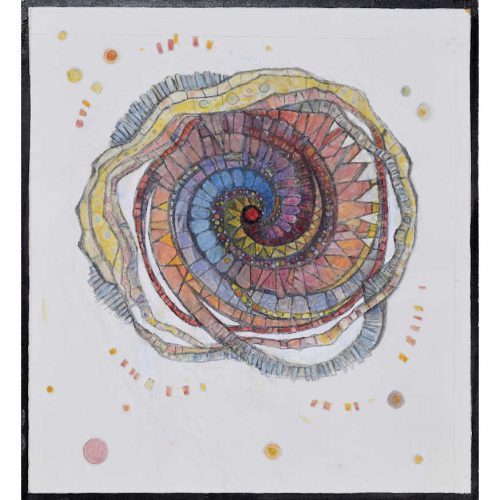
    Applique Stained Glass Window Design

      Watercolour

    18 x 16 cm

    Studio label verso

    In this stained glass design, Gray uses the appliqué method to construct a highly colourful, abstract, swirling image, typical of many of her more modern works. Gray uses the same technique as in other works of hers where a sense of the transcendental is married with modern abstraction, the viewer’s gaze hypnotically pulled in to the central red dot.

    Provenance: the artist’s studio sale. Condition: very good. If you are interested, please email info@manningfineart.co.uk or call us on 07929 749056. For other works by Jane Gray and more information about her, please click here.    
  • Jane Gray (b.1931)

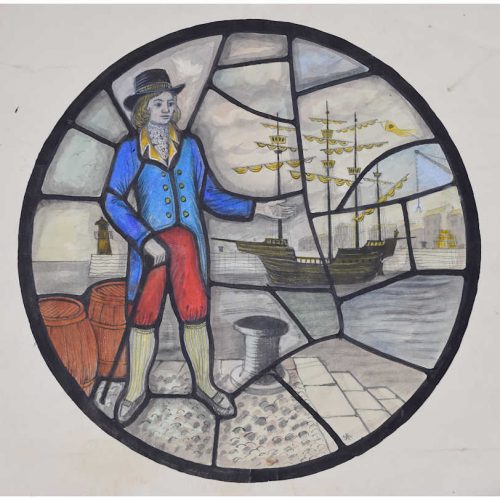
    Port Scene Design for Stained Glass Roundel (1962)

      Watercolour

    D. 25.5 cm

    One of Gray’s most interesting stained glass designs, this roundel depicts a colourful port scene, with a brightly attired middle class merchant standing on the dockside in front of an impressive carrack. Whilst a traditional scene, the design has Gray’s uniquely modern twist.

    Provenance: the artist’s studio sale. Condition: very good. If you are interested, please email info@manningfineart.co.uk or call us on 07929 749056. For other works by Jane Gray and more information about her, please click here.    
  • Jane Gray (b.1931)

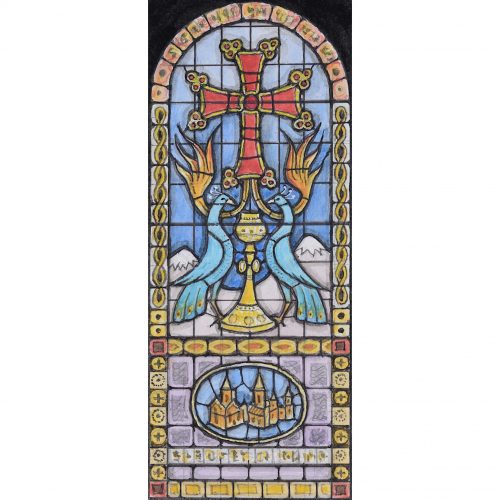
    Stained Glass Window Design for a Church

      Watercolour

    15.5 x 6 cm

    This design for a stained glass window draws together Gray’s modern yet traditional approach to designing church windows. The design features an oval external view of the church buildings beneath a pair of bright blue peacocks, two colourfully burning flames and  a large red cross.

    Provenance: the artist’s studio sale. Condition: very good. If you are interested, please email info@manningfineart.co.uk or call us on 07929 749056. For other works by Jane Gray and more information about her, please click here.    
  • Jane Gray (b.1931)

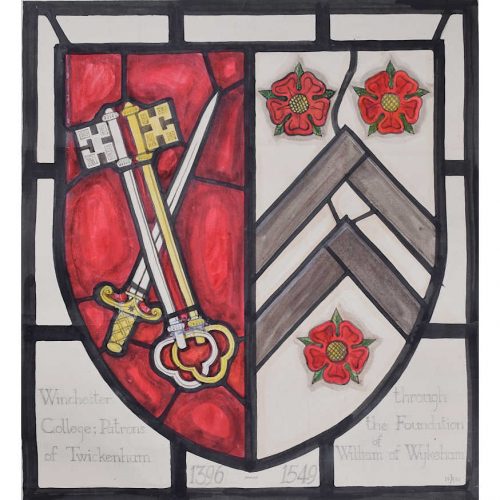
    Winchester College: Patrons of Twickenham Stained Glass Window Design, St Mary’s Church, Twickenham (1960)

      Watercolour

    41.5 x 37.5 cm

    Signed and dated l.r.

    This stained glass window design is one of a handful Gray designed for her local church, St Mary’s Twickenham. St Mary’s Church stands on the site of an earlier church in Twickenham, a short distance from York House and the banks of the River Thames, and incorporates a 15th-century, medieval tower. St Mary's has an impressive and illustrious history of notable parishioners including the painter Godfrey Kneller who, after the collapse of the ancient church's 14th-century nave in 1714, took active involvement in redesigning the church in the Neo-classical style alongside local architect John James, as well as Henry Fielding and Alfred Lord Tennyson whose sons were both baptised here. Gray had a personal connection to St Mary’s, her great grandfather having been the vicar some years before. This design, in particular, focusses on the religious involvement of Winchester College, represented here by the right hand side of the shield which bears the key components of the school’s coat of arms; three red roses and two right-angled bars.

    Provenance: the artist’s studio sale. Condition: very good. If you are interested, please email info@manningfineart.co.uk or call us on 07929 749056. For other works by Jane Gray and more information about her, please click here.    
  • Fred Stingemore (1890-1954) London Underground Railways Pocket Map January 1927 Lithograph, linen-based card Bi-fold pocket map 12.5 x 15 cm (unfolded) Stingemore spent forty years in the London Transport drawing office, but is best known as the artist behind the map that preceded Harry Beck's famous and iconic 1933 new design - the circuit diagram version. The 1927 edition is identical to that of 1926, but features a yellow - rather than green - cover. The twelve editions of Stingemore's map featured different coloured covers. A broadly topographical map, he nevertheless distorted the central London area to make it clearer. His greatest claim to fame is of encouraging Harry Beck to resubmit his own design to London Transport. Beck was a technical draughtsman who worked for the London Metro Signal Office. Following being fired, he created the first diagrammatic Tube map in 1931. Having submitted it to the Publicity Office at London Transport, it was rejected. However an updated proposal was accepted, being published in January 1933 in an edition of 700,000 pocket maps - most of which were consigned to the dustbin within hours, days or weeks. Those that survive are rare. Immediately popular it was adoped and similar maps have been used ever since by London Transport - and indeed many other rail systems worldwide. Beck was inspired whilst creating an electrical circuit diagram to apply the same concept to the Underground system, in the understanding that passengers on the network were more interested in how the lines related to each other, than in how they related to the topography of the city. Beck worked on the map in his spare time, and was - depending on the story you believe - either not paid for his work, or was paid a mere five or ten guineas. These days his work is acknowledged on all published London Tranport maps.  
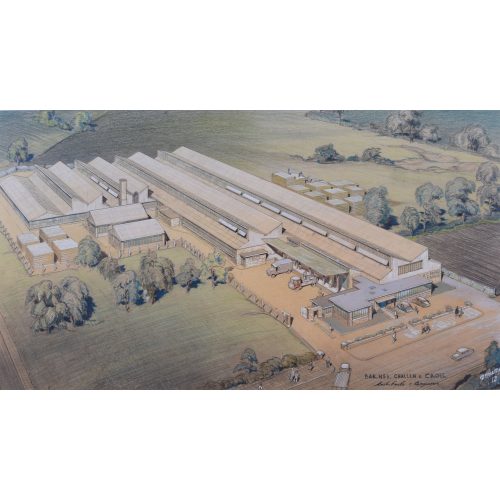
  • John Dean Monroe Harvey (1895 – 1978) Architectural Drawing: Design for a factory for VC Bond

    for Barnes Challen & Cross, Architects and Engineers Mixed Media 38x68cm Even the factory commissioned by the manufacturers of a furniture company deserved the attention of a drawing by the famous JDM Harvey in the Board Room. Unusually, perhaps, for Harvey, here he is drawing fields, carefully catching the texture of a ploughed field with the confident diagonal strokes of his hand. The factory is busily occupied, men are unstacking great piles of timber at the back of the building. A further lorry-load of raw materials enters through the gate and the Directors' fine saloon cars are parked towards the front. Even in this obviously rural environment Harvey draws his usual pedestrians. All these aspects give life to what in the hands of a lesser man would probably be a rather clinical drawing - instead of a picture of which to be proud. Probably unrivalled as an architectural perspectivist working after the second World War, Harvey trained as an architect but after 1944 worked almost solely on drawing architectural perspectives for other architects. “The architectural draughtsman who is equally competent at drawing such incidentals [as landscape and figures] is as rare as the landscape or figure painter who is equally competent at architecture. Harvey was one of those rare men. He would draw a building with a slightly freer hand than an architect would, and his landscape in a slightly more architectural manner than that of a painter.” Perspective in Perspective, Lawrence Wright (Routledge 1983) p234. Harvey was born in Newfoundland, where his father was a railway engineer, and came to England aged 17, studying at St Paul’s School, London and at the School of Architecture, University College London 1914-1918, being awarded the Donaldson medal. In 1920 he went into practice on his own, designing several interiors with J A Bowden. Amongst his works were the reconstruction and interior decoration of 4 Cleveland Place, London (1936-37), and a house – including all furnishings – in Herne Hill for Dr M I Elliot (1938). After 1944 he primarily worked as a perspective artist and illustrator, a role to which he was particularly well suited. During the war he was a member of St Paul’s Watch, a group of over one hundred architects and surveyors and artists who kept watch over St Paul’s Cathedral during the blitz, extinguishing fires and helping St Paul’s to survive the war virtually unscathed. The Watch was described as the ‘Best dining club in London’ on account of its influential members. He retired to Italy, living on the shore of Lake Como, and enjoying the local red wine. If you are interested email info@manningfineart.co.uk or call us on 07929 749056. Condition: Excellent. In original frame (which has been repolished and with new mount). Glass will be removed for overseas shipping, or subject to a significant shipping surcharge.
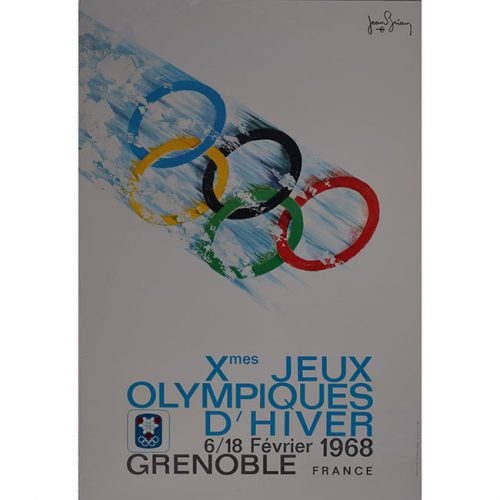
  • Jean Brian (1910-90)

    X Jeux Olympiques d'Hiver (1968 Winter Olympics Grenoble France)

    1968 Lithographic poster 95.1x 63.4cm If you are interested email info@manningfineart.co.uk or call us on 07929 749056.    
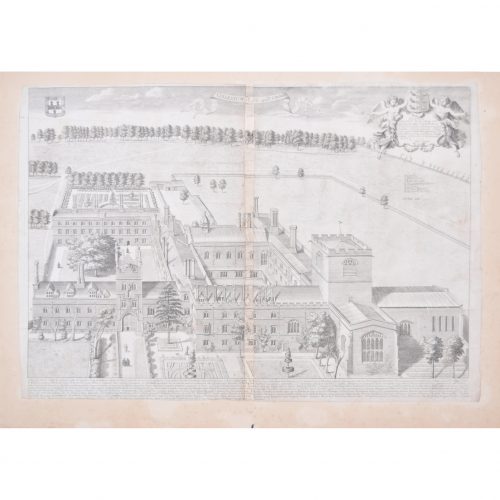
  • David Loggan (1634 - 1692)

    Jesus College, Cambridge (1690)

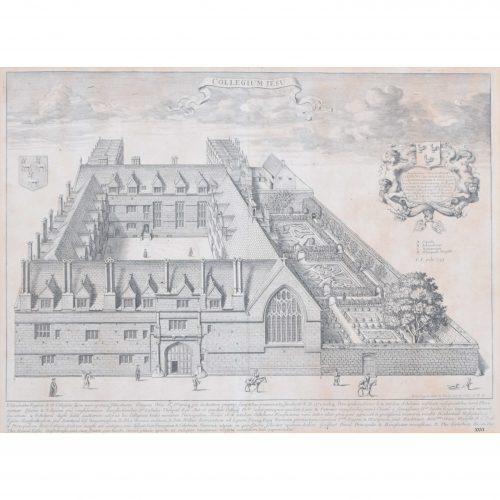
    Engraving 36 x 52 cm Loggan's skilful view of Jesus College from the 'Cantabrigia Illustrata'. Loggan was born to English and Scottish parents, and was baptised in Danzig in 1634. After studying engraving in Danzig with Willem Hondius (1598-1652 or 1658), he moved to London in the late 1650s, going on to produce the engraved title-page for the folio 1662 Book of Common Prayer. He married in 1663 and moved to Nuffield in Oxfordshire in 1665. Loggan was appointed Public Sculptor to the nearby University of Oxford in the late 1660s, having been commissioned to produce bird’s-eye views of all the Oxford colleges. He lived in Holywell Street as he did this. The 'Oxonia Illustrata' was published in 1675, with the help of Robert White (1645 - 1704). Following its completion, Loggan began work on his equivalent work for Cambridge; the 'Cantabrigia Illustrata' was finally published in 1690, when he was made engraver to Cambridge University. The 'Oxonia Illustrata' also includes an engraving of Winchester College (Winchester and New College share William of Wykeham as their founder) whilst the 'Cantabrigia Illustrata' includes one of Eton College (which shares its founder, Henry VIII, with King’s College). Bird’s-eye views from this era required a particular talent as an architectural perspectivist; it was not until 1783 that it became possible for artists to ascend via hot air balloons and view the scenes they were depicting from above. Loggan thus had to rely on his imagination in conceiving the views. Loggan’s views constitute the first accurate depictions of the two Universities, in many ways unchanged today. Whilst the Oxford engravings were produced in reasonable numbers and ran to a second edition by Henry Overton (on thicker paper and with a plate number in Roman numerals in the bottom right-hand corner), those of Cambridge were printed in much smaller numbers. The Dutchman Pieter van der Aa published some miniature versions of the engravings for James Beverell’s guidebook to the UK, 'Les Delices de la Grande Bretagne' (circa 1708). The contemporary artist Andrew Ingamells has produced a highly-acclaimed series of etchings which bring Loggan’s original vision up to date. Condition: extant portions very good; partly trimmed to within platemark; lacking portions of letters in lower left; also missing 1cm-width section down middle, historically replaced in pen and ink. Backed to laid paper. If you’d like to know more, please email info@manningfineart.co.uk or call us on 07929 749056. Click here for other views of Jesus College, Cambridge.
  • Out of stock

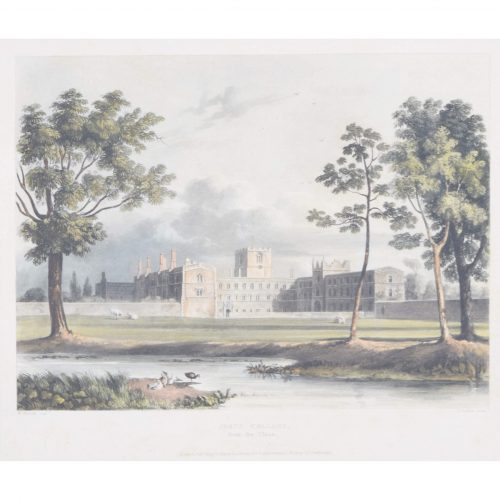
    Joseph Constantine Stadler (1755 - 1828) after William Westall (1781 - 1850)

    Jesus College, Cambridge, from the Close (1815)

      Hand-coloured aquatint 24 x 29.5 cm Published by Rudolph Ackermann (1764 - 1834). An engraving of Jesus College, foregrounded by trees, the River Cam, and grazing cattle. Joseph Constantine Stadler was a prolific German émigré engraver of images after his contemporaries - here, 18th-century English landscape painter and diarist Joseph Farington. Stadler''s engravings are wide-ranging in subject matter and include landscapes, seascapes and portraits, as well as military, sporting and decorative subjects. Stadler was employed by the leading print publisher of the time, John Boydell. Stadler lived in Knightsbridge when he died at the age of 73. William Westall was a British landscape artist. He was born in Hertford and enrolled at the Royal Academy schools in 1799. He later became the draughtsman for a voyage to Australia and the South Seas. After being shipwrecked, he travelled to Canton in China and to India, staying in Bombay for several months. He returned to England in 1805 but later set off for Madeira and Jamaica. He became a member of the Society of Painters in Water Colours (1811) and an associate of the Academy (1812). Following a mental breakdown, he regularly visited the Lake District and published ‘Views of the Valley and Vale of Keswick’ (1820). His series of aquatints of the Thames, the great universities, and England's public schools for Ackermann are among his most popular works. Rudolph Ackermann was an Anglo-German bookseller, inventor, lithographer, publisher and businessman. In 1795 he established a print-shop and drawing-school at 96 Strand. Here Ackermann set up a lithographic press and began a trade in prints. He later began to manufacture colours and thick carton paper for landscape and miniature painters. Within three years the premises had become too small and he moved to 101 Strand, in his own words "four doors nearer to Somerset House", the seat of the Royal Academy of Arts. Between 1797 and 1800 Ackermann rapidly developed his print and book publishing business, encompassing many different genres including topography, caricature, portraits, transparencies and decorative prints. Condition: good. Some age toning. If you’d like to know more, please email info@manningfineart.co.uk or call us on 07929 749056.
  • Pieter van der Aa (1659 - 1733), after David Loggan (1634 - 1692)

    Jesus College, Cambridge (1727)

      Engraving 13 x 17 cm An eighteenth-century view of Jesus College, Cambridge, engraved by Pieter van der Aa after David Loggan, the noted engraver, draughtsman, and painter. Pieter van der Aa of Leiden was a Dutch publisher best known for preparing maps and atlases, though he also printed editions of foreign bestsellers and illustrated volumes. He is noted for the many engravings he produced after David Loggan's series of Oxford and Cambridge colleges and costumes. In 1727 Van Der Aa illustrated "Les Delices de la Grande Bretagne & de L'Irelande" by James Beeverell, the book in which this engraving appears. Condition: very good. If you are interested, please email info@manningfineart.co.uk or call us on 07929 749056. Click here for other views of Jesus College, Cambridge
  • Julian Trevelyan (1910 - 1988)

    Jesus College, Cambridge

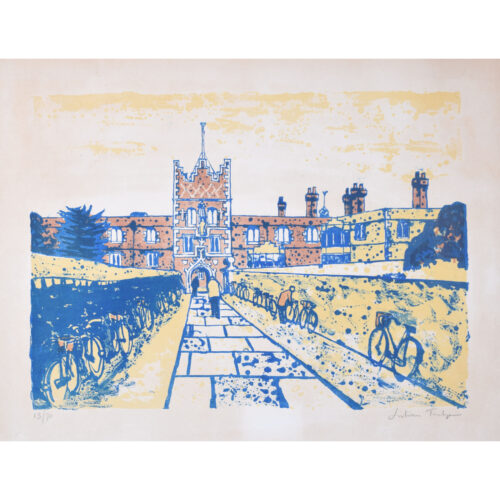
    Lithograph 38 x 53 cm Numbered 13/70 lower left and signed lower right, both in pencil. Nephew of the historian G M Trevelyan, Julian Trevelyan was educated at Bedales and then at Trinity College, Cambridge, where he read English. After moving to Paris, Trevelyan studied engraving at Stanley William Hayter’s school, working alongside artists such as Max Ernst, Joan Miro and Pablo Picasso. He married the potter Ursula Darwin in 1934, and in 1935 they moved to Hammersmith, buying Durham Wharf beside the River Thames which was Trevelyan’s studio – and home – for the rest of his life. His wartime service was – like so many artists – as a camoufleur. A Royal Engineer from 1940-43, he served in North Africa and Palestine, forcing the German Afrika Korps to use resources against a dummy army whilst real tanks were disguised as more harmless equipment. In the desert, nothing could be hidden - but it could be disguised. Following the dissolution of his marriage in 1950, he married the painter Mary Fedden. Teaching at Chelsea School of Art, Trevelyan eventually became head of the Etching Department and his pupils included David Hockney and Peter Ackroyd. Condition: generally very good; some age toning to paper. If you are interested, please email info@manningfineart.co.uk or call us on 07929 749056. Click here for other views of Jesus College, Cambridge.
  • David Loggan (1634 - 1692)

    Jesus College, Oxford (1705)

      Engraving 29 x 41 cm Loggan was born to English and Scottish parents, and was baptised in Danzig in 1634. After studying engraving in Danzig with Willem Hondius (1598 - 1652 or 1658), he moved to London in the late 1650s, going on to produce the engraved title-page for the folio 1662 Book of Common Prayer. He married in 1663 and moved to Nuffield in Oxfordshire in 1665. Loggan was appointed Public Sculptor to the nearby University of Oxford in the late 1660s, having been commissioned to produce bird’s-eye views of all the Oxford colleges. He lived in Holywell Street as he did this. The 'Oxonia Illustrata' was published in 1675, with the help of Robert White (1645 - 1704). Following its completion, Loggan began work on his equivalent work for Cambridge; the 'Cantabrigia Illustrata' was finally published in 1690, when he was made engraver to Cambridge University. The "Oxonia Illustrata" also includes an engraving of Winchester College (Winchester and New College share William of Wykeham as their founder) whilst the "Cantabrigia Illustrata" includes one of Eton College (which shares its founder, Henry VIII, with King’s College). Bird’s-eye views from this era required a particular talent as an architectural perspectivist; it was not until 1783 that it became possible for artists to ascend via hot air balloons and view the scenes they were depicting from above. Loggan thus had to rely on his imagination in conceiving the views. Loggan’s views constitute the first accurate depictions of the two Universities, in many ways unchanged today. Whilst the Oxford engravings were produced in reasonable numbers and ran to a second edition by Henry Overton (on thicker paper and with a plate number in Roman numerals in the bottom right-hand corner), those of Cambridge were printed in much smaller numbers. The Dutchman Pieter van der Aa published some miniature versions of the engravings for James Beverell’s guidebook to the UK, ''Les Delices de la Grande Bretagne'' (circa 1708). The contemporary artist Andrew Ingamells has produced a highly-acclaimed series of etchings which bring Loggan’s original vision up to date. Condition: generally very good. Slight time staining. If you’d like to know more, please email info@manningfineart.co.uk or call us on 07929 749056.
  • Pieter van der Aa (1659-1733), after David Loggan (1634–1692)

    Jesus College, Oxford (1727)

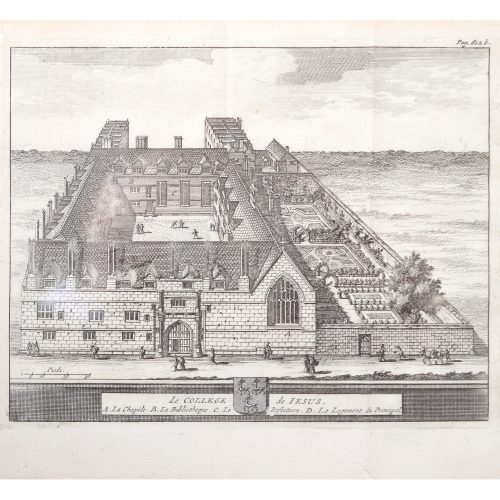
      Engraving 12 x 16 cm An eighteenth-century view of Jesus College, engraved by Pieter van der Aa after David Loggan, the noted engraver, draughtsman, and painter. Pieter van der Aa of Leiden was a Dutch publisher best known for preparing maps and atlases, though he also printed editions of foreign bestsellers and illustrated volumes. He is noted for the many engravings he produced after David Loggan's series of Oxford and Cambridge colleges and costumes. In 1727 Van Der Aa illustrated "Les Delices de la Grande Bretagne & de L'Irelande" by James Beeverell, the book in which this engraving appears. Condition: a good impression. If you’d like to know more, please email info@manningfineart.co.uk or call us on 07929 749056.
  • Johannes 'Jan' Kip (1652/3 - 1722)

    The North Prospect of Gloster Cathedral (c.1716)

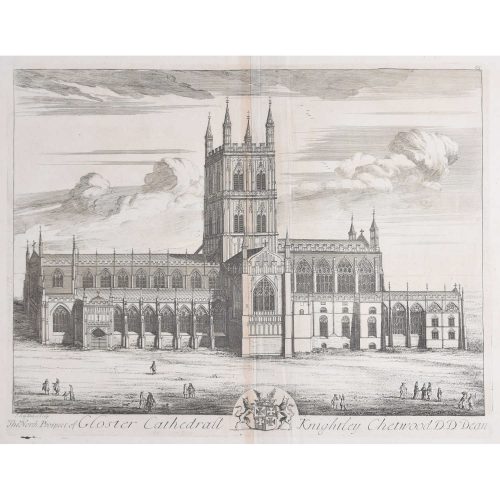
    43 x 47 cm Copper engraving Johannes "Jan" Kip was a Dutch engraver, draughtsman and print dealer. After producing works for the court of William of Orange in Amsterdam, Kip followed William and Mary to London, settling in Farringdon and selling prints. Later, Kip collaborated with draughtsman and painter Leonard Knyff, and together they made a popular series of engraved views of English country houses. This print is from Sir Robert Atkyn's 'The Ancient and Present State of Gloucestershire'. In his usual manner - Kip was probably the foremost engraver of his time in England - he has placed figures before the Cathedral to give life - and scale - to the building. Condition: Generally very good with central vertical fold and adjacent parallel creases; one diagonal crease mid left to bottom centre. Will look very good when framed.  
  • John Alcock, Founder of Jesus College, Cambridge

    Aquatint with original hand colouring 18 x 16 cm Published by Rudolph Ackermann (1764 - 1834). Rudolph Ackermann was an Anglo-German bookseller, inventor, lithographer, publisher and businessman. In 1795 he established a print-shop and drawing-school at 96 Strand. Here Ackermann set up a lithographic press and began a trade in prints. He later began to manufacture colours and thick carton paper for landscape and miniature painters. Within three years the premises had become too small and he moved to 101 Strand, in his own words "four doors nearer to Somerset House", the seat of the Royal Academy of Arts. Between 1797 and 1800 Ackermann rapidly developed his print and book publishing business, encompassing many different genres including topography, caricature, portraits, transparencies and decorative prints. Condition: Generally very good.

    If you would like to know more, please email info@manningfineart.co.uk or call us on 07929 749056.

  • John Aldridge RA (1905 - 1983)

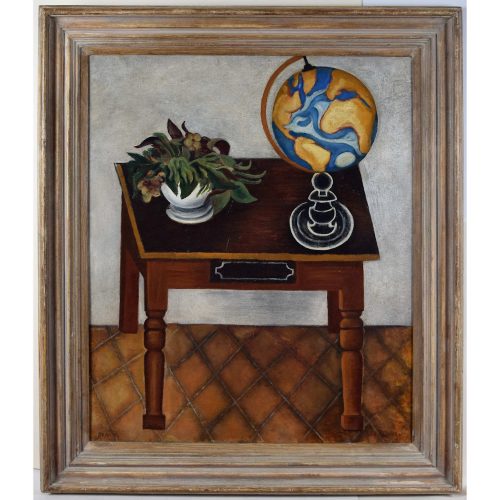
    Still Life with Globe Painted at El Porche, Dejà, Mallorca 1932

    Oil on Board 74 x 62 cm Signed ‘John Aldridge’ lower right, inscribed 'Deja 32' lower left, and titled to reverse. A British oil painter, designer of wallpapers and textiles, book illustrator, art teacher and enthusiastic plantsman, John Aldridge was born in Woolwich, England, and grew up in a comparatively wealthy military family. After reading Greats at the University of Oxford, Aldridge graduated in 1928 with a Bachelor of Arts degree, settling in London and teaching himself to paint. Invited by Ben Nicholson, Aldridge joined artists such as Hepworth, Moore and Piper in the ‘Seven and Five Society’ with whom he held his first mixed exhibition in 1931. Despite being based in London during this time, Aldridge made excursions to Paris, Germany, Italy, Tenerife and Mallorca. As a dear friend of the poet Robert Graves, the two spent endless holidays together in Mallorca near Deià, Graves having a house there which can be visited to this day. This work is inscribed ‘Deyà 32’ in the lower left corner, thus it is likely that it was painted during one of these periods. Exhibitions held with the ‘Seven and Five Society’ at Leicester Galleries in this period lead to numerous other exhibitions of his work, both with the ‘Seven and Five Society’ and otherwise. Aldridge was elected an Associate of the Royal Academy (ARA) in 1954, then a full member (RA) in 1963. Despite this, during his later years Aldridge’s art went out of fashion, his somewhat nostalgic works out of style with the arrival of the swinging 60s and 70s that treated old England as an abomination that needed to be forgotten. Since then, Aldridge’s art has been brought back into the eyes of the fine arts industry and recognised as it deserves. True to Aldridge’s diverse output, this work reflects the rapid-spreading modernist movement of the early twentieth century. It mimics Cézanne’s dual perspective, looking down yet looking forwards. The technique encapsulates the human experience of multiple viewpoints while simultaneously creating a sense of instability. The globe, often associated with knowledge, exploration and a symbol of human control over the world, is juxtaposed with the wilting pot plant, a motif of the transience and uncontrollability of nature. On account of the unsteadiness, the globe appears precarious, teetering on the edge of the table, while the plant stands firmly in the centre, perhaps signifying that nature is ultimately more dominant that a futile human attempt at control over the world. Although the objects appear simple or mundane, Aldridge uses this altar-like setup, pedestalling them to encourage the viewer to contemplate objects which would otherwise go unnoticed. The objects themselves are traditional, the globe a contemplative symbol shared with Holbein’s ‘The Ambassadors’, yet Aldridge follows in the footsteps of the emerging modernists, breaking the mould through perspective and abstraction, opening an opportunity for reception theory; the meaning of the painting changes and evolves for each new spectator. His art is in major public collections such as the Tate, the British Council, the National Portrait Gallery, the Royal Academy and the Victoria and Albert Museum. The Fry Art Gallery in Saffron Walden, which specialises in East Anglian pictures, has a significant holding of his work. Condition: generally very good. Distressed frame with occasional loss, and board slightly bowed.
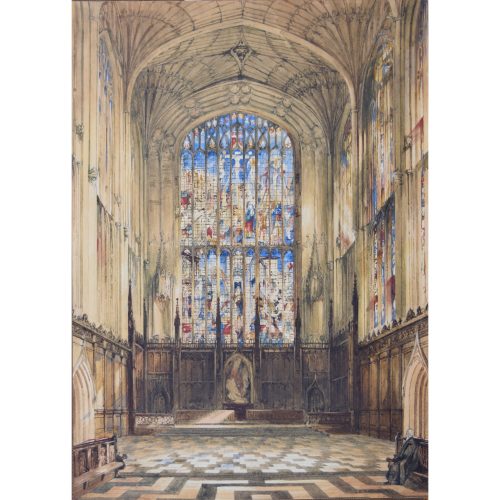
  • John Anderson Bell (1809-1865)

    King's College Cambridge Chapel Interior

    Signed and indistinctly dated Watercolour c. 1840 53x39cm Bell was born in Glasgow; his father was James Bell, advocate and his sister Jane Cross Simpson the hymn-writer and poet. Following Edinburgh University Bell spent 1829 and 1830 in Rome as an art student, returning to the UK to serve his articles as an architect with Rickman & Hutchinson, the gothic revivalist practice in Birmingham.  Subsequently he practised in Edinburgh, designing country houses, and the Victoria Buildings in Glasgow for the Conservative politician Archibald Orr Ewing in Scottish baronial style. Thirty of the engravings in John Le Keux's magnificent 1847 book Memorials of Cambridge are from paintings by Bell; this particular painting is believed to have been painted at the same time, although not published. The Great East Window depicted in the painting was created between 1526 and 1531 by Gaylon Hone and three partners (one Flemish and two English) and - together with the other sixteen they made - represent some of the finest stained glass of their period. Here Bell has captured the colours and the light of the window in almost magical fashion. It is an interesting view as it records the chapel in the mid nineteenth century. In 1968 the installation of Rubens' the Adoration of the Magi as an altarpiece involved the lowering of the Sanctuary floor through removal of the steps clearly visible in Bell's view and also removal of the seventeenth century panelling around the walls. It is still felt that the chapel would have been better left 'unimproved' and without the Reubens, though the form recorded by Bell had itself been improved in 1906 when Detmar Blow designed a reredos. Blow's reredos remains in storage in the College. The East window may be viewed in high resolution in the series of seven short films - accompanied by music by King's alumnus Francis Grier - entitled Sword in the Soul.
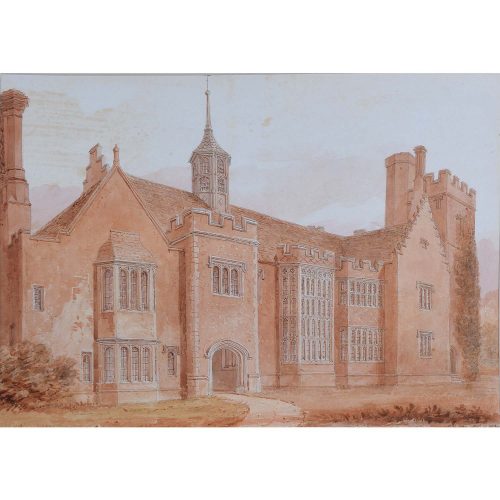
  • John Chessell Buckler (1793-1894)

    Horham Hall Essex 1830

    Watercolour 25 x 35.5 cm 44 x 57 cm including frame, UK shipping only J C Buckler was an esteemed architect, coming second to Charles Barry in the competition for the design of the new Houses of Parliament in 1836. However, his greatest passion was recording the details of historical buildings. ⁠ ⁠ 'With such subjects before me as cathedrals, abbeys and ancient parish churches...I never made any effort to increase the number of my employments as an architect.' Buckler 1852⁠ ⁠ Harmoniously working with his father and younger brother, Buckler drew and preserved the designs of ancient structures, many of which no longer survive today. ⁠ ⁠ Horham Hall is stands as a fortunate exception.⁠ If you are interested email info@manningfineart.co.uk or call us on 07929 749056. Condition: Good.
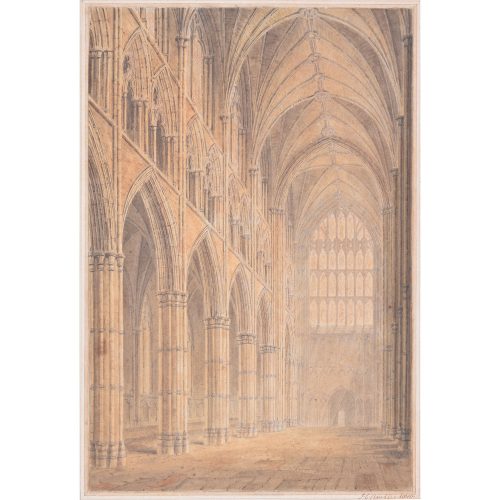
  • John Chessel Buckler (1793-1894)

    The Nave of Westminster Abbey

    Watercolour Signed, Titled and dated 1810 25x17 cm Click here for other works by Buckler and biographical detail. If you are interested email info@manningfineart.co.uk or call us on 07929 749056.
  • John Dean Monroe Harvey (1895-1978) 

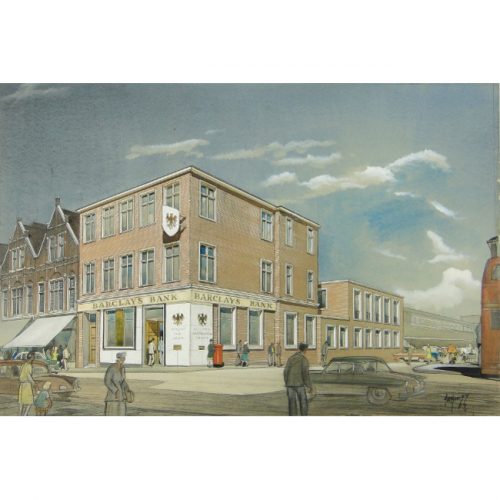
    A design for Barclays Bank, Walthamstow (1964)

    Signed and dated ‘J D M Harvey 64.’ Gouache on paper. A very fine architectural perspective by Harvey with his customary distinctive clouds and elegant people. The scheme was built, but the ground floor has since been rebuilt in a rather less satisfactory fashion. 41 x 60 cm (16 x 23 inches) For biographical details and more works by JDM Harvey, please click here. If you are interested email info@manningfineart.co.uk or call us on 07929 749056.
  • John Dean Monroe Harvey (1895-1978)

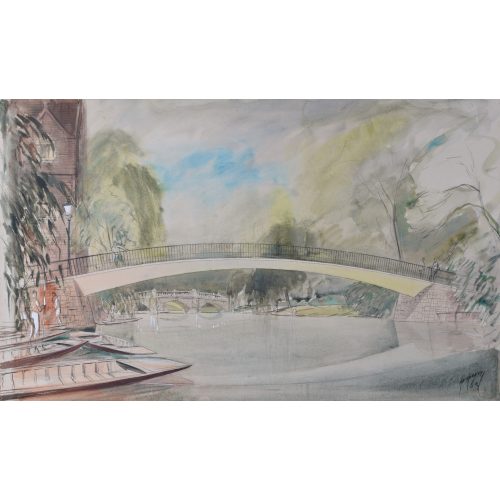
    Garret Hostel Bridge, Cambridge, Trinity Hall and Clare College behind

    38x61cm Watercolour and pencil For biographical details and more works by JDM Harvey, please click here. If you are interested email info@manningfineart.co.uk or call us on 07929 749056.
  • John Fulleylove (1845-1908) attributed Canterbury Quad, St John's College Oxford

    Watercolour over pencil, unsigned 40.5x30.5cm Born in Leicester, John Fulleylove trained as an architect with a Leicester firm before becoming a full-time painter. He exhibited widely in the UK, at such venues as the Royal Academy, the Fine Art Society, and the Royal Society of British Artists. His paintings were the subject of illustrated topographical books, including one on ‘Oxford’ published by the Fine Art Society. If you are interested email info@manningfineart.co.uk or call us on 07929 749056. Condition: Laid to thick card support; generally very good, two small spots to sky visible in photograph.
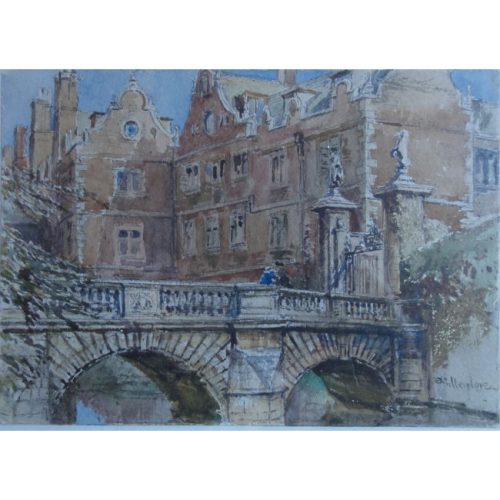
  • John Fulleylove (1845-1908) The Kitchen Bridge, St John’s College, Cambridge Signed lower right “Fulleylove” Watercolour 13 x 19cm (5 x 7 inches) Please click here for the matching watercolour of the Old Library together with biographical details and other works by the artist. If you are interested email info@manningfineart.co.uk or call us on 07929 749056.
  • John Fulleylove (1845-1908)

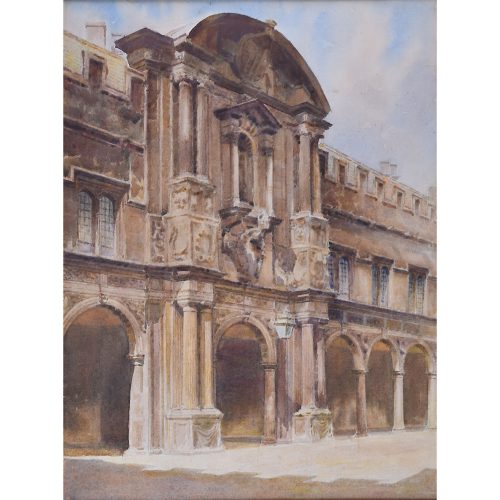
    The Old Library, St John’s College, Cambridge

    Signed lower right “Fulleylove” Watercolour 19x13cm (7×5 inches) Please click here for the matching watercolour of the Kitchen Bridge together with biographical details and other works by the artist. If you are interested email info@manningfineart.co.uk or call us on 07929 749056.
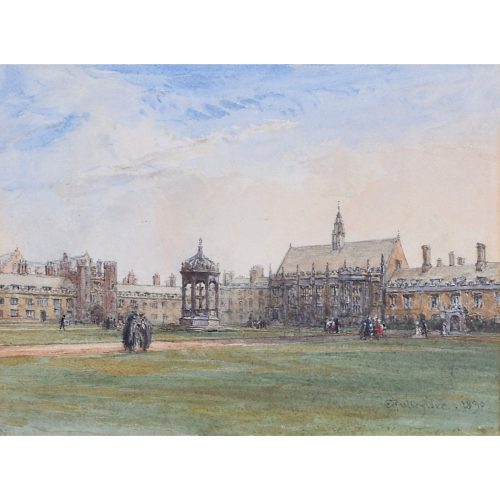
  • John Fulleylove (1845-1908) Trinity College, Cambridge - Great Court

    Watercolour 13x17cm Born in Leicester, John Fulleylove trained as an architect with a Leicester firm before becoming a full-time painter. He exhibited widely in the UK, at such venues as the Royal Academy, the Fine Art Society, and the Royal Society of British Artists. His paintings were the subject of illustrated topographical books, including one on ‘Oxford’ published by the Fine Art Society. If you are interested email info@manningfineart.co.uk or call us on 07929 749056. Condition: Good.
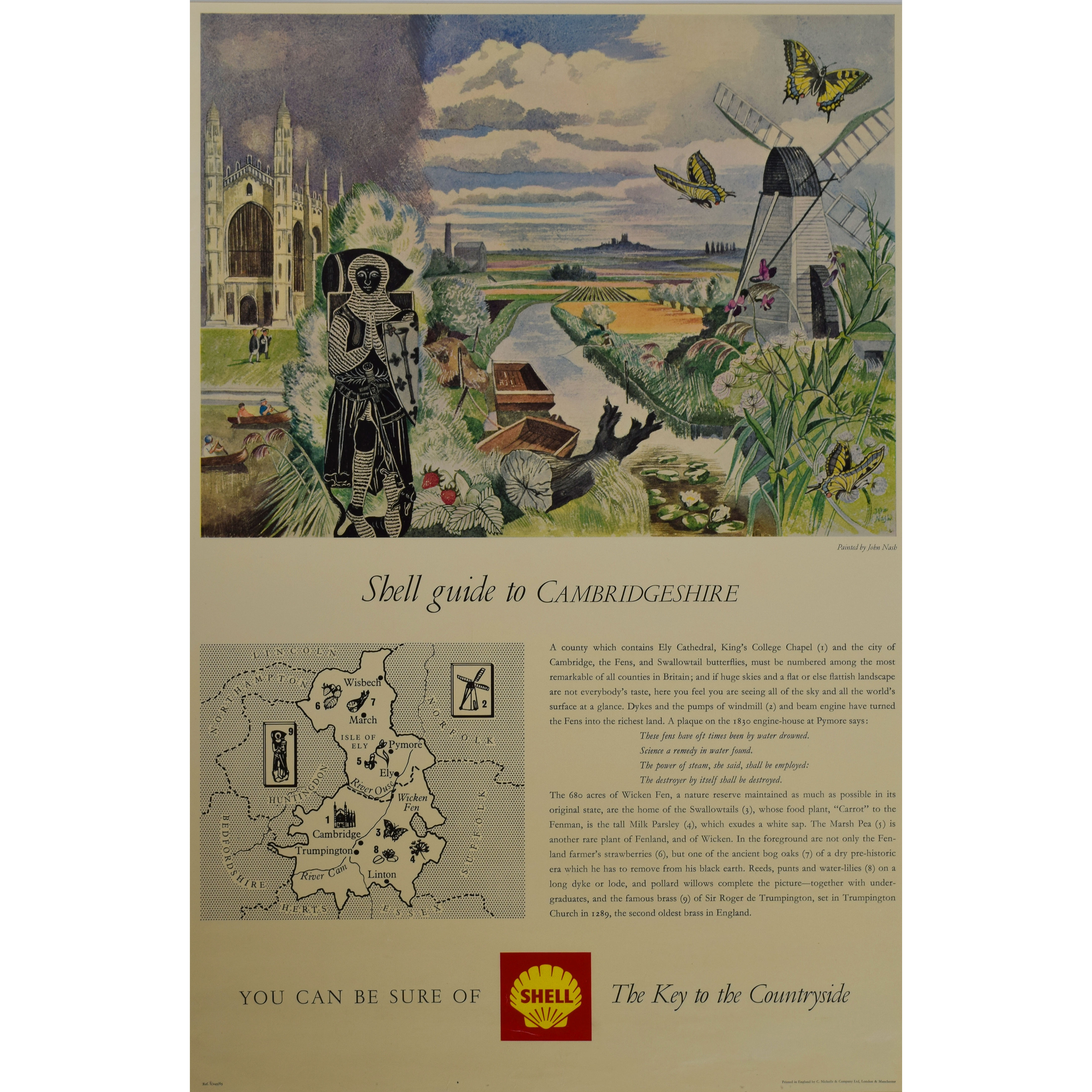
  • John Nash

    Shell Guide to Cambridgeshire Original poster c. 1960s 76x51cm Shell commissioned a series of posters to go with their County Guide books, and they commissioned paintings by the leading artists of the day. Nash needs no introduction as an artist. A painter of landscapes and still-lives and illustrator - particularly of botanic works - who worked extensively with wood engravings, he was a natural choice for Shell. His most famous work is probably 'Over the Top' which hangs in the Imperial War Museum, relating to a counter-attack by 1st Battalion Artists' Rifles at Welsh Ridge on 30 December 1917. Of the eighty men who went over the top, sixty-eight were killed or wounded within the first few minutes. Nash escaped and painted the picture three months later. The Tate holds his 1918 painting 'The Cornfield' which was his first non-war painting (he only started painting in oils in 1914). Condition: mounted in conservation mount and wrapped in plastic sleeve (mount hides short edge tears).
  • John Piper (1903-1992)

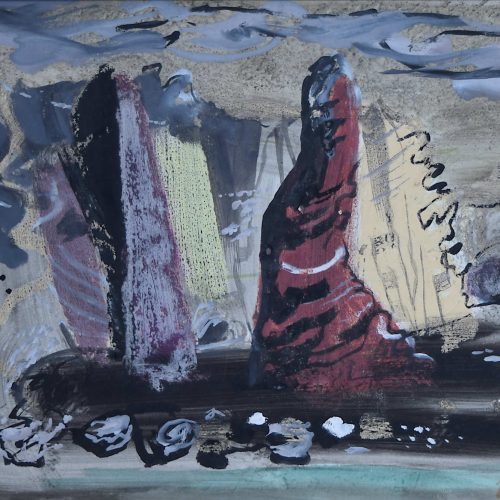
    Bullslaughter Bay

    Watercolour, gouache and pastel on paper 27.5 x 35.5cm John Piper CH was an English painter, printmaker, and designer of stained-glass windows. His work often focused on the British landscape, especially churches and monuments, and included tapestry designs, book jackets, screen-prints, photography, fabrics and ceramics. Piper spent a considerable amount of time in Pembrokeshire, frequently returning to the landscape of Bullslaughter Bay; this painting was probably produced there in the mid-1950s. The artist captures an animated, capricious bay, characterised by a distinctive colour palette and stamped with irregular rock formations. Condition: generally excellent. For other works by the artist and biographical details, click here. If you are interested email info@manningfineart.co.uk or call us on 07929 749056.
  • John Piper (1903-1992)

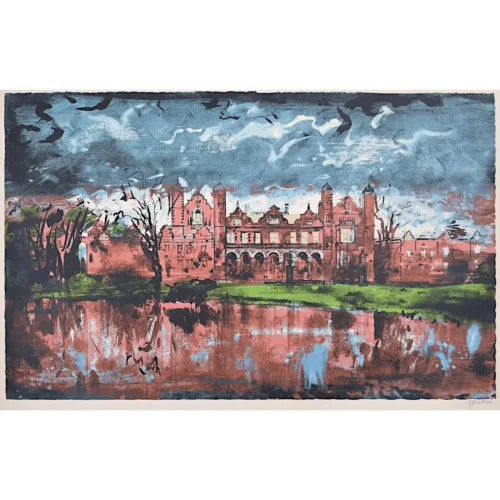
    Capesthorne Hall (1977)

      Screenprint 64 x 102 cm Piper captures here, in his usual fanciful colours, the Cheshire stately home of Capesthorne Hall. Built in neoclassical style by William Smith and his son Francis, the hall today is used for weddings and other civil occasions. John Piper CH was an English painter, printmaker, and designer of stained-glass windows. His work often focused on the British landscape, especially churches and monuments, and included tapestry designs, book jackets, screen-prints, photography, fabrics and ceramics. Condition: very good; a little old discolouration to edges under mount. If you are interested, please email info@manningfineart.co.uk or call us on 07929 749056. Click here for other works by John Piper.
  • John Piper (1903 - 1992)

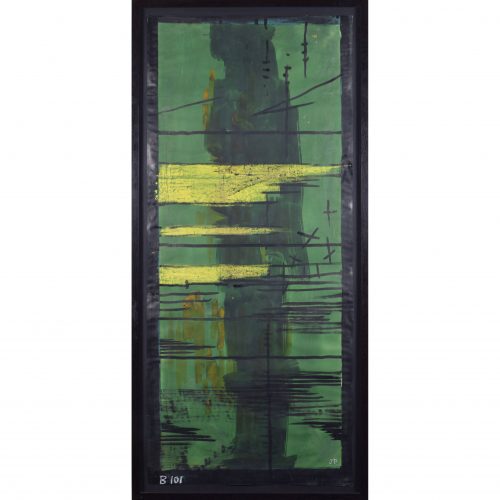
    Cartoon for Baptistry Chapel Window, Coventry Cathedral

      Gouache and mixed media art 127 x 54 cm Labelled B101 by the artist and initialled. A gouache design for one of the Coventry Cathedral Baptistry Window panels. John Piper was commissioned to design the Baptistry Window in 1955, in partnership with glassmaker Patrick Reyntiens. The window is made of 198 panels of stained glass and is 26 metres high.

    Piper commented in his book “Stained Glass: Art or Anti-Art?” that ‘The function, the flesh and blood and bones of stained glass – its whole being – is to gratify light and to intensify atmosphere in a room or building, not necessarily to provide colour – or a message.’ The ambiguous post-war tenor of the design is striking: the khaki palette, the soldier-like figure, and the landscape evoking a 20th century theatre of war.

    John Piper CH was an English painter, printmaker, and designer of stained-glass windows. His work often focused on the British landscape, especially churches and monuments, and included tapestry designs, book jackets, screen-prints, photography, fabrics and ceramics. Condition: very good. Four pin holes and a small handling mark mid left. If you are interested, please email info@manningfineart.co.uk or call us on 07929 749056. Click here for other works by John Piper.
  • John Piper (1903–1992)

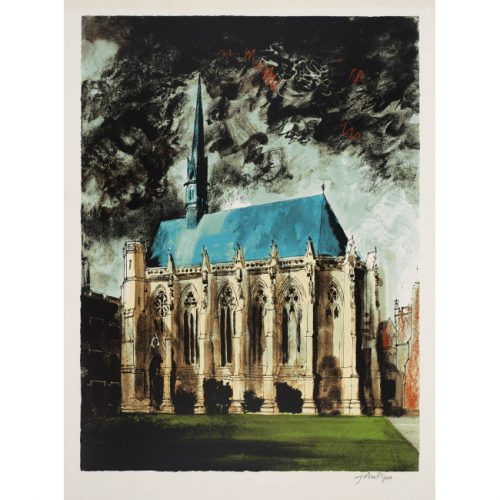
    Exeter College, Oxford (1977)

    Screenprint Signed in pencil 81.9x61cm (32.2x24 inches) One of Piper's largest and most impressive prints, here featuring Gilbert Scott's chapel at Exeter. It is often claimed that Gilbert Scott based it on Paris's Sainte Chapelle. If you are interested email info@manningfineart.co.uk or call us on 07929 749056. Condition: slight even age toning to paper, small area of repair to print.
  • John Piper C.H. (British 1903-1992)

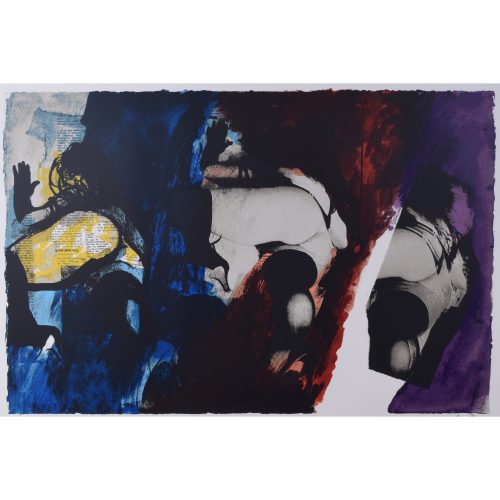
    Eye and Camera: Red, Blue and Yellow

    (Levinson 317) Screenprint in colours, 1980, on Arches signed John Piper, a proof print aside form the numbered edition of 150, published by Kelpra Editions and the Tate Gallery. Framed in plain black hand-finished frame 400 x 605 mm Condition: Excellent - never previously framed. Click here for biographical details and other works by the artist. If you are interested email info@manningfineart.co.uk or call us on 07929 749056.
  • John Piper C.H. (1903-1992)

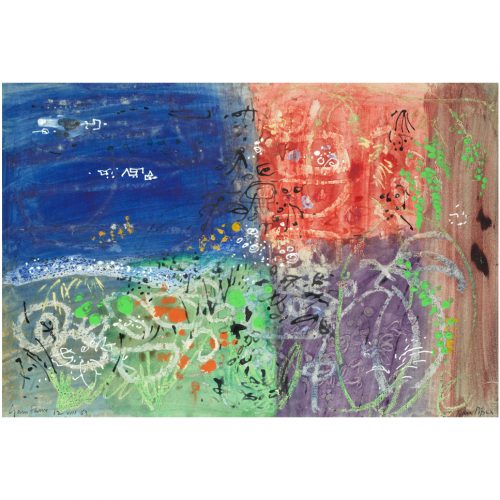
    Garn Fawr

    Watercolour and gouache on paper; executed 1969 37 x 54 cm Titled and dated lower left ‘Garn Fawr 12 VIII 69′; signed lower right. It was Piper's wife, Myfanwy - whom he met whilst she lived in London with her Welsh family - who first introduced Piper to West Wales in the 1930s. The Pembrokeshire landscape became his muse, as it also did for Graham Sutherland, another great neo-romantic painter. Having lived in various parts of Wales during the post-war period, the Pipers bought a cottage by Garn Fawr, on the Pembrokeshire Coas, in 1962. The volcanic outcrop was the site of an Iron Age hill fort, and had also been used as a high-viewpoint during the First World War. Piper started out as a mostly abstract artist, but by the 1960s he had moved more towards realism, often focusing on depicting architecture. Here, Piper paints the wet Welsh countryside. Each of the fields is complete with its own crop; the different plants and flowers are designated by characteristic splashes of dark colour. For other works by the artist and biographical details, click here. If you are interested, please email info@manningfineart.co.uk or call us on 07929 749056.
  • John Piper (1903-1992)

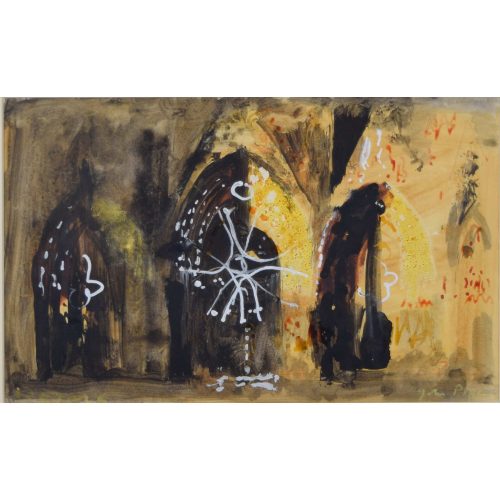
    Reims Cathedral (c. 1960)

    Ink, watercolour and gouache 21x35cm Inscribed 'Reims' lower left and signed 'John Piper' lower right. Piper loved all things France, and all things Cathedral; in this work, he brings the cathedral of Reims, where France's monarchs were crowned, to life. Piper also produced an aquatint of Reims which was published in 1972. For other works by the artist and biographical details, click here. If you are interested email info@manningfineart.co.uk or call us on 07929 749056. Condition: Generally excellent; framed.
  • John Piper C.H. (BRITISH, 1903-1992)

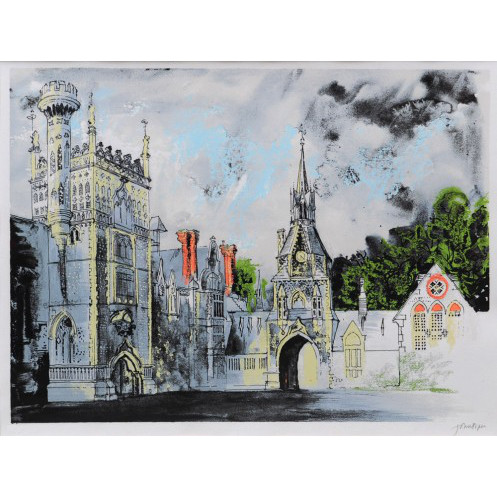
    Shadwell Park

    (Levinson 277) Screenprint in colours, on Arches, signed and numbered. Printed by Kelpra Studio and published by Marlborough Fine Art, London. 510 x 690mm From the 'Victorian Dream Palaces' series of prints by Piper. Click here for biographical details and other works by the artist. If you are interested email info@manningfineart.co.uk or call us on 07929 749056. Condition: generally very good. A little discolouration to extreme margins hidden under mount. In hand-finished black-painted frame.
  • John Piper

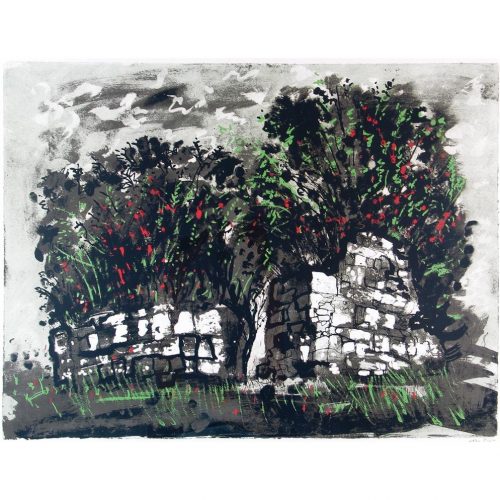
    Skeabost, Skye 1975

    Screenprint by Curwen Studio Printed on Arches by Kelpra Studio and published by Marlborough Fine Art 68x89cm Signed in crayon; an un-numbered proof print aside from the edition of 70. Levinson 250 From the Series 'Five Scottish Chapels (in ruins)' If you are interested email info@manningfineart.co.uk or call us on 07929 749056.
  • John Piper (1903-1992) Study for the Piper Building Mural Gouache 24 x 20 cm Provenance: Bernard Kelly Collection John Piper CH was an English painter, printmaker, and designer of stained-glass windows. His work often focused on the British landscape, especially churches and monuments, and included tapestry designs, book jackets, screen-prints, photography, fabrics and ceramics. This study forms a striking a part of London's architectural history. It was originally produced by Piper as a study for a larger mural in the Piper Building. Although the abstraction of this painting is, in itself, striking, the pinkish hues and ethereal shapes almost recall Monet's hazy views over the Thames. The Piper Building is a mid-century architectural icon in Fulham. Built in the 1950s as 'Watson House', it was a laboratory complex for the North Thames Gas Board and has an innovative concrete structure. Piper was commissioned to produce the murals surrounding the building. The Gas Board moved out in the mid 1980s. Scheduled for demolition in the 1990s, the building was instead converted into seventy apartments and renamed the Piper Building. With double-height ceilings, the apartments were sold as shells, and purchasers were free to commission their own architects and builders. Condition: Generally excellent; framed. For other works by the artist and biographical details, click here. If you are interested email info@manningfineart.co.uk or call us on 07929 749056.
  • John Piper (1903-1992)

    Study for the Piper Building mural

    Gouache 14.5x11.5cm Provenance: P Manzareli (who built the fibreglass murals for Piper), gift from the artist; Milne & Moller Fine Art; Katharine House Gallery; private collection, Scotland. This study is a fascinating part of London's architectural history. The Piper Building is a mid-century architectural icon in Fulham. Built in the 1950s as 'Watson House', it was a laboratory complex for the North Thames Gas Board and has an innovative concrete structure. Piper was commissioned to produce the murals surrounding the building. The Gas Board moved out in the mid 1980s. Scheduled for demolition in the 1990s, the building was instead converted into seventy apartments and renamed the Piper Building. With double-height ceilings, the apartments were sold as shells, and purchasers were free to commission their own architects and builders. Condition: Generally excellent; framed. For other works by the artist and biographical details, click here. If you are interested email info@manningfineart.co.uk or call us on 07929 749056.
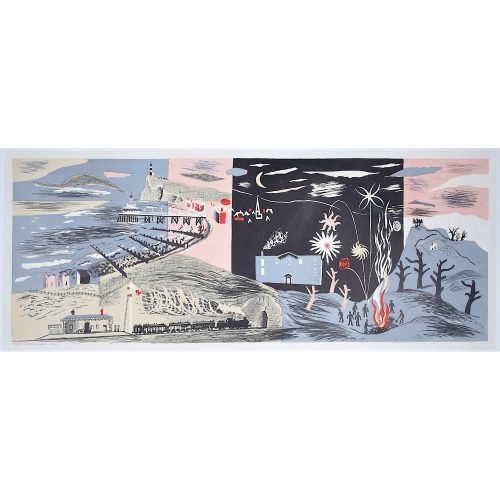
  • John Piper C.H. (British 1903-1992) Nursery Frieze II

    500 x 1250 mm Lithograph 1936 One of Piper's many seascapes, Frieze II is an exercise in abstract capriccio. Piper draws together the muted grey, pink, and blue of the lithograph's fragmented background with foreground details in black, white, and bright red, picking out particular moments of the frieze for the viewer. The lighthouse has no keeper; the beach and the pier are empty; the train has neither passengers nor driver. The church at the top of the rocky hill is a brilliant cubist borrowing, showing both the West end and the North side simultaneously - and it has no congregation. The only human figures present in the frieze are those collected around the bonfire, watching the flames and the show of fireworks. The scene is at once devoid of people and intensely human. Piper was just 24 when he made Frieze II. If you are interested, please email info@manningfineart.co.uk or call us on 07929 749056. Condition: Generally very good, backed to linen with small - and largely not visible - areas of restoration.
  • John Piper (1903-1992)

    St James the Less, Westminster

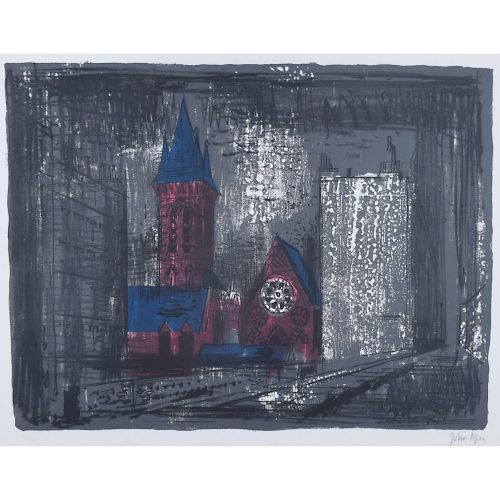
    Screenprint 65 x 49 cm From the 'Retrospect of Churches' series, numbered 24/70. Generally very good. Signed in pencil. John Piper CH was an English painter, printmaker, and designer of stained-glass windows. His work often focused on the British landscape, especially churches and monuments, and included tapestry designs, book jackets, screen-prints, photography, fabrics and ceramics. A Retrospect of Churches was issued as a suite of 24 original colour lithographs in colour, in an edition of 70 copies (70 numbered copies plus five artist's proofs). This poignant and dramatic representation of St James the Less is an evocative depiction of this part of London in the evening: wet pavements reflect the bright lights of the buildings, and the church is a warm, moody reddish-purple against the deep black of a dark night. Condition: Generally very good.
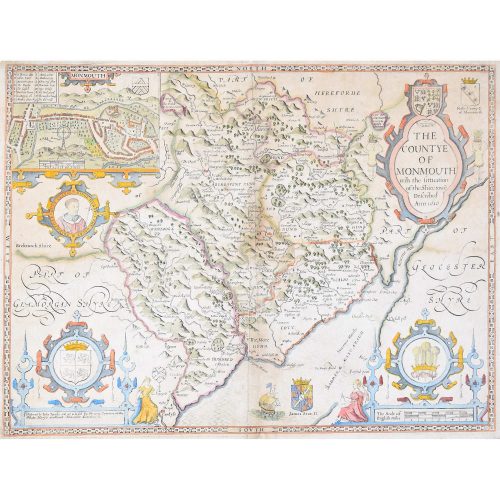
  • John Speed/Speede (1551/2-1629) The Countye of Monmouthshire

    Performed by John Speede assisted by William Smyth. And are to be sold by Henry Overton at the White Horse without Newgate London. Printed 1710-1743 Probably the most famous early English mapmaker, John Speed's early life is somewhat of an enigma. He is believed to have trained as a rolling-press printer, but he was at heart an historian granted a sinecure in the Customs House by Queen Elizabeth to indulge his passion, later becoming a Fellow of the Society of Antiquaries. His first maps were historical, of the Holy Land 'Canaan as it was Possessed both in Abraham and Israels Dayes' and of England and Ireland recording 'all their Civill Warres since the Conquest'. In 1611 he published his 'Hostory of Great Britaine' which he regarded as his magnum opus, but it was the companion atlas 'Theatre of the Empire of Great Britaine' that - as the first printed atlas of Great Britain - sealed his reputation. William Rogers engraved the first map, 'the County Palatine of Chester' in about 1600, but following his untimely death the task of engraving was passed to Jodocus Hondius of Amsterdam. By 1612 the atlas was complete, the maps famed for their decorative elements. Many have town plans - Britain's first series of such plans - and descriptive text was printed to the reverse until the 1676 edition. Later printings (up until 1770) were issued without this text. By 1627 it has become a part of a world atlas 'Prospect of the Most Famous Parts of the World'. During the 17th century the plates passed through the hands of a series of publishers, the 1676 edition of Thomas Bassett and Richard Chiswell being regarded as its high point with the inclusion for the first time of a series of important maps. For the first half of the eighteenth century they were firmly established in the hands of the Overton family. If you are interested email info@manningfineart.co.uk or call us on 07929 749056. Condition: Small losses outside platemark just reaching platemark at top, with some toning to paper as usual. Later but well undertaken hand-colouring. Generally good condition.
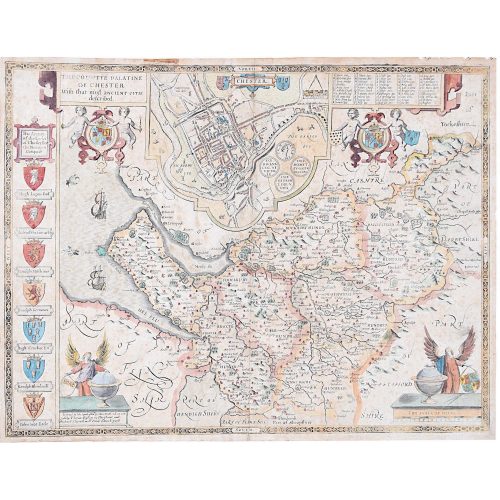
  • John Speed/Speede (1551/2-1629) The Countye Palatine of Chester with that most ancient citie 

    39x51cm Engraving Probably the most famous early English mapmaker, John Speed's early life is somewhat of an enigma. He is believed to have trained as a rolling-press printer, but he was at heart an historian granted a sinecure in the Customs House by Queen Elizabeth to indulge his passion, later becoming a Fellow of the Society of Antiquaries. His first maps were historical, of the Holy Land 'Canaan as it was Possessed both in Abraham and Israels Dayes' and of England and Ireland recording 'all their Civill Warres since the Conquest'. In 1611 he published his 'Hostory of Great Britaine' which he regarded as his magnum opus, but it was the companion atlas 'Theatre of the Empire of Great Britaine' that - as the first printed atlas of Great Britain - sealed his reputation. William Rogers engraved the first map, 'the County Palatine of Chester' in about 1600, but following his untimely death the task of engraving was passed to Jodocus Hondius of Amsterdam. By 1612 the atlas was complete, the maps famed for their decorative elements. Many have town plans - Brtiain's first series of such plans - and descriptive text was printed to the reverse until the 1676 edition. Later printings (up until 1770) were issued without this text. By 1627 it has become a part of a world atlas 'Prospect of the Most Famous Parts of the World'. During the 17th century the plates passed through the hands of a series of publishers, the 1676 edition (as here) of Thomas Bassett and Richard Chiswell being regarded as its high point with the inclusion for the first time of a series of important maps. If you are interested email info@manningfineart.co.uk or call us on 07929 749056. Condition: Trimmed and other small losses outside platemark. Some toning and spotting to paper as usual. Later but well undertaken hand-colouring. Old tape mark to top outside platemark. Generally good condition.
  • John Speed/Speede (1551/2-1629) The County of Surrey Described and Divided into Hundreds

    Engraving with later hand colouring and text to the reverse Dated to 1650 36 x 49 cm Probably the most famous early English mapmaker, John Speed's early life is somewhat of an enigma. He is believed to have trained as a rolling-press printer, but he was at heart an historian granted a sinecure in the Customs House by Queen Elizabeth to indulge his passion, later becoming a Fellow of the Society of Antiquaries. His first maps were historical, of the Holy Land 'Canaan as it was Possessed both in Abraham and Israels Dayes' and of England and Ireland recording 'all their Civill Warres since the Conquest'. In 1611 he published his 'Hostory of Great Britaine' which he regarded as his magnum opus, but it was the companion atlas 'Theatre of the Empire of Great Britaine' that - as the first printed atlas of Great Britain - sealed his reputation. William Rogers engraved the first map, 'the County Palatine of Chester' in about 1600, but following his untimely death the task of engraving was passed to Jodocus Hondius of Amsterdam. By 1612 the atlas was complete, the maps famed for their decorative elements. Many have town plans - Britain's first series of such plans - and descriptive text was printed to the reverse until the 1676 edition. Later printings (up until 1770) were issued without this text. By 1627 it has become a part of a world atlas 'Prospect of the Most Famous Parts of the World'. During the 17th century the plates passed through the hands of a series of publishers, the 1676 edition of Thomas Bassett and Richard Chiswell being regarded as its high point with the inclusion for the first time of a series of important maps. For the first half of the eighteenth century they were firmly established in the hands of the Overton family. This particular edition originally featured in The Theatre Of The Empire Of Great Britaine. It features attractive inset views of the long-since destroyed Richmond and Nonsuch Palaces, compass rose, scale of miles, coats of arms and decorative strapwork. Its hand colouring also lends a bright charm to this map, highlight the fields and adding vibrancy to the coats of arms. If you are interested email info@manningfineart.co.uk or call us on 07929 749056. Condition: Generally very good, glued to mount (sold with frame), few creases
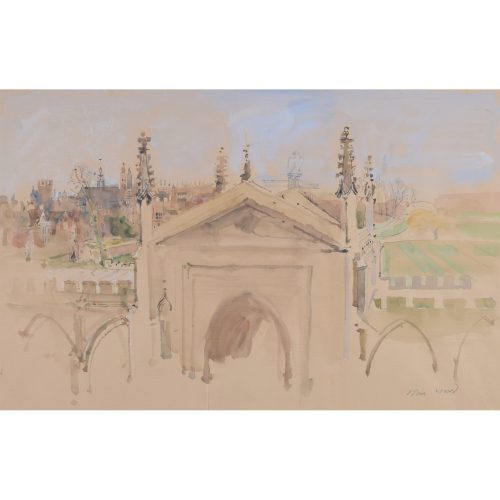
  • John Stanton Ward CBE (1917 - 2007)

    St John's College, Cambridge

      Watercolour 30 x 47 cm   John Stanton Ward CBE was an English portrait artist, landscape painter and illustrator. This view of St John's highlights the dreamlike quality of the college and its city. Ward depicts Cambridge on a winter afternoon; the trees are bare, and the afternoon sun sets gently over the city's lawns and high spires. Condition: very good.
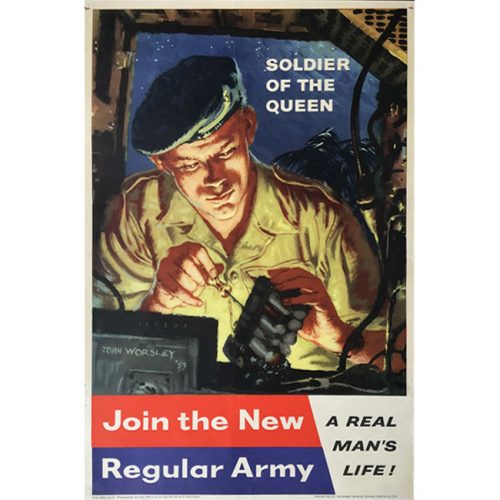
  • John Worsley (1919-2000)

    Join the Regular Army

    Printed for H.M. Stationary Office by Leonard Ripley & Co. (1959) Lithographic poster 76x51cm Worsley was a war artist during World War II who was captured by the Germans and then an illustrator for Eagle comic. Click here for further biographical details and other posters by Worsley. This image is titled A Royal Signals Technician Repairing a Radio and the original oil painting is in the Royal Signals Museum in Blandford Forum. If you are interested email info@manningfineart.co.uk or call us on 07929 749056.
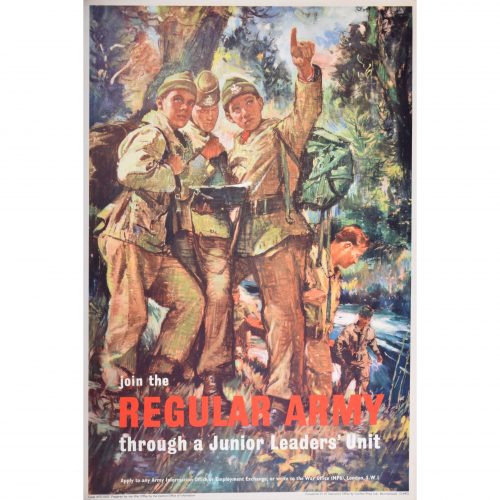
  • John Worsley (1919-2000)  (attributed)

    Join the Regular Army through a Junior Leaders' Unit

    Printed for H.M. Stationary Office by Carillon Press Ltd, Bournemouth. (c. 1959) Prepared for the War Office by the Central Office of Information Lithographic poster 76x51cm Young soldiers in a clearing in a forest read a map as a canoe is lowered into the river behind them. Worsley was a war artist during World War II who was captured by the Germans and then an illustrator for Eagle comic. Click here for further biographical details and other posters by Worsley. If you are interested email info@manningfineart.co.uk or call us on 07929 749056.
  • Join QARANC - Queen Alexandra's Royal Army Nursing Corps

    The Army looks to you to look after the Army

    Lithographic poster c. 1940s 38x25cm Printed for HMSO by Fosh & Kosh Limited, London and prepared for the War Office by the Central Office of Information. If you are interested email info@manningfineart.co.ukor call us on 07929 749056.
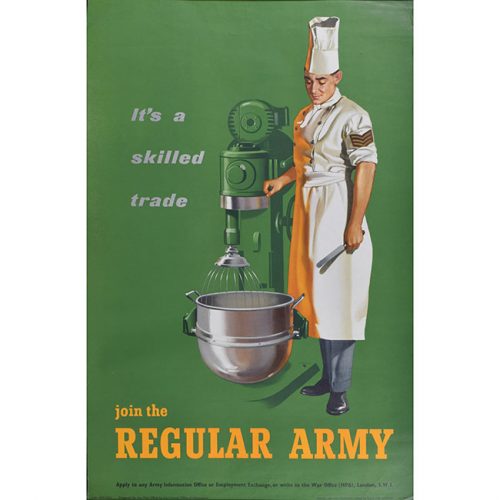
  • Anon.

    Join the Regular Army: A Skilled Trade

    Lithographic poster c. 1950s. Framed in a hand-finished black frame 75x50cm Army recruitment poster produced for the War Office. If you are interested email info@manningfineart.co.uk or call us on 07929 749056.
  • Join Your Street Group - Save for Prosperity

      Original vintage poster 74 x 50 cm Issued by the National Savings Committee, London. Printed for HM Stationery Office by Fosh & Cross Ltd. An original vintage WW2 poster encouraging Britons to save via the National Savings scheme. Condition: generally very good. Not backed. If you are interested, please email info@manningfineart.co.uk or call us on 07929 749056. Click here for other original vintage National Savings posters.
Go to Top