• James Basire & John Carter Specimens of the Architecture and Ornaments of the Abbey Church at St Albans

    Engraving 62 x 46 cm This engraving was originally published by the Society of Antiquaries of London, an organisation dedicated to studying and preserving historical monuments. Recognising it as one of England's most significant medieval structures, the society commissioned a series of engravings of St Albans Cathedral by James Basire--based on drawings by the architectural draughtsman John Carter. In doing so, the Antiquaries hoped to preserve and disseminate knowledge of England’s architectural heritage. Condition: Generally very good, some spotting to the corners.

    If you would like to know more, please email info@manningfineart.co.uk or call us on 07929 749056.

  • James Basire & John Carter Architectural Fragments of St Albans Cathedral

    Engraving 44 x 62 cm This engraving was originally published by the Society of Antiquaries of London, an organisation dedicated to studying and preserving historical monuments. Recognising it as one of England's most significant medieval structures, the society commissioned a series of engravings of St Albans Cathedral by James Basire--based on drawings by the architectural draughtsman John Carter. In doing so, the Antiquaries hoped to preserve and disseminate knowledge of England’s architectural heritage. Condition: Generally very good, some spotting to the corners.

    If you would like to know more, please email info@manningfineart.co.uk or call us on 07929 749056.

  • James Basire & John Carter Architectural Details of St Albans Cathedral

    Engraving 62 x 46 cm This engraving was originally published by the Society of Antiquaries of London, an organisation dedicated to studying and preserving historical monuments. Recognising it as one of England's most significant medieval structures, the society commissioned a series of engravings of St Albans Cathedral by James Basire--based on drawings by the architectural draughtsman John Carter. In doing so, the Antiquaries hoped to preserve and disseminate knowledge of England’s architectural heritage. Condition: Generally very good.

    If you would like to know more, please email info@manningfineart.co.uk or call us on 07929 749056.

  • James Basire & John Carter The Abbey Church of St Albans

    Engraving 62 x 46 cm This engraving was originally published by the Society of Antiquaries of London, an organisation dedicated to studying and preserving historical monuments. Recognising St Albans Cathedral as one of England's most significant medieval structures, the society commissioned a series of engravings by James Basire--based on drawings by the architectural draughtsman John Carter. In doing so, the Antiquaries hoped to preserve and disseminate knowledge of England’s architectural heritage. Condition: Generally very good.

    If you would like to know more, please email info@manningfineart.co.uk or call us on 07929 749056.

  • James Basire & John Carter Architectural Fragments of St Albans Cathedral

    Engraving 60 x 44 cm This engraving was originally published by the Society of Antiquaries of London, an organisation dedicated to studying and preserving historical monuments. Recognising it as one of England's most significant medieval structures, the society commissioned a series of engravings of St Albans Cathedral by James Basire, based on drawings by the architectural draughtsman John Carter. In doing so, the Antiquaries hoped to preserve and disseminate knowledge of England’s architectural heritage. Condition: Generally very good.

    If you would like to know more, please email info@manningfineart.co.uk or call us on 07929 749056.

  • James Basire & John Carter Architectural Fragments of St Albans Cathedral

    Engraving 60 x 44 cm This engraving was originally published by the Society of Antiquaries of London, an organisation dedicated to studying and preserving historical monuments. Recognising it as one of England's most significant medieval structures, the society commissioned a series of engravings of St Albans Cathedral by James Basire, based on drawings by the architectural draughtsman John Carter. In doing so, the Antiquaries hoped to preserve and disseminate knowledge of England’s architectural heritage. Condition: Generally very good.

    If you would like to know more, please email info@manningfineart.co.uk or call us on 07929 749056.

  • James Basire & John Carter Architectural Fragments of St Albans Cathedral

    Engraving 60 x 44 cm This engraving was originally published by the Society of Antiquaries of London, an organisation dedicated to studying and preserving historical monuments. Recognising it as one of England's most significant medieval structures, the society commissioned a series of engravings of St Albans Cathedral by James Basire, based on drawings by the architectural draughtsman John Carter. In doing so, the Antiquaries hoped to preserve and disseminate knowledge of England’s architectural heritage. Condition: Generally very good.

    If you would like to know more, please email info@manningfineart.co.uk or call us on 07929 749056.

  • James Basire & John Carter Architectural Fragments of St Albans Cathedral

    Engraving 60 x 44 cm This engraving was originally published by the Society of Antiquaries of London, an organisation dedicated to studying and preserving historical monuments. Recognising it as one of England's most significant medieval structures, the society commissioned a series of engravings of St Albans Cathedral by James Basire, based on drawings by the architectural draughtsman John Carter. In doing so, the Antiquaries hoped to preserve and disseminate knowledge of England’s architectural heritage. Condition: Generally very good.

    If you would like to know more, please email info@manningfineart.co.uk or call us on 07929 749056.

  • James Basire & William Turner Davey A Chimney Piece in the Bishop's Palace at Exeter

    Engraving 45 x 60 cm This engraving was originally published by the Society of Antiquaries of London, an organisation dedicated to studying and preserving historical monuments. The society commissioned a series of architectural engravings by James Basire, this one based on a drawing by the English artist and engraver William Turner Davey. In doing so, the Antiquaries hoped to preserve and disseminate knowledge of England’s architectural heritage. This engraving depicts an ornate chimney piece in the Bishop's Palace at Exeter. It features a number of crests and Basire's masterful engraving technique expertly captures the fine masonry of the piece. Condition: Generally very good.

    If you would like to know more, please email info@manningfineart.co.uk or call us on 07929 749056.

  • James Basire & Robert Blemmel Schnebbelie The Holy Sepulchre at Northwold in the county of Norfolk

    Engraving 45 x 60 cm This engraving was originally published by the Society of Antiquaries of London, an organisation dedicated to studying and preserving historical monuments. The society commissioned a series of architectural engravings by James Basire, this one based on a drawing by the English painter and illustrator Robert Blemmel Schnebbelie. In doing so, the Antiquaries hoped to preserve and disseminate knowledge of England’s architectural heritage. This particular edition depicts the Holy Sepulchre at Northwold in Norfolk. This sepulchre probably dated to the late 15th century and was used for the Deposition and Resurrection rituals on Good Friday and Easter Sunday-- an in depth commentary on such sepulchre in Norfolk was written by Veronica Sekules for the University of Missouri. Condition: Generally very good.

    If you would like to know more, please email info@manningfineart.co.uk or call us on 07929 749056.

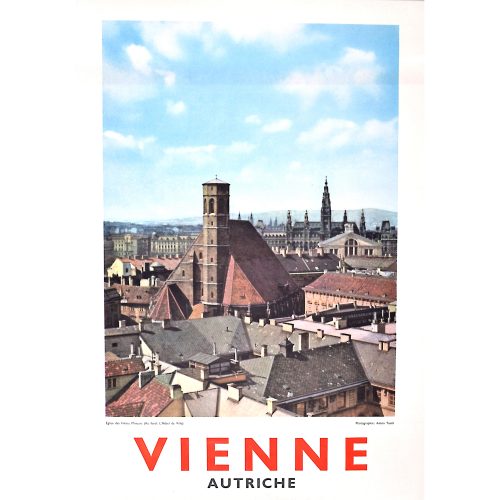
  • Anton Tusch (photographer) Eglise des Freres Mineurs, Vienna, Austria / Osterreich

    Original poster c. 1950s 61x43cm If you are interested email info@manningfineart.co.uk or call us on 07929 749056. Condition: Generally very good.
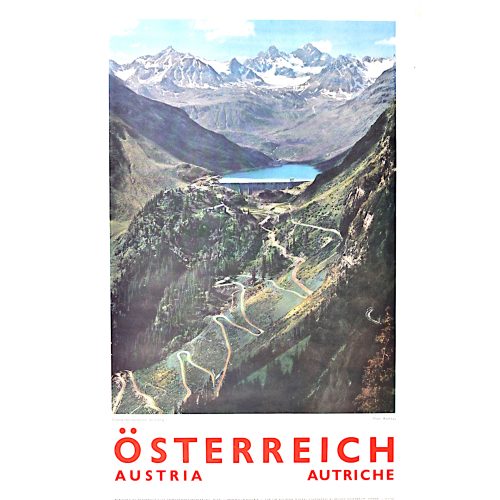
  • Risch Lau (publisher) Silvretta-Hochalpenstrasse, Vorarlberg, Austria / Osterreich

    Original poster c. 1950s 61x43cm If you are interested email info@manningfineart.co.uk or call us on 07929 749056. Condition: Generally very good.
  • Anonymous

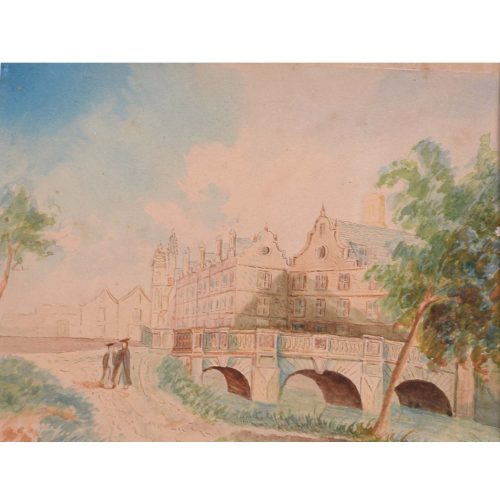
    St John’s College, Cambridge

    Watercolour and pencil 13x18cm Probably early 19th century. This watercolour depicts St John’s prior to construction of Hutchinson’s 1831 New Court buildings; two figures wearing gowns and square caps are engaged in conversation by the Wren Bridge. If you are interested email info@manningfineart.co.uk or call us on 07929 749056. Condition: Good.
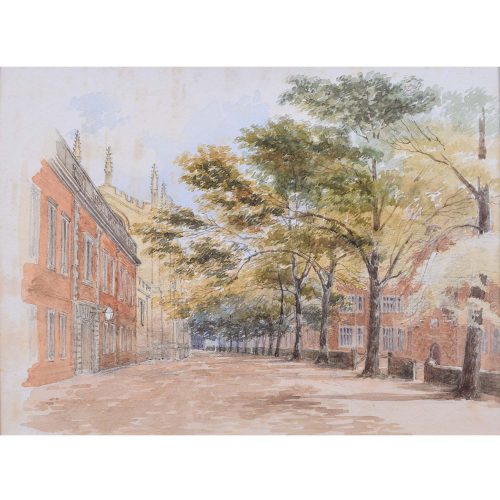
  • Anonymous Eton College 

    Watercolour 21.2×28.5cm   If you are interested email info@manningfineart.co.ukor call us on 07929 749056. Condition: Good.
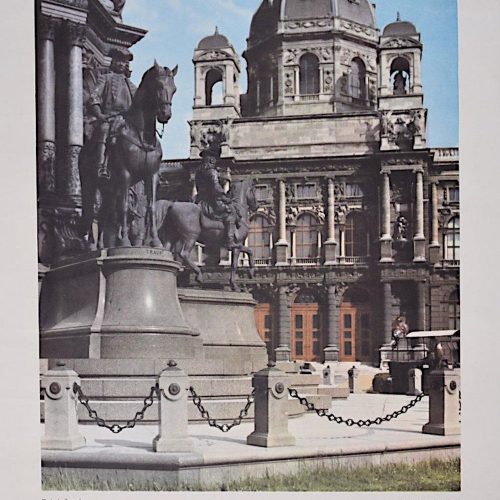
  • Albert Herndl (photographer)

    Musée des Beaux Arts, Vienna, Austria / Osterreich (c.1950s)

    Original lithographic poster 61x43cm  
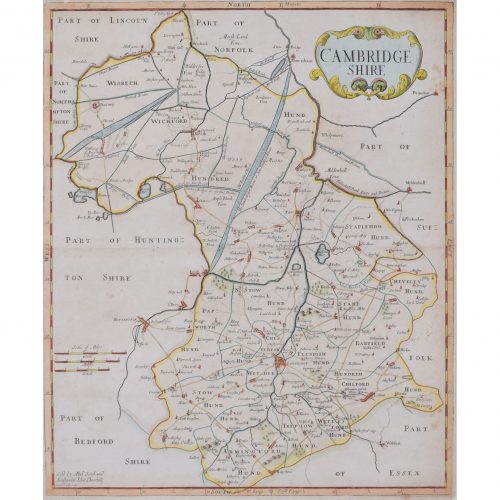
  • Sutton Nichols (1668 - 1729)

    Map of Cambridgeshire

      Engraving 43 x 36 cm Signed in plate lower left. A beautifully coloured 18th century map engraving of Cambridgeshire. The map was produced by Robert Morden for publication in Edward Gibson's 1695 translation of William Camden's Britannia, a topographical and historical survey of Great Britain and Ireland produced to "restore antiquity to Britaine, and Britain to his antiquity" - a most noble aim. William Camden (1551 - 1623) was an English antiquarian, historian, topographer, and herald, best known as the author of Britannia, the first chorographical survey of the islands of Great Britain and Ireland, and the Annales, the first detailed historical account of the Queen Elizabeth I's reign. Sutton Nicholls was a draughtsman and engraver best known for his panoramic views of the cities of London and Westminster. Almost all of his engravings were commissioned by publishers. Nicholls specialised in topographical and architectural designs; he also produced many maps, notably illustrating John Strype’s edition of John Stowe’s ‘Survey of London’ in 1720. Condition: good. Mounted to board. If you’d like to know more, please email info@manningfineart.co.uk or call us on 07929 749056.
  • Jane Gray (b.1931)

    St Mary’s Church, Penwortham, Lancashire, Design for Stained Glass Window Dedicated to the Royal British Legion (1984)

      Watercolour 19.5 x 11 cm

    Dated and artist label verso.

    St Mary’s Church, set in the midst of ancient woodland, is the parish church of the Ancient Parish of Penwortham and dates from the 14th century. The church Nave and Chancel contain several memorial windows and tablets sacred to the memory of parishioners who have died; most are Victorian, such as memorial to John Horrocks, a prominent industrialist in the golden age of the Lancashire cotton industry who founded the textile company Horrockses, Miller, & Co., but the North wall features Gray’s traditional design for a window dedicated to the Royal British Legion.

    Provenance: the artist’s studio sale. Condition: very good. If you are interested, please email info@manningfineart.co.uk or call us on 07929 749056. For other works by Jane Gray and more information about her, please click here.    
  • Jane Gray (b.1931)

    St Margaret’s Church, Downham, Billericay, Essex, Design for Stained Glass Window

      Watercolour 15.5 x 7.5 cm

    Signed and studio stamp verso.

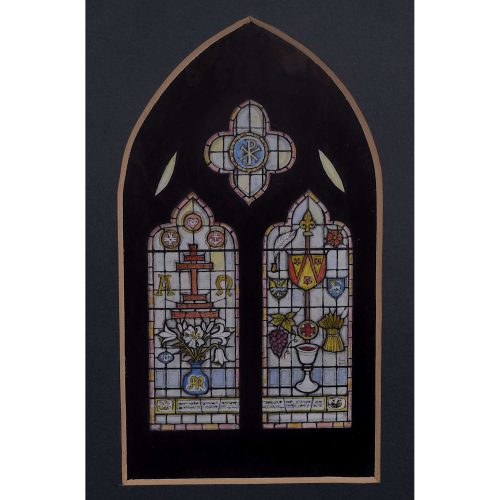
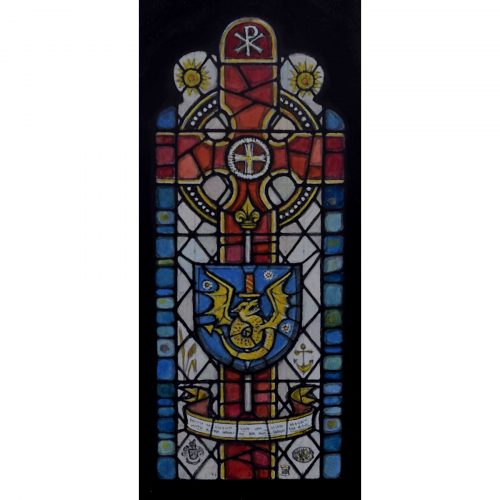
    It is likely that Christians have worshiped at this site for over a thousand years, but it wasn’t until the mid13th century that the first recorded church appeared. The church is dedicated to St Margaret of Antioch, a dragon slayer and patron saint of child bearing. Devotion Saint Margaret of Antioch became popular in the 13th century and there are around 80 churches today that share this dedication from the 13th century. The oldest part of the present church is the tower which dates from c.1470. The nave was rebuilt in the nineteenth century using much of the material from the thirteenth century church. An arson attack in March 1977 resulted in the gutting of the church, resulting in a highly modern interior. This window features the symbol of St Margaret and a red Cross on quarry background. The window was installed in 1988.

    Provenance: the artist’s studio sale. Literature: Jane Gray, Playing with Rainbows. (Shropshire: Ellingham Press, 2011), p.79. Condition: very good. If you are interested, please email info@manningfineart.co.uk or call us on 07929 749056. For other works by Jane Gray and more information about her, please click here.    
  • Jane Gray (b.1931)

    St Peter’s Church, Cound, Shropshire, Design for Stained Glass Window (1999)

      Watercolour 16.5 x 11.5 cm

    Signed, dated and studio stamp verso.

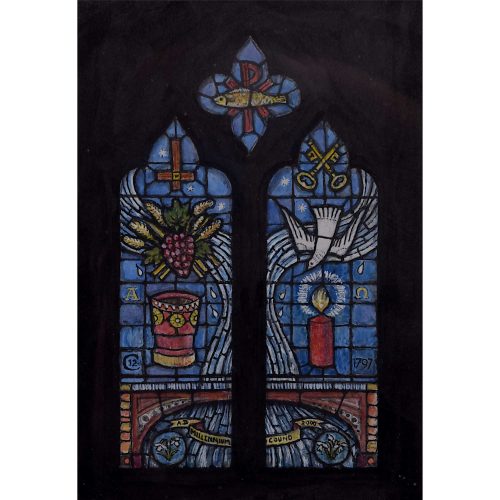
    Proposed design for a window on the south wall, over the font. St Peter’s Church, Cound lies in the grounds of the Cound Hall estate and is dedicated to St Peter because of its medieval association with Shrewsbury Abbey (dedicated to Saints Peter and Paul). The oldest part of the present church dates back to the 13th century but it has been renovated several times since then, with additions from the 14th, 15th and 19th centuries.

    Provenance: the artist’s studio sale. Condition: very good. If you are interested, please email info@manningfineart.co.uk or call us on 07929 749056. For other works by Jane Gray and more information about her, please click here.    
  • Jane Gray (b.1931)

    Royal Airforce Music Services Headquarters, Design for Memorial Stained Glass Window (1985)

      Watercolour 6 x 22.5 cm

    Signed and dated verso.

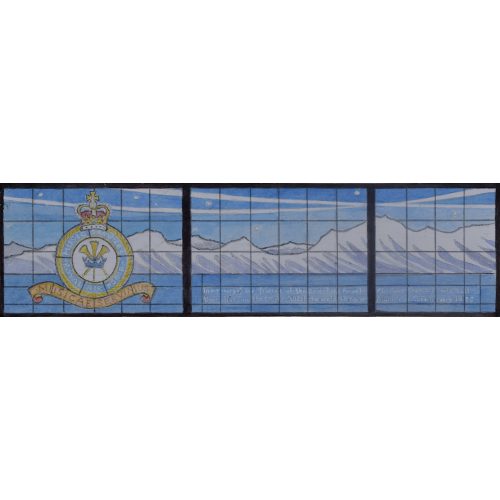
    Gray’s design for this memorial window commemorates the lives of those lost in the Langenbruck bus crash, 11 February 1985, when a double-decker bus carrying 40 musicians from the band of Royal Air Force Germany, crashed on an autobahn between Nuremberg and Munich. Twenty-one of the occupants were killed in the crash. As the text in the design remembers: this window is ‘In memory of our friends of the Band of the Royal Air Force Germany who lost their lives in the tragic Autobahn accident near Munich on 11 February 1985’.

    Provenance: the artist’s studio sale. Condition: very good. If you are interested, please email info@manningfineart.co.uk or call us on 07929 749056. For other works by Jane Gray and more information about her, please click here.    
  • Jane Gray (b.1931)

    St Lawrence Church, Weston under Penyard, Design for Stained Glass Window (1999)

      Watercolour 21.5 x 8.5 cm

    Signed, dated and studio stamp verso.

    St Catherine’s Church, Penrith is a Puginian Gothic town church, built by Fr George Haydock of Cottam and other Catholic notables in the early 19th century in the 14th century Gothic style. The church and its substantial presbytery, built in 1853, adjoin the churchyard of the Anglican parish church. This window was installed in 1992.

    Provenance: the artist’s studio sale. Literature: Jane Gray, Playing with Rainbows. (Shropshire: Ellingham Press, 2011), p.87. Condition: very good. If you are interested, please email info@manningfineart.co.uk or call us on 07929 749056. For other works by Jane Gray and more information about her, please click here.    
  • Jane Gray (b.1931)

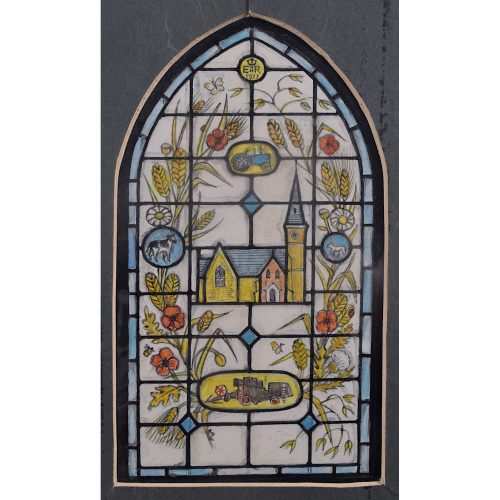
    Gatton Church, nr Redhill, Surrey, Design for Stained Glass Window (1979)

      Watercolour 15.5 x 8.5 cm

    Dated, detailed in artist’s hand and studio label verso.

    A church has existed in this Surrey parish since the Doomsday Survey in 1086 but the present Church dates back to the 13th century, undergoing extensive alterations in the 18th and early 19th centuries. Notably, in 1834, the pulpit and altar, bought from Nuremberg, were hopefully attributed to Albrecht Dürer; the carved doors had travelled from Rouen; the presbytery stalls from a disestablished monastery in Ghent, the altar rails from Tongeren; and the stained glass for the windows, and the wainscoting of the nave and carved canopies had come from Aarschot, near Leuven. This tiny church window was one of Gray’s smallest commissions. Her brief was to include the church at the heart of the Gatton agricultural community, and she did, supplementing this with illustrations of corn, oats, barley, poppies, bees, butterflies, ladybirds, a caterpillar and a grasshopper, alongside small roundels set amongst these containing a calf, a tractor, and a combine harvester respectively. The window was installed in 1980.

    Provenance: the artist’s studio sale. Literature: Jane Gray, Playing with Rainbows. (Shropshire: Ellingham Press, 2011), pp.41, 76. Condition: very good. If you are interested, please email info@manningfineart.co.uk or call us on 07929 749056. For other works by Jane Gray and more information about her, please click here.    
  • Jane Gray (b.1931)

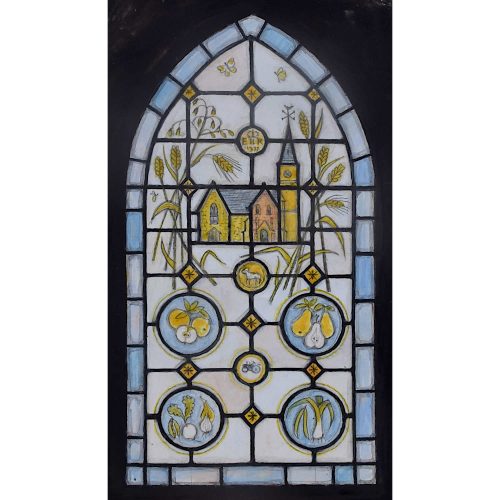
    Gatton Church, nr Redhill, Surrey, Design for Stained Glass Window (1979)

      Watercolour 16 x 9 cm

    A church has existed in this Surrey parish since the Doomsday Survey in 1086 but the present Church dates back to the 13th century, undergoing extensive alterations in the 18th and early 19th centuries. Notably, in 1834, the pulpit and altar, bought from Nuremberg, were hopefully attributed to Albrecht Dürer; the carved doors had travelled from Rouen; the presbytery stalls from a disestablished monastery in Ghent, the altar rails from Tongeren; and the stained glass for the windows, and the wainscoting of the nave and carved canopies had come from Aarschot, near Leuven. This tiny church window was one of Gray’s smallest commissions. Her brief was to include the church at the heart of the Gatton agricultural community, and she did, supplementing this with illustrations of corn, oats, barley, poppies, bees, butterflies, ladybirds, a caterpillar and a grasshopper, alongside small roundels set amongst these containing a calf, a tractor, and a combine harvester respectively. The window was installed in 1980.

    Provenance: the artist’s studio sale. Literature: Jane Gray, Playing with Rainbows. (Shropshire: Ellingham Press, 2011), pp.41, 76. Condition: very good. If you are interested, please email info@manningfineart.co.uk or call us on 07929 749056. For other works by Jane Gray and more information about her, please click here.    
  • Jane Gray (b.1931)

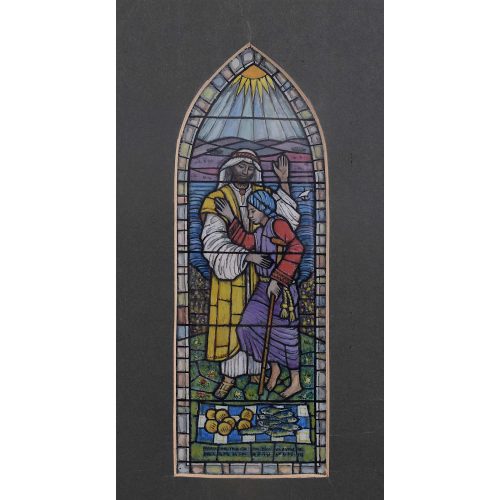
    St Anne’s Church, Copp, Great Eccleston, Design for Stained Glass Window (1979)

      Watercolour 19 x 6.5 cm Studio label verso.

    A chapel was first built at Copp in 1723 for the members of St. Michaels on Wyre Church and Kirkham Church who were too far from their parish churches. Elswick Chapel would have been ideal for the purpose, but as it was in the hands of dissenters the bishop of the time, Bishop Gastrall, decided a new building would be preferable. On May 13th, 1723, a deed was drawn up arranging for three men to rent a piece of land (known as Higher Cop) for one peppercorn a year to build a new chapel. St. Anne's Chapel was built that same year. It wasn’t until 1849, however, that Copp Parish was formed by an Order in Council at Queen Victoria's court at Windsor. The church was completely restored in 1884, the outside transformed by building over it in Yorkshire stone, and the tower raised to 45ft. This window design centres on the scene of Christ healing a lame man and features symbolic images of loaves and fishes. The window was installed in 1979.

    Provenance: the artist’s studio sale. Literature: Jane Gray, Playing with Rainbows. (Shropshire: Ellingham Press, 2011), p.75. Condition: very good. If you are interested, please email info@manningfineart.co.uk or call us on 07929 749056. For other works by Jane Gray and more information about her, please click here.    
  • Jane Gray (b.1931)

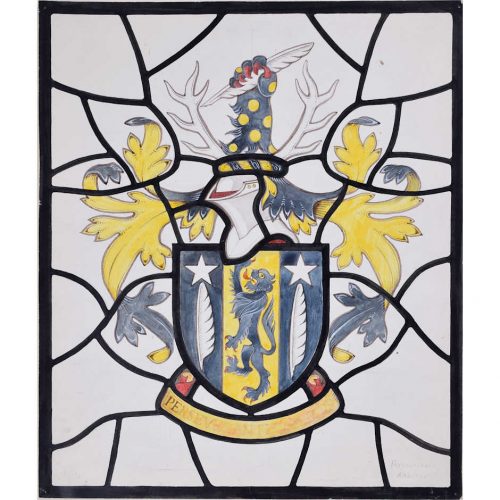
    Gilmour Coat of Arms, Stained Glass Window Design

      Watercolour

    38.5 x 32.5 cm

    Signed verso

    The Gilmours are part of clan Morrison of the Isle of Lewis, and the first documented bearer of this surname was Richard Gilemore, who was recorded in the Feet of Fines of Huntindonshire in 1228 AD. The family mottoes include, as Gray uses here, Perseveranti dabitur, meaning ‘It will be given to the persevering’.

    Provenance: the artist’s studio sale. Condition: very good. If you are interested, please email info@manningfineart.co.uk or call us on 07929 749056. For other works by Jane Gray and more information about her, please click here.    
  • S Clapham (active 1940 - 1960)

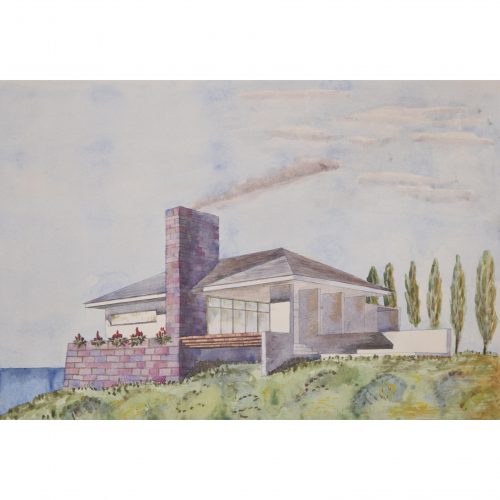
    Design for Modernist Seaside House

      Watercolour 27 x 40 cm Signed lower left and inscribed to reverse. Clapham's designs for a modernist war memorial to be erected in a training area at an army base. Clapham was an architect based in Stockwell in London. Condition: very good. If you are interested, please email info@manningfineart.co.uk or call us on 07929 749056. Click here for other works by the artist.
  • Jane Gray (b.1931)

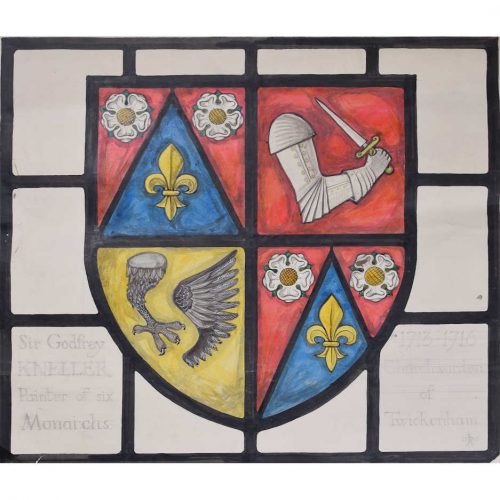
    Sir Godfrey Kneller Stained Glass Window Design, St Mary’s Church, Twickenham (1961)

      Watercolour

    42 x 48.5 cm

    Signed and dated l.r.

    This stained glass window design is one of a handful Gray designed for her local church, St Mary’s Twickenham. St Mary’s Church stands on the site of an earlier church in Twickenham, a short distance from York House and the banks of the River Thames, and incorporates a 15th-century, medieval tower. St Mary's has an impressive and illustrious history of notable parishioners including the painter Godfrey Kneller who, after the collapse of the ancient church's 14th-century nave in 1714, took active involvement in redesigning the church in the Neo-classical style alongside local architect John James, as well as Henry Fielding and Alfred Lord Tennyson whose sons were both baptised here. Gray had a personal connection to St Mary’s, her great grandfather having been the vicar some years before. This design, in particular, commemorates Godfrey Kneller and his active involvement in the church and its redesign in the eighteenth century.

    Provenance: the artist’s studio sale. Condition: very good. If you are interested, please email info@manningfineart.co.uk or call us on 07929 749056. For other works by Jane Gray and more information about her, please click here.    
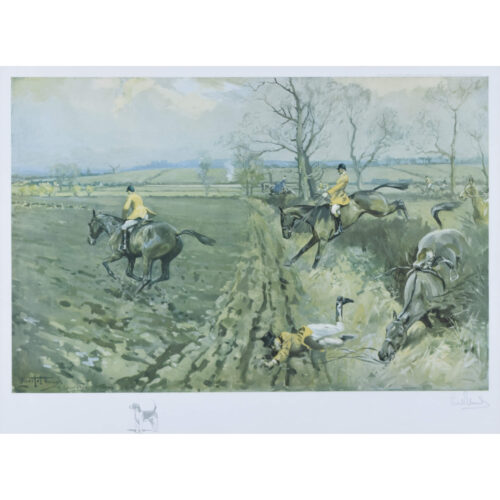
  • Lionel Edwards (1878 - 1966)

    The Belvoir Hunt (1928)

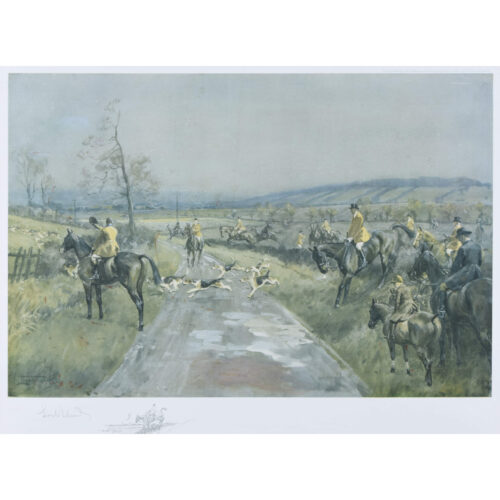
      Lithograph 31 x 51 cm Signed and dated in plate lower left, and in pencil outside plate lower left. A Lionel Edwards lithograph depicting the Belvoir - part of the artist's 'Hunting Countries' series. The Belvoir Hunt, sometimes known as the Duke of Rutland's Hounds, dates from 1750 and became a foxhound pack in 1762. Since then, the kennels have been located at Belvoir Castle. Lionel Edwards was a British artist who specialised in pictures of country life, particularly horses, and provided illustrations for Country Life. He is best known for his hunting scenes but also painted pictures of horse racing, shooting and fishing. Condition: print good; original handsome period frame; small area of loss to top of frame. If you are interested, please email info@manningfineart.co.uk or call us on 07929 749056. Click here for other hunting pictures.
  • Out of stock

    Lionel Edwards (1878 - 1966)

    The South Notts Hunt (1928)

      Lithograph 31 x 51 cm Signed and dated in plate lower left, and in pencil outside plate lower left. Note to reverse (1988) identifies those illustrated. A Lionel Edwards lithograph depicting the South Notts Hunt - part of the artist's 'Hunting Countries' series. The South Notts country lies in Nottinghamshire and Derbyshire and has been hunted as far back as 1677 by the Earl of Lincoln. In 1775 it was hunted by John Musters, the great-grandfather of John Chaworth-Musters, and in 1860 Mr. John Chaworth-Musters re-established the hunt. Lionel Edwards was a British artist who specialised in pictures of country life, particularly horses, and provided illustrations for Country Life. He is best known for his hunting scenes but also painted pictures of horse racing, shooting and fishing. Condition: print good; original handsome period frame. If you are interested, please email info@manningfineart.co.uk or call us on 07929 749056. Click here for other hunting pictures.
  • Lionel Edwards (1878 - 1966)

    The Quorn Hunt (1934)

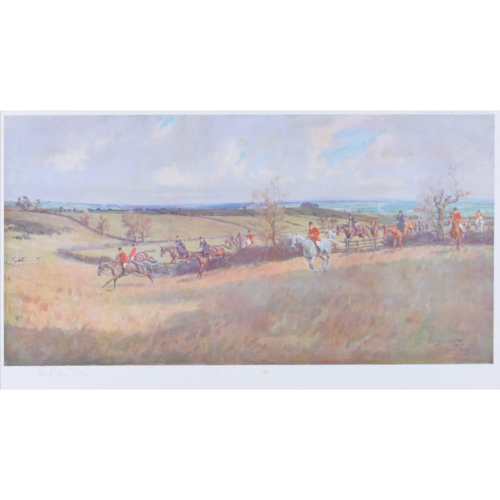
      Lithograph 34 x 62 cm Signed, titled and dated in plate lower right. Signed in pencil outside plate lower left. A Lionel Edwards lithograph depicting the Quorn - part of the artist's 'Hunting Countries' series. The Quorn Hunt has a claim to be the oldest hunt in the country, being founded in 1696 by Mr Thomas Boothby of Tooley Park, Leicestershire. The hunt takes its name from the village of Quorn, where the hounds were kennelled from 1753 to 1904. Lionel Edwards was a British artist who specialised in pictures of country life, particularly horses, and provided illustrations for Country Life. He is best known for his hunting scenes but also painted pictures of horse racing, shooting and fishing. Condition: print generally good; a couple of very small brown spots. Original 3/4" black frame in generally good condition. If you are interested, please email info@manningfineart.co.uk or call us on 07929 749056. Click here for other hunting pictures.
  • H Clark

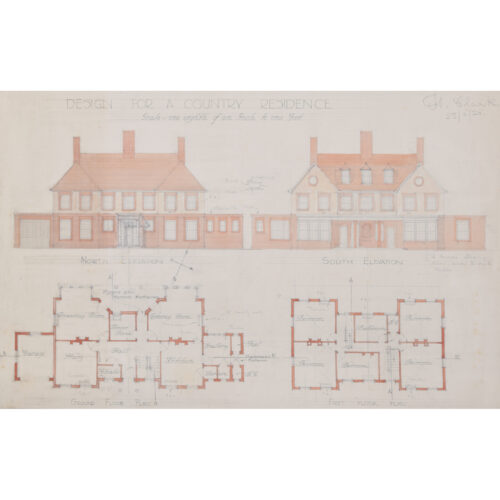
    Design for a Country Residence (1925)

    Pencil and wash 36 x 54 cm An excellent 1925 design for a country house. Clark uses a wash to depict the warm red of the bricks in his design. Condition: mostly very good; old, soft crease to top left. If you are interested, please email info@manningfineart.co.uk or call us on 07929 749056. Click here for more architectural designs.
  • Raymond Weston

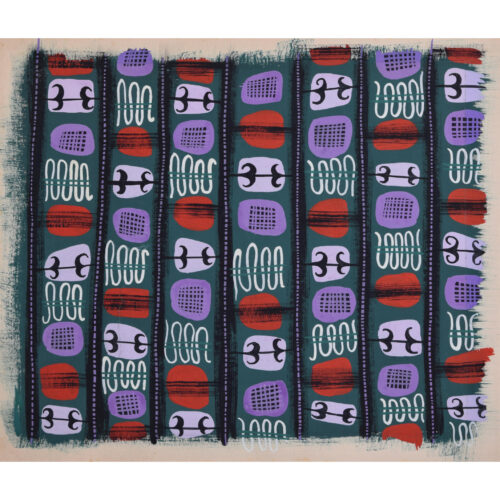
    Fabric design

      Gouache 32 x 37 cm Label to reverse. A fabric design for a dress, produced by a student at the Loughborough College of Art. The colours and forms suggest a mid-century design; the label to the reverse indicates that it would have been machine printed on silk, to be made into a dress. Condition: generally very good. If you are interested, please email info@manningfineart.co.uk or call us on 07929 749056.
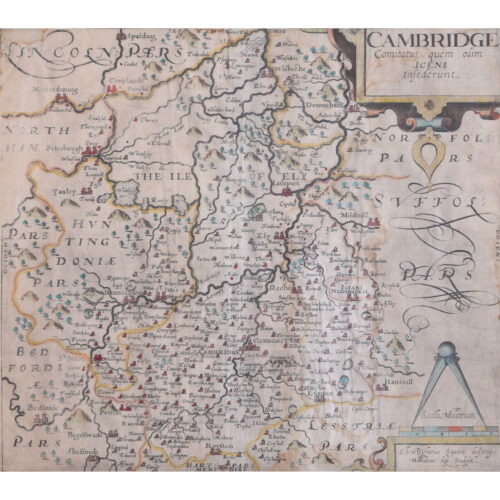
  • William Kip (active 1598 - 1610) after Christopher Saxton (1540 - 1610)

    Map of Cambridgeshire (1637)

      Engraving with later hand colouring 29 x 32 cm An antique map of Cambridgeshire. The map was originally published in William Camden's atlas 'Britannia', which was first published in 1586. William Kip was a goldsmith and map engraver. He was born in Utrecht in the Netherlands and moved to London to pursue his career as an engraver. Alongside William Hole, Kip re-engraved Christopher Saxton's 1574 county maps for publication in Camden's 'Britannia', and it is this venture for which he is most well-known. Christopher Saxton was an English cartographer who produced the first county maps of England and Wales. Between 1574 and 1578 he engraved maps of every county in Britain, and compiled them into an atlas in 1579. These maps bore Queen Elizabeth I's arms as well as those of Saxton's patron, Thomas Seckford. Condition: generally good; faint evidence of old staining. If you are interested, please email info@manningfineart.co.uk or call us on 07929 749056. Click here for more maps and general pictures of Cambridge.
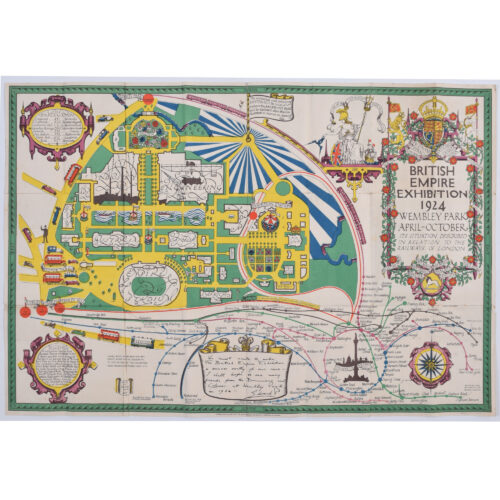
  • Stanley Kennedy North (1887 - 1942)

    British Empire Exhibition Map (1924)

      Lithograph 51 x 75 cm This fascinating and attractive map with elaborate cartouche highlights the attractions of the British Empire Exhibition, a showcase held in London to exhibit the fruits of Britain's overseas colonies. It was designed to boost support for the Empire's activities, encourage trade of imperial goods, and remind other world powers of Britain's (historic) colonial capacity. The Empire Stadium was built especially to house the exhibition; it is known today as Wembley Stadium. The exhibition was opened by King George V on St George's Day, 1924. Condition: generally good; folds as issued; a few short tears at corners. If you are interested, please email info@manningfineart.co.uk or call us on 07929 749056. Click here for other original vintage posters.
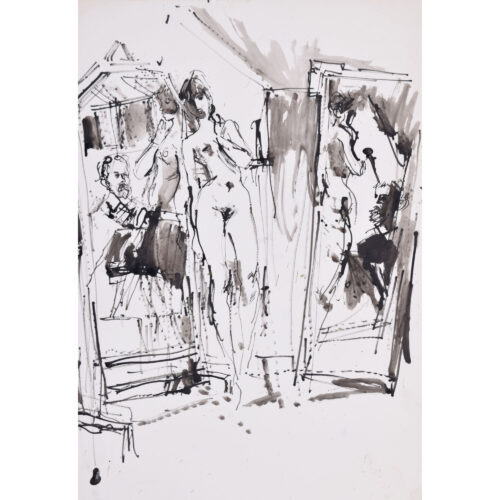
  • Peter Collins ARCA (1923 - 2001)

    Self-Portrait in Two Mirrors with Nude

      Ink and wash 45 x 30 cm Provenance: the artist's studio sale. Collins simultaneously depicts himself painting, and reflected painting - his face is repeated in the two mirrors, and the model's figure appears three times. The picture's perspective leaves us questioning which model, and perhaps which Collins, is the real one. Collins's first job was at an advertising agency, in the commercial studio. World War II interrupted his career and he joined the Royal Artillery (of the British Army), teaching painting and drawing in the Education Corps - whilst simultaneously teaching at St Martin's School of Art, part time. Following the war, Collins studied at the Royal College of Art, winning a scholarship. He then worked as a commercial artist, producing some well-known posters for clients including British Railways and British European Airways. He was the Art Director at Odhams Press and spent time designing for both ICI and Shell. With his wife Georgette, he created the 'Bacombe Galleries' in Sussex, converting a group of buildings into a gallery space. In 1975 they developed the Stanley Studios in Chelsea, which were scheduled for redevelopment, into a combined artists' studio and residence. Moving into the Stanley Studios allowed the Collinses to immerse themselves in Chelsea's art scene, and they proceeded to fill the studios with art, antiques, sculpture, and other curios. Condition: generally very good. If you are interested, please email info@manningfineart.co.uk or call us on 07929 749056. Click here for other nudes.
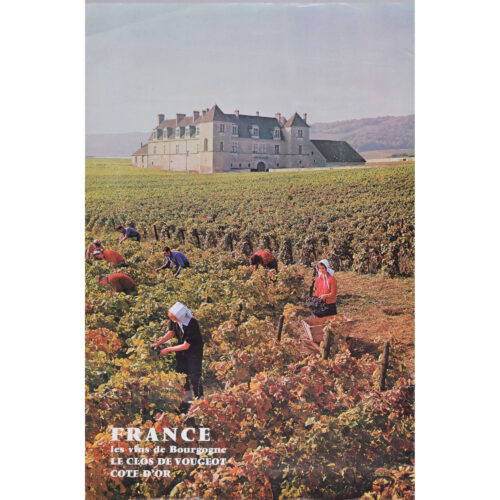
  • France - les vins de Bourgogne Le Clos de Vougeot Cote d'Or

        Original vintage poster 61 x 40 cm An original poster depicting the Château du Clos de Vougeot vineyard in Burgundy during the grape harvest. Men and women pick the grapes outside the Château. Standing in the very heart of Burgundy's vineyards, Clos de Vougeot was originally a wine farm, built in the 12th century by monks from the nearby Abbey of Cîteaux. In the 16th century, a Renaissance style château was added to the existing buildings. Even though the Chateau du Clos de Vougeot does not produce wine anymore, it stays the symbol of a millenary of Burgundy's History. Condition: generally very good, small crease to top corner. If you are interested, please email info@manningfineart.co.uk or call us on 07929 749056. Click here for more original vintage posters.
  • Austria Österreich - St Wolfgang am Wolfgangsee

      Original vintage poster 61 x 43 cm St. Wolfgang im Salzkammergut is an Austrian market town east of Salzburg, named after Saint Wolfgang of Regensburg. This sunny poster encourages us to visit - and perhaps to lunch by Lake Wolfgangsee. Condition: generally very good; a few very small edge losses to right hand. If you are interested, please email info@manningfineart.co.uk or call us on 07929 749056. Click here for other original vintage travel posters.
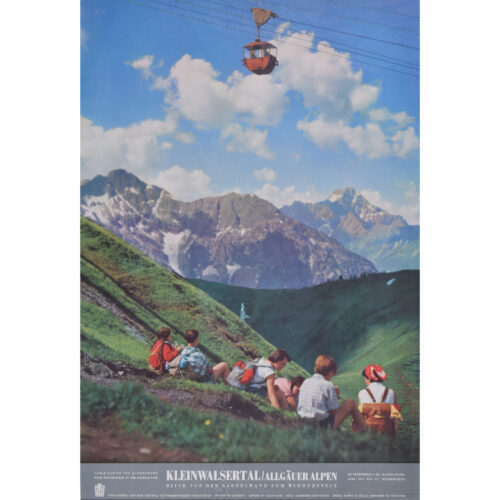
  • Kleinwalsertal Allgauer Alpen

      Original vintage poster 74 x 50 cm This bright 1970s poster encourages us to tour to Austria and ride the cable car up to the Kanzelwand (a mountain on the border between Vorarlberg, Austria and Bavaria, Germany). Here, a charming family of hikers gaze up at the cable car as it crosses overhead. Condition: generally very good; one or two little creases to bottom. If you are interested, please email info@manningfineart.co.uk or call us on 07929 749056. Click here for other original vintage travel posters.
  • Hugh Casson (1910 - 1999)

    Wadham College, Oxford - The Fellows' Garden

      Lithograph 24 x 40 cm Proof print aside from the numbered edition. Signed, titled and dated in plate. Casson's peaceful, pastoral depiction of Wadham. Sir Hugh Casson was educated at Eastbourne College; St John’s College, Cambridge; and the Bartlett School of Architecture. Trained in the 1930s in the early modernist style, he taught at the Cambridge School of Architecture. After employment as a camoufleur during World War 2 by the Air Ministry, in 1948 he was appointed as director of architecture for the Festival of Britain. A close friend of the Royal Family, he undertook designs for the 1953 coronation, designed the interior of the Royal Yacht Britannia (“The overall idea was to give the impression of a country house at sea”), and taught the young Charles III to paint in watercolours. Amongst his architectural achievements are the Elephant House at London Zoo, the 1978 redevelopment of Bristol Docks, the Raised Faculty Building for The University of Cambridge, and a building for the Royal College of Art. He published a number of illustrated books, of which Casson’s Oxford and Casson’s Cambridge are probably the best known. A limited edition series of prints was produced from the paintings. Condition: very good. If you are interested, please email info@manningfineart.co.uk or call us on 07929 749056. Click here for other views of Wadham College, Oxford.
  • Sutton Nichols (1668 - 1729)

    Map of Cambridgeshire

      Engraving 43 x 36 cm Signed in plate lower left. A beautifully coloured 18th century map engraving of Cambridgeshire. The map was produced by Robert Morden for publication in Edward Gibson's 1695 translation of William Camden's Britannia, a topographical and historical survey of Great Britain and Ireland produced to "restore antiquity to Britaine, and Britain to his antiquity" - a most noble aim. William Camden (1551 - 1623) was an English antiquarian, historian, topographer, and herald, best known as the author of Britannia, the first chorographical survey of the islands of Great Britain and Ireland, and the Annales, the first detailed historical account of the Queen Elizabeth I's reign. Sutton Nicholls was a draughtsman and engraver best known for his panoramic views of the cities of London and Westminster. Almost all of his engravings were commissioned by publishers. Nicholls specialised in topographical and architectural designs; he also produced many maps, notably illustrating John Strype’s edition of John Stowe’s ‘Survey of London’ in 1720. Condition: Generally very good. If you’d like to know more, please email info@manningfineart.co.uk or call us on 07929 749056.
  • Out of stock

    M R A Hollis The Local History Society Presents Prehistoric Animals

    Vintage poster Gouache 38 x 55 cm Professor Malcolm A Hollis was a chartered surveyor, arbitrator and professor of Building Pathology. This poster very clearly stands apart from his other architectural sketches. It is playful and bold, depicting a stegosaurus.
  • John Hill (1770 - 1850) after Frederick Mackenzie (1788 - 1854) Brasenose College, Part of the Schools etc. Taken from the top of the Radcliffe Library (1813)

    Hand-coloured aquatint 24 x 29 cm Published by Rudolph Ackermann (1764 - 1834). Frederick Mackenzie (circa 1788 - 1854) was a British watercolourist and architectural draughtsman. He first exhibited at the Royal Academy in 1804, and contributed eleven drawings between that year and 1828. He contributed to the Society of Painters in Water Colours exhibitions from 1813, becoming an associate in 1822, and a full member the following year. From 30 November 1831 until, his death he was treasurer to the society. In later life Mackenzie was no longer commissioned to illustrate books. John Hill was born in London in 1770, and was an engraver's apprentice. He worked in aquatint and largely produced book illustration aquatints. He went to America in 1816 and produced the notable Picturesque Views of American Scenery amongst other books of prints. Rudolph Ackermann was an Anglo-German bookseller, inventor, lithographer, publisher and businessman. In 1795 he established a print-shop and drawing-school at 96 Strand. Here Ackermann set up a lithographic press and began a trade in prints. He later began to manufacture colours and thick carton paper for landscape and miniature painters. Within three years the premises had become too small and he moved to 101 Strand, in his own words "four doors nearer to Somerset House", the seat of the Royal Academy of Arts. Between 1797 and 1800 Ackermann rapidly developed his print and book publishing business, encompassing many different genres including topography, caricature, portraits, transparencies and decorative prints. Condition: Generally very good, paper slightly toned within platemark.

    If you would like to know more, please email info@manningfineart.co.uk or call us on 07929 749056.

  • Joseph Constantine Stadler (1755 - 1828) after Frederick Mackenzie (1788 - 1854) Clare Hall Chapel (1815)

    Hand-coloured aquatint 29.5 x 21 cm Published by Rudolph Ackermann (1764 - 1834). An engraving of Clare College Chapel, which was was built in 1763 and designed by Sir James Burrough. Frederick Mackenzie (circa 1788 - 1854) was a British watercolourist and architectural draughtsman. He first exhibited at the Royal Academy in 1804, and contributed eleven drawings between that year and 1828. He contributed to the Society of Painters in Water Colours exhibitions from 1813, becoming an associate in 1822, and a full member the following year. From 30 November 1831 until, his death he was treasurer to the society. In later life Mackenzie was no longer commissioned to illustrate books. Joseph Constantine Stadler was a prolific German émigré engraver of images after his contemporaries - here, 18th-century English landscape painter and diarist Joseph Farington. Stadler's engravings are wide-ranging in subject matter and include landscapes, seascapes and portraits, as well as military, sporting and decorative subjects. Stadler was employed by the leading print publisher of the time, John Boydell. Stadler lived in Knightsbridge when he died at the age of 73. Rudolph Ackermann was an Anglo-German bookseller, inventor, lithographer, publisher and businessman. In 1795 he established a print-shop and drawing-school at 96 Strand. Here Ackermann set up a lithographic press and began a trade in prints. He later began to manufacture colours and thick carton paper for landscape and miniature painters. Within three years the premises had become too small and he moved to 101 Strand, in his own words "four doors nearer to Somerset House", the seat of the Royal Academy of Arts. Between 1797 and 1800 Ackermann rapidly developed his print and book publishing business, encompassing many different genres including topography, caricature, portraits, transparencies and decorative prints. Condition: Generally very good.

    If you would like to know more, please email info@manningfineart.co.uk or call us on 07929 749056.
  • J Sutherland after Augustus Charles Pugin (1762 - 1832) Merton College, North Window of the Ante Chapel (1813)

    Aquatint with original hand colouring 27 x 21 cm Published by Rudolph Ackermann (1764 - 1834). Augustus Charles Pugin was an Anglo-French artist and architectural draughtsman. Pugin produced views of London, jointly creating the illustrations for the 'Microcosm of London' published by Rudolph Ackermann in 1811, followed by plates for Ackermann's books about Westminster Abbey, Oxford and Cambridge universities, and Winchester College. His later works included illustrations for Specimens of Gothic Architecture (1821–1823), The Royal Pavilion at Brighton (1826), Architectural Antiquities of Great Britain (1826), Specimens of the Architectural Antiquities of Normandy (1827), Illustrations of the Public Buildings of London (1825 to 1828), Paris and its Environs (1829 to 1831), and Examples of Gothic Architecture (1831). He also produced a book of furniture designs called Gothic Furniture, and assisted architects with detailing for their gothic designs. He ran a drawing school at his house in Bloomsbury. Ackermann was an Anglo-German bookseller, inventor, lithographer, publisher and businessman. He attended the Latin school in Stollberg, but his wish to study at the university was made impossible by lack of financial means, and he therefore became a saddler like his father. He worked as a saddler and coach-builder in different German cities, moved from Dresden to Basel and Paris, and then, 23 years old, settled in London. He established himself in Long Acre, the centre of coach-making in London and close to the market at Covent Garden. Ackermann then moved to Little Russell Street where he published Imitations of Drawings of Fashionable Carriages (1791) to promote his coach-making. Other publications followed. In 1795 he established a print-shop and drawing-school at 96 Strand. Here Ackermann set up a lithographic press and began a trade in prints. He later began to manufacture colours and thick carton paper for landscape and miniature painters. Within three years the premises had become too small and he moved to 101 Strand, in his own words "four doors nearer to Somerset House", the seat of the Royal Academy of Arts. Between 1797 and 1800 Ackermann rapidly developed his print and book publishing business, encompassing many different genres including topography, caricature, portraits, transparencies and decorative prints. During the Napoleonic wars, Ackermann was an energetic supporter of the Allied cause and made significant contributions to British propaganda through his publication of anti-Napoleonic prints and military manuals. He became a naturalised British citizen in March 1809. As one of the pioneers of modern publishing methods, Ackermann developed an international distribution network for his publications and came to have significant commercial interests in South America. The business he founded in London flourished throughout the 19th century under the management of his descendants. He was buried at St. Clement Danes in the Strand, London. In 2020, the St. Louis Mercantile Library wrote that: "Ackermann excelled in the creation of landscape and architectural engravings. He created beautiful illustrations of the city of London, his adopted home, as well as two volumes of classic views of Westminster Abbey, along with exquisite views of river scenes. One of our favorite collections are four massive volumes of lovingly illustrated exterior and interior landmarks of Oxford and Cambridge Universities created just over two hundred years ago. These publications show Ackermann’s hand at every turn of the page along with the team of assistant designers and engravers he employed to create these works. Perhaps they were a way by which the artist could lay to rest his own regret at not being able to attend [an Oxbridge] college himself in a fondly depicted idyll to learning which these prints so aptly represent." Condition: Generally very good.

    If you would like to know more, please email info@manningfineart.co.uk or call us on 07929 749056.
  • Frederick Christian Lewis (1779 - 1856) after Frederick Nash (1782 - 1856) St Mary's Church, Oxford (1813)

    Aquatint with original hand colouring 21 x 27 cm Published by Rudolph Ackermann (1764 - 1834). Frederick Nash was born in Lambeth. He studied architectural drawing under Thomas Malton and then enrolled at the Royal Academy of Arts. From 1801 to 1809 he worked with the antiquarians John Britton and Edward Wedlake Brayley, subsequently becoming a member of the Society of Painters in Watercolours - a group of painters who had left the Royal Academy following complaints of under-recognition of their works. Nash became primarily a landscape painter and toured the rivers of Germany. Frederick Christian Lewis was an English etcher, aquatint and stipple engraver, landscape and portrait painter. He studied under J. C. Stadler and in the schools of the Royal Academy and aquatinted most of Thomas Girtin's etchings of Paris, 1803. His superlative skills as engraver led to frequent commissions from Royalty, and to his contribution to J. M. W. Turner's Liber Studiorum, a collection of seventy-one etchings with mezzotint, greatly influencing landscape painting. Rudolph Ackermann was an Anglo-German bookseller, inventor, lithographer, publisher and businessman. In 1795 he established a print-shop and drawing-school at 96 Strand. Here Ackermann set up a lithographic press and began a trade in prints. He later began to manufacture colours and thick carton paper for landscape and miniature painters. Within three years the premises had become too small and he moved to 101 Strand, in his own words "four doors nearer to Somerset House", the seat of the Royal Academy of Arts. Between 1797 and 1800 Ackermann rapidly developed his print and book publishing business, encompassing many different genres including topography, caricature, portraits, transparencies and decorative prints.
Go to Top