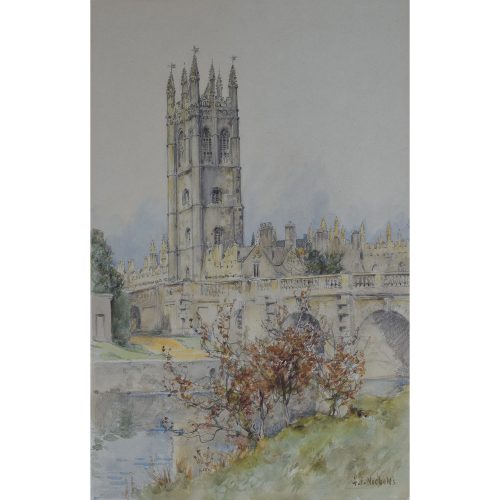
-
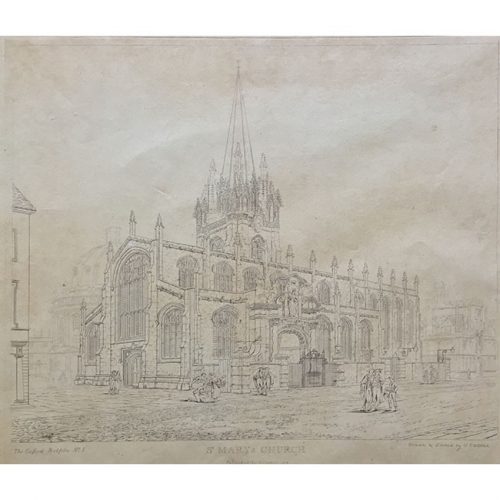
G. Cooper
St. Mary's Church, Oxford
Etching c. 1820 40x47cm From The Oxford Portfolio a series of thirteen views printed on Sepia paper, very rare. If you are interested email info@manningfineart.co.uk or call us on 07929 749056. -
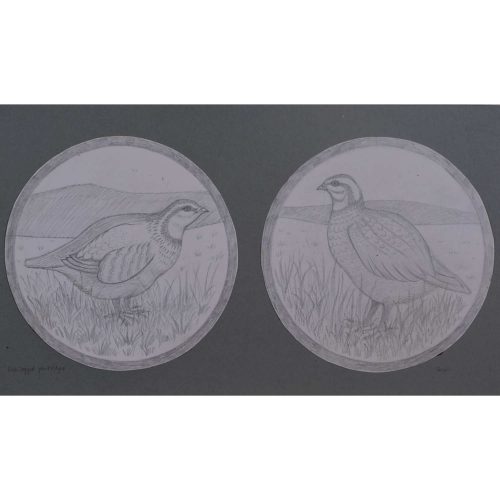
Jane Gray (b.1931)
Game Bird Designs for Stained Glass Roundels (1987)
Watercolour D.18.5 cm (x2)Dated and detailed in the artist's hand verso.
These pencil-sketched designs for two stained glass roundels charmingly depict a red legged partridge and quail set against simple pastoral backgrounds. Gray spent the later years of her life in the rural countryside of Shropshire and was fond of the natural world around her, plants and flowers, in particular, often featuring in her religious and secular work.
Provenance: the artist’s studio sale. Condition: very good. If you are interested, please email info@manningfineart.co.uk or call us on 07929 749056. For other works by Jane Gray and more information about her, please click here. -

John Reeves (1752 - 1829) after Frederick Mackenzie (1788 - 1854) Gate of Christ Church - from Pembroke College (1814)
Hand-coloured aquatint 27 x 21 cm Published by Rudolph Ackermann (1764 - 1834). Frederick Mackenzie (circa 1788 - 1854) was a British watercolourist and architectural draughtsman. He first exhibited at the Royal Academy in 1804, and contributed eleven drawings between that year and 1828. He contributed to the Society of Painters in Water Colours exhibitions from 1813, becoming an associate in 1822, and a full member the following year. From 30 November 1831 until, his death he was treasurer to the society. In later life Mackenzie was no longer commissioned to illustrate books. Rudolph Ackermann was an Anglo-German bookseller, inventor, lithographer, publisher and businessman. In 1795 he established a print-shop and drawing-school at 96 Strand. Here Ackermann set up a lithographic press and began a trade in prints. He later began to manufacture colours and thick carton paper for landscape and miniature painters. Within three years the premises had become too small and he moved to 101 Strand, in his own words "four doors nearer to Somerset House", the seat of the Royal Academy of Arts. Between 1797 and 1800 Ackermann rapidly developed his print and book publishing business, encompassing many different genres including topography, caricature, portraits, transparencies and decorative prints. Condition: Generally very good.If you would like to know more, please email info@manningfineart.co.uk or call us on 07929 749056.
-
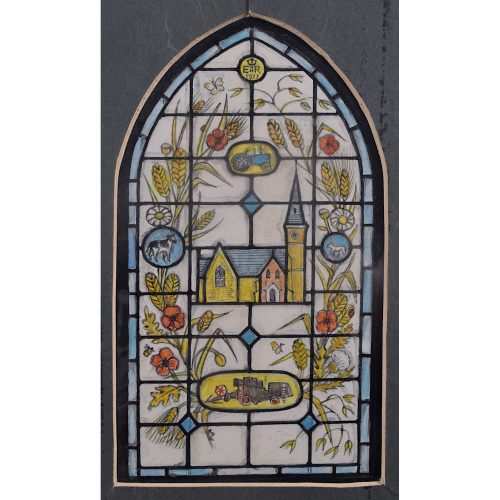
Jane Gray (b.1931)
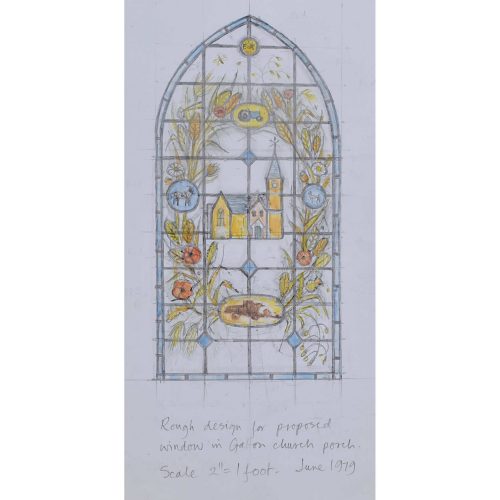
Gatton Church, nr Redhill, Surrey, Design for Stained Glass Window (1979)
Watercolour 15.5 x 8.5 cmDated, detailed in artist’s hand and studio label verso.
A church has existed in this Surrey parish since the Doomsday Survey in 1086 but the present Church dates back to the 13th century, undergoing extensive alterations in the 18th and early 19th centuries. Notably, in 1834, the pulpit and altar, bought from Nuremberg, were hopefully attributed to Albrecht Dürer; the carved doors had travelled from Rouen; the presbytery stalls from a disestablished monastery in Ghent, the altar rails from Tongeren; and the stained glass for the windows, and the wainscoting of the nave and carved canopies had come from Aarschot, near Leuven. This tiny church window was one of Gray’s smallest commissions. Her brief was to include the church at the heart of the Gatton agricultural community, and she did, supplementing this with illustrations of corn, oats, barley, poppies, bees, butterflies, ladybirds, a caterpillar and a grasshopper, alongside small roundels set amongst these containing a calf, a tractor, and a combine harvester respectively. The window was installed in 1980.
Provenance: the artist’s studio sale. Literature: Jane Gray, Playing with Rainbows. (Shropshire: Ellingham Press, 2011), pp.41, 76. Condition: very good. If you are interested, please email info@manningfineart.co.uk or call us on 07929 749056. For other works by Jane Gray and more information about her, please click here. -
Jane Gray (b.1931)
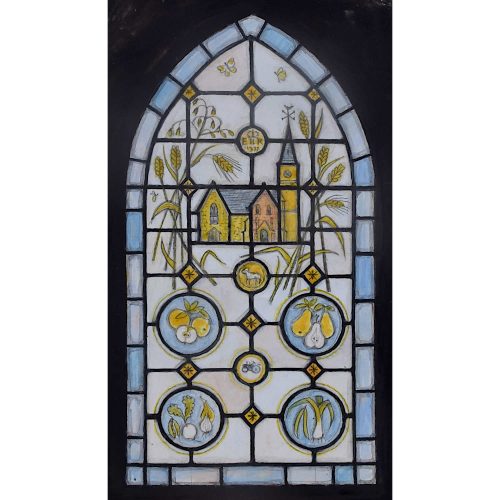
Gatton Church, nr Redhill, Surrey, Design for Stained Glass Window (1979)
Watercolour 15.5 x 8.5 cmDated. Signed verso.
A church has existed in this Surrey parish since the Doomsday Survey in 1086 but the present Church dates back to the 13th century, undergoing extensive alterations in the 18th and early 19th centuries. Notably, in 1834, the pulpit and altar, bought from Nuremberg, were hopefully attributed to Albrecht Dürer; the carved doors had travelled from Rouen; the presbytery stalls from a disestablished monastery in Ghent, the altar rails from Tongeren; and the stained glass for the windows, and the wainscoting of the nave and carved canopies had come from Aarschot, near Leuven. This tiny church window was one of Gray’s smallest commissions. Her brief was to include the church at the heart of the Gatton agricultural community, and she did, supplementing this with illustrations of corn, oats, barley, poppies, bees, butterflies, ladybirds, a caterpillar and a grasshopper, alongside small roundels set amongst these containing a calf, a tractor, and a combine harvester respectively. The window was installed in 1980.
Provenance: the artist’s studio sale. Literature: Jane Gray, Playing with Rainbows. (Shropshire: Ellingham Press, 2011), pp.41, 76. Condition: very good. If you are interested, please email info@manningfineart.co.uk or call us on 07929 749056. For other works by Jane Gray and more information about her, please click here. -
Jane Gray (b.1931)
Gatton Church, nr Redhill, Surrey, Design for Stained Glass Window (1979)
Watercolour 16 x 9 cmA church has existed in this Surrey parish since the Doomsday Survey in 1086 but the present Church dates back to the 13th century, undergoing extensive alterations in the 18th and early 19th centuries. Notably, in 1834, the pulpit and altar, bought from Nuremberg, were hopefully attributed to Albrecht Dürer; the carved doors had travelled from Rouen; the presbytery stalls from a disestablished monastery in Ghent, the altar rails from Tongeren; and the stained glass for the windows, and the wainscoting of the nave and carved canopies had come from Aarschot, near Leuven. This tiny church window was one of Gray’s smallest commissions. Her brief was to include the church at the heart of the Gatton agricultural community, and she did, supplementing this with illustrations of corn, oats, barley, poppies, bees, butterflies, ladybirds, a caterpillar and a grasshopper, alongside small roundels set amongst these containing a calf, a tractor, and a combine harvester respectively. The window was installed in 1980.
Provenance: the artist’s studio sale. Literature: Jane Gray, Playing with Rainbows. (Shropshire: Ellingham Press, 2011), pp.41, 76. Condition: very good. If you are interested, please email info@manningfineart.co.uk or call us on 07929 749056. For other works by Jane Gray and more information about her, please click here. -

Gavin Stamp (1948-2018) Christmas Card, 1975 - St Martin's Military Church, Delhi
Ballpoint pen and ink 21 x 20 cm Born in 1948, Gavin Stamp was educated on a London County Council Scholarship at Dulwich College and took a degree in history and architectural history at Cambridge. He moved to London in 1972 and worked as an architectural draughtsman and graphic designer, combining this with journalism and cataloguing at the RIBA drawings collection. By the late 1970s he was describing himself as ‘an odd-job man in the vicious cut-throat world of architectural history’. Over the course of his career, his scholarship and enthusiasm promoted the understanding and celebration of several great but neglected architects, while he also succeeded in saving many 19th and 20th century buildings from demolition. Sourced from his estaste, Gavin Stamp designed this Christmas card depicting St Martin's Military Church, Delhi in the winter of 1975. The pared back aesthetic allows us to appreciate the neatness of the parallel dashes and the pleasing pointillist effect created across the trees. -
Gaynor Chapman (1935-2000)
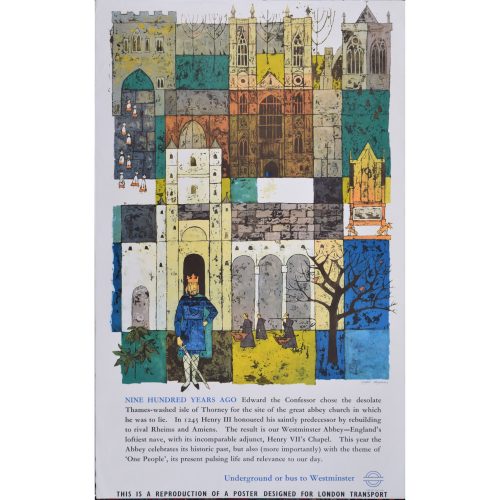
Nine Hundred Years Ago
1966 Lithographic poster for London Transport From the original printing but sold at the time in the London Transport poster shop hence overprinted 'This is a reproduction of a poster designed for London Transport." 101×63.5cm Chapman attended the Epsom School of Art and the RCA where she studied illustration and graphics. Her posters for London Transport are amongst her best works. If you are interested email info@manningfineart.co.uk or call us on 07929 749056. -

John Samuel Agar (1773 - 1858) after John Uwins (1782 - 1857) Gentleman Commoner, Oxford (1814)
Aquatint with original hand colouring 27 x 21 cm Published by Rudolph Ackermann (1764 - 1834). An engraving of a gentleman student from Ackermann's 'History of Oxford'. Thomas Uwins RA RWS was a British painter in watercolour and oil, and a book illustrator. He became a full member of the Old Watercolour Society and a Royal Academician, and held a number of high-profile art appointments including the librarian of the Royal Academy, Surveyor of Pictures to Queen Victoria and the Keeper of the National Gallery. In the late 1790s he began producing work for Ackermann's collections. John Samuel Agar was an English portrait painter and engraver, who exhibited his works at the Royal Academy from 1796 to 1806 and at the British Institution until 1811. He was at one time president of the Society of Engravers. Rudolph Ackermann published many of his engravings. Rudolph Ackermann was an Anglo-German bookseller, inventor, lithographer, publisher and businessman. In 1795 he established a print-shop and drawing-school at 96 Strand. Here Ackermann set up a lithographic press and began a trade in prints. He later began to manufacture colours and thick carton paper for landscape and miniature painters. Within three years the premises had become too small and he moved to 101 Strand, in his own words "four doors nearer to Somerset House", the seat of the Royal Academy of Arts. Between 1797 and 1800 Ackermann rapidly developed his print and book publishing business, encompassing many different genres including topography, caricature, portraits, transparencies and decorative prints. Condition: Generally very good.If you would like to know more, please email info@manningfineart.co.uk or call us on 07929 749056.
-

Keith Vaughan Gentleman in Black-Tie
Ballpoint pen sketch 17 x 13 cm Born in 1912, Keith Vaughan was a British painter known for his modernist and semi-abstract depictions of the male figure. He was self-taught as an artist but during his time as a conscientious objector in the Second World War, he befriended the painters Graham Sutherland and John Minton. Through these contacts, he formed part of the neo-romantic circle of the immediate post-war period. Over time, Vaughan's idiosyncratic style evolved away from the group as he focussed on male nudes and groups, often rendered in a geometric yet lyrical manner. Vaughan was openly gay at a time when homosexuality was criminalised in Britain. As a result, his work often reflected themes of isolation and desire, capturing both the physical and emotional aspects of human existence. He continues to be celebrated today and his works are held in several major galleries, inlcuding the National Galleries of Scotland, the National Portrait Gallery, the Tate and the Victoria and Albert Museum. This sketch of a gentleman in black-tie was taken from Vaughan's 'Ischia Cheese & Grill' sketchbook. Together the drawings record Vaughan's experimentalism with landscape, abstraction and notably his commitment to the human form. This sketchbook was sold as part of Peter Adam's estate; Adam was not just a close friend of Vaughan but his executor, biographer and the curator of multiple exhibitions of his work after he died in 1977. This sketch represents the unique opportunity to own a small piece of Keith Vaughan's oeuvre as he continues to grow in popularity. -

George Bissill (1896-1973) Landscape
Watercolour 20 x 28 cm Born in 1896, George Bissill was a British miner, painter and furniture designer. Raised in the mining village of Langley Mill, Derbyshire, Bissill became a miner at the age of 13, before leaving to join the war effort in 1915. Upon his return from the war after being gassed, Bissill chose to become a pavement artist outside the newly erected Bush House in Aldwych, painting from his memory and his sketch book the uncompromising underground world he had inhabited. In 1935 he moved to the countryside near Newbury, where he lived and worked as a landscape painter, art restorer and dealer until his death in 1973. This watercolour forms part of a larger collection, 'unseen since they were taken from George Bissil's studio in 1983' and restored by Kate Pattinson. A series of planned exhibitions were cancelled due to Covid, but two shows, one in Oxford and one in Ilkeston, did take place. Through such exhibitions, Pattinson hoped to 'restore the reputation of an artist who, through mighty endeavour, conquered the art world in the 1920s with his powerful, authentic and experimental pictures.' Bissill's paintings are also held in a number of important public collections, including the Tate Gallery, National Museum of Ireland and the Manchester Art Gallery. This watercolour depicts a landscape view over fields. Fluffy clouds populate the sky, gentle earthen tones colour the fields and trees mark the horizon. Condition: generally very good.If you would like to know more, please email info@manningfineart.co.uk or call us on 07929 749056.
-
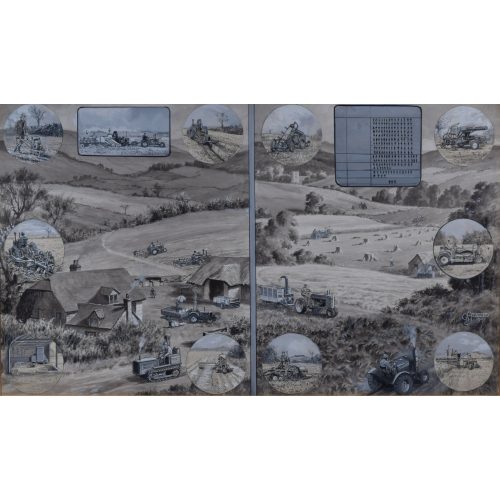
George Horace Davis (1888-1963) Design for publication probably in The Illustrated London News
Tractors and mechanisation Signed and dated 1947 Gouache, monochrome 17.25x29.75" Here the reduction in manpower as a result of the mechanisation of agriculture is celebrated in a typical work by Davis. A "special artist" for 'The Illustrated London News', he worked for it for forty years, the scope and detail of his work being without peer in the rest of the staff. Tractors are pictured in every possible role in agriculture; however the great advances made in the sixty years since then could not have been forseen. Born in Kensington, London, Davis was educated at Kensington Park College and then at Ealing School of Art, working subsequently as a freelance artist until the First World War intervened. He served with the Royal Flying Corps (subsequently the Royal Air Force) with distinction, and had a number of his paintings of aerial combat published in 'The Sphere.' In 1923 he commenced work with The Illustrated London News, for which he worked for the next forty years. His first drawing related to the use, in small boats, of wireless and was the first of many similar diagrammatic drawings designed to educate and inform readers of advances in science, warfare, technology or transport. Needless to say his attention to detail meant architectural drawings were another strength of his, drawings of 10 Downing Street and Westminster Abbey, for instance - and also architectural phantasies such as a proposed heliport at Charing Cross Station. During his career at The Illustrated London News he is estimated to have produced illustrations covering some 2,500 pages of the publication; each one requiring an informed understanding arising from careful research. He continued to work for it until his eighties and at the time of his death there was a supply of finished but as-yet-unpublished works. The sale at Christies in London of the archive of The Illustrated London News on 7 October 2014 included many works by Davis - a price of £16,875 being obtained for a series of seven drawings by him. -
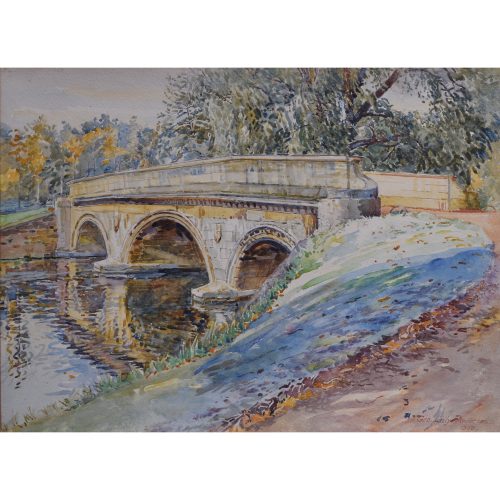
George Lilly Anderson (British b. 1870)
Trinity College Cambridge Bridge
28x38cm Watercolour Intriguingly nothing is known of Anderson's life, apart from the carefully painted landscapes. If you are interested email info@manningfineart.co.uk or call us on 07929 749056. -
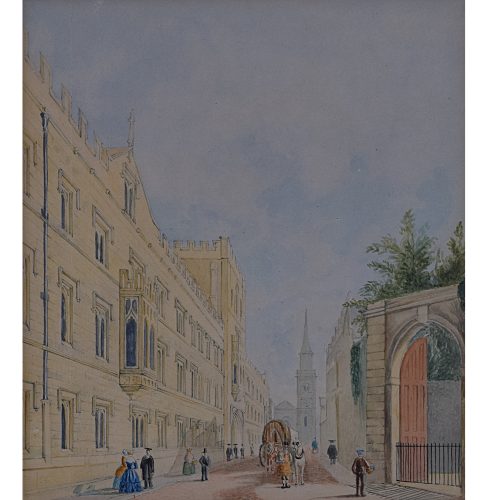
George Pyne (1800-1884) Exeter College, Oxford
Watercolour 22x18.5cm Pyne was the elder son of William Henry Pyne, the publisher artist behind the monumental History of the Royal Residences, and son-in-law of John Varley – two founders of the Society of Painters in Watercolours. Living in Oxford from the 1850s until his death, he brought the hand of an architectural draughtsman to his views of Oxford, the works for which he is best known, but with an artist’s ability to represent the romance of old stone. His views of Cambridge and Eton also contribute to his valuable and historical record of the period. If you are interested email info@manningfineart.co.uk or call us on 07929 749056. Condition: Generally excellent condition. -
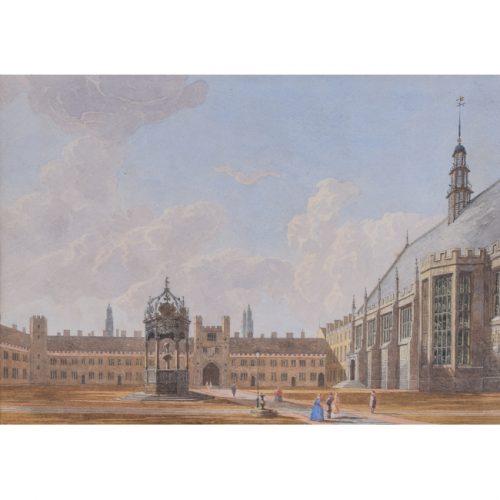
George Pyne (1800-1884)
Great Court, Trinity College, Cambridge
Signed G Pyne 1850 Watercolour 20.5 x 29 cm (8 x 11.5 in.) It appears Pyne spent some time painting in Cambridge in 1849-50. This is - for Pyne - an unusually large composition; a fine watercolour of Trinity Great Court, with King’s College chapel in the background and elegant figures in the court. It is a particularly pleasing composition. Click here for biographical details and other works by the artist. If you are interested email info@manningfineart.co.uk or call us on 07929 749056. -
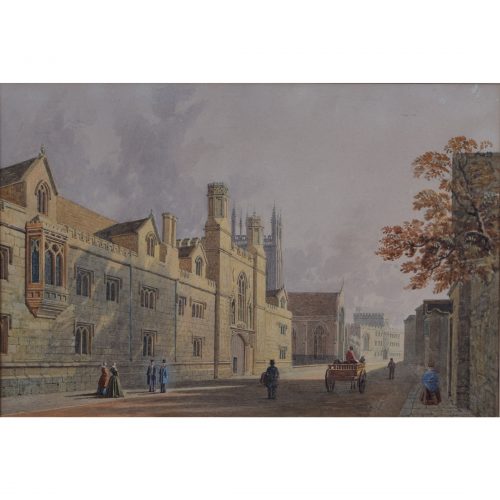
George Pyne (1800-1884)
Merton College, Oxford
Watercolour 18 x 28 cm (7 x 11 in.) Provenance: Agnews -
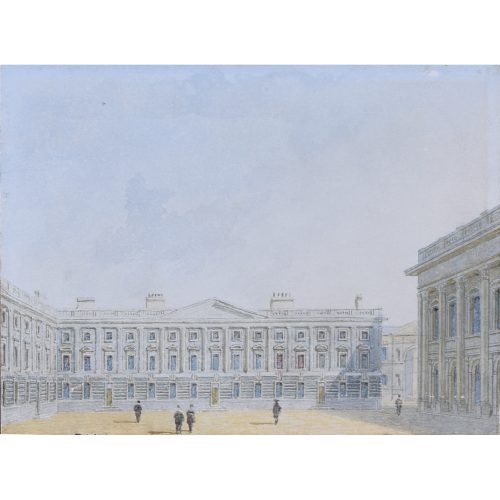
George Pyne
Peckwater Quad, Christ Church, Oxford
Watercolour 13x18cm Click here for biographical details and other works by the artist. If you are interested email info@manningfineart.co.uk or call us on 07929 749056. -

German Aircraft Original vintage Second World War poster
Lithograph 51 x 71 cm c.1941-1944 This original vintage poster, published in 1941, depicts a series of German aircraft, including the fighter plane Messcherschmitt BF 109, the Junkers Ju 87 "Stuka" – a dive bomber known for its accuracy and infamous siren–, and the Heinkel He 111--the Luftwaffe’s main medium bomber, used extensively in the Blitz. In these black-and-white technical drawings, each German aircraft is depicted from different angles, providing a clear view of their shape and markings, making it a crucial tool for aircraft reconnaissance. During the Second World War, the Ministry of Information produced a number of posters detailing the differences between British and German aircraft. In general, they were designed to help British civilians and military personnel identify enemy aircraft, distinguishing them from Allied planes. This poster is marked in the top left-hand corner as being confidential, suggesting that it was restricted to military use, rather than public distribution and served as educational tool to train pilots, anti-aircraft gunners, and air raid wardens to distinguish German planes from friendly or neutral aircraft. This is an excellent example of WWII military intelligence and training material, demonstrating how Allied forces prepared for German aerial threats. Condition: Generally very good. Slight age toning and spotting to paper, small tears at the edges and tape stains that will be covered by mount.If you would like to know more, please email info@manningfineart.co.uk or call us on 07929 749056.
-

German Aircraft Original vintage poster
Lithograph 57 x 45 cm This original vintage poster, published in 1941, depicts a series of German aircraft, including the fighter plane Heinkel HE 113, the bomber plane Junkers JU 89 and the sea plane Arado Ar 196. Each plane is depicted from three different angles, illustrating their unique features and insignia. During the Second World War, the Ministry of Information produced a number of posters detailing the differences between British and German aircraft. They were designed to help British civilians and military personnel identify enemy aircraft, distinguishing them from Allied planes. Condition: Generally very good, tape stain to right hand corner, will be covered by mount.If you would like to know more, please email info@manningfineart.co.uk or call us on 07929 749056.
-
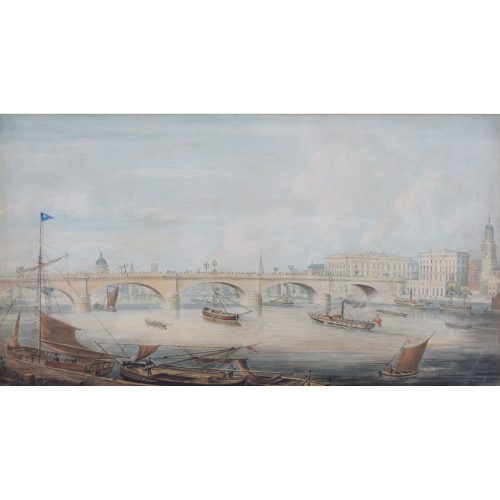
Gideon Yates (?1790-?1840)
1831 View on The Thames with London Bridge from the East Side showing Fishmonger's Hall, The Church of St Magnus the Martyr and St. Paul's Cathedral.
c.1831 29x54cm Watercolour unsigned Provenance: The Parker Gallery LIttle is known of the life of Yates. Even his date of death is disputed with some sources putting it at 1837. What is known is that he spent most of his working life in London, producing many detailed views of The Thames such as this one. His style is very distinctive, and this large and impressive view of London Bridge is a typical view. He is thought to have lived in Lancaster in 1811, and to have travelled widely throughout Britain and the Continent. His works are in public collections including the Victoria and Albert Museum. In this view, Thames barges are in the foreground with their distinctive brown sails. A steamship proceeds along the middle of The Thames. The first steamboat patented was in 1729, by John Allen an English physician. However it was not until 1783 that the first steam-powered ship, "Pyroscaphe," was demonstrated on the River Saône. By 1788 John Fitch in Philadelphia was operating a commercial service along the Delaware River were built in the United States. The first sea-going steamboat was the "Experiment" built by Richard Wright in 1813; by this point river services were becoming well established although it was not until 1815 that The Thames acquired its first successful services with "Margery" and "Thames" arriving from the Clyde where they had been in service for some years. Margate and Gravesend were the main destinations. The steamboat in this view is a paddlesteamer, with two side wheels. At the north end of London Bridge (on the far side from the viewer) is Fishmongers' Hall, St Magnus the Martyr Church is visible on the near side of the bridge, and St Paul's Cathedral is visible beyond. UK Government Art Collection item 6701 is another view of The Thames by Yates, also from The Parker Gallery. If you are interested email info@manningfineart.co.uk or call us on 07929 749056. -
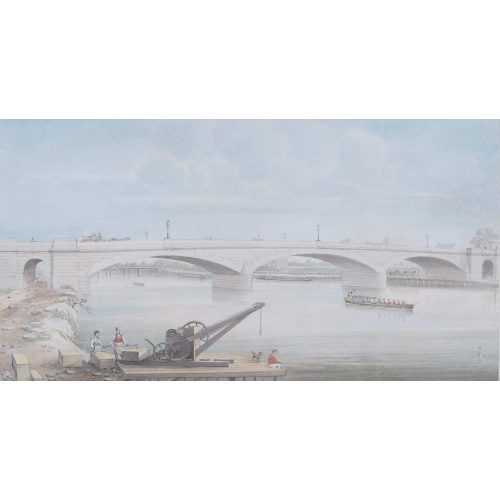
Gideon Yates
View on The Thames with Staines Bridge
25 x 48 cm Watercolour Charmingly signed lower left, on the side of the stone c.1830 Little is known of the life of Yates. Even his date of death is disputed with some sources putting it at 1837. What is known is that he spent most of his working life in London, producing many detailed views of The Thames such as this one. His style is very distinctive, and this large and impressive view of London Bridge is a typical view. He is thought to have lived in Lancaster in 1811, and to have travelled widely throughout Britain and the Continent. His works are in public collections including the Victoria and Albert Museum. UK Government Art Collection item 6701 is another view of The Thames by Yates. Click here for other paintings by Yates. If you are interested email info@manningfineart.co.uk or call us on 07929 749056. -

Sir George Gilbert Scott FRIBA Girls' School Harrogate
Watercolour 53 x 96 cm Signed to the lower right. Sir George Gilbert Scott (1811–1878) is one of the most influential British architects of the 19th century, renowned for his mastery of the Gothic Revival style. His work shaped the skylines of Britain, from the breathtaking Midland Grand Hotel at St Pancras to the majestic Albert Memorial in Kensington Gardens. A prolific designer, he restored countless medieval churches and cathedrals, leaving an indelible mark on the nation’s heritage. Though his restorations were sometimes controversial, his passion for craftsmanship and historical preservation cemented his legacy. Knighted in 1872, Scott’s influence extended beyond his lifetime, inspiring generations of architects, including his own descendants. This charming watercolour rendering of a girls' school in Harrogate, attributed to Sir George Gilbert Scott, beautifully showcases the elegance and functionality of late Victorian institutional architecture. Constructed in warm red brick, the building features a symmetrical façade with long, well-proportioned wings extending from a grand central entrance, which is accentuated by a stately staircase and a delicate cupola. Large sash windows ensure ample natural light, while dormer windows suggest attic spaces, possibly for boarding or study. The leftmost section, with its turreted and fortified appearance, hints at Scott’s Gothic Revival influences, while subtle Tudor-style details in the brickwork and gables add a sense of historical continuity. The surrounding landscape, with neatly arranged pathways and groups of students, enhances the sense of purpose and refinement. This architectural vision seamlessly blends beauty with practicality, embodying the era’s dedication to education and progress. -
Out of stock

Hugh Casson (1910 - 1999) The Gatehouse, Girton College
Lithograph 31 x 26 cm Signed and numbered 263/500, both in pencil. Casson's warm-hued view of Girton, with students strolling under the the neo-Tudor gatehouse. Sir Hugh Casson was educated at Eastbourne College; St John’s College, Cambridge; and the Bartlett School of Architecture. Trained in the 1930s in the early modernist style, he taught at the Cambridge School of Architecture. After employment as a camoufleur during World War 2 by the Air Ministry, in 1948 he was appointed as director of architecture for the Festival of Britain. A close friend of the Royal Family, he undertook designs for the 1953 coronation, designed the interior of the Royal Yacht Britannia (“The overall idea was to give the impression of a country house at sea”), and taught the young Charles III to paint in watercolours. Amongst his architectural achievements are the Elephant House at London Zoo, the 1978 redevelopment of Bristol Docks, the Raised Faculty Building for The University of Cambridge, and a building for the Royal College of Art. He published a number of illustrated books, of which Casson’s Oxford and Casson’s Cambridge are probably the best known. A limited edition series of prints was produced from the paintings. For other views of Girton College, click here. -

Joy Fox (née Hollings) Girton College
Watercolour 24 x 17 cm Signed to bottom right. Little is known about Joy Fox. It seems that she studied at Girton College, Cambridge between 1939 and 1942. This charming watercolour depicting the main gate at the college featured in Douglas de Lacey's book 'Girton's War: the Village 1939-1945.' The work included memories of rationing and the various strategies employed to keep warm and to find clothes for coming up to Girton. There are also descriptions of lectures, college rules, entertainments and war work. Condition: Generally very good.If you would like to know more, please email info@manningfineart.co.uk or call us on 07929 749056.
For other views of Girton College, please click here. -
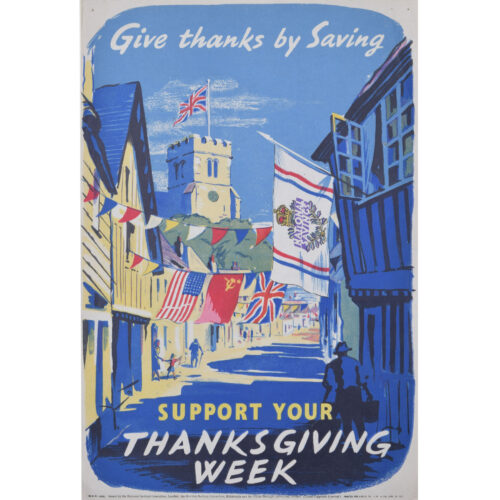
Give Thanks by Saving (1945)
Original vintage poster 38 x 26 cm Issued by the National Savings Committee, London, the Scottish Savings Committee, Edinburgh and the Ulster Savings Committee, Belfast. This patriotic poster, with Union Jack flying and VE Day bunting fluttering, encourages us to show our gratitude to the Allies (including the Soviet Union, whose flag is included amongst the rest of the Allied nations) by investing in the National Savings scheme during 'Thanksgiving Week' in September 1945. Condition: generally very good; pinhole to each top corner. If you are interested, please email info@manningfineart.co.uk or call us on 07929 749056. Click here for other original vintage posters. -
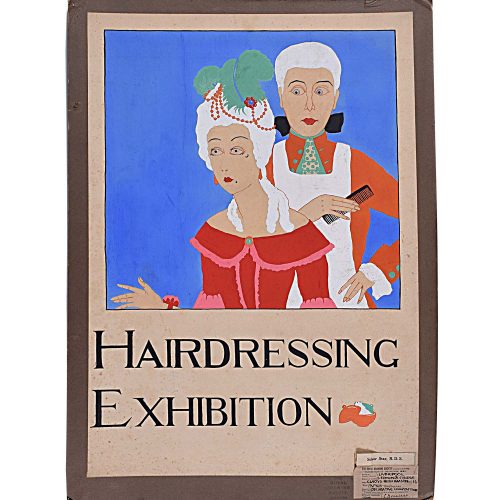
Gladys Williamson
Hairdressing Exhibition
Original Painted Design for Poster55x38cm
Gladys Williamson, a student at St Edmunds College, Liverpool was awarded a silver star for this decorative composition. The award is still attached in the bottom right corner of the design. If you are interested email info@manningfineart.co.uk or call us on 07929 749056. Condition: Generally good, some light spotting. Mounted to board by artist, with label to bottom right. -
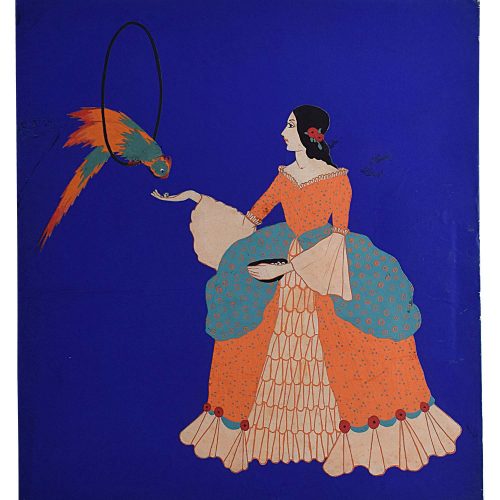
Gladys Williamson
Lady and Parrot
Original Painted Design for Poster Collage and Gouache43x38.5cm
If you are interested email info@manningfineart.co.uk or call us on 07929 749056. Condition: Generally very good, slight wear to blue background some spotting to rim of dress. -
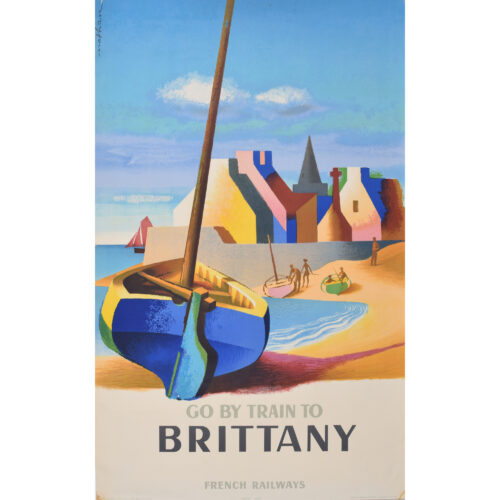
Nathan - Jacques Nathan-Garamond (1910 - 2001)
Go by Train to Brittany (1956)
Original vintage poster 101 x 62 cm Printed in France for and by the French Railways. This charming and cheering poster, featuring a blue sailing boat on a sandy beach with brightly-coloured houses behind, encourages us to explore France by train and make a sojourn to Brittany. Jacques Nathan Garamond (born Jacques Nathan) was a French graphic designer. He studied at the École nationale supérieure des arts décoratifs and became the Director of Contemporary Architecture there. He then began his career as a graphic designer, specialising in posters and commercial illustrations. He was a founding member of the Alliance Graphique Internationale, a society for graphic artists and designers. Condition: generally very good; stains to bottom corners and six enlarged pin holdes to corners and middles of sides. If you are interested, please email info@manningfineart.co.uk or call us on 07929 749056. Click here for other original vintage travel posters. -
Out of stock

Pieter van der Aa (1659 - 1733), after David Loggan (1634 - 1692)
Gonville & Caius College, Cambridge (1727)
Engraving 13 x 17 cm An eighteenth-century view of Gonville and Caius College, Cambridge, engraved by Pieter van der Aa after David Loggan, the noted engraver, draughtsman, and painter. Pieter van der Aa of Leiden was a Dutch publisher best known for preparing maps and atlases, though he also printed editions of foreign bestsellers and illustrated volumes. He is noted for the many engravings he produced after David Loggan's series of Oxford and Cambridge colleges and costumes. In 1727 Van Der Aa illustrated "Les Delices de la Grande Bretagne & de L'Irelande" by James Beeverell, the book in which this engraving appears. Condition: very good. If you are interested, please email info@manningfineart.co.uk or call us on 07929 749056. Click here for other views of Gonville and Caius College, Cambridge -
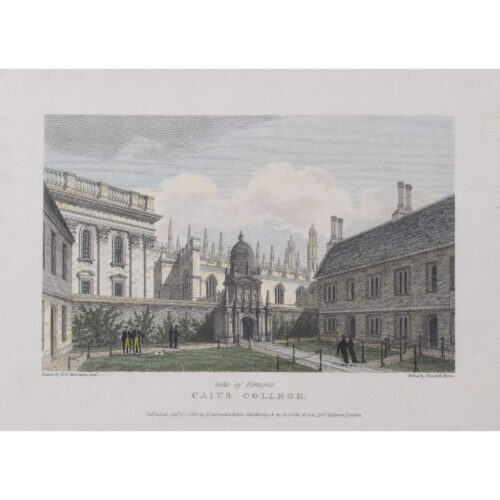
Richard Bankes Harraden (1778 - 1862)
Gate of Honour, Caius College (1810)
Etching 13 x 20 cm A nineteenth-century view of Christ's College, Cambridge, complete with Members of the College and a hound on the lawn. Richard Bankes Harraden was a printmaker, painter, and drawing master. He was active in Cambridge, producing many views of the colleges, and subsequently several Oxford colleges. Harraden was an early and exhibiting member of the Society of British Artists in London, which was established in 1823, and remained a member until 1849. He specialised in depictions of landscape, topography and architecture, and was the son of Richard Harraden (1756 - 1838) with whom he published plates as 'Harraden & Son'. Byrne was a London-born etcher and landscape painter, who was taught by her father, the etcher William Byrne. She and her father contributed etchings to the 'Magna Britannia' and 'Britannia Depicta', books illustrating the most interesting views in various English counties, published by Samuel Lysons in the late 1810s. Condition: very good; later hand coloured. If you are interested, please email info@manningfineart.co.uk or call us on 07929 749056. Click here for other views of Gonville and Caius. -
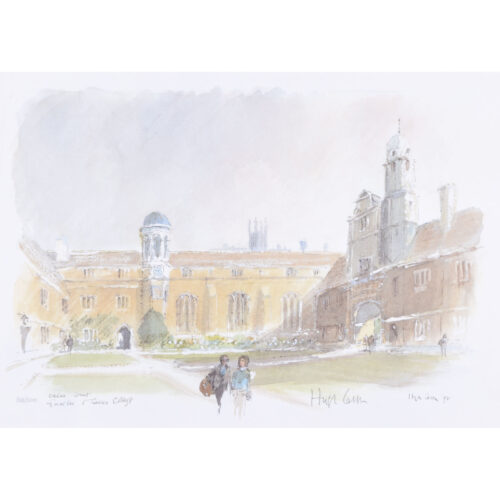
Hugh Casson (1910 - 1999)
Caius Court, Gonville and Caius College (1992)
Lithograph 31 x 44 cm Signed and numbered 358/500, both in pencil. Casson's depiction of Gonville and Caius, with sun slanting into the 16th-century Caius Court. Members of the college stroll through the court. Sir Hugh Casson was educated at Eastbourne College; St John’s College, Cambridge; and the Bartlett School of Architecture. Trained in the 1930s in the early modernist style, he taught at the Cambridge School of Architecture. After employment as a camoufleur during World War 2 by the Air Ministry, in 1948 he was appointed as director of architecture for the Festival of Britain. A close friend of the Royal Family, he undertook designs for the 1953 coronation, designed the interior of the Royal Yacht Britannia (“The overall idea was to give the impression of a country house at sea”), and taught the young Charles III to paint in watercolours. Amongst his architectural achievements are the Elephant House at London Zoo, the 1978 redevelopment of Bristol Docks, the Raised Faculty Building for The University of Cambridge, and a building for the Royal College of Art. He published a number of illustrated books, of which Casson’s Oxford and Casson’s Cambridge are probably the best known. A limited edition series of prints was produced from the paintings. Condition: very good. If you are interested, please email info@manningfineart.co.uk or call us on 07929 749056. Click here for other views of Gonville and Caius, Cambridge. -
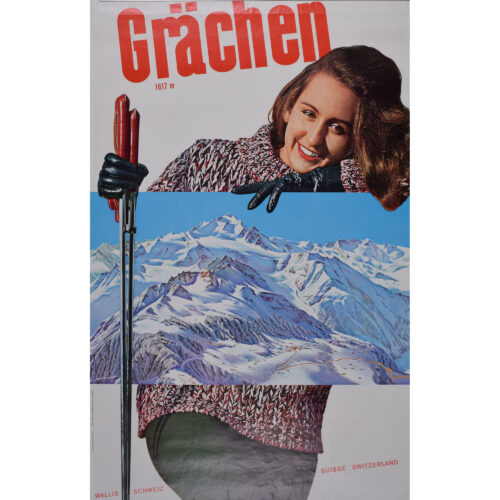
Grächen, 1617 m (1969)
Original vintage poster 101 x 64 cm A beaming skier holds a map of Grächen, encouraging us to plan our next skiing trip there. Voluminous hair, a lack of helmet, turtleneck jumper and leather gloves mark the poster out as fabulously 1960s. Condition: generally very good; a few tiny repaired edge tears. Not backed. If you are interested, please email info@manningfineart.co.uk or call us on 07929 749056. Click here for more original vintage posters. -
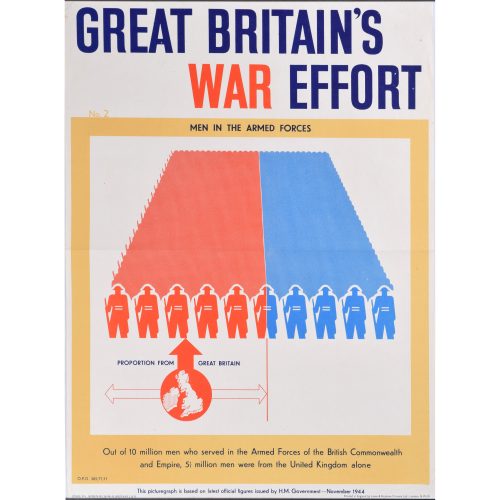
Printed by Lowe & Brydone Printers (1944)
Great Britain's War Effort No. 2 (Men in the armed forces)
50x37cm "Of the ten million men who served in the Commonwealth's Armed Forces five-and-a-half million men were from the United Kingdom alone. This picturegraph is based on latest official figures issued by HM Government November 1944." The population of the Empire had to be persuaded that Britain was pulling her weight in World War 2. By this poster and others similar could the message be put across. If you are interested email info@manningfineart.co.uk or call us on 07929 749056. Condition: Folds as issued, otherwise generally excellent. -
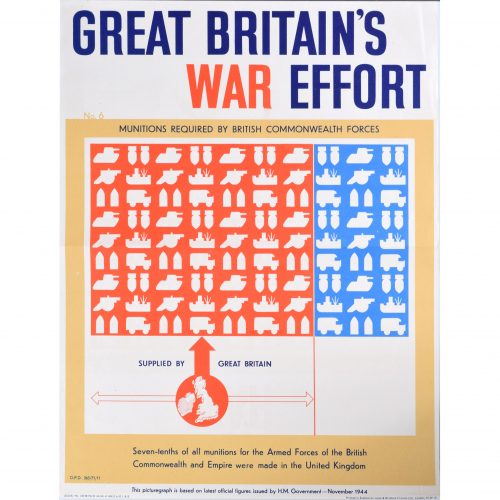
Printed by Lowe & Brydone Printers (1944)
Great Britain's War Effort No. 6 (Munitions)
50x37cm "Seven-tenths of all munitions for the Armed Forces of the British Commonwealth and Empire were made in the United Kingdom. This picturegraph is based on latest official figures issued by HM Government November 1944." The population of the Empire had to be persuaded that Britain was pulling her weight in World War 2. Bu this poster and others similar could the message be put across. The fine stylised tanks, bombs, ships, guns and other vehicles are stacked up on the left-hand side showing the British contribution. If you are interested email info@manningfineart.co.uk or call us on 07929 749056. Condition: Folds as issued, otherwise generally excellent. -
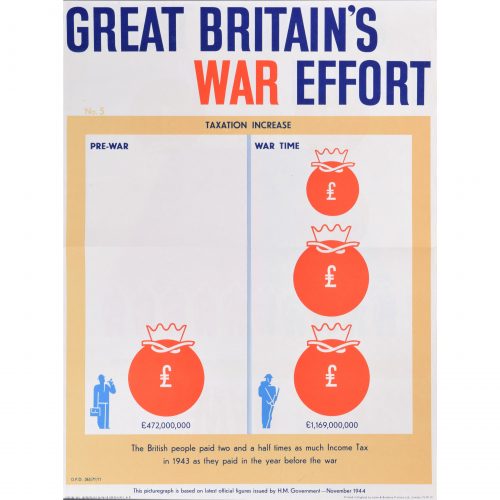
Printed by Lowe & Brydone Printers (1944)
Great Britain's War Effort No. 5 (Taxation)
50x37cm "The British people paid two and a half times as much Income Tax in 1943 as they paid in the year before the war. This picturegraph is based on latest official figures issued by HM Government November 1944." Pre-war taxation: £472,000,000 War-time £1,169,000,000 The population of the Empire had to be persuaded that Britain was pulling her weight in World War 2. By this poster and others similar could the message be put across. If you are interested email info@manningfineart.co.uk or call us on 07929 749056. Condition: Folds as issued, otherwise generally excellent. -

Pieter van der Aa (1659 - 1733), after David Loggan (1634 - 1692)
Great St Mary's, Cambridge (1727)
Engraving 13 x 17 cm An eighteenth-century view of Great St Mary's, Cambridge, engraved by Pieter van der Aa after David Loggan, the noted engraver, draughtsman, and painter. Pieter van der Aa of Leiden was a Dutch publisher best known for preparing maps and atlases, though he also printed editions of foreign bestsellers and illustrated volumes. He is noted for the many engravings he produced after David Loggan's series of Oxford and Cambridge colleges and costumes. In 1727 Van Der Aa illustrated "Les Delices de la Grande Bretagne & de L'Irelande" by James Beeverell, the book in which this engraving appears. Condition: very good. If you are interested, please email info@manningfineart.co.uk or call us on 07929 749056. Click here for other general views of Cambridge. -
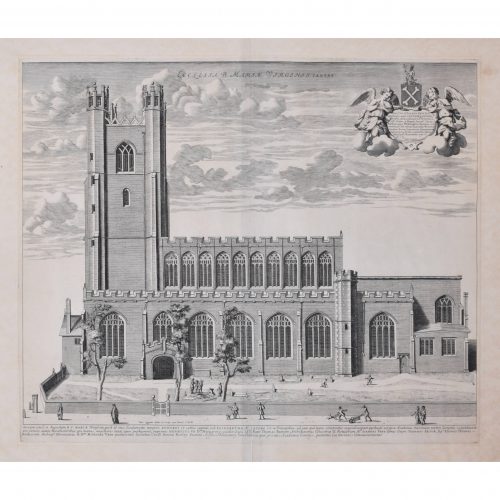
David Loggan (1634 - 1692)
The Church of St Mary the Virgin, Cambridge (1690)
Engraving 38 x 47 cm Loggan was born to English and Scottish parents, and was baptised in Danzig in 1634. After studying engraving in Danzig with Willem Hondius (1598-1652 or 1658), he moved to London in the late 1650s, going on to produce the engraved title-page for the folio 1662 Book of Common Prayer. He married in 1663 and moved to Nuffield in Oxfordshire in 1665. Loggan was appointed Public Sculptor to the nearby University of Oxford in the late 1660s, having been commissioned to produce bird’s-eye views of all the Oxford colleges. He lived in Holywell Street as he did this. The 'Oxonia Illustrata' was published in 1675, with the help of Robert White (1645 - 1704). Following its completion, Loggan began work on his equivalent work for Cambridge; the 'Cantabrigia Illustrata' was finally published in 1690, when he was made engraver to Cambridge University. The 'Oxonia Illustrata' also includes an engraving of Winchester College (Winchester and New College share William of Wykeham as their founder) whilst the 'Cantabrigia Illustrata' includes one of Eton College (which shares its founder, Henry VIII, with King’s College). Bird’s-eye views from this era required a particular talent as an architectural perspectivist; it was not until 1783 that it became possible for artists to ascend via hot air balloons and view the scenes they were depicting from above. Loggan thus had to rely on his imagination in conceiving the views. Loggan’s views constitute the first accurate depictions of the two Universities, in many ways unchanged today. Whilst the Oxford engravings were produced in reasonable numbers and ran to a second edition by Henry Overton (on thicker paper and with a plate number in Roman numerals in the bottom right-hand corner), those of Cambridge were printed in much smaller numbers. The Dutchman Pieter van der Aa published some miniature versions of the engravings for James Beverell’s guidebook to the UK, 'Les Delices de la Grande Bretagne' (circa 1708). The contemporary artist Andrew Ingamells has produced a highly-acclaimed series of etchings which bring Loggan’s original vision up to date. Condition: has been previously washed; generally good. If you’d like to know more, please email info@manningfineart.co.uk or call us on 07929 749056. -
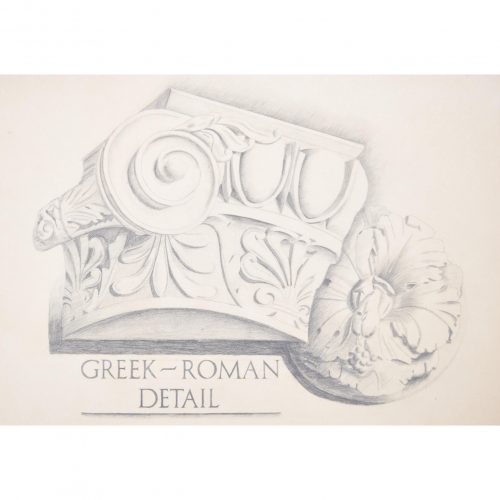
S Clapham (active 1940 - 1960)
Greek Roman Detail
Pencil 51 x 72 cm A mid-century design for a column in the neoclassical style. Clapham was an architect based in Stockwell in London. Condition: very good; mounted to board. Slight even age toning to paper. If you are interested, please email info@manningfineart.co.uk or call us on 07929 749056. Click here for other works by the artist. -
Out of stock
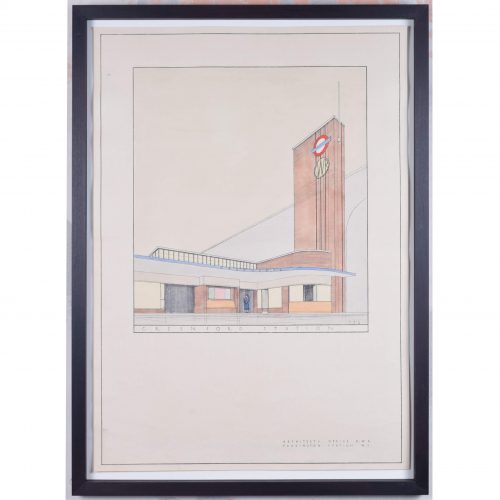
Brian Bannatyne Lewis (1906 - 1991)
Greenford Station (1938)
Pen, ink and watercolour 70 x 50 cm Initialled and dated 7 3 38. A 1938 design for the new Greenford tube station, commissioned by the Great Western Railway (GWR) for its proposed western extension to the Central Line. The design's Art Deco lettering befits London Transport's aesthetic in the 1930s. Lewis brings his designs to life by including smartly-dressed characters entering and leaving the stations. The Central line opened in 1900, between Shepherd's Bush and Bank; it extended westwards to Ealing Broadway in 1920. Two years after the formation of London Transport in 1933, an extensive New Works Programme began, proposing a westwards extension of the line to Denham. Brian Lewis created designs for nine stations in early 1938, but the Second World War broke out before they could be built. By the time the extension had been built, Lewis was no longer chief architect of the GWR - the stations were modified and completed by Frederick Francis Charles Curtis instead. The extension to Greenford opened in 1947 and finally reached West Ruislip in 1948. Denham never actually became part of the tube line, owing to the establishment of the green belt. Brian Lewis was born in Tasmania, attended school in Melbourne, and subsequently obtained a Diploma in Architecture in 1928 from the University of Melbourne. He then moved to the UK to study at the Liverpool School of Architecture, winning scholarships in each of his three years of study to fund extensive European travel. He married a fellow Liverpool architectural student, Hilary Archer. After moving to London, he took up employment with the GWR in their architects’ office; he also lectured at a local polytechnic, and moonlighted with his wife at home on mainly residential commissions – rather different projects from the hotels and stations which GWR commissioned from him. He exhibited frequently at the Royal Academy of Arts, showing superb measured drawings of historic buildings. In the Second World War he enlisted with the Second Imperial Australian Force, serving in the Middle East, then transferred to the Royal Australian Engineers where he became a Captain. In 1943 he was sent to London to help GWR repair bomb damage. Lewis became Chief Architect of GWR in 1945 (following the retirement of the noted Percy Emerson Culverhouse), and the first Chair of Architecture at Melbourne University in 1947. He also became the consulting architect for the major buildings of the Australian National University in Canberra, producing an imaginative site plan and designing University House, which was awarded the Sulman medal in 1954. He also designed the Risdon Prison Complex in 1960. He retired in 1971 to paint watercolours and write his memoirs. Condition: generally very good; a few handling marks and two holes from filing. Handsomely framed. If you are interested, please email info@manningfineart.co.uk or call us on 07929 749056. Click here to view the other station designs in the set. -
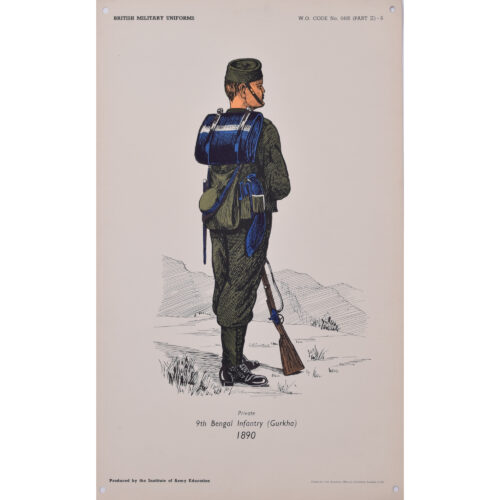
9th Bengal Infantry (Gurkha) Private 1890 uniform
Lithograph 50 x 31 cm Produced for the Institute of Army Education. Printed for HM Stationery Office by I A Limited, Southall 51. These posters were produced by the Institute of Army Education, likely for display in barracks. Created in the 1950s, they illustrate the 'vintage' uniforms worn by the Corps during the First World War. Condition: punched holes to corners as issued; otherwise generally very good. If you are interested, please email info@manningfineart.co.uk or call us on 07929 749056. Click here for other original vintage Institute of Army Education uniform posters. -
Gwen White
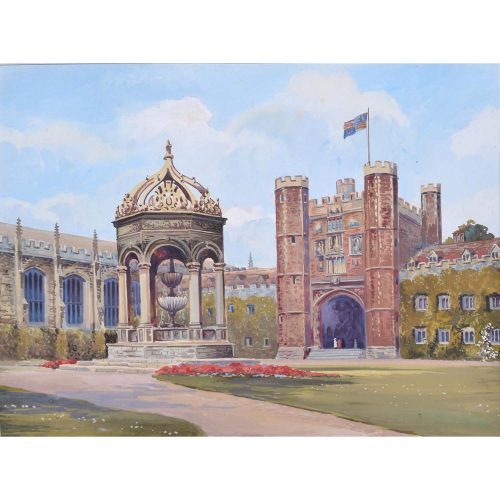
Great Court, Trinity College, Cambridge
Gouache 24x32cm Gwen White is author of Perspective: A Guide for Artists, Architects and Designers and this view of Trinity is painted with an architect’s eye for detail. If you are interested email info@manningfineart.co.ukor call us on 07929 749056. -
Gwyneth Johnstone (1915 - 2010)
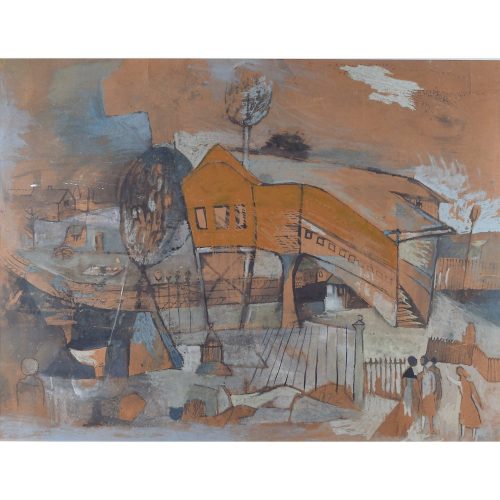
The Railway Bridge
Mixed media 64 x 83 cm Signed lower left in paint, and monogrammed lower left in pencil. Provenance: the estate of the artist. Johnstone explores the possibilities of abstraction in this semi-delirious depiction of a railway bridge. Painted in tones of burnt umber, orange, grey, and black, the picture is populated by warped railings, bending trees, and staring onlookers, all of which centre around a railway line and bridge. Tanya Harrod described Johnstone's painting style a 'a hallucinogenic, haunting pastoral', and that is immensely evident in this picture. Johnstone was an English painter who worked mostly in oils and often depicted poignant modern landscapes. Her parents were the musician Nora Brownsford and the artist Augustus John. She studied at the Slade School of Fine Art, where she established lifelong friendships with fellow artists Mary Fedden and Virginia Parsons. After the Slade, Johnstone was taught academicised cubism by the painter André Lhote at the Académie de la Grande Chaumière in Paris. For a brief period in the early 1950s she took life classes with the surrealist artist Cecil Collins at the Central School of Arts and Crafts.