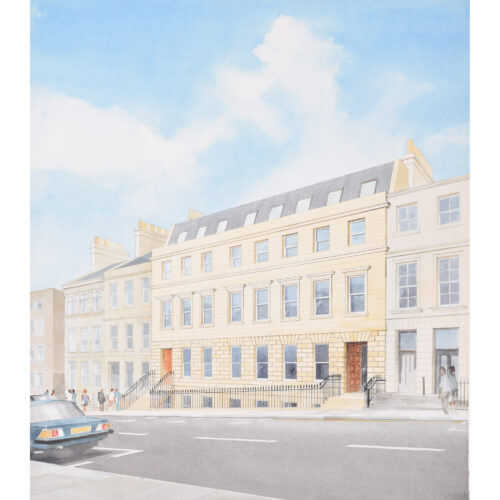
-
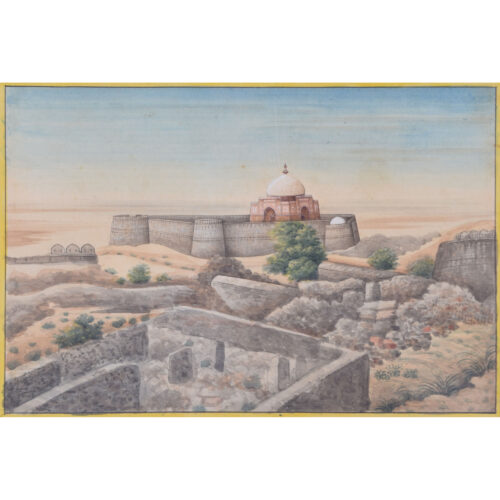
Tughlaqabad Fort, Delhi
Watercolour 13 x 20 cmA 20th century watercolour by an unknown artist of Tughlaqabad Fort, a ruined 14th-century fort in Delhi. We have three other Indian architectural views by the same artist available.Condition: generally very good; one or two small scratches as visible in photographs. If you are interested, please email info@manningfineart.co.uk or call us on 07929 749056. Click here for other works from the same series. -

George Bissill (1896-1973) 'Two Woodcutters'
Watercolour 29 x 39 cm Born in 1896, George Bissill was a British miner, painter and furniture designer. Raised in the mining village of Langley Mill, Derbyshire, Bissill became a miner at the age of 13, before leaving to join the war effort in 1915. Upon his return from the war after being gassed, Bissill chose to become a pavement artist outside the newly erected Bush House in Aldwych, painting from his memory and his sketch book the uncompromising underground world he had inhabited. In 1935 he moved to the countryside near Newbury, where he lived and worked as a landscape painter, art restorer and dealer until his death in 1973. This painting forms part of a larger collection, 'unseen since they were taken from George Bissil's studio in 1983' and restored by Kate Pattinson. A series of planned exhibitions were cancelled due to Covid, but two shows, one in Oxford and one in Ilkeston, did take place. Through such exhibitions, Pattinson hoped to 'restore the reputation of an artist who, through mighty endeavour, conquered the art world in the 1920s with his powerful, authentic and experimental pictures.' Bissill's paintings are also held in a number of important public collections, including the Tate Gallery, National Museum of Ireland and the Manchester Art Gallery. This watercolour depicts two woodcutters, preparing timber in a woodland area. The cool colours and leafless trees suggest a wintry scene, while the men at work evoke Bissill's earlier paintings of miner's labouring in the pits. Through his typical paired back style and strong lines, Bissell skilfully achieves what he does so well: the freezing of an everyday moment in time. Condition: Generally very good.If you would like to know more, please email info@manningfineart.co.uk or call us on 07929 749056.
-

Julian Trevelyan (1910 - 1988)
Ufizzi Gallery (1966)
Etching and aquatint 47 x 34 cm (paper 80 x 57 cm) Trevelyan's vibrant kaleidoscopic depiction of the interior of the Uffizi, Florence. Numbered 61/100 lower left, titled below, and signed lower right, all in pencil. Condition: Excellent - this print is often rather faded; old tape damage to reverse in top centimetre of print. -

A. E. Halliwell (1905-1987) Underground to Escape the Fog
Gouache 19 x 13 cm c.1930 Signed to the bottom right and inscribed 'Design for a Poster, Carried out 12" x 20".' Provenance: Family of the artist. A.E. Halliwell (1905–1986) was a British artist, illustrator, and designer best known for his vibrant poster designs created for British railway companies during the mid-20th century. Born in Southport, Halliwell developed a strong foundation in art and design early in life. He studied at the Southport School of Art from 1923 to 1926 before graduating to the Royal College of Art in London and subsequently practising as a professional designer from the 1930s. Following his studies, Halliwell married Doris Doyle in Strood Kent, and went on to have a significant teaching career himself, most notably as a lecturer at the Central School of Arts and Crafts (later part of Central Saint Martins), where he influenced a new generation of designers and illustrators. Halliwell is perhaps best remembered for his vibrant and engaging poster designs created for British railway companies during the 1930s. His work was characterised by a bright, graphic style that balanced charm with clarity, often depicting idealised scenes of British holiday destinations—from sunny seaside towns to tranquil countryside vistas. Beyond posters, his artistic output included book illustration, commercial design, and stage costume sketches, showcasing his versatility across mediums. His posters continue to remain enduring symbols of a golden age of British travel and design and are displayed in major collections including the London Transport Museum and the V & A. This striking poster design uses moody tones and bold silhouettes to show Londoners disoriented in a misty street where lights are distorted by the haze and the houses are unrecognisable but for their chimneys. Fear not... they are saved by the glowing red Underground sign cutting through the haze and the poster therefore serves as a reminder that (apparently) even in thick fog, the Tube stays clear and reliable. Condition: Generally very good.If you would like to know more, please email info@manningfineart.co.uk or call us on 07929 749056.
-
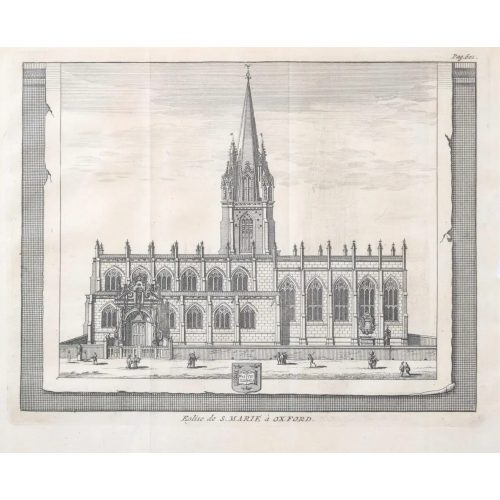
Pieter van der Aa (1659-1733), after David Loggan (1634–1692)
The University Church of St Mary the Virgin, University of Oxford (1727)
Engraving 12 x 16 cm An eighteenth-century view of the University Church, engraved by Pieter van der Aa after David Loggan, the noted engraver, draughtsman, and painter. St Mary's was the first building of the University of Oxford and its parish consists almost exclusively of university and college buildings. Its eccentric Baroque porch, designed by Nicholas Stone, faces the High Street, and it boasts a spire which is claimed by some church historians to be one of the most beautiful in England. Radcliffe Square lies to the north and to the east is Catte Street. The 13th-century tower is open to the public and provides magnificent views across the heart of the historic university city, especially Radcliffe Square, the Radcliffe Camera, Brasenose College, and All Souls College. Of particular interest here is the trompe l'oeil piece of gently torn paper which frames the view of the church. Pieter van der Aa of Leiden was a Dutch publisher best known for preparing maps and atlases, though he also printed editions of foreign bestsellers and illustrated volumes. He is noted for the many engravings he produced after David Loggan's series of Oxford and Cambridge colleges and costumes. In 1727 Van Der Aa illustrated "Les Delices de la Grande Bretagne & de L'Irelande" by James Beeverell, the book in which this engraving appears. Condition: a good impression. If you’d like to know more, please email info@manningfineart.co.uk or call us on 07929 749056. -
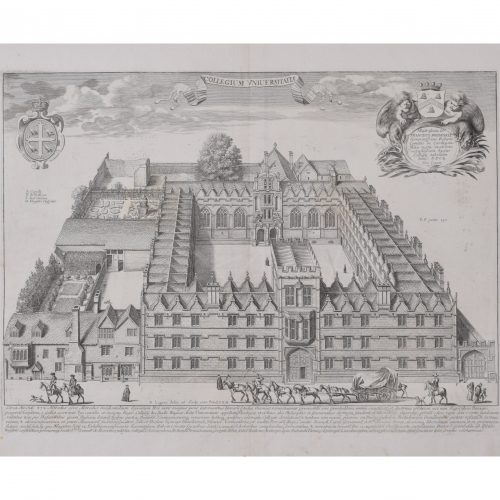
David Loggan (1634 - 1692)
University College, Oxford (1675)
Engraving 29 x 40 cm Loggan's view of Univ from the 'Oxonia Illustrata'. Loggan was born to English and Scottish parents, and was baptised in Danzig in 1634. After studying engraving in Danzig with Willem Hondius (1598-1652 or 1658), he moved to London in the late 1650s, going on to produce the engraved title-page for the folio 1662 Book of Common Prayer. He married in 1663 and moved to Nuffield in Oxfordshire in 1665. Loggan was appointed Public Sculptor to the nearby University of Oxford in the late 1660s, having been commissioned to produce bird’s-eye views of all the Oxford colleges. He lived in Holywell Street as he did this. The 'Oxonia Illustrata' was published in 1675, with the help of Robert White (1645 - 1704). Following its completion, Loggan began work on his equivalent work for Cambridge; the 'Cantabrigia Illustrata' was finally published in 1690, when he was made engraver to Cambridge University. The 'Oxonia Illustrata' also includes an engraving of Winchester College (Winchester and New College share William of Wykeham as their founder) whilst the 'Cantabrigia Illustrata' includes one of Eton College (which shares its founder, Henry VIII, with King’s College). Bird’s-eye views from this era required a particular talent as an architectural perspectivist; it was not until 1783 that it became possible for artists to ascend via hot air balloons and view the scenes they were depicting from above. Loggan thus had to rely on his imagination in conceiving the views. Loggan’s views constitute the first accurate depictions of the two Universities, in many ways unchanged today. Whilst the Oxford engravings were produced in reasonable numbers and ran to a second edition by Henry Overton (on thicker paper and with a plate number in Roman numerals in the bottom right-hand corner), those of Cambridge were printed in much smaller numbers. The Dutchman Pieter van der Aa published some miniature versions of the engravings for James Beverell’s guidebook to the UK, 'Les Delices de la Grande Bretagne' (circa 1708). The contemporary artist Andrew Ingamells has produced a highly-acclaimed series of etchings which bring Loggan’s original vision up to date. Condition: generally very good. If you’d like to know more, please email info@manningfineart.co.uk or call us on 07929 749056. -
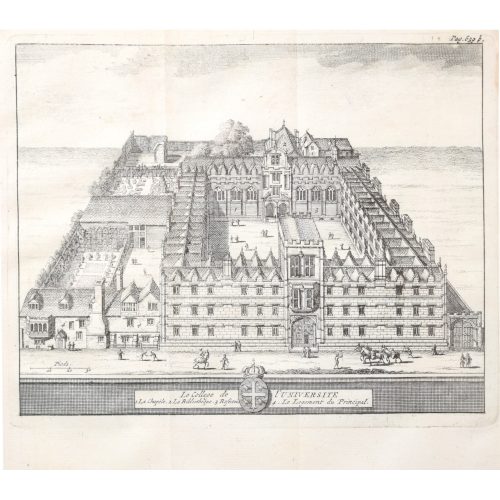
Pieter van der Aa (1659-1733), after David Loggan (1634–1692)
University College, Oxford (1727)
Engraving 12 x 16 cm An eighteenth-century view of University College, Oxford, engraved by Pieter van der Aa after David Loggan, the noted engraver, draughtsman, and painter. Pieter van der Aa of Leiden was a Dutch publisher best known for preparing maps and atlases, though he also printed editions of foreign bestsellers and illustrated volumes. He is noted for the many engravings he produced after David Loggan's series of Oxford and Cambridge colleges and costumes. In 1727 Van Der Aa illustrated "Les Delices de la Grande Bretagne & de L'Irelande" by James Beeverell, the book in which this engraving appears. Condition: a good impression. If you’d like to know more, please email info@manningfineart.co.uk or call us on 07929 749056. -
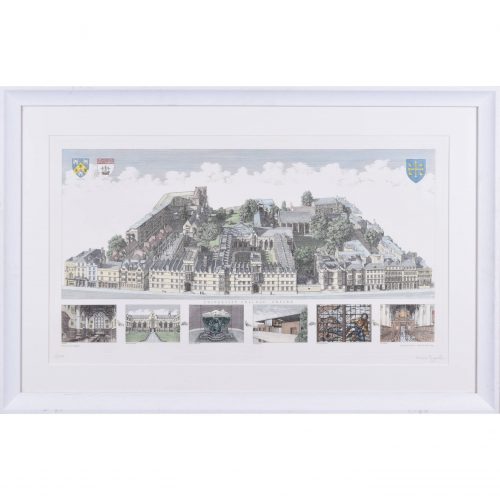
Andrew Ingamells (1956 - )
University College, Oxford
Etching 40 x 70 cm Signed lower right and numbered 15/100 lower left, both in pencil. Inspired by David Loggan’s celebrated engraving of the college, this view of Univ College belongs to Ingamells’ series of views of Oxford and Cambridge. The series took six months to complete and has long-since sold out from the publisher. Ingamells trained at St Albans School of Art and the London College of Printing, subsequently working as a graphic designer and illustrator. Based in London, he began making drawings of the buildings and landscapes of London. Ingamells’ work is in many public collections including those of the Tate Gallery, The National Trust, The Paul Mellon Centre for British Art, and the City of London Guildhall Library. His pictures are also in several private collections, including those of various Oxford and Cambridge colleges, HM King Charles III, and Shell Oil. The artist is currently part-way through his epic project to record all the colleges of Oxford and Cambridge, a project undertaken in homage to David Loggan. Condition: excellent. If you are interested, please email info@manningfineart.co.uk or call us on 07929 749056. Click here for other views of University College, Oxford. -
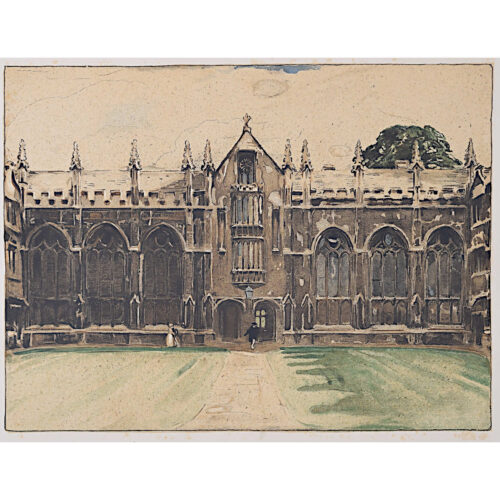
William Nicholson (1872 - 1949)
University College, Oxford
Lithograph 27 x 35 cm Titled in pencil below. Blindstamped 'Stafford Gallery' and dated 1906 below right. Between 1902 and 1904 William Nicholson lived in Woodstock; during this period he made several architectural studies of Oxford's colleges and other University buildings. Sir William Nicholson was a British painter and printmaker. He is also known as an illustrator, author of children’s books, stained glass designer, and theatre set designer. Condition: generally very good; a little spotting to margins. If you are interested, please email info@manningfineart.co.uk or call us on 07929 749056. Click here for other views of University College, Oxford. -

John Samuel Agar (1773 - 1858) after John Uwins (1782 - 1857) Nobleman, Cambridge (1815)
Aquatint with original hand colouring 30 x 25 cm Published by Rudolph Ackermann (1764 - 1834). An engraving of a nobleman studying at Cambridge, from Ackermann's 'A History of the University of Cambridge, Its Colleges, Halls and Public Buildings'. Thomas Uwins RA RWS was a British painter in watercolour and oil, and a book illustrator. He became a full member of the Old Watercolour Society and a Royal Academician, and held a number of high-profile art appointments including the librarian of the Royal Academy, Surveyor of Pictures to Queen Victoria and the Keeper of the National Gallery. In the late 1790s he began producing work for Ackermann's collections. John Samuel Agar was an English portrait painter and engraver, who exhibited his works at the Royal Academy from 1796 to 1806 and at the British Institution until 1811. He was at one time president of the Society of Engravers. Rudolph Ackermann published many of his engravings. Ackermann was an Anglo-German bookseller, inventor, lithographer, publisher and businessman. He attended the Latin school in Stollberg, but his wish to study at the university was made impossible by lack of financial means, and he therefore became a saddler like his father. He worked as a saddler and coach-builder in different German cities, moved from Dresden to Basel and Paris, and then, 23 years old, settled in London. He established himself in Long Acre, the centre of coach-making in London and close to the market at Covent Garden. Ackermann then moved to Little Russell Street where he published Imitations of Drawings of Fashionable Carriages (1791) to promote his coach-making. Other publications followed. In 1795 he established a print-shop and drawing-school at 96 Strand. Here Ackermann set up a lithographic press and began a trade in prints. He later began to manufacture colours and thick carton paper for landscape and miniature painters. Within three years the premises had become too small and he moved to 101 Strand, in his own words "four doors nearer to Somerset House", the seat of the Royal Academy of Arts. Between 1797 and 1800 Ackermann rapidly developed his print and book publishing business, encompassing many different genres including topography, caricature, portraits, transparencies and decorative prints. During the Napoleonic wars, Ackermann was an energetic supporter of the Allied cause and made significant contributions to British propaganda through his publication of anti-Napoleonic prints and military manuals. He became a naturalised British citizen in March 1809. As one of the pioneers of modern publishing methods, Ackermann developed an international distribution network for his publications and came to have significant commercial interests in South America. The business he founded in London flourished throughout the 19th century under the management of his descendants. He was buried at St. Clement Danes in the Strand, London. In 2020, the St. Louis Mercantile Library wrote that: "Ackermann excelled in the creation of landscape and architectural engravings. He created beautiful illustrations of the city of London, his adopted home, as well as two volumes of classic views of Westminster Abbey, along with exquisite views of river scenes. One of our favorite collections are four massive volumes of lovingly illustrated exterior and interior landmarks of Oxford and Cambridge Universities created just over two hundred years ago. These publications show Ackermann’s hand at every turn of the page along with the team of assistant designers and engravers he employed to create these works. Perhaps they were a way by which the artist could lay to rest his own regret at not being able to attend [an Oxbridge] college himself in a fondly depicted idyll to learning which these prints so aptly represent." Condition: Paper slightly toned within platemark.If you would like to know more, please email info@manningfineart.co.uk or call us on 07929 749056.
-

John Samuel Agar (1773 - 1858) after John Uwins (1782 - 1857)
Nobleman, Cambridge (1815)
Aquatint with original hand colouring 30 x 25 cm Published by Rudolph Ackermann (1764 - 1834). An engraving of a nobleman studying at Cambridge, from Ackermann's 'A History of the University of Cambridge, Its Colleges, Halls and Public Buildings'. Thomas Uwins RA RWS was a British painter in watercolour and oil, and a book illustrator. He became a full member of the Old Watercolour Society and a Royal Academician, and held a number of high-profile art appointments including the librarian of the Royal Academy, Surveyor of Pictures to Queen Victoria and the Keeper of the National Gallery. In the late 1790s he began producing work for Ackermann's collections. John Samuel Agar was an English portrait painter and engraver, who exhibited his works at the Royal Academy from 1796 to 1806 and at the British Institution until 1811. He was at one time president of the Society of Engravers. Rudolph Ackermann published many of his engravings. Rudolph Ackermann was an Anglo-German bookseller, inventor, lithographer, publisher and businessman. In 1795 he established a print-shop and drawing-school at 96 Strand. Here Ackermann set up a lithographic press and began a trade in prints. He later began to manufacture colours and thick carton paper for landscape and miniature painters. Within three years the premises had become too small and he moved to 101 Strand, in his own words “four doors nearer to Somerset House”, the seat of the Royal Academy of Arts. Between 1797 and 1800 Ackermann rapidly developed his print and book publishing business, encompassing many different genres including topography, caricature, portraits, transparencies and decorative prints. Condition: paper slightly toned within platemark. If you are interested, please email info@manningfineart.co.uk or call us on 07929 749056. Click here for other Cambridge pictures. -

John Samuel Agar (1773 - 1858) after John Uwins (1782 - 1857)
Pensioner, Cambridge (1815)
Aquatint with original hand colouring 30 x 25 cm Published by Rudolph Ackermann (1764 - 1834). An engraving of a pensioner (one who paid a fixed annual fee in order to study) of the University from Ackermann's 'A History of the University of Cambridge, Its Colleges, Halls and Public Buildings'. The student pores over an open book with quill poised nearby. Thomas Uwins RA RWS was a British painter in watercolour and oil, and a book illustrator. He became a full member of the Old Watercolour Society and a Royal Academician, and held a number of high-profile art appointments including the librarian of the Royal Academy, Surveyor of Pictures to Queen Victoria and the Keeper of the National Gallery. In the late 1790s he began producing work for Ackermann's collections. John Samuel Agar was an English portrait painter and engraver, who exhibited his works at the Royal Academy from 1796 to 1806 and at the British Institution until 1811. He was at one time president of the Society of Engravers. Rudolph Ackermann published many of his engravings. Rudolph Ackermann was an Anglo-German bookseller, inventor, lithographer, publisher and businessman. In 1795 he established a print-shop and drawing-school at 96 Strand. Here Ackermann set up a lithographic press and began a trade in prints. He later began to manufacture colours and thick carton paper for landscape and miniature painters. Within three years the premises had become too small and he moved to 101 Strand, in his own words “four doors nearer to Somerset House”, the seat of the Royal Academy of Arts. Between 1797 and 1800 Ackermann rapidly developed his print and book publishing business, encompassing many different genres including topography, caricature, portraits, and decorative prints. Condition: very good; slight paper toning. If you are interested, please email info@manningfineart.co.uk or call us on 07929 749056. Click here for other Cambridge pictures. -

John Samuel Agar (1773 - 1858) after John Uwins (1782 - 1857) Pensioner, Cambridge (1815)
Aquatint with original hand colouring 30 x 25 cm Published by Rudolph Ackermann (1764 - 1834). An engraving of a pensioner (one who paid a fixed annual fee in order to study) of the University from Ackermann's 'A History of the University of Cambridge, Its Colleges, Halls and Public Buildings'. The student pores over an open book with quill poised nearby. Thomas Uwins RA RWS was a British painter in watercolour and oil, and a book illustrator. He became a full member of the Old Watercolour Society and a Royal Academician, and held a number of high-profile art appointments including the librarian of the Royal Academy, Surveyor of Pictures to Queen Victoria and the Keeper of the National Gallery. In the late 1790s he began producing work for Ackermann's collections. John Samuel Agar was an English portrait painter and engraver, who exhibited his works at the Royal Academy from 1796 to 1806 and at the British Institution until 1811. He was at one time president of the Society of Engravers. Rudolph Ackermann published many of his engravings. Ackermann was an Anglo-German bookseller, inventor, lithographer, publisher and businessman. He attended the Latin school in Stollberg, but his wish to study at the university was made impossible by lack of financial means, and he therefore became a saddler like his father. He worked as a saddler and coach-builder in different German cities, moved from Dresden to Basel and Paris, and then, 23 years old, settled in London. He established himself in Long Acre, the centre of coach-making in London and close to the market at Covent Garden. Ackermann then moved to Little Russell Street where he published Imitations of Drawings of Fashionable Carriages (1791) to promote his coach-making. Other publications followed. In 1795 he established a print-shop and drawing-school at 96 Strand. Here Ackermann set up a lithographic press and began a trade in prints. He later began to manufacture colours and thick carton paper for landscape and miniature painters. Within three years the premises had become too small and he moved to 101 Strand, in his own words "four doors nearer to Somerset House", the seat of the Royal Academy of Arts. Between 1797 and 1800 Ackermann rapidly developed his print and book publishing business, encompassing many different genres including topography, caricature, portraits, transparencies and decorative prints. During the Napoleonic wars, Ackermann was an energetic supporter of the Allied cause and made significant contributions to British propaganda through his publication of anti-Napoleonic prints and military manuals. He became a naturalised British citizen in March 1809. As one of the pioneers of modern publishing methods, Ackermann developed an international distribution network for his publications and came to have significant commercial interests in South America. The business he founded in London flourished throughout the 19th century under the management of his descendants. He was buried at St. Clement Danes in the Strand, London. In 2020, the St. Louis Mercantile Library wrote that: "Ackermann excelled in the creation of landscape and architectural engravings. He created beautiful illustrations of the city of London, his adopted home, as well as two volumes of classic views of Westminster Abbey, along with exquisite views of river scenes. One of our favorite collections are four massive volumes of lovingly illustrated exterior and interior landmarks of Oxford and Cambridge Universities created just over two hundred years ago. These publications show Ackermann’s hand at every turn of the page along with the team of assistant designers and engravers he employed to create these works. Perhaps they were a way by which the artist could lay to rest his own regret at not being able to attend [an Oxbridge] college himself in a fondly depicted idyll to learning which these prints so aptly represent." Condition: Very good; slight paper toning.If you would like to know more, please email info@manningfineart.co.uk or call us on 07929 749056.
-

John Samuel Agar (1773 - 1858) after John Uwins (1782 - 1857) Servitor, Bachelor of Divinity, Collector (1814)
Aquatint with original hand colouring 24 x 29 cm Published by Rudolph Ackermann (1764 - 1834). A Servitor; Bachelor of Divinity; and Collector of the University of Oxford. Thomas Uwins RA RWS was a British painter in watercolour and oil, and a book illustrator. He became a full member of the Old Watercolour Society and a Royal Academician, and held a number of high-profile art appointments including the librarian of the Royal Academy, Surveyor of Pictures to Queen Victoria and the Keeper of the National Gallery. In the late 1790s he began producing work for Ackermann's collections. John Samuel Agar was an English portrait painter and engraver, who exhibited his works at the Royal Academy from 1796 to 1806 and at the British Institution until 1811. He was at one time president of the Society of Engravers. Rudolph Ackermann published many of his engravings. Ackermann was an Anglo-German bookseller, inventor, lithographer, publisher and businessman. He attended the Latin school in Stollberg, but his wish to study at the university was made impossible by lack of financial means, and he therefore became a saddler like his father. He worked as a saddler and coach-builder in different German cities, moved from Dresden to Basel and Paris, and then, 23 years old, settled in London. He established himself in Long Acre, the centre of coach-making in London and close to the market at Covent Garden. Ackermann then moved to Little Russell Street where he published Imitations of Drawings of Fashionable Carriages (1791) to promote his coach-making. Other publications followed. In 1795 he established a print-shop and drawing-school at 96 Strand. Here Ackermann set up a lithographic press and began a trade in prints. He later began to manufacture colours and thick carton paper for landscape and miniature painters. Within three years the premises had become too small and he moved to 101 Strand, in his own words "four doors nearer to Somerset House", the seat of the Royal Academy of Arts. Between 1797 and 1800 Ackermann rapidly developed his print and book publishing business, encompassing many different genres including topography, caricature, portraits, transparencies and decorative prints. During the Napoleonic wars, Ackermann was an energetic supporter of the Allied cause and made significant contributions to British propaganda through his publication of anti-Napoleonic prints and military manuals. He became a naturalised British citizen in March 1809. As one of the pioneers of modern publishing methods, Ackermann developed an international distribution network for his publications and came to have significant commercial interests in South America. The business he founded in London flourished throughout the 19th century under the management of his descendants. He was buried at St. Clement Danes in the Strand, London. In 2020, the St. Louis Mercantile Library wrote that: "Ackermann excelled in the creation of landscape and architectural engravings. He created beautiful illustrations of the city of London, his adopted home, as well as two volumes of classic views of Westminster Abbey, along with exquisite views of river scenes. One of our favorite collections are four massive volumes of lovingly illustrated exterior and interior landmarks of Oxford and Cambridge Universities created just over two hundred years ago. These publications show Ackermann’s hand at every turn of the page along with the team of assistant designers and engravers he employed to create these works. Perhaps they were a way by which the artist could lay to rest his own regret at not being able to attend [an Oxbridge] college himself in a fondly depicted idyll to learning which these prints so aptly represent." Condition: The odd spot, else very good.If you would like to know more, please email info@manningfineart.co.uk or call us on 07929 749056.
-
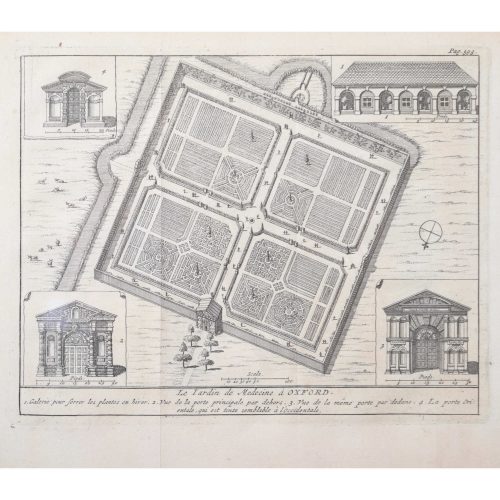
Pieter van der Aa (1659-1733), after David Loggan (1634–1692)
The University of Oxford Botanic Garden (1727)
Engraving 12 x 16 cm An eighteenth-century view of one of Oxford's dreamiest spaces: the Botanic Garden, engraved by Pieter van der Aa after David Loggan, the noted engraver, draughtsman, and painter. The University of Oxford Botanic Garden was founded in 1621 and is the oldest botanical garden in Great Britain. van der Aa's engraving focuses on its architectural qualities, with four features of the garden highlighted for their beauty, symmetry, and prowess of design. Of particular interest in this etching are the four trompe l'oeil pieces of gently curling paper which frame the gates of the garden. The Danby Gate (bottom left) at the front entrance to the garden is one of the three entrances designed by Nicholas Stone between 1632 and 1633. The gateway consists of three bays, each with a pediment; the niches contain statues of Charles I and Charles II in classical pose, and the niche in the the central pediment contains a bust of the Earl of Danby (hence the gate's name). Pieter van der Aa of Leiden was a Dutch publisher best known for preparing maps and atlases, though he also printed editions of foreign bestsellers and illustrated volumes. He is noted for the many engravings he produced after David Loggan's series of Oxford and Cambridge colleges and costumes. In 1727 Van Der Aa illustrated "Les Delices de la Grande Bretagne & de L'Irelande" by James Beeverell, the book in which this engraving appears. Condition: a good impression. If you’d like to know more, please email info@manningfineart.co.uk or call us on 07929 749056. -
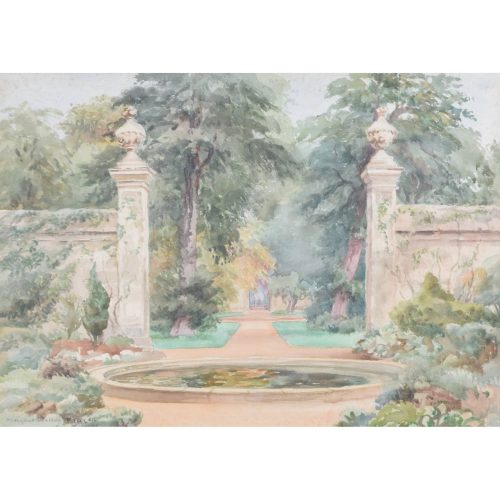
Margaret Waller (1916 - 1997)
The Oxford University Botanic Garden
Watercolour 35 x 51 cm Signed lower left. A watercolour depicting the serenity of Oxford's Botanic Garden. Koi swim just below the surface of the round pond and the garden stretches into the distance through a pair of stone arches. Margaret Waller was a mid-century artist and Fellow of the Institute of Arts and Letters. Condition: generally good; a little spotting to the sky. 'FIAL' added to signature later. If you are interested, please email info@manningfineart.co.uk or call us on 07929 749056. Click here for other non-collegiate views of Oxford. -
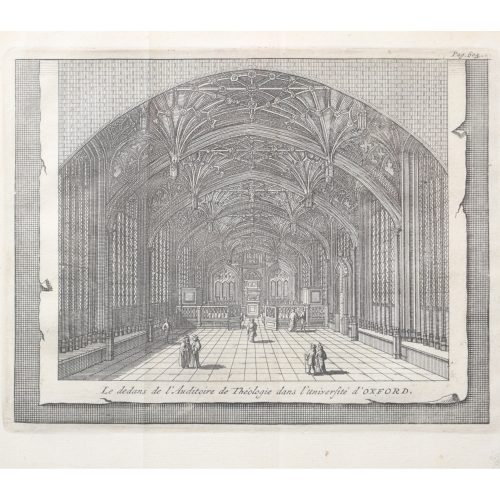
Pieter van der Aa (1659-1733), after David Loggan (1634–1692)
The Divinity School, University of Oxford
Engraving (1727) 12 x 16 cm An eighteenth-century view of Oxford's medieval Divinity School, which was once the beating heart of theological studies at the University. The scene is engraved by Pieter van der Aa after David Loggan, the noted engraver, draughtsman, and painter. Of particular interest here is the trompe l'oeil piece of torn paper which frames the Divinity School view. Pieter van der Aa of Leiden was a Dutch publisher best known for preparing maps and atlases, though he also printed editions of foreign bestsellers and illustrated volumes. He is noted for the many engravings he produced after David Loggan's series of Oxford and Cambridge colleges and costumes. In 1727 Van Der Aa illustrated "Les Delices de la Grande Bretagne & de L'Irelande" by James Beeverell, the book in which this engraving appears. Condition: a good impression. If you are interested, please email info@manningfineart.co.uk or call us on 07929 749056. -
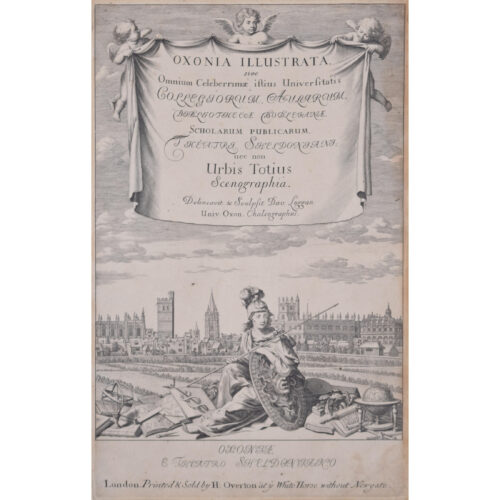
David Loggan (1634 - 1692)
Frontispiece to the Oxonia Illustrata (1675)
Engraving 38 x 24 cm The intricately engraved frontispiece to Loggan's 'Oxonia Illustrata', featuring cherubs bearing the volume's title on a banner and Minerva, goddess of wisdom, sitting before a panorama of Oxford's resplendent architecture. David Loggan's view of Oxford's medieval Divinity School, which was once the beating heart of theological studies at the University. Of particular interest here is the trompe l'oeil scroll of torn paper which frames the view. Loggan was born to English and Scottish parents, and was baptised in Danzig in 1634. After studying engraving in Danzig with Willem Hondius (1598-1652 or 1658), he moved to London in the late 1650s, going on to produce the engraved title-page for the folio 1662 Book of Common Prayer. He married in 1663 and moved to Nuffield in Oxfordshire in 1665. Loggan was appointed Public Sculptor to the nearby University of Oxford in the late 1660s, having been commissioned to produce bird’s-eye views of all the Oxford colleges. He lived in Holywell Street as he did this. The 'Oxonia Illustrata' was published in 1675, with the help of Robert White (1645-1704). Following its completion, Loggan began work on his equivalent work for Cambridge; the 'Cantabrigia Illustrata' was finally published in 1690, when he was made engraver to Cambridge University. The 'Oxonia Illustrata' also includes an engraving of Winchester College (Winchester and New College share William of Wykeham as their founder) whilst the 'Cantabrigia Illustrata' includes one of Eton College (which shares its founder, Henry VIII, with King’s College). Bird’s-eye views from this era required a particular talent as an architectural perspectivist; it was not until 1783 that it became possible for artists to ascend via hot air balloons and view the scenes they were depicting from above. Loggan thus had to rely on his imagination in conceiving the views. Loggan’s views constitute the first accurate depictions of the two Universities, in many ways unchanged today. Whilst the Oxford engravings were produced in reasonable numbers and ran to a second edition by Henry Overton (on thicker paper and with a plate number in Roman numerals in the bottom right-hand corner), those of Cambridge were printed in much smaller numbers. The Dutchman Pieter van der Aa published some miniature versions of the engravings for James Beverell’s guidebook to the UK, 'Les Delices de la Grande Bretagne' (circa 1708). The contemporary artist Andrew Ingamells (born 1956) has produced a highly-acclaimed series of etchings which bring Loggan’s original vision up to date. Condition: trimmed within platemark and mounted to board, otherwise in very good condition. If you are interested, please email info@manningfineart.co.uk or call us on 07929 749056. Click here for other general views of Oxford. -

Frederick Christian Lewis (1779 - 1856) after Frederick Mackenzie (1788 - 1854) Divinity School (1813)
Hand-coloured aquatint 24 x 29 cm Published by Rudolph Ackermann (1764 - 1834). Oxford's medieval Divinity School, which was once the beating heart of theological studies at the University. Frederick Mackenzie (circa 1788 - 1854) was a British watercolourist and architectural draughtsman. He first exhibited at the Royal Academy in 1804, and contributed eleven drawings between that year and 1828. He contributed to the Society of Painters in Water Colours exhibitions from 1813, becoming an associate in 1822, and a full member the following year. From 30 November 1831 until, his death he was treasurer to the society. In later life Mackenzie was no longer commissioned to illustrate books. Frederick Christian Lewis was an English etcher, engraver, and painter. He studied under Joseph Stadler and at the Royal Academy and produced the plates for the publisher John Chamberlaine's 'Original Designs of the most celebrated Masters in the Royal Collection' in 1812. His superlative skills as engraver led to frequent commissions from Royalty, and to his contribution to J. M. W. Turner's Liber Studiorum, a collection of seventy-one etchings with mezzotint, greatly influencing landscape painting. Rudolph Ackermann was an Anglo-German bookseller, inventor, lithographer, publisher and businessman. In 1795 he established a print-shop and drawing-school at 96 Strand. Here Ackermann set up a lithographic press and began a trade in prints. He later began to manufacture colours and thick carton paper for landscape and miniature painters. Within three years the premises had become too small and he moved to 101 Strand, in his own words "four doors nearer to Somerset House", the seat of the Royal Academy of Arts. Between 1797 and 1800 Ackermann rapidly developed his print and book publishing business, encompassing many different genres including topography, caricature, portraits, transparencies and decorative prints. Condition: Generally very good.If you would like to know more, please email info@manningfineart.co.uk or call us on 07929 749056.
-

Walter Hoyle (1922 - 2000) Untitled Abstract
Linocut 10 x 68 cm Signed and inscribed A/P in pencil. This linocut by Walter Hoyle is a striking abstract composition that blends geometric precision with rhythmic energy. Using a limited but bold palette of purples, oranges, browns, and whites, Hoyle divides the image into distinct panels, each filled with dynamic shapes—from radiating circles and curving grids to architectural lines and layered forms. The piece flows like a visual symphony, with each section contributing to a sense of movement and harmony. Textured line work and careful composition reflect Hoyle’s modernist sensibilities, showcasing his talent for balancing structure with expressive design. Hoyle trained at Beckenham School of Art and the Royal College of Art. At the latter he was strongly influenced by Edward Bawden, one of Britain’s greatest linocut printers. Bawden had been commissioned by the 1951 Festival of Britain to produce a mural for the South Bank, and chose Hoyle to assist on account of his great talent. Hoyle later moved to Great Bardfield in Essex, becoming a part of the Great Bardfield group of artists; diverse in style, they created figurative work, in stark contrast to the abstract art of the St Ives artists at the opposite end of the country. Hoyle taught at St Martin’s School of Art from 1951-60, the Central School of Arts and Crafts from 1960-64, and the Cambridge School of Art from 1964-1985, during which time he launched Cambridge Print Editions. His work is held in the collections of the Tate Gallery, the Victoria and Albert Museum, The British Museum, Kettle’s Yard and the Fry Art Gallery. Condition: Generally very good; a few handling marks and a little spotting to the margins.If you would like to know more, please email info@manningfineart.co.uk or call us on 07929 749056.
-

Penelope Ellis (1935-2016) Up with the Rooster
Woodblock print 15 x 11 cm Provenance: From the artist's estate sale. Penelope Mary Ellis (1935–2016) was a British artist celebrated for her conceptual abstract works in the 1960s. Born in Hampstead, London, she was the eldest daughter of artists and educators Clifford and Rosemary Ellis. Ellis attended the High School in Bath before enrolling at the Slade School of Fine Art from 1953 to 1956, focusing on sculpture. She was awarded a British Institute in Paris Scholarship for the 1956–1957 academic year, allowing her to further her art studies in France. Upon returning to England, Ellis taught art at Badminton School until her retirement in 1997. Ellis was known for her pioneering conceptual abstract oil paintings in the 1960s, noted for being ahead of their time. Additionally, she created sculptures, ceramics, jewellery, and models, showcasing her versatility and commitment to professional craftsmanship. This woodblock print depicts a rooster strutting across the farmyard. Its lines and shapes are irregular, suggesting either a deliberate folk-art influence or the natural texture of the woodblock carving process. Furthermore, Ellis makes use of the technique of 'negative space', creating contrasts between, for example, the bricks of the farm buildings and the rooster's body. This composition was likely produced in Ellis's early artistic career, before she shifted to more abstract conceptual work. In any case, it is a beautiful and evocative piece, capturing a rustic, almost timeless moment with striking simplicity. Condition: Generally very good.If you would like to know more, please email info@manningfineart.co.uk or call us on 07929 749056.
-
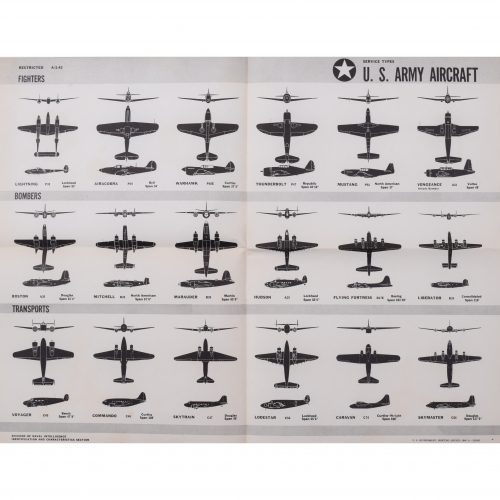
1943 Army World War II USA (1942)
Original aeroplane recognition poster 44 x 59 cm A summary of US aeroplanes from the series of US Navy identification posters that we have in stock. Fighters: P38 Lightning; P39 Airacobra; Curtiss P40E Warhawk; P47 Thunderbolt; P51 Mustang; A31 Vengeance. Bombers: A20 Boston; B25 Mitchell; B26 Marauder; Lockheed Hudson; Boeing B17E Flying Fortress; B24 Consolidated Liberator. Transports: C45 Voyager; C46 Commando; C47 Douglas Skytrain; Lockheed Lodestar; C76 Caravan; C54 Douglas Skymaster. Condition: generally very good, occasional handling marks. Folds as issued. If you’d like to know more, please email info@manningfineart.co.uk or call us on 07929 749056. -
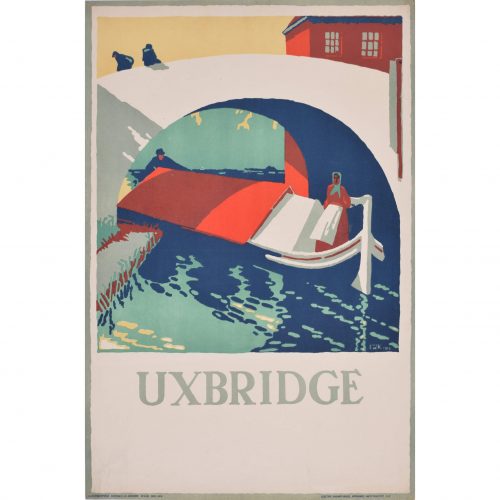
Edward McKnight Kauffer (1890 - 1954)
Uxbridge (1919)
Original vintage poster 76 x 51 cm Designed in 1919 and printed by the Dangerfield Printing Co Ltd on the 12th April 1920. 224/1000. A fantastic 1919 poster illustrating the pleasures of Uxbridge. Another version of this poster, bearing the legend 'Uxbridge by Tram', was released the same year to advertise London United Tramways. A copy of the poster is held by the Victoria and Albert Museum. Edward McKnight Kauffer was an American artist and graphic designer who lived for much of his life in the United Kingdom. He is mainly known for his work in poster design, but was also active as a painter, book illustrator and theatre designer. He studied art at the California School of Design from 1910 to 1912 and then at the Académie Moderne in Paris until 1914 (via a six month stint at the Art Institute of Chicago). He moved to London upon the start of the First World War and produced 140 poster for London Underground and London Transport. He created posters for Shell Oil, the Great Western Railway and other commercial clients, and also illustrated books and book covers. Later he also became interested in textiles, interior design, and theatrical design. He returned to New York City in 1940 and began designing posters for American Airlines (his primary client until his death) in 1947 .In 1952 he designed the book jacket for Ralph Ellison's novel Invisible Man - arguably Kauffer's most famous work. Condition: generally very good; a few short neatly repaired edge tears. Amusing article loosely pasted to reverse. If you are interested, please email info@manningfineart.co.uk or call us on 07929 749056. Click here for other original vintage London Transport posters. -
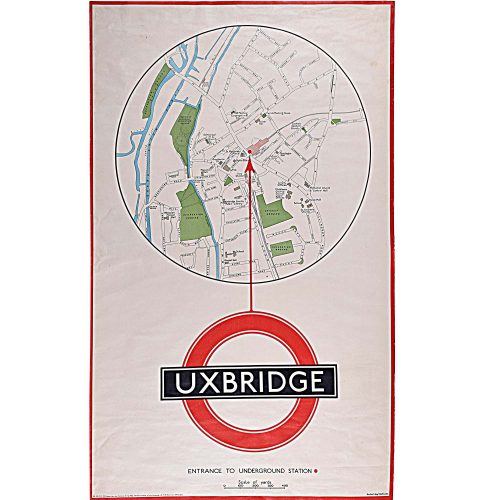
Uxbridge Station Poster c.1930 Printed by HMSO
Lithograph 100x62cm This four coloured lithograph was printed in extremely limited numbers for London Transport by HMSO. These maps detailed station entrances and were placed along the underground network to inform commuters exactly where they were in London. If you are interested email info@manningfineart.co.uk or call us on 07929 749056. Condition: Generally very good, slight bruising to the very edges in places, and a little touching in of the red border. -
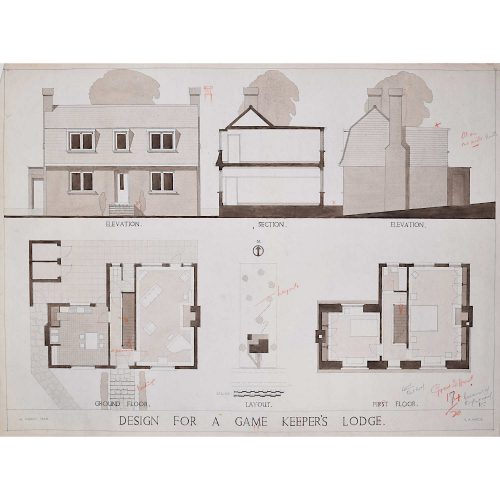
V A Hards (British, c. 1930-c. 2012) Design for Modernist Game Keeper Lodge
Watercolour on wove Signed and dated March 1948 55x77cm Hards was educated at Brixton School of Building and Woolwich Polytechnic between 1948 and 1956, during which period he produced some very competent work including this rather fun modernist design for a monumental fountain in a grand park. Brixton School of Building was incorporated into the Polytechnic of the South Bank - now London South Bank University. If you are interested email info@manningfineart.co.uk or call us on 07929 749056. Condition: Some edge wear and isolated spots . -
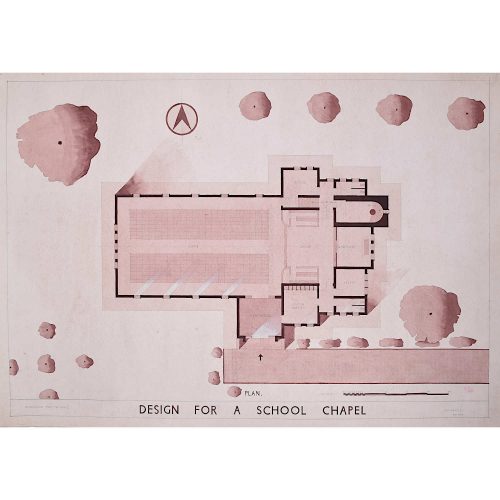
V A Hards (British, c. 1930-c. 2012) Design for Modernist School Chapel
Watercolour on wove Signed and dated November 1948 and marked 35/40 55x77cm Hards was educated at Brixton School of Building and Woolwich Polytechnic between 1948 and 1956, during which period he produced some very competent work including this rather fun modernist design for a riverside tearoom. Brixton School of Building was incorporated into the Polytechnic of the South Bank - now London South Bank University. If you are interested email info@manningfineart.co.uk or call us on 07929 749056. Condition: Some edge wear and isolated spots. -
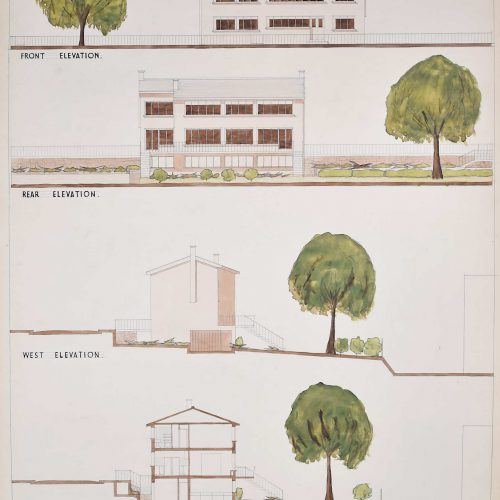
V A Hards (British, c. 1930-c. 2012) Design for Modernist Town House
Watercolour on wove Signed and dated October 1949 and inscribed Woolwich Polytechnic. 77x55cm Hards was educated at Brixton School of Building and Woolwich Polytechnic between 1948 and 1956, during which period he produced some very competent work including this rather fun modernist brutalist design for a town house. Brixton School of Building was incorporated into the Polytechnic of the South Bank - now London South Bank University. If you are interested email info@manningfineart.co.uk or call us on 07929 749056. Condition: Some edge wear and isolated spots. -
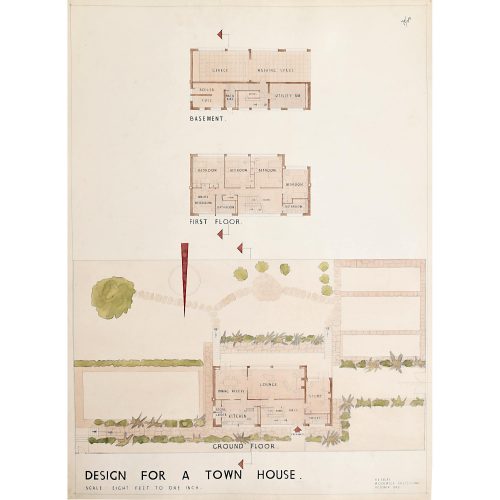
V A Hards (British, c. 1930-c. 2012) Design for Modernist Town House
Watercolour on wove Signed and dated October 1949 and inscribed Woolwich Polytechnic. 77x55cm Hards was educated at Brixton School of Building and Woolwich Polytechnic between 1948 and 1956, during which period he produced some very competent work including this rather fun modernist brutalist design for a town house. Brixton School of Building was incorporated into the Polytechnic of the South Bank - now London South Bank University. If you are interested email info@manningfineart.co.uk or call us on 07929 749056. Condition: Some edge wear and isolated spots. -
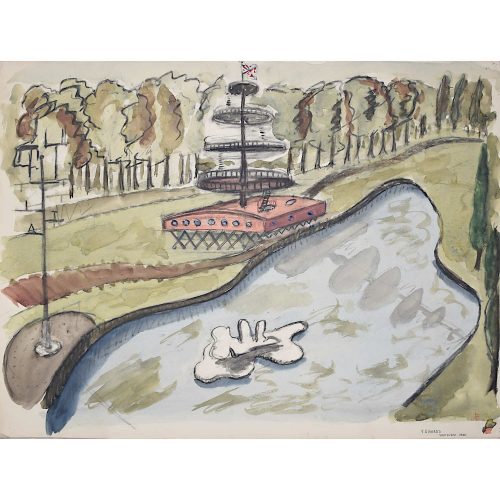
V A Hards (British, c. 1930-c. 2012) Design for Monumental Fountain
Watercolour on wove Signed and dated 1955 55x77cm Hards was educated at Brixton School of Building and Woolwich Polytechnic between 1948 and 1956, during which period he produced some very competent work including this rather fun modernist design for a monumental fountain in a grand park. Brixton School of Building was incorporated into the Polytechnic of the South Bank - now London South Bank University. If you are interested email info@manningfineart.co.uk or call us on 07929 749056. Condition: Some edge wear and isolated spots. -
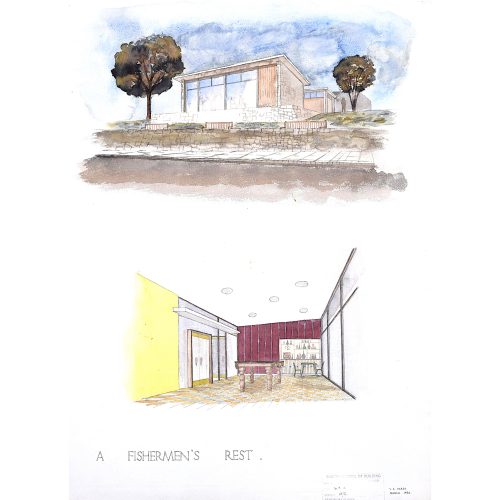
V A Hards (British, c. 1930-c. 2012) Design for Modernist Fisherman's Hut
Watercolour on wove Signed and dated March 1956 and stamped for Brixton School of Building. 77x55cm Hards was educated at Brixton School of Building and Woolwich Polytechnic between 1948 and 1956, during which period he produced some very competent work including this rather fun modernist brutalist design for a fisherman's hut, not designed to blend in with the scenery. Brixton School of Building was incorporated into the Polytechnic of the South Bank - now London South Bank University. To view more of his work we have listed, scroll down to 'View more from this seller' and click on 'View all from this seller' and then search for 'Hards'. If you are interested email info@manningfineart.co.uk or call us on 07929 749056. Condition: Good. Some edge wear and isolated spots. -
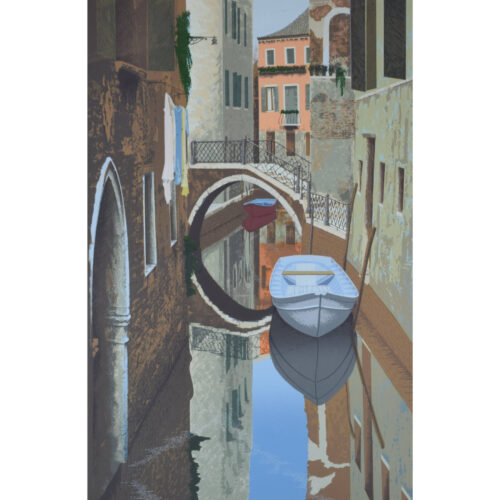
Graham Bannister (born 1954)
A Venetian Canal
Screenprint 76 x 50 cm A screenprint of one of Venice's canals, crossed by an iron-railed bridge. Drying clothes hang from a canalside window as two moored gondolas bob gently. The stone buildings of Venice stretch up to the sky and are reflected back by the calm waters. Graham Bannister specialises in printmaking and trained at the Brillig Art Centre in Bath in the 1970s. He is known for his views of Venice's waterways. Condition: very good. If you are interested, please email info@manningfineart.co.uk or call us on 07929 749056. Click here for more pictures of Italy. -

John Chaplain
Venetian View of Santa Maria della Salute
Etching and aquatint 14 x 18 cm Signed in bottom left and right hand corners. View of Santa Maria della Salute from Riva degli Schiavani with the statue of King Emmanuel II, created c.1920. Condition: Generally very good, some age toning but only to margins. -

Josep Artigas Ojeda (1919 - 1992)
Vevey, Switzerland (1958)
Original vintage poster 98 x 64 cm This original Swiss poster was designed for the Italian Department of Tourism and encourages us to visit charming and sun-drenched Vevey, where we might hike, swim, drink, and otherwise be at leisure. Josep Artigas Ojeda was a postwar poster designer from Spain. He designed his first posters for a graphic design company before the Spanish Civil War and designed banknotes during the war. He ran his own poster design studio between 1955 and 1965. Condition: generally very good; some spotting to sky, as visible in photographs. If you are interested, please email info@manningfineart.co.uk or call us on 07929 749056. Click here for other original vintage travel posters. -

John Samuel Agar (1773 - 1858) after John Uwins (1782 - 1857) Vice Chancellor, Esquire Beadle, Yeoman Beadle (1814)
Aquatint with original hand colouring 27 x 21 cm Published by Rudolph Ackermann (1764 - 1834). A Vice Chancellor, Esquire Beadle, and Yeoman Beadle of the University of Oxford, apparently en route to a ceremony. Thomas Uwins RA RWS was a British painter in watercolour and oil, and a book illustrator. He became a full member of the Old Watercolour Society and a Royal Academician, and held a number of high-profile art appointments including the librarian of the Royal Academy, Surveyor of Pictures to Queen Victoria and the Keeper of the National Gallery. In the late 1790s he began producing work for Ackermann's collections. John Samuel Agar was an English portrait painter and engraver, who exhibited his works at the Royal Academy from 1796 to 1806 and at the British Institution until 1811. He was at one time president of the Society of Engravers. Rudolph Ackermann published many of his engravings. Ackermann was an Anglo-German bookseller, inventor, lithographer, publisher and businessman. He attended the Latin school in Stollberg, but his wish to study at the university was made impossible by lack of financial means, and he therefore became a saddler like his father. He worked as a saddler and coach-builder in different German cities, moved from Dresden to Basel and Paris, and then, 23 years old, settled in London. He established himself in Long Acre, the centre of coach-making in London and close to the market at Covent Garden. Ackermann then moved to Little Russell Street where he published Imitations of Drawings of Fashionable Carriages (1791) to promote his coach-making. Other publications followed. In 1795 he established a print-shop and drawing-school at 96 Strand. Here Ackermann set up a lithographic press and began a trade in prints. He later began to manufacture colours and thick carton paper for landscape and miniature painters. Within three years the premises had become too small and he moved to 101 Strand, in his own words "four doors nearer to Somerset House", the seat of the Royal Academy of Arts. Between 1797 and 1800 Ackermann rapidly developed his print and book publishing business, encompassing many different genres including topography, caricature, portraits, transparencies and decorative prints. During the Napoleonic wars, Ackermann was an energetic supporter of the Allied cause and made significant contributions to British propaganda through his publication of anti-Napoleonic prints and military manuals. He became a naturalised British citizen in March 1809. As one of the pioneers of modern publishing methods, Ackermann developed an international distribution network for his publications and came to have significant commercial interests in South America. The business he founded in London flourished throughout the 19th century under the management of his descendants. He was buried at St. Clement Danes in the Strand, London. In 2020, the St. Louis Mercantile Library wrote that: "Ackermann excelled in the creation of landscape and architectural engravings. He created beautiful illustrations of the city of London, his adopted home, as well as two volumes of classic views of Westminster Abbey, along with exquisite views of river scenes. One of our favorite collections are four massive volumes of lovingly illustrated exterior and interior landmarks of Oxford and Cambridge Universities created just over two hundred years ago. These publications show Ackermann’s hand at every turn of the page along with the team of assistant designers and engravers he employed to create these works. Perhaps they were a way by which the artist could lay to rest his own regret at not being able to attend [an Oxbridge] college himself in a fondly depicted idyll to learning which these prints so aptly represent." Condition: Generally very good.If you would like to know more, please email info@manningfineart.co.uk or call us on 07929 749056.
-

John Samuel Agar (1773 - 1858) after John Uwins (1782 - 1857)
Vice Chancellor, Esquire Beadle, Yeoman Beadle (1814)
Aquatint with original hand colouring 27 x 21 cm Published by Rudolph Ackermann (1764 - 1834). A Vice Chancellor, Esquire Beadle, and Yeoman Beadle of the University of Oxford, apparently en route to a ceremony. Thomas Uwins RA RWS was a British painter in watercolour and oil, and a book illustrator. He became a full member of the Old Watercolour Society and a Royal Academician, and held a number of high-profile art appointments including the librarian of the Royal Academy, Surveyor of Pictures to Queen Victoria and the Keeper of the National Gallery. In the late 1790s he began producing work for Ackermann's collections. John Samuel Agar was an English portrait painter and engraver, who exhibited his works at the Royal Academy from 1796 to 1806 and at the British Institution until 1811. He was at one time president of the Society of Engravers. Rudolph Ackermann published many of his engravings. Rudolph Ackermann was an Anglo-German bookseller, inventor, lithographer, publisher and businessman. In 1795 he established a print-shop and drawing-school at 96 Strand. Here Ackermann set up a lithographic press and began a trade in prints. He later began to manufacture colours and thick carton paper for landscape and miniature painters. Within three years the premises had become too small and he moved to 101 Strand, in his own words “four doors nearer to Somerset House”, the seat of the Royal Academy of Arts. Between 1797 and 1800 Ackermann rapidly developed his print and book publishing business, encompassing many different genres including topography, caricature, portraits, transparencies and decorative prints. Condition: generally very good. If you are interested, please email info@manningfineart.co.uk or call us on 07929 749056. Click here for other Oxford pictures. -

George Leech Victory Procession Down The Mall, 1946
Lithograph For Macmillan's History Pictures, c. 1960 43 x 54 cm This colourful lithograph depicts a momentous parade down the mall, held as part of the London Victory Celebrations of 1946 following the defeat of Nazi Germany and Japan in the Second World War. The celebrations took place in London on the 8th of June 1946, and consisted mainly of a military parade through the city and a night time fireworks display. The parade itself assembled the Chiefs of Staff, a mechanised column stretching 4 miles long and containing more than 500 military vehicles, and a marching column headed by the flags of the Allied nations which took part in the parade, as shown in this lithograph. In this depiction, King George VI can be seen saluting, alongside his wife, Elizabeth, and their two daughters, the queen-to-be Elizabeth and Margaret. Born in 1894, George Leech was a British painter and etcher. He studied both at the Lambeth and Putney Schools of Art and worked for some years as a magazine editor. Alongside this, he also exhibited widely, including at the Royal Academy of Art. -
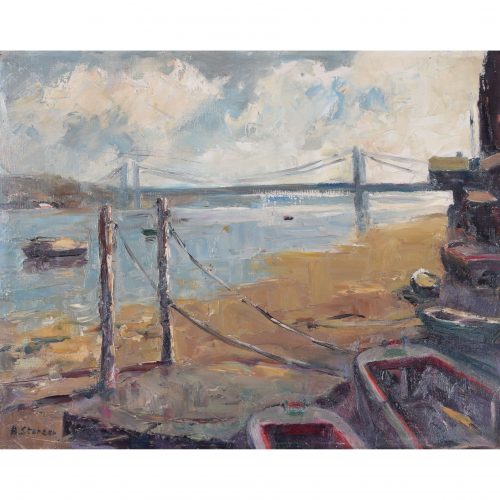
Angela Stones (1914 - 1995)
From Battersea Bridge (before Redevelopment)
Oil on board 40 x 50 cm Stones' view of the Thames and Chelsea Bridge, painted from Battersea Bridge. The artist's use of impasto, particularly evident in her depiction of the rambunctious white clouds above the bridge, lends a liveliness to the painting. Stones was educated at the Chelsea School of Art, and was a member of an artistic dynasty. Her mother Dorothy Bradshaw (1893-1983) studied under Jack Merriott – the artist famous for his British Rail posters, and her son, Christopher Assheton-Stones (1947-1999), was arguably the foremost pastel artist of his time. Provenance: the family of the artist. Condition: very good. If you’d like to know more, please email info@manningfineart.co.uk or call us on 07929 749056. -
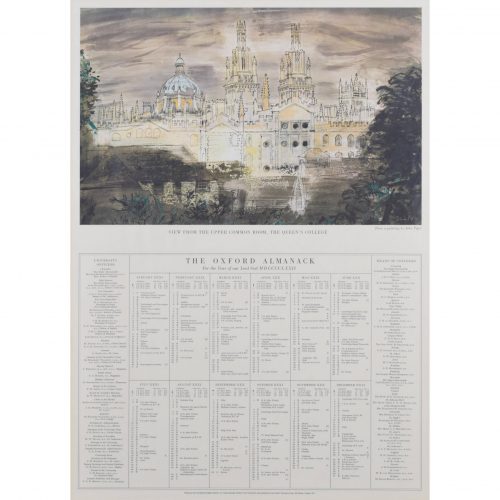
after John Piper (1903 - 1992) View from the Upper Common Room, The Queen's College - Oxford Almanac 1972
Lithograph 68 x 49 cm A lithograph featuring Oxford's skyline, including the towers of All Souls and the Radcliffe Camera, set against a blustery Piper sky. Piper's painting was reproduced as a lithograph in 1972, to be published in the "Oxford Almanack". The Oxford Almanack was an annual almanac published by the Oxford University Press for the University of Oxford from 1674 through 2019 (when printing sadly ceased due to "dwindling interest"). The almanac traditionally included engravings or lithographs of the University and information about the upcoming year. Other almanac artists have included James Basire, Michael Burghers, J. M. W. Turner, and Michael Oelman. John Piper CH was an English painter, printmaker, and designer of stained-glass windows. His work often focused on the British landscape, especially churches and monuments, and included tapestry designs, book jackets, screen-prints, photography, fabrics and ceramics. Condition: very good. If you are interested, please email info@manningfineart.co.uk or call us on 07929 749056. Click here for other views of Queen's College, Oxford. -
 G F Nicholls Early 20th century view of Oxford Gouache 36 x 28 cm Signed to lower left George Frederick Nicholls (1857–1939) was a British painter renowned for his topographical artworks, particularly those depicting the landscapes of Cornwall, the Cotswolds, and Oxford. His works are characterised by strong technique and his ability to capture light and typically depict picturesque views over rural England. His art continues to be appreciated today for its detailed representation of early 20th-century British landscapes. Nicholls painted this gouache of All Souls College from Oxford high street in the early 20th century. It captures the bustle of everyday city life, with a car trundling down the street, people crossing the road and engaging in some light window shopping. Condition: Generally very good
If you would like to know more, please email info@manningfineart.co.uk or call us on 07929 749056.
For other views of All Souls College, click here. -

Pieter van der Aa (1659 - 1733), after David Loggan (1634 - 1692)
View of Cambridge (1727)
Engraving 13 x 17 cm An eighteenth-century view of Cambridge, engraved by Pieter van der Aa after David Loggan, the noted engraver, draughtsman, and painter. Pieter van der Aa of Leiden was a Dutch publisher best known for preparing maps and atlases, though he also printed editions of foreign bestsellers and illustrated volumes. He is noted for the many engravings he produced after David Loggan's series of Oxford and Cambridge colleges and costumes. In 1727 Van Der Aa illustrated "Les Delices de la Grande Bretagne & de L'Irelande" by James Beeverell, the book in which this engraving appears. Condition: very good. If you are interested, please email info@manningfineart.co.uk or call us on 07929 749056. Click here for other general views of Cambridge. -

Sir Albert Richardson PRA Panoramic view across Durham
Monochrome Wash 22 x 33 cm A unique monochrome wash composition depicting a panoramic view across the Durham skyline. Richardson painted this view of Durham Cathedral, potentially from where Milburngate Bridge now stands. Rolling hills and church spires populate the foreground, while the magnificent cathedral looms over the rest of the city. Sir Albert Richardson (1880-1964) was a leading architect, teacher and architectural historian in the 20th century. In Durham, he is best known for his involvement in the designs of Durham University's buildings and for his work on the Durham Castle and Cathedral area. Richardson's contributions were part of a broader movement of restoring and enhancing historical buildings, while also integrating new designs that respected the local architectural style. He was notably part of a wider team of architects and restorers who worked to maintain the cathedral's status as a UNESCO World Heritage site. Condition: Generally very good, some age toning and a little faint spotting to paper, painted on rough Whatman. -
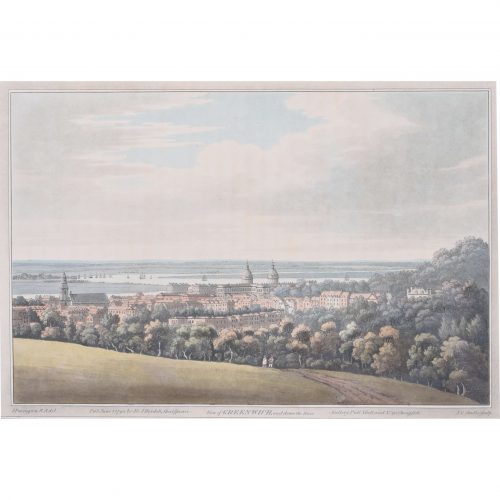
Joseph Constantine Stadler (1755 - 1828) after Joseph Farington (1747 - 1821)
View of Greenwich and Down the River (1795)
Hand-coloured engraving 23 x 33 cm Joseph Constantine Stadler was a prolific German émigré engraver of images after his contemporaries - here, 18th-century English landscape painter and diarist Joseph Farington. Stadler's engravings are wide-ranging in subject matter and include landscapes, seascapes and portraits, as well as military, sporting and decorative subjects. Stadler was employed by the leading print publisher of the time, John Boydell. Stadler lived in Knightsbridge when he died at the age of 73. Joseph Farington was born in Lancashire and went to study with Richard Wilson in London in 1763. In 1764, 1765, and 1766 he won "premiums" from the Society of Artists for his landscape drawing; he became a member in 1765. He joined the Royal Academy when it was founded in 1769 and was elected an ARA in 1783 and an RA in 1785. Farington contributed works to the Academy's exhibitions every year until 1801, but only occasionally between 1801 and 1813. He was an active member of the Academy and sat on several important committees, including the one which determined where artworks would be hung during the exhibitions. In 1793 he became a fellow of the Society of Antiquaries and helped establish the British Institution. Condition: very good. If you’d like to know more, please email info@manningfineart.co.uk or call us on 07929 749056. -

John Bluck (early 19th century) after JMW Turner (1775 - 1851) View of Oxford, From the Gallery in the Observatory (1814)
Aquatint with original hand colouring 21 x 27 cm Published by Rudolph Ackermann (1764 - 1834). Joseph Mallord William Turner RA, known in his time as William Turner, was an English Romantic painter, printmaker and watercolourist. He is known for his expressive colouring, imaginative landscapes and turbulent, often violent, marine paintings. He left behind more than 550 oil paintings, 2,000 watercolours, and 30,000 works on paper. He was championed by the leading English art critic John Ruskin from 1840, and is today regarded as having elevated landscape painting to an eminence rivalling history painting. John Bluck was an aquatint engraver, mainly of topographical views, but also of marine and sporting subjects after his contemporaries. He produced plates for numerous publications. Rudolph Ackermann was an Anglo-German bookseller, inventor, lithographer, publisher and businessman. In 1795 he established a print-shop and drawing-school at 96 Strand. Here Ackermann set up a lithographic press and began a trade in prints. He later began to manufacture colours and thick carton paper for landscape and miniature painters. Within three years the premises had become too small and he moved to 101 Strand, in his own words "four doors nearer to Somerset House", the seat of the Royal Academy of Arts. Between 1797 and 1800 Ackermann rapidly developed his print and book publishing business, encompassing many different genres including topography, caricature, portraits, transparencies and decorative prints. Condition: Generally very good.If you would like to know more, please email info@manningfineart.co.uk or call us on 07929 749056.
-

George Bissill (1896-1973) View of St Peter's Church, Willersey
Pencil sketch 25 x 35 cm Born in 1896, George Bissill was a British miner, painter and furniture designer. Raised in the mining village of Langley Mill, Derbyshire, Bissill became a miner at the age of 13, before leaving to join the war effort in 1915. Upon his return from the war after being gassed, Bissill chose to become a pavement artist outside the newly erected Bush House in Aldwych, painting from his memory and his sketch book the uncompromising underground world he had inhabited. In 1935 he moved to the countryside near Newbury, where he lived and worked as a landscape painter, art restorer and dealer until his death in 1973. This painting forms part of a larger collection, 'unseen since they were taken from George Bissil's studio in 1983' and restored by Kate Pattinson. A series of planned exhibitions were cancelled due to Covid, but two shows, one in Oxford and one in Ilkeston, did take place. Through such exhibitions, Pattinson hoped to 'restore the reputation of an artist who, through mighty endeavour, conquered the art world in the 1920s with his powerful, authentic and experimental pictures.' Bissill's paintings are also held in a number of important public collections, including the Tate Gallery, National Museum of Ireland and the Manchester Art Gallery. This pencil sketch depicts an idyllic view over a village church. Surrounded by beautiful fields and animal grazing, the traditional village church and adjacent cottages stand out within this rural landscape. Whereas the animals and fields have a distinctly sketchy quality to them, Bissill has paid careful attention in his shading and pencil work to capture both the façade of the church and the clean lines of its architecture. Given the architectural similarities and his sketch of the New Inn, evidencing his time spent in Willersey, it seems likely that this sketch depicts the Church of St Peter. A local landmark, this church was built in the 12th century, has a fifteenth century bell tower with traditional pinnacles and gargoyles and is now a grade I listed building. Condition: Generally very good.If you would like to know more, please email info@manningfineart.co.uk or call us on 07929 749056.
-

George Bissill (1896-1973) View of the village church
Pencil sketch 13 x 18 cm Born in 1896, George Bissill was a British miner, painter and furniture designer. Raised in the mining village of Langley Mill, Derbyshire, Bissill became a miner at the age of 13, before leaving to join the war effort in 1915. Upon his return from the war after being gassed, Bissill chose to become a pavement artist outside the newly erected Bush House in Aldwych, painting from his memory and his sketch book the uncompromising underground world he had inhabited. In 1935 he moved to the countryside near Newbury, where he lived and worked as a landscape painter, art restorer and dealer until his death in 1973. This painting forms part of a larger collection, 'unseen since they were taken from George Bissil's studio in 1983' and restored by Kate Pattinson. A series of planned exhibitions were cancelled due to Covid, but two shows, one in Oxford and one in Ilkeston, did take place. Through such exhibitions, Pattinson hoped to 'restore the reputation of an artist who, through mighty endeavour, conquered the art world in the 1920s with his powerful, authentic and experimental pictures.' Bissill's paintings are also held in a number of important public collections, including the Tate Gallery, National Museum of Ireland and the Manchester Art Gallery. This pencil sketch depicts a bucolic view of a village. The village church is depicted in the background, with a canal and lock gate in the foreground. This pared-back sketch offers an intriguing insight into Bissill's working process, as the flurry of sketched lines suggest his frenzied efforts to capture this conversely quiet moment of village life. Condition: Generally very good, slight age toning to paper and fold down centreIf you would like to know more, please email info@manningfineart.co.uk or call us on 07929 749056.