-
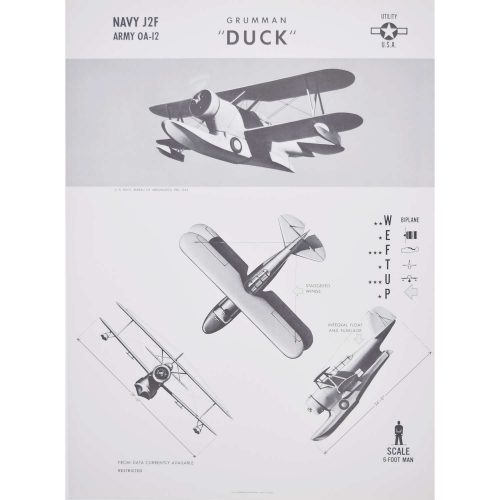
Navy and Army Grumman "Duck"
Aeroplane identification poster, published 1942 63 x 47 cm A particularly unusual style of aeroplane identification poster, owing to the very arty images. Most such posters rely on very plain silhouettes, this series - and we have several in this series; view them here - have a much more arty approach to the task with shading and an interesting angle view. The Grumman J2F Duck was an American single-engine amphibious biplane. It was used by each major branch of the U.S. armed forces from the mid-1930s until just after World War II, primarily for utility and air-sea rescue duties. It was also used by the Argentine Navy, who took delivery of their first J2F in 1937. Apart from general utility and light transport duties, its missions included mapping, reconnaissance, anti-submarine patrol, air-sea rescue work, photographic surveys, and target tug. Condition: generally very good. If you are interested, please email info@manningfineart.co.uk or call us on 07929 749056. -

Army Gotha "Go 242"
Aeroplane identification poster, published 1942 63 x 47 cm A particularly unusual style of aeroplane identification poster, owing to the very arty images. Most such posters rely on very plain silhouettes, this series - and we have several in this series; view them here - have a much more arty approach to the task with shading and an interesting angle view. The Gotha Go 242 was a transport glider used by the Luftwaffe during World War II. It was designed by Albert Kalkert in response to the request for a heavy transport glider to replace the DFS 230 which was then in service. The requirement was for a glider capable of carrying 20 fully laden troops, or equivalent cargo. Two prototypes flew in 1941 and the type quickly entered production, with a total of 1,528 being built. In service, Go 242s were towed into the air by Heinkel He 111s or Junkers Ju 52s. Most saw service in the Mediterranean, North Africa and Aegean. Ju 87D-2s had strengthened rear fuselage and combined tailwheel and hook for towing the Go 242. Today, there are two surviving 242s - one in the Musée de la Resistance du Vercors in Valence, France, and the other in the Technik Museum and Luftwaffenmuseum der Bundeswehr in Berlin, Germany. Condition: generally very good. If you are interested, please email info@manningfineart.co.uk or call us on 07929 749056. -
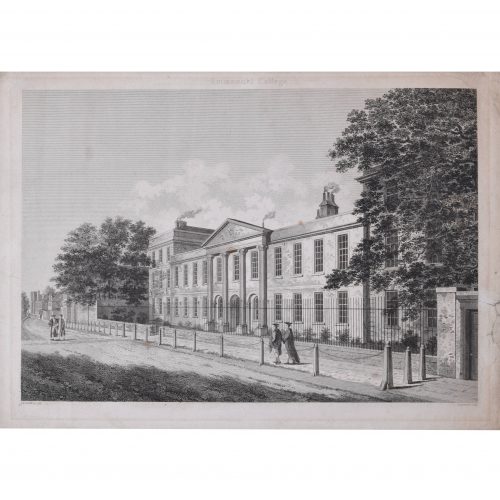
Samuel Sparrow (active 1800) after John Kirby Baldrey (1750 - 1823)
Emmanuel College, Cambridge
Engraving 35 x 49 cm An engraving of Emmanuel College's neoclassical facade, complete with strolling undergraduates in pairs. The engraving was printed in the Cambridge Almanack in 1806. Samuel Sparrow was a British engraver of landscapes and architectural scenes after his fellow artists, often published as bookplates. John Kirkby Baldrey was a draughtsman and engraver who provided designs for the Cambridge University Almanack between 1803 and 1810. Condition: generally very good; some age toning. If you’d like to know more, please email info@manningfineart.co.uk or call us on 07929 749056. -
Out of stock
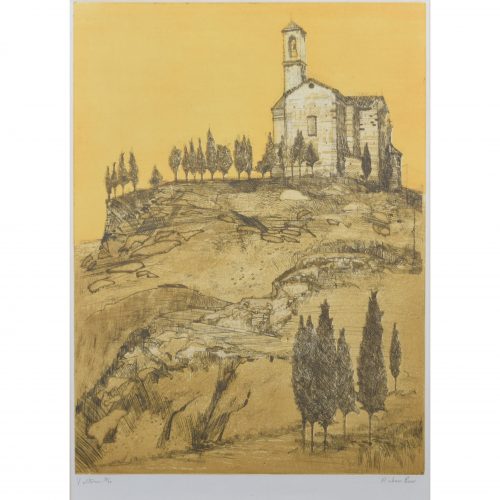
Richard Beer (1928 - 2017)
Volterra
Etching and aquatint 60 x 45 cm Titled and numbered 4/70 lower left, and signed lower right, both in pencil. Beer's yellow-hued view of Volterra, a mountain town in Tuscany. Overseen by the beating Italian sun, a church perches atop a hill marked by trees and rocky outcrops. Born in London in 1928, just too late to serve in the Second World War, Richard Beer studied between 1945 - 1950 at the Slade School. Subsequently, a French Government scholarship allowed him to spend time in Paris at Atelier 17, working under Stanley William Hayter (1901 - 1988), one of the most significant print makers of the 20th Century – having spent the War in New York, advising as a camofleur, Hayter only returned to Paris in 1950. Subsequently Beer studied at the École des Beaux Arts, Paris. Working for John Cranko, choreographer for the Royal Ballet, Beer designed the sets and costumes for his The Lady and the Fool at Covent Garden, subsequently working for him following his move in 1961 to Stuttgart Ballet. Additionally he produced book illustrations and designed book jackets. Beer later taught print-making at the Chelsea School of Art, where he was a popular teacher. Probably his greatest work was a collaboration with John Betjeman to produce a portfolio of prints of ten Wren Churches in the City for Editions Alecto, copies of which are in The Government Art Collection. That collection contains a total of 54 prints by Beer, and the Tate Gallery’s collection holds seven. His Oxford series was also produced for Editions Alecto as was a series of predominantly architectural views in Southern Europe. Most of his prints are of architectural subjects. Condition: very good. If you’d like to know more, please email info@manningfineart.co.uk or call us on 07929 749056. -
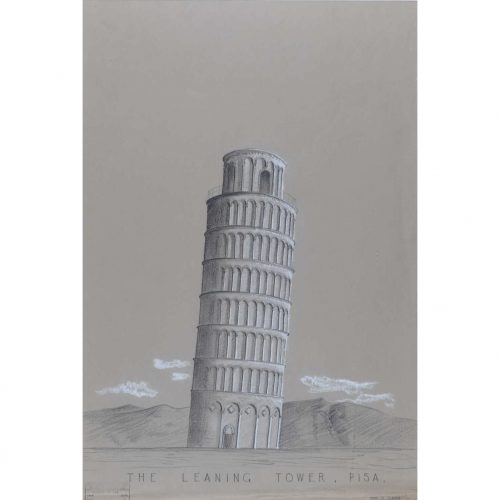
John D Paxton
The Leaning Tower, Pisa
Pencil and white chalk 75 x 50 cm Stamped bottom left indistinctly "Edinburgh School of Art, School of Architecture". An architectural drawing of Pisa's famous Leaning Tower. -
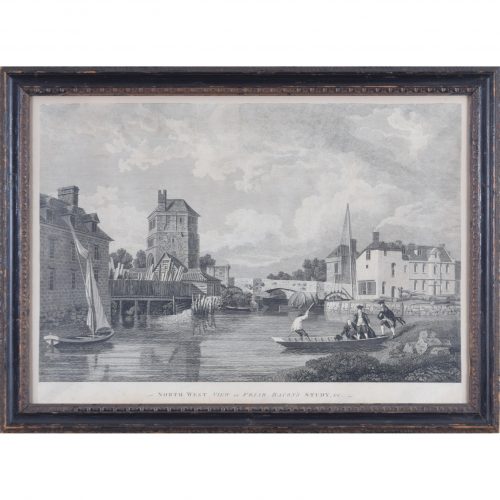
after Michael Angelo Rooker (1743/6 - 1801)
North West view of Friar Bacon's Study, and Folly Bridge
Engraving 30 x 45 cm Friar Bacon's Study was built as a watchtower in the thirteenth century. The name is 'merely traditional, and not in any Record to be found', according to the 1773 text 'The Antient and Present State of the City of Oxford'; it is said to have been used by the Franciscan Friar Roger Bacon as an astronomical observatory. For hundreds of years after Friar Bacon's use of it, the tower was a notable landmark in Oxford, and Samuel Pepys visited it in 1668: 'So to Friar Bacon's study: I up and saw it, and gave the man a shilling. Oxford mighty fine place.' The Study was often considered a folly, and the bridge is now known as Folly Bridge. Rooker painted the tower in 1780 - around the same time as the tower was demolished - and James Basire produced an engraving of his painting in 1787, to be used as the frontispiece for the Oxford Almanack. The Oxford Almanack was an annual almanack published by the Oxford University Press for the University of Oxford from 1674 through 2019 (when printing sadly ceased due to "dwindling interest"). The almanack traditionally included engravings or lithographs of the University and information about the upcoming year. Other almanack artists have included Michael Burghers, J. M. W. Turner, and John Piper. Basire and Dayes collaborated on several views of Oxford during the courses of their careers. Michael Angelo Rooker ARA was an English oil and watercolour painter of architecture and landscapes, illustrator, and engraver. Rooker's original painting currently hangs in Worcester College. Condition: good; in handsome (worn) antique Hogarth frame. If you are interested, please email info@manningfineart.co.uk or call us on 07929 749056. Click here for other non-collegiate views of Oxford. -
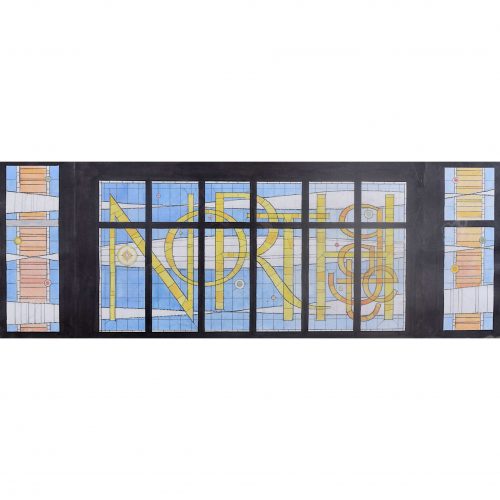
Jane Gray (b.1931)
Northgate, Design for Stained Glass Window
Watercolour 49.5 x 18 cmGray left little information about this design but it is possibly for a shopping centre or similar building. Nevertheless, this design perfectly captures Gray’s colourful and quintessentially modern style and approach to stained glass window design. Here, Gray uses a few key colours, strong lines, and geometrical elements to construct her multi-panelled, lettered design.
Provenance: the artist’s studio sale. Condition: very good. If you are interested, please email info@manningfineart.co.uk or call us on 07929 749056. For other works by Jane Gray and more information about her, please click here. -
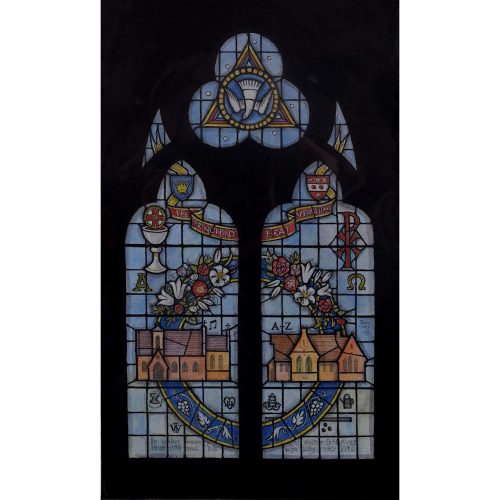
Jane Gray (b.1931)
St Barnabas Church, Franche, Kidderminster, Design for Stained Glass Window (1985)
Watercolour 23 x 14 cmSigned, dated and studio stamp verso.
St Barnabas Church, a red brick church designed by Martin & Chamberlain, was established in Franche in 1871 as a chapel-of-ease to the Parish Church of Kidderminster, St Mary and All Saints. St Barnabas is known for its diverse collection of stained glass windows and, alongside Gray’s modern memorial window, features windows in the Arts and Crafts style, likely designed by Benjamin Warren. Designed in 1985, this window was installed in the church in 1987.
Provenance: the artist’s studio sale. Literature: Jane Gray, Playing with Rainbows. (Shropshire: Ellingham Press, 2011), p.78. Condition: very good. If you are interested, please email info@manningfineart.co.uk or call us on 07929 749056. For other works by Jane Gray and more information about her, please click here. -
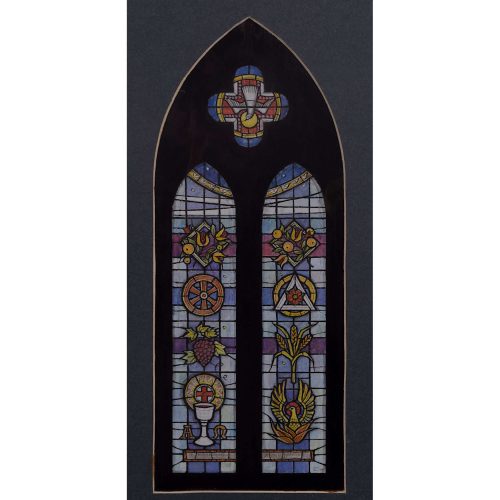
Jane Gray (b.1931)
Holy Trinity Church, Morecambe, Design for Stained Glass Window (1985)
Watercolour 25.5 x 10 cmSigned, dated and artist label verso.
Holy Trinity Church was originally built as a chapel-of-ease to St Mary’s, Lancaster in 1745 on land bequeathed for the purpose in the village blacksmith’s will of 1742. By the early 1800s the chapel was too small for the growing population and in 1840 it was redesigned and rebuilt by the Lancaster architect, Edmund Sharpe with the help of a personal contribution from Queen Victoria. The church features a number of stained glass windows designed by Shrigley and Hunt, Abbott and Company, and the Loyne Ecclesiastical Studios amongst others.
Provenance: the artist’s studio sale. Condition: very good. If you are interested, please email info@manningfineart.co.uk or call us on 07929 749056. For other works by Jane Gray and more information about her, please click here. -
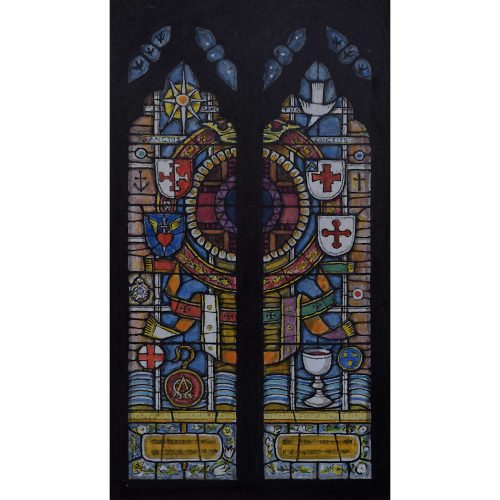
Jane Gray (b.1931)
St Michael and All Angels Church, Craven Arms, Shropshire, Design for Stained Glass Window (1995)
Watercolour 18.5 x 10.5 cmSigned, dated and studio stamp verso.
St Michael and All Angels is a Norman church that dates back to the 12th century. In 1902, it was sympathetically restored by the renowned early 20th century architect, Detmar Blow in his characteristic Arts and Crafts style, but is perhaps best known for housing both a significant fragment of a medieval wall painting, and the oldest Perpendicular pulpit (with Jacobean additions) in Shropshire.
Provenance: the artist’s studio sale. Condition: very good. If you are interested, please email info@manningfineart.co.uk or call us on 07929 749056. For other works by Jane Gray and more information about her, please click here. -
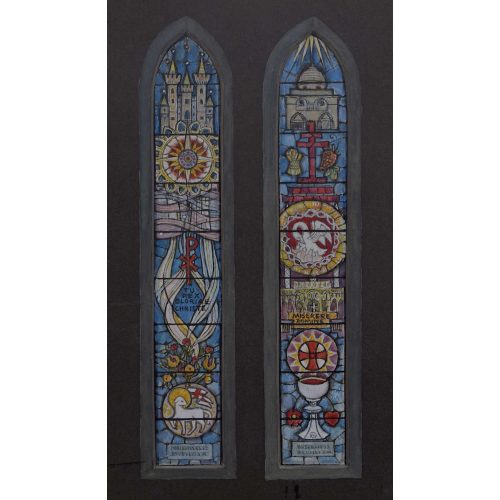
Jane Gray (b.1931)
St Peter’s Church, Martindale Design for Stained Glass Windows (1976)
Watercolour 17.5 x 6 cmStudio label verso.
St Peter’s Church was built in Martindale, Cumbria in 1880 by a local craftsman using stone from the surrounding area. The church is situated in an enchanting rural oasis and has connections to the acclaimed modern poet, Kathleen Raine, who lived in the Old Vicarage, as well as William and Dorothy Wordsworth who visited the area on one of their Cumbrian excursions. Gray’s ‘Martindale Era’ lasted from 1974-1981, in which time, she designed and installed fifteen stained glass windows in St Peter’s Church. These window designs are for Resurrection and Passion windows on the north-side of the church.
Provenance: the artist’s studio sale. Literature: Jane Gray, Playing with Rainbows. (Shropshire: Ellingham Press, 2011), pp.17, 74. Condition: very good. If you are interested, please email info@manningfineart.co.uk or call us on 07929 749056. For other works by Jane Gray and more information about her, please click here. -
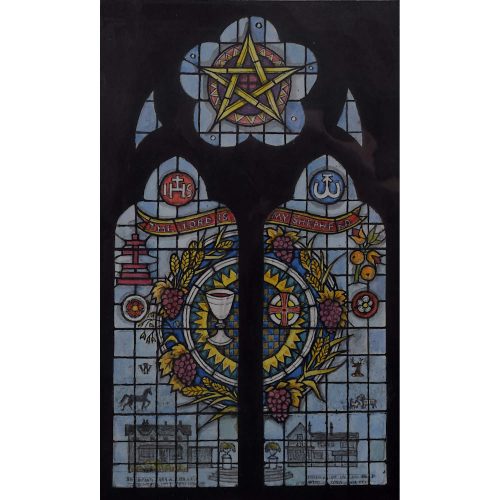
Jane Gray (b.1931)
St Barnabas Church, Franche, Kidderminster, Design for Stained Glass Memorial Window (1992)
Watercolour 21 x 12.5 cmSigned, dated and studio stamp verso.
St Barnabas Church, a red brick church designed by Martin & Chamberlain, was established in Franche in 1871 as a chapel-of-ease to the Parish Church of Kidderminster, St Mary and All Saints. St Barnabas is known for its diverse collection of stained glass windows and, alongside Gray’s modern memorial window, features windows in the Arts and Crafts style, likely designed by Benjamin Warren.
Provenance: the artist’s studio sale. Condition: very good. If you are interested, please email info@manningfineart.co.uk or call us on 07929 749056. For other works by Jane Gray and more information about her, please click here. -
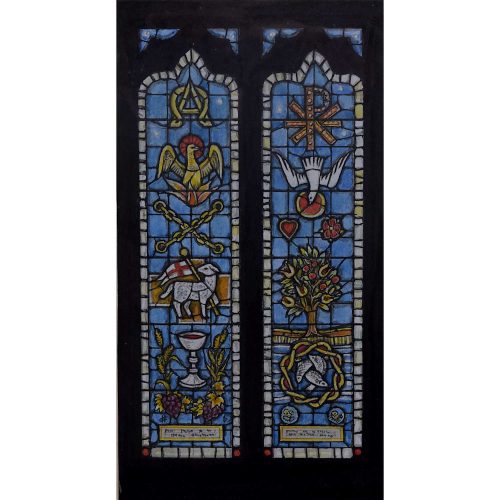
Jane Gray (b.1931)
St Leonards Church, Stagsden, Bedfordshire, Design for Stained Glass Window (1998)
Watercolour 19 x 10 cmSigned and dated verso.
Stagsden receives mention in the Domesday Book, suggesting the likely existence of a church here in the 11th century, St Leonard’s church is, however, first recorded in the 13th century, the vicar in 1229 being Reginald de Stacheden (Stagsden). The nave and the chancel of the present church date back to a similar period. Additions and renovations have since taken place, including the late 14th/early 15th century addition of the north chapel. This window was installed in 2000.
Provenance: the artist’s studio sale. Literature: Jane Gray, Playing with Rainbows. (Shropshire: Ellingham Press, 2011), p.86. Condition: very good. If you are interested, please email info@manningfineart.co.uk or call us on 07929 749056. For other works by Jane Gray and more information about her, please click here. -
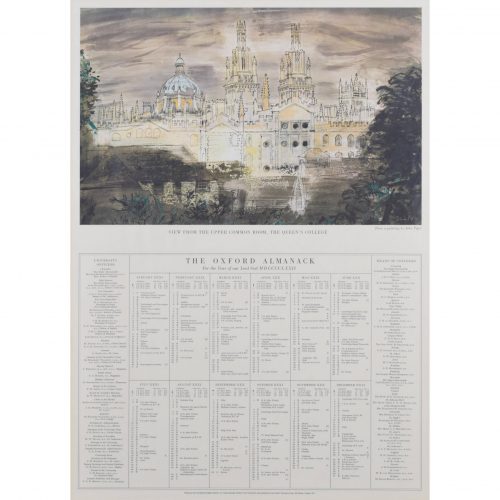
after John Piper (1903 - 1992) View from the Upper Common Room, The Queen's College - Oxford Almanac 1972
Lithograph 68 x 49 cm A lithograph featuring Oxford's skyline, including the towers of All Souls and the Radcliffe Camera, set against a blustery Piper sky. Piper's painting was reproduced as a lithograph in 1972, to be published in the "Oxford Almanack". The Oxford Almanack was an annual almanac published by the Oxford University Press for the University of Oxford from 1674 through 2019 (when printing sadly ceased due to "dwindling interest"). The almanac traditionally included engravings or lithographs of the University and information about the upcoming year. Other almanac artists have included James Basire, Michael Burghers, J. M. W. Turner, and Michael Oelman. John Piper CH was an English painter, printmaker, and designer of stained-glass windows. His work often focused on the British landscape, especially churches and monuments, and included tapestry designs, book jackets, screen-prints, photography, fabrics and ceramics. Condition: very good. If you are interested, please email info@manningfineart.co.uk or call us on 07929 749056. Click here for other views of Queen's College, Oxford. -
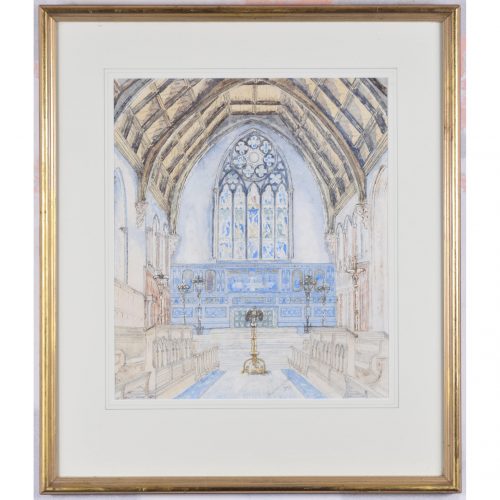
Meadows-Frost (possibly Sir John Meadows Frost [1856 - 1935])
Charterhouse School Chapel
Watercolour 37 x 31 cm Signed 'Meadows-Frost' and dated. A watercolour of Charterhouse's magnificent gothic chapel. Designed by Sir Giles Gilbert Scott, the chapel was consecrated in 1927 as a memorial to nearly 700 Carthusians who died in the Great War. It is the largest war memorial in England. Sir John Meadows Frost was the Mayor of Chester from 1913 to 1918. The following record, likely referring to Sir John's eldest son, also appears in the Charterhouse Register of 1872-1910; this watercolour was executed in 1894. It is likely that one of the family painted it, and any more information as to which individual it was would be gratefully received: "Frost, John Meadows, t). 22 April, 1885: i g. of John Meadows Frost, of Chester; (Girdlestoneites); Left C.Q. 1903. Ch. Ch., Oxf.; B.A. — In firm of Messrs. F. A. Frost & Sons (Millers). tn. 1 910, Olivia, I "U. of Henry Shelmerdine, of Southport. J. M. Frost, Esq., junr., Holmfield, Westminster Park, Chester." Another son, Thomas Laurence Frost, was educated at Charterhouse between between 1901 and 1907, spending 3 years with the Charterhouse Cadet Corps, followed by Clare College, Cambridge. Condition: very good. If you are interested, please email info@manningfineart.co.uk or call us on 07929 749056. -
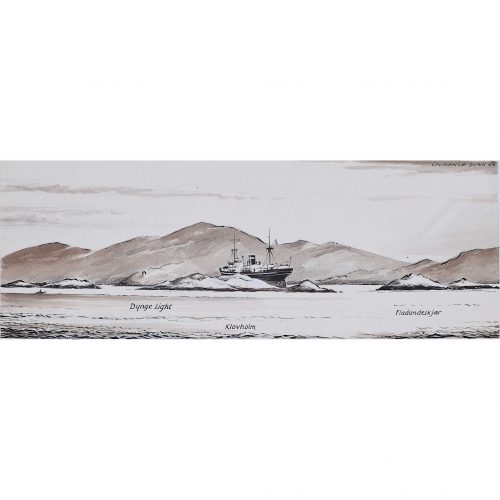
Laurence Dunn (1910-2006)
The Stranded Astoria 4454
11.5 x 31.5 cm Watercolour on paperThis delicately coloured marine watercolour depicts the stranded Astoria, as Dunn notes in detail below the image: ‘The stranded Danish ship ASTORIA as seen from the bridge of the searching destroyer BERGEN after the former had sent a call for aid. As the ASTORIA proved to be in no immediate danger the destroyer did not venture in among the treacherous fringe of skerries, leaving salvage operations to more suitable naval salvage craft which later reflected the ship. The ASTORIA 4454 was bound for Kristiansand from the Baltic in ballast approaching the harbour entrance during the night fog, washed soon ashore close to the Dynge Light some 15 miles away.’
Laurence Dunn (1910-2006) was a well-known British marine artist and writer known for his depictions of ships. He grew up in Devon, where he practised drawing passing ships, and went on to study at the Central School of Art. He then worked for shipbuilding firm John I. Thornycroft & Company Limited, where he contributed to the design of the Royal Yacht. During the Second World War, Dunn worked in naval intelligence. In the early 1960s, he created many line drawings of Atlantic ocean liners.
Upon his death in 2006, the World Ship Society published the following obituary:
DUNN, Laurence. [December 15 2006 — Lloyds List] Many readers will be saddened by the death of well-known marine artist and writer Laurence Dunn in his 97th year. A man of encyclopaedic knowledge, he began his lifelong love of ships in Brixham, where he meticulously recorded passing traffic with the exquisitely accurate line drawings which later became something of a trademark. While studying at London’s Central School of Art his work was noticed by the Southern Railway, which commissioned profiles of its fleet, and this in turn led to work for Orient Line, where he also designed the well-known corn-coloured hull, and later Thorneycroft, where he helped with shaping draft plans for a new royal yacht. During the second world was he worked for naval intelligence at the Admiralty, where his technique did much to improve recognition standards, and greatly expanded his shipping clientele, becoming personally known to many chairmen. As well as the shipping press he worked for mainstream publications such as Everybody’s, Sphere and the upmarket comic Eagle. Through his many contacts he enjoyed going to sea in a great variety of ships from aircraft carriers to colliers. Laurence wrote several books, starting with ship recognition titles which introduced new standards of layout, but his best known work was probably Passenger Liners, which was widely taken up by the travel trade. His love of Greece, where he was an early publicist of island cruising, let to involvement in reshaping various passenger liners beginning with Greek Line’s OLYMPIA. In later life he designed several sets of shipping stamps for the Crown Agents, produced photographic volumes on Thames and Mediterranean shipping and still found time to enjoy the passing Thames traffic. Our sympathies go to his wife Jennifer, who provided succour to the many ship lovers who beat a path to the welcoming door of their Gravesend home.
-
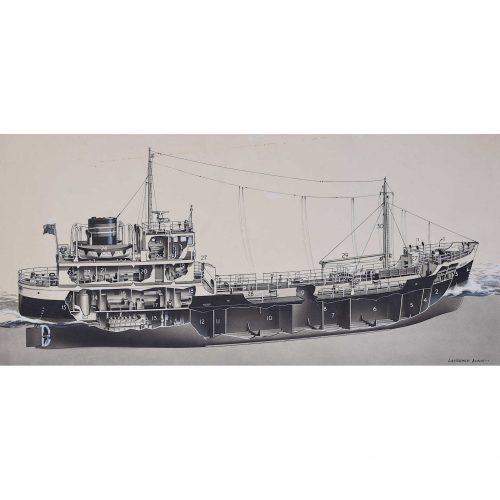
Laurence Dunn (1910-2006)
WELDER, Merchant Ship
25.5 x 56 cm
Ink on paper Signed l.r.Laurence Dunn (1910-2006) was a well-known British marine artist and writer known for his depictions of ships. He grew up in Devon, where he practised drawing passing ships, and went on to study at the Central School of Art. He then worked for shipbuilding firm John I. Thornycroft & Company Limited, where he contributed to the design of the Royal Yacht. During the Second World War, Dunn worked in naval intelligence. In the early 1960s, he created many line drawings of Atlantic ocean liners.
Upon his death in 2006, the World Ship Society published the following obituary:
DUNN, Laurence. [December 15 2006 — Lloyds List] Many readers will be saddened by the death of well-known marine artist and writer Laurence Dunn in his 97th year. A man of encyclopaedic knowledge, he began his lifelong love of ships in Brixham, where he meticulously recorded passing traffic with the exquisitely accurate line drawings which later became something of a trademark. While studying at London’s Central School of Art his work was noticed by the Southern Railway, which commissioned profiles of its fleet, and this in turn led to work for Orient Line, where he also designed the well-known corn-coloured hull, and later Thorneycroft, where he helped with shaping draft plans for a new royal yacht. During the second world was he worked for naval intelligence at the Admiralty, where his technique did much to improve recognition standards, and greatly expanded his shipping clientele, becoming personally known to many chairmen. As well as the shipping press he worked for mainstream publications such as Everybody’s, Sphere and the upmarket comic Eagle. Through his many contacts he enjoyed going to sea in a great variety of ships from aircraft carriers to colliers. Laurence wrote several books, starting with ship recognition titles which introduced new standards of layout, but his best known work was probably Passenger Liners, which was widely taken up by the travel trade. His love of Greece, where he was an early publicist of island cruising, let to involvement in reshaping various passenger liners beginning with Greek Line’s OLYMPIA. In later life he designed several sets of shipping stamps for the Crown Agents, produced photographic volumes on Thames and Mediterranean shipping and still found time to enjoy the passing Thames traffic. Our sympathies go to his wife Jennifer, who provided succour to the many ship lovers who beat a path to the welcoming door of their Gravesend home.
-
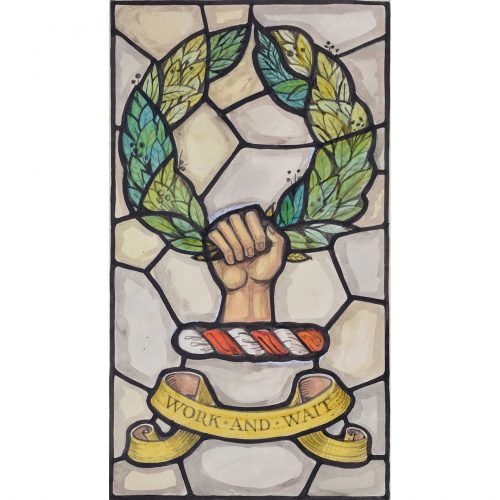
Jane Gray (b.1931)
'Work and Wait' Stained Glass Window Design
Watercolour37.5 x 20.5 cm
This highly graphic, modern stained glass design depicts a communist-style fist clasping a laurel wreath above a rope and scroll reading the motto: ‘Work and Wait’. Most likely a private commission, this design perfectly marries Gray’s traditional and modern approaches to her work.
Provenance: the artist’s studio sale. Condition: very good. If you are interested, please email info@manningfineart.co.uk or call us on 07929 749056. For other works by Jane Gray and more information about her, please click here. -
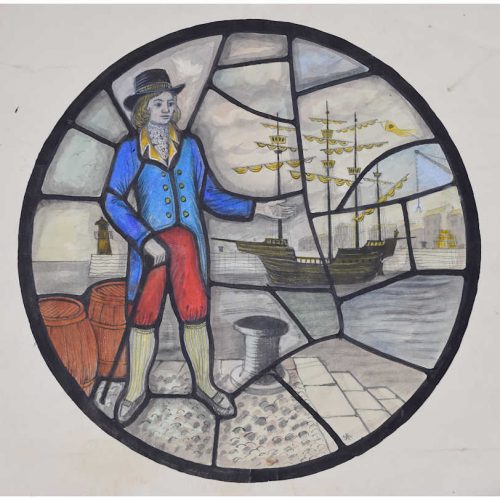
Jane Gray (b.1931)
Port Scene Design for Stained Glass Roundel (1962)
WatercolourD. 25.5 cm
One of Gray’s most interesting stained glass designs, this roundel depicts a colourful port scene, with a brightly attired middle class merchant standing on the dockside in front of an impressive carrack. Whilst a traditional scene, the design has Gray’s uniquely modern twist.
Provenance: the artist’s studio sale. Condition: very good. If you are interested, please email info@manningfineart.co.uk or call us on 07929 749056. For other works by Jane Gray and more information about her, please click here. -
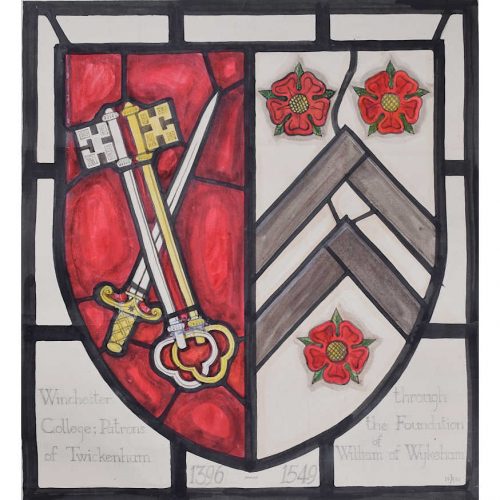
Jane Gray (b.1931)
Winchester College: Patrons of Twickenham Stained Glass Window Design, St Mary’s Church, Twickenham (1960)
Watercolour41.5 x 37.5 cm
Signed and dated l.r.This stained glass window design is one of a handful Gray designed for her local church, St Mary’s Twickenham. St Mary’s Church stands on the site of an earlier church in Twickenham, a short distance from York House and the banks of the River Thames, and incorporates a 15th-century, medieval tower. St Mary's has an impressive and illustrious history of notable parishioners including the painter Godfrey Kneller who, after the collapse of the ancient church's 14th-century nave in 1714, took active involvement in redesigning the church in the Neo-classical style alongside local architect John James, as well as Henry Fielding and Alfred Lord Tennyson whose sons were both baptised here. Gray had a personal connection to St Mary’s, her great grandfather having been the vicar some years before. This design, in particular, focusses on the religious involvement of Winchester College, represented here by the right hand side of the shield which bears the key components of the school’s coat of arms; three red roses and two right-angled bars.
Provenance: the artist’s studio sale. Condition: very good. If you are interested, please email info@manningfineart.co.uk or call us on 07929 749056. For other works by Jane Gray and more information about her, please click here. -
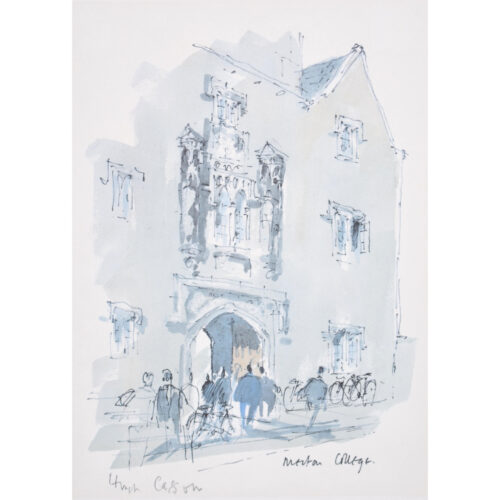
Hugh Casson (1910 - 1999)
Merton College, Oxford
Lithograph 24 x 17 cm Titled in plate lower right and signed in pencil lower left. Casson's blue-toned view of Merton, complete with strolling undergraduates and leaning bicycles. Sir Hugh Casson was educated at Eastbourne College; St John’s College, Cambridge; and the Bartlett School of Architecture. Trained in the 1930s in the early modernist style, he taught at the Cambridge School of Architecture. After employment as a camoufleur during World War 2 by the Air Ministry, in 1948 he was appointed as director of architecture for the Festival of Britain. A close friend of the Royal Family, he undertook designs for the 1953 coronation, designed the interior of the Royal Yacht Britannia (“The overall idea was to give the impression of a country house at sea”), and taught the young Charles III to paint in watercolours. Amongst his architectural achievements are the Elephant House at London Zoo, the 1978 redevelopment of Bristol Docks, the Raised Faculty Building for The University of Cambridge, and a building for the Royal College of Art. He published a number of illustrated books, of which Casson’s Oxford and Casson’s Cambridge are probably the best known. A limited edition series of prints was produced from the paintings. Condition: very good. If you’d like to know more, please email info@manningfineart.co.uk or call us on 07929 749056. Click here for other views of Merton College, Oxford. -
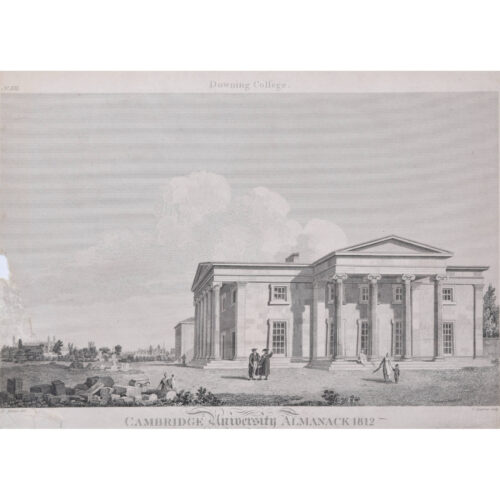
Samuel Sparrow (active 1770 - 1806) after Henry Barker (1774 - 1856)
Downing College, Cambridge (1812)
Engraving 31 x 43 cm A copy of this engraving is held by the British Museum. An early nineteenth-century engraving of Downing College, with building materials in the foreground and elegantly dressed figures, including two scholars, strolling in the College's grounds. The Cambridge University Almanack was an annual almanac published by the Cambridge University Press. It traditionally included engravings or lithographs of the University and information about the upcoming year. Condition: generally good, except loss/damage to left hand side visible in photograph. If you’d like to know more, please email info@manningfineart.co.uk or call us on 07929 749056. -
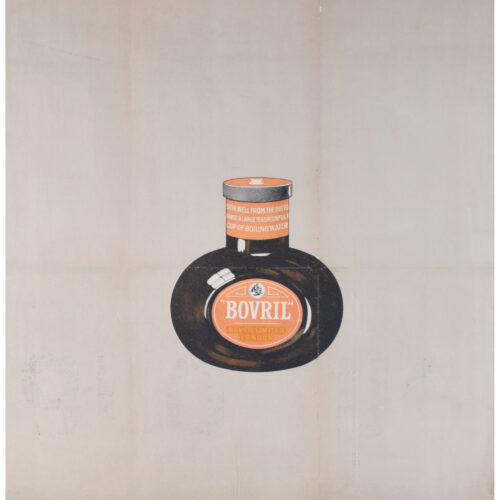
Bovril
Lithograph 75 x 73 cm An original advertisement for Bovril, featuring the brand's uniquely shaped amber glass bottle. One of the instructions for preparing the meat paste into a liquid is 'Stir Well from the Bottom', which went on to become a recognisable tagline for Bovril. Condition: old folds as issued; otherwise generally good. If you are interested, please email info@manningfineart.co.uk or call us on 07929 749056. Click here for other original vintage posters. -
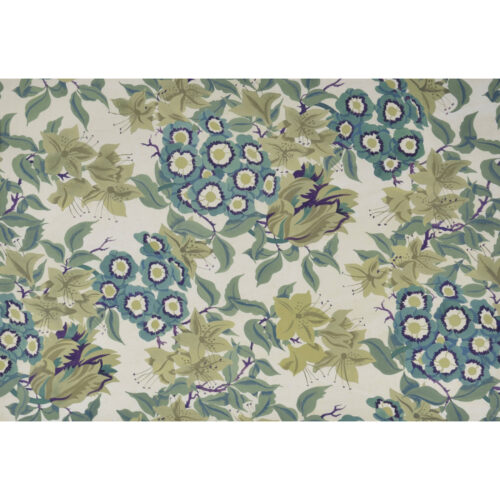
Glasgow School of Art
Wallpaper design
Gouache 33 x 48 cm An Arts and Crafts wallpaper design in the style popularised by William Morris, featuring pansies and lilies in shades of green, blue, and purple. Condition: generally very good; a few very faint spots. If you are interested, please email info@manningfineart.co.uk or call us on 07929 749056. -
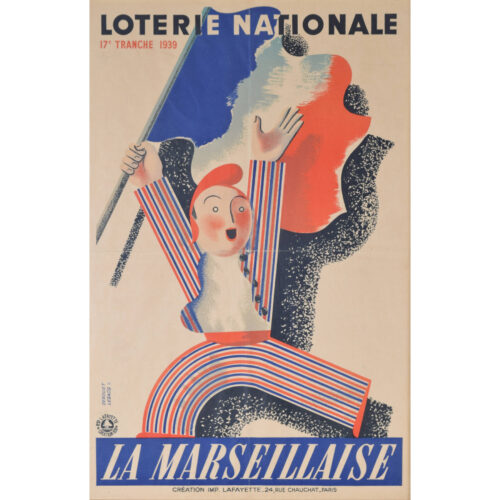
Edgard Derouet (1910 - 2001)
Loterie Nationale La Marseillaise (1939)
Original vintage poster 59 x 39 cm Derouet's famous "jumping man" motif features on this stylish Art Deco poster which advertises the National Lottery. The figure's pinstripe trousers are in the colours of the French flag, which he also waves animatedly; the figure became the figurehead of the Loterie Nationale. Edgar Derouet was a French painter and poster artist. He studied under the celebrated poster artist Paul Colin, and worked as a poster illustrator for most of his career. During the Second World War he worked for the Vichy government and the German film industry; he became the artistic director of the magazine Art et Industrie when the war ended in 1945. He stopped working as a poster artist in 1954, instead running a print shop. Condition: generally very good; folds as issued; some browning to paper. If you are interested, please email info@manningfineart.co.uk or call us on 07929 749056. Click here for other original vintage posters. -
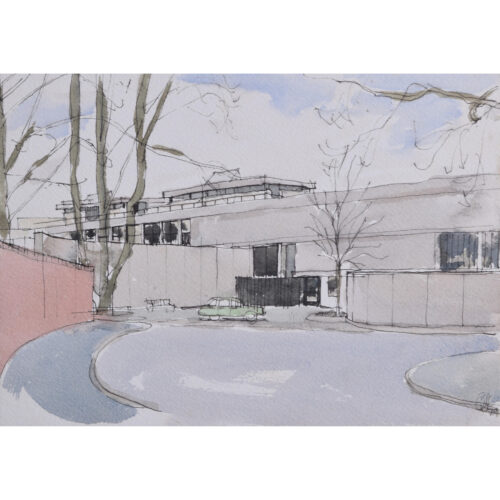
Gavin Pomeroy (born 1929)
Wolfson College, Oxford
Watercolour 17 x 25 cm Signed and dated lower right. A watercolour of the modernist Wolfson College, featuring a 1970s mint-green car. Founded in 1965, its main building (designed by Powell and Moya Architects) was completed in 1974. Pomeroy portrays it in winter, with the cloudy sky and bare trees melding with the grey of the modernist facade. William Gavin Ingram Pomeroy was born in Newlyn, Cornwall. From 1947 he studied architecture under Geoffrey Bazeley, and later became a lecturer for the Plymouth School of Architecture. He became the senior lecturer in architecture at what is now Plymouth University and retired in 1999. Condition: generally very good. If you’d like to know more, please email info@manningfineart.co.uk or call us on 07929 749056. Click here for more views of Wolfson College. -
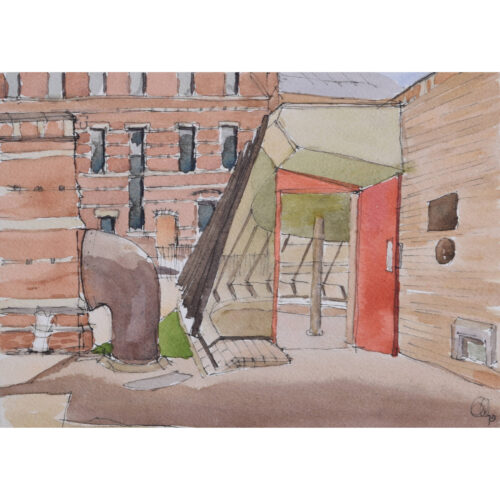
Gavin Pomeroy (born 1929)
Keble College, Oxford
Watercolour 17 x 25 cm Signed and dated lower right. A watercolour of Keble College. Pomeroy juxtaposes the red brick of the original 1870s buildings with the glass and metal of one of the modernist additions to the college in the 1970s: the ABK buildings, including the glass "goldfish bowl" bar. William Gavin Ingram Pomeroy was born in Newlyn, Cornwall. From 1947 he studied architecture under Geoffrey Bazeley, and later became a lecturer for the Plymouth School of Architecture. He became the senior lecturer in architecture at what is now Plymouth University and retired in 1999. Condition: generally very good. If you’d like to know more, please email info@manningfineart.co.uk or call us on 07929 749056. Click here for more views of Keble College. -
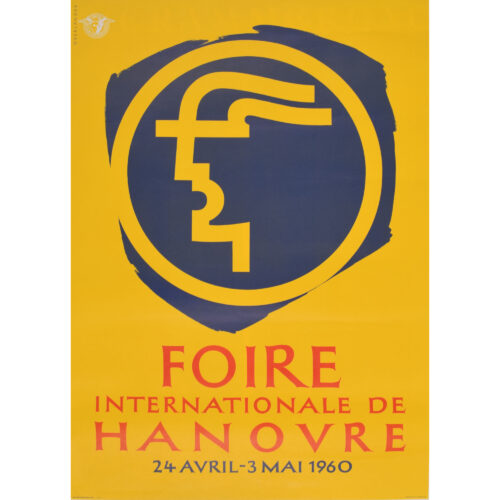
Foire Internationale de Hanover
Original vintage poster 84 x 59 cm This poster with its highly modern logo advertises the 1960 Hanover Fair. British military authorities organised the trade fair as a bolster to Germany's post-war economy. Over 1,000 exhibitors showed a selection of items made in Germany for overseas export. This version of the poster was designed for display in France. Condition: generally very good. Not backed. If you are interested, please email info@manningfineart.co.uk or call us on 07929 749056. Click here for more original vintage posters. -
Out of stock

Leslie Carr (1891 - 1969)
Paddlesteamer
Gouache 19 x 29 cm Signed lower right. A steamship on a bright blue ocean, complete with frothing waves. Leslie Carr was a painter and poster designer from London. He served in the Tank Corps in the First World War and then became a professional artist, mainly producing maritime and architectural scenes. He designed posters for Southern Railway, the London and North Eastern Railway, and British Railways (among others). Carr served as a fireman in the Second World War and was a part of several firemen artists' exhibitions. Carr was a member of the Society of Marine Artists. Condition: very good. If you are interested, please email info@manningfineart.co.uk or call us on 07929 749056. Click here for other maritime pictures. -

John Finnie (born 1935)
Waterways (1965)
Original vintage poster 102 x 63 cm Overprinted 'This is a reproduction of a poster designed for London Transport'. This was overprinted for a period on copies of London Transport posters (produced on the normal production line) that were sold in what is now the London Transport Museum in Covent Garden. Finnie's poster promotes travel on London's waterways, and indicates that said waterways are in easy reach of London Underground stations (here, Warwick Road). John Finnie was an illustrator and designer who trained at Leicester College of Art. He was elected a Member of the Society of Industrial Artists and Designers in 1958, and then worked as a freelance artist, designing posters for the British Ship Building Conference, The Post Office, Shell, London Transport, and many other notable companies. From 1976 he began producing glass engraving designs. Condition: generally very good. If you are interested, please email info@manningfineart.co.uk or call us on 07929 749056. Click here for other original vintage London Transport posters. -

Risch Lau (publisher)
Bregenz am Bodensee, Vorarlberg, Bodensee, Österreich (c. 1960)
Original vintage poster 86 x 60 cm A church in beautiful Bregenz in Vorarlberg in Austria, from the Austrian poster publisher Risch Lau. Condition: very good; odd handling marks as expected. If you are interested, please email info@manningfineart.co.uk or call us on 07929 749056. Click here for other original vintage travel posters. -

Joseph Constantine Stadler (1755 - 1828) after Joseph Farington (1747-1821)
Oxford High Street with Queen's College and University College
Engraving with hand colouring 22 x 33 cm Published by J & J Boydell. Joseph Constantine Stadler was a prolific German émigré engraver of images after his contemporaries - here, 18th-century English landscape painter and diarist Joseph Farington. Stadler's engravings are wide-ranging in subject matter and include landscapes, seascapes and portraits, as well as military, sporting and decorative subjects. Stadler was employed by the leading print publisher of the time, John Boydell. Stadler lived in Knightsbridge when he died at the age of 73. Joseph Farington was born in Lancashire and went to study with Richard Wilson in London in 1763. In 1764, 1765, and 1766 he won “premiums” from the Society of Artists for his landscape drawing; he became a member in 1765. He joined the Royal Academy when it was founded in 1769 and was elected an ARA in 1783 and an RA in 1785. Farington contributed works to the Academy’s exhibitions every year until 1801, but only occasionally between 1801 and 1813. He was an active member of the Academy and sat on several important committees, including the one which determined where artworks would be hung during the exhibitions. In 1793 he became a fellow of the Society of Antiquaries and helped establish the British Institution. This particular edition depicts a view down Oxford High Street with Queen's College and University College in the eighteenth century. The hand colouring lends a unique charm to this engraving, where the light colours and calm streets suggest the sereneness of the start of an Oxford summer day. Condition: very good. If you are interested, please email info@manningfineart.co.uk or call us on 07929 749056. For other general views of Oxford, click here. -

Gavin Stamp (1948-2018) Christmas Card, 1975 - St Martin's Military Church, Delhi
Ballpoint pen and ink 21 x 20 cm Born in 1948, Gavin Stamp was educated on a London County Council Scholarship at Dulwich College and took a degree in history and architectural history at Cambridge. He moved to London in 1972 and worked as an architectural draughtsman and graphic designer, combining this with journalism and cataloguing at the RIBA drawings collection. By the late 1970s he was describing himself as ‘an odd-job man in the vicious cut-throat world of architectural history’. Over the course of his career, his scholarship and enthusiasm promoted the understanding and celebration of several great but neglected architects, while he also succeeded in saving many 19th and 20th century buildings from demolition. Sourced from his estaste, Gavin Stamp designed this Christmas card depicting St Martin's Military Church, Delhi in the winter of 1975. The pared back aesthetic allows us to appreciate the neatness of the parallel dashes and the pleasing pointillist effect created across the trees. -

Richard Bankes Harraden (1778 - 1862)
St John's College, Cambridge (Great Gate)
Engraving 19 x 25 cm A nineteenth-century view of the Great Gate at St John's College Cambridge. Richard Bankes Harraden was a printmaker, painter, and drawing master. He was active in Cambridge, producing many views of the colleges, and subsequently several Oxford colleges. Harraden was an early and exhibiting member of the Society of British Artists in London, which was established in 1823, and remained a member until 1849. He specialised in depictions of landscape, topography and architecture, and was the son of Richard Harraden (1756 - 1838) with whom he published plates as 'Harraden & Son'. Condition: Generally very good, slight age toning to paper, in Victorian rosewood frame. If you are interested, please email info@manningfineart.co.uk or call us on 07929 749056. Click here for other views of Magdalene College, Cambridge. -

Howard Scott Closed for the Duration, Loose Talk Can Cost Lives
Lithograph 51 x 36 cm 'Closed for the duration...Loose talk can cost lives.' In both the United Kingdom and the United States, there was a constant fear of insider information being overheard by the enemy. As a result, there were several propaganda drives to encourage discretion among the citizens of the countries. This particular poster belongs to an American collection centring around the slogan 'loose talk can cost lives.' Depicting a man with his mouth taped together, his lips shut tight and sealed shut, this poster represents an aspirational antithesis of 'loose talk'. Howard Scott (1902-1983) was a billboard designer for many American companies in the mid-twentieth century. He was known for designing billboards with clever one liners and large pictures of friendly, everyday people on them. He was famous for his designs for companies including Heinz Ketchup, Nash Automotive, and Campbell’s Soup. During the Second World War, he joined the navy where he illustrated posters for the U.S. War Information Center, including the poster pictured here. For other propaganda posters, click here. -

Charles E. Brown Lancaster bomber, G for George
Silver gelatine photograph 21 x 14 cm This striking black and white photograph by Charles E. Brown showcases the magnificent Lancaster bomber, G for George W4783. Unlike many of Brown's other photographs of aeroplanes mid-air, G for George is parked. The viewer is treated to a unique view through the cockpit, with the steering wheel and aircraft controls clearly in view. In general, Lancaster bombers were used as British heavy bombers in the Second World War. G for George is, however, of particular note as the second most prolific operational bomber; most operational Lancasters were shot down after 20 sorties whereas G for George survived 90 before being retired. It is now preserved at the Australian War Memorial in Canberra. Charles E. Brown (1896-1982) was a British commercial aviation photography whose career spanned both World Wars. He worked primarily for British newspapers, the aviation industry and as a freelance commercial photographer with official accreditation as a war correspondent. He retired as an aviation photographer in 1964 and the Royal Airforce Museum has preserved his aviation archive of 30,000 images since 1978. -

Sir Eduardo Paolozzi CBE RA (1924-2005) Steps
Plaster of Paris 10 x 10 x 4 cm Paolozzi’s fascination with anatomy, machine parts, and the idiom of classical statuary is evident in his modernist sculptural forms. The clean lines and gleaming white of 'Steps' evoke the monumental forms and marble of antiquity, constituting an ode to classicism by Paolozzi. Sir Eduardo Luigi Paolozzi CBE RA was a Scottish artist, known for his sculpture and graphic works. He is widely considered to be one of the pioneers of pop art. Paolozzi studied at the Edinburgh College of Art in 1943, briefly at Saint Martin's School of Art in 1944, and then at the Slade School of Fine Art at University College London from 1944 to 1947, after which he worked in Paris. While in Paris from 1947 to 1949, Paolozzi became acquainted with Alberto Giacometti, Jean Arp, Constantin Brâncuși, Georges Braque and Fernand Léger. This period became an important influence for his later work. For example, the influence of Giacometti and many of the original Surrealists he met in Paris can be felt in the group of lost-wax sculptures made by Paolozzi in the mid-1950s. Their surfaces, studded with found objects and machine parts, were to gain him recognition. He taught sculpture and ceramics at several institutions, including the Hochschule für bildende Künste Hamburg (1960–62), University of California, Berkeley (in 1968) and at the Royal College of Art. Paolozzi had a long association with Germany, having worked in Berlin from 1974 as part of the Berlin Artist Programme of the German Academic Exchange Programme. He was a professor at the Fachhochschule in Cologne from 1977 to 1981, and later taught sculpture at the Akademie der Bildenden Künste in Munich. Paolozzi was fond of Munich and many of his works and concept plans were developed in a studio he kept there, including the mosaics of the Tottenham Court Road Station in London. He took a stab at industrial design in the 1970s with a 500-piece run of the upscale Suomi tableware by Timo Sarpaneva that Paolozzi decorated for the German Rosenthal porcelain maker's Studio Linie. Condition: Generally very good, occasional inclusions etc., as expected. If you'd like to know more, please email info@manningfineart.co.uk or call us on 07929 749056. -

18th Century View of Cambridge
Engraving 15 x 20 cm This detailed engraving captures an 18th century view of Cambridge from the West. Green expanses dominate the piece, featuring scholars pictured resting or wandering in the foreground. In the background, the Cambridge skyline is clearly visible, where the view over the Backs is unmistakeable. From King's College Chapel, to Trinity's world famous Wren Library, Great St Mary's Church and the medieval spire of Queen's College, many of the historical Cambridge landmarks still recognisable today are to be found in this intriguing composition. Condition: Generally very good, some age toning to paper. If you’d like to know more, please email info@manningfineart.co.uk or call us on 07929 749056. For other views of Cambridge, click here. -

George Bissill (1896-1973) View through the village
Watercolour 26 x 21 cm Born in 1896, George Bissill was a British miner, painter and furniture designer. Raised in the mining village of Langley Mill, Derbyshire, Bissill became a miner at the age of 13, before leaving to join the war effort in 1915. Upon his return from the war after being gassed, Bissill chose to become a pavement artist outside the newly erected Bush House in Aldwych, painting from his memory and his sketch book the uncompromising underground world he had inhabited. In 1935 he moved to the countryside near Newbury, where he lived and worked as a landscape painter, art restorer and dealer until his death in 1973. This watercolour forms part of a larger collection, 'unseen since they were taken from George Bissil's studio in 1983' and restored by Kate Pattinson. A series of planned exhibitions were cancelled due to Covid, but two shows, one in Oxford and one in Ilkeston, did take place. Through such exhibitions, Pattinson hoped to 'restore the reputation of an artist who, through mighty endeavour, conquered the art world in the 1920s with his powerful, authentic and experimental pictures.' Bissill's paintings are also held in a number of important public collections, including the Tate Gallery, National Museum of Ireland and the Manchester Art Gallery. In this watercolour, Bissill paints a view through a village. Houses line a small road leading to a clearing where three horses are frolicking. Bissill combines watercolour and pencil in this multimedia composition, using pencil to detail the minimalistic horses, for example. This painting offers therefore a unique insight into Bissill's working processes as he frantically sketches and paints life around him. Condition: generally very good.If you would like to know more, please email info@manningfineart.co.uk or call us on 07929 749056.
-

Jane Gray (b.1931) Design for stained glass window
Pencil and coloured pencil on paper 52 x 68 cm Dated 1975 to lower right. Jane Gray A.R.C.A. (b.1931) is a British stained glass artist. She studied stained glass at the Kingston School of Arts (1949-51) and later at the Royal College of Art (1951-55) under Lawrence Lee. Lee was so impressed with Gray’s work that he asked her to work alongside him on the design of ten nave windows for Coventry Cathedral. This six-year-long design project culminated in their final installation in 1962 after the cathedral’s consecration. Gray was the first woman to become a liveryman of the Worshipful Company of Glaziers and has designed more than a hundred windows in private and public buildings, chapels and over forty churches across the country, including St Peter’s, Martindale, Shrewsbury Abbey, St Oswald, Oswestry and St Mary, Chirk. Gray’s designs mark a crucial turning point in the history of stained glass art as the Victorian style gave way to a modern aesthetic. In her work, Gray navigates this shift with a style that, whilst distinctly modern, retains a deep rooted sense of the medieval. Despite many of her commissions being for church windows, stained glass design was not simply about religious depiction for Gray, but more about ‘colour, shapes, luminosity, [and] playing with rainbows’. This stained glass cartoon depicts a lovely wildflower meadow. In keeping with her love of colour and luminosity, the flowers included in this design promise to breathe a breath of fresh air into any room. Although it remains unclear if and where this design was realised in glass, Gray's drawing and annotations offer valuable insights into her working process. -

Hillary Hennes (1919-1993) Watching Over the Fire
Pencil drawing 43 x 28 cm Hillary Hennes was a British artist and illustrator. Her father was a curator at the South London Art Gallery and she was consequently initiated into the art world from a young age. After attending the Blackheath High School, Hennes (then Miller) studied at the Blackheath School of Art and then spent a further three years at the Royal College of Art. After graduating, Miller taught at the South East Sussex Technical College and in 1946 married the artist Hubert Hennes. Between 1948 and 1967 Miller frequently exhibited paintings at the Royal Academy in London and also illustrated a number of books on gardening and natural history, such as The Living World and Boff's Book of Gardening. This pencil drawing depicts a woman resting by the fireplace. Her legs are crossed and she is slumped gently to the side. Hennes excellently captures the light of the room: the mirror in the background reflects a sunny day and the woman is basked in light, though it is unclear if this from the gentle glow of a fire or the sun rays peaking through the window. Condition: Generally very good.If you would like to know more, please email info@manningfineart.co.uk or call us on 07929 749056.
-

German Aircraft Original vintage Second World War poster
Lithograph 51 x 71 cm c.1941-1944 This original vintage poster, published in 1941, depicts a series of German aircraft, including the fighter plane Messcherschmitt BF 109, the Junkers Ju 87 "Stuka" – a dive bomber known for its accuracy and infamous siren–, and the Heinkel He 111--the Luftwaffe’s main medium bomber, used extensively in the Blitz. In these black-and-white technical drawings, each German aircraft is depicted from different angles, providing a clear view of their shape and markings, making it a crucial tool for aircraft reconnaissance. During the Second World War, the Ministry of Information produced a number of posters detailing the differences between British and German aircraft. In general, they were designed to help British civilians and military personnel identify enemy aircraft, distinguishing them from Allied planes. This poster is marked in the top left-hand corner as being confidential, suggesting that it was restricted to military use, rather than public distribution and served as educational tool to train pilots, anti-aircraft gunners, and air raid wardens to distinguish German planes from friendly or neutral aircraft. This is an excellent example of WWII military intelligence and training material, demonstrating how Allied forces prepared for German aerial threats. Condition: Generally very good. Slight age toning and spotting to paper, small tears at the edges and tape stains that will be covered by mount.If you would like to know more, please email info@manningfineart.co.uk or call us on 07929 749056.
-

Joseph Constantine Stadler (1755 - 1828) after William Westall (1781 - 1850) Trinity Gate (1815)
Aquatint with original hand colouring 25 x 21 cm Published by Rudolph Ackermann (1764 - 1834). Trinity's towering gate, complete with the College's arms. Engraved for Ackermann's 'History of Cambridge'. Joseph Constantine Stadler was a prolific German émigré engraver of images after his contemporaries - here, 18th-century English landscape painter and diarist Joseph Farington. Stadler's engravings are wide-ranging in subject matter and include landscapes, seascapes and portraits, as well as military, sporting and decorative subjects. Stadler was employed by the leading print publisher of the time, John Boydell. Stadler lived in Knightsbridge when he died at the age of 73. William Westall was a British landscape artist. He was born in Hertford and enrolled at the Royal Academy schools in 1799. He later became the draughtsman for a voyage to Australia and the South Seas. After being shipwrecked, he travelled to Canton in China and to India, staying in Bombay for several months. He returned to England in 1805 but later set off for Madeira and Jamaica. He became a member of the Society of Painters in Water Colours (1811) and an associate of the Academy (1812). Following a mental breakdown, he regularly visited the Lake District and published ‘Views of the Valley and Vale of Keswick’ (1820). His series of aquatints of the Thames, the great universities, and England's public schools for Ackermann are among his most popular works. Rudolph Ackermann was an Anglo-German bookseller, inventor, lithographer, publisher and businessman. In 1795 he established a print-shop and drawing-school at 96 Strand. Here Ackermann set up a lithographic press and began a trade in prints. He later began to manufacture colours and thick carton paper for landscape and miniature painters. Within three years the premises had become too small and he moved to 101 Strand, in his own words "four doors nearer to Somerset House", the seat of the Royal Academy of Arts. Between 1797 and 1800 Ackermann rapidly developed his print and book publishing business, encompassing many different genres including topography, caricature, portraits, transparencies and decorative prints. Condition: Generally very good; slight toning to within platemarkIf you would like to know more, please email info@manningfineart.co.uk or call us on 07929 749056.
-

Alex Trickett and David Brooks ParalympicsGB Medallists Map 2012
Lithograph 79 x 60 cm Numbered 692/1000 This colourful map celebrates the achievements of all the 97 athletes and five horses who contributed to ParalympicsGB's medal haul, and follows on from the Team GB Olympic medallists map released in September 2012. Designed by sports journalists Alex Trickett and David Brooks, the map groups athletes from various sporting disciplines on different lines. Athletics takes pride of place on the Circle line, though Britain's monumental success in sports such as cycling and swimming meant that athletes had to be allocated multiple lines, with the medal-winning cyclists, for instance, representing both the Central and Hammersmith & City lines. In addition to this, designers Trickett and Brooks took into account the legendary status of some of these athletes and placed them at symbolic entry points to London 2012, with Sarah Storey, Britain's most decorated female Paralympian, occupying Stratford Station--home of the olympic park-- and Ellie Simmonds placed at West Ham. Printed on high quality paper, the underground lines assume a certain allure as their colours shimmer and the thames, shining silver across the map, divides the city in two. Condition: Generally very good, some small handling marks.If you would like to know more, please email info@manningfineart.co.uk or call us on 07929 749056.