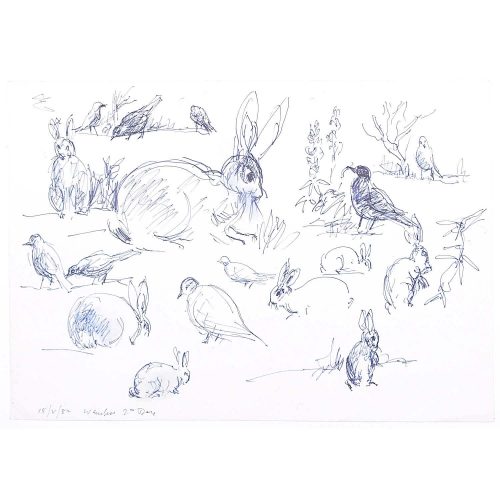
-
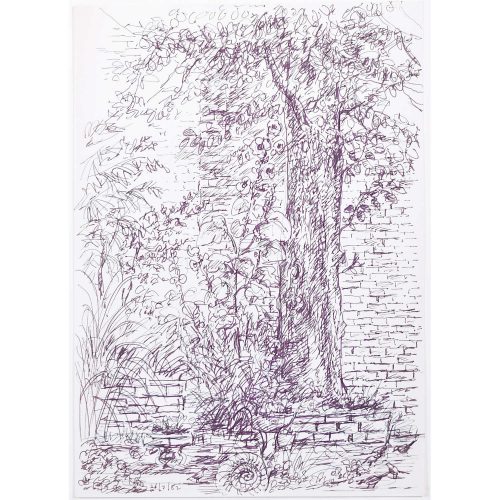
Derrick Latimer Sayer (British: 1917-1992) Tree for Beverly Nichols' Cats' ABC
30x21cm Pen and ink Dated 26 vii 1982 Sayer illustrated Beverley Nichols' 'Cats' A.B.C.' and we are delighted to present some of his preparatory drawings here. Search for 'Sayer' in our stock to see more of these utterly charming illustrations - mostly of cats. If you are interested email info@manningfineart.co.uk or call us on 07929 749056. Condition: Good. For biographical details and other works by the artist please click here. -
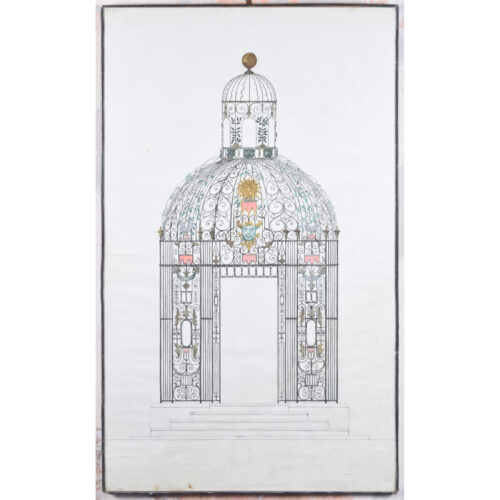
Louis Osman FRIBA (1914 - 1996)
Design for the Restoration of the 'Bird Cage' Arbour, Melbourne Hall, Derbyshire
Mixed media, including pen, ink, watercolour, and gold leaf 108 x 63 cm Provenance: the artist's daughter. In 1958 Osman was commissioned to advise on the restoration of a metal arbour, originally designed in 1708 by Robert Blackwell for the grounds of Melbourne Hall in Derbyshire. The arbour is known as the 'Bird Cage' and was originally painted in a dreamy array of vivid colours; Osman extensively researched Blackwell's work and consulted his original plans for the metalwork in order to restore the arbour to its former glory. The paint was stripped and the iron repainted as per Blackwell's original scheme. The ironwork specialists George Lister & Sons Ltd worked with Osman on the project. This large design features watercolour and gold leaf to illustrate the embellishments Osman had in mind. Osman was as much an artist as an architect. This is likely a portfolio piece from his time studying at the Bartlett School of Architecture, and is as such a piece of architectural history as well as a beautiful Osman design. Osman was awarded a First Class degree and the Donaldson Medal of the RIBA (for the best result in his year group) by the Bartlett, and then went on to the Slade School of Art. He subsequently trained with Sir Albert Richardson - we also have several Richardson works in our collection. After the war, Osman busied himself as an architect. His work included contributions to Westminster Abbey, and Lincoln, Exeter, Ely, and Lichfield Cathedrals, Staunton Harold Church in Ashby de la Zouch for the National Trust, and of course his folly: the Grade I listed Elizabethan manor house, Canons Ashby in Northamptonshire, now a National Trust property. At Canons Ashby he established a workshop and had a team of silversmiths and goldsmiths working for him. In 1976 he made the gold enamelled coffin that holds the copy of the Magna Carta on view in the United States Capitol, Washington, DC. Condition: generally very good; one or two small brown spots to periphery. In artist's original lead-edged frame. If you’d like to know more, please email info@manningfineart.co.uk or call us on 07929 749056. -
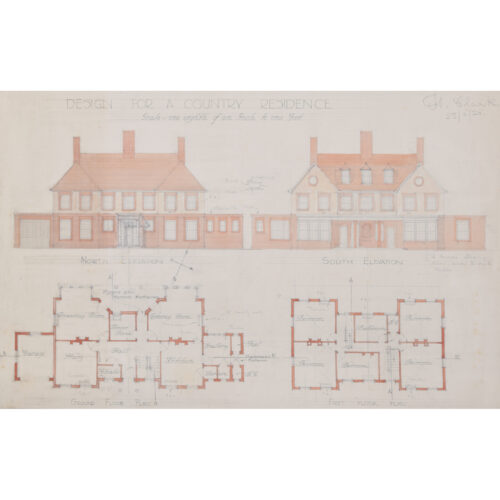
H Clark
Design for a Country Residence (1925)
Pencil and wash 36 x 54 cm An excellent 1925 design for a country house. Clark uses a wash to depict the warm red of the bricks in his design. Condition: mostly very good; old, soft crease to top left. If you are interested, please email info@manningfineart.co.uk or call us on 07929 749056. Click here for more architectural designs. -
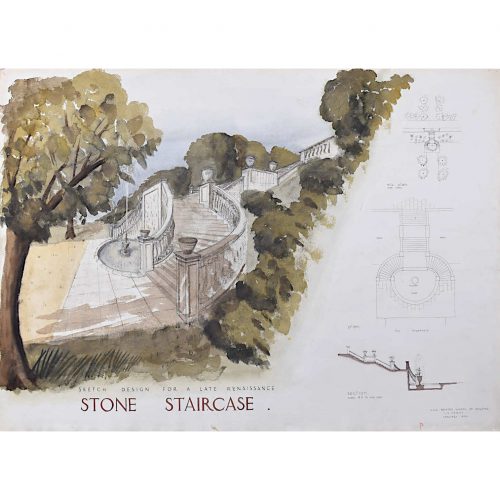
V A Hards (British, c. 1930-c. 2012) Design for a late Renaissance stone staircase (1956)
Watercolour on wove 77 x 55 cm Signed and dated 1956. Hards was educated at Brixton School of Building and Woolwich Polytechnic between 1948 and 1956, during which period he produced some very competent work, including this architectural design for a late Renaissance stone staircase. Brixton School of Building was incorporated into the Polytechnic of the South Bank - now London South Bank University. Condition: some edge wear and isolated spots - see photographs. Stamped and marked with 'Brixton School of Building' stamp. If you’d like to know more, please email info@manningfineart.co.uk or call us on 07929 749056. -
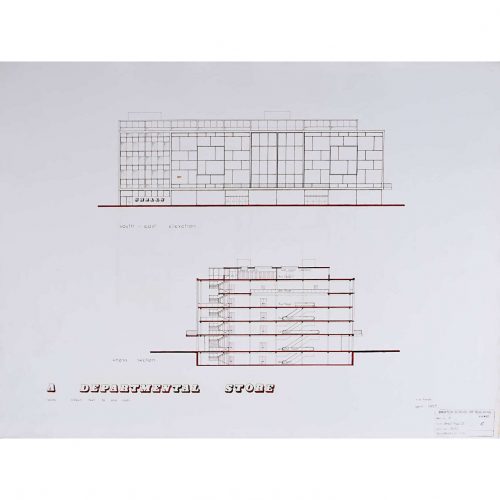
V A Hards (British, c. 1930-c. 2012) Design for a Departmental Store (1956)
Watercolour on wove 77 x 55 cm Signed and dated 1956. Hards was educated at Brixton School of Building and Woolwich Polytechnic between 1948 and 1956, during which period he produced some very competent work, including this architectural design for a modernist department store. Brixton School of Building was incorporated into the Polytechnic of the South Bank - now London South Bank University. Condition: some edge wear and isolated spots - see photographs. Stamped and marked with 'Brixton School of Building' stamp. If you’d like to know more, please email info@manningfineart.co.uk or call us on 07929 749056. -
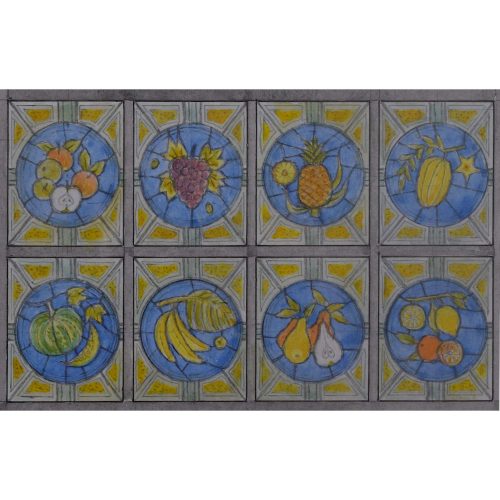
Jane Gray (b.1931)
Design for an Illuminated Panel of Stained Glass in a Private House (1994)
Watercolour 10 x 15.5 cmSigned and dated verso.
This design for a domestic window in a Bristol house was the second commission Gray received from this client. Having previously created a panel of eight squares featuring red floral designs, Gray was now faced with the challenge of another eight panel series, this time of fruits, which the client wanted to look as natural as possible. Gray succeeded in completing this effect, the screen featuring 8 bordered roundels containing apples, grapes, pineapple, starfruit, melon, bananas, pears, and citrus fruits.
Provenance: the artist’s studio sale. Literature: Jane Gray, Playing with Rainbows. (Shropshire: Ellingham Press, 2011), p.27. Condition: very good. If you are interested, please email info@manningfineart.co.uk or call us on 07929 749056. For other works by Jane Gray and more information about her, please click here. -
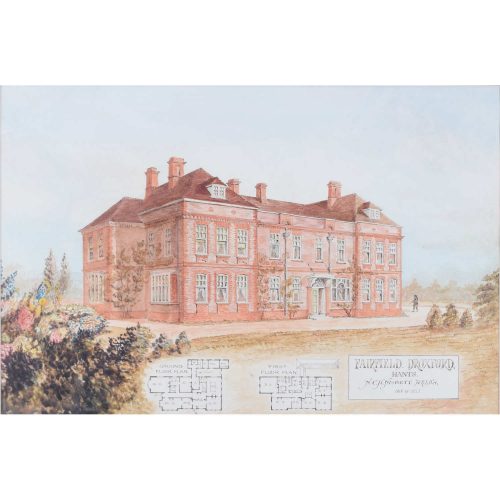
Norman Clayton Hadlow Nisbet ARIBA
Design for Fairfield House, Droxford, Hampshire (c. 1910)
Watercolour and pencil 33 x 51 cm Signed and extensively inscribed. Exhibited at the Royal Academy, 1910. A fine design for an Edwardian country house in England by Norman Nisbet ARIBA, an architect who at the time was practising at 45 Jewry Street, Winchester. The house still stands today, although it is subject to proposals for extension and conversion to a hotel. Condition: very good. -
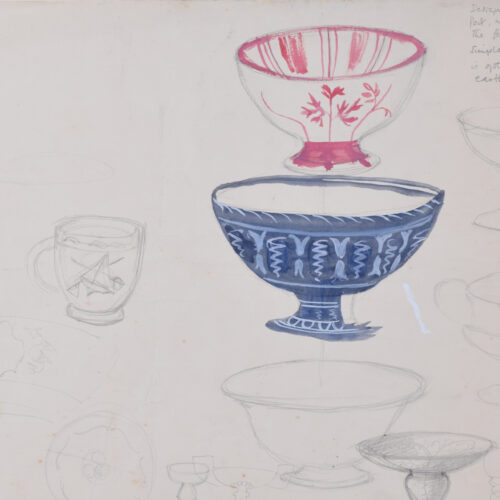
Hilary Hennes (née Hilary Miller) (1919 - 1993)
Design for fruit bowls
Watercolour and pencil 38 x 56 cm Provenance: the artist's studio sale. With notes by the artist in pencil upper right. Two richly-coloured fruit bowl designs by Hennes in watercolour, surrounded by various other bowl designs sketched in pencil. Hilary Miller was born in London, where her father was a curator at the South London Art Gallery. She attended Blackheath High School and, from 1936 to 1940, studied at the Blackheath School of Art, and then for a further three years at the Royal College of Art. After graduating, she taught at the South East Sussex Technical College and in 1946 married the artist Hubert Hennes. The couple lived in Oxford, where they both held teaching posts at the Oxford School of Art. Between 1948 and 1967 Miller frequently exhibited paintings at the Royal Academy in London, and also illustrated a number of books on gardening and natural history, such as 'The Living World' and 'Boff's Book of Gardening'. Condition: generally good. If you are interested, please email info@manningfineart.co.uk or call us on 07929 749056. Click here for other works by the artist. -
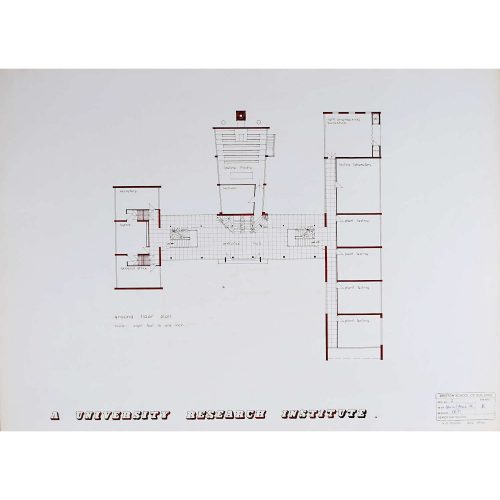
V A Hards (British, c. 1930-c. 2012) Design for Modernist Brutalist University Institute I (1956)
Watercolour on wove 77 x 55 cm Signed and dated 1956. Hards was educated at Brixton School of Building and Woolwich Polytechnic between 1948 and 1956, during which period he produced some very competent work, including this design for a university's brutalist building. Brixton School of Building was incorporated into the Polytechnic of the South Bank - now London South Bank University. Condition: some edge wear and isolated spots - see photographs. Stamped and marked with 'Brixton School of Building' stamp. If you’d like to know more, please email info@manningfineart.co.uk or call us on 07929 749056. -
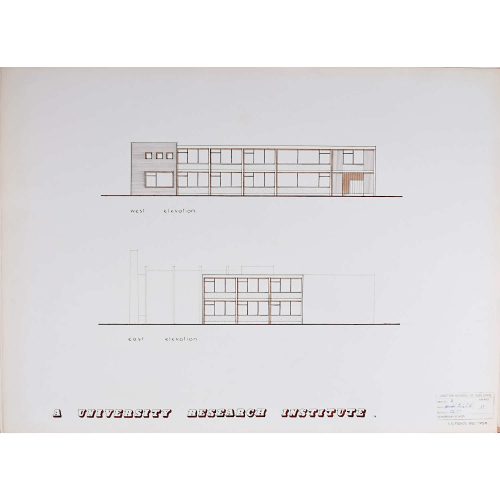
V A Hards (British, c. 1930-c. 2012) Design for Modernist Brutalist University Institute II (1956)
Watercolour on wove 77 x 55 cm Signed and dated 1956. Hards was educated at Brixton School of Building and Woolwich Polytechnic between 1948 and 1956, during which period he produced some very competent work, including this design for a university's brutalist building. Brixton School of Building was incorporated into the Polytechnic of the South Bank - now London South Bank University. Condition: some edge wear and isolated spots - see photographs. Stamped and marked with 'Brixton School of Building' stamp. If you’d like to know more, please email info@manningfineart.co.uk or call us on 07929 749056. -
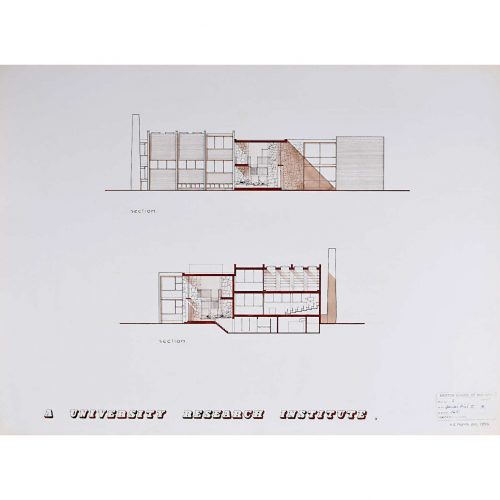
V A Hards (British, c. 1930-c. 2012) Design for Modernist Brutalist University Institute III (1956)
Watercolour on wove 77 x 55 cm Signed and dated 1956. Hards was educated at Brixton School of Building and Woolwich Polytechnic between 1948 and 1956, during which period he produced some very competent work, including this design for a university's brutalist building. Brixton School of Building was incorporated into the Polytechnic of the South Bank - now London South Bank University. Condition: some edge wear and isolated spots - see photographs. Stamped and marked with 'Brixton School of Building' stamp. If you’d like to know more, please email info@manningfineart.co.uk or call us on 07929 749056. -
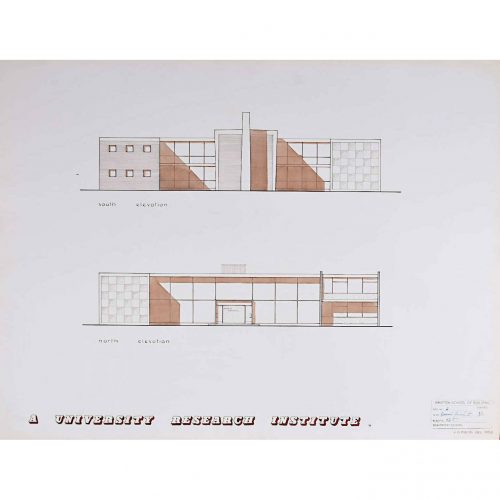
V A Hards (British, c. 1930-c. 2012) Design for Modernist Brutalist University Institute IV (1956)
Watercolour on wove 77 x 55 cm Signed and dated 1956. Hards was educated at Brixton School of Building and Woolwich Polytechnic between 1948 and 1956, during which period he produced some very competent work, including this design for a university's brutalist building. Brixton School of Building was incorporated into the Polytechnic of the South Bank - now London South Bank University. Condition: some edge wear and isolated spots - see photographs. Stamped and marked with 'Brixton School of Building' stamp. If you’d like to know more, please email info@manningfineart.co.uk or call us on 07929 749056. -
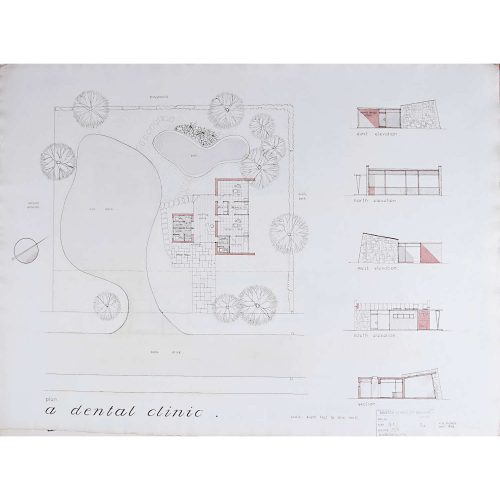
V A Hards (British, c. 1930-c. 2012) Design for Modernist dental surgery (1956)
Watercolour on wove 77 x 55 cm Signed and dated 1956. Hards was educated at Brixton School of Building and Woolwich Polytechnic between 1948 and 1956, during which period he produced some very competent work, including this rather fun modernist design for a dentist's surgery. Brixton School of Building was incorporated into the Polytechnic of the South Bank - now London South Bank University. Condition: some edge wear and isolated spots - see photographs. Stamped and marked with 'Brixton School of Building' stamp. Condition: some edge wear and isolated spots - see photographs. Stamped and marked with 'Brixton School of Building' stamp. If you’d like to know more, please email info@manningfineart.co.uk or call us on 07929 749056. -
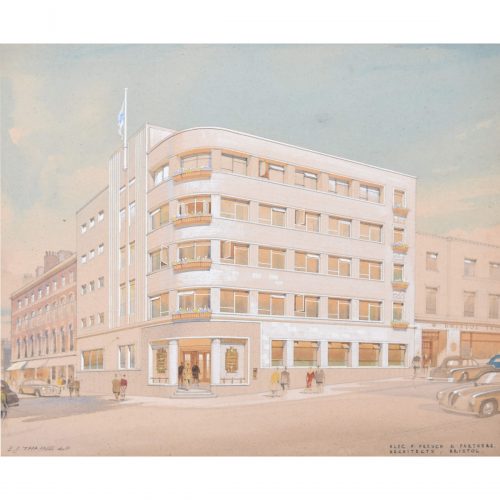
Edmund J Thring (1906 - 1985)
Design for St Nicholas House, High Street, Bristol
Gouache 46 x 54 cm Signed lower left and inscribed 'Alec F French & Partners, Architects, Bristol' (home to the Commercial Union Group and remodelled in 1959 by Alec French and partners). An architectural drawing of St Nicholas House, a 1930s Art Deco building on the corner of St Nicholas Street and High Street in the heart of Bristol. It was originally built as a banking headquarters, and is recognisable for its curved facade. Today St Nicholas House is a co-working space owned by The Office Group; the interiors have been remodelled in an Art Deco-inspired style, in honour of the building's architectural origins. Edmund J Thring was an architectural perspectivist who produced over 2,500 perspectives in his lifetime. He spent much of the Second WorId War in the Photographic Reconnaissance Interpretation Unit at RAF Nuneham Park, interpreting aerial photographs and making models. In 'A History of Architectural Model Making in Britain', David Lund notes that Thring was the chief instructor for the hundred or so recruits in the model-making department. He was described as ‘a sweetly patient man with a merciless eye and inflexible standards of quality’ who pushed his recruits hard. The team made over four hundred models for the D-Day invasion, and a thousand further models over the rest of the war. Pilots bombing German warships in Norwegian fjords found maps almost useless, so carried cardboard models of the topography in their cockpits. Thring also served with the Observer Corps, scanning the English Channel from the Sussex coast. Following the war, he began taking commissions for architectural perspectives (there were plenty of these available on account of the extensive postwar rebuilding works). We are grateful to the artist’s daughter for providing this information. Condition: generally very good, mounted to board, old time-staining to very margins under mount area. If you are interested, please email info@manningfineart.co.uk or call us on 07929 749056. Click here for our other architectural drawings. -
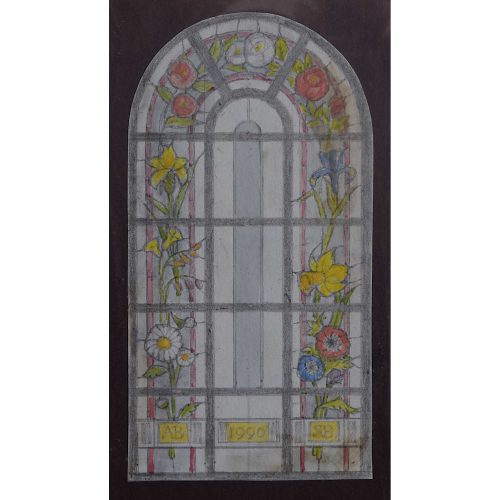
Jane Gray (b.1931)
Design for Stained Glass Panel in a Private House (1990)
Watercolour 14.5 x 7.5 cmSigned, dated and studio stamp verso.
This design for a staircase window in a private house features the owner’s favourite flowers, including Daffodils, Irises and Poppies, and is typical of Gray’s secular designs which were often highly colourful and often floral-centric. The window was installed in 1991.
Provenance: the artist’s studio sale. Literature: Jane Gray, Playing with Rainbows. (Shropshire: Ellingham Press, 2011), p.29. Condition: very good. If you are interested, please email info@manningfineart.co.uk or call us on 07929 749056. For other works by Jane Gray and more information about her, please click here. -
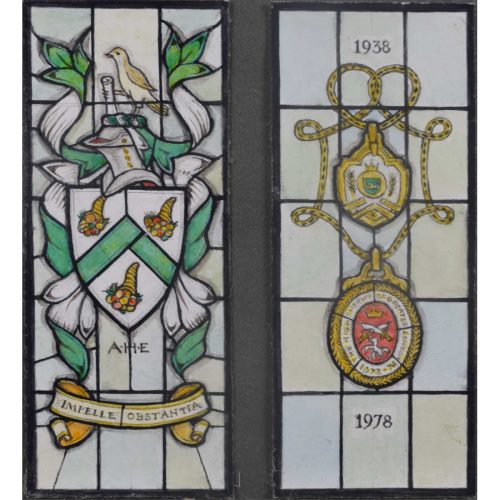
Jane Gray (b.1931)
Design for Stained Glass Panel in a Private House (1978)
Watercolour 10 x 8 cm Signed and dated verso.This design is for a window commemorating Arthur Henry Edmond Esq., of Ranelagh, 50 Russell Road, Moor Park, Northwood, Middlesex, who held the position of High Sheriff of Greater London between 1973-4. The Clan from whom the Arthurs family descends began among the ancient Dalriadan kingdom of the west coast of Scotland. Their name comes from the Celtic personal name, Arthur, which is of various and often disputed etymology. The personal name Arthur may be derived from some early cognate of the Gaelic “art” and the Welsh “arth”, meaning “bear” and may indicate early Celtic worship of the bear or one who has a high regard for the bear’s virtuous qualities. The Latin motto, ‘Impelle obstantia’ (meaning, 'Thrust aside obstacles’) would originally have acted a war cry or slogan. Mottoes first appeared in coast of arms in the 14th and 15th centuries, but were not in general use until the 17th century. The office of High Sheriff of Greater London was created in 1965 and granted armorial bearings 1966. The blazon of the arms, as depicted here is: ‘Gules, two seaxes in saltire argent, pommels and hilts or, between in chief a Saxon Crown or and in base a horse courant argent’.
Provenance: the artist’s studio sale. Condition: very good. If you are interested, please email info@manningfineart.co.uk or call us on 07929 749056. For other works by Jane Gray and more information about her, please click here. -

A. E. Halliwell (1905-1987) Design for Underground Poster
Gouache 15 x 12 cm 1927 Signed, dated and inscribed "Design for Underground Poster, executed 30" x 20", A. E. Halliwell '27" Provenance: Family of the artist A.E. Halliwell (1905–1986) was a British artist, illustrator, and designer best known for his vibrant poster designs created for British railway companies during the mid-20th century. Born in Southport, Halliwell developed a strong foundation in art and design early in life. He studied at the Southport School of Art from 1923 to 1926 before graduating to the Royal College of Art in London and subsequently practising as a professional designer from the 1930s. Following his studies, Halliwell married Doris Doyle in Strood Kent, and went on to have a significant teaching career himself, most notably as a lecturer at the Central School of Arts and Crafts (later part of Central Saint Martins), where he influenced a new generation of designers and illustrators. Halliwell is perhaps best remembered for his vibrant and engaging poster designs created for British railway companies during the 1930s. His work was characterised by a bright, graphic style that balanced charm with clarity, often depicting idealised scenes of British holiday destinations—from sunny seaside towns to tranquil countryside vistas. Beyond posters, his artistic output included book illustration, commercial design, and stage costume sketches, showcasing his versatility across mediums. His posters continue to remain enduring symbols of a golden age of British travel and design and are displayed in major collections including the London Transport Museum and the V & A. Dominated by two stylised figures dressed in theatrical costume, this striking poster design calls to mind the vibrancy of London's West End. As an underground train emerges from the woman's flowing garments, Halliwell creates a playfully burlesque scene. Their clothes rendered in bold yellow, black, and blue, then visually merge with the motion and perspective of the speeding trains below, whose converging tracks create a dramatic vanishing point. Condition: Generally very good.If you would like to know more, please email info@manningfineart.co.uk or call us on 07929 749056.
-
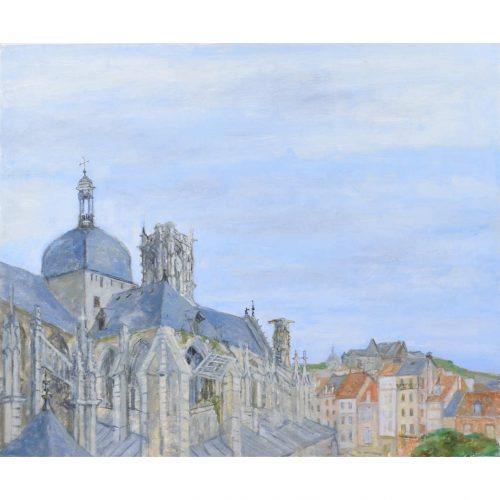
Richard Beer (1928 - 2017)
Dieppe Cathedral
Oil on canvas 66 x 76 cm A mountaintop cathedral and surrounding houses; broad blue sky fills the rest of the canvas. This oil painting is a fantastic example of Beer's focus on architecture, the central and recurring theme of his pictorial idiom. Born in London in 1928, just too late to serve in the Second World War, Richard Beer studied between 1945 - 1950 at the Slade School. Subsequently, a French Government scholarship allowed him to spend time in Paris at Atelier 17, working under Stanley William Hayter (1901 - 1988), one of the most significant print makers of the 20th Century – having spent the War in New York, advising as a camofleur, Hayter only returned to Paris in 1950. Subsequently Beer studied at the École des Beaux Arts, Paris. Working for John Cranko, choreographer for the Royal Ballet, Beer designed the sets and costumes for his The Lady and the Fool at Covent Garden, subsequently working for him following his move in 1961 to Stuttgart Ballet. Additionally he produced book illustrations and designed book jackets. Beer later taught print-making at the Chelsea School of Art, where he was a popular teacher. Probably his greatest work was a collaboration with John Betjeman to produce a portfolio of prints of ten Wren Churches in the City for Editions Alecto, copies of which are in The Government Art Collection. That collection contains a total of 54 prints by Beer, and the Tate Gallery’s collection holds seven. His Oxford series was also produced for Editions Alecto as was a series of predominantly architectural views in Southern Europe. Most of his prints are of architectural subjects. Condition: excellent. If you’d like to know more, please email info@manningfineart.co.uk or call us on 07929 749056. Click here for other views by Richard Beer. -
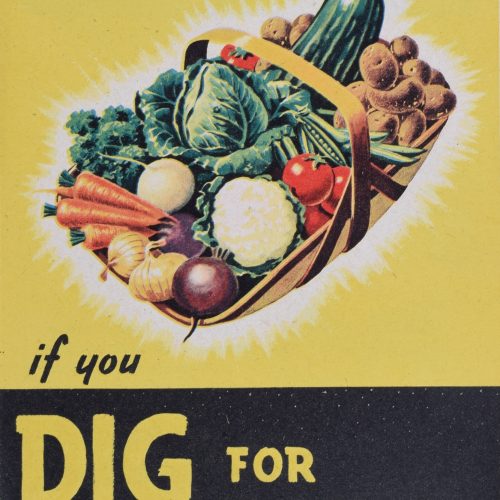
Dig for Victory Now
Norman Wilson, c1940
Dig for Victory Now Lithograph 18x12cm (7×4.7 inches), price includes frame. When rationing was at its height, what could be more appealing than a basket of fresh vegetables. What more incentive could be required to Dig For Victory Now? If you are interested email info@manningfineart.co.uk or call us on 07929 749056. -
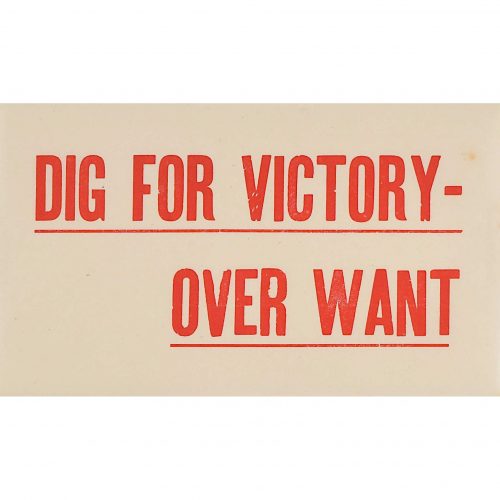
Dig for Victory over Want World War II public information
11x18cm for His Majesty's Stationery Office HMSO On gummed paper Printed on gummed paper, this was designed to be widely propagated, so that the public information message would not get lost. With food having to be shipped over the U-Boat infested Atlantic putting sailors' lives and ships at risk, every scrap of food that could be grown at home saved lives and allowed munitions to be transported instead. Therefore the Government started a large public information campaign to Dig for Victory - encouraging people to dig up their gardens and grow food. If you are interested email info@manningfineart.co.uk or call us on 07929 749056. -
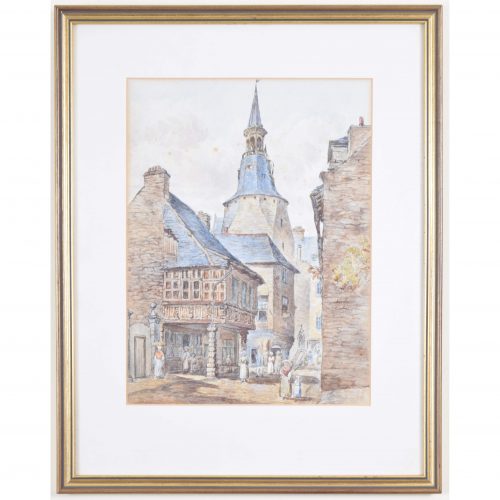
Attributed to Antony Vandyke Copley Fielding (1787 - 1855)
Dinan Tour de l’Horloge (Dinan Clock Tower)
Watercolour 28 x 21 cm A spirited watercolour of Dinan, Brittany. Dinan's famous clock tower looks over a French street scene: men, women, and children weave through the town's half-timbered houses, shops, and ateliers. The characterful mediaeval stonework and architecture of the town are paramount, and the artist adds a bright blue hue to his depiction of Dinan's roofs. Dinan is a walled medieval Breton town and commune in the Côtes-d'Armor department of northwestern France. Enclosed by nearly three kilometres of ramparts, the town and its 14th-century castle proudly overlook the Rance river. Anthony Vandyke Copley Fielding, commonly called Copley Fielding, was an English painter famous for his watercolour landscapes. At an early age Fielding became a pupil of John Varley. In 1810 he became an associate exhibitor in the Old Watercolour Society (later known as the Royal Society of Watercolours), in 1813 a full member, and in 1831 the Society's President. In 1824 he won a gold medal at the Paris Salon, alongside Richard Parkes Bonington and John Constable. Examples of his work are held by the Victoria and Albert Museum and other major museums in Britain. Condition: good. Some spotting to sky; handsomely framed. If you’d like to know more, please email info@manningfineart.co.uk or call us on 07929 749056. -
 John Samuel Agar (1773 - 1858) after John Uwins (1782 - 1857) Doctor in Divinity (1814) Aquatint with original hand colouring 24 x 29 cm Published by Rudolph Ackermann (1764 - 1834). A Doctor in Divinity of the University of Cambridge, resplendent in academic dress. Thomas Uwins RA RWS was a British painter in watercolour and oil, and a book illustrator. He became a full member of the Old Watercolour Society and a Royal Academician, and held a number of high-profile art appointments including the librarian of the Royal Academy, Surveyor of Pictures to Queen Victoria and the Keeper of the National Gallery. In the late 1790s he began producing work for Ackermann's collections. John Samuel Agar was an English portrait painter and engraver, who exhibited his works at the Royal Academy from 1796 to 1806 and at the British Institution until 1811. He was at one time president of the Society of Engravers. Rudolph Ackermann published many of his engravings. Ackermann was an Anglo-German bookseller, inventor, lithographer, publisher and businessman. He attended the Latin school in Stollberg, but his wish to study at the university was made impossible by lack of financial means, and he therefore became a saddler like his father. He worked as a saddler and coach-builder in different German cities, moved from Dresden to Basel and Paris, and then, 23 years old, settled in London. He established himself in Long Acre, the centre of coach-making in London and close to the market at Covent Garden. Ackermann then moved to Little Russell Street where he published Imitations of Drawings of Fashionable Carriages (1791) to promote his coach-making. Other publications followed. In 1795 he established a print-shop and drawing-school at 96 Strand. Here Ackermann set up a lithographic press and began a trade in prints. He later began to manufacture colours and thick carton paper for landscape and miniature painters. Within three years the premises had become too small and he moved to 101 Strand, in his own words "four doors nearer to Somerset House", the seat of the Royal Academy of Arts. Between 1797 and 1800 Ackermann rapidly developed his print and book publishing business, encompassing many different genres including topography, caricature, portraits, transparencies and decorative prints. During the Napoleonic wars, Ackermann was an energetic supporter of the Allied cause and made significant contributions to British propaganda through his publication of anti-Napoleonic prints and military manuals. He became a naturalised British citizen in March 1809. As one of the pioneers of modern publishing methods, Ackermann developed an international distribution network for his publications and came to have significant commercial interests in South America. The business he founded in London flourished throughout the 19th century under the management of his descendants. He was buried at St. Clement Danes in the Strand, London. In 2020, the St. Louis Mercantile Library wrote that: "Ackermann excelled in the creation of landscape and architectural engravings. He created beautiful illustrations of the city of London, his adopted home, as well as two volumes of classic views of Westminster Abbey, along with exquisite views of river scenes. One of our favorite collections are four massive volumes of lovingly illustrated exterior and interior landmarks of Oxford and Cambridge Universities created just over two hundred years ago. These publications show Ackermann’s hand at every turn of the page along with the team of assistant designers and engravers he employed to create these works. Perhaps they were a way by which the artist could lay to rest his own regret at not being able to attend [an Oxbridge] college himself in a fondly depicted idyll to learning which these prints so aptly represent." Condition: Generally very good.
If you would like to know more, please email info@manningfineart.co.uk or call us on 07929 749056.
-
 John Samuel Agar (1773 - 1858) after John Uwins (1782 - 1857) Doctor in Divinity (1814) Aquatint with original hand colouring 29 x 24 cm Published by Rudolph Ackermann (1764 - 1834). A Doctor in Divinity of the University of Oxford, resplendent in academic dress. Thomas Uwins RA RWS was a British painter in watercolour and oil, and a book illustrator. He became a full member of the Old Watercolour Society and a Royal Academician, and held a number of high-profile art appointments including the librarian of the Royal Academy, Surveyor of Pictures to Queen Victoria and the Keeper of the National Gallery. In the late 1790s he began producing work for Ackermann's collections. John Samuel Agar was an English portrait painter and engraver, who exhibited his works at the Royal Academy from 1796 to 1806 and at the British Institution until 1811. He was at one time president of the Society of Engravers. Rudolph Ackermann published many of his engravings. Ackermann was an Anglo-German bookseller, inventor, lithographer, publisher and businessman. He attended the Latin school in Stollberg, but his wish to study at the university was made impossible by lack of financial means, and he therefore became a saddler like his father. He worked as a saddler and coach-builder in different German cities, moved from Dresden to Basel and Paris, and then, 23 years old, settled in London. He established himself in Long Acre, the centre of coach-making in London and close to the market at Covent Garden. Ackermann then moved to Little Russell Street where he published Imitations of Drawings of Fashionable Carriages (1791) to promote his coach-making. Other publications followed. In 1795 he established a print-shop and drawing-school at 96 Strand. Here Ackermann set up a lithographic press and began a trade in prints. He later began to manufacture colours and thick carton paper for landscape and miniature painters. Within three years the premises had become too small and he moved to 101 Strand, in his own words "four doors nearer to Somerset House", the seat of the Royal Academy of Arts. Between 1797 and 1800 Ackermann rapidly developed his print and book publishing business, encompassing many different genres including topography, caricature, portraits, transparencies and decorative prints. During the Napoleonic wars, Ackermann was an energetic supporter of the Allied cause and made significant contributions to British propaganda through his publication of anti-Napoleonic prints and military manuals. He became a naturalised British citizen in March 1809. As one of the pioneers of modern publishing methods, Ackermann developed an international distribution network for his publications and came to have significant commercial interests in South America. The business he founded in London flourished throughout the 19th century under the management of his descendants. He was buried at St. Clement Danes in the Strand, London. In 2020, the St. Louis Mercantile Library wrote that: "Ackermann excelled in the creation of landscape and architectural engravings. He created beautiful illustrations of the city of London, his adopted home, as well as two volumes of classic views of Westminster Abbey, along with exquisite views of river scenes. One of our favorite collections are four massive volumes of lovingly illustrated exterior and interior landmarks of Oxford and Cambridge Universities created just over two hundred years ago. These publications show Ackermann’s hand at every turn of the page along with the team of assistant designers and engravers he employed to create these works. Perhaps they were a way by which the artist could lay to rest his own regret at not being able to attend [an Oxbridge] college himself in a fondly depicted idyll to learning which these prints so aptly represent." Condition: Generally very good.
If you would like to know more, please email info@manningfineart.co.uk or call us on 07929 749056.
-
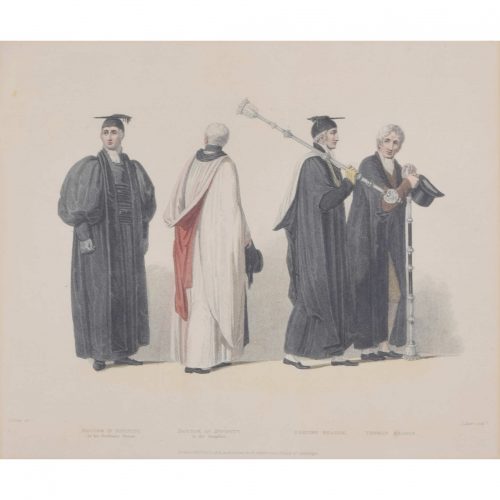
John Samuel Agar (1773 - 1858) after John Uwins (1782 - 1857)
Doctors in Divinity, Esquire Beadle, and Yeoman Beadle (1815)
Hand-coloured aquatint 25 x 30 cm Published by Rudolph Ackermann (1764 - 1834). An engraving of two Doctors in Divinity and two beadles (administrative assistants to the Chancellor and Proctors of the University) from Ackermann's ''A History of the University of Cambridge, Its Colleges, Halls and Public Buildings''. The four figures walk forward with ceremonial accoutrements, likely to a graduation ceremony. Thomas Uwins RA RWS was a British painter in watercolour and oil, and a book illustrator. He became a full member of the Old Watercolour Society and a Royal Academician, and held a number of high-profile art appointments including the librarian of the Royal Academy, Surveyor of Pictures to Queen Victoria and the Keeper of the National Gallery. In the late 1790s he began producing work for Ackermann''s collections. John Samuel Agar was an English portrait painter and engraver, who exhibited his works at the Royal Academy from 1796 to 1806 and at the British Institution until 1811. He was at one time president of the Society of Engravers. Rudolph Ackermann published many of his engravings. Rudolph Ackermann was an Anglo-German bookseller, inventor, lithographer, publisher and businessman. In 1795 he established a print-shop and drawing-school at 96 Strand. Here Ackermann set up a lithographic press and began a trade in prints. He later began to manufacture colours and thick carton paper for landscape and miniature painters. Within three years the premises had become too small and he moved to 101 Strand, in his own words "four doors nearer to Somerset House", the seat of the Royal Academy of Arts. Between 1797 and 1800 Ackermann rapidly developed his print and book publishing business, encompassing many different genres including topography, caricature, portraits, transparencies and decorative prints. Condition: good. Some age toning. If you’d like to know more, please email info@manningfineart.co.uk or call us on 07929 749056. -

A. E. Halliwell (1905-1987) Don't be drowned, travel underground
Gouache 11 x 6 cm 1927 Signed, dated and inscribed 'Poster design 12.5" x 20" executed 1927' Provenance: Family of the artist A.E. Halliwell (1905–1986) was a British artist, illustrator, and designer best known for his vibrant poster designs created for British railway companies during the mid-20th century. Born in Southport, Halliwell developed a strong foundation in art and design early in life. He studied at the Southport School of Art from 1923 to 1926 before graduating to the Royal College of Art in London and subsequently practising as a professional designer from the 1930s. Following his studies, Halliwell married Doris Doyle in Strood Kent, and went on to have a significant teaching career himself, most notably as a lecturer at the Central School of Arts and Crafts (later part of Central Saint Martins), where he influenced a new generation of designers and illustrators. Halliwell is perhaps best remembered for his vibrant and engaging poster designs created for British railway companies during the 1930s. His work was characterised by a bright, graphic style that balanced charm with clarity, often depicting idealised scenes of British holiday destinations—from sunny seaside towns to tranquil countryside vistas. Beyond posters, his artistic output included book illustration, commercial design, and stage costume sketches, showcasing his versatility across mediums. His posters continue to remain enduring symbols of a golden age of British travel and design and are displayed in major collections including the London Transport Museum and the V & A. This poster design cleverly contrasts the perils of winter travel on icy streets with the safety and reliability of the London Underground. Halliwell's use of sharp angles and limited colour palette heightens the emotional impact, making the message both memorable and visually compelling. It is a fine example of early 20th-century transport poster art that blends public service messaging with striking modernist aesthetics. As Halliwell signals beneath this design, the poster was executed and featured around the London Underground system throughout the 1930s. Condition: Generally very good.If you would like to know more, please email info@manningfineart.co.uk or call us on 07929 749056.
-
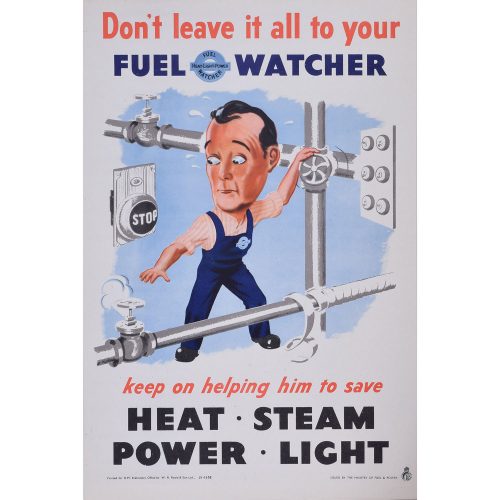
Don't leave it all to your fuel watcher
Keep on helping him to save HEAT STEAM POWER LIGHT Lithographic poster c. 1940 for HMSO by W R Royle & Son and issued by the Ministry of Fuel and Power 38x25cm If you are interested email info@manningfineart.co.uk or call us on 07929 749056. -
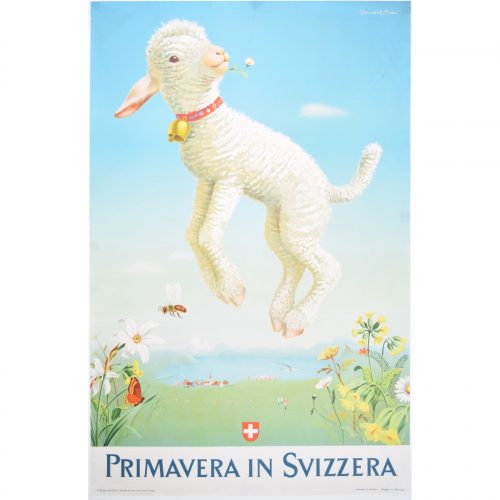
Donald Brun (1909-1999)
Primavera in Svizzera (1945) Lithographic poster Printed by Swiss National Tourist Office, Zurich 40×25 inches This poster won a Swiss Poster award in 1945 Donald Brun produced his famous series of posters for Switzerland as global travel became more possible. Here a Swiss steamer boat is seen crossing Lake Geneva (presumably) as a lamb celebrates spring, cavorting with a bee and a butterfly. -
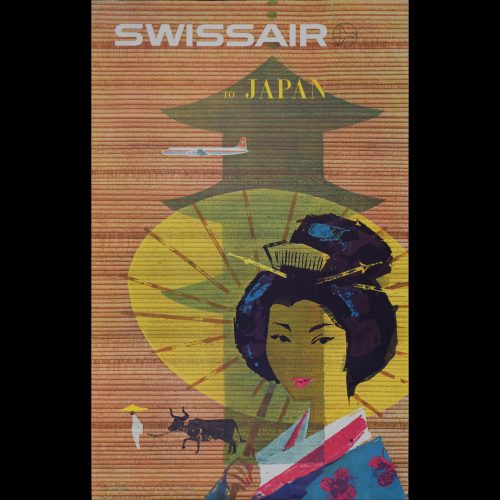
Donald Brun (1909-1999)
Swissair to Japan
Lithographic poster 40x25 inches If you are interested email info@manningfineart.co.uk or call us on 07929 749056. -
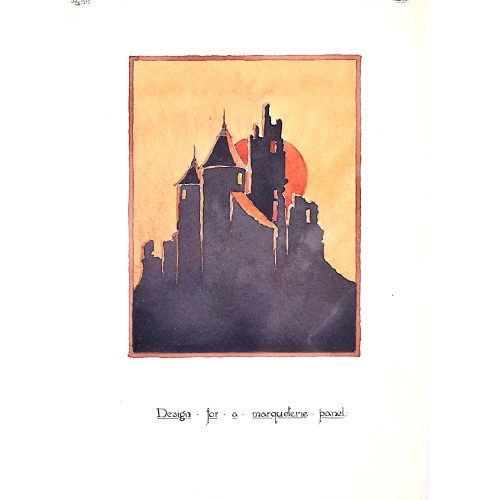
Douglas L Hadden (British, 20th century) Design for a Marquetry Panels for furniture for Geo. M Hammer with castle
25x18cm Watercolour signed and dated 1927 Hadden was a senior designer for Geo M Hammer, designers and retailers of school and ecclesiastical furniture. Their lift-top school desks are particularly well regarded, and always carried their brass name plate. Hammer were renowned for their interior woodwork, they were commissioned to undertake the choir stalls in Sir Basil Spence’s ground-breaking Coventry Cathedral. Dick Russell (brother of Gordon Russell and who worked for his brother before World War Two) famously designed the chairs to be used by the congregation; as all-wood stacking chairs they were innovative at the time. As senior designer, Hadden was at the heart of the Coventry project. Hadden was educated at the Wycombe School of Art and quickly rose to the position of chief designer at Burkles, early in his career. During the World War Two he worked as an air warden in Cowley and later within the Royal Artillery, before returning to work for the Italian firm BIANOS, helping to shift its production of spitfires propellers back to peace-time wood-work. For his 7th and finale job he worked as chief designer for one of the largest and oldest firms in Britain, Geo. M Hammer. With a wide experience of designing furniture to a high standard, Hadden worked for colleges, universities, schools, libraries, monasteries and nunneries, churches and abbeys, cathedrals, synagogues and private houses. In addition to furnishings, Hadden took pride in producing fine pianos for many of these residences. Through Geo M Hammer, Hadden's designs can be found across the British Isles today, with many further appearing in America. If you are interested email info@manningfineart.co.uk or call us on 07929 749056. Condition : Good. Wrapped in transparent sleeve for protection. -
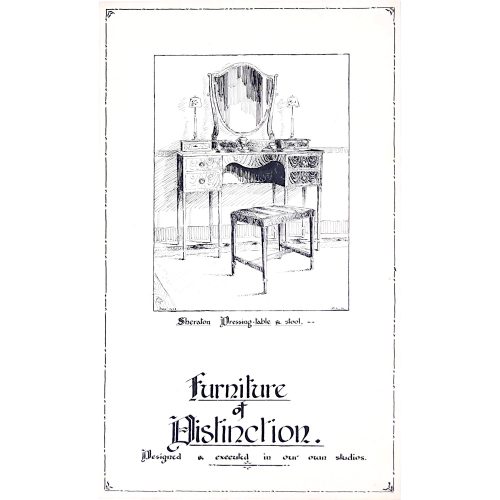
Douglas L Hadden (British, 20th century) Design for Poster/Showcard 'Furniture of Distinction'
33x20cm Pen and ink c. 1930 Hadden was a senior designer for Geo M Hammer, designers and retailers of school and ecclesiastical furniture. Their lift-top school desks are particularly well regarded, and always carried their brass name plate. Hammer were renowned for their interior woodwork, they were commissioned to undertake the choir stalls in Sir Basil Spence’s ground-breaking Coventry Cathedral. Dick Russell (brother of Gordon Russell and who worked for his brother before World War Two) famously designed the chairs to be used by the congregation; as all-wood stacking chairs they were innovative at the time. As senior designer, Hadden was at the heart of the Coventry project. Hadden was educated at the Wycombe School of Art and quickly rose to the position of chief designer at Burkles, early in his career. During the World War Two he worked as an air warden in Cowley and later within the Royal Artillery, before returning to work for the Italian firm BIANOS, helping to shift its production of spitfires propellers back to peace-time wood-work. For his 7th and finale job he worked as chief designer for one of the largest and oldest firms in Britain, Geo. M Hammer. With a wide experience of designing furniture to a high standard, Hadden worked for colleges, universities, schools, libraries, monasteries and nunneries, churches and abbeys, cathedrals, synagogues and private houses. In addition to furnishings, Hadden took pride in producing fine pianos for many of these residences. Through Geo M Hammer, Hadden's designs can be found across the British Isles today, with many further appearing in America. If you are interested email info@manningfineart.co.uk or call us on 07929 749056. Condition : Good. -
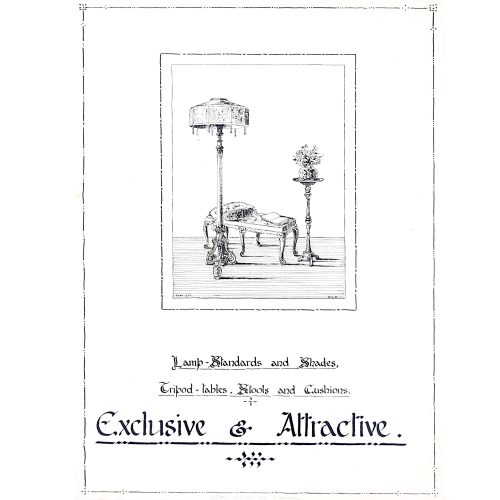
Douglas L Hadden (British, 20th century) Design for Poster/Showcard 'Attractive & Exclusive'
32x24cm Pen and ink c. 1930 Hadden was a senior designer for Geo M Hammer, designers and retailers of school and ecclesiastical furniture. Their lift-top school desks are particularly well regarded, and always carried their brass name plate. Hammer were renowned for their interior woodwork, they were commissioned to undertake the choir stalls in Sir Basil Spence’s ground-breaking Coventry Cathedral. Dick Russell (brother of Gordon Russell and who worked for his brother before World War Two) famously designed the chairs to be used by the congregation; as all-wood stacking chairs they were innovative at the time. As senior designer, Hadden was at the heart of the Coventry project. Hadden was educated at the Wycombe School of Art and quickly rose to the position of chief designer at Burkles, early in his career. During the World War Two he worked as an air warden in Cowley and later within the Royal Artillery, before returning to work for the Italian firm BIANOS, helping to shift its production of spitfires propellers back to peace-time wood-work. For his 7th and finale job he worked as chief designer for one of the largest and oldest firms in Britain, Geo. M Hammer. With a wide experience of designing furniture to a high standard, Hadden worked for colleges, universities, schools, libraries, monasteries and nunneries, churches and abbeys, cathedrals, synagogues and private houses. In addition to furnishings, Hadden took pride in producing fine pianos for many of these residences. Through Geo M Hammer, Hadden's designs can be found across the British Isles today, with many further appearing in America. If you are interested email info@manningfineart.co.uk or call us on 07929 749056. Condition : Good. -
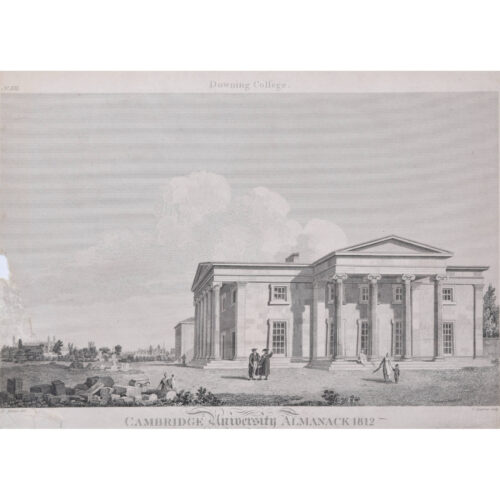
Samuel Sparrow (active 1770 - 1806) after Henry Barker (1774 - 1856)
Downing College, Cambridge (1812)
Engraving 31 x 43 cm A copy of this engraving is held by the British Museum. An early nineteenth-century engraving of Downing College, with building materials in the foreground and elegantly dressed figures, including two scholars, strolling in the College's grounds. The Cambridge University Almanack was an annual almanac published by the Cambridge University Press. It traditionally included engravings or lithographs of the University and information about the upcoming year. Condition: generally good, except loss/damage to left hand side visible in photograph. If you’d like to know more, please email info@manningfineart.co.uk or call us on 07929 749056. -

Andrew Ingamells Downing College
Engraving 40 x 63 cm Signed to lower right and numbered 86/175 This meticulously detailed gravure etching by Andrew Ingamells is the first etching or engraving to depict Downing College Cambridge from an aerial perspective since David Loggan's celebrated engraving of the 1680s. As well as a general aerial view of the college, it also features an intriguing bird's eye view of the whole grounds and architectural thumbnails of each of the college's notable buildings including the boat house, Singer building and the Senior Combination Room. Ingamells trained at St Albans School of Art and the London College of Printing, subsequently working as a graphic designer and illustrator. Based in London, he began making drawings of the buildings and landscapes of London. Ingamells’ work is in many public collections including those of the Tate Gallery, The National Trust, The Paul Mellon Centre for British Art, and the City of London Guildhall Library. His pictures are also in several private collections, including those of various Oxford and Cambridge colleges, HRH King Charles III, and Shell Oil. The artist is currently part-way through his epic project to record all the colleges of Oxford and Cambridge, a project undertaken in homage to David Loggan. Condition: Generally very good.If you would like to know more, please email info@manningfineart.co.uk or call us on 07929 749056.
For other views of Downing College, Cambridge, click here. -
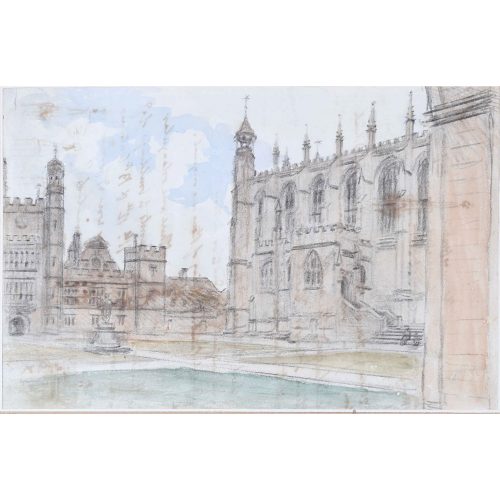
Dr William Crotch (1775-1847) Eton College Chapel
13x20cm Pencil and colour wash Extensively inscribed to reverse Dated 10.20am August 1 1832 Provenance: Spink, King Street, London Composer and organist (a child prodigy, playing the organ of the Chapel Royal at the age of three-and-a-half) Crotch is most famous for probably beint the composter of the Westminster Chimes - struck by Big Ben inter alia. In 1797 he became Heatehr Professor of Music at Oxford University, becoming DMus in 1799. John Malchair, the musician and artist, became a friend whilst he was in Oxford, and so with his guidance Crotch took up sketching. He also took Malchair's habit of recording the date and time of his picture passing this habit to John Constable upon meeting him in London in 1805. He became first Principal of the Royal Academy of Music, a post he held for ten years until he resigned His works are well represented in many public and private collections. The Tate holds three of his works. If you are interested email info@manningfineart.co.uk or call us on 07929 749056. Condition: Good. -
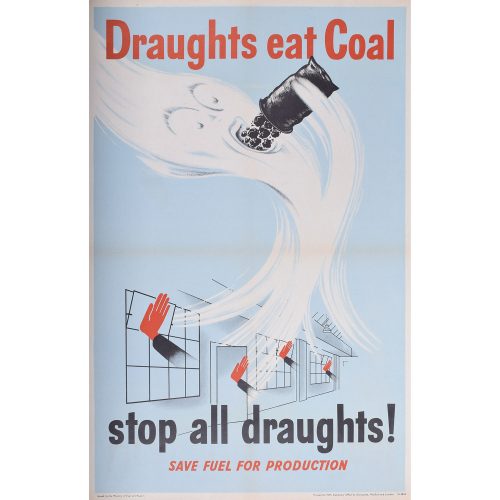
Anonymous
Draughts Eat Coal - Stop All Draughts! Save Fuel for Production
Lithographic poster 76 x 50cm Issued by the Ministry of Fuel and Power Printed for HM Stationery Office by J Weiner Ltd, London WC1 Fuel was needed for production of munitions and machinery, as well as to drive the machinery. The population was therefore exhorted not to waste fuel. Successful Home Front propaganda posters, as Fougasse proved, needed to amuse the watcher; cartoonists were accordingly highly regarded for this task. -
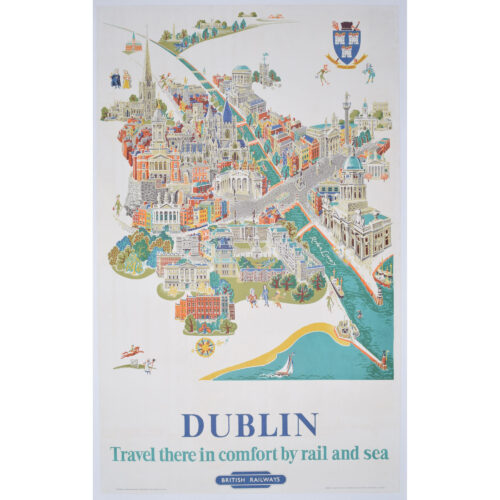
Kerry Lee (1902 - 1988)
Dublin
Original vintage poster 103 x 64 cm A detailed and brightly-coloured map of Dublin by celebrated pictorial cartographer Kerry Lee, published by British Railways to encourage rail travel around the country. Kerry Lee produced war maps and military education images of aircraft during the Second World War. He founded the London firm Pictorial Maps in 1946 and published a Prospectus of Pictorial Maps of British cities, including Dublin. Condition: backed to linen; excellent. If you are interested, please email info@manningfineart.co.uk or call us on 07929 749056. Click here for other original vintage posters. -
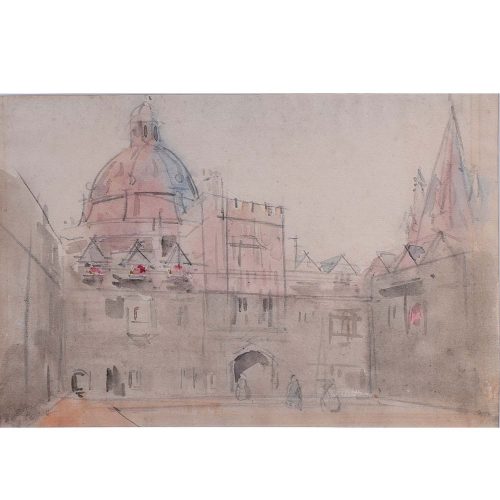
Dugald Sutherland MacColl Brasenose College, Oxford
Pencil and Wash 24x31cm 44x51cm including frame, UK shipping only MacColl was Keeper of the Tate 1906-1911, and from 1911-1924 of the Wallace Collection. A more worked-up version of this painting appears in the Tate collection and may be seen on their website. If you are interested email info@manningfineart.co.uk or call us on 07929 749056. Condition: Good. Paper lightly ripped, slight discolouration and some light staining to margins. -
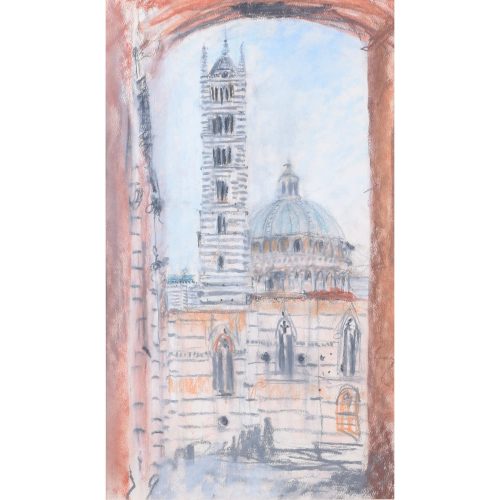
Selina Thorp (born 1968)
View Through an Archway, Sienna (1993)
Pastel 47 x 26 cm A view of the Duomo di Siena. Sienna has been defined architecturally by this cathedral since it was built in mediaeval times; Thorp's view of it through an archway emphasises its status as a seen symbol of the city, an object of cultural, religious, and aesthetic significance. Selina Thorp was born in Leeds in 1968 and studied at the Edinburgh College of Art. Much of her work focuses on architecture and landscape. Condition: very good. If you’d like to know more, please email info@manningfineart.co.uk or call us on 07929 749056. -

Norman Wade (20th century)
Durham Cathedral (1972)
Silkscreen print 24 x 43 cmNumbered 50/100 and titled lower left, and signed and dated lower right, all in pencil.An imposing view of the cathedral by British artist Norman Wade, who is known for his depictions of Durham Cathedral.Condition: very good. If you are interested, please email info@manningfineart.co.uk or call us on 07929 749056. Click here for other views of St John’s College, Cambridge. -

Sir Albert Richardson PRA View of Durham Cathedral from Palace Green
Watercolour with pen and gouache 21 x 25 cm A unique multimedia composition depicting the magnificent Durham Cathedral from Palace Green. Richardson's use of gouache produces splashes of colour, introducing the luscious greenery of this World Heritage Site into this work, bringing the composition to life. Sir Albert Richardson (1880-1964) was a leading architect, teacher and architectural historian in the 20th century. In Durham, he is best known for his involvement in the designs of Durham University's buildings and for his work on the Durham Castle and Cathedral area. Richardson's contributions were part of a broader movement of restoring and enhancing historical buildings, while also integrating new designs that respected the local architectural style. He was notably part of a wider team of architects and restorers who worked to maintain the cathedral's status as a UNESCO World Heritage site. Condition: Generally very good, painted on blue paper, slight age toning. -
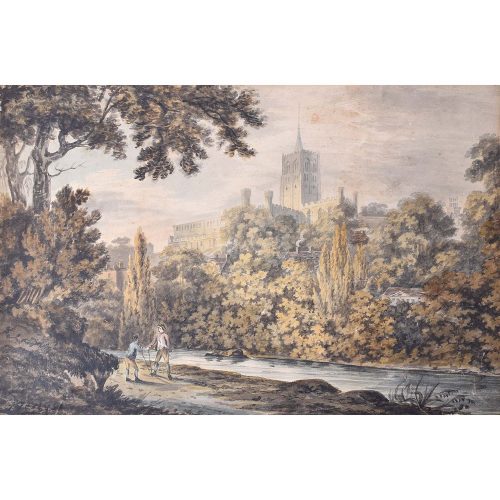
Anon. Prospect of Durham from the River Wear
Watercolour 19th Century 30.5x45.5cm Bears signature 'J Varley' If you are interested email info@manningfineart.co.uk or call us on 07929 749056. Condition: Generally good, backed to board and slight loss of colour. -
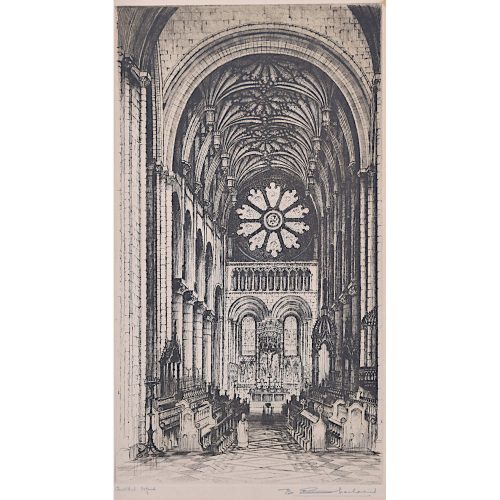
Edward W Sharland (1884-1967) - British Christ Church Cathedral Oxford interior
Etching 32x18cm Sharland was a Bristol-based artist who specialised in architectural views such as this, the interiors of cathedrals being a particular speciality. The British Museum holds copies of his cathedral interior etchings. -
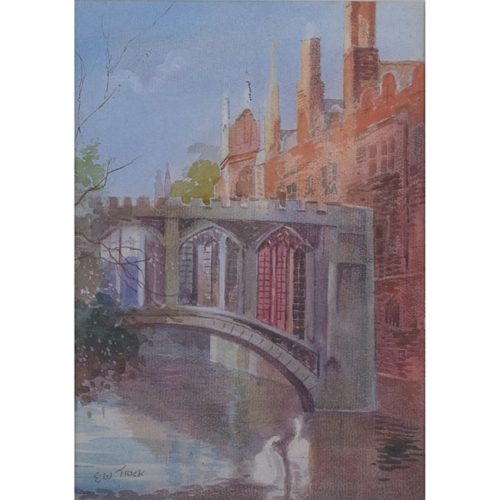
E W Trick
Bridge of Sighs, St. John's College, Cambridge
Watercolour 24x18cm If you are interested email info@manningfineart.co.uk or call us on 07929 749056. -
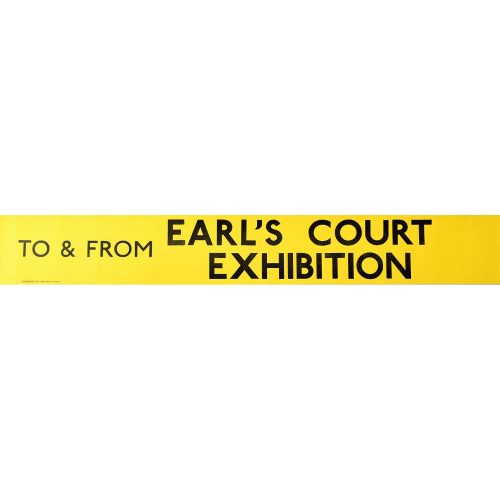
Earl's Court Exhibition Routemaster Slipboard Poster c1970
Screenprint poster 64x9cm Printed for London Transport for use on Routemaster or RT buses - the traditional red London bus with open platform and hop-on-hop-off facility. If you are interested email info@manningfineart.co.uk or call us on 07929 749056. Condition: Excellent. -
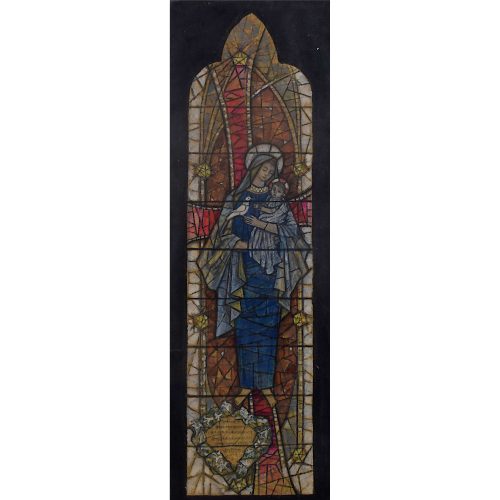
Jane Gray (b.1931)
Early Design for Stained Glass Memorial Window (1962)
Watercolour 27.5 x 9 cmA rare example of Gray’s early work, this design shows a more traditional approach to stained glass window design, something that Gray came to eschew in favour of a more modern style in much of her later work. This design was for a memorial window commemorating Rosemary Anstice, although its intended location is unknown.
Provenance: the artist’s studio sale. Condition: very good. If you are interested, please email info@manningfineart.co.uk or call us on 07929 749056. For other works by Jane Gray and more information about her, please click here. -

A. E. Halliwell (1905-1987) Early Summer Period Excursions from London
Gouache 26 x 15 cm c.1930 Provenance: Family of the artist A.E. Halliwell (1905–1986) was a British artist, illustrator, and designer best known for his vibrant poster designs created for British railway companies during the mid-20th century. Born in Southport, Halliwell developed a strong foundation in art and design early in life. He studied at the Southport School of Art from 1923 to 1926 before graduating to the Royal College of Art in London and subsequently practising as a professional designer from the 1930s. Following his studies, Halliwell married Doris Doyle in Strood Kent, and went on to have a significant teaching career himself, most notably as a lecturer at the Central School of Arts and Crafts (later part of Central Saint Martins), where he influenced a new generation of designers and illustrators. Halliwell is perhaps best remembered for his vibrant and engaging poster designs created for British railway companies during the 1930s. His work was characterised by a bright, graphic style that balanced charm with clarity, often depicting idealised scenes of British holiday destinations—from sunny seaside towns to tranquil countryside vistas. Beyond posters, his artistic output included book illustration, commercial design, and stage costume sketches, showcasing his versatility across mediums. His posters continue to remain enduring symbols of a golden age of British travel and design and are displayed in major collections including the London Transport Museum. This colourful poster design by A.E. Halliwell for a train provider promotes early summer period excursions from London. In his signature bold style, Halliwell brings together recognisable symbols of the early summer period--a pansy, and the harbinger of summer: a swallow-- and places them against a striking background, using geometric patterns and blocks of colour to create visual segments on the poster. Condition: Generally very good.If you would like to know more, please email info@manningfineart.co.uk or call us on 07929 749056.