Welcome to the shop. You are most welcome to browse, navigate using the menu above, or search the website.


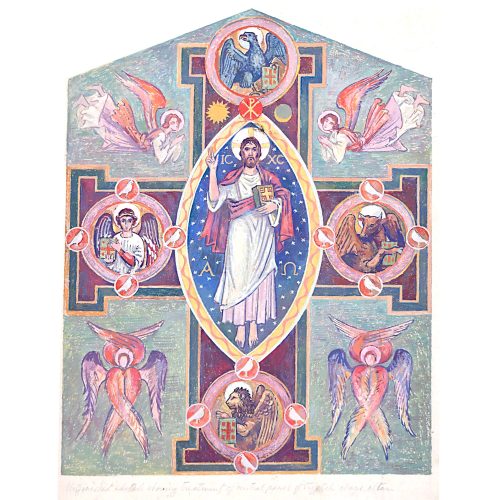
  • Anonymous Design for Triptych Above Alta

    British, c. 1920s Gouache 38x28.5cm Christ Pantocrator stands in the middle of the design, surrounded by the four evangelists - represented by the Eagle, Bull, Lion and Angel - together with two seraphim. This is a well executed design for an as-yet unidentified location. At the bottom is a pencil description as an 'unfinished sketch'. Condition: Generally very good condition. If you are interested email info@manningfineart.co.uk or call us on 07929 749056.
  • Out of stock

    Hugh Casson (1910 - 1999) The Gatehouse, Girton College

    Lithograph 31 x 26 cm Signed and numbered 263/500, both in pencil. Casson's warm-hued view of Girton, with students strolling under the the neo-Tudor gatehouse. Sir Hugh Casson was educated at Eastbourne College; St John’s College, Cambridge; and the Bartlett School of Architecture. Trained in the 1930s in the early modernist style, he taught at the Cambridge School of Architecture. After employment as a camoufleur during World War 2 by the Air Ministry, in 1948 he was appointed as director of architecture for the Festival of Britain. A close friend of the Royal Family, he undertook designs for the 1953 coronation, designed the interior of the Royal Yacht Britannia (“The overall idea was to give the impression of a country house at sea”), and taught the young Charles III to paint in watercolours. Amongst his architectural achievements are the Elephant House at London Zoo, the 1978 redevelopment of Bristol Docks, the Raised Faculty Building for The University of Cambridge, and a building for the Royal College of Art. He published a number of illustrated books, of which Casson’s Oxford and Casson’s Cambridge are probably the best known. A limited edition series of prints was produced from the paintings. For other views of Girton College, click here.
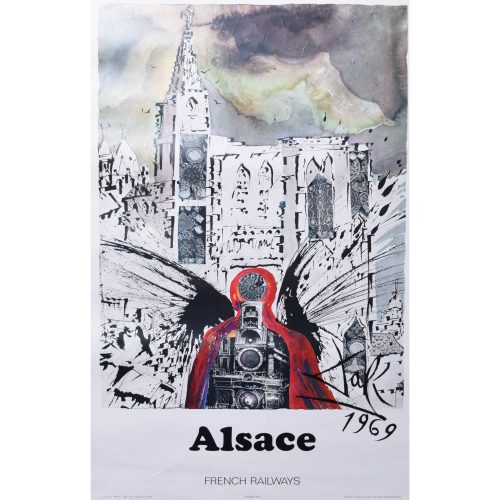
  • Salvador Dali (1904-1989) Alsace

    Original Poster for French Railways SNCF 100x60cm Printed by Draeger Printed in France for and by the French National Railways, 1970 Signed and dated in the plate 1969 If you are interested email info@manningfineart.co.uk or call us on 07929 749056. Condition: Generally excellent condition; slight age toning to edges of poster.
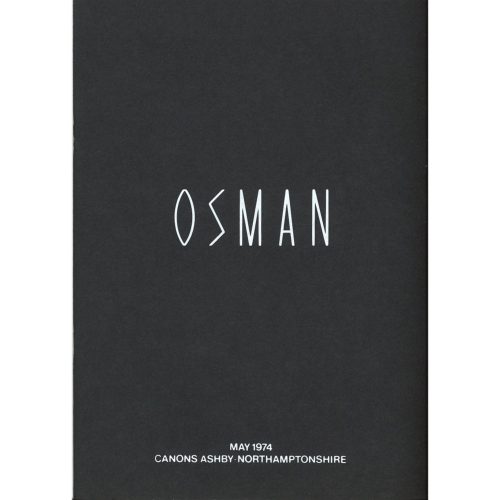
  • Louis Osman (1914-1996) Catalogue for May 1974 Exhibition at Canons Ashby, Northamptonshire

    29.6x21.3cm (A4-sized) 24 pages plus card covers Staple bound Provenance: from the artist's estate Louis Osman (30 January 1914 - 11 April 1996) was an architect, artist, goldsmith, silversmith and medallist. Few people matched his creations as a goldsmith, and consequently he was chosen to make the crown for the Investiture of the Prince of Wales in 1969. Many of his other works are in public collections in the UK and worldwide. After Hele's school in Exeter he studied at the Bartlett School of Architecture - part of University College London - from 1931. Also attending the Slade, he left the Bartlett being awarded the top first, which brings with it the Donaldson Medal of the RIBA. Subsequently he trained with Sir Albert Richardson (who lived in a large Georgian house in Northamptonshire in which he refused to have electric light; his wife was endlessly patient with his eccentricities). Serving during the Second World War as a Major in the Intelligence Corps, he was a specialist in Air Photography and served on the Beach Reconnaissance Committee prior to the June 1944 Normandy 'D-Day' landings. Following the war he was busy as an architect, works including for Westminster Abbey, and Lincoln, Exeter, Ely and Lichfield Cathedrals. Staunton Harold Church in Ashby de la Zouch for the National Trust, and of course his own folly, the Grade I listed Elizabethan manor house, Canons Ashby in Northamptonshire - which was given to the National Trust in 1981 when Osman was not able to keep the tenancy any longer. At Canons Ashby he established a workshop and had a team of silversmiths and goldsmiths working for him. In 1974 he created the exhibition celebrated by this lavishly illustrated catalogue. His crown for the Investiture of the Prince of Wales was on display, together with many other items of his own creation, and also by other silversmiths such as Malcolm Green, Philip Noaks and Stephen Nunn, also acknowledging the work of Desmond Clenn-Murphy, Peter Musgrove and Christopher Philipson in his own works. In 1976 he made the gold enamelled casket that holds the copy of the Magna Carta on view in the United States Capitol, Washington, DC. If you are interested email info@manningfineart.co.uk or call us on 07929 749056. Condition: Excellent. As new, staple bound and staples - as always - showing slight sign of rust to the inside
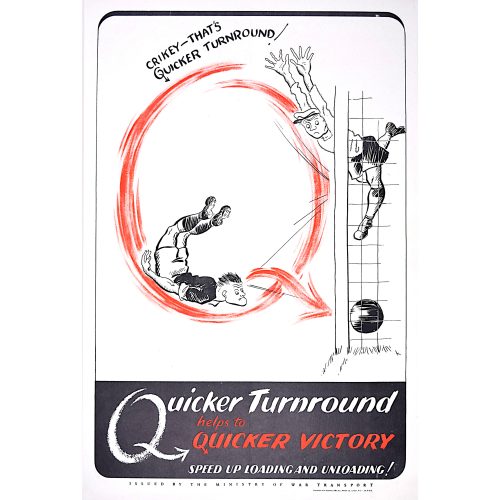
  • Ministry of War Transport Quicker Turnaround Helps to Quicker Victory - Football

    Original vintage poster c. 1940 30x20" Printed by H M Stationery Office by J Weiner Ltd London WC1 Provenance, the Bendell Bayley studio. During the war, every aspect of life had its own Government influence. Here transport of war materiel is being managed and faster re-loading of transport is encouraged to improve efficiency. Condition: Good. Backed to linen. If you are interested email info@manningfineart.co.uk or call us on 07929 749056.
  • 'Samivel' Paul Gayet-Tancrède (1907-1992)

    Du Léman à La Méditerranée, La Grande Traversée des Alpes Françaises

    ('From Lake Geneva to the Mediterranean, La Grande Traversée of the French Alps') Imprimé en France - Printed in France 1975 Original Vintage Ski Poster 99x62cm Condition: excellent With the ever-popular topic of mountains for climbing and skiing, Samivel here draws a snow-covered col in the mountains. La Grande Traversée is a long-distance walking route from Thonon les Bains to Nice, set up in the early 1970s. Samivel was a writer, an artist, a photographer, an explorer and more. In 1948 he accompanied Paul Émile Victor on the first French Greenland expedition, making three documentary films in the process. His friends included Théodore Monod and Gilbert André - the latter the mayor of Bonneval-sur-Arc and one of the founders of the Vanoise National Park - and with them and others he spent his whole life aiming for the protection of the imperilled countryside. The graphic artist side of him had a life-long fascination with high mountains, and his illustrated books and series of posters of the French Alps have long been popular. Click here to see other posters by Samivel. If you are interested email info@manningfineart.co.uk or call us on 07929 749056.
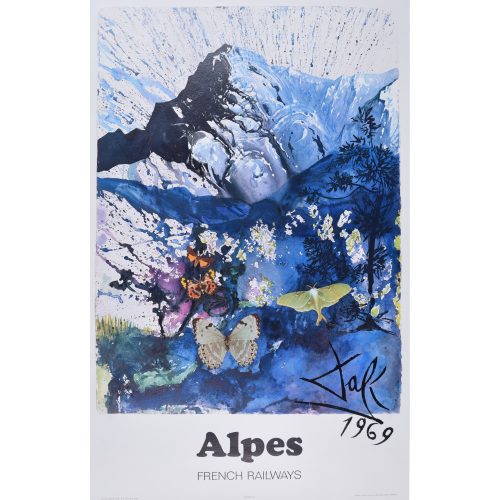
  • Salvador Dali (1904-1989) Alpes French Railways - The Alps

    Original Poster for French Railways SNCF 40x25" (100x67cm) Printed by Draeger Printed in France for and by the French National Railways, 1970 Signed and dated in the stone 1969 Condition: very good, slight age toning/handling wear to very edges as usual
  • Out of stock

    Michelle Mason Lines For All Seasons

    Lithograph 100 x 65 cm A colourful, abstract poster, depicting a series of geometric zig-zag lines with colours representing the different London Underground lines.
  • Out of stock

    Daniel Havell (1785 - 1822) after Frederick Mackenzie (1788 - 1854) King's College Chapel (1815)

    Aquatint with original hand colouring 18 x 27 cm Published by Rudolph Ackermann (1764 - 1834). An engraving of the south side of King's College Chapel overlooking the lawn. Engraved for publication in Ackermann's 'History of Cambridge'. Frederick Mackenzie (circa 1788 - 1854) was a British watercolourist and architectural draughtsman. He first exhibited at the Royal Academy in 1804, and contributed eleven drawings between that year and 1828. He contributed to the Society of Painters in Water Colours exhibitions from 1813, becoming an associate in 1822, and a full member the following year. From 30 November 1831 until, his death he was treasurer to the society. In later life Mackenzie was no longer commissioned to illustrate books. Daniel Havell was a member of the Havell family of Reading, Berkshire, England, which included a number of notable engravers, etchers and painters, as well as writers, publishers, educators, and musicians. Daniel and his brother Robert set up in partnership as aquatint engravers. Soon Daniel began to work independently, engraving plates for Rudolph Ackermann's History of Cambridge (1815) and hid history of various public schools including Eton, Winchester, and Rugby (1816), as well as a celebrated views of St Paul's Cathedral (1818) and various other London landmarks for Ackermann's Repository of Arts. Rudolph Ackermann was an Anglo-German bookseller, inventor, lithographer, publisher and businessman. In 1795 he established a print-shop and drawing-school at 96 Strand. Here Ackermann set up a lithographic press and began a trade in prints. He later began to manufacture colours and thick carton paper for landscape and miniature painters. Within three years the premises had become too small and he moved to 101 Strand, in his own words "four doors nearer to Somerset House", the seat of the Royal Academy of Arts. Between 1797 and 1800 Ackermann rapidly developed his print and book publishing business, encompassing many different genres including topography, caricature, portraits, transparencies and decorative prints. Condition: Toning within platemark.

    If you would like to know more, please email info@manningfineart.co.uk or call us on 07929 749056.
  • Out of stock

    John Bluck (early 19th century) after Frederick Mackenzie (1788 - 1854) Chapel of Trinity College, Cambridge (1814)

    Aquatint with original hand colouring 27 x 21 cm Published by Rudolph Ackermann (1764 - 1834). Frederick Mackenzie (1788 - 1854) was a British watercolourist and architectural draughtsman. He first exhibited at the Royal Academy in 1804, and contributed eleven drawings between that year and 1828. He contributed to the Society of Painters in Water Colours exhibitions from 1813, becoming an associate in 1822, and a full member the following year. From 30 November 1831 till his death he was treasurer to the society. In later life Mackenzie was no longer commissioned to illustrate books. John Bluck was an aquatint engraver, mainly of topographical views, but also of marine and sporting subjects after his contemporaries. He produced plates for numerous publications. Rudolph Ackermann was an Anglo-German bookseller, inventor, lithographer, publisher and businessman. In 1795 he established a print-shop and drawing-school at 96 Strand. Here Ackermann set up a lithographic press and began a trade in prints. He later began to manufacture colours and thick carton paper for landscape and miniature painters. Within three years the premises had become too small and he moved to 101 Strand, in his own words "four doors nearer to Somerset House", the seat of the Royal Academy of Arts. Between 1797 and 1800 Ackermann rapidly developed his print and book publishing business, encompassing many different genres including topography, caricature, portraits, transparencies and decorative prints. Condition: Generally very good; slight toning within platemark.

    If you would like to know more, please email info@manningfineart.co.uk or call us on 07929 749056.
  • Out of stock

    Mabel Oliver Rae (1868-1956) Keble College, Oxford

    c.1920 Etching 14 x 18 cm Signed in pencil below. Mabel Oliver Rae was born in Cambridge, Cambridgeshire, and trained at the Slade School of Fine Art between 1888 and 1890. Rae is known for her skilled etchings of various rural scenes and townscapes, particularly those of the colleges of Oxford and Cambridge. She signed works with the pseudonym 'M.Oliver Rae', a ruse to conceal the fact she was a female artist, so as not to reduce her chances with commercial dealers and agents. This particular etching depicts a lovely view of Keble College, Oxford. Condition: Generally very good, mounted to board, residual glue to margins under the mount.

    If you would like to know more, please email info@manningfineart.co.uk or call us on 07929 749056.

    For other views of Keble College, Oxford, click here. 

  • Mabel Oliver Rae (1868-1956) Clare Bridge, Cambridge

    c.1920 Etching 13 x 17 cm Signed in pencil below. Mabel Oliver Rae was born in Cambridge, Cambridgeshire, and trained at the Slade School of Fine Art between 1888 and 1890. Rae is known for her skilled etchings of various rural scenes and townscapes, particularly those of the colleges of Oxford and Cambridge. She signed works with the pseudonym 'M.Oliver Rae', a ruse to conceal the fact she was a female artist, so as not to reduce her chances with commercial dealers and agents. This particular etching depicts a lovely view of Clare Bridge, Cambridge. Rae expertly captures the reflections of the bridge's arcs and the shadows of the trees on the water surface. In the foreground of the etching, a punter enjoys the tranquil scene and the work is consequently imbued by the atmosphere of a warm summer's day. Condition: generally very good, slight age toning to paper.

    If you would like to know more, please email info@manningfineart.co.uk or call us on 07929 749056.
    For other views of Clare College, Cambridge, please click here.
  • Out of stock
    Mabel Oliver Rae (1868-1956) Kings College, Cambridge (view from the Meadow) c.1920 Etching 12 x 9 cm Signed in pencil below. Mabel Oliver Rae was born in Cambridge, Cambridgeshire, and trained at the Slade School of Fine Art between 1888 and 1890. Rae is known for her skilled etchings of various rural scenes and townscapes, particularly those of the colleges of Oxford and Cambridge. She signed works with the pseudonym 'M.Oliver Rae', a ruse to conceal the fact she was a female artist, so as not to reduce her chances with commercial dealers and agents. This particular etching depicts a lovely view of King's chapel from the backs. The River Cam is also visible in the foreground, with what seems to be a punter making their way across the river.
  • Out of stock

    M R A Hollis The Local History Society Presents Prehistoric Animals

    Vintage poster Gouache 38 x 55 cm Professor Malcolm A Hollis was a chartered surveyor, arbitrator and professor of Building Pathology. This poster very clearly stands apart from his other architectural sketches. It is playful and bold, depicting a stegosaurus.
  • Out of stock

    Hugh Casson (1910 - 1999) St John's College, Cambridge

    Lithograph 29 x 37 cm Signed and numbered 427/500, both in pencil. Sir Hugh Casson was educated at Eastbourne College; St John’s College, Cambridge; and the Bartlett School of Architecture. Trained in the 1930s in the early modernist style, he taught at the Cambridge School of Architecture. After employment as a camoufleur during World War 2 by the Air Ministry, in 1948 he was appointed as director of architecture for the Festival of Britain. A close friend of the Royal Family, he undertook designs for the 1953 coronation, designed the interior of the Royal Yacht Britannia (“The overall idea was to give the impression of a country house at sea”), and taught the young Charles III to paint in watercolours. Amongst his architectural achievements are the Elephant House at London Zoo, the 1978 redevelopment of Bristol Docks, the Raised Faculty Building for The University of Cambridge, and a building for the Royal College of Art. He published a number of illustrated books, of which Casson’s Oxford and Casson’s Cambridge are probably the best known. A limited edition series of prints was produced from the paintings. This lithograph depicts a view over Kitchen Bridge in St John's College. As is typical in many of his works, Casson expertly captures the architecture of this Cambridge college, while also portraying the everyday comings-and-goings of college life. In this case, a punt floats past a group of students basking in the sun and another group crosses over the bridge, perhaps on their way to get their lunch from the cafe. Condition: Generally very good.

    If you would like to know more, please email info@manningfineart.co.uk or call us on 07929 749056.
    For other views of St John's College, click here.
  • Out of stock

    Keith Vaughan Male Nude

    Ballpoint pen sketch 17 x 13 cm Born in 1912, Keith Vaughan was a British painter known for his modernist and semi-abstract depictions of the male figure. He was self-taught as an artist but during his time as a conscientious objector in the Second World War, he befriended the painters Graham Sutherland and John Minton. Through these contacts, he formed part of the neo-romantic circle of the immediate post-war period. Over time, Vaughan's idiosyncratic style evolved away from the group as he focussed on male nudes and groups, often rendered in a geometric yet lyrical manner. Vaughan was openly gay at a time when homosexuality was criminalised in Britain. As a result, his work often reflected themes of isolation and desire, capturing both the physical and emotional aspects of human existence. He continues to be celebrated today and his works are held in several major galleries, inlcuding the National Galleries of Scotland, the National Portrait Gallery, the Tate and the Victoria and Albert Museum. This sketch depicting a male nude was taken from Vaughan's 'Ischia Cheese & Grill' sketchbook. Together the drawings in the sketchbook record Vaughan's experimentalism with landscape, abstraction and notably his commitment to the human form. This collection was sold as part of Peter Adam's estate; Adam was not just a close friend of Vaughan but his executor, biographer and the curator of multiple exhibitions of his work after he died in 1977. This sketch represents the unique opportunity to own a small piece of Keith Vaughan's oeuvre as he continues to grow in popularity. Condition: generally very good.

    UpdateIf you would like to know more, please email info@manningfineart.co.uk or call us on 07929 749056.
  • Out of stock
    Original vintage Second World War poster 'Warning, be on your guard' Lithograph 38 x 25 cm 'Warning, be on your guard. Thousands of lives were lost in the last war because valuable information was given away to the enemy through careless talk.' In the Second World War, enemy espionage, spy networks and secret operations seemed a real and ever-present danger. As a result, this Second World War poster was produced as part of a propaganda drive warning against careless talk that could lead to damaging information leaks. The poster itself is paired back, featuring black text on a white background with a red crown above, in the style of the 'Keep Calm and Carry on' posters. Condition: Generally very good, few old soft creases.

    If you would like to know more, please email info@manningfineart.co.uk or call us on 07929 749056.

  • Out of stock

    Les champs de neige de Val d'Isère Original vintage skiing poster

    Lithograph 60 x 40 cm Vintage travel poster for the popular Val d'Isère ski resort. Includes an illustration of a group of skiers looking over the peaks of the snowy alps. Originally produced for the French tourist board. Condition: very good If you are interested, please email info@manningfineart.co.uk or call us on 07929 749056. Click here for other original vintage travel posters.
  • Out of stock

    Cyril Kenneth Bird ‘Fougasse’ (1887 - 1965)

    Jump for Them

      Lithographic poster 30 x 22 cm Fougasse was a British cartoonist. He was art editor of Punch between 1937 and 1949, and subsequently editor until 1953. He is best known for his ‘Careless Talk Costs Lives’ series of posters, and the other posters for the Ministry of Information and London Transport. As the Second World War progressed, the Ministry of Information’s poster campaign had become less and less effective. There were posters instructing the population to save old clothes for rags, turn off the lights, save food, dig for victory, watch out for spies, and keep calm and carry on. With this instruction overload, the population had ceased paying attention to the posters. Fougasse noticed this, and offered his services unpaid to the Ministry of Information, with a view to bringing a touch of humour to the posters. His amusing designs with pithy captions, reminiscent of newspaper cartoons, helped to get the Ministry's messages across in a novel way.
    Fougasse's distinctive poster style, with the red border- as seen in this poster-was subsequently adopted by other Ministry artists. In this poster, taken from The Art of Refereeing, Fougasse depicts a man hurling a book in the direction of a scrum, drawing an intriguing analogy between sports and literary culture. 
    Condition: backed to linen; generally excellent. If you are interested, please email info@manningfineart.co.uk or call us on 07929 749056. Click here for other works by the artist.
  • Out of stock

    Pieter van der Aa (1659 - 1733), after David Loggan (1634 - 1692)

    Gonville & Caius College, Cambridge (1727)

      Engraving 13 x 17 cm An eighteenth-century view of Gonville and Caius College, Cambridge, engraved by Pieter van der Aa after David Loggan, the noted engraver, draughtsman, and painter. Pieter van der Aa of Leiden was a Dutch publisher best known for preparing maps and atlases, though he also printed editions of foreign bestsellers and illustrated volumes. He is noted for the many engravings he produced after David Loggan's series of Oxford and Cambridge colleges and costumes. In 1727 Van Der Aa illustrated "Les Delices de la Grande Bretagne & de L'Irelande" by James Beeverell, the book in which this engraving appears. Condition: very good. If you are interested, please email info@manningfineart.co.uk or call us on 07929 749056. Click here for other views of Gonville and Caius College, Cambridge
  • Out of stock

    Richard Bankes Harraden (1778 - 1862)

    The Library - Magdalen College

    Hand-coloured aquatint 13 x 21 cm A nineteenth-century view of the Library of Magdalen College, Cambridge (spelled here as 'Magdalen' - in the 19th century, the spelling of the college's name was fixed as "Magdalene" with a final "e", to avoid confusion with Magdalen College, Oxford). The Pepys Library is the personal library collected by Samuel Pepys, which he bequeathed to Magdalene following his death in 1703. Richard Bankes Harraden was a printmaker, painter, and drawing master. He was active in Cambridge, producing many views of the colleges, and subsequently several Oxford colleges. Harraden was an early and exhibiting member of the Society of British Artists in London, which was established in 1823, and remained a member until 1849. He specialised in depictions of landscape, topography and architecture, and was the son of Richard Harraden (1756 - 1838) with whom he published plates as 'Harraden & Son'. Condition: very good. If you are interested, please email info@manningfineart.co.uk or call us on 07929 749056. Click here for other views of Magdalene College, Cambridge
  • Out of stock

    Cyril Power (1872 - 1951)

    Christ's College, Cambridge

      Etching 23 x 15 cm Cyril Power was an English artist. His father was the architect Edward William Power and encouraged him to practise architectural drawing. Power studied architecture and won the Royal Institute of British Architects' Sloane Medallion in 1900 for his design for an art school. He worked as an architect at the Ministry of Works and later lectured on architecture at Goldsmiths and what is now the Bartlett School of Architecture. His A History of English Mediaeval Architecture, a book of architectural illustrations and designs, was published in 1912. In 1918, Power met the artist Sybil Andrews, with whom he worked for two decades. He co-founded The Grosvenor School of Modern Art in 1922; he and Andrews attended Claude Flight's linocutting classes there. Linocut exhibitions followed at the Redfern Gallery and then further afield. Frank Pick, the Deputy Chairman of the Underground Electric Railways Company of London, commissioned Power and Andrews to design a series of posters for him after seeing their linocut work. In 1930 Power was elected member of the Royal Society of British Artists and established a studio with Andrews in Hammersmith close to the River Thames, a location which inspired many prints by both artists, most notably 'The Eight' by Power and 'Bringing in the Boat' by Sybil Andrews. Their first major joint exhibition was at the Redfern Gallery in 1933 which consisted of linocuts and monotypes. Condition: very good; fractional toning to paper. If you are interested, please email info@manningfineart.co.uk or call us on 07929 749056. Click here for other views of Christ's College, Cambridge Titled and numbered 45/168 lower left and signed lower right, all in pencil.
  • Out of stock

    Charles E Brown (1896 - 1982)

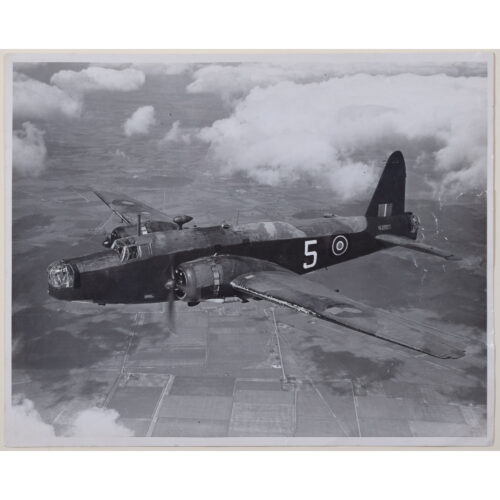
    Wellington Bomber

      Silver gelatin photograph 20 x 25 cm The Vickers Wellington was a British twin-engined, long-range medium bomber. It was designed during the mid-1930s at Brooklands in Weybridge, Surrey. Led by Vickers-Armstrongs’ chief designer Rex Pierson; a key feature of the aircraft is its geodetic airframe fuselage structure, which was principally designed by Barnes Wallis. Development had been started in response to Air Ministry Specification B.9/32, issued in the middle of 1932, for a bomber for the Royal Air Force. This specification called for a twin-engined day bomber capable of delivering higher performance than any previous design. Other aircraft developed to the same specification include the Armstrong Whitworth Whitley and the Handley Page Hampden. During the development process, performance requirements such as for the tare weight changed substantially, and the engine used was not the one originally intended. The Wellington was used as a night bomber in the early years of the Second World War, performing as one of the principal bombers used by Bomber Command. During 1943, it started to be superseded as a bomber by the larger four-engined “heavies” such as the Avro Lancaster. The Wellington continued to serve throughout the war in other duties, particularly as an anti-submarine aircraft. It holds the distinction of having been the only British bomber that was produced for the duration of the war, and of having been produced in a greater quantity than any other British-built bomber. The Wellington remained as first-line equipment when the war ended, although it had been increasingly relegated to secondary roles. The Wellington was one of two bombers named after Arthur Wellesley, 1st Duke of Wellington, the other being the Vickers Wellesley. A larger heavy bomber aircraft designed to Specification B.1/35, the Vickers Warwick, was developed in parallel with the Wellington; the two aircraft shared around 85% of their structural components. Many elements of the Wellington were also re-used in a civil derivative, the Vickers VC.1 Viking. Leslie Carr was a painter and poster designer from London. He served in the Tank Corps in the First World War and then became a professional artist, mainly producing maritime and architectural scenes. He designed posters for Southern Railway, the London and North Eastern Railway, and British Railways (among others). Carr served as a fireman in the Second World War and was a part of several firemen artists’ exhibitions. Carr was a member of the Society of Marine Artists. Charles E Brown was an aviation photographer. His archive of 30,000 images has been held by the RAF Museum in Hendon since 1978. Condition: generally good; a few old creases and a short (repaired) tear top right approx 1 cm long. If you are interested, please email info@manningfineart.co.uk or call us on 07929 749056. Click here for other Second World War pictures.
  • Out of stock

    Leslie Carr (1891 - 1969)

    Paddlesteamer

    Gouache 19 x 29 cm Signed lower right. A steamship on a bright blue ocean, complete with frothing waves. Leslie Carr was a painter and poster designer from London. He served in the Tank Corps in the First World War and then became a professional artist, mainly producing maritime and architectural scenes. He designed posters for Southern Railway, the London and North Eastern Railway, and British Railways (among others). Carr served as a fireman in the Second World War and was a part of several firemen artists' exhibitions. Carr was a member of the Society of Marine Artists. Condition: very good. If you are interested, please email info@manningfineart.co.uk or call us on 07929 749056. Click here for other maritime pictures.
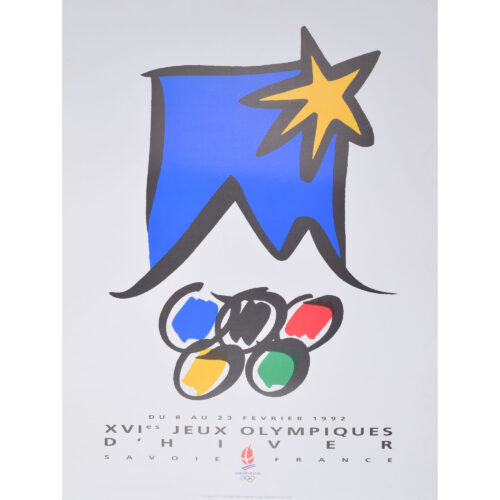
  • XVIes Jeux Olympiques d'Hiver (Albertville 1992)

      Lithograph 80 x 61 cm This poster advertises the 1992 Winter Olympics. It features a snowy-white mountain against a bright blue sky, with a golden sun in the shape of a star above right, and the Olympic rings below. Condition: backed to linen; generally very good; some staining to right hand side that could be covered by a mount. If you are interested, please email info@manningfineart.co.uk or call us on 07929 749056. Click here for other original vintage posters.
  • Out of stock

    R C Meaux

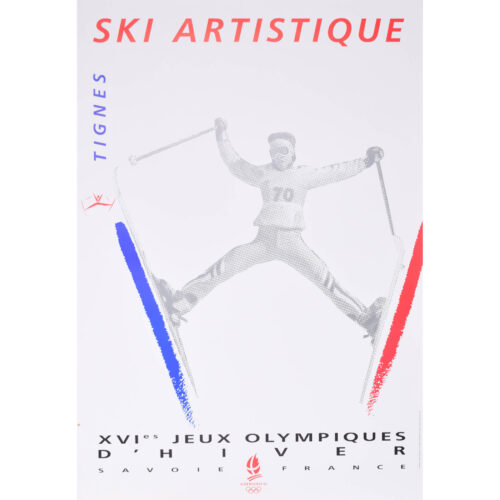
    Tignes - Ski Artistique (1990)

      Original vintage poster 80 x 53 cm An original vintage poster printed in colour in 1990 by L’Avenir Graphic. The poster was designed to promote the 1992 Olympic Winter Games in Albertville. A similar design was also used for a limited edition French postage stamp in 1992. Condition: very good. If you are interested, please email info@manningfineart.co.uk or call us on 07929 749056. Click here for more original vintage ski posters.
  • Out of stock

    Hills and Saunders

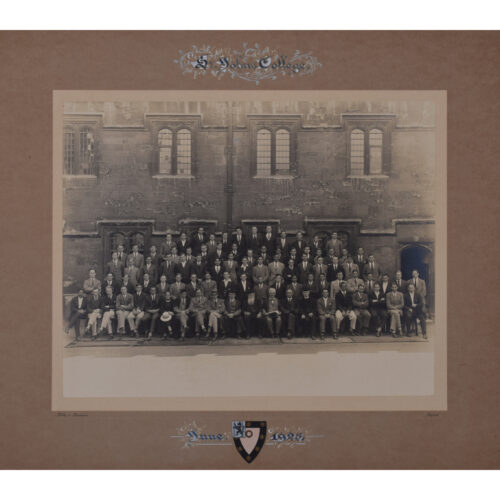
    St John's College, Oxford (1925)

      Silver gelatin photograph with extensive hand-decoration of mount 43 x 49 cm A photograph taken of St John's College students and tutors in 1925. Hills & Saunders was one of the leading Victorian social photography firms. Robert Hills and Henry Saunders started the firm together in 1860 and had studios in Oxford, Cambridge, and London during the course of their partnership, as well as near certain army bases and public schools. They were given a Royal Warrant in 1867. Condition: generally very good. If you are interested, please email info@manningfineart.co.uk or call us on 07929 749056. Click here for more St John's pictures.
  • David Loggan (1634 - 1692)

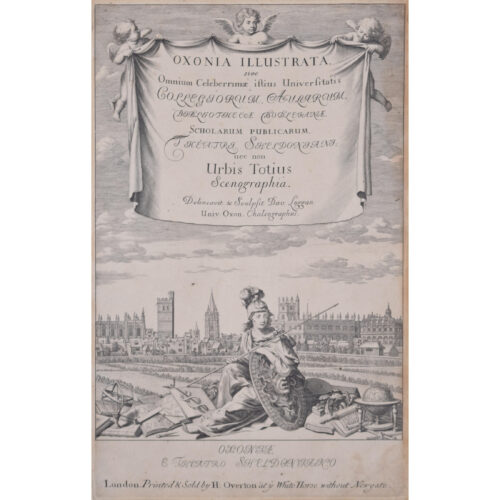
    Frontispiece to the Oxonia Illustrata (1675)

      Engraving 38 x 24 cm The intricately engraved frontispiece to Loggan's 'Oxonia Illustrata', featuring cherubs bearing the volume's title on a banner and Minerva, goddess of wisdom, sitting before a panorama of Oxford's resplendent architecture. David Loggan's view of Oxford's medieval Divinity School, which was once the beating heart of theological studies at the University. Of particular interest here is the trompe l'oeil scroll of torn paper which frames the view. Loggan was born to English and Scottish parents, and was baptised in Danzig in 1634. After studying engraving in Danzig with Willem Hondius (1598-1652 or 1658), he moved to London in the late 1650s, going on to produce the engraved title-page for the folio 1662 Book of Common Prayer. He married in 1663 and moved to Nuffield in Oxfordshire in 1665. Loggan was appointed Public Sculptor to the nearby University of Oxford in the late 1660s, having been commissioned to produce bird’s-eye views of all the Oxford colleges. He lived in Holywell Street as he did this. The 'Oxonia Illustrata' was published in 1675, with the help of Robert White (1645-1704). Following its completion, Loggan began work on his equivalent work for Cambridge; the 'Cantabrigia Illustrata' was finally published in 1690, when he was made engraver to Cambridge University. The 'Oxonia Illustrata' also includes an engraving of Winchester College (Winchester and New College share William of Wykeham as their founder) whilst the 'Cantabrigia Illustrata' includes one of Eton College (which shares its founder, Henry VIII, with King’s College). Bird’s-eye views from this era required a particular talent as an architectural perspectivist; it was not until 1783 that it became possible for artists to ascend via hot air balloons and view the scenes they were depicting from above. Loggan thus had to rely on his imagination in conceiving the views. Loggan’s views constitute the first accurate depictions of the two Universities, in many ways unchanged today. Whilst the Oxford engravings were produced in reasonable numbers and ran to a second edition by Henry Overton (on thicker paper and with a plate number in Roman numerals in the bottom right-hand corner), those of Cambridge were printed in much smaller numbers. The Dutchman Pieter van der Aa published some miniature versions of the engravings for James Beverell’s guidebook to the UK, 'Les Delices de la Grande Bretagne' (circa 1708). The contemporary artist Andrew Ingamells (born 1956) has produced a highly-acclaimed series of etchings which bring Loggan’s original vision up to date. Condition: trimmed within platemark and mounted to board, otherwise in very good condition. If you are interested, please email info@manningfineart.co.uk or call us on 07929 749056. Click here for other general views of Oxford.
  • Out of stock

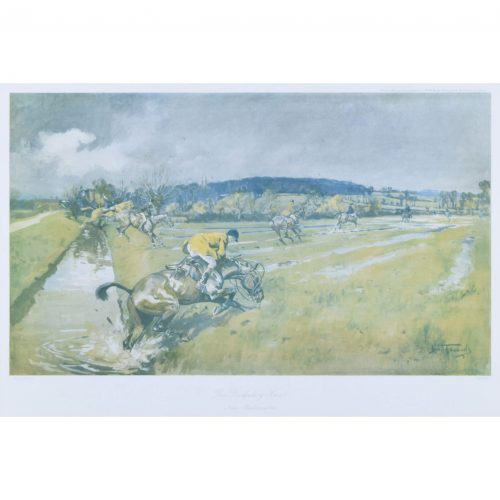
    Lionel Edwards (1878 - 1966)

    The South Notts Hunt (1928)

      Lithograph 31 x 51 cm Signed and dated in plate lower left, and in pencil outside plate lower left. Note to reverse (1988) identifies those illustrated. A Lionel Edwards lithograph depicting the South Notts Hunt - part of the artist's 'Hunting Countries' series. The South Notts country lies in Nottinghamshire and Derbyshire and has been hunted as far back as 1677 by the Earl of Lincoln. In 1775 it was hunted by John Musters, the great-grandfather of John Chaworth-Musters, and in 1860 Mr. John Chaworth-Musters re-established the hunt. Lionel Edwards was a British artist who specialised in pictures of country life, particularly horses, and provided illustrations for Country Life. He is best known for his hunting scenes but also painted pictures of horse racing, shooting and fishing. Condition: print good; original handsome period frame. If you are interested, please email info@manningfineart.co.uk or call us on 07929 749056. Click here for other hunting pictures.
  • Out of stock

    Margaret Souttar (1914 - 1987)

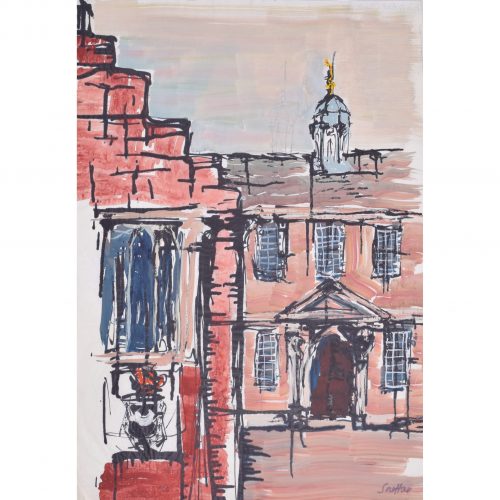
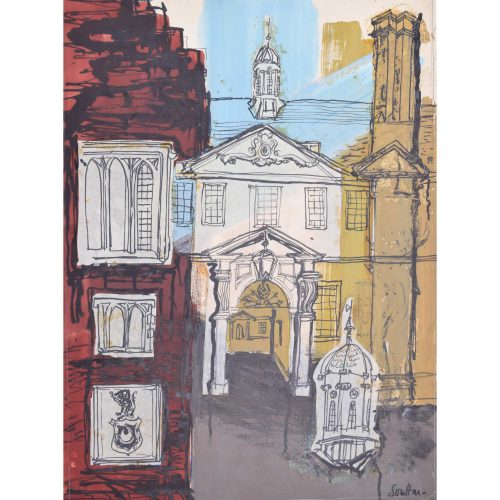
    Trinity Hall, Cambridge IV

      Acrylic paint 62 x 92 cm Signed lower right. Souttar was a Scottish painter and printmaker known for her images of town- and cityscapes. In the early 1960s, she was commissioned to produce a series of prints of the Cambridge colleges. She captures the modernity and optimism of 1960s Cambridge; the fact that a female artist was commissioned to create the prints reflects the changing attitudes of the University towards women. Trinity Hall was one of the first Cambridge colleges to admit women as students – it did not do so until 1976. Provenance: the artist's studio sale. Condition: generally very good; on thin paper - some crinkling to paper as a result of being painted. Further sketch to reverse. If you are interested, please email info@manningfineart.co.uk or call us on 07929 749056. Click here for other views of Trinity Hall.
  • Out of stock

    Lionel Edwards (1878 - 1966)

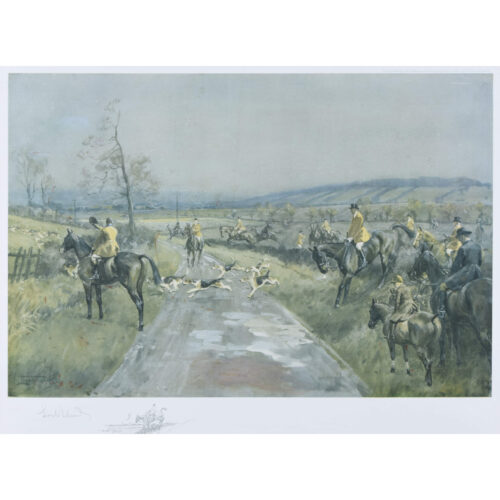
    The Berkeley Hunt - Near Rockhampton (1925)

      Lithograph 34 x 51 cm Signed in plate lower right. In original 3/4" black frame. A Lionel Edwards lithograph depicting the Berkeley - part of the artist's 1925 'Hunting Countries' series. The yellow coats with green collars and the running fox on the lapel are worn by the Masters and Hunt Staff and are unique in hunting circles, representing the outdoor livery of the Berkeley family; the ladies' colours of navy and maroon represent the indoor livery. The Berkeley is the oldest pack in the country and is one of the very few that are still family owned. The Fifth Earl of Berkeley could hunt his hounds from Berkeley Castle to Berkeley Square in London and had six kennels along the route. The season would start in Berkeley and progress to each of his kennels to London and then in stages back again to Gloucestershire. The present kennels date from the early 18th century and are home to around 90 hounds. Lionel Edwards was a British artist who specialised in pictures of country life, particularly horses, and provided illustrations for Country Life. He is best known for his hunting scenes but also painted pictures of horse racing, shooting and fishing. Condition: print generally good; the odd tiny spot in top left area. In original 3/4" black frame - some scratches to frame. If you are interested, please email info@manningfineart.co.uk or call us on 07929 749056. Click here for other hunting pictures.
  • Out of stock

    Tom Carr (1912 - 1977)

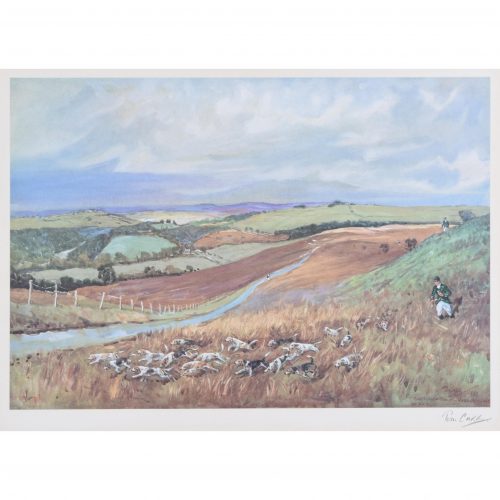
    Christ Church and New College Beagles in Northumberland (1967)

      Lithograph 28 x 38 cm Signed in pencil lower right. A classic Carr hunting print of the Christ Church (now the Christ Church and Farley Hill) Beagles, and the Magdalen and New College Beagles, on their annual trip to Northumberland. Tom Carr was a painter of hunting and racing scenes. He was born in Durham and worked as a blacksmith at Preistman Collieries, before sustaining an injury which saw him admitted to hospital, where he took up drawing and painting. He decided to become an artist and went to study at King's College, Newcastle-upon-Tyne, using the compensation money from his injury to pay for his tuition. Carr became known for his energetic hunting scenes, and earned the patronage of the Dukes of Beaufort and Northumberland. Condition: generally very good. If you are interested, please email info@manningfineart.co.uk or call us on 07929 749056. Click here for other hunting pictures.
  • Out of stock

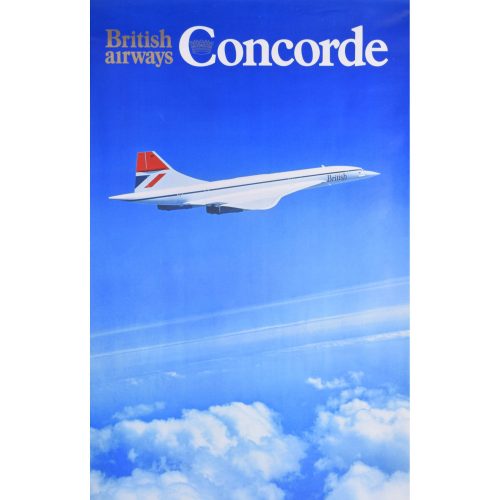
    Concorde

      Original vintage poster 102 x 64 cm A striking poster advertising the glamorous Concorde aircraft for British Airways. Concorde entered service in 1976 with Air France from Paris-Roissy and British Airways from London Heathrow. Condition: very good. If you are interested, please email info@manningfineart.co.uk or call us on 07929 749056.
  • Out of stock

    William Matthison (1853-1926)

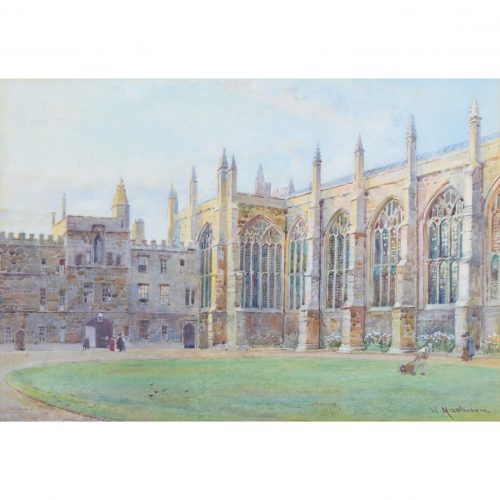
    New College, Oxford: Front Quad

    Watercolour 35 x 52 cm Signed lower right. A charming watercolour of New College's Front Quad complete with members of the college in academic dress, wandering birds, and a gardener mowing the grass. William of Wykeham, who founded New College in 1379, was an ambitious builder. His vision for the college was of a Chapel, Hall, Library, and rooms for tutors and students to work and live in, all of which would be built around a quadrangle. This was the first time a college had been set in this way, and it became a model for colleges worldwide. Matthison was born near Birmingham and attended King Edward’s School in the city. He learnt drawing at the Birmingham Central School of Art and then became a pupil of Birmingham artist Edward Watson. He became a professional artist in 1875 and moved to Oxfordshire a few years after; this was where he had the opportunity to produce many of the Oxford views for which he is known today. In 1902 he moved to Park Town in Oxford and was commissioned by Robert Peel to paint more than seventy views of the University of Oxford, which were subsequently made into postcards. Priced at seven for a shilling, they were only available from E Cross of Pembroke Street (a long-since closed business). Raphael Tuck & Sons also commissioned him to produce postcard scenes of Cambridge. Matthison’s views of Oxford were later printed in Fifty Watercolour Drawings of Oxford, published in 1912 by Alden & Co. Condition: generally very good; a few spots to sky. If you are interested, please email info@manningfineart.co.uk or call us on 07929 749056. Click here for other views of New College, Oxford.
  • Out of stock

    Walter Hoyle (1922 - 2000)

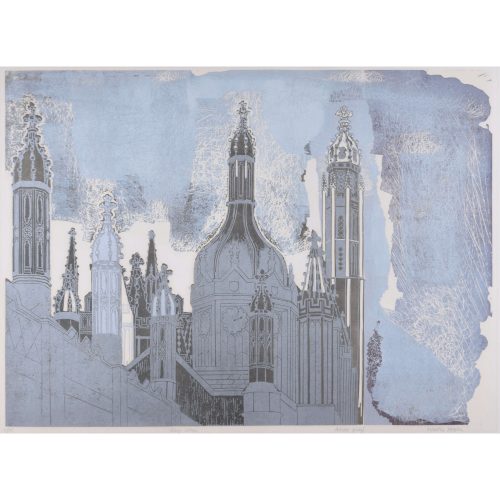
    King's College, Cambridge (Cambridge Series 1956 - 66)

      Linocut 61 x 80 cm Numbered 37/75 lower left, titled below, marked as artist's proof, and signed lower right, all in pencil. A blue- and grey-hued linocut of King's. A version of this print, owned by the Government Art Collection, hangs in the British Embassy in Tunis. Hoyle trained at Beckenham School of Art and the Royal College of Art. At the latter he was strongly influenced by Edward Bawden, one of Britain’s greatest linocut printers. Bawden had been commissioned by the 1951 Festival of Britain to produce a mural for the South Bank, and chose Hoyle to assist on account of his great talent. Hoyle moved to Great Bardfield in Essex, becoming a part of the Great Bardfield group of artists; diverse in style, they created figurative work, in stark contrast to the abstract art of the St Ives artists at the opposite end of the country. Hoyle taught at St Martin’s School of Art from 1951-60, the Central School of Arts and Crafts from 1960-64, and the Cambridge School of Art from 1964-1985, during which time he launched Cambridge Print Editions. His work is held in the collections of the Tate Gallery, the Victoria and Albert Museum, The British Museum, Kettle’s Garden and the Fry Art Gallery. Provenance: ex the Arthur Andersen collection. Condition: generally very good; some gentle and even age toning to paper. If you are interested, please email info@manningfineart.co.uk or call us on 07929 749056. Click here for other views of King's College, Cambridge.
  • Margaret Souttar (1914-1987)

    Trinity Hall, Cambridge

      Acrylic on paper 76 x 56 cm Signed lower right. Souttar was a Scottish painter and printmaker known for her images of town- and cityscapes. In the early 1960s, she was commissioned to produce a series of prints of the Cambridge colleges. She captures the modernity and optimism of 1960s Cambridge; the fact that a female artist was commissioned to create the prints reflects the changing attitudes of the University towards women. Trinity Hall was one of the first Cambridge colleges to admit women as students - it did not do so until 1976. Provenance: the artist's studio sale. Condition: generally very good; some small glue stains around collaging. If you are interested, please email info@manningfineart.co.uk or call us on 07929 749056. Click here for other views of Trinity Hall.
  • Out of stock

    Cyril Kenneth Bird ‘Fougasse’ (1887 - 1965)

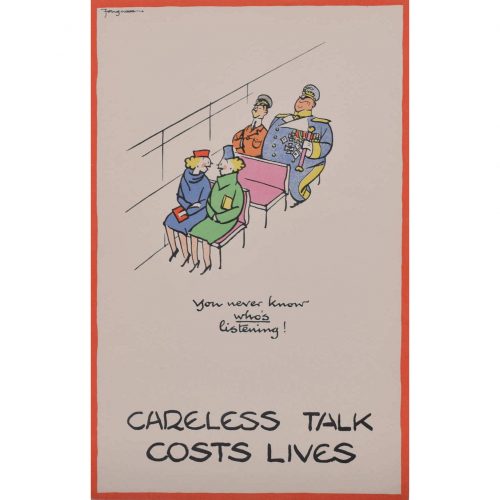
    Careless Talk Costs Lives (circa 1940)

      Lithographic poster 32 x 20 cm (12.5 x 8 in) Version printed on thinner paper. Fougasse was a British cartoonist. He was art editor of Punch between 1937 and 1949, and subsequently editor until 1953. He is best known for his ‘Careless Talk Costs Lives’ series of posters, and the other posters for the Ministry of Information and London Transport. As the Second World War progressed, the Ministry of Information’s poster campaign had become less and less effective. There were posters instructing the population to save old clothes for rags, turn off the lights, save food, dig for victory, watch out for spies, and keep calm and carry on. With this instruction overload, the population had ceased paying attention to the posters. Fougasse noticed this, and offered his services unpaid to the Ministry of Information, with a view to bringing a touch of humour to the posters. His amusing designs with pithy captions, reminiscent of newspaper cartoons, helped to get the Ministry's messages across in a novel way. Fougasse's distinctive poster style, with the red border, was subsequently adopted by other Ministry artists. Condition: if you’d like to know more, please email info@manningfineart.co.uk or call us on 07929 749056.
  • Out of stock

    Ebenezer Challis (1806 - 1881)

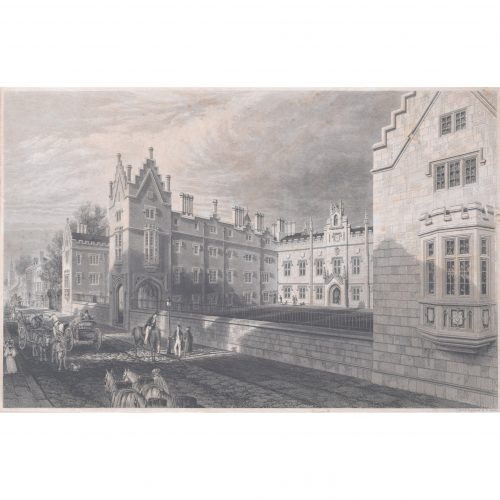
    Sidney Sussex College, Cambridge (1834)

      Engraving 27 x 43 cm A 19th century view of Sidney Sussex, complete with Victorian undergraduates in academic dress, horse and cart, and behatted rider. Condition: good. Trimmed. Otherwise generally good with the occasional tiny spot. If you’d like to know more, please email info@manningfineart.co.uk or call us on 07929 749056. Click here for more views of Sidney Sussex.
  • Out of stock

    Johannes Kip (1652 - 1722) after R Whitehand

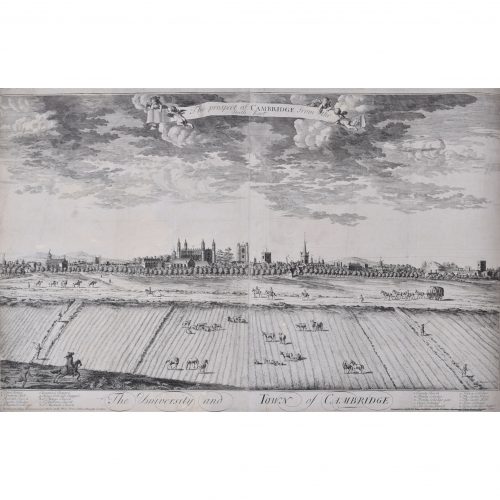
    Prospect of Cambridge from the South East (1724)

    Engraving 57 x 88 cm A view of the city of Cambridge, replete with college spires, by Johannes ''Jan'' Kip, the Dutch draughtsman, engraver and print dealer. The engraving illustrates an 18th century Cambridge defined by livestock and farmhands, as well as its University. The largest and best view of Cambridge, extremely rare - we have not traced any other copies at auction. Condition: good. Previously folded, occasional small losses and the odd slightly toned patch; two joined sheets. Trimmed to within platemark; very rare. If you’d like to know more, please email info@manningfineart.co.uk or call us on 07929 749056.
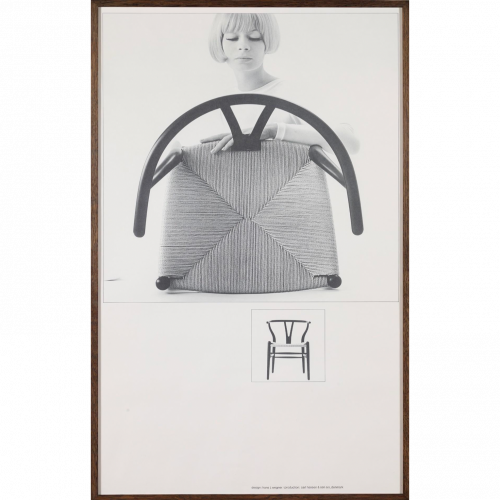
  • Paul Salomonsen (active 1960s) Y Chair (1964)

    Lithographic poster (2014) 99 x 61 cm The poster features Hans J Wegner's famous 'Y chair', also known as the 'Wishbone chair'. Carl Hansen & Søn commissioned the poster from a photograph by Salomonsen, a 1960s photographer. The stylish and typically Danish woman examining the chair marks it as a piece of typically Danish design. The chair was known as "The Chair" when it was used in the TV-transmitted debate between John F Kennedy and Richard Nixon in 1959. The Chair subsequently became an icon of Danish mid-century furniture design. Condition: Excellent. If you’d like to know more, please email info@manningfineart.co.uk or call us on 07929 749056.
  • Out of stock

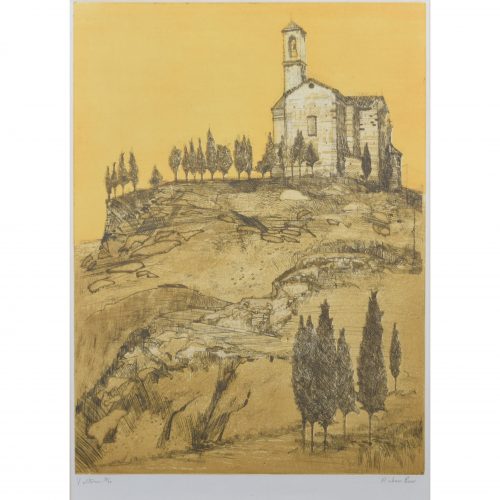
    Richard Beer (1928 - 2017)

    Volterra

      Etching and aquatint 60 x 45 cm Titled and numbered 4/70 lower left, and signed lower right, both in pencil. Beer's yellow-hued view of Volterra, a mountain town in Tuscany. Overseen by the beating Italian sun, a church perches atop a hill marked by trees and rocky outcrops. Born in London in 1928, just too late to serve in the Second World War, Richard Beer studied between 1945 - 1950 at the Slade School. Subsequently, a French Government scholarship allowed him to spend time in Paris at Atelier 17, working under Stanley William Hayter (1901 - 1988), one of the most significant print makers of the 20th Century – having spent the War in New York, advising as a camofleur, Hayter only returned to Paris in 1950. Subsequently Beer studied at the École des Beaux Arts, Paris. Working for John Cranko, choreographer for the Royal Ballet, Beer designed the sets and costumes for his The Lady and the Fool at Covent Garden, subsequently working for him following his move in 1961 to Stuttgart Ballet. Additionally he produced book illustrations and designed book jackets. Beer later taught print-making at the Chelsea School of Art, where he was a popular teacher. Probably his greatest work was a collaboration with John Betjeman to produce a portfolio of prints of ten Wren Churches in the City for Editions Alecto, copies of which are in The Government Art Collection. That collection contains a total of 54 prints by Beer, and the Tate Gallery’s collection holds seven. His Oxford series was also produced for Editions Alecto as was a series of predominantly architectural views in Southern Europe. Most of his prints are of architectural subjects. Condition: very good. If you’d like to know more, please email info@manningfineart.co.uk or call us on 07929 749056.
  • Out of stock

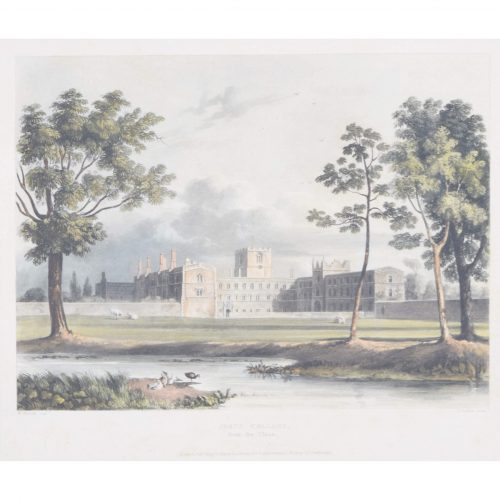
    Joseph Constantine Stadler (1755 - 1828) after William Westall (1781 - 1850)

    Jesus College, Cambridge, from the Close (1815)

      Hand-coloured aquatint 24 x 29.5 cm Published by Rudolph Ackermann (1764 - 1834). An engraving of Jesus College, foregrounded by trees, the River Cam, and grazing cattle. Joseph Constantine Stadler was a prolific German émigré engraver of images after his contemporaries - here, 18th-century English landscape painter and diarist Joseph Farington. Stadler''s engravings are wide-ranging in subject matter and include landscapes, seascapes and portraits, as well as military, sporting and decorative subjects. Stadler was employed by the leading print publisher of the time, John Boydell. Stadler lived in Knightsbridge when he died at the age of 73. William Westall was a British landscape artist. He was born in Hertford and enrolled at the Royal Academy schools in 1799. He later became the draughtsman for a voyage to Australia and the South Seas. After being shipwrecked, he travelled to Canton in China and to India, staying in Bombay for several months. He returned to England in 1805 but later set off for Madeira and Jamaica. He became a member of the Society of Painters in Water Colours (1811) and an associate of the Academy (1812). Following a mental breakdown, he regularly visited the Lake District and published ‘Views of the Valley and Vale of Keswick’ (1820). His series of aquatints of the Thames, the great universities, and England's public schools for Ackermann are among his most popular works. Rudolph Ackermann was an Anglo-German bookseller, inventor, lithographer, publisher and businessman. In 1795 he established a print-shop and drawing-school at 96 Strand. Here Ackermann set up a lithographic press and began a trade in prints. He later began to manufacture colours and thick carton paper for landscape and miniature painters. Within three years the premises had become too small and he moved to 101 Strand, in his own words "four doors nearer to Somerset House", the seat of the Royal Academy of Arts. Between 1797 and 1800 Ackermann rapidly developed his print and book publishing business, encompassing many different genres including topography, caricature, portraits, transparencies and decorative prints. Condition: good. Some age toning. If you’d like to know more, please email info@manningfineart.co.uk or call us on 07929 749056.
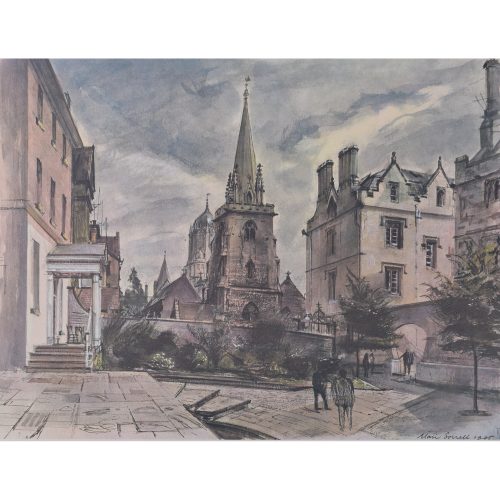
  • Alan Sorrell (1904 - 1974)

    Pembroke College, View from the North Quadrangle (1966)

      Lithograph 36 x 50 cm A lithograph of Pembroke's North Quad, from a drawing by Alan Sorrell. The artist's striking use of perspective and nebulously sketched figures make it a good example of Sorrell's style. Sorrell's 1965 etching was reproduced as a lithograph a year later, to be published in the "Oxford Almanack". The Oxford Almanack was an annual almanac published by the Oxford University Press for the University of Oxford from 1674 through 2019 (when printing sadly ceased due to "dwindling interest"). The almanac traditionally included engravings or lithographs of the University and information about the upcoming year. Other almanac artists have included James Basire, Michael Burghers, J. M. W. Turner, and John Piper. Alan Ernest Sorrell was an English artist and writer best remembered for his archaeological illustrations, particularly his detailed reconstructions of Roman Britain. Sorrell trained at the Southend municipal school of art and, after a brief spell as a commercial artist in London, he attended the Royal College of Art between 1924 and 1927. He was a Senior Assistant Instructor of Drawing there between 1931 and 1939, and again between 1946 and 1948. In 1937 he had been elected a member of the Royal Watercolour Society, and during the war served as a camofleur. After the war, Sorrell's archaeological and architectural work became their focus. Condition: very good. If you’d like to know more, please email info@manningfineart.co.uk or call us on 07929 749056.
Go to Top