-
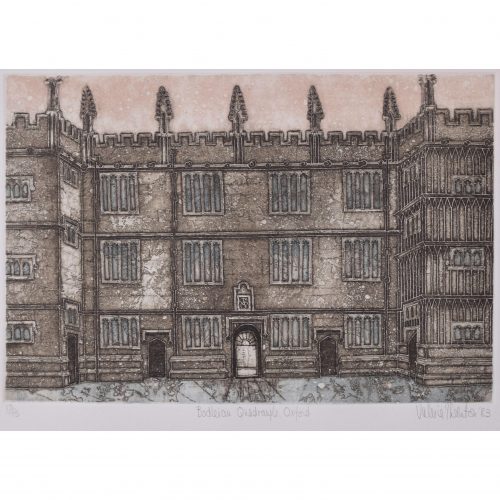
Valerie Thornton (1931-1991)
Bodleian Quadrangle, Oxford (1983)
Etching 24 x 35 cm Numbered 13/75 lower left, titled below, and signed and dated lower right, all in pencil. A very good example of Thornton's recognisable and unusual etching style. Her work is deeply concerned with material, and many of her etchings focus on eroded stone, emotive landscapes, and weathered architecture. Here, Thornton draws out the exceptional texture of the Bodleian Library's local stone. Valerie Thornton was a British etcher and printmaker. She was born in London, but was evacuated to Canada with her two brothers during World War II. She returned to London in 1944 and studied at the Byam Shaw School of Art in 1949. From 1950 to 1953 Thornton studied under P.F. Millard at the Regent Street Polytechnic, then spent eight months at Atelier 17 in Paris. In the early 1960s, she moved to New York and worked at Pratt Graphic Art Centre. In 1955, she succeeded Howard Hodgkin as assistant art teacher at Charterhouse School and in 1965 she became a founding member of the Print Makers Council. In 1970 she became a Fellow of the Royal Society of Painters-Etchers and Engravers. Thornton was a member of The Regent Street Group (a group of nine artists who studied together at the Regent Street Polytechnic in the early 1950s). The group also included Susan Horsfield, Renate Meyer, Michael Lewis, Ken Symonds, Philip Le Bas, and Peter Riches. Thornton's work is included in a number of major public collections including the Victoria and Albert Museum, the British Museum, and the Tate. Thornton died in 1991 in Chelsworth, Suffolk. Condition: generally very good. If you are interested, please email info@manningfineart.co.uk or call us on 07929 749056. Click here for more works by Valerie Thornton. -

Anonymous A Bomber Plane Coming in to Land
Charcoal sketch 34 x 43 cm This charcoal sketch depicts a four-engine bomber coming into land, featuring a further two bombers stationary in a hangar in the background. The circular insignia on the landing plane side distinguishes it as a part of the RAF, although its highly stylised form makes it impossible to identify which of the RAF bomber planes it is. The dynamism of this sketch is particularly striking, as the artist captures the speed of the plane using horizontal lines parallel to the ground. -
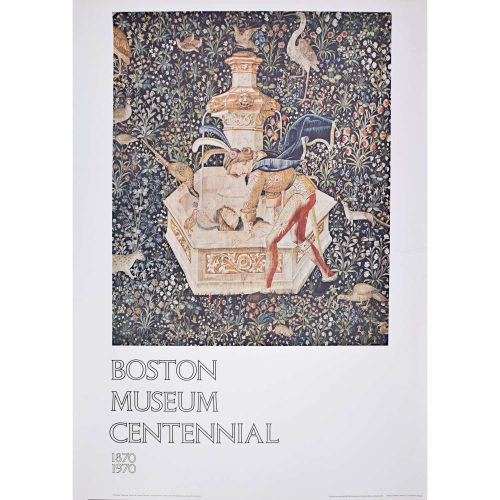
Anonymous Boston Museum Centennial 1870-1970
"Narcissus Tapestry, French or Franco-Flemish, Late 15th or 16th Century, Centennial Acquisition" 97x70cm Vintage poster 1970 If you are interested email info@manningfineart.co.uk or call us on 07929 749056. Condition: Good. Two repaired edge tears to right margin, not into image, one 3" long, other shorter; one repaired short tear to left. -
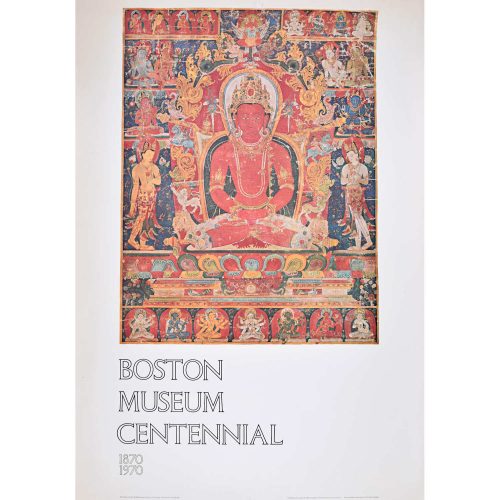
Anonymous Boston Museum Centennial 1870-1970
"Mandala of Eight Bodhisatlvas, Nepal 12th Century, Centennial Acquisition" 97x70cm Vintage poster 1970 If you are interested email info@manningfineart.co.uk or call us on 07929 749056. Condition: Good. -
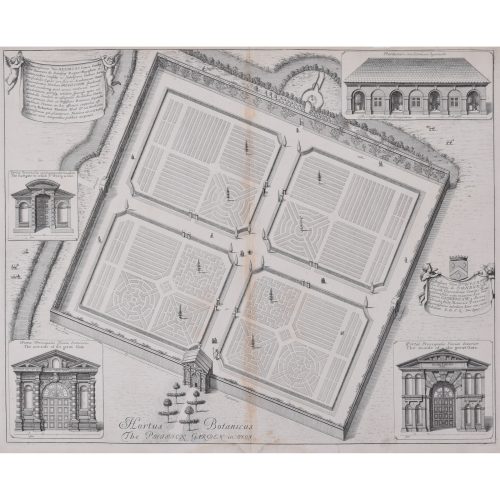
David Loggan (1634 - 1692)
The University of Oxford Botanic Garden (1675)
Engraving 40 x 50 cm An eighteenth-century view of one of Oxford's dreamiest spaces: the Botanic Garden, engraved by David Loggan, the noted engraver, draughtsman, and painter. The University of Oxford Botanic Garden was founded in 1621 and is the oldest botanical garden in Great Britain. Loggan's engraving focuses on its architectural qualities, with four features of the garden highlighted for their beauty, symmetry, and prowess of design. Of particular interest in this etching are the six trompe l'oeil pieces: four gently curling pieces of paper which frame the gates of the garden, and two heraldic banners borne by cherubs and sporting legends about the garden's foundation. The Danby Gate (bottom left) at the front entrance to the garden is one of the three entrances designed by Nicholas Stone between 1632 and 1633. The gateway consists of three bays, each with a pediment; the niches contain statues of Charles I and Charles II in classical pose, and the niche in the the central pediment contains a bust of the Earl of Danby (hence the gate's name). Loggan was born to English and Scottish parents, and was baptised in Danzig in 1634. After studying engraving in Danzig with Willem Hondius (1598-1652 or 1658), he moved to London in the late 1650s, going on to produce the engraved title-page for the folio 1662 Book of Common Prayer. He married in 1663 and moved to Nuffield in Oxfordshire in 1665. Loggan was appointed Public Sculptor to the nearby University of Oxford in the late 1660s, having been commissioned to produce bird’s-eye views of all the Oxford colleges. He lived in Holywell Street as he did this. The 'Oxonia Illustrata' was published in 1675, with the help of Robert White (1645 - 1704). Following its completion, Loggan began work on his equivalent work for Cambridge; the 'Cantabrigia Illustrata' was finally published in 1690, when he was made engraver to Cambridge University. The 'Oxonia Illustrata' also includes an engraving of Winchester College (Winchester and New College share William of Wykeham as their founder) whilst the 'Cantabrigia Illustrata' includes one of Eton College (which shares its founder, Henry VIII, with King’s College). Bird’s-eye views from this era required a particular talent as an architectural perspectivist; it was not until 1783 that it became possible for artists to ascend via hot air balloons and view the scenes they were depicting from above. Loggan thus had to rely on his imagination in conceiving the views. Loggan’s views constitute the first accurate depictions of the two Universities, in many ways unchanged today. Whilst the Oxford engravings were produced in reasonable numbers and ran to a second edition by Henry Overton (on thicker paper and with a plate number in Roman numerals in the bottom right-hand corner), those of Cambridge were printed in much smaller numbers. The Dutchman Pieter van der Aa published some miniature versions of the engravings for James Beverell’s guidebook to the UK, 'Les Delices de la Grande Bretagne' (circa 1708). The contemporary artist Andrew Ingamells has produced a highly-acclaimed series of etchings which bring Loggan’s original vision up to date. Condition: slight toning to central margin, odd marginal losses. If you’d like to know more, please email info@manningfineart.co.uk or call us on 07929 749056. -
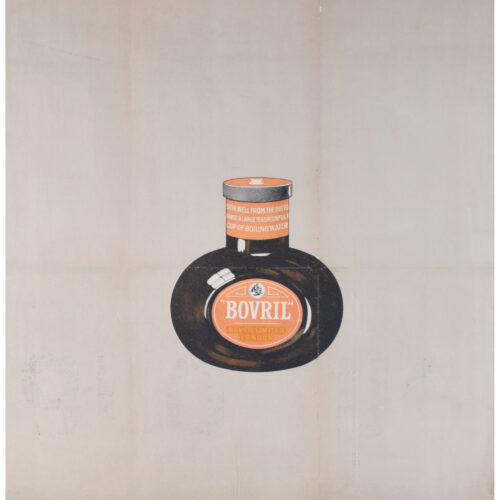
Bovril
Lithograph 75 x 73 cm An original advertisement for Bovril, featuring the brand's uniquely shaped amber glass bottle. One of the instructions for preparing the meat paste into a liquid is 'Stir Well from the Bottom', which went on to become a recognisable tagline for Bovril. Condition: old folds as issued; otherwise generally good. If you are interested, please email info@manningfineart.co.uk or call us on 07929 749056. Click here for other original vintage posters. -
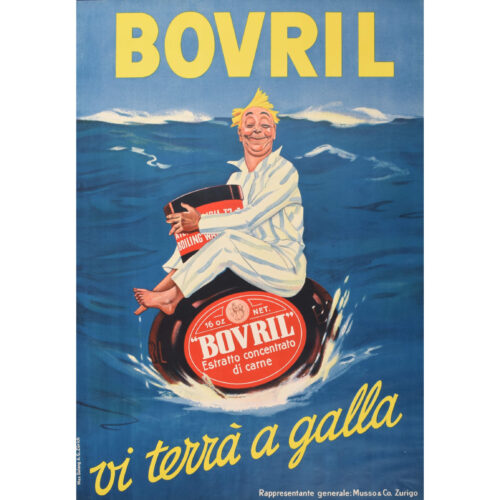
Herbert Harris (1888 - 1962)
Bovril - vi terra a galla ("Bovril keeps you afloat")
Lithograph 128 x 90 cm An original vintage poster advertising Bovril. The poster was designed in 1920 by notable poster artist Herbert Harris for the advertising agency S H Bentley. It originally read 'Bovril prevents that sinking feeling' in English. Bovril, says the poster, is the ultimate comfort, and will keep you going in adversity. The Italian version of the poster, published in the 1930s, instead supplied "Bovril - vi terra a galla" - "Bovril keeps you afloat". German and French versions with appropriate idioms were also produced; these European versions of the poster were Musso & Co. and designed by the Max Dalang Atelier, both in Zurich. Condition: generally very good; repaired tear from edge approx 4" long towards bottom on left side, essentially invisible. If you are interested, please email info@manningfineart.co.uk or call us on 07929 749056. Click here for other original vintage posters. -
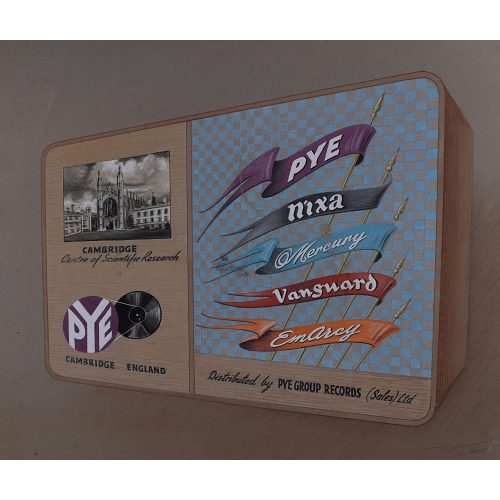
Bowens (British, fl. mid 20th Century) Cambridge: Centre of Scientific Research
Pye Group Records Pye - Nixa - Mercury - Vanguard - EmArcy c. mid-late 1950s Haig Road in Cambridge, where Pye had their factory, was subsumed into Elizabeth Way and was a long way from King's College chapel. However that iconic building is used to illustrate the Cambridge connection. EmArcy Records is a jazz record label founded in 1954 by Mercury Records. Mercury Record Corporation was founded in Chicago in 1945 Pye Records was a British record label; it had started life manufacturing televisions and radios, with its main plant off Haig Road in Cambridge. It purchased Nixa Records in 1953 Vanguard Records is a US record label set up in 1950 primarily as a classical label. If you are interested email info@manningfineart.co.uk or call us on 07929 749056. Condition: Good. -
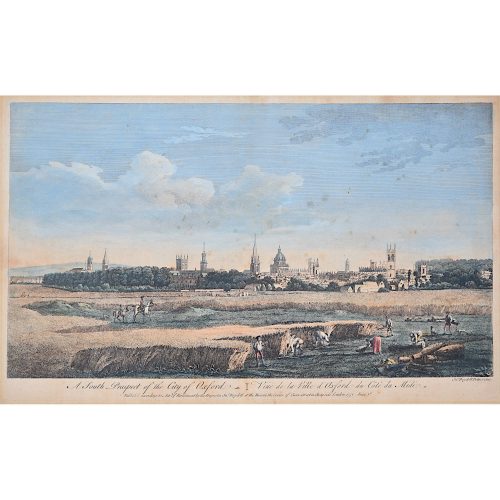
John Boydell (1719-1804)
A South Prospect of the City of Oxford
Hand-coloured engraving published 1751 in the series Four Views of Oxford 28x44.5cm If you are interested email info@manningfineart.co.uk or call us on 07929 749056. One of the most influential Georgian printsellers, Boydell was apprenticed to William Henry Toms at the age of 21, studying drawing at the St Marin's Lane Academy. From 1755 he imported foreign prints in great numbers. He became Mayor of London in 1790. -
 George Pyne (1800 - 1884) Brasenose College Quadrangle Watercolour 16 x 22 cm Signed and dated to lower right A well-executed watercolour of the quadrangle at Brasenose College, Oxford. Pyne expertly depicts the main gate with the Radcliffe Camera behind and the spire of the University Church of St Mary shrouded in a light mist. He also intriguingly captures the smaller details of the scene: a scholar in academic dress wandering around the periphery of the quad, the shadows and relief of a statue which no longer stands in the Old Court, the reflections in the old single-glazed windows. In doing so, he captures the unique charm of Brasenose College on this sunny day in the late 19th Century. George Pyne was related to two founders of the Society of Painters in Watercolours – William Henry Pyne was his father, and John Varley his father-in-law. Pyne trained as an architectural draughtsman and lived in Oxford from the 1850s until his death in 1884, specialising in views of the city and its colleges. His Oxford pictures are both architecturally-minded and romantically creative, often combining intensely detailed depictions of college buildings with imagined pedestrian scenes. Pyne was also noted for his views of Cambridge and Eton, and for his drawing manuals ‘A Rudimentary and Practical Treatise on Perspective for Beginners’ (1848) and ‘Practical Rules on Drawing for the Operative Builder, and Young Student in Architecture’ (1854); the latter texts offer an insight into his method of depicting architecture and its surroundings. Condition: Generally very good, a couple of spots to the sky.
If you would like to know more, please email info@manningfineart.co.uk or call us on 07929 749056.
-

John Hill (1770 - 1850) after Frederick Mackenzie (1788 - 1854) Brasenose College, Part of the Schools etc. Taken from the top of the Radcliffe Library (1813)
Hand-coloured aquatint 24 x 29 cm Published by Rudolph Ackermann (1764 - 1834). Frederick Mackenzie (circa 1788 - 1854) was a British watercolourist and architectural draughtsman. He first exhibited at the Royal Academy in 1804, and contributed eleven drawings between that year and 1828. He contributed to the Society of Painters in Water Colours exhibitions from 1813, becoming an associate in 1822, and a full member the following year. From 30 November 1831 until, his death he was treasurer to the society. In later life Mackenzie was no longer commissioned to illustrate books. John Hill was born in London in 1770, and was an engraver's apprentice. He worked in aquatint and largely produced book illustration aquatints. He went to America in 1816 and produced the notable Picturesque Views of American Scenery amongst other books of prints. Rudolph Ackermann was an Anglo-German bookseller, inventor, lithographer, publisher and businessman. In 1795 he established a print-shop and drawing-school at 96 Strand. Here Ackermann set up a lithographic press and began a trade in prints. He later began to manufacture colours and thick carton paper for landscape and miniature painters. Within three years the premises had become too small and he moved to 101 Strand, in his own words "four doors nearer to Somerset House", the seat of the Royal Academy of Arts. Between 1797 and 1800 Ackermann rapidly developed his print and book publishing business, encompassing many different genres including topography, caricature, portraits, transparencies and decorative prints. Condition: Generally very good, paper slightly toned within platemark.If you would like to know more, please email info@manningfineart.co.uk or call us on 07929 749056.
-

Pieter van der Aa (1659-1733), after David Loggan (1634–1692)
Brasenose College, Oxford (1727)
Engraving 12 x 16 cm An eighteenth-century view of 'Le Nez de Bronze', or Brasenose, engraved by Pieter van der Aa after David Loggan, the noted engraver, draughtsman, and painter. Pieter van der Aa of Leiden was a Dutch publisher best known for preparing maps and atlases, though he also printed editions of foreign bestsellers and illustrated volumes. He is noted for the many engravings he produced after David Loggan's series of Oxford and Cambridge colleges and costumes. In 1727 Van Der Aa illustrated "Les Delices de la Grande Bretagne & de L'Irelande" by James Beeverell, the book in which this engraving appears. Condition: a good impression. If you’d like to know more, please email info@manningfineart.co.uk or call us on 07929 749056. -

Joseph Skelton (1783 - 1871) after Frederick Mackenzie (1788 - 1854)
Brasenose College, Oxford with the Radcliffe Camera
Engraving 33 x 46 cm Published by Rudolph Ackermann (1764 - 1834). Frederick Mackenzie was a British watercolourist and architectural draughtsman. He first exhibited at the Royal Academy in 1804, and contributed eleven drawings between that year and 1828. He contributed to the Society of Painters in Water Colours exhibitions from 1813, becoming an associate in 1822, and a full member the following year. From 30 November 1831 until, his death he was treasurer to the society. In later life Mackenzie was no longer commissioned to illustrate books. Joseph Skelton was an a topographical and antiquarian engraver. He lived in Oxford for a time and became a Fellow of the Society of Antiquaries of London. His Oxford publications include the Oxonia Antiqua Illustrata; Antiquities of Oxfordshire, from drawings by F. Mackenzie; and the Pietas Oxoniensis, or Records of Oxford Founders. Rudolph Ackermann was an Anglo-German bookseller, inventor, lithographer, publisher and businessman. In 1795 he established a print-shop and drawing-school at 96 Strand. Here Ackermann set up a lithographic press and began a trade in prints. He later began to manufacture colours and thick carton paper for landscape and miniature painters. Within three years the premises had become too small and he moved to 101 Strand, in his own words "four doors nearer to Somerset House", the seat of the Royal Academy of Arts. Between 1797 and 1800 Ackermann rapidly developed his print and book publishing business, encompassing many different genres including topography, caricature, portraits, transparencies and decorative prints. Condition: generally very good; some staining to margins but print itself fine. If you are interested, please email info@manningfineart.co.uk or call us on 07929 749056. Click here for other Oxford views. -

Andrew Ingamells (1956 - )
Brasenose College, Oxford
Etching 41 x 61 cm Numbered 76/175 lower left and signed lower right, both in pencil. Inspired by David Loggan’s 17th-century engraving of Brasenose, this view is part of Ingamells’ series of views of Oxford and Cambridge. It has long-since sold out from the publisher. Ingamells trained at St Albans School of Art and the London College of Printing, subsequently working as a graphic designer and illustrator. Based in London, he began making drawings of the buildings and landscapes of London. Ingamells’ work is in many public collections including those of the Tate Gallery, The National Trust, The Paul Mellon Centre for British Art, and the City of London Guildhall Library. His pictures are also in several private collections, including those of various Oxford and Cambridge colleges, HRH King Charles III, and Shell Oil. The artist is currently part-way through his epic project to record all the colleges of Oxford and Cambridge, a project undertaken in homage to David Loggan. Condition: very good; small soft crease to top right corner which is essentially not noticeable. If you are interested, please email info@manningfineart.co.uk or call us on 07929 749056. Click here for other views of Brasenose College, Oxford. -
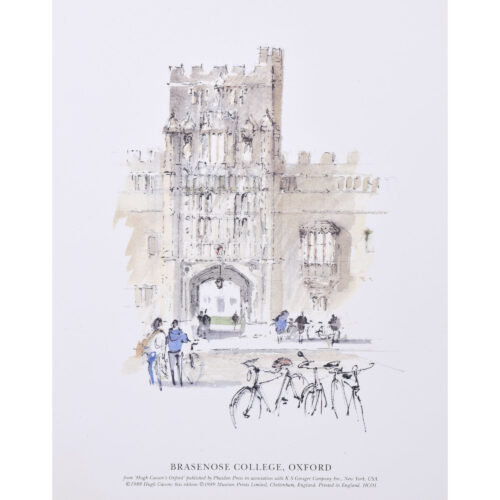
Hugh Casson (1910 - 1999)
Brasenose College, Oxford
Lithograph 30 x 24 cm Casson's view of Brasenose, complete with many a bicycle. Sir Hugh Casson was educated at Eastbourne College; St John’s College, Cambridge; and the Bartlett School of Architecture. Trained in the 1930s in the early modernist style, he taught at the Cambridge School of Architecture. After employment as a camoufleur during World War 2 by the Air Ministry, in 1948 he was appointed as director of architecture for the Festival of Britain. A close friend of the Royal Family, he undertook designs for the 1953 coronation, designed the interior of the Royal Yacht Britannia (“The overall idea was to give the impression of a country house at sea”), and taught the young Charles III to paint in watercolours. Amongst his architectural achievements are the Elephant House at London Zoo, the 1978 redevelopment of Bristol Docks, the Raised Faculty Building for The University of Cambridge, and a building for the Royal College of Art. He published a number of illustrated books, of which Casson’s Oxford and Casson’s Cambridge are probably the best known. A limited edition series of prints was produced from the paintings. Condition: very good; mounted to board. If you are interested, please email info@manningfineart.co.uk or call us on 07929 749056. Click here for other views of Brasenose College, Oxford. -

Braun & Hogenberg
Map of Cambridge
Engraving with later hand colouring 34 x 45 cm This map is taken from the Civitates Orbit Terrarium, also known as the ‘Braun & Hogenberg.’ This work is the culmination of a fifty year collaboration between Braun and Hogenberg, containing 546 prospects, bird’s-eye views and maps of cities from all around the world. Of these 546 works, 363 were engravings and this particular edition stands out as one of the beautiful and vibrant maps treated to meticulous hand-colouring. Georg Braun was born in Cologne in 1541 and worked as a topo-geographer. As principal editor of the work, he acquired the tables, hired the artists and cartographers and wrote the texts, including the Latin article on ‘Cantabrigia’ found on the reverse of this engraving. He died as an octogenarian in 1622, the only survivor of the original team to witness the publication of volume VI. Frans Hogenberg was born in 1535 in Mechelen in Flanders and worked as a painter, engraver and mapmaker. He was notably exiled from Antwerp in 1568 by the Duke of Alva because he was Protestant and had printed engravings sympathising with the Beeldenstorm (the Great Iconoclasm, a historical event in which many forms of church fittings and decoration were destroyed as part of the Protestant Reformation). He then moved to London for a brief period before settling in Cologne, where he worked with Braun on the Civitates. Condition: Generally very good. For other general views of Cambridge, click here. -
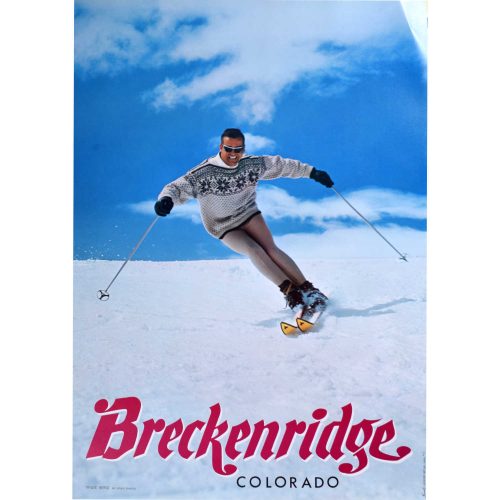
Breckenridge, Colorado Vintage Ski Poster USA (1967)
67 x 53 cm Printed by LooArt Press, Colorado Springs, Colorado, 1967 Travel poster for skiing in Breckenridge, Colorado, featuring a photograph of a smiling skier - Trygve Berge sporting Kneissl skis - and a rather cool pair of shades and jumper. Direct from the surplus stock of the printers, LooArt Press, which closed in the early 1970s. Condition: Excellent. -
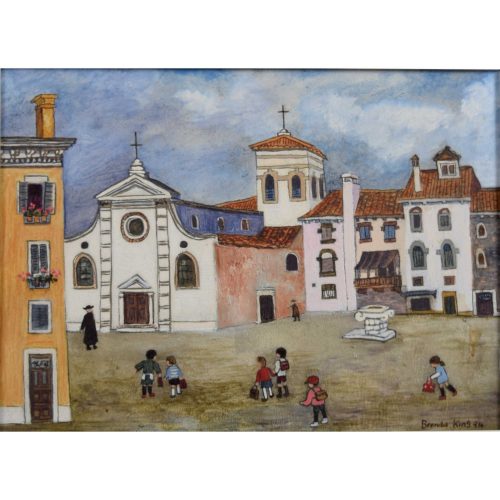
Brenda King (1934-2011)
Venetian Schoolchildren (1974)
Oil on board 16.5.x 20.5 cm Signed and dated lower right. Naive scene of school children in a Venetian square in a distinctive 1970s frame. Brenda King was born in Cumbria in 1934. She enrolled at the Lancaster College of Art from 1950 to 1954 before enrolling at the Royal Academy from 1954 to 1957, indeed, going on to exhibit frequently at the RA summer exhibition. She moved to Cornwall in 1975 with her landscape painter husband Jeremy King (b.1933), and the pair shared a studio in St Just, Lands End. Her distinctively naive and playful style, often capturing incidental figures in quaint, pastoral British scenes, is said to have been strongly influenced by the oils and watercolours of Helen Bradley (1900-1979), another Lancastrian. If you are interested e-mail info@manningfineart.co.uk or call us on 07929 749056 Condition: Generally excellent, original 1970s frame shows some wear. -
Out of stock
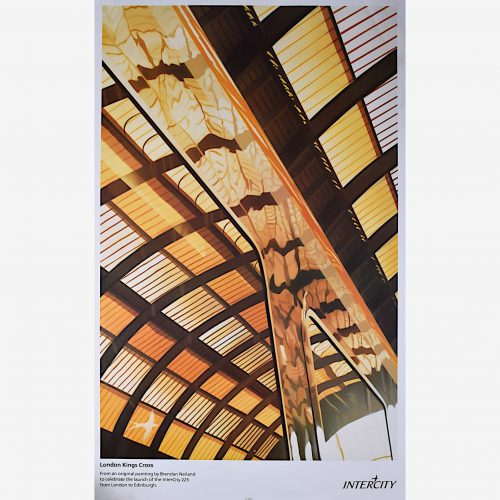
Brendan Neiland (b.1941)
Kings Cross Intercity Poster
Original Vintage Poster - lithograph 102x64cm (40×25 inches) each 1991 Click here for biographical details and other works by the artist. If you are interested email info@manningfineart.co.uk or call us on 07929 749056. -

Brendan Neiland (b.1941)
Original Designs for Intercity Posters - Edinburgh and York
Collage, spraypaint and cut out 91x58cm (36×23 inches) each 1991 Click here for biographical details and other works by the artist. If you are interested email info@manningfineart.co.uk or call us on 07929 749056. -
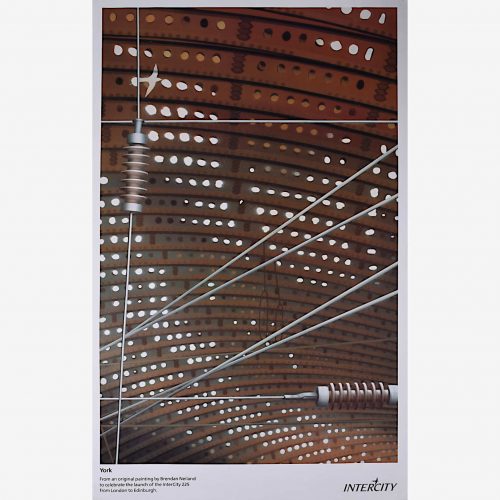
Brendan Neiland (b.1941)
York Intercity Poster
Original Vintage Poster - lithograph 102x64cm (40×25 inches) each 1991 Click here for biographical details and other works by the artist. If you are interested email info@manningfineart.co.uk or call us on 07929 749056. -
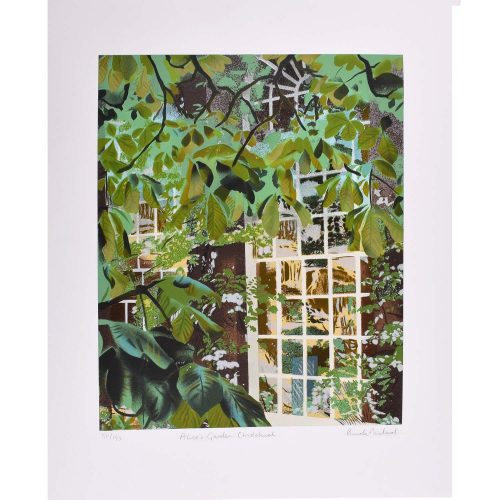
Brendon Neiland (b. 1941) Alice's Garden Oxford 50/195
Screenprint 66.5x57cm Here he surreally captures rippling reflection of Tom Tower in Christchurch. The style is emblematic of his later work that increasingly uses bold and dynamic colour palettes. For biographical details and other works by the artist click here. If you are interested email info@manningfineart.co.uk or call us on 07929 749056. Condition: Excellent. -
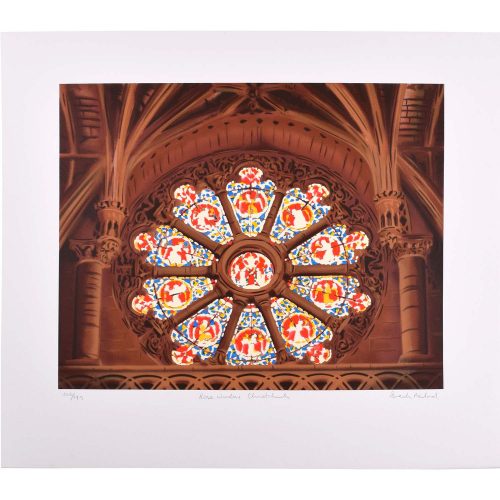
Brendon Neiland (b. 1941) Gilbert Scott's Rose Window Christ Church Oxford 106/195
Screenprint 66x58cm Here Neiland captures the colours of the new window installed in the cathedral by George Gilbert Scott (Junior) c. 1870. The style is emblematic of his later work that increasingly uses bold and dynamic colour palettes. For biographical details and other works by the artist click here. If you are interested email info@manningfineart.co.uk or call us on 07929 749056. Condition: Excellent. -
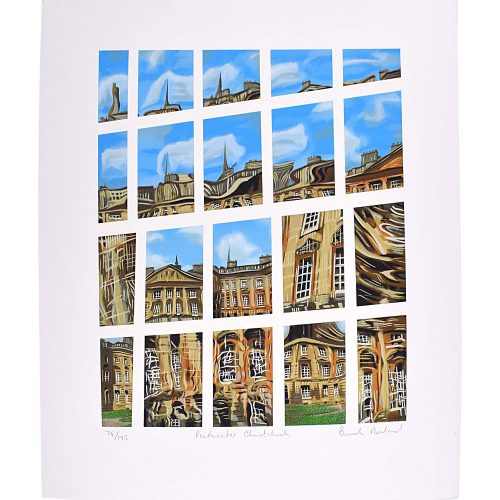
Brendon Neiland (b. 1941) Peckwater Christ Church 74/195
Screen print 68.5x56cm Here he surreally captures Peckwater Quad in Christchurch, experimenting with pictorial structure with vivacious dashes of blue, orange and yellow. It is emblematic of his later work that increasingly uses bold and dynamic colour palettes. For biographical details and other works by the artist click here. If you are interested email info@manningfineart.co.uk or call us on 07929 749056. Condition: Excellent. -
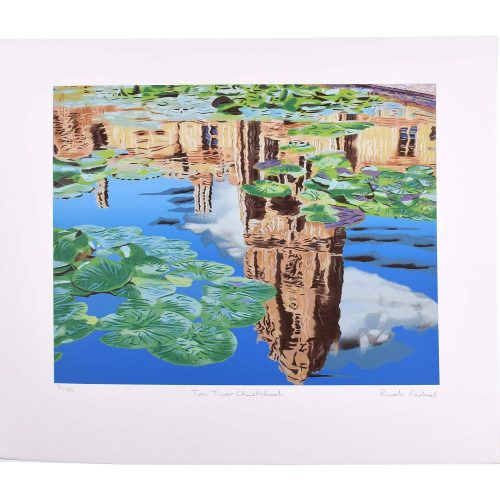 Brendon Neiland (b. 1941) Tom Tower Christ Church 38/195 Screenprint 66x58cm Here he surreally captures rippling reflection of Tom Tower in Christchurch. The style is emblematic of his later work that increasingly uses bold and dynamic colour palettes. For biographical details and other works by the artist click here. If you are interested email info@manningfineart.co.uk or call us on 07929 749056. Condition: Excellent.
 -
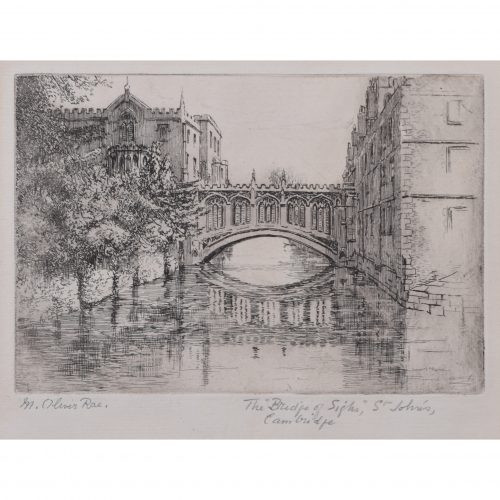
Mabel Oliver Rae (1868 - 1956)
The Bridge of Sighs, St John's College, Cambridge (circa 1920)
Etching 13 x 18 cm Hand-signed in pencil lower left, and titled in pencil lower right. Initialled 'MR' in plate lower left. The Bridge of Sighs is an iconic feature of St John’s College, and one of the most recognisable pieces of architecture in Cambridge. It was built in 1831 by the architect Henry Hutchinson and crosses the River Cam between the college's Third Court and New Court. It is the only covered bridge to cross the River Cam, and the only College bridge built in the Victorian Gothic style. Mabel Oliver Rae was born in Cambridge, Cambridgeshire, and trained at the Slade School of Fine Art between 1888 and 1890. Rae is known for her skilled etchings of various rural scenes and townscapes, particularly those of the colleges of Oxford and Cambridge. She signed works with the pseudonym 'M.Oliver Rae', a ruse to conceal the fact she was a female artist, so as not to reduce her chances with commercial dealers and agents. Condition: even age toning, a little spotting, generally good. If you’d like to know more, please email info@manningfineart.co.uk or call us on 07929 749056. -

Frank Wootton (1914 - 1998)
Britain Delivers the Goods Thanks to the British Navy
Original vintage poster 10 x 15 cm Frank Wootton OBE was an aviation artist, famous for his works depicting the Royal Air Force during the Second World War. He studied at the Eastbourne School of Art and created the bestselling book How to Draw Aircraft in 1939. He became a war artist for the RAF and Royal Canadian Air Force, painting RAF subjects from England to France and Belgium before travelling to Southeast Asia at the end of the Second World War. The 1983 inaugural of the National Air and Space Museum featured an exhibition on Wootton's work. Condition: very good. If you are interested, please email info@manningfineart.co.uk or call us on 07929 749056. Click here for other original vintage WW2 posters. -
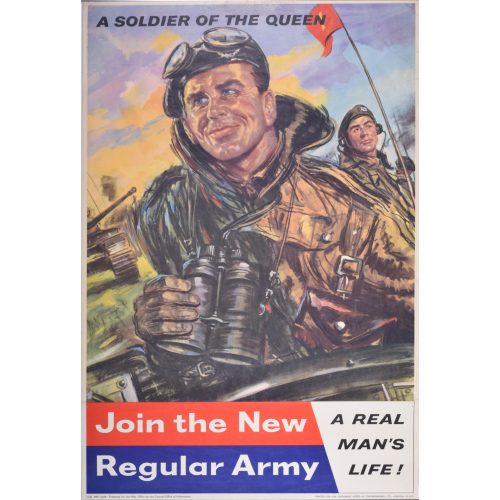
Attributed to John Worsley
Join the New Regular Army - A Real Man's Life
Published by Her Majesty’s Stationery Office. Printed by Chromoworks Limited, 1959 Lithographic poster 75x50cm Worsley was a war artist during World War II who was captured by the Germans and then an illustrator for Eagle comic. Click here for further biographical details and other posters by Worsley. The Soldier of the Queen depicted is a tank commander. At the time the poster was printed the main location for deployment of tanks was West Germany. In 1946 the British Army of the Rhine was created to protect Germany - and indeed Europe - from a Soviet invasion. Numbering up to 80,000 soldiers it was estimated that in the event of war the life expectancy of a tank commander would be less than two days. A Real Man's Life indeed. If you are interested email info@manningfineart.co.uk or call us on 07929 749056. -
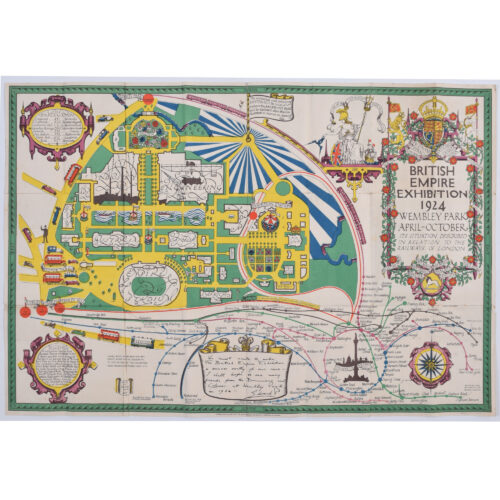
Stanley Kennedy North (1887 - 1942)
British Empire Exhibition Map (1924)
Lithograph 51 x 75 cm This fascinating and attractive map with elaborate cartouche highlights the attractions of the British Empire Exhibition, a showcase held in London to exhibit the fruits of Britain's overseas colonies. It was designed to boost support for the Empire's activities, encourage trade of imperial goods, and remind other world powers of Britain's (historic) colonial capacity. The Empire Stadium was built especially to house the exhibition; it is known today as Wembley Stadium. The exhibition was opened by King George V on St George's Day, 1924. Condition: generally good; folds as issued; a few short tears at corners. If you are interested, please email info@manningfineart.co.uk or call us on 07929 749056. Click here for other original vintage posters. -

Vivan Bewick British light tanks
Gouache 17 x 25 cm This striking gouache depicts two British light tanks in formation. Bewick captures the details of these vehicles seemingly with ease, using contrasts between lighter and darker colours to create a sense of depth. In this unique composition, he also exploits gouache as a medium, exploiting its opaqueness as he depicts the tanks whipping up the sand beneath them. Vivian Bewick (1912–1999) was a British artist and educator, notable for his contributions to mid-20th-century art and his role as a tutor at the Buckhurst Hill Community Association (BHCA). He was also a descendant of Thomas Bewick, the renowned 19th-century engraver celebrated for his depictions of birds and animals. While fulfilling his military duties in the Royal Artillery during the Second World War, Bewick maintained his artistic pursuits. He contributed to the wall-newspaper "Swillbin," a tradition from the First World War, and designed army Christmas cards. Additionally, he illustrated technical manuals and conducted art classes and exhibitions, with critiques by James Bateman R.A. After the war, Bewick continued his artistic education and career, spending five years at St. Martin’s School of Art and London University. He also engaged in part-time teaching of adults in art clubs, societies, and colleges and exhibited at the Royal Academy, the Paris Salon, the Royal Institute of Painters in Watercolours, and the Royal Society of British Artists. Condition: Generally very good, slight age toning, mounted to board. If you are interested, please email info@manningfineart.co.uk or call us on 07929 749056. -
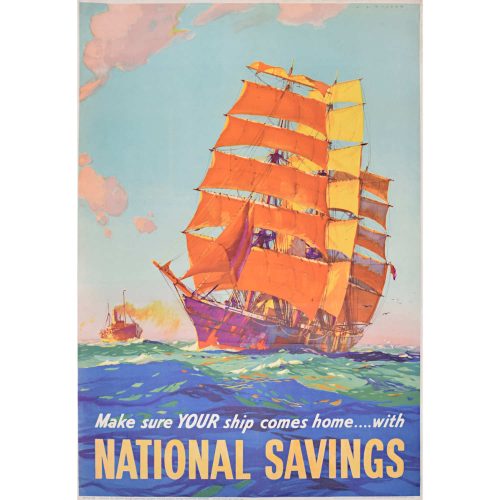
Leslie Arthur Wilcox RI RSMA (1904-1982) National Savings - Make Sure Your Ship Comes In
c.1945 75x50cm Original Vintage Poster During World War 2, the British Government had two particular financial problems addressed by this poster. There was little to buy, so the general populace had surplus cash to spend. If they spent it, this would be inflationary and would reduce the supply of items. Likewise, the Government needed money to spend on materiel and was short of cash. Encouraging the population to lend its spare cash to the Government was therefore a solution to this problem, and a series of posters - and other advertisings campaigns - aimed to address this point. For biographical details and other works by the artist click here. If you are interested email info@manningfineart.co.uk or call us on 07929 749056. Condition: Good. A few tiny tears to margin, not into image. -
Out of stock

John Hoyland (1934-2011) Brown, Beige, Pink (1971)
Screenprint 52 x 70 cm Signed and dated to lower right, numbered 95/100 'Brown, Beige, Pink' is an intriguing composition, featuring an abstract mass of gentle tones. It exemplifies Hoyland's exploration of colour and form, featuring bold geometric shapes in earthy tones juxtaposed against vibrant hues. The composition invites viewers to engage with the interplay of colours and the spatial tension between the forms. The work itself is part of a limited edition series, with known editions held in prestigious collections such as the Yale Center for British Art, the Tate, and the Carnegie Museum of Art. John Hoyland was a leading British abstract artist, renowned for his bold use of color and dynamic compositions. Born on October 12, 1934, in Sheffield, England, he studied at Sheffield School of Art before attending the Royal Academy Schools in London. Initially influenced by figurative painting, he transitioned to abstraction after being inspired by American Abstract Expressionists such as Mark Rothko and Barnett Newman. Hoyland gained recognition in the 1960s, becoming one of Britain’s foremost abstract painters. His work is characterised by vibrant, large-scale canvases with striking geometric and gestural elements. In 1967, he represented Britain at the São Paulo Biennale, and in 1982, he was elected a Royal Academician. His career spanned decades, with major exhibitions at institutions like the Tate and the Royal Academy of Arts. Hoyland remained a committed advocate for non-figurative painting, rejecting minimalism in favour of emotional depth and expressive colour. He passed away on July 31, 2011, leaving behind a legacy as one of Britain’s most significant post-war abstract artists. -
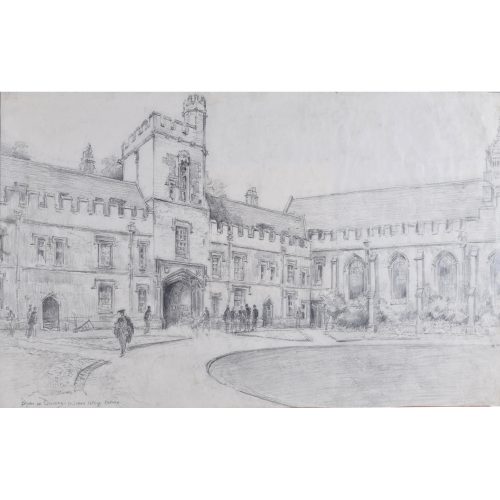
Bryan de Grineau (1883-1957)
St John’s College, Oxford for The Illustrated London News
Front Quad
Signed and inscribed Pencil Drawing published in The Illustrated London News 18 June 1955 33 x 52 cm (13 x 20.5 in.) Click here for other views of St John’s College by this artist and biographical details. If you are interested email info@manningfineart.co.uk or call us on 07929 749056. -
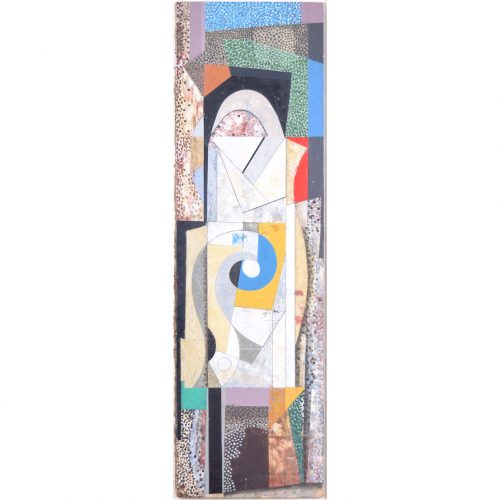
Bryan Ingham (1936-1997)
Upright Jug (1993-95)
Pencil and oil on board 64 x 19 cm Provenance: Bohun Galleries, Paintings in Hospitals. Signed, titled and dated 1993-95 (on backboard). Bryan Ingham was born in Yorkshire. For his National Service he joined the RAF, and spent his time in Germany as an airman. After demobilisation, his final report included the statement that "Ingham is an artistic sort of airman." In his spare time he had started painting in oils, and by the time he left the RAF he had completed a large number of paintings. He studied at St Martin's School of Art in London, where he had the tuition of a fine post-war generation of teachers who helped him to hone his draughtsmanship and other skills, and he swiftly showed a capacity for painting that drew the attention of his tutors and peers. On graduating he was offered and accepted a post-graduate place at the Royal College of Art, where in his second year he was awarded a Royal Scholarship and was a contemporary of a number of now better-known names including David Hockney. Ingham applied for and received a Leverhulme travel award to explore the sites of the great Renaissance painters, and spent many happy months engaged in this expedition. He spent time at the English Art school in Rome, where he lived well and busied himself the same studio that Barbara Hepworth had used. At this stage of his career, Ingham consciously rejected the prospect of pursuing a career as an establishment artist, although the RA was open to him, and he went to live in remote cottage in Cornwall. The subsequent years were varied and highly productive, and Ingham's personal artistic voice emerged in his oeuvre in the form of an always-developing dialogue with influences both of landscape and other artists of every age. His preoccupation with etching resulted in several hundred plates, some very large, and the results are as unmistakable as they are varied, but invariably of outstanding quality. He produced a number of sculptures in bronze and in plaster, while his lifelong output of paintings remained small but again of very high quality. He taught etching regularly until about 5 years before his death, latterly at Falmouth Art School, and also at Farnham Art College. During the late eighties he established a relationship with the art dealer Francis Graham-Dixon, who had a London gallery. This meant that his paintings were professionally marketed for the first time, and prices for his work rose steadily in the last ten years of his life, and subsequently. He was able to purchase a cottage in Helston for his parents, who lived there until their deaths. He then moved into a fine set of converted-barn studios with a patch of garden, quietly situated off the High St in Helston, and it was here, on 22 September 1997, that he died, having quietly suffered from cancer for nearly a year. If you'd like to know more, please email info@manningfineart.co.uk or call us on 07929 749056. Condition: Generally excellent; framed. -
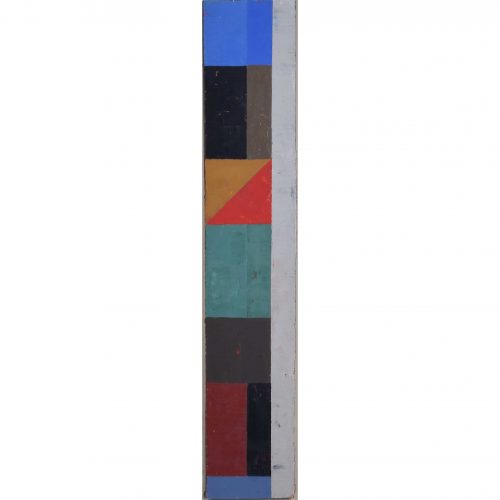
Bryan Ingham (1936-1997)
Erotisches Bild (1988)
Oil on board 62 x 11 cm Provenance: Fracis Graham-Dixon gallery. Titled to backboard and dated 1988. Bryan Ingham was born in Yorkshire. For his National Service he joined the RAF, and spent his time in Germany as an airman. After demobilisation, his final report included the statement that "Ingham is an artistic sort of airman." In his spare time he had started painting in oils, and by the time he left the RAF he had completed a large number of paintings. He studied at St Martin's School of Art in London, where he had the tuition of a fine post-war generation of teachers who helped him to hone his draughtsmanship and other skills, and he swiftly showed a capacity for painting that drew the attention of his tutors and peers. On graduating he was offered and accepted a post-graduate place at the Royal College of Art, where in his second year he was awarded a Royal Scholarship and was a contemporary of a number of now better-known names including David Hockney. Ingham applied for and received a Leverhulme travel award to explore the sites of the great Renaissance painters, and spent many happy months engaged in this expedition. He spent time at the English Art school in Rome, where he lived well and busied himself the same studio that Barbara Hepworth had used. At this stage of his career, Ingham consciously rejected the prospect of pursuing a career as an establishment artist, although the RA was open to him, and he went to live in remote cottage in Cornwall. The subsequent years were varied and highly productive, and Ingham's personal artistic voice emerged in his oeuvre in the form of an always-developing dialogue with influences both of landscape and other artists of every age. His preoccupation with etching resulted in several hundred plates, some very large, and the results are as unmistakable as they are varied, but invariably of outstanding quality. He produced a number of sculptures in bronze and in plaster, while his lifelong output of paintings remained small but again of very high quality. He taught etching regularly until about 5 years before his death, latterly at Falmouth Art School, and also at Farnham Art College. During the late eighties he established a relationship with the art dealer Francis Graham-Dixon, who had a London gallery. This meant that his paintings were professionally marketed for the first time, and prices for his work rose steadily in the last ten years of his life, and subsequently. He was able to purchase a cottage in Helston for his parents, who lived there until their deaths. He then moved into a fine set of converted-barn studios with a patch of garden, quietly situated off the High St in Helston, and it was here, on 22 September 1997, that he died, having quietly suffered from cancer for nearly a year. Condition: Generally very good, scrapes to board as intended by artist. Framed. If you'd like to know more, please email info@manningfineart.co.uk or call us on 07929 749056. -
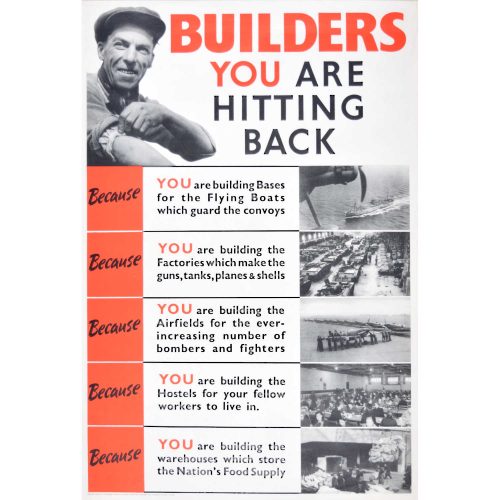
Builders YOU Are Hitting Back Original WW2 Poster (c.1940)
'Builders - YOU Are Hitting Back' Original WW2 Poster (c.1940) 76 x 50.5 cm Lithograph and letterpress (on paper) Printed by Lowe and Brydone Printers Ltd, London NW10. Published by HM Stationery Office. Because: You are building bases for the Flying Boats which guard the convoys You are building the Factories which makes the guns, tanks, planes & shells You are building the Airfields for the ever increasing number of bombers and fighters - Spitfire You are building the Hostels for your fellow workers to live in You are building the warehouses which store the Nation's Food Supply -
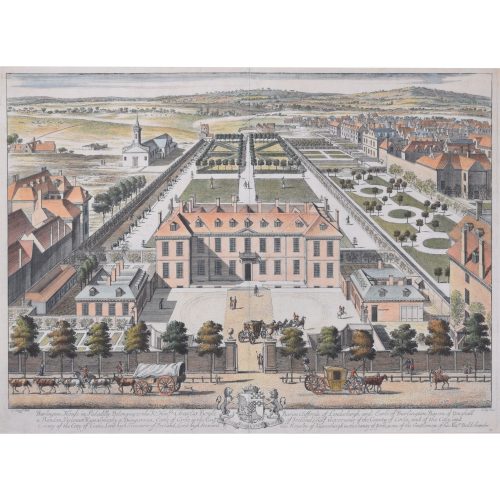
Johannes Kip (1652 - 1722) and Leonard Knyff (1650 - 1722)
Burlington House (1707)
Engraving with later hand-colouring 36 x 50 cm The linked careers of Jan Kip and Leonard Knyff made a specialty of engraved views of English country houses, represented in detail from the bird's-eye view, a pictorial convention for topography. Their major work was Britannia Illustrata: Or Views of Several of the Queens Palaces, as Also of the Principal seats of the Nobility and Gentry of Great Britain, Curiously Engraven on 80 Copper Plates, London (1707, published in the winter of 1708-9). The volume is among the most important English topographical publications of the 18th century. Architecture is rendered with care, and the settings of parterres and radiating avenues driven through woods or planted across fields, garden paths, gates and toolsheds are illustrated in detail. The images are staffed with figures and horses, coaches pulling into forecourts, water-craft on rivers, in line with the traditions of the Low Countries. The inscription in the plate reads: Burlington House in Pickadilly Belonging to the R.t Honble Charles Boyle Baron Clifforde of Londesburgh, and Earle of Burlington Baron of younghall & Bandon, Viscount Kynalmeaky & Dungarvan, Earle of Corke in the Kingdom of Ireland, Chief Governour of the County of Corke, and the Citty, and County of the Citty of Corke, Lord high Treasurer of Ireland, Lord high Steward of the Royalty of Knaresburgh in the County of Yorke, & one of the Gentlemen of his Majties Beddchamber. Condition: recent hand colouring, with wash-lined mount. If you’d like to know more, please email info@manningfineart.co.uk or call us on 07929 749056. -

A. E. Halliwell (1905-1987) Buy From Our Own Empire the Best Market (in blue)
Gouache 19 x 76 cm c.1930 Design for Empire Marketing Board Provenance: Family of the artist A.E. Halliwell (1905–1986) was a British artist, illustrator, and designer best known for his vibrant poster designs created for British railway companies during the mid-20th century. Born in Southport, Halliwell developed a strong foundation in art and design early in life. He studied at the Southport School of Art from 1923 to 1926 before graduating to the Royal College of Art in London and subsequently practising as a professional designer from the 1930s. Following his studies, Halliwell married Doris Doyle in Strood Kent, and went on to have a significant teaching career himself, most notably as a lecturer at the Central School of Arts and Crafts (later part of Central Saint Martins), where he influenced a new generation of designers and illustrators. Halliwell is perhaps best remembered for his vibrant and engaging poster designs created for British railway companies during the 1930s. His work was characterised by a bright, graphic style that balanced charm with clarity, often depicting idealised scenes of British holiday destinations—from sunny seaside towns to tranquil countryside vistas. Beyond posters, his artistic output included book illustration, commercial design, and stage costume sketches, showcasing his versatility across mediums. His posters continue to remain enduring symbols of a golden age of British travel and design and are displayed in major collections including the London Transport Museum and the V & A. This bold poster design by A. E. Halliwell uses vibrant blue and layered text to promote trade within the British Empire. Featuring variations of the Union Jack across all four panels, the design reinforces imperial unity with the slogan “Buy from our own Empire – the best market.” Condition: Generally very good.If you would like to know more, please email info@manningfineart.co.uk or call us on 07929 749056.
-

A. E. Halliwell (1905-1987) Buy From Our Own Empire the Best Market (in black)
Gouache 19 x 76 cm c.1930 Design for Empire Marketing Board Provenance: Family of the artist A.E. Halliwell (1905–1986) was a British artist, illustrator, and designer best known for his vibrant poster designs created for British railway companies during the mid-20th century. Born in Southport, Halliwell developed a strong foundation in art and design early in life. He studied at the Southport School of Art from 1923 to 1926 before graduating to the Royal College of Art in London and subsequently practising as a professional designer from the 1930s. Following his studies, Halliwell married Doris Doyle in Strood Kent, and went on to have a significant teaching career himself, most notably as a lecturer at the Central School of Arts and Crafts (later part of Central Saint Martins), where he influenced a new generation of designers and illustrators. Halliwell is perhaps best remembered for his vibrant and engaging poster designs created for British railway companies during the 1930s. His work was characterised by a bright, graphic style that balanced charm with clarity, often depicting idealised scenes of British holiday destinations—from sunny seaside towns to tranquil countryside vistas. Beyond posters, his artistic output included book illustration, commercial design, and stage costume sketches, showcasing his versatility across mediums. His posters continue to remain enduring symbols of a golden age of British travel and design and are displayed in major collections including the London Transport Museum and the V & A. This bold poster design by A. E. Halliwell uses vibrant blue and black with layered text to promote trade within the British Empire. Featuring variations of the Union Jack across all four panels, the design reinforces imperial unity with the slogan “Buy from our own Empire – the best market.” Condition: Generally very good.If you would like to know more, please email info@manningfineart.co.uk or call us on 07929 749056.
-
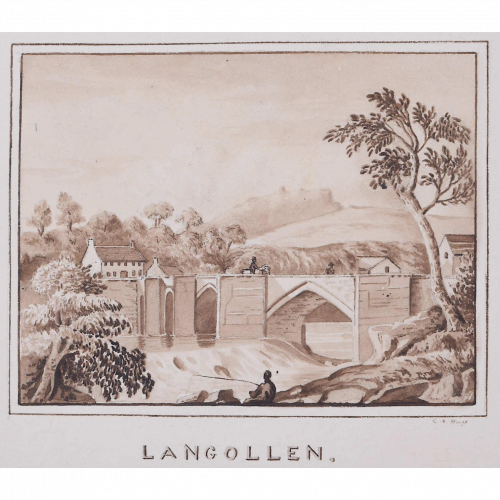
C.A. Hay
Llangollen Bridge, Wales (early 19th century)
Pen, ink and monochrome watercolour 8 x 12 cm Llangollen Bridge is built across the River Dee at the North end of the high street of Llangollen in the county of Denbigshire in Wales. The Bridge is listed as one of the seven wonders of Wales and is Grade I listed. There has been a bridge across the Dee at Llangollen since at least 1284. Some historians believe that the bridge was constructed in the 1540s; there is evidence of sepulchral slabs within the bridge's masonry, indicating that it was rebuilt following the dissolution of Henry VIII's dissolution of the monasteries. We also have in stock an en-suite watercolour of the nearby Valle Crucis abbey, from which some of the bridge's stone might have been taken. Condition: Generally very good. Signed lower right. -
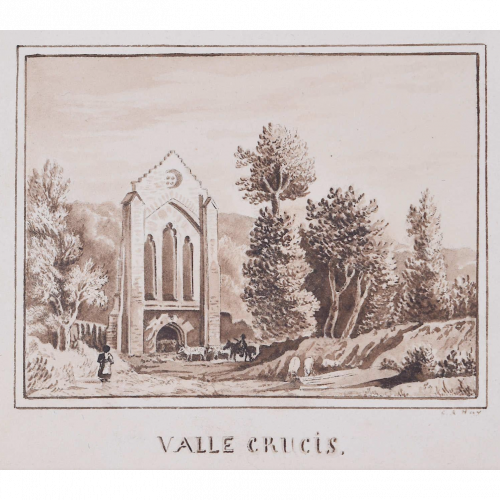
C.A. Hay
Valle Crucis Abbey, Wales (early 19th century)
Pen, ink and monochrome watercolour 8 x 12 cm Valle Crucis is a Cistercian abbey located in Llantysilio in Denbighshire, Wales. The abbey was built in 1201 by Madog ap Gruffydd Maelor, Prince of Powys Fadog. In 1537, at the height of Henry VIII's Dissolution of the Monasteries, Valle Crucis was dissolved and fell into disrepair. The abbey is now a ruin, though large parts of the original structure still survive. We also have in stock an en-suite watercolour of the nearby Llangollen Bridge; it is likely that some of the abbey's stone was used to build the bridge after the abbey had been dissolved. Condition: Generally very good. Signed lower right. -
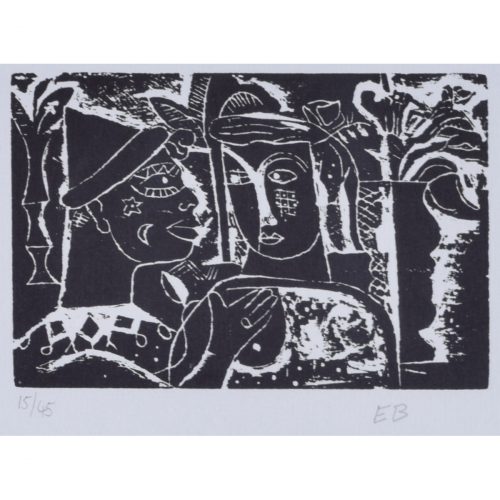
Edward Burra (1905 - 1976)
Café
(1928 - 1929, this edition published 1971) Woodcut 10 x 15 cm; sheet size 24 x 34 cm Numbered 15/45 lower left and initialled EB lower right. Published by the Nicholas Treadwell Gallery in 1971. Burra's woodcut of a male and a female figure, entitled 'Café'. The two figures, seemingly a couple, gaze at one another intensely and intimately, giving the impression of having been interrupted by the viewer. Both figures' faces bear tattoo-like markings: he a star and the moon, she a geometric design resembling a noughts-and-crosses board. The "café" in which they sit is a dreamily abstract landscape full of palms and other plants from the tropics. Edward Burra was an English painter, draughtsman, and printmaker. He travelled to Italy in 1925, the same year he met the noted British Surrealist Paul Nash, and both of these influences are evident in this woodcut. Nash introduced Burra to woodcut-making in 1928, the same year that Burra began this woodcut series. His first solo show was held at the Leicester Galleries in April 1929, and he exhibited with the English Surrealists in the 1930s. Condition: Excellent. If you’d like to know more, please email info@manningfineart.co.uk or call us on 07929 749056. -
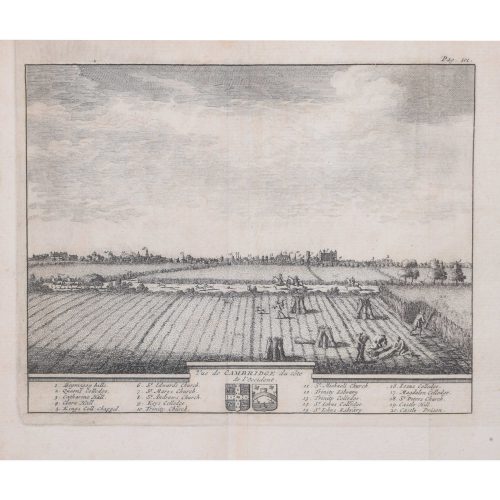
Pieter van der Aa (1659-1733), after David Loggan (1634–1692)
Cambridge from the East (1727)
Engraving 12 x 16 cm An eighteenth-century view of Cambridge from the East, engraved by Pieter van der Aa after David Loggan, the noted engraver, draughtsman, and painter who specialised in engravings of Oxford and Cambridge. A wide Cambridgeshire sky opens out over the harvest scene; in the background, the spires of the city's skyline are numbered, and identified below. A fascinating engraving which muses on the relationship between the city and its University. Pieter van der Aa of Leiden was a Dutch publisher best known for preparing maps and atlases, though he also printed editions of foreign bestsellers and illustrated volumes. He is noted for the many engravings he produced after David Loggan's series of Oxford and Cambridge colleges and costumes. In 1727 Van Der Aa illustrated "Les Delices de la Grande Bretagne & de L'Irelande" by James Beeverell, the book in which this engraving appears. Condition: generally very good. If you’d like to know more, please email info@manningfineart.co.uk or call us on 07929 749056. -
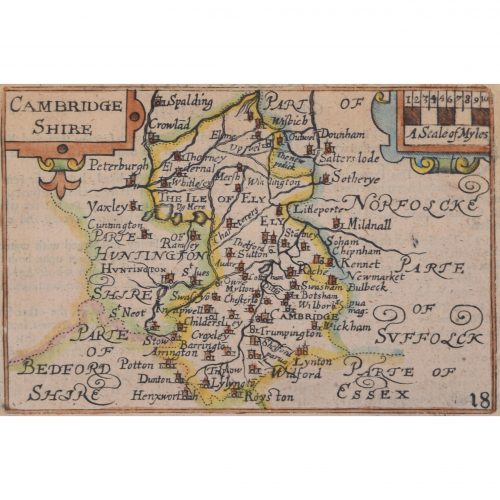
Pieter van den Keere (1571 - circa 1646) after John Speed (1551 or 1552 - 1629)
Map of Cambridgeshire (1627)
Engraving 8 x 12 cm A beautifully coloured map of Cambridgeshire, with an antique description of the county to the reverse. The map, along with many others, was published in Speed's atlas, 'The Theatre of the Empire of Great Britaine', first published in 1611. This particular miniature edition of the 'Theatre' was published in miniature by George Humble in 1627, entitled 'England Wales Scotland and Ireland Described and Abridged With ye Historic Relation of things worthy memory from a farr larger Voulume. Done by John Speed.’ Speed's original map was likely engraved for this edition by Peter van den Keere. van den Keere's maps soon came to be known as "Miniature Speeds". John Speed was an English cartographer, chronologer and historian. The son of a citizen and Merchant Taylor in London, he rose from his family occupation to accept the task of drawing together and revising the histories, topographies and maps of the Kingdoms of Great Britain as an exposition of the union of their monarchies in the person of King James I and VI. He accomplished this with remarkable success, with the support and assistance of the leading antiquarian scholars of his generation. He drew upon and improved the shire maps of Christopher Saxton, John Norden and others, being the first to incorporate the hundred-boundaries into them, and he was the surveyor and originator of many of the town or city plans inset within them. His work helped to define early modern concepts of British national identity. His Biblical genealogies were also formally associated with the first edition of the King James Bible. He is among the most famous of English mapmakers. George Humble (1572 - 1640) was an English publisher, known for his publication of John Speed's 'The theatre of the empire of Great Britaine,' the first comprehensive atlas depicting the British Isles, and his later 'A prospect of the most famous parts of the World,' the first English world atlas. Pieter van den Keere was a Flemish engraver, publisher, and globe maker who worked in England and the Dutch Republic. Condition: generally very good; some age toning. If you’d like to know more, please email info@manningfineart.co.uk or call us on 07929 749056.