• Laurence Dunn (1910 - 2006) HMS Hermes

    Pencil drawing 20 x 38 cm A vibrantly coloured lithograph depicting the HMS Hermes with illustrations of uniforms on the HMS Hermes to the reverse. As per Dunn's notes, this lithograph was produced for the builders and admiralty following the ship's reconstruction. HMS Hermes (R12) was a Centaur-class aircraft carrier of the British Royal Navy, commissioned in 1959. It served in multiple roles over its career, including as a strike carrier, commando carrier, and anti-submarine warfare carrier. It was originally commissioned in 1959 and was designed as a as a strike carrier for fixed-wing aircraft. During the 1980s it served as the flagship of the British task force against Argentina, playing a crucial role in air defence and amphibious operations. It was eventually sold to India in 1987 and was recommissioned as INS Viraat, before being taken out of service in 2017. Laurence Dunn was a well-known British marine artist and writer known for his depictions of ships. He grew up in Devon, where he practised drawing passing ships, and went on to study at the Central School of Art. He then worked for shipbuilding firm John I. Thornycroft & Company Limited, where he contributed to the design of the Royal Yacht. During the Second World War, Dunn worked in naval intelligence. In the early 1960s, he created many line drawings of Atlantic ocean liners. Upon his death in 2006, the World Ship Society published the following obituary: DUNN, Laurence. [December 15 2006 — Lloyds List] Many readers will be saddened by the death of well-known marine artist and writer Laurence Dunn in his 97th year. A man of encyclopaedic knowledge, he began his lifelong love of ships in Brixham, where he meticulously recorded passing traffic with the exquisitely accurate line drawings which later became something of a trademark. While studying at London’s Central School of Art his work was noticed by the Southern Railway, which commissioned profiles of its fleet, and this in turn led to work for Orient Line, where he also designed the well-known corn-coloured hull, and later Thorneycroft, where he helped with shaping draft plans for a new royal yacht. During the second world was he worked for naval intelligence at the Admiralty, where his technique did much to improve recognition standards, and greatly expanded his shipping clientele, becoming personally known to many chairmen. As well as the shipping press he worked for mainstream publications such as Everybody’s, Sphere and the upmarket comic Eagle. Through his many contacts he enjoyed going to sea in a great variety of ships from aircraft carriers to colliers. Laurence wrote several books, starting with ship recognition titles which introduced new standards of layout, but his best known work was probably Passenger Liners, which was widely taken up by the travel trade. His love of Greece, where he was an early publicist of island cruising, let to involvement in reshaping various passenger liners beginning with Greek Line’s OLYMPIA. In later life he designed several sets of shipping stamps for the Crown Agents, produced photographic volumes on Thames and Mediterranean shipping and still found time to enjoy the passing Thames traffic. Our sympathies go to his wife Jennifer, who provided succour to the many ship lovers who beat a path to the welcoming door of their Gravesend home. Condition: Generally very good.

    If you would like to know more, please email info@manningfineart.co.uk or call us on 07929 749056.

  • Laurence Dunn (1910 - 2006) Naess Sovereign

    Pencil drawing 29 x 43 cm A vibrantly coloured lithograph depicting the Naess Sovereign at sea. The Naess Sovereign was originally built in 1961 by Mitsubishi Zosen, Nagasaki. When delivered, she was the third largest vessel in the world, and the largest vessel under British flag. In 1963, she was then followed by her sister vessel: the Naess Champion. Both ships were owned by the Naess group, one of the largest private shipping countries in the world. They were subsequently sold to Burmah Oil and the Sovereign was eventually laid up in 1975 and broken up in 1977. Laurence Dunn was a well-known British marine artist and writer known for his depictions of ships. He grew up in Devon, where he practised drawing passing ships, and went on to study at the Central School of Art. He then worked for shipbuilding firm John I. Thornycroft & Company Limited, where he contributed to the design of the Royal Yacht. During the Second World War, Dunn worked in naval intelligence. In the early 1960s, he created many line drawings of Atlantic ocean liners. Upon his death in 2006, the World Ship Society published the following obituary: DUNN, Laurence. [December 15 2006 — Lloyds List] Many readers will be saddened by the death of well-known marine artist and writer Laurence Dunn in his 97th year. A man of encyclopaedic knowledge, he began his lifelong love of ships in Brixham, where he meticulously recorded passing traffic with the exquisitely accurate line drawings which later became something of a trademark. While studying at London’s Central School of Art his work was noticed by the Southern Railway, which commissioned profiles of its fleet, and this in turn led to work for Orient Line, where he also designed the well-known corn-coloured hull, and later Thorneycroft, where he helped with shaping draft plans for a new royal yacht. During the second world was he worked for naval intelligence at the Admiralty, where his technique did much to improve recognition standards, and greatly expanded his shipping clientele, becoming personally known to many chairmen. As well as the shipping press he worked for mainstream publications such as Everybody’s, Sphere and the upmarket comic Eagle. Through his many contacts he enjoyed going to sea in a great variety of ships from aircraft carriers to colliers. Laurence wrote several books, starting with ship recognition titles which introduced new standards of layout, but his best known work was probably Passenger Liners, which was widely taken up by the travel trade. His love of Greece, where he was an early publicist of island cruising, let to involvement in reshaping various passenger liners beginning with Greek Line’s OLYMPIA. In later life he designed several sets of shipping stamps for the Crown Agents, produced photographic volumes on Thames and Mediterranean shipping and still found time to enjoy the passing Thames traffic. Our sympathies go to his wife Jennifer, who provided succour to the many ship lovers who beat a path to the welcoming door of their Gravesend home. Condition: Generally very good.

    If you would like to know more, please email info@manningfineart.co.uk or call us on 07929 749056.

  • 'Join your Neighbours in the Civil Defence'

    Original vintage recruitment poster 38 x 26 cm Printed for HM Stationery Office by Stafford & Co Ltd Netherfield, Nottingham. There was no World War Two activity to which the population could not be encouraged by the use of a poster. First established in 1935, the Civil Defence Department was essential for maintaining order during air raids. Pictured here is a man in Civil Defence uniform walking along a residential street with a row of houses, exuding satisfaction at having protected the community from another night of bombing. Condition: Generally very good.

    If you would like to know more, please email info@manningfineart.co.uk or call us on 07929 749056.

  • Mervyn Laurence London Transport Posters

    Lithograph 76 x 52 cm This poster was produced to promote 'London Transport Posters', a book by Michael F. Levey, first published in 1976 by Phaidon Press. The 80-page volume delves into the rich history and artistic significance of posters commissioned by London Transport, showcasing how these artworks have both reflected and influenced public taste over the years. The book features a diverse collection of posters, highlighting the evolution of design and advertising strategies employed by London Transport. It serves as both a visual celebration of these artworks and an insightful commentary on their cultural impact. The image featured on this poster was originally published on a 1912 London Transport poster: 'Always Warm and Bright', designed by Mervyn Lawrence. The original painting depicts passengers travelling in a underground car. At this time, posters had become a medium for popular commercial interpretation of contemporary avant-garde art. Here, Laurence employs the strident colour of the Fauves and alludes to Matisse's 'The Red Studio', which was produced the previous year. Both paintings are windows onto full, engaging, over-furnished worlds where form is decorative and described in terms of pure colour. The artists invite you into their painting, offering you an empty underground seat, or a place at the artist's table. Condition: Generally very good, some handling marks and some marks on the poster itself.

    If you would like to know more, please email info@manningfineart.co.uk or call us on 07929 749056.

  • M.A. Welch & Brian Harris See London Vintage Style

    Original vintage poster Lithograph 76 x 52 cm c.1972 Vintage poster advertising the bus route 100, a unique opportunity for passengers to see the London sights from the classic 1930 ST922 bus model. The poster features a classic typewriter typeface, a lovely coral orange background and a vintage photograph of the ST922, presumably taken during its hayday in the 1930s. Condition: Generally very good, a few very light handling marks.

    If you would like to know more, please email info@manningfineart.co.uk or call us on 07929 749056.

  • John Samuel Agar (1773 - 1858) after John Uwins (1782 - 1857) Pensioner, Cambridge (1815)

    Aquatint with original hand colouring 30 x 25 cm Published by Rudolph Ackermann (1764 - 1834). An engraving of a pensioner (one who paid a fixed annual fee in order to study) of the University from Ackermann's 'A History of the University of Cambridge, Its Colleges, Halls and Public Buildings'. The student pores over an open book with quill poised nearby. Thomas Uwins RA RWS was a British painter in watercolour and oil, and a book illustrator. He became a full member of the Old Watercolour Society and a Royal Academician, and held a number of high-profile art appointments including the librarian of the Royal Academy, Surveyor of Pictures to Queen Victoria and the Keeper of the National Gallery. In the late 1790s he began producing work for Ackermann's collections. John Samuel Agar was an English portrait painter and engraver, who exhibited his works at the Royal Academy from 1796 to 1806 and at the British Institution until 1811. He was at one time president of the Society of Engravers. Rudolph Ackermann published many of his engravings. Ackermann was an Anglo-German bookseller, inventor, lithographer, publisher and businessman. He attended the Latin school in Stollberg, but his wish to study at the university was made impossible by lack of financial means, and he therefore became a saddler like his father. He worked as a saddler and coach-builder in different German cities, moved from Dresden to Basel and Paris, and then, 23 years old, settled in London. He established himself in Long Acre, the centre of coach-making in London and close to the market at Covent Garden. Ackermann then moved to Little Russell Street where he published Imitations of Drawings of Fashionable Carriages (1791) to promote his coach-making. Other publications followed. In 1795 he established a print-shop and drawing-school at 96 Strand. Here Ackermann set up a lithographic press and began a trade in prints. He later began to manufacture colours and thick carton paper for landscape and miniature painters. Within three years the premises had become too small and he moved to 101 Strand, in his own words "four doors nearer to Somerset House", the seat of the Royal Academy of Arts. Between 1797 and 1800 Ackermann rapidly developed his print and book publishing business, encompassing many different genres including topography, caricature, portraits, transparencies and decorative prints. During the Napoleonic wars, Ackermann was an energetic supporter of the Allied cause and made significant contributions to British propaganda through his publication of anti-Napoleonic prints and military manuals. He became a naturalised British citizen in March 1809. As one of the pioneers of modern publishing methods, Ackermann developed an international distribution network for his publications and came to have significant commercial interests in South America. The business he founded in London flourished throughout the 19th century under the management of his descendants. He was buried at St. Clement Danes in the Strand, London. In 2020, the St. Louis Mercantile Library wrote that: "Ackermann excelled in the creation of landscape and architectural engravings. He created beautiful illustrations of the city of London, his adopted home, as well as two volumes of classic views of Westminster Abbey, along with exquisite views of river scenes. One of our favorite collections are four massive volumes of lovingly illustrated exterior and interior landmarks of Oxford and Cambridge Universities created just over two hundred years ago. These publications show Ackermann’s hand at every turn of the page along with the team of assistant designers and engravers he employed to create these works. Perhaps they were a way by which the artist could lay to rest his own regret at not being able to attend [an Oxbridge] college himself in a fondly depicted idyll to learning which these prints so aptly represent." Condition: Very good; slight paper toning.

    If you would like to know more, please email info@manningfineart.co.uk or call us on 07929 749056.

  • John Bluck (early 19th century) after Frederick Mackenzie (1788 - 1854) Astronomical Observatory, Oxford (1815) Aquatint with original hand colouring 30 x 25 cm Published by Rudolph Ackermann (1764 - 1834). An engraving of the Astronomical Observatory in Oxford - that is, the Radcliffe Observatory, now a part of Green Templeton College. The observatory building commenced to designs by Henry Keene in 1772, and was completed in 1794 to the designs of James Wyatt, with a prominent octagonal tower based on the Tower of the Winds in Athens. Its tower is topped with a statue by John Bacon of Atlas holding up the World. Frederick Mackenzie (1788 - 1854) was a British watercolourist and architectural draughtsman. He first exhibited at the Royal Academy in 1804, and contributed eleven drawings between that year and 1828. He contributed to the Society of Painters in Water Colours exhibitions from 1813, becoming an associate in 1822, and a full member the following year. From 30 November 1831 till his death he was treasurer to the society. In later life Mackenzie was no longer commissioned to illustrate books. John Bluck was an aquatint engraver, mainly of topographical views, but also of marine and sporting subjects after his contemporaries. He produced plates for numerous publications. Rudolph Ackermann was an Anglo-German bookseller, inventor, lithographer, publisher and businessman. In 1795 he established a print-shop and drawing-school at 96 Strand. Here Ackermann set up a lithographic press and began a trade in prints. He later began to manufacture colours and thick carton paper for landscape and miniature painters. Within three years the premises had become too small and he moved to 101 Strand, in his own words "four doors nearer to Somerset House", the seat of the Royal Academy of Arts. Between 1797 and 1800 Ackermann rapidly developed his print and book publishing business, encompassing many different genres including topography, caricature, portraits, transparencies and decorative prints. Condition: Generally very good, paper quite toned within platemark.

    If you would like to know more, please email info@manningfineart.co.uk or call us on 07929 749056.

  • Joseph Constantine Stadler (1755 - 1828) after William Westall (1781 - 1850) Entrance to the Avenue, from Clare Hall Piece (1815)

    Hand-coloured aquatint 25 x 30 cm Published by Rudolph Ackermann (1764 - 1834). An engraving of the gates of Clare College, formerly known as Clare Hall. The River Cam winds its way through the scene; we can see the New Buildings of King's College, Cambridge on the far bank. Victorian figures, several with parasols, picnic or promenade in the foreground. Joseph Constantine Stadler was a prolific German émigré engraver of images after his contemporaries - here, 18th-century English landscape painter and diarist Joseph Farington. Stadler's engravings are wide-ranging in subject matter and include landscapes, seascapes and portraits, as well as military, sporting and decorative subjects. Stadler was employed by the leading print publisher of the time, John Boydell. Stadler lived in Knightsbridge when he died at the age of 73. William Westall was a British landscape artist. He was born in Hertford and enrolled at the Royal Academy schools in 1799. He later became the draughtsman for a voyage to Australia and the South Seas. After being shipwrecked, he travelled to Canton in China and to India, staying in Bombay for several months. He returned to England in 1805 but later set off for Madeira and Jamaica. He became a member of the Society of Painters in Water Colours (1811) and an associate of the Academy (1812). Following a mental breakdown, he regularly visited the Lake District and published ‘Views of the Valley and Vale of Keswick’ (1820). His series of aquatints of the Thames, the great universities, and England's public schools for Ackermann are among his most popular works. Rudolph Ackermann was an Anglo-German bookseller, inventor, lithographer, publisher and businessman. In 1795 he established a print-shop and drawing-school at 96 Strand. Here Ackermann set up a lithographic press and began a trade in prints. He later began to manufacture colours and thick carton paper for landscape and miniature painters. Within three years the premises had become too small and he moved to 101 Strand, in his own words "four doors nearer to Somerset House", the seat of the Royal Academy of Arts. Between 1797 and 1800 Ackermann rapidly developed his print and book publishing business, encompassing many different genres including topography, caricature, portraits, transparencies and decorative prints. Condition: Good. Some gentle age toning.

    If you would like to know more, please email info@manningfineart.co.uk or call us on 07929 749056.

  • Gill Bradley Monkeys Loose in Notting Hill, 1927

    Lithograph 100 x 65 cm "The monkey hunt which has been entertaining all but those immediately associated with the fugitives is still proceeding. Yesterday morning three of the thirteen members of a monkey jazz band which escaped from the Notting Hill district of London last Friday were still at large. Two of them had entrenched themselves, so to speak, under the arches which support the platform of Latimer Road Metropolitan Railway Station, South Kensington, while the third, Franko, the leader of the band, had left that locality, having apparently boarded a train for Paddington on Monday. He has been "seen" by various people in districts as far apart as Ealing, Brixton, and Brentford. Late on Tuesday night it was discovered that Bimbo, the drummer, had also left Latimer Road." "Five of them got into my store, and ate 28 lbs of biscuits. Eight of us, including two policemen, caught one, after three hours and after sifting two tons of oats. Then it escaped, and we spent three and a half hours recapturing it." What an eventful day the 24th of November 1927 was... Franco, Bimbo and another unnamed monkey made a break for freedom, tunnelling their way through the London underground, venturing far and wide across the capital. Inspired by this adventure, Gill Bradley painted the chaotic simian scenes in her 2014 entry for the Serco Prize for Illustration. The illustration uses bold colours, exaggerated proportions, and a mix of realism and abstraction to create a chaotic and dynamic scene. The judges of the competition 'were drawn to the evident humour of the image, strong colour palette and the fact that it was a bit bonkers, and felt that commuters would find it very intriguing to look at during their travels.' Condition: Generally very good.

    If you would like to know more, please email info@manningfineart.co.uk or call us on 07929 749056.

  • Out of stock

    Michelle Mason Lines For All Seasons

    Lithograph 100 x 65 cm A colourful, abstract poster, depicting a series of geometric zig-zag lines with colours representing the different London Underground lines.
  • Mick Brownfield Trains Don't Stop at St Pancras

    Lithograph 100 x 65 cm Signed in plate The year is 1980. You get off the train at St Pancras, stars in your eyes, Big Ben, St Paul's, Tower Bridge almost in sight. You continue your adventure and you set your eyes on Mick Browfield's futuristic poster 'Trains don't stop at St Pancras.' Brownfield designed this poster to greet and encourage passengers not to end their journey there, but instead to use the Victoria, Metropolitan, Circle, Piccadilly or Northern lines to travel further, perhaps to the West End or into the City. It is visually striking, with each train line emerging out of the arches of the iconic St Pancras station. The poster also features the Underground roundel, positioned in the sky as a sun or satellite, suggesting the universal nature of the Underground. Interestingly, the roundel was also used in this way in by Man Ray in 1938, and by Misha Black and John Barker in 1947. Condition: Generally very good.

    If you would like to know more, please email info@manningfineart.co.uk or call us on 07929 749056.

  • David McCullough Wiltshire

    Lithograph 57 x 43 cm The Countryman County Map of Wiltshire was part of the Countryman magazine’s series of illustrated county maps, designed to celebrate the unique heritage, geography, and culture of each region. These maps, produced in the mid-20th century, featured charming hand-drawn illustrations of landmarks, historical sites, and rural traditions. This map notably includes illustrations of Stonehenge, Salisbury Cathedral, Lacock Abbey, Malmesbury Abbey, and Wilton House. Condition: Small handling mark and couple of isolated spots.

    If you would like to know more, please email info@manningfineart.co.uk or call us on 07929 749056.

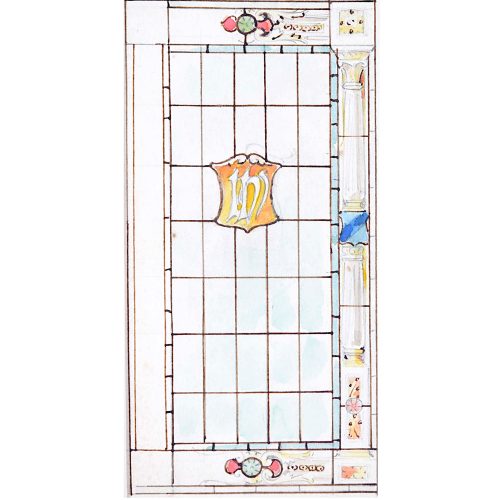
  • Florence Camm (1874-1960) Design for church stained glass window with 'IHS' roundel

    Watercolour 17x9 cm Design for TW Camm & Co., Smethwick, Birmingham With 'IHS' Roundel - 'Iesus Hominum Salvator' ('Jesus Saviour of Mankind') The Camms were stained glass designers who exhibited 48 times at the Royal Academy and also exhibited at The Walker Art Gallery in Liverpool, The Royal Scottish Academy and Royal Birmingham Society of Artists. Following the death of her father, Florence Camm became chief designer at TW Camm with many commissions both nationally and internationally. Florence Camm was the daughter of Thomas William Camm (1839-1912) who founded the stained glass business T W Camm in High Street Smethwick. From 1892-1911 she studied at The Birmingham Municipal School of Art which, unusually for the time, encouraged girls to attend the life drawing classes – drawing fully nude female models and partially draped male models – thus explaining Camm’s skill with the human figure. Students were encouraged to execute their drawings for designs, thus giving them the skills to set up as manufacturers in Birmingham’s Jewellery Quarter. The arts and crafts designer Henry Payne was an influential tutor for Camm, being one of the most influential teachers at the BMSA who was working as a stained glass designer at the time; one of his most notable commissions was a painted mural illustrating Tudor History for the Houses of Parliament in 1908. Following the death of TW Camm, Florence and her brothers – Walter and Robert – took over the business and Florence did most of the designing. If you are interested email info@manningfineart.co.uk or call us on 07929 749056. Condition: In conservation mount and in plastic sleeve for protection.
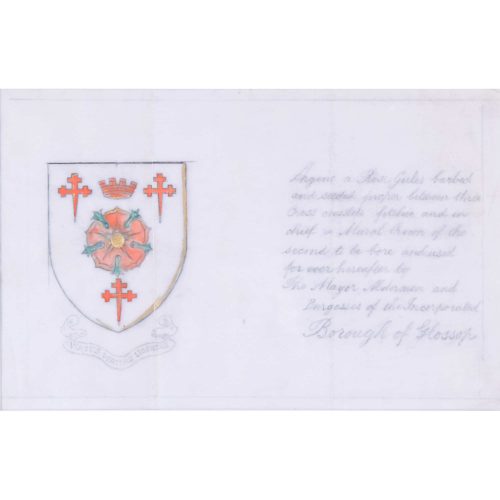
  • Florence Camm (1874-1960) Design for stained glass window for the Arms of the Borough of Glossop

    Watercolour on tracing paper 18x28 cm Design for TW Camm & Co., Smethwick, Birmingham The Camms were stained glass designers who exhibited 48 times at the Royal Academy and also exhibited at The Walker Art Gallery in Liverpool, The Royal Scottish Academy and Royal Birmingham Society of Artists. Following the death of her father, Florence Camm became chief designer at TW Camm with many commissions both nationally and internationally. Florence Camm was the daughter of Thomas William Camm (1839-1912) who founded the stained glass business T W Camm in High Street Smethwick. From 1892-1911 she studied at The Birmingham Municipal School of Art which, unusually for the time, encouraged girls to attend the life drawing classes – drawing fully nude female models and partially draped male models – thus explaining Camm’s skill with the human figure. Students were encouraged to execute their drawings for designs, thus giving them the skills to set up as manufacturers in Birmingham’s Jewellery Quarter. The arts and crafts designer Henry Payne was an influential tutor for Camm, being one of the most influential teachers at the BMSA who was working as a stained glass designer at the time; one of his most notable commissions was a painted mural illustrating Tudor History for the Houses of Parliament in 1908. Following the death of TW Camm, Florence and her brothers – Walter and Robert – took over the business and Florence did most of the designing. If you are interested email info@manningfineart.co.uk or call us on 07929 749056. Condition: In conservation mount and in plastic sleeve for protection.
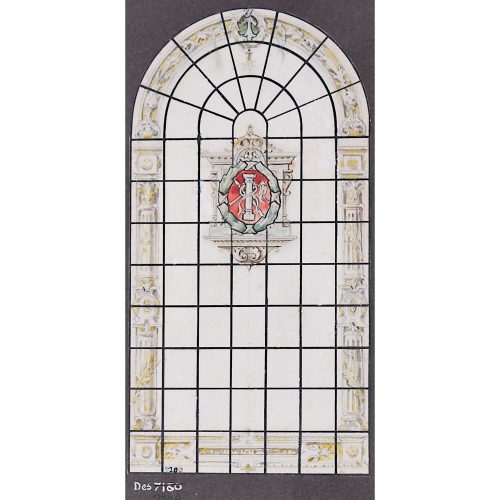
  • Florence Camm (1874-1960) Design for stained glass window 'The Instruments of the Passion'

    Watercolour 20x10 cm Design for TW Camm & Co., Smethwick, Birmingham embossed with their stamp to bottom Numbered 7180/7200 The Camms were stained glass designers who exhibited 48 times at the Royal Academy and also exhibited at The Walker Art Gallery in Liverpool, The Royal Scottish Academy and Royal Birmingham Society of Artists. Following the death of her father, Florence Camm became chief designer at TW Camm with many commissions both nationally and internationally. Florence Camm was the daughter of Thomas William Camm (1839-1912) who founded the stained glass business T W Camm in High Street Smethwick. From 1892-1911 she studied at The Birmingham Municipal School of Art which, unusually for the time, encouraged girls to attend the life drawing classes – drawing fully nude female models and partially draped male models – thus explaining Camm’s skill with the human figure. Students were encouraged to execute their drawings for designs, thus giving them the skills to set up as manufacturers in Birmingham’s Jewellery Quarter. The arts and crafts designer Henry Payne was an influential tutor for Camm, being one of the most influential teachers at the BMSA who was working as a stained glass designer at the time; one of his most notable commissions was a painted mural illustrating Tudor History for the Houses of Parliament in 1908. Following the death of TW Camm, Florence and her brothers – Walter and Robert – took over the business and Florence did most of the designing. If you are interested email info@manningfineart.co.uk or call us on 07929 749056. Conditon: Good. In plastic sleeve for protection.
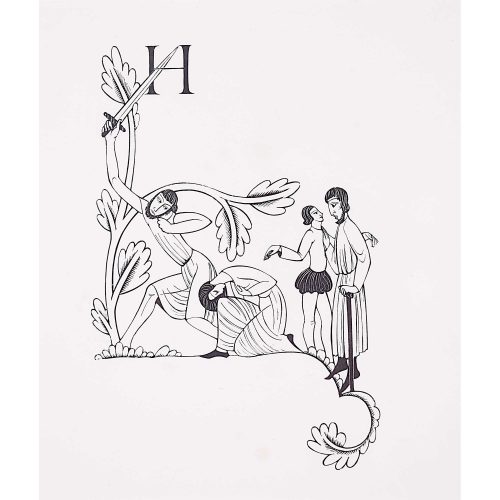
  • Eric Gill

    Initial Letter 'H' for The Canterbury Tales (1929) - The Doctor's Tale

    Woodblock Print Published Hague & Gill 1934 in an unnumbered edition of 300 23x21cm Following Chichester Technical and Art School, Gill moved to London in 1900 to train with the ecclesiastical architects W D Caroe. Finding architecture somewhat pedestrian he took stonemasonry lessons at Westminster Technical Institute and calligraphy lessons at the Central School of Arts and Crafts, coming under the influence of Edward Johnson, the designer of the London Underground's own typeface. In 1903 he ceased his attempts to become an architect, instead becoming a monumental mason, letter-cutter and calligrapher. Based in Ditchling, he began direct carving of stone figures, the semi-abstract figures taking their influence from mediaeval statuary, mixed with influences from Classical statuary from the Greeks and Romans, with a little post-Impressionism added in. With major commissions from Westminster Cathedral for its Stations of the Cross (1914), a series of War Memorials including the Grade II* memorial in Trumpington, and three of the sculptures for Charles Holden's 1928 headquarters of London Underground at 55 Broadway, St James's, and a series of sculptures for the new 1932 Broadcasting House. The list continues. Never one to rest on his laurels, he was at the same time engaged in typographical adventures. He had collaborated with Edward Johnson on the latter's initial thoughts on his London Transport typeface, but in 1925 designed Perpetua on his own, and Gill Sans between 1927-30. For the Golden Cockerel Press he created, in 1929, a bolder typeface to complement wood engravings. And of course Gill was publishing decorated books. His 1929 Canterbury Tales was an epic work, with a whole series of beautiful wood engravings such as this one. The present print is from the 1934 edition for Faber & Faber ('Engravings 1928-1933 by Eric Gill') he printed with his son-in-law, Rene Hague, produced with the original engraved wood blocks. In Chaucer's Tales, the Summoner's Tale tells the story of the man who summonsed people to the ecclesiastical courts. It satirises the friar, considering him to be corrupt. Philip Hofer was a curator and collector, and commissioned this fine Ex Libris plate from Gill. If you are interested email info@manningfineart.co.uk or call us on 07929 749056. Condition: Generally very good condition.
  • George Bissill (1896-1973) Country lane with bird of prey

    Pencil sketch 27 x 33 cm Born in 1896, George Bissill was a British miner, painter and furniture designer. Raised in the mining village of Langley Mill, Derbyshire, Bissill became a miner at the age of 13, before leaving to join the war effort in 1915. Upon his return from the war after being gassed, Bissill chose to become a pavement artist outside the newly erected Bush House in Aldwych, painting from his memory and his sketch book the uncompromising underground world he had inhabited. In 1935 he moved to the countryside near Newbury, where he lived and worked as a landscape painter, art restorer and dealer until his death in 1973. This painting forms part of a larger collection, 'unseen since they were taken from George Bissil's studio in 1983' and restored by Kate Pattinson. A series of planned exhibitions were cancelled due to Covid, but two shows, one in Oxford and one in Ilkeston, did take place. Through such exhibitions, Pattinson hoped to 'restore the reputation of an artist who, through mighty endeavour, conquered the art world in the 1920s with his powerful, authentic and experimental pictures.' Bissill's paintings are also held in a number of important public collections, including the Tate Gallery, National Museum of Ireland and the Manchester Art Gallery. This pencil sketch depicts a view down a country lane. Leafy trees line the path and nearby a bird of prey circles. Bissill captures the peaceful nature of this scene beautifully, where the typically sketched character of the trees suggests a sense of motion, a gentle breeze blowing through the leaves, while the bird of prey catches this breeze in the distance, watching out for movement in the grass down below. Condition: generally very good.

    If you would like to know more, please email info@manningfineart.co.uk or call us on 07929 749056.
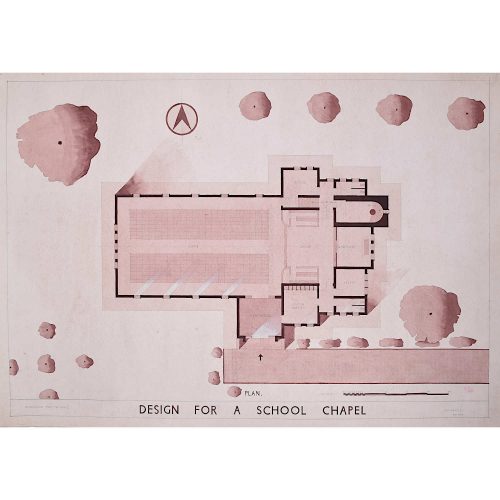
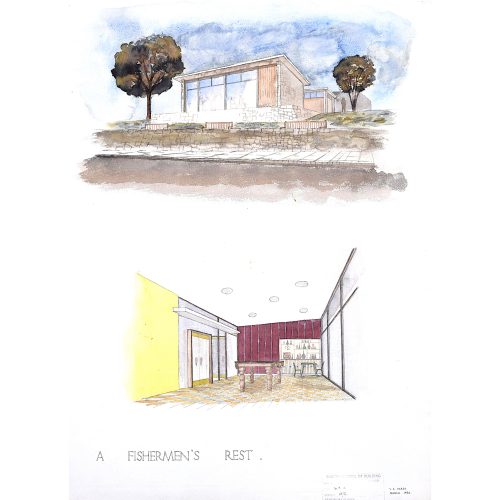
  • V A Hards (British, c. 1930-c. 2012) Design for Modernist School Chapel

    Watercolour on wove Signed and dated November 1948 and marked 35/40 55x77cm Hards was educated at Brixton School of Building and Woolwich Polytechnic between 1948 and 1956, during which period he produced some very competent work including this rather fun modernist design for a riverside tearoom. Brixton School of Building was incorporated into the Polytechnic of the South Bank - now London South Bank University. If you are interested email info@manningfineart.co.uk or call us on 07929 749056. Condition: Some edge wear and isolated spots.
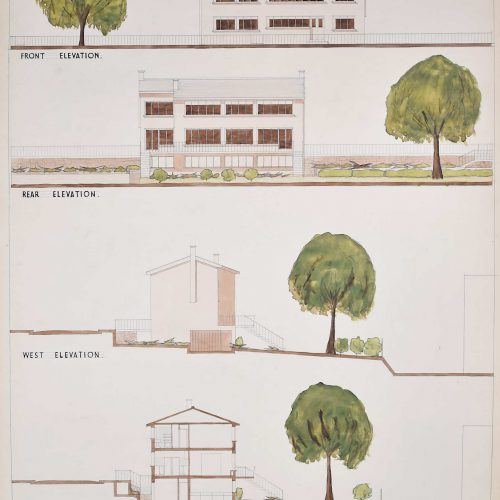
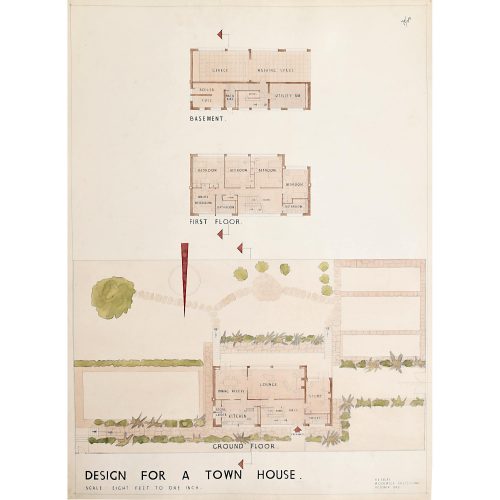
  • V A Hards (British, c. 1930-c. 2012) Design for Modernist Town House

    Watercolour on wove Signed and dated October 1949 and inscribed Woolwich Polytechnic. 77x55cm Hards was educated at Brixton School of Building and Woolwich Polytechnic between 1948 and 1956, during which period he produced some very competent work including this rather fun modernist brutalist design for a town house. Brixton School of Building was incorporated into the Polytechnic of the South Bank - now London South Bank University. If you are interested email info@manningfineart.co.uk or call us on 07929 749056. Condition: Some edge wear and isolated spots.
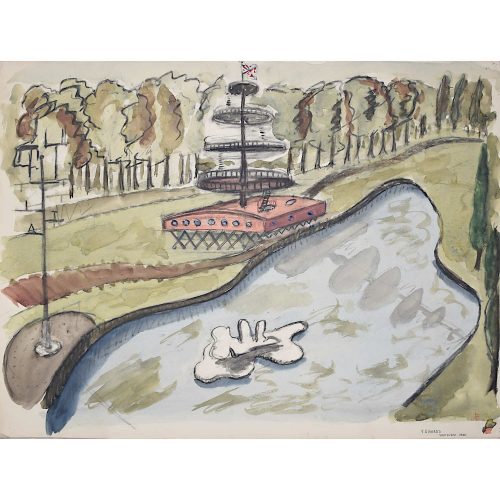
  • V A Hards (British, c. 1930-c. 2012) Design for Monumental Fountain

    Watercolour on wove Signed and dated 1955 55x77cm Hards was educated at Brixton School of Building and Woolwich Polytechnic between 1948 and 1956, during which period he produced some very competent work including this rather fun modernist design for a monumental fountain in a grand park. Brixton School of Building was incorporated into the Polytechnic of the South Bank - now London South Bank University. If you are interested email info@manningfineart.co.uk or call us on 07929 749056. Condition: Some edge wear and isolated spots.
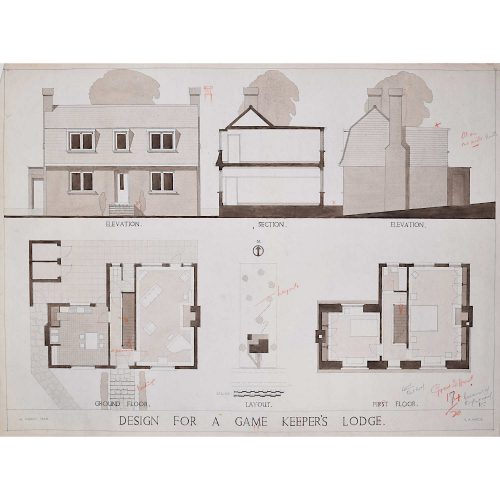
  • V A Hards (British, c. 1930-c. 2012) Design for Modernist Game Keeper Lodge

    Watercolour on wove Signed and dated March 1948 55x77cm Hards was educated at Brixton School of Building and Woolwich Polytechnic between 1948 and 1956, during which period he produced some very competent work including this rather fun modernist design for a monumental fountain in a grand park. Brixton School of Building was incorporated into the Polytechnic of the South Bank - now London South Bank University. If you are interested email info@manningfineart.co.uk or call us on 07929 749056. Condition: Some edge wear and isolated spots .
  • V A Hards (British, c. 1930-c. 2012) Design for Modernist Town House

    Watercolour on wove Signed and dated October 1949 and inscribed Woolwich Polytechnic. 77x55cm Hards was educated at Brixton School of Building and Woolwich Polytechnic between 1948 and 1956, during which period he produced some very competent work including this rather fun modernist brutalist design for a town house. Brixton School of Building was incorporated into the Polytechnic of the South Bank - now London South Bank University. If you are interested email info@manningfineart.co.uk or call us on 07929 749056. Condition: Some edge wear and isolated spots.
  • V A Hards (British, c. 1930-c. 2012) Design for Modernist Fisherman's Hut

    Watercolour on wove Signed and dated March 1956 and stamped for Brixton School of Building. 77x55cm Hards was educated at Brixton School of Building and Woolwich Polytechnic between 1948 and 1956, during which period he produced some very competent work including this rather fun modernist brutalist design for a fisherman's hut, not designed to blend in with the scenery. Brixton School of Building was incorporated into the Polytechnic of the South Bank - now London South Bank University. To view more of his work we have listed, scroll down to 'View more from this seller' and click on 'View all from this seller' and then search for 'Hards'. If you are interested email info@manningfineart.co.uk or call us on 07929 749056. Condition: Good. Some edge wear and isolated spots.
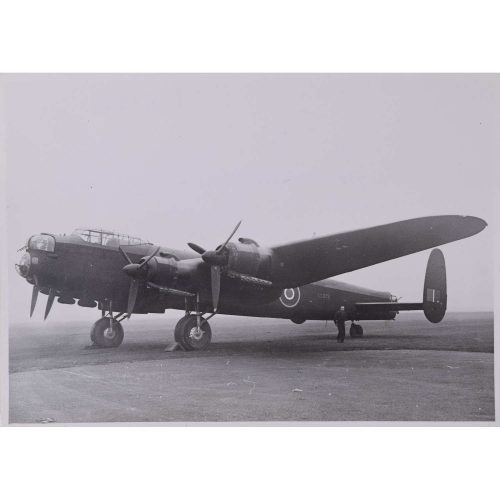
  • Lancaster LL678 'Lily Mars' - 1

    Silver Gelatin photograph, December 1943 12 x 16 cm Stamped to reverse 'The Photograph has been passed by Censor' 'Copyright This TP copyright illustration from "The Aeroplane" must not be reproduced without the written permission of Temple Press Ltd'. 'A general view of an Avro Lancaster II with Hercules radial motors.' 300 Lancaster II aeroplanes were made, fitted with Bristol Hercules radial engines, as there was a worry that there would be a shortage of Merlin engines, reserved for the Spitfire and Hurricane. Lily Mars was named after the 1943 American musical starring Judy Garland and was based at RAF Waterbeach, in Cambridgeshire. An excellent podcast (click) gives details of the final flight on 13 June 1944 which was to be the final raid of the crew's tour. The bombing raid was of 303 Lancasters against the Nordstern synthetic oil plant at Gelsenkichen in the Ruhr, deep inside Germany and the aircraft took off at 23.12 hrs. On the home run LL678 was intercepted and shot down by a night fighter capitained by Oberleutnant Schmidt in a Bf 110 at 01.24 hrs at Zuidloo, a small hamlet, where five of the eight crew are buried; the other three crew members baled out and escaped. A memorial plaque was laid on 4 May 2016 and a Lancaster flypast was arranged. Owing to technical problems a Dakota from the BBMF was sent instead. On 4 May 2022 the Lancaster of the BBMF undertook a flypast which can be seen here. Dietrich Schmidt (1919-?) had 29 confirmed night kills by the time of LL678, achieving 41 kills by the end of the war off 171 missions and was awarded the Ritterkreuz - Knight's Cross. In 1999 the living crewmembers, Dutch resistance and Schmidt and his wireless operator met in the Netherlands.
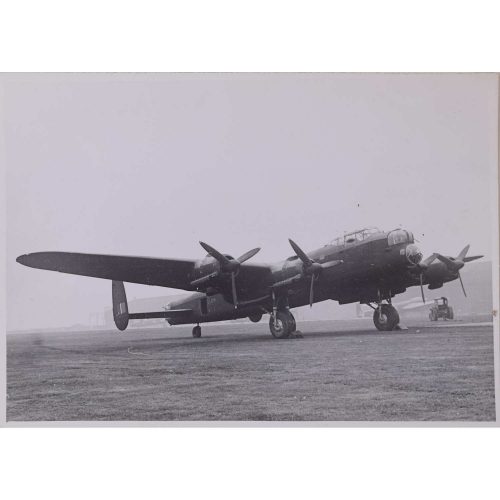
  • Lancaster LL678 'Lily Mars' - 2

    Original Silver Gelatin photograph, December 1943 12 x 16 cm Stamped to reverse 'The Photograph has been passed by Censor' 'Copyright This TP copyright illustration from "The Aeroplane" must not be reproduced without the written permission of Temple Press Ltd'. 'Lancaster II heavy bombers are now flying with RAF BOMBER COMMAND.' 300 Lancaster II aeroplanes were made, fitted with Bristol Hercules radial engines, as there was a worry that there would be a shortage of Merlin engines, reserved for the Spitfire and Hurricane. Lily Mars was named after the 1943 American musical starring Judy Garland and was based at RAF Waterbeach, in Cambridgeshire. A podcast (click) gives details of the final flight on 13 June 1944 which was to be the final raid of the crew's tour. The bombing raid was of 303 Lancasters against the Nordstern synthetic oil plant at Gelsenkichen in the Ruhr, deep inside Germany and the aircraft took off at 23.12 hrs. On the home run LL678 was intercepted and shot down by a night fighter capitained by Oberleutnant Schmidt in a Bf 110 at 01.24 hrs at Zuidloo, a small hamlet, where five of the eight crew are buried; the other three crew members baled out and escaped. A memorial plaque was laid on 4 May 2016 and a Lancaster flypast was arranged. Owing to technical problems a Dakota from the BBMF was sent instead. On 4 May 2022 the Lancaster of the BBMF undertook a flypast which can be seen here. Dietrich Schmidt (1919-?) had 29 confirmed night kills by the time of LL678, achieving 41 kills by the end of the war off 171 missions and was awarded the Ritterkreuz - Knight's Cross. In 1999 the living crewmembers, Dutch resistance, and Schmidt and his wireless operator met in the Netherlands. Provenance: from the collection of Philip J R Moyes, author of many books on the RAF, most notably The Pictorial History which ran to several volumes.
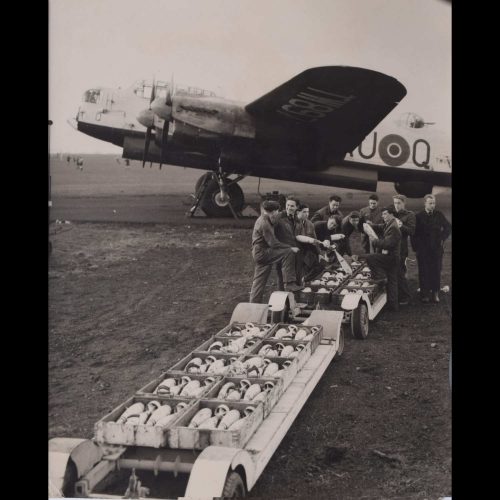
  • Lancaster Bomber AU-Q loading bombs

    Original Silver Gelatin photograph 25 x 20 cm Stamped to reverse 'Copyright Associated Press Photograph' Press release states:LAST MINUTE PREPARATIONS FOR TOMORROW'S ATTACK ON THE FLEET At RAF Station Upwood, Hunts, today, Dec 8th last minute preparations were being carried out for tomorrow's attack on the fleet. Photo shows airmen of 148 Squadron no 3 Bomber Command look over smoke bombs with a Lancaster in background. WOR 339888 Provenance: from the collection of Philip J R Moyes, author of many books on the RAF, most notably The Pictorial History which ran to several volumes. Condition: generally good.
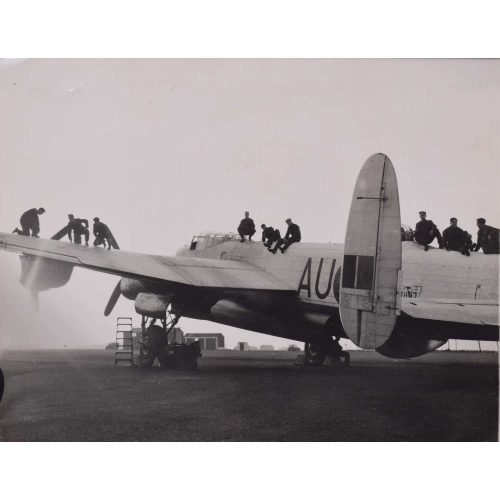
  • Lancaster Bomber AU-Q loading bombs

    Original Silver Gelatin photograph 21 x 25 cm Stamped to reverse 'Copyright Associated Press Photograph' Press release states:LAST MINUTE PREPARATIONS FOR TOMORROW'S ATTACK ON THE FLEET At RAF Station Upwood, Hunts, today, Dec 8th last minute preparations were being carried out for tomorrow's attack on the fleet. Photo shows a Lancaster being made ready for a dawn take off tomorrow photographed this evening against the setting sun. WOR 339889 Associated Press Photo Provenance: from the collection of Philip J R Moyes, author of many books on the RAF, most notably The Pictorial History which ran to several volumes.
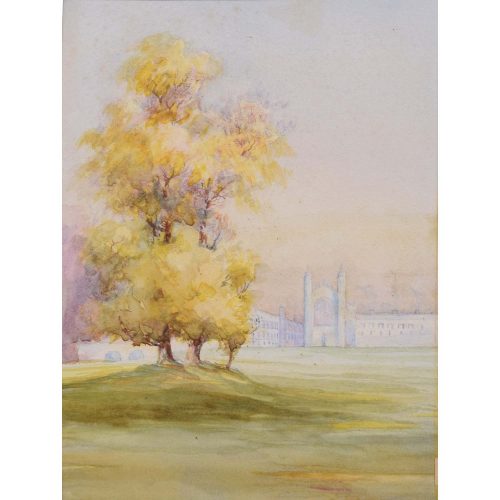
  • King’s College Cambridge from The Backs

    Watercolour 24×16.5cm If you are interested email info@manningfineart.co.ukor call us on 07929 749056.
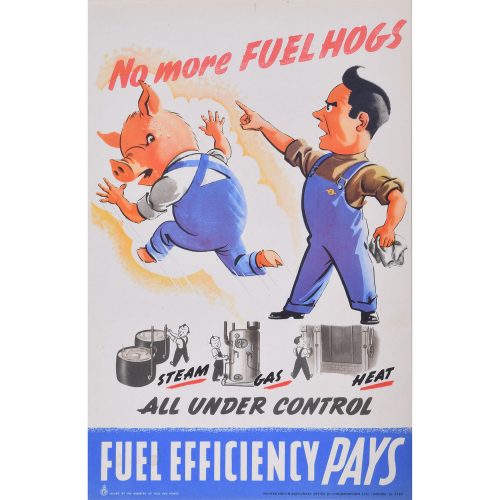
  • No more Fuel Hogs

    Steam, Gas, Heat, all under control. Fuel Efficiency Pays Lithographic poster c. 1940 Printed for HMSO by Chromoworks Limited and issued by the Ministry of Fuel and Power 37x24cm If you are interested email info@manningfineart.co.uk or call us on 07929 749056.
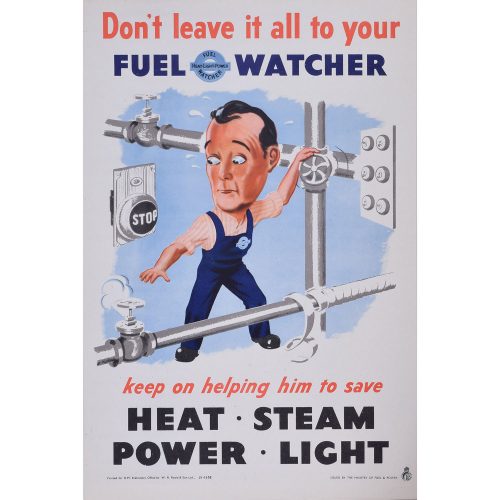
  • Don't leave it all to your fuel watcher

    Keep on helping him to save HEAT STEAM POWER LIGHT Lithographic poster c. 1940 for HMSO by W R Royle & Son and issued by the Ministry of Fuel and Power 38x25cm If you are interested email info@manningfineart.co.uk or call us on 07929 749056.
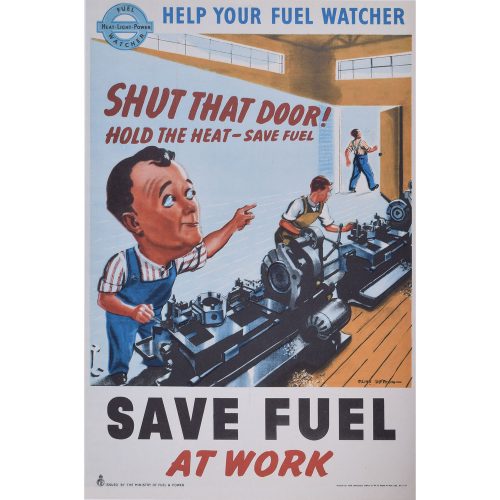
  • Clive Uppton (1911-2006)

    Save Fuel at Work: Shut that Door! Hold the Heat - Save Fuel

    Lithographic poster c. 1940 37x25cm Uptton was a widely-published artist, political cartoonist of the Daily Sketch and Sunday Graphic from 1940-42. If you are interested email info@manningfineart.co.ukor call us on 07929 749056.
  • Save Fuel in the Kitchens

    Lithographic poster c. 1940 37x25cm Printed for HMSO by Nathaniel Lloyd and Co for the Ministry of Fuel and Power Energy was urgently needed to make bombs and fuel the vehicles of war. Britons were endlessly exhorted to save fuel; a message that has no less resonance today. If you are interested email info@manningfineart.co.ukor call us on 07929 749056.
  • Ambulance and First Aid Section

    Lithographic poster probably c. 1940s 36x23cm First established in 1935 the Civil Defence Department was essential for maintaining order during air raids. Here a glamorous young lady - presumably unable to join the army - is volunteering to 'do her bit' by driving an ambulance. If you are interested email info@manningfineart.co.ukor call us on 07929 749056.
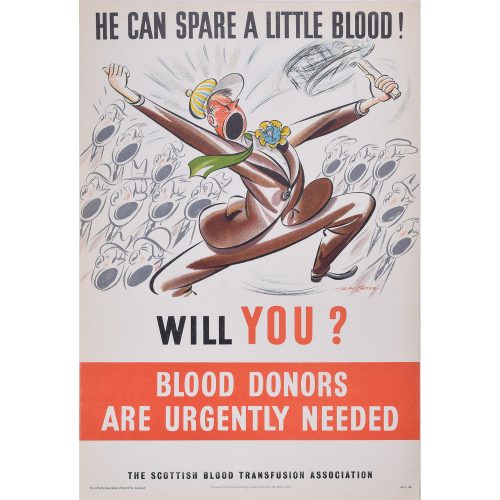
  • Allan Carter

    He can spare a little blood - Blood Donors are Urgently Needed

    Lithographic poster c. 1940s 38x25cm Printed for HMSO by Sanders Phillips & Co. The Scottish Blood Transfusion Association If you are interested email info@manningfineart.co.ukor call us on 07929 749056.
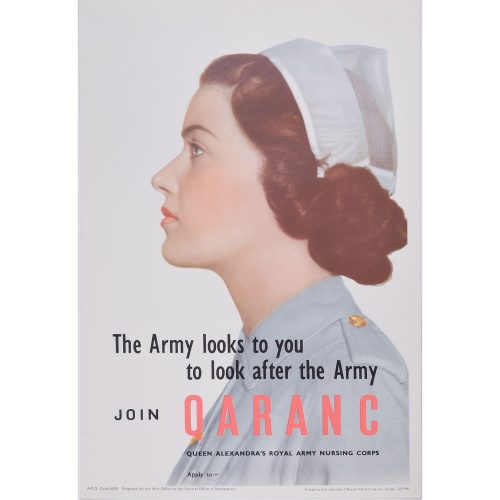
  • Join QARANC - Queen Alexandra's Royal Army Nursing Corps

    The Army looks to you to look after the Army

    Lithographic poster c. 1940s 38x25cm Printed for HMSO by Fosh & Kosh Limited, London and prepared for the War Office by the Central Office of Information. If you are interested email info@manningfineart.co.ukor call us on 07929 749056.
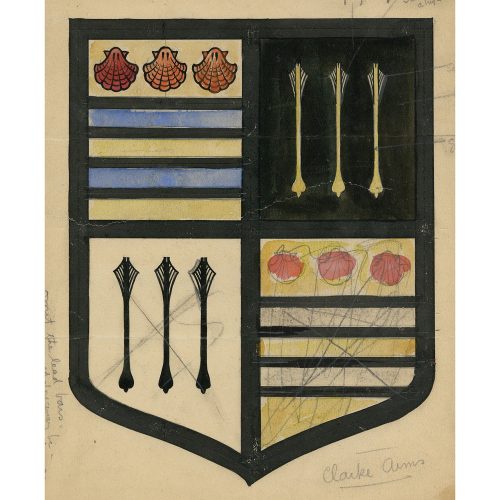
  • Florence Camm (1874-1960)

    Clarke Arms Design

    Watercolour and pencil 22x17cm Design for TW Camm & Co. If you are interested email info@manningfineart.co.uk or call us on 07929 749056.
  • Peter Collins ARCA (1923-2001) Design for BEA Holiday Brochure 1966 BEA Panorama Holidays 

    Mixed media on paper 30x21cm Provenance: The Artist's Studio As a graphic designer, Collins produced many brochures such as these. With his fondness for life drawing, he was perhaps a natural choice for the bikini-clad inhabitants of the pages of a holiday brochure. Click here for other items by the artist and for biographical details. If you are interested email info@manningfineart.co.uk or call us on 07929 749056.
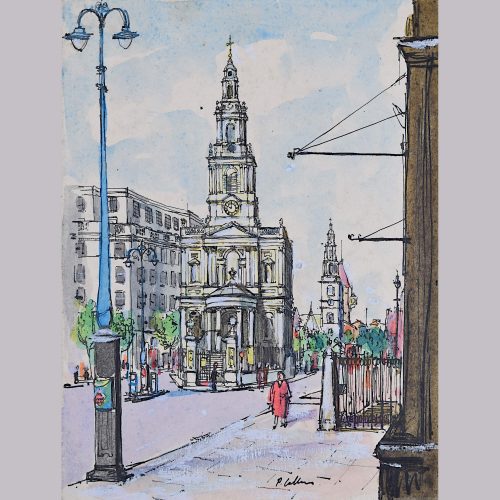
  • Peter Collins ARCA (1923-2001) St Mary le Strand Church

    Watercolour 17 x 21 cm Signed lower right. Provenance: The artist's studio. Typical Collins, with his bright colours and captivating scene, reminiscent of his travel posters, here a passerby in red walks purposely towards the foreground. Click here for other items by the artist and for biographical details. If you are interested email info@manningfineart.co.uk or call us on 07929 749056.
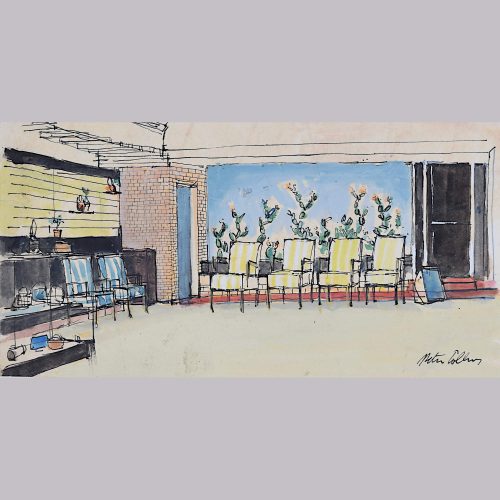
  • Peter Collins ARCA (1923-2001) Mid Century Modern Lounge Interior

    Pen, ink and watercolour 10.5x20.5cm Signed Peter Collins lower right Provenance: The Artist's Studio A stongly-painted image, with a wonderful sense of the light and brightness of a modernist interior. Whether the scene on the back wall is intended to be an extraordinary wallpaper, or whether the view to the garden, we do not know. But the viewer is encouraged to take a seat in an interior that at the time will have felt modern yet comfortable. Click here for other items by the artist and for biographical details. If you are interested email info@manningfineart.co.uk or call us on 07929 749056.
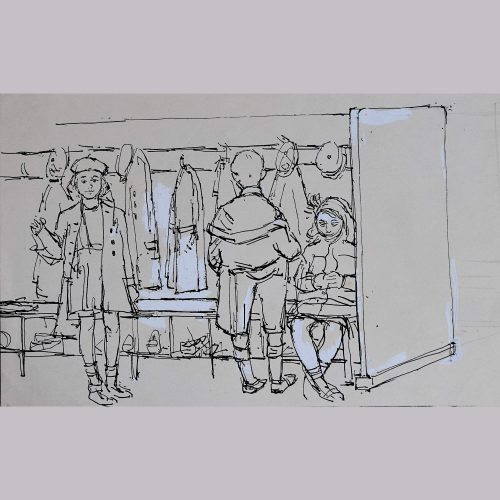
  • Peter Collins ARCA (1923-2001) School Children in a Cloakroom

    Pen, ink and whitening 15x24cm Provenance: The Artist's Studio A stongly-painted image, ensuite with Collins' schoolroom scene that we have listed with a wonderful sense of the light available in a new, post-war school. The schoolboy wears short trousers and - together with schoolgirls - is engaged in the task of time immemorial of waiting in the cloakroom. Shoes are stacked under the benches and coats hang from the hooks. Click here for other items by the artist and for biographical details. If you are interested email info@manningfineart.co.uk or call us on 07929 749056.

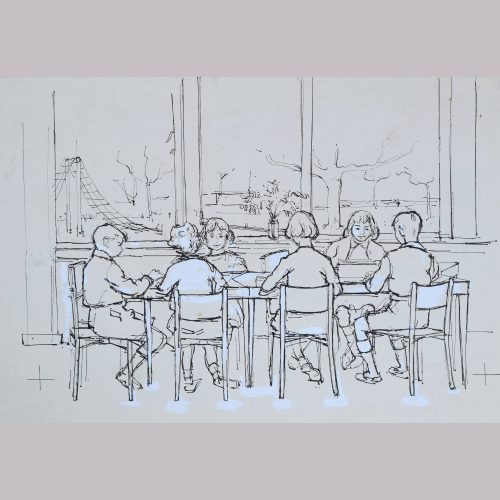
  • Peter Collins ARCA (1923-2001) The Schoolroom

    Pen, ink and whitening 19x27cm Provenance: The Artist's Studio A stongly-painted image, with a wonderful sense of the light available in a new, post-war classroom. The schoolboys wear short trousers and - together with schoolgirls - are engrossed in a task. Click here for other items by the artist and for biographical details. If you are interested email info@manningfineart.co.uk or call us on 07929 749056.

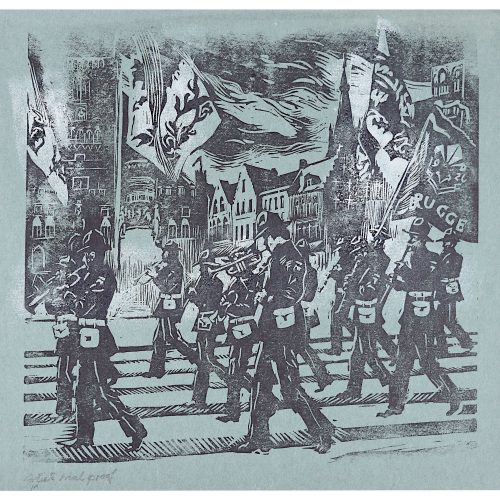
  • Percy Drake Brookshaw (1907-1993) Marching Band

    Linocut c. 1930s 30x30 cm Inscribed 'Artist's trial proof 1A' Provenance: the family of the artist, by descent. Brookshaw was born in Southwark, in London, and educated at the Central School of Arts and Crafts. He was a particularly accomplished lithographer, skilled also as a painter in both oil and watercolour. Identifying the former talent, F Gregory Brown - the poster and textile designer - encouraged him to become an illustrator and poster designer. Producing posters for London Transport and Shell, inter alia, between 1928 and 1958, many of his posters depict sporting events. His two posters for the annual University Boat Race are well known and highly sought after, and his wonderful posters often evoke a feeling of movement, whether rowers straining on their oars, or horses or greyhounds racing. In this carefully executed linocut, Brookshaw brings the band members to life with the same skill and enthusiasm he brings to his posters. If you are interested email info@manningfineart.co.uk or call us on 07929 749056. Condition: Generally very good, some spotting to external margins outside image area.
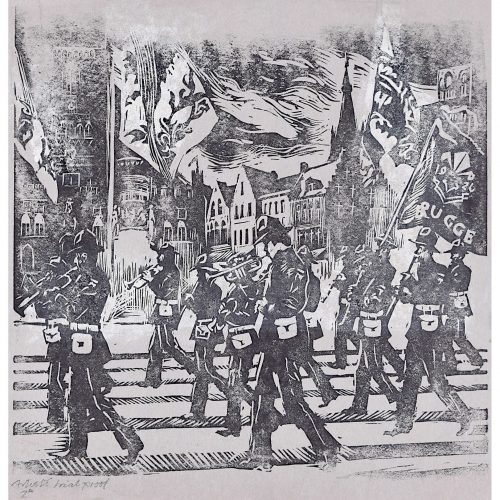
  • Percy Drake Brookshaw (1907-1993) Marching Band

    Linocut c. 1930s 30x30 cm Inscribed 'Artist's trial proof 1A' Provenance: the family of the artist, by descent. Brookshaw was born in Southwark, in London, and educated at the Central School of Arts and Crafts. He was a particularly accomplished lithographer, skilled also as a painter in both oil and watercolour. Identifying the former talent, F Gregory Brown - the poster and textile designer - encouraged him to become an illustrator and poster designer. Producing posters for London Transport and Shell, inter alia, between 1928 and 1958, many of his posters depict sporting events. His two posters for the annual University Boat Race are well known and highly sought after, and his wonderful posters often evoke a feeling of movement, whether rowers straining on their oars, or horses or greyhounds racing. In this carefully executed linocut, Brookshaw brings the band members to life with the same skill and enthusiasm he brings to his posters. If you are interested email info@manningfineart.co.uk or call us on 07929 749056. Condition: Generally very good, some spotting to external margins outside image area.
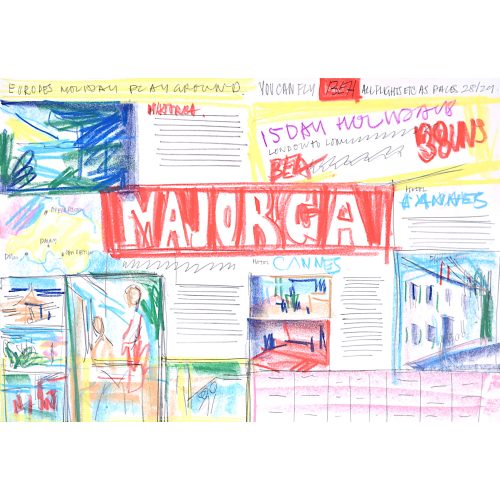
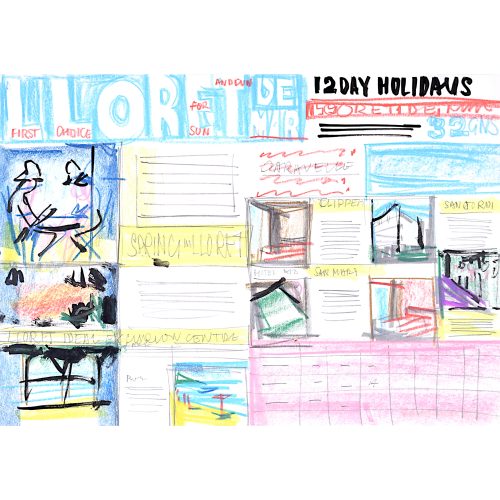
  • Peter Collins ARCA (1923-2001) Design for Holiday Brochure for Majorca 3 (for BEA Panorama Holidays)

    Mixed media 30x45cm Provenance: The Artist's Studio As a graphic designer, Collins produced many brochures such as these. With his fondness for life drawing, he was perhaps a natural choice for the bikini-clad inhabitants of the pages of a holiday brochure. Collins's first job was at an advertising agency, in the commercial studio, whilst he attended evening art classes. World War II interrupted his career and he joined the Royal Artillery (of the British Army), teaching painting and drawing in the Education Corps - whilst simultaneously teaching at St Martin's School of Art, part time. Following the war Collins studied at the Royal College of Art, winning a scholarship. Leaving in 1950 he then worked as a commercial artist producing some well-known posters for clients including British Railways and British European Airways. He was the Art Director at Odhams Press and spent time designing for both ICI and Shell. With his wife Georgette he created the 'Bacombe Galleries' in Sussex, converting a group of buildings. In 1975 they again converted buildings, this time Stanley Studios in Chelsea which were scheduled for redevelopment; many artists had worked there, probably the most famous being Elizabeth Frink. Combining an artist's studio and a single residence at Stanley Studios the Collinses were immersed in Chelsea's art scene and proceeded to fill the place with art, antiques, sculpture and curios. If you are interested email info@manningfineart.co.uk or call us on 07929 749056. Condition: Generally very good.
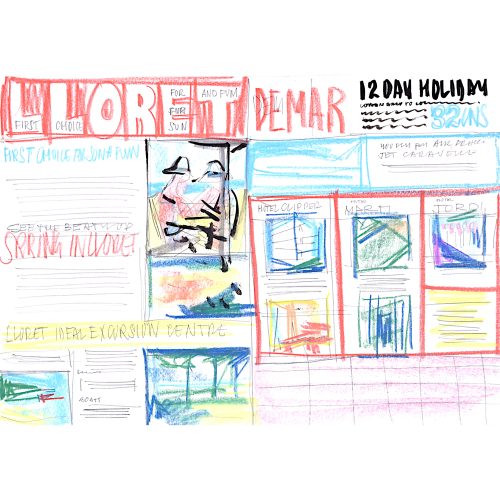
  • Peter Collins ARCA (1923-2001) Lloret, Spain 2 - Design for Holiday Brochure (for BEA Panorama Holidays)

    Mixed media 30x45cm Provenance: The Artist's Studio As a graphic designer, Collins produced many brochures such as these. With his fondness for life drawing, he was perhaps a natural choice for the bikini-clad inhabitants of the pages of a holiday brochure. Collins's first job was at an advertising agency, in the commercial studio, whilst he attended evening art classes. World War II interrupted his career and he joined the Royal Artillery (of the British Army), teaching painting and drawing in the Education Corps - whilst simultaneously teaching at St Martin's School of Art, part time. Following the war Collins studied at the Royal College of Art, winning a scholarship. Leaving in 1950 he then worked as a commercial artist producing some well-known posters for clients including British Railways and British European Airways. He was the Art Director at Odhams Press and spent time designing for both ICI and Shell. With his wife Georgette he created the 'Bacombe Galleries' in Sussex, converting a group of buildings. In 1975 they again converted buildings, this time Stanley Studios in Chelsea which were scheduled for redevelopment; many artists had worked there, probably the most famous being Elizabeth Frink. Combining an artist's studio and a single residence at Stanley Studios the Collinses were immersed in Chelsea's art scene and proceeded to fill the place with art, antiques, scupture and curios. If you are interested email info@manningfineart.co.uk or call us on 07929 749056. Condition: Generally very good.

  • Peter Collins ARCA (1923-2001) Lloret, Spain - Design for Holiday Brochure (for BEA Panorama Holidays)

    Mixed media 30x45cm Provenance: The Artist's Studio As a graphic designer, Collins produced many brochures such as these. With his fondness for life drawing, he was perhaps a natural choice for the bikini-clad inhabitants of the pages of a holiday brochure. Collins's first job was at an advertising agency, in the commercial studio, whilst he attended evening art classes. World War II interrupted his career and he joined the Royal Artillery (of the British Army), teaching painting and drawing in the Education Corps - whilst simultaneously teaching at St Martin's School of Art, part time. Following the war Collins studied at the Royal College of Art, winning a scholarship. Leaving in 1950 he then worked as a commercial artist producing some well-known posters for clients including British Railways and British European Airways. He was the Art Director at Odhams Press and spent time designing for both ICI and Shell. With his wife Georgette he created the 'Bacombe Galleries' in Sussex, converting a group of buildings. In 1975 they again converted buildings, this time Stanley Studios in Chelsea which were scheduled for redevelopment; many artists had worked there, probably the most famous being Elizabeth Frink. Combining an artist's studio and a single residence at Stanley Studios the Collinses were immersed in Chelsea's art scene and proceeded to fill the place with art, antiques, scupture and curios. If you are interested email info@manningfineart.co.uk or call us on 07929 749056. Condition: Generally very good.
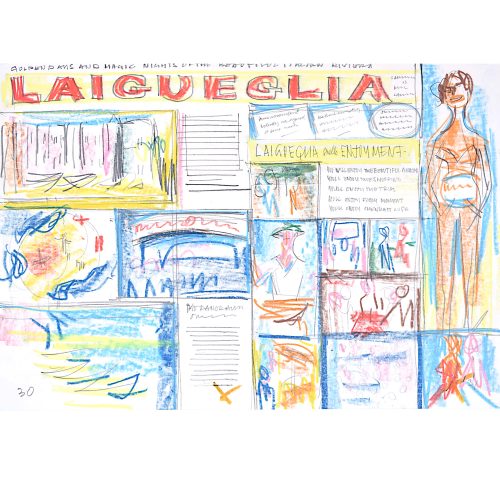
  • Peter Collins ARCA (1923-2001) Design for Holiday Brochure for Laigueglia Italy (for BEA Panorama Holidays) 3

    Mixed media 30x45cm Provenance: The Artist's Studio As a graphic designer, Collins produced many brochures such as these. With his fondness for life drawing, he was perhaps a natural choice for the bikini-clad inhabitants of the pages of a holiday brochure. Collins's first job was at an advertising agency, in the commercial studio, whilst he attended evening art classes. World War II interrupted his career and he joined the Royal Artillery (of the British Army), teaching painting and drawing in the Education Corps - whilst simultaneously teaching at St Martin's School of Art, part time. Following the war Collins studied at the Royal College of Art, winning a scholarship. Leaving in 1950 he then worked as a commercial artist producing some well-known posters for clients including British Railways and British European Airways. He was the Art Director at Odhams Press and spent time designing for both ICI and Shell. With his wife Georgette he created the 'Bacombe Galleries' in Sussex, converting a group of buildings. In 1975 they again converted buildings, this time Stanley Studios in Chelsea which were scheduled for redevelopment; many artists had worked there, probably the most famous being Elizabeth Frink. Combining an artist's studio and a single residence at Stanley Studios the Collinses were immersed in Chelsea's art scene and proceeded to fill the place with art, antiques, scupture and curios. If you are interested email info@manningfineart.co.uk or call us on 07929 749056. Condition: Generally very good.
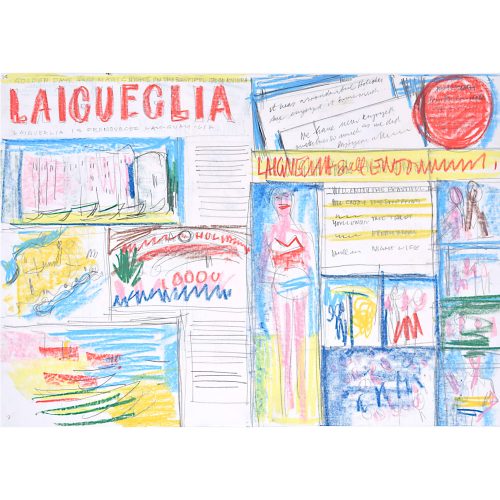
  • Peter Collins ARCA (1923-2001) Design for Holiday Brochure for Laigueglia Italy (for BEA Panorama Holidays) 4

    Mixed media 30x45cm Provenance: The Artist's Studio As a graphic designer, Collins produced many brochures such as these. With his fondness for life drawing, he was perhaps a natural choice for the bikini-clad inhabitants of the pages of a holiday brochure. Collins's first job was at an advertising agency, in the commercial studio, whilst he attended evening art classes. World War II interrupted his career and he joined the Royal Artillery (of the British Army), teaching painting and drawing in the Education Corps - whilst simultaneously teaching at St Martin's School of Art, part time. Following the war Collins studied at the Royal College of Art, winning a scholarship. Leaving in 1950 he then worked as a commercial artist producing some well-known posters for clients including British Railways and British European Airways. He was the Art Director at Odhams Press and spent time designing for both ICI and Shell. With his wife Georgette he created the 'Bacombe Galleries' in Sussex, converting a group of buildings. In 1975 they again converted buildings, this time Stanley Studios in Chelsea which were scheduled for redevelopment; many artists had worked there, probably the most famous being Elizabeth Frink. Combining an artist's studio and a single residence at Stanley Studios the Collinses were immersed in Chelsea's art scene and proceeded to fill the place with art, antiques, scupture and curios. If you are interested email info@manningfineart.co.uk or call us on 07929 749056. Condition: Generally very good.
Go to Top