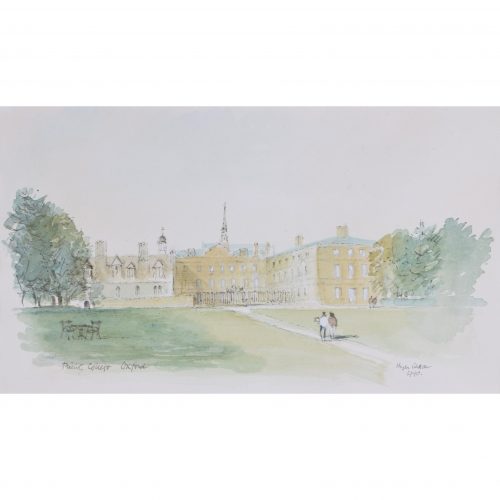
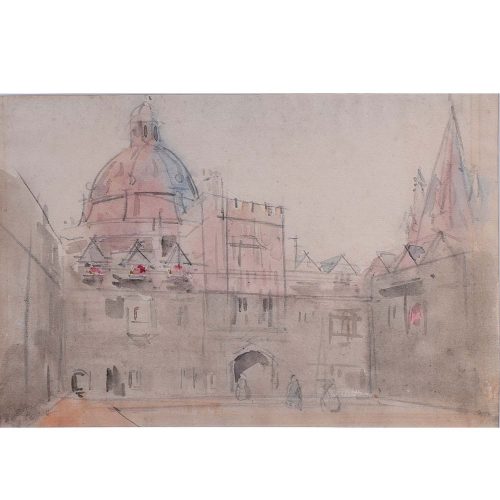
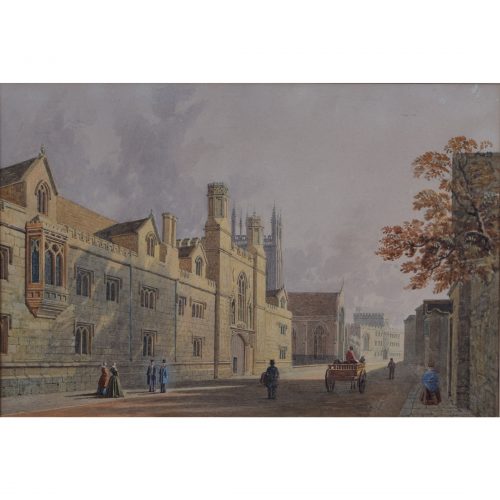
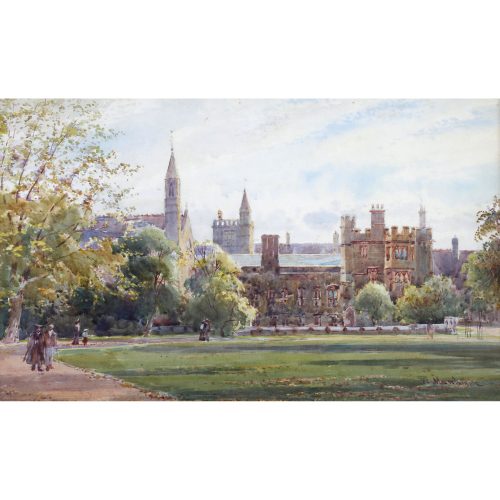
• Michael Angelo Rooker (1746–1801) St John's College, Oxford

    Watercolour 25 x 40 cm Depicting a lovely view over the gardens of St John's College, Oxford, this watercolour may have been produced for the 1783 edition of the Oxford Almanack. This almanack ran between 1674 and 2019 and traditionally included engravings and information about Oxford University. Michael Angelo Rooker (1746–1801) was an English painter, engraver, and illustrator, best known for his topographical landscapes and architectural scenes. His works often depicted picturesque views of British towns, universities, and ruins, executed with meticulous detail and atmospheric effects. He was particularly well-regarded for his ability to blend topographical accuracy with artistic beauty, making his works valuable both as historical records and as fine art. This watercolour exemplifies beautifully his fine attention to detail, atmosphere and architectural perspective, as he expertly depicts the façade of the college, while also capturing the long shadows cast by the trees on this seemingly warm summer's day. Condition: Generally very good.

    If you would like to know more, please email info@manningfineart.co.uk or call us on 07929 749056.
  • Paul Ayshford Methuen, 4th Baron Methuen of Corsham (1886 -1974)

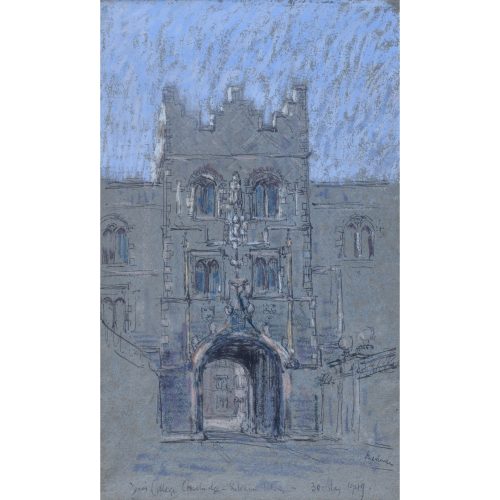
    Jesus College, Cambridge

    Ink and pastel Signed and dated 30 May 1949; in artist’s original oak frame. 41x26cm (16.1×10.2 inches) For biographical details and other works by the artist click here. If you are interested email info@manningfineart.co.uk or call us on 07929 749056.
  • Paul Nash (1889 - 1946)

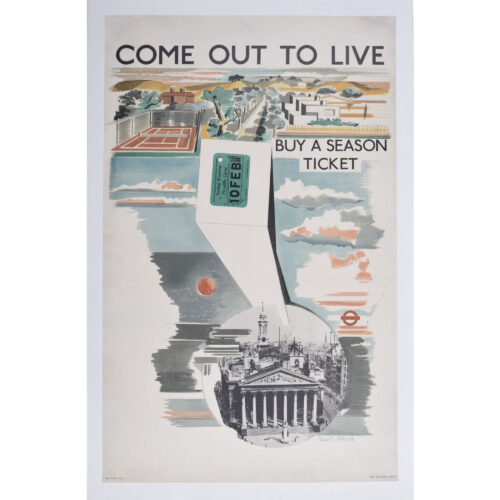
    Come Out to Live (1936)

      Original vintage poster 101 x 63 cm A copy of this poster is held by the London Transport Museum. Published by the Baynard Press. Nash's poster encourages us to buy a season ticket in order to travel more cheaply by train. A modernist suburb is juxtaposed with a monochrome photograph of the Royal Exchange in the heart of the City of London, suggesting that by travelling in from suburbia we can "come out to live". Paul Nash was a modernist, surrealist British artist. He is known for his modernist landscapes and work as a war artist. He studied at the Slate School of Art and soon focused his work on landscapes, especially those containing ruins; he went on to produce some of the most recognisable artworks of the First World War, mostly depicting war-torn landscapes. Condition: very good. If you are interested, please email info@manningfineart.co.uk or call us on 07929 749056. Click here for other original vintage posters.
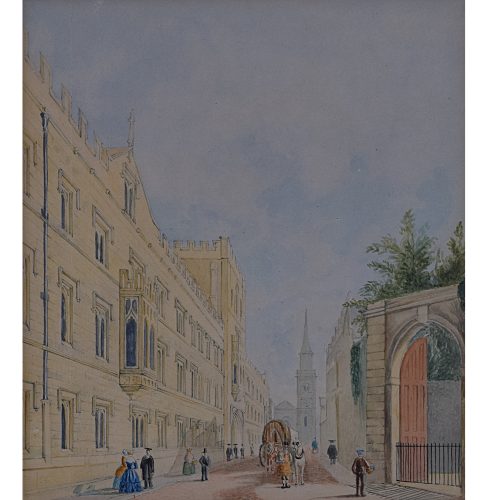
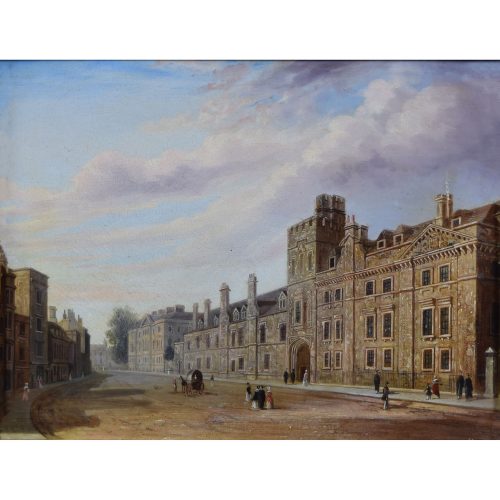
  • J. C. Buckler (1793-1894) Queen's College in the High Street Oxford

    Watercolour 29 x 36 cm Signed to lower right. John Chessell Buckler (1793–1894) was a British architect and artist, renowned for his contributions to Gothic Revival architecture and his detailed architectural drawings. Throughout his career, Buckler did a lot of work in Oxford. He carried out repairs and additions to St Mary's Church, and Oriel, Brasenose, Magdalen, and Jesus colleges. During this period, he was also an extremely prolific artist, creating works characterised by his fastidious attention to detail and strong sense of architectural perspective. Between 1797 and 1830 he created no less than 625 Indian ink and 19 watercolour drawings, many of which are now housed in the Bodeleian libraries. As one of only 19 watercolour paintings produced by Buckler, this painting of Queen's College constitutes a rare opportunity to own such a fine example of Buckler's work. It depicts the façade of Queen's College using strong lines, exemplifying Buckler's strong sense of architectural perspective. Scholars, all dressed in academic robes, also wander down the street, breathing life into this architectural drawing. Condition: Generally very good.

    If you would like to know more, please email info@manningfineart.co.uk or call us on 07929 749056.

  • Sir Edward Brantwood Maufe KBE RA FRIBA (1882-1974)

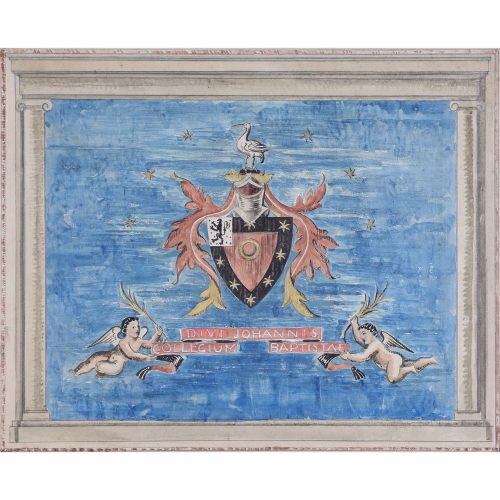
    Heraldic Design for a carpet for the Senior Common Room, St John’s College Oxford 

    Watercolour and ink Signed and inscribed Provenance: The estate of Bernard Bumpus If you are interested email info@manningfineart.co.uk or call us on 07929 749056. 37x46cm (14.5×18.1 inches) Maufe designed buildings for his old Oxford College, St John’s, over an extended period, starting with two memorial slabs in 1923, and was made honorary fellow in 1943.  His most major works were the Rawlinson Building extension (1933) and Dolphin Quad (1947). This design relates to the 1936 remodelling of the smoking room of the Senior Common Room. Click here for biographical details and other works by the artist.
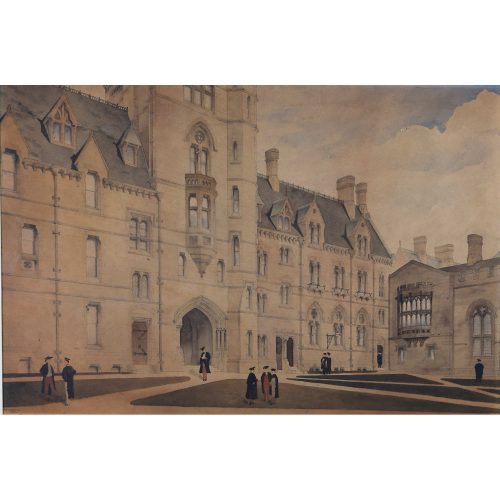
  • F F Hoyland Balliol College, Oxford (1880) Watercolour 44 x 66 cm   Signed lower left and dated. An impressive watercolour of Balliol College. Scholars, sporting gowns and mortarboards, gather in the quad. Hoyland's stylistic precision transforms this watercolour into a beautifully executed depiction of the College's architecture.
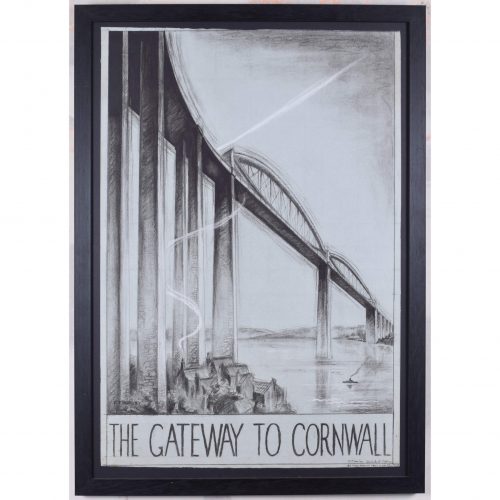
  • Ronald T Horley (active 1930s - 1940s)

    The Gateway to Cornwall

    Charcoal heightened with white 76 x 53 cm Signed and inscribed lower right 'Architect's Office, 83 Marlborough Place NW8 Marylebone'. The Great Western Railway commissioned a series of posters promoting train travel around the UK. This charcoal drawing of the Royal Albert Bridge at Saltash is the artist's original design for a poster encouraging rail travel to Devon and Cornwall. The bridge is known fondly as the 'Gateway to Cornwall'. The Royal Albert Bridge was designed by Isambard Kingdom Brunel. Surveying started in 1848 and construction commenced in 1854. The first main span was positioned in 1857 and the completed bridge was opened by Prince Albert on 2 May 1859. Condition: generally very good; a few isolated spots to bottom left corner. Click here for other original vintage travel posters and designs.
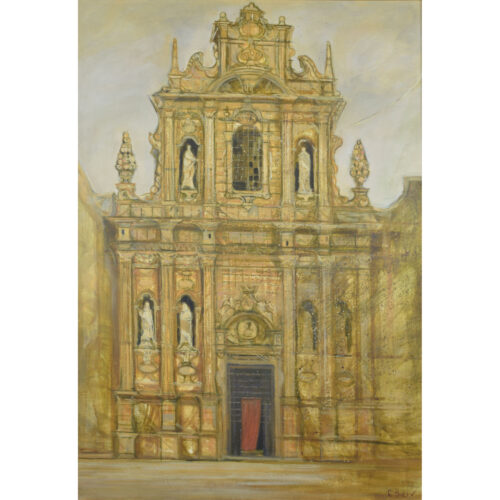
  • Richard Beer (1928 - 2017)

    Lecce Cathedral, Puglia

      Oil on canvas 122 x 85 cm Provenance: the artist's studio. A momentous depiction of Lecce Cathedral in all its glory. This oil painting is a fantastic example of Beer's focus on architecture, the central and recurring theme of his pictorial idiom. Born in London in 1928, just too late to serve in the Second World War, Richard Beer studied between 1945 - 1950 at the Slade School. Subsequently, a French Government scholarship allowed him to spend time in Paris at Atelier 17, working under Stanley William Hayter (1901 - 1988), one of the most significant print makers of the 20th Century – having spent the War in New York, advising as a camofleur, Hayter only returned to Paris in 1950. Subsequently Beer studied at the École des Beaux Arts, Paris. Working for John Cranko, choreographer for the Royal Ballet, Beer designed the sets and costumes for his The Lady and the Fool at Covent Garden, subsequently working for him following his move in 1961 to Stuttgart Ballet. Additionally he produced book illustrations and designed book jackets. Beer later taught print-making at the Chelsea School of Art, where he was a popular teacher. Probably his greatest work was a collaboration with John Betjeman to produce a portfolio of prints of ten Wren Churches in the City for Editions Alecto, copies of which are in The Government Art Collection. That collection contains a total of 54 prints by Beer, and the Tate Gallery’s collection holds seven. His Oxford series was also produced for Editions Alecto as was a series of predominantly architectural views in Southern Europe. Most of his prints are of architectural subjects. Condition: generally very good. If you are interested, please email info@manningfineart.co.uk or call us on 07929 749056. Click here for other works by Richard Beer.
  • William Matthison

    Balliol College Oxford

    Watercolour 26 x 44 cm Signed lower right 'W Matthison'. Matthison was born near Birmingham and attended King Edward’s School in the city. He learned drawing at the Birmingham Central School of Art and then became a pupil of Birmingham artist Edward Watson. He became a professional artist in 1875 and moved to Oxfordshire a few years after; this was where he had the opportunity to produce many of the Oxford views for which he is known today. In 1902 he moved to Park Town in Oxford and was commissioned by Robert Peel to paint more than seventy views of the University of Oxford, which were subsequently made into postcards. Priced at seven for a shilling, they were only available from E Cross of Pembroke Street (a long-since closed business). Raphael Tuck & Sons also commissioned him to produce postcard scenes of Cambridge. Matthison’s views of Oxford were later printed in Fifty Watercolour Drawings of Oxford, published in 1912 by Alden & Co. Click here for other works by the artist. If you are interested, please email info@manningfineart.co.uk or call us on 07929 749056.
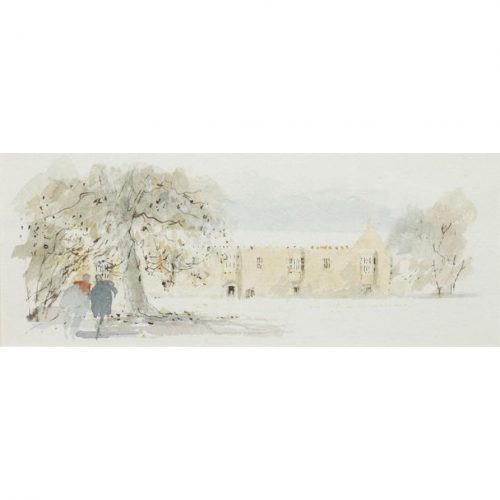
  • Sir Hugh Casson CH, KCVO, PRA, RDI (1910-1999) St John’s College, Oxford, Canterbury Quad Signed, inscribed with title and dated ‘1988’ (on a label attached to the backboard) Pencil, pen, ink and watercolour 10.5 x 27cm (4 1/8 x 10 5/8in). Painted for inclusion in Hugh Casson’s Oxford (Phaidon Press Ltd, 1988). Click here for biographical details and other works by the artist. If you are interested email info@manningfineart.co.uk or call us on 07929 749056.
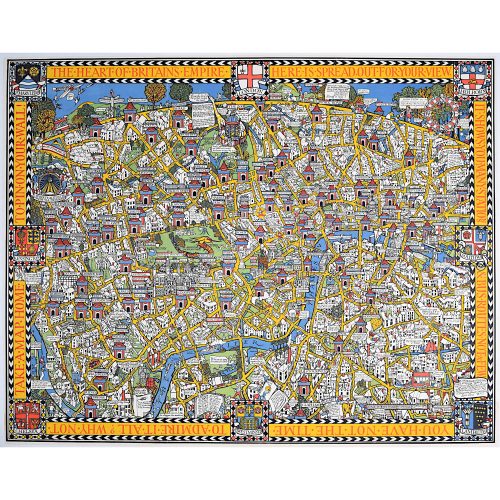
  • Macdonald (Max) Gill (1884-1947) Wonderground Map of London (c. 1924, after 1914 original edition)

    Lithographic poster 75x94cm In the present work, in the top left-hand corner it reads 'On to Wembley' making reference to the British Empire Exhibition of 1924. Gill's original 1914 poster was hugely popular and reprinted with updates to feature topical events. Born in Brighton, Max Gill was the second son in a family of thirteen children; his elder brother was Eric Gill, the typographer and sculptor. Both Gills exhibited significant talent at a young age. Max Gill’s first map was made for a school map-drawing project following which he entered maps into competitions in boys’ magazines. In 1903 he moved to London as assistant to the ecclesiastical architects Sir Charles Nicholson and Hubert Corlette. By 1908 he had started his own architectural practice, but in 1909 Sir Edwin Lutyens commissioned Gill to paint a “wind dial” map for Nashdom, a large house in Buckinghamshire. The wind dial was set over the fireplace and attached to a weather vane on the roof, allowing the occupant to know the direction of the wind from the comfort of the house. He produced seven further wind dials including for Lutyens’s Lindisfarne Castle and for the Allhusen Room at Trinity College, Cambridge. Although he continued to practice as an architect, Frank Pick commissioned him to create seven pictorial maps for the Underground, the first being the famous 1913 ‘Wonderground Map of London Town.’ In 1917 he joined the Imperial War Graves Commission’s headstone design committee, designing the typeface and regimental badges. Gill’s memorials for the fallen in the First World War include for Balliol and Worcester Colleges and Christ Church in Oxford. During the 1920s and 30s Gill undertook many commercial commissions for advertising materials. The Empire Marketing Board and Shell-Mex as well as further maps for the Underground. He designed in 1922 the first diagrammatic map of the Underground which provided the foundation for Beck’s more famous map. By the 1930s his major works were murals. Those of the Arctic and Antarctic on the ceilings of the Scott Polar Research Institute in Cambridge are beautiful, but the most impressive is the map of the North Atlantic in the first-class dining room of the Queen Mary (maiden voyage: 1936, now moored at Long Beach, California). During the Second World War he created a series of propaganda posters for the Ministry of Information.
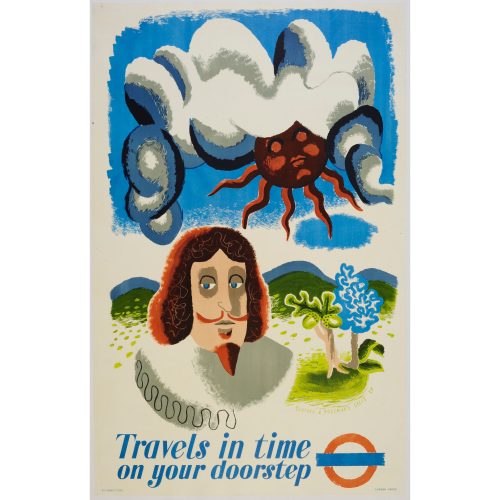
  • Clifford and Rosemary Ellis

    Travels in Time on your Doorstep

    Lithographic poster for London Transport (1937) 101 x 63.5 cm Printed by Curwen Press Provenance: the family of the artist, by descent. Condition: A- backed to linen, pin holes to corners. Click here for biographical details and other works by the artist. If you are interested email info@manningfineart.co.uk or call us on 07929 749056.
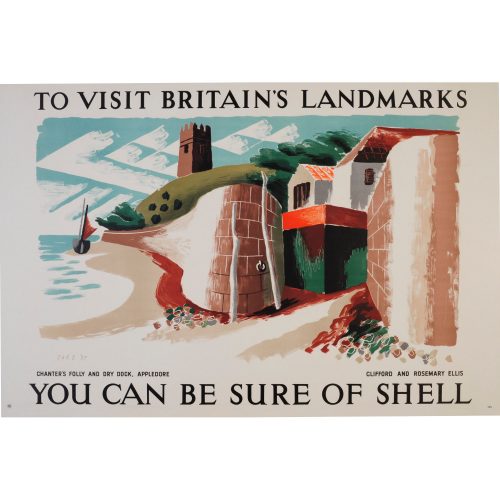
  • Clifford and Rosemary Ellis

    You can be sure of Shell

    Chanter's Folly and Dry Dock, Appledore

    Lithographic poster for Shell Mex BP (1937) 30x44" Provenance: the family of the artist, by descent. Condition: A/A- backed to linen. Click here for biographical details and other works by the artist. Shell produced a large series of posters in the 1920s and 30s to encourage motorists to use their products in that early and golden age of motoring. They often commission artists not known for their commercial art, so their posters very often featured large and dramatic views of the British countryside and landmarks, inspiring motorists to travel further afield. Here the Ellises have taken a well-known landmark and applied avant-garde artistic techniques so stylising the view, turning, e.g. the clouds into an array of angular v-shaped blocks. Thomas Burnard Chanter (1797-1874) was owner of a fleet of sailing vessels and erected a signal tower ('Chanter's Folly') to give him advance notice of his vessels' arrival. It was demolished in 1952. The dry dock - Richmond dry dock - was built in 1853 and designed to hold two 'large' ships. It exists today and is Grade II listed. If you are interested email info@manningfineart.co.uk or call us on 07929 749056.
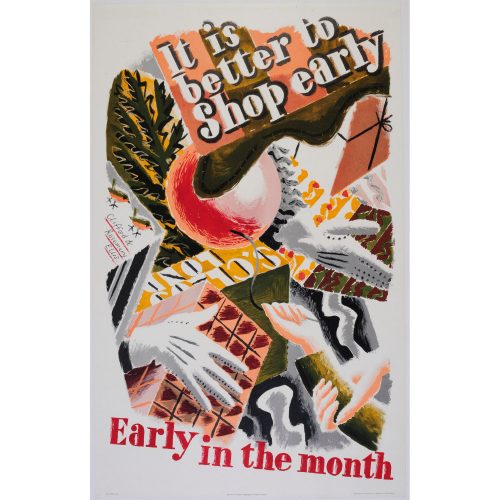
  • Clifford and Rosemary Ellis

    Shop Early (1935)

    Lithographic poster for London Transport 101 x 63.5 cm Printed by Waterlow & Sons Ltd For the artist’s biographical details and for other works by the artist available for sale please click here.  If you are interested email info@manningfineart.co.uk or call us on 07929 749056.
  • Edward Bawden (1903 - 1989)

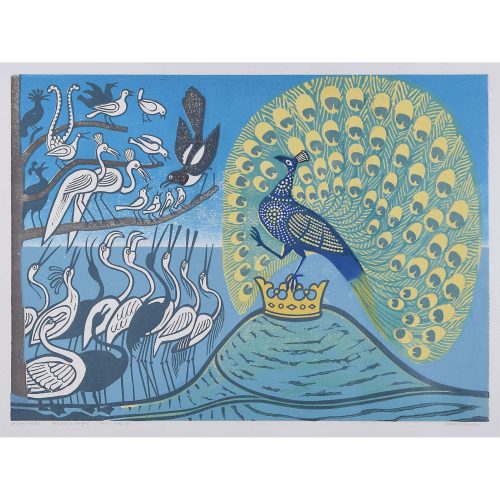
    Aesop's Fables: Peacock and Magpie (1970)

      Linocut print 63 x 75 cm Signed, numbered 11/50, and titled in pencil. A delightful print illustrating Aesop's fable of the Peacock and Magpie. In the fable, the birds are searching for a king, and the Peacock puts himself forward. The birds are about to make him king because of his charming plumage, but a Magpie asks the Peacock how he might defend the birds from predators. The Peacock has no answer. Aesop's moral is that those in power must be suited to the task, and not just vain pretenders. The artist's use of vibrant colour brings the tale to life. Edward Bawden was an English painter, illustrator and graphic artist, known for his prints, book covers, posters, and garden metalwork furniture. Bawden taught at the Royal College of Art, where he had been a student, worked as a commercial artist, and served as a war artist in World War II. He illustrated several books and painted various public murals, and his work and career are often associated with that of his contemporary, Eric Ravilious. Condition: generally very good; small stain to extremity that will be hidden under mount. If you’d like to know more, please email info@manningfineart.co.uk or call us on 07929 749056.
  • Fred Taylor (1875 - 1963)

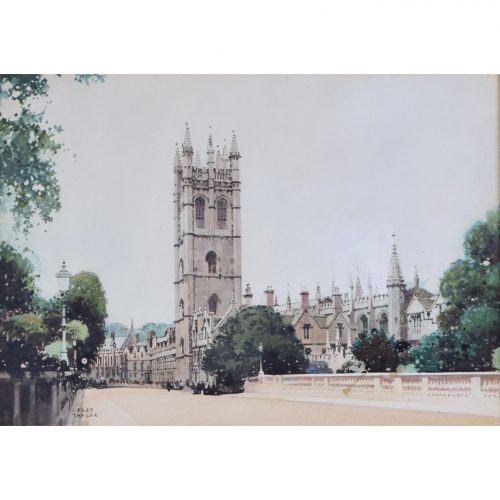
    Magdalen Tower from Magdalen Bridge

      Watercolour 25 x 37 cm Signed lower left. Fred Taylor captures the indomitable features of Magdalen Tower. The spire rises into a pale sky as undergraduates stream past the entrance to the Porter's Lodge. An old-fashioned car drives up the High.
    This watercolour of Magdalen was a design for the front cover of a guidebook about Oxford.
    Fred Taylor was a London-born painter and poster designer. He studied at the Académie Julian in Paris, and Goldsmiths’ in London, later travelling to Italy on a scholarship to study art. He produced many poster designs for railway and shipping firms and was an official camoufleur during the Second World War. He exhibited at the Royal Academy.
    Condition: very good. If you are interested, please email info@manningfineart.co.uk or call us on 07929 749056. Click here for other views of Magdalen College, Oxford.
  • A. E. Halliwell (1905-1987) Underground to Escape the Fog

    Gouache 19 x 13 cm c.1930 Signed to the bottom right and inscribed 'Design for a Poster, Carried out 12" x 20".' Provenance: Family of the artist. A.E. Halliwell (1905–1986) was a British artist, illustrator, and designer best known for his vibrant poster designs created for British railway companies during the mid-20th century. Born in Southport, Halliwell developed a strong foundation in art and design early in life. He studied at the Southport School of Art from 1923 to 1926 before graduating to the Royal College of Art in London and subsequently practising as a professional designer from the 1930s. Following his studies, Halliwell married Doris Doyle in Strood Kent, and  went on to have a significant teaching career himself, most notably as a lecturer at the Central School of Arts and Crafts (later part of Central Saint Martins), where he influenced a new generation of designers and illustrators. Halliwell is perhaps best remembered for his vibrant and engaging poster designs created for British railway companies during the 1930s. His work was characterised by a bright, graphic style that balanced charm with clarity, often depicting idealised scenes of British holiday destinations—from sunny seaside towns to tranquil countryside vistas. Beyond posters, his artistic output included book illustration, commercial design, and stage costume sketches, showcasing his versatility across mediums. His posters continue to remain enduring symbols of a golden age of British travel and design and are displayed in major collections including the London Transport Museum and the V & A. This striking poster design uses moody tones and bold silhouettes to show Londoners disoriented in a misty street where lights are distorted by the haze and the houses are unrecognisable but for their chimneys. Fear not... they are saved by the glowing red Underground sign cutting through the haze and the poster therefore serves as a reminder that (apparently) even in thick fog, the Tube stays clear and reliable. Condition: Generally very good.

    If you would like to know more, please email info@manningfineart.co.uk or call us on 07929 749056.
  • A. E. Halliwell (1905-1987) Fog

    Gouache 19 x 13 cm 1927 Signed to the bottom right and inscribed 'Design for a Poster Entitled "Fog".' A.E. Halliwell (1905–1986) was a British artist, illustrator, and designer best known for his vibrant poster designs created for British railway companies during the mid-20th century. Born in Southport, Halliwell developed a strong foundation in art and design early in life. He studied at the Southport School of Art from 1923 to 1926 before graduating to the Royal College of Art in London and subsequently practising as a professional designer from the 1930s. Following his studies, Halliwell married Doris Doyle in Strood Kent, and  went on to have a significant teaching career himself, most notably as a lecturer at the Central School of Arts and Crafts (later part of Central Saint Martins), where he influenced a new generation of designers and illustrators. Halliwell is perhaps best remembered for his vibrant and engaging poster designs created for British railway companies during the 1930s. His work was characterised by a bright, graphic style that balanced charm with clarity, often depicting idealised scenes of British holiday destinations—from sunny seaside towns to tranquil countryside vistas. Beyond posters, his artistic output included book illustration, commercial design, and stage costume sketches, showcasing his versatility across mediums. His posters continue to remain enduring symbols of a golden age of British travel and design and are displayed in major collections including the London Transport Museum and the V & A. In this striking poster design, thick ribbons of grey fog snake dramatically through the scene, partially obscuring buildings, street lamps, and figures, and creating a sense of movement and disorientation. In the midst of this urban haze, the bright yellow and blue signage of the Underground station stands out as a beacon of clarity and modernity. As is characteristic for Halliwell's designs, the artist makes use of bold blocks of colour. In this case, he draws the circles of light emanating from the streetlamp as intersecting cogs in different colours, disrupting the seemingly impenetrable opacity of the grey swathes of fog. This blend of swirling shapes and, on the other hand, industrial forms creates a unique surrealist-futurist synthesis, almost evoking Fritz Lang's revolutionary 1927 film 'Metropolis.' Condition: Generally very good.

    If you would like to know more, please email info@manningfineart.co.uk or call us on 07929 749056.
  • A. E. Halliwell (1905-1987) Royal Air Force Display by Underground (Hendon)

    Gouache 16 x 24 cm 1930 Stamped A. E. Halliwell to reverse Provenance: Family of the artist A.E. Halliwell (1905–1986) was a British artist, illustrator, and designer best known for his vibrant poster designs created for British railway companies during the mid-20th century. Born in Southport, Halliwell developed a strong foundation in art and design early in life. He studied at the Southport School of Art from 1923 to 1926 before graduating to the Royal College of Art in London and subsequently practising as a professional designer from the 1930s. Following his studies, Halliwell married Doris Doyle in Strood Kent, and  went on to have a significant teaching career himself, most notably as a lecturer at the Central School of Arts and Crafts (later part of Central Saint Martins), where he influenced a new generation of designers and illustrators. Halliwell is perhaps best remembered for his vibrant and engaging poster designs created for British railway companies during the 1930s. His work was characterised by a bright, graphic style that balanced charm with clarity, often depicting idealised scenes of British holiday destinations—from sunny seaside towns to tranquil countryside vistas. Beyond posters, his artistic output included book illustration, commercial design, and stage costume sketches, showcasing his versatility across mediums. His posters continue to remain enduring symbols of a golden age of British travel and design and are displayed in major collections including the London Transport Museum and the V & A. Featuring a dramatic silhouette of a biplane soaring across a stylised sky, the artwork captures the sense of motion and excitement associated with Hendon Air Display. It showcases Halliwell's excellent command of typography, while while the muted colour palette of blues and greys lends it a sleek, atmospheric feel. Both functional and artistic, the poster exemplifies the era’s art deco fusion of design and public service messaging. Condition: Generally very good.

    If you would like to know more, please email info@manningfineart.co.uk or call us on 07929 749056.

  • A. E. Halliwell (1905-1987) Royal Air Force Display by Underground (Hendon)

    Gouache 16 x 24 cm 1928 Signed and dated 1928, inscribed 'Roughs Submitted for the 1929 Air Display'; with documentation from publisher. A.E. Halliwell (1905–1986) was a British artist, illustrator, and designer best known for his vibrant poster designs created for British railway companies during the mid-20th century. Born in Southport, Halliwell developed a strong foundation in art and design early in life. He studied at the Southport School of Art from 1923 to 1926 before graduating to the Royal College of Art in London and subsequently practising as a professional designer from the 1930s. Following his studies, Halliwell married Doris Doyle in Strood Kent, and  went on to have a significant teaching career himself, most notably as a lecturer at the Central School of Arts and Crafts (later part of Central Saint Martins), where he influenced a new generation of designers and illustrators. Halliwell is perhaps best remembered for his vibrant and engaging poster designs created for British railway companies during the 1930s. His work was characterised by a bright, graphic style that balanced charm with clarity, often depicting idealised scenes of British holiday destinations—from sunny seaside towns to tranquil countryside vistas. Beyond posters, his artistic output included book illustration, commercial design, and stage costume sketches, showcasing his versatility across mediums. His posters continue to remain enduring symbols of a golden age of British travel and design and are displayed in major collections including the London Transport Museum and the V & A. Featuring a dramatic silhouette of a biplane soaring across a stylised sky, the artwork captures the sense of motion and excitement associated with Hendon Air Display. It showcases Halliwell's excellent command of typography, while while the muted colour palette of blues and greys lends it a sleek, atmospheric feel. Both functional and artistic, the poster exemplifies the era’s art deco fusion of design and public service messaging. Condition: Generally very good.

    If you would like to know more, please email info@manningfineart.co.uk or call us on 07929 749056.
  • A. E. Halliwell (1905-1987) Buy From Our Own Empire the Best Market (in blue)

    Gouache 19 x 76 cm c.1930 Design for Empire Marketing Board Provenance: Family of the artist A.E. Halliwell (1905–1986) was a British artist, illustrator, and designer best known for his vibrant poster designs created for British railway companies during the mid-20th century. Born in Southport, Halliwell developed a strong foundation in art and design early in life. He studied at the Southport School of Art from 1923 to 1926 before graduating to the Royal College of Art in London and subsequently practising as a professional designer from the 1930s. Following his studies, Halliwell married Doris Doyle in Strood Kent, and  went on to have a significant teaching career himself, most notably as a lecturer at the Central School of Arts and Crafts (later part of Central Saint Martins), where he influenced a new generation of designers and illustrators. Halliwell is perhaps best remembered for his vibrant and engaging poster designs created for British railway companies during the 1930s. His work was characterised by a bright, graphic style that balanced charm with clarity, often depicting idealised scenes of British holiday destinations—from sunny seaside towns to tranquil countryside vistas. Beyond posters, his artistic output included book illustration, commercial design, and stage costume sketches, showcasing his versatility across mediums. His posters continue to remain enduring symbols of a golden age of British travel and design and are displayed in major collections including the London Transport Museum and the V & A. This bold poster design by A. E. Halliwell uses vibrant blue and layered text to promote trade within the British Empire. Featuring variations of the Union Jack across all four panels, the design reinforces imperial unity with the slogan “Buy from our own Empire – the best market.” Condition: Generally very good.

    If you would like to know more, please email info@manningfineart.co.uk or call us on 07929 749056.
  • A. E. Halliwell (1905-1987) Buy From Our Own Empire the Best Market (in black)

    Gouache 19 x 76 cm c.1930 Design for Empire Marketing Board Provenance: Family of the artist A.E. Halliwell (1905–1986) was a British artist, illustrator, and designer best known for his vibrant poster designs created for British railway companies during the mid-20th century. Born in Southport, Halliwell developed a strong foundation in art and design early in life. He studied at the Southport School of Art from 1923 to 1926 before graduating to the Royal College of Art in London and subsequently practising as a professional designer from the 1930s. Following his studies, Halliwell married Doris Doyle in Strood Kent, and  went on to have a significant teaching career himself, most notably as a lecturer at the Central School of Arts and Crafts (later part of Central Saint Martins), where he influenced a new generation of designers and illustrators. Halliwell is perhaps best remembered for his vibrant and engaging poster designs created for British railway companies during the 1930s. His work was characterised by a bright, graphic style that balanced charm with clarity, often depicting idealised scenes of British holiday destinations—from sunny seaside towns to tranquil countryside vistas. Beyond posters, his artistic output included book illustration, commercial design, and stage costume sketches, showcasing his versatility across mediums. His posters continue to remain enduring symbols of a golden age of British travel and design and are displayed in major collections including the London Transport Museum and the V & A. This bold poster design by A. E. Halliwell uses vibrant blue and black with layered text to promote trade within the British Empire. Featuring variations of the Union Jack across all four panels, the design reinforces imperial unity with the slogan “Buy from our own Empire – the best market.” Condition: Generally very good.

    If you would like to know more, please email info@manningfineart.co.uk or call us on 07929 749056.
  • A. E. Halliwell (1905-1987) Lifts and Stairs Galore

    Gouache 53 x 33 cm c.1930 Signed lower right Provenance: Family of the artist A.E. Halliwell (1905–1986) was a British artist, illustrator, and designer best known for his vibrant poster designs created for British railway companies during the mid-20th century. Born in Southport, Halliwell developed a strong foundation in art and design early in life. He studied at the Southport School of Art from 1923 to 1926 before graduating to the Royal College of Art in London and subsequently practising as a professional designer from the 1930s. Following his studies, Halliwell married Doris Doyle in Strood Kent, and  went on to have a significant teaching career himself, most notably as a lecturer at the Central School of Arts and Crafts (later part of Central Saint Martins), where he influenced a new generation of designers and illustrators. Halliwell is perhaps best remembered for his vibrant and engaging poster designs created for British railway companies during the 1930s. His work was characterised by a bright, graphic style that balanced charm with clarity, often depicting idealised scenes of British holiday destinations—from sunny seaside towns to tranquil countryside vistas. Beyond posters, his artistic output included book illustration, commercial design, and stage costume sketches, showcasing his versatility across mediums. His posters continue to remain enduring symbols of a golden age of British travel and design and are displayed in major collections including the London Transport Museum and the V & A. This striking poster design by A.E. Halliwell for the London Underground uses bold geometric forms and a limited colour palette to depict a stylised network of staircases, lifts, and passageways. A solitary commuter, hunched and weary, navigates the maze-like station. The composition is both dynamic and structured with a clear modernist aesthetic. Condition: Generally very good.

    If you would like to know more, please email info@manningfineart.co.uk or call us on 07929 749056.
  • Cyril A. Farey (1888-1954)

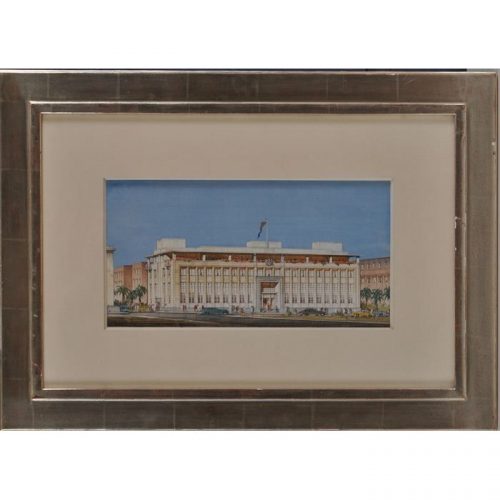
    National Bank of India, Aden

    Watercolour 44x60cm (frame) 17.5×33.5cm (6.8×13.1 inches) Biographical details and other works by Cyril Farey can be found here. In 1839 Aden was taken by the East India Company as a recoaling point between India and the UK. Aden came under the control of the Government of Bombay. In 1937, recognising the geographical distinction between India and Aden it ceased to be a part of British India and became a Crown Colony with its own Governor. If you are interested email info@manningfineart.co.uk or call us on 07929 749056.
  • David Loggan (1634-1692)

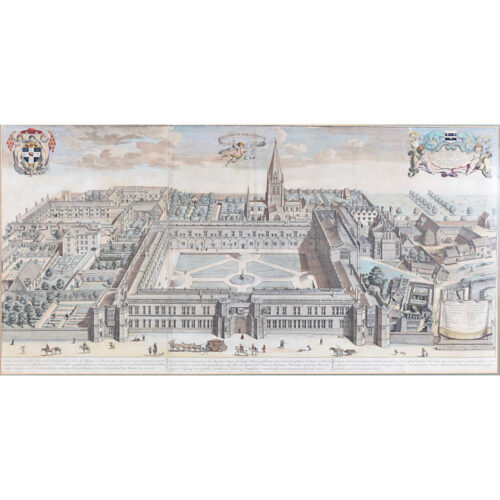
    Christ Church, Oxford (1675)

      Engraving 42 x 84 cm Loggan's view of Christ Church from the 'Oxonia Illustrata'. Loggan was born to English and Scottish parents, and was baptised in Danzig in 1634. After studying engraving in Danzig with Willem Hondius (1598-1652 or 1658), he moved to London in the late 1650s, going on to produce the engraved title-page for the folio 1662 Book of Common Prayer. He married in 1663 and moved to Nuffield in Oxfordshire in 1665. Loggan was appointed Public Sculptor to the nearby University of Oxford in the late 1660s, having been commissioned to produce bird’s-eye views of all the Oxford colleges. He lived in Holywell Street as he did this. The 'Oxonia Illustrata' was published in 1675, with the help of Robert White (1645-1704). Following its completion, Loggan began work on his equivalent work for Cambridge; the 'Cantabrigia Illustrata' was finally published in 1690, when he was made engraver to Cambridge University. The 'Oxonia Illustrata' also includes an engraving of Winchester College (Winchester and New College share William of Wykeham as their founder) whilst the 'Cantabrigia Illustrata' includes one of Eton College (which shares its founder, Henry VIII, with King’s College). Bird’s-eye views from this era required a particular talent as an architectural perspectivist; it was not until 1783 that it became possible for artists to ascend via hot air balloons and view the scenes they were depicting from above. Loggan thus had to rely on his imagination in conceiving the views. Loggan’s views constitute the first accurate depictions of the two Universities, in many ways unchanged today. Whilst the Oxford engravings were produced in reasonable numbers and ran to a second edition by Henry Overton (on thicker paper and with a plate number in Roman numerals in the bottom right-hand corner), those of Cambridge were printed in much smaller numbers. The Dutchman Pieter van der Aa published some miniature versions of the engravings for James Beverell’s guidebook to the UK, 'Les Delices de la Grande Bretagne' (circa 1708). The contemporary artist Andrew Ingamells (born 1956) has produced a highly-acclaimed series of etchings which bring Loggan’s original vision up to date. Condition: very good; later hand coloured. If you are interested, please email info@manningfineart.co.uk or call us on 07929 749056. Click here for other views of Christ Church.
  • Bryan de Grineau (1883 - 1957)

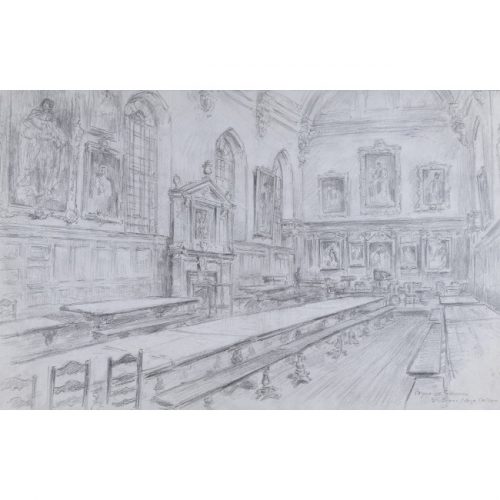
    The Hall, St John’s College, Oxford

    Pencil 34 x 56 cm Signed and titled lower right. Drawing published in The Illustrated London News, 18 June 1955. Condition: very good. Click here for other views of St John’s College by this artist and biographical details. If you are interested, please email info@manningfineart.co.uk or call us on 07929 749056.
  • Walter Charles Ives (d. 1961)

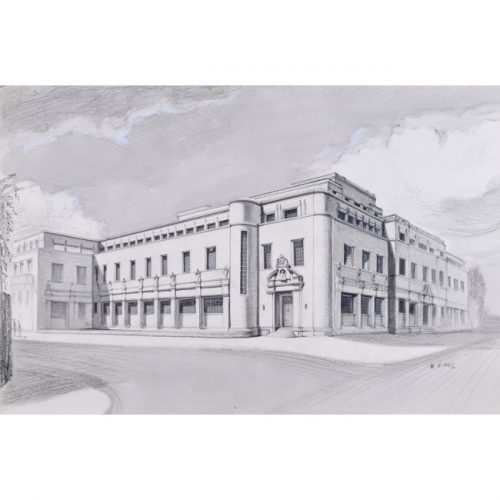
    The New Bodleian Building, Oxford 1946

    Signed Pencil, wash and whitening 35 x 53 cm (15 x 21 in.)  
  • William Matthison (1853-1926)

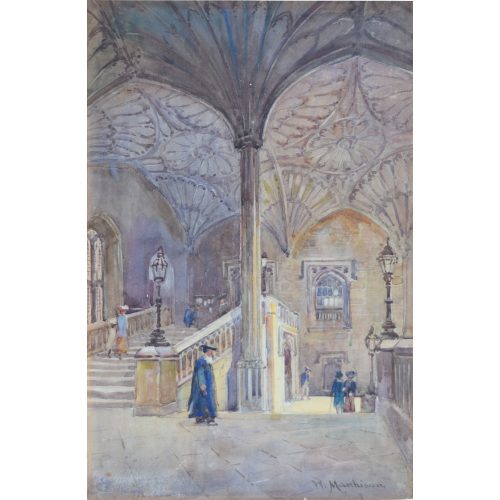
    Christ Church Oxford Staircase

    Watercolour 38 x 25 cm Matthison was born near Birmingham and attended King Edward’s School in the city. He learned drawing at the Birmingham Central School of Art and then became a pupil of Birmingham artist Edward Watson. He became a professional artist in 1875 and moved to Oxfordshire a few years after; this was where he had the opportunity to produce many of the Oxford views for which he is known today. In 1902 he moved to Park Town in Oxford and was commissioned by Robert Peel to paint more than seventy views of the University of Oxford, which were subsequently made into postcards. Priced at seven for a shilling, they were only available from E Cross of Pembroke Street (a long-since closed business). Raphael Tuck & Sons also commissioned him to produce postcard scenes of Cambridge. Matthison’s views of Oxford were later printed in Fifty Watercolour Drawings of Oxford, published in 1912 by Alden & Co. Click here for other works by the artist. If you are interested, please email info@manningfineart.co.uk or call us on 07929 749056.
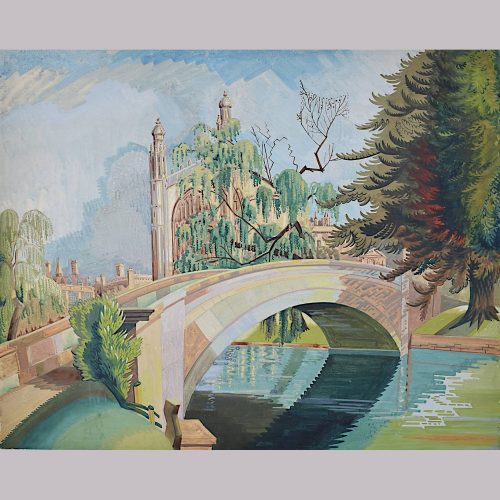
  • Anonymous King's College Cambridge with the River Cam and Bridge to foreground

    51x63.5cm Watercolour Probably 1920s A fine, and large, view of King's College. The artist paints in an art deco style, picking out the stones of the bridge in different colours, the colours all having a heightened sense of reality. Born from cubism, the art deco era is characterised by a fragmented, geometric character particularly evident here. It gives the impression of a shimmering dream. The twenties was an incredible period of change, moving from heavy elaborate styles to a pared back and sleek style expressing more dynamism, an interest in dimension and abstraction. If you are interested email info@manningfineart.co.uk or call us on 07929 749056.
  • George Pyne (1800-1884) Exeter College, Oxford

    Watercolour 22x18.5cm Pyne was the elder son of William Henry Pyne, the publisher artist behind the monumental History of the Royal Residences, and son-in-law of John Varley – two founders of the Society of Painters in Watercolours. Living in Oxford from the 1850s until his death, he brought the hand of an architectural draughtsman to his views of Oxford, the works for which he is best known, but with an artist’s ability to represent the romance of old stone. His views of Cambridge and Eton also contribute to his valuable and historical record of the period. If you are interested email info@manningfineart.co.uk or call us on 07929 749056. Condition: Generally excellent condition.
  • Hugh Casson (1910 - 1999)

    Trinity College, Oxford (1990)

      Watercolour 20 x 33 cm (38 x 50 cm framed) Casson's marvellous watercolour of Trinity and its perfectly manicured lawns, adorned with strolling undergraduates. Sir Hugh Casson was educated at Eastbourne College; St John’s College, Cambridge; and the Bartlett School of Architecture. Trained in the 1930s in the early modernist style, he taught at the Cambridge School of Architecture. After employment as a camoufleur during World War 2 by the Air Ministry, in 1948 he was appointed as director of architecture for the Festival of Britain. A close friend of the Royal Family, he undertook designs for the 1953 coronation, designed the interior of the Royal Yacht Britannia (“The overall idea was to give the impression of a country house at sea”), and taught the young Charles III to paint in watercolours. Amongst his architectural achievements are the Elephant House at London Zoo, the 1978 redevelopment of Bristol Docks, the Raised Staff Building for The University of Cambridge, and a building for the Royal College of Art. He published a number of illustrated books, of which Casson’s Oxford and Casson’s Cambridge are probably the best known. A limited edition series of prints was produced from the paintings. Condition: excellent. If you’d like to know more, please email info@manningfineart.co.uk or call us on 07929 749056. Click here for other views of Trinity College, Oxford.
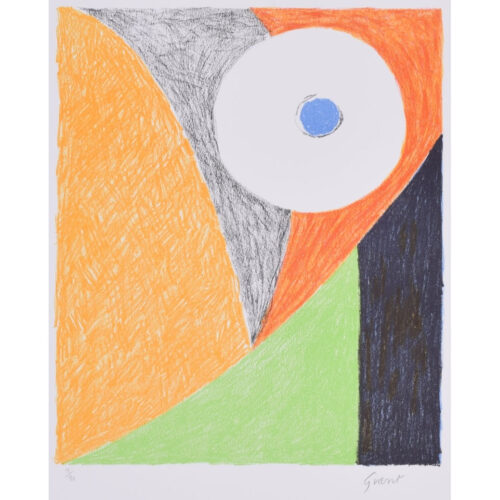
  • Duncan Grant (1885 - 1978)

    Interior (1973)


    Lithograph 36 x 30 cm (paper size 77 x 57 cm) Signed 'Grant' and numbered 9/90 in pencil; part of the Penwith Portfolio. Published by Penwith Galleries, St Ives in 1973 with works by Barbara Hepworth, Henry Moore, Peter Lanyon, Alan Davie, Merlyn Evans, John Piper, Ben Nicholson, Robert Adams, Bernard Leach, Michael Rothenstein, and F E McWilliam. An excellent example of Duncan Grant's late work. Duncan Grant was a member of the Bloomsbury Group. He was a painter and also designed textiles, pottery, theatre sets, and costumes. He was a member of the Bloomsbury Group. Condition: generally very good; a few light handling creases in margins. If you are interested, please email info@manningfineart.co.uk or call us on 07929 749056. Click here for more Modern British Art.
  • Dugald Sutherland MacColl Brasenose College, Oxford

    Pencil and Wash 24x31cm 44x51cm including frame, UK shipping only MacColl was Keeper of the Tate 1906-1911, and from 1911-1924 of the Wallace Collection. A more worked-up version of this painting appears in the Tate collection and may be seen on their website. If you are interested email info@manningfineart.co.uk or call us on 07929 749056. Condition: Good. Paper lightly ripped, slight discolouration and some light staining to margins.
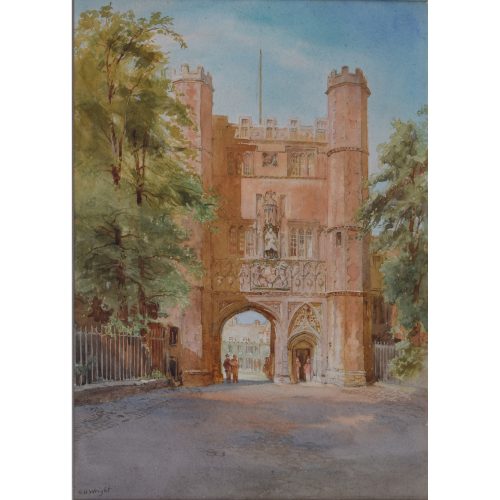
  • Richard Henry Wright (1857-1930)

    Trinity Great Gate, Cambridge

    Watercolour 47x39cm (frame) 25x18cm (9.8×7 inches) Originally from Hampshire, Wright was an artist who specialised in topographical views, mostly in Europe and Egypt. He exhibited at the RA from 1885 to 1913. In 1892 he married the artist Catherine Morris Wood, who also exhibited at the RA – but from 1880 until the 1920s. They lived at 2 Harcourt Buildings in the Inner Temple If you are interested email info@manningfineart.co.uk or call us on 07929 749056.
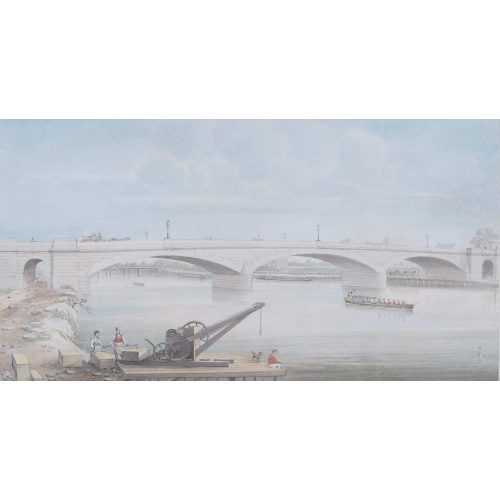
  • Gideon Yates

    View on The Thames with Staines Bridge

    25 x 48 cm Watercolour Charmingly signed lower left, on the side of the stone c.1830 Little is known of the life of Yates. Even his date of death is disputed with some sources putting it at 1837. What is known is that he spent most of his working life in London, producing many detailed views of The Thames such as this one. His style is very distinctive, and this large and impressive view of London Bridge is a typical view. He is thought to have lived in Lancaster in 1811, and to have travelled widely throughout Britain and the Continent. His works are in public collections including the Victoria and Albert Museum. UK Government Art Collection item 6701 is another view of The Thames by Yates. Click here for other paintings by Yates. If you are interested email info@manningfineart.co.uk or call us on 07929 749056.
  • J. Lewis (fl. 1801-1808)

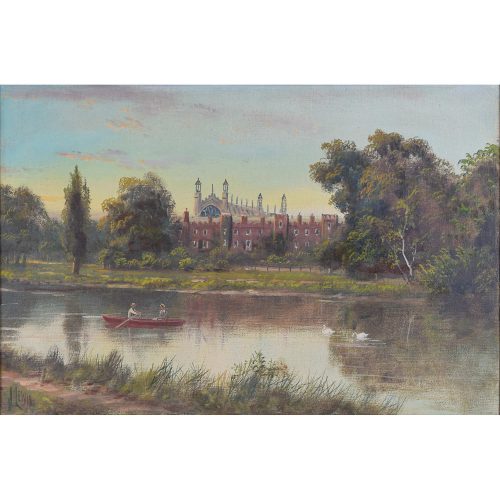
    Eton College from the River

    Oil on canvas 41 x 62 cm Signed lower left. While not a prolific artist, Lewis was noted for his views of the Thames - this view of Eton College is remarkable for its depiction of the river and wider environs of the school, as well as its architecture. Two snowy swans and boater-clad boys complete the view from the other sides of the Thames. Condition: very good.
  • Hugh Casson (1910 - 1999)

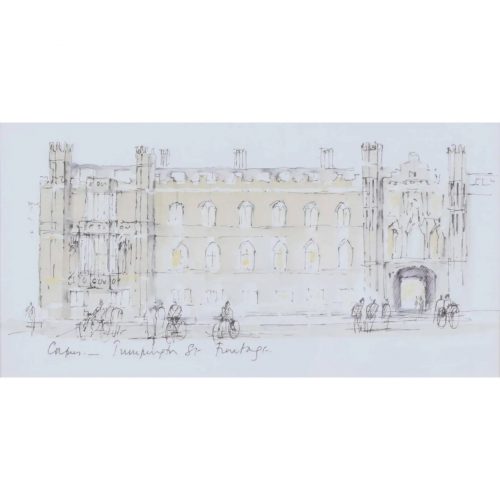
    Corpus Christi College, Cambridge

      Watercolour 11 x 21 cm A beautiful original water of Corpus. Casson juxtaposes the sparely painted figures of undergraduates and academics with the majesty of the pale stone used to build much of the college. This watercolour was used in Casson's book "Hugh Casson's Cambridge." Sir Hugh Casson was educated at Eastbourne College; St John’s College, Cambridge; and the Bartlett School of Architecture. Trained in the 1930s in the early modernist style, he taught at the Cambridge School of Architecture. After employment as a camoufleur during World War 2 by the Air Ministry, in 1948 he was appointed as director of architecture for the Festival of Britain. A close friend of the Royal Family, he undertook designs for the 1953 coronation, designed the interior of the Royal Yacht Britannia (“The overall idea was to give the impression of a country house at sea”), and taught the young Charles III to paint in watercolours. Amongst his architectural achievements are the Elephant House at London Zoo, the 1978 redevelopment of Bristol Docks, the Raised Faculty Building for The University of Cambridge, and a building for the Royal College of Art. He published a number of illustrated books, of which Casson’s Oxford and Casson’s Cambridge are probably the best known. A limited edition series of prints was produced from the paintings. Condition: very good. If you’d like to know more, please email info@manningfineart.co.uk or call us on 07929 749056.
  • Joseph Murray Ince (1806-1859) (attributed)

    Balliol College, Oxford

    Oil on board 22.5x29cm (9 x 11.5 in.) In a fine hand-finished black and gilt frame. If you are interested email info@manningfineart.co.uk or call us on 07929 749056. Brought up in Radnorshire, in Wales, Ince studied under David Cox from 1823-1826, and then exhibited at the Royal Academy. He was a drawing master at Cambridge University during the 1830s, during which period he painted many views of the Colleges of both Oxford and Cambridge, returning to Radnorshire in 1835. His works are in the collections of major galleries including the Tate, The V&A and The Fitzwilliam Museum in Cambridge.
  • R. Phene-Spiers (1838 – 1916)

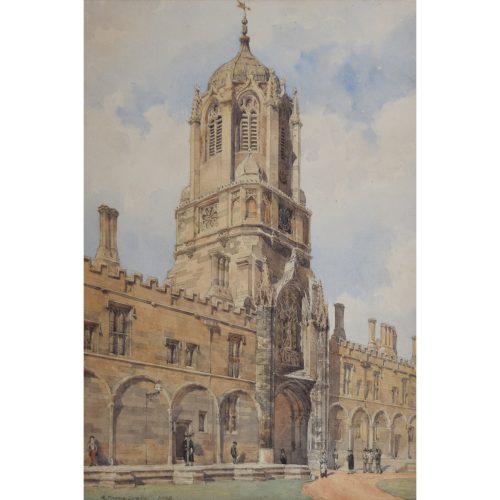
    Tom Tower, Christ Church, Oxford

    Signed and inscribed and dated 1880 Watercolour on paper 37x25cm (14.5×9.8 in.) Spiers was educated as an engineer at King’s College, London.  Subsequently he was Master of the Architectural School at the RA, and was President of the Architectural Association from 1867-68.
  • J Phillip Davies (British, 20th Century)

    Selwyn College Cambridge

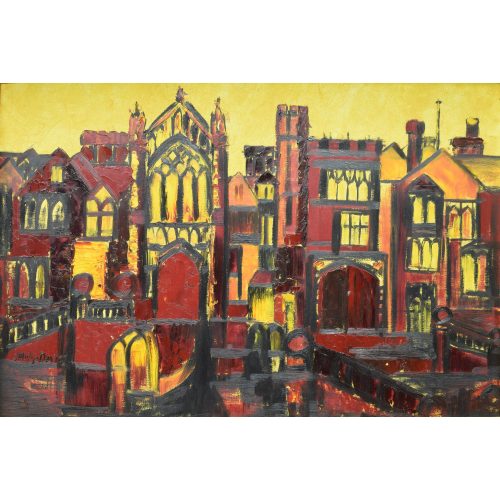
    Oil on board c. 1970 60x89cm A rare view of Selwyn College Cambridge, captured here in all the glory of its Victorian red brick.
  • Out of stock

    William Matthison (1853-1926)

    New College, Oxford: Front Quad

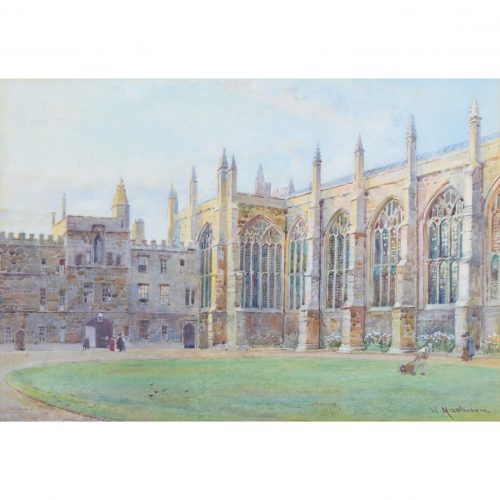
    Watercolour 35 x 52 cm Signed lower right. A charming watercolour of New College's Front Quad complete with members of the college in academic dress, wandering birds, and a gardener mowing the grass. William of Wykeham, who founded New College in 1379, was an ambitious builder. His vision for the college was of a Chapel, Hall, Library, and rooms for tutors and students to work and live in, all of which would be built around a quadrangle. This was the first time a college had been set in this way, and it became a model for colleges worldwide. Matthison was born near Birmingham and attended King Edward’s School in the city. He learnt drawing at the Birmingham Central School of Art and then became a pupil of Birmingham artist Edward Watson. He became a professional artist in 1875 and moved to Oxfordshire a few years after; this was where he had the opportunity to produce many of the Oxford views for which he is known today. In 1902 he moved to Park Town in Oxford and was commissioned by Robert Peel to paint more than seventy views of the University of Oxford, which were subsequently made into postcards. Priced at seven for a shilling, they were only available from E Cross of Pembroke Street (a long-since closed business). Raphael Tuck & Sons also commissioned him to produce postcard scenes of Cambridge. Matthison’s views of Oxford were later printed in Fifty Watercolour Drawings of Oxford, published in 1912 by Alden & Co. Condition: generally very good; a few spots to sky. If you are interested, please email info@manningfineart.co.uk or call us on 07929 749056. Click here for other views of New College, Oxford.
  • Algernon Newton (1880-1968) Study for Clare College, Cambridge

    Pencil and chalk on paper, squared for transfer 15 x 28 cm Algernon Newton was a British landscape artist, known informally as the 'Canaletto of the canals.' Newton studied at Clare College, Cambridge in 1899, deciding however at the end of his final year to leave university and pursue a professional career as an artist. He went on to serve in the army during the First World War and began exhibiting at the Royal Academy in 1919. He also enjoyed a successful international career, exhibiting alongside Picasso, Braque and Chagall in the Carnegie International Exhibition of Painting at Pittsburgh in 1938. In 1926 and 1934, he was also one of the esteemed artists chosen to represent Britain at the Venice Biennale of Art. This study was produced in preparation for the artist's 1946 oil painting of the same subject, shown at the Royal Academy Summer Exhibition the following year. It depicts a view of the Backs, looking over Clare College and King's College, with the chapel figuring prominently in the centre of the study. Algernon's work process is intriguing and the piece has been squared for transfer. Condition: Generally very good, squared for transfer, pinholes and short tear in the bottom left hand corner. For other general views of Cambridge, click here. 
  • John Piper (1903-1992) Study for the Piper Building Mural Gouache 24 x 20 cm Provenance: Bernard Kelly Collection John Piper CH was an English painter, printmaker, and designer of stained-glass windows. His work often focused on the British landscape, especially churches and monuments, and included tapestry designs, book jackets, screen-prints, photography, fabrics and ceramics. This study forms a striking a part of London's architectural history. It was originally produced by Piper as a study for a larger mural in the Piper Building. Although the abstraction of this painting is, in itself, striking, the pinkish hues and ethereal shapes almost recall Monet's hazy views over the Thames. The Piper Building is a mid-century architectural icon in Fulham. Built in the 1950s as 'Watson House', it was a laboratory complex for the North Thames Gas Board and has an innovative concrete structure. Piper was commissioned to produce the murals surrounding the building. The Gas Board moved out in the mid 1980s. Scheduled for demolition in the 1990s, the building was instead converted into seventy apartments and renamed the Piper Building. With double-height ceilings, the apartments were sold as shells, and purchasers were free to commission their own architects and builders. Condition: Generally excellent; framed. For other works by the artist and biographical details, click here. If you are interested email info@manningfineart.co.uk or call us on 07929 749056.
  • Albert Walter Moore (1874 – 1965)

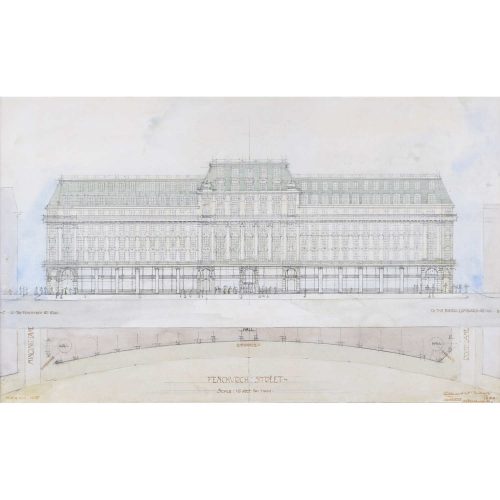
    Design for 30 Fenchurch Street (1915)

    Pencil and watercolour on paper 38.1 x 62 cm Signed and inscribed ‘Albert W Moore FRIBA Architect, 112 Fenchurch St, March 1915’. Provenance: Sotheby’s lot 166, 25 June 1981. A design for a fine building on the Plantation House site (the site was cleared in 2005 for a new building, '30 Fenchurch Street'). The architectural drawing is rendered carefully in pencil, with blue, yellow, and brown washes adding colour and depth to the picture. Moore was articled to George Hubbard, and the two became partners in 1898. He studied at the West London School of Art and was a member of the Architectural Association. Condition: very good; some losses to frame.
  • Florence & Walter Camm

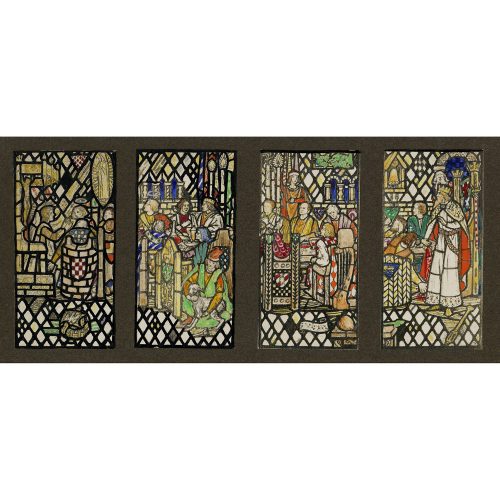
    Design for Series of Four Arthurian Stained Glass Windows for Mercersburg Academy Chapel, Pennsylvania 

    1928 Watercolour over photographic background 10 x 24cm Provenance: The archives of TW Camm The Irvine Chapel of Mercersburg Academy was built as a war memorial for the First World War dead of the school. The dead were honoured in a series of stained glass windows that were commissioned from a series of the greatest stained glass designers of the time. If you are interested email info@manningfineart.co.uk or call us on 07929 749056.
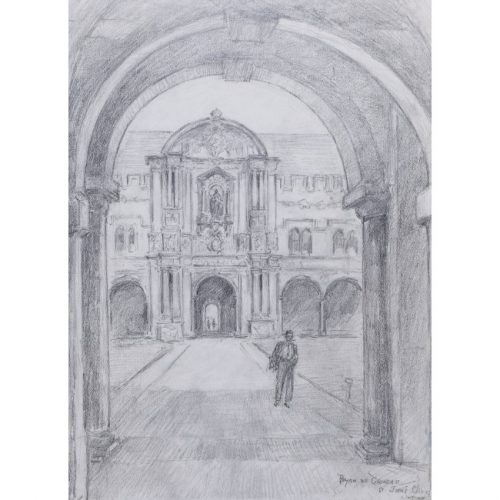
  • Bryan de Grineau (1883 - 1957)

    Canterbury Quad, St John’s College, Oxford

    Pencil 46 x 34 cm Signed and titled lower right. Drawing published in The Illustrated London News, 1955. Click here for other views of St John’s College by this artist and biographical details. Condition: very good. If you are interested, please email info@manningfineart.co.uk or call us on 07929 749056. Click here for other views of St John's College, Oxford.
  • George Pyne (1800-1884)

    Merton College, Oxford

    Watercolour 18 x 28 cm (7 x 11 in.) Provenance: Agnews  
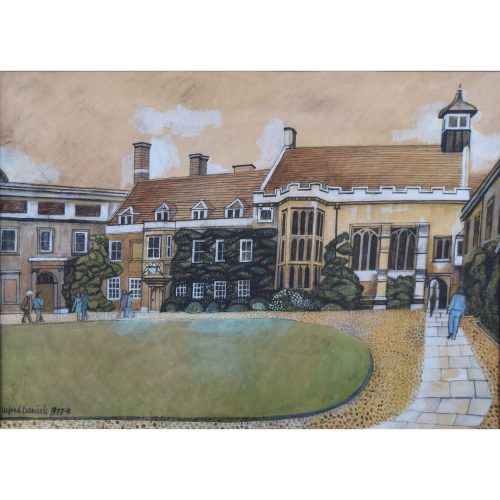
  • Alfred Daniels RBA RWS (1924-2015)

    Christ’s College, Cambridge

    Gouache, watercolour and ink on board 40x56cm (15.7×22 inches). In a hand-finished cream frame. Click here for biographical details and other works by the artist. If you are interested email info@manningfineart.co.uk or call us on 07929 749056.
Go to Top