• George Bissill (1896-1973) View over the bridge

    Watercolour 18 x 22 cm Born in 1896, George Bissill was a British miner, painter and furniture designer. Raised in the mining village of Langley Mill, Derbyshire, Bissill became a miner at the age of 13, before leaving to join the war effort in 1915. Upon his return from the war after being gassed, Bissill chose to become a pavement artist outside the newly erected Bush House in Aldwych, painting from his memory and his sketch book the uncompromising underground world he had inhabited. In 1935 he moved to the countryside near Newbury, where he lived and worked as a landscape painter, art restorer and dealer until his death in 1973. This watercolour forms part of a larger collection, 'unseen since they were taken from George Bissil's studio in 1983' and restored by Kate Pattinson. A series of planned exhibitions were cancelled due to Covid, but two shows, one in Oxford and one in Ilkeston, did take place. Through such exhibitions, Pattinson hoped to 'restore the reputation of an artist who, through mighty endeavour, conquered the art world in the 1920s with his powerful, authentic and experimental pictures.' Bissill's paintings are also held in a number of important public collections, including the Tate Gallery, National Museum of Ireland and the Manchester Art Gallery. In this watercolour, one colour blends beautifully into another, be it in the browns and purples of the foreground, or the greens and yellows of the fields in the background. Bissill demonstrates an expert command over the medium in his shading of the bridge, capturing the light and sun-rays of this summer's day excellently. Condition: generally very good, slight age toning to paper.

    If you would like to know more, please email info@manningfineart.co.uk or call us on 07929 749056.

  • George Bissill (1896-1973) View through the village

    Watercolour 26 x 21 cm Born in 1896, George Bissill was a British miner, painter and furniture designer. Raised in the mining village of Langley Mill, Derbyshire, Bissill became a miner at the age of 13, before leaving to join the war effort in 1915. Upon his return from the war after being gassed, Bissill chose to become a pavement artist outside the newly erected Bush House in Aldwych, painting from his memory and his sketch book the uncompromising underground world he had inhabited. In 1935 he moved to the countryside near Newbury, where he lived and worked as a landscape painter, art restorer and dealer until his death in 1973. This watercolour forms part of a larger collection, 'unseen since they were taken from George Bissil's studio in 1983' and restored by Kate Pattinson. A series of planned exhibitions were cancelled due to Covid, but two shows, one in Oxford and one in Ilkeston, did take place. Through such exhibitions, Pattinson hoped to 'restore the reputation of an artist who, through mighty endeavour, conquered the art world in the 1920s with his powerful, authentic and experimental pictures.' Bissill's paintings are also held in a number of important public collections, including the Tate Gallery, National Museum of Ireland and the Manchester Art Gallery. In this watercolour, Bissill paints a view through a village. Houses line a small road leading to a clearing where three horses are frolicking. Bissill combines watercolour and pencil in this multimedia composition, using pencil to detail the minimalistic horses, for example. This painting offers therefore a unique insight into Bissill's working processes as he frantically sketches and paints life around him. Condition: generally very good.

    If you would like to know more, please email info@manningfineart.co.uk or call us on 07929 749056.
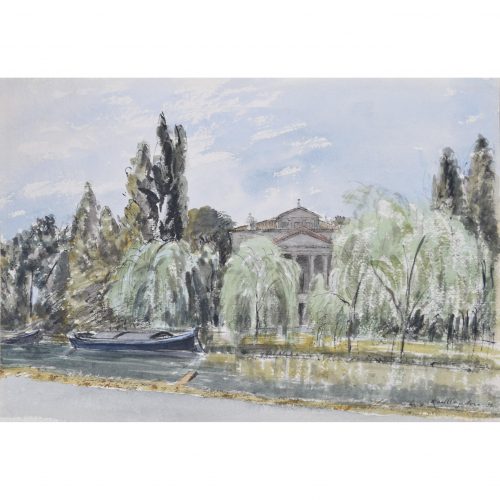
  • Karl Hagedorn (1889 - 1969)

    The Villa Malcontenta, Venice (1958)

      Watercolour and ink 33 x 50 cm Signed and dated 1958 lower right (dated August 23rd to reverse). A watercolour of the Villa Malcontenta in Venice, nestled between willow trees. The River Brenta flows serenely in the foreground. Villa Foscari is a patrician villa in Mira, near Venice, northern Italy, designed by the Italian Renaissance architect Andrea Palladio. It is also known as La Malcontenta ("The Discontented"), a nickname which - according to a legend - it received when the spouse of one of the Foscaris was locked up in the house because she allegedly did not live up to her conjugal duty. Karl Hagedorn was a painter and illustrator. He was educated in Berlin, and at the Manchester School of Technology, Manchester School of Art, and Slade School of Fine Art (where he later taught), before training in Paris under Maurice Denis. Hagedorn showed regularly at the Society of Modern Painters in Manchester, and then (from 1913 onwards), at the Royal Academy and the New English Art Club. He became a British citizen in 1914, and served in the British Army during World War I. During World War II, he sold pictures of military subjects to the United Kingdom Government's War Artists' Advisory Committee. He was also commissioned by the Recording Britain project to produce views of Middlesex and Derbyshire. Condition: very good. If you are interested, please email info@manningfineart.co.uk or call us on 07929 749056. Click here for more Modern British painting.
  • Join the School Saving Bank Vintage poster, lithograph

    36 x 25 cm Printed 1967, numbered 4/67 The post-war period in the United States saw the growth of the school savings bank movement, in which children were encouraged to save money by opening and regularly depositing into savings bank accounts through the school. This poster was presumably designed to be hung in classrooms across the country. Showcasing a colourful minimalist design, this poster features a circle with the slogan 'Join the School Saving Bank' in a configuration that recalls the face of a coin,
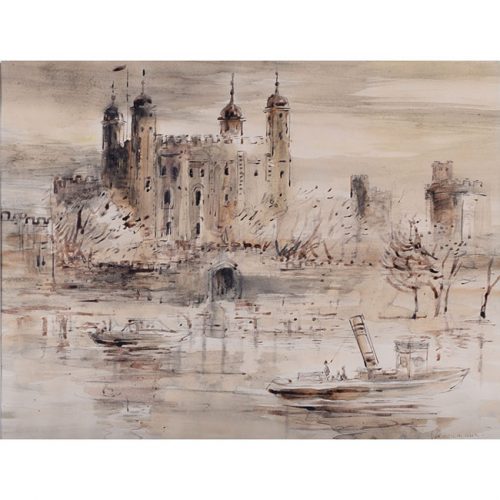
  • Violet Hilda Drummond

    The Tower of London

    Watercolour 33 x 42 cm An evocative view of the Thames and The Tower in Drummond's distinctive style. Provenance: The Arthur Andersen Collection, The Deloitte Collection. Click here for other works by the artist and biographical details. If you are interested email info@manningfineart.co.uk or call us on 07929 749056.
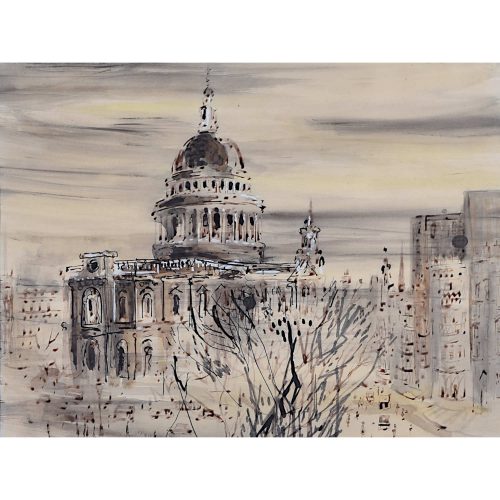
  • Violet Hilda Drummond (British, 1911-2000)

    St Paul's Cathedral

    Watercolour 33 x 43 cm Signed upper right (visible in the photograph showing the framed painting). Provenance: the Arthur Andersen art collection. Here, the artist paints a sprightly view of St Paul's, which rises from a sea of nondescript traffic and pedestrians. The mostly monochrome palette, gently highlighted with a yellow wash and white details, communicates the character of the city. Drummond's father, a Scots Guard, was killed at Ypres in 1914. Drummond and her two sisters were brought up by her mother and educated in Eastbourne and at Le Chateau Vitry-sur-Seine, a Parisian finishing school. After Paris, Drummond attended St Martin’s School of Art. Later in life, she began writing children’s picture books – the most notable being Miss Anna Truly (1945) and her Little Laura series (1960 onwards). She also produced cartoons for the BBC. 'Mrs Easter and the Stork' – published in 1957 by Faber & Faber – was awarded the Kate Greenway Medal. Drummond later took to painting watercolours of London street scenes which have remained popular ever since.
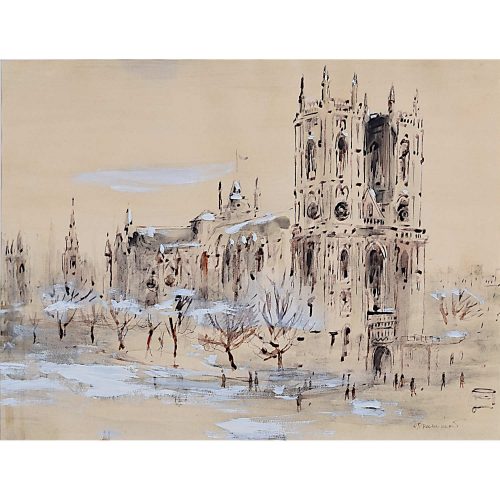
  • Violet Hilda Drummond (British, 1911-2000)

    Westminster Abbey

    Watercolour 33 x 43 cm Signed lower right. Here, the artist paints a sprightly view of Westminster Abbey, which rises from a sea of nondescript pedestrians. The mostly monochrome palette, gently highlighted with splashes of a muted red, and white details, communicates the character of the city. Drummond's father, a Scots Guard, was killed at Ypres in 1914. Drummond and her two sisters were brought up by her mother and educated in Eastbourne and at Le Chateau Vitry-sur-Seine, a Parisian finishing school. After Paris, Drummond attended St Martin’s School of Art. Later in life, she began writing children’s picture books – the most notable being Miss Anna Truly (1945) and her Little Laura series (1960 onwards). She also produced cartoons for the BBC. 'Mrs Easter and the Stork' – published in 1957 by Faber & Faber – was awarded the Kate Greenway Medal. Drummond later took to painting watercolours of London street scenes which have remained popular ever since. Provenance: the Arthur Andersen art collection.
  • Out of stock

    Richard Beer (1928 - 2017)

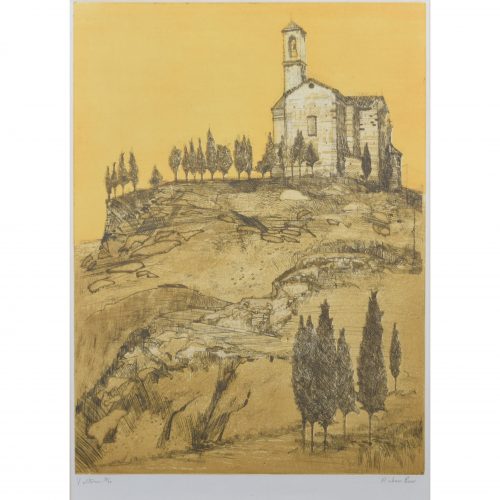
    Volterra

      Etching and aquatint 60 x 45 cm Titled and numbered 4/70 lower left, and signed lower right, both in pencil. Beer's yellow-hued view of Volterra, a mountain town in Tuscany. Overseen by the beating Italian sun, a church perches atop a hill marked by trees and rocky outcrops. Born in London in 1928, just too late to serve in the Second World War, Richard Beer studied between 1945 - 1950 at the Slade School. Subsequently, a French Government scholarship allowed him to spend time in Paris at Atelier 17, working under Stanley William Hayter (1901 - 1988), one of the most significant print makers of the 20th Century – having spent the War in New York, advising as a camofleur, Hayter only returned to Paris in 1950. Subsequently Beer studied at the École des Beaux Arts, Paris. Working for John Cranko, choreographer for the Royal Ballet, Beer designed the sets and costumes for his The Lady and the Fool at Covent Garden, subsequently working for him following his move in 1961 to Stuttgart Ballet. Additionally he produced book illustrations and designed book jackets. Beer later taught print-making at the Chelsea School of Art, where he was a popular teacher. Probably his greatest work was a collaboration with John Betjeman to produce a portfolio of prints of ten Wren Churches in the City for Editions Alecto, copies of which are in The Government Art Collection. That collection contains a total of 54 prints by Beer, and the Tate Gallery’s collection holds seven. His Oxford series was also produced for Editions Alecto as was a series of predominantly architectural views in Southern Europe. Most of his prints are of architectural subjects. Condition: very good. If you’d like to know more, please email info@manningfineart.co.uk or call us on 07929 749056.
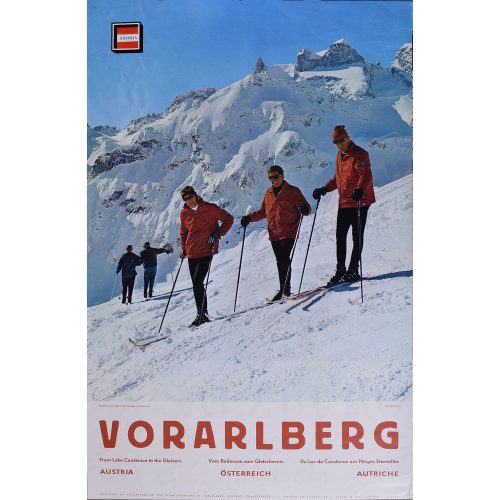
  • Vorarlberg Austria

    Lithographic poster Printed G Gistel 81x50cm If you are interested email info@manningfineart.co.ukor call us on 07929 749056.  
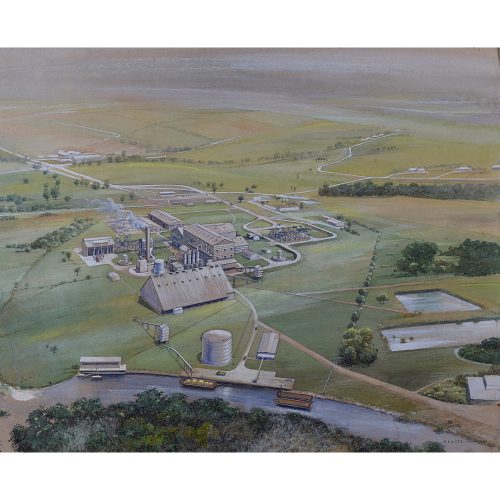
  • W. A. A. Cox ARIBA Architectural Design for a Factory in the United Kingdom

    Watercolour, pencil 53x64 cm Signed and dated, lower right 'W. A. A. Cox ARIBA 1966' If you are interested email info@manningfineart.co.uk or call us on 07929 749056. Condition: Good.  
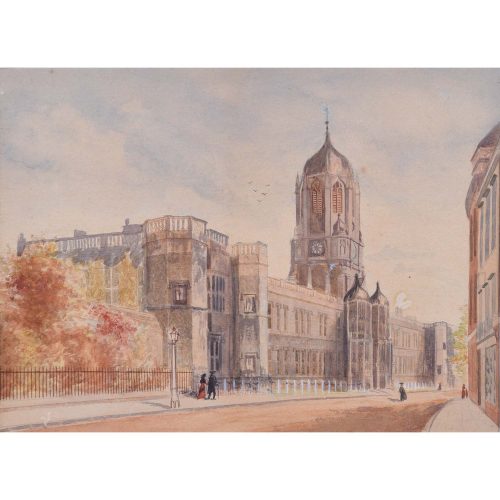
  • W. H. Hill

    Tom Tower, Christ Church, Oxford (1883)

      Watercolour 23.7×32.5cm   If you are interested email info@manningfineart.co.ukor call us on 07929 749056. Condition: Good.
  • Out of stock

    W. A. Scott

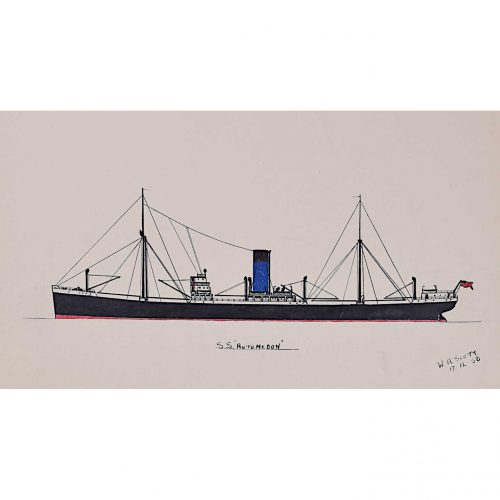
    S. S. Automedon (1956)


    26 x 33.5 cm

    Bodycolour and ink on paper Signed l.r.

    SS Automedon was a Blue Funnel Line refrigerated cargo steamship. She was launched in 1921 on the River Tyne as one of a class of 11 ships to replace many of Blue Funnel's losses in the First World War.

    A converted German auxiliary cruiser and merchant raider Atlantis captured and scuttled Automedon in 1940 in the Indian Ocean. Her capture is notable because she was carrying top secret documents addressed to the British Far East Command. Their capture may have influenced Japan's decision to enter the Second World War.

    Automedon was Achilles' charioteer in Homer’s Iliad. This was the first of three Blue Funnel Line ships to be named after him. The second was a motor ship launched in 1949 and scrapped in 1972. The third was a motor ship launched in 1948 as Cyclops, renamed Automedon in 1975 and scrapped in 1977.

    W. A. Scott was a marine artist known for his highly accurate line and body colour drawings. It is likely that he was an admirer of Laurence Dunn as his work bears much resemblance to Dunn's highly regarded marine drawings. 

  • W. A. Scott

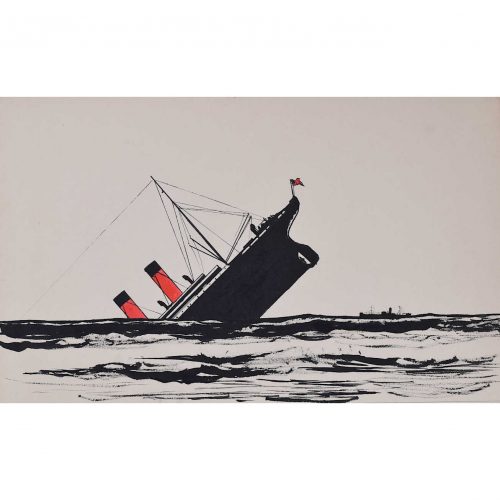
    The Titanic Sinking


    23 x 37 cm

    Bodycolour and ink on paper

    W. A. Scott was a marine artist known for his highly accurate line and body colour drawings.

    It is likely that Scott was an admirer of Laurence Dunn as his work bears much resemblance to Dunn's highly regarded marine drawings. 

  • David Loggan (1634 - 1692)

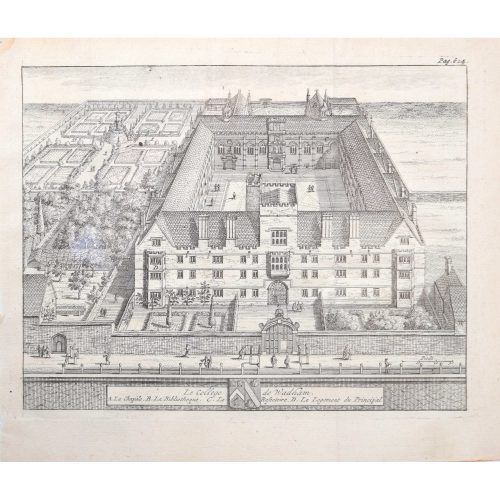
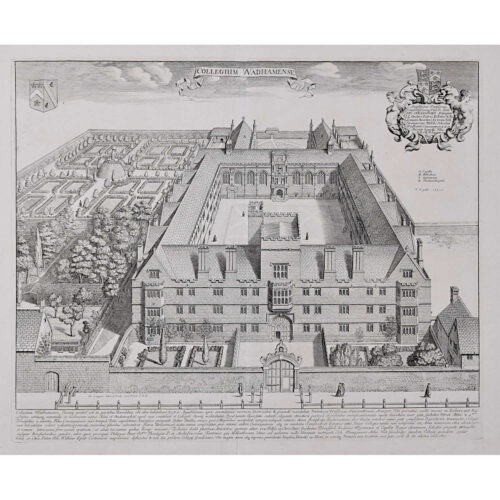
    Wadham College, Oxford (1675)

    Engraving 32 x 41 cm Loggan's view of Wadham from the 'Oxonia Illustrata'. Loggan was born to English and Scottish parents, and was baptised in Danzig in 1634. After studying engraving in Danzig with Willem Hondius (1598-1652 or 1658), he moved to London in the late 1650s, going on to produce the engraved title-page for the folio 1662 Book of Common Prayer. He married in 1663 and moved to Nuffield in Oxfordshire in 1665. Loggan was appointed Public Sculptor to the nearby University of Oxford in the late 1660s, having been commissioned to produce bird’s-eye views of all the Oxford colleges. He lived in Holywell Street as he did this. The 'Oxonia Illustrata' was published in 1675, with the help of Robert White (1645-1704). Following its completion, Loggan began work on his equivalent work for Cambridge; the 'Cantabrigia Illustrata' was finally published in 1690, when he was made engraver to Cambridge University. The 'Oxonia Illustrata' also includes an engraving of Winchester College (Winchester and New College share William of Wykeham as their founder) whilst the 'Cantabrigia Illustrata' includes one of Eton College (which shares its founder, Henry VIII, with King’s College). Bird’s-eye views from this era required a particular talent as an architectural perspectivist; it was not until 1783 that it became possible for artists to ascend via hot air balloons and view the scenes they were depicting from above. Loggan thus had to rely on his imagination in conceiving the views. Loggan’s views constitute the first accurate depictions of the two Universities, in many ways unchanged today. Whilst the Oxford engravings were produced in reasonable numbers and ran to a second edition by Henry Overton (on thicker paper and with a plate number in Roman numerals in the bottom right-hand corner), those of Cambridge were printed in much smaller numbers. The Dutchman Pieter van der Aa published some miniature versions of the engravings for James Beverell’s guidebook to the UK, 'Les Delices de la Grande Bretagne' (circa 1708). The contemporary artist Andrew Ingamells (born 1956) has produced a highly-acclaimed series of etchings which bring Loggan’s original vision up to date. Condition: generally very good; central fold as issued. If you are interested, please email info@manningfineart.co.uk or call us on 07929 749056. Click here for other views of Wadham College, Oxford.
  • G R T (Raymond Teane) Cowern (1913 - 1986)

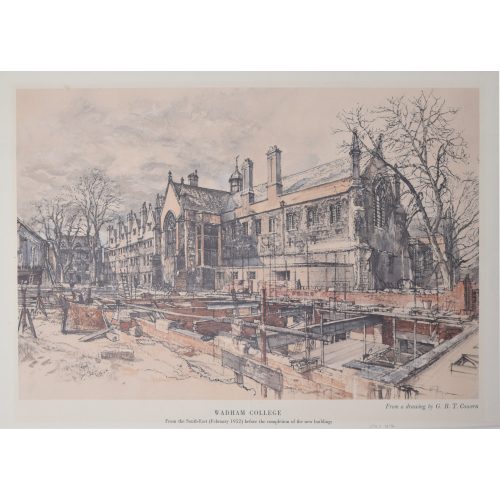
    Wadham College, Oxford from the South East before the completion of the new buildings (1952)

      Lithograph 33 x 46 cm A 1953 lithograph of Wadham during the construction of the college's mid-century buildings. Cowern made his drawing of the quad in 1952 and it was reproduced a year later as a lithograph to be published in the "Oxford Almanack". The Oxford Almanack was an annual almanac published by the Oxford University Press for the University of Oxford from 1674 through 2019 (when printing sadly ceased due to "dwindling interest"). The almanac traditionally included engravings or lithographs of the University and information about the upcoming year. Other almanac artists have included James Basire, Michael Burghers, J. M. W. Turner, and John Piper. G R T Cowern was a British painter, illustrator, and accomplished draughtsman. He was elected a full member of the Royal Academy in 1968. Cowern joined the British Army during the Second World War and served as an intelligence officer and then as a Field Security Officer. Throughout his Army service, Cowern made numerous drawings of his experiences during training and in the Netherlands and Belgium. Several of these works were purchased by the War Artists' Advisory Committee and are now held by the Imperial War Museum in London. Cowern also worked for the Recording Britain project, painting and etching images of historic buildings at risk of destruction in Suffolk, Worcestershire, and Herefordshire. A number of these drawings are now in the collection of the Victoria and Albert Museum. Condition: generally very good, a little discolouration to the paper, and a tear to the margin (which will be hidden under the mount). If you’d like to know more, please email info@manningfineart.co.uk or call us on 07929 749056.
  • Emery Walker (1851 - 1933) after Edmund Hort New (1871 - 1931)

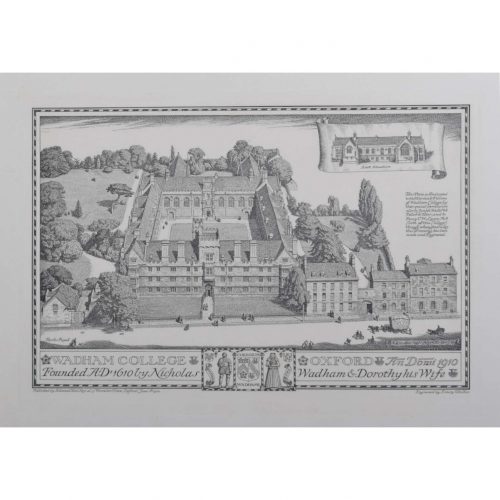
    Wadham College, Oxford

      Photogravure 27 x 41 cm New produced a series of pen-and-ink drawings of Oxford colleges, of which this is one. They paid homage to the artist David Loggan, often using the same aerial viewpoint as him, but showing the colleges two hundred years later. Emery Walker turned New's drawings into photoengravings in the early 20th century. Probably no more than two hundred prints of each engraving were produced, and the plates were destroyed in the blitz. Edmund Hort New was an English artist. He was a member of the Birmingham Group of Arts and Crafts-associated painters and craftsmen, and is known as a leading illustrator of his period. He specialised in pen and ink drawings of rural and urban landscapes, old buildings and their interiors, architectural features, and also designed bookplates. He provided illustrations for the English Illustrated Magazine and was commissioned by Bodley Head publishers to illustrate critically acclaimed editions of books, such as Walton's The Compleat Angler. In 1895, New met William Morris and began designing for the Kelmscott Press. He also taught drawing to T E Lawrence. In 1905, he began his drawings of the Oxford colleges, and spent the rest of his life working on the (sadly unfinished) project. In 1921 he exhibited at the first exhibition of the Society of Graphic Art. Sir Emery Walker FSA was an English engraver, photographer, and printer. He was very involved with the Arts and Crafts movement, a Master of the Art Workers' Guild, President of the Arts and Crafts Exhibition Society, a Trustee of the Wallace Collection, and a Fellow of the Society of Antiquaries. He was also a close friend of William Morris. Walker's expertise and his collection of 16th-century typefaces inspired Morris to create the Kelmscott Press. In 1910, Walker photographed the notable Rice portrait of Jane Austen. He was knighted in 1930. Condition: very good; modern printing. If you’d like to know more, please email info@manningfineart.co.uk or call us on 07929 749056. Click here for other views of Wadham.
  • Pieter van der Aa (1659-1733), after David Loggan (1634–1692)

    Wadham College, Oxford (1727)

      Engraving 12 x 16 cm An eighteenth-century view of Wadham, engraved by Pieter van der Aa after David Loggan, the noted engraver, draughtsman, and painter. Pieter van der Aa of Leiden was a Dutch publisher best known for preparing maps and atlases, though he also printed editions of foreign bestsellers and illustrated volumes. He is noted for the many engravings he produced after David Loggan's series of Oxford and Cambridge colleges and costumes. In 1727 Van Der Aa illustrated "Les Delices de la Grande Bretagne & de L'Irelande" by James Beeverell, the book in which this engraving appears. Condition: a good impression. If you’d like to know more, please email info@manningfineart.co.uk or call us on 07929 749056.
  • Hugh Casson (1910 - 1999)

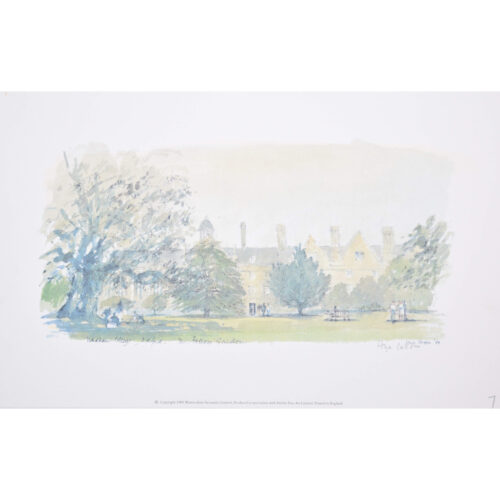
    Wadham College, Oxford - The Fellows' Garden

      Lithograph 24 x 40 cm Proof print aside from the numbered edition. Signed, titled and dated in plate. Casson's peaceful, pastoral depiction of Wadham. Sir Hugh Casson was educated at Eastbourne College; St John’s College, Cambridge; and the Bartlett School of Architecture. Trained in the 1930s in the early modernist style, he taught at the Cambridge School of Architecture. After employment as a camoufleur during World War 2 by the Air Ministry, in 1948 he was appointed as director of architecture for the Festival of Britain. A close friend of the Royal Family, he undertook designs for the 1953 coronation, designed the interior of the Royal Yacht Britannia (“The overall idea was to give the impression of a country house at sea”), and taught the young Charles III to paint in watercolours. Amongst his architectural achievements are the Elephant House at London Zoo, the 1978 redevelopment of Bristol Docks, the Raised Faculty Building for The University of Cambridge, and a building for the Royal College of Art. He published a number of illustrated books, of which Casson’s Oxford and Casson’s Cambridge are probably the best known. A limited edition series of prints was produced from the paintings. Condition: very good. If you are interested, please email info@manningfineart.co.uk or call us on 07929 749056. Click here for other views of Wadham College, Oxford.
  • Hugh Casson (1910 - 1999)

    Wadham College, Oxford (1989)

      Lithograph 22 x 40 cm Proof print aside from the numbered edition. Signed, titled and dated in plate, and signed lower right in pencil. Printed on wove. Casson's peaceful, pastoral depiction of Wadham. Sir Hugh Casson was educated at Eastbourne College; St John’s College, Cambridge; and the Bartlett School of Architecture. Trained in the 1930s in the early modernist style, he taught at the Cambridge School of Architecture. After employment as a camoufleur during World War 2 by the Air Ministry, in 1948 he was appointed as director of architecture for the Festival of Britain. A close friend of the Royal Family, he undertook designs for the 1953 coronation, designed the interior of the Royal Yacht Britannia (“The overall idea was to give the impression of a country house at sea”), and taught the young Charles III to paint in watercolours. Amongst his architectural achievements are the Elephant House at London Zoo, the 1978 redevelopment of Bristol Docks, the Raised Faculty Building for The University of Cambridge, and a building for the Royal College of Art. He published a number of illustrated books, of which Casson’s Oxford and Casson’s Cambridge are probably the best known. A limited edition series of prints was produced from the paintings. Condition: very good. If you’d like to know more, please email info@manningfineart.co.uk or call us on 07929 749056. Click here for other views of Wadham College, Oxford.
  • William Nicholson (1872 - 1949)

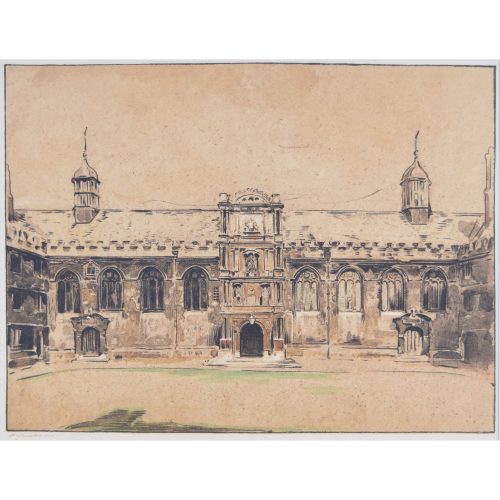
    Front Quad, Wadham College, Oxford

      Lithograph 26 x 34.5 cm Signed. Published by Stafford Gallery. Sir William Nicholson was a British painter and printmaker. He is also known as an illustrator, author of children’s books, stained glass designer, and theatre set designer. In 1902, he produced a series of watercolour, chalk, and pen drawings of Oxford which were published in 1905 by the Stafford Gallery as two portfolios of lithographs, with descriptions by Arthur Waugh (father of Evelyn Waugh). These dramatic depictions of Oxford show Nicholson’s interest in the effects of light and shade on the city’s architecture. Condition: generally very good. In conservation mount. If you are interested, please email info@manningfineart.co.uk or call us on 07929 749056. Click here for other views of Wadham College, Oxford.
  • Dennis Flanders (1915 - 1994)

    Wadham College, Oxford, Garden Front

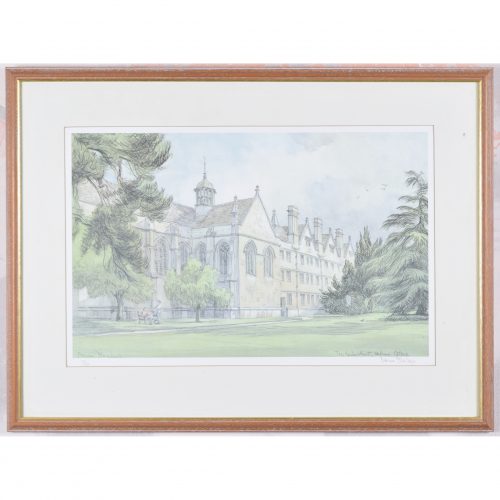
      Lithograph 30 x 48 cm Numbered 117/500 lower left and signed lower right, both in pencil. Signed lower left and titled lower right in the plate. A tranquil view of Wadham, verdant of grass and leafy of tree. Two undergraduates in jeans and t-shirts chat, laden down with books. Dennis Flanders RBA RWS was a British artist and draughtsman who specialised in pen and ink drawings, often of English landscapes and buildings. He is notable for his meticulous depictions of the impact of aerial bombing upon historic buildings during World War Two. After attending the Merchant Taylors' School, Flanders studied at the Regent Street Polytechnic, St. Martin's School of Art, and at the Central School of Arts and Crafts. Flanders worked at the School of Military Engineering during World War Two and made models of buildings and landscapes based on aerial reconnaissance photographs. He applied for a commission with the War Artists' Advisory Committee and, although he was unsuccessful, the Committee did agree to purchase several drawings from him. These were mostly detailed depictions of bomb-damaged buildings and churches which included views of St Paul's Cathedral and Canterbury Cathedral. After the war, Flanders became a regular exhibitor at the Royal Academy and held his first solo exhibition at Colnaghi in 1947. He illustrated several books and published two volumes of prints from his own drawings of British architecture and landscapes, which had been the dominant theme of his artistic career. Condition: very good. If you are interested, please email info@manningfineart.co.uk or call us on 07929 749056. Click here for other views of Wadham College, Oxford.
  • Waimea Bay, Hawaii 1964 Vintage Surfing Poster of Mike Doyle Champion Surfer

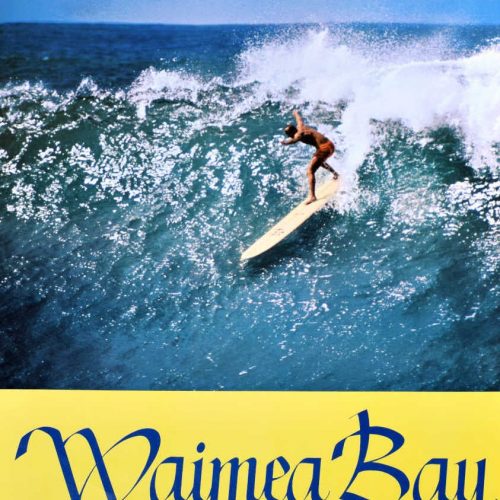
    67 x 53 cm Poster (lithograph) Printed by Looart Press, Colorado Springs, Colorado (1964) Waimea Bay Hawaii vintage 1964 surfing poster, with photograph of legendary surfer Mike Doyle on a wave on the north coast of Hawaii, taken by the iconic Californian surf photographer Leroy Grannis (1917-2011). Born in California in 1941, Doyle was first capitvated at the age of thirteen by surfing. The epitome of a surfer; tanned, chiseled features, charismatic and permanently smiling. He won readers polls in 1964 and 1965 in Surfer magazine, and in 1966 was voted Surfer's 'Top International Surfer'. Direct from the surplus stock of the printers, LooArt Press, which closed in the early 1970s. The poster is in generally excellent condition.
  • James Basire & Robert Blemmell Schnebbelie Wainflete School, Lincolnshire

    Engraving 50 x 32 cm This engraving was originally published by the Society of Antiquaries of London, an organisation dedicated to studying and preserving historical monuments. The society commissioned a series of architectural engravings by James Basire, this one based on a drawing by Robert Schnebbelie. In doing so, the Antiquaries hoped to preserve and disseminate knowledge of England’s architectural heritage. This engraving depicts a north-westerly view of a school in Wainflete, Lincolnshire. It is likely that the building pictured illustrates the Magdalen College School, opened in 1484 by William Patten of Wainlete as a feeder school for Magdalen College, which he founded in 1458. The engraving showcases the lovely red-brick building and the effigies of his father Richard Patten, presumably designed to feature in the school. Condition: Generally very good.

    If you would like to know more, please email info@manningfineart.co.uk or call us on 07929 749056.

  • "Zero" Hans Schleger (1898 - 1976)

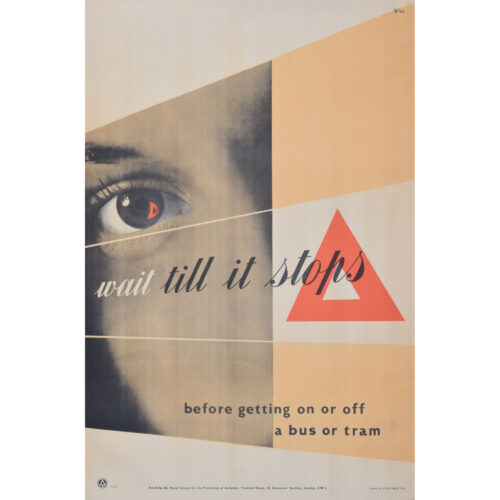
    Wait till it stops before getting on or off a bus or tram

      Original vintage poster 76 x 49 cm Hans Schleger was born in Germany. After the First World War, he studied at the Berlin Kunstgewerbeschule. After working in Berlin, he moved to New York in 1924 and began to work as a graphic designer. He returned to Berlin in 1929 and began working for the British advertising agency Crawfords, where he met Edward McKnight Kauffer, who introduced him to Jack Beddington (the head of advertising at Shell Mex BP). He moved to London following the rise of Hitler and produced a series of posters for Shell Mex. During the Second World War he worked for the British Government. He later taught at the Chicago Institute of Design and subsequently designed the trademarks of the John Lewis Partnership, Penguin, Deutsche Bank, and the Edinburgh Festival. Condition: generally very good, the odd gentle crease; not backed. If you are interested, please email info@manningfineart.co.uk or call us on 07929 749056. Click here for other original vintage posters.
  • Penelope Ellis (1935-2016) Wallowing in the Mud

    Woodblock print 16 x 11 cm Provenance: From the artist's estate sale. ​Penelope Mary Ellis (1935–2016) was a British artist celebrated for her conceptual abstract works in the 1960s. Born in Hampstead, London, she was the eldest daughter of artists and educators Clifford and Rosemary Ellis. Ellis attended the High School in Bath before enrolling at the Slade School of Fine Art from 1953 to 1956, focusing on sculpture. She was awarded a British Institute in Paris Scholarship for the 1956–1957 academic year, allowing her to further her art studies in France. Upon returning to England, Ellis taught art at Badminton School until her retirement in 1997. Ellis was known for her pioneering conceptual abstract oil paintings in the 1960s, noted for being ahead of their time. Additionally, she created sculptures, ceramics, jewellery, and models, showcasing her versatility and commitment to professional craftsmanship. This woodblock print depicts a cow heading out to pasture. Its lines and shapes are irregular, suggesting either a deliberate folk-art influence or the natural texture of the woodblock carving process. Furthermore, Ellis makes use of the technique of 'negative space', creating contrasts, as is exemplified by her choice to depict the mud and surroundings of the stye in light colours and the pig conversely in dark colours. Although this work hints at her later abstract techniques through the unconventional use of colour, this composition was likely produced in Ellis's early artistic career, before she shifted to more abstract conceptual work. In any case, it is a beautiful and evocative piece, capturing a rustic, almost timeless moment with striking simplicity. Condition: Generally very good.

    If you would like to know more, please email info@manningfineart.co.uk or call us on 07929 749056.
  • Walter Hoyle

    Jesus College Cambridge

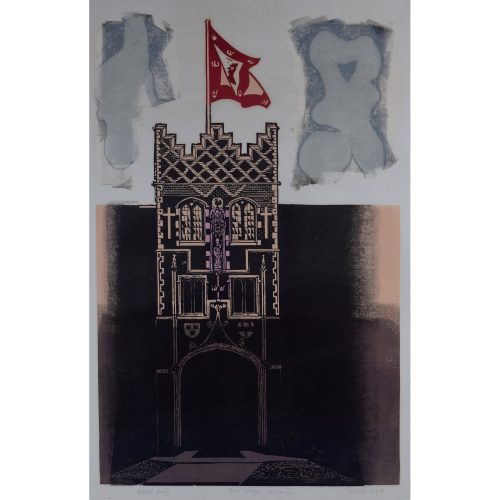
    Linocut, 1965 76x48 cm Signed and titled in pencil. Printed on handmade Japanese Hosho paper by the artist at Editions Electo Click here for biographical details and other works by the artist. If you are interested email info@manningfineart.co.uk or call us on 07929 749056.
  • Walter Hoyle (1922 - 2000)

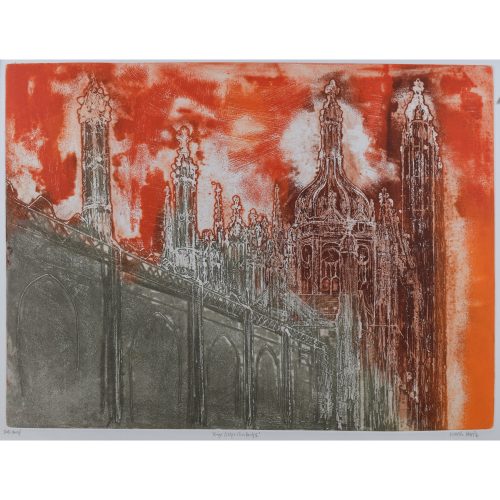
    King's College Chapel, Cambridge in red (1965)

    Linocut Cambridge Series State Proof, Signed and Titled in pencil. Printed by the artist at Editions Alecto
    51x69cm Condition: Excellent Click here for biographical details and other works by the artist. If you are interested email info@manningfineart.co.uk or call us on 07929 749056.
     
  • Walter Hoyle (1922 - 2000)

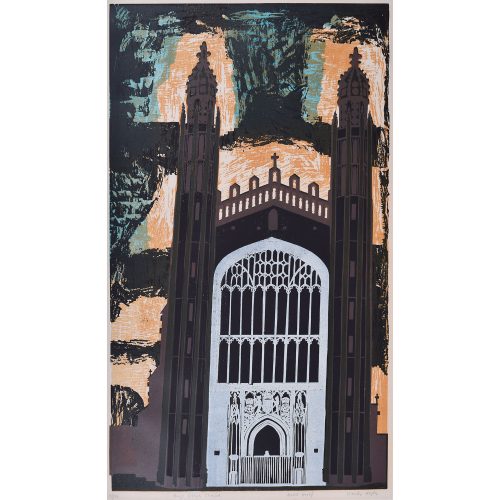
    King's College Chapel West End, Cambridge (1965)

    Linocut Cambridge Series 51/75, Signed and Titled. Printed by the artist at Editions Alecto
    71x41cm Click here for biographical details and other works by the artist. If you are interested email info@manningfineart.co.ukor call us on 07929 749056.
     
  • Walter Hoyle

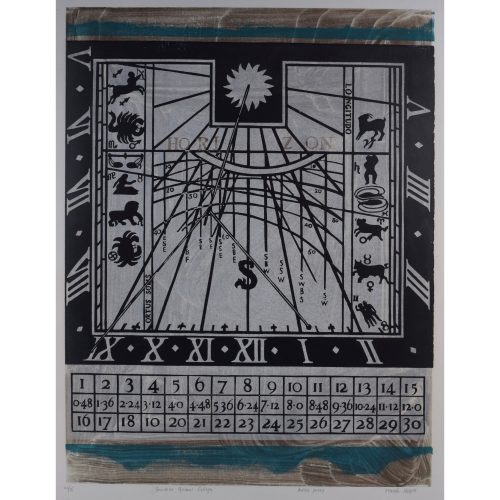
    Queens' College Cambridge, Sundial

    Linocut, 1965 76x57 cm Signed numbered and titled in pencil. Printed on handmade Japanese Hosho paper by the artist at Editions Electo Click here for biographical details and other works by the artist. If you are interested email info@manningfineart.co.uk or call us on 07929 749056.
  • Walter Hoyle (1922-2000)

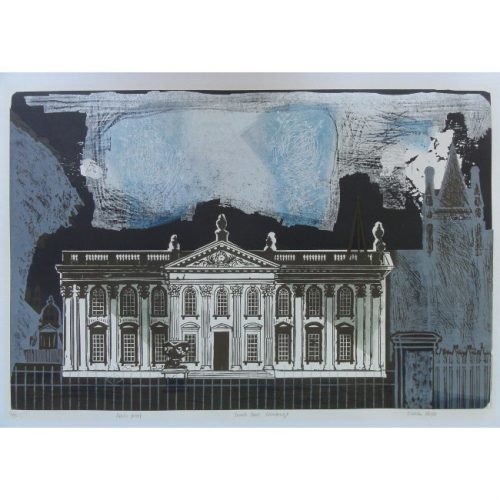
    Senate House, Cambridge (Cambridge Series 1956-6)

    Block print 72/75 Artist’s proof, published by Editions Alecto, London, 1966 46x89cm Click here for biographical details and other works by the artist. If you are interested email info@manningfineart.co.uk or call us on 07929 749056.
  • Walter Hoyle (1922-2000)

    St Catharine's College, Cambridge (1956-66)

      Linocut 59 x 39 cm Signed lower right; inscribed and numbered 35/75 in pencil. Hoyle trained at Beckenham School of Art and the Royal College of Art. At the latter he was strongly influenced by Edward Bawden, one of Britain’s greatest linocut printers. Bawden had been commissioned by the 1951 Festival of Britain to produce a mural for the South Bank, and chose Hoyle to assist on account of his great talent. Hoyle moved to Great Bardfield in Essex, becoming a part of the Great Bardfield group of artists; diverse in style, they created figurative work, in stark contrast to the abstract art of the St Ives artists at the opposite end of the country. Hoyle taught at St Martin’s School of Art from 1951-60, the Central School of Arts and Crafts from 1960-64, and the Cambridge School of Art from 1964-1985, during which time he launched Cambridge Print Editions. His work is held in the collections of the Tate Gallery, the Victoria and Albert Museum, The British Museum, Kettle’s Yard and the Fry Art Gallery. Condition: very good.
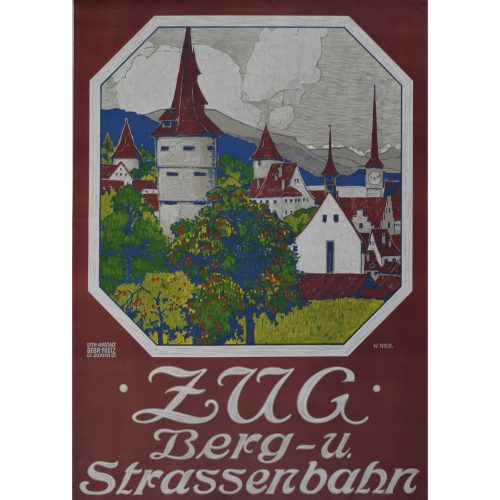
  • Walther Koch (1875-1915) Zug Berg und Strassenbahn

    Original lithographic poster (1914) 40x30" Printed in Zurich by Anstalt Gebr Fretz If you are interested email info@manningfineart.co.uk or call us on 07929 749056. Condition: Excellent.
  • A. E. Halliwell (1905-1987) War is War

    Gouache 21 x 19 cm (full sheet size 38 x 28 cm) c.1930 With signature and title from applied support paper Provenance: Family of the artist A.E. Halliwell (1905–1986) was a British artist, illustrator, and designer best known for his vibrant poster designs created for British railway companies during the mid-20th century. Born in Southport, Halliwell developed a strong foundation in art and design early in life. He studied at the Southport School of Art from 1923 to 1926 before graduating to the Royal College of Art in London and subsequently practising as a professional designer from the 1930s. Following his studies, Halliwell married Doris Doyle in Strood Kent, and  went on to have a significant teaching career himself, most notably as a lecturer at the Central School of Arts and Crafts (later part of Central Saint Martins), where he influenced a new generation of designers and illustrators. Halliwell is perhaps best remembered for his vibrant and engaging poster designs created for British railway companies during the 1930s. His work was characterised by a bright, graphic style that balanced charm with clarity, often depicting idealised scenes of British holiday destinations—from sunny seaside towns to tranquil countryside vistas. Beyond posters, his artistic output included book illustration, commercial design, and stage costume sketches, showcasing his versatility across mediums. His posters continue to remain enduring symbols of a golden age of British travel and design and are displayed in major collections including the London Transport Museum and the V & A. Halliwell produced this book dust cover design for the novel 'War is War', written by Alfred Burrage and published in 1930. In War is War, Burrage recounts his experiences as a private soldier in France during the First World War, his reactions to abnormal conditions and his general observations-- all in an effort to offer a true representation of what war is really like. In this account, written of necessity under a pseudonym, he covers the wide canvas of war, from off duty moments in grubby estaminets and brothels, to life in shell torn trenches, going over the top with equally terrified yet resigned comrades, being a casualty, to periods of numbing boredom. Halliwell's design is sombre and impactful, using minimal colour and abstract forms to evoke the horrors and futility of war. Condition: Generally very good.

    If you would like to know more, please email info@manningfineart.co.uk or call us on 07929 749056.
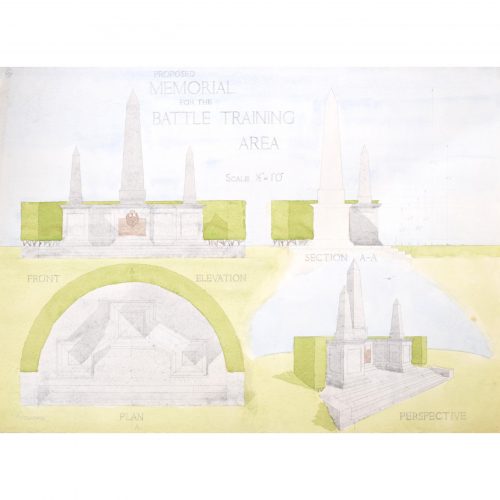
  • S Clapham (active 1940 - 1960)

    Proposed Memorial for the Battle Training Area

      Pencil wash 49 x 70 cm Signed lower left and inscribed to reverse. Clapham's designs for a modernist war memorial to be erected in a training area at an army base. Clapham was an architect based in Stockwell in London. Condition: generally very good; one small mark to far right towards bottom. If you are interested, please email info@manningfineart.co.uk or call us on 07929 749056. Click here for other works by the artist.
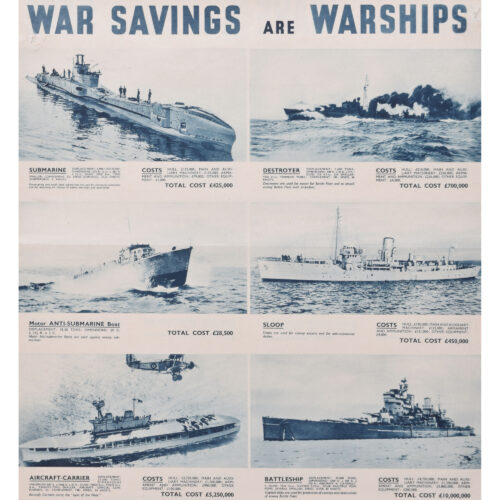
  • War Savings are Warships / The Signal is Save

      Original vintage poster 41 x 37 cm Issued by the National Savings Committee, London, the Scottish Savings Committee, Edinburgh, and the Ulster Savings Committee, Belfast. An original vintage WW2 poster encouraging Britons to save via the National Savings scheme, which would use the money to fund warships. Condition: generally very good; central fold as issued, two pin holes to top corners only. Double sided. If you are interested, please email info@manningfineart.co.uk or call us on 07929 749056. Click here for other original vintage National Savings posters.
  • Out of stock
    Original vintage Second World War poster 'Warning, be on your guard' Lithograph 38 x 25 cm 'Warning, be on your guard. Thousands of lives were lost in the last war because valuable information was given away to the enemy through careless talk.' In the Second World War, enemy espionage, spy networks and secret operations seemed a real and ever-present danger. As a result, this Second World War poster was produced as part of a propaganda drive warning against careless talk that could lead to damaging information leaks. The poster itself is paired back, featuring black text on a white background with a red crown above, in the style of the 'Keep Calm and Carry on' posters. Condition: Generally very good, few old soft creases.

    If you would like to know more, please email info@manningfineart.co.uk or call us on 07929 749056.
  • Jane Gray (b.1931)

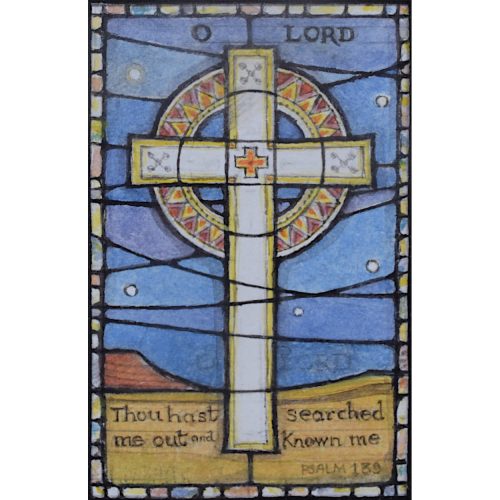
    Warrington Hospital Chapel, Design for Stained Glass Window (1984)

      Watercolour 7.5 x 5 cm Dated, detailed in artist’s hand and studio label verso.

    Warrington Hospital was originally built as an isolation hospital in 1893. The Warrington Union Workhouse Infirmary was built on the site shortly after in 1898, and it was occupied by the Whitecross Military Hospital during the First World War. It wasn’t until 1930, that the infirmary officially became the Warrington Borough General Hospital. Gray’s design for this window in the hospital’s chapel wonderfully demonstrates her colourful, modern style and features the Cross suspended between land and sky, and a line from Psalm 139: ‘O Lord, Thou hast searched me out and known me’. This was one of Gray’s simplest but most favourite window designs, it was installed in the chapel in 1984.

    Provenance: the artist’s studio sale. Literature: Jane Gray, Playing with Rainbows. (Shropshire: Ellingham Press, 2011), pp.23, 77. Condition: very good. If you are interested, please email info@manningfineart.co.uk or call us on 07929 749056. For other works by Jane Gray and more information about her, please click here.    
  • George Bissill (1896-1973) Watching over the farmhouse in Stow-on-the-Wold

    Pencil sketch 25 x 39 cm Born in 1896, George Bissill was a British miner, painter and furniture designer. Raised in the mining village of Langley Mill, Derbyshire, Bissill became a miner at the age of 13, before leaving to join the war effort in 1915. Upon his return from the war after being gassed, Bissill chose to become a pavement artist outside the newly erected Bush House in Aldwych, painting from his memory and his sketch book the uncompromising underground world he had inhabited. In 1935 he moved to the countryside near Newbury, where he lived and worked as a landscape painter, art restorer and dealer until his death in 1973. This painting forms part of a larger collection, 'unseen since they were taken from George Bissil's studio in 1983' and restored by Kate Pattinson. A series of planned exhibitions were cancelled due to Covid, but two shows, one in Oxford and one in Ilkeston, did take place. Through such exhibitions, Pattinson hoped to 'restore the reputation of an artist who, through mighty endeavour, conquered the art world in the 1920s with his powerful, authentic and experimental pictures.' Bissill's paintings are also held in a number of important public collections, including the Tate Gallery, National Museum of Ireland and the Manchester Art Gallery. This pencil sketch depicts a man watching over a farmhouse in Stow-on-the-Wold, an idyllic town in Gloucestershire located on top of an 800ft hill. This hilly terrain is illustrated in this serene scene, where the faint lines depicting shrubbery rise and fall with the landscape. Condition: generally very good.

    If you would like to know more, please email info@manningfineart.co.uk or call us on 07929 749056.
  • Hillary Hennes (1919-1993) Watching Over the Fire

    Pencil drawing 43 x 28 cm Hillary Hennes was a British artist and illustrator. Her father was a curator at the South London Art Gallery and she was consequently initiated into the art world from a young age. After attending the Blackheath High School, Hennes (then Miller) studied at the Blackheath School of Art and then spent a further three years at the Royal College of Art. After graduating, Miller taught at the South East Sussex Technical College and in 1946 married the artist Hubert Hennes. Between 1948 and 1967 Miller frequently exhibited paintings at the Royal Academy in London and also illustrated a number of books on gardening and natural history, such as The Living World and Boff's Book of Gardening. This pencil drawing depicts a woman resting by the fireplace. Her legs are crossed and she is slumped gently to the side. Hennes excellently captures the light of the room: the mirror in the background reflects a sunny day and the woman is basked in light, though it is unclear if this from the gentle glow of a fire or the sun rays peaking through the window. Condition: Generally very good.

    If you would like to know more, please email info@manningfineart.co.uk or call us on 07929 749056.
  • Sir Albert Richardson PRA Architectural Study of Dieppe Cathedral

    Watercolour & Pencil 27 x 17 cm Signed bottom left and dated 1956 to bottom right. Sir Albert Edward Richardson (1880–1964) was a distinguished British architect, teacher, and historian, known for his deep reverence for classical design principles and his pivotal contributions to architecture during the 20th century. He was a prolific figure whose work and writings championed traditional architectural forms amidst the rise of modernism. Richardson was captivated by the charm of Dieppe, its historic architecture, and its position as a cultural hub. He saw the town as a rich repository of architectural styles, particularly French Baroque and Rococo, which complemented his interest in classical and historical design. As with other towns, he played an active role in efforts to preserve and document Dieppe’s architectural heritage. While in Dieppe, Richardson produced numerous sketches and drawings of Dieppe’s streetscapes, detailing its historic buildings, market squares, and coastal landscapes. Such works remain valuable as a record of the town’s architectural history. The work pictured here is one such example of Richardson's Dieppe sketches. The terracotta coloured roof of Dieppe cathedral stands out in watercolour against the pencil sketching of the ornate masonry details, meanwhile townsfolk are sketched into the foreground, wandering down the impressive street. Richardson blends the daily life of the city with the monumental architecture that has become part of its landscape. In doing so, he highlights the historical and architectural significance of this area.
  • Queens' College and Mathematical Bridge Watercolour 26 x 35 cm An idyllic depiction of the famous view down the Cam towards mathematical bridge, this watercolour captures the soothing reflections of the medieval architecture of Queens' College and the gentle ripples created as a kayaker floats down the river. Sumptuous greenery and warm tones imbue this lovely watercolour with a calming effect.
  • Rev. William Henry Barnard (Co. Donegal or Co. Derry 1767-1818 London) The Radcliffe Camera from the Great Quadrangle of All Souls College, Oxford

    Pen and brown ink and watercolour, on paper 30 x 44 cm Signed with initials 'H.B.' (lower right) Rev William Henry Barnard was an extremely well-connected artist and clergyman -being first cousin of Prime Minister George Canning, grandson of William Barnard, Bishop of Derry, and nephew of Thomas Barnard, Dean of Derry and Bishop of Limerick. He graduated from Pembroke College, Oxford in 1797. During his time at university he studied drawing with John Baptist Malchair (1731 – 1812) and produced numerous drawings and watercolours, often depicting humble Oxford street scenes using a black monochrome wash. He is now represented in a number of important collections. TATE acquired twelve of his paintings in 1996 and a drawing by Barnard of Windsor Castle was purchased for the Royal Collection in 1947. This watercolour depicts a view of the Radcliffe Camera from the great quadrangle of All Souls College, Oxford. It demonstrates a strong sense of architectural perspective as Barnard expertly captures the angles and masonry of the baroque architecture. In keeping with Barnard's tendency to capture humble Oxford street scenes, this loftier rendering of this Oxford landmark still presents gardeners and academics alongside each other. He thereby adeptly depicts everyday life in this Oxford college in the early Eighteenth Century. Provenance: The Collection of the Late John Appleby: A Channel Island. Condition: Generally very good, comes framed.

    If you would like to know more, please email info@manningfineart.co.uk or call us on 07929 749056.
  • Cecil King (1881-1942)

    The Thames and Tower Bridge

    Watercolour 26 x 37 cm Cecil King was a British painter. He studied at the Goldsmiths’ Institute College School of Art, the Westminster School of Art, and in Paris with Jean-Paul Laurens and Théophile Steinlen. King notably competed in the art competition of the 1928 Summer Olympics held in Amsterdam. The 1928 competition went down in Olympic memory as being particularly well celebrated, spanning multiple categories, art competitions were, however, part of the Olympic programme between 1912 and 1948. This particular watercolour depicts London industrial docks with the Thames and Tower Bridge in the background, capturing the unique atmosphere of London in the early 20th century.
  • View of Corpus Christi College, Cambridge

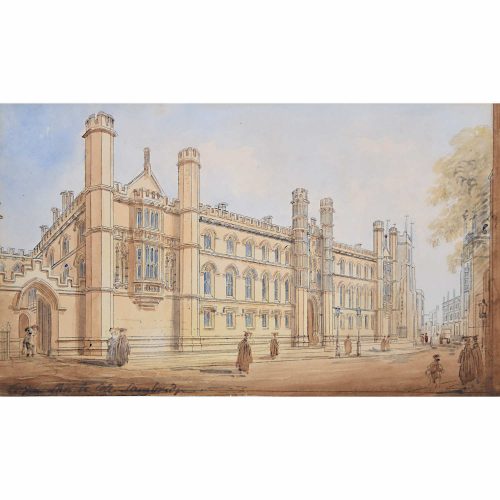
    Watercolour on paper 13.5 x 23cm   A charming view of Corpus Christi College and assorted denizens of Cambridge. The college is notable as the only one founded by Cambridge townspeople; it was established in 1352 by the Guild of Corpus Christi and the Guild of the Blessed Virgin Mary, making it the sixth-oldest college in Cambridge. With around 250 undergraduates and 200 postgraduates, it also has the second smallest student body of the traditional colleges of the University, after Peterhouse. The College has traditionally been one of the more academically successful colleges in the University of Cambridge. It also ranks among the wealthiest Cambridge colleges in terms of fixed assets, being exceptionally rich in silver. Unsigned; labelled 'Corpus Christi Coll. Cambridge' in ink, lower left. If you’d like to know more, please email info@manningfineart.co.uk or call us on 07929 749056.
  • Brendan Neiland (b. 1941) R.A. (Expelled)

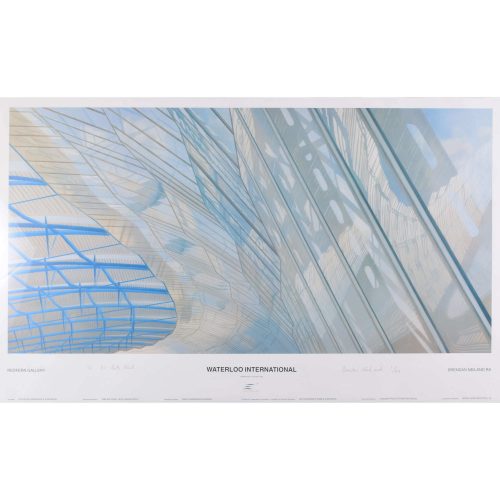
    Waterloo International (1993)

      Lithographic poster 101 x 60 cm Signed 'Brendan Neiland', numbered I/XII, and inscribed 'To Bob Reid' (Reid was Chairman of the British Railways Board from 1990 until 1995; he was present at Waterloo International Station prior to the opening of the Channel Tunnel). Neiland is known for his interpretations of city life. His work is widely exhibited in major museums and galleries worldwide including, in Britain, the Victoria and Albert Museum, The Tate Gallery London, The Collections of the British Council and the Arts Council of Great Britain. He is represented by the Redfern Gallery and has had numerous shows internationally, including at the Galerie Belvedere in Singapore, who represent him in Singapore and the Far East. Reflected architecture is one of Neiland’s most recurring themes. Condition: very good. If you are interested, please email info@manningfineart.co.uk or call us on 07929 749056. Click here for other works by Brendan Neiland.
  • We Save for Victory

      Original vintage poster 38 x 26 cm Issued by the National Savings Committee, London, SW1. Printed for HMSO by Messrs M’Corquodale & Co. Ltd., Glasgow. Saving becomes an act of patriotism in this poster, published to encouraged saving via the National Savings Scheme. Condition: generally very good; two pin holes to each corner; a few tiny edge tears (repaired); and the odd handling crease. If you are interested, please email info@manningfineart.co.uk or call us on 07929 749056. Click here for other National Savings posters.
  • We've Got To Keep On Saving

      Original vintage poster 38 x 26 cm Issued by the National Savings Committee, London, the Scottish Savings Committee, Edinburgh, the Ulster Savings Committee, Belfast. Printed for HM Stationery Office by Flemings, Leicester. RAF bomber crews run towards four Short Stirling bomber aircraft, ready on a runway. The poster illustrates how money saved with the National Savings Committee might help to finance the war effort. Condition: generally very good; fold as issued 1cm repared tear to left side; and a couple of old gentle creases. If you are interested, please email info@manningfineart.co.uk or call us on 07929 749056. Click here for other original vintage National Savings posters.
  • Out of stock

    Leslie Carr (1891 - 1969)

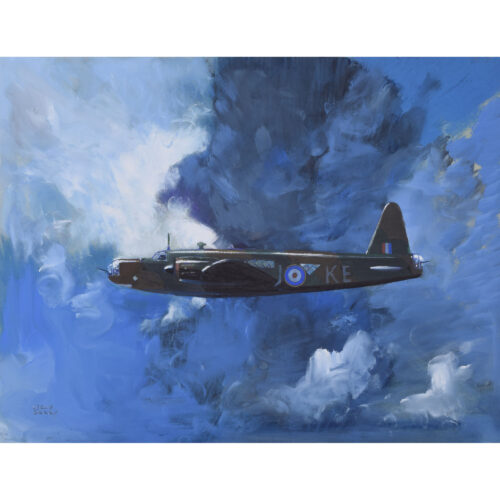
    Wellington Bomber

    Gouache 23 x 30 cm Signed lower right. A Wellington Bomber set against a torrid blue sky. The Vickers Wellington was a British twin-engined, long-range medium bomber. It was designed during the mid-1930s at Brooklands in Weybridge, Surrey. Led by Vickers-Armstrongs' chief designer Rex Pierson; a key feature of the aircraft is its geodetic airframe fuselage structure, which was principally designed by Barnes Wallis. Development had been started in response to Air Ministry Specification B.9/32, issued in the middle of 1932, for a bomber for the Royal Air Force. This specification called for a twin-engined day bomber capable of delivering higher performance than any previous design. Other aircraft developed to the same specification include the Armstrong Whitworth Whitley and the Handley Page Hampden. During the development process, performance requirements such as for the tare weight changed substantially, and the engine used was not the one originally intended. The Wellington was used as a night bomber in the early years of the Second World War, performing as one of the principal bombers used by Bomber Command. During 1943, it started to be superseded as a bomber by the larger four-engined "heavies" such as the Avro Lancaster. The Wellington continued to serve throughout the war in other duties, particularly as an anti-submarine aircraft. It holds the distinction of having been the only British bomber that was produced for the duration of the war, and of having been produced in a greater quantity than any other British-built bomber. The Wellington remained as first-line equipment when the war ended, although it had been increasingly relegated to secondary roles. The Wellington was one of two bombers named after Arthur Wellesley, 1st Duke of Wellington, the other being the Vickers Wellesley. A larger heavy bomber aircraft designed to Specification B.1/35, the Vickers Warwick, was developed in parallel with the Wellington; the two aircraft shared around 85% of their structural components. Many elements of the Wellington were also re-used in a civil derivative, the Vickers VC.1 Viking. Leslie Carr was a painter and poster designer from London. He served in the Tank Corps in the First World War and then became a professional artist, mainly producing maritime and architectural scenes. He designed posters for Southern Railway, the London and North Eastern Railway, and British Railways (among others). Carr served as a fireman in the Second World War and was a part of several firemen artists' exhibitions. Carr was a member of the Society of Marine Artists. Condition: very good. If you are interested, please email info@manningfineart.co.uk or call us on 07929 749056. Click here for other Second World War pictures.
Go to Top