-
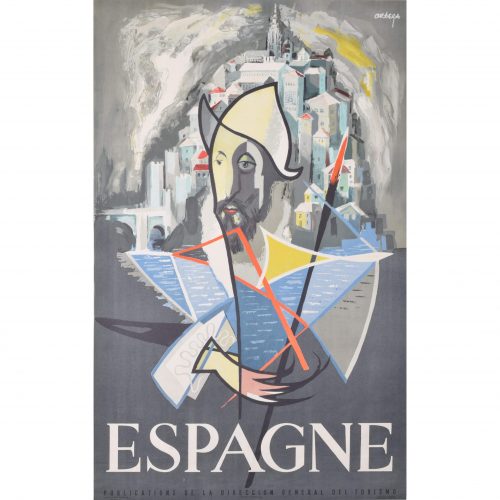
José Ortega (1921 - 1990)
"Don Quixote" Espagne
Original vintage poster c. 1960 99 x 65 cm Printed in Barcelona for the Publications de la Direccion General del Turismo. Ortega's poster is an abstract depiction Don Quixote (the Spanish hero written by Miguel de Cervantes), complete with his distinctive hat and spear. Ortega designed the poster for the Spanish tourist board, using an illustrious figure from Spain's literary heritage to encourage people to visit Spain. José García Ortega was born in Arroba de los Montes and was a member of the Communist Party. He worked as a painter and sculptor, studying at the Círculo de Bellas Artes in Madrid. In 1953 he went to France to study art, funded by a French government scholarship. He returned to Spain throughout the 1950s and 1960s, and became a commercially successful artist. Some of his most famous designs include the posters which the Spanish tourist board commissioned from him circa 1960. Condition: generally very good. If you are interested, please email info@manningfineart.co.uk or call us on 07929 749056. Click here for more original vintage travel posters. -
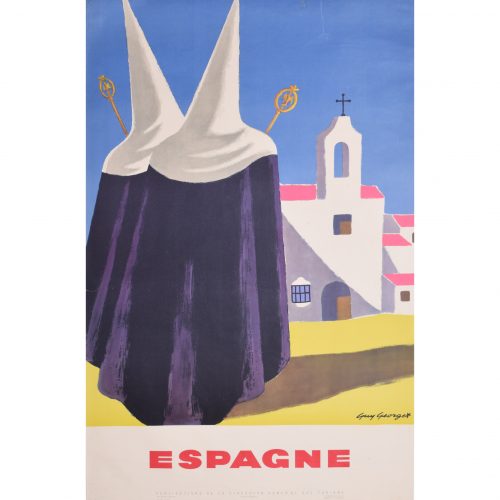
Guy Georget (1911 - 1992)
Espagne - Pilgrims
Original vintage poster 100 x 62 cm One of the fantastic posters Georget designed for the Spanish tourist board. Two pilgrims progress towards a typically Spanish church; Georget makes uses vibrant tones of bright blue, pink, and yellow to illustrate the scene. Guy Georget was a commercial designer; most of his poster designs were published in the late 1940s. Hired by the tourist boards in their post-war spree of tourism encouragement, Georget designed posters influenced by the styles of Pablo Picasso and Georges Braque. Condition: generally very good; a few repaired edge tears including one at the top c. 80mm, one to left side c. 25 mm. If you are interested, please email info@manningfineart.co.uk or call us on 07929 749056. Click here for more original vintage travel posters. -
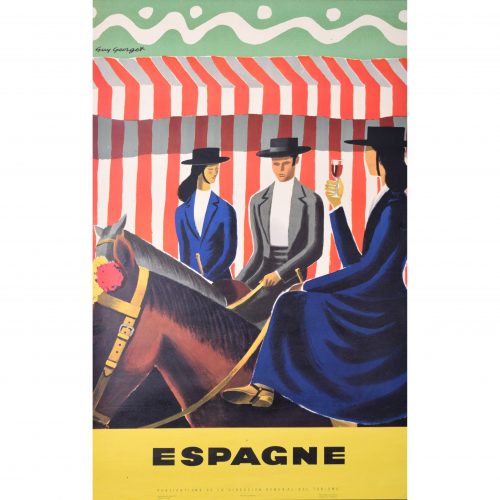
Guy Georget (1911 - 1992)
Espagne - Riders
Original vintage poster 100 x 62 cm One of Georget's fantastic posters designed for the Spanish tourist board. Three riders in traditional dress, with the ladies riding side-saddle, and one with sherry in hand, pose mounted in front of a red and white striped background. The bold, bright colours make the poster typically Georget. Guy Georget was a commercial designer; most of his poster designs were published in the late 1940s. Hired by the tourist boards in their post-war spree of tourism encouragement, Georget designed posters influenced by the styles of Pablo Picasso and Georges Braque. Condition: generally very good; a few tiny repaired edge tears. If you are interested, please email info@manningfineart.co.uk or call us on 07929 749056. Click here for more original vintage travel posters. -

Ethel Louise Rawlins (1880 – 1940)
A Garden Below the South Downs
Oil on canvas51 x 61 cmSigned lower right.Rawlins was a painter who studied at the Slade School of Fine Art and in Newlyn, Cornwall. She settled in Sussex in the early 1920s, and often painted the rolling hills of the Sussex landscape. Here, blue hills and a grey sky serve as the background for an extensive garden complete with stone urns, flowers, and slanting shadows created by the late afternoon sun. -
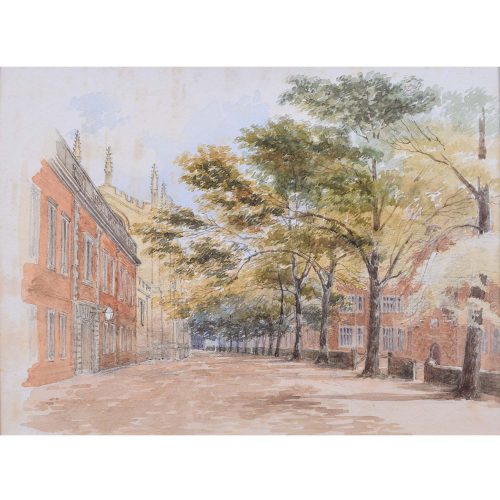
Anonymous Eton College
Watercolour 21.2×28.5cm If you are interested email info@manningfineart.co.ukor call us on 07929 749056. Condition: Good. -
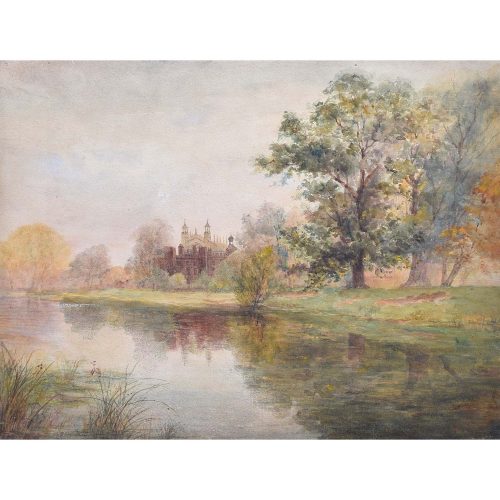
Anon. Eton College
Watercolour 31.5x40.5cm If you are interested email info@manningfineart.co.uk or call us on 07929 749056. Condition: Good. -
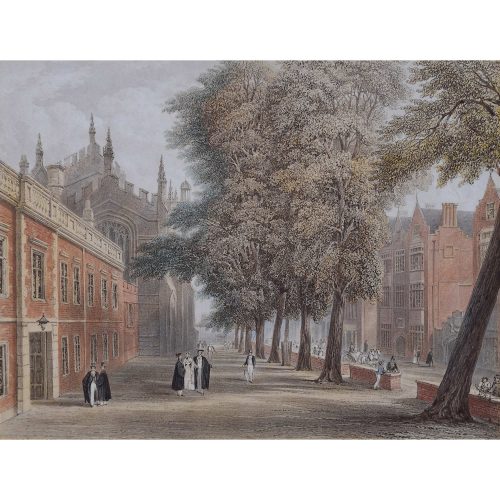
Anonymous (19th century) Eton College
Lithograph 29 x 38 cm We have a pair of these rather fine 19th century lithographs; view the other picture here. Condition: Mounted to board. -
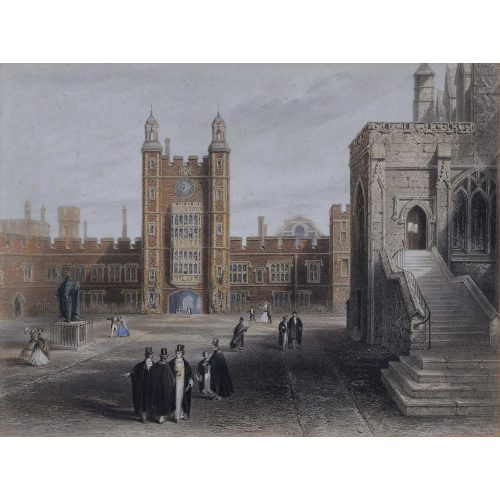
Anonymous (19th century) Eton College Courtyard
Lithograph 29 x 38 cm We have a pair of these rather fine 19th century lithographs: see the second one here. Mounted to board. -
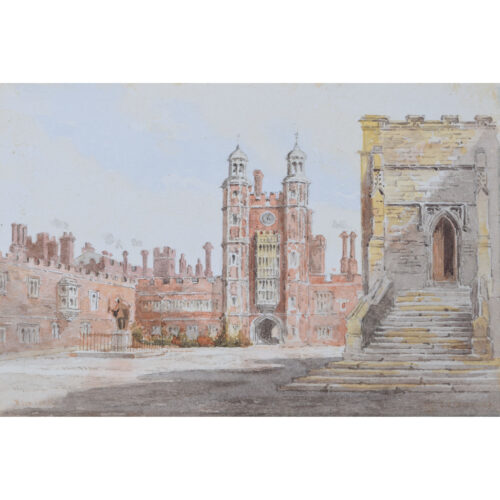
FP Barraud (1856 - 1924)
Eton College
Watercolour 12 x 18 cm Inscribed faintly lower left 'Eton Coll.' and signed lower right. Condition: generally very good; mounted to board. If you are interested, please email info@manningfineart.co.uk or call us on 07929 749056. Click here for other views of Eton College. -
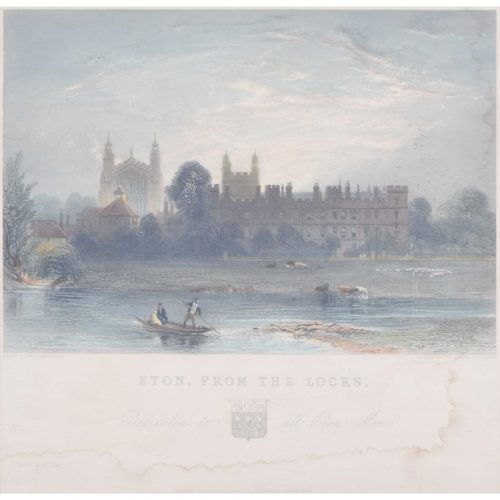
James Redaway (1797 - 1858)
Eton from the Locks
Hand-coloured engraving 27 x 28 cm Redaway's view of Eton College, seen from the locks on the River Thames. James Redaway was a nineteenth-century engraver, principally of landscapes and architectural subjects. Condition: some staining to lower half of print. If you’d like to know more, please email info@manningfineart.co.uk or call us on 07929 749056. -
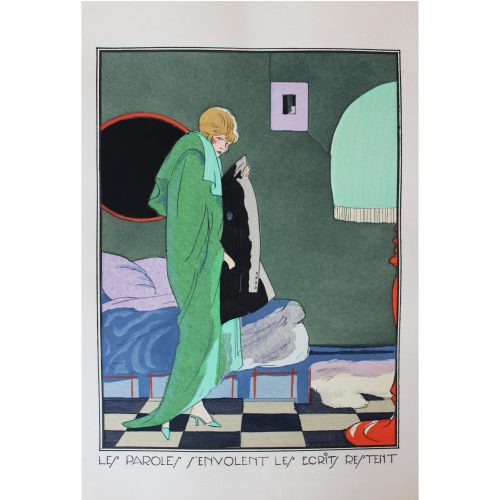
After Ettore Tito (1859-1941) c.1920s A set of four pochoir prints: 'Les paroles s'envolent les ecrits restent'; 'On a souvent besoin d'un plus petit que soi'; 'Qui trop embrasse...'; 'Aide-toi le ciel t'aidera'
23.5 x 16.5 cm (to mount) Ettore Tito (1859-1941) Tito trained at the Accademia di Belle Arti in Venice and later became a professor there, known for his landscapes and scenes of traditional life in the Veneto region, as well as producing several larger mythological murals notably for the Villa Berlinghieri in Rome and the Chiesa degli Scalzi in Venice. He associated with an expatriate artistic milieu that included John Singer Sargent and Isabella Stewart Gardner. However, in the 1920s he also produced these pochoir prints of emancipated women for a French magazine which were considered rather risqué at the time! If you are interested email info@manningfineart.co.ukor call us on 07929 749056. Condition: Excellent, mounted. -

Exeter College, Oxford (1898)
Watercolour 23 x 27 cm Initialled CP and dated '98 lower right. A well-executed watercolour of Exeter College, after the manner of George Pyne, complete with horse-drawn cab and members of the University in academic dress. Condition: very good. If you are interested, please email info@manningfineart.co.uk or call us on 07929 749056. Click here for other views of Exeter College, Oxford. -

David Loggan (1634 - 1692)
Exeter College, Oxford (1675)
Engraving 30 x 42 cm Loggan's view of Exeter College from the 'Oxonia Illustrata'. Loggan was born to English and Scottish parents, and was baptised in Danzig in 1634. After studying engraving in Danzig with Willem Hondius (1598-1652 or 1658), he moved to London in the late 1650s, going on to produce the engraved title-page for the folio 1662 Book of Common Prayer. He married in 1663 and moved to Nuffield in Oxfordshire in 1665. Loggan was appointed Public Sculptor to the nearby University of Oxford in the late 1660s, having been commissioned to produce bird’s-eye views of all the Oxford colleges. He lived in Holywell Street as he did this. The 'Oxonia Illustrata' was published in 1675, with the help of Robert White (1645-1704). Following its completion, Loggan began work on his equivalent work for Cambridge; the 'Cantabrigia Illustrata' was finally published in 1690, when he was made engraver to Cambridge University. The 'Oxonia Illustrata' also includes an engraving of Winchester College (Winchester and New College share William of Wykeham as their founder) whilst the 'Cantabrigia Illustrata' includes one of Eton College (which shares its founder, Henry VIII, with King’s College). Bird’s-eye views from this era required a particular talent as an architectural perspectivist; it was not until 1783 that it became possible for artists to ascend via hot air balloons and view the scenes they were depicting from above. Loggan thus had to rely on his imagination in conceiving the views. Loggan’s views constitute the first accurate depictions of the two Universities, in many ways unchanged today. Whilst the Oxford engravings were produced in reasonable numbers and ran to a second edition by Henry Overton (on thicker paper and with a plate number in Roman numerals in the bottom right-hand corner), those of Cambridge were printed in much smaller numbers. The Dutchman Pieter van der Aa published some miniature versions of the engravings for James Beverell’s guidebook to the UK, 'Les Delices de la Grande Bretagne' (circa 1708). The contemporary artist Andrew Ingamells (born 1956) has produced a highly-acclaimed series of etchings which bring Loggan’s original vision up to date. Condition: very good; a couple of tiny marks to margins. If you are interested, please email info@manningfineart.co.uk or call us on 07929 749056. Click here for other views of Exeter College, Oxford. -
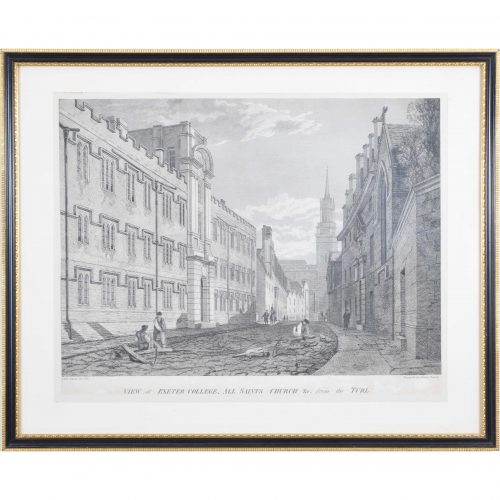
James Basire II (1769 - 1822) after JMW Turner (1775 - 1851)
View of Exeter College, All Saints Church &c. from the Turl
Engraving 35 x 46 cm A view of Exeter College, Oxford from Turl Street. Labourers cobble the road. The spire of what was All Saints Church, now Lincoln College's library, overlooks the scene. Turner's drawing was reproduced as a lithograph in 1800, to be published in the “Oxford Almanack”. The Oxford Almanack was an annual almanack published by the Oxford University Press for the University of Oxford from 1674 through 2019 (when printing sadly ceased due to “dwindling interest”). The almanack traditionally included engravings or lithographs of the University and information about the upcoming year. Other almanack artists have included Michael Burghers and John Piper. Basire and Dayes collaborated on several views of Oxford during the courses of their careers. Joseph Mallord William Turner RA, known in his time as William Turner, was an English Romantic painter, printmaker and watercolourist. He is known for his expressive colouring, imaginative landscapes and turbulent, often violent, marine paintings. He left behind more than 550 oil paintings, 2,000 watercolours, and 30,000 works on paper. He was championed by the leading English art critic John Ruskin from 1840, and is today regarded as having elevated landscape painting to an eminence rivalling history painting. James Basire II was a British engraver, son of James Basire I, also a celebrated engraver. In 1802 he became Engraver to the Society of Antiquaries. Condition: trimmed within plate mark and mounted to paper. If you’d like to know more, please email info@manningfineart.co.uk or call us on 07929 749056. Other views of Exeter College, Oxford are available here. -
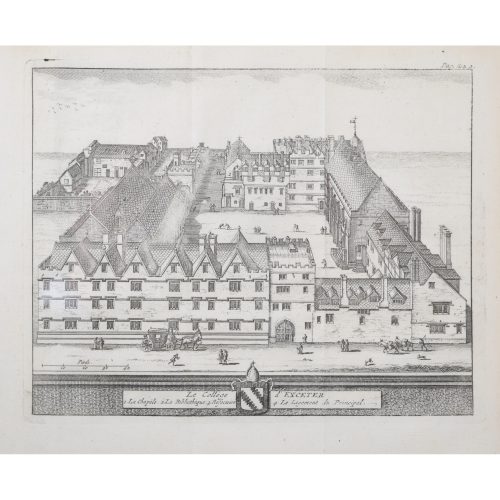
Pieter van der Aa (1659-1733), after David Loggan (1634–1692)
Exeter College, Oxford (1727)
Engraving 12 x 16 cm An eighteenth-century view of Exeter, engraved by Pieter van der Aa after David Loggan, the noted engraver, draughtsman, and painter. Pieter van der Aa of Leiden was a Dutch publisher best known for preparing maps and atlases, though he also printed editions of foreign bestsellers and illustrated volumes. He is noted for the many engravings he produced after David Loggan's series of Oxford and Cambridge colleges and costumes. In 1727 Van Der Aa illustrated "Les Delices de la Grande Bretagne & de L'Irelande" by James Beeverell, the book in which this engraving appears. Condition: a good impression. If you’d like to know more, please email info@manningfineart.co.uk or call us on 07929 749056. -

George Bissill (1896-1973) Exploring the Lake District
Watercolour 20 x 28 cm Born in 1896, George Bissill was a British miner, painter and furniture designer. Raised in the mining village of Langley Mill, Derbyshire, Bissill became a miner at the age of 13, before leaving to join the war effort in 1915. Upon his return from the war after being gassed, Bissill chose to become a pavement artist outside the newly erected Bush House in Aldwych, painting from his memory and his sketch book the uncompromising underground world he had inhabited. In 1935 he moved to the countryside near Newbury, where he lived and worked as a landscape painter, art restorer and dealer until his death in 1973. This watercolour forms part of a larger collection, 'unseen since they were taken from George Bissil's studio in 1983' and restored by Kate Pattinson. A series of planned exhibitions were cancelled due to Covid, but two shows, one in Oxford and one in Ilkeston, did take place. Through such exhibitions, Pattinson hoped to 'restore the reputation of an artist who, through mighty endeavour, conquered the art world in the 1920s with his powerful, authentic and experimental pictures.' Bissill's paintings are also held in a number of important public collections, including the Tate Gallery, National Museum of Ireland and the Manchester Art Gallery. One of Bissill's most powerful and expertly executed watercolours, this painting depicts a view over the shores of a lake in the Lake District. The sky is overcast, the fells are sparse--painted with muddy tones--, and yet flashes of colour appear on the shoreline as visitors enjoy the offerings of the majestic scenery. The figures seem to be passing their time skimming pebbles, conversing and hiking up the craggy paths of the fells, with their presence lending a lightness to the dramatic scenery. Condition: generally very good.If you would like to know more, please email info@manningfineart.co.uk or call us on 07929 749056.
-
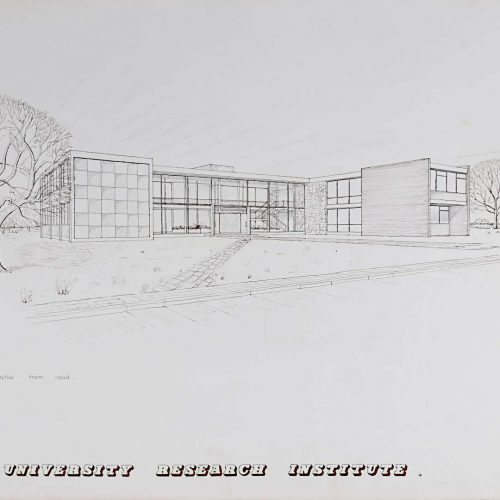
V A Hards (British, c. 1930-c. 2012) Exterior for a University Research Institute (1956)
Watercolour on wove 77 x 55 cm Signed and dated 1956. Hards was educated at Brixton School of Building and Woolwich Polytechnic between 1948 and 1956, during which period he produced some very competent work, including this design for a brutalist University Institute's exterior. Brixton School of Building was incorporated into the Polytechnic of the South Bank - now London South Bank University. Condition: some edge wear and isolated spots - see photographs. Stamped and marked with 'Brixton School of Building' stamp. If you’d like to know more, please email info@manningfineart.co.uk or call us on 07929 749056. -
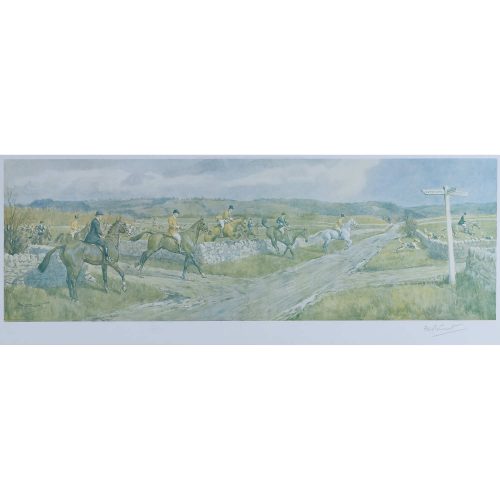 Frank Algernon Stewart (1877-1945) The Heythrop at Stow on the Wold Lithograph 24 x 63cm Signed in pencil. Framed. A typical hunting print by Stewart, showing one of the country's leading packs. Condition: Slight, even, loss of colour, as expected. If you’d like to know more, please email info@manningfineart.co.uk or call us on 07929 749056.
 -
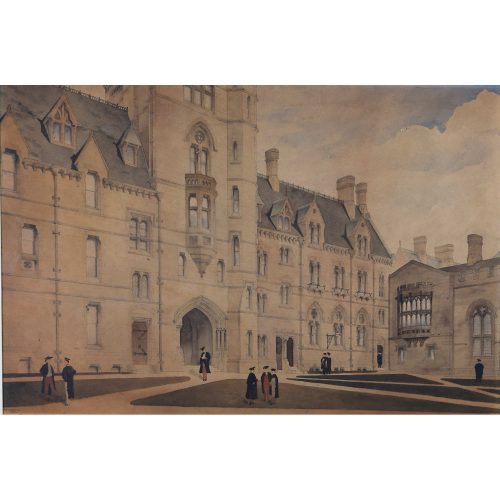 F F Hoyland Balliol College, Oxford (1880) Watercolour 44 x 66 cm Signed lower left and dated. An impressive watercolour of Balliol College. Scholars, sporting gowns and mortarboards, gather in the quad. Hoyland's stylistic precision transforms this watercolour into a beautifully executed depiction of the College's architecture.
 -
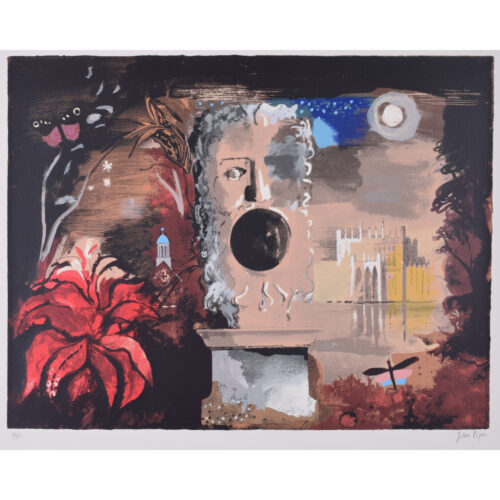
John Piper (1903 - 1992)
Façade (1987)
Lithograph 45 x 60 cm Numbered 96/108 lower left and signed lower right, both in pencil. Printed by Piper and the screenprinter Chris Prater in 1987 after the original designs from 1942. 'Façade' was a sequence of poems written by the English poet Edith Sitwell. They were set to music by William Walton in 1922, four years after they were first written. 'Façade' premiered in 1923 in London, and was praised for its experimental modernist style. The choreographer Frederick Ashton made Façade into a ballet in 1931; Sitwell did not wish her poems to be included, but Walton's orchestral arrangements were used. John Piper was commissioned as set designer for a 1942 performance of Facade in 1942. This lithograph is the design for the performance's curtain; the poetry and music of the performance were played behind the curtain, unseen by the audience. The Gothic house to the right was inspired by Eaton Hall in Cheshire, and we also see a folly, lake, and wood typical of an English country house. The moon, butterfly, and dragonfly lend themselves to the scene's dreamlike aspects, and the mask in the centre of the design highlights the collaborative nature of Façade - a salute to poetry, music, art, and even architecture. John Piper CH was an English painter, printmaker, and designer of stained-glass windows. His work often focused on the British landscape, especially churches and monuments, and included tapestry designs, book jackets, screen-prints, photography, fabrics and ceramics. Condition: very good. If you are interested, please email info@manningfineart.co.uk or call us on 07929 749056. Click here for other works by John Piper. -
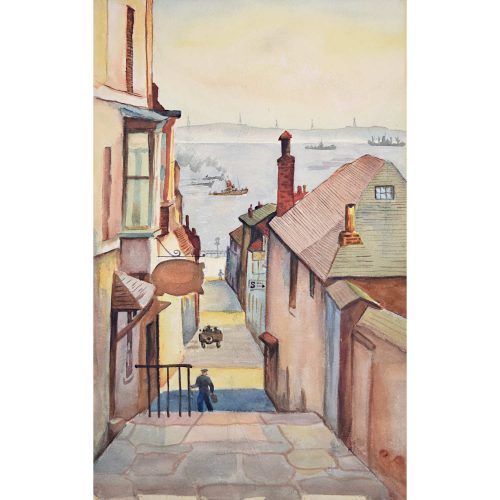
Falmouth, 1944 (unknown Modern British Artist)
Watercolour 46 x 30cm An evocative painting of Falmouth, the Cornish town shaped by its relationship to the sea. The artist leads us from the warm tones of the stone flags and empty buildings down towards a grey sea and a gently smouldering sky. Ships move in to the port, and a unit of pylons, starkly silhouetted, looks out over the bay. Condition: excellent. If you’d like to know more, please email info@manningfineart.co.uk or call us on 07929 749056. -

George Bissill (1896-1973) Farmhouse view
Pencil sketch 18 x 25 cm Born in 1896, George Bissill was a British miner, painter and furniture designer. Raised in the mining village of Langley Mill, Derbyshire, Bissill became a miner at the age of 13, before leaving to join the war effort in 1915. Upon his return from the war after being gassed, Bissill chose to become a pavement artist outside the newly erected Bush House in Aldwych, painting from his memory and his sketch book the uncompromising underground world he had inhabited. In 1935 he moved to the countryside near Newbury, where he lived and worked as a landscape painter, art restorer and dealer until his death in 1973. This painting forms part of a larger collection, 'unseen since they were taken from George Bissil's studio in 1983' and restored by Kate Pattinson. A series of planned exhibitions were cancelled due to Covid, but two shows, one in Oxford and one in Ilkeston, did take place. Through such exhibitions, Pattinson hoped to 'restore the reputation of an artist who, through mighty endeavour, conquered the art world in the 1920s with his powerful, authentic and experimental pictures.' Bissill's paintings are also held in a number of important public collections, including the Tate Gallery, National Museum of Ireland and the Manchester Art Gallery. This pencil drawing depicts a view over a farmhouse with an adjacent man seemingly chopping wood. In contrast to some of his other sketches, in this work Bissill pays careful attention to the fine detailing of the house, shrubbery and trees. He executes beautiful shading on the trees, capturing the natural shadows of a low sun on a winter's day. Condition: generally very good.If you would like to know more, please email info@manningfineart.co.uk or call us on 07929 749056.
-

Anon.
Farnborough Hospital Routemaster
Slipboard Poster c.1970 Screenprint poster 64x9cm In a black hand-finished frame. Printed for London Transport for use on Routemaster or RT buses. If you are interested email info@manningfineart.co.uk or call us on 07929 749056. Condition: Excellent. -

John Samuel Agar (1773 - 1858) after John Uwins (1782 - 1857) Fellow Commoner, Cambridge (1814)
Aquatint 30 x 24 cm Published by Rudolph Ackermann (1764 - 1834). An engraving of a curly-haired Fellow from Ackermann's 'History of Oxford'. Thomas Uwins RA RWS was a British painter in watercolour and oil, and a book illustrator. He became a full member of the Old Watercolour Society and a Royal Academician, and held a number of high-profile art appointments including the librarian of the Royal Academy, Surveyor of Pictures to Queen Victoria and the Keeper of the National Gallery. In the late 1790s he began producing work for Ackermann's collections. John Samuel Agar was an English portrait painter and engraver, who exhibited his works at the Royal Academy from 1796 to 1806 and at the British Institution until 1811. He was at one time president of the Society of Engravers. Rudolph Ackermann published many of his engravings. Rudolph Ackermann was an Anglo-German bookseller, inventor, lithographer, publisher and businessman. In 1795 he established a print-shop and drawing-school at 96 Strand. Here Ackermann set up a lithographic press and began a trade in prints. He later began to manufacture colours and thick carton paper for landscape and miniature painters. Within three years the premises had become too small and he moved to 101 Strand, in his own words "four doors nearer to Somerset House", the seat of the Royal Academy of Arts. Between 1797 and 1800 Ackermann rapidly developed his print and book publishing business, encompassing many different genres including topography, caricature, portraits, transparencies and decorative prints. Condition: Generally very good; slight toning to paper.If you would like to know more, please email info@manningfineart.co.uk or call us on 07929 749056.
-
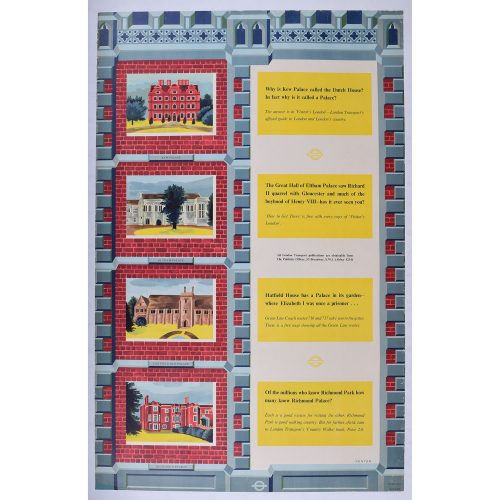
Ernest William Fenton (b. 1922)
Transport for London: Kew Palace, Eltham Palace, Hatfield Old Palace, Richmond Palace
Printed for London Transport Lithographic poster 40x25 inches Educated at Selby College of Art, Leeds College of Art and the Royal College of Art, William Fenton designed posters for London Transport from 1952-1976. If you are interested email info@manningfineart.co.ukor call us on 07929 749056. -
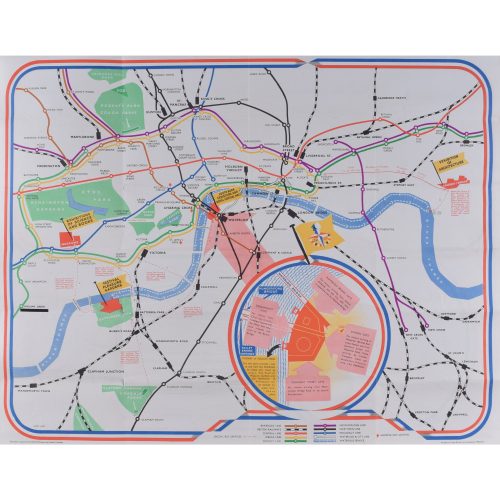
James Hart
Festival of Britain
Lithographic poster map 45 x 58 cm Folding map published for London Transport and British Railways for visitors to the 1951 Festival of Britain, featuring the Abram Games logo, details of water bus services, a detailed plan of the Lambeth exhibition area by Waterloo Bridge. If you are interested email info@manningfineart.co.uk or call us on 07929 749056. -
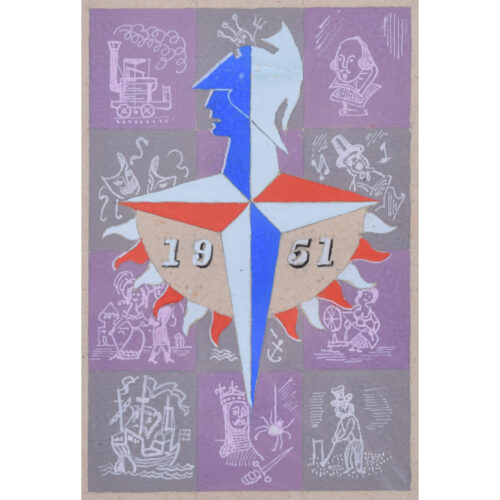
Peter J Wright after Abram Games (1914 - 1996)
Festival of Britain Logo (1951)
Gouache 21 x 13 cm A gouache painting of Abram Games' fantastic Art Deco Modern design for the logo advertising the Festival of Britain. Games' design, called the Festival Star, includes a modernist Britannia in profile with bunting below, all set on the four points of the compass and in the Union Jack colours of red, white, and blue. Games was one of twelve artists invited to submit designs to the Arts Council and the Council of Industrial Design in 1948. The Festival of Britain was a national exhibition and fair that reached millions of visitors throughout the United Kingdom in the summer of 1951. It was devised as a celebration of a hundred years since the Great Exhibition of 1851, but focused entirely on Britain and its achievements rather than adopting the international outlook of the Great Exhibition. The Festival's purpose was to highlight and celebrate how far Britain had come in the wake of the Second World War's devastation. Abram Games OBE RDI was a celebrated British graphic artist. His parents were Eastern European Jews and changed their family name from Gamse to Games after moving to Britain. Games studied at Saint Martin's School of Art in London but left after two terms; aged 21, he won a poster competition for the London County Council and then began to work as a freelance poster designer. In 1937 the journal Art and Industry featured him in an article and this resulted inseveral high-profile graphic design commissions from the General Post Office, London Transport, Royal Dutch Shell, and more. He also designed stamps for the Israeli Post Office, covers for The Jewish Chronicle and synagogue prayer book prints, and designed several posters promoting Jewish organisations and initiatives. Condition: generally very good. If you are interested, please email info@manningfineart.co.uk or call us on 07929 749056. Click here for other Modern British design. -
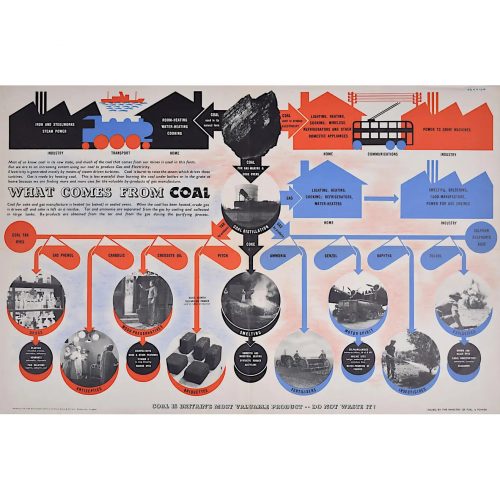
FHK Henrion (1914 - 1990)
What Comes from Coal (circa 1945)
Original vintage poster 51 x 76 cm Signed in plate. Issued by the Ministry of Fuel and Power; printed for HM Stationery Office by Field Sons & Co Ltd, Bradford. We have been unable to identify any other copy of this poster by this renowned designer in any public collection - it is possibly the only remaining copy. A Ministry of Fuel poster encouraging the public to use less fuel. FHK Henrion was a German graphic designer who moved to Paris after leaving school, studying with the poster designer Paul Colin and then moving to London in 1936. Interned in the Isle of Man during the Second World War, he went on to design posters for the Ministry of Information and the US Office of War Information. After the War he started his own design agency, pioneering the concept of corporate identity. Clients included KLM, Giro, The Post Office, Tate & Lyle. The Ministry of Power and Fuel existed from 1942 to 1957 to control the nation's use of the scarce resources during and after the Second World War. Condition: centre folds as issued with a little wear to the extremities of the folds; generally very good. If you’d like to know more, please email info@manningfineart.co.uk or call us on 07929 749056. -
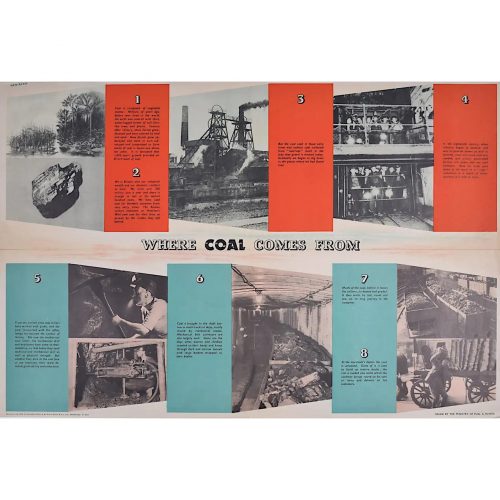
FHK Henrion (1914 - 1990)
Where Coal Comes From (circa 1945)
Original vintage poster 51 x 76 cm Signed in plate. Issued by the Ministry of Fuel and Power; printed for HM Stationery Office by Field Sons & Co Ltd, Bradford. We have been unable to identify any other copy of this poster by this renowned designer in any public collection - it is possibly the only remaining copy. A Ministry of Fuel poster encouraging the public to use less fuel. FHK Henrion was a German graphic designer who moved to Paris after leaving school, studying with the poster designer Paul Colin and then moving to London in 1936. Interned in the Isle of Man during the Second World War, he went on to design posters for the Ministry of Information and the US Office of War Information. After the War he started his own design agency, pioneering the concept of corporate identity. Clients included KLM, Giro, The Post Office, Tate & Lyle. The Ministry of Power and Fuel existed from 1942 to 1957 to control the nation's use of the scarce resources during and after the Second World War. Condition: centre folds as issued with a little wear to the extremities of the folds; generally very good. If you’d like to know more, please email info@manningfineart.co.uk or call us on 07929 749056. -

George Bissill (1896-1973) Landscape view with barn and church, Devon
Pencil sketch 25 x 35 cm Born in 1896, George Bissill was a British miner, painter and furniture designer. Raised in the mining village of Langley Mill, Derbyshire, Bissill became a miner at the age of 13, before leaving to join the war effort in 1915. Upon his return from the war after being gassed, Bissill chose to become a pavement artist outside the newly erected Bush House in Aldwych, painting from his memory and his sketch book the uncompromising underground world he had inhabited. In 1935 he moved to the countryside near Newbury, where he lived and worked as a landscape painter, art restorer and dealer until his death in 1973. This painting forms part of a larger collection, 'unseen since they were taken from George Bissil's studio in 1983' and restored by Kate Pattinson. A series of planned exhibitions were cancelled due to Covid, but two shows, one in Oxford and one in Ilkeston, did take place. Through such exhibitions, Pattinson hoped to 'restore the reputation of an artist who, through mighty endeavour, conquered the art world in the 1920s with his powerful, authentic and experimental pictures.' Bissill's paintings are also held in a number of important public collections, including the Tate Gallery, National Museum of Ireland and the Manchester Art Gallery. This pencil sketch depicts a bucolic view of a north Devonshire landscape. In amongst the rolling hills of Devon, traces of rural life are discernible, with a small barn depicted nestled into the hillside. This sketch stands out from his other sketched works as a preliminary study for an oil painting, evidenced by Bissill's labelling of the fields in the background. The sketch offers therefore a unique insight into Bissill's artistic practice. Condition: Generally very good.If you would like to know more, please email info@manningfineart.co.uk or call us on 07929 749056.
-
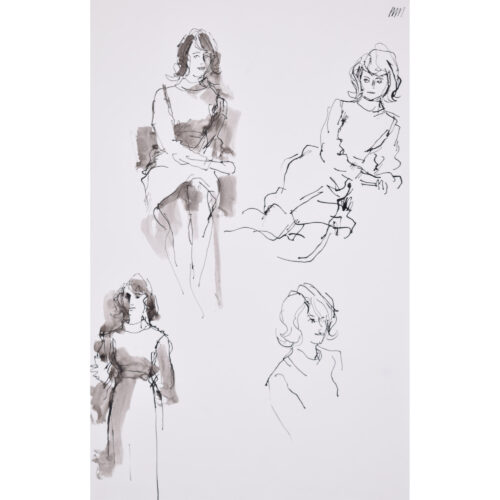
Peter Collins ARCA (1923 - 2001)
Figure Studies
Ink and wash 44 x 28 cm Provenance: the artist's studio sale. Four characterful and intimate clothed studies of a model with voluminous 1960s hair. Collins' first job was in the commercial studio of an advertising agency. World War II interrupted his career and he joined the Royal Artillery, teaching painting and drawing in the Education Corps - whilst simultaneously teaching at St Martin's School of Art, part time. Following the war, Collins studied at the Royal College of Art, winning a scholarship. He then worked as a commercial artist, producing some well-known posters for clients including British Railways and British European Airways. He was the Art Director at Odhams Press and spent time designing for both ICI and Shell. With his wife Georgette, he created the 'Bacombe Galleries' in Sussex, converting a group of buildings into a gallery space. In 1975 they developed the Stanley Studios in Chelsea, which were scheduled for redevelopment, into a combined artists' studio and residence. Moving into the Stanley Studios allowed the Collinses to immerse themselves in Chelsea's art scene, and they proceeded to fill the studios with art, antiques, sculpture, and other curios. Condition: generally very good. If you are interested, please email info@manningfineart.co.uk or call us on 07929 749056. Click here for other works by Peter Collins. -
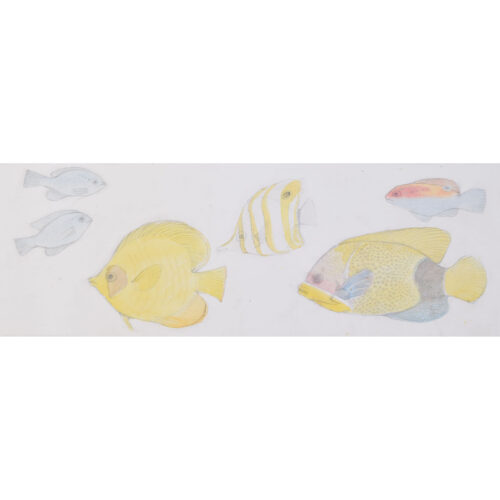
Jane Gray (born 1931)
Fish (1960)
Pencil and watercolour 19 x 54 cm Provenance: the artist's studio sale. Jane Gray A.R.C.A. (b.1931) is a British stained glass artist. She studied stained glass at the Kingston School of Arts (1949 - 1951) and later at the Royal College of Art (1951 - 1955) under Lawrence Lee. Lee was so impressed with Gray’s work that he asked her to work alongside him on the design of ten nave windows for Coventry Cathedral. This six-year-long design project culminated in their final installation in 1962 after the cathedral’s consecration. Gray was the first woman to become a liveryman of the Worshipful Company of Glaziers and has designed more than a hundred windows in private and public buildings, chapels and over forty churches across the country, including St Peter’s, Martindale, Shrewsbury Abbey, St Oswald, Oswestry and St Mary, Chirk. Gray’s designs mark a crucial turning point in the history of stained glass art as the Victorian style gave way to a modern, aesthetic. In her work, Gray navigates this shift with a style that, whilst distinctly modern, retains a deep rooted sense of the medieval. Despite many of her commissions being for church windows, stained glass design was not simply about religious depiction for Gray, but more about ‘colour, shapes, luminosity, [and] playing with rainbows’. Condition: generally very good. If you are interested, please email info@manningfineart.co.uk or call us on 07929 749056. For other works by Jane Gray and more information about her, please click here. -
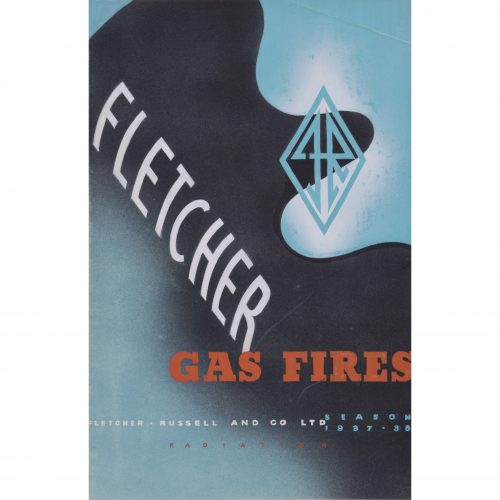
Brownbridge (flourished 1930s - 1940s)
Fletcher Gas Fires brochure design (1937)
Lithographic brochure 21.5 x 14 cm From a small archive of works by Brownbridge, a member of the Society of Industrial Artists. An original gouache design for a brochure advertising Fletcher Russell and Co. gas fires. The futuristic style of the boldly blue-, black-, and orange-coloured poster, as well as the dynamic diamond-shaped badge containing the initials F and R (for Fletcher and Russell) combine to make this a highly modern piece of 1930s design. Society of Industrial Artists correspondance (photographed above) is not included; please enquire separately. Condition: generally very good; gentle crease to top right corner. If you are interested, please email info@manningfineart.co.uk or call us on 07929 749056. Click here for other designs by Brownbridge. -

James Basire & John Carter Floor Plan of St Albans Cathedral
Engraving 61 x 95 cm This engraving was originally published by the Society of Antiquaries of London, an organisation dedicated to studying and preserving historical monuments. Recognising it as one of England's most significant medieval structures, the society commissioned a series of engravings of St Albans Cathedral by James Basire, based on drawings by the architectural draughtsman John Carter. In doing so, the Antiquaries hoped to preserve and disseminate knowledge of England’s architectural heritage. This particular edition depicts the architectural floor plan of St Albans Cathedral. The cruciform architecture is striking, as portrayed from an aerial view. Basire and Carter also expertly preserve the finer details of this beautiful cathedral in these plans, depicting the details of the floor tiling and the masonry of the columns. This attention both to the architecture and the details produces a unique overall view of the cathedral. Condition: Generally very good.If you would like to know more, please email info@manningfineart.co.uk or call us on 07929 749056.
-
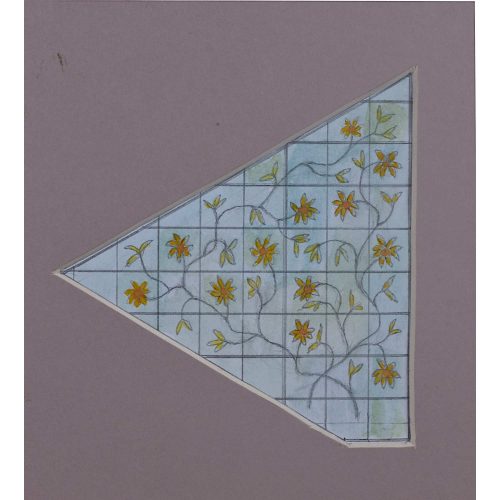
Jane Gray (b.1931)
Floral Design for Domestic Stained Glass Window
Watercolour 11.5 x 11 cmStudio stamp verso.
This uniquely shaped design for a domestic window centres on a sprawling pair of entangled floral branches that cover the small squared panels in an astute imitation of a trellis. The design is typical of many of Gray’s domestic windows which often focus on floral designs.
Provenance: the artist’s studio sale. Condition: very good. If you are interested, please email info@manningfineart.co.uk or call us on 07929 749056. For other works by Jane Gray and more information about her, please click here. -
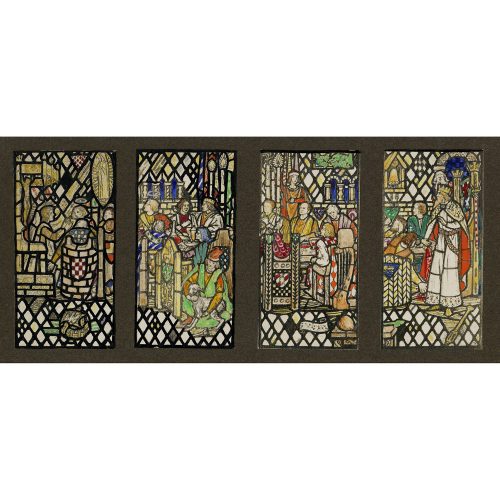
Florence & Walter Camm
Design for Series of Four Arthurian Stained Glass Windows for Mercersburg Academy Chapel, Pennsylvania
1928 Watercolour over photographic background 10 x 24cm Provenance: The archives of TW Camm The Irvine Chapel of Mercersburg Academy was built as a war memorial for the First World War dead of the school. The dead were honoured in a series of stained glass windows that were commissioned from a series of the greatest stained glass designers of the time. If you are interested email info@manningfineart.co.uk or call us on 07929 749056. -
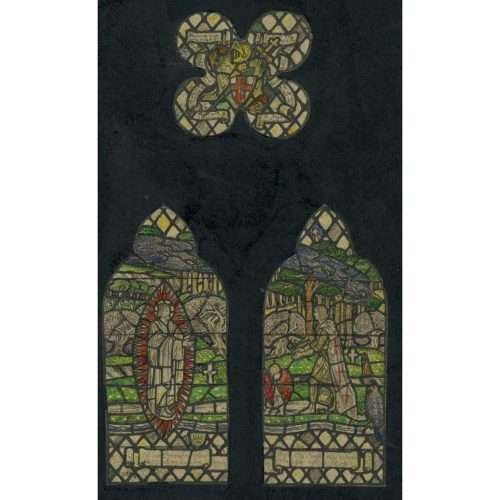
Florence Camm (1874-1960)
Arthurian Stained Glass Window Design II
Watercolour 16x9.5cm Design for TW Camm & Co., Smethwick, Birmingham. If you are interested email info@manningfineart.co.uk or call us on 07929 749056. -
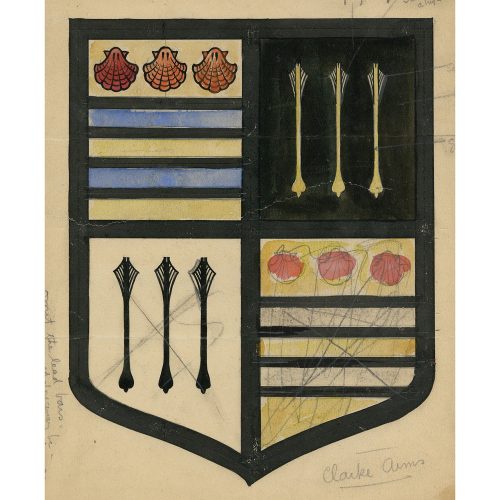
Florence Camm (1874-1960)
Clarke Arms Design
Watercolour and pencil 22x17cm Design for TW Camm & Co. If you are interested email info@manningfineart.co.uk or call us on 07929 749056. -
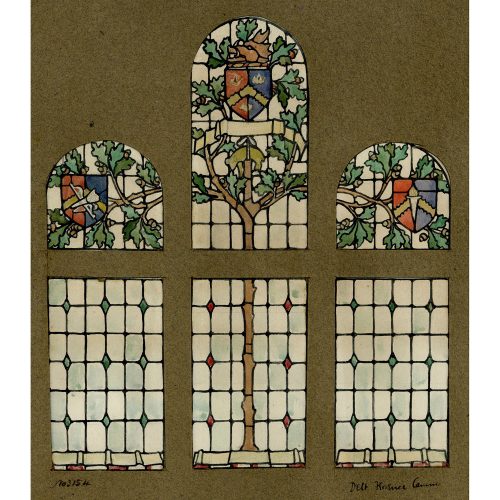
Florence Camm (1874-1960)
Heraldic Stained Glass Window Design with Oak Leaves
Watercolour 20x18cm Click for biographical details and other works by Camm. If you are interested email info@manningfineart.co.uk or call us on 07929 749056. -
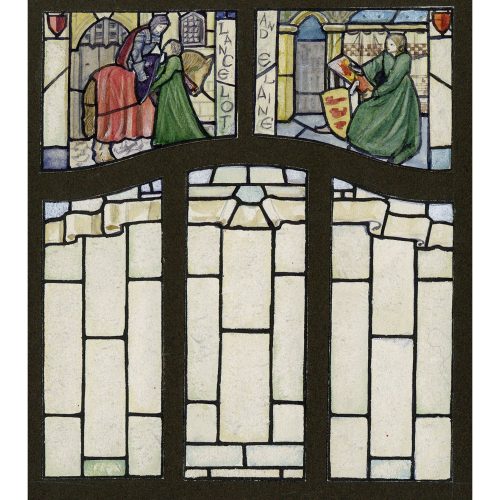
Florence Camm (1874-1960)
Lancelot and Elaine Stained Glass Window Design
Watercolour 13.5x11.5cm Design for TW Camm & Co., Smethwick, Birmingham. If you are interested email info@manningfineart.co.uk or call us on 07929 749056. -
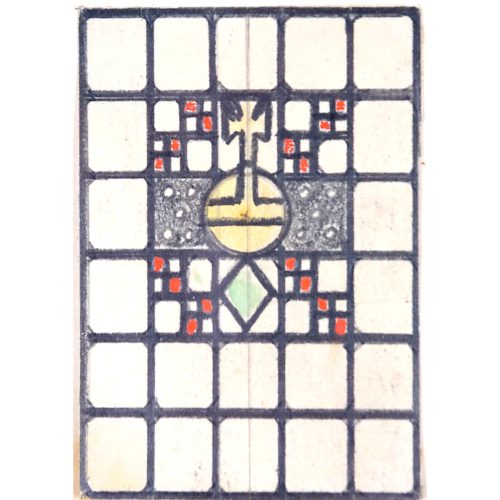
Florence Camm (1874-1960) Design for stained glass window with orb and cross
Watercolour 7x5 cm Design for TW Camm & Co., Smethwick, Birmingham The Camms were stained glass designers who exhibited 48 times at the Royal Academy and also exhibited at The Walker Art Gallery in Liverpool, The Royal Scottish Academy and Royal Birmingham Society of Artists. Following the death of her father, Florence Camm became chief designer at TW Camm with many commissions both nationally and internationally. Florence Camm was the daughter of Thomas William Camm (1839-1912) who founded the stained glass business T W Camm in High Street Smethwick. From 1892-1911 she studied at The Birmingham Municipal School of Art which, unusually for the time, encouraged girls to attend the life drawing classes – drawing fully nude female models and partially draped male models – thus explaining Camm’s skill with the human figure. Students were encouraged to execute their drawings for designs, thus giving them the skills to set up as manufacturers in Birmingham’s Jewellery Quarter. The arts and crafts designer Henry Payne was an influential tutor for Camm, being one of the most influential teachers at the BMSA who was working as a stained glass designer at the time; one of his most notable commissions was a painted mural illustrating Tudor History for the Houses of Parliament in 1908. Following the death of TW Camm, Florence and her brothers – Walter and Robert – took over the business and Florence did most of the designing. If you are interested email info@manningfineart.co.uk or call us on 07929 749056. Condition: In conservation mount and in plastic sleeve for protection. -
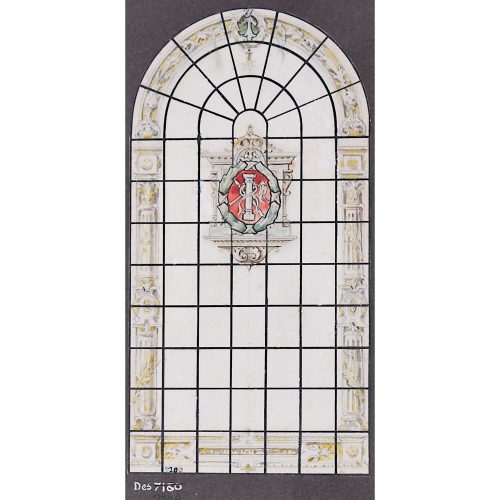
Florence Camm (1874-1960) Design for stained glass window 'The Instruments of the Passion'
Watercolour 20x10 cm Design for TW Camm & Co., Smethwick, Birmingham embossed with their stamp to bottom Numbered 7180/7200 The Camms were stained glass designers who exhibited 48 times at the Royal Academy and also exhibited at The Walker Art Gallery in Liverpool, The Royal Scottish Academy and Royal Birmingham Society of Artists. Following the death of her father, Florence Camm became chief designer at TW Camm with many commissions both nationally and internationally. Florence Camm was the daughter of Thomas William Camm (1839-1912) who founded the stained glass business T W Camm in High Street Smethwick. From 1892-1911 she studied at The Birmingham Municipal School of Art which, unusually for the time, encouraged girls to attend the life drawing classes – drawing fully nude female models and partially draped male models – thus explaining Camm’s skill with the human figure. Students were encouraged to execute their drawings for designs, thus giving them the skills to set up as manufacturers in Birmingham’s Jewellery Quarter. The arts and crafts designer Henry Payne was an influential tutor for Camm, being one of the most influential teachers at the BMSA who was working as a stained glass designer at the time; one of his most notable commissions was a painted mural illustrating Tudor History for the Houses of Parliament in 1908. Following the death of TW Camm, Florence and her brothers – Walter and Robert – took over the business and Florence did most of the designing. If you are interested email info@manningfineart.co.uk or call us on 07929 749056. Conditon: Good. In plastic sleeve for protection. -
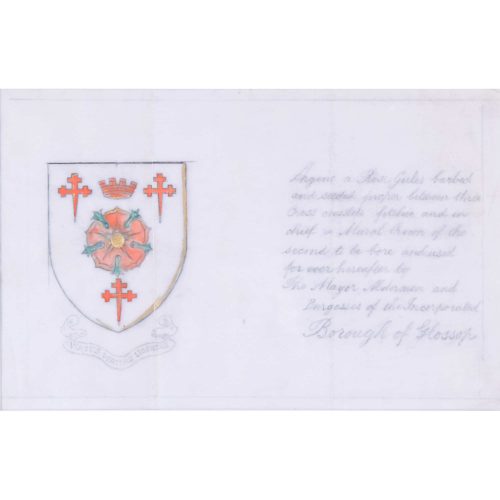
Florence Camm (1874-1960) Design for stained glass window for the Arms of the Borough of Glossop
Watercolour on tracing paper 18x28 cm Design for TW Camm & Co., Smethwick, Birmingham The Camms were stained glass designers who exhibited 48 times at the Royal Academy and also exhibited at The Walker Art Gallery in Liverpool, The Royal Scottish Academy and Royal Birmingham Society of Artists. Following the death of her father, Florence Camm became chief designer at TW Camm with many commissions both nationally and internationally. Florence Camm was the daughter of Thomas William Camm (1839-1912) who founded the stained glass business T W Camm in High Street Smethwick. From 1892-1911 she studied at The Birmingham Municipal School of Art which, unusually for the time, encouraged girls to attend the life drawing classes – drawing fully nude female models and partially draped male models – thus explaining Camm’s skill with the human figure. Students were encouraged to execute their drawings for designs, thus giving them the skills to set up as manufacturers in Birmingham’s Jewellery Quarter. The arts and crafts designer Henry Payne was an influential tutor for Camm, being one of the most influential teachers at the BMSA who was working as a stained glass designer at the time; one of his most notable commissions was a painted mural illustrating Tudor History for the Houses of Parliament in 1908. Following the death of TW Camm, Florence and her brothers – Walter and Robert – took over the business and Florence did most of the designing. If you are interested email info@manningfineart.co.uk or call us on 07929 749056. Condition: In conservation mount and in plastic sleeve for protection. -
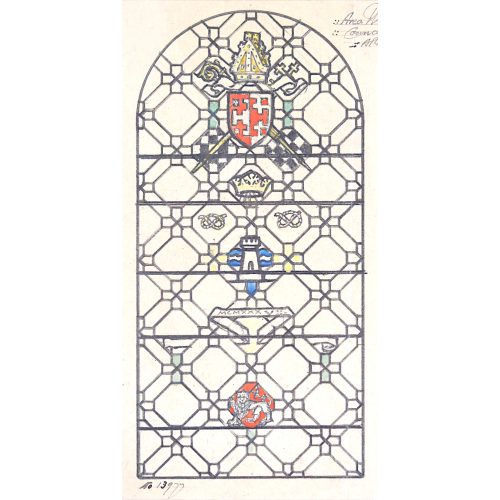
Florence Camm (1874-1960) Design for stained glass for Council with Castle and Lion Crown and Mitre
Watercolour 18.5x9.5 cm Dated 1935 Design for TW Camm & Co., Smethwick, Birmingham no. 13979 The Camms were stained glass designers who exhibited 48 times at the Royal Academy and also exhibited at The Walker Art Gallery in Liverpool, The Royal Scottish Academy and Royal Birmingham Society of Artists. Following the death of her father, Florence Camm became chief designer at TW Camm with many commissions both nationally and internationally. Florence Camm was the daughter of Thomas William Camm (1839-1912) who founded the stained glass business T W Camm in High Street Smethwick. From 1892-1911 she studied at The Birmingham Municipal School of Art which, unusually for the time, encouraged girls to attend the life drawing classes – drawing fully nude female models and partially draped male models – thus explaining Camm’s skill with the human figure. Students were encouraged to execute their drawings for designs, thus giving them the skills to set up as manufacturers in Birmingham’s Jewellery Quarter. The arts and crafts designer Henry Payne was an influential tutor for Camm, being one of the most influential teachers at the BMSA who was working as a stained glass designer at the time; one of his most notable commissions was a painted mural illustrating Tudor History for the Houses of Parliament in 1908. Following the death of TW Camm, Florence and her brothers – Walter and Robert – took over the business and Florence did most of the designing. If you are interested email info@manningfineart.co.uk or call us on 07929 749056. Condition: In conservation mount and in plastic sleeve for protection. -
Out of stock
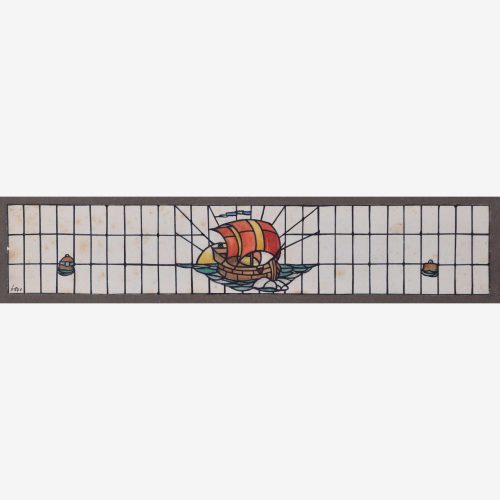
Florence Camm (1874-1960)
Stained Glass Window Design with Red Sailing Ship
Watercolour 6.5x34cm Condition: Some spotting to image; mounted to board - see image. Click for biographical details and other works by Camm. If you are interested email info@manningfineart.co.uk or call us on 07929 749056. -
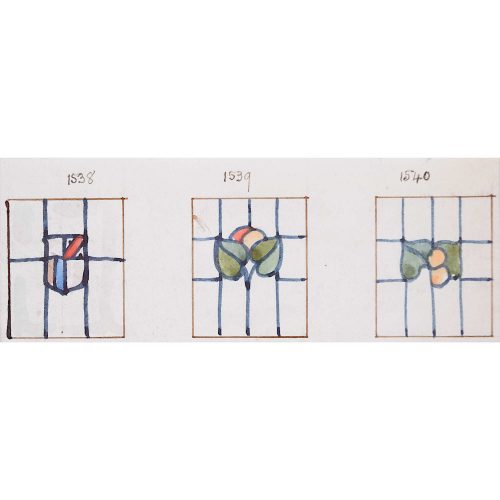
Florence Camm (1874-1960) Design for domestic stained glass window
Watercolour 14x5 cm Design for TW Camm & Co., Smethwick, Birmingham Numbered 1538,1539,1540 The Camms were stained glass designers who exhibited 48 times at the Royal Academy and also exhibited at The Walker Art Gallery in Liverpool, The Royal Scottish Academy and Royal Birmingham Society of Artists. Following the death of her father, Florence Camm became chief designer at TW Camm with many commissions both nationally and internationally. Florence Camm was the daughter of Thomas William Camm (1839-1912) who founded the stained glass business T W Camm in High Street Smethwick. From 1892-1911 she studied at The Birmingham Municipal School of Art which, unusually for the time, encouraged girls to attend the life drawing classes – drawing fully nude female models and partially draped male models – thus explaining Camm’s skill with the human figure. Students were encouraged to execute their drawings for designs, thus giving them the skills to set up as manufacturers in Birmingham’s Jewellery Quarter. The arts and crafts designer Henry Payne was an influential tutor for Camm, being one of the most influential teachers at the BMSA who was working as a stained glass designer at the time; one of his most notable commissions was a painted mural illustrating Tudor History for the Houses of Parliament in 1908. Following the death of TW Camm, Florence and her brothers – Walter and Robert – took over the business and Florence did most of the designing. If you are interested email info@manningfineart.co.uk or call us on 07929 749056. Conditon: Good. In conservation mount and in plastic sleeve for protection.