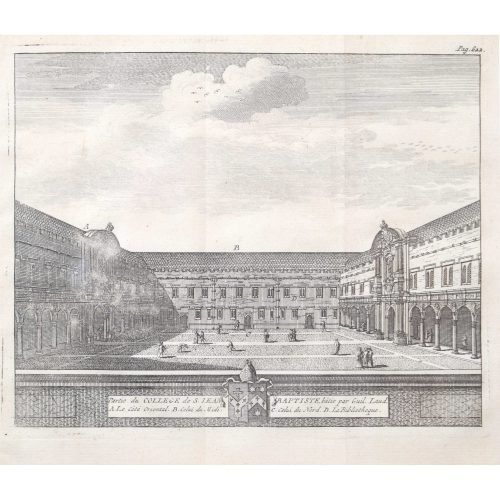
-
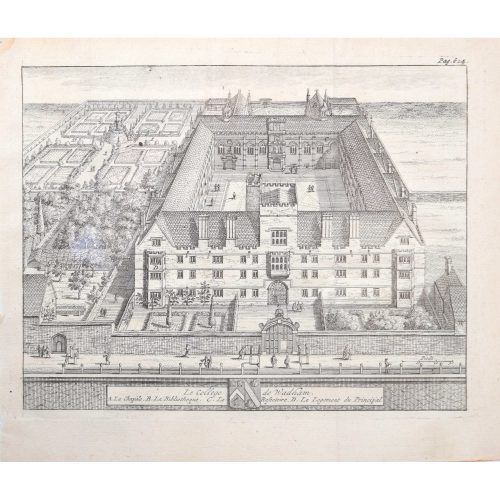
Pieter van der Aa (1659-1733), after David Loggan (1634–1692)
Wadham College, Oxford (1727)
Engraving 12 x 16 cm An eighteenth-century view of Wadham, engraved by Pieter van der Aa after David Loggan, the noted engraver, draughtsman, and painter. Pieter van der Aa of Leiden was a Dutch publisher best known for preparing maps and atlases, though he also printed editions of foreign bestsellers and illustrated volumes. He is noted for the many engravings he produced after David Loggan's series of Oxford and Cambridge colleges and costumes. In 1727 Van Der Aa illustrated "Les Delices de la Grande Bretagne & de L'Irelande" by James Beeverell, the book in which this engraving appears. Condition: a good impression. If you’d like to know more, please email info@manningfineart.co.uk or call us on 07929 749056. -
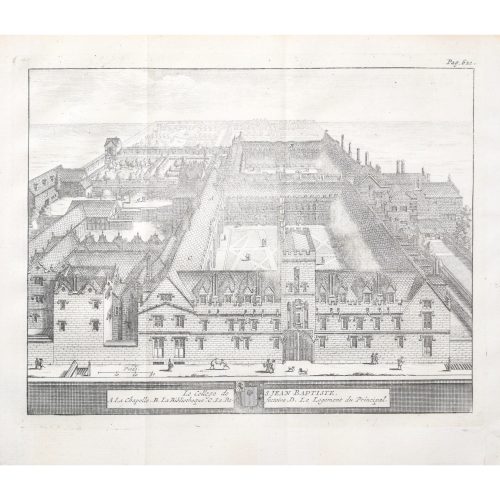
Pieter van der Aa (1659-1733), after David Loggan (1634–1692)
St John's College, Oxford (1727)
Engraving 12 x 16 cm An eighteenth-century view of St John's, engraved by Pieter van der Aa after David Loggan, the noted engraver, draughtsman, and painter. Pieter van der Aa of Leiden was a Dutch publisher best known for preparing maps and atlases, though he also printed editions of foreign bestsellers and illustrated volumes. He is noted for the many engravings he produced after David Loggan's series of Oxford and Cambridge colleges and costumes. In 1727 Van Der Aa illustrated "Les Delices de la Grande Bretagne & de L'Irelande" by James Beeverell, the book in which this engraving appears. Condition: a good impression. If you’d like to know more, please email info@manningfineart.co.uk or call us on 07929 749056. -

Pieter van der Aa (1659-1733), after David Loggan (1634–1692)
Brasenose College, Oxford (1727)
Engraving 12 x 16 cm An eighteenth-century view of 'Le Nez de Bronze', or Brasenose, engraved by Pieter van der Aa after David Loggan, the noted engraver, draughtsman, and painter. Pieter van der Aa of Leiden was a Dutch publisher best known for preparing maps and atlases, though he also printed editions of foreign bestsellers and illustrated volumes. He is noted for the many engravings he produced after David Loggan's series of Oxford and Cambridge colleges and costumes. In 1727 Van Der Aa illustrated "Les Delices de la Grande Bretagne & de L'Irelande" by James Beeverell, the book in which this engraving appears. Condition: a good impression. If you’d like to know more, please email info@manningfineart.co.uk or call us on 07929 749056. -
Out of stock
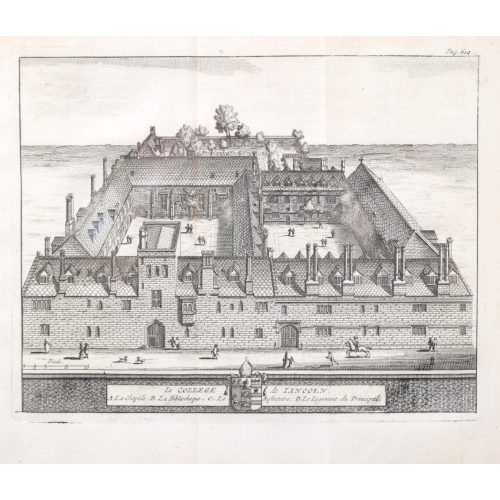
Pieter van der Aa (1659-1733), after David Loggan (1634–1692)
Lincoln College, Oxford (1727)
Engraving 12 x 16 cm An eighteenth-century view of Lincoln, engraved by Pieter van der Aa after David Loggan, the noted engraver, draughtsman, and painter. Pieter van der Aa of Leiden was a Dutch publisher best known for preparing maps and atlases, though he also printed editions of foreign bestsellers and illustrated volumes. He is noted for the many engravings he produced after David Loggan's series of Oxford and Cambridge colleges and costumes. In 1727 Van Der Aa illustrated "Les Delices de la Grande Bretagne & de L'Irelande" by James Beeverell, the book in which this engraving appears. Condition: a good impression. If you’d like to know more, please email info@manningfineart.co.uk or call us on 07929 749056. -
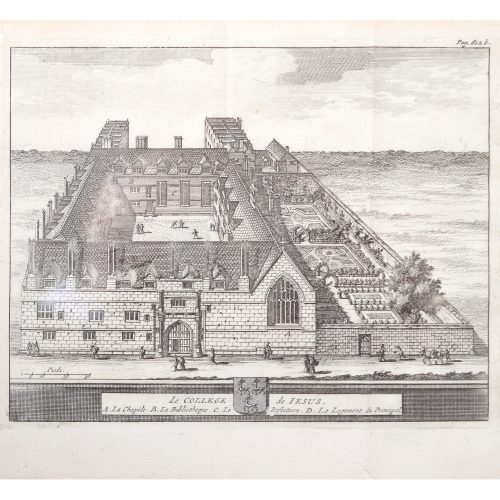
Pieter van der Aa (1659-1733), after David Loggan (1634–1692)
Jesus College, Oxford (1727)
Engraving 12 x 16 cm An eighteenth-century view of Jesus College, engraved by Pieter van der Aa after David Loggan, the noted engraver, draughtsman, and painter. Pieter van der Aa of Leiden was a Dutch publisher best known for preparing maps and atlases, though he also printed editions of foreign bestsellers and illustrated volumes. He is noted for the many engravings he produced after David Loggan's series of Oxford and Cambridge colleges and costumes. In 1727 Van Der Aa illustrated "Les Delices de la Grande Bretagne & de L'Irelande" by James Beeverell, the book in which this engraving appears. Condition: a good impression. If you’d like to know more, please email info@manningfineart.co.uk or call us on 07929 749056. -
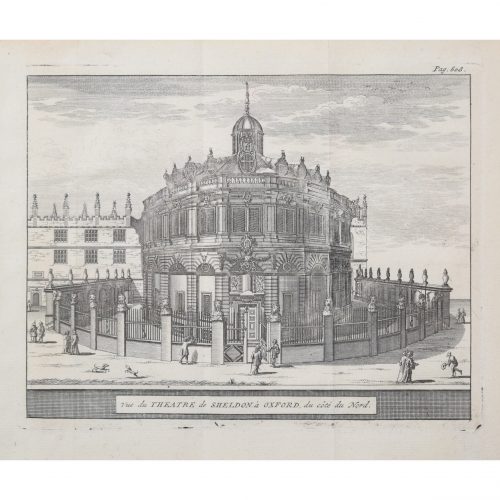
Pieter van der Aa (1659-1733), after David Loggan (1634–1692)
The Sheldonian Theatre, University of Oxford (1727)
Engraving 12 x 16 cm An eighteenth-century view of Oxford's marvellous Sheldonian Theatre, engraved by Pieter van der Aa after David Loggan, the noted engraver, draughtsman, and painter. Christopher Wren designed the building and it was constructed between 1664 and 1669; it takes its name from Gilbert Sheldon, chancellor of the University at the time and the Theatre's main financial backer. Pieter van der Aa of Leiden was a Dutch publisher best known for preparing maps and atlases, though he also printed editions of foreign bestsellers and illustrated volumes. He is noted for the many engravings he produced after David Loggan's series of Oxford and Cambridge colleges and costumes. In 1727 Van Der Aa illustrated "Les Delices de la Grande Bretagne & de L'Irelande" by James Beeverell, the book in which this engraving appears. Condition: a good impression. If you’d like to know more, please email info@manningfineart.co.uk or call us on 07929 749056. -
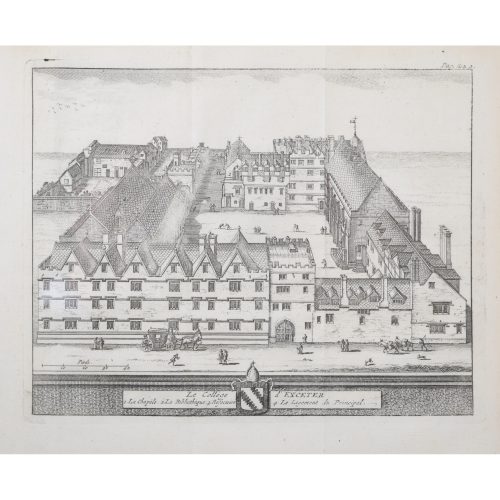
Pieter van der Aa (1659-1733), after David Loggan (1634–1692)
Exeter College, Oxford (1727)
Engraving 12 x 16 cm An eighteenth-century view of Exeter, engraved by Pieter van der Aa after David Loggan, the noted engraver, draughtsman, and painter. Pieter van der Aa of Leiden was a Dutch publisher best known for preparing maps and atlases, though he also printed editions of foreign bestsellers and illustrated volumes. He is noted for the many engravings he produced after David Loggan's series of Oxford and Cambridge colleges and costumes. In 1727 Van Der Aa illustrated "Les Delices de la Grande Bretagne & de L'Irelande" by James Beeverell, the book in which this engraving appears. Condition: a good impression. If you’d like to know more, please email info@manningfineart.co.uk or call us on 07929 749056. -
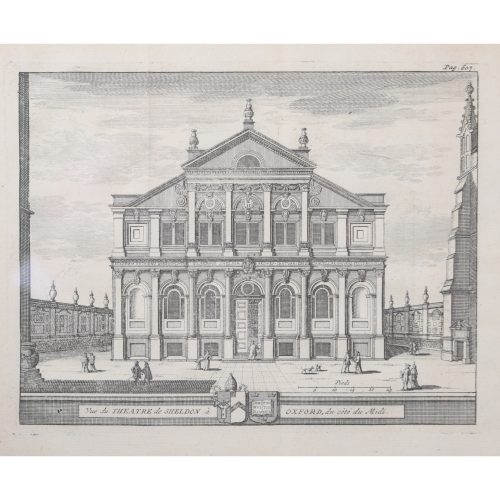
Pieter van der Aa (1659-1733), after David Loggan (1634–1692)
The Sheldonian Theatre, University of Oxford (1727)
Engraving 12 x 16 cm An eighteenth-century view of Oxford's marvellous Sheldonian Theatre, engraved by Pieter van der Aa after David Loggan, the noted engraver, draughtsman, and painter. Christopher Wren designed the building and it was constructed between 1664 and 1669; it takes its name from Gilbert Sheldon, chancellor of the University at the time and the Theatre's main financial backer. Pieter van der Aa of Leiden was a Dutch publisher best known for preparing maps and atlases, though he also printed editions of foreign bestsellers and illustrated volumes. He is noted for the many engravings he produced after David Loggan's series of Oxford and Cambridge colleges and costumes. In 1727 Van Der Aa illustrated "Les Delices de la Grande Bretagne & de L'Irelande" by James Beeverell, the book in which this engraving appears. Condition: a good impression. If you’d like to know more, please email info@manningfineart.co.uk or call us on 07929 749056. -
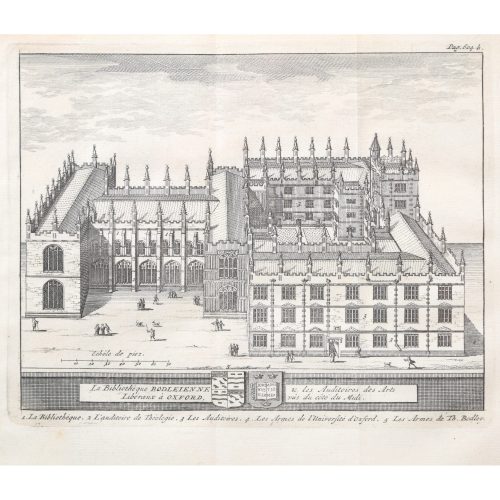
Pieter van der Aa (1659-1733), after David Loggan (1634–1692)
The Bodleian Library, Oxford (1727)
Engraving 12 x 16 cm An eighteenth-century view of the beautiful Bodleian Library, engraved by Pieter van der Aa after David Loggan, the noted engraver, draughtsman, and painter. Pieter van der Aa of Leiden was a Dutch publisher best known for preparing maps and atlases, though he also printed editions of foreign bestsellers and illustrated volumes. He is noted for the many engravings he produced after David Loggan's series of Oxford and Cambridge colleges and costumes. In 1727 Van Der Aa illustrated "Les Delices de la Grande Bretagne & de L'Irelande" by James Beeverell, the book in which this engraving appears. Condition: a good impression. If you’d like to know more, please email info@manningfineart.co.uk or call us on 07929 749056. -
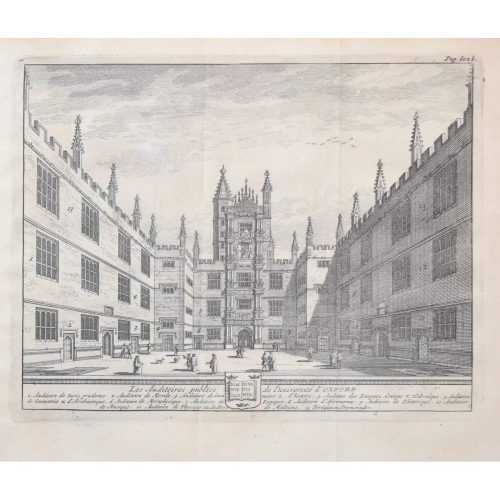
Pieter van der Aa (1659-1733), after David Loggan (1634–1692)
The Public Schools, University of Oxford (1727)
Engraving 12 x 16 cm An eighteenth-century view of the interior of the Public Schools, engraved by Pieter van der Aa after David Loggan, the noted engraver, draughtsman, and painter. Pieter van der Aa of Leiden was a Dutch publisher best known for preparing maps and atlases, though he also printed editions of foreign bestsellers and illustrated volumes. He is noted for the many engravings he produced after David Loggan's series of Oxford and Cambridge colleges and costumes. In 1727 Van Der Aa illustrated "Les Delices de la Grande Bretagne & de L'Irelande" by James Beeverell, the book in which this engraving appears. Condition: a good impression. If you’d like to know more, please email info@manningfineart.co.uk or call us on 07929 749056. -
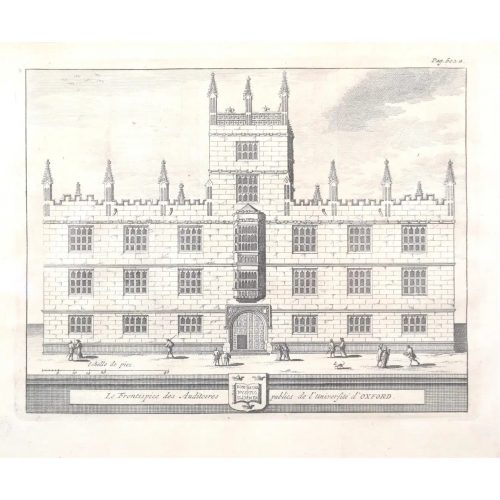
Pieter van der Aa (1659-1733), after David Loggan (1634–1692)
The Public Schools, University of Oxford (1727)
Engraving 12 x 16 cm An eighteenth-century view of the facade of Oxford's Public Schools, engraved by Pieter van der Aa after David Loggan, the noted engraver, draughtsman, and painter. Pieter van der Aa of Leiden was a Dutch publisher best known for preparing maps and atlases, though he also printed editions of foreign bestsellers and illustrated volumes. He is noted for the many engravings he produced after David Loggan's series of Oxford and Cambridge colleges and costumes. In 1727 Van Der Aa illustrated "Les Delices de la Grande Bretagne & de L'Irelande" by James Beeverell, the book in which this engraving appears. Condition: a good impression. If you’d like to know more, please email info@manningfineart.co.uk or call us on 07929 749056. -
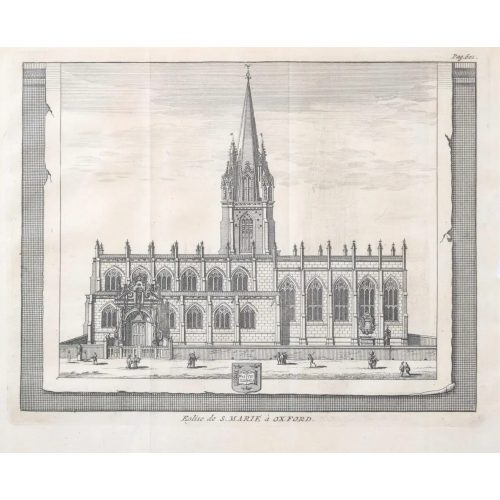
Pieter van der Aa (1659-1733), after David Loggan (1634–1692)
The University Church of St Mary the Virgin, University of Oxford (1727)
Engraving 12 x 16 cm An eighteenth-century view of the University Church, engraved by Pieter van der Aa after David Loggan, the noted engraver, draughtsman, and painter. St Mary's was the first building of the University of Oxford and its parish consists almost exclusively of university and college buildings. Its eccentric Baroque porch, designed by Nicholas Stone, faces the High Street, and it boasts a spire which is claimed by some church historians to be one of the most beautiful in England. Radcliffe Square lies to the north and to the east is Catte Street. The 13th-century tower is open to the public and provides magnificent views across the heart of the historic university city, especially Radcliffe Square, the Radcliffe Camera, Brasenose College, and All Souls College. Of particular interest here is the trompe l'oeil piece of gently torn paper which frames the view of the church. Pieter van der Aa of Leiden was a Dutch publisher best known for preparing maps and atlases, though he also printed editions of foreign bestsellers and illustrated volumes. He is noted for the many engravings he produced after David Loggan's series of Oxford and Cambridge colleges and costumes. In 1727 Van Der Aa illustrated "Les Delices de la Grande Bretagne & de L'Irelande" by James Beeverell, the book in which this engraving appears. Condition: a good impression. If you’d like to know more, please email info@manningfineart.co.uk or call us on 07929 749056. -
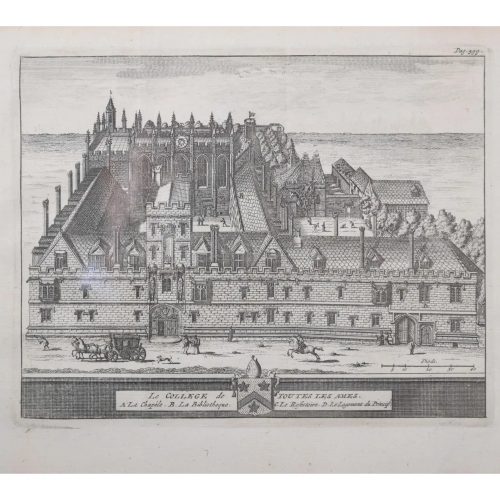
Pieter van der Aa (1659-1733), after David Loggan (1634–1692)
All Souls College, Oxford (1727)
Engraving 12 x 16 cm An eighteenth-century view of Le College de Toutre les Ames (All Souls), engraved by Pieter van der Aa after David Loggan, the noted engraver, draughtsman, and painter. The college was founded by Henry VI of England and Henry Chichele (fellow of New College and Archbishop of Canterbury), in 1438, to commemorate the victims of the Hundred Years' War. Pieter van der Aa of Leiden was a Dutch publisher best known for preparing maps and atlases, though he also printed editions of foreign bestsellers and illustrated volumes. He is noted for the many engravings he produced after David Loggan's series of Oxford and Cambridge colleges and costumes. In 1727 Van Der Aa illustrated "Les Delices de la Grande Bretagne & de L'Irelande" by James Beeverell, the book in which this engraving appears. Condition: a good impression. If you’d like to know more, please email info@manningfineart.co.uk or call us on 07929 749056. -
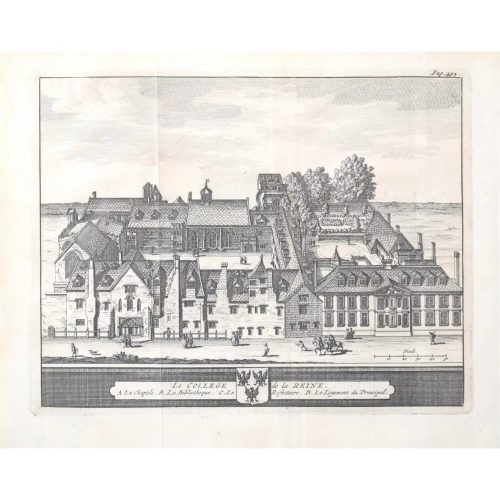
Pieter van der Aa (1659-1733), after David Loggan (1634–1692)
Queen's College, Oxford (1727)
Engraving 12 x 16 cm An eighteenth-century view of Le College de la Reine (Queen's College), engraved by Pieter van der Aa after David Loggan, the noted engraver, draughtsman, and painter. The college was founded in 1341 by Robert de Eglesfield in honour of Philippa of Hainault (the wife of King Edward III). Queen's is known for its predominantly neoclassical architecture, which includes buildings designed by Sir Christopher Wren and Nicholas Hawksmoor. Pieter van der Aa of Leiden was a Dutch publisher best known for preparing maps and atlases, though he also printed editions of foreign bestsellers and illustrated volumes. He is noted for the many engravings he produced after David Loggan's series of Oxford and Cambridge colleges and costumes. In 1727 Van Der Aa illustrated "Les Delices de la Grande Bretagne & de L'Irelande" by James Beeverell, the book in which this engraving appears. Condition: a good impression. If you’d like to know more, please email info@manningfineart.co.uk or call us on 07929 749056. -
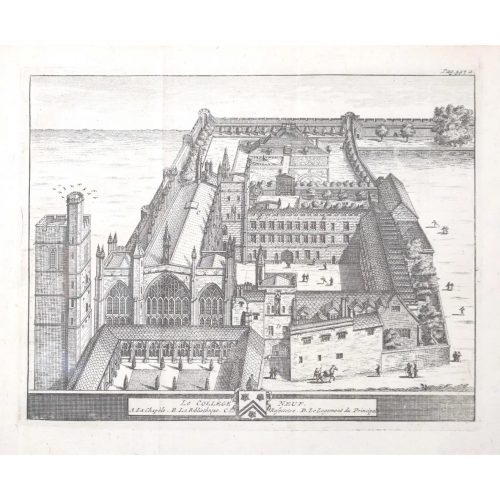
Pieter van der Aa (1659-1733), after David Loggan (1634–1692)
New College, Oxford (1727)
Engraving 12 x 16 cm An eighteenth-century view of Le College Neuf (New College), engraved by Pieter van der Aa after David Loggan, the noted engraver, draughtsman, and painter. Founded in 1379 by William of Wykeham, New College is one of the oldest colleges at the university and was the first to admit undergraduate students. Architecturally, New College was innovative in its design, in that it was all planned around an enclosed quadrangle (finished 1386). This was the first quadrangle of its type, though it has since become one of the defining features of colleges across Oxford and Cambridge. Pieter van der Aa of Leiden was a Dutch publisher best known for preparing maps and atlases, though he also printed editions of foreign bestsellers and illustrated volumes. He is noted for the many engravings he produced after David Loggan's series of Oxford and Cambridge colleges and costumes. In 1727 Van Der Aa illustrated "Les Delices de la Grande Bretagne & de L'Irelande" by James Beeverell, the book in which this engraving appears. Condition: a good impression. If you’d like to know more, please email info@manningfineart.co.uk or call us on 07929 749056. -
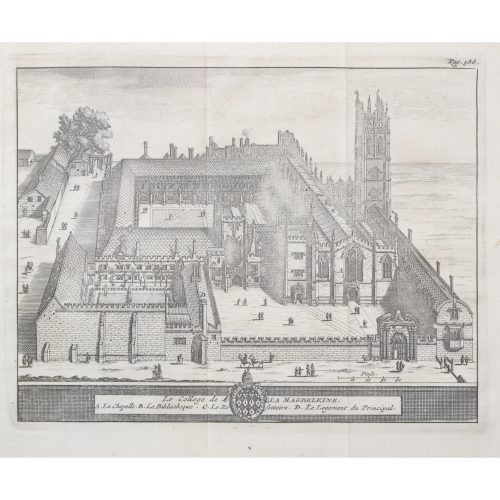
Pieter van der Aa (1659-1733), after David Loggan (1634–1692)
Magdalen College, Oxford (1727)
Engraving 12 x 16 cm A magnificent eighteenth-century view of Magdalen, engraved by Pieter van der Aa after David Loggan, the noted engraver, draughtsman, and painter. Magdalen was founded in 1458 by William of Waynflete, and is considered by many to be Oxford's most beautiful college. The college is organised around five quads; the irregularly shaped St John's Quad is the first on entering the college, and connects to the Great Quad (the Cloister) via the Perpendicular Gothic Founders Tower, which is richly decorated with carvings and pinnacles and has carved bosses in its vault. Chaplain's Quad runs along the side of the Chapel and Hall, to the foot of the Great Tower. St Swithun's Quad and Longwall Quad (which contains the Library) date from the late 19th and early 20th centuries, and make up the southwest corner of the college. Pieter van der Aa of Leiden was a Dutch publisher best known for preparing maps and atlases, though he also printed editions of foreign bestsellers and illustrated volumes. He is noted for the many engravings he produced after David Loggan's series of Oxford and Cambridge colleges and costumes. In 1727 Van Der Aa illustrated "Les Delices de la Grande Bretagne & de L'Irelande" by James Beeverell, the book in which this engraving appears. Condition: a small area slightly lacking in ink. If you’d like to know more, please email info@manningfineart.co.uk or call us on 07929 749056. -
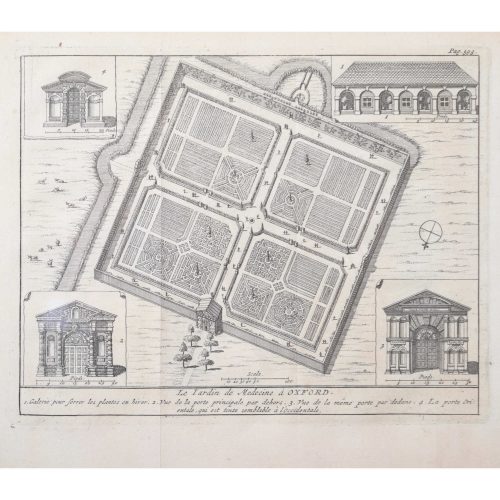
Pieter van der Aa (1659-1733), after David Loggan (1634–1692)
The University of Oxford Botanic Garden (1727)
Engraving 12 x 16 cm An eighteenth-century view of one of Oxford's dreamiest spaces: the Botanic Garden, engraved by Pieter van der Aa after David Loggan, the noted engraver, draughtsman, and painter. The University of Oxford Botanic Garden was founded in 1621 and is the oldest botanical garden in Great Britain. van der Aa's engraving focuses on its architectural qualities, with four features of the garden highlighted for their beauty, symmetry, and prowess of design. Of particular interest in this etching are the four trompe l'oeil pieces of gently curling paper which frame the gates of the garden. The Danby Gate (bottom left) at the front entrance to the garden is one of the three entrances designed by Nicholas Stone between 1632 and 1633. The gateway consists of three bays, each with a pediment; the niches contain statues of Charles I and Charles II in classical pose, and the niche in the the central pediment contains a bust of the Earl of Danby (hence the gate's name). Pieter van der Aa of Leiden was a Dutch publisher best known for preparing maps and atlases, though he also printed editions of foreign bestsellers and illustrated volumes. He is noted for the many engravings he produced after David Loggan's series of Oxford and Cambridge colleges and costumes. In 1727 Van Der Aa illustrated "Les Delices de la Grande Bretagne & de L'Irelande" by James Beeverell, the book in which this engraving appears. Condition: a good impression. If you’d like to know more, please email info@manningfineart.co.uk or call us on 07929 749056. -
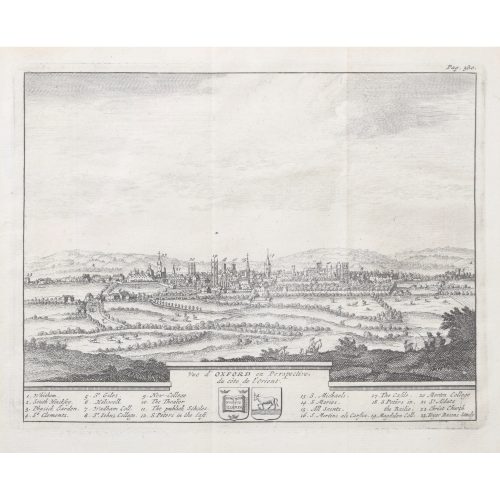
Pieter van der Aa (1659-1733), after David Loggan (1634–1692)
Oxford from the East (1727)
Engraving 12 x 16 cm An eighteenth-century view of Oxford from the east, engraved by Pieter van der Aa after David Loggan, the noted engraver, draughtsman, and painter. The skies are wide and full of the University's dreaming spires. Pieter van der Aa of Leiden was a Dutch publisher best known for preparing maps and atlases, though he also printed editions of foreign bestsellers and illustrated volumes. He is noted for the many engravings he produced after David Loggan's series of Oxford and Cambridge colleges and costumes. In 1727 Van Der Aa illustrated "Les Delices de la Grande Bretagne & de L'Irelande" by James Beeverell, the book in which this engraving appears. Condition: a good impression. If you’d like to know more, please email info@manningfineart.co.uk or call us on 07929 749056. -
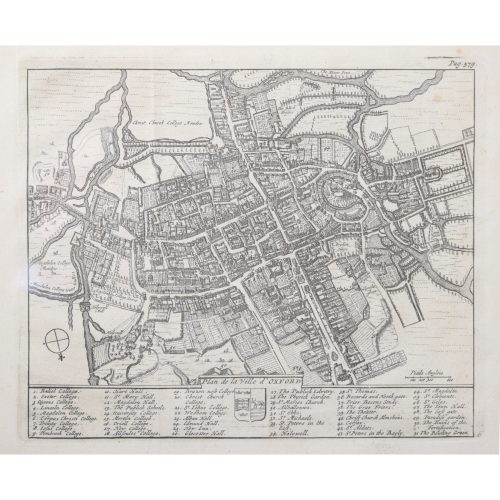
Pieter van der Aa (1659-1733), after David Loggan (1634–1692)
Map of Oxford (1727)
Engraving 12 x 16 cm An eighteenth-century map of Oxford, engraved by Pieter van der Aa after David Loggan, the noted engraver, draughtsman, and painter. The aerial view shows the city and its university buildings in all their glory. Pieter van der Aa of Leiden was a Dutch publisher best known for preparing maps and atlases, though he also printed editions of foreign bestsellers and illustrated volumes. He is noted for the many engravings he produced after David Loggan's series of Oxford and Cambridge colleges and costumes. In 1727 Van Der Aa illustrated "Les Delices de la Grande Bretagne & de L'Irelande" by James Beeverell, the book in which this engraving appears. Condition: a good impression. If you’d like to know more, please email info@manningfineart.co.uk or call us on 07929 749056. -
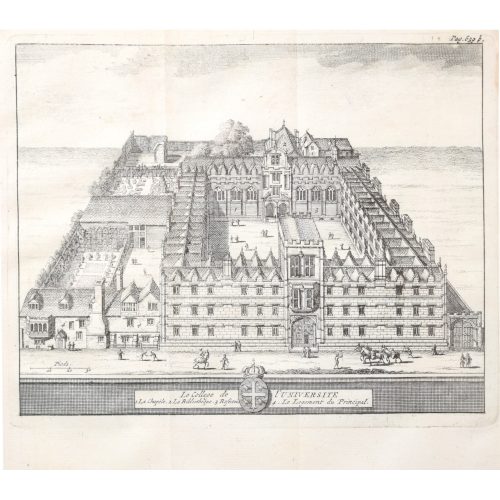
Pieter van der Aa (1659-1733), after David Loggan (1634–1692)
University College, Oxford (1727)
Engraving 12 x 16 cm An eighteenth-century view of University College, Oxford, engraved by Pieter van der Aa after David Loggan, the noted engraver, draughtsman, and painter. Pieter van der Aa of Leiden was a Dutch publisher best known for preparing maps and atlases, though he also printed editions of foreign bestsellers and illustrated volumes. He is noted for the many engravings he produced after David Loggan's series of Oxford and Cambridge colleges and costumes. In 1727 Van Der Aa illustrated "Les Delices de la Grande Bretagne & de L'Irelande" by James Beeverell, the book in which this engraving appears. Condition: a good impression. If you’d like to know more, please email info@manningfineart.co.uk or call us on 07929 749056. -
Out of stock
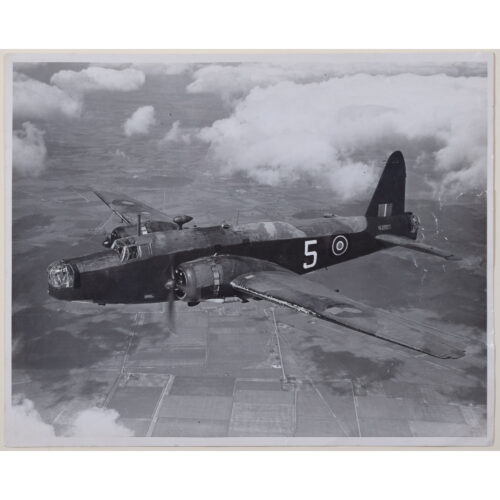
Charles E Brown (1896 - 1982)
Wellington Bomber
Silver gelatin photograph 20 x 25 cm The Vickers Wellington was a British twin-engined, long-range medium bomber. It was designed during the mid-1930s at Brooklands in Weybridge, Surrey. Led by Vickers-Armstrongs’ chief designer Rex Pierson; a key feature of the aircraft is its geodetic airframe fuselage structure, which was principally designed by Barnes Wallis. Development had been started in response to Air Ministry Specification B.9/32, issued in the middle of 1932, for a bomber for the Royal Air Force. This specification called for a twin-engined day bomber capable of delivering higher performance than any previous design. Other aircraft developed to the same specification include the Armstrong Whitworth Whitley and the Handley Page Hampden. During the development process, performance requirements such as for the tare weight changed substantially, and the engine used was not the one originally intended. The Wellington was used as a night bomber in the early years of the Second World War, performing as one of the principal bombers used by Bomber Command. During 1943, it started to be superseded as a bomber by the larger four-engined “heavies” such as the Avro Lancaster. The Wellington continued to serve throughout the war in other duties, particularly as an anti-submarine aircraft. It holds the distinction of having been the only British bomber that was produced for the duration of the war, and of having been produced in a greater quantity than any other British-built bomber. The Wellington remained as first-line equipment when the war ended, although it had been increasingly relegated to secondary roles. The Wellington was one of two bombers named after Arthur Wellesley, 1st Duke of Wellington, the other being the Vickers Wellesley. A larger heavy bomber aircraft designed to Specification B.1/35, the Vickers Warwick, was developed in parallel with the Wellington; the two aircraft shared around 85% of their structural components. Many elements of the Wellington were also re-used in a civil derivative, the Vickers VC.1 Viking. Leslie Carr was a painter and poster designer from London. He served in the Tank Corps in the First World War and then became a professional artist, mainly producing maritime and architectural scenes. He designed posters for Southern Railway, the London and North Eastern Railway, and British Railways (among others). Carr served as a fireman in the Second World War and was a part of several firemen artists’ exhibitions. Carr was a member of the Society of Marine Artists. Charles E Brown was an aviation photographer. His archive of 30,000 images has been held by the RAF Museum in Hendon since 1978. Condition: generally good; a few old creases and a short (repaired) tear top right approx 1 cm long. If you are interested, please email info@manningfineart.co.uk or call us on 07929 749056. Click here for other Second World War pictures. -

Hugh Casson (1910 - 1999)
Christ Church, Oxford
Lithograph 30 x 24 cm Casson's view of a busy Christ Church. Sir Hugh Casson was educated at Eastbourne College; St John’s College, Cambridge; and the Bartlett School of Architecture. Trained in the 1930s in the early modernist style, he taught at the Cambridge School of Architecture. After employment as a camoufleur during World War 2 by the Air Ministry, in 1948 he was appointed as director of architecture for the Festival of Britain. A close friend of the Royal Family, he undertook designs for the 1953 coronation, designed the interior of the Royal Yacht Britannia (“The overall idea was to give the impression of a country house at sea”), and taught the young Charles III to paint in watercolours. Amongst his architectural achievements are the Elephant House at London Zoo, the 1978 redevelopment of Bristol Docks, the Raised Faculty Building for The University of Cambridge, and a building for the Royal College of Art. He published a number of illustrated books, of which Casson’s Oxford and Casson’s Cambridge are probably the best known. A limited edition series of prints was produced from the paintings. Condition: very good; mounted to board. If you are interested, please email info@manningfineart.co.uk or call us on 07929 749056. Click here for other views of Christ Church. -
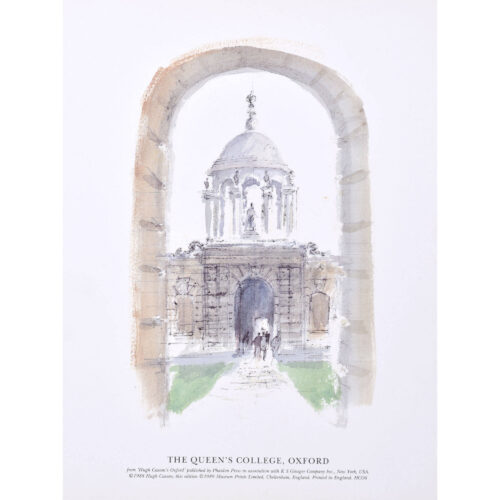
Hugh Casson (1910 - 1999)
The Queen's College, Oxford
Lithograph 30 x 24 cm Casson's view of Queen's, with students heading out to the High Street. Sir Hugh Casson was educated at Eastbourne College; St John’s College, Cambridge; and the Bartlett School of Architecture. Trained in the 1930s in the early modernist style, he taught at the Cambridge School of Architecture. After employment as a camoufleur during World War 2 by the Air Ministry, in 1948 he was appointed as director of architecture for the Festival of Britain. A close friend of the Royal Family, he undertook designs for the 1953 coronation, designed the interior of the Royal Yacht Britannia (“The overall idea was to give the impression of a country house at sea”), and taught the young Charles III to paint in watercolours. Amongst his architectural achievements are the Elephant House at London Zoo, the 1978 redevelopment of Bristol Docks, the Raised Faculty Building for The University of Cambridge, and a building for the Royal College of Art. He published a number of illustrated books, of which Casson’s Oxford and Casson’s Cambridge are probably the best known. A limited edition series of prints was produced from the paintings. Condition: very good; mounted to board. If you are interested, please email info@manningfineart.co.uk or call us on 07929 749056. Click here for other views of Queen's College, Oxford. -
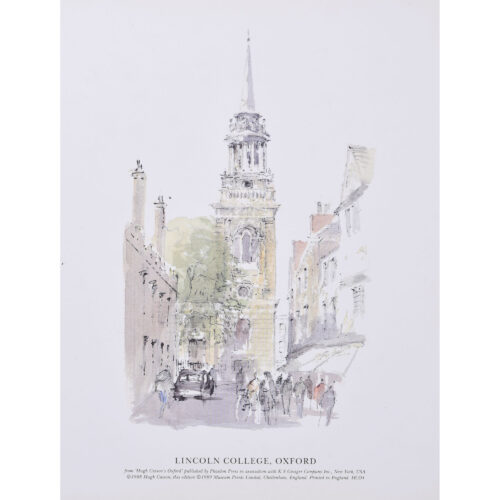
Hugh Casson (1910 - 1999)
Lincoln College, Oxford
Lithograph 30 x 24 cm Casson's view of Lincoln Library from a bustling Turl Street. Sir Hugh Casson was educated at Eastbourne College; St John’s College, Cambridge; and the Bartlett School of Architecture. Trained in the 1930s in the early modernist style, he taught at the Cambridge School of Architecture. After employment as a camoufleur during World War 2 by the Air Ministry, in 1948 he was appointed as director of architecture for the Festival of Britain. A close friend of the Royal Family, he undertook designs for the 1953 coronation, designed the interior of the Royal Yacht Britannia (“The overall idea was to give the impression of a country house at sea”), and taught the young Charles III to paint in watercolours. Amongst his architectural achievements are the Elephant House at London Zoo, the 1978 redevelopment of Bristol Docks, the Raised Faculty Building for The University of Cambridge, and a building for the Royal College of Art. He published a number of illustrated books, of which Casson’s Oxford and Casson’s Cambridge are probably the best known. A limited edition series of prints was produced from the paintings. Condition: very good; mounted to board. If you are interested, please email info@manningfineart.co.uk or call us on 07929 749056. Click here for other views of Lincoln College, Oxford. -
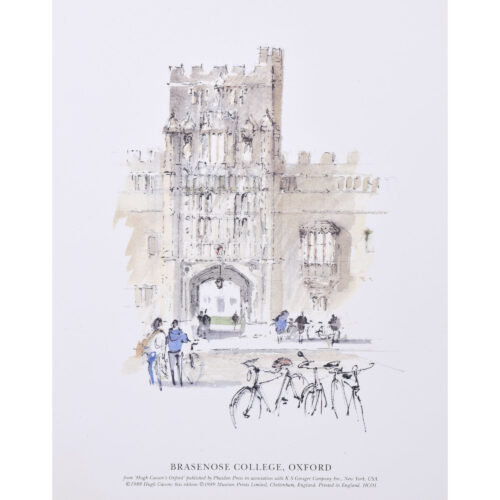
Hugh Casson (1910 - 1999)
Brasenose College, Oxford
Lithograph 30 x 24 cm Casson's view of Brasenose, complete with many a bicycle. Sir Hugh Casson was educated at Eastbourne College; St John’s College, Cambridge; and the Bartlett School of Architecture. Trained in the 1930s in the early modernist style, he taught at the Cambridge School of Architecture. After employment as a camoufleur during World War 2 by the Air Ministry, in 1948 he was appointed as director of architecture for the Festival of Britain. A close friend of the Royal Family, he undertook designs for the 1953 coronation, designed the interior of the Royal Yacht Britannia (“The overall idea was to give the impression of a country house at sea”), and taught the young Charles III to paint in watercolours. Amongst his architectural achievements are the Elephant House at London Zoo, the 1978 redevelopment of Bristol Docks, the Raised Faculty Building for The University of Cambridge, and a building for the Royal College of Art. He published a number of illustrated books, of which Casson’s Oxford and Casson’s Cambridge are probably the best known. A limited edition series of prints was produced from the paintings. Condition: very good; mounted to board. If you are interested, please email info@manningfineart.co.uk or call us on 07929 749056. Click here for other views of Brasenose College, Oxford. -

Hugh Casson (1910 - 1999)
St John's College, Oxford (1989)
Lithograph 30 x 24 cm Casson's charming view of Canterbury Quad, St John's College, Oxford. Sir Hugh Casson was educated at Eastbourne College; St John’s College, Cambridge; and the Bartlett School of Architecture. Trained in the 1930s in the early modernist style, he taught at the Cambridge School of Architecture. After employment as a camoufleur during World War 2 by the Air Ministry, in 1948 he was appointed as director of architecture for the Festival of Britain. A close friend of the Royal Family, he undertook designs for the 1953 coronation, designed the interior of the Royal Yacht Britannia (“The overall idea was to give the impression of a country house at sea”), and taught the young Charles III to paint in watercolours. Amongst his architectural achievements are the Elephant House at London Zoo, the 1978 redevelopment of Bristol Docks, the Raised Faculty Building for The University of Cambridge, and a building for the Royal College of Art. He published a number of illustrated books, of which Casson’s Oxford and Casson’s Cambridge are probably the best known. A limited edition series of prints was produced from the paintings. Condition: very good; mounted to board. If you are interested, please email info@manningfineart.co.uk or call us on 07929 749056. Click here for other views of St John’s College, Oxford. -
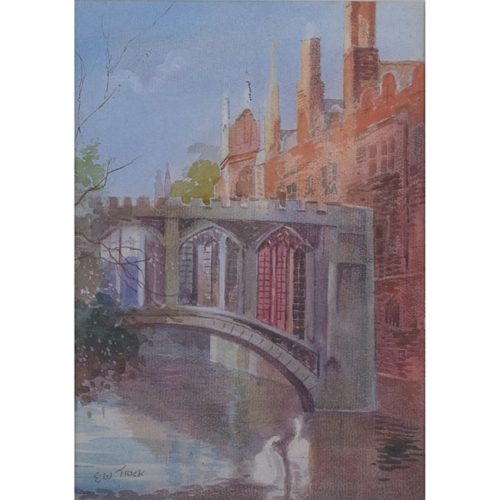
E W Trick
Bridge of Sighs, St. John's College, Cambridge
Watercolour 24x18cm If you are interested email info@manningfineart.co.uk or call us on 07929 749056. -

Robert Thomson (British, 20th Century) Trinity College Cambridge - Trinity Bridge over the River Cam with Punts
22 x 32 cm Watercolour Signed in pencil 'Thomson' to bottom right An old favourite view, painted in a bold and confident fashion by Robert Thomson, capturing the carefree spirit of an afternoon's punting, and the bold and clear architecture of Cambridge's biggest and wealthiest College. If you are interested email info@manningfineart.co.uk or call us on 07929 749056. Condition: Excellent. -
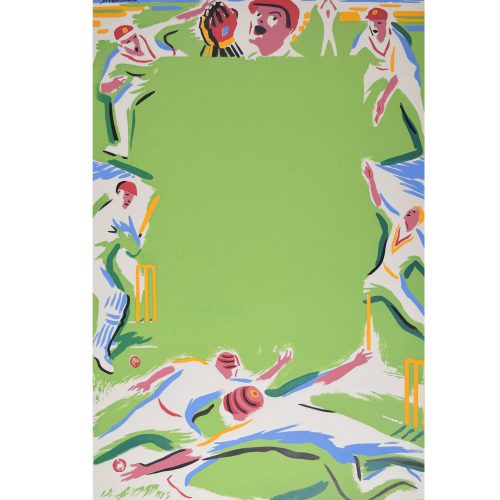
Percy Drake Brookshaw (1907-1993) Cricket
Original coach poster Lithograph c. 1950s 76x50cm A poster for advertising details of coaches to cricket matches such as The Ashes or other Test Matches. Brookshaw was born in Southwark, in London, and educated at the Central School of Arts and Crafts. He was a particularly accomplished lithographer, skilled also as a painter in both oil and watercolour. Identifying the former talent, F Gregory Brown - the poster and textile designer - encouraged him to become an illustrator and poster designer. Producing posters for London Transport and Shell, inter alia, between 1928 and 1958, many of his posters depict sporting events. His two posters for the annual University Boat Race are well known and highly sought after, and his wonderful posters often evoke a feeling of movement, whether rowers straining on their oars, or horses or greyhounds racing. If you are interested email info@manningfineart.co.uk or call us on 07929 749056. Conditon: Generally very good, a few short edge tears and soft creases, see photograph. -
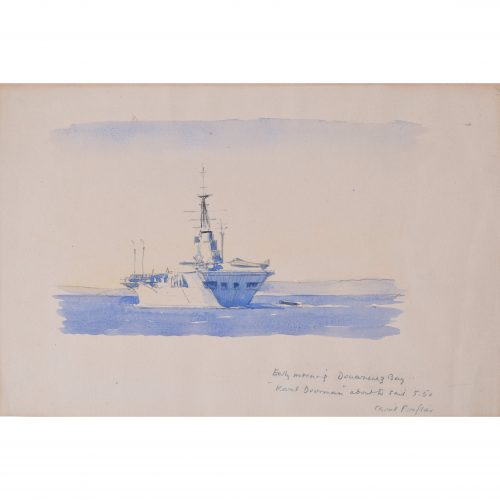
Laurence Dunn (1910-2006)
Karel Doorman About to Sail
Watercolour 15 x 23 cm (sheet size 99 x 73 cm) Signed to backing board, with extensive inscription by Dunn. HNLMS Karel Doorman (R81) was a Colossus-class aircraft carrier of the Royal Netherlands Navy. Formerly the British ship HMS Venerable, she was sold to the Netherlands in 1948 as a light attack carrier. In 1960, she was involved in the decolonization conflict in Western New Guinea with Indonesia. In the mid 1960s, her role was changed to anti-submarine warfare carrier and only ASW aircraft and helicopters were carried. An engine room fire took her out of service in 1968. She was sold to Argentina in 1969 and renamed ARA Veinticinco de Mayo. Laurence Dunn was an artist known for his depictions of ships. He grew up in Devon, where he practised drawing passing ships, and went on to study at the Central School of Art. He then worked for shipbuilding firm John I. Thornycroft & Company Limited, where he assisted with the design of the royal yacht.During the Second World War, Dunn worked for naval intelligence. In the early 1960s he created many line drawings of Atlantic ocean liners. The World Ship Society published the following obituary for Laurence Dunn in 2006: DUNN, Laurence. [December 15 2006 — Lloyds List] Many readers will be saddened by the death of well-known marine artist and writer Laurence Dunn in his 97th year. A man of encyclopaedic knowledge, he began his lifelong love of ships in Brixham, where he meticulously recorded passing traffic with the exquisitely accurate line drawings which later became something of a trademark. While studying at London’s Central School of Art his work was noticed by the Southern Railway, which commissioned profiles of its fleet, and this in turn led to work for Orient Line, where he also designed the well-known corn-coloured hull, and later Thorneycroft, where he helped with shaping draft plans for a new royal yacht. During the second world was he worked for naval intelligence at the Admiralty, where his technique did much to improve recognition standards, and greatly expanded his shipping clientele, becoming personally known to many chairmen. As well as the shipping press he worked for mainstream publications such as Everybody’s, Sphere and the upmarket comic Eagle. Through his many contacts he enjoyed going to sea in a great variety of ships from aircraft carriers to colliers. Laurence wrote several books, starting with ship recognition titles which introduced new standards of layout, but his best known work was probably Passenger Liners, which was widely taken up by the travel trade. His love of Greece, where he was an early publicist of island cruising, let to involvement in reshaping various passenger liners beginning with Greek Line’s OLYMPIA. In later life he designed several sets of shipping stamps for the Crown Agents, produced photographic volumes on Thames and Mediterranean shipping and still found time to enjoy the passing Thames traffic. Our sympathies go to his wife Jennifer, who provided succour to the many ship lovers who beat a path to the welcoming door of their Gravesend home. Condition: very good. If you'd like to know more, please email info@manningfineart.co.uk or call us on 07929 749056. -
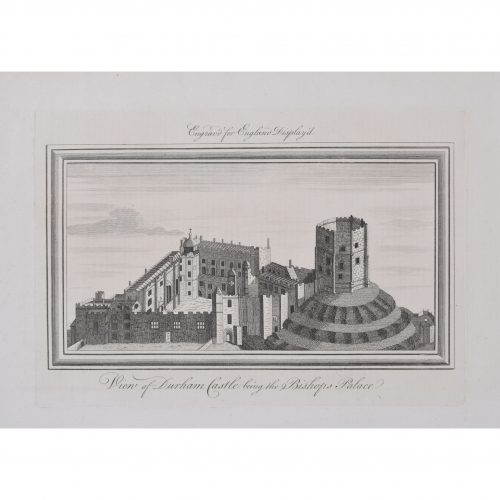
after Samuel Buck (1696 - 1779) and Nathaniel Buck (active 1724 - 1759)
View of Durham Castle being the Bishops Palace (1769)
Engraving 18 x 26 cm An engraved view of Durham Castle, complete with engraved frame in the plate. Empty of any inhabitants, the magnificence of the castle's architecture, is made all the more evident. This engraving was produced for 'England Displayed, published in London in 1769 or 1770 by Adlard and Brown; it was made after the original by Samuel and Nathaniel Buck, originally published in their 'Views of Ruins of Castles & Abbeys in England', created between 1726 and 1742. Durham Castle is a Norman castle in Durham, England, which has been occupied since 1837 by Castle - that is, University College, Durham. Previously, it was the residence of the Bishops of Durham; it stands on top of a hill above the River Wear on Durham's peninsula, opposite Durham Cathedral. Samuel and Nathaniel Buck were brothers and notable 18th century architectural artists, best known for their depictions of ancient castles and monasteries entitled 'Buck's Antiquities' and those of townscapes of England and Wales, ''Sea-Ports and Capital Towns''. LIttle is known about the brothers' lives. Samuel was born in Yorkshire and died in penury in London in 1779, and was buried in the churchyard of St Clement Danes. Nathaniel pre-deceased him, dying between 1759 and 1774. Condition: very good. If you’d like to know more, please email info@manningfineart.co.uk or call us on 07929 749056. -
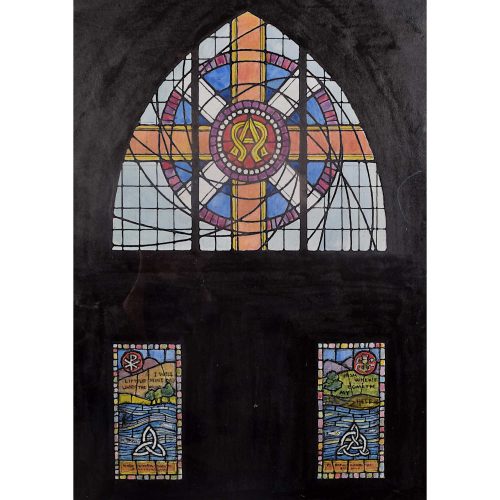
Jane Gray (b.1931)
St Andrew’s Church, Walton-on-Thames, Design for Stained Glass Window (1993)
Watercolour 28.5 x 20.5 cmSigned, dated and studio stamp verso.
St Andrew’s Church was built in 1931 but its story began some years earlier in 1928 when a group of Scots and those with Scottish roots, started meeting in the Walton Playhouse to worship under a retired Presbyterian Minister. Over time, funds were raised to build a proper church, the foundation stone laid in 1931, bearing the Presbyterian Church’s Latin motto, ‘Nec Tamen Consumebatur’ (and yet it was not consumed) from the Old Testament story of Moses and the Burning Bush. In 1972, alongside most Presbyterian Churches of England, St Andrew’s united with The Congregational Church of England and Wales to form, ‘The United Reformed Church’. This window features a red cross with St Andrew’s cross, along with the Alpha and Omega, and was installed in 1994.
Provenance: the artist’s studio sale. Literature: Jane Gray, Playing with Rainbows. (Shropshire: Ellingham Press, 2011), p.83. Condition: very good. If you are interested, please email info@manningfineart.co.uk or call us on 07929 749056. For other works by Jane Gray and more information about her, please click here. -
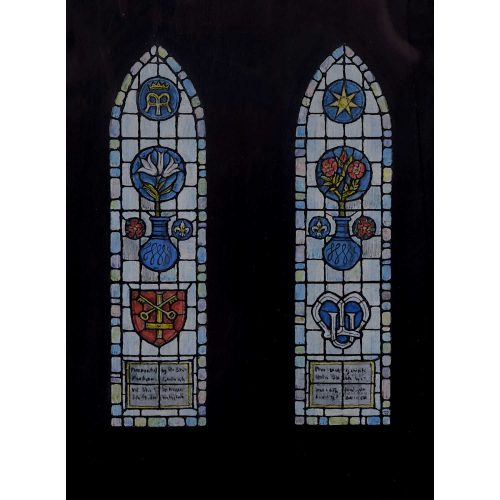
Jane Gray (b.1931)
St Peter’s Church, Chorley, Lancashire, Design for Stained Glass Window (1987)
Watercolour 18 x 13 cmSigned, dated and studio stamp verso.
St Peter’s Church was designed by the Liverpudlian architect, Charles Reed in the Early English style and built in 1850 with stone donated from Lady Hoghton’s nearby quarry. Reed wrote, ‘The general effect is expected to be very quaint and beautiful, while its elevated situation will make it a charming landmark from every side’. The church was consecrated on St Mark’s Day, 1851 by the first Bishop of Manchester, the Rt. Revd. James Prince Lee. This window was installed in 1988.
Provenance: the artist’s studio sale. Literature: Jane Gray, Playing with Rainbows. (Shropshire: Ellingham Press, 2011), p.79. Condition: very good. If you are interested, please email info@manningfineart.co.uk or call us on 07929 749056. For other works by Jane Gray and more information about her, please click here. -
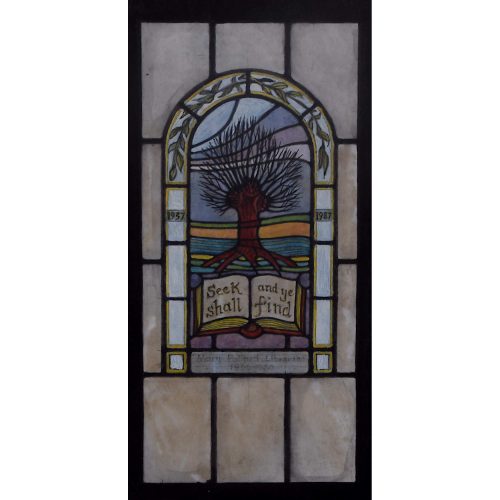
Jane Gray (b.1931)
Ruislip Library, Design for Stained Glass Window (1987)
Watercolour 18 x 8.5 cmSigned, dated and studio stamp verso.
In 1987, money was put aside for something to commemorate the Ruislip Library’s 50th anniversary; instead of another bench in a reading room, Gray received a commission for a stained glass window. This was the first window Gray made from her home in Shropshire and she used the nearby willow trees to inspire the wreath of willow leaves and central ‘Tree of Knowledge'—a pollarded willow. The choice of tree was highly intentional as, coincidentally, a librarian by the name Miss Pollard had also died that year.
Provenance: the artist’s studio sale. Literature: Jane Gray, Playing with Rainbows. (Shropshire: Ellingham Press, 2011), p.36. Condition: very good. If you are interested, please email info@manningfineart.co.uk or call us on 07929 749056. For other works by Jane Gray and more information about her, please click here. -
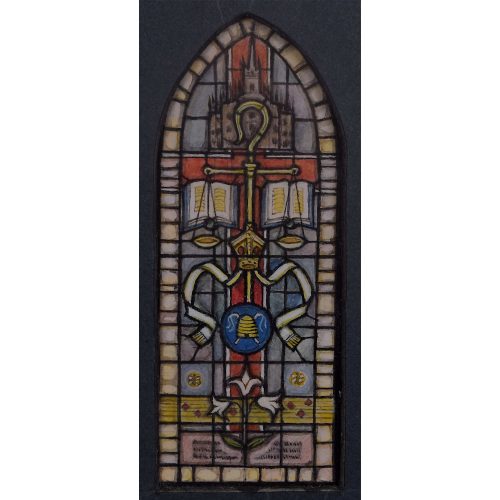
Jane Gray (b.1931)
St Ambrose Church, Leyland, Design for Stained Glass Window (1980)
Watercolour 11.5 x 4.5 cmStudio label verso.
The site of St Ambrose Church, Leyland, originally lay in the parish of St. Andrew’s Leyland; however, after a 37% population increase in the town caused by the coming of the railways and industrialisation in the 1870’s, the Vicar of St. Andrews decided to build a chapel of ease to St. Andrews. The church was rebuilt on the northern edge of the town in 1880. This window features symbols of St Ambrose and was installed in the church in 1982.
Provenance: the artist’s studio sale. Literature: Jane Gray, Playing with Rainbows. (Shropshire: Ellingham Press, 2011), p.76. Condition: very good. If you are interested, please email info@manningfineart.co.uk or call us on 07929 749056. For other works by Jane Gray and more information about her, please click here. -
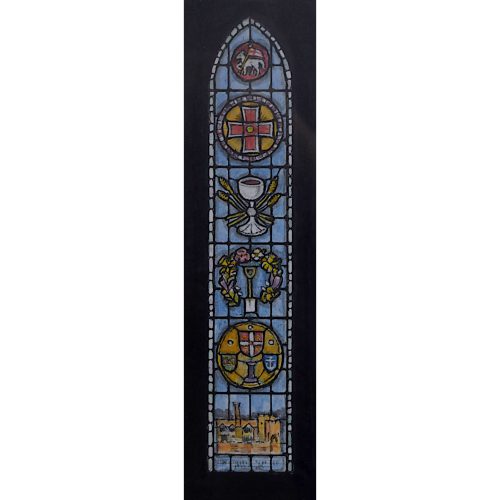
Jane Gray (b.1931)
St John the Baptist Church, Preen Manor, Design for Stained Glass Window (2003)
Watercolour 17.5 x 5 cmSigned, dated and studio stamp verso.
St John the Baptist Church sits at the heart of the Shropshire hamlet, Preen. Church Preen Manor sits adjacent to the church and lies on an old Clunjac Monastery, thought to have been built in 1159. The present church was built in the 13th century although it was originally a monastic church, founded as a cell of Wenlock Priory in 1163 and features in the Domesday Book. A prior and two or three monks would have served the church, however the priory has little remains, excepting a few visible in the gardens of Church Preen Manor.
Provenance: the artist’s studio sale. Literature: Jane Gray, Playing with Rainbows. (Shropshire: Ellingham Press, 2011), p.88. Condition: very good. If you are interested, please email info@manningfineart.co.uk or call us on 07929 749056. For other works by Jane Gray and more information about her, please click here. -
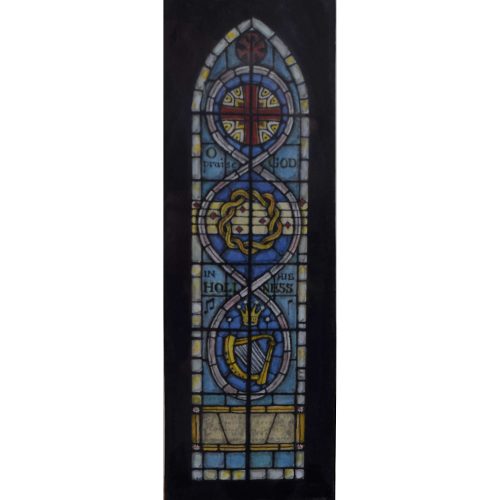
Jane Gray (b.1931)
All Saints Church, Lightwater, Surrey, Design for Stained Glass Window (1990)
Watercolour 18 x 6 cmSigned, dated and studio stamp verso.
All Saints Church in Lightwater, Surrey was built and dedicated in 1903. Prior to this, services were held in Florence Laundry in Guildford Road as, at that time, Lightwater was a small hamlet. With the development of nurseries and cottages to house the influx of workers that followed soon after, the Conventional District of All Saints’ was formed in 1931. Before this, All Saints Church had been a daughter church of Windlesham. A Priest-in-Charge was appointed shortly after the split in 1931 and a vestry extension was added to the building. This window commemorates the church’s organist, Catherine Challen, and features symbols associated with St Cecilia in acknowledgement of her musical contribution. The window was installed in 1991.
Provenance: the artist’s studio sale. Literature: Jane Gray, Playing with Rainbows. (Shropshire: Ellingham Press, 2011), p.79. Condition: very good. If you are interested, please email info@manningfineart.co.uk or call us on 07929 749056. For other works by Jane Gray and more information about her, please click here. -
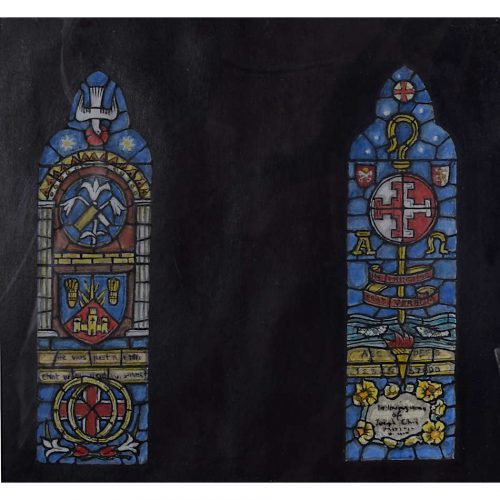
Jane Gray (b.1931)
St Catherine’s Church, Penrith, Cumbria, Design for Stained Glass Memorial Windows (1992)
Watercolour 16.5 x 15 cmSigned, dated and studio stamp verso.
St Catherine’s Church, Penrith is a Puginian Gothic town church, built by Fr George Haydock of Cottam and other Catholic notables in the early 19th century in the 14th century Gothic style. The church and its substantial presbytery, built in 1853, adjoin the churchyard of the Anglican parish church. This window was installed in 1992.
Provenance: the artist’s studio sale. Literature: Jane Gray, Playing with Rainbows. (Shropshire: Ellingham Press, 2011), p.82. Condition: very good. If you are interested, please email info@manningfineart.co.uk or call us on 07929 749056. For other works by Jane Gray and more information about her, please click here. -
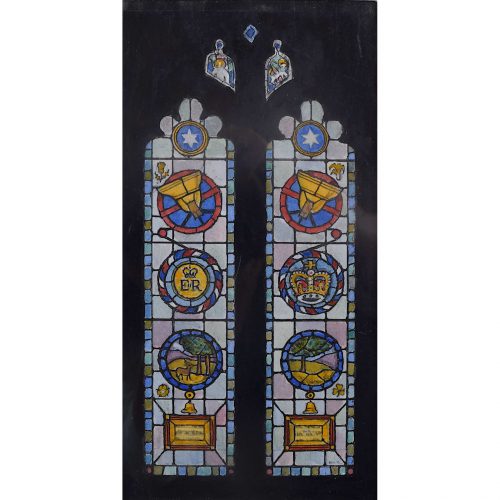
Jane Gray (b.1931)
St Giles Church, Bradford on Tone, Taunton, Somerset, Design for Stained Glass Window (2011)
Watercolour 21.5 x 11.5 cm Signed, dated and studio stamp verso.St Giles Church in Bradford on Tone lies nestled between the Blackdown and Quantock Hills and dates back from the 13th century. One of the lords of the manor, Sir John de Merit (d.1391), founded a chantry chapel here in 1387 but the church has undergone a series of renovations since. The present south aisle and most of the windows date to the 15th century, and the west tower to the early 16th century, before the church underwent full restoration works in 1867.
Provenance: the artist’s studio sale. Condition: very good. If you are interested, please email info@manningfineart.co.uk or call us on 07929 749056. For other works by Jane Gray and more information about her, please click here. -
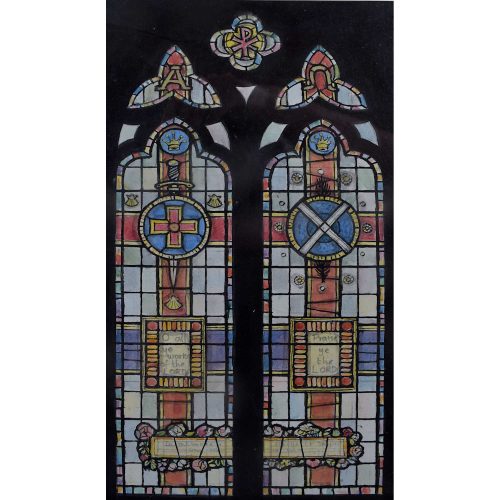
Jane Gray (b.1931)
St James’ Church, Weddington, Nuneaton, Warwickshire, Design for Stained Glass Memorial Window (1989)
Watercolour 19 x 10.5 cm Signed, dated and studio stamp verso.St James’ Church in Weddington dates back to the early-14th-century. The chancel, nave, and west tower were rebuilt in red brick in 1733, and the building was restored in 1881, when Gothic windows were inserted in place of the 1733 details. This design fantastically demonstrates Gray’s modernist style, with her colourful palette and simple yet detailed, geometrical structure. This window was installed in 1990.
Provenance: the artist’s studio sale. Literature: Jane Gray, Playing with Rainbows. (Shropshire: Ellingham Press, 2011), p.80. Condition: very good. If you are interested, please email info@manningfineart.co.uk or call us on 07929 749056. For other works by Jane Gray and more information about her, please click here. -
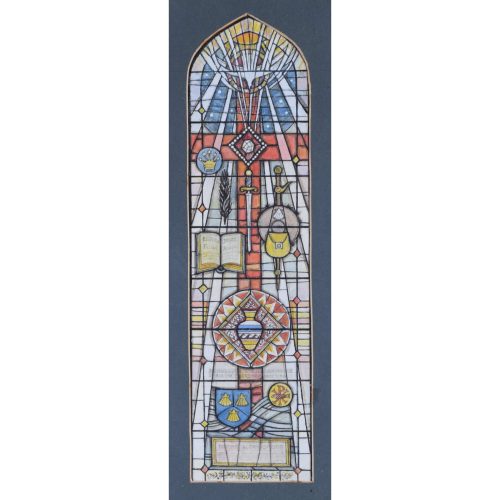
Jane Gray (b.1931)
St James, Temple Sowerby, Cumbria, Design for Stained Glass Window (1978)
Watercolour 30 x 12 cm Signed and dated verso.St James’ Church in Temple Sowerby, Cumbria was built in 1754, and enlarged in 1770, the west tower being added in 1807. In his 1831 work, A Topographical Dictionary of England, Samuel Lewis described the church as ‘a handsome structure of red freestone, with a square tower and portico’.
Provenance: the artist’s studio sale. Condition: very good. If you are interested, please email info@manningfineart.co.uk or call us on 07929 749056. For other works by Jane Gray and more information about her, please click here. -
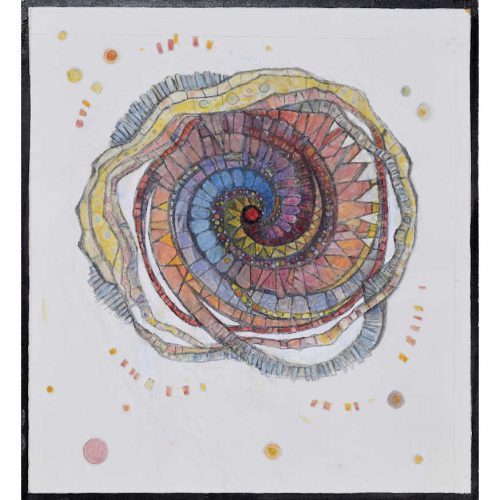
Jane Gray (b.1931)
Applique Stained Glass Window Design
Watercolour18 x 16 cm
Studio label versoIn this stained glass design, Gray uses the appliqué method to construct a highly colourful, abstract, swirling image, typical of many of her more modern works. Gray uses the same technique as in other works of hers where a sense of the transcendental is married with modern abstraction, the viewer’s gaze hypnotically pulled in to the central red dot.
Provenance: the artist’s studio sale. Condition: very good. If you are interested, please email info@manningfineart.co.uk or call us on 07929 749056. For other works by Jane Gray and more information about her, please click here. -
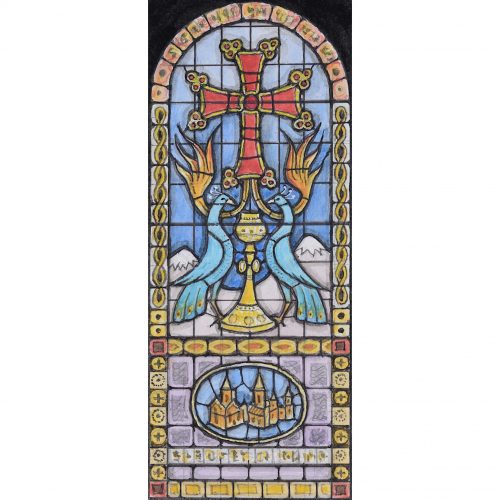
Jane Gray (b.1931)
Stained Glass Window Design for a Church
Watercolour15.5 x 6 cm
This design for a stained glass window draws together Gray’s modern yet traditional approach to designing church windows. The design features an oval external view of the church buildings beneath a pair of bright blue peacocks, two colourfully burning flames and a large red cross.
Provenance: the artist’s studio sale. Condition: very good. If you are interested, please email info@manningfineart.co.uk or call us on 07929 749056. For other works by Jane Gray and more information about her, please click here. -
Jane Gray (b.1931)
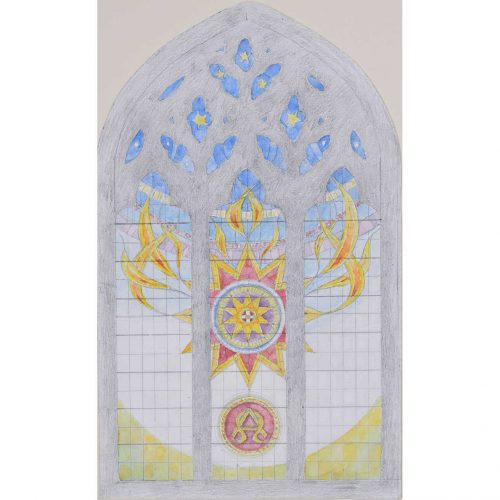
Design for Large Stained Glass Window in a Church
Watercolour and pencil33.5 x 20.5 cm
This design for a stained glass window draws together Gray’s modern yet traditional approach to designing church windows. The design features a central, inwardly repeating star shape with bright flame-like shapes curling upwards from its corners. This central motif sits against a blue sky background with smaller stars scattered in the smaller glass panes at the top of the design.
Provenance: the artist’s studio sale. Condition: very good. If you are interested, please email info@manningfineart.co.uk or call us on 07929 749056. For other works by Jane Gray and more information about her, please click here. -
Jane Gray (b.1931)
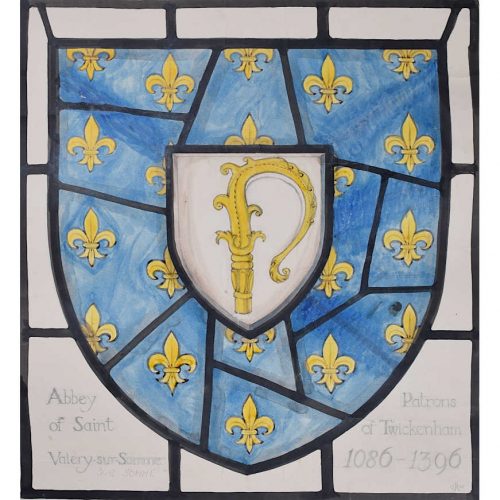
Stained Glass Window Design, St Mary’s Church, Twickenham (1960)
Watercolour41 x 37 cm
Signed and dated l.r.This stained glass window design is one of a handful Gray designed for her local church, St Mary’s Twickenham. St Mary’s Church stands on the site of an earlier church in Twickenham, a short distance from York House and the banks of the River Thames, and incorporates a 15th-century, medieval tower. St Mary's has an impressive and illustrious history of notable parishioners including the painter Godfrey Kneller who, after the collapse of the ancient church's 14th-century nave in 1714, took active involvement in redesigning the church in the Neo-classical style alongside local architect John James, as well as Henry Fielding and Alfred Lord Tennyson whose sons were both baptised here. Gray had a personal connection to St Mary’s, her great grandfather having been the vicar some years before. This design, in particular, commemorates the benedictine monastery at the mouth of the Somme River: the Abbey of Saint Valery-sur-Somme. The imagery focusses on the repeated motif of the heraldic and highly symbolic fleur-de-lis, set against a sky blue background, the central shield containing the head of an ornate, gilt shepherd’s crook; a religious symbol of care, particularly in difficult circumstances.
Provenance: the artist’s studio sale. Condition: very good. If you are interested, please email info@manningfineart.co.uk or call us on 07929 749056. For other works by Jane Gray and more information about her, please click here. -
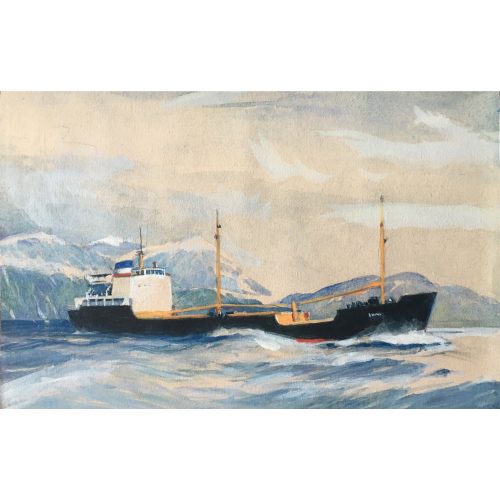
Laurence Dunn (1910-2006) Otra
Gouache 11.5x18cm Inscribed to reverse 'Rough sketch for painting of "Otra" commissioned for Capt. F.E. Eagle, whose favourite command she was' and signed 'Laurence Dunn' The World Ship Society published the following obituary for Dunn: DUNN, Laurence. [December 15 2006 — Lloyds List] Many readers will be saddened by the death of well-known marine artist and writer Laurence Dunn in his 97th year. A man of encyclopaedic knowledge, he began his lifelong love of ships in Brixham, where he meticulously recorded passing traffic with the exquisitely accurate line drawings which later became something of a trademark. While studying at London’s Central School of Art his work was noticed by the Southern Railway, which commissioned profiles of its fleet, and this in turn led to work for Orient Line, where he also designed the well-known corn-coloured hull, and later Thorneycroft, where he helped with shaping draft plans for a new royal yacht. During the second world was he worked for naval intelligence at the Admiralty, where his technique did much to improve recognition standards, and greatly expanded his shipping clientele, becoming personally known to many chairmen. As well as the shipping press he worked for mainstream publications such as Everybody’s, Sphere and the upmarket comic Eagle. Through his many contacts he enjoyed going to sea in a great variety of ships from aircraft carriers to colliers. Laurence wrote several books, starting with ship recognition titles which introduced new standards of layout, but his best known work was probably Passenger Liners, which was widely taken up by the travel trade. His love of Greece, where he was an early publicist of island cruising, let to involvement in reshaping various passenger liners beginning with Greek Line’s OLYMPIA. In later life he designed several sets of shipping stamps for the Crown Agents, produced photographic volumes on Thames and Mediterranean shipping and still found time to enjoy the passing Thames traffic. Our sympathies go to his wife Jennifer, who provided succour to the many ship lovers who beat a path to the welcoming door of their Gravesend home. If you are interested email info@manningfineart.co.uk or call us on 07929 749056. Condition: Excellent. -
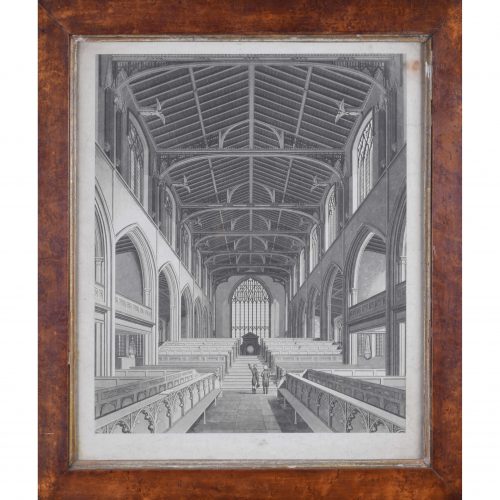
Chapel Interior (circa 1800)
Engraving 49 x 40 cm An engraving of a magnificent chapel interior. Two men tour the chapel, one gesticulating towards the spectacular design of the chancel window. Condition: good. Some gentle discolouration; in faux burr-maple frame. If you’d like to know more, please email info@manningfineart.co.uk or call us on 07929 749056.