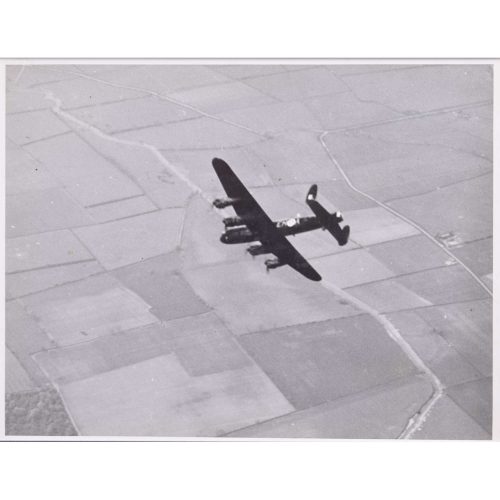
-
Out of stock
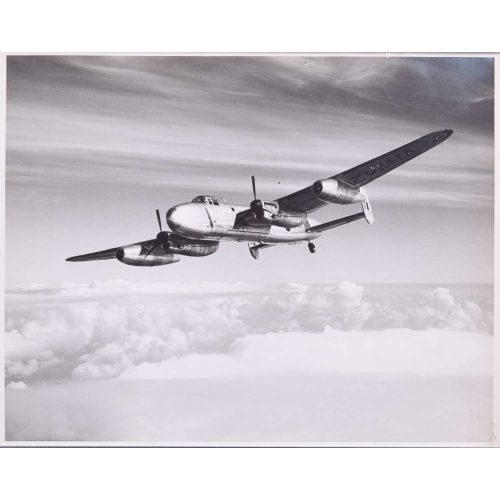
Charles E Brown (1896-1982)
Lancastrian VH742 - The first Jet Airliner
Original Silver Gelatin photograph, 1940s 19 x 24 cm Stamped to reverse 'Charles E Brown' with address and 6140-2 reference number, together with press release reading: "THE FIRST JET LINER "Captain R T Shepherd, Rolls Royce chief test pilot, demonstrating the remarkable performance of the 62,500 lb Avro LANCASTRIAN on the two NENE jets alone. With the two Merlins and their propellors stopped one is struck by the entire absence of visible moving parts. Even more noticeable is the reduced noise and complete lack of vibration." The Lancastrian was developed from the Lancaster bomber with armaments and armour removed, and a new - streamlined - nose. The first batch were made by converting Lancaster bombers, latter batches made from scratch. The Lancaster had been designed to carry bombs rather than passengers, and so the space available meant that whilst the Lancastrian was not suitable for large numbers of passengers it was admirably suited to carrying mail and other perishable goods.First to fly was Lancastrian VH742, delivered to the Rolls-Royce flight development airfield at Hucknall in October 1945. Its outer Merlin engines were removed and the nacelles were also taken away, while the fuel system was completely rebuilt to carry both gasoline for the inner engines and kerosine for the new jets. In the outer positions were added completely new nacelles housing Nene turbojets, then the most powerful jet engines in the world. It flew again on August 14, 1946 with two Merlins and two Nenes.
On September 19, 1946 this aircraft acted as the world's first jet airliner by making three passenger flights carrying representatives of the Press as well as Ministry officials and other passengers (who were all most impressed and suggested that an airline that could offer jet travel would be the talk of the world). Rolls-Royce also flew a second Nene-Lancastrian, VH737, and two Avon-Lancastrians, VM732 and VL970. The latter The first flight of a jet airliner was reported as follows:
"The Nene-Lanc, Flies to Paris "THE flight of the Nene Lancaster from London to Paris last Monday, to play its part in connection with the exhibition, may be said to have marked a historic part in British aircraft development, for it constituted the first time that any jet-powered airliner had flown from one country to another. Moreover, since this particular aircraft has been flying fairly regularly since round about the time of the Radlett exhibition, the flight to Paris was no special performance, but merely one more public demonstration of its inherent reliability. "In the hands of Capt. R. T. Shepherd, chief test pilot for Rolls-Royce, the “Nene-Lanc” landed at Le Bourget at 10.58 a.m., G.M.T., after a 50-minute flight from London Airport, giving an average speed of 247.5 m.p.h. [398.3 kilometers per hour] Two passengers were carried in addition to the crew; they were Mr. Roy Chadwick, the Avro designer, and Mr. R. B. William Thompson, Chief Information Officer of the Ministry of Supply. "Capt. Shepherd said that he was very pleased with the aircraft’s performance and added that, but for having to circle Le Bourget Airport Twice before landing, the flight would have been completed in 43 minutes." FLIGHT and AIRCRAFT ENGINEER, No. 1978. Vol. L., Thursday, November 21st, 1946 at Page 561, Column 2. Charles E Brown was a famous photographer of aircraft whose father was a butcher in Wimbledon, London. Young Charles was given a camera for his 14th birthday and in 1911 photographed an Edwardian gentleman in trouble landing his balloon in neighbouring Southfields. This photograph was published in the Daily Mirror – the fee being half a crown – and Brown was encouraged to join the Daily Mirror’s photography department upon leaving school at 16. Towards the end of the First World War he served with the Royal Air Force at their official London Photographic Centre. Following the war, he took to photographing trains, and captured a famous photograph of a Southern Railway locomotive that was used for the following ten years in railway posters. The income from this allowed him to pursue his passion of aviation photography in the 1920s and 1930s, from which commissions from the Air Ministry and Fleet Air Arm followed. During the war his work included commissions for Aeronautics magazine. Provenance: from the collection of Philip J R Moyes, author of many books on the RAF, most notably The Pictorial History which ran to several volumes. Condition: Generally very good. -
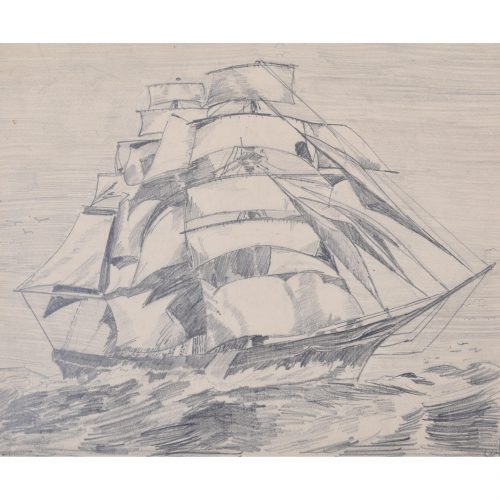
Gerald Mac Spink (flourished 1920 - 1940)
Sailing ship
Pencil 31 x 38 cm A stormy sea and the wind in her sails. Spink was a skilled artist, illustrator, and designer who produced a series of posters in the inter-war period for companies including the London Underground, Southern Railways, LNER, Hawker Engineering, and British Steel. He won a prize in 1933 from the Imperial Institute for his poster artwork. He also worked as an aeronautical engineer in Kingston-on-Thames for Hawker Engineering; his greatest achievement was the creation of the 'Squanderbug', a 500cc racing car which he built in 1947, and which races even to this day. Provenance: the artist's estate. Condition: generally very good. If you are interested, please email info@manningfineart.co.uk or call us on 07929 749056. Click here for other works by the artist. -
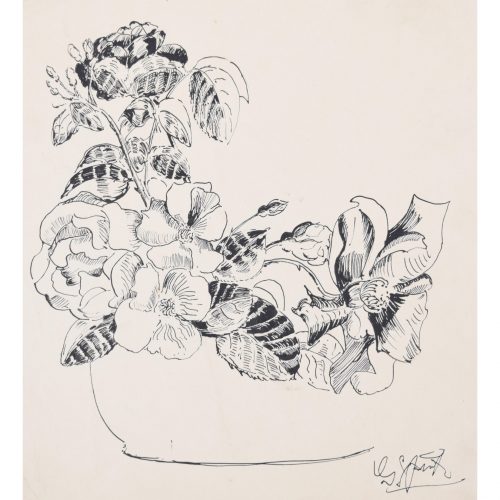
Gerald Mac Spink (flourished 1920 - 1940)
Flowers
Pen and ink 15 x 23 cm Signed 'G Spink' lower right. Spink was a skilled artist, illustrator, and designer who produced a series of posters in the inter-war period for companies including the London Underground, Southern Railways, LNER, Hawker Engineering, and British Steel. He won a prize in 1933 from the Imperial Institute for his poster artwork. He also worked as an aeronautical engineer in Kingston-on-Thames for Hawker Engineering; his greatest achievement was the creation of the 'Squanderbug', a 500cc racing car which he built in 1947, and which races even to this day. Provenance: the artist's estate. Condition: generally very good. If you are interested, please email info@manningfineart.co.uk or call us on 07929 749056. Click here for other works by the artist. -
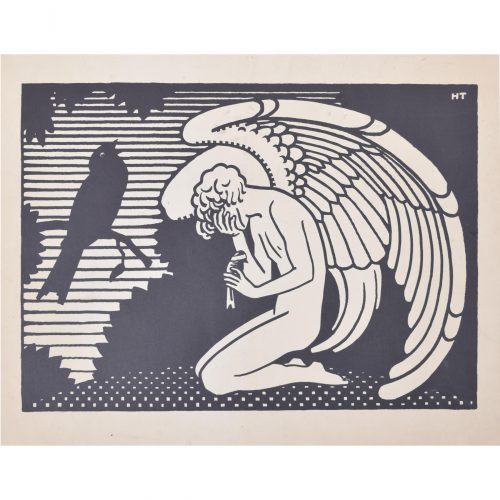
"HT"
Raven and Angel
Block print 28 x 41 cm Signed 'HT' upper right in the plate. A monochrome print of an angel holding a bird - usually a symbol of peace or prophecy. The birds here are black, however, rather than the more typical white dove, and the bird held by the weeping angel seems to be injured. Condition: generally very good; vertical crease to centre; even overall slight toning to paper. If you are interested, please email info@manningfineart.co.uk or call us on 07929 749056. -
Out of stock
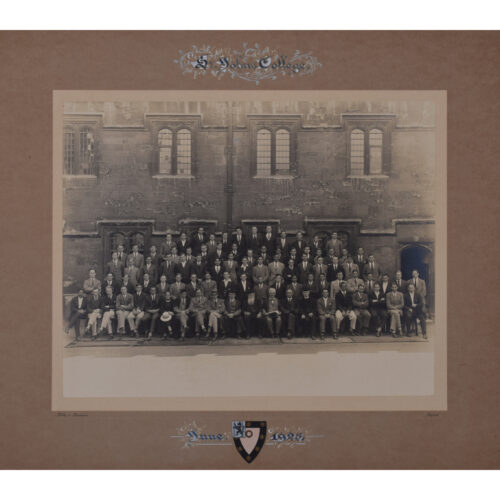
Hills and Saunders
St John's College, Oxford (1925)
Silver gelatin photograph with extensive hand-decoration of mount 43 x 49 cm A photograph taken of St John's College students and tutors in 1925. Hills & Saunders was one of the leading Victorian social photography firms. Robert Hills and Henry Saunders started the firm together in 1860 and had studios in Oxford, Cambridge, and London during the course of their partnership, as well as near certain army bases and public schools. They were given a Royal Warrant in 1867. Condition: generally very good. If you are interested, please email info@manningfineart.co.uk or call us on 07929 749056. Click here for more St John's pictures. -
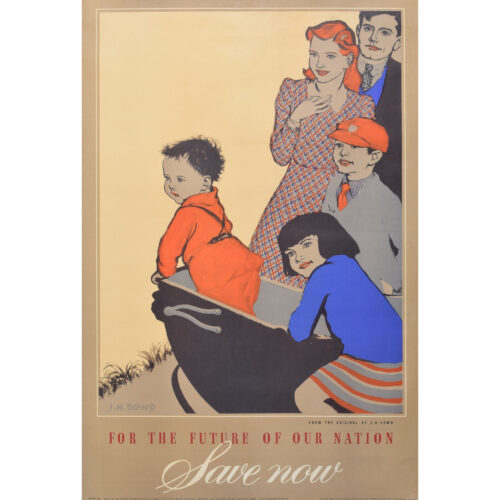
For the Future of our Nation - Save Now
Original vintage poster 73 x 49 cm Issued by the National Savings Committee, London, the Scottish Savings Committee, Edinburgh, and the Ulster Savings Committee, Belfast. An original vintage WW2 poster encouraging Britons to save via the National Savings scheme; by saving, the couple in the picture can ensure a good future for their three children. James Henry Dowd was born in 1884. He worked as a draughtsman, etcher and painter. Dowd was a regular contributor to the The Daily Graphic and in 1906 began to have his work published in Punch Magazine. Condition: generally very good. Not backed. If you are interested, please email info@manningfineart.co.uk or call us on 07929 749056. Click here for other original vintage National Savings posters. -

Savings Are Like the Best Books
Original vintage poster 38 x 26 cm Issued by the National Savings Committee, London. Printed for HM Stationery Office by James Haworth & Brother Ltd., London. Peter Pan, Alice in Wonderland, The Bible - just a selection of the great works of English literature gracing the shelf on the poster. Another book which should be regarded as one of their number is the small National Savings stamp book depicted below - just like the best literature, much improvement might be found within its pages. Condition: very good; pinholes in each top corner. If you are interested, please email info@manningfineart.co.uk or call us on 07929 749056. Click here for other original vintage National Savings posters. -

John Chaplain
Venetian View of Santa Maria della Salute
Etching and aquatint 14 x 18 cm Signed in bottom left and right hand corners. View of Santa Maria della Salute from Riva degli Schiavani with the statue of King Emmanuel II, created c.1920. Condition: Generally very good, some age toning but only to margins. -

George Bissill (1896-1973) View of the village church
Pencil sketch 13 x 18 cm Born in 1896, George Bissill was a British miner, painter and furniture designer. Raised in the mining village of Langley Mill, Derbyshire, Bissill became a miner at the age of 13, before leaving to join the war effort in 1915. Upon his return from the war after being gassed, Bissill chose to become a pavement artist outside the newly erected Bush House in Aldwych, painting from his memory and his sketch book the uncompromising underground world he had inhabited. In 1935 he moved to the countryside near Newbury, where he lived and worked as a landscape painter, art restorer and dealer until his death in 1973. This painting forms part of a larger collection, 'unseen since they were taken from George Bissil's studio in 1983' and restored by Kate Pattinson. A series of planned exhibitions were cancelled due to Covid, but two shows, one in Oxford and one in Ilkeston, did take place. Through such exhibitions, Pattinson hoped to 'restore the reputation of an artist who, through mighty endeavour, conquered the art world in the 1920s with his powerful, authentic and experimental pictures.' Bissill's paintings are also held in a number of important public collections, including the Tate Gallery, National Museum of Ireland and the Manchester Art Gallery. This pencil sketch depicts a bucolic view of a village. The village church is depicted in the background, with a canal and lock gate in the foreground. This pared-back sketch offers an intriguing insight into Bissill's working process, as the flurry of sketched lines suggest his frenzied efforts to capture this conversely quiet moment of village life. Condition: Generally very good, slight age toning to paper and fold down centreIf you would like to know more, please email info@manningfineart.co.uk or call us on 07929 749056.
-

George Bissill (1896-1973) Landscape view
Pencil sketch 13 x 18 cm Born in 1896, George Bissill was a British miner, painter and furniture designer. Raised in the mining village of Langley Mill, Derbyshire, Bissill became a miner at the age of 13, before leaving to join the war effort in 1915. Upon his return from the war after being gassed, Bissill chose to become a pavement artist outside the newly erected Bush House in Aldwych, painting from his memory and his sketch book the uncompromising underground world he had inhabited. In 1935 he moved to the countryside near Newbury, where he lived and worked as a landscape painter, art restorer and dealer until his death in 1973. This painting forms part of a larger collection, 'unseen since they were taken from George Bissil's studio in 1983' and restored by Kate Pattinson. A series of planned exhibitions were cancelled due to Covid, but two shows, one in Oxford and one in Ilkeston, did take place. Through such exhibitions, Pattinson hoped to 'restore the reputation of an artist who, through mighty endeavour, conquered the art world in the 1920s with his powerful, authentic and experimental pictures.' Bissill's paintings are also held in a number of important public collections, including the Tate Gallery, National Museum of Ireland and the Manchester Art Gallery. This pencil sketch depicts a bucolic view of an English landscape. Although minimalistic in style, Bissill incorporates subtle details, such as a man at work in what appears to be a small stream adjacent to the farm house. Condition: Generally very good.If you would like to know more, please email info@manningfineart.co.uk or call us on 07929 749056.
-

George Bissill (1896-1973) Landscape view with barn and church, Devon
Pencil sketch 25 x 35 cm Born in 1896, George Bissill was a British miner, painter and furniture designer. Raised in the mining village of Langley Mill, Derbyshire, Bissill became a miner at the age of 13, before leaving to join the war effort in 1915. Upon his return from the war after being gassed, Bissill chose to become a pavement artist outside the newly erected Bush House in Aldwych, painting from his memory and his sketch book the uncompromising underground world he had inhabited. In 1935 he moved to the countryside near Newbury, where he lived and worked as a landscape painter, art restorer and dealer until his death in 1973. This painting forms part of a larger collection, 'unseen since they were taken from George Bissil's studio in 1983' and restored by Kate Pattinson. A series of planned exhibitions were cancelled due to Covid, but two shows, one in Oxford and one in Ilkeston, did take place. Through such exhibitions, Pattinson hoped to 'restore the reputation of an artist who, through mighty endeavour, conquered the art world in the 1920s with his powerful, authentic and experimental pictures.' Bissill's paintings are also held in a number of important public collections, including the Tate Gallery, National Museum of Ireland and the Manchester Art Gallery. This pencil sketch depicts a bucolic view of a north Devonshire landscape. In amongst the rolling hills of Devon, traces of rural life are discernible, with a small barn depicted nestled into the hillside. This sketch stands out from his other sketched works as a preliminary study for an oil painting, evidenced by Bissill's labelling of the fields in the background. The sketch offers therefore a unique insight into Bissill's artistic practice. Condition: Generally very good.If you would like to know more, please email info@manningfineart.co.uk or call us on 07929 749056.
-

George Bissill (1896-1973) Study for oil painting- Coombe, Hampshire
Pencil sketch 25 x 31 cm Born in 1896, George Bissill was a British miner, painter and furniture designer. Raised in the mining village of Langley Mill, Derbyshire, Bissill became a miner at the age of 13, before leaving to join the war effort in 1915. Upon his return from the war after being gassed, Bissill chose to become a pavement artist outside the newly erected Bush House in Aldwych, painting from his memory and his sketch book the uncompromising underground world he had inhabited. In 1935 he moved to the countryside near Newbury, where he lived and worked as a landscape painter, art restorer and dealer until his death in 1973. This sketch forms part of a larger collection, 'unseen since they were taken from George Bissil's studio in 1983' and restored by Kate Pattinson. A series of planned exhibitions were cancelled due to Covid, but two shows, one in Oxford and one in Ilkeston, did take place. Through such exhibitions, Pattinson hoped to 'restore the reputation of an artist who, through mighty endeavour, conquered the art world in the 1920s with his powerful, authentic and experimental pictures.' Bissill's paintings are also held in a number of important public collections, including the Tate Gallery, National Museum of Ireland and the Manchester Art Gallery. This pencil sketch depicts a view of a farmhouse, nestled at the foot of some rolling Hampshire hills. Bissill's scrawling writing in the bottom right of the sketch reveal it to be a study for a later oil painting, providing a unique insight into his artistic practices. -

Brenda Cripps Oxford Spires
Lithograph 20 x 29 cm Titled, signed and dated to lower right hand corner. This lithograph depicts a view over the Oxford skyline. The Old Tom Tower of Christchurch, the Radcliffe Camera, the Church of St Mary the Virgin, and the Sheldonian Theatre tower over the canopy of luscious trees and stand out against the blue summer sky. Condition: Generally very good.If you would like to know more, please email info@manningfineart.co.uk or call us on 07929 749056.
-

John Cowey (1786-1833) Christ Church Cathedral, Oxford, 1816, from the Dean's gardens
Engraving 23 x 32 cm Condition: generally very good, slight age toning to paper.If you would like to know more, please email info@manningfineart.co.uk or call us on 07929 749056.
-
 Mabel Oliver Rae (1868-1956) Tom Tower, Oxford c.1920 Etching 12 x 9 cm Signed in pencil below. Mabel Oliver Rae was born in Cambridge, Cambridgeshire, and trained at the Slade School of Fine Art between 1888 and 1890. Rae is known for her skilled etchings of various rural scenes and townscapes, particularly those of the colleges of Oxford and Cambridge. She signed works with the pseudonym 'M.Oliver Rae', a ruse to conceal the fact she was a female artist, so as not to reduce her chances with commercial dealers and agents. This particular etching depicts a lovely view of Merton Tower, Oxford. Condition: Generally very good.
If you would like to know more, please email info@manningfineart.co.uk or call us on 07929 749056.
-

Mabel Oliver Rae (1868-1956) Clare Bridge, Cambridge
c.1920 Etching 13 x 17 cm Signed in pencil below. Mabel Oliver Rae was born in Cambridge, Cambridgeshire, and trained at the Slade School of Fine Art between 1888 and 1890. Rae is known for her skilled etchings of various rural scenes and townscapes, particularly those of the colleges of Oxford and Cambridge. She signed works with the pseudonym 'M.Oliver Rae', a ruse to conceal the fact she was a female artist, so as not to reduce her chances with commercial dealers and agents. This particular etching depicts a lovely view of Clare Bridge, Cambridge. Rae expertly captures the reflections of the bridge's arcs and the shadows of the trees on the water surface. In the foreground of the etching, a punter enjoys the tranquil scene and the work is consequently imbued by the atmosphere of a warm summer's day. Condition: generally very good, slight age toning to paper.If you would like to know more, please email info@manningfineart.co.uk or call us on 07929 749056.
For other views of Clare College, Cambridge, please click here. -
Out of stock

Mabel Oliver Rae (1868-1956) Keble College, Oxford
c.1920 Etching 14 x 18 cm Signed in pencil below. Mabel Oliver Rae was born in Cambridge, Cambridgeshire, and trained at the Slade School of Fine Art between 1888 and 1890. Rae is known for her skilled etchings of various rural scenes and townscapes, particularly those of the colleges of Oxford and Cambridge. She signed works with the pseudonym 'M.Oliver Rae', a ruse to conceal the fact she was a female artist, so as not to reduce her chances with commercial dealers and agents. This particular etching depicts a lovely view of Keble College, Oxford. Condition: Generally very good, mounted to board, residual glue to margins under the mount.If you would like to know more, please email info@manningfineart.co.uk or call us on 07929 749056.
-

Richard Dighton (1795-1880) A View from Brazen Nose College (1808)
Hand coloured engraving 28 x 22 cm Richard Dighton (1795–1880) was a prominent English artist and caricaturist, best known for his elegant profile portraits of early 19th-century society figures. The son of caricaturist Robert Dighton, he developed a distinctive style that balanced satire with sophistication, moving away from the exaggerated grotesquery of earlier caricatures. His finely drawn etchings and later lithographs and watercolours captured the refined yet often pompous airs of Regency London’s fashionable elite—politicians, lawyers, military men, and dandies alike. With clean lines, elongated forms, and a sharp eye for personality, Dighton’s work offers a witty yet insightful glimpse into the characters of his time. His legacy lived on through his sons, who continued in the family’s artistic tradition. This hand-coloured engraving portrays a rotund academic in full scholarly robes, captured in Dighton’s signature profile style. With a stern expression, powdered wig, and traditional cap, the figure stands in a dignified pose, one hand placed on his chest. The simple background and muted tones draw attention to the character’s form and posture, blending gentle satire with respectful observation of academic life. Condition: Generally very good.If you would like to know more, please email info@manningfineart.co.uk or call us on 07929 749056.
-

Richard Dighton (1795-1880) A View from Merton College (1808)
Hand coloured engraving 28 x 22 cm Richard Dighton (1795–1880) was a prominent English artist and caricaturist, best known for his elegant profile portraits of early 19th-century society figures. The son of caricaturist Robert Dighton, he developed a distinctive style that balanced satire with sophistication, moving away from the exaggerated grotesquery of earlier caricatures. His finely drawn etchings and later lithographs and watercolours captured the refined yet often pompous airs of Regency London’s fashionable elite—politicians, lawyers, military men, and dandies alike. With clean lines, elongated forms, and a sharp eye for personality, Dighton’s work offers a witty yet insightful glimpse into the characters of his time. His legacy lived on through his sons, who continued in the family’s artistic tradition. This engraving captures the quirky elegance of an Oxford academic in Dighton’s signature caricature style. The tall, gaunt figure is shown in profile, dressed in flowing academic robes and a square cap, with exaggerated features and a solemn, slightly comic expression. Set against a minimal background, the figure stands out as a gently satirical yet respectful portrait of university life in the early 19th century. Condition: Generally very good.If you would like to know more, please email info@manningfineart.co.uk or call us on 07929 749056.
-

Richard Dighton (1795-1880) A View from St John's College (1809)
Hand coloured engraving 28 x 22 cm Richard Dighton (1795–1880) was a prominent English artist and caricaturist, best known for his elegant profile portraits of early 19th-century society figures. The son of caricaturist Robert Dighton, he developed a distinctive style that balanced satire with sophistication, moving away from the exaggerated grotesquery of earlier caricatures. His finely drawn etchings and later lithographs and watercolours captured the refined yet often pompous airs of Regency London’s fashionable elite—politicians, lawyers, military men, and dandies alike. With clean lines, elongated forms, and a sharp eye for personality, Dighton’s work offers a witty yet insightful glimpse into the characters of his time. His legacy lived on through his sons, who continued in the family’s artistic tradition. This hand-coloured engraving is a quintessential example of Dighton's signature style—capturing character through exaggerated yet elegant profile. The figure, likely an academic or clergyman, is portrayed in full stride, dressed in a long, dark academic gown, white stockings, and buckled shoes. Dighton masterfully exaggerates the man's posture and expression, giving a sense of motion, personality, and perhaps even a touch of comic solemnity as he emphasises the man's eccentric presence and stylised mannerisms. The fine line work and subtle water colour washes blur the line, however, between caricature and portraiture, making this not just a humorous rendering, but also a social observation of Cambridge life in the early 19th century. -

M R Webb Abstract Form
21 x 26 cm Signed to lower right Provenance: Family of A. E. Halliwell Little is known about M R Webb beyond the fact that he studied under A E Halliwell, though the fact that Halliwell collected this painting suggests that he thought highly of his student. This abstract composition provides few clues as to what exactly it is depicting... Is it an Underground roundel? Perhaps some kind of animal, a cockerel maybe? Webb leaves it to his viewer to decide. In any case, the colours and swirling forms offer a sense of motion and excitement in this dynamic piece. Condition: Generally very good.If you would like to know more, please email info@manningfineart.co.uk or call us on 07929 749056.
-

J. C. Kim Rainbow Prism
20 x 25 cm 1946 Provenance: Family of A. E. Halliwell Little is known about J. C. Kim beyond the fact that he studied under A E Halliwell, though the fact that Halliwell collected this painting suggests that he thought highly of his student. Calling to mind Pink Floyd's later iconic album cover, this painting features a prism refracting white starlight into a multicolour rainbow of light. The contrast between the monochrome black, grey and white palette and the shock of rainbow colour is striking, leaving a striking impression on the viewer. Condition: Generally very goodIf you would like to know more, please email info@manningfineart.co.uk or call us on 07929 749056.
-
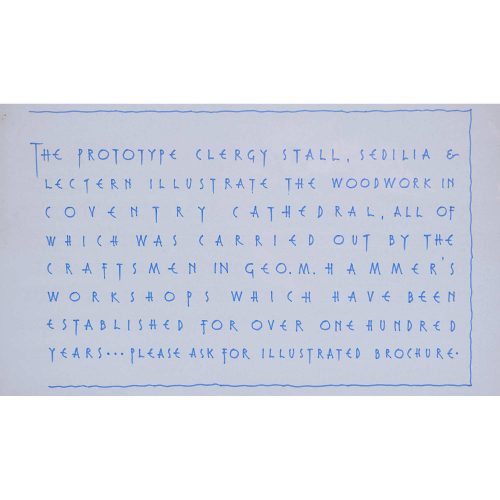
D L Hadden
Calligraphy for George M Hammer Coventry Cathedral Fittings
Pen and ink 20x35cm c. 1950 Hadden was a senior designer for Geo M Hammer, designers and retailers of school and ecclesiastical furniture. Their lift-top school desks are particularly well regarded, and always carried their brass name plate. Hammer were renowned for their interior woodwork, they were commissioned to undertake the choir stalls in Sir Basil Spence’s ground-breaking Coventry Cathedral. Dick Russell (brother of Gordon Russell and who worked for his brother before World War Two) famously designed the chairs to be used by the congregation; as all-wood stacking chairs they were innovative at the time. As senior designer, Hadden was at the heart of the Coventry project. Coventry's great place in the world of calligraphy comes from the Ralph Beyer typeface (or font) which surely has had an influence on Hadden's calligraphy here - see our matching card that refers to London Churches. For biographical details and other works by the artist click here. If you are interested email info@manningfineart.co.uk or call us on 07929 749056. -
Out of stock
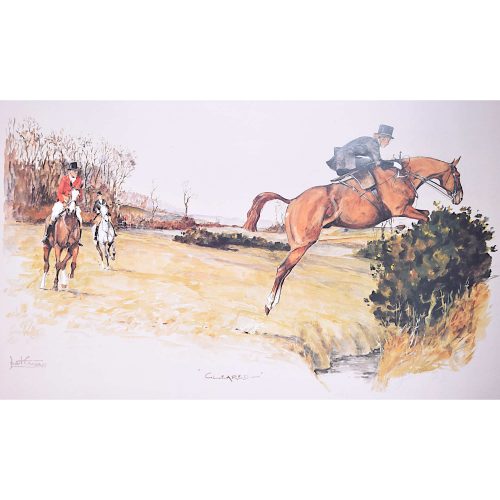
Daniel Crane (b. 1969) 'Cleared'
Limited edition print Signed in pencil and numbered 168/250 40x60cm One of the UK's leading sporting artists, Crane was born in Norfolk and is the youngest son of a hunting family. He grew up with a love of animals, the countryside and fieldsports, acquiring a particular passion for fox hunting in his late teens. He has been whipper-in, Master and Field Master and therefore understands the whole hunting process, allowing his paintings to reflect his knowledge and love of the sport. He is artist in residence for the Household Cavalry, and has many prestigious commissions to his name including Frankel - the greatest racehorse of all time - and Valegro the World and Olympic Champion. In this print, Crane captures the thrill and exhilaration that comes from clearing a hedge in fine style. If you are interested email info@manningfineart.co.uk or call us on 07929 749056. Condition: Never previously framed and in excellent condition. -
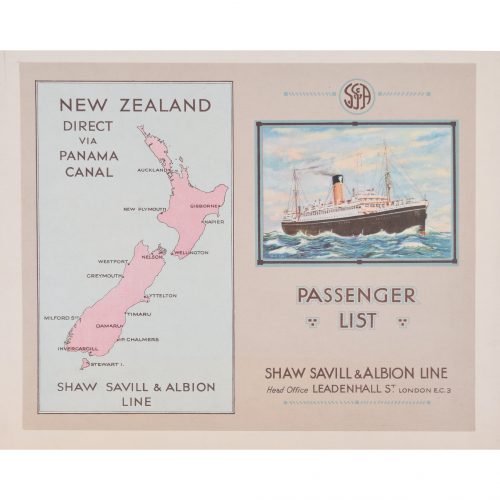
A E Agar (artist) Original passenger list brochure for Shaw Savill Albion Line, c. 1940s or 1950s.
24x34cm (approx) Provenance: the artist's estate As new, unissued printer's proof. Could be trimmed to the brochure size if desired. Fine image of ocean liner to front cover, map - via Panama Canal - to back cover. From the great age of Ocean Liners. If you are interested email info@manningfineart.co.uk or call us on 07929 749056. Condition: Excellent. -
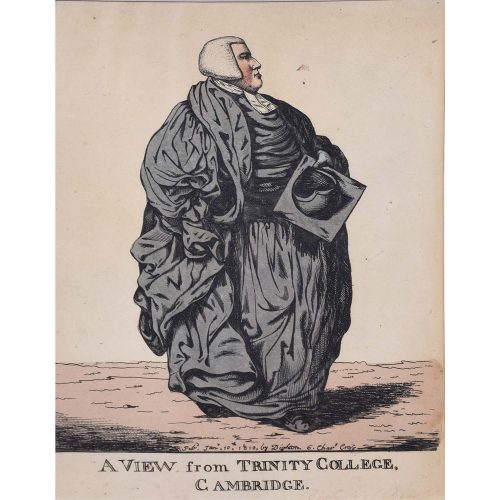
Robert Dighton A View from Trinity College, Cambridge
27x20cm Etching A caricature portrait of William Lort Mansel (1753-1820), Master of Trinity College, Cambridge and later the Bishop of Bristol. If you are interested email info@manningfineart.co.uk or call us on 07929 749056. Condition: Good. -
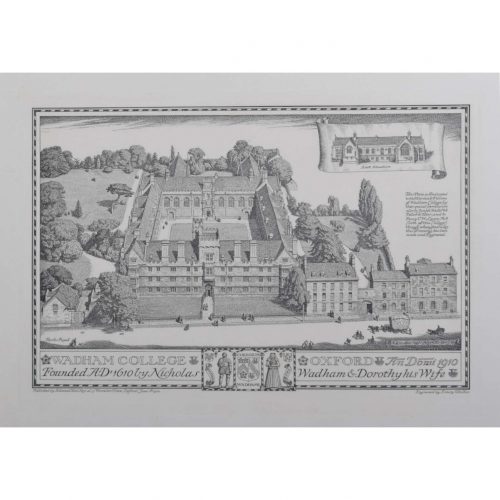
Emery Walker (1851 - 1933) after Edmund Hort New (1871 - 1931)
Wadham College, Oxford
Photogravure 27 x 41 cm New produced a series of pen-and-ink drawings of Oxford colleges, of which this is one. They paid homage to the artist David Loggan, often using the same aerial viewpoint as him, but showing the colleges two hundred years later. Emery Walker turned New's drawings into photoengravings in the early 20th century. Probably no more than two hundred prints of each engraving were produced, and the plates were destroyed in the blitz. Edmund Hort New was an English artist. He was a member of the Birmingham Group of Arts and Crafts-associated painters and craftsmen, and is known as a leading illustrator of his period. He specialised in pen and ink drawings of rural and urban landscapes, old buildings and their interiors, architectural features, and also designed bookplates. He provided illustrations for the English Illustrated Magazine and was commissioned by Bodley Head publishers to illustrate critically acclaimed editions of books, such as Walton's The Compleat Angler. In 1895, New met William Morris and began designing for the Kelmscott Press. He also taught drawing to T E Lawrence. In 1905, he began his drawings of the Oxford colleges, and spent the rest of his life working on the (sadly unfinished) project. In 1921 he exhibited at the first exhibition of the Society of Graphic Art. Sir Emery Walker FSA was an English engraver, photographer, and printer. He was very involved with the Arts and Crafts movement, a Master of the Art Workers' Guild, President of the Arts and Crafts Exhibition Society, a Trustee of the Wallace Collection, and a Fellow of the Society of Antiquaries. He was also a close friend of William Morris. Walker's expertise and his collection of 16th-century typefaces inspired Morris to create the Kelmscott Press. In 1910, Walker photographed the notable Rice portrait of Jane Austen. He was knighted in 1930. Condition: very good; modern printing. If you’d like to know more, please email info@manningfineart.co.uk or call us on 07929 749056. Click here for other views of Wadham. -
Brownbridge (flourished 1930s - 1940s)
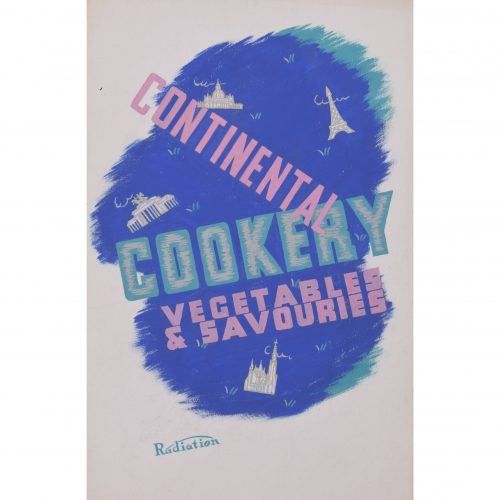
Continental Cookery Radiation cooker brochure design
Gouache 21.5 x 14 cm From a small archive of works by Brownbridge, a member of the Society of Industrial Artists. A beautiful original gouache design for a brochure of continental recipes, created to advertise Radiation cookers (innovative gas cookers which were sold in Britain in the 1920s and 1930s). Brownbridge's brightly-coloured design includes boldly slanted text in pink and turquoise, set over a deep blue background; he also highlights architectural gems of Europe, such as the Eiffel Tower. By cooking with a Radiation cooker, the cover suggests, you too can experience the cultural and culinary delights of Europe from the comfort of your own home. Society of Industrial Artists correspondance (photographed above) is not included; please enquire separately. Condition: generally very good. If you are interested, please email info@manningfineart.co.uk or call us on 07929 749056. Click here for other designs by Brownbridge. -
Jane Gray (b.1931)
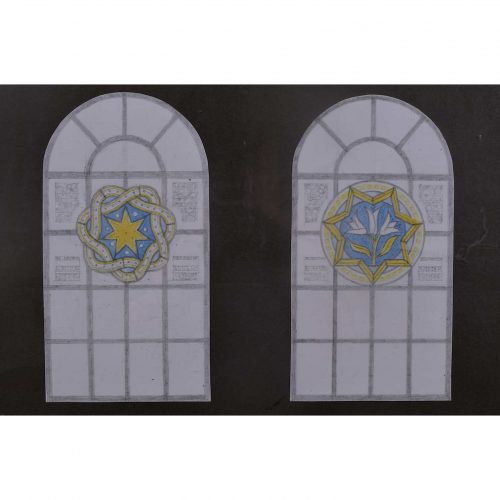
St Mary’s Church, Twickenham, Middlesex, Design for Stained Glass Memorial Windows (1988)
Watercolour 15.5 x 17 cmSigned, dated and studio stamp verso.
St Mary’s Church stands on the site of an earlier church in Twickenham, a short distance from York House and the banks of the River Thames, and incorporates a 15th-century, medieval tower. St Mary's has an impressive and illustrious history of notable parishioners including the painter Godfrey Kneller who, after the collapse of the ancient church's 14th-century nave in 1714, took active involvement in redesigning the church in the Neo-classical style alongside local architect John James, as well as Henry Fielding and Alfred Lord Tennyson whose sons were both baptised here. Gray had a personal connection to St Mary’s, her great grandfather having been the vicar some years before. These windows held especial personal meaning for Gray as they commemorated the death of her parents in 1982 and 1985 respectively. The windows were installed in 1989.
Provenance: the artist’s studio sale. Literature: Jane Gray, Playing with Rainbows. (Shropshire: Ellingham Press, 2011), pp.42-3, 80. Condition: very good. If you are interested, please email info@manningfineart.co.uk or call us on 07929 749056. For other works by Jane Gray and more information about her, please click here. -
Jane Gray (b.1931)
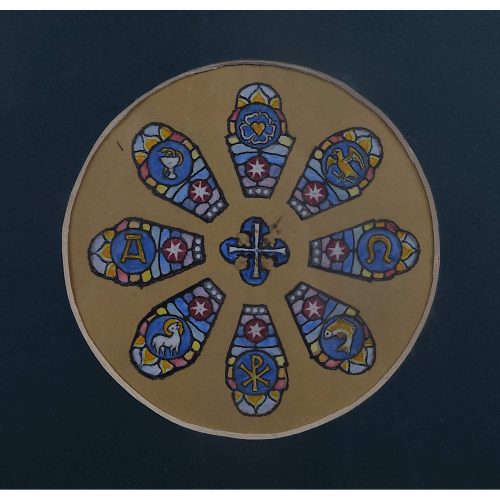
St John’s Church, Pool Quay, Design for Stained Glass Roundel (2005)
Watercolour D.14 cmSigned and studio stamp verso.
St John's Church was built in 1861 under the patronage of the third Earl of Powys to provide for the religious needs of the largely industrial population of Pool Quay. The church was originally designed in the Early English style but was extensively restored first in 1956 and again in 2003/4. Despite this, it still retains its unique charm, built in the instantly recognisable red Sweeney Mountain sandstone, and features stained glass windows by Winfield of Birmingham (1891) and Camm of Smethwick (1899). This design by Gray features eight lights containing attributes of St John and other Christian symbols.
Provenance: the artist’s studio sale. Literature: Jane Gray, Playing with Rainbows. (Shropshire: Ellingham Press, 2011), p.89. Condition: very good. If you are interested, please email info@manningfineart.co.uk or call us on 07929 749056. For other works by Jane Gray and more information about her, please click here. -
Jane Gray (b.1931)
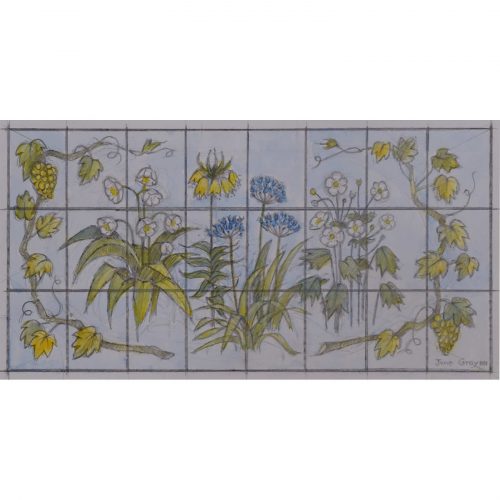
Saling Hall, Essex, Design for Stained Glass Window (1980)
Watercolour 11 x 20 cmSigned and dated.
Saling Hall, in Essex, has a long and rich history, dating back to the early 12th century when Sir Baldwin Wiscart was the first recorded Lord of the Manor. After his his son, the house passed to the knightly family of Bibbesworth, who lived there for four generations. Sir Walter de Bibbesworth was a crusader and a poet (in French). Nothing remains of the first Saling Hall which was rebuilt around 1590 by the Maxey family who had bought the hall in 1487. The house faced further remodelling by its 17th century owner, Martin Carter, a lawyer. He ornamented the new facade with Dutch gables, which are the latest example of their kind in Essex, and the house has changed little since. The hall passed through many more hands before it was bought, in 1935, by Lady Isabella Carlyle (née Barton) who was a passionate gardener and gave the Hall its first modern gardens. Lady Carlyle sold the Hall in 1971 to Hugh Johnson, a well known garden writer, who continued Lady Carlyle’s work on the gardens. This design is a final drawing for a stained glass window commissioned by Johnson for a fanlight in Saling Hall. Johnson wished the design to include the plants he grew in his own garden to symbolise the seasons. Gray designed the panel using Corsican Hellebore for winter, the Crown Imperial Fritillary for spring, Agapanthas for summer, and Japanese Anemones for autumn. Gray also included vines to frame the design and nod to Johnson’s oenological interests.
Provenance: the artist’s studio sale. Literature: Jane Gray, Playing with Rainbows. (Shropshire: Ellingham Press, 2011), p.40. Condition: very good. If you are interested, please email info@manningfineart.co.uk or call us on 07929 749056. For other works by Jane Gray and more information about her, please click here. -
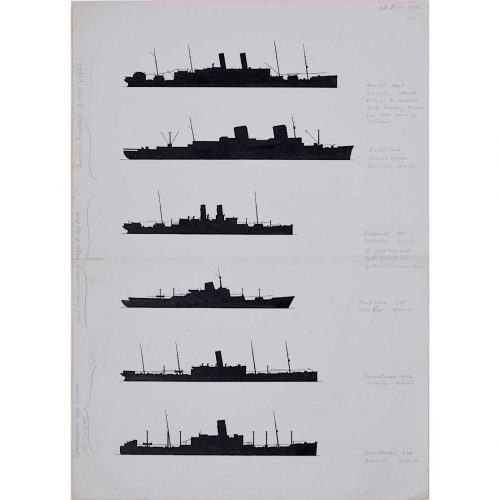
Laurence Dunn (1910-2006)
A Series of Coastal Tramp Silhouettes
34.5 x 24 cm Bodycolour on paper Dunn’s depictions of coastal tramps are early works, likely captured from the side of the Thames estuary near his home. This work contains extensive notes on the featured ships.Laurence Dunn (1910-2006) was a well-known British marine artist and writer known for his depictions of ships. He grew up in Devon, where he practised drawing passing ships, and went on to study at the Central School of Art. He then worked for shipbuilding firm John I. Thornycroft & Company Limited, where he contributed to the design of the Royal Yacht. During the Second World War, Dunn worked in naval intelligence. In the early 1960s, he created many line drawings of Atlantic ocean liners.
Upon his death in 2006, the World Ship Society published the following obituary:
DUNN, Laurence. [December 15 2006 — Lloyds List] Many readers will be saddened by the death of well-known marine artist and writer Laurence Dunn in his 97th year. A man of encyclopaedic knowledge, he began his lifelong love of ships in Brixham, where he meticulously recorded passing traffic with the exquisitely accurate line drawings which later became something of a trademark. While studying at London’s Central School of Art his work was noticed by the Southern Railway, which commissioned profiles of its fleet, and this in turn led to work for Orient Line, where he also designed the well-known corn-coloured hull, and later Thorneycroft, where he helped with shaping draft plans for a new royal yacht. During the second world was he worked for naval intelligence at the Admiralty, where his technique did much to improve recognition standards, and greatly expanded his shipping clientele, becoming personally known to many chairmen. As well as the shipping press he worked for mainstream publications such as Everybody’s, Sphere and the upmarket comic Eagle. Through his many contacts he enjoyed going to sea in a great variety of ships from aircraft carriers to colliers. Laurence wrote several books, starting with ship recognition titles which introduced new standards of layout, but his best known work was probably Passenger Liners, which was widely taken up by the travel trade. His love of Greece, where he was an early publicist of island cruising, let to involvement in reshaping various passenger liners beginning with Greek Line’s OLYMPIA. In later life he designed several sets of shipping stamps for the Crown Agents, produced photographic volumes on Thames and Mediterranean shipping and still found time to enjoy the passing Thames traffic. Our sympathies go to his wife Jennifer, who provided succour to the many ship lovers who beat a path to the welcoming door of their Gravesend home.
-
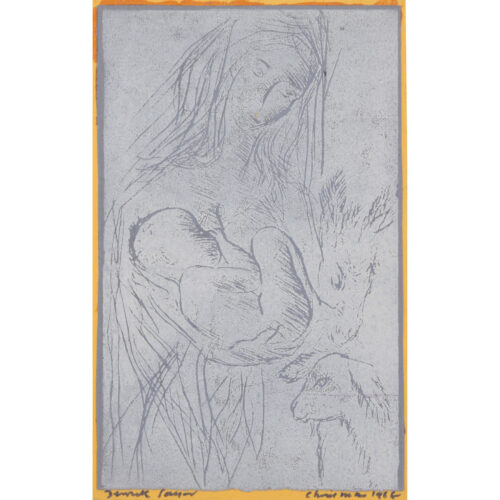
Derrick Latimer Sayer (1917 - 1992)
Madonna and Child (Christmas Card)
Linocut 21 x 13.5 cm Mounted to card, signed 'Derrick Sayer' and dated Christmas 1968. Sayer's linocut of the Virgin Mary and baby Jesus is hauntingly emotive; his spare use of line shows Mary, eyes closed, cradling her newborn son. Two animals from the stable in Bethlehem look on. Sayer studied at the Chelsea School of Art under Graham Sutherland and Henry Moore, and then in Paris in Ben Nicholson's studio. In the late 1930s he was in Cornwall, founding the Mousehole Group Art School. He was well known for his work as a poster artist and book illustrator. Condition: very good. If you are interested, please email info@manningfineart.co.uk or call us on 07929 749056. -
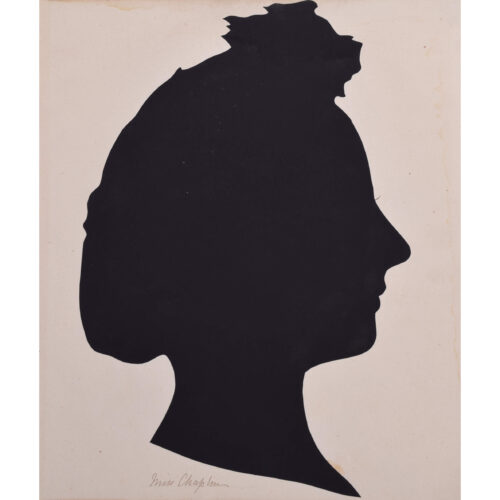
Silhouette (circa 1870)
Miss Chaplin
Gouache, pen, and ink 52 x 44 cm Prior to photography, silhouettes were the easiest way of recording a person's appearance. This set might record the group present at a country house party, a wedding, or other similar convivial occasion. Condition: good. Some staining at upper and right edges. If you are interested, please email info@manningfineart.co.uk or call us on 07929 749056. Click here for other silhouettes. -
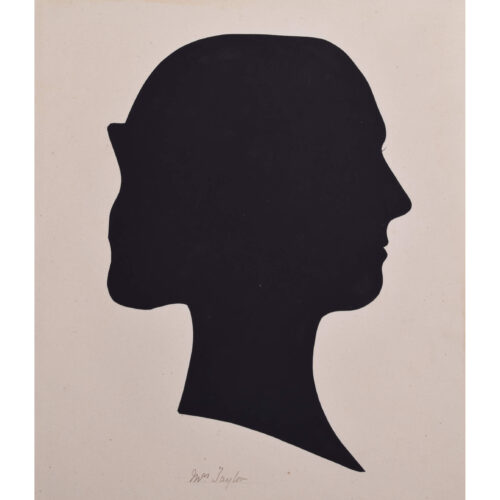
Silhouette (circa 1870)
Mrs Taylor
Gouache, pen, and ink 52 x 44 cm Prior to photography, silhouettes were the easiest way of recording a person's appearance. This set might record the group present at a country house party, a wedding, or other similar convivial occasion. Condition: generally very good. If you are interested, please email info@manningfineart.co.uk or call us on 07929 749056. Click here for other silhouettes. -
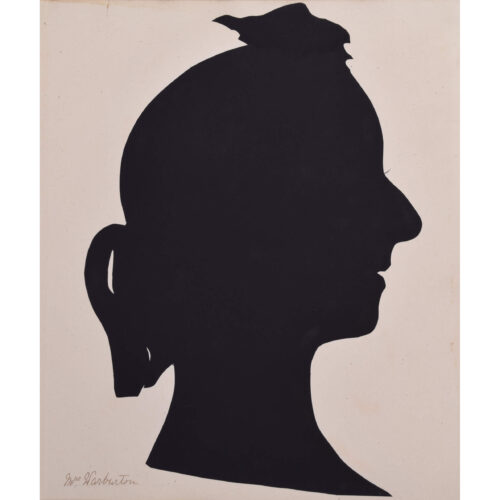
Silhouette (circa 1870)
Mrs Warburton
Gouache, pen, and ink 52 x 44 cm Prior to photography, silhouettes were the easiest way of recording a person's appearance. This set might record the group present at a country house party, a wedding, or other similar convivial occasion. Condition: generally very good; some light staining at upper edge. If you are interested, please email info@manningfineart.co.uk or call us on 07929 749056. Click here for other silhouettes. -
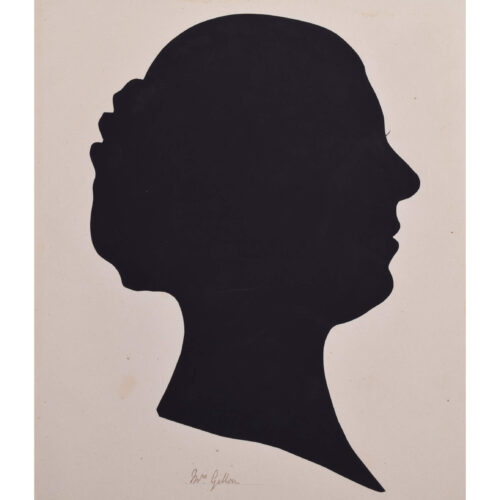
Silhouette (circa 1870)
Mrs Gillon
Gouache, pen, and ink 52 x 44 cm Prior to photography, silhouettes were the easiest way of recording a person's appearance. This set might record the group present at a country house party, a wedding, or other similar convivial occasion. Condition: generally very good; some light staining. If you are interested, please email info@manningfineart.co.uk or call us on 07929 749056. Click here for other silhouettes. -
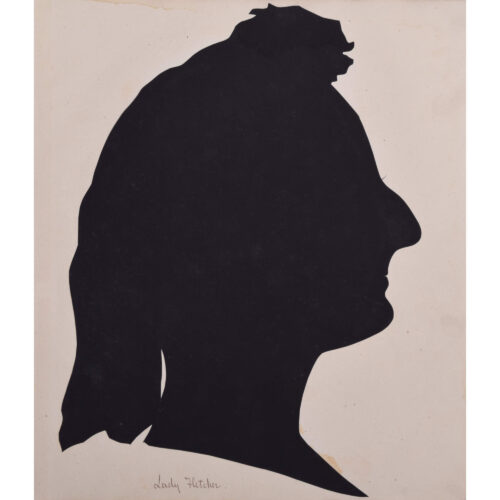
Silhouette (circa 1870)
Lady Fletcher
Gouache, pen, and ink 52 x 44 cm Prior to photography, silhouettes were the easiest way of recording a person's appearance. This set might record the group present at a country house party, a wedding, or other similar convivial occasion. Condition: generally very good; some light staining to right edge. If you are interested, please email info@manningfineart.co.uk or call us on 07929 749056. Click here for other silhouettes. -
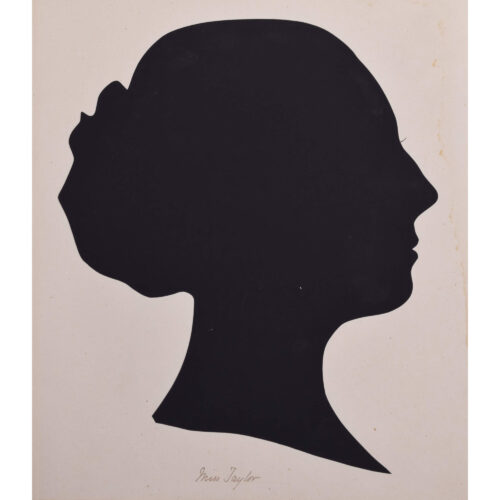
Silhouette (circa 1870)
Miss Taylor
Gouache, pen, and ink 52 x 44 cm Prior to photography, silhouettes were the easiest way of recording a person's appearance. This set might record the group present at a country house party, a wedding, or other similar convivial occasion. Condition: good; some staining to right edge. If you are interested, please email info@manningfineart.co.uk or call us on 07929 749056. Click here for other silhouettes. -
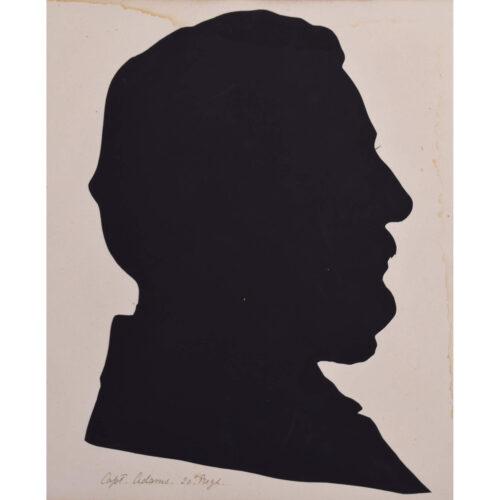
Silhouette (circa 1870)
Captain Adams, 20th Regt
Gouache, pen, and ink 52 x 44 cm Prior to photography, silhouettes were the easiest way of recording a person's appearance. This set might record the group present at a country house party, a wedding, or other similar convivial occasion. Condition: generally good; some staining to upper and right margins. If you are interested, please email info@manningfineart.co.uk or call us on 07929 749056. Click here for other silhouettes. -
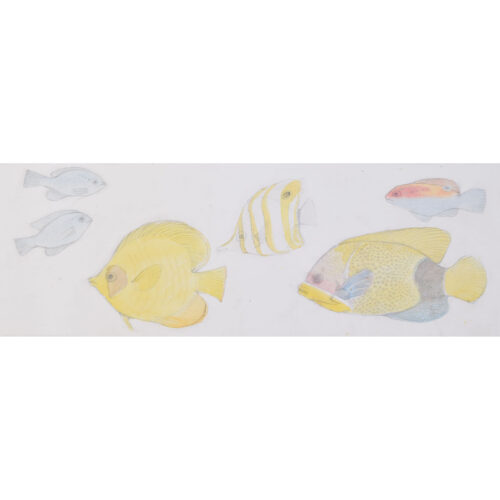
Jane Gray (born 1931)
Fish (1960)
Pencil and watercolour 19 x 54 cm Provenance: the artist's studio sale. Jane Gray A.R.C.A. (b.1931) is a British stained glass artist. She studied stained glass at the Kingston School of Arts (1949 - 1951) and later at the Royal College of Art (1951 - 1955) under Lawrence Lee. Lee was so impressed with Gray’s work that he asked her to work alongside him on the design of ten nave windows for Coventry Cathedral. This six-year-long design project culminated in their final installation in 1962 after the cathedral’s consecration. Gray was the first woman to become a liveryman of the Worshipful Company of Glaziers and has designed more than a hundred windows in private and public buildings, chapels and over forty churches across the country, including St Peter’s, Martindale, Shrewsbury Abbey, St Oswald, Oswestry and St Mary, Chirk. Gray’s designs mark a crucial turning point in the history of stained glass art as the Victorian style gave way to a modern, aesthetic. In her work, Gray navigates this shift with a style that, whilst distinctly modern, retains a deep rooted sense of the medieval. Despite many of her commissions being for church windows, stained glass design was not simply about religious depiction for Gray, but more about ‘colour, shapes, luminosity, [and] playing with rainbows’. Condition: generally very good. If you are interested, please email info@manningfineart.co.uk or call us on 07929 749056. For other works by Jane Gray and more information about her, please click here. -
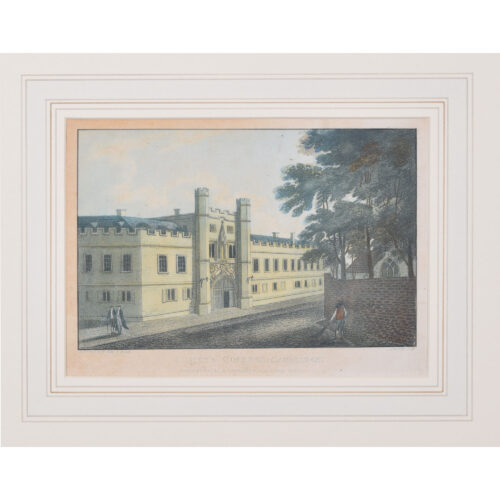
Richard Bankes Harraden (1778 - 1862)
Christ's College, Cambridge
Engraving 15 x 22 cm A nineteenth-century view of Christ's College, Cambridge, complete with two academics and a street-sweeper. Richard Bankes Harraden was a printmaker, painter, and drawing master. He was active in Cambridge, producing many views of the colleges, and subsequently several Oxford colleges. Harraden was an early and exhibiting member of the Society of British Artists in London, which was established in 1823, and remained a member until 1849. He specialised in depictions of landscape, topography and architecture, and was the son of Richard Harraden (1756 - 1838) with whom he published plates as 'Harraden & Son'. Condition: generally very good; a little discolouration to paper; in handsome washlined mount. If you are interested, please email info@manningfineart.co.uk or call us on 07929 749056. Click here for other views of Christ's College, Cambridge. -
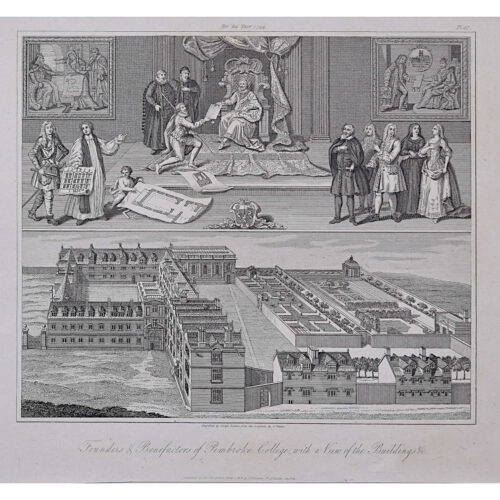
Joseph Skelton (1783 - 1871) after George Vertue (1684 - 1756)
Founders & Benefactors of Pembroke College, with a View of the Buildings &c. (1818)
Engraving 21 x 24 cm A historic engraving of Pembroke's august founders and early architecture, which later formed part of the artist's 1828 'Pietas Oxoniensis, or Records of Oxford Founders'. George Vertue FSA was an English engraver and antiquary. He was apprenticed to a heraldic engraver in France, then worked for the Flemish engraver Michael Vandergucht before setting up on his own. He was also a student of the English portrait painter and copyist Thomas Gibson. He became the official engraver to the Society of Antiquaries when it was founded in 1717, and his patrons included several British aristocrats. He is buried in Westminster Abbey. Joseph Skelton was an a topographical and antiquarian engraver. He lived in Oxford for a time and became a Fellow of the Society of Antiquaries of London. His Oxford publications include the Oxonia Antiqua Illustrata; Antiquities of Oxfordshire, from drawings by F. Mackenzie; and the Pietas Oxoniensis, or Records of Oxford Founders. Condition: generally very good. If you are interested, please email info@manningfineart.co.uk or call us on 07929 749056. Click here for other views of Pembroke College, Oxford. -

George Bissill (1896-1973) Farmhouse view
Pencil sketch 18 x 25 cm Born in 1896, George Bissill was a British miner, painter and furniture designer. Raised in the mining village of Langley Mill, Derbyshire, Bissill became a miner at the age of 13, before leaving to join the war effort in 1915. Upon his return from the war after being gassed, Bissill chose to become a pavement artist outside the newly erected Bush House in Aldwych, painting from his memory and his sketch book the uncompromising underground world he had inhabited. In 1935 he moved to the countryside near Newbury, where he lived and worked as a landscape painter, art restorer and dealer until his death in 1973. This painting forms part of a larger collection, 'unseen since they were taken from George Bissil's studio in 1983' and restored by Kate Pattinson. A series of planned exhibitions were cancelled due to Covid, but two shows, one in Oxford and one in Ilkeston, did take place. Through such exhibitions, Pattinson hoped to 'restore the reputation of an artist who, through mighty endeavour, conquered the art world in the 1920s with his powerful, authentic and experimental pictures.' Bissill's paintings are also held in a number of important public collections, including the Tate Gallery, National Museum of Ireland and the Manchester Art Gallery. This pencil drawing depicts a view over a farmhouse with an adjacent man seemingly chopping wood. In contrast to some of his other sketches, in this work Bissill pays careful attention to the fine detailing of the house, shrubbery and trees. He executes beautiful shading on the trees, capturing the natural shadows of a low sun on a winter's day. Condition: generally very good.If you would like to know more, please email info@manningfineart.co.uk or call us on 07929 749056.
-

George Bissill (1896-1973) View through the village
Watercolour 26 x 31 cm Initialled to bottom right Born in 1896, George Bissill was a British miner, painter and furniture designer. Raised in the mining village of Langley Mill, Derbyshire, Bissill became a miner at the age of 13, before leaving to join the war effort in 1915. Upon his return from the war after being gassed, Bissill chose to become a pavement artist outside the newly erected Bush House in Aldwych, painting from his memory and his sketch book the uncompromising underground world he had inhabited. In 1935 he moved to the countryside near Newbury, where he lived and worked as a landscape painter, art restorer and dealer until his death in 1973. This watercolour forms part of a larger collection, 'unseen since they were taken from George Bissil's studio in 1983' and restored by Kate Pattinson. A series of planned exhibitions were cancelled due to Covid, but two shows, one in Oxford and one in Ilkeston, did take place. Through such exhibitions, Pattinson hoped to 'restore the reputation of an artist who, through mighty endeavour, conquered the art world in the 1920s with his powerful, authentic and experimental pictures.' Bissill's paintings are also held in a number of important public collections, including the Tate Gallery, National Museum of Ireland and the Manchester Art Gallery. Condition: generally very good.If you would like to know more, please email info@manningfineart.co.uk or call us on 07929 749056.
-

Laurence Dunn (1910 - 2006) Container Ship
Pencil drawing 41 x 21 cm Laurence Dunn was a well-known British marine artist and writer known for his depictions of ships. He grew up in Devon, where he practised drawing passing ships, and went on to study at the Central School of Art. He then worked for shipbuilding firm John I. Thornycroft & Company Limited, where he contributed to the design of the Royal Yacht. During the Second World War, Dunn worked in naval intelligence. In the early 1960s, he created many line drawings of Atlantic ocean liners. Upon his death in 2006, the World Ship Society published the following obituary: DUNN, Laurence. [December 15 2006 — Lloyds List] Many readers will be saddened by the death of well-known marine artist and writer Laurence Dunn in his 97th year. A man of encyclopaedic knowledge, he began his lifelong love of ships in Brixham, where he meticulously recorded passing traffic with the exquisitely accurate line drawings which later became something of a trademark. While studying at London’s Central School of Art his work was noticed by the Southern Railway, which commissioned profiles of its fleet, and this in turn led to work for Orient Line, where he also designed the well-known corn-coloured hull, and later Thorneycroft, where he helped with shaping draft plans for a new royal yacht. During the second world was he worked for naval intelligence at the Admiralty, where his technique did much to improve recognition standards, and greatly expanded his shipping clientele, becoming personally known to many chairmen. As well as the shipping press he worked for mainstream publications such as Everybody’s, Sphere and the upmarket comic Eagle. Through his many contacts he enjoyed going to sea in a great variety of ships from aircraft carriers to colliers. Laurence wrote several books, starting with ship recognition titles which introduced new standards of layout, but his best known work was probably Passenger Liners, which was widely taken up by the travel trade. His love of Greece, where he was an early publicist of island cruising, let to involvement in reshaping various passenger liners beginning with Greek Line’s OLYMPIA. In later life he designed several sets of shipping stamps for the Crown Agents, produced photographic volumes on Thames and Mediterranean shipping and still found time to enjoy the passing Thames traffic. Our sympathies go to his wife Jennifer, who provided succour to the many ship lovers who beat a path to the welcoming door of their Gravesend home.