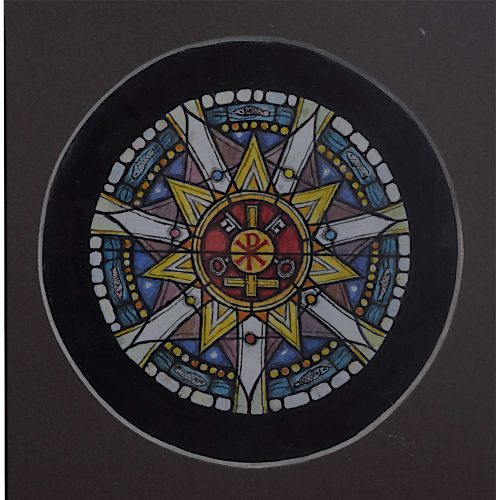
• Jane Gray (b.1931)

    St Peter’s Church, Monkmoor Road, Shrewsbury, Design for Stained Glass Window (1990)

      Watercolour D.12 cm

    Signed, dated and studio stamp verso.

    St Peter’s is a small, modern mission church adjoining Shrewsbury Abbey and was consecrated shortly before the outbreak of World War II in 1939. Gray’s stained glass design sensitively yet strikingly reflects this simple site of religious worship in her typical modern-medieval style. Important numbers in Christian iconography are included: three for the Trinity (Body, Mind, and Spirit), four for the material world of the Elements, and so, together, seven which combines the worlds of matter and spirit and is thus regarded as the perfect number. At the centre of the window sits the Chi-Ro, or monogram of Christ, placed against the emblems of St Peter (a pair of crossed keys and an inverted Latinate cross). Surrounding the design, seven fish swim in a turquoise sea. The window was installed in 1992.

    Provenance: the artist’s studio sale. Literature: Jane Gray, Playing with Rainbows. (Shropshire: Ellingham Press, 2011), pp.48, 81. Condition: very good. If you are interested, please email info@manningfineart.co.uk or call us on 07929 749056. For other works by Jane Gray and more information about her, please click here.    
  • John Hill (1770 - 1850) after Augustus Charles Pugin (1762 - 1832) St Sepulchre's - The Round Church (1814)

    Aquatint with original hand colouring 24 x 29 cm Published by Rudolph Ackermann (1764 - 1834). An interior engraving of the Church of the Holy Sepulchre, Cambridge, the round shape of which is inspired by the rotunda in the church of the Holy Sepulchre, Jerusalem. John Hill was born in London in 1770, and was an engraver's apprentice. He worked in aquatint and largely produced book illustration aquatints. He went to America in 1816 and produced the notable Picturesque Views of American Scenery amongst other books of prints. Augustus Charles Pugin was an Anglo-French artist and architectural draughtsman. Pugin produced views of London, jointly creating the illustrations for the 'Microcosm of London' published by Rudolph Ackermann in 1811, followed by plates for Ackermann's books about Westminster Abbey, Oxford and Cambridge universities, and Winchester College. His later works included illustrations for Specimens of Gothic Architecture (1821–1823), The Royal Pavilion at Brighton (1826), Architectural Antiquities of Great Britain (1826), Specimens of the Architectural Antiquities of Normandy (1827), Illustrations of the Public Buildings of London (1825 to 1828), Paris and its Environs (1829 to 1831), and Examples of Gothic Architecture (1831). He also produced a book of furniture designs called Gothic Furniture, and assisted architects with detailing for their gothic designs. He ran a drawing school at his house in Bloomsbury. Ackermann was an Anglo-German bookseller, inventor, lithographer, publisher and businessman. He attended the Latin school in Stollberg, but his wish to study at the university was made impossible by lack of financial means, and he therefore became a saddler like his father. He worked as a saddler and coach-builder in different German cities, moved from Dresden to Basel and Paris, and then, 23 years old, settled in London. He established himself in Long Acre, the centre of coach-making in London and close to the market at Covent Garden. Ackermann then moved to Little Russell Street where he published Imitations of Drawings of Fashionable Carriages (1791) to promote his coach-making. Other publications followed. In 1795 he established a print-shop and drawing-school at 96 Strand. Here Ackermann set up a lithographic press and began a trade in prints. He later began to manufacture colours and thick carton paper for landscape and miniature painters. Within three years the premises had become too small and he moved to 101 Strand, in his own words "four doors nearer to Somerset House", the seat of the Royal Academy of Arts. Between 1797 and 1800 Ackermann rapidly developed his print and book publishing business, encompassing many different genres including topography, caricature, portraits, transparencies and decorative prints. During the Napoleonic wars, Ackermann was an energetic supporter of the Allied cause and made significant contributions to British propaganda through his publication of anti-Napoleonic prints and military manuals. He became a naturalised British citizen in March 1809. As one of the pioneers of modern publishing methods, Ackermann developed an international distribution network for his publications and came to have significant commercial interests in South America. The business he founded in London flourished throughout the 19th century under the management of his descendants. He was buried at St. Clement Danes in the Strand, London. In 2020, the St. Louis Mercantile Library wrote that: "Ackermann excelled in the creation of landscape and architectural engravings. He created beautiful illustrations of the city of London, his adopted home, as well as two volumes of classic views of Westminster Abbey, along with exquisite views of river scenes. One of our favorite collections are four massive volumes of lovingly illustrated exterior and interior landmarks of Oxford and Cambridge Universities created just over two hundred years ago. These publications show Ackermann’s hand at every turn of the page along with the team of assistant designers and engravers he employed to create these works. Perhaps they were a way by which the artist could lay to rest his own regret at not being able to attend [an Oxbridge] college himself in a fondly depicted idyll to learning which these prints so aptly represent." Condition: Generally very good.

    If you would like to know more, please email info@manningfineart.co.uk or call us on 07929 749056.

  • Ken Howard RA (1932 - 2022)

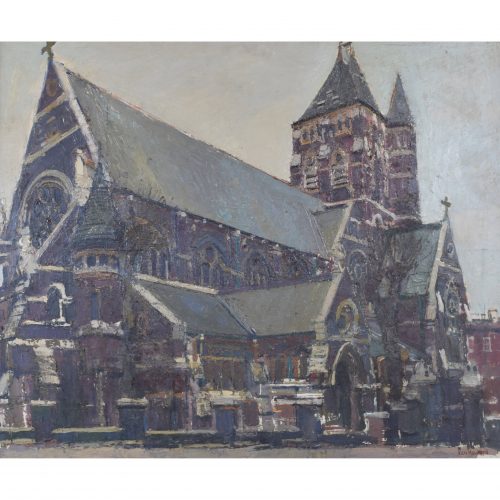
    Hampstead Church (St Stephen's Church, Rosslyn Hill)

      Oil on board 75 x 91 cm Ken Howard's magnificent view of St Stephen's Church, Hampstead. The artist's rich, deep colour palette and use of impasto underline the neo-gothic style of the church. Howard died in Hampstead and painted several views of the area and its architecture. St Stephen's was designed in the Neo Gothic style by Samuel Sanders Teulon and he considered it the best of the 114 churches he designed, calling it his "mighty church". The building is no longer a church, but wedding ceremonies still take place there; it was made a Grade I listed building in 1974. Kenneth Howard OBE RA was a British artist and painter. He was President of the New English Art Club from 1998 to 2003. He studied at the Hornsey College of Art and the Royal College of Art. In 1958 he won a British Council Scholarship to Florence, and in 1973 and 1978 he was the Official War Artist to Northern Ireland, and 1973 - 80 worked in various locations, including Hong Kong, Cyprus and Canada with the British Army. In 1983 he was elected an Associate of the Royal Academy (ARA). In 1998 he became President of the New English Art Club, a post he held until 2003. In 1991 he was elected a Royal Academician (RA). Howard was given his OBE in 2010. Condition: very good. If you’d like to know more, please email info@manningfineart.co.uk or call us on 07929 749056.
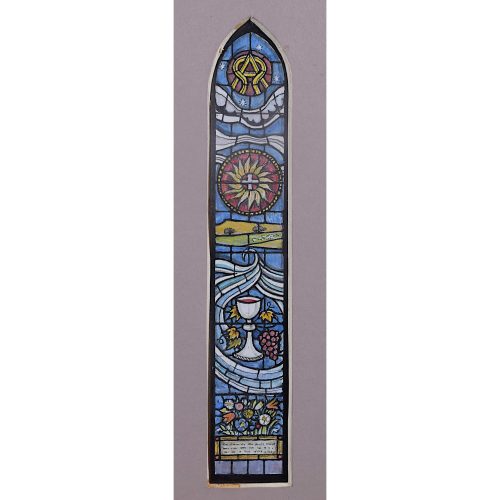
  • Jane Gray (b.1931)

    St Wilfrid’s Church, Ribchester, Lancashire, Design for Stained Glass Memorial Window (1995)

      Watercolour 20.5 x 3.5 cm Signed, dated and studio stamp verso.

    St Wilfrid’s Church, Ribchester is situated in the picturesque Ribble Valley, in the heart of rural Lancashire, and dates back to the 13th century. It has since undergone several alterations in the 14th, 15th and 16th centuries as well as substantial restoration works in the 17th, 18th and 19th centuries. The village of Ribchester grew out of the ruins of the Roman fort of Bremetenaccum and the Parish Church of St Wilfrid's stands where the key buildings of the fort would have been. This window was installed in 1996.

    Provenance: the artist’s studio sale. Literature: Jane Gray, Playing with Rainbows. (Shropshire: Ellingham Press, 2011), p.84. Condition: very good. If you are interested, please email info@manningfineart.co.uk or call us on 07929 749056. For other works by Jane Gray and more information about her, please click here.    
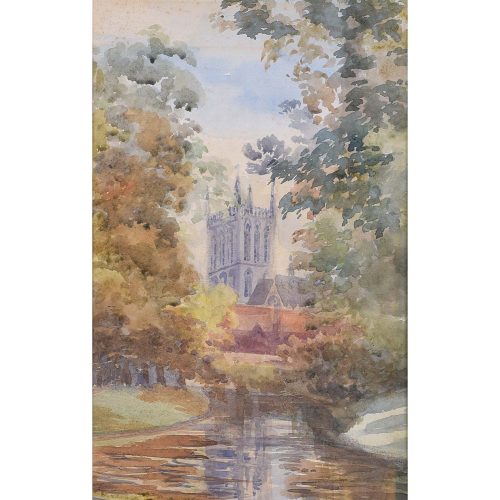
  • Anonymous St. John’s College, Cambridge

    Watercolour 32x24.5cm If you are interested email info@manningfineart.co.ukor call us on 07929 749056. Condition: Good.
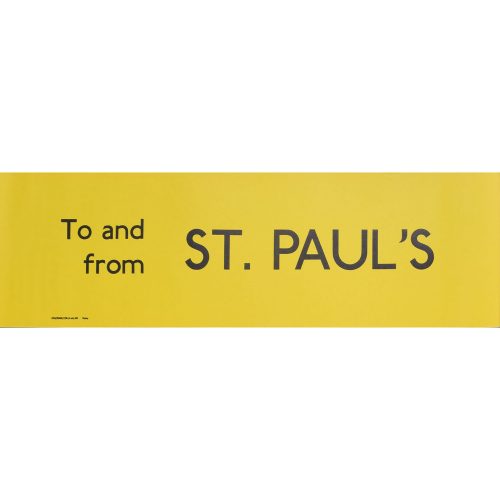
  • St. Paul's Routemaster Slipboard Poster c1970

    Screenprint poster 64x19cm In a black hand-finished frame. Printed for London Transport for use on Routemaster or RT busses. If you are interested email info@manningfineart.co.uk or call us on 07929 749056.
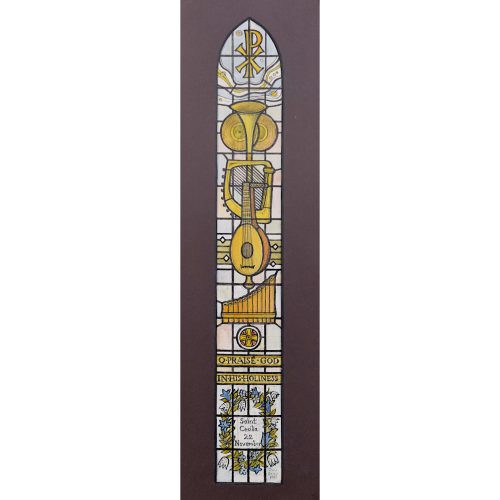
  • Jane Gray (b.1931)

    St Peter's Church, Martindale, Design for Stained Glass Window (1980)

      Watercolour 29.5 x 4.5 cm Signed and dated verso. St Peter’s Church was built in Martindale, Cumbria in 1880 by a local craftsman using stone from the surrounding area. The church is situated in an enchanting rural oasis and has connections to the acclaimed modern poet, Kathleen Raine, who lived in the Old Vicarage, as well as William and Dorothy Wordsworth who visited the area on one of their Cumbrian excursions. Gray's 'Martindale Era' lasted from 1974-81, in which time, she designed and installed fifteen stained glass windows in St Peter's Church. This window was designed in memory of Charles Barrand, the vicar at Martindale, who died in 1981. Alongside the cymbals, harp, pipes, horn, and musical notes to celebrate the musical Saint Cecilia, are some of the flowers the vicar grew in the vicarage garden and his favourite psalm: number 150.  Provenance: the artist’s studio sale. Literature: Jane Gray, Playing with Rainbows. (Shropshire: Ellingham Press, 2011), pp.20, 74. Condition: very good. If you are interested, please email info@manningfineart.co.uk or call us on 07929 749056. For other works by Jane Gray and more information about her, please click here.    
  • Terry Frost (1915-2003) Stage Design

    Wax crayon drawing 21 x 42 cm Sir Terry Frost was a British abstract artist known for his vibrant use of colour, geometric forms, and expressive compositions. His work often explored movement, rhythm, and balance, influenced by his experiences in Cornwall and his interactions with leading modernist artists. Frost's artistic career began at the age of 30. During a period of internment at a prisoner of war camp in Bavaria, Frost was encouraged by the artist Adrian Heath to paint. Immediately after the war he enrolled at the Birmingham College of Art and subsequently spent a year studying at the St Ives School of Painting. Alongside exhibiting in various galleries, including the Leicester Galleries in London's West End, Frost also led a successful academic career, teaching at the University of Leeds and of Reading. He was eventually elected a Royal Academician in 1994 and knighted for his contributions to British art in 1998. This crayon sketch appears to depict a sequence of movements, possibly for a dance or performance piece. The red and black palette gives a sense of contrast and rhythm, emphasising the energy of the composition. Frost may have produced it for the Aldeburgh Festival, a renowned music and arts festival founded by composer Benjamin Britten, Peter Pears, and Eric Crozier in 1948. His abstract and dynamic use of colour and form, as exemplified by this striking work, would have complemented the festival’s innovative approach to opera and music. Condition: generally very good, comes framed.
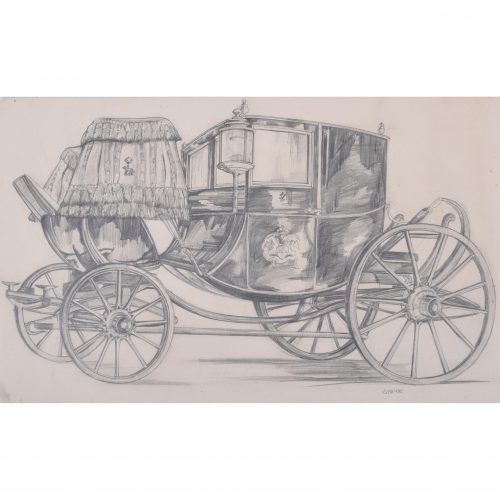
  • Gerald Mac Spink (flourished 1920 - 1940)

    Stagecoach

      Pencil 32 x 53 cm Signed 'Spink' lower right. Spink was a skilled artist, illustrator, and designer who produced a series of posters in the inter-war period for companies including the London Underground, Southern Railways, LNER, Hawker Engineering, and British Steel. He won a prize in 1933 from the Imperial Institute for his poster artwork. He also worked as an aeronautical engineer in Kingston-on-Thames for Hawker Engineering; his greatest achievement was the creation of the 'Squanderbug', a 500cc racing car which he built in 1947, and which races even to this day. Provenance: the artist's estate. Condition: generally very good. If you are interested, please email info@manningfineart.co.uk or call us on 07929 749056. Click here for other works by the artist.
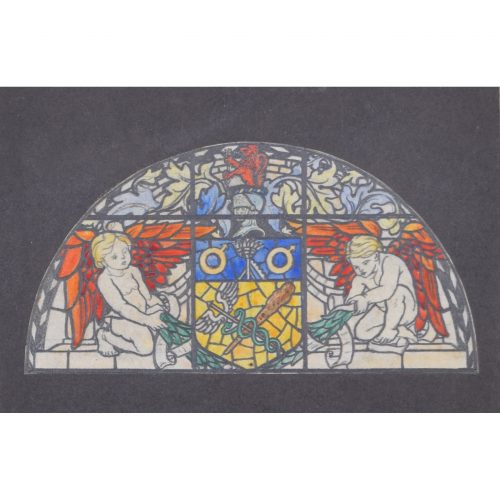
  • Thomas William Camm (1839 – 1912)

    Stained glass window design for an arched panel

      Watercolour 7 x 13 cm Design for TW Camm & Co., Smethwick, Birmingham. Numbered 13080. From the Camm studio sale. The Camms were stained glass designers who exhibited 48 times at the Royal Academy and also exhibited at The Walker Art Gallery in Liverpool, The Royal Scottish Academy, and the Royal Birmingham Society of Artists. Thomas William Camm's work was widely acclaimed, with his studio winning medals in Paris in 1878, in Sydney in 1879 and in Turin in 1911. In 1915, the American architect Ralph Adams Cram wrote that 'at the present moment a large number of artists in England are producing work of most singular beauty and perfection. Amongst these I have no hesitation in placing Mr. Camm easily as the first'. Following the death of her father, Florence Camm became the chief designer at TW Camm. Condition: very good; in oak frame. If you’d like to know more, please email info@manningfineart.co.uk or call us on 07929 749056.
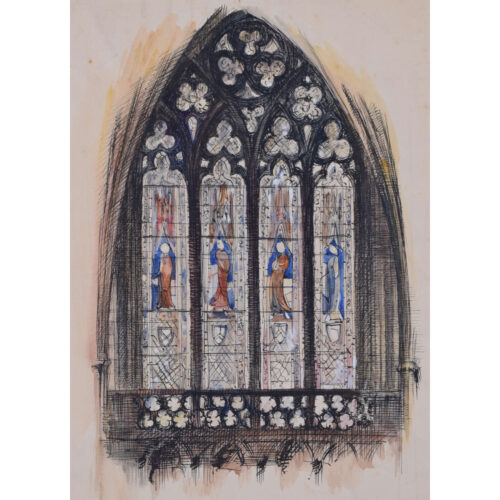
  • Louis Osman FRIBA (1914 - 1996)

    Stained glass window

      Watercolour 23 x 16 cm On Pioneer Fine laid paper. An intricately-detailed watercolour of a stained glass window, featuring four Biblical figures. Osman was as much an artist as an architect. This is likely a portfolio piece from his time studying at the Bartlett School of Architecture, and is as such a piece of architectural history as well as a beautiful Osman design. Osman was awarded a First Class degree and the Donaldson Medal of the RIBA (for the best result in his year group) by the Bartlett, and then went on to the Slade School of Art. He subsequently trained with Sir Albert Richardson - we also have several Richardson works in our collection. After the war, Osman busied himself as an architect. His work included contributions to Westminster Abbey, and Lincoln, Exeter, Ely, and Lichfield Cathedrals, Staunton Harold Church in Ashby de la Zouch for the National Trust, and of course his folly: the Grade I listed Elizabethan manor house, Canons Ashby in Northamptonshire, now a National Trust property. At Canons Ashby he established a workshop and had a team of silversmiths and goldsmiths working for him. In 1976 he made the gold enamelled coffin that holds the copy of the Magna Carta on view in the United States Capitol, Washington, DC. Condition: generally very good. If you’d like to know more, please email info@manningfineart.co.uk or call us on 07929 749056.
  • James Basire & John Carter Stalls in Tiltey Church Essex & Stalls in the Choir of Rochester Cathedral

    Engraving 50 x 32 cm This engraving was originally published by the Society of Antiquaries of London, an organisation dedicated to studying and preserving historical monuments. The society commissioned a series of architectural engravings by James Basire, this one based on a drawing by John Carter. In doing so, the Antiquaries hoped to preserve and disseminate knowledge of England’s architectural heritage. This engraving depicts the stalls in Tiltey Church Essex and Rochester Cathedral. Each set of stalls has its own set of distinguishing features. Although the stalls in Tiltey Church are comparatively pared back with their bare bricks and simple stone masonry, these nooks are not simply stalls but are in fact a three-levelled sedilia with a piscina, as was typical in medieval churches. The sedilia in Rochester Cathedral is, in contrast, extremely ornate, figuring as a fine example of Gothic architecture, specifically from the Decorated period (c. 1250–1350). Condition: Generally very good.

    If you would like to know more, please email info@manningfineart.co.uk or call us on 07929 749056.
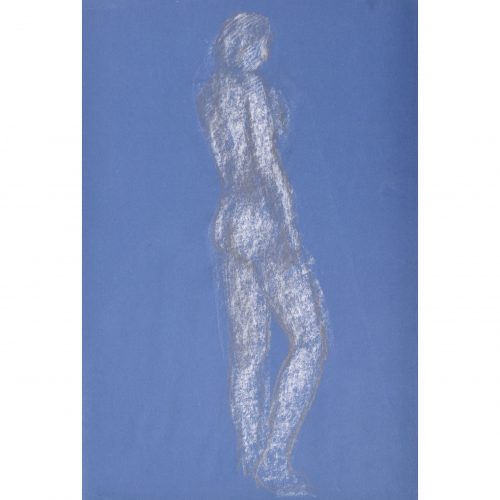
  • Hilary Hennes (née Hilary Miller) (1919 - 1993)

    Standing Nude

      Chalks 56 x 38 cm A chalk drawing of a standing female nude. The reverse of Hennes' drawing Flowers on a Table. Hilary Miller was born in London, where her father was a curator at the South London Art Gallery. She attended Blackheath High School and, from 1936 to 1940, studied at the Blackheath School of Art, and then for a further three years at the Royal College of Art. After graduating, she taught at the South East Sussex Technical College and in 1946 married the artist Hubert Hennes. The couple lived in Oxford, where they both held teaching posts at the Oxford School of Art. Between 1948 and 1967 Miller frequently exhibited paintings at the Royal Academy in London, and also illustrated a number of books on gardening and natural history, such as 'The Living World' and 'Boff's Book of Gardening'. Provenance: the artist's studio sale. Condition: generally very good. The reverse of Hennes' drawing Flowers on a Table (see photograph above). If you are interested, please email info@manningfineart.co.uk or call us on 07929 749056. Click here for other works by the artist.
  • Leslie Carr (1891 - 1969)

    1440 Great Northern Railway (1910)

    Pen and ink 19 x 41 cm Signed and dated lower right. The Great Northern Railway (GNR) was a British railway company incorporated in 1846 with the object of building a line from London to York. Although many local lines have been closed, much of the network remains active today. Leslie Carr was a painter and poster designer from London. He served in the Tank Corps in the First World War and then became a professional artist, mainly producing maritime and architectural scenes. He designed posters for Southern Railway, the London and North Eastern Railway, and British Railways (among others). Carr served as a fireman in the Second World War and was a part of several firemen artists' exhibitions. Carr was a member of the Society of Marine Artists. Condition: very good. If you are interested, please email info@manningfineart.co.uk or call us on 07929 749056. Click here for other pictures by the artist.
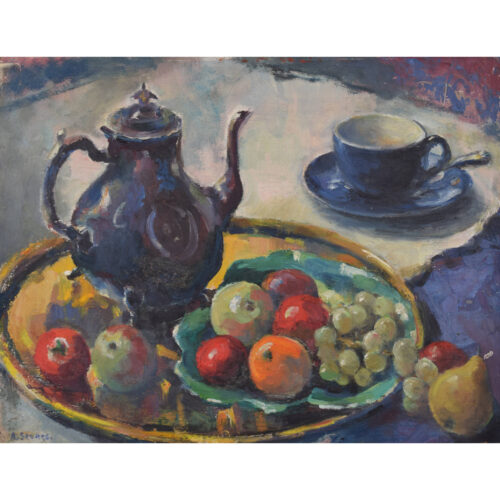
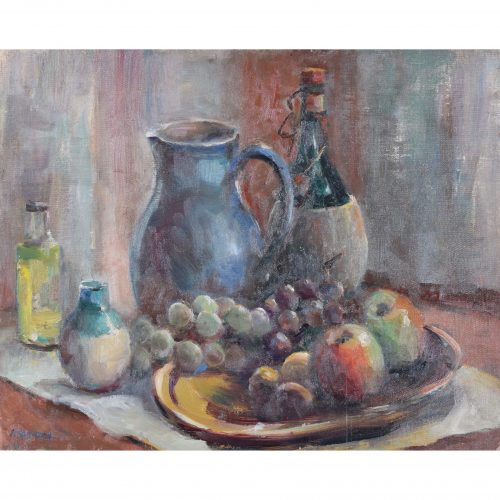
  • Angela Stones (1914 - 1995)

    Still Life with Coffee Pot and Fruit

      Oil on board 41 x 51 cm Signed lower right. Provenance: the family of the artist. A mid-century still life in oils, characterised by Stones' textured brushwork, inventive composition, and rich use of colour. Stones was educated at the Chelsea School of Art, and was a member of an artistic dynasty. Her mother Dorothy Bradshaw (1893-1983) studied under Jack Merriott – the artist famous for his British Rail posters, and her son, Christopher Assheton-Stones (1947-1999), was arguably the foremost pastel artist of his time. Condition: very good. If you’d like to know more, please email info@manningfineart.co.uk or call us on 07929 749056. Click here for more still lifes.
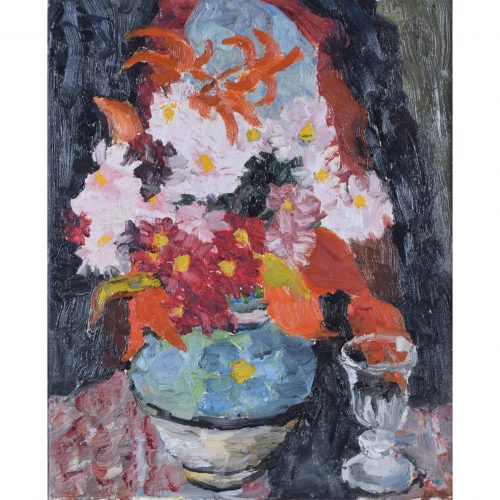
  • Eva Lucy Harwood (1893 - 1972)

    Still Life with Flowers and Glass

      Oil on canvas 49 x 40 cm ( 67 x 57 cm framed) A mid-century still life typical of Harwood's impasto style. Lucy Harwood was a British artist who studied art at the Slade just before the outbreak of the First World War. She had initially intended to be a professional pianist, but turned her attentions to visual art after becoming partially paralysed. She was one of the first students to enrol at Cedric Morris' East Anglian School of Drawing and Painting, where she focused on painting Post-Impressionist landscapes, painting just with her left hand. She moved to Upper Layham in Suffolk and is known for her landscapes of the area. Condition: generally very good. Handsome hand-finished frame. Provenance: Louise Kosman, Edinburgh. If you’d like to know more, please email info@manningfineart.co.uk or call us on 07929 749056. Click here to view our other still life pictures.
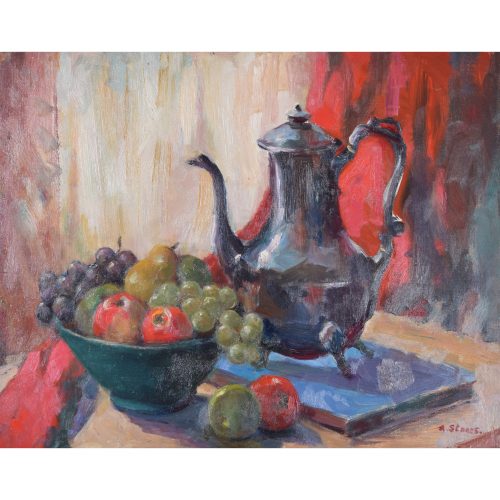
  • Angela Stones (1914 - 1995)

    Still Life with Fruit and Coffee Pot

      Oil on board 41 x 51 cm Signed lower right. A sophisticated mid-century still life, characterised by gleaming coffee pot and brimming fruit bowl. The rich red of the apples communicates with the scarlet of the draperies and Stones' signature, just as the bluish-purple hues of the grapes do with the glinting metal of the coffee pot and the blue book on which it stands. Stones was educated at the Chelsea School of Art, and was a member of an artistic dynasty. Her mother Dorothy Bradshaw (1893-1983) studied under Jack Merriott – the artist famous for his British Rail posters, and her son, Christopher Assheton-Stones (1947-1999), was arguably the foremost pastel artist of his time. Provenance: the family of the artist. Condition: very good. If you’d like to know more, please email info@manningfineart.co.uk or call us on 07929 749056.
  • Angela Stones (1914 - 1995)

    Still Life with Fruit and Flowers

      Oil on board 62 x 46 cm A typically stylish mid-century still life. The citrus fruits in the foreground are the painting's focus, with their peel dancing between reds, greens, yellows, and oranges. Stones was educated at the Chelsea School of Art, and was a member of an artistic dynasty. Her mother Dorothy Bradshaw (1893-1983) studied under Jack Merriott – the artist famous for his British Rail posters, and her son, Christopher Assheton-Stones (1947-1999), was arguably the foremost pastel artist of his time. Provenance: the family of the artist. Condition: very good; recently cleaned and varnished. If you’d like to know more, please email info@manningfineart.co.uk or call us on 07929 749056.
  • Angela Stones (1914 - 1995)

    Still Life with Fruit and Jug

      Oil on board 40 x 50 cm Signed lower left. A stylish mid-century still life, characterised by Stones' lively brushwork and rich use of colour. Stones was educated at the Chelsea School of Art, and was a member of an artistic dynasty. Her mother Dorothy Bradshaw (1893-1983) studied under Jack Merriott – the artist famous for his British Rail posters, and her son, Christopher Assheton-Stones (1947-1999), was arguably the foremost pastel artist of his time. Provenance: the family of the artist. Condition: very good. If you’d like to know more, please email info@manningfineart.co.uk or call us on 07929 749056.
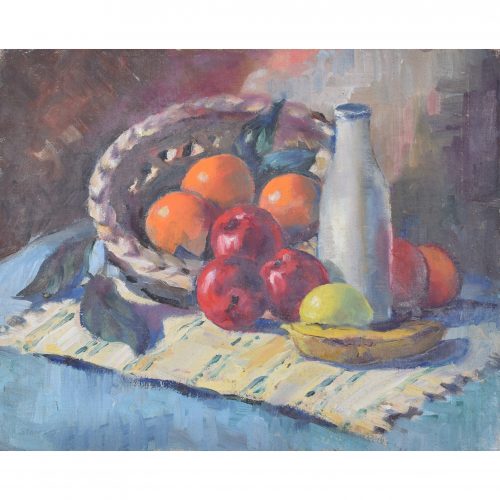
  • Angela Stones (1914 - 1995)

    Still Life with Fruit and Milk Bottle

      Oil on board 41 x 51 cm Signed lower left. A mid-century still life in oils, characterised by Stones' textured brushwork and use of vivid colours. Stones was educated at the Chelsea School of Art, and was a member of an artistic dynasty. Her mother Dorothy Bradshaw (1893-1983) studied under Jack Merriott – the artist famous for his British Rail posters, and her son, Christopher Assheton-Stones (1947-1999), was arguably the foremost pastel artist of his time. Provenance: the family of the artist. Condition: very good. If you’d like to know more, please email info@manningfineart.co.uk or call us on 07929 749056.
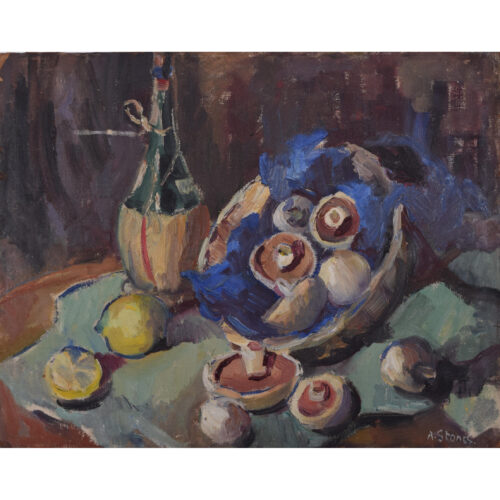
  • Angela Stones (1914 - 1995)

    Still Life with Mushrooms

      Oil on board 41 x 51 cm Signed lower right. Provenance: the family of the artist. A dark, characterful mid-century still life in oils, characterised by Stones' textured brushwork and rich use of colour. Stones was educated at the Chelsea School of Art, and was a member of an artistic dynasty. Her mother Dorothy Bradshaw (1893-1983) studied under Jack Merriott – the artist famous for his British Rail posters, and her son, Christopher Assheton-Stones (1947 - 1999), was arguably the foremost pastel artist of his time. Condition: very good. If you’d like to know more, please email info@manningfineart.co.uk or call us on 07929 749056. Click here for more still lifes.
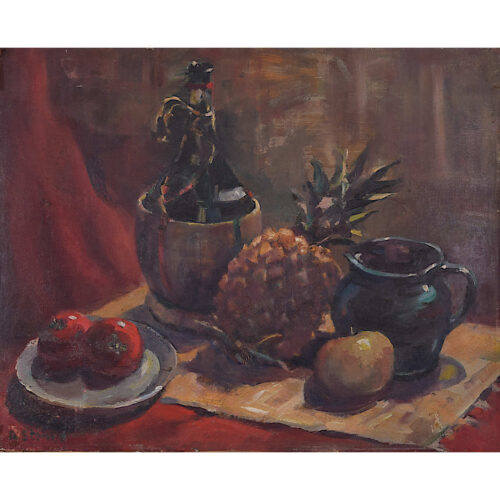
  • Angela Stones (1914 - 1995)

    Still Life with Pineapple

      Oil on board 41 x 51 cm Signed lower left. Provenance: the family of the artist. A dark, characterful mid-century still life in oils, characterised by Stones' textured brushwork and rich use of colour. Stones was educated at the Chelsea School of Art, and was a member of an artistic dynasty. Her mother Dorothy Bradshaw (1893-1983) studied under Jack Merriott – the artist famous for his British Rail posters, and her son, Christopher Assheton-Stones (1947 - 1999), was arguably the foremost pastel artist of his time. Condition: very good. If you’d like to know more, please email info@manningfineart.co.uk or call us on 07929 749056. Click here for more still lifes.
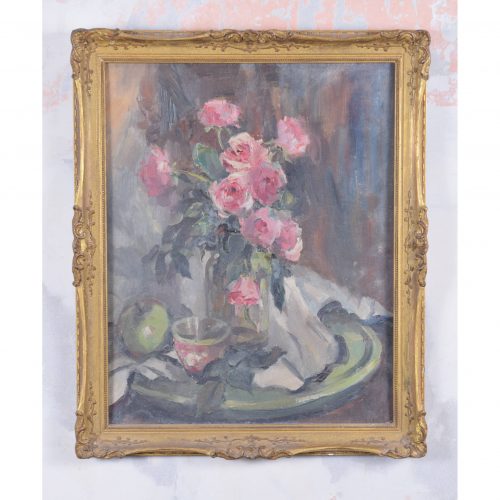
  • Angela Stones (1914 - 1995)

    Still Life with Pink Roses

      Oil on board 47 x 37 cm A beautiful still life which moves between pink and green: pink roses and bowl, and green leaves, apples, and plate. Stones' impasto technique brings texture to the fruit and petals, and the blues and browns of the background highlight the brilliance of the roses. Stones was educated at the Chelsea School of Art, and was a member of an artistic dynasty. Her mother Dorothy Bradshaw (1893 - 1983) studied under Jack Merriott – the artist famous for his British Rail posters, and her son, Christopher Assheton-Stones (1947 - 1999), was arguably the foremost pastel artist of his time. Provenance: the family of the artist. Condition: very good; gilt frame has a few repaired small losses. If you are interested, please email info@manningfineart.co.uk or call us on 07929 749056. Click here for other pictures by the artist.
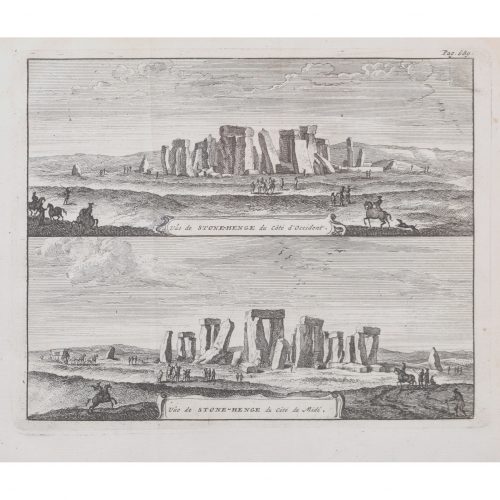
  • Pieter van der Aa (1659-1733), after David Loggan (1634–1692)

    Stonehenge (1727)

      Engraving 12 x 16 cm Two eighteenth-century views of the pagan and mystical Stonehenge, engraved by Pieter van der Aa after David Loggan, the noted engraver, draughtsman, and painter. Pieter van der Aa of Leiden was a Dutch publisher best known for preparing maps and atlases, though he also printed editions of foreign bestsellers and illustrated volumes. He is noted for the many engravings he produced after David Loggan's series of Oxford and Cambridge colleges and costumes. In 1727 Van Der Aa illustrated "Les Delices de la Grande Bretagne & de L'Irelande" by James Beeverell, the book in which this engraving appears. Condition: a good impression. If you’d like to know more, please email info@manningfineart.co.uk or call us on 07929 749056.
  • Anon.

    Strand Routemaster

    Slipboard Poster c.1970 Screenprint poster 64x9cm In a black hand-finished frame. Printed for London Transport for use on Routemaster or RT busses. If you are interested email info@manningfineart.co.uk or call us on 07929 749056. Condition: Excellent.
  • John Dixon Scott Stratford-upon-Avon

    76 x 51 cm Lithograph Published by the Travel Association of Great Britain and N.Ireland this beautiful photographic image encouraged travel to Stratford-upon-Avon and the United Kingdom more generally. This poster was part of a broader series released in 1947/48 by the British Travel Association to coincide with the 1948 Olympic Games in London in an effort to bring international tourism back to the United Kingdom after the Second World War. John Dixon Scott (1890–1977) was a British photographer known for his extensive documentation of the British countryside, landscapes, and rural life. In the late 1920s, Scott became concerned at the way the rural and urban environment of Britain was changing. As a result, he decided to drive around the country with his camera, intending to preserve through his pictures what he saw as a vanishing landscape. This project occupied him for the rest of his career, resulting in images including the photograph pictured.
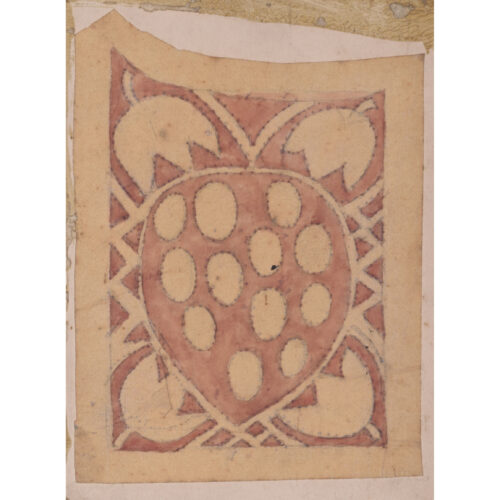
  • Reginald Hallward (1858 - 1948)

    Design for a banner in the shape of a strawberry

      Watercolour 14 x 10 cm A design for a banner featuring a strawberry motif. The design, like many others by Hallward, is likely influenced by in the Arts and Crafts style popularised by William Morris in the 1890s. Reginald Hallward was born on the Isle of Wight, and was a painter, poet, glassmaker and book designer. He is best known for his stained glass window designs and the tempera murals he painted in several churches. A great exponent of the English Arts and Crafts movement, he often used black paint for outlines, rather than leaded glass. A consumate craftsman, he insisted on painting, firing and leading with his own hands. Condition: mounted to board, old glue marks to margins, and some loss of colour; otherwise good. If you are interested, please email info@manningfineart.co.uk or call us on 07929 749056. Click here for other pictures by Reginald Hallward.
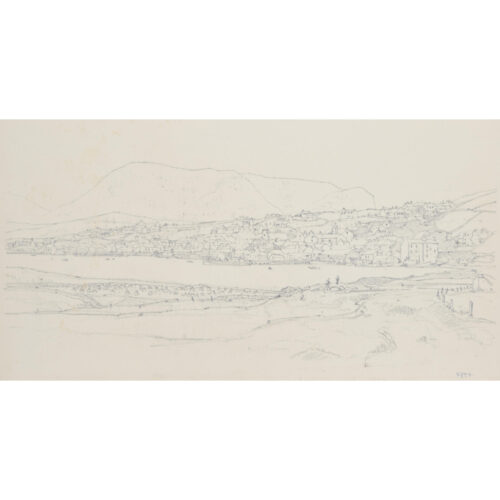
  • Claude Muncaster (1903 - 1974)

    Stromness, Orkney

      Pencil drawing 23 x 53 cm A drawing of Stromness, Orkney, with two figures in the foreground. The buildings seem tiny in comparison to the huge cliffs overlooking the town. Claude Grahame Muncaster, RWS ROI RBA SMA was the son of Oliver Hall RA. He was born Grahame Hall (his father was the Royal Academician Oliver Hall, who taught his son to paint from an early age) but adopted the name Claude Muncaster in 1922, hoping to strike out on his own and dissociate his career from that of his father. His career as a landscape painter began when he was fifteen; he spent the 1920s and 30s travelling the world with his sketchbook by boat. Muncaster’s primary choice of subject matter came from a genuine love of the sea. He made several long-distance sea voyages, including one around the Horn as a deckhand in the windjammer Olivebank in 1931, which he described in ‘Rolling Round the Horn’, published in 1933. Armed with a sketchbook, his aim was to be able to ‘paint ships and the sea with greater authority’. This he certainly achieved, perfectly capturing the limpid first light of morning over the Port of Aden, the choppy rain-grey waters of the Bay of Biscay and a streak of sunlight through gathering storm clouds at dusk in Exeter. He became an Associate of the Royal Watercolour Society in 1931 and was a founder member, and later President, of the Royal Society of Marine Artists. When the Second World War broke out, Muncaster joined the Royal Naval Reserves, training as a navigator before going on to advise on the camouflage of ships. He also worked as an official war artist. In ‘Still Morning at Aden’ (1944) he depicts Allied warships in this safe anchorage in the Middle East; the back is stamped with Admiralty approval. In 1946-7 he was commissioned by the Queen to produce watercolours of the royal residences (some of which are available below); the Duke of Edinburgh, in a foreword to a biography of Muncaster, recalls looking at these and considering the artist’s ‘unerring instinct for a subject’, his sense of atmosphere. Other commissions included large panoramas of the Thames and of Bradford. His career also included work as an etcher, illustrator, writer, lecturer and broadcaster, and his paintings can be found in the Royal Academy, Tate, National Maritime Museum Cornwall, National Railway Museum and Royal Air Force Museum. He was a frequent guest at Sandringham for the rest of his life. If you are interested, please email info@manningfineart.co.uk or call us on 07929 749056. Click here for other works by the artist.
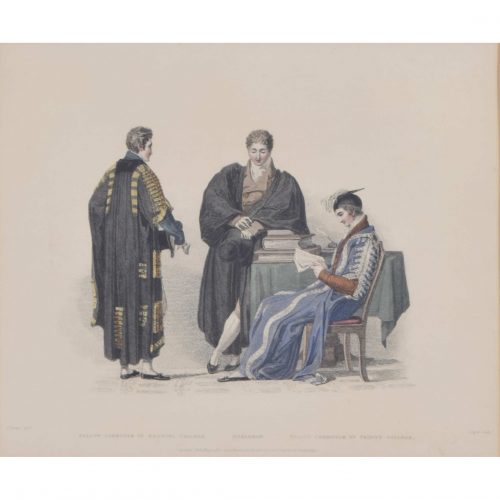
  • John Samuel Agar (1773 - 1858) after John Uwins (1782 - 1857) Fellow Commoner of Emanuel College; a Nobleman; Fellow Commoner of Trinity College (1815)

    Hand-coloured aquatint 25 x 29.5 cm Published by Rudolph Ackermann (1764 - 1834). An engraving of two students and a nobleman from Ackermann's 'A History of the University of Cambridge, Its Colleges, Halls and Public Buildings'. The three figures dwell over a pile of books and papers, clad in the appropriate academic dress. Thomas Uwins RA RWS was a British painter in watercolour and oil, and a book illustrator. He became a full member of the Old Watercolour Society and a Royal Academician, and held a number of high-profile art appointments including the librarian of the Royal Academy, Surveyor of Pictures to Queen Victoria and the Keeper of the National Gallery. In the late 1790s he began producing work for Ackermann's collections. John Samuel Agar was an English portrait painter and engraver, who exhibited his works at the Royal Academy from 1796 to 1806 and at the British Institution until 1811. He was at one time president of the Society of Engravers. Rudolph Ackermann published many of his engravings. Rudolph Ackermann was an Anglo-German bookseller, inventor, lithographer, publisher and businessman. In 1795 he established a print-shop and drawing-school at 96 Strand. Here Ackermann set up a lithographic press and began a trade in prints. He later began to manufacture colours and thick carton paper for landscape and miniature painters. Within three years the premises had become too small and he moved to 101 Strand, in his own words "four doors nearer to Somerset House", the seat of the Royal Academy of Arts. Between 1797 and 1800 Ackermann rapidly developed his print and book publishing business, encompassing many different genres including topography, caricature, portraits, transparencies and decorative prints. Condition: Good. Some age toning, frame included.
  • John Samuel Agar (1773 - 1858) after John Uwins (1782 - 1857)

    Fellow Commoner of Emanuel College; a Nobleman; Fellow Commoner of Trinity College (1815)

      Hand-coloured aquatint 25 x 29.5 cm Published by Rudolph Ackermann (1764 - 1834). An engraving of two students and a nobleman from Ackermann's ''A History of the University of Cambridge, Its Colleges, Halls and Public Buildings''. The three figures dwell over a pile of books and papers, clad in the appropriate academic dress. Thomas Uwins RA RWS was a British painter in watercolour and oil, and a book illustrator. He became a full member of the Old Watercolour Society and a Royal Academician, and held a number of high-profile art appointments including the librarian of the Royal Academy, Surveyor of Pictures to Queen Victoria and the Keeper of the National Gallery. In the late 1790s he began producing work for Ackermann''s collections. John Samuel Agar was an English portrait painter and engraver, who exhibited his works at the Royal Academy from 1796 to 1806 and at the British Institution until 1811. He was at one time president of the Society of Engravers. Rudolph Ackermann published many of his engravings. Rudolph Ackermann was an Anglo-German bookseller, inventor, lithographer, publisher and businessman. In 1795 he established a print-shop and drawing-school at 96 Strand. Here Ackermann set up a lithographic press and began a trade in prints. He later began to manufacture colours and thick carton paper for landscape and miniature painters. Within three years the premises had become too small and he moved to 101 Strand, in his own words "four doors nearer to Somerset House", the seat of the Royal Academy of Arts. Between 1797 and 1800 Ackermann rapidly developed his print and book publishing business, encompassing many different genres including topography, caricature, portraits, transparencies and decorative prints. Condition: good. Some age toning. If you’d like to know more, please email info@manningfineart.co.uk or call us on 07929 749056.
  • George Bissill (1896-1973) Study for oil painting- Coombe, Hampshire

    Pencil sketch 25 x 31 cm Born in 1896, George Bissill was a British miner, painter and furniture designer. Raised in the mining village of Langley Mill, Derbyshire, Bissill became a miner at the age of 13, before leaving to join the war effort in 1915. Upon his return from the war after being gassed, Bissill chose to become a pavement artist outside the newly erected Bush House in Aldwych, painting from his memory and his sketch book the uncompromising underground world he had inhabited. In 1935 he moved to the countryside near Newbury, where he lived and worked as a landscape painter, art restorer and dealer until his death in 1973. This sketch forms part of a larger collection, 'unseen since they were taken from George Bissil's studio in 1983' and restored by Kate Pattinson. A series of planned exhibitions were cancelled due to Covid, but two shows, one in Oxford and one in Ilkeston, did take place. Through such exhibitions, Pattinson hoped to 'restore the reputation of an artist who, through mighty endeavour, conquered the art world in the 1920s with his powerful, authentic and experimental pictures.' Bissill's paintings are also held in a number of important public collections, including the Tate Gallery, National Museum of Ireland and the Manchester Art Gallery. This pencil sketch depicts a view of a farmhouse, nestled at the foot of some rolling Hampshire hills. Bissill's scrawling writing in the bottom right of the sketch reveal it to be a study for a later oil painting, providing a unique insight into his artistic practices.
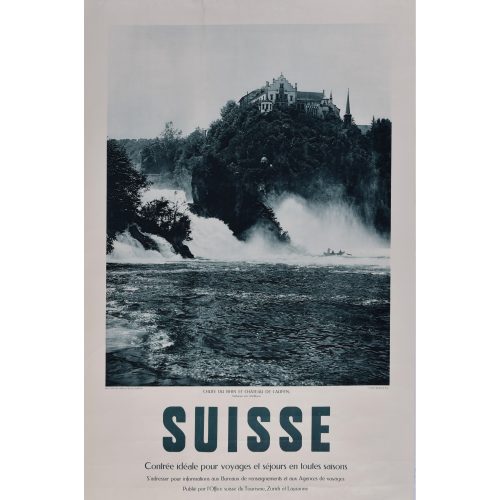
  • Suisse Chutes du Rhin

    Original lithographic poster (1925) 40x25" If you are interested email info@manningfineart.co.uk or call us on 07929 749056. Condition: Generally good, a little edge wear.
  • A. E. Halliwell (1905-1987) Summer and August Bank Holiday Period Excursions

    Gouache 26 x 15 cm c.1930 Provenance: Family of the artist A.E. Halliwell (1905–1986) was a British artist, illustrator, and designer best known for his vibrant poster designs created for British railway companies during the mid-20th century. Born in Southport, Halliwell developed a strong foundation in art and design early in life. He studied at the Southport School of Art from 1923 to 1926 before graduating to the Royal College of Art in London and subsequently practising as a professional designer from the 1930s. Following his studies, Halliwell married Doris Doyle in Strood Kent, and  went on to have a significant teaching career himself, most notably as a lecturer at the Central School of Arts and Crafts (later part of Central Saint Martins), where he influenced a new generation of designers and illustrators. Halliwell is perhaps best remembered for his vibrant and engaging poster designs created for British railway companies during the 1930s. His work was characterised by a bright, graphic style that balanced charm with clarity, often depicting idealised scenes of British holiday destinations—from sunny seaside towns to tranquil countryside vistas. Beyond posters, his artistic output included book illustration, commercial design, and stage costume sketches, showcasing his versatility across mediums. His posters continue to remain enduring symbols of a golden age of British travel and design and are displayed in major collections including the London Transport Museum. This bold and colourful poster design by A.E. Halliwell promotes summer and August Bank Holiday railway excursions from London. Featuring a stylised rose and butterfly against graphic, patterned backgrounds, the composition combines vibrant reds, pinks, and blues with playful typography. Though unfinished, the design captures Halliwell’s distinctive flair for eye-catching, decorative travel posters typical of mid-20th century British railway advertising. Condition: Generally very good.

    If you would like to know more, please email info@manningfineart.co.uk or call us on 07929 749056.

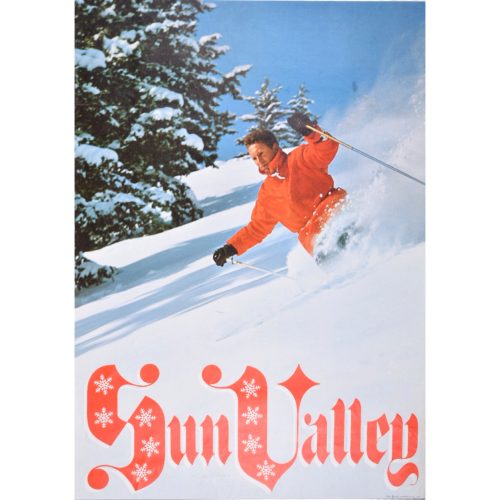
  • Sun Valley

    Original lithographic poster c. 1965 76x51cm Published by LooArt Press, Colorado The resort was the first destination winter resort in the US and was developed by W A Harriman, the chairman of the Union Pacific Railroad to increase passenger numbers. The Austrian Count Schaffgotsch was instructed to find a suitable site and Sun Valley was born. Sun Valley was the site of the world's first chairlifts as single-seat chairs were installed in 1936 for the opening. The poster is believed to depict Sigfried 'Sigi' Engl, an Austrian who became director of Sun Valley Ski School in 1952 and made it famous for his innovative instructional methods. A few light creases and small spot towards top right.
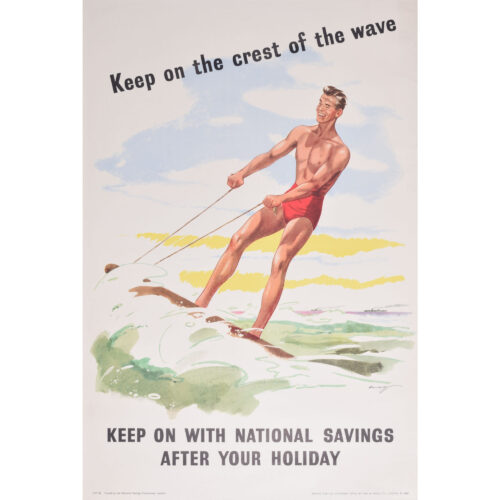
  • Keep on the Crest of the Wave

      Original vintage poster 76 x 51 cm Issued by the National Savings Committee, London. Printed for HM Stationery Office by Fosh & Cross Ltd. An original vintage WW2 poster encouraging Britons to save via the National Savings scheme - like the cheery and composed surfer, we must keep saving to stay on the crest of the wave. Condition: generally very good; slight wear to right-hand margin. Not backed. If you are interested, please email info@manningfineart.co.uk or call us on 07929 749056. Click here for other original vintage National Savings posters.
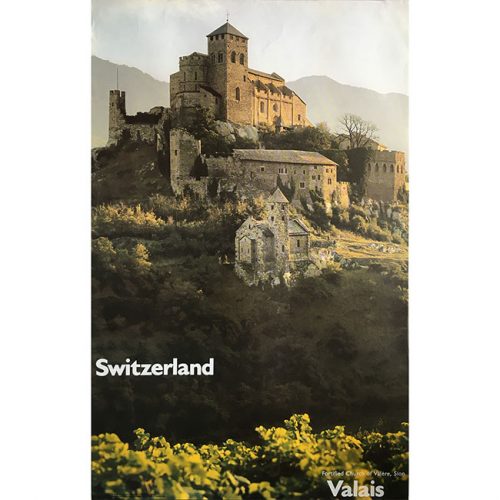
  • Anonymous Switzerland (Valais, Church of Rarogne) Photo:Giegel/SNTO Photolithographic poster 102x64cm If you are interested email info@manningfineart.co.uk or call us on 07929 749056.
  • Hugo Wetli (1916 - 1972)

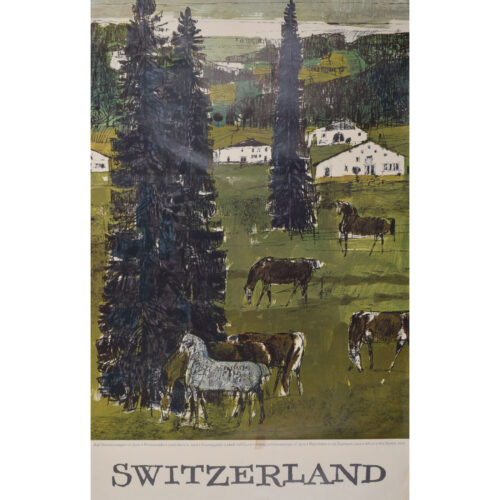
    Switzerland - Afoot in the Swiss Jura

    Original vintage poster 100 x 64 cm Hugo Wetli trained as a technical draughtsman and then became apprenticed to a private graphic studio. He worked in Geneva and Berne as a painter and draughtsman, also producing book illustrations and travel poster designs. In 1947 he studied at the Académie de la Grande Chaumière in Paris and then ran his own graphic design studio. Condition: generally very good; old tape stain under 'Paseo' approx 2 cm sq and extending almost invisibly into image; a few pin holes to corners; a little soft creasing. If you are interested, please email info@manningfineart.co.uk or call us on 07929 749056. Click here for other original vintage travel posters.
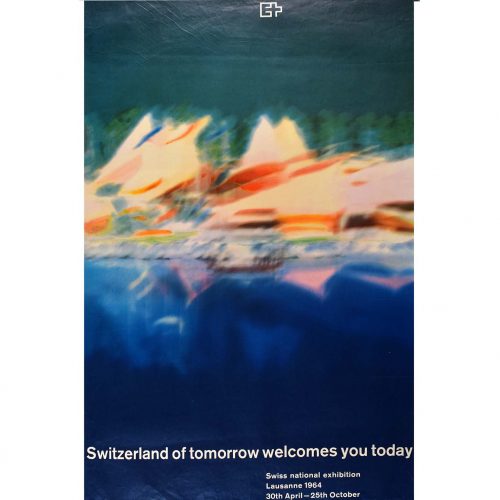
  • Switzerland of Tomorrow Welcomes You Today (1964)

    Lithographic poster 152.4cm x 63.5 cm 1964   Original "Switzerland of Tomorrow" poster from the 1964 Swiss National Exhibition. As well as a brilliantly-designed futuristic poster printed in rich colours, it is a real piece of Swiss (and European) history. The poster is the English-language edition of a tourism-encouraging poster produced in several languages to welcome international visitors to an exhibition of Swiss innovation. Switzerland holds such an event four times per century, and the exhibitions often act as a portrait of contemporary culture, design, and politics. The 1964 National Exhibition in Lausanne offered a rather different representation of Switzerland from previous exhibitions. This was partly the result of its being held during one of the tensest periods of the Cold War; the attitudes of the Swiss were changing as the twentieth century progressed, as was the case for most Europeans, and the shadow of war had encouraged many citizens, businesses, and public bodies to reexamine their values. At "Expo 64", the nickname for that year's exhibition, the 'Gulliver Project' was introduced. The exhibition organisers made use of the character Gulliver (from Swift's 'Gulliver's Travels' to assess visitors' attitudes to daily life. A small questionnaire written by "Gulliver" was given to visitors, asking them questions about their societal attitudes, domestic lives, and work ethics, such as "Can you be a good Swiss and get up at 9am?". The theatre director Charles Apothéloz suggested having Gulliver ask these questions so as to make the questionnaire seem less serious, and to encourage people to answer truthfully. The questionnaire answers were compiled and analysed, but never published, as had been Apothéloz's initial intention. Charles Ascher discusses this at length in his 1965 article 'Gulliver in the Land of the Swiss'. If you are interested, please email info@manningfineart.co.uk or call us on 07929 749056. Condition: Good, pinholes to corners with some soft creases along bottom inch (would be hidden by mount).
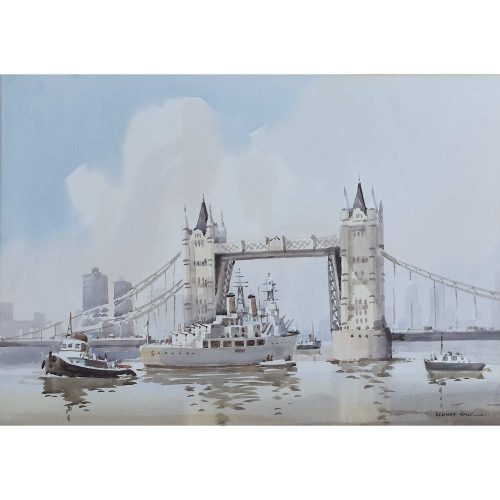
  • Sydney Vale F. R. S. A. (1916 - 1991)

    A warship passing under Tower Bridge

      Watercolour 35 x 50 cm Born in 1916, Sydney Vale was a Fellow of the Royal Society of Arts and a member of the prestigious Wapping Group of Artists from 1972 to 1991, which was formed primarily to record life in London's Docklands. Within this group, Vale and his contemporaries specialised in portraying the charm and romance of the River Thames from source to estuary.
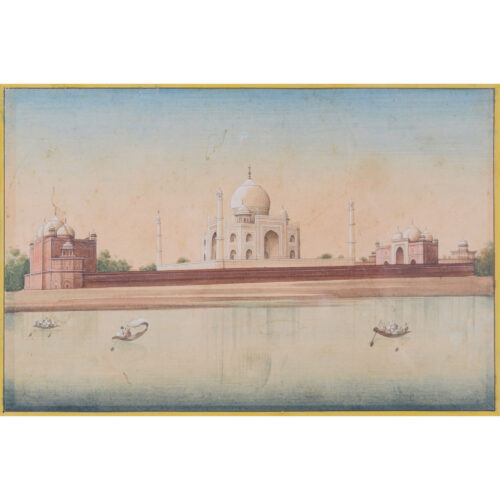
  • Taj Mahal, India

      Watercolour 13 x 20 cm
    A 20th century watercolour by an unknown artist of the Taj Mahal, Shah Jahan's 1631 mausoleum for his wife. We have three other Indian architectural views by the same artist available.
    Condition: generally very good; one or two small scratches as visible in photographs. If you are interested, please email info@manningfineart.co.uk or call us on 07929 749056. Click here for other works from the same series.
  • A. E. Halliwell (1905-1987) Take the Underground to the RA

    Gouache c.1930 23 x 30 cm Provenance: the family of A. E. Halliwell A.E. Halliwell (1905–1986) was a British artist, illustrator, and designer best known for his vibrant poster designs created for British railway companies during the mid-20th century. Born in Southport, Halliwell developed a strong foundation in art and design early in life. He studied at the Southport School of Art from 1923 to 1926 before graduating to the Royal College of Art in London and subsequently practising as a professional designer from the 1930s. Following his studies, Halliwell married Doris Doyle in Strood Kent, and  went on to have a significant teaching career himself, most notably as a lecturer at the Central School of Arts and Crafts (later part of Central Saint Martins), where he influenced a new generation of designers and illustrators. Halliwell is perhaps best remembered for his vibrant and engaging poster designs created for British railway companies during the 1930s. His work was characterised by a bright, graphic style that balanced charm with clarity, often depicting idealised scenes of British holiday destinations—from sunny seaside towns to tranquil countryside vistas. Beyond posters, his artistic output included book illustration, commercial design, and stage costume sketches, showcasing his versatility across mediums. His posters continue to remain enduring symbols of a golden age of British travel and design and are displayed in major collections including the London Transport Museum and the V & A. This playful work features a man, clad in tartan trousers and puffing away at a pipe, marching steadfastly with the roundel of the London Underground in two. The roundel is adorned with the ornate decoration that surrounds the stylised letters of the R and A of the Royal Academy, suggesting that the man is marching straight towards the Academy. In classic Halliwell style, the design features a play on words, the man is not just taking the underground, as you do, he is physically and literally bringing the Underground with him to the exhibition, adding a mischievous flare to the piece. Condition: Generally very good.

    If you would like to know more, please email info@manningfineart.co.uk or call us on 07929 749056.
  • Cecil Keeling Taking cover in the trenches Pen, ink and wash 20 x 26 cm Initialled lower right This poignant work depicts three soldiers sheltering from a raid in the trenches. As searchlights illuminate the night sky, two of the men shield their ears, seemingly bracing themselves for the horrors of the night, while the third looks to the side, as if something has caught his attention. While the fear of the two men is palpable, the other man--wrapped up in his blanket, looking into the distance--seems numbed to the conflict around him. Perhaps based on his personal experiences of serving in the Middle East, Keeling powerfully captures the subtlety of emotions of his subjects and thereby uniquely represents the experience of war. Cecil Keeling (1912-1976) was an English designer and illustrator and was known for his diverse artistic techniques, including scraperboard, lithography, linocuts, and wood engravings. He studied at the Putney School of Art, before continuing his studies at the Chelsea School of Art. His work is generally characterised by a blend of traditional and modern techniques, reflecting his adaptability and creative range. He is remembered for his keen attention to detail and a deep appreciation for the subjects he depicted. Condition: Generally very good.

    If you would like to know more, please email info@manningfineart.co.uk or call us on 07929 749056.
  • Taos New Mexico USA Vintage Ski Poster 1974 Victor Frohlich and Tom Carrera

    67 x 53 cm Poster Printed by LooArt Press, Colorado Springs, Colorado Direct from the surplus stock of the printers, LooArt Press, which closed in the early 1970s. This features Victor Frohlich in the foreground, who had been at Taos Ski Valley since the start, with Tom Carrera in behind him. This is on the Snakedance fun in 1974. Taos Ski Valley was founded in 1955 by Ernie and Rhonda Blake who lived in an eleven foot camper van prior to the construction of the Hondo Lodge - now the Inn at Snakedance (where they lived without power until 1963!) In 1956 Ernie - together with sixteen men from Taos Puelbo and a mule named Lightning - installed the first lift, the Bridger-Boseman J-Bar, serving the current Snakedance run which at the time was the mountain's only run. Condition: From the printer's surplus stock, in generally excellent condition.
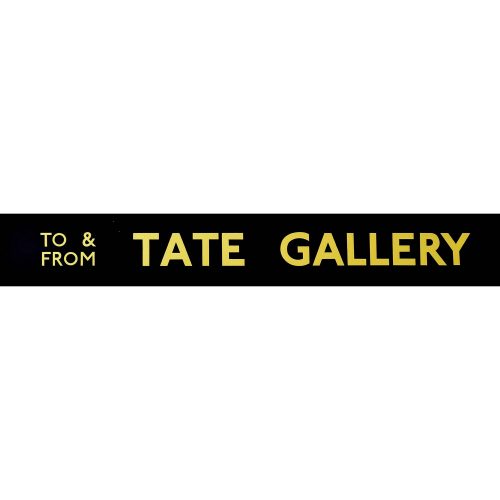
  • Anon.

    Tate Gallery Routemaster

    Slipboard Poster c.1970 Screenprint poster 64x9cm In a black hand-finished frame. Printed for London Transport for use on Routemaster or RT busses. If you are interested email info@manningfineart.co.uk or call us on 07929 749056. Condition: Excellent.
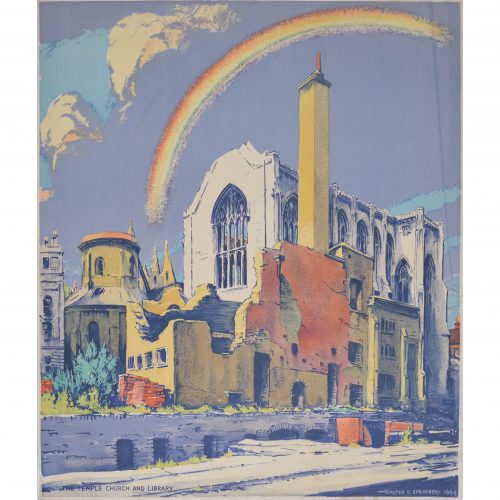
  • Walter Ernest Spradbery (1889 - 1969)

    Temple Church and Library after Bombardment (1944)

      Lithograph 66 x 57 cm Walter Spradbery's poster for the London Underground depicting a bombed Temple Church; a rainbow strikes hopefully out of the church's remains, and the sun shines on the golden stone of the building. The full poster bears the legend 'The Proud City' above Spradbery's design, and, beneath it, a quote from Charles Lamb: 'So may the winged horse, your ancient badge and cognisance, still flourish!'. This is a fantastic piece of British and London history, as well as a fantastically designed poster by a notable 20th century artist. The London Transport Museum has a copy of the poster, reference 1983/4/5751. 'The Proud City' was a series of six posters, all designed by Spradbery. They were commissioned by London Transport in 1944 as a defiant celebration of London's surviving the Blitz, and each poster also included a literary quotation. Walter Ernest Spradbery was a designer, painter, and poet who lived through the First and Second World Wars. He produced posters for LNER, Southern Railways, and London Transport, and was noted for his fascination with architecture and landscape. He studied, and later taught, at the Walthamstow School of Art. He was a pacifist and campaigned for nuclear disarmament, serving in the Medical Corps during the First World War and painting scenes of warfare for its duration, as well as during the Second World War. His anti-war stance and the horrors he had witnessed as a medic fed into his post-war poster design, especially 'The Proud City' poster series. Condition: generally very good. If you’d like to know more, please email info@manningfineart.co.uk or call us on 07929 749056.
  • George Bissill (1896-1973) Tending to the fences

    Pencil sketch 28 x 39 cm Born in 1896, George Bissill was a British miner, painter and furniture designer. Raised in the mining village of Langley Mill, Derbyshire, Bissill became a miner at the age of 13, before leaving to join the war effort in 1915. Upon his return from the war after being gassed, Bissill chose to become a pavement artist outside the newly erected Bush House in Aldwych, painting from his memory and his sketch book the uncompromising underground world he had inhabited. In 1935 he moved to the countryside near Newbury, where he lived and worked as a landscape painter, art restorer and dealer until his death in 1973. This painting forms part of a larger collection, 'unseen since they were taken from George Bissil's studio in 1983' and restored by Kate Pattinson. A series of planned exhibitions were cancelled due to Covid, but two shows, one in Oxford and one in Ilkeston, did take place. Through such exhibitions, Pattinson hoped to 'restore the reputation of an artist who, through mighty endeavour, conquered the art world in the 1920s with his powerful, authentic and experimental pictures.' Bissill's paintings are also held in a number of important public collections, including the Tate Gallery, National Museum of Ireland and the Manchester Art Gallery. This pencil sketch depicts a man tending to the fences in a woodland area. Bissil's use of strong lines to depict the man's stocky figure is evocative of his earlier paintings and sketches of the miners. It is, however, the beautifully shaded trees that stand out in this sketch, whereby Bissill illustrates the shadows of the trees on the ground and the angle of the sun rays hitting their bark. Condition: generally very good.

    If you would like to know more, please email info@manningfineart.co.uk or call us on 07929 749056.
  • Anonymous

    Man of the World: in a modern force the territorial army for adventure plus technical training 

    Lithographic poster c. 1960 75.5x51cm If you are interested email info@manningfineart.co.uk or call us on 07929 749056.
Go to Top