-
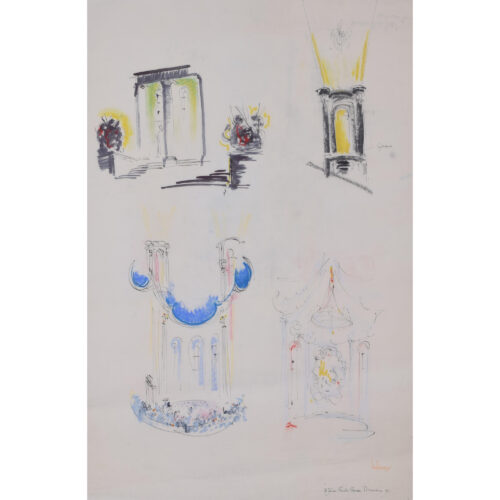
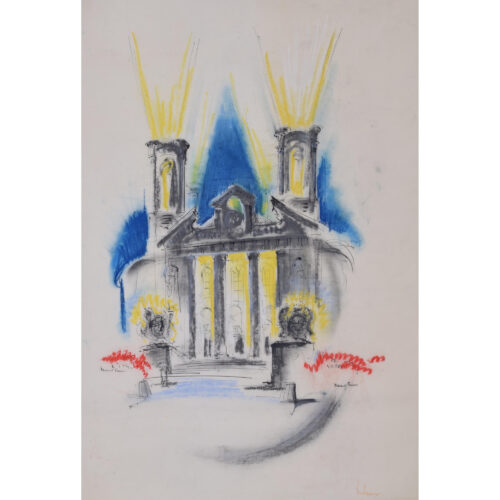
Louis Osman FRIBA (1914 - 1996)
Proposal details for St John's Smith Square (1953)
Watercolour 74 x 46 cm Signed in red crayon lower right. Details from Louis Osman's proposal for the post-war, post-bombing redevelopment of St John's church on Smith Square. Osman had envisioned an interior with a ceiling painted by Picasso; sadly, this project was never executed. The church was bombed in 1941 and gutted by fire; subsequently, the church was a ruin open to the sky for over 20 years. It was saved by Lady Parker of Waddington, who formed the Friends of St John's in 1962 to raise money and restore the church to its former glory - a reconstruction in the style of the church's original architect, Thomas Archer. Osman was as much an artist as an architect. This is a piece of architectural history as well as a beautiful Osman design. Osman was awarded a First Class degree and the Donaldson Medal of the RIBA (for the best result in his year group) by the Bartlett where he studied, and then went on to the Slade School of Art. He subsequently trained with Sir Albert Richardson - we also have several Richardson works in our collection. After the war, Osman busied himself as an architect. His work included contributions to Westminster Abbey, and Lincoln, Exeter, Ely, and Lichfield Cathedrals, Staunton Harold Church in Ashby de la Zouch for the National Trust, and of course his folly: the Grade I listed Elizabethan manor house, Canons Ashby in Northamptonshire, now a National Trust property. At Canons Ashby he established a workshop and had a team of silversmiths and goldsmiths working for him. In 1976 he made the gold enamelled coffin that holds the copy of the Magna Carta on view in the United States Capitol, Washington, DC. Condition: generally very good. If you’d like to know more, please email info@manningfineart.co.uk or call us on 07929 749056. -
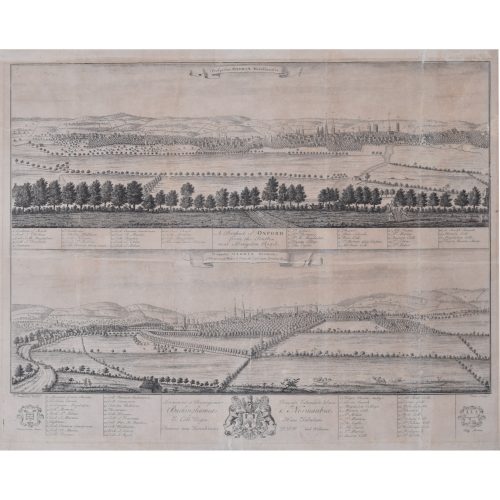
William Williams (Welsh, active 1724 - 1733)
Jesus College, Oxford (circa 1732)
Engraving 43 x 44 cm This engraving of the city of Oxford, adorned with its eponymous dreaming spires, comes from the 'Oxonia Depicta', a large folio of engraved plates illustrating Oxford's halls and colleges. Condition: previously folded; some losses to folds, some toning. If you’d like to know more, please email info@manningfineart.co.uk or call us on 07929 749056. -
Jane Gray (b.1931)
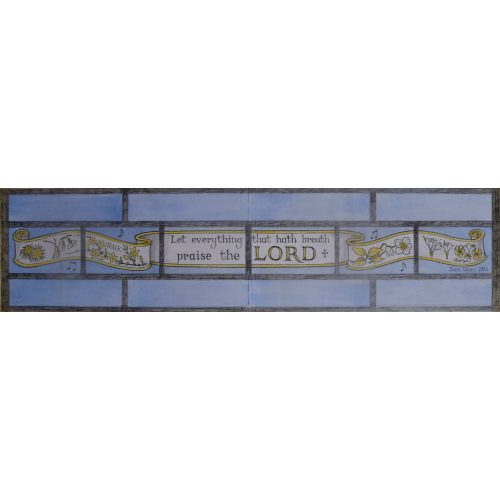
Psalm 150, Design for Stained Glass Window (1984)
Watercolour 17.5 x 71 cmSigned and dated.
This design centres on a scroll containing the lyrical text from Psalm 150:6, ‘Let. Everything that hath breath praise the LORD’. The scroll also features daintily painted white and yellow flowers as well as musical notes, typical elements of Gray's domestic designs.
Provenance: the artist’s studio sale. Condition: very good. If you are interested, please email info@manningfineart.co.uk or call us on 07929 749056. For other works by Jane Gray and more information about her, please click here. -
Pieter van der Aa (1659-1733), after David Loggan (1634–1692)
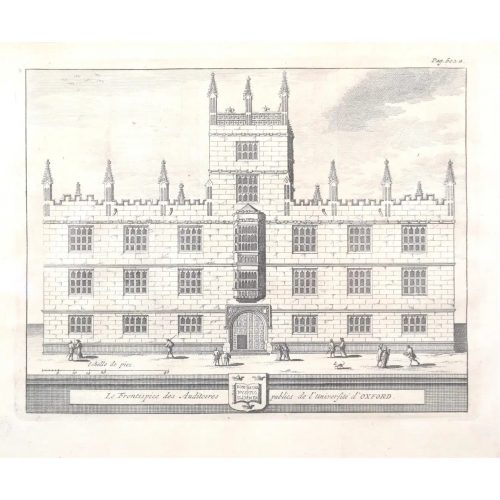
The Public Schools, University of Oxford (1727)
Engraving 12 x 16 cm An eighteenth-century view of the facade of Oxford's Public Schools, engraved by Pieter van der Aa after David Loggan, the noted engraver, draughtsman, and painter. Pieter van der Aa of Leiden was a Dutch publisher best known for preparing maps and atlases, though he also printed editions of foreign bestsellers and illustrated volumes. He is noted for the many engravings he produced after David Loggan's series of Oxford and Cambridge colleges and costumes. In 1727 Van Der Aa illustrated "Les Delices de la Grande Bretagne & de L'Irelande" by James Beeverell, the book in which this engraving appears. Condition: a good impression. If you’d like to know more, please email info@manningfineart.co.uk or call us on 07929 749056. -
Pieter van der Aa (1659-1733), after David Loggan (1634–1692)
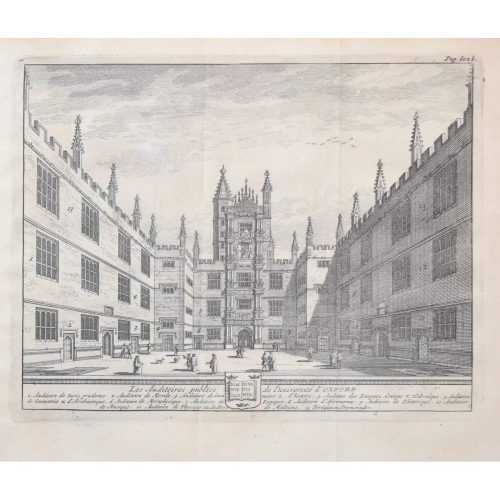
The Public Schools, University of Oxford (1727)
Engraving 12 x 16 cm An eighteenth-century view of the interior of the Public Schools, engraved by Pieter van der Aa after David Loggan, the noted engraver, draughtsman, and painter. Pieter van der Aa of Leiden was a Dutch publisher best known for preparing maps and atlases, though he also printed editions of foreign bestsellers and illustrated volumes. He is noted for the many engravings he produced after David Loggan's series of Oxford and Cambridge colleges and costumes. In 1727 Van Der Aa illustrated "Les Delices de la Grande Bretagne & de L'Irelande" by James Beeverell, the book in which this engraving appears. Condition: a good impression. If you’d like to know more, please email info@manningfineart.co.uk or call us on 07929 749056. -
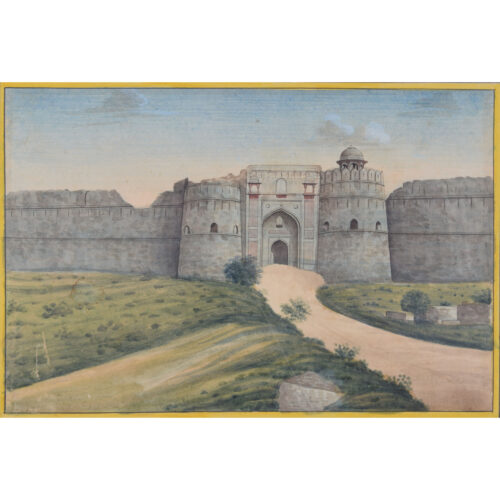
Purana Qila Fort, Delhi, India
Watercolour 13 x 20 cmA 20th century watercolour by an unknown artist of Purana Qila, one of the oldest forts in Delhi. We have three other Indian architectural views by the same artist available.Condition: generally very good; one or two small scratches as visible in photographs. If you are interested, please email info@manningfineart.co.uk or call us on 07929 749056. Click here for other works from the same series. -
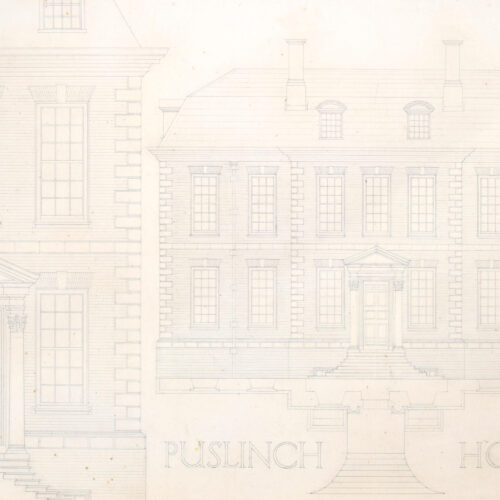
S Clapham (active 1940 - 1960)
Puslinch House
Pencil 55 x 77 cm An architectural drawing of Puslinch House, a fine Christopher Wren-style Georgian mansion in Devon. The estate was owned by the Poslylinch, Mohun, and Upton families before being taken over by the Yonge family in 1718, following the marriage of John Yonge and Mary Upton. The Queen Anne House mansion was built on the occasion of their wedding and an earlier mediaeval house still exists in the grounds as a country cottage. During the war, the house was used as a voluntary hospital for wounded officers. Clapham was an architect based in Stockwell in London. Condition: generally good; a little spotting, backed to board by artist and signed to board lower right. If you are interested, please email info@manningfineart.co.uk or call us on 07929 749056. Click here for other works by the artist. -
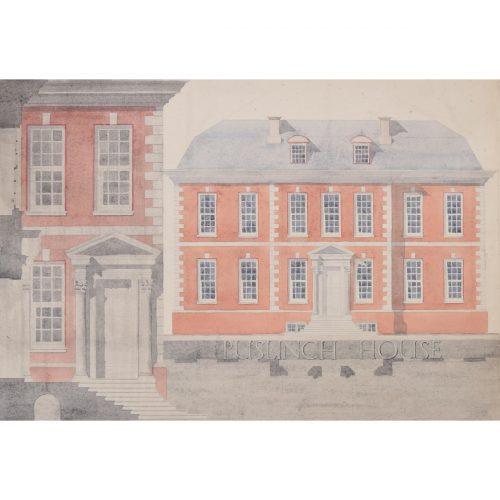
S Clapham (active 1940 - 1960)
Puslinch House
Watercolour 49 x 70 cm A beautifully-coloured watercolour of Puslinch House, a fine Christopher Wren-style Georgian mansion in Devon. The estate was owned by the Poslylinch, Mohun, and Upton families before being taken over by the Yonge family in 1718, following the marriage of John Yonge and Mary Upton. The Queen Anne House mansion was built on the occasion of their wedding and an earlier mediaeval house still exists in the grounds as a country cottage. During the war, the house was used as a voluntary hospital for wounded officers. Clapham was an architect based in Stockwell in London. Condition: generally very good; a little faint spotting to top right corner. If you are interested, please email info@manningfineart.co.uk or call us on 07929 749056. Click here for other works by the artist. -

John Bluck (early 19th century) after Frederick Mackenzie (1788 - 1854) Quadrangle of Balliol College, Oxford (1814)
Aquatint with original hand colouring 21 x 27 cm Published by Rudolph Ackermann (1764 - 1834). Frederick Mackenzie (1788 - 1854) was a British watercolourist and architectural draughtsman. He first exhibited at the Royal Academy in 1804, and contributed eleven drawings between that year and 1828. He contributed to the Society of Painters in Water Colours exhibitions from 1813, becoming an associate in 1822, and a full member the following year. From 30 November 1831 till his death he was treasurer to the society. In later life Mackenzie was no longer commissioned to illustrate books. John Bluck was an aquatint engraver, mainly of topographical views, but also of marine and sporting subjects after his contemporaries. He produced plates for numerous publications. Rudolph Ackermann was an Anglo-German bookseller, inventor, lithographer, publisher and businessman. In 1795 he established a print-shop and drawing-school at 96 Strand. Here Ackermann set up a lithographic press and began a trade in prints. He later began to manufacture colours and thick carton paper for landscape and miniature painters. Within three years the premises had become too small and he moved to 101 Strand, in his own words "four doors nearer to Somerset House", the seat of the Royal Academy of Arts. Between 1797 and 1800 Ackermann rapidly developed his print and book publishing business, encompassing many different genres including topography, caricature, portraits, transparencies and decorative prints. Condition: Generally very good.If you would like to know more, please email info@manningfineart.co.uk or call us on 07929 749056.
-
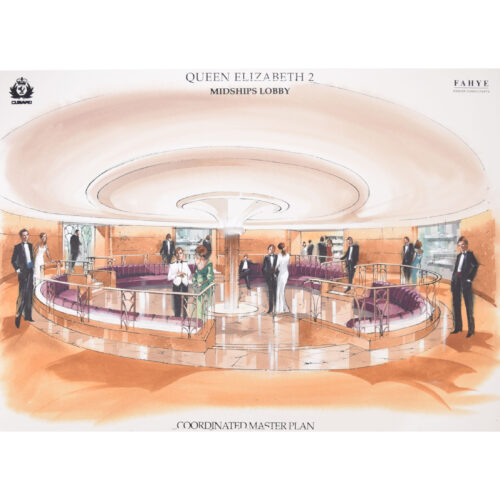
Fahye Design Consultants for Cunard
Queen Elizabeth 2 - Midships Lobby
Gouache and lettraset 59 x 83 cm A fabulously mid-century design for a lobby in the QE2, a luxury ocean liner operated by Cunard from 1969 to 2008. Glamorous passengers in black tie mingle in the lobby before dinner. A sunken conversation pit marks the mid-century interior style of the ship. The Queen Elizabeth 2 was designed in Cunard's offices in Liverpool and Southampton and built in Clydebank, Scotland. She was retired in 2018 and is now a floating hotel in Dubai. Condition: very good; mounted to foamboard. If you are interested, please email info@manningfineart.co.uk or call us on 07929 749056. -
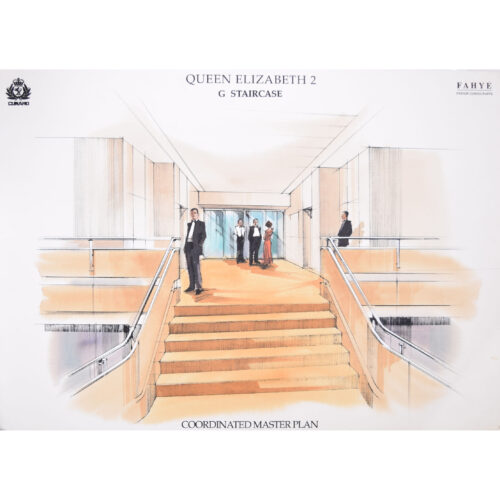
Fahye Design Consultants for Cunard
Queen Elizabeth 2 - Staircase G
Gouache and lettraset 59 x 83 cm A fabulously mid-century design for a staircase in the QE2, a luxury ocean liner operated by Cunard from 1969 to 2008. Glamorous passengers in black tie mingle on the staircase landing before dinner. Fahye's gouache designs illustrate the mid-century modern aesthetic of the golden age of ocean travel. The Queen Elizabeth 2 was designed in Cunard's offices in Liverpool and Southampton and built in Clydebank, Scotland. She was retired in 2018 and is now a floating hotel in Dubai. Condition: very good; mounted to foamboard. If you are interested, please email info@manningfineart.co.uk or call us on 07929 749056. -
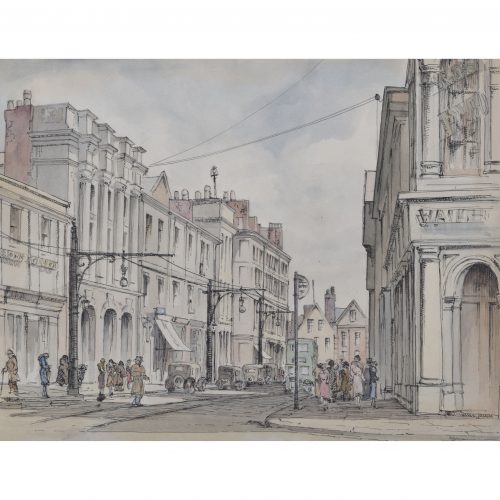
Louis Osman (1914 - 1996)
Queen Street, Exeter
Watercolour 25 x 33 cm Inscribed in Osman's hand on old mount (visible in the gallery of photographs). Osman's view of Queen Street in Exeter, complete with modish pedestrians and vehicles typical of the 1930s. Osman was as much an artist as an architect. This is likely a portfolio piece from his time studying at the Bartlett School of Architecture, and is as such a piece of architectural history as well as a beautiful Osman design. Osman was awarded a First Class degree and the Donaldson Medal of the RIBA (for the best result in his year group) by the Bartlett, and then went on to the Slade School of Art. He subsequently trained with Sir Albert Richardson - we also have several Richardson works in our collection. After the war, Osman busied himself as an architect. His work included contributions to Westminster Abbey, and Lincoln, Exeter, Ely, and Lichfield Cathedrals, Staunton Harold Church in Ashby de la Zouch for the National Trust, and of course his folly: the Grade I listed Elizabethan manor house, Canons Ashby in Northamptonshire, now a National Trust property. At Canons Ashby he established a workshop and had a team of silversmiths and goldsmiths working for him. In 1976 he made the gold enamelled coffin that holds the copy of the Magna Carta on view in the United States Capitol, Washington, DC. Condition: generally very good; some age toning. If you’d like to know more, please email info@manningfineart.co.uk or call us on 07929 749056. -
 Anonymous Queen's College and the High, Oxford Watercolour 12 x 16 cm Initialled to bottom left This highly-detailed watercolour depicts everyday life in front of Queen's College and on the High in Oxford in the Eighteenth Century. Well-dressed city dwellers wander along the high street while merchants tidy up after a carriage mishap and a dog dashes across the road. The noise of city life is intriguingly captured in this watercolour, harking back to days-gone-by. Condition: Generally very good, mounted to board.
If you would like to know more, please email info@manningfineart.co.uk or call us on 07929 749056.
-

J. C. Buckler (1793-1894) Queen's College in the High Street Oxford
Watercolour 29 x 36 cm Signed to lower right. John Chessell Buckler (1793–1894) was a British architect and artist, renowned for his contributions to Gothic Revival architecture and his detailed architectural drawings. Throughout his career, Buckler did a lot of work in Oxford. He carried out repairs and additions to St Mary's Church, and Oriel, Brasenose, Magdalen, and Jesus colleges. During this period, he was also an extremely prolific artist, creating works characterised by his fastidious attention to detail and strong sense of architectural perspective. Between 1797 and 1830 he created no less than 625 Indian ink and 19 watercolour drawings, many of which are now housed in the Bodeleian libraries. As one of only 19 watercolour paintings produced by Buckler, this painting of Queen's College constitutes a rare opportunity to own such a fine example of Buckler's work. It depicts the façade of Queen's College using strong lines, exemplifying Buckler's strong sense of architectural perspective. Scholars, all dressed in academic robes, also wander down the street, breathing life into this architectural drawing. Condition: Generally very good.If you would like to know more, please email info@manningfineart.co.uk or call us on 07929 749056.
-
Out of stock
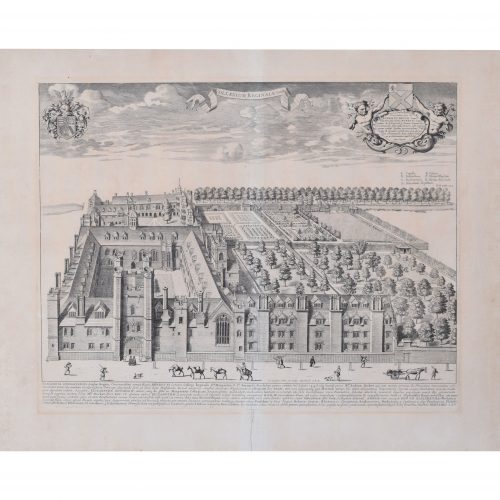
David Loggan (1634 - 1692)
Queen's College, Cambridge (1690)
Engraving 36 x 46 cm Loggan was born to English and Scottish parents, and was baptised in Danzig in 1634. After studying engraving in Danzig with Willem Hondius (1598-1652 or 1658), he moved to London in the late 1650s, going on to produce the engraved title-page for the folio 1662 Book of Common Prayer. He married in 1663 and moved to Nuffield in Oxfordshire in 1665. Loggan was appointed Public Sculptor to the nearby University of Oxford in the late 1660s, having been commissioned to produce bird’s-eye views of all the Oxford colleges. He lived in Holywell Street as he did this. The 'Oxonia Illustrata' was published in 1675, with the help of Robert White (1645 - 1704). Following its completion, Loggan began work on his equivalent work for Cambridge; the 'Cantabrigia Illustrata' was finally published in 1690, when he was made engraver to Cambridge University. The 'Oxonia Illustrata' also includes an engraving of Winchester College (Winchester and New College share William of Wykeham as their founder) whilst the 'Cantabrigia Illustrata' includes one of Eton College (which shares its founder, Henry VIII, with King’s College). Bird’s-eye views from this era required a particular talent as an architectural perspectivist; it was not until 1783 that it became possible for artists to ascend via hot air balloons and view the scenes they were depicting from above. Loggan thus had to rely on his imagination in conceiving the views. Loggan’s views constitute the first accurate depictions of the two Universities, in many ways unchanged today. Whilst the Oxford engravings were produced in reasonable numbers and ran to a second edition by Henry Overton (on thicker paper and with a plate number in Roman numerals in the bottom right-hand corner), those of Cambridge were printed in much smaller numbers. The Dutchman Pieter van der Aa published some miniature versions of the engravings for James Beverell’s guidebook to the UK, 'Les Delices de la Grande Bretagne' (circa 1708). The contemporary artist Andrew Ingamells has produced a highly-acclaimed series of etchings which bring Loggan’s original vision up to date. Condition: generally good; mostly even over-all toning, fraction lighter down central fold; has previously been washed. If you’d like to know more, please email info@manningfineart.co.uk or call us on 07929 749056. -
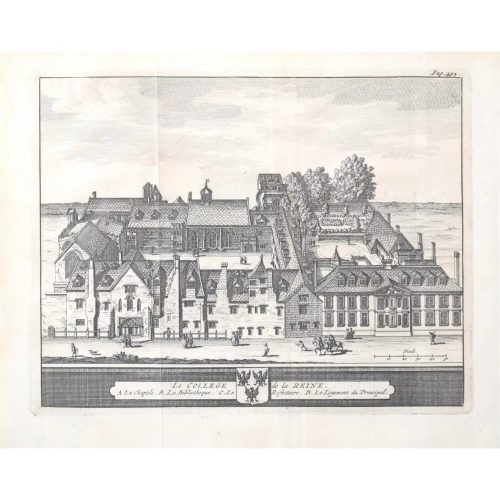
Pieter van der Aa (1659-1733), after David Loggan (1634–1692)
Queen's College, Oxford (1727)
Engraving 12 x 16 cm An eighteenth-century view of Le College de la Reine (Queen's College), engraved by Pieter van der Aa after David Loggan, the noted engraver, draughtsman, and painter. The college was founded in 1341 by Robert de Eglesfield in honour of Philippa of Hainault (the wife of King Edward III). Queen's is known for its predominantly neoclassical architecture, which includes buildings designed by Sir Christopher Wren and Nicholas Hawksmoor. Pieter van der Aa of Leiden was a Dutch publisher best known for preparing maps and atlases, though he also printed editions of foreign bestsellers and illustrated volumes. He is noted for the many engravings he produced after David Loggan's series of Oxford and Cambridge colleges and costumes. In 1727 Van Der Aa illustrated "Les Delices de la Grande Bretagne & de L'Irelande" by James Beeverell, the book in which this engraving appears. Condition: a good impression. If you’d like to know more, please email info@manningfineart.co.uk or call us on 07929 749056. -
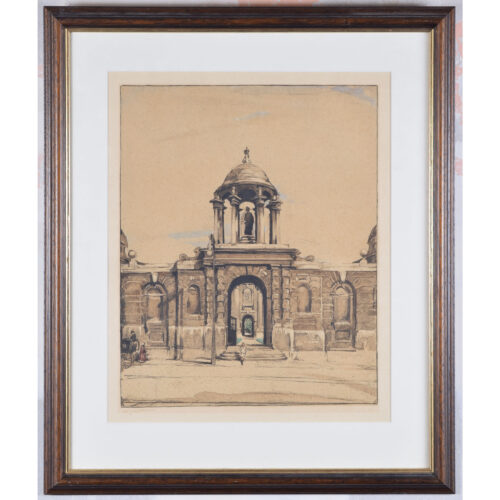
William Nicholson (1872 - 1949)
Queen's College, Oxford
Lithograph 38 x 30 cm Signed lower left. Between 1902 and 1904 William Nicholson lived in Woodstock; during this period he made several architectural studies of Oxford's colleges and other University buildings. Sir William Nicholson was a British painter and printmaker. He is also known as an illustrator, author of children’s books, stained glass designer, and theatre set designer. Condition: very good. If you are interested, please email info@manningfineart.co.uk or call us on 07929 749056. Click here for other views of Queen's College, Oxford. -
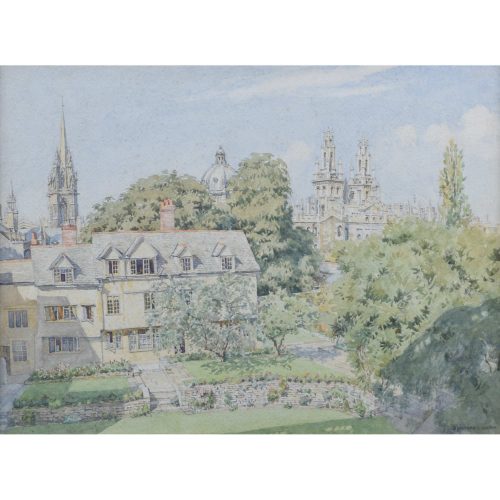
Bernard Cecil Gotch (1876-1964)
Queen's College, Oxford
Watercolour 28 x 39 cm (51 x 64 cm framed) Signed lower right. Queen's College in all its leafy glory. The dreaming spires of the University Church of St Mary the Virgin, the Radcliffe Camera, and All Souls peep over the quad. Bernard Cecil Gotch was a Winchester-born artist who is best known for his atmospheric watercolours of Britain's towns and cities (most notably Oxford). He moved to Oxford in 1927, painting many watercolours of the interiors and exteriors of Oxford’s many buildings. His works concentrate on the grand exteriors and interiors of the University's colleges, and he exhibited frequently - including an exhibition every term at Oriel College. His first notable commission was for the publisher Methuen, illustrating 'A Shepherd’s Life' by W H Hudson. Whilst in London he was invited to illustrate a book on the Public Schools of England (which was sadly never completed). He exhibited watercolours at the Fine Art Society and Lincolns Inn, and also exhibited at the Royal Academy. In 1952 Gotch was given an Honorary MA by the University of Oxford, and, after his death in 1963, a memorial was held for him at Oriel. Condition: very good; original frame & mount (some ageing to the latter). If you’d like to know more, please email info@manningfineart.co.uk or call us on 07929 749056. Click here for other views of Queen's College, Oxford. -
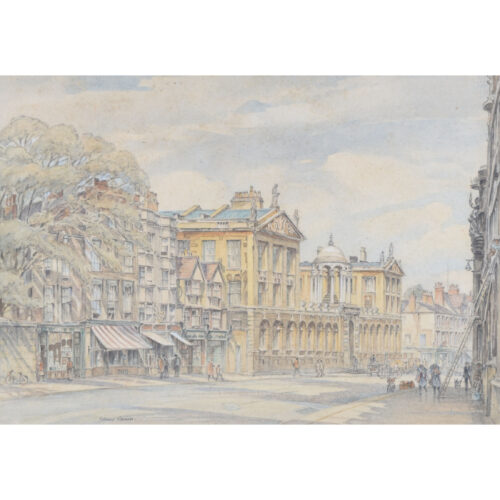
William Sydney Causer (1876 - 1958)
Queen's College, Oxford
Watercolour 38 x 53 cm A most agreeable depiction of Queen's College on the High. The college's Headington Stone is made golden by the sun. William Sidney Causer was a landscape artist known coastal and his urban scenes. He studied at the Wolverhampton School of Art and exhibited at the Royal Academy for the first time in 1923, and later the Paris Salon. Causer painted several pictures in Spain before the Civil War there, and also painted landscapes in France and Italy as well as the English South Coast. Condition: generally very good. If you are interested, please email info@manningfineart.co.uk or call us on 07929 749056. Click here for other views of Queen's College, Oxford. -

Joseph Constantine Stadler (1755 - 1828) after William Westall (1781 - 1850) Queen's College (1814)
Aquatint with original hand colouring 19 x 28 cm Published by Rudolph Ackermann (1764 - 1834). Engraved for Ackermann's 'A History of the University of Cambridge, Its Colleges, Halls and Public Buildings'. Joseph Constantine Stadler was a prolific German émigré engraver of images after his contemporaries - here, William Westall. Stadler's engravings are wide-ranging in subject matter and include landscapes, seascapes and portraits, as well as military, sporting and decorative subjects. Stadler was employed by the leading print publisher of the time, John Boydell. Stadler lived in Knightsbridge when he died at the age of 73. William Westall was a British landscape artist. He was born in Hertford and enrolled at the Royal Academy schools in 1799. He later became the draughtsman for a voyage to Australia and the South Seas. After being shipwrecked, he travelled to Canton in China and to India, staying in Bombay for several months. He returned to England in 1805 but later set off for Madeira and Jamaica. He became a member of the Society of Painters in Water Colours (1811) and an associate of the Academy (1812). Following a mental breakdown, he regularly visited the Lake District and published ‘Views of the Valley and Vale of Keswick’ (1820). His series of aquatints of the Thames, the great universities, and England's public schools for Ackermann are among his most popular works. Rudolph Ackermann was an Anglo-German bookseller, inventor, lithographer, publisher and businessman. In 1795 he established a print-shop and drawing-school at 96 Strand. Here Ackermann set up a lithographic press and began a trade in prints. He later began to manufacture colours and thick carton paper for landscape and miniature painters. Within three years the premises had become too small and he moved to 101 Strand, in his own words "four doors nearer to Somerset House", the seat of the Royal Academy of Arts. Between 1797 and 1800 Ackermann rapidly developed his print and book publishing business, encompassing many different genres including topography, caricature, portraits, transparencies and decorative prints. Condition: Colours very good, mounted to board, old mount staining to margins within platemark, a little toning to paper.If you would like to know more, please email info@manningfineart.co.uk or call us on 07929 749056.
-

John Bluck (early 19th century) after William Westall (1781 - 1850) Queens' College from the Private Walk (1814)
Aquatint with original hand colouring 19 x 28 cm Published by Rudolph Ackermann (1764 - 1834). William Westall was a British landscape artist. He was born in Hertford and enrolled at the Royal Academy schools in 1799. He later became the draughtsman for a voyage to Australia and the South Seas. After being shipwrecked, he travelled to Canton in China and to India, staying in Bombay for several months. He returned to England in 1805 but later set off for Madeira and Jamaica. He became a member of the Society of Painters in Water Colours (1811) and an associate of the Academy (1812). Following a mental breakdown, he regularly visited the Lake District and published ‘Views of the Valley and Vale of Keswick’ (1820). His series of aquatints of the Thames, the great universities, and England's public schools for Ackermann are among his most popular works. John Bluck was an aquatint engraver, mainly of topographical views, but also of marine and sporting subjects after his contemporaries. He produced plates for numerous publications. Rudolph Ackermann was an Anglo-German bookseller, inventor, lithographer, publisher and businessman. In 1795 he established a print-shop and drawing-school at 96 Strand. Here Ackermann set up a lithographic press and began a trade in prints. He later began to manufacture colours and thick carton paper for landscape and miniature painters. Within three years the premises had become too small and he moved to 101 Strand, in his own words "four doors nearer to Somerset House", the seat of the Royal Academy of Arts. Between 1797 and 1800 Ackermann rapidly developed his print and book publishing business, encompassing many different genres including topography, caricature, portraits, transparencies and decorative prints. Condition: Colours very good, mounted to board, old mount staining to margins within platemark, a little toning to paper.If you would like to know more, please email info@manningfineart.co.uk or call us on 07929 749056.
-

Pieter van der Aa (1659 - 1733), after David Loggan (1634 - 1692)
Queens' College, Cambridge (1727)
Engraving 13 x 17 cm An eighteenth-century view of Queens' College, Cambridge, engraved by Pieter van der Aa after David Loggan, the noted engraver, draughtsman, and painter. Pieter van der Aa of Leiden was a Dutch publisher best known for preparing maps and atlases, though he also printed editions of foreign bestsellers and illustrated volumes. He is noted for the many engravings he produced after David Loggan's series of Oxford and Cambridge colleges and costumes. In 1727 Van Der Aa illustrated "Les Delices de la Grande Bretagne & de L'Irelande" by James Beeverell, the book in which this engraving appears. Condition: very good. If you are interested, please email info@manningfineart.co.uk or call us on 07929 749056. Click here for other views of Queens' College, Cambridge -
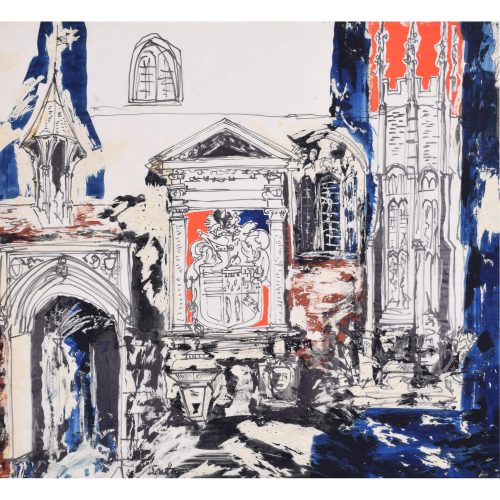
Margaret Souttar (1914 - 1987)
Queens' College, Cambridge I
Acrylic paint 67 x 74 cm Signed below. Souttar was a Scottish painter and printmaker known for her images of town- and cityscapes. In the early 1960s, she was commissioned to produce a series of prints of the Cambridge colleges. She captures the modernity and optimism of 1960s Cambridge; the fact that a female artist was commissioned to create the prints reflects the changing attitudes of the University towards women. These views highlight the layers of history and architectural styles which make up a Cambridge college. Provenance: the artist's studio sale. Condition: generally very good, on thin paper; some crinkling to paper as a result of being painted. Possible slight discolouration around pediment. If you are interested, please email info@manningfineart.co.uk or call us on 07929 749056. Click here for other views of Queens' College, Cambridge. -
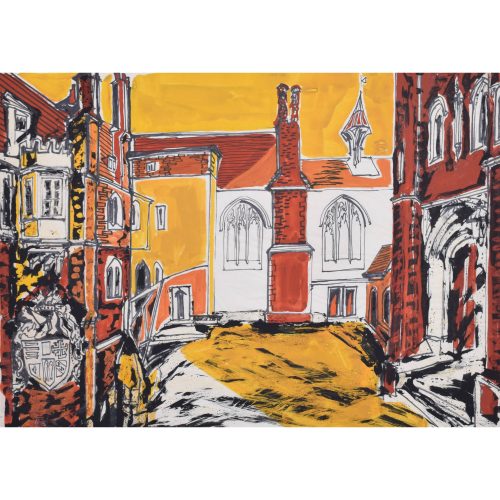
Margaret Souttar (1914 - 1987)
Queens' College, Cambridge II
Acrylic paint 55 x 75 cm Souttar was a Scottish painter and printmaker known for her images of town- and cityscapes. In the early 1960s, she was commissioned to produce a series of prints of the Cambridge colleges. She captures the modernity and optimism of 1960s Cambridge; the fact that a female artist was commissioned to create the prints reflects the changing attitudes of the University towards women. These views highlight the layers of history and architectural styles which make up a Cambridge college. Provenance: the artist's studio sale. Condition: generally very good; some crinkling as a result of using water-based paints on thin paper; slight toning to paper in some areas. If you are interested, please email info@manningfineart.co.uk or call us on 07929 749056. Click here for other views of Queens' College, Cambridge. -
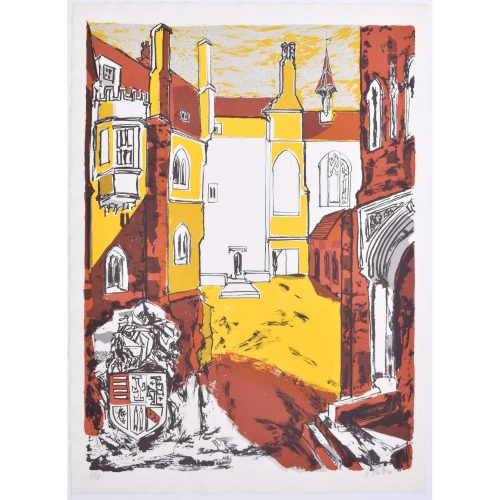
Margaret Souttar (1914 - 1987)
Queens' College, Cambridge
Lithograph 72 x 56 cm Numbered 169/178 lower left, and signed lower right, in pencil. Souttar was a Scottish painter and printmaker known for her images of town- and cityscapes. In the early 1960s, she was commissioned to produce a series of prints of the Cambridge colleges. She captures the modernity and optimism of 1960s Cambridge; the fact that a female artist was commissioned to create the prints reflects the changing attitudes of the University towards women. These views highlight the layers of history and architectural styles which make up a Cambridge college. Provenance: the artist's studio sale. Condition: generally very good. If you are interested, please email info@manningfineart.co.uk or call us on 07929 749056. Click here for other views of Queens' College, Cambridge. -
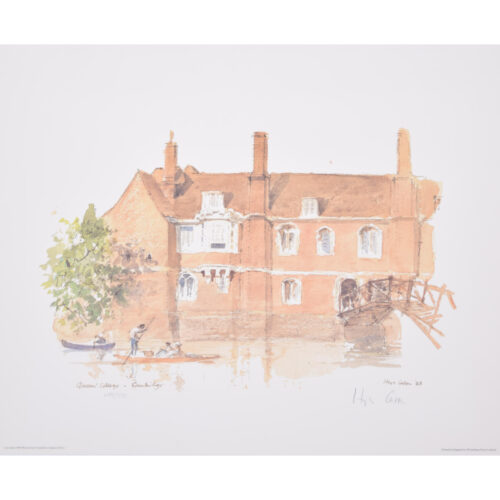
Hugh Casson (1910 - 1999)
Queens' College, Cambridge
Lithograph 28 x 34 cm Signed and numbered 485/550, both in pencil. Casson's warm-hued view of Queens' College, Cambridge, featuring the famed and beauteous Mathematical Bridge. Sir Hugh Casson was educated at Eastbourne College; St John’s College, Cambridge; and the Bartlett School of Architecture. Trained in the 1930s in the early modernist style, he taught at the Cambridge School of Architecture. After employment as a camoufleur during World War 2 by the Air Ministry, in 1948 he was appointed as director of architecture for the Festival of Britain. A close friend of the Royal Family, he undertook designs for the 1953 coronation, designed the interior of the Royal Yacht Britannia (“The overall idea was to give the impression of a country house at sea”), and taught the young Charles III to paint in watercolours. Amongst his architectural achievements are the Elephant House at London Zoo, the 1978 redevelopment of Bristol Docks, the Raised Faculty Building for The University of Cambridge, and a building for the Royal College of Art. He published a number of illustrated books, of which Casson’s Oxford and Casson’s Cambridge are probably the best known. A limited edition series of prints was produced from the paintings. Condition: very good. If you’d like to know more, please email info@manningfineart.co.uk or call us on 07929 749056. Click here for other views of Queens' College, Cambridge. -
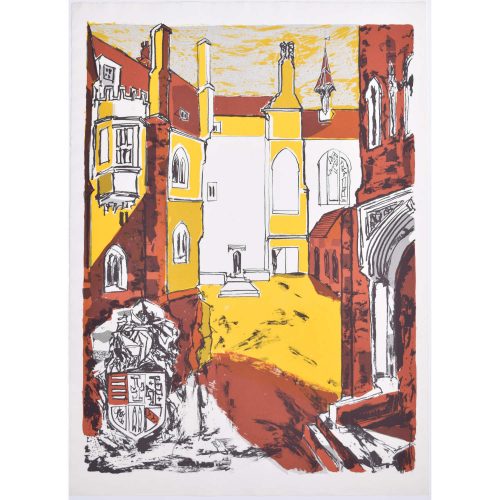
Margaret Souttar (1914 - 1987)
Queens' College, Cambridge
Lithograph 72 x 56 cm Proof print aside from the numbered edition of 178. Souttar was a Scottish painter and printmaker known for her images of town- and cityscapes. In the early 1960s, she was commissioned to produce a series of prints of the Cambridge colleges. She captures the modernity and optimism of 1960s Cambridge; the fact that a female artist was commissioned to create the prints reflects the changing attitudes of the University towards women. These views highlight the layers of history and architectural styles which make up a Cambridge college. Provenance: the artist's studio sale. Condition: generally very good. If you are interested, please email info@manningfineart.co.uk or call us on 07929 749056. Click here for other views of Queens' College, Cambridge. -

David Loggan (1634 - 1692) Queens' College, Cambridge
Engraving 33 x 45 cm An eighteenth-century view of Queens' College, Cambridge, engraved by David Loggan, the noted engraver, draughtsman, and painter. Loggan was born to English and Scottish parents, and was baptised in Danzig in 1634. After studying engraving in Danzig with Willem Hondius (1598-1652 or 1658), he moved to London in the late 1650s, going on to produce the engraved title-page for the folio 1662 Book of Common Prayer. He married in 1663 and moved to Nuffield in Oxfordshire in 1665. Loggan was appointed Public Sculptor to the nearby University of Oxford in the late 1660s, having been commissioned to produce bird’s-eye views of all the Oxford colleges. He lived in Holywell Street as he did this. The 'Oxonia Illustrata' was published in 1675, with the help of Robert White (1645-1704). Following its completion, Loggan began work on his equivalent work for Cambridge; the 'Cantabrigia Illustrata' was finally published in 1690, when he was made engraver to Cambridge University. The 'Oxonia Illustrata' also includes an engraving of Winchester College (Winchester and New College share William of Wykeham as their founder) whilst the 'Cantabrigia Illustrata' includes one of Eton College (which shares its founder, Henry VIII, with King’s College). Bird’s-eye views from this era required a particular talent as an architectural perspectivist; it was not until 1783 that it became possible for artists to ascend via hot air balloons and view the scenes they were depicting from above. Loggan thus had to rely on his imagination in conceiving the views. Loggan’s views constitute the first accurate depictions of the two Universities, in many ways unchanged today. Whilst the Oxford engravings were produced in reasonable numbers and ran to a second edition by Henry Overton (on thicker paper and with a plate number in Roman numerals in the bottom right-hand corner), those of Cambridge were printed in much smaller numbers. The Dutchman Pieter van der Aa published some miniature versions of the engravings for James Beverell’s guidebook to the UK, 'Les Delices de la Grande Bretagne' (c. 1708). The contemporary artist Andrew Ingamells (b.1956) has produced a highly-acclaimed series of etchings which bring Loggan’s original vision up to date. Condition: Generally very good.If you would like to know more, please email info@manningfineart.co.uk or call us on 07929 749056.
For other views of Queens' College, please click here. -
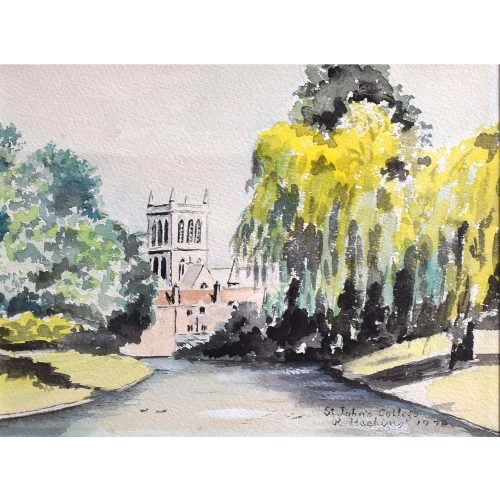
R Hacking
St. John’s College, Cambridge (1978)
Watercolour 17x25cm If you are interested email info@manningfineart.co.ukor call us on 07929 749056. Condition: Good. -
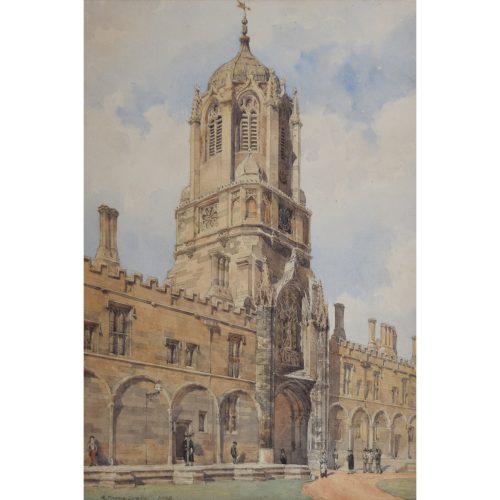
R. Phene-Spiers (1838 – 1916)
Tom Tower, Christ Church, Oxford
Signed and inscribed and dated 1880 Watercolour on paper 37x25cm (14.5×9.8 in.) Spiers was educated as an engineer at King’s College, London. Subsequently he was Master of the Architectural School at the RA, and was President of the Architectural Association from 1867-68. -
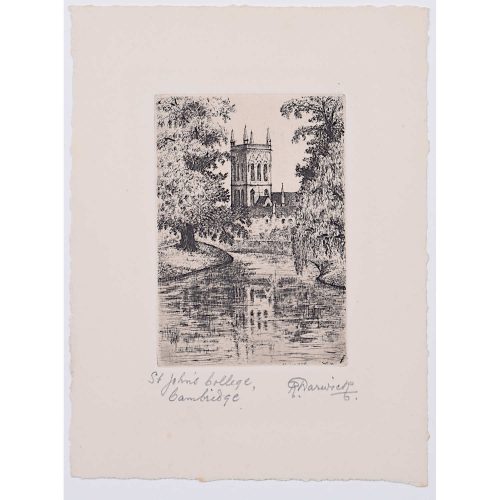
R Warwick (British, fl c. 1900-1930) St John's College Cambridge
Etching size: 9x6cm; sheet size 15x12cm On deckle-edged paper If you are interested email info@manningfineart.co.uk or call us on 07929 749056. Condition: Generally very good condition. -
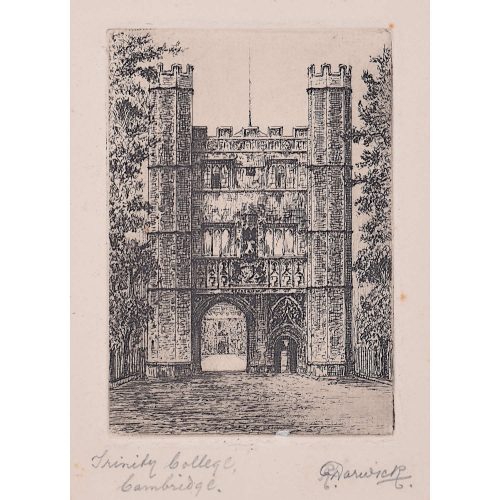
R Warwick (British, fl c. 1900-1930) Trinity College Cambridge, Great Gate
Etching size: 9x6cm; sheet size 15x12cm On deckle-edged paper If you are interested email info@manningfineart.co.uk or call us on 07929 749056. Condition: Generally good condition, some foxing to sheet, but scarcely within image area. -
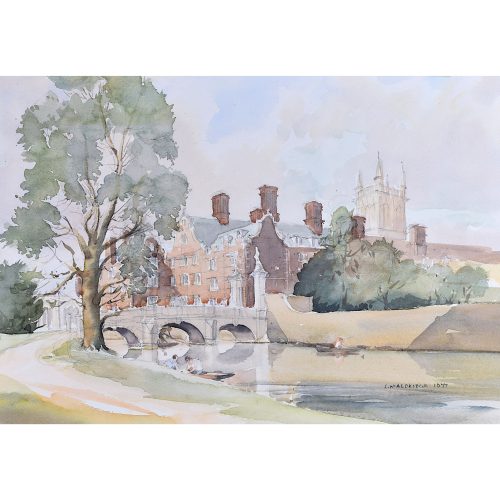
Rowland de Winton Aldridge (1906-1997) The Backs, St John's College Cambridge
34x51cm watercolour Born in Kent he was given 'de Winton' after his grandmother, who was related to the De Wintons of the Welsh engineering company De Winton & Co (1854-1901) that built narrow-gauge railways. He was a protégé of Edward Wesson, one of Britian's most important twentieth century watercolourists, and was a prolific artist of landscapes and urban riverscapes. St John's College Cambridge was one of his favourite views to paint, combining as it does an urban riverscape, a landscape and late 17th century buildings. Aldridge was an authority on 18th century architecture and was adviser to Baron Iliffe during his restoration of Basildon Park. If you are interested email info@manningfineart.co.ukor call us on 07929 749056. Condition: Good. -

Rowland de Winton Aldridge (1906-1997) The Backs, St John's College Cambridge
31 x 45 cm Watercolour Born in Kent in 1906, he was given 'de Winton' after his grandmother, who was related to the De Wintons of the Welsh engineering company De Winton & Co (1854-1901) that built narrow-gauge railways. Aldridge was a protégé of Edward Wesson, one of Britain's most important twentieth century watercolourists, and was a prolific artist of landscapes and urban riverscapes. St John's College Cambridge was one of his favourite views to paint, combining as it does an urban riverscape, a landscape and late 17th century buildings. Aldridge was an authority on 18th century architecture and was adviser to Baron Iliffe during his restoration of Basildon Park. If you are interested email info@manningfineart.co.ukor call us on 07929 749056. Condition: Good. For other views of St John's College, click here. -
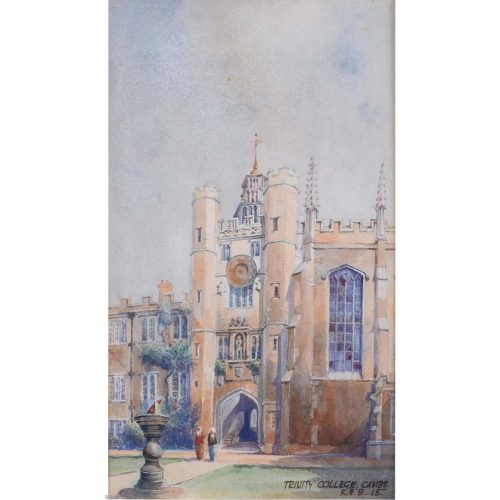
R.H.B Trinity College, Cambridge
22.5x13cm 1915 If you are interested email info@manningfineart.co.ukor call us on 07929 749056. Condition: Good. -

In the manner of A. E. Halliwell (1905-1987) RA Exhibition
Gouache c.1930 26 x 30 cm Provenance: Family of A. E. Halliwell. A.E. Halliwell (1905–1986) was a British artist, illustrator, and designer best known for his vibrant poster designs created for British railway companies during the mid-20th century. Born in Southport, Halliwell developed a strong foundation in art and design early in life. He studied at the Southport School of Art from 1923 to 1926 before graduating to the Royal College of Art in London and subsequently practising as a professional designer from the 1930s. Following his studies, Halliwell married Doris Doyle in Strood Kent, and went on to have a significant teaching career himself, most notably as a lecturer at the Central School of Arts and Crafts (later part of Central Saint Martins), where he influenced a new generation of designers and illustrators. Halliwell is perhaps best remembered for his vibrant and engaging poster designs created for British railway companies during the 1930s. His work was characterised by a bright, graphic style that balanced charm with clarity, often depicting idealised scenes of British holiday destinations—from sunny seaside towns to tranquil countryside vistas. Beyond posters, his artistic output included book illustration, commercial design, and stage costume sketches, showcasing his versatility across mediums. His posters continue to remain enduring symbols of a golden age of British travel and design and are displayed in major collections including the London Transport Museum and the V & A. This vibrant work features a design for an Underground poster, centring around a theoretical exhibition at the Royal Academy. It showcases an excellent command of stylised typeface, painting the RA in a gilt frame. An abstracted human form watches over the painting, surrounded by a colourful purple swirl, mimicking the gesture of the paintbrush across the paper. As a finishing touch, the iconic Underground roundel is painted into the bottom right hand corner. Condition: Generally very good, a little very faint spotting and slight discolouration and pin holes to the top corners (would be covered by mount).If you would like to know more, please email info@manningfineart.co.uk or call us on 07929 749056.
-
 John Bluck (early 19th century) after Frederick Mackenzie (1788 - 1854) Astronomical Observatory, Oxford (1815) Aquatint with original hand colouring 30 x 25 cm Published by Rudolph Ackermann (1764 - 1834). An engraving of the Astronomical Observatory in Oxford - that is, the Radcliffe Observatory, now a part of Green Templeton College. The observatory building commenced to designs by Henry Keene in 1772, and was completed in 1794 to the designs of James Wyatt, with a prominent octagonal tower based on the Tower of the Winds in Athens. Its tower is topped with a statue by John Bacon of Atlas holding up the World. Frederick Mackenzie (1788 - 1854) was a British watercolourist and architectural draughtsman. He first exhibited at the Royal Academy in 1804, and contributed eleven drawings between that year and 1828. He contributed to the Society of Painters in Water Colours exhibitions from 1813, becoming an associate in 1822, and a full member the following year. From 30 November 1831 till his death he was treasurer to the society. In later life Mackenzie was no longer commissioned to illustrate books. John Bluck was an aquatint engraver, mainly of topographical views, but also of marine and sporting subjects after his contemporaries. He produced plates for numerous publications. Rudolph Ackermann was an Anglo-German bookseller, inventor, lithographer, publisher and businessman. In 1795 he established a print-shop and drawing-school at 96 Strand. Here Ackermann set up a lithographic press and began a trade in prints. He later began to manufacture colours and thick carton paper for landscape and miniature painters. Within three years the premises had become too small and he moved to 101 Strand, in his own words "four doors nearer to Somerset House", the seat of the Royal Academy of Arts. Between 1797 and 1800 Ackermann rapidly developed his print and book publishing business, encompassing many different genres including topography, caricature, portraits, transparencies and decorative prints. Condition: Generally very good, paper quite toned within platemark.
If you would like to know more, please email info@manningfineart.co.uk or call us on 07929 749056.
-

John Bluck (early 19th century) after Frederick Mackenzie (1788 - 1854)
Astronomical Observatory, Oxford (1815)
Aquatint with original hand colouring 30 x 25 cm Published by Rudolph Ackermann (1764 - 1834). An engraving of the Astronomical Observatory in Oxford - that is, the Radcliffe Observatory, now a part of Green Templeton College. The observatory building commenced to designs by Henry Keene in 1772, and was completed in 1794 to the designs of James Wyatt, with a prominent octagonal tower based on the Tower of the Winds in Athens. Its tower is topped with a statue by John Bacon of Atlas holding up the World. Frederick Mackenzie (1788 - 1854) was a British watercolourist and architectural draughtsman. He first exhibited at the Royal Academy in 1804, and contributed eleven drawings between that year and 1828. He contributed to the Society of Painters in Water Colours exhibitions from 1813, becoming an associate in 1822, and a full member the following year. From 30 November 1831 till his death he was treasurer to the society. In later life Mackenzie was no longer commissioned to illustrate books. John Bluck was an aquatint engraver, mainly of topographical views, but also of marine and sporting subjects after his contemporaries. He produced plates for numerous publications. Rudolph Ackermann was an Anglo-German bookseller, inventor, lithographer, publisher and businessman. In 1795 he established a print-shop and drawing-school at 96 Strand. Here Ackermann set up a lithographic press and began a trade in prints. He later began to manufacture colours and thick carton paper for landscape and miniature painters. Within three years the premises had become too small and he moved to 101 Strand, in his own words "four doors nearer to Somerset House", the seat of the Royal Academy of Arts. Between 1797 and 1800 Ackermann rapidly developed his print and book publishing business, encompassing many different genres including topography, caricature, portraits, transparencies and decorative prints. Condition: paper quite toned within platemark. If you are interested, please email info@manningfineart.co.uk or call us on 07929 749056. Click here for other general views of Oxford. -

David Gentleman Radcliffe Camera
Lithograph 53 x 64 cm Signed and numbered 41/200. Born on the 11th March 1930, David Gentleman is a British artist, illustrator, and designer known for his distinctive watercolours, engravings, and graphic work. He originally studied art and painting at the Royal College of Art under Edward Bawden and John Nash and has since produced work at scales ranging from platform-length murals for Charing Cross Underground Station in London to postage stamps and logos. His work is generally characterised by precise line drawings, detailed engravings, and delicate watercolour paintings, often depicting landscapes, architecture, and urban scenes. He notably distinguishes his work through his skilful ability to blend traditional techniques with modern sensibilities, rendering his work highly recognisable. He has left a lasting legacy on British graphic design and illustration and his work is now represented in the Tate Britain, the British Museum, the Victoria and Albert Museum, the Imperial War Museum and the Fitzwilliam Museum, Cambridge. Condition: Generally very good.If you would like to know more, please email info@manningfineart.co.uk or call us on 07929 749056.
-

John Piper (1903 - 1992)
Radcliffe Camera
Lithograph 53 x 35.5 cm John Piper's view of the Radcliffe Camera in Radcliffe Square. John Piper CH was an English painter, printmaker, and designer of stained-glass windows. His work often focused on the British landscape, especially churches and monuments, and included tapestry designs, book jackets, screen-prints, photography, fabrics and ceramics. Condition: very good. If you are interested, please email info@manningfineart.co.uk or call us on 07929 749056. Click here for other views of Oxford. -
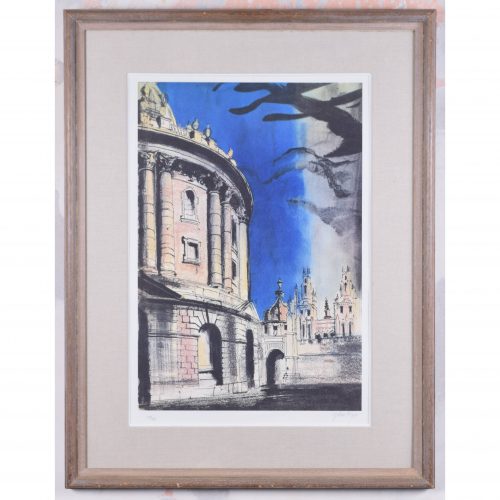
John Piper (1903 - 1992)
Radcliffe Camera
Lithograph 53 x 35.5 cm Numbered 110/1150 lower left and signed lower right in pencil. John Piper's view of the Radcliffe Camera in Radcliffe Square. John Piper CH was an English painter, printmaker, and designer of stained-glass windows. His work often focused on the British landscape, especially churches and monuments, and included tapestry designs, book jackets, screen-prints, photography, fabrics and ceramics. Condition: very good. Attractively framed; frame included for mainland UK shipping only. If you are interested, please email info@manningfineart.co.uk or call us on 07929 749056. Click here for other views of Oxford. -
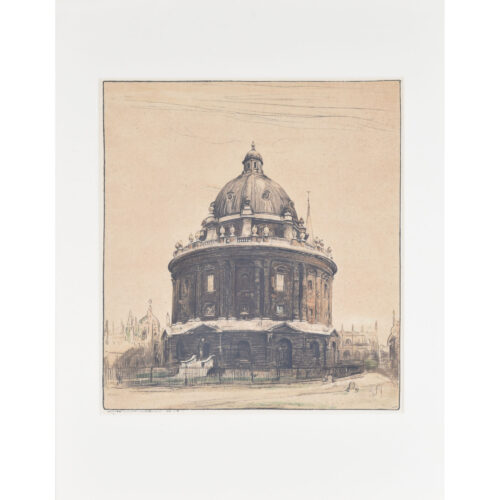
William Nicholson (1872 - 1949)
The Radcliffe Camera, Oxford
Lithograph 35 x 28 cm Signed lower left and numbered 10 in ink. Between 1902 and 1904 William Nicholson lived in Woodstock; during this period he made several architectural studies of Oxford's colleges and other University buildings. Sir William Nicholson was a British painter and printmaker. He is also known as an illustrator, author of children’s books, stained glass designer, and theatre set designer. Condition: very good. If you are interested, please email info@manningfineart.co.uk or call us on 07929 749056. Click here for other general views of Oxford. -

John Hill (1770 - 1850) after Frederick Mackenzie (1788 - 1854) The Vestibule of Radcliffe Library (1815)
Hand-coloured aquatint 24 x 29 cm Published by Rudolph Ackermann (1764 - 1834). Frederick Mackenzie (circa 1788 - 1854) was a British watercolourist and architectural draughtsman. He first exhibited at the Royal Academy in 1804, and contributed eleven drawings between that year and 1828. He contributed to the Society of Painters in Water Colours exhibitions from 1813, becoming an associate in 1822, and a full member the following year. From 30 November 1831 until, his death he was treasurer to the society. In later life Mackenzie was no longer commissioned to illustrate books. John Hill was born in London in 1770, and was an engraver's apprentice. He worked in aquatint and largely produced book illustration aquatints. He went to America in 1816 and produced the notable Picturesque Views of American Scenery amongst other books of prints. Rudolph Ackermann was an Anglo-German bookseller, inventor, lithographer, publisher and businessman. In 1795 he established a print-shop and drawing-school at 96 Strand. Here Ackermann set up a lithographic press and began a trade in prints. He later began to manufacture colours and thick carton paper for landscape and miniature painters. Within three years the premises had become too small and he moved to 101 Strand, in his own words "four doors nearer to Somerset House", the seat of the Royal Academy of Arts. Between 1797 and 1800 Ackermann rapidly developed his print and book publishing business, encompassing many different genres including topography, caricature, portraits, transparencies and decorative prints. Condition: Generally very good; slight staining just about visible top left and lower right.If you would like to know more, please email info@manningfineart.co.uk or call us on 07929 749056.
-
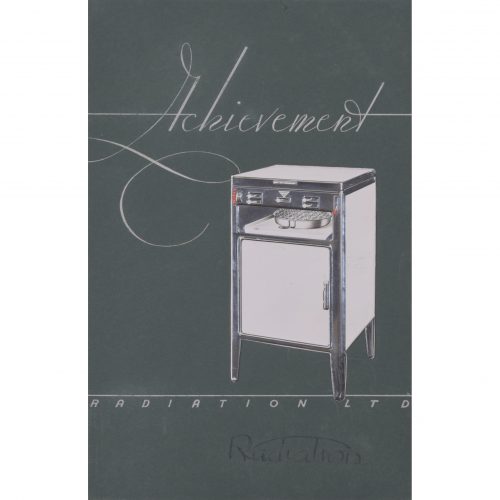
Brownbridge (flourished 1930s - 1940s)
Achievement Radiation gas cookers brochure design
Pen and collage 21.5 x 14 cm From a small archive of works by Brownbridge, a member of the Society of Industrial Artists. Brownbridge's bold design advertises Radiation cookers (innovative gas cookers which were sold in Britain in the 1920s and 1930s). Shiny white against a dark background, the Radiation cooker seems impossibly glamorous and inviting. Society of Industrial Artists correspondance (photographed above) is not included; please enquire separately. Condition: generally very good. If you are interested, please email info@manningfineart.co.uk or call us on 07929 749056. Click here for other designs by Brownbridge. -
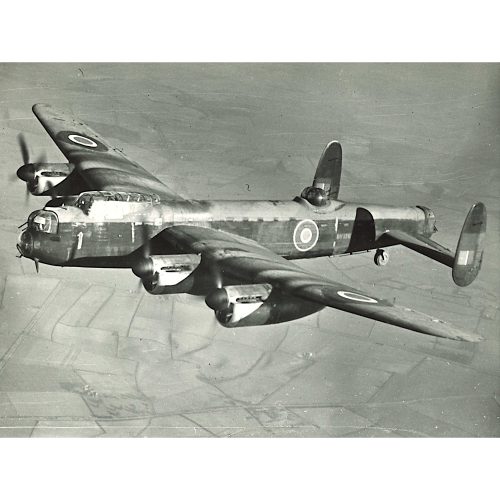
DV170 Lancaster Bomber in flight
Silver Gelatin Photograph 15x20cm Stamped to reverse "Rolls Royce Ltd Hucknall Neg no s76 Copyright Reserved" c. 1940s DV170 was built as a Mk III and converted to Mk VI. Used by Rolls Royce for Merlin trials series 65, 85, 38, 68, 100, 102 & 621 300+ f/hrs testing. Dismantled (probably at Hucknall), by road to Newton 10 December 1947, scrapped by 58 Maintenance Unit. Shown here with 4 Merlin 102s in Avro Tudor power plants with unshrouded exhausts. Provenance: from the collection of Philip J R Moyes, author of many books on the RAF, most notably The Pictorial History which ran to several volumes. -
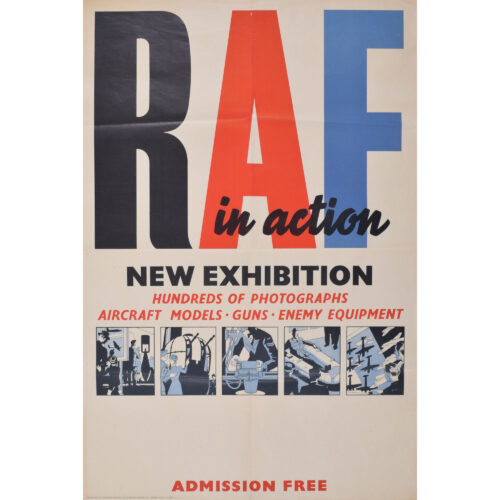
RAF In Action
Original vintage poster 75 x 50 cm An original vintage poster advertising the 'RAF in Action' exhibition, a public exhibition highlighting the work of the Royal Air Force. Condition: generally very good; folds as issued. If you are interested, please email info@manningfineart.co.uk or call us on 07929 749056. Click here for other original vintage Second World War posters.