-
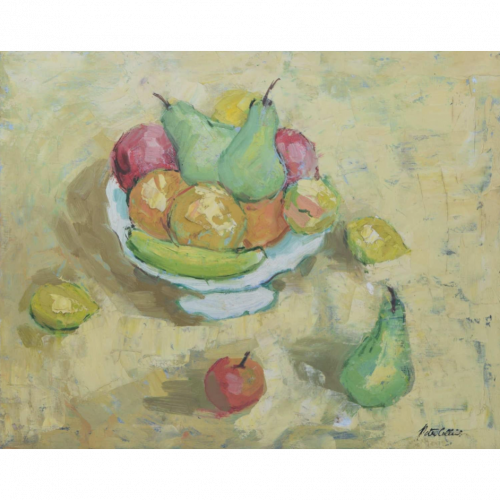
Peter Collins ARCA (1923-2001)
Still Life of a Fruit Bowl (c. 1960s)
Oil on canvas 40 x 51 cm Signed lower right. A stylish mid-century still life with fruit. Collins's first job was at an advertising agency, in the commercial studio. World War II interrupted his career and he joined the Royal Artillery (of the British Army), teaching painting and drawing in the Education Corps - whilst simultaneously teaching at St Martin's School of Art, part time. Following the war, Collins studied at the Royal College of Art, winning a scholarship. He then worked as a commercial artist, producing some well-known posters for clients including British Railways and British European Airways. He was the Art Director at Odhams Press and spent time designing for both ICI and Shell. With his wife Georgette, he created the 'Bacombe Galleries' in Sussex, converting a group of buildings into a gallery space. In 1975 they developed the Stanley Studios in Chelsea, which were scheduled for redevelopment, into a combined artists' studio and residence. Moving into the Stanley Studios allowed the Collinses to immerse themselves in Chelsea's art scene, and they proceeded to fill the studios with art, antiques, scupture, and other curios. Provenance: the artist's studio sale 2017, lot 2050. Condition: very good. -

Angela Stones (1914 - 1995)
Still Life with Fruit and Bottle
Oil on board 39 x 49 cm A stylish mid-century still life. Stones was educated at the Chelsea School of Art, and was a member of an artistic dynasty. Her mother Dorothy Bradshaw (1893-1983) studied under Jack Merriott – the artist famous for his British Rail posters, and her son, Christopher Assheton-Stones (1947-1999), was arguably the foremost pastel artist of his time. Provenance: the family of the artist. Condition: Generally very good. If you’d like to know more, please email info@manningfineart.co.uk or call us on 07929 749056. -
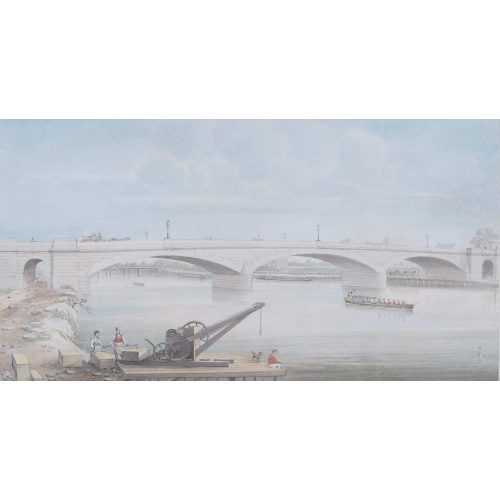
Gideon Yates
View on The Thames with Staines Bridge
25 x 48 cm Watercolour Charmingly signed lower left, on the side of the stone c.1830 Little is known of the life of Yates. Even his date of death is disputed with some sources putting it at 1837. What is known is that he spent most of his working life in London, producing many detailed views of The Thames such as this one. His style is very distinctive, and this large and impressive view of London Bridge is a typical view. He is thought to have lived in Lancaster in 1811, and to have travelled widely throughout Britain and the Continent. His works are in public collections including the Victoria and Albert Museum. UK Government Art Collection item 6701 is another view of The Thames by Yates. Click here for other paintings by Yates. If you are interested email info@manningfineart.co.uk or call us on 07929 749056. -
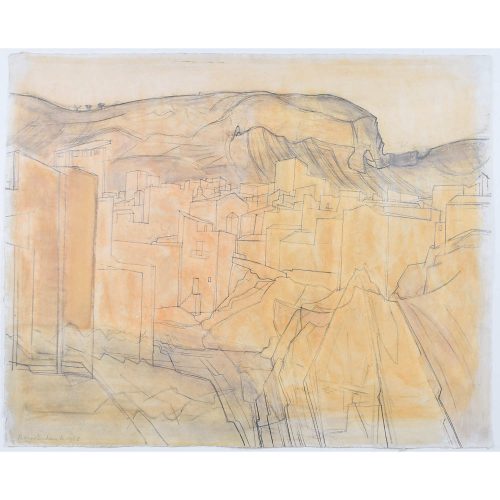
Wilhelmina Barns-Graham (1912-2004)
Monreale, Sicily (1955)
Pencil and wash on paper 48 x 58 cm Signed and dated lower left. A heady evocation of summer in Sicily, characterised by burnt oranges and yellows. Wilhelmina Barns-Graham, known as Willie, was born in St Andrews, Fife, on 8 June 1912. Her parents were second cousins, and their respective families were well established representatives of minor Scottish gentry from both the east and west of the country. As a child, Barns-Graham showed very early signs of creative ability. It was at school that Wilhelmina decided that she wanted to be an artist, stating later in life that "painting chose me, not I it". After school she set her sights on Edinburgh College of Art where, after some dispute with her father (who was an emotional man prone to uncontrolled anger), she enrolled in 1931. During her time at Edinburgh College, Barns-Graham was taught by tutors including portrait painter David Alison and painter William MacTaggart. Her friends there included the influential Scottish painters Robert MacBryde, Robert Colquhoun, and William Gear. After her education, Barns-Graham made study trips to Paris, London, and St Tropez before moving to St Ives, Cornwall, in 1940 (at the suggestion of the Edinburgh College of Art's Principal Hubert Wellington). Barns-Graham moved near to where a group of modernist artists had settled, at Carbis Bay - this was a pivotal moment in her life. On one of her first evenings there she met the sculptor Barbara Hepworth, who made an immediate and lasting impression on her. She then went on to meet Borlase Smart, Alfred Wallis, and Bernard Leach, as well as the painter Ben Nicholson and the sculptors Naum Gabo and Margaret Mellis. After two weeks in St Ives, Barns-Graham acquired her first studio, directly below the Porthmeor Gallery which was the administrative headquarters of the St Ives Society of Artists. Her paintings at the time were heavily influenced by the Cornish landscapes and the St Ives harbour. During 1940 and 1941, Barns-Graham contributed to the war effort by volunteering in a factory making camouflage nets. In 1942 Barns-Graham became a member of the Newlyn Society of Artists, in which she exhibited with every year, and the St Ives Society of Artists. Whilst establishing herself in St Ives, Barns-Graham also continued to send work back to Scotland for major exhibitions held there such as the Royal Scottish Academy's 117th Exhibition in 1943. The 1940s were an active time for the St Ives Society of Artists who received a number of invitations to send exhibitions and groups of works to galleries in the UK and abroad, Barns-Graham's work was always included in these as the Society's secretary, Borlase Smart, thought highly of her work. Barns-Graham's first opportunity to exhibit in London came when her work was included in a group exhibition of six at the Redfern Gallery. This was due to the introduction and support of Patrick Heron, who had visited Barns-Graham's studio in St Ives and was excited by her work. Barns-Graham would later have her first one-person exhibition in London at Redfern in 1952. After a few years of tension, Barns-Graham eventually left the St Ives Society of Artists in 1949, becoming one of the founding members of a new breakaway group named Penwith Society of Arts. The first Penwith Society exhibition opened in June 1949 to huge success - 2755 paying visitors came to see it. Provenance: Barns-Graham Charitable Trust, authentication no 1665. If you are interested, please email info@manningfineart.co.uk or call us on 07929 749056. -
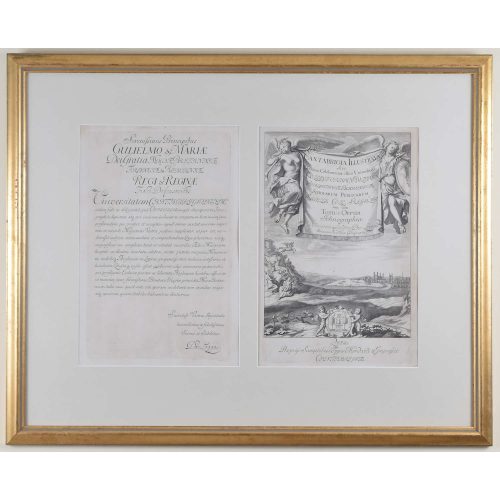 David Loggan (1634-1692) University of Cambridge Frontispiece and Dedication for Cantabrigia Illustrata (1690) Engraving 38 x 55 cm Loggan was born to English and Scottish parents, and was baptised in Danzig in 1634. After studying engraving in Danzig with Willem Hondius (1598-1652 or 1658), he moved to London in the late 1650s, going on to produce the engraved title-page for the folio 1662 Book of Common Prayer. He married in 1663 and moved to Nuffield in Oxfordshire in 1665. Loggan was appointed Public Sculptor to the nearby University of Oxford in the late 1660s, having been commissioned to produce bird’s-eye views of all the Oxford colleges. He lived in Holywell Street as he did this. The 'Oxonia Illustrata' was published in 1675, with the help of Robert White (1645-1704). Following its completion, Loggan began work on his equivalent work for Cambridge; the 'Cantabrigia Illustrata' was finally published in 1690, when he was made engraver to Cambridge University. The 'Oxonia Illustrata' also includes an engraving of Winchester College (Winchester and New College share William of Wykeham as their founder) whilst the 'Cantabrigia Illustrata' includes one of Eton College (which shares its founder, Henry VIII, with King’s College). Bird’s-eye views from this era required a particular talent as an architectural perspectivist; it was not until 1783 that it became possible for artists to ascend via hot air balloons and view the scenes they were depicting from above. Loggan thus had to rely on his imagination in conceiving the views. Loggan’s views constitute the first accurate depictions of the two Universities, in many ways unchanged today. Whilst the Oxford engravings were produced in reasonable numbers and ran to a second edition by Henry Overton (on thicker paper and with a plate number in Roman numerals in the bottom right-hand corner), those of Cambridge were printed in much smaller numbers. The Dutchman Pieter van der Aa published some miniature versions of the engravings for James Beverell’s guidebook to the UK, 'Les Delices de la Grande Bretagne' (c. 1708). The contemporary artist Andrew Ingamells (b.1956) has produced a highly-acclaimed series of etchings which bring Loggan’s original vision up to date.
 -
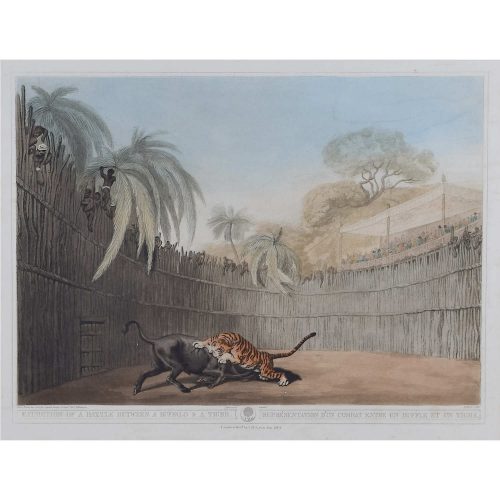
Samuel Howitt (1765-1822) after Thomas Williamson (1758-1817)
Exhibition of a Battle between a Buffalo & a Tiger' from Oriental Field Sports (1819)
Hand-coloured aquatint 35 x 47 cm Captain Thomas Williamson served in a British regiment in Bengal, India. He was known as a keen sportsman and, after returning to England, his notable interest in contemporary Indian sports attracted the attention of the publisher Edward Orme. Orme was a British engraver, painter and publisher of illustrated books, and in 1805 he commissioned Williamson to produce a work focused on Oriental sports and animals. The book took two years to complete, with the painter Samuel Howitt commissioned to produce watercolours based on original sketches by Williamson, most of which he had created while in India. The book in which the aquatint plates after Howitt were published was called Oriental Field Sports, which describes itself as 'being a complete, detailed, and accurate description of the wild sports of the East and exhibiting, in a novel and interesting manner, the natural history of the elephant, the rhinoceros, the tiger, and other undomesticated animals'. -
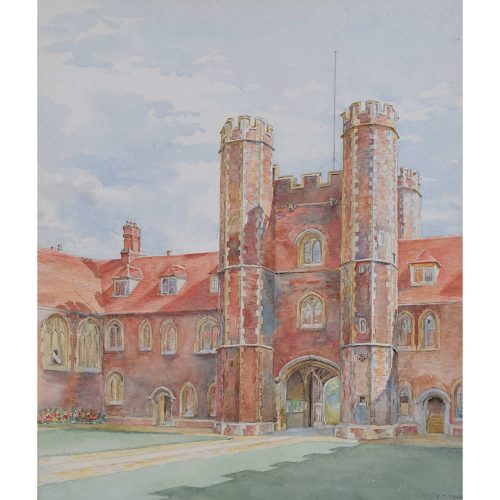
E. T. Talbot
St John's College, Cambridge, showing the First Court and Chapel
Watercolour 30 x 25 cm A richly-coloured watercolour painting of the First Court of St John's. First Court was built in 1511-20 to the south of the old Hospital of St John the Evangelist, and was designed to contain living quarters, chapel, library, hall, and kitchens. The version of First Court which Talbot paints looks markedly different to the college today - the chapel on the far left of the picture was demolished after the new chapel was completed in 1869. -
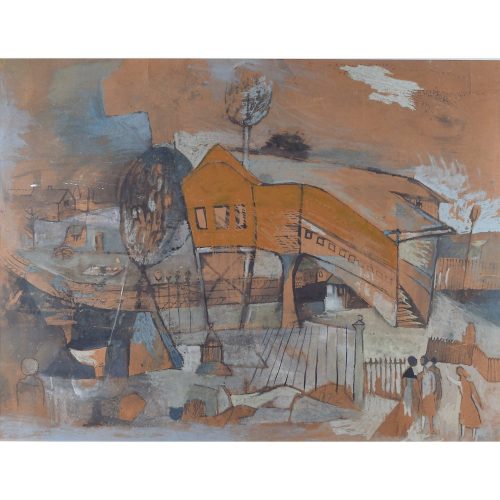
Gwyneth Johnstone (1915 - 2010)
The Railway Bridge
Mixed media 64 x 83 cm Signed lower left in paint, and monogrammed lower left in pencil. Provenance: the estate of the artist. Johnstone explores the possibilities of abstraction in this semi-delirious depiction of a railway bridge. Painted in tones of burnt umber, orange, grey, and black, the picture is populated by warped railings, bending trees, and staring onlookers, all of which centre around a railway line and bridge. Tanya Harrod described Johnstone's painting style a 'a hallucinogenic, haunting pastoral', and that is immensely evident in this picture. Johnstone was an English painter who worked mostly in oils and often depicted poignant modern landscapes. Her parents were the musician Nora Brownsford and the artist Augustus John. She studied at the Slade School of Fine Art, where she established lifelong friendships with fellow artists Mary Fedden and Virginia Parsons. After the Slade, Johnstone was taught academicised cubism by the painter André Lhote at the Académie de la Grande Chaumière in Paris. For a brief period in the early 1950s she took life classes with the surrealist artist Cecil Collins at the Central School of Arts and Crafts. -
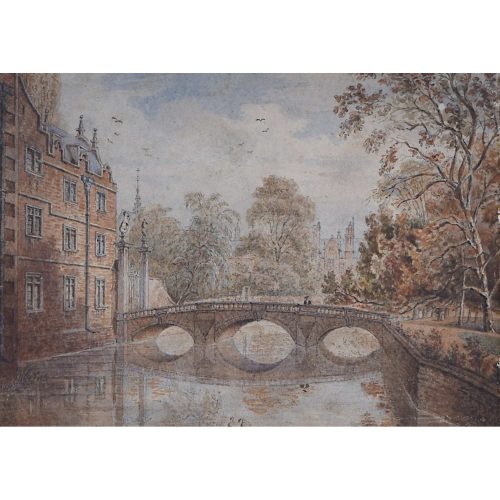
Sarah Orange (19th century)
The Kitchen Bridge, St John's College, Cambridge (c. 1830)
Watercolour 14 x 20 cm Provenance: Bene't Gallery, Cambridge. This 19th century watercolour depicts the Kitchen Bridge at John's. A scholar in gown and mortarboard stands alone in the bridge's centre, gazing meditatively into the glassy water below. -
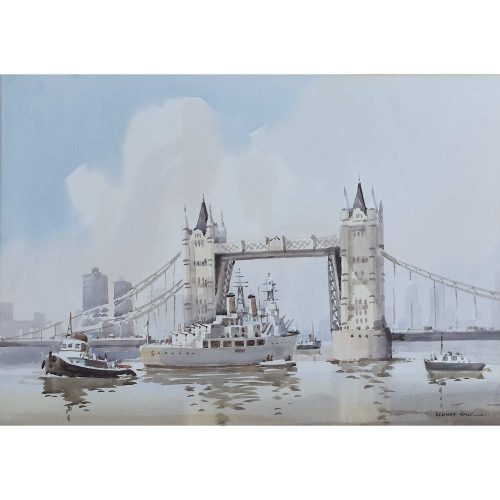
Sydney Vale F. R. S. A. (1916 - 1991)
A warship passing under Tower Bridge
Watercolour 35 x 50 cm Born in 1916, Sydney Vale was a Fellow of the Royal Society of Arts and a member of the prestigious Wapping Group of Artists from 1972 to 1991, which was formed primarily to record life in London's Docklands. Within this group, Vale and his contemporaries specialised in portraying the charm and romance of the River Thames from source to estuary. -
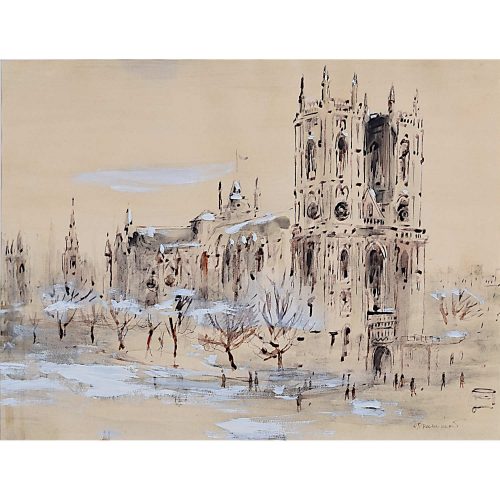
Violet Hilda Drummond (British, 1911-2000)
Westminster Abbey
Watercolour 33 x 43 cm Signed lower right. Here, the artist paints a sprightly view of Westminster Abbey, which rises from a sea of nondescript pedestrians. The mostly monochrome palette, gently highlighted with splashes of a muted red, and white details, communicates the character of the city. Drummond's father, a Scots Guard, was killed at Ypres in 1914. Drummond and her two sisters were brought up by her mother and educated in Eastbourne and at Le Chateau Vitry-sur-Seine, a Parisian finishing school. After Paris, Drummond attended St Martin’s School of Art. Later in life, she began writing children’s picture books – the most notable being Miss Anna Truly (1945) and her Little Laura series (1960 onwards). She also produced cartoons for the BBC. 'Mrs Easter and the Stork' – published in 1957 by Faber & Faber – was awarded the Kate Greenway Medal. Drummond later took to painting watercolours of London street scenes which have remained popular ever since. Provenance: the Arthur Andersen art collection. -
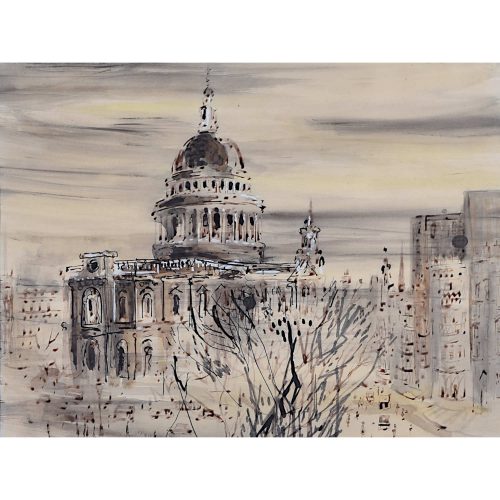
Violet Hilda Drummond (British, 1911-2000)
St Paul's Cathedral
Watercolour 33 x 43 cm Signed upper right (visible in the photograph showing the framed painting). Provenance: the Arthur Andersen art collection. Here, the artist paints a sprightly view of St Paul's, which rises from a sea of nondescript traffic and pedestrians. The mostly monochrome palette, gently highlighted with a yellow wash and white details, communicates the character of the city. Drummond's father, a Scots Guard, was killed at Ypres in 1914. Drummond and her two sisters were brought up by her mother and educated in Eastbourne and at Le Chateau Vitry-sur-Seine, a Parisian finishing school. After Paris, Drummond attended St Martin’s School of Art. Later in life, she began writing children’s picture books – the most notable being Miss Anna Truly (1945) and her Little Laura series (1960 onwards). She also produced cartoons for the BBC. 'Mrs Easter and the Stork' – published in 1957 by Faber & Faber – was awarded the Kate Greenway Medal. Drummond later took to painting watercolours of London street scenes which have remained popular ever since. -
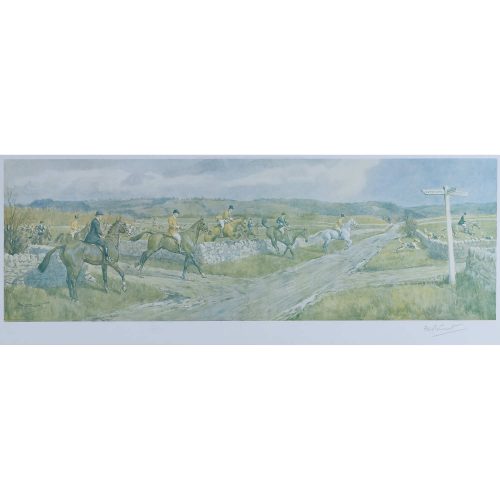 Frank Algernon Stewart (1877-1945) The Heythrop at Stow on the Wold Lithograph 24 x 63cm Signed in pencil. Framed. A typical hunting print by Stewart, showing one of the country's leading packs. Condition: Slight, even, loss of colour, as expected. If you’d like to know more, please email info@manningfineart.co.uk or call us on 07929 749056.
 -
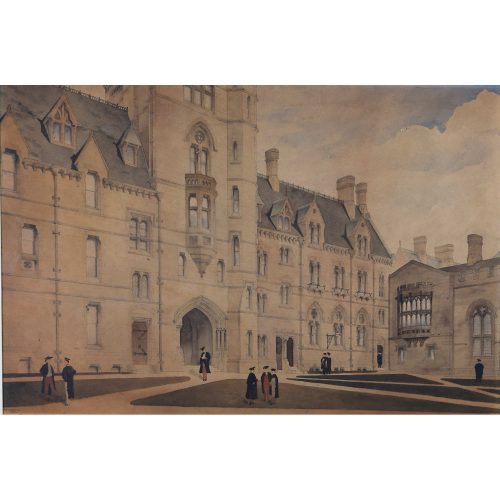 F F Hoyland Balliol College, Oxford (1880) Watercolour 44 x 66 cm Signed lower left and dated. An impressive watercolour of Balliol College. Scholars, sporting gowns and mortarboards, gather in the quad. Hoyland's stylistic precision transforms this watercolour into a beautifully executed depiction of the College's architecture.
 -
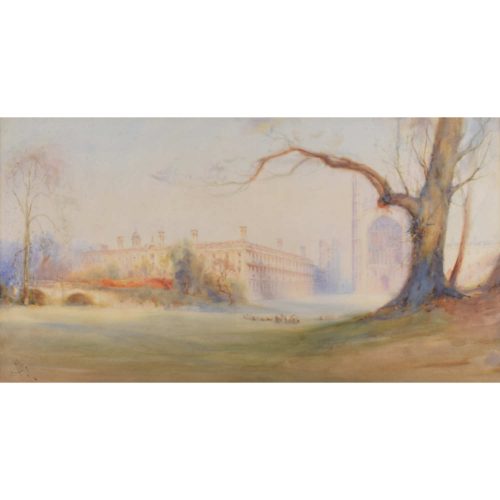 Charles March Gere R.A. R.W.S. (1869 - 1957) King's College from the Backs Watercolour 36 x 69 cm Monogrammed lower left. An atmospheric watercolour of one of Cambridge's most exalted sights: King's College chapel from the Backs, together with Clare College. Charles March Gere R.A. R.W.S. was an English painter, illustrator of books, and stained glass and embroidery designer associated with the Arts and Crafts movement.
 -

'Bisto for all Meat Dishes'
Original vintage poster 55 x 202 cm This original vintage poster is an excellent opportunity to acquire a piece of British advertising history. Bisto is an instantly recognisable brand today, and has been throughout the 20th century; the catchphrase on the poster here, "Bisto for all meat dishes" was used in the 1950s. The first Bisto product, in 1908, was a meat-flavoured gravy powder which rapidly became a bestseller in the UK. It was added to gravies to thicken them and give a richer taste and aroma. Invented by Messrs Roberts & Patterson, it was named "Bisto" because it "Browns, Seasons and Thickens in One". As of 2005, Bisto Gravy Granules had a British market share of over 70%. Nearly all British grocery outlets stock a Bisto product. -

Ethel Louise Rawlins (1880 – 1940)
A Garden Below the South Downs
Oil on canvas51 x 61 cmSigned lower right.Rawlins was a painter who studied at the Slade School of Fine Art and in Newlyn, Cornwall. She settled in Sussex in the early 1920s, and often painted the rolling hills of the Sussex landscape. Here, blue hills and a grey sky serve as the background for an extensive garden complete with stone urns, flowers, and slanting shadows created by the late afternoon sun. -
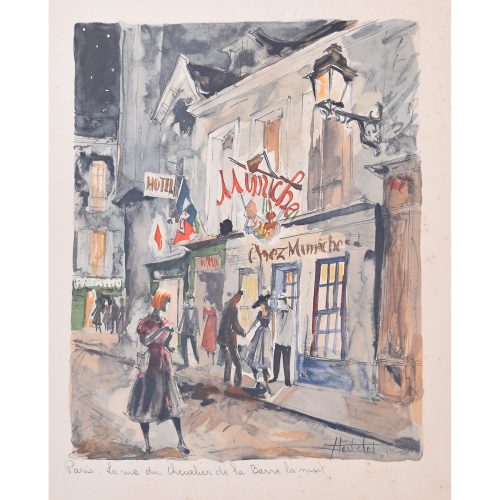 Franz Herbelot (French, active 1940s-1950s) Paris: La Rue de Chevalier de la Barre la nuit Lithograph 28 x 22 cm A fantastic lithograph by Herbelot which brilliantly captures the spirit of mid-century Paris. Little is known of Herbelot's life, but he is most notable for his views of Paris. The Rue de Chevalier de la Barre is a street in Montmartre named after the Knight de la Barre, François-Jean Lefebvre de la Barre, who died in 1766. Here, we see the street as it was in the 20th century, brimming with ladies and gentlemen dressed à la mode, bathed in the warm light of thriving bistros and hotels.
 -
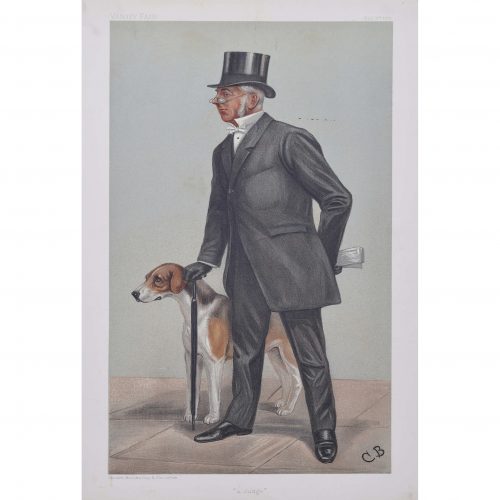
Cuthbert "CB" Bradley for Vanity Fair Magazine 'A Judge': The Rev Cecil Legard
11 July 1901 Lithograph 21 x 37 cm CB's cartoon depicts The Rev Cecil Legard (1843-1918), the Rector of Cottesbrooke and heir to the baronetcy. As well as a clergyman, Legard was a noted sportsman and hound expert; he was a steeplechase rider, and also edited the Foxhound Kennel Stud Book. CB depicts him judging hounds, excellently outfitted; as the biography on the reverse of the mounted lithograph notes, he might be 'the best judge of a foxhound in England'. A copy of the cartoon is held by the Kingston Lacy Estate in Dorset. Cuthbert Bradley was also a sporting man - he famously authored 'Fox-Hunting from Shire to Shire with Many Noted Packs' and worked as a sporting journalist for The Field. As well as illustrating for Vanity Fair, he painted polo and foxhunting scenes, and other pictures of equestrian interest. The majority of his Vanity Fair cartoons are of hunting men. The Vanity Fair magazine of 1868 to 1914 was subtitled 'A Weekly Show of Political, Social and Literary Wares'. Founded by Thomas Gibson Bowles, who aimed to expose the contemporary vanities of Victorian society, it featured regular full-page, colour lithographs of famous (or infamous) contemporary figures. It is for these caricatures that the original Vanity Fair is best known today. If you are interested, please email info@manningfineart.co.uk or call us on 07929 749056. Condition: Generally very good. -
Out of stock
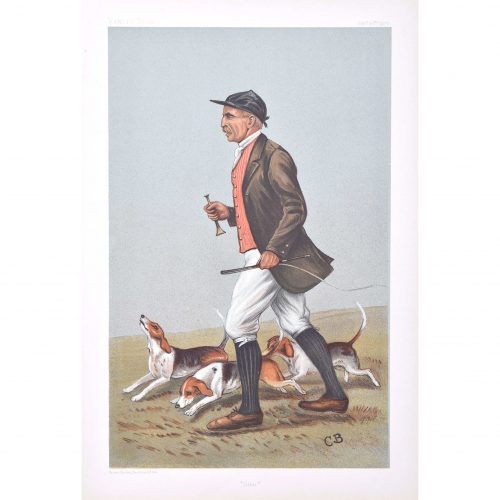
Cuthbert "CB" Bradley for Vanity Fair Magazine 'Otho': Otho Paget
30 January 1902 Lithograph 21 x 37 cm CB's cartoon depicts John Otho Paget, noted beagler and author of 'Beagles and Beagling'. Cuthbert Bradley was also a sporting man - he famously authored 'Fox-Hunting from Shire to Shire with Many Noted Packs' and worked as a sporting journalist for The Field. As well as illustrating for Vanity Fair, he painted polo and foxhunting scenes, and other pictures of equestrian interest. The majority of his Vanity Fair cartoons are of hunting men. The Vanity Fair magazine of 1868 to 1914 was subtitled 'A Weekly Show of Political, Social and Literary Wares'. Founded by Thomas Gibson Bowles, who aimed to expose the contemporary vanities of Victorian society, it featured regular full-page, colour lithographs of famous (or infamous) contemporary figures. It is for these caricatures that the original Vanity Fair is best known today. If you are interested, please email info@manningfineart.co.uk or call us on 07929 749056. Condition: Generally very good. -
Out of stock
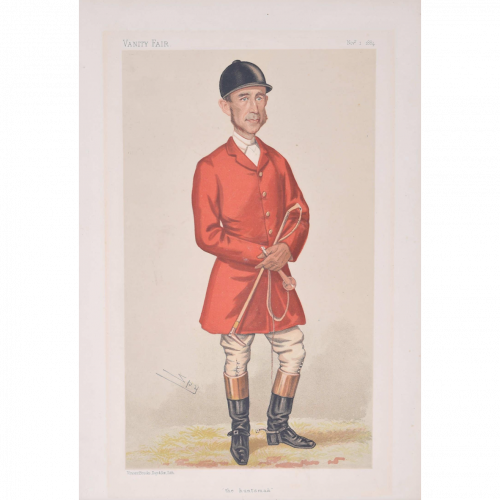
Sir Leslie "Spy" Ward for Vanity Fair Magazine 'The Huntsman': Thomas Firr
1 November 1884 Lithograph 21 x 37 cm Depicting Thomas Firr, Huntsman of the Quorn, on the day of the season's opening meet. The illustrated volume 'Tom Firr of the Quorn: Huntsman Extraordinary' details Firr's days with the hunt, and considers him 'the greatest huntsman in England'. He was huntsman to the Quorn for 27 years from 1872 to 1899. The Quorn Hunt has a claim to be the oldest hunt in the country, having been founded in 1696 by Mr Thomas Boothby of Tooley Park, Leicestershire. Tooley Park lies about eight miles southwest of Leicester, just to the north of the Hinckley road. The hunt takes its name from the village of Quorn, where the hounds were kennelled from 1753 to 1904. If you are interested, please email info@manningfineart.co.uk or call us on 07929 749056. Condition: Good. Mounted to board, some age toning. -
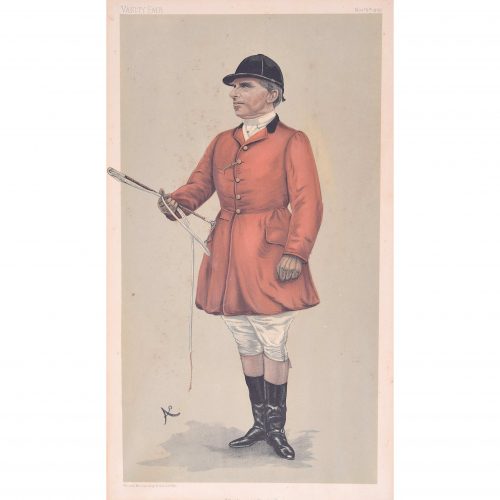
Roland "Ao" / "Armadillo" L'Estrange for Vanity Fair Magazine 'Berks and Bucks': Sir Robert Rodney Wilmot
5 November 1903 Lithograph 21 x 37 cm Depicting Sir Robert Rodney Wilmot, in red hunting clothes and whip, of the Berks & Bucks Draghounds at their opening meet. Wilmot was educated at Eton and Oxford, and his hobbies famously included croquet. The Vanity Fair magazine of 1868 to 1914 was subtitled 'A Weekly Show of Political, Social and Literary Wares'. Founded by Thomas Gibson Bowles, who aimed to expose the contemporary vanities of Victorian society, it featured regular full-page, colour lithographs of famous (or infamous) contemporary figures. It is for these caricatures that the original Vanity Fair is best known today. If you are interested, please email info@manningfineart.co.uk or call us on 07929 749056. Condition: Good. Mounted to board, some age toning. -
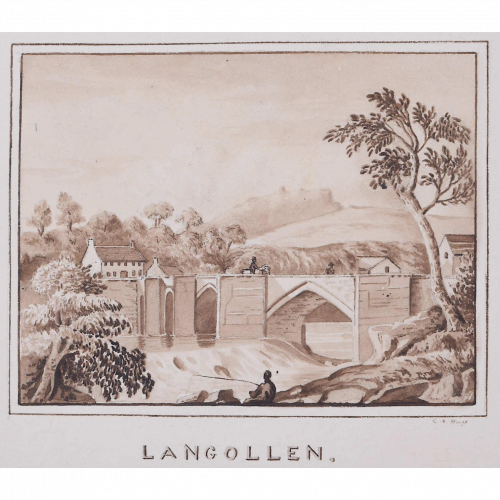
C.A. Hay
Llangollen Bridge, Wales (early 19th century)
Pen, ink and monochrome watercolour 8 x 12 cm Llangollen Bridge is built across the River Dee at the North end of the high street of Llangollen in the county of Denbigshire in Wales. The Bridge is listed as one of the seven wonders of Wales and is Grade I listed. There has been a bridge across the Dee at Llangollen since at least 1284. Some historians believe that the bridge was constructed in the 1540s; there is evidence of sepulchral slabs within the bridge's masonry, indicating that it was rebuilt following the dissolution of Henry VIII's dissolution of the monasteries. We also have in stock an en-suite watercolour of the nearby Valle Crucis abbey, from which some of the bridge's stone might have been taken. Condition: Generally very good. Signed lower right. -
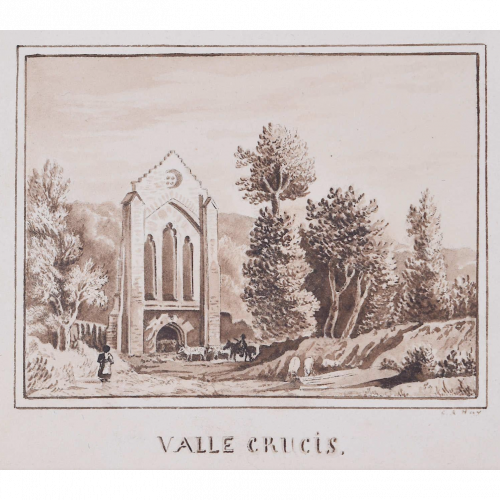
C.A. Hay
Valle Crucis Abbey, Wales (early 19th century)
Pen, ink and monochrome watercolour 8 x 12 cm Valle Crucis is a Cistercian abbey located in Llantysilio in Denbighshire, Wales. The abbey was built in 1201 by Madog ap Gruffydd Maelor, Prince of Powys Fadog. In 1537, at the height of Henry VIII's Dissolution of the Monasteries, Valle Crucis was dissolved and fell into disrepair. The abbey is now a ruin, though large parts of the original structure still survive. We also have in stock an en-suite watercolour of the nearby Llangollen Bridge; it is likely that some of the abbey's stone was used to build the bridge after the abbey had been dissolved. Condition: Generally very good. Signed lower right. -
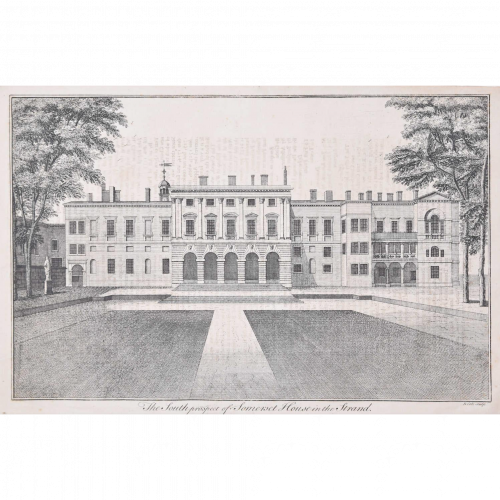
Benjamin Cole (1697-1783)
South Prospect of Somerset House (c. 1753)
Engraving 24 x 37 cm Stow's Survey of London, a ward-by-ward topographical and historical tour of the City of London giving an account of buildings, social conditions and customs, was first published in 1598. Cole's architectural view of Somerset House illustrates the clean neoclassical proportions for which it is known. Condition: Trimmed by the binder's knife within plate marks; some offsetting from facing page; occasional soft creases; generally good. -
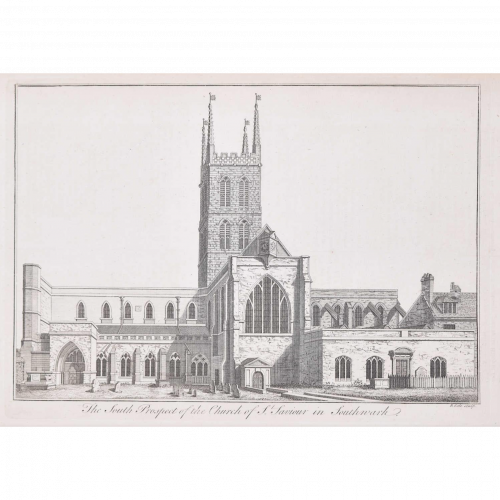
Benjamin Cole (1697-1783)
Southwark Cathedral (c. 1753)
Engraving 24 x 33 cm Stow's Survey of London, a ward-by-ward topographical and historical tour of the City of London giving an account of buildings, social conditions and customs, was first published in 1598. This view of Southwark Cathedral, labelled here as 'the South Prospect of the Church of St Saviour in Southwark', offers a charming perspective of the building's architecture and churchyard. Condition: Generally very good; slight offsetting from facing page and old library stamp to reverse. -
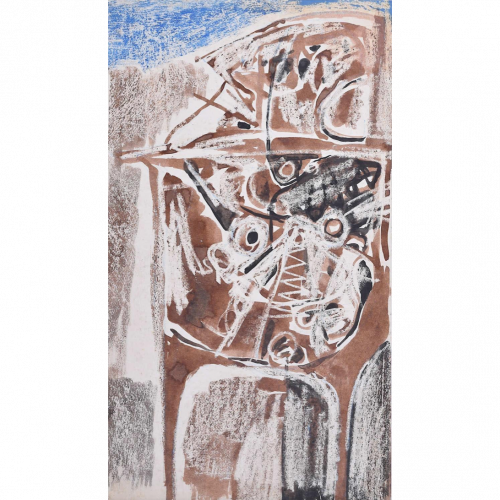
Charles Pulsford ARSA (1912-1989)
Abstract Landscape
Watercolour with wax resist 55 x 31 cm Provenance: the artist; the residual stock of William Hardie. Pulsford was born in Staffordshire to Scottish parents. His family returned to Dunfermline when he was a child, and he subsequently attended Edinburgh College of Art (ECA) between 1933 and 1937. He, along with other prominent Scottish artists, embraced modernism and abstraction following the end of the war. Alan Davie, William Turnbull, William Gear and Eduardo Paolozzi are the key artists of the group with which he was association, and the National Galleries of Scotland regard Pulsford as the 'fifth man' of the group. Between 1952 and 1960 he taught at ECA and then at Canterbury College of Art. Condition: Generally very good. If you are interested, please email info@manningfineart.co.uk or call us on 07929 749056. -
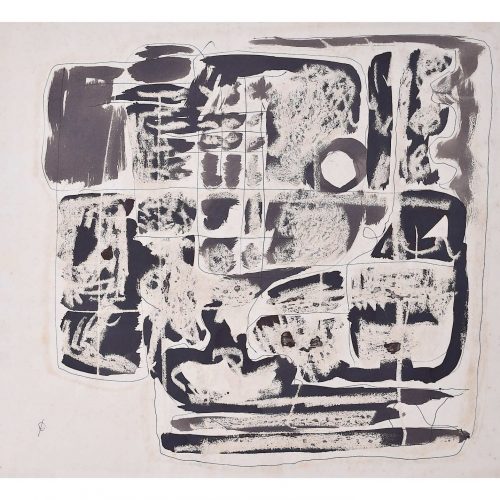
Charles Pulsford ARSA (1912-1989)
'Monochrome Landscape'
Watercolour with ink 39 x 43 cm Initialled lower left Provenance: the artist; the residual stock of William Hardie. Pulsford was born in Staffordshire to Scottish parents. His family returned to Dunfermline when he was a child, and he subsequently attended Edinburgh College of Art (ECA) between 1933 and 1937. He, along with other prominent Scottish artists, embraced modernism and abstraction following the end of the war. Alan Davie, William Turnbull, William Gear and Eduardo Paolozzi are the key artists of the group with which he was association, and the National Galleries of Scotland regard Pulsford as the 'fifth man' of the group. Between 1952 and 1960 he taught at ECA and then at Canterbury College of Art. Condition: Good. Paper slightly toned, a little spotting. If you are interested, please email info@manningfineart.co.uk or call us on 07929 749056. -
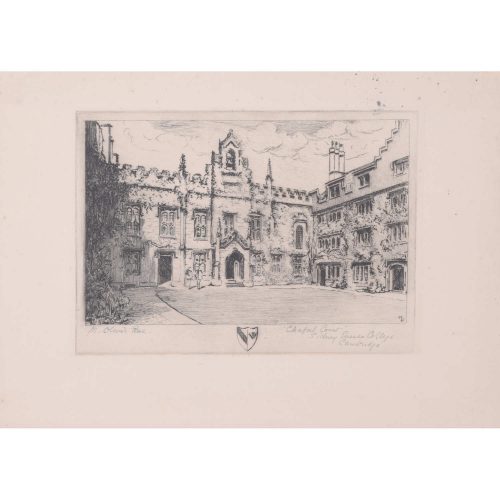
Mabel Oliver Rae
Chapel Court, Sidney Sussex College, Cambridge
Etching, circa 1920 12 x 17 cm Hand-signed in pencil lower left, and titled in pencil lower right. Signed "MR" in plate. Mabel Oliver Rae was born in Cambridge, Cambridgeshire, and trained at the Slade School of Fine Art between 1888 and 1890. Rae is known for her skilled etchings of various rural scenes and townscapes, particularly those of the colleges of Oxford and Cambridge. She signed works with the pseudonym 'M.Oliver Rae', a ruse to conceal the fact she was a female artist, so as not to reduce her chances with commercial dealers and agents. Condition: Generally very good. -
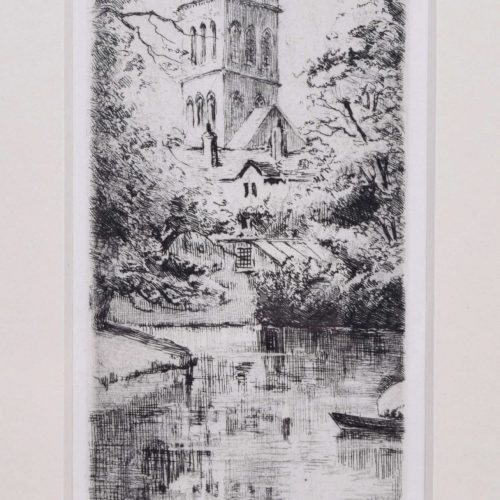
Mabel Oliver Rae
Chapel Tower of St John's College, Cambridge
Etching, circa 1920 19 x 7 cm Hand-signed in pencil lower left, and titled in pencil lower right. Signed "MR" in plate. Mabel Oliver Rae was born in Cambridge, Cambridgeshire, and trained at the Slade School of Fine Art between 1888 and 1890. Rae is known for her skilled etchings of various rural scenes and townscapes, particularly those of the colleges of Oxford and Cambridge. She signed works with the pseudonym 'M.Oliver Rae', a ruse to conceal the fact she was a female artist, so as not to reduce her chances with commercial dealers and agents. Condition: Generally very good. -
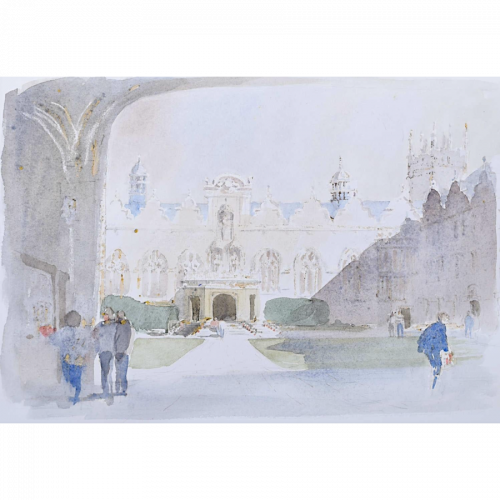
Hugh Casson (1910 - 1999)
Oriel College, Oxford
27 x 39 cm Watercolour We are lucky to be able to offer here the original watercolour from which Casson’s print of the College was produced. We also (elsewhere on the site) offer the print from his ever-popular Oxford and Cambridge series. Sir Hugh Casson was educated at Eastbourne College; St John’s College, Cambridge; and the Bartlett School of Architecture. Trained in the 1930s in the early modernist style, he taught at the Cambridge School of Architecture. After employment as a camoufleur during World War 2 by the Air Ministry, in 1948 he was appointed as director of architecture for the Festival of Britain. A close friend of the Royal Family, he undertook designs for the 1953 coronation, designed the interior of the Royal Yacht Britannia (“The overall idea was to give the impression of a country house at sea”), and taught the Prince of Wales to paint in watercolours. Amongst his architectural achievements are the Elephant House at London Zoo, the 1978 redevelopment of Bristol Docks, the Raised Faculty Building for The University of Cambridge, and a building for the Royal College of Art. He published a number of illustrated books, of which Casson’s Oxford and Casson’s Cambridge are probably the best known. A limited edition series of prints was produced from the paintings. Condition: excellent. If you’d like to know more, please email info@manningfineart.co.uk or call us on 07929 749056. -
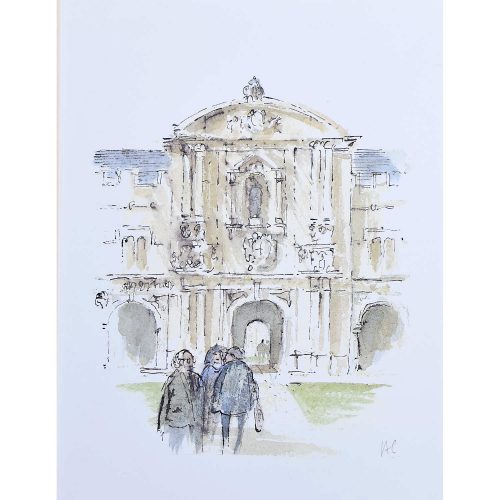
Hugh Casson (1910 - 1999)
St John's College, Oxford
Initalled in pencil 25 x 20 cm From Casson’s ever-popular Oxford and Cambridge series of prints. Sir Hugh Casson was educated at Eastbourne College; St John’s College, Cambridge; and the Bartlett School of Architecture. Trained in the 1930s in the early modernist style, he taught at the Cambridge School of Architecture. After employment as a camoufleur during World War 2 by the Air Ministry, in 1948 he was appointed as director of architecture for the Festival of Britain. A close friend of the Royal Family, he undertook designs for the 1953 coronation, designed the interior of the Royal Yacht Britannia (“The overall idea was to give the impression of a country house at sea”), and taught the Prince of Wales to paint in watercolours. Amongst his architectural achievements are the Elephant House at London Zoo, the 1978 redevelopment of Bristol Docks, the Raised Faculty Building for The University of Cambridge, and a building for the Royal College of Art. He published a number of illustrated books, of which Casson’s Oxford and Casson’s Cambridge are probably the best known. A limited edition series of prints was produced from the paintings. Condition: excellent. If you’d like to know more, please email info@manningfineart.co.uk or call us on 07929 749056. -
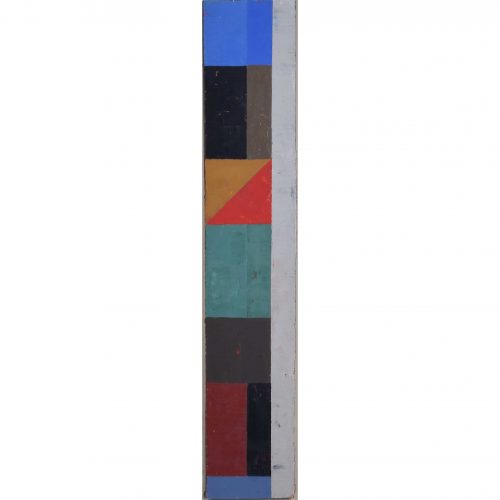
Bryan Ingham (1936-1997)
Erotisches Bild (1988)
Oil on board 62 x 11 cm Provenance: Fracis Graham-Dixon gallery. Titled to backboard and dated 1988. Bryan Ingham was born in Yorkshire. For his National Service he joined the RAF, and spent his time in Germany as an airman. After demobilisation, his final report included the statement that "Ingham is an artistic sort of airman." In his spare time he had started painting in oils, and by the time he left the RAF he had completed a large number of paintings. He studied at St Martin's School of Art in London, where he had the tuition of a fine post-war generation of teachers who helped him to hone his draughtsmanship and other skills, and he swiftly showed a capacity for painting that drew the attention of his tutors and peers. On graduating he was offered and accepted a post-graduate place at the Royal College of Art, where in his second year he was awarded a Royal Scholarship and was a contemporary of a number of now better-known names including David Hockney. Ingham applied for and received a Leverhulme travel award to explore the sites of the great Renaissance painters, and spent many happy months engaged in this expedition. He spent time at the English Art school in Rome, where he lived well and busied himself the same studio that Barbara Hepworth had used. At this stage of his career, Ingham consciously rejected the prospect of pursuing a career as an establishment artist, although the RA was open to him, and he went to live in remote cottage in Cornwall. The subsequent years were varied and highly productive, and Ingham's personal artistic voice emerged in his oeuvre in the form of an always-developing dialogue with influences both of landscape and other artists of every age. His preoccupation with etching resulted in several hundred plates, some very large, and the results are as unmistakable as they are varied, but invariably of outstanding quality. He produced a number of sculptures in bronze and in plaster, while his lifelong output of paintings remained small but again of very high quality. He taught etching regularly until about 5 years before his death, latterly at Falmouth Art School, and also at Farnham Art College. During the late eighties he established a relationship with the art dealer Francis Graham-Dixon, who had a London gallery. This meant that his paintings were professionally marketed for the first time, and prices for his work rose steadily in the last ten years of his life, and subsequently. He was able to purchase a cottage in Helston for his parents, who lived there until their deaths. He then moved into a fine set of converted-barn studios with a patch of garden, quietly situated off the High St in Helston, and it was here, on 22 September 1997, that he died, having quietly suffered from cancer for nearly a year. Condition: Generally very good, scrapes to board as intended by artist. Framed. If you'd like to know more, please email info@manningfineart.co.uk or call us on 07929 749056. -
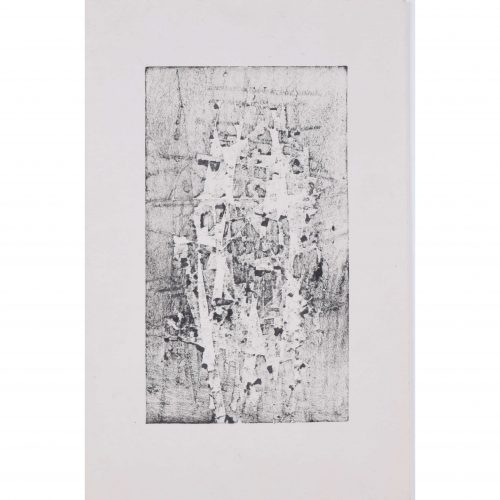
Henry Cliffe (1919-1983) Monochrome Figures
Etching 9.5 x 16.5 cm Condition: Good. If you are interested, please email info@manningfineart.co.uk or call us on 07929 749056. -
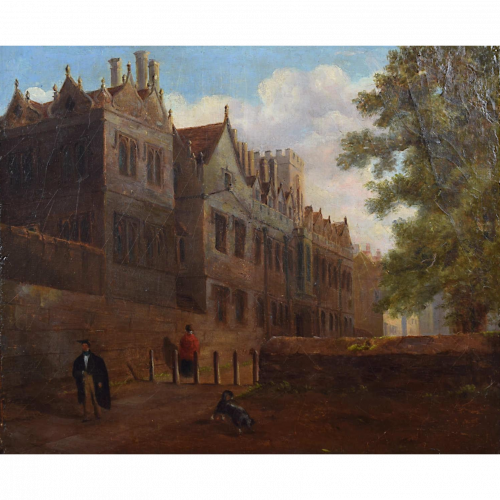
Richard Bankes Harraden (1778–1862)
St John's College, Oxford
Oil on board 24 x 29 cm Richard Bankes Harraden was a printmaker, painter and drawing master. He was active in Cambridge, producing many views of the colleges, and subsequently several Oxford colleges. Harraden was an early and exhibiting member of the Society of British Artists in London, which was established in 1823, and remained a member until 1849. He specialised in depictions of landscape, topography and architecture, and was the son of Richard Harraden (1756-1838) with whom he published plates as 'Harraden & Son'. Condition: A little craquelure and retouching. If you are interested, please email info@manningfineart.co.uk or call us on 07929 749056. -
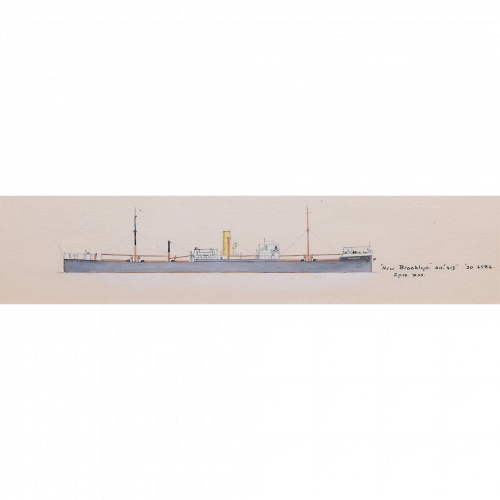
Laurence Dunn (1910-2006)
SS New Brooklyn (c.1927)
4 x 17 cm Ink and bodycolour on paper SS New Brooklyn was built in Belfast by Harland & Wolff in 1920 for Elder Dempster & Co, and was known initially as New Romance. In 1954, she was sold to Mageolia Nav SA, Panama and renamed Marianna. She was scrapped in 1959 at La Spezia. She was an 'N' Type fabricated ship with straight frames which was introduced in 1917 to utilise the capacity of bridge building companies which had very little of their normal bridge-building work to do during the war. Dunn's drawings of coastal tramps are early works, likely sketched from the side of the Thames estuary near his home. The World Ship Society published the following obituary for the well-published maritime artist and writer in 2006: DUNN, Laurence. [December 15 2006 — Lloyds List] Many readers will be saddened by the death of well-known marine artist and writer Laurence Dunn in his 97th year. A man of encyclopaedic knowledge, he began his lifelong love of ships in Brixham, where he meticulously recorded passing traffic with the exquisitely accurate line drawings which later became something of a trademark. While studying at London’s Central School of Art his work was noticed by the Southern Railway, which commissioned profiles of its fleet, and this in turn led to work for Orient Line, where he also designed the well-known corn-coloured hull, and later Thorneycroft, where he helped with shaping draft plans for a new royal yacht. During the second world was he worked for naval intelligence at the Admiralty, where his technique did much to improve recognition standards, and greatly expanded his shipping clientele, becoming personally known to many chairmen. As well as the shipping press he worked for mainstream publications such as Everybody’s, Sphere and the upmarket comic Eagle. Through his many contacts he enjoyed going to sea in a great variety of ships from aircraft carriers to colliers. Laurence wrote several books, starting with ship recognition titles which introduced new standards of layout, but his best known work was probably Passenger Liners, which was widely taken up by the travel trade. His love of Greece, where he was an early publicist of island cruising, let to involvement in reshaping various passenger liners beginning with Greek Line’s OLYMPIA. In later life he designed several sets of shipping stamps for the Crown Agents, produced photographic volumes on Thames and Mediterranean shipping and still found time to enjoy the passing Thames traffic. Our sympathies go to his wife Jennifer, who provided succour to the many ship lovers who beat a path to the welcoming door of their Gravesend home. Condition: Generally very good, slight toning to paper. If you'd like to know more, please email info@manningfineart.co.uk or call us on 07929 749056. -
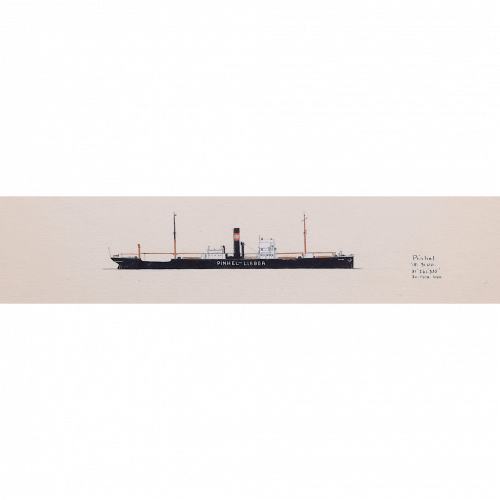
Laurence Dunn (1910-2006)
SS Pinhel Lisboa (c.1927)
4 x 17 cm Ink and bodycolour on paper Dunn's drawings of coastal tramps are early works, likely sketched from the side of the Thames estuary near his home. The World Ship Society published the following obituary for the well-published maritime artist and writer in 2006: DUNN, Laurence. [December 15 2006 — Lloyds List] Many readers will be saddened by the death of well-known marine artist and writer Laurence Dunn in his 97th year. A man of encyclopaedic knowledge, he began his lifelong love of ships in Brixham, where he meticulously recorded passing traffic with the exquisitely accurate line drawings which later became something of a trademark. While studying at London’s Central School of Art his work was noticed by the Southern Railway, which commissioned profiles of its fleet, and this in turn led to work for Orient Line, where he also designed the well-known corn-coloured hull, and later Thorneycroft, where he helped with shaping draft plans for a new royal yacht. During the second world was he worked for naval intelligence at the Admiralty, where his technique did much to improve recognition standards, and greatly expanded his shipping clientele, becoming personally known to many chairmen. As well as the shipping press he worked for mainstream publications such as Everybody’s, Sphere and the upmarket comic Eagle. Through his many contacts he enjoyed going to sea in a great variety of ships from aircraft carriers to colliers. Laurence wrote several books, starting with ship recognition titles which introduced new standards of layout, but his best known work was probably Passenger Liners, which was widely taken up by the travel trade. His love of Greece, where he was an early publicist of island cruising, let to involvement in reshaping various passenger liners beginning with Greek Line’s OLYMPIA. In later life he designed several sets of shipping stamps for the Crown Agents, produced photographic volumes on Thames and Mediterranean shipping and still found time to enjoy the passing Thames traffic. Our sympathies go to his wife Jennifer, who provided succour to the many ship lovers who beat a path to the welcoming door of their Gravesend home. Condition: Generally very good, slight toning to paper. If you'd like to know more, please email info@manningfineart.co.uk or call us on 07929 749056. -
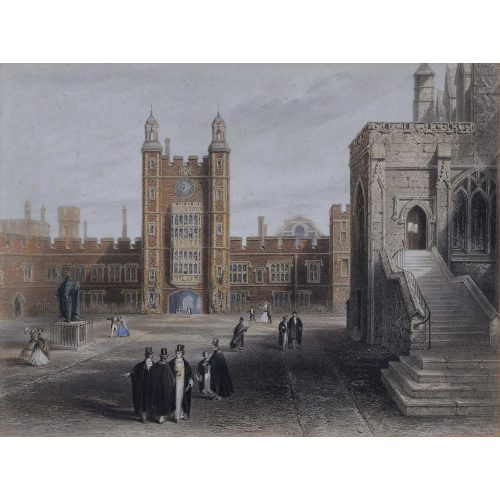
Anonymous (19th century) Eton College Courtyard
Lithograph 29 x 38 cm We have a pair of these rather fine 19th century lithographs: see the second one here. Mounted to board. -
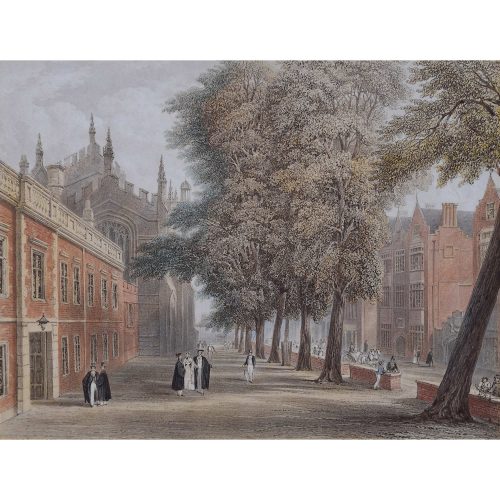
Anonymous (19th century) Eton College
Lithograph 29 x 38 cm We have a pair of these rather fine 19th century lithographs; view the other picture here. Condition: Mounted to board. -
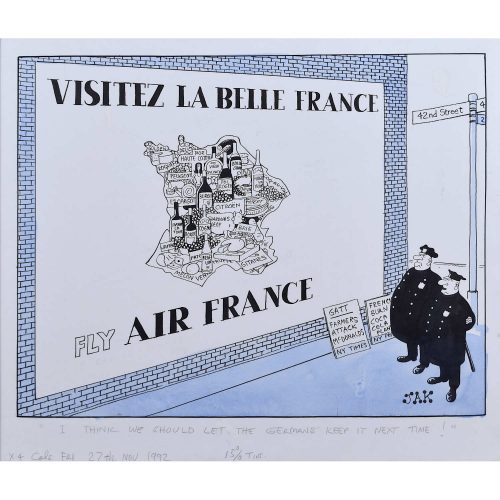
JAK (Raymond Allen Jackson) 1927-1997
"I think we should let the Germans keep it next time" (1992)
Visitez La Belle France, Fly Air France 51x59cm Pen, ink and monochrome wash with inscriptions in pencil. For the London Evening Standard JAK was one of Britian's best-known political cartoonists, working for the London Evening Standard and the Daily Mail between the 1950s and 1990s. He left school at the age of 14, and after a brief career as a messenger boy studied at Willesden College of Technology, studying art with the aim of becoming an art teacher. Following National Service (in the Territorial Army, teaching conscripts to paint), in 1950 he became a staff artist at Link House Publications, and then at advertising agency J Keymer & Co. Whilst working here he submitted cartoons to Punch and other journals, joining the Evening Standard in 1952 as illustrator, also drawing occasional cartoons. In 1966, following the suicide of 'Vicky' (Victor Weisz), he became policital cartoonist at the Evening Standard. Some of his cartoons were highly controversial. In 1970 he caricatured power workers (then striking to improve their conditions) as stupid, greedy and deaf to reason; the entire Evening Standard staff nearly went on strike in response. In 1982 a cartoon in response to the Northern Ireland situation (he frequently depicted Irish people negatively) caused Ken Livingstone to withdraw all advertising from the Standard. His style was distinctive, drawn in ink on 17" x 21.5" board using a mapping pen and brush. His signature was always in a bottom corner, with blob-like serifs, and the title and other instructions were drawn on the picture in pencil. He also drew cartoons for the Mail on Sunday, Daily Express, and Sunday Express. -
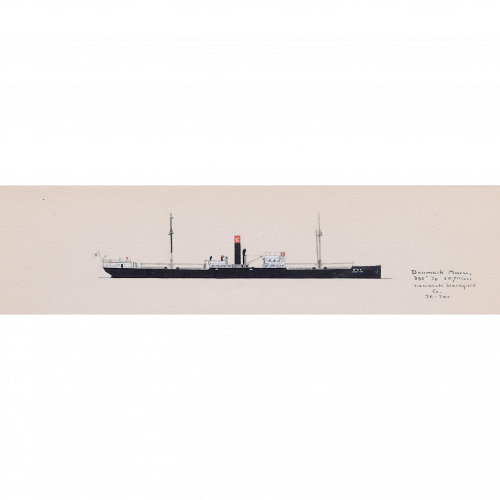
Laurence Dunn (1910-2006)
SS Denmark Maru (c.1927)
4 x 17 cm Ink and bodycolour on paper SS Denmark Maru was built by Kawasaki Shipyard Co in Japan. Until 1935 she was in service on K Line's Hamburg - New York route. Dunn's drawings of coastal tramps are early works, likely sketched from the side of the Thames estuary near his home. The World Ship Society published the following obituary for the well-published maritime artist and writer in 2006: DUNN, Laurence. [December 15 2006 — Lloyds List] Many readers will be saddened by the death of well-known marine artist and writer Laurence Dunn in his 97th year. A man of encyclopaedic knowledge, he began his lifelong love of ships in Brixham, where he meticulously recorded passing traffic with the exquisitely accurate line drawings which later became something of a trademark. While studying at London’s Central School of Art his work was noticed by the Southern Railway, which commissioned profiles of its fleet, and this in turn led to work for Orient Line, where he also designed the well-known corn-coloured hull, and later Thorneycroft, where he helped with shaping draft plans for a new royal yacht. During the second world was he worked for naval intelligence at the Admiralty, where his technique did much to improve recognition standards, and greatly expanded his shipping clientele, becoming personally known to many chairmen. As well as the shipping press he worked for mainstream publications such as Everybody’s, Sphere and the upmarket comic Eagle. Through his many contacts he enjoyed going to sea in a great variety of ships from aircraft carriers to colliers. Laurence wrote several books, starting with ship recognition titles which introduced new standards of layout, but his best known work was probably Passenger Liners, which was widely taken up by the travel trade. His love of Greece, where he was an early publicist of island cruising, let to involvement in reshaping various passenger liners beginning with Greek Line’s OLYMPIA. In later life he designed several sets of shipping stamps for the Crown Agents, produced photographic volumes on Thames and Mediterranean shipping and still found time to enjoy the passing Thames traffic. Our sympathies go to his wife Jennifer, who provided succour to the many ship lovers who beat a path to the welcoming door of their Gravesend home. Condition: Generally very good, slight toning to paper. If you'd like to know more, please email info@manningfineart.co.uk or call us on 07929 749056. -
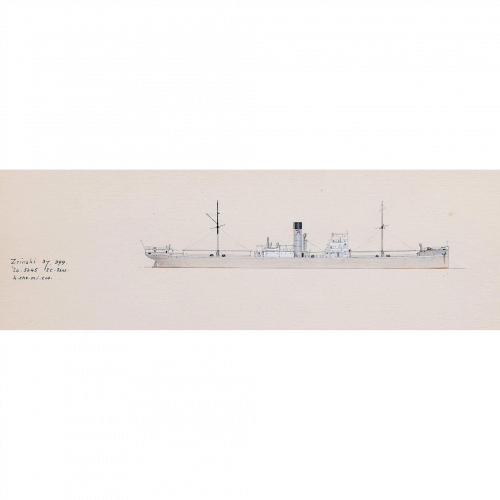
Laurence Dunn (1910-2006)
SS Zrinski (c.1925)
4 x 17 cm Ink and bodycolour on paper Zrinski was built by the Northumberland Shipbuilding Co Ltd. Following a period in Norwegian ownership it was transferred to Yugoslavian ownership in 1927. In 1940 it was acquired by the Crest Shipping Co Ltd, and sunk by German U-Boat U-140 on 8 December 1940 - as SS Ashcrest. Dunn's drawings of coastal tramps are early works, likely sketched from the side of the Thames estuary near his home. The World Ship Society published the following obituary for the well-published maritime artist and writer in 2006: DUNN, Laurence. [December 15 2006 — Lloyds List] Many readers will be saddened by the death of well-known marine artist and writer Laurence Dunn in his 97th year. A man of encyclopaedic knowledge, he began his lifelong love of ships in Brixham, where he meticulously recorded passing traffic with the exquisitely accurate line drawings which later became something of a trademark. While studying at London’s Central School of Art his work was noticed by the Southern Railway, which commissioned profiles of its fleet, and this in turn led to work for Orient Line, where he also designed the well-known corn-coloured hull, and later Thorneycroft, where he helped with shaping draft plans for a new royal yacht. During the second world was he worked for naval intelligence at the Admiralty, where his technique did much to improve recognition standards, and greatly expanded his shipping clientele, becoming personally known to many chairmen. As well as the shipping press he worked for mainstream publications such as Everybody’s, Sphere and the upmarket comic Eagle. Through his many contacts he enjoyed going to sea in a great variety of ships from aircraft carriers to colliers. Laurence wrote several books, starting with ship recognition titles which introduced new standards of layout, but his best known work was probably Passenger Liners, which was widely taken up by the travel trade. His love of Greece, where he was an early publicist of island cruising, let to involvement in reshaping various passenger liners beginning with Greek Line’s OLYMPIA. In later life he designed several sets of shipping stamps for the Crown Agents, produced photographic volumes on Thames and Mediterranean shipping and still found time to enjoy the passing Thames traffic. Our sympathies go to his wife Jennifer, who provided succour to the many ship lovers who beat a path to the welcoming door of their Gravesend home. Condition: Generally very good, slight toning to paper. If you'd like to know more, please email info@manningfineart.co.uk or call us on 07929 749056. -
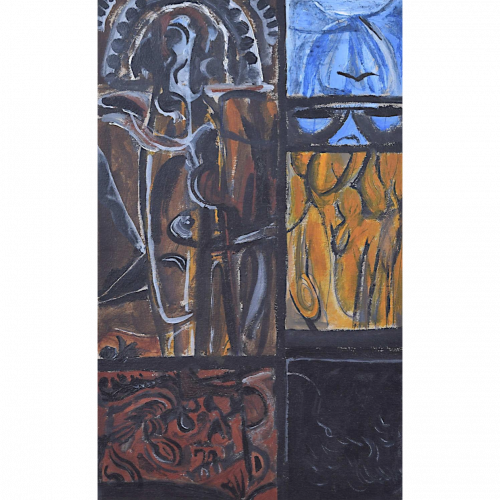
Charles Pulsford ARSA (1912-1989)
Abstract Stained Glass Design
Gouache 40 x 25 cm Provenance: the artist, the residual stock of William Hardie Gallery. This mesmerising depiction of an abstract figure is likely a design for a stained glass window panel. Pulsford was born in Staffordshire to Scottish parents. His family returned to Dunfermline when he was a child, and he subsequently attended Edinburgh College of Art (ECA) between 1933 and 1937. He, along with other prominent Scottish artists, embraced modernism and abstraction following the end of the war. Alan Davie, William Turnbull, William Gear and Eduardo Paolozzi are the key artists of the group with which he was association, and the National Galleries of Scotland regard Pulsford as the 'fifth man' of the group. Between 1952 and 1960 he taught at ECA and then at Canterbury College of Art. Condition: Generally very good. If you are interested, email info@manningfineart.co.uk or call us on 07929 749056. -
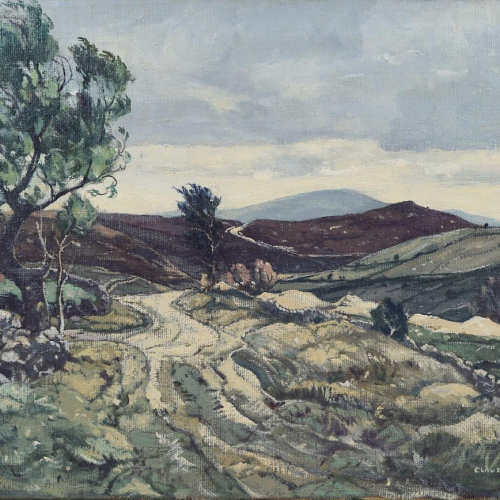
Claude Muncaster Moor above Llangollen
Oil on canvas 36 x 51 cm Condition: Excellent, recently cleaned and revarnished. Signed lower right. Click here for biographical details and other works by the artist. If you are interested, email info@manningfineart.co.uk or call us on 07929 749056. -
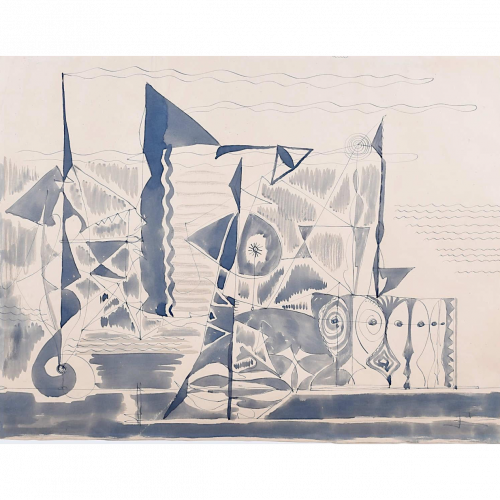
Charles Pulsford ARSA (1912-1989)
Abstract Harbour
Watercolour 36 x 46 cm Signed lower right. Pulsford was born in Staffordshire to Scottish parents. His family returned to Dunfermline when he was a child, and he subsequently attended Edinburgh College of Art (ECA) between 1933 and 1937. He, along with other prominent Scottish artists, embraced modernism and abstraction following the end of the war. Alan Davie, William Turnbull, William Gear and Eduardo Paolozzi are the key artists of the group with which he was association, and the National Galleries of Scotland regard Pulsford as the 'fifth man' of the group. Between 1952 and 1960 he taught at ECA and then at Canterbury College of Art. Provenance: the artist, the residual stock of William Hardie Gallery. Condition: Generally very good, in fine hand-finished frame. If you are interested, email info@manningfineart.co.uk or call us on 07929 749056. -
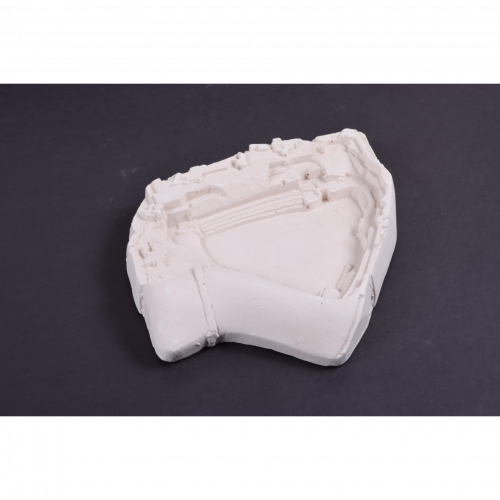
Sir Eduardo Paolozzi CBE RA (1924-2005)
Amphitheatre
Plaster 27 x 22 x 4 cm (max) Paolozzi’s fascination with anatomy, machine parts, and the idiom of classical statuary is evident in his modernist sculptural forms. Amphitheatre blends neoclassicism with 20th-century brutalism, betraying a fascination with the materiality of public architecture. Sir Eduardo Luigi Paolozzi CBE RA was a Scottish artist, known for his sculpture and graphic works. He is widely considered to be one of the pioneers of pop art. Paolozzi studied at the Edinburgh College of Art in 1943, briefly at Saint Martin's School of Art in 1944, and then at the Slade School of Fine Art at University College London from 1944 to 1947, after which he worked in Paris. While in Paris from 1947 to 1949, Paolozzi became acquainted with Alberto Giacometti, Jean Arp, Constantin Brâncuși, Georges Braque and Fernand Léger. This period became an important influence for his later work. For example, the influence of Giacometti and many of the original Surrealists he met in Paris can be felt in the group of lost-wax sculptures made by Paolozzi in the mid-1950s. Their surfaces, studded with found objects and machine parts, were to gain him recognition. He taught sculpture and ceramics at several institutions, including the Hochschule für bildende Künste Hamburg (1960–62), University of California, Berkeley (in 1968) and at the Royal College of Art. Paolozzi had a long association with Germany, having worked in Berlin from 1974 as part of the Berlin Artist Programme of the German Academic Exchange Programme. He was a professor at the Fachhochschule in Cologne from 1977 to 1981, and later taught sculpture at the Akademie der Bildenden Künste in Munich. Paolozzi was fond of Munich and many of his works and concept plans were developed in a studio he kept there, including the mosaics of the Tottenham Court Road Station in London. He took a stab at industrial design in the 1970s with a 500-piece run of the upscale Suomi tableware by Timo Sarpaneva that Paolozzi decorated for the German Rosenthal porcelain maker's Studio Linie. Condition: Generally very good, occasional inclusions etc., as expected. If you'd ike to know more, please email info@manningfineart.co.uk or call us on 07929 749056. -
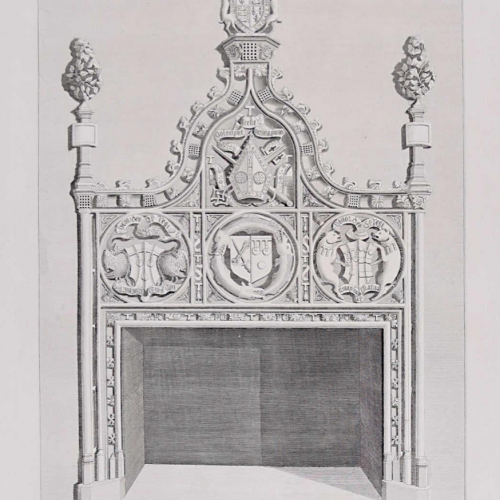
James Basire
James Basire engraving of Bishop's Palace Exeter
Engraving 50 x 33 cm (to plate mark) Published by the Society of Antiquaries 23rd April 1796. A member of the Society of Antiquaries, Basire specialised in architectural prints. He was appointed as engraver to the society, much of his finest works being found in their Vestuta Monumenta. Basire's father Isaac was a cartographer, and both his son and grandson were called James and also worked for the society. William Blake was apprenticed to Basire for seven years. If you are interested, email info@manningfineart.co.ukor call us on 07929 749056.