-

Mary, Countess of Pembroke, Foundress of Pembroke College, Cambridge
Hand-coloured aquatint 18 x 16 cm Published by Rudolph Ackermann (1764 - 1834). Rudolph Ackermann was an Anglo-German bookseller, inventor, lithographer, publisher and businessman. In 1795 he established a print-shop and drawing-school at 96 Strand. Here Ackermann set up a lithographic press and began a trade in prints. He later began to manufacture colours and thick carton paper for landscape and miniature painters. Within three years the premises had become too small and he moved to 101 Strand, in his own words "four doors nearer to Somerset House", the seat of the Royal Academy of Arts. Between 1797 and 1800 Ackermann rapidly developed his print and book publishing business, encompassing many different genres including topography, caricature, portraits, transparencies and decorative prints. -

Charles George Lewis (13 June 1808 - 16 June 1880) after Sir Joshua Reynolds PRA FRS FRSA (16 July 1723 - 23 February 1792) Window of New College Chapel (1814)
Aquatint with original hand colouring 30 x 22 cm An engraving of one of New College Chapel's magnificent stained glass windows, designed by Sir Joshua Reynolds in 1777. Sir Joshua Reynolds was one of England's leading portraitists in the 18th century; he was also a founder and first president of the Royal Academy of Arts. Charles George Lewis was a British printmaker, and engraved many works after other artists as well as producing his own. He was he second son of Frederick Christian Lewis and learned drawing and engraving from his father. Rudolph Ackermann was an Anglo-German bookseller, inventor, lithographer, publisher and businessman. In 1795 he established a print-shop and drawing-school at 96 Strand. Here Ackermann set up a lithographic press and began a trade in prints. He later began to manufacture colours and thick carton paper for landscape and miniature painters. Within three years the premises had become too small and he moved to 101 Strand, in his own words "four doors nearer to Somerset House", the seat of the Royal Academy of Arts. Between 1797 and 1800 Ackermann rapidly developed his print and book publishing business, encompassing many different genres including topography, caricature, portraits, transparencies and decorative prints. Condition: Generally very good - some wear to margins which will be hidden under mount.If you would like to know more, please email info@manningfineart.co.uk or call us on 07929 749056.
-

Anonymous
He Chose the Army
Printed for Her Majesty’s Stationary Office by the British Colour Printing Co. Ltd. c. 1960. Photolithograph 76x51cm If you are interested email info@manningfineart.co.uk or call us on 07929 749056. -

Anonymous
Man of the World: in a modern force the territorial army for adventure plus technical training
Lithographic poster c. 1960 75.5x51cm If you are interested email info@manningfineart.co.uk or call us on 07929 749056. -
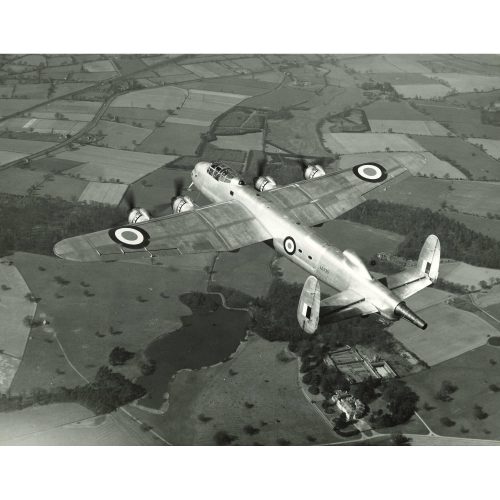
Charles E Brown (1896-1982)
Testbed Avro Lancaster Bomber LL735
Silver Gelatin Black & White Photographic Print 19x25cm Stamped to reverse "6231-3 Copyright photograph by Charles E Brown, 14, Longfellow Road, Worcester Park, Surrey, Derwent 4396." The Lancaster bomber needs no introduction as the most famous and important bomber of the Second World War. Here however LL735, a Mk II, is is fitted with a fifth engine, a jet engine. The air intake may be seen above the fuselage and the engine itself replaces the rear gun turret. In 1943 LL735 was fitted with the Metropolitan-Vickers F2/1 Beryl jet engine, and in 1945 it trialed the F2/4 jet engine. This photograph would have been particularly secret at the time it was taken. Charles E Brown was a famous photographer of aircraft whose father was a butcher in Wimbledon, London. Young Charles was given a camera for his 14th birthday and in 1911 photographed an Edwardian gentleman in trouble landing his balloon in neighbouring Southfields. This photograph was published in the Daily Mirror - the fee being half a crown - and Brown was encouraged to join the Daily Mirror's photography department upon leaving school at 16. Towards the end of the First World War he served with the Royal Air Force at their official London Photographic Centre. Following the war, he took to photographing trains, and captured a famous photograph of a Southern Railway locomotive that was used for the following ten years in railway posters. The income from this allowed him to pursue his passion of aviation photography in the 1920s and 1930s, from which commissions from the Air Ministry and Fleet Air Arm followed. During the war his work included commissions for Aeronautics magazine. Provenance: from the collection of Philip J R Moyes, author of many books on the RAF, most notably The Pictorial History which ran to several volumes. -
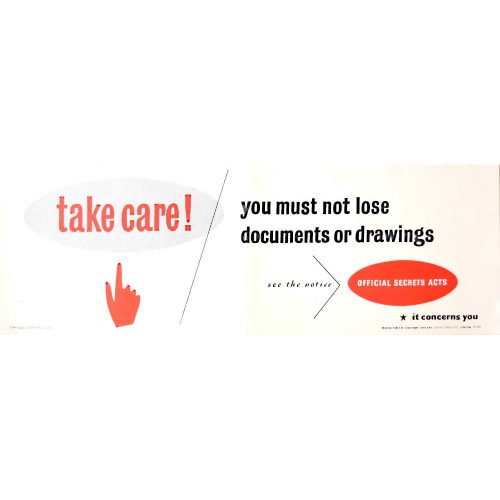
Take Care! Official Secrets Act WW2 Poster (c.1940)
Lithographic poster 18 x 51 cm Printed for the HM Stationary Office by Gothic Press, London. -
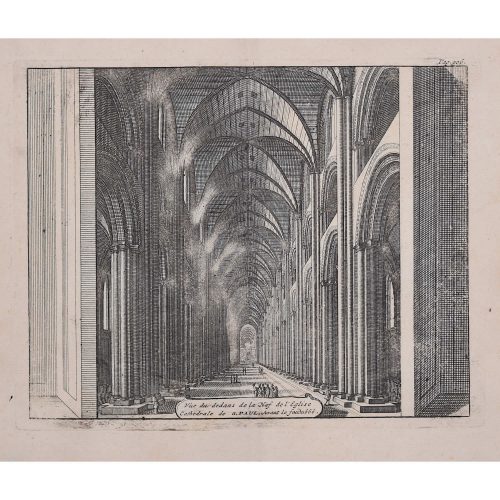
Pieter van der Aa (1659-1733), after Jan Kip (1652/3-1722)
Old St Paul's Cathedral (1707)
Engraving, 14 x 17 cm A view of the nave of Old St Paul's Cathedral, engraved by Pieter van der Aa after Johannes 'Jan' Kip, the Dutch draftsman, engraver and print dealer. Pieter van der Aa of Leiden was a Dutch publisher best known for preparing maps and atlases, though he also printed editions of foreign bestsellers and illustrated volumes. He is noted for the many engravings he produced after David Loggan's series of Oxford and Cambridge colleges and costumes. In 1727 Van Der Aa illustrated "Les Delices de la Grande Bretagne & de L'Irelande" by James Beeverell, the book in which this engraving appears. Condition: Generally very good. -
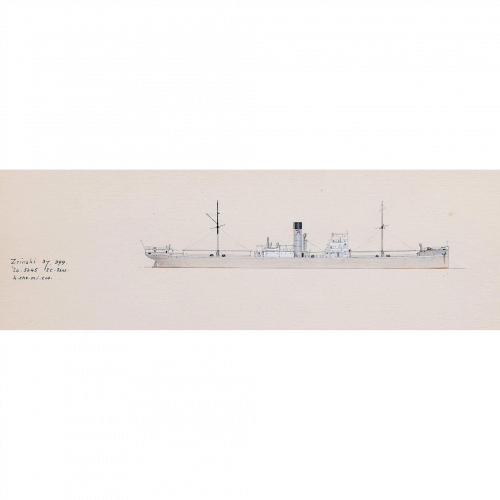
Laurence Dunn (1910-2006)
SS Zrinski (c.1925)
4 x 17 cm Ink and bodycolour on paper Zrinski was built by the Northumberland Shipbuilding Co Ltd. Following a period in Norwegian ownership it was transferred to Yugoslavian ownership in 1927. In 1940 it was acquired by the Crest Shipping Co Ltd, and sunk by German U-Boat U-140 on 8 December 1940 - as SS Ashcrest. Dunn's drawings of coastal tramps are early works, likely sketched from the side of the Thames estuary near his home. The World Ship Society published the following obituary for the well-published maritime artist and writer in 2006: DUNN, Laurence. [December 15 2006 — Lloyds List] Many readers will be saddened by the death of well-known marine artist and writer Laurence Dunn in his 97th year. A man of encyclopaedic knowledge, he began his lifelong love of ships in Brixham, where he meticulously recorded passing traffic with the exquisitely accurate line drawings which later became something of a trademark. While studying at London’s Central School of Art his work was noticed by the Southern Railway, which commissioned profiles of its fleet, and this in turn led to work for Orient Line, where he also designed the well-known corn-coloured hull, and later Thorneycroft, where he helped with shaping draft plans for a new royal yacht. During the second world was he worked for naval intelligence at the Admiralty, where his technique did much to improve recognition standards, and greatly expanded his shipping clientele, becoming personally known to many chairmen. As well as the shipping press he worked for mainstream publications such as Everybody’s, Sphere and the upmarket comic Eagle. Through his many contacts he enjoyed going to sea in a great variety of ships from aircraft carriers to colliers. Laurence wrote several books, starting with ship recognition titles which introduced new standards of layout, but his best known work was probably Passenger Liners, which was widely taken up by the travel trade. His love of Greece, where he was an early publicist of island cruising, let to involvement in reshaping various passenger liners beginning with Greek Line’s OLYMPIA. In later life he designed several sets of shipping stamps for the Crown Agents, produced photographic volumes on Thames and Mediterranean shipping and still found time to enjoy the passing Thames traffic. Our sympathies go to his wife Jennifer, who provided succour to the many ship lovers who beat a path to the welcoming door of their Gravesend home. Condition: Generally very good, slight toning to paper. If you'd like to know more, please email info@manningfineart.co.uk or call us on 07929 749056. -
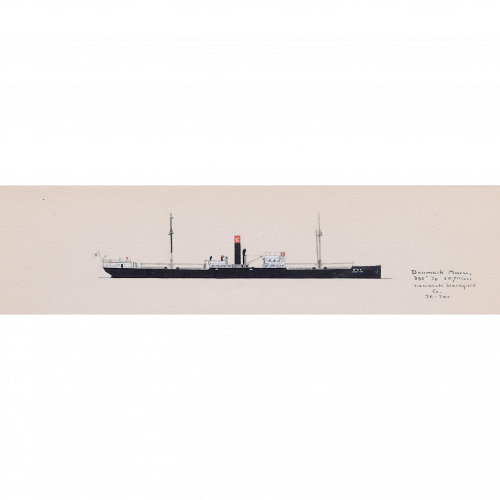
Laurence Dunn (1910-2006)
SS Denmark Maru (c.1927)
4 x 17 cm Ink and bodycolour on paper SS Denmark Maru was built by Kawasaki Shipyard Co in Japan. Until 1935 she was in service on K Line's Hamburg - New York route. Dunn's drawings of coastal tramps are early works, likely sketched from the side of the Thames estuary near his home. The World Ship Society published the following obituary for the well-published maritime artist and writer in 2006: DUNN, Laurence. [December 15 2006 — Lloyds List] Many readers will be saddened by the death of well-known marine artist and writer Laurence Dunn in his 97th year. A man of encyclopaedic knowledge, he began his lifelong love of ships in Brixham, where he meticulously recorded passing traffic with the exquisitely accurate line drawings which later became something of a trademark. While studying at London’s Central School of Art his work was noticed by the Southern Railway, which commissioned profiles of its fleet, and this in turn led to work for Orient Line, where he also designed the well-known corn-coloured hull, and later Thorneycroft, where he helped with shaping draft plans for a new royal yacht. During the second world was he worked for naval intelligence at the Admiralty, where his technique did much to improve recognition standards, and greatly expanded his shipping clientele, becoming personally known to many chairmen. As well as the shipping press he worked for mainstream publications such as Everybody’s, Sphere and the upmarket comic Eagle. Through his many contacts he enjoyed going to sea in a great variety of ships from aircraft carriers to colliers. Laurence wrote several books, starting with ship recognition titles which introduced new standards of layout, but his best known work was probably Passenger Liners, which was widely taken up by the travel trade. His love of Greece, where he was an early publicist of island cruising, let to involvement in reshaping various passenger liners beginning with Greek Line’s OLYMPIA. In later life he designed several sets of shipping stamps for the Crown Agents, produced photographic volumes on Thames and Mediterranean shipping and still found time to enjoy the passing Thames traffic. Our sympathies go to his wife Jennifer, who provided succour to the many ship lovers who beat a path to the welcoming door of their Gravesend home. Condition: Generally very good, slight toning to paper. If you'd like to know more, please email info@manningfineart.co.uk or call us on 07929 749056. -
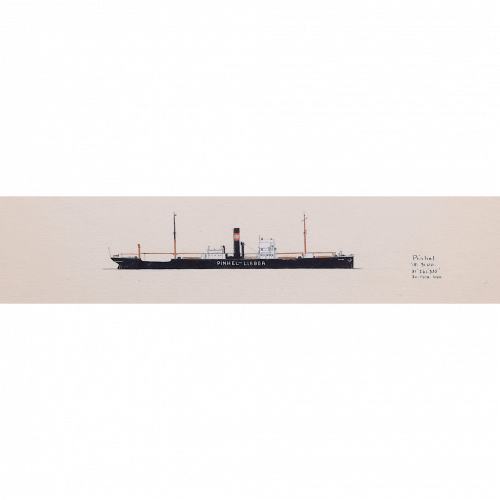
Laurence Dunn (1910-2006)
SS Pinhel Lisboa (c.1927)
4 x 17 cm Ink and bodycolour on paper Dunn's drawings of coastal tramps are early works, likely sketched from the side of the Thames estuary near his home. The World Ship Society published the following obituary for the well-published maritime artist and writer in 2006: DUNN, Laurence. [December 15 2006 — Lloyds List] Many readers will be saddened by the death of well-known marine artist and writer Laurence Dunn in his 97th year. A man of encyclopaedic knowledge, he began his lifelong love of ships in Brixham, where he meticulously recorded passing traffic with the exquisitely accurate line drawings which later became something of a trademark. While studying at London’s Central School of Art his work was noticed by the Southern Railway, which commissioned profiles of its fleet, and this in turn led to work for Orient Line, where he also designed the well-known corn-coloured hull, and later Thorneycroft, where he helped with shaping draft plans for a new royal yacht. During the second world was he worked for naval intelligence at the Admiralty, where his technique did much to improve recognition standards, and greatly expanded his shipping clientele, becoming personally known to many chairmen. As well as the shipping press he worked for mainstream publications such as Everybody’s, Sphere and the upmarket comic Eagle. Through his many contacts he enjoyed going to sea in a great variety of ships from aircraft carriers to colliers. Laurence wrote several books, starting with ship recognition titles which introduced new standards of layout, but his best known work was probably Passenger Liners, which was widely taken up by the travel trade. His love of Greece, where he was an early publicist of island cruising, let to involvement in reshaping various passenger liners beginning with Greek Line’s OLYMPIA. In later life he designed several sets of shipping stamps for the Crown Agents, produced photographic volumes on Thames and Mediterranean shipping and still found time to enjoy the passing Thames traffic. Our sympathies go to his wife Jennifer, who provided succour to the many ship lovers who beat a path to the welcoming door of their Gravesend home. Condition: Generally very good, slight toning to paper. If you'd like to know more, please email info@manningfineart.co.uk or call us on 07929 749056. -
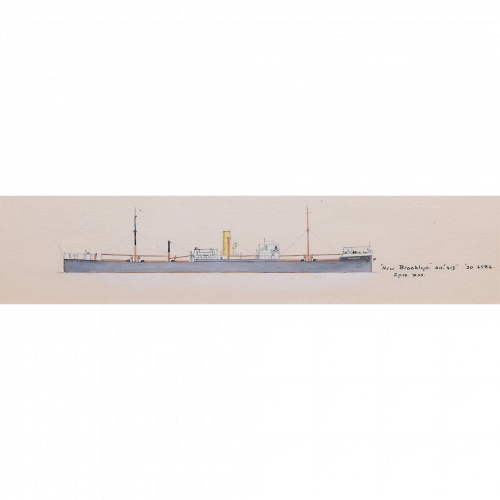
Laurence Dunn (1910-2006)
SS New Brooklyn (c.1927)
4 x 17 cm Ink and bodycolour on paper SS New Brooklyn was built in Belfast by Harland & Wolff in 1920 for Elder Dempster & Co, and was known initially as New Romance. In 1954, she was sold to Mageolia Nav SA, Panama and renamed Marianna. She was scrapped in 1959 at La Spezia. She was an 'N' Type fabricated ship with straight frames which was introduced in 1917 to utilise the capacity of bridge building companies which had very little of their normal bridge-building work to do during the war. Dunn's drawings of coastal tramps are early works, likely sketched from the side of the Thames estuary near his home. The World Ship Society published the following obituary for the well-published maritime artist and writer in 2006: DUNN, Laurence. [December 15 2006 — Lloyds List] Many readers will be saddened by the death of well-known marine artist and writer Laurence Dunn in his 97th year. A man of encyclopaedic knowledge, he began his lifelong love of ships in Brixham, where he meticulously recorded passing traffic with the exquisitely accurate line drawings which later became something of a trademark. While studying at London’s Central School of Art his work was noticed by the Southern Railway, which commissioned profiles of its fleet, and this in turn led to work for Orient Line, where he also designed the well-known corn-coloured hull, and later Thorneycroft, where he helped with shaping draft plans for a new royal yacht. During the second world was he worked for naval intelligence at the Admiralty, where his technique did much to improve recognition standards, and greatly expanded his shipping clientele, becoming personally known to many chairmen. As well as the shipping press he worked for mainstream publications such as Everybody’s, Sphere and the upmarket comic Eagle. Through his many contacts he enjoyed going to sea in a great variety of ships from aircraft carriers to colliers. Laurence wrote several books, starting with ship recognition titles which introduced new standards of layout, but his best known work was probably Passenger Liners, which was widely taken up by the travel trade. His love of Greece, where he was an early publicist of island cruising, let to involvement in reshaping various passenger liners beginning with Greek Line’s OLYMPIA. In later life he designed several sets of shipping stamps for the Crown Agents, produced photographic volumes on Thames and Mediterranean shipping and still found time to enjoy the passing Thames traffic. Our sympathies go to his wife Jennifer, who provided succour to the many ship lovers who beat a path to the welcoming door of their Gravesend home. Condition: Generally very good, slight toning to paper. If you'd like to know more, please email info@manningfineart.co.uk or call us on 07929 749056. -
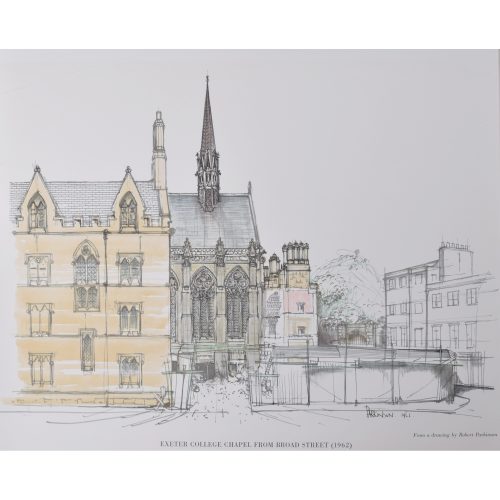
Robert Parkinson
Exeter College Chapel from Broad Street (1964)
Lithograph 33 x 46 cm A lithograph of Exeter's chapel, viewed from Broad Street, from a drawing by Robert Parkinson. Parkinson's depiction of the chapel centres around its architecture; markedly inspired by the Sainte-Chapelle in Paris and designed by Sir George Gilbert Scott, the chapel was built between 1856 and 1860. Here, Parkinson has its spire reach upward into a blank sky. Parkinson's 1962 etching was reproduced as a lithograph in 1964, to be published in the "Oxford Almanack". The Oxford Almanack was an annual almanac published by the Oxford University Press for the University of Oxford from 1674 through 2019 (when printing sadly ceased due to "dwindling interest"). The almanac traditionally included engravings or lithographs of the University and information about the upcoming year. Other almanac artists have included James Basire, Michael Burghers, J. M. W. Turner, and John Piper. Condition: very good, save for crease to top left corner (tear to margin which will be hidden under the mount). If you’d like to know more, please email info@manningfineart.co.uk or call us on 07929 749056. -
Out of stock
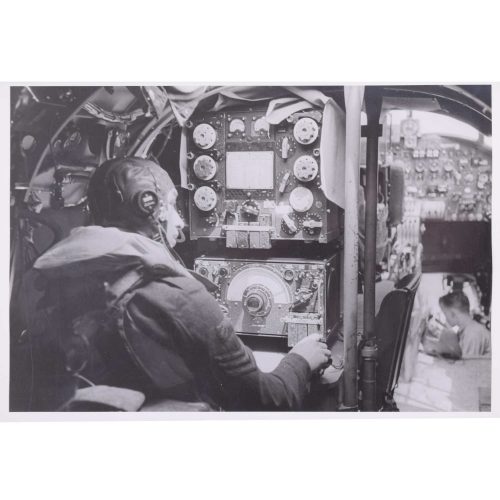
Charles E Brown
AVRO Lancaster bomber Radio Operator
Original Silver Gelatin photograph, c. 1944 Stamped to reverse 'Charles E Brown' with address etc. and serial number 14 x 21 cm Charles E Brown was a famous photographer of aircraft whose father was a butcher in Wimbledon, London. Young Charles was given a camera for his 14th birthday and in 1911 photographed an Edwardian gentleman in trouble landing his balloon in neighbouring Southfields. This photograph was published in the Daily Mirror – the fee being half a crown – and Brown was encouraged to join the Daily Mirror’s photography department upon leaving school at 16. Towards the end of the First World War he served with the Royal Air Force at their official London Photographic Centre. Following the war, he took to photographing trains, and captured a famous photograph of a Southern Railway locomotive that was used for the following ten years in railway posters. The income from this allowed him to pursue his passion of aviation photography in the 1920s and 1930s, from which commissions from the Air Ministry and Fleet Air Arm followed. During the war his work included commissions for Aeronautics magazine. Provenance: from the collection of Philip J R Moyes, author of many books on the RAF, most notably The Pictorial History which ran to several volumes. Condition: Very good -
Out of stock
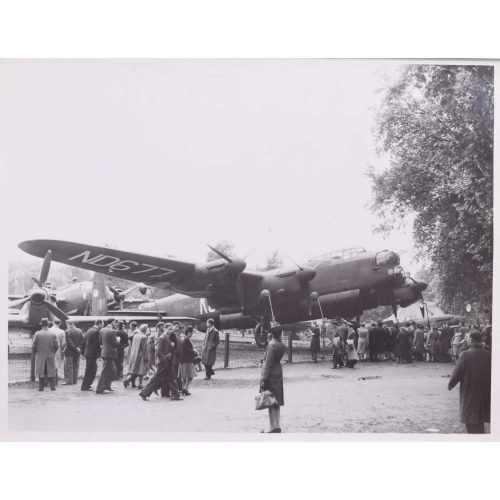
Lancaster bomber in Green Park
Original Silver Gelatin photograph, 1946 18 x 25 cm Stamped to reverse: "Photograph Supplied by The Topical Press Agency Ltd 20-21 Red Lion Court, Fleet Street" Press release label to reverse reads: "XH - RAF PLANES ON VIEW IN GREEN PARK, LONDON "In connection with the Victory Day celebrations in London, a number of RAF planes have been put on view in Green Park, London. "11/6/1946" Further typewritten note reads: "Lancaster B.III ND677/G KO-X of 115 Sqn. First Lancaster to have MONICA airborne tail warning device. Served with 460 Sqn RAAF, during 1944, went to 49 Sqn in April 1945 and finally to 113 Sqn in September 1945. Scrapped July 1946." ND677 was a veteran of 59 missions. The /G suffix - visible in the photograph - indicates that it must have an armed guard at all times. It was unceremoniously scrapped within a month of being on display to the crowds. Monica was a tail-borne radar device, designed to give the bomber crew warning of the approach of a German fighter in their blind spot. However following the crash in February 1943 of a Monica-equipped Lancaster (just seven days into Monica's operational life) the Germans developed equipment called 'Flensburg'. Introduced in early 1944 it was a homing device, a passive radar receiver which enabled Flensburg-equipped night fighters to locate Allied bombers. In July 1944 a Flensburg-equipped Junkers Ju88-G1 mistakenly landed at Woodbridge aerodrome in Suffolk, following which Monica was rapidly withdrawn from service. Condition: Generally very good. Provenance: from the collection of Philip J R Moyes, author of many books on the RAF, most notably The Pictorial History which ran to several volumes. -
Out of stock
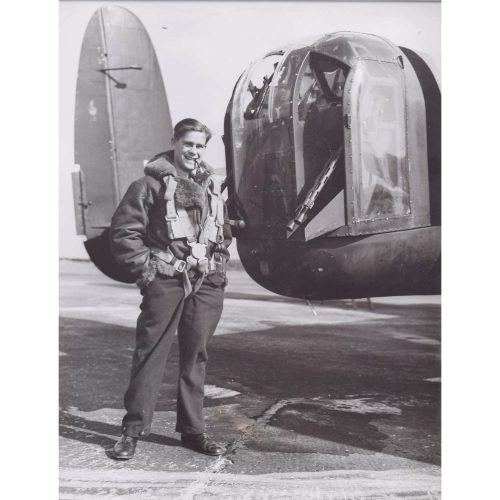
Roberts Dunstan DSO - Tail-end Charlie on Lancaster Bomber
Original Silver Gelatin photograph, c. 1943 20 x 15 cm The sitting-down war played out in the skies suited amputees who wanted to continue killing the enemy. Douglas Bader famously bailed out of his Spitfire over Germany, leaving behind his artificial legs. There were others who flew with artificial legs, including Dunstan. Dunstan was born in 1922, lying about his age (by three years) in order to join up in June 1940. In January 1941, serving with the Royal Australian Engineers, he was injured in one leg near Tobruk (in Libya) on a night reconnaisance raid. After five operations his leg was amputated; after ten more he was returned to Australia and invalided out of the services in February 1942. A few months later, he caught sight of a poster recruiting for the RAAF, and volunteered his services, enlisting on 23 June 1942 - having spent some time convincing the RAAF that there were roles that he could undertake successfully. Following training at the RAAF Bombing and Gunnery School he was soon on his way to the UK, sailing on 24 August from Sydney. He was soon serving at RAF Breighton in Yorkshire with 460 Sqn RAAF as rear gunner in an Avro Lancaster bomber. As he walked to the aircraft he used his crutches; onboard he would crawl to his post in the tail. On the night of 22/23 October 1943, aboard W4927, his Lancaster left Binbrook for a bombing raid over Germany. Above Kassel, the target, a Lancaster bomber above them dropped its bombs. Two incendiary bombs dropped through W4927; one hitting the flight engineer's jump seat - beside the pilot - the other falling through the middle of the aeroplane and severing the oxygen supply to the rear and mid-upper turrets - the former being Dunstan's. A German night fighter chose this moment to attack W4927. Befuddled by lack of oxygen the gunners were unable to shoot, W4927 losing its port elevator and receiving holes in its port wing and fuselage - and one cannon shell went into Dunstan's rear turret. However the pilot nursed the plane back to England, where it crash landed at either RAF Elsham Wold, or Bisham - sources vary. On 3/4 November 1943 Dunstan completed his thirtieth mission, to Dusseldorf, the day before his twenty-first birthday. He was gazetted for his DSO on 7 November. In 1944 he returned to Australia and in 1956 was elected to the Victoria State Parliament where he held ministerial posts for water supply, and subsequently for public works. -
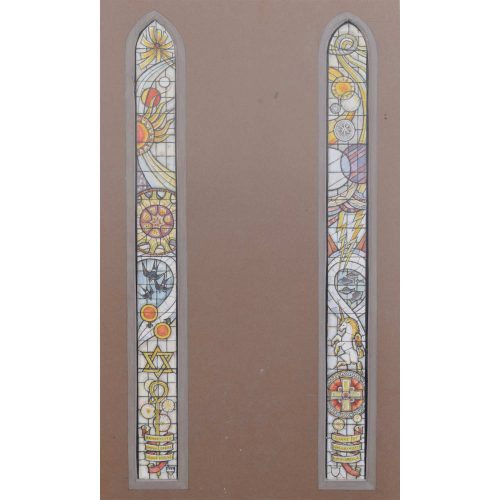
Jane Gray (b.1931)
St Peter’s Church, Martindale, Design for Benedicite Stained Glass Windows (1975-77)
Watercolour 32.5 x 8 cmSt Peter’s Church was built in Martindale, Cumbria in 1880 by a local craftsman using stone from the surrounding area. The church is situated in an enchanting rural oasis and has connections to the acclaimed modern poet, Kathleen Raine, who lived in the Old Vicarage, as well as William and Dorothy Wordsworth who visited the area on one of their Cumbrian excursions. Gray’s ‘Martindale Era’ lasted from 1974-1981, in which time, she designed and installed fifteen stained glass windows in St Peter’s Church. This pair of windows were commissioned as Gray was constructing her fifth, and supposedly last, window; the church had received a gift from an American donor who shared the name ‘Martindale’ and the vicar decided to commission two more windows on the them of the Benedicite.
Provenance: the artist’s studio sale. Literature: Jane Gray, Playing with Rainbows. (Shropshire: Ellingham Press, 2011), pp.17-18, 74. Condition: very good. If you are interested, please email info@manningfineart.co.uk or call us on 07929 749056. For other works by Jane Gray and more information about her, please click here. -
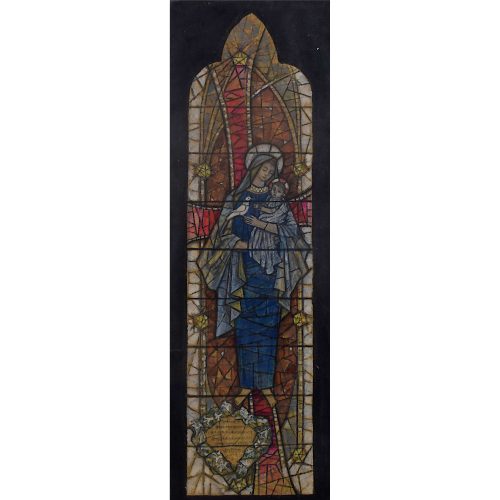
Jane Gray (b.1931)
Early Design for Stained Glass Memorial Window (1962)
Watercolour 27.5 x 9 cmA rare example of Gray’s early work, this design shows a more traditional approach to stained glass window design, something that Gray came to eschew in favour of a more modern style in much of her later work. This design was for a memorial window commemorating Rosemary Anstice, although its intended location is unknown.
Provenance: the artist’s studio sale. Condition: very good. If you are interested, please email info@manningfineart.co.uk or call us on 07929 749056. For other works by Jane Gray and more information about her, please click here. -

George Bissill (1896-1973) View of St Peter's Church, Willersey
Pencil sketch 25 x 35 cm Born in 1896, George Bissill was a British miner, painter and furniture designer. Raised in the mining village of Langley Mill, Derbyshire, Bissill became a miner at the age of 13, before leaving to join the war effort in 1915. Upon his return from the war after being gassed, Bissill chose to become a pavement artist outside the newly erected Bush House in Aldwych, painting from his memory and his sketch book the uncompromising underground world he had inhabited. In 1935 he moved to the countryside near Newbury, where he lived and worked as a landscape painter, art restorer and dealer until his death in 1973. This painting forms part of a larger collection, 'unseen since they were taken from George Bissil's studio in 1983' and restored by Kate Pattinson. A series of planned exhibitions were cancelled due to Covid, but two shows, one in Oxford and one in Ilkeston, did take place. Through such exhibitions, Pattinson hoped to 'restore the reputation of an artist who, through mighty endeavour, conquered the art world in the 1920s with his powerful, authentic and experimental pictures.' Bissill's paintings are also held in a number of important public collections, including the Tate Gallery, National Museum of Ireland and the Manchester Art Gallery. This pencil sketch depicts an idyllic view over a village church. Surrounded by beautiful fields and animal grazing, the traditional village church and adjacent cottages stand out within this rural landscape. Whereas the animals and fields have a distinctly sketchy quality to them, Bissill has paid careful attention in his shading and pencil work to capture both the façade of the church and the clean lines of its architecture. Given the architectural similarities and his sketch of the New Inn, evidencing his time spent in Willersey, it seems likely that this sketch depicts the Church of St Peter. A local landmark, this church was built in the 12th century, has a fifteenth century bell tower with traditional pinnacles and gargoyles and is now a grade I listed building. Condition: Generally very good.If you would like to know more, please email info@manningfineart.co.uk or call us on 07929 749056.
-

George Bissill (1896-1973) View over the bridge
Watercolour 18 x 22 cm Born in 1896, George Bissill was a British miner, painter and furniture designer. Raised in the mining village of Langley Mill, Derbyshire, Bissill became a miner at the age of 13, before leaving to join the war effort in 1915. Upon his return from the war after being gassed, Bissill chose to become a pavement artist outside the newly erected Bush House in Aldwych, painting from his memory and his sketch book the uncompromising underground world he had inhabited. In 1935 he moved to the countryside near Newbury, where he lived and worked as a landscape painter, art restorer and dealer until his death in 1973. This watercolour forms part of a larger collection, 'unseen since they were taken from George Bissil's studio in 1983' and restored by Kate Pattinson. A series of planned exhibitions were cancelled due to Covid, but two shows, one in Oxford and one in Ilkeston, did take place. Through such exhibitions, Pattinson hoped to 'restore the reputation of an artist who, through mighty endeavour, conquered the art world in the 1920s with his powerful, authentic and experimental pictures.' Bissill's paintings are also held in a number of important public collections, including the Tate Gallery, National Museum of Ireland and the Manchester Art Gallery. In this watercolour, one colour blends beautifully into another, be it in the browns and purples of the foreground, or the greens and yellows of the fields in the background. Bissill demonstrates an expert command over the medium in his shading of the bridge, capturing the light and sun-rays of this summer's day excellently. Condition: generally very good, slight age toning to paper.If you would like to know more, please email info@manningfineart.co.uk or call us on 07929 749056.
-
 Daniel Havell (1785 - 1822) after Augustus Charles Pugin (1762 - 1832) Peterhouse: 'Chapel of St Peter's College' (1815) Aquatint with original hand colouring 27 x 21 cm Published by Rudolph Ackermann (1764 - 1834). An engraving of the chapel of Peterhouse, Cambridge, formerly known as St Peter's College. Engraved for Ackermann's 'A History of the University of Cambridge, Its Colleges, Halls and Public Buildings'. Augustus Charles Pugin was an Anglo-French artist and architectural draughtsman. Pugin produced views of London, jointly creating the illustrations for the 'Microcosm of London' published by Rudolph Ackermann in 1811, followed by plates for Ackermann's books about Westminster Abbey, Oxford and Cambridge universities, and Winchester College. His later works included illustrations for Specimens of Gothic Architecture (1821–1823), The Royal Pavilion at Brighton (1826), Architectural Antiquities of Great Britain (1826), Specimens of the Architectural Antiquities of Normandy (1827), Illustrations of the Public Buildings of London (1825 to 1828), Paris and its Environs (1829 to 1831), and Examples of Gothic Architecture (1831). He also produced a book of furniture designs called Gothic Furniture, and assisted architects with detailing for their gothic designs. He ran a drawing school at his house in Bloomsbury. Daniel Havell was a member of the Havell family of Reading, Berkshire, England, which included a number of notable engravers, etchers and painters, as well as writers, publishers, educators, and musicians. Daniel and his brother Robert set up in partnership as aquatint engravers. Soon Daniel began to work independently, engraving plates for Rudolph Ackermann's History of Cambridge (1815) and hid history of various public schools including Eton, Winchester, and Rugby (1816), as well as a celebrated views of St Paul's Cathedral (1818) and various other London landmarks for Ackermann's Repository of Arts. Rudolph Ackermann was an Anglo-German bookseller, inventor, lithographer, publisher and businessman. In 1795 he established a print-shop and drawing-school at 96 Strand. Here Ackermann set up a lithographic press and began a trade in prints. He later began to manufacture colours and thick carton paper for landscape and miniature painters. Within three years the premises had become too small and he moved to 101 Strand, in his own words "four doors nearer to Somerset House", the seat of the Royal Academy of Arts. Between 1797 and 1800 Ackermann rapidly developed his print and book publishing business, encompassing many different genres including topography, caricature, portraits, transparencies and decorative prints. Condition: Generally very good; slight toning to within platemark.
If you would like to know more, please email info@manningfineart.co.uk or call us on 07929 749056.
-

William James Bennett (1787 - 1844) after William Westall (1781 - 1850) Christ Church Cathedral (1814)
Aquatint with original hand colouring 19 x 26 cm Published by Rudolph Ackermann (1764 - 1834). An interior of Christ Church's magnificent Cathedral. Engraved for Ackermann's 'A History of the University of Cambridge, Its Colleges, Halls and Public Buildings'. William James Bennett was a British-born painter and engraver. He studied at the Royal Academy Schools and was a pupil of Westall's. He was a founder member of the "Associated Artists in Watercolour" in 1808, and twelve years later was elected an Associate of the Water-Colour Society. He went to the United States around 1826, and became a member of the National Academy of Design at New York in 1828, where he exhibited watercolour landscapes and seascapes, and engravings. In the 1830s and early 1840s he produced a series of aquatints of topographical views, from both his own paintings and those of others. William Westall was a British landscape artist. He was born in Hertford and enrolled at the Royal Academy schools in 1799. He later became the draughtsman for a voyage to Australia and the South Seas. After being shipwrecked, he travelled to Canton in China and to India, staying in Bombay for several months. He returned to England in 1805 but later set off for Madeira and Jamaica. He became a member of the Society of Painters in Water Colours (1811) and an associate of the Academy (1812). Following a mental breakdown, he regularly visited the Lake District and published ‘Views of the Valley and Vale of Keswick’ (1820). His series of aquatints of the Thames, the great universities, and England's public schools for Ackermann are among his most popular works. Rudolph Ackermann was an Anglo-German bookseller, inventor, lithographer, publisher and businessman. In 1795 he established a print-shop and drawing-school at 96 Strand. Here Ackermann set up a lithographic press and began a trade in prints. He later began to manufacture colours and thick carton paper for landscape and miniature painters. Within three years the premises had become too small and he moved to 101 Strand, in his own words "four doors nearer to Somerset House", the seat of the Royal Academy of Arts. Between 1797 and 1800 Ackermann rapidly developed his print and book publishing business, encompassing many different genres including topography, caricature, portraits, transparencies and decorative prints. Condition: Generally very good - some wear and staining to margins which will be hidden under mount and a couple of spots.If you would like to know more, please email info@manningfineart.co.uk or call us on 07929 749056.
-

Joseph Constantine Stadler (1755 - 1828) after William Westall (1781 - 1850) Colonnade under Trinity Library (1815)
Aquatint with original hand colouring 20 x 27 cm Published by Rudolph Ackermann (1764 - 1834). An engraving of the colonnade below Trinity's library, peopled with figures in academic dress and their companions. Engraved for Ackermann's 'A History of the University of Cambridge, Its Colleges, Halls and Public Buildings'. Joseph Constantine Stadler was a prolific German émigré engraver of images after his contemporaries - here, 18th-century English landscape painter and diarist Joseph Farington. Stadler's engravings are wide-ranging in subject matter and include landscapes, seascapes and portraits, as well as military, sporting and decorative subjects. Stadler was employed by the leading print publisher of the time, John Boydell. Stadler lived in Knightsbridge when he died at the age of 73. William Westall was a British landscape artist. He was born in Hertford and enrolled at the Royal Academy schools in 1799. He later became the draughtsman for a voyage to Australia and the South Seas. After being shipwrecked, he travelled to Canton in China and to India, staying in Bombay for several months. He returned to England in 1805 but later set off for Madeira and Jamaica. He became a member of the Society of Painters in Water Colours (1811) and an associate of the Academy (1812). Following a mental breakdown, he regularly visited the Lake District and published ‘Views of the Valley and Vale of Keswick’ (1820). His series of aquatints of the Thames, the great universities, and England's public schools for Ackermann are among his most popular works. Rudolph Ackermann was an Anglo-German bookseller, inventor, lithographer, publisher and businessman. In 1795 he established a print-shop and drawing-school at 96 Strand. Here Ackermann set up a lithographic press and began a trade in prints. He later began to manufacture colours and thick carton paper for landscape and miniature painters. Within three years the premises had become too small and he moved to 101 Strand, in his own words "four doors nearer to Somerset House", the seat of the Royal Academy of Arts. Between 1797 and 1800 Ackermann rapidly developed his print and book publishing business, encompassing many different genres including topography, caricature, portraits, transparencies and decorative prints. -

Elizabeth de Clare, Foundress of Clare College, Cambridge
Hand-coloured aquatint 18 x 16 cm Published by Rudolph Ackermann (1764 - 1834). Rudolph Ackermann was an Anglo-German bookseller, inventor, lithographer, publisher and businessman. In 1795 he established a print-shop and drawing-school at 96 Strand. Here Ackermann set up a lithographic press and began a trade in prints. He later began to manufacture colours and thick carton paper for landscape and miniature painters. Within three years the premises had become too small and he moved to 101 Strand, in his own words "four doors nearer to Somerset House", the seat of the Royal Academy of Arts. Between 1797 and 1800 Ackermann rapidly developed his print and book publishing business, encompassing many different genres including topography, caricature, portraits, transparencies and decorative prints. Condition: Generally very good.If you would like to know more, please email info@manningfineart.co.uk or call us on 07929 749056.
-

Frances Sidney, Countess of Sussex, Foundress of Sidney Sussex College, Cambridge
Hand-coloured aquatint 18 x 16 cm Published by Rudolph Ackermann (1764 - 1834). Rudolph Ackermann was an Anglo-German bookseller, inventor, lithographer, publisher and businessman. In 1795 he established a print-shop and drawing-school at 96 Strand. Here Ackermann set up a lithographic press and began a trade in prints. He later began to manufacture colours and thick carton paper for landscape and miniature painters. Within three years the premises had become too small and he moved to 101 Strand, in his own words "four doors nearer to Somerset House", the seat of the Royal Academy of Arts. Between 1797 and 1800 Ackermann rapidly developed his print and book publishing business, encompassing many different genres including topography, caricature, portraits, transparencies and decorative prints. Condition: Generally very good.If you would like to know more, please email info@manningfineart.co.uk or call us on 07929 749056.
-

John Alcock, Founder of Jesus College, Cambridge
Aquatint with original hand colouring 18 x 16 cm Published by Rudolph Ackermann (1764 - 1834). Rudolph Ackermann was an Anglo-German bookseller, inventor, lithographer, publisher and businessman. In 1795 he established a print-shop and drawing-school at 96 Strand. Here Ackermann set up a lithographic press and began a trade in prints. He later began to manufacture colours and thick carton paper for landscape and miniature painters. Within three years the premises had become too small and he moved to 101 Strand, in his own words "four doors nearer to Somerset House", the seat of the Royal Academy of Arts. Between 1797 and 1800 Ackermann rapidly developed his print and book publishing business, encompassing many different genres including topography, caricature, portraits, transparencies and decorative prints. Condition: Generally very good.If you would like to know more, please email info@manningfineart.co.uk or call us on 07929 749056.
-
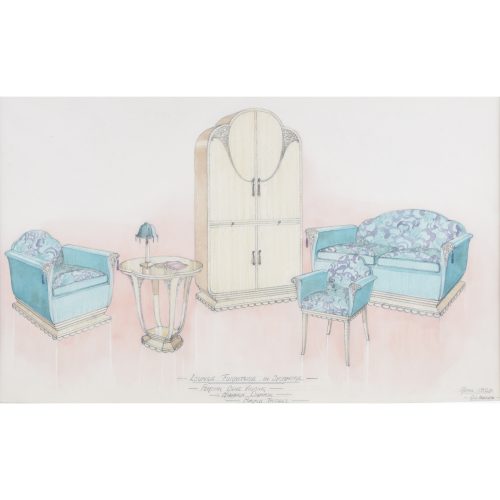
D L Hadden
Design for Lounge Furniture in Sycamore (1929)
Pencil and watercolour 29x49cm For biographical details and other works by the artist click here. If you are interested email info@manningfineart.co.uk or call us on 07929 749056. -
Out of stock

H. M.Bateman
Don't be Fuel-ish (the man who wasted gas)
Lithographic poster c.1940 For HMSO by Chromoworks. Ministry of Fuel & Power 38x26cm If you are interested email info@manningfineart.co.uk or call us on 07929 749056. -
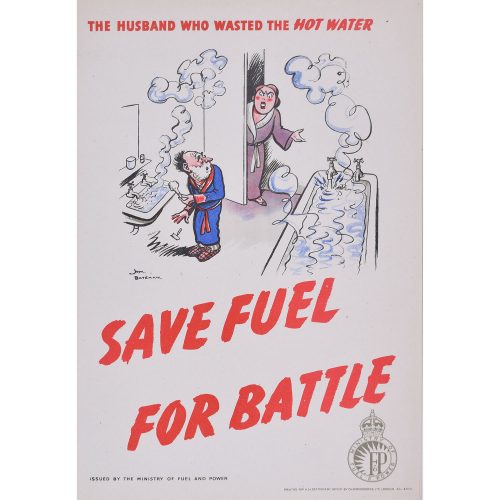
H. M. Bateman (1887-1970)
Save Fuel for Battle (the husband who wasted the hot water)
Lithographic poster c. 1940 For HMSO by Chromoworks. Ministry of Fuel & Power 38x26cm If you are interested email info@manningfineart.co.uk or call us on 07929 749056. -
Out of stock

H. M. Bateman (1887-1970)
Don't be Fuel-ish (the man who wasted power)
Lithographic poster 38x26cm If you are interested email info@manningfineart.co.uk or call us on 07929 749056. -
Out of stock

H. M. Bateman
Don't be Fuel-ish (the man who would not close the doors)
Lithographic poster 38x26cm If you are interested email info@manningfineart.co.uk or call us on 07929 749056. -
Out of stock

H. M. Bateman (1887-1970)
Don't be Fuel-ish (the Man who Wasted Gas II)
For HMSO by Chromoworks. Ministry of Fuel & Power Lithographic poster c. 1940 38x26cm If you are interested email info@manningfineart.co.uk or call us on 07929 749056. -
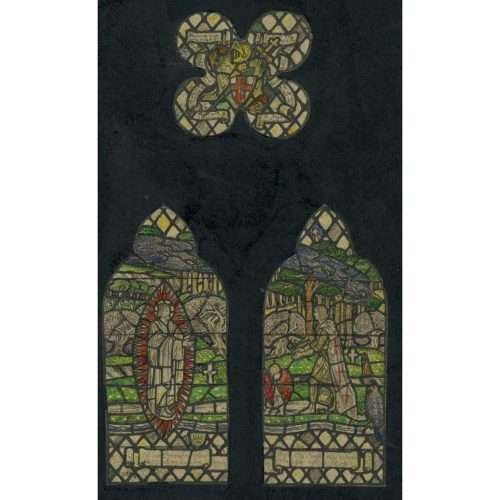
Florence Camm (1874-1960)
Arthurian Stained Glass Window Design II
Watercolour 16x9.5cm Design for TW Camm & Co., Smethwick, Birmingham. If you are interested email info@manningfineart.co.uk or call us on 07929 749056. -
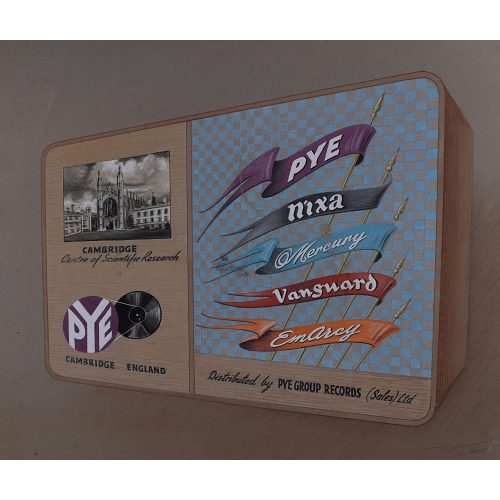
Bowens (British, fl. mid 20th Century) Cambridge: Centre of Scientific Research
Pye Group Records Pye - Nixa - Mercury - Vanguard - EmArcy c. mid-late 1950s Haig Road in Cambridge, where Pye had their factory, was subsumed into Elizabeth Way and was a long way from King's College chapel. However that iconic building is used to illustrate the Cambridge connection. EmArcy Records is a jazz record label founded in 1954 by Mercury Records. Mercury Record Corporation was founded in Chicago in 1945 Pye Records was a British record label; it had started life manufacturing televisions and radios, with its main plant off Haig Road in Cambridge. It purchased Nixa Records in 1953 Vanguard Records is a US record label set up in 1950 primarily as a classical label. If you are interested email info@manningfineart.co.uk or call us on 07929 749056. Condition: Good. -
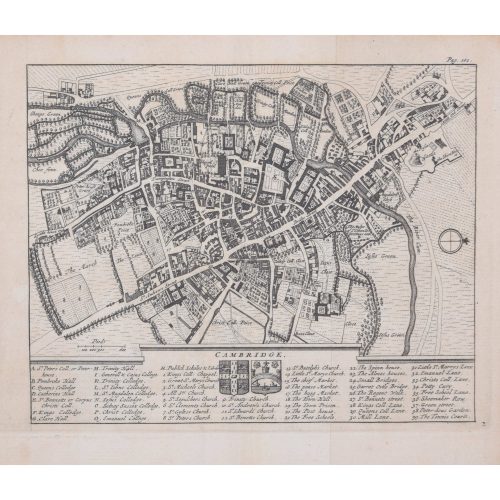
Pieter van der Aa (1659-1733), after David Loggan (1634–1692)
Map of Cambridge
Engraving (1727) 12 x 16 cm An eighteenth-century map of Cambridge engraved by Pieter van der Aa after David Loggan, the noted engraver, draughtsman, and painter who specialised in engravings of Oxford and Cambridge. Loggan's vision illustrates the inimitable layout of Cambridge; the River Cam, Bridge Street, and Trumpington Street bend across the map like arteries. Pieter van der Aa of Leiden was a Dutch publisher best known for preparing maps and atlases, though he also printed editions of foreign bestsellers and illustrated volumes. He is noted for the many engravings he produced after David Loggan's series of Oxford and Cambridge colleges and costumes. In 1727 Van Der Aa illustrated "Les Delices de la Grande Bretagne & de L'Irelande" by James Beeverell, the book in which this engraving appears. If you are interested, please email info@manningfineart.co.uk or call us on 07929 749056. -
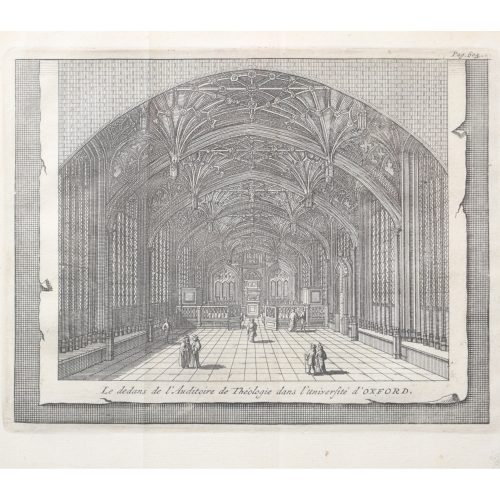
Pieter van der Aa (1659-1733), after David Loggan (1634–1692)
The Divinity School, University of Oxford
Engraving (1727) 12 x 16 cm An eighteenth-century view of Oxford's medieval Divinity School, which was once the beating heart of theological studies at the University. The scene is engraved by Pieter van der Aa after David Loggan, the noted engraver, draughtsman, and painter. Of particular interest here is the trompe l'oeil piece of torn paper which frames the Divinity School view. Pieter van der Aa of Leiden was a Dutch publisher best known for preparing maps and atlases, though he also printed editions of foreign bestsellers and illustrated volumes. He is noted for the many engravings he produced after David Loggan's series of Oxford and Cambridge colleges and costumes. In 1727 Van Der Aa illustrated "Les Delices de la Grande Bretagne & de L'Irelande" by James Beeverell, the book in which this engraving appears. Condition: a good impression. If you are interested, please email info@manningfineart.co.uk or call us on 07929 749056. -
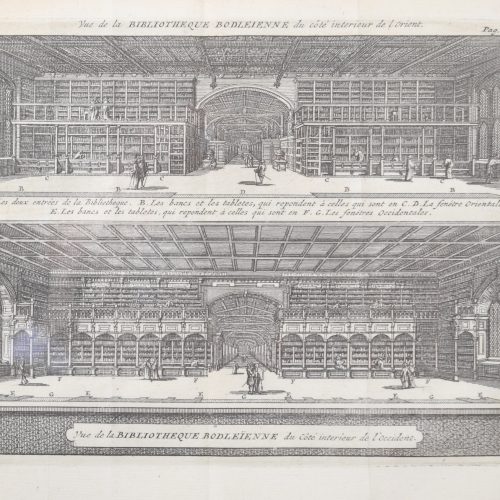
Pieter van der Aa (1659-1733), after David Loggan (1634–1692)
The Bodleian Library, University of Oxford
Engraving (1727) 12 x 16 cm An eighteenth-century view of the interior of the Bodleian Library, engraved by Pieter van der Aa after David Loggan, the noted engraver, draughtsman, and painter. Pieter van der Aa of Leiden was a Dutch publisher best known for preparing maps and atlases, though he also printed editions of foreign bestsellers and illustrated volumes. He is noted for the many engravings he produced after David Loggan's series of Oxford and Cambridge colleges and costumes. In 1727 Van Der Aa illustrated "Les Delices de la Grande Bretagne & de L'Irelande" by James Beeverell, the book in which this engraving appears. Condition: a good impression. If you are interested, please email info@manningfineart.co.uk or call us on 07929 749056. -
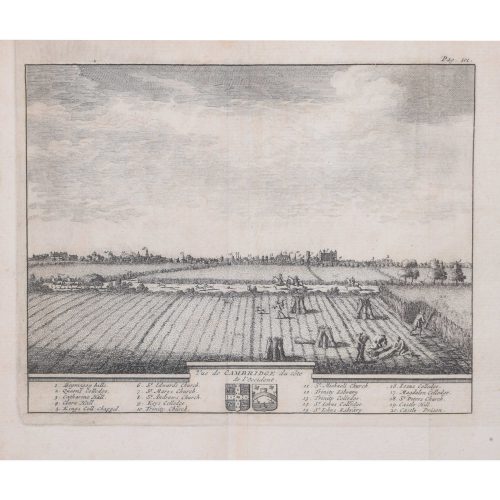
Pieter van der Aa (1659-1733), after David Loggan (1634–1692)
Cambridge from the East (1727)
Engraving 12 x 16 cm An eighteenth-century view of Cambridge from the East, engraved by Pieter van der Aa after David Loggan, the noted engraver, draughtsman, and painter who specialised in engravings of Oxford and Cambridge. A wide Cambridgeshire sky opens out over the harvest scene; in the background, the spires of the city's skyline are numbered, and identified below. A fascinating engraving which muses on the relationship between the city and its University. Pieter van der Aa of Leiden was a Dutch publisher best known for preparing maps and atlases, though he also printed editions of foreign bestsellers and illustrated volumes. He is noted for the many engravings he produced after David Loggan's series of Oxford and Cambridge colleges and costumes. In 1727 Van Der Aa illustrated "Les Delices de la Grande Bretagne & de L'Irelande" by James Beeverell, the book in which this engraving appears. Condition: generally very good. If you’d like to know more, please email info@manningfineart.co.uk or call us on 07929 749056. -
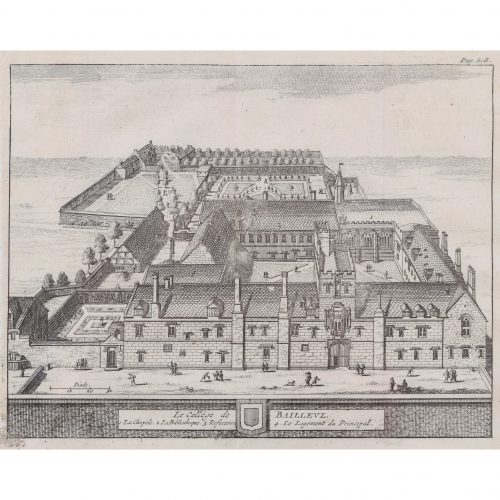
Pieter van der Aa (1659-1733), after David Loggan (1634–1692)
Balliol College, Oxford (1727)
Engraving 12 x 16 cm An eighteenth-century view of Balliol, engraved by Pieter van der Aa after David Loggan, the noted engraver, draughtsman, and painter who specialised in engravings of Oxford and Cambridge. Pieter van der Aa of Leiden was a Dutch publisher best known for preparing maps and atlases, though he also printed editions of foreign bestsellers and illustrated volumes. He is noted for the many engravings he produced after David Loggan's series of Oxford and Cambridge colleges and costumes. In 1727 Van Der Aa illustrated "Les Delices de la Grande Bretagne & de L'Irelande" by James Beeverell, the book in which this engraving appears. Condition: a good impression; trimmed just onto platemark on left side. If you’d like to know more, please email info@manningfineart.co.uk or call us on 07929 749056. -
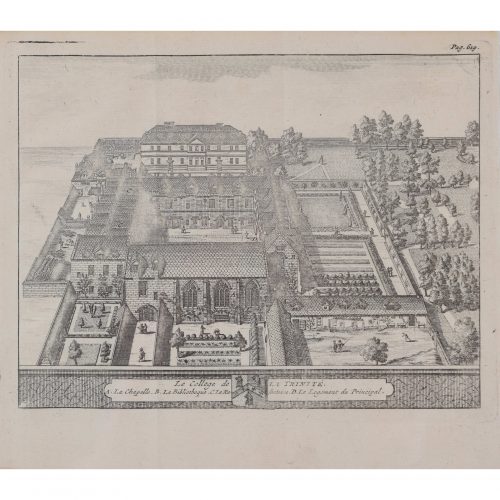
Pieter van der Aa (1659-1733), after David Loggan (1634–1692)
Trinity College, Oxford (1727)
Engraving 12 x 16 cm An eighteenth-century view of Trinity College, engraved by Pieter van der Aa after David Loggan, the noted engraver, draughtsman, and painter who specialised in engravings of Oxford and Cambridge. Pieter van der Aa of Leiden was a Dutch publisher best known for preparing maps and atlases, though he also printed editions of foreign bestsellers and illustrated volumes. He is noted for the many engravings he produced after David Loggan's series of Oxford and Cambridge colleges and costumes. In 1727 Van Der Aa illustrated "Les Delices de la Grande Bretagne & de L'Irelande" by James Beeverell, the book in which this engraving appears. Condition: a good impression. If you’d like to know more, please email info@manningfineart.co.uk or call us on 07929 749056. -
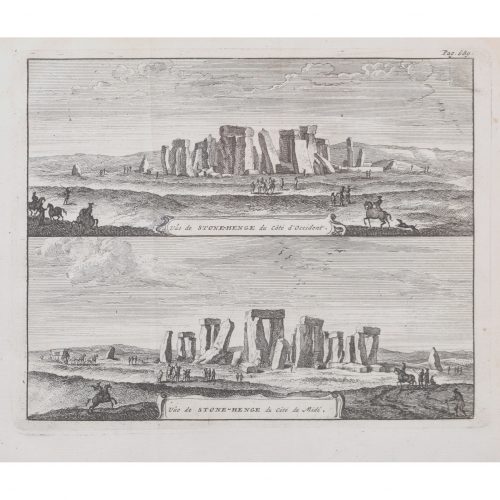
Pieter van der Aa (1659-1733), after David Loggan (1634–1692)
Stonehenge (1727)
Engraving 12 x 16 cm Two eighteenth-century views of the pagan and mystical Stonehenge, engraved by Pieter van der Aa after David Loggan, the noted engraver, draughtsman, and painter. Pieter van der Aa of Leiden was a Dutch publisher best known for preparing maps and atlases, though he also printed editions of foreign bestsellers and illustrated volumes. He is noted for the many engravings he produced after David Loggan's series of Oxford and Cambridge colleges and costumes. In 1727 Van Der Aa illustrated "Les Delices de la Grande Bretagne & de L'Irelande" by James Beeverell, the book in which this engraving appears. Condition: a good impression. If you’d like to know more, please email info@manningfineart.co.uk or call us on 07929 749056. -
Out of stock
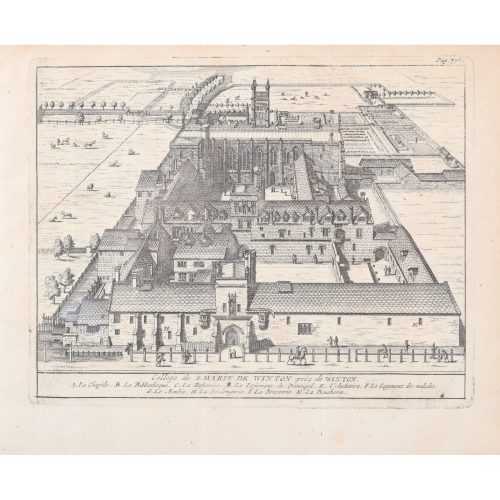
Pieter van der Aa (1659-1733), after David Loggan (1634–1692)
Winchester College, or "Le College de St Marie de Winton" (1727)
Engraving 12 x 16 cm An eighteenth-century view of Winchester College, engraved by Pieter van der Aa after David Loggan, the noted engraver, draughtsman, and painter. Pieter van der Aa of Leiden was a Dutch publisher best known for preparing maps and atlases, though he also printed editions of foreign bestsellers and illustrated volumes. He is noted for the many engravings he produced after David Loggan's series of Oxford and Cambridge colleges and costumes. In 1727 Van Der Aa illustrated "Les Delices de la Grande Bretagne & de L'Irelande" by James Beeverell, the book in which this engraving appears. Condition: a good impression. If you’d like to know more, please email info@manningfineart.co.uk or call us on 07929 749056. -
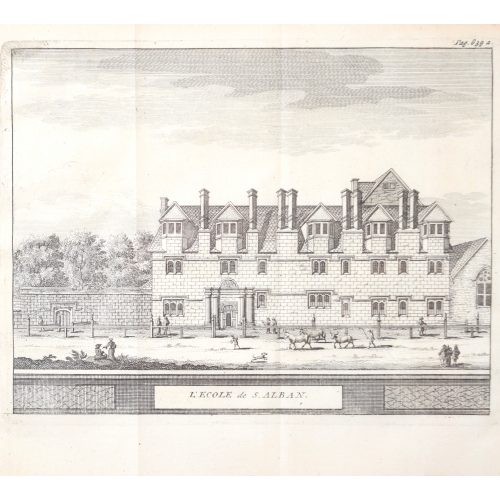
Pieter van der Aa (1659-1733), after David Loggan (1634–1692)
St Alban Hall, Oxford - now Merton College (1727)
Engraving 12 x 16 cm St Alban Hall, sometimes known as St Alban's Hall or Stubbins, was one of the medieval halls of the University of Oxford, and one of the longest-surviving. It was established in the 13th century and was acquired by neighbouring Merton College in the 16th century. The institutions formally merged in the late 19th century. The site in Merton Street, Oxford, is now occupied by Merton's Edwardian St Alban's Quad. Engraved by Pieter van der Aa after David Loggan, the noted engraver, draughtsman, and painter. Pieter van der Aa of Leiden was a Dutch publisher best known for preparing maps and atlases, though he also printed editions of foreign bestsellers and illustrated volumes. He is noted for the many engravings he produced after David Loggan's series of Oxford and Cambridge colleges and costumes. In 1727 Van Der Aa illustrated "Les Delices de la Grande Bretagne & de L'Irelande" by James Beeverell, the book in which this engraving appears. Condition: a good impression. If you’d like to know more, please email info@manningfineart.co.uk or call us on 07929 749056. -
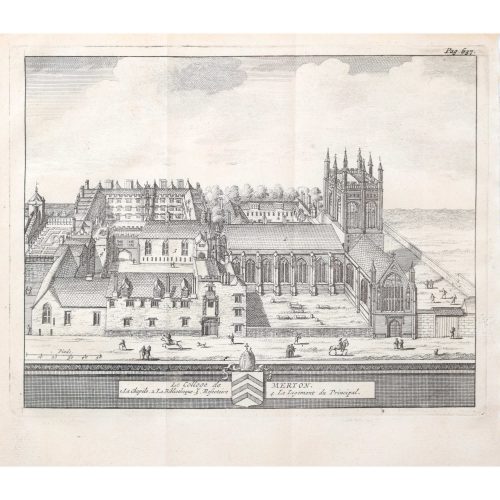
Pieter van der Aa (1659-1733), after David Loggan (1634–1692)
Merton College, Oxford (1727)
Engraving 12 x 16 cm An eighteenth-century view of Merton College, engraved by Pieter van der Aa after David Loggan, the noted engraver, draughtsman, and painter. Pieter van der Aa of Leiden was a Dutch publisher best known for preparing maps and atlases, though he also printed editions of foreign bestsellers and illustrated volumes. He is noted for the many engravings he produced after David Loggan's series of Oxford and Cambridge colleges and costumes. In 1727 Van Der Aa illustrated "Les Delices de la Grande Bretagne & de L'Irelande" by James Beeverell, the book in which this engraving appears. Condition: a good impression. If you’d like to know more, please email info@manningfineart.co.uk or call us on 07929 749056. -
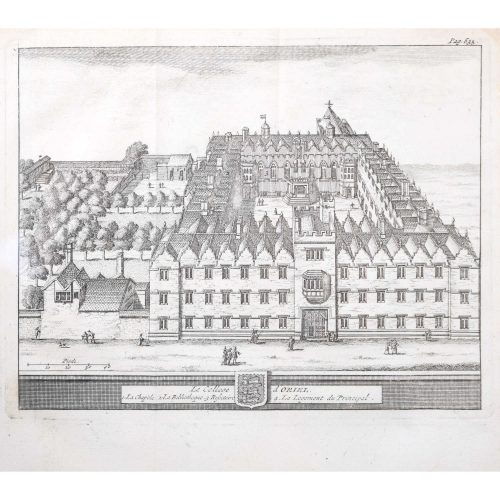
Pieter van der Aa (1659-1733), after David Loggan (1634–1692)
Oriel College, Oxford (1727)
Engraving 12 x 16 cm An eighteenth-century view of Oriel College, engraved by Pieter van der Aa after David Loggan, the noted engraver, draughtsman, and painter. Pieter van der Aa of Leiden was a Dutch publisher best known for preparing maps and atlases, though he also printed editions of foreign bestsellers and illustrated volumes. He is noted for the many engravings he produced after David Loggan's series of Oxford and Cambridge colleges and costumes. In 1727 Van Der Aa illustrated "Les Delices de la Grande Bretagne & de L'Irelande" by James Beeverell, the book in which this engraving appears. Condition: a good impression. If you’d like to know more, please email info@manningfineart.co.uk or call us on 07929 749056. -
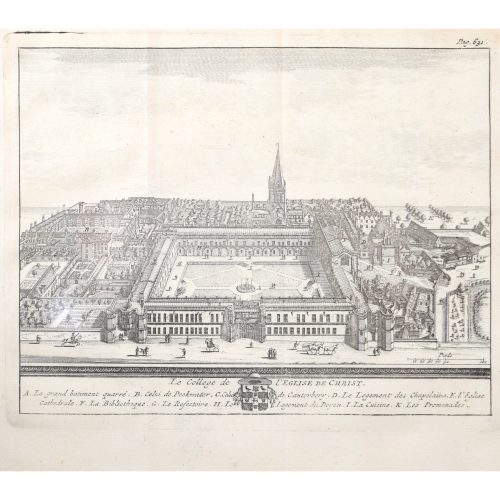
Pieter van der Aa (1659-1733), after David Loggan (1634–1692)
Christ Church, Oxford (1727)
Engraving 12 x 16 cm An eighteenth-century view of Christ Church, engraved by Pieter van der Aa after David Loggan, the noted engraver, draughtsman, and painter. Pieter van der Aa of Leiden was a Dutch publisher best known for preparing maps and atlases, though he also printed editions of foreign bestsellers and illustrated volumes. He is noted for the many engravings he produced after David Loggan's series of Oxford and Cambridge colleges and costumes. In 1727 Van Der Aa illustrated "Les Delices de la Grande Bretagne & de L'Irelande" by James Beeverell, the book in which this engraving appears. Condition: a good impression. If you’d like to know more, please email info@manningfineart.co.uk or call us on 07929 749056. -
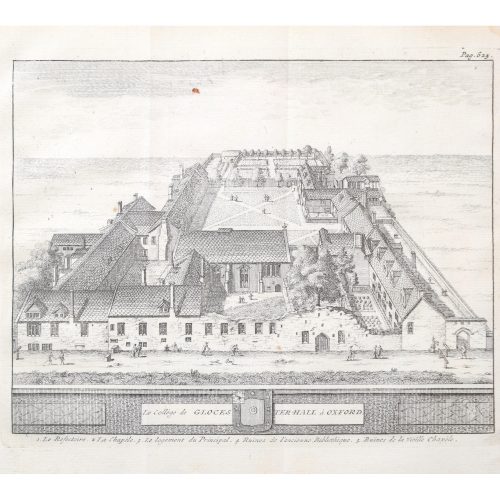
Pieter van der Aa (1659-1733), after David Loggan (1634–1692)
Gloucester College, Oxford (now Worcester College) (1727)
Engraving 12 x 16 cm An eighteenth-century view of Worcester College's predecessor, Gloucester College. Gloucester College was founded in 1283 by the Benedictine Abbey of St Peter at Gloucester as a place of study for 13 monks. The dissolution of the monasteries in the 1530s resulted in the closure of the College, which was eventually re-founded as Worcester College in 1714. Pieter van der Aa's engraving comes after an earlier one by David Loggan, the noted engraver, draughtsman, and painter, when the site was still known as Gloucester. Pieter van der Aa of Leiden was a Dutch publisher best known for preparing maps and atlases, though he also printed editions of foreign bestsellers and illustrated volumes. He is noted for the many engravings he produced after David Loggan's series of Oxford and Cambridge colleges and costumes. In 1727 Van Der Aa illustrated "Les Delices de la Grande Bretagne & de L'Irelande" by James Beeverell, the book in which this engraving appears. Condition: a good impression. If you’d like to know more, please email info@manningfineart.co.uk or call us on 07929 749056. -
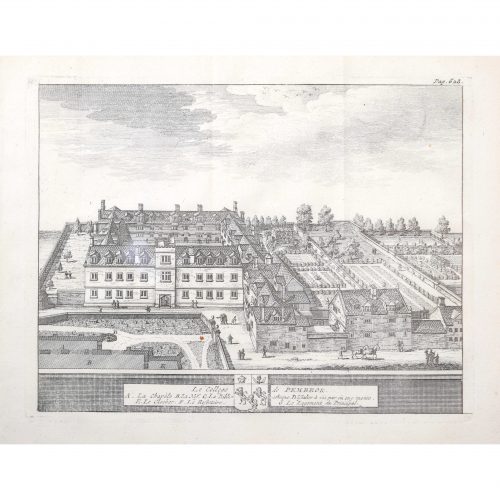
Pieter van der Aa (1659-1733), after David Loggan (1634–1692)
Pembroke College, Oxford (1727)
Engraving 12 x 16 cm An eighteenth-century view of Pembroke College, Oxford, engraved by Pieter van der Aa after an earlier one by David Loggan, the noted engraver, draughtsman, and painter. Pieter van der Aa of Leiden was a Dutch publisher best known for preparing maps and atlases, though he also printed editions of foreign bestsellers and illustrated volumes. He is noted for the many engravings he produced after David Loggan's series of Oxford and Cambridge colleges and costumes. In 1727 Van Der Aa illustrated "Les Delices de la Grande Bretagne & de L'Irelande" by James Beeverell, the book in which this engraving appears. Condition: a good impression. If you’d like to know more, please email info@manningfineart.co.uk or call us on 07929 749056.