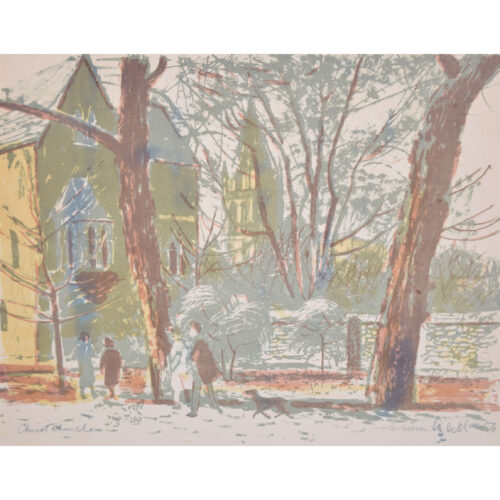
-
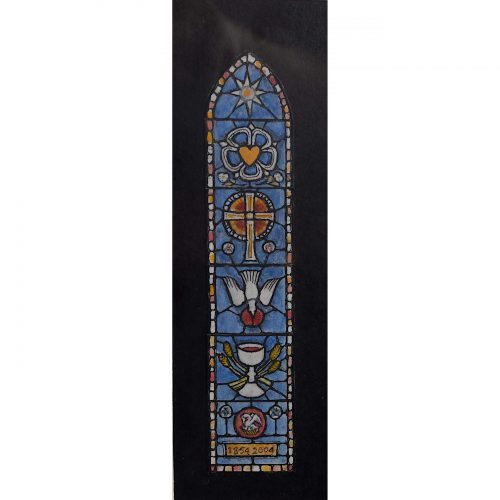
Jane Gray (b.1931)
Christ Church, Bicton, Shropshire, Design for Stained Glass Window (2005)
Watercolour 16 x 5 cmSigned, dated and studio stamp verso.
Christ Church in Bicton Heath, Shrewsbury is a fine example of an early Victorian church, built in 1854 by Edward Haycock Snr in the Early English style with many lancet features. This stained glass window above the chancel arch was commissioned to celebrate the new millennium.
Provenance: the artist’s studio sale. Condition: very good. If you are interested, please email info@manningfineart.co.uk or call us on 07929 749056. For other works by Jane Gray and more information about her, please click here. -
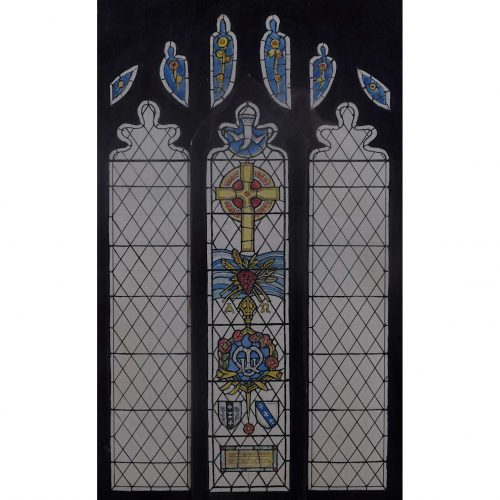
Jane Gray (b.1931)
Christ Church, Charnock Richard, Lancashire Design for Stained Glass Window (1989)
Watercolour 25.5 x 15.5 cmSigned, dated and studio stamp verso.
Christ Church was built in 1860 at the heart of the 13th century country village of Charnock Richard. Alongside its stained glass windows, the church boasts historic tile work and an exceptional marble memorial to the original benefactor’s wife, Frances Darlington. This window was installed in 1990.
Provenance: the artist’s studio sale. Literature: Jane Gray, Playing with Rainbows. (Shropshire: Ellingham Press, 2011), p.80. Condition: very good. If you are interested, please email info@manningfineart.co.uk or call us on 07929 749056. For other works by Jane Gray and more information about her, please click here. -
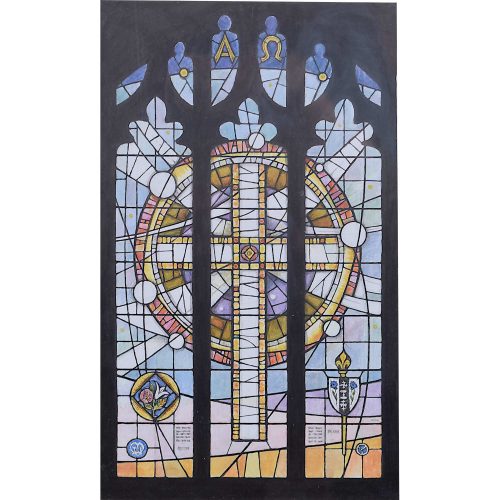
Jane Gray (b.1931)
Christ Church, Charnock Richard, Lancashire, Design for Stained Glass Window (1988)
Watercolour 25.5 x 15.5 cm Signed, dated and studio stamp verso.Christ Church was built in 1860 at the heart of the 13th century country village of Charnock Richard. Alongside its stained glass windows, the church boasts historic tile work and an exceptional marble memorial to the original benefactor’s wife, Frances Darlington.
Provenance: the artist’s studio sale. Condition: very good. If you are interested, please email info@manningfineart.co.uk or call us on 07929 749056. For other works by Jane Gray and more information about her, please click here. -
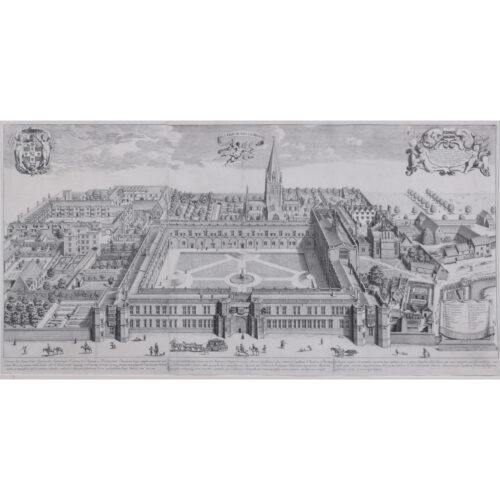
David Loggan (1634 - 1692)
Christ Church, Oxford (1675)
Engraving 42 x 84 cm Loggan's view of Christ Church from the 'Oxonia Illustrata'. Loggan was born to English and Scottish parents, and was baptised in Danzig in 1634. After studying engraving in Danzig with Willem Hondius (1598-1652 or 1658), he moved to London in the late 1650s, going on to produce the engraved title-page for the folio 1662 Book of Common Prayer. He married in 1663 and moved to Nuffield in Oxfordshire in 1665. Loggan was appointed Public Sculptor to the nearby University of Oxford in the late 1660s, having been commissioned to produce bird’s-eye views of all the Oxford colleges. He lived in Holywell Street as he did this. The 'Oxonia Illustrata' was published in 1675, with the help of Robert White (1645-1704). Following its completion, Loggan began work on his equivalent work for Cambridge; the 'Cantabrigia Illustrata' was finally published in 1690, when he was made engraver to Cambridge University. The 'Oxonia Illustrata' also includes an engraving of Winchester College (Winchester and New College share William of Wykeham as their founder) whilst the 'Cantabrigia Illustrata' includes one of Eton College (which shares its founder, Henry VIII, with King’s College). Bird’s-eye views from this era required a particular talent as an architectural perspectivist; it was not until 1783 that it became possible for artists to ascend via hot air balloons and view the scenes they were depicting from above. Loggan thus had to rely on his imagination in conceiving the views. Loggan’s views constitute the first accurate depictions of the two Universities, in many ways unchanged today. Whilst the Oxford engravings were produced in reasonable numbers and ran to a second edition by Henry Overton (on thicker paper and with a plate number in Roman numerals in the bottom right-hand corner), those of Cambridge were printed in much smaller numbers. The Dutchman Pieter van der Aa published some miniature versions of the engravings for James Beverell’s guidebook to the UK, 'Les Delices de la Grande Bretagne' (circa 1708). The contemporary artist Andrew Ingamells (born 1956) has produced a highly-acclaimed series of etchings which bring Loggan’s original vision up to date. Condition: very good. If you are interested, please email info@manningfineart.co.uk or call us on 07929 749056. Click here for other views of Christ Church. -
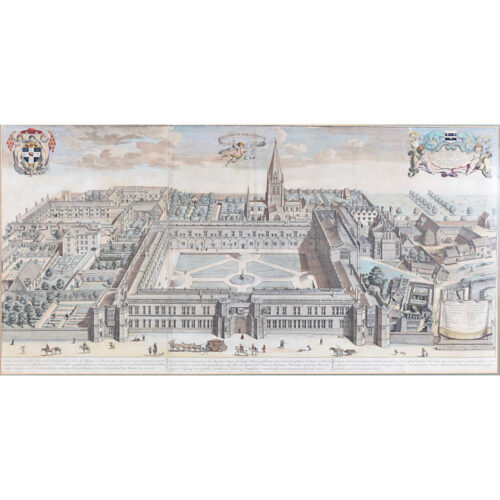
David Loggan (1634-1692)
Christ Church, Oxford (1675)
Engraving 42 x 84 cm Loggan's view of Christ Church from the 'Oxonia Illustrata'. Loggan was born to English and Scottish parents, and was baptised in Danzig in 1634. After studying engraving in Danzig with Willem Hondius (1598-1652 or 1658), he moved to London in the late 1650s, going on to produce the engraved title-page for the folio 1662 Book of Common Prayer. He married in 1663 and moved to Nuffield in Oxfordshire in 1665. Loggan was appointed Public Sculptor to the nearby University of Oxford in the late 1660s, having been commissioned to produce bird’s-eye views of all the Oxford colleges. He lived in Holywell Street as he did this. The 'Oxonia Illustrata' was published in 1675, with the help of Robert White (1645-1704). Following its completion, Loggan began work on his equivalent work for Cambridge; the 'Cantabrigia Illustrata' was finally published in 1690, when he was made engraver to Cambridge University. The 'Oxonia Illustrata' also includes an engraving of Winchester College (Winchester and New College share William of Wykeham as their founder) whilst the 'Cantabrigia Illustrata' includes one of Eton College (which shares its founder, Henry VIII, with King’s College). Bird’s-eye views from this era required a particular talent as an architectural perspectivist; it was not until 1783 that it became possible for artists to ascend via hot air balloons and view the scenes they were depicting from above. Loggan thus had to rely on his imagination in conceiving the views. Loggan’s views constitute the first accurate depictions of the two Universities, in many ways unchanged today. Whilst the Oxford engravings were produced in reasonable numbers and ran to a second edition by Henry Overton (on thicker paper and with a plate number in Roman numerals in the bottom right-hand corner), those of Cambridge were printed in much smaller numbers. The Dutchman Pieter van der Aa published some miniature versions of the engravings for James Beverell’s guidebook to the UK, 'Les Delices de la Grande Bretagne' (circa 1708). The contemporary artist Andrew Ingamells (born 1956) has produced a highly-acclaimed series of etchings which bring Loggan’s original vision up to date. Condition: very good; later hand coloured. If you are interested, please email info@manningfineart.co.uk or call us on 07929 749056. Click here for other views of Christ Church. -
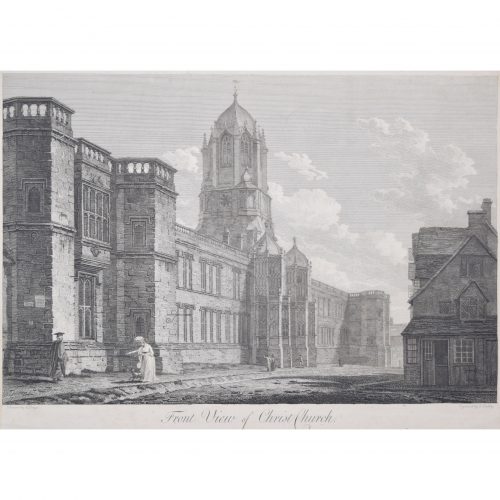
John Dadley (1767 - 1817) after Edward Dayes (1763 - 1804)
Front View of Christ Church (1796)
Engraving 33 x 45 cm An engraving illustrating the magnificent facade of Christ Church from St Aldate's, dominated by Tom Tower. John Dadley was a British portraitist and engraver. Edward Dayes was an English watercolour painter and mezzotint engraver. He first exhibited at the Royal Academy in 1786, when he showed a portrait and views of Waltham Cross and Canterbury. In the three following years he exhibited both miniatures and landscapes. He continued to exhibit at the Academy regularly until the year of his death, contributing a total of 64 works. He also exhibited at the Society of Artists, and worked as draughtsman to the Duke of York and Albany. Condition: generally very good; some age toning to margins. If you are interested, please email info@manningfineart.co.uk or call us on 07929 749056. Click here for other views of Christ Church. -
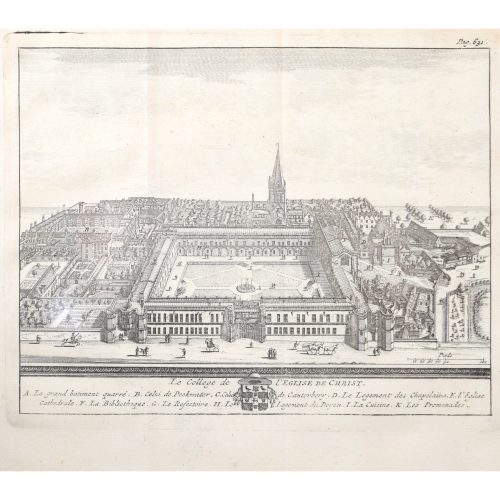
Pieter van der Aa (1659-1733), after David Loggan (1634–1692)
Christ Church, Oxford (1727)
Engraving 12 x 16 cm An eighteenth-century view of Christ Church, engraved by Pieter van der Aa after David Loggan, the noted engraver, draughtsman, and painter. Pieter van der Aa of Leiden was a Dutch publisher best known for preparing maps and atlases, though he also printed editions of foreign bestsellers and illustrated volumes. He is noted for the many engravings he produced after David Loggan's series of Oxford and Cambridge colleges and costumes. In 1727 Van Der Aa illustrated "Les Delices de la Grande Bretagne & de L'Irelande" by James Beeverell, the book in which this engraving appears. Condition: a good impression. If you’d like to know more, please email info@manningfineart.co.uk or call us on 07929 749056. -

Hugh Casson (1910 - 1999)
Christ Church, Oxford
Lithograph 30 x 24 cm Casson's view of a busy Christ Church. Sir Hugh Casson was educated at Eastbourne College; St John’s College, Cambridge; and the Bartlett School of Architecture. Trained in the 1930s in the early modernist style, he taught at the Cambridge School of Architecture. After employment as a camoufleur during World War 2 by the Air Ministry, in 1948 he was appointed as director of architecture for the Festival of Britain. A close friend of the Royal Family, he undertook designs for the 1953 coronation, designed the interior of the Royal Yacht Britannia (“The overall idea was to give the impression of a country house at sea”), and taught the young Charles III to paint in watercolours. Amongst his architectural achievements are the Elephant House at London Zoo, the 1978 redevelopment of Bristol Docks, the Raised Faculty Building for The University of Cambridge, and a building for the Royal College of Art. He published a number of illustrated books, of which Casson’s Oxford and Casson’s Cambridge are probably the best known. A limited edition series of prints was produced from the paintings. Condition: very good; mounted to board. If you are interested, please email info@manningfineart.co.uk or call us on 07929 749056. Click here for other views of Christ Church. -
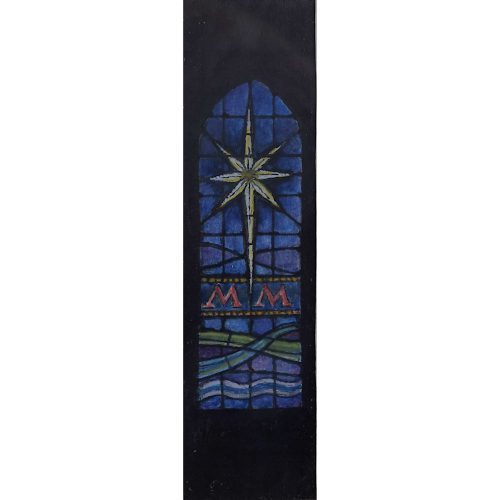
Jane Gray (b.1931)
Christ Church, Oxon, Shrewsbury, Design for Millennium Stained Glass Window (1999)
Watercolour 12.5 x 3.5 cmSigned, dated and studio stamp verso.
Christ Church in Oxon, Shrewsbury is a fine example of an early Victorian church, built in 1854 by Edward Haycock Snr in the Early English style with many lancet features. This stained glass window above the chancel arch was commissioned to celebrate the new millennium, and centres on the star of Bethlehem against a coastal backdrop. This window was installed in 2001.
Provenance: the artist’s studio sale. Literature: Jane Gray, Playing with Rainbows. (Shropshire: Ellingham Press, 2011), p.86. Condition: very good. If you are interested, please email info@manningfineart.co.uk or call us on 07929 749056. For other works by Jane Gray and more information about her, please click here. -

R.A.E Little Christ's College Chapel, Cambridge, 1842
Watercolour 20 x 26 cm Charming watercolour depicting a view of Christ's College Chapel in the mid nineteenth century. In this painting, Little pays special attention to the watercolours and the light and shadows that fill the chapel. Thanks to this care, the scene is imbued with an uplifting ambiance. Condition: Generally very good.If you would like to know more, please email info@manningfineart.co.uk or call us on 07929 749056.
For other views of Christ's College, Cambridge, please click here. -

Mabel Oliver Rae (1868-1956) Christ's College Gate
27 x 19 cm Etching Signed and titled. Mabel Oliver Rae was born in Cambridge and trained at the Slade School of Fine Art between 1888 and 1890. Rae is known for her skilled etchings of various rural scenes and townscapes, particularly those of the colleges of Oxford and Cambridge. She signed works as ‘M. Oliver Rae’, a ruse to conceal the fact she was a female artist, so as not to reduce her chances with commercial dealers and agents. This particular etching depicts the Great Gate at Christ's College Cambridge in the early 20th century. People can be seen walking along the pavement and a scholar sporting academic dress is making his way into the college. A car also trundles along the road, acting as a visual marker for the period during which this work was produced. -

David Loggan (1634 - 1692)
Christ's College, Cambridge (1690)
Engraving 39 x 48 cm Loggan's view of College, Cambridge from the 'Cantabrigia Illustrate', with later hand colouring. Loggan was born to English and Scottish parents, and was baptised in Danzig in 1634. After studying engraving in Danzig with Willem Hondius (1598-1652 or 1658), he moved to London in the late 1650s, going on to produce the engraved title-page for the folio 1662 Book of Common Prayer. He married in 1663 and moved to Nuffield in Oxfordshire in 1665. Loggan was appointed Public Sculptor to the nearby University of Oxford in the late 1660s, having been commissioned to produce bird’s-eye views of all the Oxford colleges. He lived in Holywell Street as he did this. The 'Oxonia Illustrata' was published in 1675, with the help of Robert White (1645-1704). Following its completion, Loggan began work on his equivalent work for Cambridge; the 'Cantabrigia Illustrata' was finally published in 1690, when he was made engraver to Cambridge University. The 'Oxonia Illustrata' also includes an engraving of Winchester College (Winchester and New College share William of Wykeham as their founder) whilst the 'Cantabrigia Illustrata' includes one of Eton College (which shares its founder, Henry VIII, with King’s College). Bird’s-eye views from this era required a particular talent as an architectural perspectivist; it was not until 1783 that it became possible for artists to ascend via hot air balloons and view the scenes they were depicting from above. Loggan thus had to rely on his imagination in conceiving the views. Loggan’s views constitute the first accurate depictions of the two Universities, in many ways unchanged today. Whilst the Oxford engravings were produced in reasonable numbers and ran to a second edition by Henry Overton (on thicker paper and with a plate number in Roman numerals in the bottom right-hand corner), those of Cambridge were printed in much smaller numbers. The Dutchman Pieter van der Aa published some miniature versions of the engravings for James Beverell’s guidebook to the UK, 'Les Delices de la Grande Bretagne' (circa 1708). The contemporary artist Andrew Ingamells (born 1956) has produced a highly-acclaimed series of etchings which bring Loggan’s original vision up to date. Condition: generally very good; a little staining to margins, a tiny wormhole between tree and coat of arms on left side, a pin hole in the tree on the left, two short old creases in paper below 'Collegium Christi' and a small area of thinning on the extreme right. If you are interested, please email info@manningfineart.co.uk or call us on 07929 749056. Click here for other views of Christ’s College, Cambridge. -
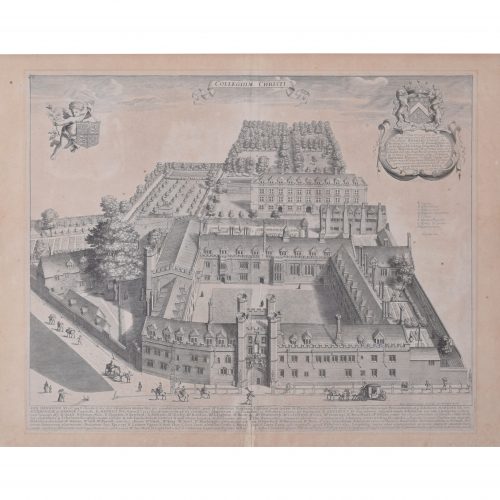
David Loggan (1634 - 1692)
Christ's College, Cambridge (1690)
Engraving 39 x 48 cm Loggan was born to English and Scottish parents, and was baptised in Danzig in 1634. After studying engraving in Danzig with Willem Hondius (1598-1652 or 1658), he moved to London in the late 1650s, going on to produce the engraved title-page for the folio 1662 Book of Common Prayer. He married in 1663 and moved to Nuffield in Oxfordshire in 1665. Loggan was appointed Public Sculptor to the nearby University of Oxford in the late 1660s, having been commissioned to produce bird’s-eye views of all the Oxford colleges. He lived in Holywell Street as he did this. The 'Oxonia Illustrata' was published in 1675, with the help of Robert White (1645 - 1704). Following its completion, Loggan began work on his equivalent work for Cambridge; the 'Cantabrigia Illustrata' was finally published in 1690, when he was made engraver to Cambridge University. The 'Oxonia Illustrata' also includes an engraving of Winchester College (Winchester and New College share William of Wykeham as their founder) whilst the 'Cantabrigia Illustrata' includes one of Eton College (which shares its founder, Henry VIII, with King’s College). Bird’s-eye views from this era required a particular talent as an architectural perspectivist; it was not until 1783 that it became possible for artists to ascend via hot air balloons and view the scenes they were depicting from above. Loggan thus had to rely on his imagination in conceiving the views. Loggan’s views constitute the first accurate depictions of the two Universities, in many ways unchanged today. Whilst the Oxford engravings were produced in reasonable numbers and ran to a second edition by Henry Overton (on thicker paper and with a plate number in Roman numerals in the bottom right-hand corner), those of Cambridge were printed in much smaller numbers. The Dutchman Pieter van der Aa published some miniature versions of the engravings for James Beverell’s guidebook to the UK, 'Les Delices de la Grande Bretagne' (circa 1708). The contemporary artist Andrew Ingamells has produced a highly-acclaimed series of etchings which bring Loggan’s original vision up to date. Condition: generally even all-over toning; old repair to lower central fold with small loss. If you’d like to know more, please email info@manningfineart.co.uk or call us on 07929 749056. -

Pieter van der Aa (1659 - 1733), after David Loggan (1634 - 1692)
Christ's College, Cambridge (1727)
Engraving 13 x 17 cm An eighteenth-century view of Christ's College, Cambridge, engraved by Pieter van der Aa after David Loggan, the noted engraver, draughtsman, and painter. Pieter van der Aa of Leiden was a Dutch publisher best known for preparing maps and atlases, though he also printed editions of foreign bestsellers and illustrated volumes. He is noted for the many engravings he produced after David Loggan's series of Oxford and Cambridge colleges and costumes. In 1727 Van Der Aa illustrated "Les Delices de la Grande Bretagne & de L'Irelande" by James Beeverell, the book in which this engraving appears. Condition: very good. If you are interested, please email info@manningfineart.co.uk or call us on 07929 749056. Click here for other views of Christ's College, Cambridge -

Pieter van der Aa (1659 - 1733), after David Loggan (1634 - 1692)
Christ's College, Cambridge (1727)
Engraving 13 x 17 cm An eighteenth-century view of Christ's College, Cambridge, engraved by Pieter van der Aa after David Loggan, the noted engraver, draughtsman, and painter. Pieter van der Aa of Leiden was a Dutch publisher best known for preparing maps and atlases, though he also printed editions of foreign bestsellers and illustrated volumes. He is noted for the many engravings he produced after David Loggan's series of Oxford and Cambridge colleges and costumes. In 1727 Van Der Aa illustrated "Les Delices de la Grande Bretagne & de L'Irelande" by James Beeverell, the book in which this engraving appears. Condition: very good. If you are interested, please email info@manningfineart.co.uk or call us on 07929 749056. Click here for other views of Christ's College, Cambridge -
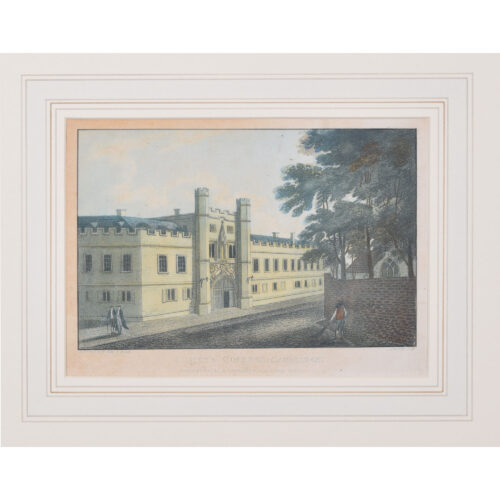
Richard Bankes Harraden (1778 - 1862)
Christ's College, Cambridge
Engraving 15 x 22 cm A nineteenth-century view of Christ's College, Cambridge, complete with two academics and a street-sweeper. Richard Bankes Harraden was a printmaker, painter, and drawing master. He was active in Cambridge, producing many views of the colleges, and subsequently several Oxford colleges. Harraden was an early and exhibiting member of the Society of British Artists in London, which was established in 1823, and remained a member until 1849. He specialised in depictions of landscape, topography and architecture, and was the son of Richard Harraden (1756 - 1838) with whom he published plates as 'Harraden & Son'. Condition: generally very good; a little discolouration to paper; in handsome washlined mount. If you are interested, please email info@manningfineart.co.uk or call us on 07929 749056. Click here for other views of Christ's College, Cambridge. -
Out of stock

Cyril Power (1872 - 1951)
Christ's College, Cambridge
Etching 23 x 15 cm Cyril Power was an English artist. His father was the architect Edward William Power and encouraged him to practise architectural drawing. Power studied architecture and won the Royal Institute of British Architects' Sloane Medallion in 1900 for his design for an art school. He worked as an architect at the Ministry of Works and later lectured on architecture at Goldsmiths and what is now the Bartlett School of Architecture. His A History of English Mediaeval Architecture, a book of architectural illustrations and designs, was published in 1912. In 1918, Power met the artist Sybil Andrews, with whom he worked for two decades. He co-founded The Grosvenor School of Modern Art in 1922; he and Andrews attended Claude Flight's linocutting classes there. Linocut exhibitions followed at the Redfern Gallery and then further afield. Frank Pick, the Deputy Chairman of the Underground Electric Railways Company of London, commissioned Power and Andrews to design a series of posters for him after seeing their linocut work. In 1930 Power was elected member of the Royal Society of British Artists and established a studio with Andrews in Hammersmith close to the River Thames, a location which inspired many prints by both artists, most notably 'The Eight' by Power and 'Bringing in the Boat' by Sybil Andrews. Their first major joint exhibition was at the Redfern Gallery in 1933 which consisted of linocuts and monotypes. Condition: very good; fractional toning to paper. If you are interested, please email info@manningfineart.co.uk or call us on 07929 749056. Click here for other views of Christ's College, Cambridge Titled and numbered 45/168 lower left and signed lower right, all in pencil. -

Charles Henri Toussaint (1849 - 1911)
Christ's College, Cambridge (1880)
Etching 21 x 17 cm Signed and dated 1880 in plate. An attractive etching of the Fellows' Garden at Christ's College, Cambridge. Charles Henri Toussaint was a French painter, illustrator and engraver known for his prints of architecture in Paris, historic towns in France, and English cities of architectural interest (including Oxford and Cambridge). He gained recognition at the Paris Salon in 1874. Condition: very good. If you are interested, please email info@manningfineart.co.uk or call us on 07929 749056. Click here for other views of Christ's College, Cambridge. -
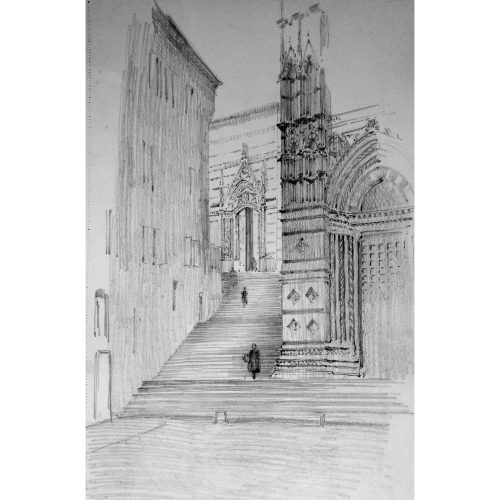
Christopher Wyndham Hughes (1881-1961) Italian Church Entrance
Pencil drawing c.1930s 35 x 23cm Born in St Albans, in Hertfordshire UK, Hughes was a painter, illustrator, printmaker and teacher. He served in the First World War in the 7th Battalion Wiltshire Regiment being awarded a Military Cross in the 1917 New Years Honours List and attaining the rank of Colonel. Subsequently he taught art at Marlborough College. He was taught painting by his father, Wyndham Hughes, who was an expert in stained glass and ecclesiastical decoration. This is from a series of drawing we have of an Italian trip, to see some others, scroll down to "More from this Seller" and below it click on "See all from this seller." If you are interested email info@manningfineart.co.uk or call us on 07929 749056. Condition: Good. -
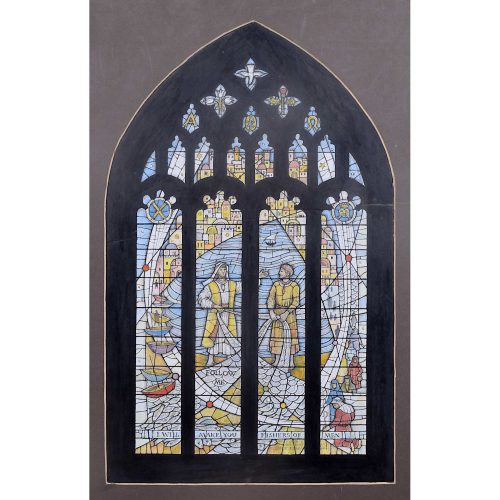
Jane Gray (b.1931)
Church of St Andrew and St Mary, Pitminster, Somerset, Design for Stained Glass Window (1987)
Watercolour 40.5 x 20.5 cmSigned, dated and studio stamp verso.
The Church of St Andrew and St Mary in Pitminster was built on the site of an earlier Saxon church around 1300 and was later added to in the 15th century and restored in 1869 by the prolific English Gothic Revival architect, Sir Gilbert Scott. Gray’s design for the east window of the church, featuring a colourful Christian depiction of Christ calling Andrew to be his disciple; the window features the Sea of Galilee, the heavenly city and fishing symbols, accompanied by the line, ‘Follow me, I will make you fishers of men’, from Matthew 4:19. The window was installed in 1989.
Provenance: the artist’s studio sale. Literature: Jane Gray, Playing with Rainbows. (Shropshire: Ellingham Press, 2011), pp.44-5, 79. Condition: very good. If you are interested, please email info@manningfineart.co.uk or call us on 07929 749056. For other works by Jane Gray and more information about her, please click here. -
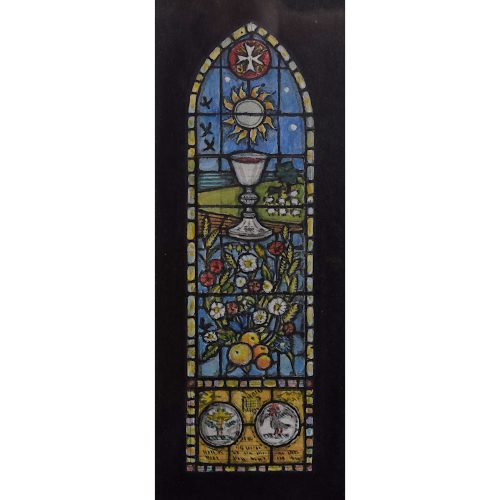
Jane Gray (b.1931)
Church of St Peter and St John the Baptist, Wivelsfield, Sussex, Design for Stained Glass Memorial Window (1993)
Watercolour 16.5 x 5.5 cmSigned, dated and studio stamp verso.
The country Church of St Peter and St John the Baptist in Wivelsfield, East Sussex, dates back to around the 11th century. Since then it has undergone several renovations; the south aisle is 13th century, the tall south chapel is 14th century, the southwest tower was built around 1500 and the chancel was lengthened in the 19th century. Originally, the church was a chapelry of Ditchling, and it wasn't until after the Reformation that the church separated completely. This window was commissioned to commemorate Sir Bryant Godman Irvine, former Deputy Speaker of the House of Commons, and to his wife, and features both their family crests. The window was installed in 1995.
Provenance: the artist’s studio sale. Literature: Jane Gray, Playing with Rainbows. (Shropshire: Ellingham Press, 2011), p.84. Condition: very good. If you are interested, please email info@manningfineart.co.uk or call us on 07929 749056. For other works by Jane Gray and more information about her, please click here. -
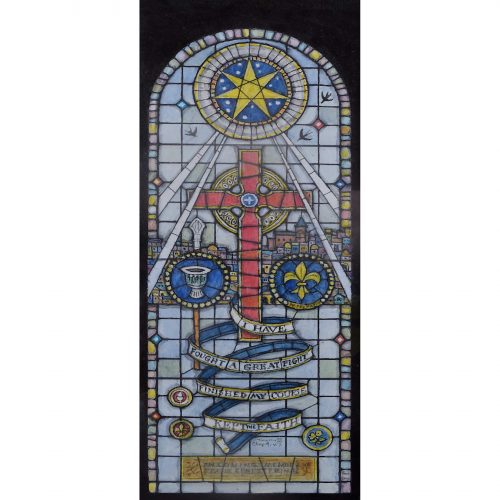
Jane Gray (b.1931)
Church of the Holy Nativity, Bristol, Design for Stained Glass Memorial Window, Commemorating Frank Ernest Pring (1997)
Watercolour 25 x 9.5 cm Signed, dated and studio stamp verso.The Church of the Holy Nativity in Bristol started out as a Mission Chapel in the latter half of the 19th century, when the population of hamlets surrounding Bristol expanded into suburbs—the result of industrial growth around Temple Meads railway station. The site chosen was close to Arnos Vale Cemetery in Knowle, where a wooden church was built to serve the local residents, opening in 1865. From the start the Mission Chapel was well attended and grew significantly in size until it became necessary to find a larger, more permanent building to accommodate the congregation. In 1867 the Chapel was moved to a new site in Wells Road, Knowle, and an appeal for building funds started. To save money the new church was developed in sections, and the Mayor of Bristol laid the foundation stone of the new church in June 1870, it was dedicated on Holy Cross Day, in September, 1871. Tragically, during the first heavy air raid on Bristol on 24th November 1940, Holy Nativity became the first church in the city to be destroyed, however, by some stroke of luck, the Tower, Clock and Bells survived the destruction and it was said that as flames consumed the church the clock continued to chime. Approval to rebuild the church was given in December 1950 and the new church was completed in November 1955. The church was consecrated on the Feast of the Conversion of St Paul, in January 1958. This window was dedicated to the memory of the late churchwarden emeritus, Ernest Pring. In this window, Gray incorporated many significant features of Ernest’s life such as his churchwarden’s staff, the Boy Scouts, his favourite biblical text and the Bristol landscape. A cross dominates the design and a star beams light across the whole design from above. Adjacent to the window is a memorial to Phyllis Pring, Ernest’s wife, also designed by Gray. This window was installed in 1998.
Provenance: the artist’s studio sale. Literature: Jane Gray, Playing with Rainbows. (Shropshire: Ellingham Press, 2011), pp.50, 60, 85. Condition: very good. If you are interested, please email info@manningfineart.co.uk or call us on 07929 749056. For other works by Jane Gray and more information about her, please click here. -

George Bissill (1896-1973) Church view from the railway
Watercolour 28 x 40 cm Signed to lower right Born in 1896, George Bissill was a British miner, painter and furniture designer. Raised in the mining village of Langley Mill, Derbyshire, Bissill became a miner at the age of 13, before leaving to join the war effort in 1915. Upon his return from the war after being gassed, Bissill chose to become a pavement artist outside the newly erected Bush House in Aldwych, painting from his memory and his sketch book the uncompromising underground world he had inhabited. In 1935 he moved to the countryside near Newbury, where he lived and worked as a landscape painter, art restorer and dealer until his death in 1973. This watercolour forms part of a larger collection, 'unseen since they were taken from George Bissil's studio in 1983' and restored by Kate Pattinson. A series of planned exhibitions were cancelled due to Covid, but two shows, one in Oxford and one in Ilkeston, did take place. Through such exhibitions, Pattinson hoped to 'restore the reputation of an artist who, through mighty endeavour, conquered the art world in the 1920s with his powerful, authentic and experimental pictures.' Bissill's paintings are also held in a number of important public collections, including the Tate Gallery, National Museum of Ireland and the Manchester Art Gallery. This watercolour depicts a view of a church from a distance. In the foreground, a railway tunnel peaks out of a gently rolling hill and wooden fences snake across the small fields adjacent to the railway. In the background, the church--which bears a striking resemblance to the medieval Cathedral in Norwich--stands out in the skyline of red roofs. The earthen colours of this composition have a distinctly calming effect, capturing a quiet moment of 20th century life. Condition: generally very good.If you would like to know more, please email info@manningfineart.co.uk or call us on 07929 749056.
-
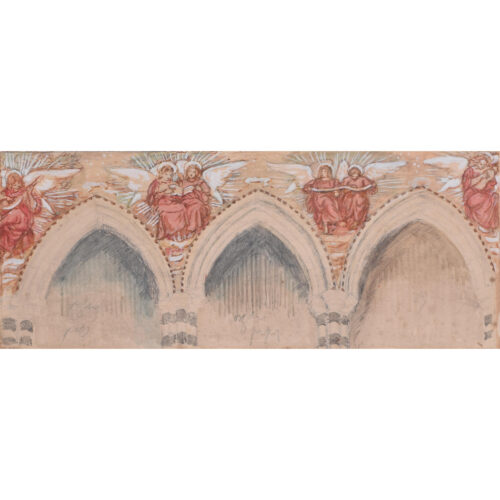
Reginald Hallward (1858 - 1948)
Design for a church wall painting (1904)
Pencil and watercolour on paper 6 x 12 cm With pencil annotations by the artist. A romantic design for a wall painting above a church organ, featuring angels variously reading, singing, and playing the lute. Reginald Hallward was born on the Isle of Wight, and was a painter, poet, glassmaker and book designer. He is best known for his stained glass window designs and the tempera murals he painted in several churches. A great exponent of the English Arts and Crafts movement, he often used black paint for outlines, rather than leaded glass. A consumate craftsman, he insisted on painting, firing and leading with his own hands. Condition: generally very good. If you are interested, please email info@manningfineart.co.uk or call us on 07929 749056. Click here for other pictures by Reginald Hallward. -

Original vintage poster Calling Out of the Whole Army Reserve
Letterpress poster 1939 51 x 48 cm A Royal call to arms... 'His Majesty the King has been graciously pleased to direct by proclamation that the army reserve and the militia (which includes the supplementary reserve) be called out on permanent service.' This poster was originally designed in 1921 following the Treaty Talks between Ireland, seeking independence, and the United Kingdom, led by Winston Churchill. Relations at this time were fraught and it is thought that this poster was shown to delegates as part of the pressure exerted on them to accept Britain's offer of partial independence. Churchill had previously threatened to swamp Ireland with troops and hold a bloody war against the Republicans and this poster was produced to show he was serious. This particular edition was reprinted from the 1921 original in 1939 in preparation for the beginning of the Second World War. -
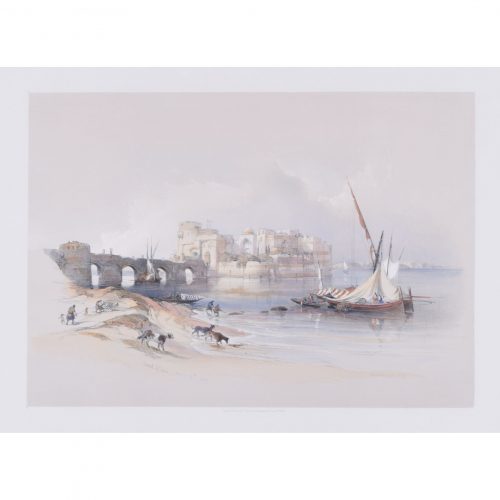
David Roberts (1769 - 1864)
Citadel of Sidon - April 28th, 1839 (published 1943)
Lithograph with hand-colouring 23 x 35 cm (sheet size 17.5 x 24.5 cm) The Citadel of Sidon, or Sidon Sea Castle, was built by crusaders in the thirteenth century as a fortress of the holy land. This lithograph is part of David Roberts' series of views of the Holy Land, which he produced from sketches made during lengthy tours of the Near East in the 1830s. Egypt was much in vogue at this time, and travellers, collectors and lovers of antiquities were keen to buy works inspired by the East or depicting the great monuments of ancient Egypt; Roberts was more than happy to produce pictures on this lucrative theme. Queen Victoria was one of his 400 subscribers, and her set of lithographs is still held by the Royal Collection Trust. The lithographer Louis Haghe worked with Roberts to turn the original sketches into high-quality lithographs, which were then published in the 1840s by the printer F. G. Moon in London. David Roberts RA RBA was a Scottish painter known for his Orientalist pictures. He was elected as a Royal Academician in 1841. -

Mabel Oliver Rae (1868-1956) Clare Bridge, Cambridge
c.1920 Etching 13 x 17 cm Signed in pencil below. Mabel Oliver Rae was born in Cambridge, Cambridgeshire, and trained at the Slade School of Fine Art between 1888 and 1890. Rae is known for her skilled etchings of various rural scenes and townscapes, particularly those of the colleges of Oxford and Cambridge. She signed works with the pseudonym 'M.Oliver Rae', a ruse to conceal the fact she was a female artist, so as not to reduce her chances with commercial dealers and agents. This particular etching depicts a lovely view of Clare Bridge, Cambridge. Rae expertly captures the reflections of the bridge's arcs and the shadows of the trees on the water surface. In the foreground of the etching, a punter enjoys the tranquil scene and the work is consequently imbued by the atmosphere of a warm summer's day. Condition: generally very good, slight age toning to paper.If you would like to know more, please email info@manningfineart.co.uk or call us on 07929 749056.
For other views of Clare College, Cambridge, please click here. -

Mark McCrum Clare Bridge
Watercolour 29 x 39 cm Signed and dated to lower right Mark McCrum, born in Cambridge, England, is a distinguished author and artist known for his diverse body of work spanning travel writing, ghostwriting, crime fiction, and landscape painting. An accomplished landscape painter, McCrum specialises in watercolours, often painting en plein air to capture the immediacy of the scene. His works feature landscapes from Cambridge and regions such as North Norfolk, Scotland's Outer Hebrides, and the West of Ireland. He has held multiple solo exhibitions, showcasing his evocative portrayals of natural settings. This lovely watercolour depicts Clare bridge in Cambridge, with the still water of the Cam reflecting the arches of the bridge. Although unfinished, the greenery of the trees gestures outwards and it is not hard to imagine the serene scene surrounding the bridge. Condition: Generally very good.If you would like to know more, please email info@manningfineart.co.uk or call us on 07929 749056.
For other views of Clare College, please click here. -
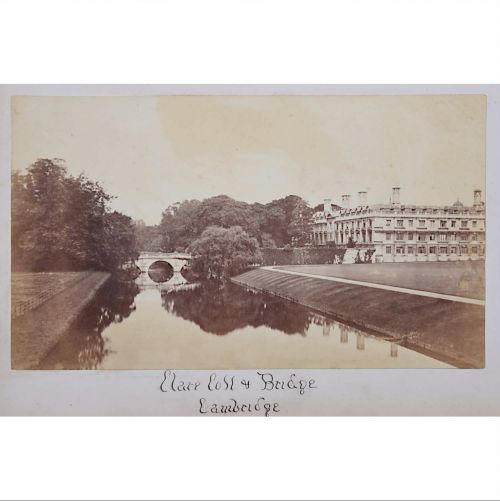
Clare College and Bridge, Cambridge
Albumen print of a photograph, circa 1850 Mounted to board and inscribed 'Clare Coll + Bridge Cambridge'. Clare College is a constituent college of the University of Cambridge in Cambridge. The college was founded in 1326 as University Hall, making it the second-oldest surviving college of the University after Peterhouse. It was refounded in 1338 as Clare Hall after an endowment from Elizabeth de Clare, and took on its current name in 1856. Clare is famous for its chapel choir and for its gardens on The Backs, overlooking the River Cam. Condition: generally very good, slight toning to sky. If you’d like to know more, please email info@manningfineart.co.uk or call us on 07929 749056. -

Joseph Constantine Stadler (1755 - 1828) after Frederick Mackenzie (1788 - 1854) Clare Hall Chapel (1815)
Hand-coloured aquatint 29.5 x 21 cm Published by Rudolph Ackermann (1764 - 1834). An engraving of Clare College Chapel, which was was built in 1763 and designed by Sir James Burrough. Frederick Mackenzie (circa 1788 - 1854) was a British watercolourist and architectural draughtsman. He first exhibited at the Royal Academy in 1804, and contributed eleven drawings between that year and 1828. He contributed to the Society of Painters in Water Colours exhibitions from 1813, becoming an associate in 1822, and a full member the following year. From 30 November 1831 until, his death he was treasurer to the society. In later life Mackenzie was no longer commissioned to illustrate books. Joseph Constantine Stadler was a prolific German émigré engraver of images after his contemporaries - here, 18th-century English landscape painter and diarist Joseph Farington. Stadler's engravings are wide-ranging in subject matter and include landscapes, seascapes and portraits, as well as military, sporting and decorative subjects. Stadler was employed by the leading print publisher of the time, John Boydell. Stadler lived in Knightsbridge when he died at the age of 73. Rudolph Ackermann was an Anglo-German bookseller, inventor, lithographer, publisher and businessman. In 1795 he established a print-shop and drawing-school at 96 Strand. Here Ackermann set up a lithographic press and began a trade in prints. He later began to manufacture colours and thick carton paper for landscape and miniature painters. Within three years the premises had become too small and he moved to 101 Strand, in his own words "four doors nearer to Somerset House", the seat of the Royal Academy of Arts. Between 1797 and 1800 Ackermann rapidly developed his print and book publishing business, encompassing many different genres including topography, caricature, portraits, transparencies and decorative prints. Condition: Generally very good.If you would like to know more, please email info@manningfineart.co.uk or call us on 07929 749056.
-
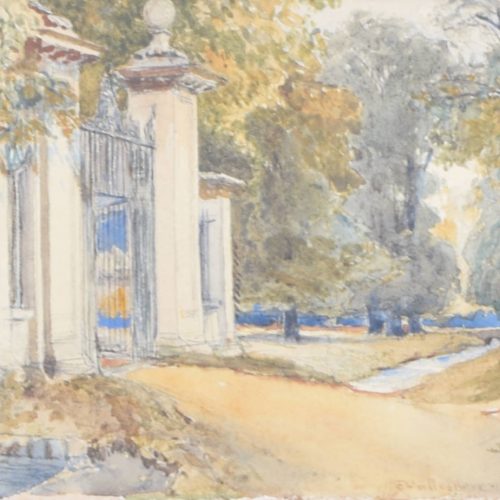
John Fulleylove RI, ROI (1845 - 1908)
Clare College Gates, Cambridge (1890)
Watercolour 11.5 x 17cm Signed lower right. John Fulleylove was an English landscape artist and illustrator. He was apprenticed to a firm of architects in Leicester, and later became a full-time painter in watercolour and oils. He exhibited widely in the UK, at such venues as the Royal Academy, the Fine Art Society, and the Royal Society of British Artists. Abroad, he painted in France, Italy, Greece, and the Middle East; his predilection for travel and his interest in architecture provided him with plenty of subjects for themed exhibitions. He exhibited watercolour views of Oxford in 1888 and of Cambridge in 1890, of Paris and Versailles in 1894, and of the Holy Land in 1902. Condition: very good. If you are interested, please email info@manningfineart.co.uk or call us on 07929 749056. Click here for other views of Clare. -

Joseph Constantine Stadler (1755 - 1828) after William Westall (1781 - 1850) Entrance to the Avenue, from Clare Hall Piece (1815)
Hand-coloured aquatint 25 x 30 cm Published by Rudolph Ackermann (1764 - 1834). An engraving of the gates of Clare College, formerly known as Clare Hall. The River Cam winds its way through the scene; we can see the New Buildings of King's College, Cambridge on the far bank. Victorian figures, several with parasols, picnic or promenade in the foreground. Joseph Constantine Stadler was a prolific German émigré engraver of images after his contemporaries - here, 18th-century English landscape painter and diarist Joseph Farington. Stadler's engravings are wide-ranging in subject matter and include landscapes, seascapes and portraits, as well as military, sporting and decorative subjects. Stadler was employed by the leading print publisher of the time, John Boydell. Stadler lived in Knightsbridge when he died at the age of 73. William Westall was a British landscape artist. He was born in Hertford and enrolled at the Royal Academy schools in 1799. He later became the draughtsman for a voyage to Australia and the South Seas. After being shipwrecked, he travelled to Canton in China and to India, staying in Bombay for several months. He returned to England in 1805 but later set off for Madeira and Jamaica. He became a member of the Society of Painters in Water Colours (1811) and an associate of the Academy (1812). Following a mental breakdown, he regularly visited the Lake District and published ‘Views of the Valley and Vale of Keswick’ (1820). His series of aquatints of the Thames, the great universities, and England's public schools for Ackermann are among his most popular works. Rudolph Ackermann was an Anglo-German bookseller, inventor, lithographer, publisher and businessman. In 1795 he established a print-shop and drawing-school at 96 Strand. Here Ackermann set up a lithographic press and began a trade in prints. He later began to manufacture colours and thick carton paper for landscape and miniature painters. Within three years the premises had become too small and he moved to 101 Strand, in his own words "four doors nearer to Somerset House", the seat of the Royal Academy of Arts. Between 1797 and 1800 Ackermann rapidly developed his print and book publishing business, encompassing many different genres including topography, caricature, portraits, transparencies and decorative prints. Condition: Good. Some gentle age toning.If you would like to know more, please email info@manningfineart.co.uk or call us on 07929 749056.
-
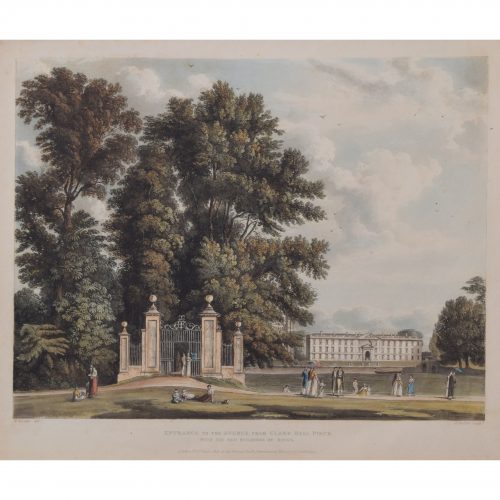
Joseph Constantine Stadler (1755 - 1828) after William Westall (1781 - 1850)
Entrance to the Avenue, from Clare Hall Piece (1815)
Hand-coloured aquatint 25 x 30 cm Published by Rudolph Ackermann (1764 - 1834). An engraving of the gates of Clare College, formerly known as Clare Hall. The River Cam winds its way through the scene; we can see the New Buildings of King's College, Cambridge on the far bank. Victorian figures, several with parasols, picnic or promenade in the foreground. Joseph Constantine Stadler was a prolific German émigré engraver of images after his contemporaries - here, 18th-century English landscape painter and diarist Joseph Farington. Stadler's engravings are wide-ranging in subject matter and include landscapes, seascapes and portraits, as well as military, sporting and decorative subjects. Stadler was employed by the leading print publisher of the time, John Boydell. Stadler lived in Knightsbridge when he died at the age of 73. William Westall was a British landscape artist. He was born in Hertford and enrolled at the Royal Academy schools in 1799. He later became the draughtsman for a voyage to Australia and the South Seas. After being shipwrecked, he travelled to Canton in China and to India, staying in Bombay for several months. He returned to England in 1805 but later set off for Madeira and Jamaica. He became a member of the Society of Painters in Water Colours (1811) and an associate of the Academy (1812). Following a mental breakdown, he regularly visited the Lake District and published ‘Views of the Valley and Vale of Keswick’ (1820). His series of aquatints of the Thames, the great universities, and England's public schools for Ackermann are among his most popular works. Rudolph Ackermann was an Anglo-German bookseller, inventor, lithographer, publisher and businessman. In 1795 he established a print-shop and drawing-school at 96 Strand. Here Ackermann set up a lithographic press and began a trade in prints. He later began to manufacture colours and thick carton paper for landscape and miniature painters. Within three years the premises had become too small and he moved to 101 Strand, in his own words "four doors nearer to Somerset House", the seat of the Royal Academy of Arts. Between 1797 and 1800 Ackermann rapidly developed his print and book publishing business, encompassing many different genres including topography, caricature, portraits, transparencies and decorative prints. Condition: good. Some gentle age toning. If you’d like to know more, please email info@manningfineart.co.uk or call us on 07929 749056. -
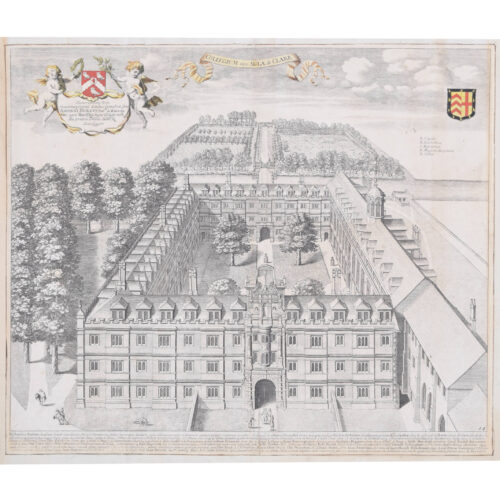
David Loggan (1634 - 1692)
Clare College, Cambridge (1690)
Engraving with later hand-colouring 36 x 43 cm Loggan's aerial view of Clare College; the cartouche borne by two cherubs, titular banner, and college crest have been hand-coloured. Loggan was born to English and Scottish parents, and was baptised in Danzig in 1634. After studying engraving in Danzig with Willem Hondius (1598-1652 or 1658), he moved to London in the late 1650s, going on to produce the engraved title-page for the folio 1662 Book of Common Prayer. He married in 1663 and moved to Nuffield in Oxfordshire in 1665. Loggan was appointed Public Sculptor to the nearby University of Oxford in the late 1660s, having been commissioned to produce bird’s-eye views of all the Oxford colleges. He lived in Holywell Street as he did this. The 'Oxonia Illustrata' was published in 1675, with the help of Robert White (1645 - 1704). Following its completion, Loggan began work on his equivalent work for Cambridge; the 'Cantabrigia Illustrata' was finally published in 1690, when he was made engraver to Cambridge University. The 'Oxonia Illustrata' also includes an engraving of Winchester College (Winchester and New College share William of Wykeham as their founder) whilst the 'Cantabrigia Illustrata' includes one of Eton College (which shares its founder, Henry VIII, with King’s College). Bird’s-eye views from this era required a particular talent as an architectural perspectivist; it was not until 1783 that it became possible for artists to ascend via hot air balloons and view the scenes they were depicting from above. Loggan thus had to rely on his imagination in conceiving the views. Loggan’s views constitute the first accurate depictions of the two Universities, in many ways unchanged today. Whilst the Oxford engravings were produced in reasonable numbers and ran to a second edition by Henry Overton (on thicker paper and with a plate number in Roman numerals in the bottom right-hand corner), those of Cambridge were printed in much smaller numbers. The Dutchman Pieter van der Aa published some miniature versions of the engravings for James Beverell’s guidebook to the UK, 'Les Delices de la Grande Bretagne' (circa 1708). The contemporary artist Andrew Ingamells has produced a highly-acclaimed series of etchings which bring Loggan’s original vision up to date. Condition: good; trimmed to platemark and mounted to antique laid paper. Other items pasted to reverse. If you’d like to know more, please email info@manningfineart.co.uk or call us on 07929 749056. Click here for other views of Clare College, Cambridge. -

Pieter van der Aa (1659 - 1733), after David Loggan (1634 - 1692)
Clare College, Cambridge (1727)
Engraving 13 x 17 cm An eighteenth-century view of Clare College, Cambridge, engraved by Pieter van der Aa after David Loggan, the noted engraver, draughtsman, and painter. Pieter van der Aa of Leiden was a Dutch publisher best known for preparing maps and atlases, though he also printed editions of foreign bestsellers and illustrated volumes. He is noted for the many engravings he produced after David Loggan's series of Oxford and Cambridge colleges and costumes. In 1727 Van Der Aa illustrated "Les Delices de la Grande Bretagne & de L'Irelande" by James Beeverell, the book in which this engraving appears. Condition: very good. If you are interested, please email info@manningfineart.co.uk or call us on 07929 749056. Click here for other views of Clare College, Cambridge -

Pieter van der Aa (1659 - 1733), after David Loggan (1634 - 1692)
Clare College, Cambridge (1727)
Engraving 13 x 17 cm An eighteenth-century view of North Court, Clare College, Cambridge, engraved by Pieter van der Aa after David Loggan, the noted engraver, draughtsman, and painter. Pieter van der Aa of Leiden was a Dutch publisher best known for preparing maps and atlases, though he also printed editions of foreign bestsellers and illustrated volumes. He is noted for the many engravings he produced after David Loggan's series of Oxford and Cambridge colleges and costumes. In 1727 Van Der Aa illustrated "Les Delices de la Grande Bretagne & de L'Irelande" by James Beeverell, the book in which this engraving appears. Condition: very good. If you are interested, please email info@manningfineart.co.uk or call us on 07929 749056. Click here for other views of Clare College, Cambridge -
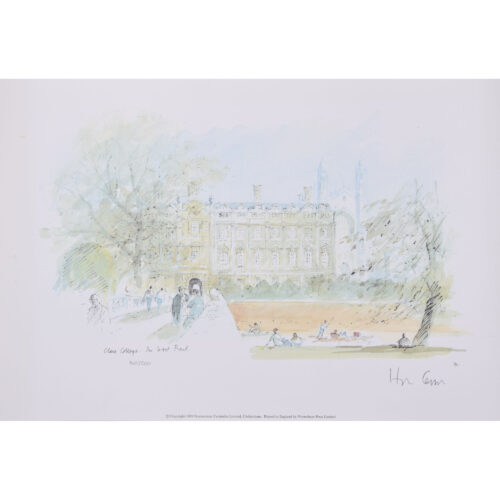
Hugh Casson (1910 - 1999)
Clare College - The West Front
Lithograph 24 x 40 cm Titled in plate lower left; numbered 160/500 lower left and signed lower right, both in pencil. Casson's view of a bustling Clare College, complete with students punting on the Backs. Sir Hugh Casson was educated at Eastbourne College; St John’s College, Cambridge; and the Bartlett School of Architecture. Trained in the 1930s in the early modernist style, he taught at the Cambridge School of Architecture. After employment as a camoufleur during World War 2 by the Air Ministry, in 1948 he was appointed as director of architecture for the Festival of Britain. A close friend of the Royal Family, he undertook designs for the 1953 coronation, designed the interior of the Royal Yacht Britannia (“The overall idea was to give the impression of a country house at sea”), and taught the young Charles III to paint in watercolours. Amongst his architectural achievements are the Elephant House at London Zoo, the 1978 redevelopment of Bristol Docks, the Raised Faculty Building for The University of Cambridge, and a building for the Royal College of Art. He published a number of illustrated books, of which Casson’s Oxford and Casson’s Cambridge are probably the best known. A limited edition series of prints was produced from the paintings. Condition: very good. If you are interested, please email info@manningfineart.co.uk or call us on 07929 749056. Click here for other views of Clare College, Cambridge. -
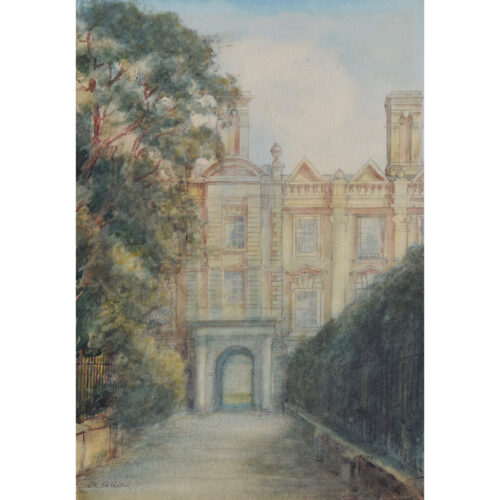
Alfred Allan
Clare College, Cambridge
Engraving 24.5 x 17 cm Signed lower left. An atmospheric watercolour depicting Clare College. Alfred Allan has painted several Cambridge colleges and also specialises in coastal scenes. Condition: generally very good; fractional age toning visible to the sky, top right. If you’d like to know more, please email info@manningfineart.co.uk or call us on 07929 749056. Click here for other views of Clare College, Cambridge. -
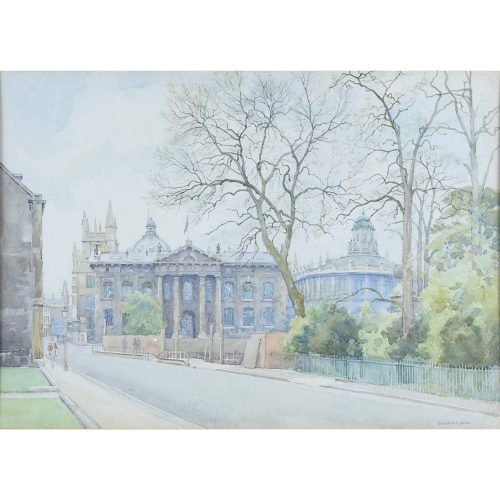
Bernard Cecil Gotch (1876-1964)
Clarendon Building and Sheldonian Theatre, Oxford
Watercolour 27 x 39 cm Signed lower right. Gotch's wintry view of the Clarendon and the Sheldonian captures both the most illustrious architecture of the University of Oxford, and the building works taking place to build a new library. Gotch paints his scene from a viewpoint just in front of Wadham College; the Radcliffe Camera and the spire of the University Church of St Mary the Virgin are visible behind the Sheldonian's roof. The building site visible across from Wadham is the site where the New Bodleian now stands. Bernard Cecil Gotch was a Winchester born artist who is best known for his atmospheric watercolours of Britain's towns and cities (most notably Oxford). He moved to Oxford in 1927, painting many watercolours of the interiors and exteriors of Oxford’s many buildings. His works concentrate on the grand exteriors and interiors of the University's colleges, and he exhibited frequently - including an exhibition every term at Oriel College. His first notable commission was for the publisher Methuen, illustrating 'A Shepherd’s Life' by W H Hudson. Whilst in London he was invited to illustrate a book on the Public Schools of England (which was sadly never completed). He exhibited watercolours at the Fine Art Society and Lincolns Inn, and also exhibited at the Royal Academy. In 1952 Gotch was given an Honorary MA by the University of Oxford, and, after his death in 1963, a memorial was held for him at Oriel. Condition: very good; original oak frame. -
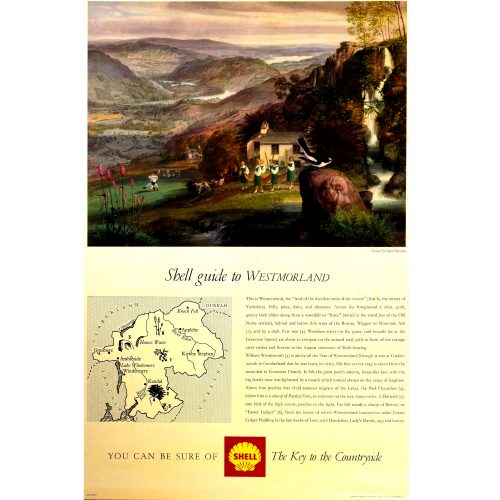
Claude Harrison Shell Guide to Westmoreland
Original poster for Shell Oil c. 1960s 76x51cm Shell commissioned a series of posters to go with their County Guide books, and they commissioned paintings by the leading artists of the day. Claude Harrison studied at Preston College of Art (1939-1941) and Liverpool College of Art (1941-2) after which he enlisted in the RAF for five years. On his return, he continued studies at Royal College of Art (1947-50). Harrison’s work consisted of murals, portraits, conversation pieces and mystical figure compositions - which are seen here in the Westmoreland poster. He was a member of the Royal Academy and his work has regularly been exhibited in the annual summer exhibition. If you are interested email info@manningfineart.co.uk or call us on 07929 749056. Condition: Fair. Short edge tears which are hidden by mount/mat; some age toning. Metal hanger removed to allow matting. See photograph for more information -
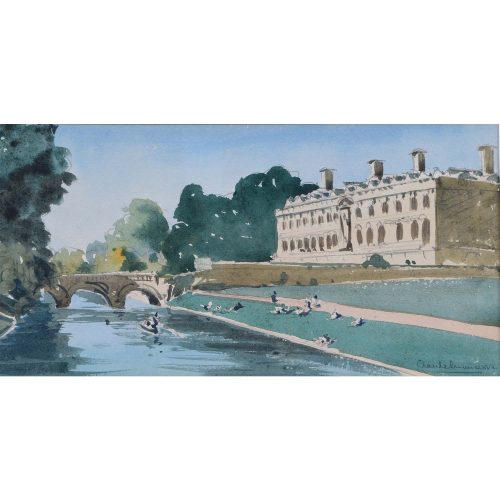
Claude Muncaster Cambridge
Watercolour 14x27cm Signed lower right Muncaster’s watercolours capture the English countryside feel with great competence. Click here for biographical details and other works by the artist. If you are interested email info@manningfineart.co.uk or call us on 07929 749056. Condition: Good. -
Sale!
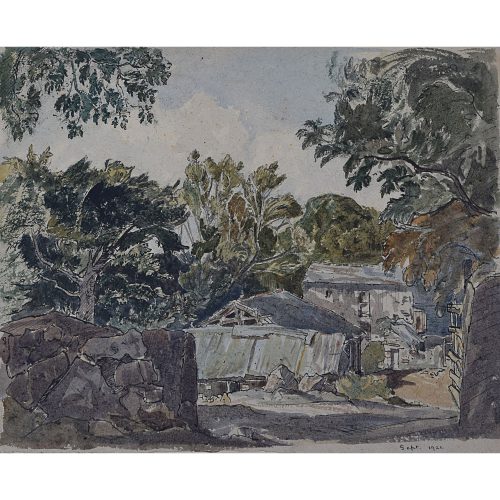
Claude Muncaster (1903-1974) Farmstead and Trees
Dated Sept 1921 Signed on reverse with additional sketches of figures Watercolour 22x28cm Claude Grahame Muncaster, RWS, ROI, RBA, SMA was the son of Oliver Hall RA. At the age of fifteen his career as a landscape painter began, and he soon took to the seas, spending the 1920s and 30s travelling the world with his sketchbook in a series of vessels. With the outbreak of war and he joined the RNVR training as a navigator. Having left school at fifteen his mathematics was very weak and it was a relief for all when his artistic talents meant he was recruited as a camofleur. A master of capturing seascapes he was therefore able to hide huge ships ‘in plain sight’ with clever disguises. After the war he painted for the Royal Family and was a frequent guest at Sandringham. Claude Muncaster was a watercolourist known for his landscapes and maritime scenes. He was born Grahame Hall, the son of the Royal Academician Oliver Hall who taught his son to paint from an early age; Grahame first exhibited his work aged 15 and a few years later was showing at the RA. However, he adopted the name Claude Muncaster in 1922 to dissociate his career from that of his father. Muncaster’s primary choice of subject matter came from a genuine love of the sea. He made several long-distance sea voyages, including one around the Horn as a deckhand in the windjammer Olivebank in 1931, which he described in ‘Rolling Round the Horn’, published in 1933. Armed with a sketchbook, his aim was to be able to ‘paint ships and the sea with greater authority’. This he certainly achieved, perfectly capturing the limpid first light of morning over the Port of Aden, the choppy rain-grey waters of the Bay of Biscay and a streak of sunlight through gathering storm clouds at dusk in Exeter. He became an Associate of the Royal Watercolour Society in 1931 and was a founder member, and later President, of the Royal Society of Marine Artists. During the Second World War, Muncaster served in the Royal Naval Volunteer Reserve (RNVR) from 1940-44, training as a navigator before going on to advise on the camouflage of ships, and also worked as an official war artist. In ‘Still Morning at Aden’ (1944) he depicts Allied warships in this safe anchorage in the Middle East; the back is stamped with Admiralty approval. In 1946-7 he was commissioned by the Queen to produce watercolours of the royal residences at Windsor, Sandringham and Balmoral; the Duke of Edinburgh, in a foreword to a biography of Muncaster, recalls looking at these and considering the artist’s ‘unerring instinct for a subject’, his sense of atmosphere. Other commissions included large panoramas of the Thames and of Bradford. His career also included work as an etcher, illustrator, writer, lecturer and broadcaster, and his paintings can be found in the Royal Academy, Tate, National Maritime Museum Cornwall, National Railway Museum and Royal Air Force Museum. Condition: generally good, few isolated spots to sky as can be seen in the magnified version of the picture. If you are interested email info@manningfineart.co.uk or call us on 07929 749056. -
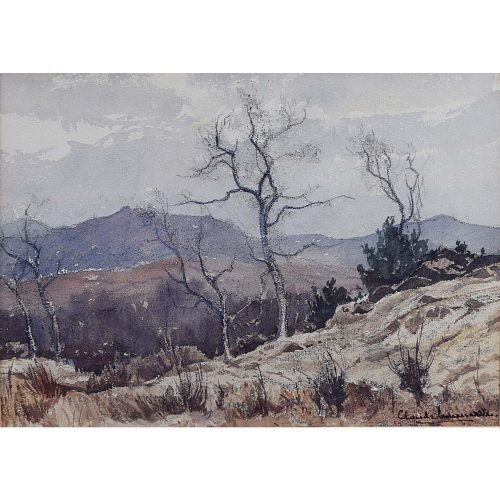
Claude Muncaster Above Finsthwaite, near Newby Bridge 1968
Watercolour 21x26.5cm 46x52cm including frame, UK shipping only Signed lower right Click here for biographical details and other works by the artist. If you are interested email info@manningfineart.co.uk or call us on 07929 749056. Condition: Good. -
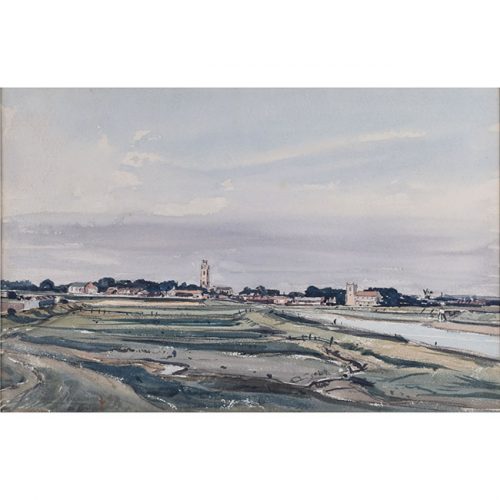
Claude Muncaster (1903-1974)
Boston Stump
Signed Pen and watercolour 23x34cm (Titled erroneously to reverse 'North Norfolk Churches' Click here for biographical details and other works by the artist. If you are interested email info@manningfineart.co.uk or call us on 07929 749056. -
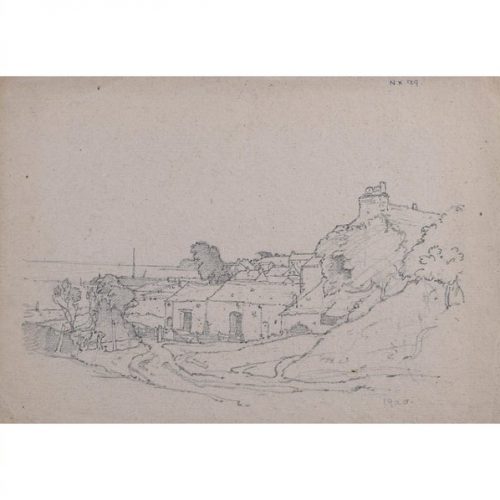
Claude Muncaster (1903-1974) Canal Foot, The Ulverston Canal
1920 Inscribed to reverse and numbered NX129 in the artist's catalogue Pencil Sketch 21x30cm Provenance: The estate of the artist and by descent Muncaster's watercolours capture the English countryside feel with great competence. Here he records the old swing bridge across the lock at the foot of the now-derelict Ulverston Canal. It was Britain's straightest canal, running two miles from Morecambe Bay to Ulverston but has long stood unused. Oliver Hall, Muncaster's father, lived at Ulverston in his latter years. Claude Grahame Muncaster, RWS, ROI, RBA, SMA was the son of Oliver Hall RA. At the age of fifteen his career as a landscape painter began, and he soon took to the seas, spending the 1920s and 30s travelling the world with his sketchbook in a series of vessels. With the outbreak of war and he joined the RNVR training as a navigator. Having left school at fifteen his mathematics was very weak and it was a relief for all when his artistic talents meant he was recruited as a camofleur. A master of capturing seascapes he was therefore able to hide huge ships ‘in plain sight’ with clever disguises. After the war he painted for the Royal Family and was a frequent guest at Sandringham. Claude Muncaster was a watercolourist known for his landscapes and maritime scenes. He was born Grahame Hall, the son of the Royal Academician Oliver Hall who taught his son to paint from an early age; Grahame first exhibited his work aged 15 and a few years later was showing at the RA. However, he adopted the name Claude Muncaster in 1922 to dissociate his career from that of his father. Muncaster’s primary choice of subject matter came from a genuine love of the sea. He made several long-distance sea voyages, including one around the Horn as a deckhand in the windjammer Olivebank in 1931, which he described in ‘Rolling Round the Horn’, published in 1933. Armed with a sketchbook, his aim was to be able to ‘paint ships and the sea with greater authority’. This he certainly achieved, perfectly capturing the limpid first light of morning over the Port of Aden, the choppy rain-grey waters of the Bay of Biscay and a streak of sunlight through gathering storm clouds at dusk in Exeter. He became an Associate of the Royal Watercolour Society in 1931 and was a founder member, and later President, of the Royal Society of Marine Artists. During the Second World War, Muncaster served in the Royal Naval Volunteer Reserve (RNVR) from 1940-44, training as a navigator before going on to advise on the camouflage of ships, and also worked as an official war artist. In ‘Still Morning at Aden’ (1944) he depicts Allied warships in this safe anchorage in the Middle East; the back is stamped with Admiralty approval. In 1946-7 he was commissioned by the Queen to produce watercolours of the royal residences at Windsor, Sandringham and Balmoral; the Duke of Edinburgh, in a foreword to a biography of Muncaster, recalls looking at these and considering the artist’s ‘unerring instinct for a subject’, his sense of atmosphere. Other commissions included large panoramas of the Thames and of Bradford. His career also included work as an etcher, illustrator, writer, lecturer and broadcaster, and his paintings can be found in the Royal Academy, Tate, National Maritime Museum Cornwall, National Railway Museum and Royal Air Force Museum. If you are interested email info@manningfineart.co.uk or call us on 07929 749056. Condition: Good. Conservation mounted and wrapped in transparent sleeve for protection -
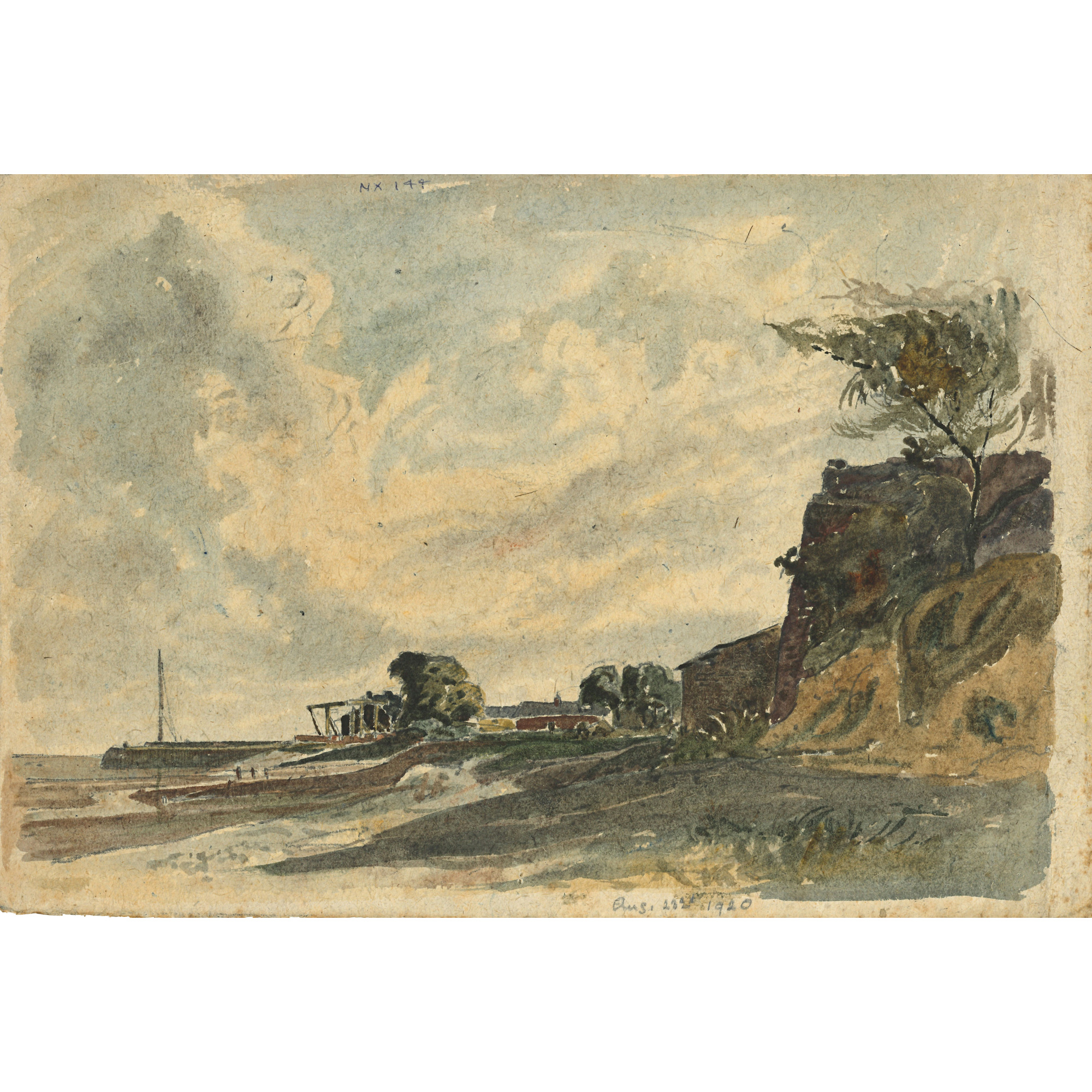
Claude Muncaster (1903-1974)
Canal Foot Ulverston Canal
Signed and titled to reverse Inscribed Aug. 23rd (?) 1920 Pen and watercolour 19x29cm Muncaster's watercolours capture the English countryside feel with great competence. Here he records the old swing bridge across the lock at the foot of the now-derelict Ulverston Canal. It was Britain's straightest canal, running two miles from Morecambe Bay to Ulverston but has long stood unused. Click here for biographical details and other works by the artist. If you are interested email info@manningfineart.co.uk or call us on 07929 749056. -
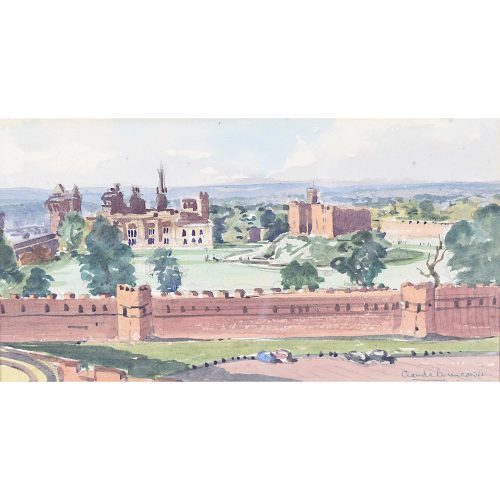
Claude Muncaster (1903-1974) Cardiff Castle Wales
Dated May 1962 Signed lower right Watercolour 14x26cm Muncaster's watercolours capture the British countryside feel with great competence and passion. Here the ancient scheduled monument of Cardiff castle is made to feel both grand and imposing, yet reflecting the softness of the countryside. A few elegant motorcars are parked before it. Claude Grahame Muncaster, RWS, ROI, RBA, SMA was the son of Oliver Hall RA. At the age of fifteen his career as a landscape painter began, and he soon took to the seas, spending the 1920s and 30s travelling the world with his sketchbook in a series of vessels. With the outbreak of war and he joined the RNVR training as a navigator. Having left school at fifteen his mathematics was very weak and it was a relief for all when his artistic talents meant he was recruited as a camofleur. A master of capturing seascapes he was therefore able to hide huge ships ‘in plain sight’ with clever disguises. After the war he painted for the Royal Family and was a frequent guest at Sandringham. Claude Muncaster was a watercolourist known for his landscapes and maritime scenes. He was born Grahame Hall, the son of the Royal Academician Oliver Hall who taught his son to paint from an early age; Grahame first exhibited his work aged 15 and a few years later was showing at the RA. However, he adopted the name Claude Muncaster in 1922 to dissociate his career from that of his father. Muncaster’s primary choice of subject matter came from a genuine love of the sea. He made several long-distance sea voyages, including one around the Horn as a deckhand in the windjammer Olivebank in 1931, which he described in ‘Rolling Round the Horn’, published in 1933. Armed with a sketchbook, his aim was to be able to ‘paint ships and the sea with greater authority’. This he certainly achieved, perfectly capturing the limpid first light of morning over the Port of Aden, the choppy rain-grey waters of the Bay of Biscay and a streak of sunlight through gathering storm clouds at dusk in Exeter. He became an Associate of the Royal Watercolour Society in 1931 and was a founder member, and later President, of the Royal Society of Marine Artists. During the Second World War, Muncaster served in the Royal Naval Volunteer Reserve (RNVR) from 1940-44, training as a navigator before going on to advise on the camouflage of ships, and also worked as an official war artist. In ‘Still Morning at Aden’ (1944) he depicts Allied warships in this safe anchorage in the Middle East; the back is stamped with Admiralty approval. In 1946-7 he was commissioned by the Queen to produce watercolours of the royal residences at Windsor, Sandringham and Balmoral; the Duke of Edinburgh, in a foreword to a biography of Muncaster, recalls looking at these and considering the artist’s ‘unerring instinct for a subject’, his sense of atmosphere. Other commissions included large panoramas of the Thames and of Bradford. His career also included work as an etcher, illustrator, writer, lecturer and broadcaster, and his paintings can be found in the Royal Academy, Tate, National Maritime Museum Cornwall, National Railway Museum and Royal Air Force Museum. If you are interested email info@manningfineart.co.uk or call us on 07929 749056. Conditon: Conservation mounted and wrapped in transparent sleeve for protection. Generally good condition.