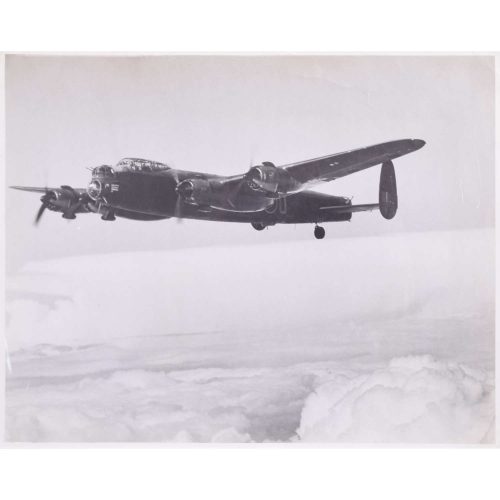
-
Out of stock
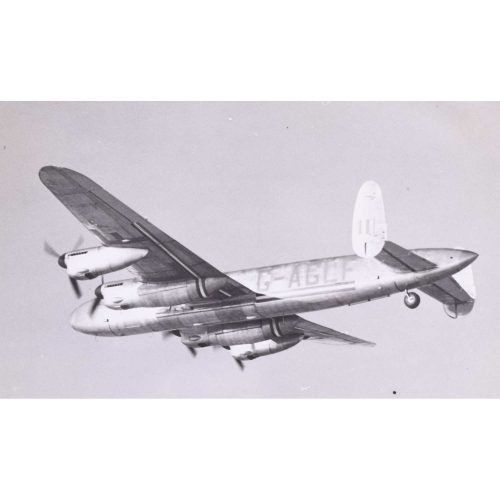
Lancastrian airliner G-AGLF
Original Silver Gelatin photograph, c. 1945 20 x 29 cm Stamped to reverse 'Daily Herald, 2 Chester Street, Oxford Road, Manchester; Copyright photo' In 1945, deliveries commenced of 30 British-built Lancastrians for BOAC. On a demonstration flight on 23 April 1945, G-AGLF flew 13,500 mi (21,700 km) from England to Auckland, New Zealand in three days, 14 hours at an average speed of 220 mph (354 km/h). G-AGLF's last flight was on Sunday 11 May 1947 when it crashed while landing at a pipeline station in the desert between Cairo and Busreh. The Lancastrian was fast, had a long range, and was capable of carrying a heavy load, but space inside was very limited as the Lancaster had been designed with space for its seven crew dispersed throughout the fuselage, and with the majority of the load being carried in the 33 ft (10.05 m) long bomb bay. Consequently, as passengers are bulky but low in weight, it was not suited to carry large numbers of passengers, but was suitable for mail and a small number of VIP passengers. BOAC used it for flights between England and Australia from 31 May 1945. It also served with the RAF; RAF Lancaster I serial number PD328, was converted to a Lancastrian and renamed Aries, as well as serving with Qantas and Flota Aérea Mercante Argentina. Lancastrians were used during the Berlin Airlift to transport petrol; 15 aircraft made over 5,000 trips. In 1946 a Lancastrian operated by BSAA was the first aircraft to make a scheduled flight from the then-newly opened London Heathrow Airport. Provenance: from the collection of Philip J R Moyes, author of many books on the RAF, most notably The Pictorial History which ran to several volumes. Condition: Marginal creases, a little foxing to reverse -
Out of stock
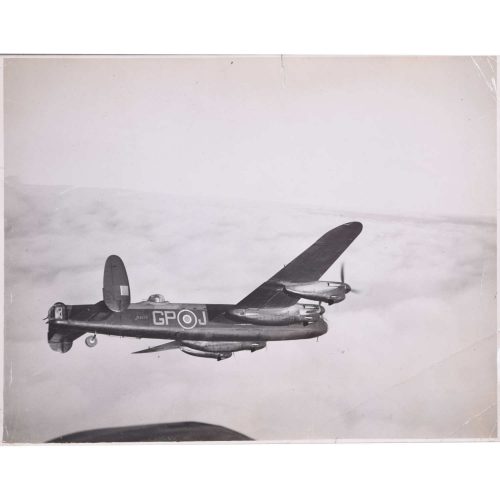
Lancaster Bomber W4113 GP-J
Original Silver Gelatin photograph, c. 1944 19 x 24 cm Published in Aeroplane Magazine, 4 February 1944. Stamped to reverse 'Wanted by 31 Janary' making this the original photograph used by the editing team at Aeroplane; and 'T[emple] P[ress] Ltd'. Photograph in official Air Ministry Second World War Collection, glass plate negative taken by F/O S A Devon. Lancaster B Mark I, W4113 ‘GP-J’, of No. 1661 Heavy Conversion Unit based at Winthorpe, Nottinghamshire, in flight. W4113 was a veteran aircraft having flown on a number of raids with Nos. 49 and 156 Squadrons RAF in 1942 and 1943, and was sent to a Heavy Conversion Unit where airmen were trained to operate the Lancaster. Became 4969M on 9/12/44, being reclassified as a ground instruction aircraft. W4113 took part in the following bombing raids: No. 49 Squadron; 1) Düsseldorf, 15-16/08/42; 2) Osnabrück, 17-18/08/42; 3) Flensburg, 18-19/08/42; 4) Gardening, Bornholm, 20-21/08/42; 5) Kassel, 27-28/08/42; 6) Saarbrücken, 01-02/09/42; 7) Duisburg, 06-07/09/42; 8.) Frankfurt, 08-09/09/42; 9) Bremen, 13-14/09/42; 10) Wilhelmshaven, 14-15/09/42; 11) Gardening, Kattegatt, 18-19/09/42; 12) Wismar, 01-02/10/42; 13) Aachen, 05-06/10/42; 14) Wismar, 12-13/10/42; 15) Kiel, 13-14/10/42; 16) Cologne, 15-16/10/42; 17) Genoa, 22-23/10/42; 18.) Genoa, 07-08/11/42; 19) Hamburg, 09/10/11/42; 20) Genoa, 15-16/11/42; 21) Stuttgart, 22-23/11/42; 22) Turin, 28-29/11/42; 23) Mannheim, 06-07/12/42, 24) 20-21/12/42. No. 156 Squadron.: a) Nuremburg, 25-26/02/43. It was produced in the third production batch of 207 aircraft ordered from A. V. Roe Co., Ltd., as part of Contract No. B69274/40 (as extended) under Works Order No. 7671, W4102-W4140, W4154-W4201, W4230-4279, W4301-W4340 and W4355-W4384. Deliveries commenced 07/42, completed 11/42 (average rate of production, approximately 13 aircraft per week). Merlin XX and XXII engines. Original Contract covered 453 aircraft in this batch but 243 were cancelled (W4385-W4900, W4414-4463, W4481-W4524, W4537-W4385, W4600-W4641 and W4655-W4700). Provenance: from the collection of Philip J R Moyes, author of many books on the RAF, most notably The Pictorial History which ran to several volumes. Condition: a couple of old edge tears and creases, visible in image. -
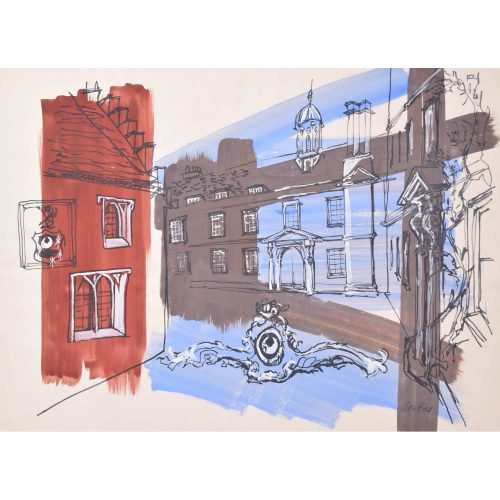
Margaret Souttar (1914 - 1987)
Trinity Hall, Cambridge I
Acrylic paint 55 x 76 cm Signed in pencil lower right. Souttar was a Scottish painter and printmaker known for her images of town- and cityscapes. In the early 1960s, she was commissioned to produce a series of prints of the Cambridge colleges. She captures the modernity and optimism of 1960s Cambridge; the fact that a female artist was commissioned to create the prints reflects the changing attitudes of the University towards women. Trinity Hall was one of the first Cambridge colleges to admit women as students - it did not do so until 1976. Provenance: the artist's studio sale. Condition: generally very good, a few handling marks. If you are interested, please email info@manningfineart.co.uk or call us on 07929 749056. Click here for other views of Trinity Hall. -
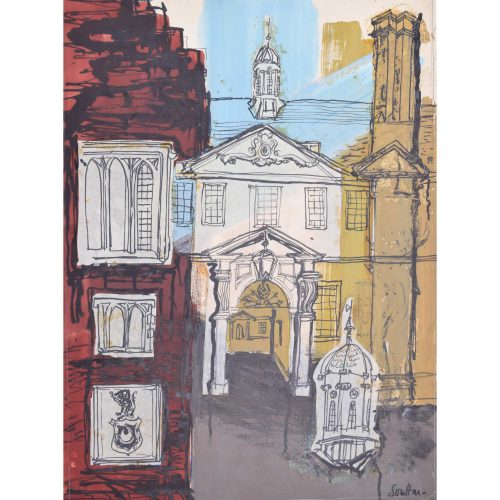
Margaret Souttar (1914-1987)
Trinity Hall, Cambridge
Acrylic on paper 76 x 56 cm Signed lower right. Souttar was a Scottish painter and printmaker known for her images of town- and cityscapes. In the early 1960s, she was commissioned to produce a series of prints of the Cambridge colleges. She captures the modernity and optimism of 1960s Cambridge; the fact that a female artist was commissioned to create the prints reflects the changing attitudes of the University towards women. Trinity Hall was one of the first Cambridge colleges to admit women as students - it did not do so until 1976. Provenance: the artist's studio sale. Condition: generally very good; some small glue stains around collaging. If you are interested, please email info@manningfineart.co.uk or call us on 07929 749056. Click here for other views of Trinity Hall. -
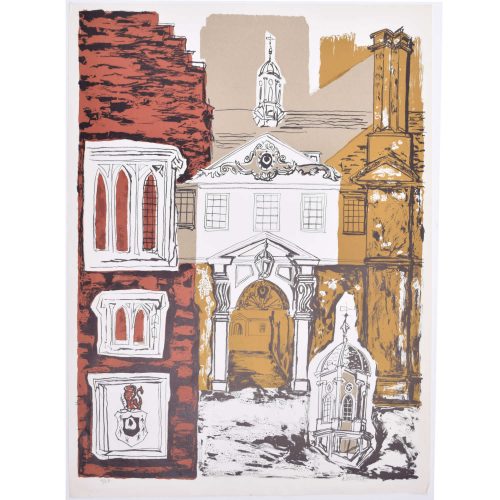
Margaret Souttar (1914 - 1987)
Trinity Hall, Cambridge
Lithograph 76 x 56 cm Signed and numbered 4/50 in pencil. Souttar was a Scottish painter and printmaker known for her images of town- and cityscapes. In the early 1960s, she was commissioned to produce a series of prints of the Cambridge colleges. She captures the modernity and optimism of 1960s Cambridge; the fact that a female artist was commissioned to create the prints reflects the changing attitudes of the University towards women. Trinity Hall was one of the first Cambridge colleges to admit women as students - it did not do so until 1976. Provenance: the artist's studio sale. Condition: generally very good; a few handling marks. If you are interested, please email info@manningfineart.co.uk or call us on 07929 749056. Click here for other views of Trinity Hall. -
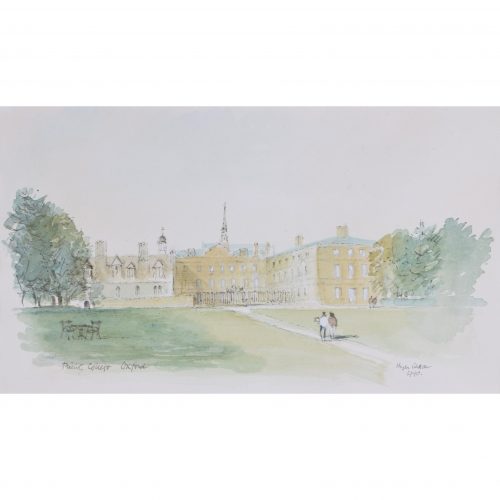
Hugh Casson (1910 - 1999)
Trinity College, Oxford (1990)
Watercolour 20 x 33 cm (38 x 50 cm framed) Casson's marvellous watercolour of Trinity and its perfectly manicured lawns, adorned with strolling undergraduates. Sir Hugh Casson was educated at Eastbourne College; St John’s College, Cambridge; and the Bartlett School of Architecture. Trained in the 1930s in the early modernist style, he taught at the Cambridge School of Architecture. After employment as a camoufleur during World War 2 by the Air Ministry, in 1948 he was appointed as director of architecture for the Festival of Britain. A close friend of the Royal Family, he undertook designs for the 1953 coronation, designed the interior of the Royal Yacht Britannia (“The overall idea was to give the impression of a country house at sea”), and taught the young Charles III to paint in watercolours. Amongst his architectural achievements are the Elephant House at London Zoo, the 1978 redevelopment of Bristol Docks, the Raised Staff Building for The University of Cambridge, and a building for the Royal College of Art. He published a number of illustrated books, of which Casson’s Oxford and Casson’s Cambridge are probably the best known. A limited edition series of prints was produced from the paintings. Condition: excellent. If you’d like to know more, please email info@manningfineart.co.uk or call us on 07929 749056. Click here for other views of Trinity College, Oxford. -
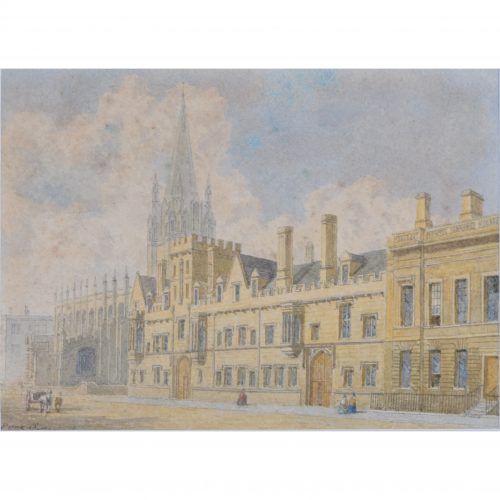
George Pyne (1800 - 1884) The High, Oxford
Watercolour 15 x 21 cm Signed and dated indiscriminately lower left. A 19th-century view of the High Street, Oxford. The spire of the University Church of St Mary the Virgin towers over the street; a horse and cart and brightly-dressed pedestrians pass by. George Pyne was related to two founders of the Society of Painters in Watercolours – William Henry Pyne was his father, and John Varley his father-in-law. Pyne trained as an architectural draughtsman and lived in Oxford from the 1850s until his death in 1884, specialising in views of the city and its colleges. His Oxford pictures are both architecturally-minded and romantically creative, often combining intensely detailed depictions of college buildings with imagined pedestrian scenes. Pyne was also noted for his views of Cambridge and Eton, and for his drawing manuals ‘A Rudimentary and Practical Treatise on Perspective for Beginners’ (1848) and ‘Practical Rules on Drawing for the Operative Builder, and Young Student in Architecture’ (1854); the latter texts offer an insight into his method of depicting architecture and its surroundings. Condition: generally good; some spotting and toning to sky. If you’d like to know more, please email info@manningfineart.co.uk or call us on 07929 749056. -
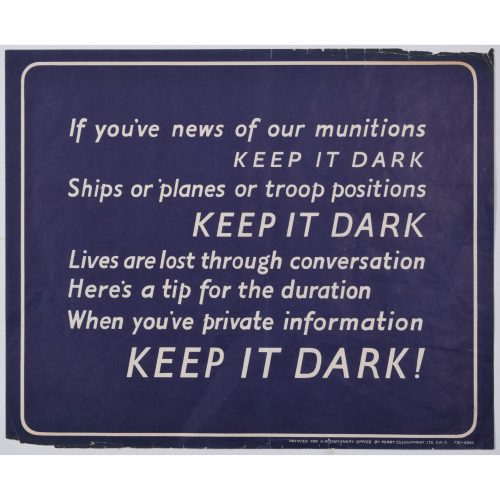
Keep It Dark (1939 - 1945)
Lithographic poster 25 x 31 cm Sponsored by Her Majesty's Stationery Office; printed by Perry Colourprint. A copy of this poster is held by the Imperial War Museum. This poster, bearing lyrics designed to be sung to the tune of "She'll be coming round the mountain", was designed for the Ministry of Information during the Second World War. It urges the population to avoid talking carelessly about details of Britain's operational movements, which might unwittingly end up in the wrong hands. Condition: good. Some small losses to extreme margins. If you’d like to know more, please email info@manningfineart.co.uk or call us on 07929 749056. -
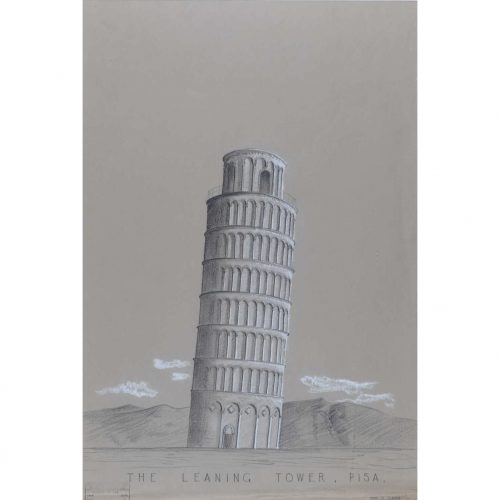
John D Paxton
The Leaning Tower, Pisa
Pencil and white chalk 75 x 50 cm Stamped bottom left indistinctly "Edinburgh School of Art, School of Architecture". An architectural drawing of Pisa's famous Leaning Tower. -
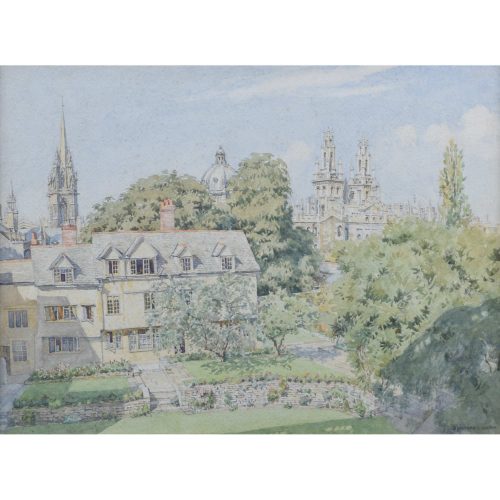
Bernard Cecil Gotch (1876-1964)
Queen's College, Oxford
Watercolour 28 x 39 cm (51 x 64 cm framed) Signed lower right. Queen's College in all its leafy glory. The dreaming spires of the University Church of St Mary the Virgin, the Radcliffe Camera, and All Souls peep over the quad. Bernard Cecil Gotch was a Winchester-born artist who is best known for his atmospheric watercolours of Britain's towns and cities (most notably Oxford). He moved to Oxford in 1927, painting many watercolours of the interiors and exteriors of Oxford’s many buildings. His works concentrate on the grand exteriors and interiors of the University's colleges, and he exhibited frequently - including an exhibition every term at Oriel College. His first notable commission was for the publisher Methuen, illustrating 'A Shepherd’s Life' by W H Hudson. Whilst in London he was invited to illustrate a book on the Public Schools of England (which was sadly never completed). He exhibited watercolours at the Fine Art Society and Lincolns Inn, and also exhibited at the Royal Academy. In 1952 Gotch was given an Honorary MA by the University of Oxford, and, after his death in 1963, a memorial was held for him at Oriel. Condition: very good; original frame & mount (some ageing to the latter). If you’d like to know more, please email info@manningfineart.co.uk or call us on 07929 749056. Click here for other views of Queen's College, Oxford. -
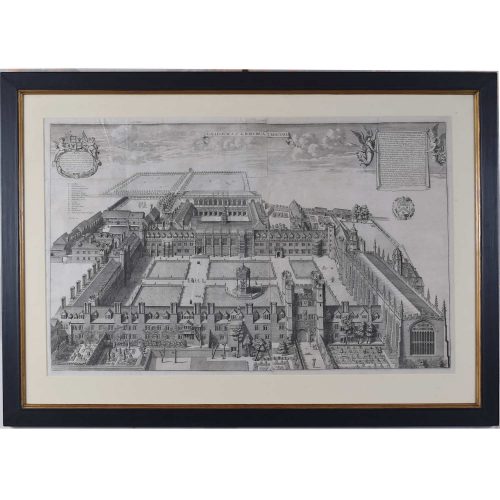
David Loggan (1634 - 1692)
Trinity College, Cambridge (1690)
Engraving 80 x 50 cm Loggan was born to English and Scottish parents, and was baptised in Danzig in 1634. After studying engraving in Danzig with Willem Hondius (1598-1652 or 1658), he moved to London in the late 1650s, going on to produce the engraved title-page for the folio 1662 Book of Common Prayer. He married in 1663 and moved to Nuffield in Oxfordshire in 1665. Loggan was appointed Public Sculptor to the nearby University of Oxford in the late 1660s, having been commissioned to produce bird’s-eye views of all the Oxford colleges. He lived in Holywell Street as he did this. The 'Oxonia Illustrata' was published in 1675, with the help of Robert White (1645 - 1704). Following its completion, Loggan began work on his equivalent work for Cambridge; the 'Cantabrigia Illustrata' was finally published in 1690, when he was made engraver to Cambridge University. The 'Oxonia Illustrata' also includes an engraving of Winchester College (Winchester and New College share William of Wykeham as their founder) whilst the 'Cantabrigia Illustrata' includes one of Eton College (which shares its founder, Henry VIII, with King’s College). Bird’s-eye views from this era required a particular talent as an architectural perspectivist; it was not until 1783 that it became possible for artists to ascend via hot air balloons and view the scenes they were depicting from above. Loggan thus had to rely on his imagination in conceiving the views. Loggan’s views constitute the first accurate depictions of the two Universities, in many ways unchanged today. Whilst the Oxford engravings were produced in reasonable numbers and ran to a second edition by Henry Overton (on thicker paper and with a plate number in Roman numerals in the bottom right-hand corner), those of Cambridge were printed in much smaller numbers. The Dutchman Pieter van der Aa published some miniature versions of the engravings for James Beverell’s guidebook to the UK, 'Les Delices de la Grande Bretagne' (circa 1708). The contemporary artist Andrew Ingamells has produced a highly-acclaimed series of etchings which bring Loggan’s original vision up to date. Condition: generally very good; printed on two sheets, folds as issued. A few creases to top area. As a multi-folded plate in the published book, Trinity has normally suffered and is normally trimmed closely and has damage; this particular example has instead good margins outside the platemark and without damage to the folds. A very good copy of Trinity. If you’d like to know more, please email info@manningfineart.co.uk or call us on 07929 749056. -
Out of stock
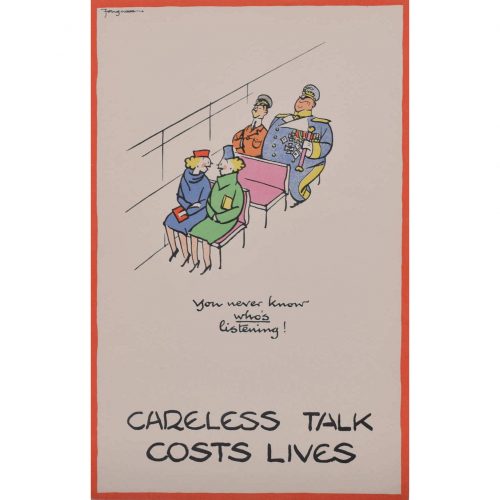
Cyril Kenneth Bird ‘Fougasse’ (1887 - 1965)
Careless Talk Costs Lives (circa 1940)
Lithographic poster 32 x 20 cm (12.5 x 8 in) Version printed on thinner paper. Fougasse was a British cartoonist. He was art editor of Punch between 1937 and 1949, and subsequently editor until 1953. He is best known for his ‘Careless Talk Costs Lives’ series of posters, and the other posters for the Ministry of Information and London Transport. As the Second World War progressed, the Ministry of Information’s poster campaign had become less and less effective. There were posters instructing the population to save old clothes for rags, turn off the lights, save food, dig for victory, watch out for spies, and keep calm and carry on. With this instruction overload, the population had ceased paying attention to the posters. Fougasse noticed this, and offered his services unpaid to the Ministry of Information, with a view to bringing a touch of humour to the posters. His amusing designs with pithy captions, reminiscent of newspaper cartoons, helped to get the Ministry's messages across in a novel way. Fougasse's distinctive poster style, with the red border, was subsequently adopted by other Ministry artists. Condition: if you’d like to know more, please email info@manningfineart.co.uk or call us on 07929 749056. -
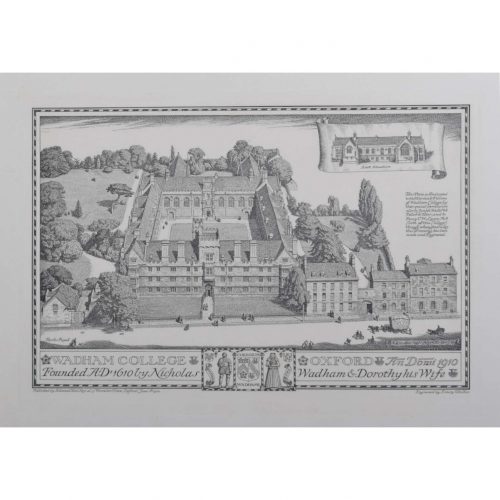
Emery Walker (1851 - 1933) after Edmund Hort New (1871 - 1931)
Wadham College, Oxford
Photogravure 27 x 41 cm New produced a series of pen-and-ink drawings of Oxford colleges, of which this is one. They paid homage to the artist David Loggan, often using the same aerial viewpoint as him, but showing the colleges two hundred years later. Emery Walker turned New's drawings into photoengravings in the early 20th century. Probably no more than two hundred prints of each engraving were produced, and the plates were destroyed in the blitz. Edmund Hort New was an English artist. He was a member of the Birmingham Group of Arts and Crafts-associated painters and craftsmen, and is known as a leading illustrator of his period. He specialised in pen and ink drawings of rural and urban landscapes, old buildings and their interiors, architectural features, and also designed bookplates. He provided illustrations for the English Illustrated Magazine and was commissioned by Bodley Head publishers to illustrate critically acclaimed editions of books, such as Walton's The Compleat Angler. In 1895, New met William Morris and began designing for the Kelmscott Press. He also taught drawing to T E Lawrence. In 1905, he began his drawings of the Oxford colleges, and spent the rest of his life working on the (sadly unfinished) project. In 1921 he exhibited at the first exhibition of the Society of Graphic Art. Sir Emery Walker FSA was an English engraver, photographer, and printer. He was very involved with the Arts and Crafts movement, a Master of the Art Workers' Guild, President of the Arts and Crafts Exhibition Society, a Trustee of the Wallace Collection, and a Fellow of the Society of Antiquaries. He was also a close friend of William Morris. Walker's expertise and his collection of 16th-century typefaces inspired Morris to create the Kelmscott Press. In 1910, Walker photographed the notable Rice portrait of Jane Austen. He was knighted in 1930. Condition: very good; modern printing. If you’d like to know more, please email info@manningfineart.co.uk or call us on 07929 749056. Click here for other views of Wadham. -
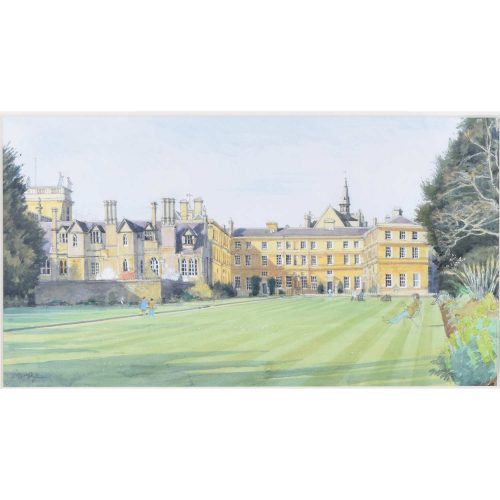
John Doyle (born 1928)
Trinity College, Oxford
Watercolour 24 x 46 cm Signed lower left. Doyle's striking portrayal of Trinity's architecture, complete with undergraduates variously strolling, sitting, and reading in the foreground. Afternoon sun slants over the immaculately mown lawns. John Doyle was born in London and works in watercolours, pastels, and oils. He studied at the Maidstone School of Art in his 30s, later showing at the Royal Academy Summer Exhibition. Much of his work focuses on landscape and architecture; he has produced a series of views of Oxford and its colleges. Condition: excellent. If you’d like to know more, please email info@manningfineart.co.uk or call us on 07929 749056. Click here for more views of Trinity College, Oxford. -
Out of stock
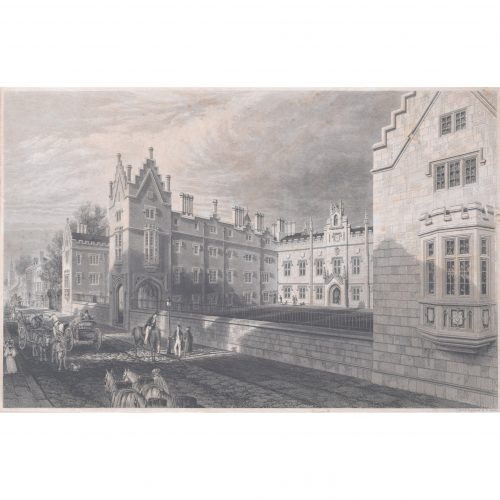
Ebenezer Challis (1806 - 1881)
Sidney Sussex College, Cambridge (1834)
Engraving 27 x 43 cm A 19th century view of Sidney Sussex, complete with Victorian undergraduates in academic dress, horse and cart, and behatted rider. Condition: good. Trimmed. Otherwise generally good with the occasional tiny spot. If you’d like to know more, please email info@manningfineart.co.uk or call us on 07929 749056. Click here for more views of Sidney Sussex.