-
 Orlov, V and Denisenko За успехи в труде [Success Through Work] (1978) Moscow, Izdaltelstvo Plakat Original vintage posters 43 x 56 cm A poster collection comprising twelve leaves loosely inserted in a printed paper portfolio, one plate previously folded, a little light wear to some fore-edges, light wear to portfolio spine, else very good. First edition. A collection of popular Soviet motifs on the enduring theme of Success through Work, created to provide best-practice design templates for artworkers, artists and propaganda designers responsible for the illustration of official Soviet literature and art, mosaics, wall-paintings, and posters. Motifs include Lenin, the distinctive logos of various Soviet bodies including the Young Guard, and medallions commemorating events such as the October revolution. Numerous medal-designs for individual and collective excellence in all kinds of industry, including farming, mining, husbandry, and machine-working also appear. Designed for eminently practical use, with cut-out lines between the individual vignettes, these pattern books rarely survived intact.
 -

Soviet Union pro-Lenin Marxist Bulgarian propaganda poster design (circa 1950s)
Gouache on board 20 x 11.5 cm After a Communist takeover in 1945, Bulgaria was a Soviet ally during the Cold War, and maintained good relationships with Russia until the Revolutions of 1989. From 1945 to 1948, the country became entrenched within the Soviet sphere of influence under the control of the Bulgarian Communist Party (BCP) which oversaw a program of Stalinization in the late 1940s and 1950s. Both countries are Slavic nations, and are bound together by a common Orthodox Christian culture. This poster design is a piece of Leninist propaganda, designed to make Bulgarians associate Lenin and Soviet Marxist rule with efficiency and plenty. It is inscribed to the reverse in Bulgarian 'To grow plants in rows next to each other - the thickest row with straight cobs'. The Pirin Mountains referred to in the top left-hand corner are a mountain range in southwestern Bulgaria. Condition: very good. If you’d like to know more, please email info@manningfineart.co.uk or call us on 07929 749056. -
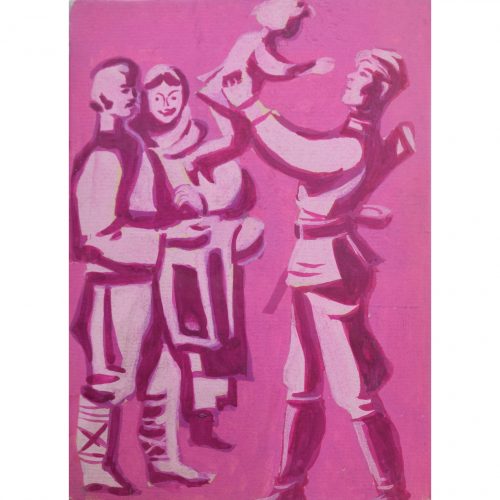
Bulgarian pro-natalist propaganda poster design (circa 1950s)
Gouache on board 17 x 12 cm After a Communist takeover in 1945, Bulgaria was a Soviet ally during the Cold War, and maintained good relationships with Russia until the Revolutions of 1989. From 1945 to 1948, the country became entrenched within the Soviet sphere of influence under the control of the Bulgarian Communist Party (BCP) which oversaw a program of Stalinization in the late 1940s and 1950s. Both countries are Slavic nations, and are bound together by a common Orthodox Christian culture. This poster design, painted in warm pink-purple tones and depicting a Bulgarian soldier holding a toddler aloft, was designed as post-war pro-natalist propaganda (likely from the 1950s). Bulgaria and its Soviet allies had lost a huge number of men during the war, and this design for a poster was intended to encourage Bulgarians to have more children. Condition: very good. If you’d like to know more, please email info@manningfineart.co.uk or call us on 07929 749056. -
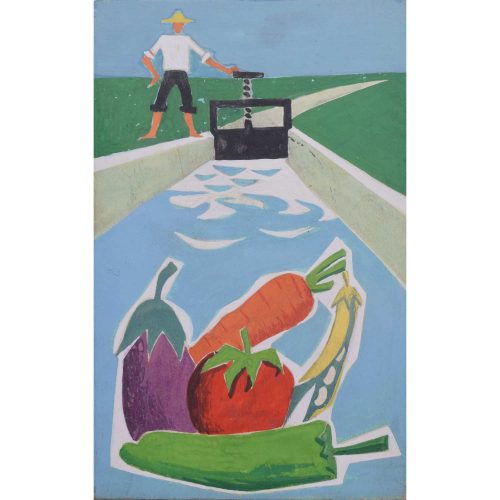
Soviet Union socialist irrigation Bulgarian propaganda poster design (circa 1950s)
Gouache on board 18 x 11 cm After a Communist takeover in 1945, Bulgaria was a Soviet ally during the Cold War, and maintained good relationships with Russia until the Revolutions of 1989. From 1945 to 1948, the country became entrenched within the Soviet sphere of influence under the control of the Bulgarian Communist Party (BCP) which oversaw a program of Stalinization in the late 1940s and 1950s. Both countries are Slavic nations, and are bound together by a common Orthodox Christian culture. This poster design features huge juicy vegetables, grown as the result of newly-implemented irrigation systems. Socialist farming practices in Bulgaria were commonplace during its time as a Soviet ally or 'satellite'; the government was keen to encourage well-yielding farming practices and to be seen as a protector of agricultural infrastructure turing this turbulent period of the 20th century. Condition: very good. If you’d like to know more, please email info@manningfineart.co.uk or call us on 07929 749056. -

David Klein (1918 - 2005)
Spain - Fly TWA
Original vintage poster 102 x 63 cm Klein's poster for Trans World Airlines (TWA) advertises flights to Spain. His design features two matadors in rich traditional address, in a stadium where a bullfight is presumably about to take place; a TWA plane flies overhead. David Klein was an American artist notable for his posters. He designed posters for the US Army, many and various Broadway productions, Trans World Airlines, and many more commercial clients. In the late 1950s and early 1960s his travel posters became iconic images of the era of commercial aeroplane travel. One of his posters was added to the MoMa's collection in 1957. Condition: good. If you are interested, please email info@manningfineart.co.uk or call us on 07929 749056. Click here for other original vintage travel posters. -
Out of stock

José Ortega (1921 - 1990)
Romanische Kunst Spanien (1960s)
Original vintage poster 100 x 63 cm Printed in Madrid for the Publications de la Direccion General del Turismo. Ortega's poster for the Spanish tourist board promotes the Romanesque art of Spain. This edition of the poster was produced for circulation in Germany. José García Ortega was born in Arroba de los Montes and was a member of the Communist Party. He worked as a painter and sculptor, studying at the Círculo de Bellas Artes in Madrid. In 1953 he went to France to study art, funded by a French government scholarship. He returned to Spain throughout the 1950s and 1960s, and became a commercially successful artist. Some of his most famous designs include the posters which the Spanish tourist board commissioned from him circa 1960. Condition: generally very good; a few tiny repaired edge tears. Not backed. If you are interested, please email info@manningfineart.co.uk or call us on 07929 749056. Click here for more original vintage posters. -

James Basire & John Carter Specimens of the Architecture and Ornaments of the Abbey Church at St Albans
Engraving 62 x 46 cm This engraving was originally published by the Society of Antiquaries of London, an organisation dedicated to studying and preserving historical monuments. Recognising it as one of England's most significant medieval structures, the society commissioned a series of engravings of St Albans Cathedral by James Basire--based on drawings by the architectural draughtsman John Carter. In doing so, the Antiquaries hoped to preserve and disseminate knowledge of England’s architectural heritage. Condition: Generally very good, some spotting to the corners.If you would like to know more, please email info@manningfineart.co.uk or call us on 07929 749056.
-
 William Matthison (1853-1926) Spires of Oxford from the Canal Watercolour 22 x 55 cm Signed lower right. A charming watercolour of the spires of Oxford as seen from the canal. Matthison expertly captures the light of a cool winter evening. He depicts a charming scene in this watercolour: the sun is setting, sheep are grazing on the banks of the canal, steam rises out the chimney of one canal boat, another moves slowly through the water and a young girl guides her horse along the path. Matthison was born near Birmingham and attended King Edward’s School in the city. He learned drawing at the Birmingham Central School of Art and then became a pupil of Birmingham artist Edward Watson. He became a professional artist in 1875 and moved to Oxfordshire a few years after; this was where he had the opportunity to produce many of the Oxford views for which he is known today. In 1902 he moved to Park Town in Oxford and was commissioned by Robert Peel to paint more than seventy views of the University of Oxford, which were subsequently made into postcards. Priced at seven for a shilling, they were only available from E Cross of Pembroke Street (a long-since closed business). Raphael Tuck & Sons also commissioned him to produce postcard scenes of Cambridge. Matthison’s views of Oxford were later printed in Fifty Watercolour Drawings of Oxford, published in 1912 by Alden & Co. Condition: Generally very good.
If you would like to know more, please email info@manningfineart.co.uk or call us on 07929 749056.
For other general views of Oxford, click here. -
 William Matthison (1853-1926) Spires of Oxford from the Canal Watercolour 22 x 55 cm Signed lower right. A charming watercolour of the spires of Oxford as seen from the canal. Matthison expertly captures the light of a warm summer's evening. He depicts a charming scene in this watercolour, with cows drinking from the canal, a canal boat quietly drifting by and a young girl leading her friend along the path on a horse. Matthison was born near Birmingham and attended King Edward’s School in the city. He learned drawing at the Birmingham Central School of Art and then became a pupil of Birmingham artist Edward Watson. He became a professional artist in 1875 and moved to Oxfordshire a few years after; this was where he had the opportunity to produce many of the Oxford views for which he is known today. In 1902 he moved to Park Town in Oxford and was commissioned by Robert Peel to paint more than seventy views of the University of Oxford, which were subsequently made into postcards. Priced at seven for a shilling, they were only available from E Cross of Pembroke Street (a long-since closed business). Raphael Tuck & Sons also commissioned him to produce postcard scenes of Cambridge. Matthison’s views of Oxford were later printed in Fifty Watercolour Drawings of Oxford, published in 1912 by Alden & Co. Condition: Generally very good.
If you would like to know more, please email info@manningfineart.co.uk or call us on 07929 749056.
For other general views of Oxford, click here. -
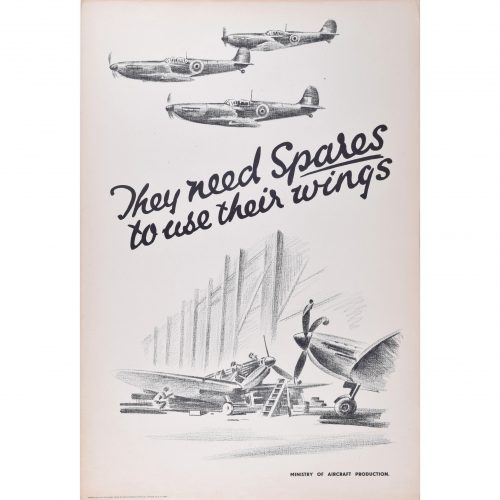
Owen Miller (1907-1960)
They need spares to use their wings
Original poster c. 1943 76x51cm Printed for HMSO by Multi Machine Plates Ltd for the Ministry of Aircraft Production Damaged Spitfires are pictured waiting in a hanger for spares to arrive, encouraging the workers in the factory to work harder in order to keep the aeroplanes in the air. Click here for biographical details and other works by the artist. If you are interested email info@manningfineart.co.uk or call us on 07929 749056. -

Laurence Dunn (1910 - 2006)
SS Beryl
Pen, ink, and watercolour 6 x 16 cm Provenance: an album of works by the artist. The Beryl was a small coastal cargo steamer which was built in Scotland in 1893. She was renamed the SS Fodhla in 1915. Laurence Dunn was a well-known British marine artist and writer known for his depictions of ships. He grew up in Devon, where he practised drawing passing ships, and went on to study at the Central School of Art. He then worked for shipbuilding firm John I. Thornycroft & Company Limited, where he contributed to the design of the Royal Yacht. During the Second World War, Dunn worked in naval intelligence. In the early 1960s, he created many line drawings of Atlantic ocean liners. Upon his death in 2006, the World Ship Society published the following obituary: DUNN, Laurence. [December 15 2006 — Lloyds List] Many readers will be saddened by the death of well-known marine artist and writer Laurence Dunn in his 97th year. A man of encyclopaedic knowledge, he began his lifelong love of ships in Brixham, where he meticulously recorded passing traffic with the exquisitely accurate line drawings which later became something of a trademark. While studying at London’s Central School of Art his work was noticed by the Southern Railway, which commissioned profiles of its fleet, and this in turn led to work for Orient Line, where he also designed the well-known corn-coloured hull, and later Thorneycroft, where he helped with shaping draft plans for a new royal yacht. During the second world was he worked for naval intelligence at the Admiralty, where his technique did much to improve recognition standards, and greatly expanded his shipping clientele, becoming personally known to many chairmen. As well as the shipping press he worked for mainstream publications such as Everybody’s, Sphere and the upmarket comic Eagle. Through his many contacts he enjoyed going to sea in a great variety of ships from aircraft carriers to colliers. Laurence wrote several books, starting with ship recognition titles which introduced new standards of layout, but his best known work was probably Passenger Liners, which was widely taken up by the travel trade. His love of Greece, where he was an early publicist of island cruising, let to involvement in reshaping various passenger liners beginning with Greek Line’s OLYMPIA. In later life he designed several sets of shipping stamps for the Crown Agents, produced photographic volumes on Thames and Mediterranean shipping and still found time to enjoy the passing Thames traffic. Our sympathies go to his wife Jennifer, who provided succour to the many ship lovers who beat a path to the welcoming door of their Gravesend home. Condition: very good. If you are interested, please email info@manningfineart.co.uk or call us on 07929 749056. Click here for other works by Laurence Dunn. -
Laurence Dunn (1910 - 2006)
SS Hesleyside
Pen, ink, and watercolour 6 x 16 cm Provenance: an album of works by the artist. The Hesleyside was a steamer built in 1912. In 1933, as Dunn notes in pen, it was bought by a Greek company and rechristened the SS Kymas. She was torpedoed by a U-boat in 1940. Laurence Dunn was a well-known British marine artist and writer known for his depictions of ships. He grew up in Devon, where he practised drawing passing ships, and went on to study at the Central School of Art. He then worked for shipbuilding firm John I. Thornycroft & Company Limited, where he contributed to the design of the Royal Yacht. During the Second World War, Dunn worked in naval intelligence. In the early 1960s, he created many line drawings of Atlantic ocean liners. Upon his death in 2006, the World Ship Society published the following obituary: DUNN, Laurence. [December 15 2006 — Lloyds List] Many readers will be saddened by the death of well-known marine artist and writer Laurence Dunn in his 97th year. A man of encyclopaedic knowledge, he began his lifelong love of ships in Brixham, where he meticulously recorded passing traffic with the exquisitely accurate line drawings which later became something of a trademark. While studying at London’s Central School of Art his work was noticed by the Southern Railway, which commissioned profiles of its fleet, and this in turn led to work for Orient Line, where he also designed the well-known corn-coloured hull, and later Thorneycroft, where he helped with shaping draft plans for a new royal yacht. During the second world was he worked for naval intelligence at the Admiralty, where his technique did much to improve recognition standards, and greatly expanded his shipping clientele, becoming personally known to many chairmen. As well as the shipping press he worked for mainstream publications such as Everybody’s, Sphere and the upmarket comic Eagle. Through his many contacts he enjoyed going to sea in a great variety of ships from aircraft carriers to colliers. Laurence wrote several books, starting with ship recognition titles which introduced new standards of layout, but his best known work was probably Passenger Liners, which was widely taken up by the travel trade. His love of Greece, where he was an early publicist of island cruising, let to involvement in reshaping various passenger liners beginning with Greek Line’s OLYMPIA. In later life he designed several sets of shipping stamps for the Crown Agents, produced photographic volumes on Thames and Mediterranean shipping and still found time to enjoy the passing Thames traffic. Our sympathies go to his wife Jennifer, who provided succour to the many ship lovers who beat a path to the welcoming door of their Gravesend home. Condition: very good. If you are interested, please email info@manningfineart.co.uk or call us on 07929 749056. Click here for other works by Laurence Dunn. -

James Basire & John Carter St Albans Cathedral
Engraving 62 x 46 cm This engraving was originally published by the Society of Antiquaries of London, an organisation dedicated to studying and preserving historical monuments. Recognising it as one of England's most significant medieval structures, the society commissioned a series of engravings of St Albans Cathedral by James Basire--based on drawings by the architectural draughtsman John Carter. In doing so, the Antiquaries hoped to preserve and disseminate knowledge of England’s architectural heritage. This particular engraving is especially striking, as Carter expertly creates contrasts between light and dark, giving his work a strong sense of depth and conveying the impressive stature of St Albans Cathedral. Condition: Generally very good.If you would like to know more, please email info@manningfineart.co.uk or call us on 07929 749056.
-

James Basire & John Carter Floor plan of St Albans Cathedral
Engraving 61 x 95 cm This engraving was originally published by the Society of Antiquaries of London, an organisation dedicated to studying and preserving historical monuments. Recognising it as one of England's most significant medieval structures, the society commissioned a series of engravings of St Albans Cathedral by James Basire, based on drawings by the architectural draughtsman John Carter. In doing so, the Antiquaries hoped to preserve and disseminate knowledge of England’s architectural heritage. This particular edition depicts a cross section of St Alban's Cathedral, offering a unique insight into both the architectural features of the building and its finer masonry and design details. Condition: Generally very good, slight spotting to the central fold.If you would like to know more, please email info@manningfineart.co.uk or call us on 07929 749056.
-

James Basire & John Carter St Albans Cathedral
Engraving 62 x 46 cm This engraving was originally published by the Society of Antiquaries of London, an organisation dedicated to studying and preserving historical monuments. Recognising it as one of England's most significant medieval structures, the society commissioned a series of engravings of St Albans Cathedral in 1810 by James Basire--based on drawings by the architectural draughtsman John Carter. In doing so, the Antiquaries hoped to preserve and disseminate knowledge of England’s architectural heritage. This striking engraving depicts a cross section of the cathedral, allowing the viewer to appreciate both the architectural details of the exterior and glimpse usually hidden areas of the building including the inside of the bell tower. Condition: Generally very good, repaired tear to the bottom right hand cornerIf you would like to know more, please email info@manningfineart.co.uk or call us on 07929 749056.
-
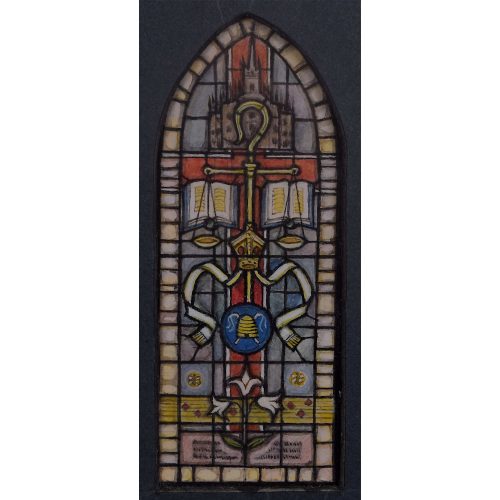
Jane Gray (b.1931)
St Ambrose Church, Leyland, Design for Stained Glass Window (1980)
Watercolour 11.5 x 4.5 cmStudio label verso.
The site of St Ambrose Church, Leyland, originally lay in the parish of St. Andrew’s Leyland; however, after a 37% population increase in the town caused by the coming of the railways and industrialisation in the 1870’s, the Vicar of St. Andrews decided to build a chapel of ease to St. Andrews. The church was rebuilt on the northern edge of the town in 1880. This window features symbols of St Ambrose and was installed in the church in 1982.
Provenance: the artist’s studio sale. Literature: Jane Gray, Playing with Rainbows. (Shropshire: Ellingham Press, 2011), p.76. Condition: very good. If you are interested, please email info@manningfineart.co.uk or call us on 07929 749056. For other works by Jane Gray and more information about her, please click here. -
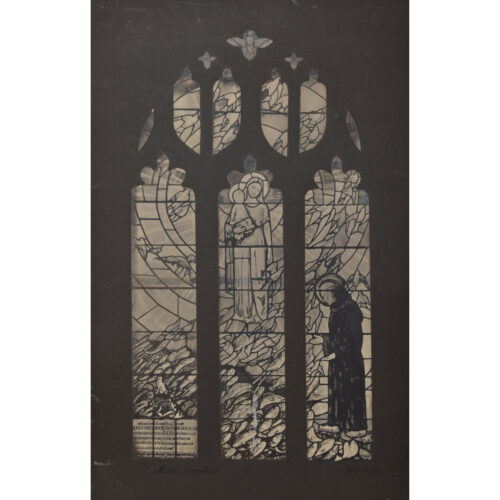
William Nicholson (1872 - 1949)
Mells Window (1930)
Photographic collage 57 x 33 cm Titled below and signed lower right in ink. Nicholson's original photographic collage of his magnificent stained glass window at St Andrew's Church in Mells. It depicts St Francis of Assisi preaching to the fish and the birds, with a Madonna and Child in the central panel. The window was commissioned by Lady Frances Horner as a memorial to her husband Sir John Horner, a barrister whose family seat was Mells Manor, a grand country house and park near Frome in Somerset. Lady Horner was a great patron of the arts and commissioned by artists including Eric Gill, Edwin Lutyens, and Edward Burne-Jones, as well as Nicholson. Nicholson was a regular visitor to Mells from the early 1920s, and designed the window in 1930. Burne-Jones had already designed a memorial in the church (to a different member of the family) in 1886. Sir William Nicholson was a British painter and printmaker. He is also known as an illustrator, author of children’s books, stained glass designer, and theatre set designer. Condition: a small stain to bottom of central panel - otherwise very good. If you are interested, please email info@manningfineart.co.uk or call us on 07929 749056. Click here for more stained glass designs. -
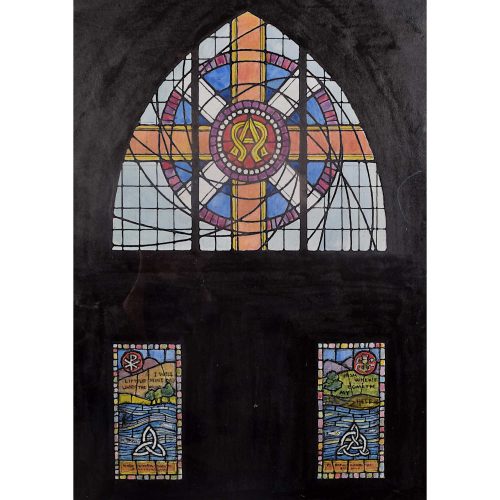
Jane Gray (b.1931)
St Andrew’s Church, Walton-on-Thames, Design for Stained Glass Window (1993)
Watercolour 28.5 x 20.5 cmSigned, dated and studio stamp verso.
St Andrew’s Church was built in 1931 but its story began some years earlier in 1928 when a group of Scots and those with Scottish roots, started meeting in the Walton Playhouse to worship under a retired Presbyterian Minister. Over time, funds were raised to build a proper church, the foundation stone laid in 1931, bearing the Presbyterian Church’s Latin motto, ‘Nec Tamen Consumebatur’ (and yet it was not consumed) from the Old Testament story of Moses and the Burning Bush. In 1972, alongside most Presbyterian Churches of England, St Andrew’s united with The Congregational Church of England and Wales to form, ‘The United Reformed Church’. This window features a red cross with St Andrew’s cross, along with the Alpha and Omega, and was installed in 1994.
Provenance: the artist’s studio sale. Literature: Jane Gray, Playing with Rainbows. (Shropshire: Ellingham Press, 2011), p.83. Condition: very good. If you are interested, please email info@manningfineart.co.uk or call us on 07929 749056. For other works by Jane Gray and more information about her, please click here. -
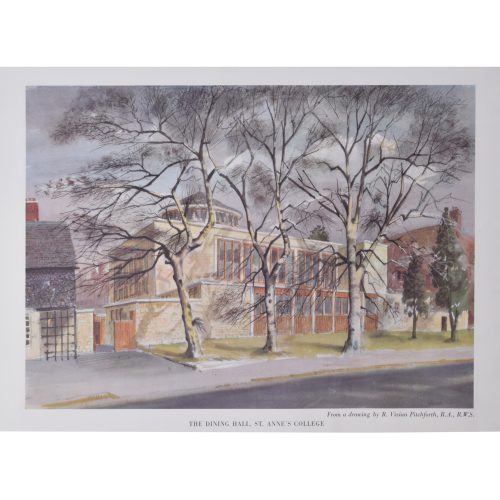
Roland Vivian Pitchforth RA ARWS (1895 - 1982)
The Dining Hall, St Anne's College
Lithograph 33 x 46 cm A lithograph of St Anne's, from a drawing by Roland Vivian Pitchforth. The artist captures the Dining Hall of the college on a blustery day. The modernist dining hall was built in 1959. Pitchforth's drawing was reproduced as a lithograph in 1962, to be published in the "Oxford Almanack". The Oxford Almanack was an annual almanac published by the Oxford University Press for the University of Oxford from 1674 through 2019 (when printing sadly ceased due to "dwindling interest"). The almanac traditionally included engravings or lithographs of the University and information about the upcoming year. Other almanac artists have included James Basire, Michael Burghers, J. M. W. Turner, and John Piper. Roland Vivian Pitchforth was an English painter, teacher and an official British war artist during the Second World War. Condition: very good. If you’d like to know more, please email info@manningfineart.co.uk or call us on 07929 749056. -
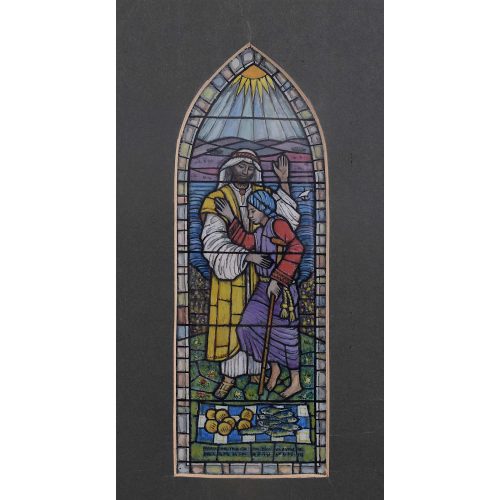
Jane Gray (b.1931)
St Anne’s Church, Copp, Great Eccleston, Design for Stained Glass Window (1979)
Watercolour 19 x 6.5 cm Studio label verso.A chapel was first built at Copp in 1723 for the members of St. Michaels on Wyre Church and Kirkham Church who were too far from their parish churches. Elswick Chapel would have been ideal for the purpose, but as it was in the hands of dissenters the bishop of the time, Bishop Gastrall, decided a new building would be preferable. On May 13th, 1723, a deed was drawn up arranging for three men to rent a piece of land (known as Higher Cop) for one peppercorn a year to build a new chapel. St. Anne's Chapel was built that same year. It wasn’t until 1849, however, that Copp Parish was formed by an Order in Council at Queen Victoria's court at Windsor. The church was completely restored in 1884, the outside transformed by building over it in Yorkshire stone, and the tower raised to 45ft. This window design centres on the scene of Christ healing a lame man and features symbolic images of loaves and fishes. The window was installed in 1979.
Provenance: the artist’s studio sale. Literature: Jane Gray, Playing with Rainbows. (Shropshire: Ellingham Press, 2011), p.75. Condition: very good. If you are interested, please email info@manningfineart.co.uk or call us on 07929 749056. For other works by Jane Gray and more information about her, please click here. -
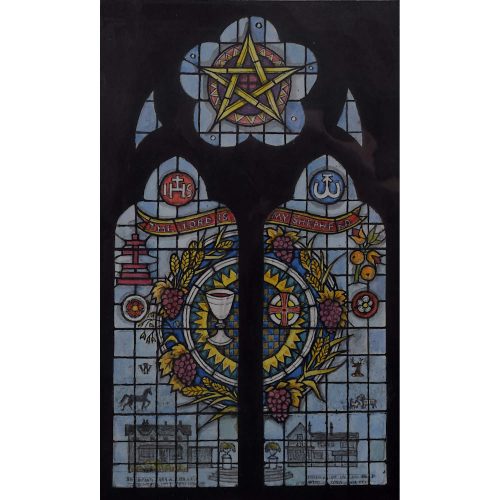
Jane Gray (b.1931)
St Barnabas Church, Franche, Kidderminster, Design for Stained Glass Memorial Window (1992)
Watercolour 21 x 12.5 cmSigned, dated and studio stamp verso.
St Barnabas Church, a red brick church designed by Martin & Chamberlain, was established in Franche in 1871 as a chapel-of-ease to the Parish Church of Kidderminster, St Mary and All Saints. St Barnabas is known for its diverse collection of stained glass windows and, alongside Gray’s modern memorial window, features windows in the Arts and Crafts style, likely designed by Benjamin Warren.
Provenance: the artist’s studio sale. Condition: very good. If you are interested, please email info@manningfineart.co.uk or call us on 07929 749056. For other works by Jane Gray and more information about her, please click here. -
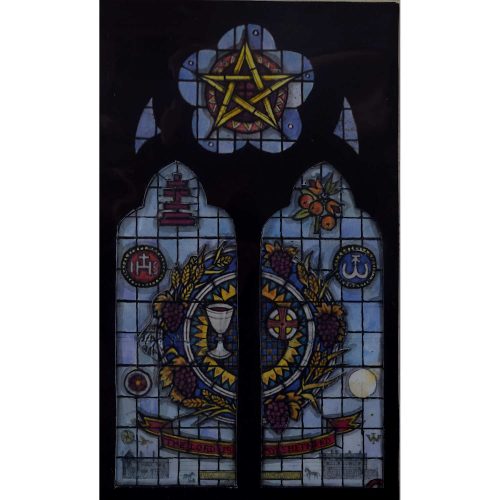
Jane Gray (b.1931)
St Barnabas Church, Franche, Kidderminster, Design for Stained Glass Window (1993)
Watercolour and Photographic Collage 21.5 x 13 cmSigned, dated and studio stamp verso.
St Barnabas Church, a red brick church designed by Martin & Chamberlain, was established in Franche in 1871 as a chapel-of-ease to the Parish Church of Kidderminster, St Mary and All Saints. St Barnabas is known for its diverse collection of stained glass windows and, alongside Gray’s modern memorial window, features windows in the Arts and Crafts style, likely designed by Benjamin Warren.
Provenance: the artist’s studio sale. Condition: very good. If you are interested, please email info@manningfineart.co.uk or call us on 07929 749056. For other works by Jane Gray and more information about her, please click here. -
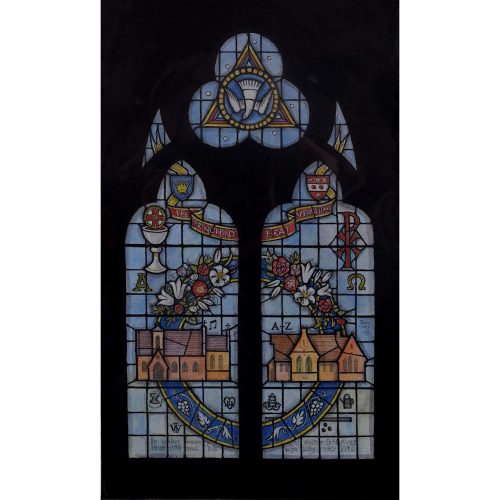
Jane Gray (b.1931)
St Barnabas Church, Franche, Kidderminster, Design for Stained Glass Window (1985)
Watercolour 23 x 14 cmSigned, dated and studio stamp verso.
St Barnabas Church, a red brick church designed by Martin & Chamberlain, was established in Franche in 1871 as a chapel-of-ease to the Parish Church of Kidderminster, St Mary and All Saints. St Barnabas is known for its diverse collection of stained glass windows and, alongside Gray’s modern memorial window, features windows in the Arts and Crafts style, likely designed by Benjamin Warren. Designed in 1985, this window was installed in the church in 1987.
Provenance: the artist’s studio sale. Literature: Jane Gray, Playing with Rainbows. (Shropshire: Ellingham Press, 2011), p.78. Condition: very good. If you are interested, please email info@manningfineart.co.uk or call us on 07929 749056. For other works by Jane Gray and more information about her, please click here. -

A E Lemmon St Barnabus
Cartoon for stained glass window 111 x 33 cm Albert Edward Lemmon (1889-1963) was a British artist and craftsman renowned for his contributions to stained glass and ecclesiastical art in the Midlands. Between 1903 and 1909, Lemmon trained at the Birmingham School of Art, before becoming an assistant to A. J. Davies in 1911 in the stained glass studio at the Bromsgrove Guild, a prominent collective of artists and designers. In 1927, Lemmon established his own studio, where he would go on to design over sixty stained glass windows, countless 'leaded lights' and a wide variety of ecclesiastical and decorative items until his death in 1963. Further details about the life and work of A E Lemmon are available in 'A E Lemmon (1889-1963), Artist and Craftsman' by Roy Albutt. As part of the stained glass making process, artists produce a full-sized drawing of their window design, showing the exact size and shape of all the pieces of glass, their colour and the sizes of the lead. This depiction of St Barnabus was produced for a stained glass window to be hung in Birmingham Children's Hospital. The window itself was later destroyed in the Second World War, leaving this cartoon as a unique, one-of-a-kind historical vestige. Condition: Generally very good, has some marks where commensurate with the production processes of stained glass, small loss approx 1cm x 1cm below the S of Barnabus.If you would like to know more, please email info@manningfineart.co.uk or call us on 07929 749056.
-
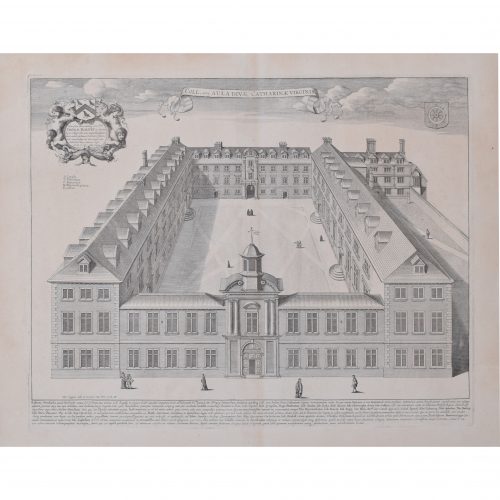
David Loggan (1634 - 1692)
St Catharine's College, Cambridge (1690)
Engraving 35 x 46 cm Loggan was born to English and Scottish parents, and was baptised in Danzig in 1634. After studying engraving in Danzig with Willem Hondius (1598-1652 or 1658), he moved to London in the late 1650s, going on to produce the engraved title-page for the folio 1662 Book of Common Prayer. He married in 1663 and moved to Nuffield in Oxfordshire in 1665. Loggan was appointed Public Sculptor to the nearby University of Oxford in the late 1660s, having been commissioned to produce bird’s-eye views of all the Oxford colleges. He lived in Holywell Street as he did this. The 'Oxonia Illustrata' was published in 1675, with the help of Robert White (1645 - 1704). Following its completion, Loggan began work on his equivalent work for Cambridge; the 'Cantabrigia Illustrata' was finally published in 1690, when he was made engraver to Cambridge University. The 'Oxonia Illustrata' also includes an engraving of Winchester College (Winchester and New College share William of Wykeham as their founder) whilst the 'Cantabrigia Illustrata' includes one of Eton College (which shares its founder, Henry VIII, with King’s College). Bird’s-eye views from this era required a particular talent as an architectural perspectivist; it was not until 1783 that it became possible for artists to ascend via hot air balloons and view the scenes they were depicting from above. Loggan thus had to rely on his imagination in conceiving the views. Loggan’s views constitute the first accurate depictions of the two Universities, in many ways unchanged today. Whilst the Oxford engravings were produced in reasonable numbers and ran to a second edition by Henry Overton (on thicker paper and with a plate number in Roman numerals in the bottom right-hand corner), those of Cambridge were printed in much smaller numbers. The Dutchman Pieter van der Aa published some miniature versions of the engravings for James Beverell’s guidebook to the UK, 'Les Delices de la Grande Bretagne' (circa 1708). The contemporary artist Andrew Ingamells has produced a highly-acclaimed series of etchings which bring Loggan’s original vision up to date. Condition: has previously been washed, otherwise generally very good. If you’d like to know more, please email info@manningfineart.co.uk or call us on 07929 749056. -

Pieter van der Aa (1659 - 1733), after David Loggan (1634 - 1692)
St Catharine's College, Cambridge (1727)
Engraving 13 x 17 cm An eighteenth-century view of St Catharine's College, Cambridge, engraved by Pieter van der Aa after David Loggan, the noted engraver, draughtsman, and painter. Pieter van der Aa of Leiden was a Dutch publisher best known for preparing maps and atlases, though he also printed editions of foreign bestsellers and illustrated volumes. He is noted for the many engravings he produced after David Loggan's series of Oxford and Cambridge colleges and costumes. In 1727 Van Der Aa illustrated "Les Delices de la Grande Bretagne & de L'Irelande" by James Beeverell, the book in which this engraving appears. Condition: very good. If you are interested, please email info@manningfineart.co.uk or call us on 07929 749056. Click here for other views of St Catharine's College, Cambridge -
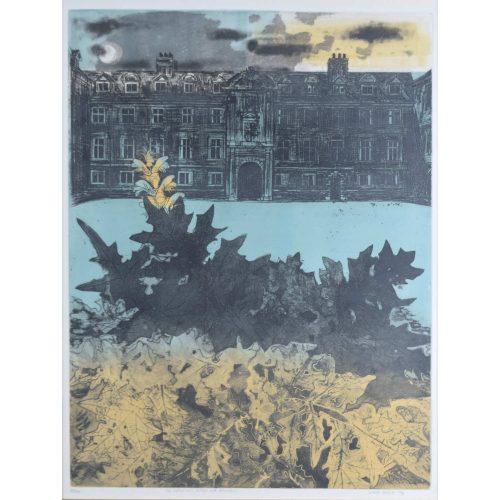
Walter Hoyle (1922-2000)
St Catharine's College, Cambridge (1973)
Linocut 72 x 56 cm Signed and dated '73 lower right, numbered 85 / 200 lower left, and signed below. Hoyle trained at Beckenham School of Art and the Royal College of Art. At the RA, he was strongly influenced by Edward Bawden, one of Britain’s greatest linocut printers. Bawden had been commissioned by the 1951 Festival of Britain to produce a mural for the South Bank, and chose Hoyle, a promising student, as his assistant. Hoyle moved to Great Bardfield in Essex and became part of the Great Bardfield group of artists: diverse in style, they created figurative work in stark contrast to the abstract art of the St Ives artists at the other end of the country. Hoyle taught at St Martin’s School of Art from 1951 - 1960, the Central School of Arts and Crafts from 1960 - 1964, and the Cambridge School of Art from 1964 - 1985, during which time he launched Cambridge Print Editions. His work is held in the collections of the Tate Gallery, the Victoria and Albert Museum, The British Museum, Kettle’s Yard, and the Fry Art Gallery. Condition: very good. If you are interested, please email info@manningfineart.co.uk or call us on 07929 749056. -
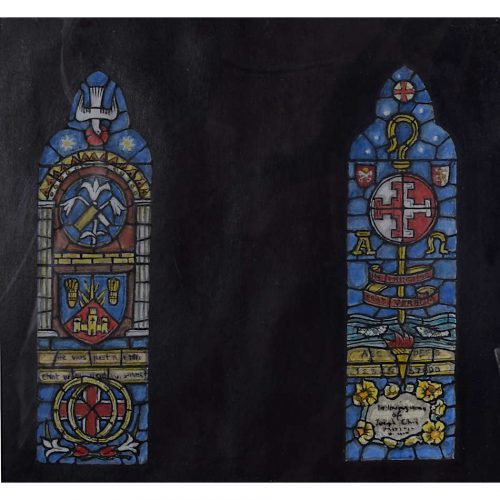
Jane Gray (b.1931)
St Catherine’s Church, Penrith, Cumbria, Design for Stained Glass Memorial Windows (1992)
Watercolour 16.5 x 15 cmSigned, dated and studio stamp verso.
St Catherine’s Church, Penrith is a Puginian Gothic town church, built by Fr George Haydock of Cottam and other Catholic notables in the early 19th century in the 14th century Gothic style. The church and its substantial presbytery, built in 1853, adjoin the churchyard of the Anglican parish church. This window was installed in 1992.
Provenance: the artist’s studio sale. Literature: Jane Gray, Playing with Rainbows. (Shropshire: Ellingham Press, 2011), p.82. Condition: very good. If you are interested, please email info@manningfineart.co.uk or call us on 07929 749056. For other works by Jane Gray and more information about her, please click here. -
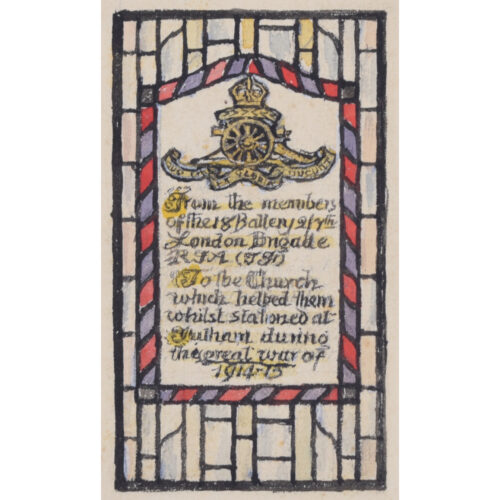
Reginald Hallward (1858 - 1948)
Stained glass window design for St Etheldreda's, Fulham
Pencil and gouache 12 x 7 cm With pencil annotations by the artist. Hallward's design for a stained glass window thanking St Etheldreda's Church for its support of soldiers stationed in Fulham during the First World War. Reginald Hallward was born on the Isle of Wight, and was a painter, poet, glassmaker and book designer. He is best known for his stained glass window designs and the tempera murals he painted in several churches. A great exponent of the English Arts and Crafts movement, he often used black paint for outlines, rather than leaded glass. A consumate craftsman, he insisted on painting, firing and leading with his own hands. Condition: generally very good. If you are interested, please email info@manningfineart.co.uk or call us on 07929 749056. Click here for other pictures by Reginald Hallward. -
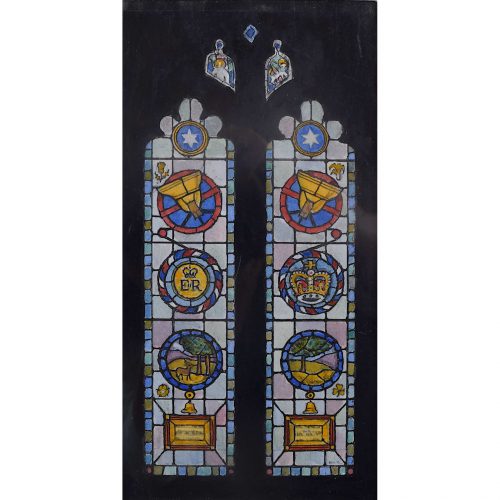
Jane Gray (b.1931)
St Giles Church, Bradford on Tone, Taunton, Somerset, Design for Stained Glass Window (2011)
Watercolour 21.5 x 11.5 cm Signed, dated and studio stamp verso.St Giles Church in Bradford on Tone lies nestled between the Blackdown and Quantock Hills and dates back from the 13th century. One of the lords of the manor, Sir John de Merit (d.1391), founded a chantry chapel here in 1387 but the church has undergone a series of renovations since. The present south aisle and most of the windows date to the 15th century, and the west tower to the early 16th century, before the church underwent full restoration works in 1867.
Provenance: the artist’s studio sale. Condition: very good. If you are interested, please email info@manningfineart.co.uk or call us on 07929 749056. For other works by Jane Gray and more information about her, please click here. -
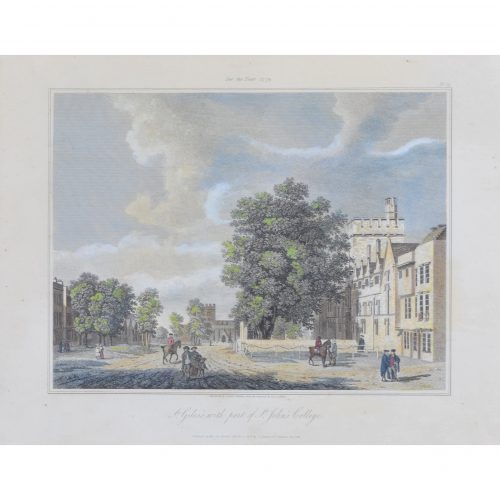
Joseph Constantine Stadler (1755 - 1828) after Michael Angelo Rooker (1743/6 - 1801)
St Giles's with a part of St John's College (1813)
Engraving with later hand-colouring 25 x 32 cm An engraving of St Giles, including the famous St Giles Church, with the front of St John's to the right. Joseph Constantine Stadler was a prolific German émigré engraver of images after his contemporaries. Stadler's engravings are wide-ranging in subject matter and include landscapes, seascapes and portraits, as well as military, sporting and decorative subjects. Stadler was employed by the leading print publisher of the time, John Boydell. Stadler lived in Knightsbridge when he died at the age of 73. Michael Angelo Rooker ARA was an English oil and watercolour painter of architecture and landscapes, illustrator, and engraver. Condition: good. Some gentle age toning. If you are interested, please email info@manningfineart.co.uk or call us on 07929 749056. Click here for other views of St John’s College, Oxford. -
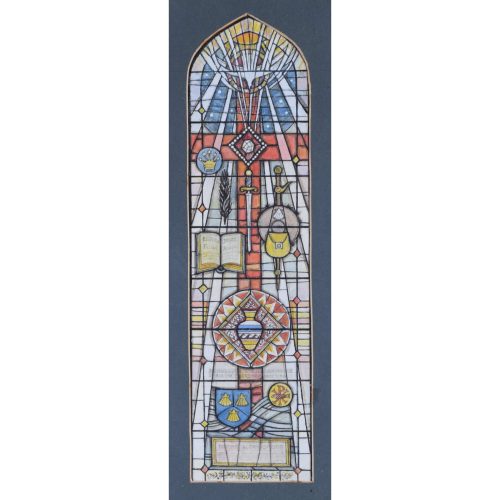
Jane Gray (b.1931)
St James, Temple Sowerby, Cumbria, Design for Stained Glass Window (1978)
Watercolour 30 x 12 cm Signed and dated verso.St James’ Church in Temple Sowerby, Cumbria was built in 1754, and enlarged in 1770, the west tower being added in 1807. In his 1831 work, A Topographical Dictionary of England, Samuel Lewis described the church as ‘a handsome structure of red freestone, with a square tower and portico’.
Provenance: the artist’s studio sale. Condition: very good. If you are interested, please email info@manningfineart.co.uk or call us on 07929 749056. For other works by Jane Gray and more information about her, please click here. -
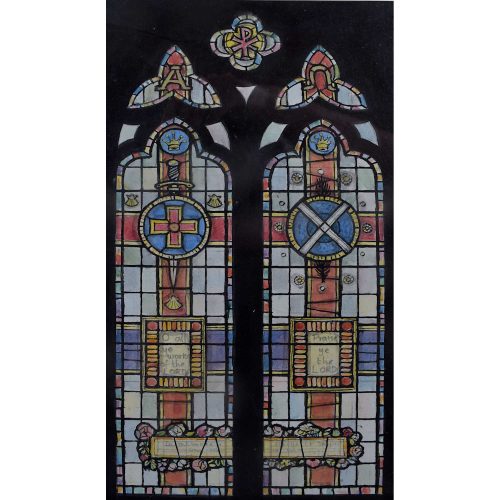
Jane Gray (b.1931)
St James’ Church, Weddington, Nuneaton, Warwickshire, Design for Stained Glass Memorial Window (1989)
Watercolour 19 x 10.5 cm Signed, dated and studio stamp verso.St James’ Church in Weddington dates back to the early-14th-century. The chancel, nave, and west tower were rebuilt in red brick in 1733, and the building was restored in 1881, when Gothic windows were inserted in place of the 1733 details. This design fantastically demonstrates Gray’s modernist style, with her colourful palette and simple yet detailed, geometrical structure. This window was installed in 1990.
Provenance: the artist’s studio sale. Literature: Jane Gray, Playing with Rainbows. (Shropshire: Ellingham Press, 2011), p.80. Condition: very good. If you are interested, please email info@manningfineart.co.uk or call us on 07929 749056. For other works by Jane Gray and more information about her, please click here. -
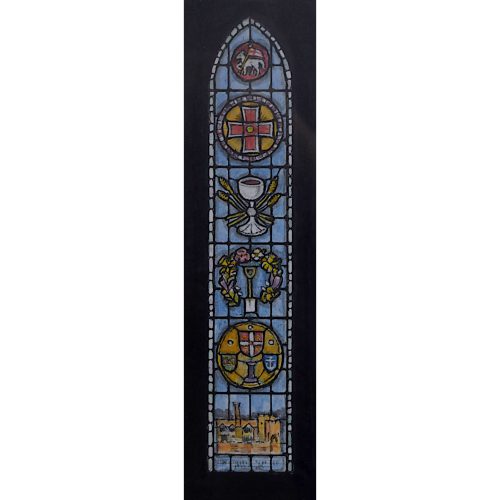
Jane Gray (b.1931)
St John the Baptist Church, Preen Manor, Design for Stained Glass Window (2003)
Watercolour 17.5 x 5 cmSigned, dated and studio stamp verso.
St John the Baptist Church sits at the heart of the Shropshire hamlet, Preen. Church Preen Manor sits adjacent to the church and lies on an old Clunjac Monastery, thought to have been built in 1159. The present church was built in the 13th century although it was originally a monastic church, founded as a cell of Wenlock Priory in 1163 and features in the Domesday Book. A prior and two or three monks would have served the church, however the priory has little remains, excepting a few visible in the gardens of Church Preen Manor.
Provenance: the artist’s studio sale. Literature: Jane Gray, Playing with Rainbows. (Shropshire: Ellingham Press, 2011), p.88. Condition: very good. If you are interested, please email info@manningfineart.co.uk or call us on 07929 749056. For other works by Jane Gray and more information about her, please click here. -
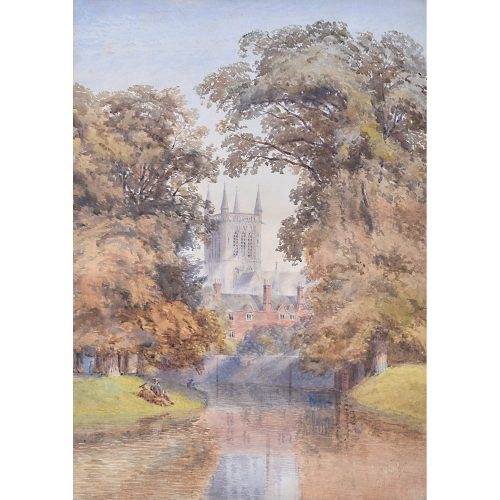
Anonymous (British, c. 1900) St John's College Cambridge from the River, Scholars Before
39x28cm Watercolour Scholars loll on the bank of the River Cam as they do today, and presumably have done ever since the foundation of the college in 1511. A dreamy view of one of the prettiest views in Cambridge. Condition: generally very good, slight staining to very margins, outside mount area. -

Andrew Ingamells St John's College, Cambridge
Engraving 75 x 51 cm Signed to lower right and numbered 1/175 Provenance: The late Sir Christopher Dobson, Master of the college This meticulously detailed gravure etching by Andrew Ingamells is the first etching or engraving to depict St John's College Cambridge from an aerial perspective since David Loggan's celebrated engraving of the 1680s. As well as a general aerial view of the college, it also features architectural thumbnails of each of the college's notable buildings including the Bridge of Sighs, New Court, the Library and Corfield Court. Ingamells trained at St Albans School of Art and the London College of Printing, subsequently working as a graphic designer and illustrator. Based in London, he began making drawings of the buildings and landscapes of London. Ingamells’ work is in many public collections including those of the Tate Gallery, The National Trust, The Paul Mellon Centre for British Art, and the City of London Guildhall Library. His pictures are also in several private collections, including those of various Oxford and Cambridge colleges, HRH King Charles III, and Shell Oil. The artist is currently part-way through his epic project to record all the colleges of Oxford and Cambridge, a project undertaken in homage to David Loggan. Condition: Generally very good, frame not available for shipping outside the UK.If you would like to know more, please email info@manningfineart.co.uk or call us on 07929 749056.
For other views of St John's college, Cambridge, please click here. -

Michael Angelo Rooker (1746–1801) St John's College, Oxford
Watercolour 25 x 40 cm Depicting a lovely view over the gardens of St John's College, Oxford, this watercolour may have been produced for the 1783 edition of the Oxford Almanack. This almanack ran between 1674 and 2019 and traditionally included engravings and information about Oxford University. Michael Angelo Rooker (1746–1801) was an English painter, engraver, and illustrator, best known for his topographical landscapes and architectural scenes. His works often depicted picturesque views of British towns, universities, and ruins, executed with meticulous detail and atmospheric effects. He was particularly well-regarded for his ability to blend topographical accuracy with artistic beauty, making his works valuable both as historical records and as fine art. This watercolour exemplifies beautifully his fine attention to detail, atmosphere and architectural perspective, as he expertly depicts the façade of the college, while also capturing the long shadows cast by the trees on this seemingly warm summer's day. Condition: Generally very good.If you would like to know more, please email info@manningfineart.co.uk or call us on 07929 749056.
-

M Gerling
St John's College, Cambridge
Pen and ink 15 x 26 cm Titled, dated June 1885, and signed lower right, all in ink. Condition: generally very good; painted on card; slightly toned. If you are interested, please email info@manningfineart.co.uk or call us on 07929 749056. Click here for other views of St John’s College, Cambridge. -

Pieter van der Aa (1659 - 1733), after David Loggan (1634 - 1692)
St John's College, Cambridge (1727)
Engraving 13 x 17 cm An eighteenth-century view of St John's College, Cambridge, engraved by Pieter van der Aa after David Loggan, the noted engraver, draughtsman, and painter. Pieter van der Aa of Leiden was a Dutch publisher best known for preparing maps and atlases, though he also printed editions of foreign bestsellers and illustrated volumes. He is noted for the many engravings he produced after David Loggan's series of Oxford and Cambridge colleges and costumes. In 1727 Van Der Aa illustrated "Les Delices de la Grande Bretagne & de L'Irelande" by James Beeverell, the book in which this engraving appears. Condition: very good. If you are interested, please email info@manningfineart.co.uk or call us on 07929 749056. Click here for other views of St John's College, Cambridge -

Pieter van der Aa (1659 - 1733), after David Loggan (1634 - 1692)
St John's College, Cambridge (1727)
Engraving 13 x 17 cm An eighteenth-century view of St John's College, Cambridge, engraved by Pieter van der Aa after David Loggan, the noted engraver, draughtsman, and painter. Pieter van der Aa of Leiden was a Dutch publisher best known for preparing maps and atlases, though he also printed editions of foreign bestsellers and illustrated volumes. He is noted for the many engravings he produced after David Loggan's series of Oxford and Cambridge colleges and costumes. In 1727 Van Der Aa illustrated "Les Delices de la Grande Bretagne & de L'Irelande" by James Beeverell, the book in which this engraving appears. Condition: very good. If you are interested, please email info@manningfineart.co.uk or call us on 07929 749056. Click here for other views of St John's College, Cambridge -

Richard Bankes Harraden (1778 - 1862)
St John's College, Cambridge (Great Gate)
Engraving 19 x 25 cm A nineteenth-century view of the Great Gate at St John's College Cambridge. Richard Bankes Harraden was a printmaker, painter, and drawing master. He was active in Cambridge, producing many views of the colleges, and subsequently several Oxford colleges. Harraden was an early and exhibiting member of the Society of British Artists in London, which was established in 1823, and remained a member until 1849. He specialised in depictions of landscape, topography and architecture, and was the son of Richard Harraden (1756 - 1838) with whom he published plates as 'Harraden & Son'. Condition: Generally very good, slight age toning to paper, in Victorian rosewood frame. If you are interested, please email info@manningfineart.co.uk or call us on 07929 749056. Click here for other views of Magdalene College, Cambridge. -
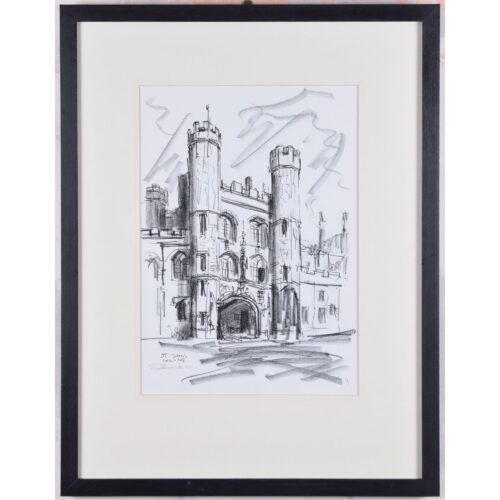
Tony Broderick (late 20th century)
St John's College, Cambridge Great Gate
Conte 38 x 27 cm Signed and dated in pencil lower left. A Lincoln-based artist known for his pictures of Lincoln and also of Cambridge's colleges. Condition: very good. If you are interested, please email info@manningfineart.co.uk or call us on 07929 749056. Click here for other views of St John’s College, Cambridge. -
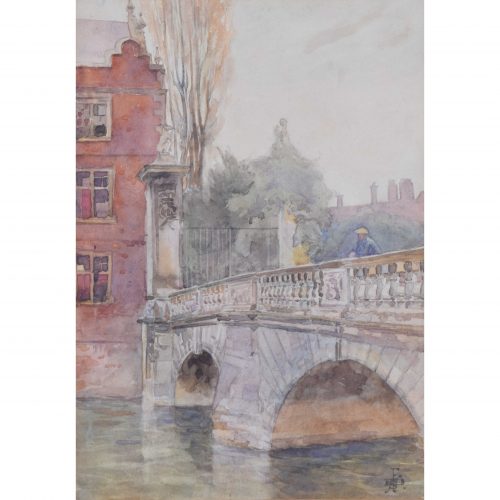
The Wren Bridge, St John's College, Cambridge
Engraving 35 x 24 cm Signed as a cypher lower right. A 1911 watercolour of St John's College's Wren Bridge, also known as the Kitchen Bridge. There had been a wooden bridge in this location since the early days of the medieval Hospital of St John the Evangelist. Christopher Wren had submitted designs to St John’s for a stone bridge in the 1690s, but building work did not commence until 1709. The Wren Bridge was completed in 1713. Its construction was overseen by Robert Grumbold, a local master stonemason and architect who was also responsible for building the Wren Library at Trinity College. The bridge reflects Wren's design, although in his original drawings he had suggested urns and pyramids, which were never added. In this view, a lone figure gazes down from the bridge into the muddy waters of the River Cam. Condition: very good. If you’d like to know more, please email info@manningfineart.co.uk or call us on 07929 749056. -
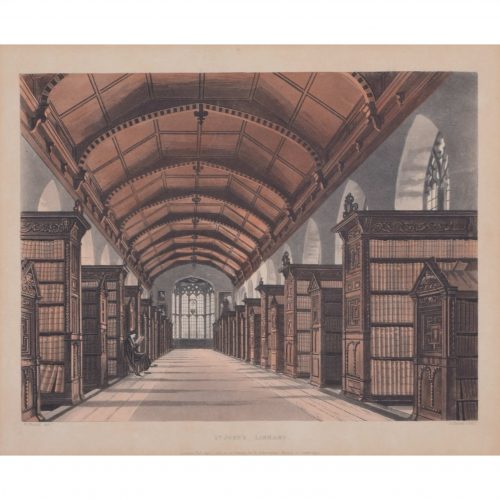
D Havell (1785 - 1822) after William Westall (1781 - 1850)
The Library of St John's College, Cambridge (1815)
Hand-coloured aquatint 24 x 29.5 cm Published by Rudolph Ackermann (1764 - 1834). An engraving of St John's College, Cambridge's marvellous library. It was built between 1623 and 1628, largely through the donations and efforts of two members of the college: Valentine Carey, Bishop of Exeter, and John Williams, Lord-Keeper and Bishop of Lincoln. The building's shell was completed in 1624, a date which appears on the south gable of the western oriel window. The building is constructed in the Jacobean Gothic style, and measures 110 feet by 30 feet wide. The tall two-light windows are a very early example of Gothic Revival, but the façade is Renaissance-inspired. The library contains 42 bookcases arranged at right angles to the north and south walls, and is the home of the College's double-manual harpsichord. William Westall was a British landscape artist. He was born in Hertford and enrolled at the Royal Academy schools in 1799. He later became the draughtsman for a voyage to Australia and the South Seas. After being shipwrecked, he travelled to Canton in China and to India, staying in Bombay for several months. He returned to England in 1805 but later set off for Madeira and Jamaica. He became a member of the Society of Painters in Water Colours (1811) and an associate of the Academy (1812). Following a mental breakdown, he regularly visited the Lake District and published ‘Views of the Valley and Vale of Keswick’ (1820). His series of aquatints of the Thames, the great universities, and England''s public schools for Ackermann are among his most popular works. The Havell family of Reading, Berkshire, England, included a number of notable engravers, etchers and painters, as well as writers, publishers, educators, and musicians. Daniel and Robert Havell set up in partnership as aquatint engravers. Soon Daniel began to work independently, engraving plates for Rudolph Ackermann''s History of Cambridge (1815) and hid history of various public schools including Eton, Winchester, and Rugby (1816), as well as a celebrated views of St Paul''s Cathedral (1818) and various other London landmarks for Ackermann''s Repository of Arts. Rudolph Ackermann was an Anglo-German bookseller, inventor, lithographer, publisher and businessman. In 1795 he established a print-shop and drawing-school at 96 Strand. Here Ackermann set up a lithographic press and began a trade in prints. He later began to manufacture colours and thick carton paper for landscape and miniature painters. Within three years the premises had become too small and he moved to 101 Strand, in his own words "four doors nearer to Somerset House", the seat of the Royal Academy of Arts. Between 1797 and 1800 Ackermann rapidly developed his print and book publishing business, encompassing many different genres including topography, caricature, portraits, transparencies and decorative prints. Condition: good. Some age toning. If you’d like to know more, please email info@manningfineart.co.uk or call us on 07929 749056. -
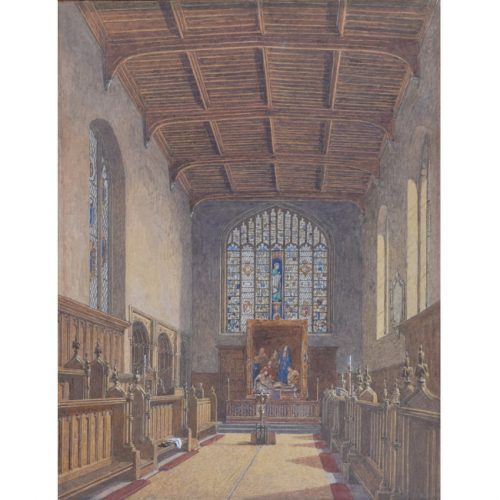
George Pyne (1800 - 1884)
St John's College, Cambridge Old Chapel
Watercolour 35 x 23 cm A view of the Old Chapel of St John’s College, Cambridge before its demolition. In 1861, the Fellows of St John’s agreed to mark the seven hundredth jubilee of their college by building a new chapel. Sir George Gilbert Scott was appointed to carry out the work, and Dr James Wood (a previous Master of the college) bequeathed the huge sum of £20,000 for the purpose of the new chapel. George Pyne was related to two founders of the Society of Painters in Watercolours – William Henry Pyne was his father, and John Varley his father-in-law. Pyne trained as an architectural draughtsman and lived in Oxford from the 1850s until his death in 1884, specialising in views of the city and its colleges. His Oxford pictures are both architecturally-minded and romantically creative, often combining intensely detailed depictions of college buildings with imagined pedestrian scenes. Pyne was also noted for his views of Cambridge and Eton, and for his drawing manuals ‘A Rudimentary and Practical Treatise on Perspective for Beginners’ (1848) and ‘Practical Rules on Drawing for the Operative Builder, and Young Student in Architecture’ (1854); the latter texts offer an insight into his method of depicting architecture and its surroundings. Condition: very good. If you are interested, please email info@manningfineart.co.uk or call us on 07929 749056. Click here for other views of St John's College, Cambridge.