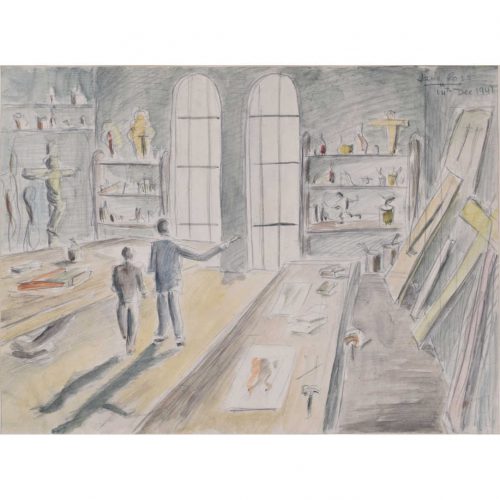
• Jane Gray (b.1931)

    The Artist's Studio (1947)

      Watercolour 38 x 27.5 cm

    Signed (Jane Ross) and dated top right corner. Prize labels verso.

    This rare, early watercolour interior of an artist’s studio by Gray, then Ross, was submitted to the Royal Drawing Society’s Exhibition Competition when Gray was only sixteen years old. Demonstrating fine draughtsmanship and a keen understanding of space, light and form, it is no surprise that the picture received a First Class Commendation.

    Provenance: the artist’s studio sale. Condition: very good. If you are interested, please email info@manningfineart.co.uk or call us on 07929 749056. For other works by Jane Gray and more information about her, please click here.    
  • Hugo Wetli (1916 - 1972)

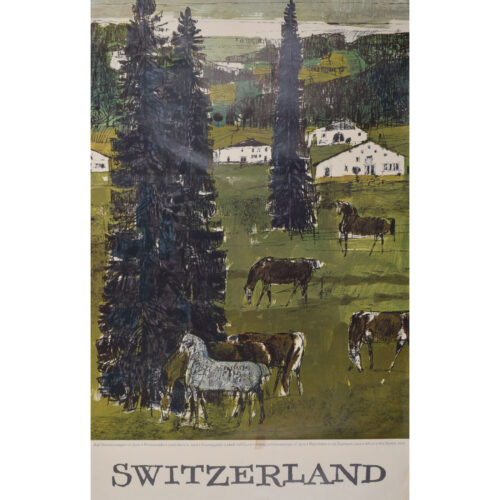
    Switzerland - Afoot in the Swiss Jura

    Original vintage poster 100 x 64 cm Hugo Wetli trained as a technical draughtsman and then became apprenticed to a private graphic studio. He worked in Geneva and Berne as a painter and draughtsman, also producing book illustrations and travel poster designs. In 1947 he studied at the Académie de la Grande Chaumière in Paris and then ran his own graphic design studio. Condition: generally very good; old tape stain under 'Paseo' approx 2 cm sq and extending almost invisibly into image; a few pin holes to corners; a little soft creasing. If you are interested, please email info@manningfineart.co.uk or call us on 07929 749056. Click here for other original vintage travel posters.
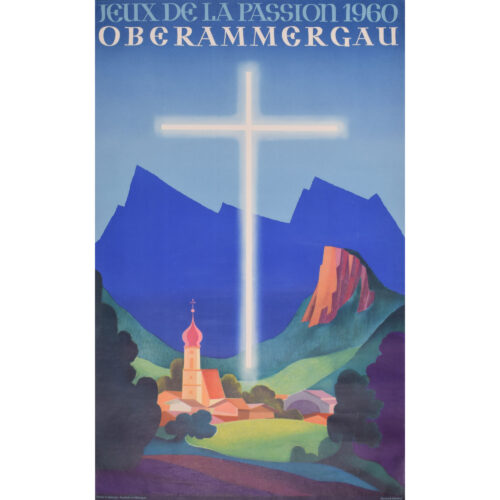
  • Jeux de la Passion Oberammergau (1960)

        Original vintage poster 100 x 63 cm Printed in Germany. This magnificent poster advertises the Passion Play (an outdoor play telling the Easter story) held every ten years in Oberammergau in the Bavarian Alps. Tradition tells that the town was struck with plague in 1633; the townsfolk vowed that they would perform a Passion Play every ten years as a symbol of thanks to God if the plague would end, which it did. At the turn of the twentieth century, improved railways across Europe meant that people from outside the Alps could travel to see the Passion Play in Oberammergau. This poster was designed for publication in France, to encourage the French to come to see the play. Condition: generally very good; a few tiny repaired edge tears. Not backed. If you are interested, please email info@manningfineart.co.uk or call us on 07929 749056. Click here for more original vintage posters.
  • Ken Messer (1931 - 2018)

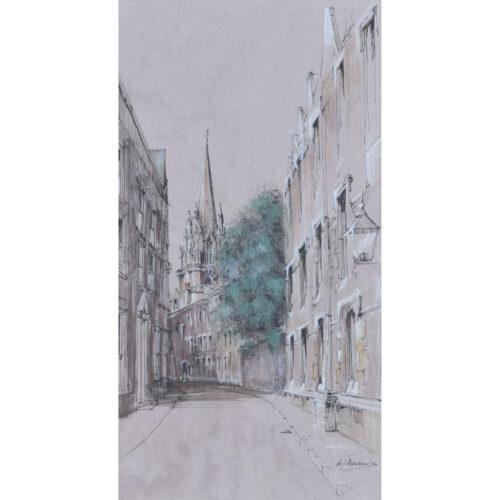
    Oriel Street (1974)

      Watercolour 39 x 21 cm Signed and dated lower right. The painter and draughtsman Ken Messer is closely related to Oxford and its architecture in several ways. Born in Newport, South Wales, he was educated at the City of Oxford High School for Boys in Oxford, and then spent six years working as an accountant in Oxford. He then joined British Overseas Airways Corporation (BOAC) as a steward, flying internationally. Injury due to a car accident during the 1960s meant that he joined the design department of Pergamon Press in Oxford at the age of 33. Six years later, he was appointed to the position of studio manager, in charge of art and design. In 1974, Messer left Pergamon Press to become a freelance graphic designer. He started painting more watercolours, becoming a full-time artist. During the 1980s, his ink drawings were regularly published in the Oxford Times. He has sometimes been called "The Oxford Artist" because of his large number of works depicting Oxford. He and his wife Dilys lived at first in Richmond upon Thames and then in Abingdon, just south of Oxford. Messer's work has been shown at the Mall Galleries for the annual exhibitions of the Royal Institute of Painters in Water Colours annual exhibitions. Condition: very good. If you are interested, please email info@manningfineart.co.uk or call us on 07929 749056. Click here for other views of Oxford.
  • Ken Messer (1931 - 2018)

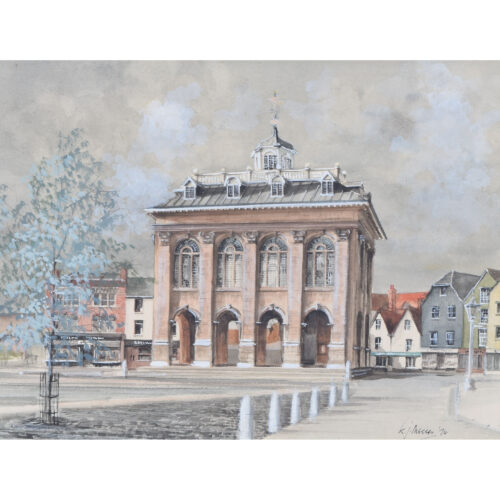
    The County Hall, Abingdon (1974)

      Watercolour 24 x 32 cm Signed and dated lower right. The painter and draughtsman Ken Messer is closely related to Oxford and its architecture in several ways. Born in Newport, South Wales, he was educated at the City of Oxford High School for Boys in Oxford, and then spent six years working as an accountant in Oxford. He then joined British Overseas Airways Corporation (BOAC) as a steward, flying internationally. Injury due to a car accident during the 1960s meant that he joined the design department of Pergamon Press in Oxford at the age of 33. Six years later, he was appointed to the position of studio manager, in charge of art and design. In 1974, Messer left Pergamon Press to become a freelance graphic designer. He started painting more watercolours, becoming a full-time artist. During the 1980s, his ink drawings were regularly published in the Oxford Times. He has sometimes been called "The Oxford Artist" because of his large number of works depicting Oxford. He and his wife Dilys lived at first in Richmond upon Thames and then in Abingdon, just south of Oxford. Messer's work has been shown at the Mall Galleries for the annual exhibitions of the Royal Institute of Painters in Water Colours annual exhibitions. Condition: very good. If you are interested, please email info@manningfineart.co.uk or call us on 07929 749056.
  • Cyril Kenneth Bird ‘Fougasse’ (1887 - 1965)

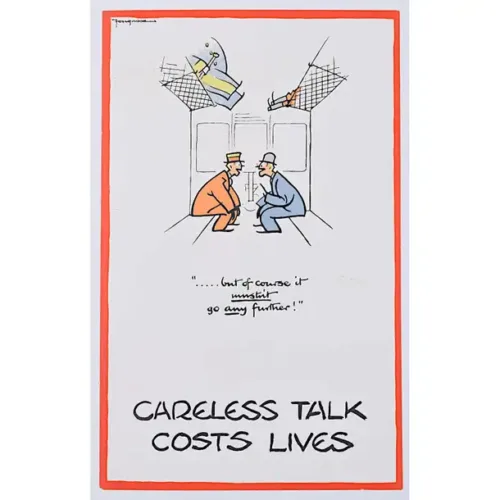
    Careless Talk Costs Lives (circa 1940)

      Lithographic poster 32 x 20 cm (12.5 x 8 in) Version printed on thicker paper. "But of course it mustn't go any further" - in the luggage compartments above two gossiping men, Mussolini and Hitler are hiding. Fougasse reminds us that we ought not to discuss secrets which could be of use to them. Fougasse was a British cartoonist. He was art editor of Punch between 1937 and 1949, and subsequently editor until 1953. He is best known for his ‘Careless Talk Costs Lives’ series of posters, and the other posters for the Ministry of Information and London Transport. As the Second World War progressed, the Ministry of Information’s poster campaign had become less and less effective. There were posters instructing the population to save old clothes for rags, turn off the lights, save food, dig for victory, watch out for spies, and keep calm and carry on. With this instruction overload, the population had ceased paying attention to the posters. Fougasse noticed this, and offered his services unpaid to the Ministry of Information, with a view to bringing a touch of humour to the posters. His amusing designs with pithy captions, reminiscent of newspaper cartoons, helped to get the Ministry's messages across in a novel way.
    Fougasse's distinctive poster style, with the red border, was subsequently adopted by other Ministry artists.
    Condition: backed to linen; generally excellent. If you are interested, please email info@manningfineart.co.uk or call us on 07929 749056. Click here for other works by the artist.
  • Cyril Kenneth Bird ‘Fougasse’ (1887 - 1965)

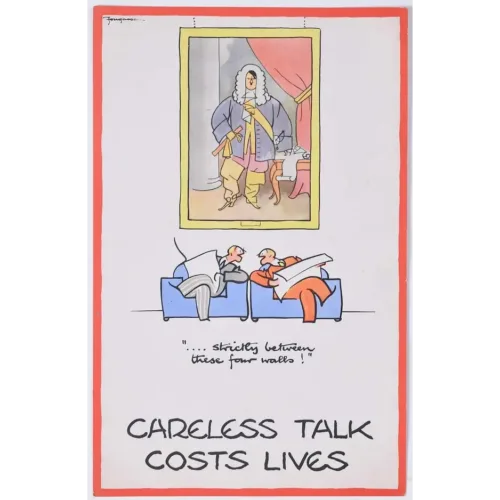
    Careless Talk Costs Lives (circa 1940)

      Lithographic poster 32 x 20 cm (12.5 x 8 in) "Strictly between these four walls" - here, in the painting hanging behind two gossiping men in gentleman's club, hide Mussolini and Hitler. Fougasse reminds us that we ought not to discuss secrets which could be of use to them. Fougasse was a British cartoonist. He was art editor of Punch between 1937 and 1949, and subsequently editor until 1953. He is best known for his ‘Careless Talk Costs Lives’ series of posters, and the other posters for the Ministry of Information and London Transport. As the Second World War progressed, the Ministry of Information’s poster campaign had become less and less effective. There were posters instructing the population to save old clothes for rags, turn off the lights, save food, dig for victory, watch out for spies, and keep calm and carry on. With this instruction overload, the population had ceased paying attention to the posters. Fougasse noticed this, and offered his services unpaid to the Ministry of Information, with a view to bringing a touch of humour to the posters. His amusing designs with pithy captions, reminiscent of newspaper cartoons, helped to get the Ministry's messages across in a novel way.
    Fougasse's distinctive poster style, with the red border, was subsequently adopted by other Ministry artists.
    Condition: good. If you are interested, please email info@manningfineart.co.uk or call us on 07929 749056. Click here for other works by the artist.
  • William Barnes (1916 - ?)

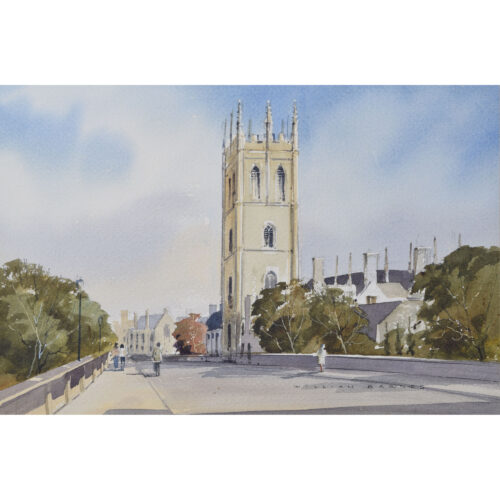
    Magdalen Tower and Bridge

      Watercolour 25 x 36 cm Signed lower right in ink. Magdalen Tower in all her glory, with pedestrians and a cyclist meandering over the bridge below. William Barnes was born in Brixton and trained at the Camberwell School of Art in the 1930s and the Wimbledon School of Art in the 1950s. Condition: good. If you are interested, please email info@manningfineart.co.uk or call us on 07929 749056. Click here for other views of Magdalen College, Oxford.
  • Richard Beer (1928 - 2017)

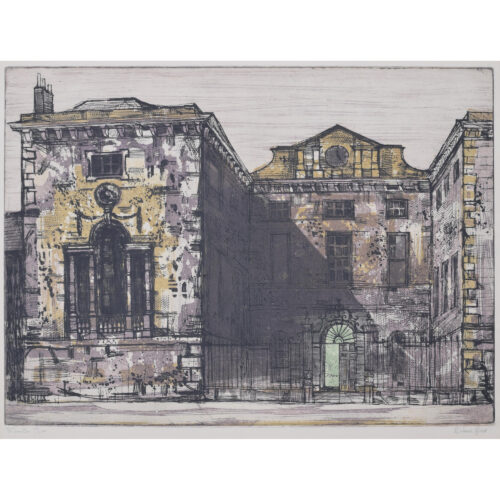
    Worcester College, Oxford

      Etching and aquatint 44 x 59 cm Titled and numbered 77/100 and signed lower right, all in pencil. The artist's view of Worcester College's facade, with the hall projecting on the left and the college chapel on the right. Beer's ability to capture the unique texture of Oxford's old stone is manifest. Born in London in 1928, just too late to serve in the Second World War, Richard Beer studied between 1945 - 1950 at the Slade School. Subsequently, a French Government scholarship allowed him to spend time in Paris at Atelier 17, working under Stanley William Hayter (1901 - 1988), one of the most significant print makers of the 20th Century – having spent the War in New York, advising as a camofleur, Hayter only returned to Paris in 1950. Subsequently Beer studied at the École des Beaux Arts, Paris. Working for John Cranko, choreographer for the Royal Ballet, Beer designed the sets and costumes for his The Lady and the Fool at Covent Garden, subsequently working for him following his move in 1961 to Stuttgart Ballet. Additionally he produced book illustrations and designed book jackets. Beer later taught print-making at the Chelsea School of Art, where he was a popular teacher. Probably his greatest work was a collaboration with John Betjeman to produce a portfolio of prints of ten Wren Churches in the City for Editions Alecto, copies of which are in The Government Art Collection. That collection contains a total of 54 prints by Beer, and the Tate Gallery’s collection holds seven. His Oxford series was also produced for Editions Alecto as was a series of predominantly architectural views in Southern Europe. Most of his prints are of architectural subjects. Condition: generally very good; slight age toning to paper and to margins. If you are interested, please email info@manningfineart.co.uk or call us on 07929 749056. Click here for other views of Worcester College.
  • Orlov, V and Denisenko За успехи в труде [Success Through Work] (1978) Moscow, Izdaltelstvo Plakat Original vintage posters 43 x 56 cm A poster collection comprising twelve leaves loosely inserted in a printed paper portfolio, one plate previously folded, a little light wear to some fore-edges, light wear to portfolio spine, else very good. First edition. A collection of popular Soviet motifs on the enduring theme of Success through Work, created to provide best-practice design templates for artworkers, artists and propaganda designers responsible for the illustration of official Soviet literature and art, mosaics, wall-paintings, and posters. Motifs include Lenin, the distinctive logos of various Soviet bodies including the Young Guard, and medallions commemorating events such as the October revolution. Numerous medal-designs for individual and collective excellence in all kinds of industry, including farming, mining, husbandry, and machine-working also appear. Designed for eminently practical use, with cut-out lines between the individual vignettes, these pattern books rarely survived intact.
  • Ronald Fielding Dodd (1890-1958)

    St Edmund Hall - 1928 Existing Buildings - Second Floor Plans

    Architectural Reproduction 46 x 77 cm Ronald Fielding Dodd ARIBA was a Scottish architect and Associate of the Royal Institute of British Architects. After serving as a Second Lieutenant in the British Army’s Machine Gun Corps during the First World War, Dodd was most active as an architect in the 1930s. Over the course of the decade, he contributed designs for St Peter’s College, Oxford; St Edmund Hall, Oxford; Stowe School; the Acland Hospital in North Oxford, where he added a Neo-Georgian frontage; and the 16th-century Chippinghurst Manor in Oxfordshire. To mark his architectural achievements, there is now a Fielding Dodd Prize for “Outstanding Work” involving architecture at Oxford Brookes University. These particular plans date from 1928 and map out detailed plans of existing buildings in St Edmund Hall, Oxford Condition: Very good, on linen-backed paper. For other views of St Edmund Hall, click here. 
  • Ronald Fielding Dodd (1890-1958)

    St Edmund Hall - 1928 Existing Buildings - Third Floor Plans

    Pen ink and hand colouring 46 x 77 cm Ronald Fielding Dodd ARIBA was a Scottish architect and Associate of the Royal Institute of British Architects. After serving as a Second Lieutenant in the British Army’s Machine Gun Corps during the First World War, Dodd was most active as an architect in the 1930s. Over the course of the decade, he contributed designs for St Peter’s College, Oxford; St Edmund Hall, Oxford; Stowe School; the Acland Hospital in North Oxford, where he added a Neo-Georgian frontage; and the 16th-century Chippinghurst Manor in Oxfordshire. To mark his architectural achievements, there is now a Fielding Dodd Prize for “Outstanding Work” involving architecture at Oxford Brookes University. These particular plans date from 1928 and map out detailed plans of existing buildings in St Edmund Hall, Oxford Condition: Very good, on linen-backed paper, loss to bottom right-hand corner For other views of St Edmund Hall, click here. 
  • Anonymous 79th Armoured Division, D-Day to the Rhine

    Lithograph c. 1945 20 x 62 cm This World War II pictorial map chronicles the 79th Armoured Division, a division of the British Army that was created in the lead-up to the Normandy invasion and commanded by Major General Percy Hobart (1885-1957). The map stretches along the coast of Western Europe, from Brest to Dusseldorf, extending north across the English Channel to show the southern coast of England. Various battles are loactaed with the badge of the division, including D-Day. The title cartouche includes information about some of the equipment used by the division, such as the so-called Crocodiles (a tank with a flamethrower), Kangaroos (an armoured personnel carrier with a self-propelled gun), and Buffaloes (a tracked amphibious landing vehicle). Beneath the cartouche are illustrations of British soldiers throughout history and a table at the bottom right indicates the strength of the division before crossing the Rhine. Other examples of this map were originally published in 'The Story of the 79th Division', a history of the unit published after the war.
  • C.C. Beall Don't be a dope and spread inside dope, loose talk can cost lives

    Lithograph 51 x 36 cm 'Closed for the duration...Loose talk can cost lives.' In both the United Kingdom and the United States, there was a constant fear of insider information being overheard by the enemy. As a result, there were several propaganda drives to encourage discretion among the citizens of the countries. This particular poster belongs to an American collection centring around the slogan 'loose talk can cost lives.' Depicting two men conversing over a couple of pints of beer with Hitler hanging over their heads. In this depiction, Hitler has an abnormally large ear, suggesting he hears all, highlighting the dangers of loose talk. C.C. Beall (1892-1970) was an American commercial illustrator and portrait painter. He specialised in watercolour and drawings for magazines and comic books. Too old to be conscripted, Beall contributed to the war effort through his poster designs, in particular for war loan drives. For other propaganda posters, click here. 
  • George Bissill (1896-1973) English rural scene

    Watercolour 18 x 28 cm Born in 1896, George Bissill was a British miner, painter and furniture designer. Raised in the mining village of Langley Mill, Derbyshire, Bissill became a miner at the age of 13, before leaving to join the war effort in 1915. Upon his return from the war after being gassed, Bissill chose to become a pavement artist outside the newly erected Bush House in Aldwych, painting from his memory and his sketch book the uncompromising underground world he had inhabited. In 1935 he moved to the countryside near Newbury, where he lived and worked as a landscape painter, art restorer and dealer until his death in 1973. This painting forms part of a larger collection, 'unseen since they were taken from George Bissil's studio in 1983' and restored by Kate Pattinson. A series of planned exhibitions were cancelled due to Covid, but two shows, one in Oxford and one in Ilkeston, did take place. Through such exhibitions, Pattinson hoped to 'restore the reputation of an artist who, through mighty endeavour, conquered the art world in the 1920s with his powerful, authentic and experimental pictures.' Bissill's paintings are also held in a number of important public collections, including the Tate Gallery, National Museum of Ireland and the Manchester Art Gallery. This watercolour depicts an English rural landscape. Fields with small stablesoccupy the foreground of the painting, while the red roofs of the village are discernible in the background. This watercolour also intriguingly includes a seemingly preparatory sketch of the village church, suspended mid-air and providing a valuable insight into Bissill's working process. Condition: Generally very good.

    If you would like to know more, please email info@manningfineart.co.uk or call us on 07929 749056.
  • German Aircraft Original vintage poster

    Lithograph 57 x 45 cm This original vintage poster, published in 1941, depicts a series of German aircraft, including the fighter plane Heinkel HE 113, the bomber plane Junkers JU 89 and the sea plane Arado Ar 196. Each plane is depicted from three different angles, illustrating their unique features and insignia. During the Second World War, the Ministry of Information produced a number of posters detailing the differences between British and German aircraft. They were designed to help British civilians and military personnel identify enemy aircraft, distinguishing them from Allied planes. Condition: Generally very good, tape stain to right hand corner, will be covered by mount.

    If you would like to know more, please email info@manningfineart.co.uk or call us on 07929 749056.
  • Robyn Denny (1930-2014) Portrait Series (5)

    Screenprint 80 x 58 cm Signed to the bottom right and blind stamped Numbered 23/30 ​‘No painting should reveal all it has to say as a kind of instant impact. Abstract painting, that is painting that is not about subject matter, if it is any good should be as diverse, and complex, and strange and unaccountable and unnameable as an experience, as any painting of any consequence has been in the past. ‘ - Robyn Denny, ISIS art journal interview, 1964 Denny, a prominent British abstract artist, was known for his minimalist and geometric style. In Portraits Series A, he employed vibrant colours and structured forms, reflecting his interest in the visual language of urban environments and modernity. These works exemplify his approach during the early 1970s, a period when he was gaining significant recognition, culminating in a solo retrospective at the Tate Gallery in 1973. Denny led an illustrious career over more than 50 years. Born in Surrey, England, he studied at the Royal College of Art, where he became a leading figure in the rise of postwar abstraction in Britain. Emerging in the 1950s and 60s, Denny’s work moved away from traditional painterly gestures, embracing a sleek, modern aesthetic influenced by urban environments, advertising, and contemporary architecture. His paintings often featured large-scale, hard-edged forms, creating a dynamic interplay between structure and depth. He was also deeply involved in printmaking, producing influential series like Portraits Series A (1973). Denny gained international recognition, representing Britain at the Venice Biennale in 1966, and his work was celebrated in a major retrospective at Tate Gallery in 1973. Over the decades, his art evolved, but he remained committed to exploring the relationship between form, color, and movement. Today, his work is held in prestigious collections, including Tate Britain and the Victoria & Albert Museum, securing his legacy as one of the most important British abstract painters of his time. Who knows... you might have even seen his public art work of coloured lines in Embankment tube station. Condition: Generally very good, tiny edge tear to left hand side.

    If you would like to know more, please email info@manningfineart.co.uk or call us on 07929 749056.
  • Robyn Denny (1930-2014) Portrait Series (1)

    Screenprint 80 x 58 cm Signed to the bottom right and blind stamped Numbered 23/30 ​‘No painting should reveal all it has to say as a kind of instant impact. Abstract painting, that is painting that is not about subject matter, if it is any good should be as diverse, and complex, and strange and unaccountable and unnameable as an experience, as any painting of any consequence has been in the past. ‘ - Robyn Denny, ISIS art journal interview, 1964 Denny, a prominent British abstract artist, was known for his minimalist and geometric style. In Portraits Series A, he employed vibrant colours and structured forms, reflecting his interest in the visual language of urban environments and modernity. These works exemplify his approach during the early 1970s, a period when he was gaining significant recognition, culminating in a solo retrospective at the Tate Gallery in 1973. Denny led an illustrious career over more than 50 years. Born in Surrey, England, he studied at the Royal College of Art, where he became a leading figure in the rise of postwar abstraction in Britain. Emerging in the 1950s and 60s, Denny’s work moved away from traditional painterly gestures, embracing a sleek, modern aesthetic influenced by urban environments, advertising, and contemporary architecture. His paintings often featured large-scale, hard-edged forms, creating a dynamic interplay between structure and depth. He was also deeply involved in printmaking, producing influential series like Portraits Series A (1973). Denny gained international recognition, representing Britain at the Venice Biennale in 1966, and his work was celebrated in a major retrospective at Tate Gallery in 1973. Over the decades, his art evolved, but he remained committed to exploring the relationship between form, colour, and movement. Today, his work is held in prestigious collections, including Tate Britain and the Victoria & Albert Museum, securing his legacy as one of the most important British abstract painters of his time. Who knows... you might have even seen his public art work of coloured lines in Embankment tube station. Condition: Generally very good.

    If you would like to know more, please email info@manningfineart.co.uk or call us on 07929 749056.
  • Robyn Denny (1930-2014) Portrait Series (3)

    Screenprint 80 x 58 cm Signed to the bottom right and blind stamped Numbered 27/30 ​‘No painting should reveal all it has to say as a kind of instant impact. Abstract painting, that is painting that is not about subject matter, if it is any good should be as diverse, and complex, and strange and unaccountable and unnameable as an experience, as any painting of any consequence has been in the past. ‘ - Robyn Denny, ISIS art journal interview, 1964 Denny, a prominent British abstract artist, was known for his minimalist and geometric style. In Portraits Series A, he employed vibrant colours and structured forms, reflecting his interest in the visual language of urban environments and modernity. These works exemplify his approach during the early 1970s, a period when he was gaining significant recognition, culminating in a solo retrospective at the Tate Gallery in 1973. Denny led an illustrious career over more than 50 years. Born in Surrey, England, he studied at the Royal College of Art, where he became a leading figure in the rise of postwar abstraction in Britain. Emerging in the 1950s and 60s, Denny’s work moved away from traditional painterly gestures, embracing a sleek, modern aesthetic influenced by urban environments, advertising, and contemporary architecture. His paintings often featured large-scale, hard-edged forms, creating a dynamic interplay between structure and depth. He was also deeply involved in printmaking, producing influential series like Portraits Series A (1973). Denny gained international recognition, representing Britain at the Venice Biennale in 1966, and his work was celebrated in a major retrospective at Tate Gallery in 1973. Over the decades, his art evolved, but he remained committed to exploring the relationship between form, colour, and movement. Today, his work is held in prestigious collections, including Tate Britain and the Victoria & Albert Museum, securing his legacy as one of the most important British abstract painters of his time. Who knows... you might have even seen his public art work of coloured lines in Embankment tube station. Condition: Generally very good.

    If you would like to know more, please email info@manningfineart.co.uk or call us on 07929 749056.
  • Robyn Denny (1930-2014) Portrait Series (4)

    Screenprint 80 x 58 cm Signed to the bottom right and blind stamped Numbered 27/30 ​‘No painting should reveal all it has to say as a kind of instant impact. Abstract painting, that is painting that is not about subject matter, if it is any good should be as diverse, and complex, and strange and unaccountable and unnameable as an experience, as any painting of any consequence has been in the past. ‘ - Robyn Denny, ISIS art journal interview, 1964 Denny, a prominent British abstract artist, was known for his minimalist and geometric style. In Portraits Series A, he employed vibrant colours and structured forms, reflecting his interest in the visual language of urban environments and modernity. These works exemplify his approach during the early 1970s, a period when he was gaining significant recognition, culminating in a solo retrospective at the Tate Gallery in 1973. Denny led an illustrious career over more than 50 years. Born in Surrey, England, he studied at the Royal College of Art, where he became a leading figure in the rise of postwar abstraction in Britain. Emerging in the 1950s and 60s, Denny’s work moved away from traditional painterly gestures, embracing a sleek, modern aesthetic influenced by urban environments, advertising, and contemporary architecture. His paintings often featured large-scale, hard-edged forms, creating a dynamic interplay between structure and depth. He was also deeply involved in printmaking, producing influential series like Portraits Series A (1973). Denny gained international recognition, representing Britain at the Venice Biennale in 1966, and his work was celebrated in a major retrospective at Tate Gallery in 1973. Over the decades, his art evolved, but he remained committed to exploring the relationship between form, colour, and movement. Today, his work is held in prestigious collections, including Tate Britain and the Victoria & Albert Museum, securing his legacy as one of the most important British abstract painters of his time. Who knows... you might have even seen his public art work of coloured lines in Embankment tube station. Condition: Generally very good.

    If you would like to know more, please email info@manningfineart.co.uk or call us on 07929 749056.
  • Robyn Denny (1930-2014) Portrait Series (2)

    Screenprint 80 x 58 cm Signed to the bottom right and blind stamped Numbered 23/30 ​‘No painting should reveal all it has to say as a kind of instant impact. Abstract painting, that is painting that is not about subject matter, if it is any good should be as diverse, and complex, and strange and unaccountable and unnameable as an experience, as any painting of any consequence has been in the past. ‘ - Robyn Denny, ISIS art journal interview, 1964 Denny, a prominent British abstract artist, was known for his minimalist and geometric style. In Portraits Series A, he employed vibrant colours and structured forms, reflecting his interest in the visual language of urban environments and modernity. These works exemplify his approach during the early 1970s, a period when he was gaining significant recognition, culminating in a solo retrospective at the Tate Gallery in 1973. Denny led an illustrious career over more than 50 years. Born in Surrey, England, he studied at the Royal College of Art, where he became a leading figure in the rise of postwar abstraction in Britain. Emerging in the 1950s and 60s, Denny’s work moved away from traditional painterly gestures, embracing a sleek, modern aesthetic influenced by urban environments, advertising, and contemporary architecture. His paintings often featured large-scale, hard-edged forms, creating a dynamic interplay between structure and depth. He was also deeply involved in printmaking, producing influential series like Portraits Series A (1973). Denny gained international recognition, representing Britain at the Venice Biennale in 1966, and his work was celebrated in a major retrospective at Tate Gallery in 1973. Over the decades, his art evolved, but he remained committed to exploring the relationship between form, colour, and movement. Today, his work is held in prestigious collections, including Tate Britain and the Victoria & Albert Museum, securing his legacy as one of the most important British abstract painters of his time. Who knows... you might have even seen his public art work of coloured lines in Embankment tube station. Condition: Generally very good.

    If you would like to know more, please email info@manningfineart.co.uk or call us on 07929 749056.
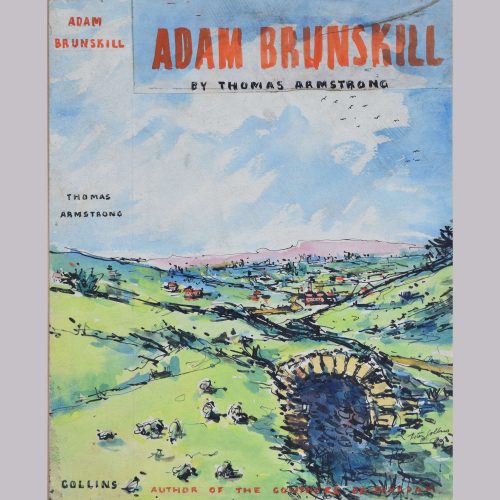
  • Peter Collins ARCA (1923-2001) Adam Brunskill Book Jacket Design

    for Collins publishers (no relation) Watercolour and collage 22x17cm Provenance: The Artist's Studio Sale Signed lower right Peter Collins Typical Collins, with his bright colours and captivating scene, very reminiscent of his travel posters. This was a proposal for the dust jacket, in the end a slightly different design by Collins was chosen for the first edition. A great one for the Adam Brunskill fans! Click here for other items by the artist and for biographical details. If you are interested email info@manningfineart.co.uk or call us on 07929 749056.
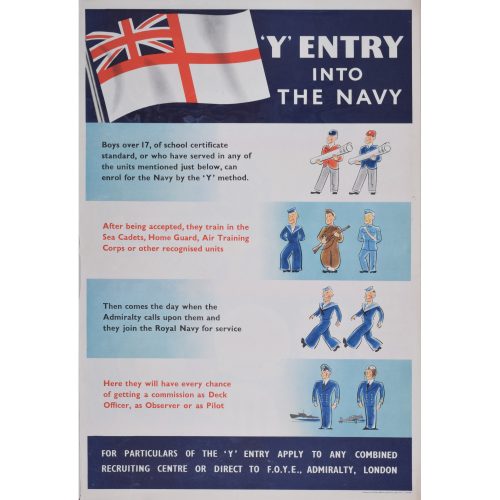
  • Y Entry to the Navy

    Original Lithographic Poster 76x51cm If you are interested, email info@manningfineart.co.uk or call us on 07929 749056.  
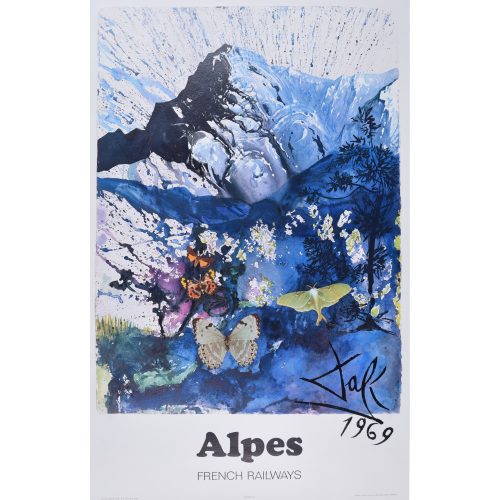
  • Salvador Dali (1904-1989) Alpes French Railways - The Alps

    Original Poster for French Railways SNCF 40x25" (100x67cm) Printed by Draeger Printed in France for and by the French National Railways, 1970 Signed and dated in the stone 1969 Condition: very good, slight age toning/handling wear to very edges as usual
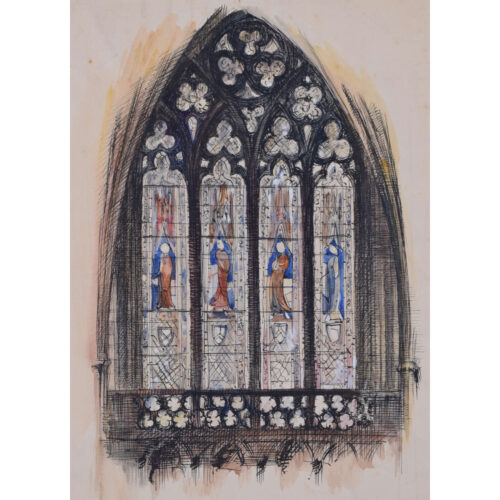
  • Louis Osman FRIBA (1914 - 1996)

    Stained glass window

      Watercolour 23 x 16 cm On Pioneer Fine laid paper. An intricately-detailed watercolour of a stained glass window, featuring four Biblical figures. Osman was as much an artist as an architect. This is likely a portfolio piece from his time studying at the Bartlett School of Architecture, and is as such a piece of architectural history as well as a beautiful Osman design. Osman was awarded a First Class degree and the Donaldson Medal of the RIBA (for the best result in his year group) by the Bartlett, and then went on to the Slade School of Art. He subsequently trained with Sir Albert Richardson - we also have several Richardson works in our collection. After the war, Osman busied himself as an architect. His work included contributions to Westminster Abbey, and Lincoln, Exeter, Ely, and Lichfield Cathedrals, Staunton Harold Church in Ashby de la Zouch for the National Trust, and of course his folly: the Grade I listed Elizabethan manor house, Canons Ashby in Northamptonshire, now a National Trust property. At Canons Ashby he established a workshop and had a team of silversmiths and goldsmiths working for him. In 1976 he made the gold enamelled coffin that holds the copy of the Magna Carta on view in the United States Capitol, Washington, DC. Condition: generally very good. If you’d like to know more, please email info@manningfineart.co.uk or call us on 07929 749056.
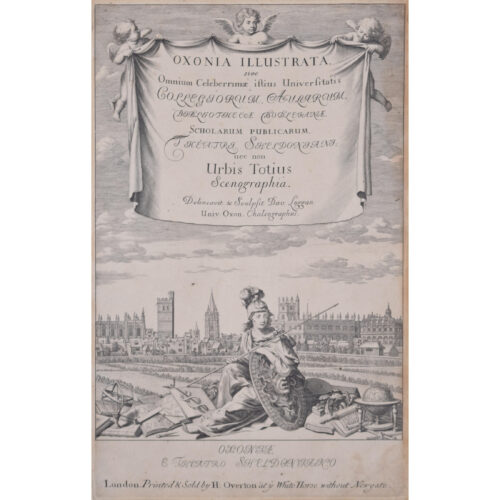
  • David Loggan (1634 - 1692)

    Frontispiece to the Oxonia Illustrata (1675)

      Engraving 38 x 24 cm The intricately engraved frontispiece to Loggan's 'Oxonia Illustrata', featuring cherubs bearing the volume's title on a banner and Minerva, goddess of wisdom, sitting before a panorama of Oxford's resplendent architecture. David Loggan's view of Oxford's medieval Divinity School, which was once the beating heart of theological studies at the University. Of particular interest here is the trompe l'oeil scroll of torn paper which frames the view. Loggan was born to English and Scottish parents, and was baptised in Danzig in 1634. After studying engraving in Danzig with Willem Hondius (1598-1652 or 1658), he moved to London in the late 1650s, going on to produce the engraved title-page for the folio 1662 Book of Common Prayer. He married in 1663 and moved to Nuffield in Oxfordshire in 1665. Loggan was appointed Public Sculptor to the nearby University of Oxford in the late 1660s, having been commissioned to produce bird’s-eye views of all the Oxford colleges. He lived in Holywell Street as he did this. The 'Oxonia Illustrata' was published in 1675, with the help of Robert White (1645-1704). Following its completion, Loggan began work on his equivalent work for Cambridge; the 'Cantabrigia Illustrata' was finally published in 1690, when he was made engraver to Cambridge University. The 'Oxonia Illustrata' also includes an engraving of Winchester College (Winchester and New College share William of Wykeham as their founder) whilst the 'Cantabrigia Illustrata' includes one of Eton College (which shares its founder, Henry VIII, with King’s College). Bird’s-eye views from this era required a particular talent as an architectural perspectivist; it was not until 1783 that it became possible for artists to ascend via hot air balloons and view the scenes they were depicting from above. Loggan thus had to rely on his imagination in conceiving the views. Loggan’s views constitute the first accurate depictions of the two Universities, in many ways unchanged today. Whilst the Oxford engravings were produced in reasonable numbers and ran to a second edition by Henry Overton (on thicker paper and with a plate number in Roman numerals in the bottom right-hand corner), those of Cambridge were printed in much smaller numbers. The Dutchman Pieter van der Aa published some miniature versions of the engravings for James Beverell’s guidebook to the UK, 'Les Delices de la Grande Bretagne' (circa 1708). The contemporary artist Andrew Ingamells (born 1956) has produced a highly-acclaimed series of etchings which bring Loggan’s original vision up to date. Condition: trimmed within platemark and mounted to board, otherwise in very good condition. If you are interested, please email info@manningfineart.co.uk or call us on 07929 749056. Click here for other general views of Oxford.
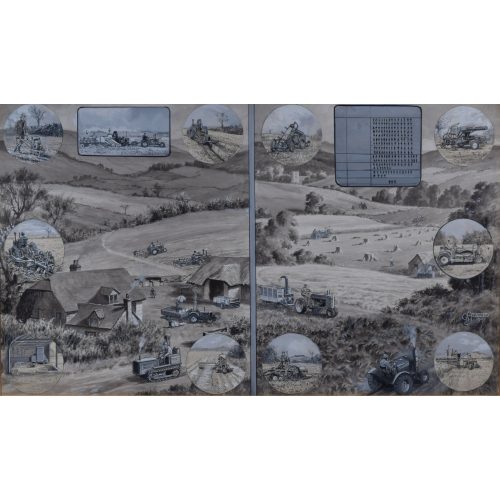
  • George Horace Davis (1888-1963) Design for publication probably in The Illustrated London News

    Tractors and mechanisation Signed and dated 1947 Gouache, monochrome 17.25x29.75" Here the reduction in manpower as a result of the mechanisation of agriculture is celebrated in a typical work by Davis. A "special artist" for 'The Illustrated London News', he worked for it for forty years, the scope and detail of his work being without peer in the rest of the staff. Tractors are pictured in every possible role in agriculture; however the great advances made in the sixty years since then could not have been forseen. Born in Kensington, London, Davis was educated at Kensington Park College and then at Ealing School of Art, working subsequently as a freelance artist until the First World War intervened. He served with the Royal Flying Corps (subsequently the Royal Air Force) with distinction, and had a number of his paintings of aerial combat published in 'The Sphere.' In 1923 he commenced work with The Illustrated London News, for which he worked for the next forty years. His first drawing related to the use, in small boats, of wireless and was the first of many similar diagrammatic drawings designed to educate and inform readers of advances in science, warfare, technology or transport. Needless to say his attention to detail meant architectural drawings were another strength of his, drawings of 10 Downing Street and Westminster Abbey, for instance - and also architectural phantasies such as a proposed heliport at Charing Cross Station. During his career at The Illustrated London News he is estimated to have produced illustrations covering some 2,500 pages of the publication; each one requiring an informed understanding arising from careful research. He continued to work for it until his eighties and at the time of his death there was a supply of finished but as-yet-unpublished works. The sale at Christies in London of the archive of The Illustrated London News on 7 October 2014 included many works by Davis - a price of £16,875 being obtained for a series of seven drawings by him.
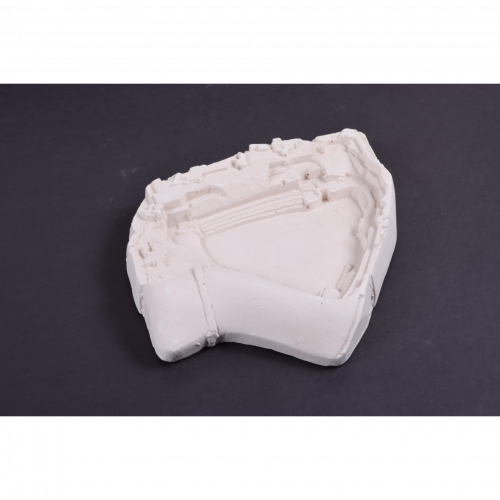
  • Sir Eduardo Paolozzi CBE RA (1924-2005)

    Amphitheatre

    Plaster 27 x 22 x 4 cm (max)   Paolozzi’s fascination with anatomy, machine parts, and the idiom of classical statuary is evident in his modernist sculptural forms. Amphitheatre blends neoclassicism with 20th-century brutalism, betraying a fascination with the materiality of public architecture.  Sir Eduardo Luigi Paolozzi CBE RA was a Scottish artist, known for his sculpture and graphic works. He is widely considered to be one of the pioneers of pop art. Paolozzi studied at the Edinburgh College of Art in 1943, briefly at Saint Martin's School of Art in 1944, and then at the Slade School of Fine Art at University College London from 1944 to 1947, after which he worked in Paris. While in Paris from 1947 to 1949, Paolozzi became acquainted with Alberto Giacometti, Jean Arp, Constantin Brâncuși, Georges Braque and Fernand Léger. This period became an important influence for his later work. For example, the influence of Giacometti and many of the original Surrealists he met in Paris can be felt in the group of lost-wax sculptures made by Paolozzi in the mid-1950s. Their surfaces, studded with found objects and machine parts, were to gain him recognition. He taught sculpture and ceramics at several institutions, including the Hochschule für bildende Künste Hamburg (1960–62), University of California, Berkeley (in 1968) and at the Royal College of Art. Paolozzi had a long association with Germany, having worked in Berlin from 1974 as part of the Berlin Artist Programme of the German Academic Exchange Programme. He was a professor at the Fachhochschule in Cologne from 1977 to 1981, and later taught sculpture at the Akademie der Bildenden Künste in Munich. Paolozzi was fond of Munich and many of his works and concept plans were developed in a studio he kept there, including the mosaics of the Tottenham Court Road Station in London. He took a stab at industrial design in the 1970s with a 500-piece run of the upscale Suomi tableware by Timo Sarpaneva that Paolozzi decorated for the German Rosenthal porcelain maker's Studio Linie. Condition: Generally very good, occasional inclusions etc., as expected. If you'd ike to know more, please email info@manningfineart.co.uk or call us on 07929 749056.
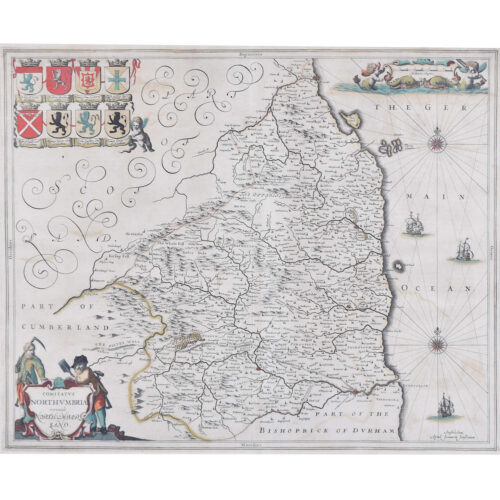
  • Joannem Janssonium (1588 - 1664)

    Map of Northumberland (1646)

      Engraving 41 x 50 cm The 1646 Latin edition. A decorative map of Northumberland by the noted Dutch mapmaker and publisher Joannem Janssonium. Condition: very good; later hand coloured. If you are interested, please email info@manningfineart.co.uk or call us on 07929 749056. Click here for other maps.
  • G F Nicholls Early 20th century view of Oxford Gouache 36 x 28 cm Signed to lower left George Frederick Nicholls (1857–1939) was a British painter renowned for his topographical artworks, particularly those depicting the landscapes of Cornwall, the Cotswolds, and Oxford. His works are characterised by strong technique and his ability to capture light and typically depict picturesque views over rural England. His art continues to be appreciated today for its detailed representation of early 20th-century British landscapes. Nicholls painted this gouache of All Souls College from Oxford high street in the early 20th century. It captures the bustle of everyday city life, with a car trundling down the street, people crossing the road and engaging in some light window shopping. Condition: Generally very good

    If you would like to know more, please email info@manningfineart.co.uk or call us on 07929 749056.
    For other views of All Souls College, click here. 
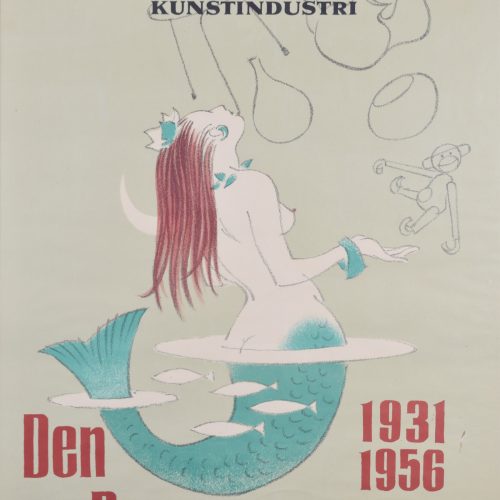
  • Arne Ungermann (1902-1981)

    'Den Permanente', "The Permanente Exhibition" (1956)

    Lithographic poster 84 x 61 cm The Danish artist Arne Ungermann designed this poster in 1956 to celebrate the 25th anniversary of Den Permanente in Copenhagen. Den Permanente, or the Permanent Exhibition, celebrated Danish art, craft, and design, and operated between the 1930s and 1980s. The Danish silversmith Kay Bojesen came up with the idea for the exhibition, which also served as a shop where customers could buy Danish art and crafts. Bojesen's idea became a reality when Christian Grauballe, director of the iconic Danish design company Holmegaard, invested in it in 1931. Den Permanente became an icon of Danish 20th century design, selling furniture, glassware, lighting, ceramics, jewellery, and textiles. Bojesen is most famous for his wooden monkey design, which Ungermann features in his poster. The motif of the mermaid emerging from the sea could be a motif drawn from Hans Christian Andersen, but made modern - she breaks the surface of the ocean in order to marvel at the treasure trove of man-made objects exhibited at Den Permanente. The notable Little Mermaid statue on Copenhagen's promenade, installed in 1913, is also inspired by Andersen's fairy tale. If you'd like to know more, please email info@manningfineart.co.uk or call us on 07929 749056. Condition: Excellent.
  • David Loggan (1634-1692)

    Christ's College, Cambridge 

    Engraving 40 x 46 cm Loggan was born to English and Scottish parents, and was baptised in Danzig in 1634. After studying engraving in Danzig with Willem Hondius (1598-1652 or 1658), he moved to London in the late 1650s, going on to produce the engraved title-page for the folio 1662 Book of Common Prayer. He married in 1663 and moved to Nuffield in Oxfordshire in 1665. Loggan was appointed Public Sculptor to the nearby University of Oxford in the late 1660s, having been commissioned to produce bird’s-eye views of all the Oxford colleges. He lived in Holywell Street as he did this. The 'Oxonia Illustrata' was published in 1675, with the help of Robert White (1645-1704). Following its completion, Loggan began work on his equivalent work for Cambridge; the 'Cantabrigia Illustrata' was finally published in 1690, when he was made engraver to Cambridge University. The 'Oxonia Illustrata' also includes an engraving of Winchester College (Winchester and New College share William of Wykeham as their founder) whilst the 'Cantabrigia Illustrata' includes one of Eton College (which shares its founder, Henry VIII, with King’s College). Bird’s-eye views from this era required a particular talent as an architectural perspectivist; it was not until 1783 that it became possible for artists to ascend via hot air balloons and view the scenes they were depicting from above. Loggan thus had to rely on his imagination in conceiving the views. Loggan’s views constitute the first accurate depictions of the two Universities, in many ways unchanged today. Whilst the Oxford engravings were produced in reasonable numbers and ran to a second edition by Henry Overton (on thicker paper and with a plate number in Roman numerals in the bottom right-hand corner), those of Cambridge were printed in much smaller numbers. The Dutchman Pieter van der Aa published some miniature versions of the engravings for James Beverell’s guidebook to the UK, 'Les Delices de la Grande Bretagne' (c. 1708). The contemporary artist Andrew Ingamells (b.1956) has produced a highly-acclaimed series of etchings which bring Loggan’s original vision up to date. This particular edition represents an aerial view of Christ's College Cambridge. It was re-engraved by Edinburgh printmakers workshop, published by Christ's College Cambridge in 1997, and features an EPW blindstamp. Condition: Generally very good. If you are interested, please email info@manningfineart.co.uk or call us on 07929 749056. For other views of Christ's College, Cambridge. 
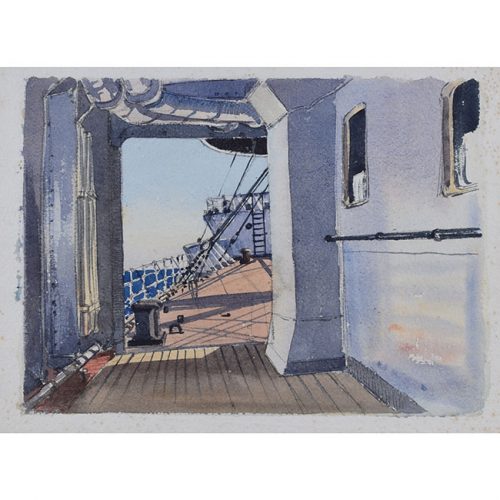
  • Claude Muncaster

    Port Alleyway, City of New York, August (1948)

    Pen and watercolour Signed 20x28cm Provenance: Martin Muncaster, the artist's son. Click here for biographical details and other works by the artist. If you are interested email info@manningfineart.co.uk or call us on 07929 749056.
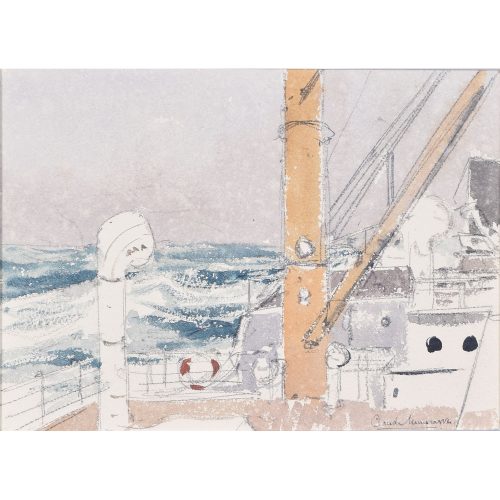
  • Claude Muncaster

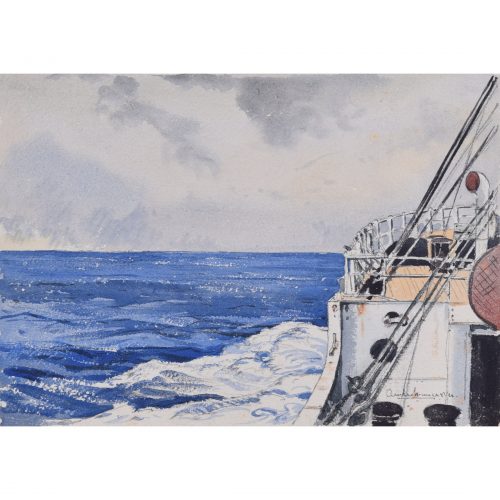
    Storm on City of Exeter, Ellerman Line (Passing through the Bay of Biscay), 1948

    Signed Watercolour and pencil 21x28cm Provenance: Martin Muncaster, the artist's son. Click here for biographical details and other works by the artist. If you are interested email info@manningfineart.co.uk or call us on 07929 749056.
  • Claude Muncaster

    The Bow Wash

    Pen and watercolour 21x28cm Framed Provenance: Martin Muncaster, the artist's son. Click here for biographical details and other works by the artist. If you are interested email info@manningfineart.co.ukor call us on 07929 749056.
  • Claude Muncaster (1903-1974) Near Mundesley, Norfolk

    Dated 1930 Signed Watercolour 22x28cm Muncaster's watercolours capture the English countryside feel with great competence Claude Grahame Muncaster, RWS, ROI, RBA, SMA was the son of Oliver Hall RA. At the age of fifteen his career as a landscape painter began, and he soon took to the seas, spending the 1920s and 30s travelling the world with his sketchbook in a series of vessels. With the outbreak of war and he joined the RNVR training as a navigator. Having left school at fifteen his mathematics was very weak and it was a relief for all when his artistic talents meant he was recruited as a camofleur. A master of capturing seascapes he was therefore able to hide huge ships ‘in plain sight’ with clever disguises. After the war he painted for the Royal Family and was a frequent guest at Sandringham. Claude Muncaster was a watercolourist known for his landscapes and maritime scenes. He was born Grahame Hall, the son of the Royal Academician Oliver Hall who taught his son to paint from an early age; Grahame first exhibited his work aged 15 and a few years later was showing at the RA. However, he adopted the name Claude Muncaster in 1922 to dissociate his career from that of his father. Muncaster’s primary choice of subject matter came from a genuine love of the sea. He made several long-distance sea voyages, including one around the Horn as a deckhand in the windjammer Olivebank in 1931, which he described in ‘Rolling Round the Horn’, published in 1933. Armed with a sketchbook, his aim was to be able to ‘paint ships and the sea with greater authority’. This he certainly achieved, perfectly capturing the limpid first light of morning over the Port of Aden, the choppy rain-grey waters of the Bay of Biscay and a streak of sunlight through gathering storm clouds at dusk in Exeter. He became an Associate of the Royal Watercolour Society in 1931 and was a founder member, and later President, of the Royal Society of Marine Artists. During the Second World War, Muncaster served in the Royal Naval Volunteer Reserve (RNVR) from 1940-44, training as a navigator before going on to advise on the camouflage of ships, and also worked as an official war artist. In ‘Still Morning at Aden’ (1944) he depicts Allied warships in this safe anchorage in the Middle East; the back is stamped with Admiralty approval. In 1946-7 he was commissioned by the Queen to produce watercolours of the royal residences at Windsor, Sandringham and Balmoral; the Duke of Edinburgh, in a foreword to a biography of Muncaster, recalls looking at these and considering the artist’s ‘unerring instinct for a subject’, his sense of atmosphere. Other commissions included large panoramas of the Thames and of Bradford. His career also included work as an etcher, illustrator, writer, lecturer and broadcaster, and his paintings can be found in the Royal Academy, Tate, National Maritime Museum Cornwall, National Railway Museum and Royal Air Force Museum. If you are interested email info@manningfineart.co.uk or call us on 07929 749056.
  • Claude Muncaster (1903-1974)

    English Landscape

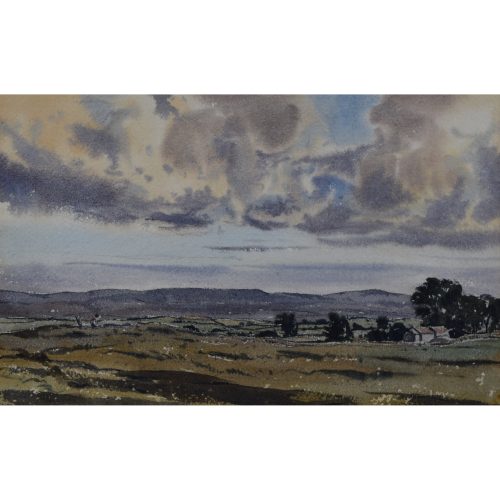
    Pen and watercolour 23x34cm A classic Claude Muncaster. Rolling clouds billow over an English landscape studded with windswept trees, drystone walls, and a farmhouse. Click here for biographical details and other works by the artist. If you'd like to know more, email info@manningfineart.co.uk or call us on 07929 749056.
  • Claude Muncaster (1903-1974) Factory Scene

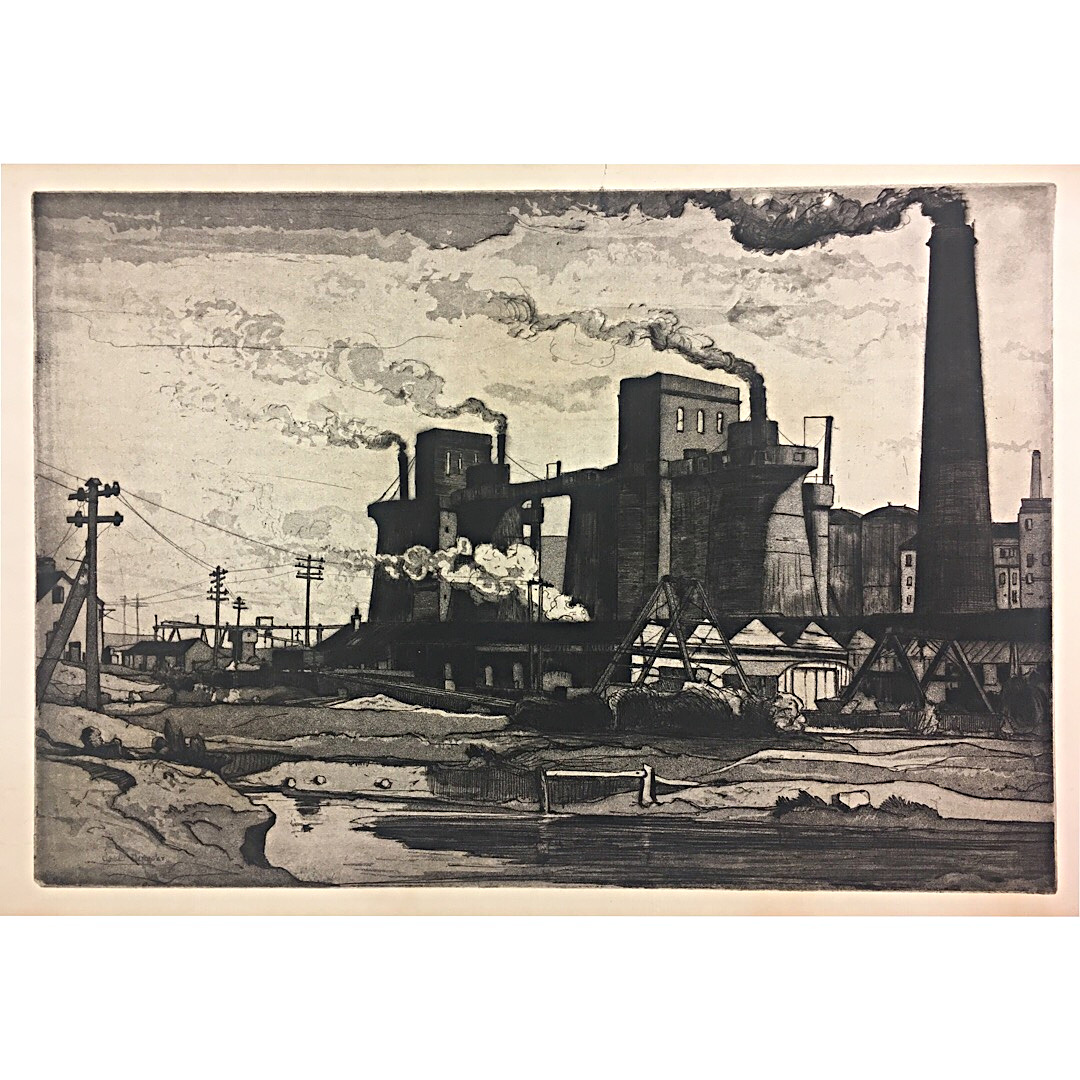
    Monochrome aquatint Signed in plate 22x28cm Provenance: the family of the artist, by descent. Click here for more from the same source. Aquatint is an unusual medium for Muncaster - the renowned watercolourist - and an unusual subject. Here he has handled the factory scene with perhaps more even than his usual skill. The smoke makes dramatic courses across the sky, and the wires, roofs and gantries all bring very strong triangular forms to a scene with powerful vertical lines. Claude Grahame Muncaster, RWS, ROI, RBA, SMA was the son of Oliver Hall RA. At the age of fifteen his career as a landscape painter began, and he soon took to the seas, spending the 1920s and 30s travelling the world with his sketchbook in a series of vessels. With the outbreak of war and he joined the RNVR training as a navigator. Having left school at fifteen his mathematics was very weak and it was a relief for all when his artistic talents meant he was recruited as a camofleur. A master of capturing seascapes he was therefore able to hide huge ships ‘in plain sight’ with clever disguises. After the war he painted for the Royal Family and was a frequent guest at Sandringham. Claude Muncaster was a watercolourist known for his landscapes and maritime scenes. He was born Grahame Hall, the son of the Royal Academician Oliver Hall who taught his son to paint from an early age; Grahame first exhibited his work aged 15 and a few years later was showing at the RA. However, he adopted the name Claude Muncaster in 1922 to dissociate his career from that of his father. Muncaster’s primary choice of subject matter came from a genuine love of the sea. He made several long-distance sea voyages, including one around the Horn as a deckhand in the windjammer Olivebank in 1931, which he described in ‘Rolling Round the Horn’, published in 1933. Armed with a sketchbook, his aim was to be able to ‘paint ships and the sea with greater authority’. This he certainly achieved, perfectly capturing the limpid first light of morning over the Port of Aden, the choppy rain-grey waters of the Bay of Biscay and a streak of sunlight through gathering storm clouds at dusk in Exeter. He became an Associate of the Royal Watercolour Society in 1931 and was a founder member, and later President, of the Royal Society of Marine Artists. During the Second World War, Muncaster served in the Royal Naval Volunteer Reserve (RNVR) from 1940-44, training as a navigator before going on to advise on the camouflage of ships, and also worked as an official war artist. In ‘Still Morning at Aden’ (1944) he depicts Allied warships in this safe anchorage in the Middle East; the back is stamped with Admiralty approval. In 1946-7 he was commissioned by the Queen to produce watercolours of the royal residences at Windsor, Sandringham and Balmoral; the Duke of Edinburgh, in a foreword to a biography of Muncaster, recalls looking at these and considering the artist’s ‘unerring instinct for a subject’, his sense of atmosphere. Other commissions included large panoramas of the Thames and of Bradford. His career also included work as an etcher, illustrator, writer, lecturer and broadcaster, and his paintings can be found in the Royal Academy, Tate, National Maritime Museum Cornwall, National Railway Museum and Royal Air Force Museum.
  • David Loggan (1634 - 1692)

    Jesus College, Cambridge (1690)

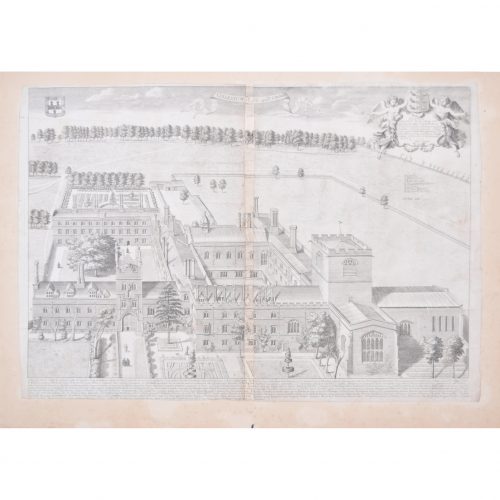
    Engraving 36 x 52 cm Loggan's skilful view of Jesus College from the 'Cantabrigia Illustrata'. Loggan was born to English and Scottish parents, and was baptised in Danzig in 1634. After studying engraving in Danzig with Willem Hondius (1598-1652 or 1658), he moved to London in the late 1650s, going on to produce the engraved title-page for the folio 1662 Book of Common Prayer. He married in 1663 and moved to Nuffield in Oxfordshire in 1665. Loggan was appointed Public Sculptor to the nearby University of Oxford in the late 1660s, having been commissioned to produce bird’s-eye views of all the Oxford colleges. He lived in Holywell Street as he did this. The 'Oxonia Illustrata' was published in 1675, with the help of Robert White (1645 - 1704). Following its completion, Loggan began work on his equivalent work for Cambridge; the 'Cantabrigia Illustrata' was finally published in 1690, when he was made engraver to Cambridge University. The 'Oxonia Illustrata' also includes an engraving of Winchester College (Winchester and New College share William of Wykeham as their founder) whilst the 'Cantabrigia Illustrata' includes one of Eton College (which shares its founder, Henry VIII, with King’s College). Bird’s-eye views from this era required a particular talent as an architectural perspectivist; it was not until 1783 that it became possible for artists to ascend via hot air balloons and view the scenes they were depicting from above. Loggan thus had to rely on his imagination in conceiving the views. Loggan’s views constitute the first accurate depictions of the two Universities, in many ways unchanged today. Whilst the Oxford engravings were produced in reasonable numbers and ran to a second edition by Henry Overton (on thicker paper and with a plate number in Roman numerals in the bottom right-hand corner), those of Cambridge were printed in much smaller numbers. The Dutchman Pieter van der Aa published some miniature versions of the engravings for James Beverell’s guidebook to the UK, 'Les Delices de la Grande Bretagne' (circa 1708). The contemporary artist Andrew Ingamells has produced a highly-acclaimed series of etchings which bring Loggan’s original vision up to date. Condition: extant portions very good; partly trimmed to within platemark; lacking portions of letters in lower left; also missing 1cm-width section down middle, historically replaced in pen and ink. Backed to laid paper. If you’d like to know more, please email info@manningfineart.co.uk or call us on 07929 749056. Click here for other views of Jesus College, Cambridge.
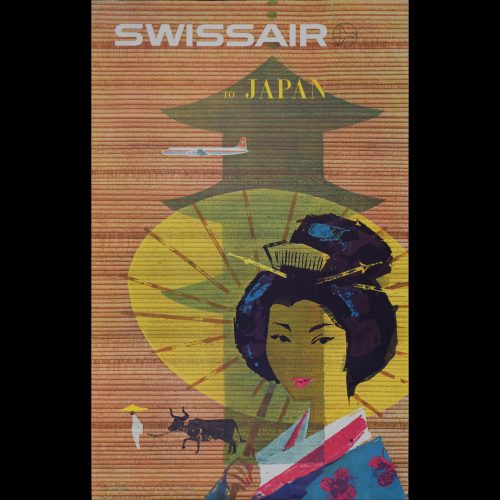
  • Donald Brun (1909-1999)

    Swissair to Japan

    Lithographic poster 40x25 inches If you are interested email info@manningfineart.co.uk or call us on 07929 749056.
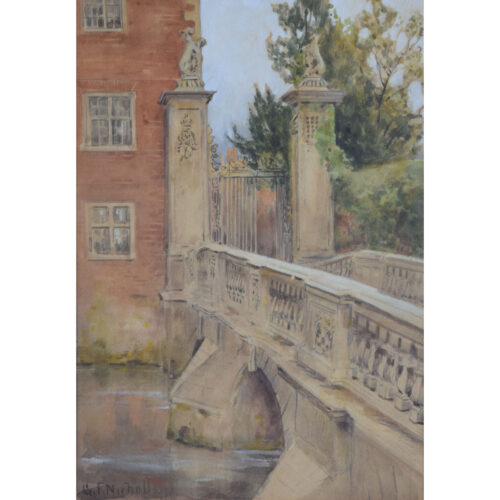
  • George Frederick Nicholls (1850 - 1935)

    Wren Bridge, St John's College, Cambridge

      Watercolour 37 x 24 cm Many of Nicholls' paintings are of the Cotswolds and Oxford. He painted the illustrations for a series of county books for A & C Black, including Cornwall (1915) and Cotswolds (1920). Condition: very good. If you are interested, please email info@manningfineart.co.uk or call us on 07929 749056. Click here for other views of St John’s College, Cambridge.
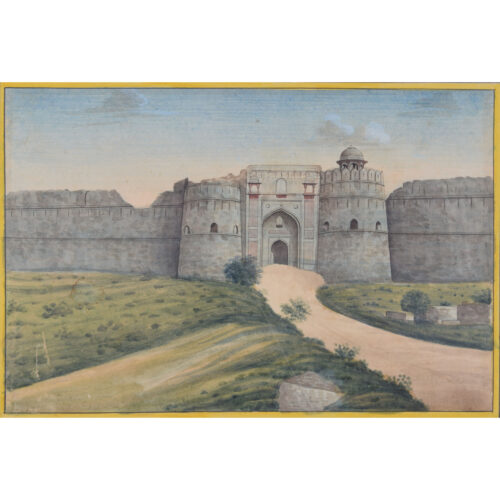
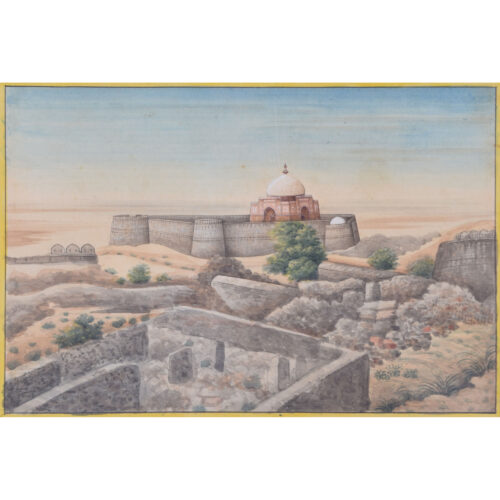
  • Purana Qila Fort, Delhi, India

      Watercolour 13 x 20 cm
    A 20th century watercolour by an unknown artist of Purana Qila, one of the oldest forts in Delhi. We have three other Indian architectural views by the same artist available.
    Condition: generally very good; one or two small scratches as visible in photographs. If you are interested, please email info@manningfineart.co.uk or call us on 07929 749056. Click here for other works from the same series.
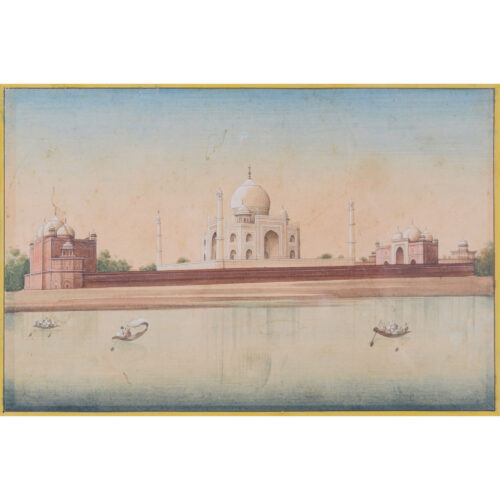
  • Taj Mahal, India

      Watercolour 13 x 20 cm
    A 20th century watercolour by an unknown artist of the Taj Mahal, Shah Jahan's 1631 mausoleum for his wife. We have three other Indian architectural views by the same artist available.
    Condition: generally very good; one or two small scratches as visible in photographs. If you are interested, please email info@manningfineart.co.uk or call us on 07929 749056. Click here for other works from the same series.
  • Tughlaqabad Fort, Delhi

      Watercolour 13 x 20 cm
    A 20th century watercolour by an unknown artist of Tughlaqabad Fort, a ruined 14th-century fort in Delhi. We have three other Indian architectural views by the same artist available.
    Condition: generally very good; one or two small scratches as visible in photographs. If you are interested, please email info@manningfineart.co.uk or call us on 07929 749056. Click here for other works from the same series.
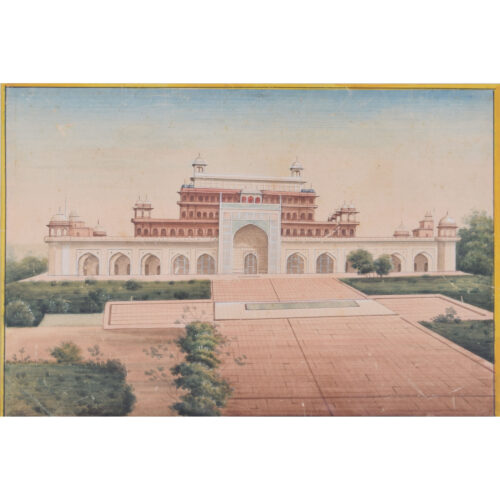
  • Akbar's Tomb, Agra

      Watercolour 13 x 20 cm
    A 20th century watercolour by an unknown artist of Akbar's Tomb, Agra, the mausoleum of the Mughal emperor Akbar. We have three other Indian architectural views by the same artist available.
    Condition: generally very good; one or two small scratches as visible in photographs. If you are interested, please email info@manningfineart.co.uk or call us on 07929 749056. Click here for other works from the same series.
  • James Basire & John Carter St Albans Cathedral

    Engraving 62 x 46 cm This engraving was originally published by the Society of Antiquaries of London, an organisation dedicated to studying and preserving historical monuments. Recognising it as one of England's most significant medieval structures, the society commissioned a series of engravings of St Albans Cathedral by James Basire--based on drawings by the architectural draughtsman John Carter. In doing so, the Antiquaries hoped to preserve and disseminate knowledge of England’s architectural heritage. This particular engraving is especially striking, as Carter expertly creates contrasts between light and dark, giving his work a strong sense of depth and conveying the impressive stature of St Albans Cathedral. Condition: Generally very good.

    If you would like to know more, please email info@manningfineart.co.uk or call us on 07929 749056.
Go to Top