Welcome to the shop. You are most welcome to browse, navigate using the menu above, or search the website.


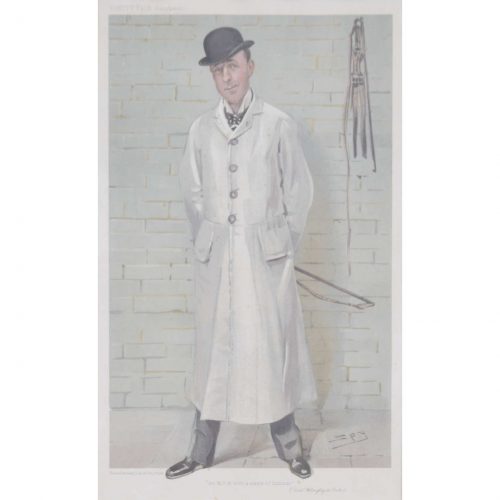
  • Sir Leslie 'Spy' Ward for Vanity Fair Magazine

    An MFH with a sense of humour (1905)

      Lithograph 36 x 21 cm Published in Vanity Fair on 23rd November 1905. The 'MFH with a sense of humour' depicted here is Richard Greville Verney, 19th Baron Willoughby de Broke (1869 - 1923), British peer, Conservative politician, and Master of Foxhounds. Verney was the son of Colonel Henry Verney, 18th Baron Willoughby de Broke and Geraldine Smith-Barry, and was educated at Eton College and New College, Oxford. The historian George Dangerfield described Verney as "a genial and sporting young peer, whose face bore a pleasing resemblance to the horse. ... He had quite a gift for writing, thought clearly, and was not more than two hundred years behind his time." He wrote a book on foxhunting called "Hunting the Fox", which was published in 1921 and remains an acclaimed text on the sport today. Verney represented Rugby, Warwickshire, as an MP from 1895–1900. In 1902 he succeeded his father as 19th Baron Willoughby de Broke. Condition: very good. If you’d like to know more, please email info@manningfineart.co.uk or call us on 07929 749056.
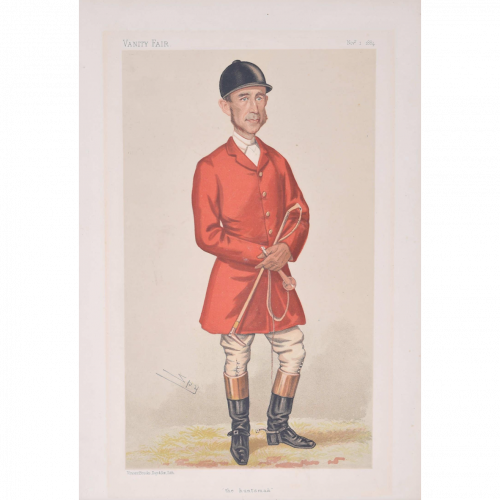
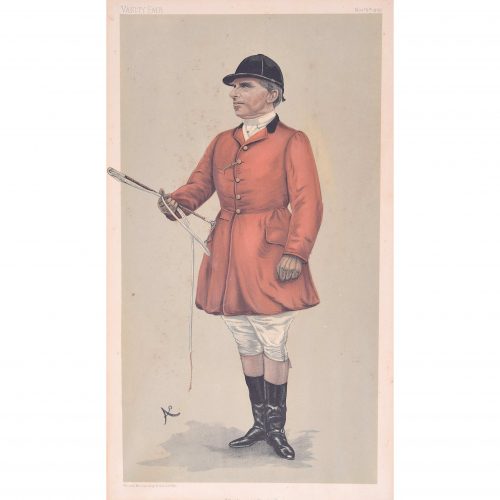
  • Roland "Ao" / "Armadillo" L'Estrange for Vanity Fair Magazine 'Berks and Bucks': Sir Robert Rodney Wilmot

    5 November 1903 Lithograph 21 x 37 cm   Depicting Sir Robert Rodney Wilmot, in red hunting clothes and whip, of the Berks & Bucks Draghounds at their opening meet. Wilmot was educated at Eton and Oxford, and his hobbies famously included croquet. The Vanity Fair magazine of 1868 to 1914 was subtitled 'A Weekly Show of Political, Social and Literary Wares'. Founded by Thomas Gibson Bowles, who aimed to expose the contemporary vanities of Victorian society, it featured regular full-page, colour lithographs of famous (or infamous) contemporary figures. It is for these caricatures that the original Vanity Fair is best known today. If you are interested, please email info@manningfineart.co.uk or call us on 07929 749056. Condition: Good. Mounted to board, some age toning.
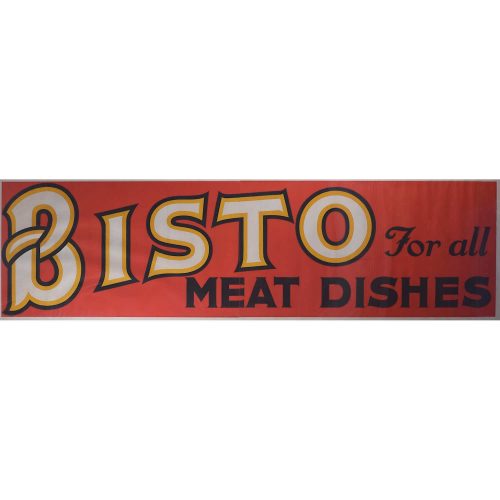
  • 'Bisto for all Meat Dishes'

      Original vintage poster 55 x 202 cm This original vintage poster is an excellent opportunity to acquire a piece of British advertising history. Bisto is an instantly recognisable brand today, and has been throughout the 20th century; the catchphrase on the poster here, "Bisto for all meat dishes" was used in the 1950s. The first Bisto product, in 1908, was a meat-flavoured gravy powder which rapidly became a bestseller in the UK. It was added to gravies to thicken them and give a richer taste and aroma. Invented by Messrs Roberts & Patterson, it was named "Bisto" because it "Browns, Seasons and Thickens in One". As of 2005, Bisto Gravy Granules had a British market share of over 70%. Nearly all British grocery outlets stock a Bisto product.
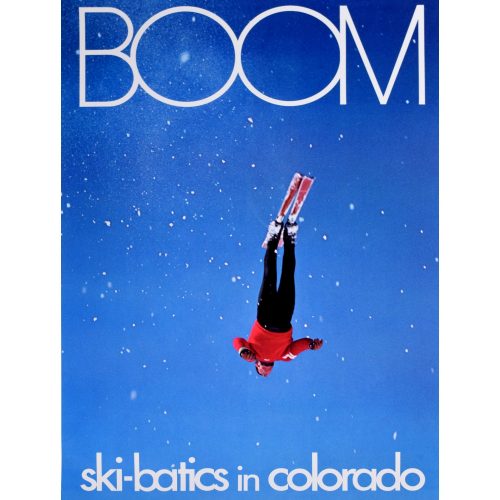
  • 'BOOM' skibatics in Colorado Poster (c.1970)

    67 x 53 cm Original Vintage Poster Printed by LooArt Press, Colorado Springs, Colorado. Features a photograph of acrobatic skier by Steve Knowlton. Direct from the surplus stock of the printers, LooArt Press, which closed in the early 1970s. In generally excellent condition.
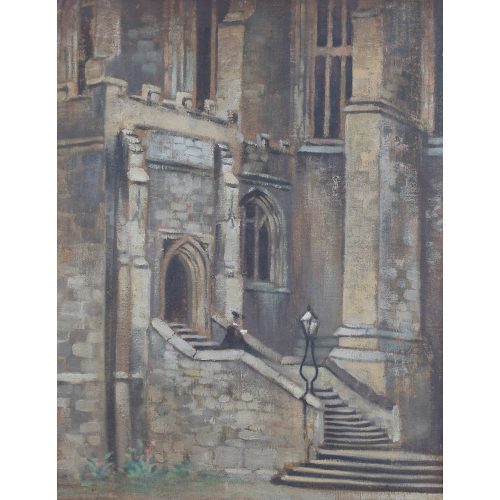
  • 'Eton College, a scholar on the steps' (early 20th century)

    Oil on canvas 62 x 49 One of our favourite paintings. A lone scholar descends the Chapel steps, a human focal point in an oil painting primarily concerned with the College's fine architecture. A blur of green and red sprouts at the bottom of the wall - flowers. In a handsome period hardwood frame. Condition: very good.
  • Cyril Kenneth Bird ‘Fougasse’ (1887 - 1965)

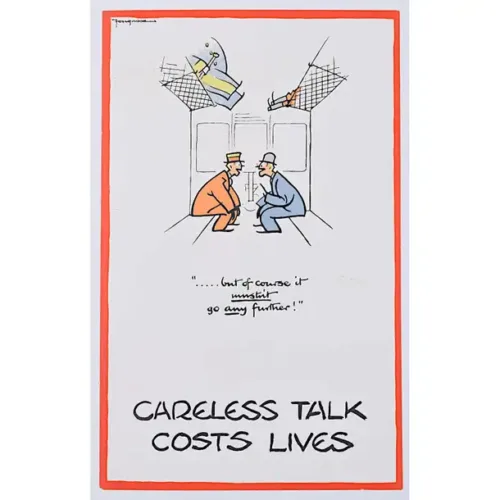
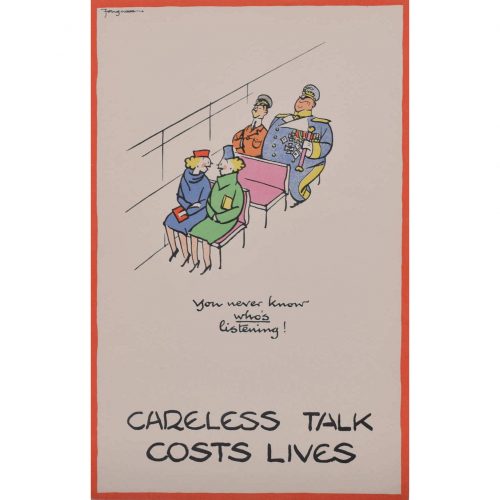
    Careless Talk Costs Lives (circa 1940)

      Lithographic poster 32 x 20 cm (12.5 x 8 in) Version printed on thicker paper. "But of course it mustn't go any further" - in the luggage compartments above two gossiping men, Mussolini and Hitler are hiding. Fougasse reminds us that we ought not to discuss secrets which could be of use to them. Fougasse was a British cartoonist. He was art editor of Punch between 1937 and 1949, and subsequently editor until 1953. He is best known for his ‘Careless Talk Costs Lives’ series of posters, and the other posters for the Ministry of Information and London Transport. As the Second World War progressed, the Ministry of Information’s poster campaign had become less and less effective. There were posters instructing the population to save old clothes for rags, turn off the lights, save food, dig for victory, watch out for spies, and keep calm and carry on. With this instruction overload, the population had ceased paying attention to the posters. Fougasse noticed this, and offered his services unpaid to the Ministry of Information, with a view to bringing a touch of humour to the posters. His amusing designs with pithy captions, reminiscent of newspaper cartoons, helped to get the Ministry's messages across in a novel way.
    Fougasse's distinctive poster style, with the red border, was subsequently adopted by other Ministry artists.
    Condition: backed to linen; generally excellent. If you are interested, please email info@manningfineart.co.uk or call us on 07929 749056. Click here for other works by the artist.
  • Cyril Kenneth Bird ‘Fougasse’ (1887 - 1965)

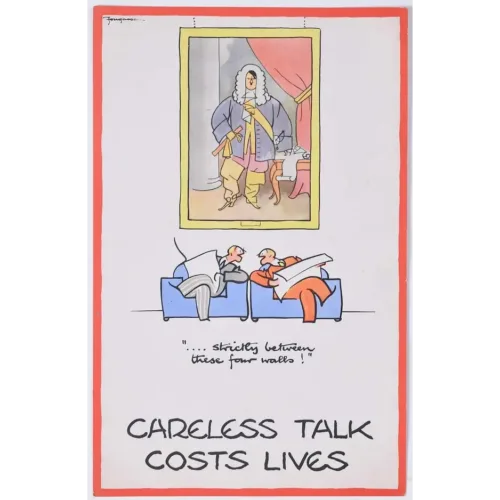
    Careless Talk Costs Lives (circa 1940)

      Lithographic poster 32 x 20 cm (12.5 x 8 in) "Strictly between these four walls" - here, in the painting hanging behind two gossiping men in gentleman's club, hide Mussolini and Hitler. Fougasse reminds us that we ought not to discuss secrets which could be of use to them. Fougasse was a British cartoonist. He was art editor of Punch between 1937 and 1949, and subsequently editor until 1953. He is best known for his ‘Careless Talk Costs Lives’ series of posters, and the other posters for the Ministry of Information and London Transport. As the Second World War progressed, the Ministry of Information’s poster campaign had become less and less effective. There were posters instructing the population to save old clothes for rags, turn off the lights, save food, dig for victory, watch out for spies, and keep calm and carry on. With this instruction overload, the population had ceased paying attention to the posters. Fougasse noticed this, and offered his services unpaid to the Ministry of Information, with a view to bringing a touch of humour to the posters. His amusing designs with pithy captions, reminiscent of newspaper cartoons, helped to get the Ministry's messages across in a novel way.
    Fougasse's distinctive poster style, with the red border, was subsequently adopted by other Ministry artists.
    Condition: good. If you are interested, please email info@manningfineart.co.uk or call us on 07929 749056. Click here for other works by the artist.
  • Cyril Kenneth Bird ‘Fougasse’ (1887 - 1965)

    Careless Talk Costs Lives (circa 1940)

    Lithographic Poster Collection 31 x 40 cm each [62 x 80 cm overall]
    "Strictly between you and me..."; "...but for Heaven's sake, don't say I told you!"; "Don't forget the walls have ears!" - This collection of posters brings together a series of Fougasse's snappy slogans, all to the backdrop of various Hitlers hiding under tables, melding with the wallpaper, and even replacing the historical figures in the traditional portrait featured. Through this public information messaging, Fougasse aimed to remind his contemporaries not to discuss secrets which may be of use to the enemy. Fougasse was a British cartoonist. He was art editor of Punch between 1937 and 1949, and subsequently editor until 1953. He is best known for his ‘Careless Talk Costs Lives’ series of posters, and the other posters for the Ministry of Information and London Transport. As the Second World War progressed, the Ministry of Information’s poster campaign had become less and less effective. There were posters instructing the population to save old clothes for rags, turn off the lights, save food, dig for victory, watch out for spies, and keep calm and carry on. With this instruction overload, the population had ceased paying attention to the posters. Fougasse noticed this, and offered his services unpaid to the Ministry of Information, with a view to bringing a touch of humour to the posters. His amusing designs with pithy captions, reminiscent of newspaper cartoons, helped to get the Ministry's messages across in a novel way. Fougasse's distinctive poster style, with the red border, was subsequently adopted by other Ministry artists.
    Condition: Very good; slight age toning. This is the version on thin paper. If you are interested, please email info@manningfineart.co.uk or call us on 07929 749056. Click here for other works by the artist.
  • Cyril Kenneth Bird ‘Fougasse’ (1887 - 1965)

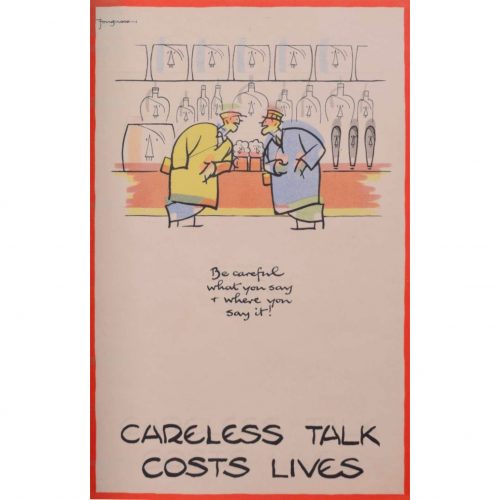
    Careless Talk Costs Lives (circa 1940)

      Lithographic poster 32 x 20 cm (12.5 x 8 in) Version printed on thinner paper. Fougasse was a British cartoonist. He was art editor of Punch between 1937 and 1949, and subsequently editor until 1953. He is best known for his ‘Careless Talk Costs Lives’ series of posters, and the other posters for the Ministry of Information and London Transport. As the Second World War progressed, the Ministry of Information’s poster campaign had become less and less effective. There were posters instructing the population to save old clothes for rags, turn off the lights, save food, dig for victory, watch out for spies, and keep calm and carry on. With this instruction overload, the population had ceased paying attention to the posters. Fougasse noticed this, and offered his services unpaid to the Ministry of Information, with a view to bringing a touch of humour to the posters. His amusing designs with pithy captions, reminiscent of newspaper cartoons, helped to get the Ministry's messages across in a novel way. Fougasse's distinctive poster style, with the red border, was subsequently adopted by other Ministry artists. Condition: if you’d like to know more, please email info@manningfineart.co.uk or call us on 07929 749056.
  • Out of stock

    Cyril Kenneth Bird ‘Fougasse’ (1887 - 1965)

    Careless Talk Costs Lives (circa 1940)

      Lithographic poster 32 x 20 cm (12.5 x 8 in) Version printed on thinner paper. Fougasse was a British cartoonist. He was art editor of Punch between 1937 and 1949, and subsequently editor until 1953. He is best known for his ‘Careless Talk Costs Lives’ series of posters, and the other posters for the Ministry of Information and London Transport. As the Second World War progressed, the Ministry of Information’s poster campaign had become less and less effective. There were posters instructing the population to save old clothes for rags, turn off the lights, save food, dig for victory, watch out for spies, and keep calm and carry on. With this instruction overload, the population had ceased paying attention to the posters. Fougasse noticed this, and offered his services unpaid to the Ministry of Information, with a view to bringing a touch of humour to the posters. His amusing designs with pithy captions, reminiscent of newspaper cartoons, helped to get the Ministry's messages across in a novel way. Fougasse's distinctive poster style, with the red border, was subsequently adopted by other Ministry artists. Condition: if you’d like to know more, please email info@manningfineart.co.uk or call us on 07929 749056.
  • Cyril Kenneth Bird ‘Fougasse’ (1887 - 1965)

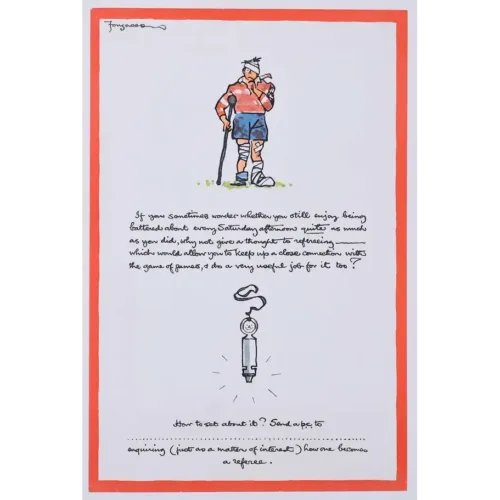
    Become a Rugby Referee

      Lithographic poster 32 x 26 cm "If you sometimes wonder whether you still enjoy being battered about on a Sunday afternoon quite as much as you did, why not give a thought to refereeing - which would allow you to keep up a connection with the game of games, and do a very useful job for it too." Fougasse was a British cartoonist. He was art editor of Punch between 1937 and 1949, and subsequently editor until 1953. He is best known for his ‘Careless Talk Costs Lives’ series of posters, and the other posters for the Ministry of Information and London Transport. As the Second World War progressed, the Ministry of Information’s poster campaign had become less and less effective. There were posters instructing the population to save old clothes for rags, turn off the lights, save food, dig for victory, watch out for spies, and keep calm and carry on. With this instruction overload, the population had ceased paying attention to the posters. Fougasse noticed this, and offered his services unpaid to the Ministry of Information, with a view to bringing a touch of humour to the posters. His amusing designs with pithy captions, reminiscent of newspaper cartoons, helped to get the Ministry's messages across in a novel way.
    Fougasse's distinctive poster style, with the red border, was subsequently adopted by other Ministry artists.
    Condition: backed to linen; generally excellent. If you are interested, please email info@manningfineart.co.uk or call us on 07929 749056. Click here for other works by the artist.
  • James Riddell (1909-2000) 'Join the University Ski Club'

    Original vintage poster Lithograph 31 x 50 cm This charming poster was designed by professional skier James Riddell for the 1934/35 Varsity trip, bringing students from Oxford and Cambridge University together for the annual Varsity ski racing, held in Klosters. Riddell, a Cambridge alumnus, played a key role in the early days of skiing as a competitive sport and holiday industry. In his early days, he was a skiing champion: his accolades include winning the Kandahar Club's Muerren Inferno, still the longest and most demanding of amateur downhill races, and acting as vice-president at the 1936 Winter Olympics at Garmisch-Partenkirchen. After his professional skiing career, Ridell became an accomplished author, writing novels including 'The Ski Runs of Switzerland' (1957), 'The Ski Runs of Austria '(1958), 'Ski Holidays in the Alps' (1961) and 'Ski Lore and Disorder' (1962). He quit skiing in his 70s but continued to return to his much-loved Muerren, the Kandahar Club's Swiss Alpine headquarters, where he spent time painting watercolours. This poster is a fine example of art-deco art. The simplified, streamlined depiction of skiers with strong, curving lines reflects the influence of Art Deco’s geometric and dynamic design approach. The limited colour palette of blue, white, and red gives a striking and vibrant look. The lettering, with its outlined and shadowed appearance, is characteristic of the era's emphasis on bold, decorative typography. Finally, the flowing lines in the background and the dramatic positioning of the skiers create a feeling of speed and action, a hallmark of 1930s graphic design. The overall effect is dynamic, eye-catching and extremely memorable. Condition: Generally very good. Colours are excellent and the paper shows only a little sign of age.

    If you would like to know more, please email info@manningfineart.co.uk or call us on 07929 749056.

  • 'Join your Neighbours in the Civil Defence'

    Original vintage recruitment poster 38 x 26 cm Printed for HM Stationery Office by Stafford & Co Ltd Netherfield, Nottingham. There was no World War Two activity to which the population could not be encouraged by the use of a poster. First established in 1935, the Civil Defence Department was essential for maintaining order during air raids. Pictured here is a man in Civil Defence uniform walking along a residential street with a row of houses, exuding satisfaction at having protected the community from another night of bombing. Condition: Generally very good.

    If you would like to know more, please email info@manningfineart.co.uk or call us on 07929 749056.

  • 'Samivel' Paul Gayet-Tancrède (1907 - 1992) L'alliance de l'homme et de la montagne

    Original vintage poster 100 x 62 cm A man sits atop a grassy hill, taking in the nature around him and looking down into the valley below. He is surrounded by the white peaks of the French alps in the Parc national de la Vanoise. Nearby a sparrow has settled on a small boulder amongst the mountain flowers. The scene is bucolic and calls to mind traditional depictions of mountain life in the likes of Heidi. Samivel was a writer, an artist, a photographer, an explorer, and more. In 1948 he accompanied Paul Émile Victor on the first French Greenland expedition, making three documentary films in the process. His friends included Théodore Monod and Gilbert André - the latter the mayor of Bonneval-sur-Arc and one of the founders of the Vanoise National Park - and with them and others he spent his whole life aiming for the protection of the imperilled countryside. The graphic artist side of him had a life-long fascination with high mountains, and his illustrated books and series of posters of the French Alps have long been popular.
  • Charles "Snaffles" Johnson Payne (1884 - 1967)

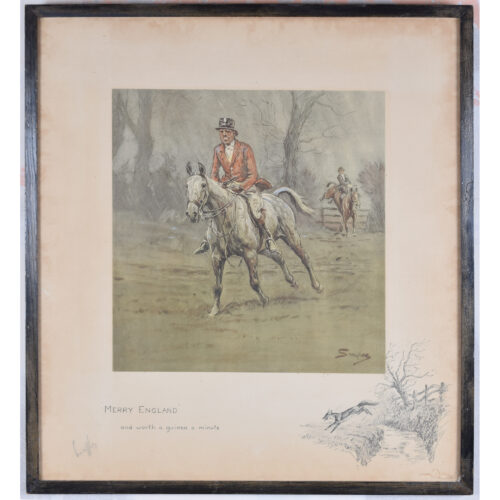
    "Merry England and worth a guinea a minute"

    Lithograph 44 x 41 cm Signed in pencil lower left. Snaffles was one of the foremost sporting artists of his era, publishing many popular prints such as these: hunting pictures, racing scenes, and military subjects. Snaffles' distinctive drawing style is emphasised by his 'remarque' - sketches in the margin - and his witty titles. Condition: generally good; some age toning to backing paper. In original half-inch black frame. If you are interested, please email info@manningfineart.co.uk or call us on 07929 749056. Click here for other hunting pictures.
  • Original Winston Churchill Poster

    Lithograph 51 x 40 cm c.1940-1945 "Never in the field of human conflict have so many owed so much to so few." The summer of 1940 saw the Battle of Britain reach its peak. Churchill delivered this speech to the House of Commons on the 20th of August 1940. The Battle of Britain had reached its peak that summer and when Churchill famously stated "Never in the field of human conflict have so many owed so much to so few", he was paying tribute to the enormous efforts made by the fighter pilots and bomber crews to establish air superiority over England. At the end of June 1940, the Luftwaffe had a large numerical superiority over the Royal Air Force, with around 2,550 planes compared to the only 750 planes of the RAF. As a result, the pilots who fought in the victorious Battle of Britain were known as "the few." This speech figures among Churchill's most famous, standing alongside "we shall fight on the beaches", "their finest hour", and "blood, toil, tears, and sweat" in the history books. This poster features the famous quote in bold lettering with a faint outline of Churchill's face in the background. The insignia of the Royal Air Force dominates the top of the poster, linking the speech to its context within the Battle of Britain. Condition: Generally very good, backed to linen.

    If you would like to know more, please email info@manningfineart.co.uk or call us on 07929 749056.

  • Charles "Snaffles" Johnson Payne (1884 - 1967)

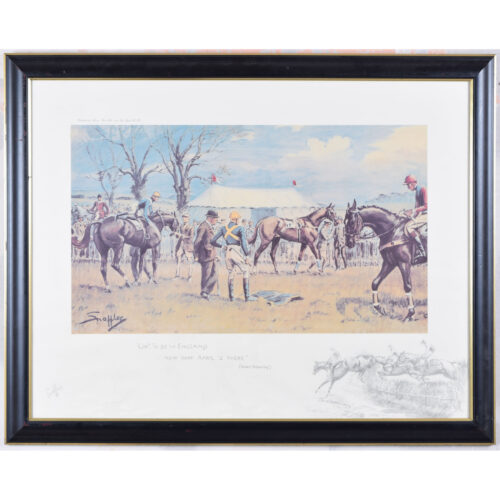
    "Oh! To Be In England Now That April's There"

    Lithograph 51 x 67 cm Signed in pencil lower left. Snaffles was one of the foremost sporting artists of his era, publishing many popular prints such as these: hunting pictures, racing scenes, and military subjects. Snaffles' distinctive drawing style is emphasised by his 'remarque' - sketches in the margin - and his witty titles. Condition: generally very good; crease to top left corner; slight unevenness to bottom edge; a few scratches to frame.
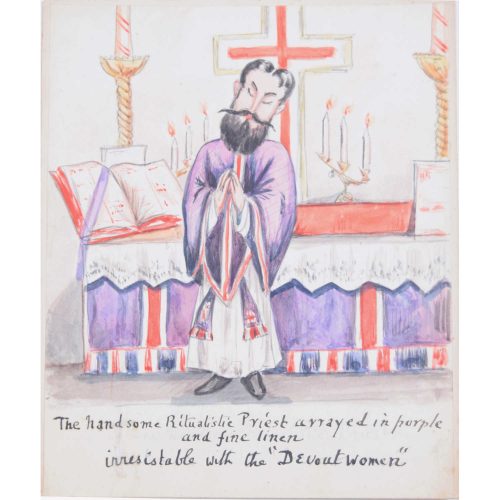
  • Anonymous, c.1850

    'The handsome Ritualistic Priest, arrayed in purple and fine linen irresistible with the "Devout Women"' Caricature

    Pen, ink and watercolour 20 x 24 cm By repute this item was found in the rooms of John Keble (1792-1866) at the Hermitage Hotel in Eastbourne after his death in 1866, together with another caricature watercolour of the 'Cotton-ia Worcester-ienisis' which we also have for sale. Condition: Generally very good, slight toning to paper.
  • 'Samivel' Paul Gayet-Tancrède (1907-1992)

    Du Léman à La Méditerranée, La Grande Traversée des Alpes Françaises

    ('From Lake Geneva to the Mediterranean, La Grande Traversée of the French Alps') Imprimé en France - Printed in France 1975 Original Vintage Ski Poster 99x62cm Condition: excellent With the ever-popular topic of mountains for climbing and skiing, Samivel here draws a snow-covered col in the mountains. La Grande Traversée is a long-distance walking route from Thonon les Bains to Nice, set up in the early 1970s. Samivel was a writer, an artist, a photographer, an explorer and more. In 1948 he accompanied Paul Émile Victor on the first French Greenland expedition, making three documentary films in the process. His friends included Théodore Monod and Gilbert André - the latter the mayor of Bonneval-sur-Arc and one of the founders of the Vanoise National Park - and with them and others he spent his whole life aiming for the protection of the imperilled countryside. The graphic artist side of him had a life-long fascination with high mountains, and his illustrated books and series of posters of the French Alps have long been popular. Click here to see other posters by Samivel. If you are interested email info@manningfineart.co.uk or call us on 07929 749056.
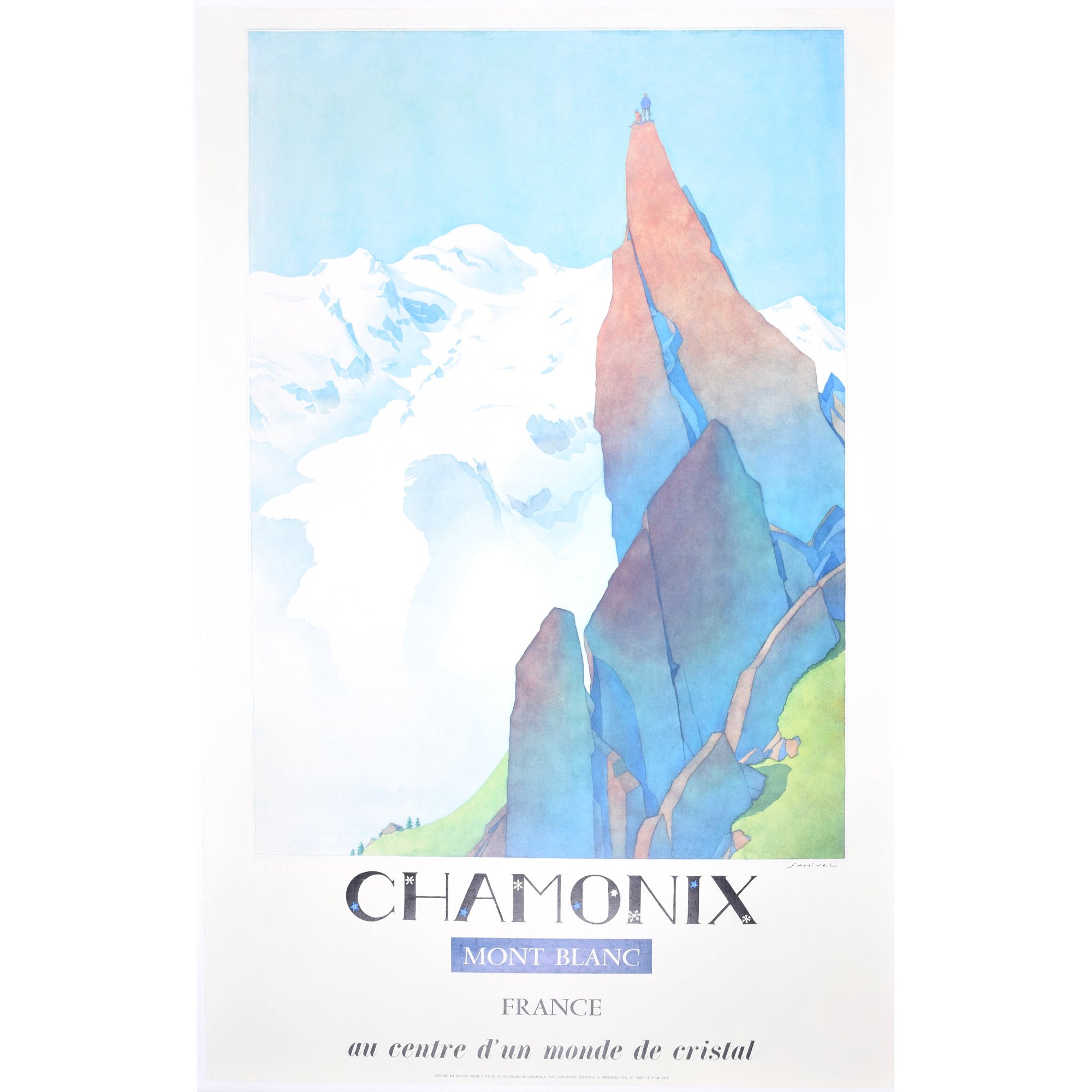
  • 'Samivel' Paul Gayet-Tancrède (1907-1992)

    Chamonix Mont Blanc, France - au centre d'un monde de cristal

    Imprimé en France pour l'office du tourisme de Chamonix par l'imprimerie generale a Grenoble Original Vintage Ski Poster 99x62cm Condition: excellent With the ever-popular topic of mountains for climbing and skiing, Samivel here draws one of the Aiguille or Aiguillettes - needles - in Chamonix which are famous for climbers. Samivel was a writer, an artist, a photographer, an explorer and more. In 1948 he accompanied Paul Émile Victor on the first French Greenland expedition, making three documentary films in the process. His friends included Théodore Monod and Gilbert André - the latter the mayor of Bonneval-sur-Arc and one of the founders of the Vanoise National Park - and with them and others he spent his whole life aiming for the protection of the imperilled countryside. The graphic artist side of him had a life-long fascination with high mountains, and his illustrated books and series of posters of the French Alps have long been popular. Click here to see other posters by Samivel. If you are interested email info@manningfineart.co.uk or call us on 07929 749056.
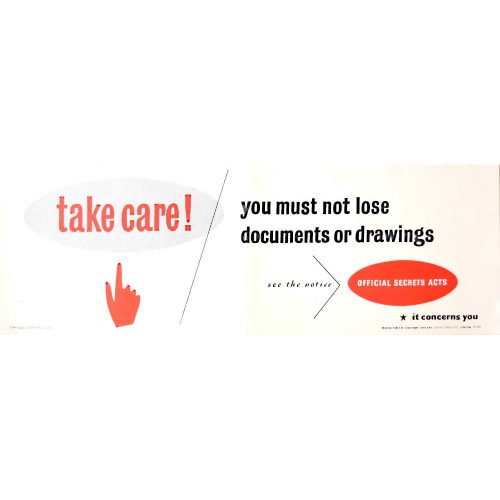
  • Take Care! Official Secrets Act WW2 Poster (c.1940)

    Lithographic poster 18 x 51 cm Printed for the HM Stationary Office by Gothic Press, London.  
  • Out of stock

    Sir Leslie "Spy" Ward for Vanity Fair Magazine 'The Huntsman': Thomas Firr

    1 November 1884 Lithograph 21 x 37 cm   Depicting Thomas Firr, Huntsman of the Quorn, on the day of the season's opening meet. The illustrated volume 'Tom Firr of the Quorn: Huntsman Extraordinary' details Firr's days with the hunt, and considers him 'the greatest huntsman in England'. He was huntsman to the Quorn for 27 years from 1872 to 1899. The Quorn Hunt has a claim to be the oldest hunt in the country, having been founded in 1696 by Mr Thomas Boothby of Tooley Park, Leicestershire. Tooley Park lies about eight miles southwest of Leicester, just to the north of the Hinckley road. The hunt takes its name from the village of Quorn, where the hounds were kennelled from 1753 to 1904. If you are interested, please email info@manningfineart.co.uk or call us on 07929 749056. Condition: Good. Mounted to board, some age toning.
  • Rosemary Anne Sisson (1923-2017) 'The Splendid Outcast', stage designs

    20 x 28 cm Watercolour (set of three) Cesar Borgia has ambitious plans and one of them is to take over the Kingdom of Naples...What follows in 'the Splendid Outcast' is a sordid love story. Marriages slip into affairs, affairs turn into assassinations, lust transforms to greed... Sisson wrote this play in 1960. The stage designs that followed in 1961 are vibrant, marked with the warm tones one might expect in a play set in Renaissance period Italy. Although a writer by craft, Sisson also proves herself adept with a brush and palette, executing playful mise-en-abimes as she incorporates miniature works of art into her stage designs. The abundance of windows and light in these watercolours also gestures to a world beyond her play, quite literally breathing a breath of fresh air and life into these works. Rosemary Anne Sisson was born in 1923 in Middlesex to the well-known Shakespeare scholar Charles Jasper Sisson, Lord Northcliffe. She developed a reputation as an acclaimed writer and playwright and was subsequently described by playwright Simon Farquhar in 2014 as being "one of television's finest period storytellers."
  • Winston Churchill 'We shall never surrender.'

    Original vintage poster 50 x 34 cm 'We shall not flag or fail, we shall go on to the end. We shall fight on the seas and oceans, we shall fight with growing confidence and growing strength in the air. We shall defend our Island, whatever the cost may be; we shall fight on the beaches, we shall fight on the landing grounds, we shall fight in the fields and in the streets, we shall fight in the hills. We shall never surrender.' Winston Churchill's 'We Shall Fight on the Beaches' speech, delivered to the House of Commons on June 4, 1940, is one of the most famous speeches of World War II. It was given in the wake of the Dunkirk evacuation (Operation Dynamo), where over 300,000 British and Allied troops were successfully rescued from France as German forces advanced. In this speech, Churchill had to describe a great military disaster, and warn of a possible invasion attempt by Nazi Germany, without casting doubt on eventual victory. The simple repetition and rhythm are unforgettable and helped to cement Churchill's reputation as an exceptional wartime leader.
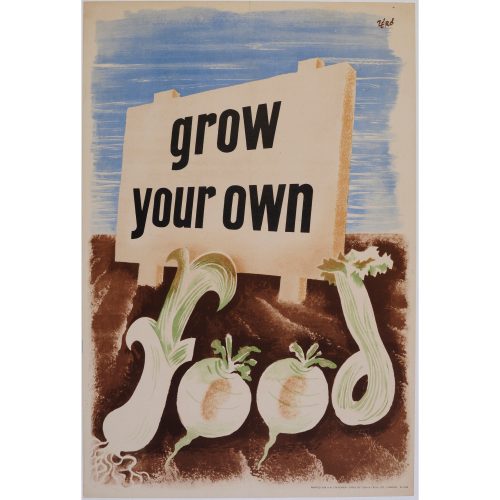
  • 'Zero' Hans Schleger (1898-1976) Grow Your Own Food

    Lithographic poster c. 1940 Printed by Fosh & Kosh Limited for HMSO 76x51cm A copy of this poster is in the collection of the Imperial War Museum. Click here for biographical details and other posters by Hans 'Zero' Schleger. Provenance: the estate of the artist. If you are interested email info@manningfineart.co.uk or call us on 07929 749056.
  • 'Zero' Hans Schleger

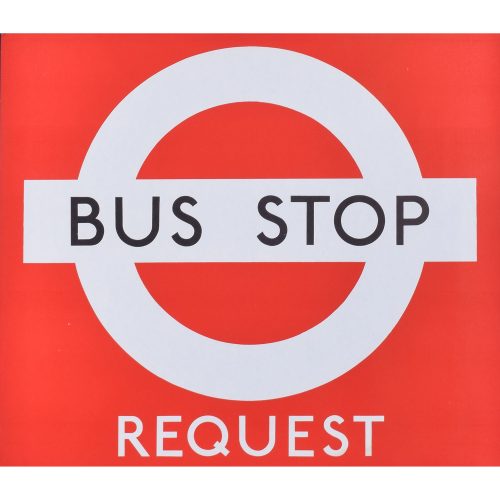
    London Transport Bus Stop Poster

    Lithographic poster 16x14" Printed for London Transport If you are interested email info@manningfineart.co.uk or call us on 07929 749056.
  • 'Zero' Hans Schleger

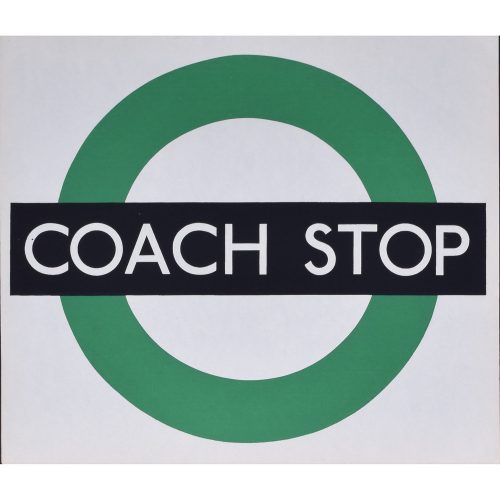
    London Transport Coach Stop/ Bus Stop Poster

    Screenprint poster c. 1970s 16x14" Printed for London Transport Includes hand-finished black frame. If you are interested email info@manningfineart.co.uk or call us on 07929 749056.
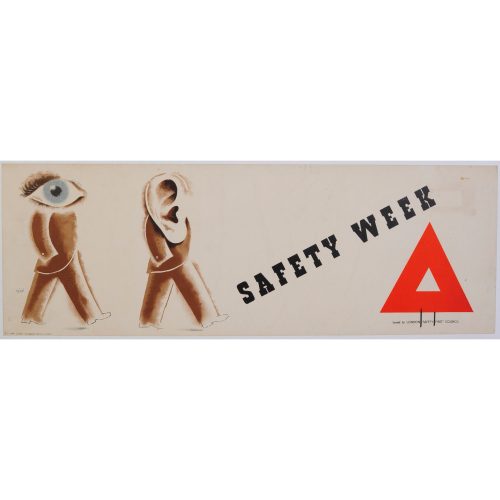
  • 'Zero' Hans Schleger Safety Week

    Lithographic panel poster 1937 Published by London 'Safety First' Council Printed by Dangerfield Printing Company Ltd A copy of this poster is in the collection of the London Transport Museum. Click here for biographical details and other posters by Hans 'Zero' Schleger. Provenance: the estate of the artist. If you are interested email info@manningfineart.co.uk or call us on 07929 749056.
  • 'Zero' Hans Schleger

    Transport for London Coach Stop Poster

    Screenprint poster c. 1970s 16×14″ Printed for London Transport Includes hand-finished black frame.   If you are interested email info@manningfineart.co.uk or call us on 07929 749056.
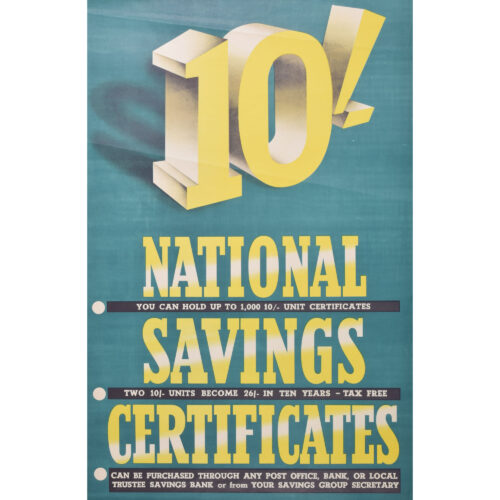
  • 10' National Savings Certificates

      Original vintage poster 73 x 49 cm An original vintage WW2 poster encouraging Britons to save via the National Savings scheme. Condition: generally very good; a couple of creases. Not backed. If you are interested, please email info@manningfineart.co.uk or call us on 07929 749056. Click here for other original vintage National Savings posters.
  • Лауреаты Государственных Премий [State Prizewinners] Moscow 1971 28 x 44 cm This folio introduces to the population of Soviet Russia the dozen winners of the State Prizes in 1971 for Literature, Art, and Architecture. "The awarding of the State Prizes of the USSR in 1971 to a large contingent of our creative intelligentsia is new evidence of the constant concern of the Communist Party of the Soviet Union for the further development of literature and art."  
  • Darton and Harvey (publisher)

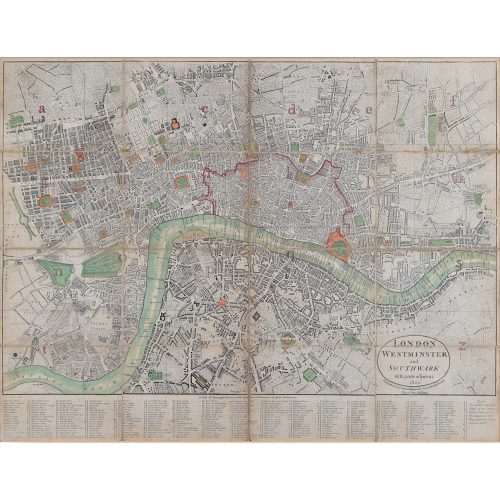
    Map of London, Southwark, and parts adjacent (1800)

      Engraving 42 x 56 cm Condition: generally very good; backed to linen with some evidence of use.
  • Frederick Nash (1782-1856) Drawn and etched

    Engraved by F C Lewis

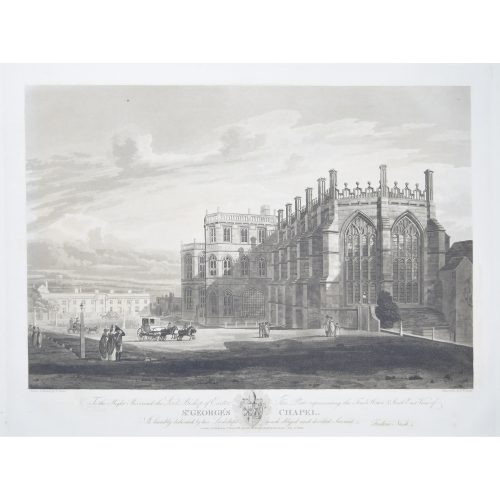
    South East View of St George's Chapel, Windsor

    To the Right Reverend the Lord Bishop of Exeter London Published by F Nash, No 6 Asylum Buildings, Westminster Road July 12 1804 39.5x52cm Frederick Nash was born in Lambeth. Initially studying architectural drawing under Thomas Malton he subsequently enrolled at the Royal Academy of Arts. From 1801 to 1809 he worked with the antiquarians John Britton and Edward Wedlake Brayley, subsequently becoming a member of the Society of Painters in Watercolours - a group of painters who had left the Royal Academy following complaints of under-recognition of their works. Latterly primarily a landscape painter he toured the rivers of Germany.
  • Frederick Nash (1782-1856) Drawn and etched

    Engraved by F C Lewis

    South East View of St George's Chapel, Windsor

    To the Right Reverend the Lord Bishop of Exeter London Published by F Nash, No 6 Asylum Buildings, Westminster Road July 12 1804 39.5x52cm Frederick Nash was born in Lambeth. Initially studying architectural drawing under Thomas Malton he subsequently enrolled at the Royal Academy of Arts. From 1801 to 1809 he worked with the antiquarians John Britton and Edward Wedlake Brayley, subsequently becoming a member of the Society of Painters in Watercolours - a group of painters who had left the Royal Academy following complaints of under-recognition of their works. Latterly primarily a landscape painter he toured the rivers of Germany.
  • Frederick Nash (1782-1856) Drawn and etched

    Engraved by F C Lewis

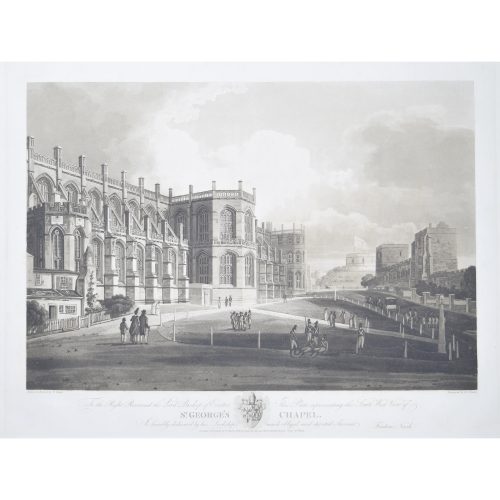
    South West View of St George's Chapel, Windsor

    To the Right Reverend the Lord Bishop of Exeter London Published by F Nash, No 6 Asylum Buildings, Westminster Road July 12 1804 39.5x52cm Frederick Nash was born in Lambeth. Initially studying architectural drawing under Thomas Malton he subsequently enrolled at the Royal Academy of Arts. From 1801 to 1809 he worked with the antiquarians John Britton and Edward Wedlake Brayley, subsequently becoming a member of the Society of Painters in Watercolours - a group of painters who had left the Royal Academy following complaints of under-recognition of their works. Latterly primarily a landscape painter he toured the rivers of Germany.
  • Louis Osman (1914-1996)

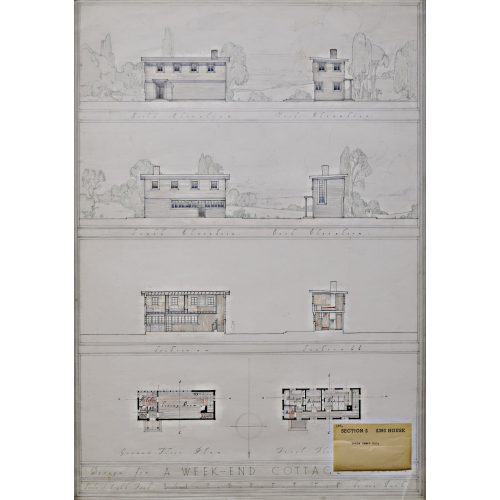
    A £350 Modernist House Weekend Cottage - Architectural drawing

    75x52cm Watercolour and pencil Inscribed Provenance: from the artist's estate Click for biographical details and other works by Osman. From Osman's time as an architectural student at the Bartlett School of Architecture. The examiner has graded the piece to the face. Osman was even more an artist than an architect, which shows with the quality of the shading and calligraphy. If you are interested email info@manningfineart.co.uk or call us on 07929 749056.    
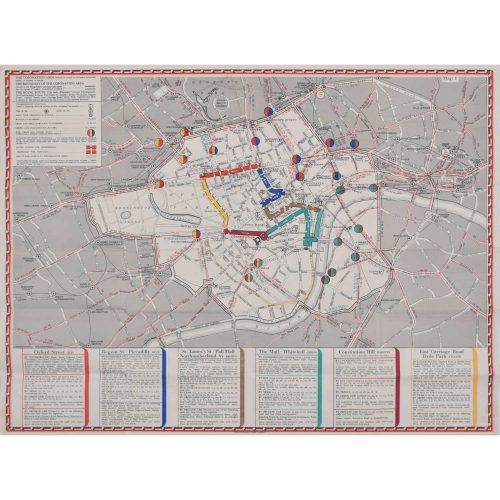
  • Coronation Arrangements - Map of London (1937)

      Lithograph 45 x 60 cm (unfolded) Published by London Transport for the Coronation of George VI, this map illustrates the route the King took in 1936. And best of all, it's just (almost!) as useful in today's London. Condition: generally very good. If you are interested, please email info@manningfineart.co.uk or call us on 07929 749056.
  • 'Zero' Hans Schleger London Underground Railways Pocket Map 1938 No. 2 Lithograph 14.5 x 20.5 cm An early edition of London Transport's iconic map, precursor to all other similar maps of other transport systems worldwide. The 1938 edition was designed by Hans Schleger, unlike the 1933 - first published - edition of Harry Beck. Beck was furious that his design had been given to Schleger and by 1941 responsibility returned to Beck. Hans Schleger was born in Germany. After the First World War, he studied at the Berlin Kunstgewerbeschule. After working in Berlin, he moved to New York in 1924 and began to work as a graphic designer. He returned to Berlin in 1929 and began working for the British advertising agency Crawfords, where he met Edward McKnight Kauffer, who introduced him to Jack Beddington (the head of advertising at Shell Mex BP). He moved to London following the rise of Hitler and produced a series of posters for Shell Mex. During the Second World War he worked for the British Government. He later taught at the Chicago Institute of Design and subsequently designed the trademarks of the John Lewis Partnership, Penguin, Deutsche Bank, and the Edinburgh Festival. Beck, on the other hand, was a technical draughtsman who worked for the London Metro Signal Office. After being fired, he created the first diagrammatic Tube map in 1931. Having submitted it to the Publicity Office at London Transport, it was rejected. However an updated proposal was accepted, being published in January 1933 in an edition of 700,000 pocket maps - most of which were consigned to the dustbin within hours, days or weeks. Those that survive are rare. Immediately popular it was adopted and similar maps have been used ever since by London Transport - and indeed many other rail systems worldwide. Beck was inspired whilst creating an electrical circuit diagram to apply the same concept to the Underground system, in the understanding that passengers on the network were more interested in how the lines related to each other, than in how they related to the topography of the city. Beck worked on the map in his spare time, and was - depending on the story you believe - either not paid for his work, or was paid a mere five or ten guineas. These days his work is acknowledged on all published London Transport maps.  
  • Ernest Wallcousins (1882-1976) Keep Calm and Carry On (Medium size)

    Ministry of Information Lithographic poster, 1939 50 x 37 cm ('Crown' size) Very rare - we have traced copies in the Imperial War Museum collection but no other public collection. Provenance: part of a small stock of posters cleared from a police station in Suffolk in the 1940s. These posters were generally sent out to police stations in groups of six or twelve. Shortly after the war, during a clear-out of the police station, these posters were put aside to be disposed of. A young police constable requested permission to take them home, and permission was granted. They spent the following nearly eight decades, surviving house moves and a long-suffering wife, sitting in a drawer. Following the policeman's death, his family have allowed the posters to be sold. As the small stock of posters at this police station came in all three sizes (small at 38 x 25 cm; medium at 38 x 50 cm; large at 75 x 50 cm) we are able to offer all three for sale today. An instantly-recognisable brand today, this poster was reserved for use in the event of the German invasion. Once it became obvious that they were not going to invade, these posters were sent back for recycling. As they were never used, the survivors are incredibly rare. Of public collections only the Imperial War Museum – which has a very extensive collection of wartime posters – has a copy of this poster. The story of the poster is well known these days, but bears repeating. In 1939, with invasion an ever-present threat, HM Government commissioned three posters with snippets designed to encourage the population. Bearing a crown at the top, it was clearly intended to be a message from the King: “Your Courage, Your Cheerfulness, Your Resolution, Will Bring Us Victory” was displayed widely, with hundreds of thousands being printed; similarly “Freedom is in Peril Defend it with all Your Might.” The third poster – “Keep Calm and Carry On” – was distributed, but was to be held back and only used in the event of invasion. In the event the poster campaign was not a great success, with the people regarding it as an instruction from the powers-that-be that it was the people, not the leaders, who were going to be the ones doing the hard work. As the invasion never happened, Hitler’s armies being otherwise occupied elsewhere in the world, and the Spitfire achieving victory in the Battle of Britain, the Keep Calm posters were never used. Owing to the shortage of raw materials, the paper was recycled and there the story should have ended. However, in 2000, the owner of Barter Books in Alnwick discovered a copy of the poster in the bottom of a box of books. They hung it up in their shop and started producing reproductions, and the poster has become an internationally recognised image, reproduced on mugs, t-shirts, and adapted into such uplifting slogans as “Keep Calm and Drink Tea”. A much more successful series of propaganda was created by ‘Fougasse’ – Cyril Bird. Picture editor of Punch from 1937-1949, then editor until 1953, he noted that the best sort of advertising would make people smile. He worked unpaid for the Ministry of Information during the war, producing cartoons with a short word of advise. His Careless Talk Costs Lives series of posters are amongst the most famous of the propaganda campaigns of the Second World War.
  • Ernest Wallcousins (1882-1976) Keep Calm and Carry On (Small size)

    Ministry of Information Lithographic poster, 1939 37 x 25 cm ('Crown Folio' size) Very rare - we have traced copies in the Imperial War Museum collection but no other public collection. Provenance: part of a small stock of posters cleared from a police station in Suffolk in the 1940s. These posters were generally sent out to police stations in groups of six or twelve. Shortly after the war, during a clear-out of the police station, these posters were put aside to be disposed of. A young police constable requested permission to take them home, and permission was granted. They spent the following nearly eight decades, surviving house moves and a long-suffering wife, sitting in a drawer. Following the policeman's death, his family have allowed the posters to be sold. As the small stock of posters at this police station came in all three sizes (small at 38 x 25 cm; medium at 38 x 50 cm; large at 75 x 50 cm) we are able to offer all three for sale today. An instantly-recognisable brand today, this poster was reserved for use in the event of the German invasion. Once it became obvious that they were not going to invade, these posters were sent back for recycling. As they were never used, the survivors are incredibly rare. Of public collections only the Imperial War Museum – which has a very extensive collection of wartime posters – has a copy of this poster. The story of the poster is well known these days, but bears repeating. In 1939, with invasion an ever-present threat, HM Government commissioned three posters with snippets designed to encourage the population. Bearing a crown at the top, it was clearly intended to be a message from the King: “Your Courage, Your Cheerfulness, Your Resolution, Will Bring Us Victory” was displayed widely, with hundreds of thousands being printed; similarly “Freedom is in Peril Defend it with all Your Might.” The third poster – “Keep Calm and Carry On” – was distributed, but was to be held back and only used in the event of invasion. In the event the poster campaign was not a great success, with the people regarding it as an instruction from the powers-that-be that it was the people, not the leaders, who were going to be the ones doing the hard work. As the invasion never happened, Hitler’s armies being otherwise occupied elsewhere in the world, and the Spitfire achieving victory in the Battle of Britain, the Keep Calm posters were never used. Owing to the shortage of raw materials, the paper was recycled and there the story should have ended. However, in 2000, the owner of Barter Books in Alnwick discovered a copy of the poster in the bottom of a box of books. They hung it up in their shop and started producing reproductions, and the poster has become an internationally recognised image, reproduced on mugs, t-shirts, and adapted into such uplifting slogans as “Keep Calm and Drink Tea”. The artist, Wallcousins, was an illustrator, official war artist of the Second World War, and painted the official victory portrait of Winston Churchill. A much more successful series of propaganda was created by ‘Fougasse’ – Cyril Bird. Picture editor of Punch from 1937-1949, then editor until 1953, he noted that the best sort of advertising would make people smile. He worked unpaid for the Ministry of Information during the war, producing cartoons with a short word of advise. His Careless Talk Costs Lives series of posters are amongst the most famous of the propaganda campaigns of the Second World War.
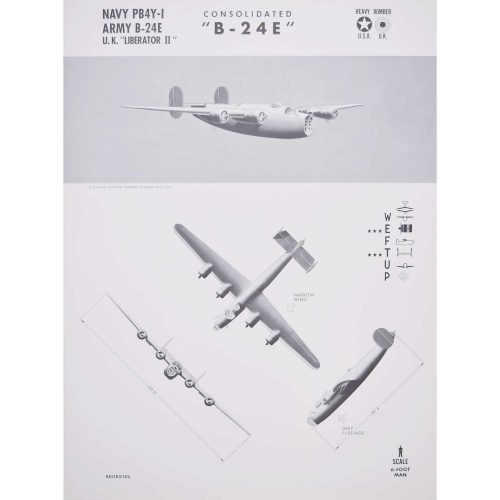
  • Navy and Army Consolidated Aircraft "B-24E" "Liberator II"

      US Naval Aviation Training Division Original aeroplane recognition poster (1942) 63 x 47 cm A particularly unusual style of aeroplane identification poster, owing to the very arty images. Most such posters rely on very plain silhouettes, this series - and we have several in this series; view them here - have a much more arty approach to the task with shading and an interesting angle view. The Consolidated B-24 Liberator is an American heavy bomber, designed by Consolidated Aircraft of San Diego, California. Early RAF Liberators were the first aircraft to cross the Atlantic Ocean as a matter of routine. The B-24 was used extensively in World War II. It served in every branch of the American armed forces as well as several Allied air forces and navies, and was used in every theatre of war operations. In comparison with its contemporaries, the B-24 was relatively difficult to fly and had poor low-speed performance; it also had a lower ceiling and was less robust than the Boeing B-17 Flying Fortress. While aircrews tended to prefer the B-17, General Staff favoured the B-24 and procured it in huge numbers for a wide variety of roles. At approximately 18,500 units – including 8,685 manufactured by Ford Engine Company – it holds records as the world's most produced bomber, heavy bomber, multi-engine aircraft, and American military aircraft in history. Condition: Generally very good, occasional handling marks. If you’d like to know more, please email info@manningfineart.co.uk or call us on 07929 749056.
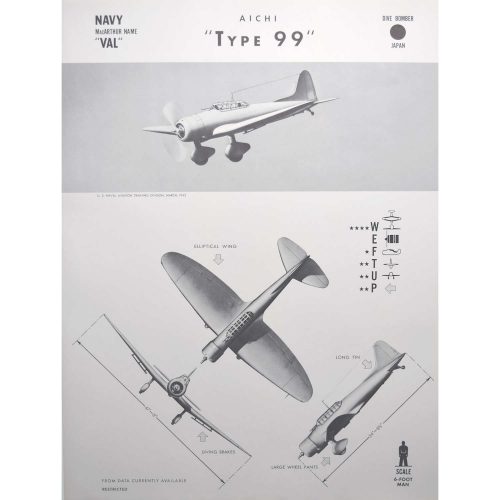
  • 1942 MacArthur name "Val" Aichi "Type 99"

    World War II Japanese dive bomber plane

      Original aeroplane identification poster, 1942 63 x 47 cm A particularly unusual style of aeroplane identification poster, owing to the very arty images. Most such posters rely on very plain silhouettes, this series - and we have many in this series - have a much more arty approach to the task with shading and an interesting angle view. The Aichi D3A Type 99 Carrier Bomber (Allied reporting name "Val") was a World War II carrier-borne dive bomber. It was the primary dive bomber of the Imperial Japanese Navy (IJN) and was involved in almost all IJN actions, including the attack on Pearl Harbor. The Aichi D3A was the first Japanese aircraft to bomb American targets in the war, commencing with Pearl Harbor and U.S. bases in the Philippines, such as the Clark Air Force Base. They sank more Allied warships than any other Axis aircraft. If you'd like to know more, please email info@manningfineart.co.uk or call us on 07929 749056.
  • US Naval Aviation Training Division

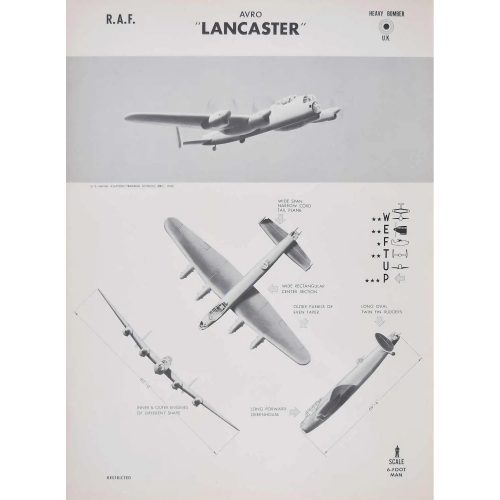
    Avro Lancaster

      Aeroplane identification poster, published 1942 63 x 47 cm A particularly unusual style of aeroplane identification poster, owing to the very arty images. Most such posters rely on very plain silhouettes, this series - and we have several in this series; view them here - have a much more arty approach to the task with shading and an interesting angle view. The Avro Lancaster is a British Second World War heavy bomber. It was designed and manufactured by Avro as a contemporary of the Handley Page Halifax, both bombers having been developed to the same specification, as well as the Short Stirling, all three aircraft being four-engined heavy bombers adopted by the Royal Air Force (RAF) during the same wartime era. The Lancaster has its origins in the twin-engine Avro Manchester which had been developed during the late 1930s in response to the Air Ministry Specification P.13/36 for a capable medium bomber for "world-wide use". Originally developed as an evolution of the Manchester (which had proved troublesome in service and was retired in 1942), the Lancaster was designed by Roy Chadwick and powered by four Rolls-Royce Merlins and in one version, Bristol Hercules engines. It first saw service with RAF Bomber Command in 1942 and as the strategic bombing offensive over Europe gathered momentum, it was the main aircraft for the night-time bombing campaigns that followed. As increasing numbers of the type were produced, it became the principal heavy bomber used by the RAF, the Royal Canadian Air Force (RCAF) and squadrons from other Commonwealth and European countries serving within the RAF, overshadowing the Halifax and Stirling. A long, unobstructed bomb bay meant that the Lancaster could take the largest bombs used by the RAF, including the 4,000 lb (1,800 kg), 8,000 lb (3,600 kg) and 12,000 lb (5,400 kg) blockbusters, loads often supplemented with smaller bombs or incendiaries. The "Lanc", as it was known colloquially, became one of the most heavily used of the Second World War night bombers, "delivering 608,612 long tonnes of bombs in 156,000 sorties". The versatility of the Lancaster was such that it was chosen to equip 617 Squadron and was modified to carry the Upkeep "bouncing bomb" designed by Barnes Wallis for Operation Chastise, the attack on German Ruhr valley dams. Although the Lancaster was primarily a night bomber, it excelled in many other roles, including daylight precision bombing, for which some Lancasters were adapted to carry the 12,000 lb (5,400 kg) Tallboy and then the 22,000 lb (10,000 kg) Grand Slam earthquake bombs (also designed by Wallis). This was the largest payload of any bomber in the war. In 1943, a Lancaster was converted to become an engine test bed for the Metropolitan-Vickers F.2 turbojet. Lancasters were later used to test other engines, including the Armstrong Siddeley Mamba and Rolls-Royce Dart turboprops and the Avro Canada Orenda and STAL Dovern turbojets. Postwar, the Lancaster was supplanted as the main strategic bomber of the RAF by the Avro Lincoln, a larger version of the Lancaster. The Lancaster took on the role of long range anti-submarine patrol aircraft (later supplanted by the Avro Shackleton) and air-sea rescue. It was also used for photo-reconnaissance and aerial mapping, as a flying tanker for aerial refuelling and as the Avro Lancastrian, a long-range, high-speed, transatlantic passenger and postal delivery airliner. In March 1946, a Lancastrian of BSAA flew the first scheduled flight from the new London Heathrow Airport. Condition: generally very good, occasional handling marks. If you are interested, please email info@manningfineart.co.uk or call us on 07929 749056.
  • US Naval Aviation Training Division

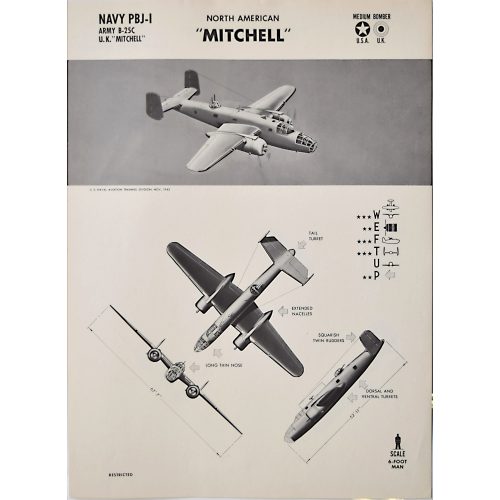
    B-25 Bomber North American Mitchell World War 2 US airplane

    Original aeroplane identification poster, 1942 63 x 47 cm A particularly unusual style of aeroplane identification poster, owing to the very arty images. Most such posters rely on very plain silhouettes, this series - and we have several in this series - have a much more arty approach to the task with shading and an interesting angle view. Manufactured by North American Aviation and named in honour of Major General William 'Billy' Mitchell, a pioneer of US military aviation its first flight was in 1940 but it remained in service until 1979 (in the Indonesian air force). A particularly durable aircraft, one from the 321st Bomb Group was nicknamed 'Patches' on account of its (by the end of the war) 400 patched holes which had been painted with bright-yellow zinc chromate primer. Having completed over 300 missions and belly-landed six times the airframe was so distorted that 'straight-and-level' flight involved 8 degrees of left aileron trim and 6 degrees of right rudder causing the aircraft to 'crab' sideways through the air. Over one hundred B-25 Mitchells survive, with about 45 still airworthy. Seventeen flyable aircraft (and one hulk which was sacrificed to a crash scene) starred in the 1970 film 'Catch 22' fifteen of which still exist. If you are interested, please email info@manningfineart.co.uk or call us on 07929 749056.
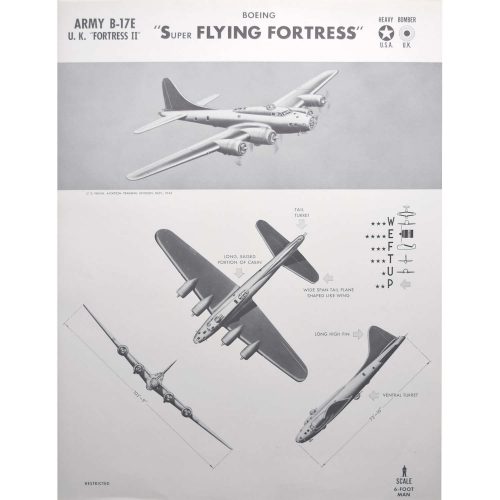
  • B-17E Boeing "Super Flying Fortress"

      World War II US and UK heavy bomber plane Original aeroplane recognition poster (1942) 63 x 47 cm A particularly unusual style of aeroplane identification poster, owing to the very arty images. Most such posters rely on very plain silhouettes, this series - and we have several in this series; view them here - have a much more arty approach to the task with shading and an interesting angle view. The Boeing B-17 Flying Fortress is a four-engined heavy bomber developed in the 1930s for the United States Army Air Corps. From its introduction in 1938, the B-17 Flying Fortress evolved through numerous design advances, becoming the third-most produced bomber of all time. The B-17 was primarily employed by the United States Army Air Forces in the daylight strategic bombing campaign of World War II against German industrial, military and civilian targets. The B-17 also participated to a lesser extent in the Pacific War, early in World War II, where it conducted raids against Japanese shipping and airfields. In 1935 it was simply known as the Model 299. Seattle Times reporter Richard Smith dubbed the new plane, with its many machine-gun mounts, the “Flying Fortress,” and Boeing quickly adopted and trademarked the name. Condition: generally very good, occasional handling marks. If you’d like to know more, please email info@manningfineart.co.uk or call us on 07929 749056.
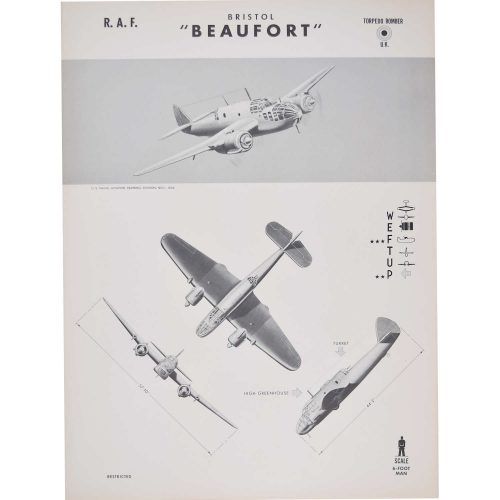
  • Bristol Beaufort Torpedo Bomber

    US Naval Aviation Training Division Original aeroplane recognition poster (1942) 63 x 47 cm A particularly unusual style of aeroplane identification poster, owing to the very arty images. Most such posters rely on very plain silhouettes, this series - and we have several in this series; view them here - have a much more arty approach to the task with shading and an interesting angle view. The Bristol Beaufort (manufacturer designation Type 152) was a British twin-engined torpedo bomber designed by the Bristol Aeroplane Company, and developed from experience gained designing and building the earlier Blenheim light bomber. At least 1,180 Beauforts were built by Bristol and other British manufacturers. The Australian government''s Department of Aircraft Production (DAP) also manufactured variants of the Beaufort. These are often known collectively as the DAP Beaufort. More than 700 Australian-built Beauforts saw service with the Royal Australian Air Force in the South West Pacific theatre, where they were used until the end of the war. Beauforts first saw service with Royal Air Force Coastal Command and then the Royal Navy Fleet Air Arm from 1940. They were used as torpedo bombers, conventional bombers and mine-layers until 1942, when they were removed from active service and were then used as trainer aircraft until being declared obsolete in 1945. Beauforts also saw considerable action in the Mediterranean; Beaufort squadrons based in Egypt and on Malta helped interdict Axis shipping supplying Rommel's Deutsches Afrikakorps in North Africa. Although it was designed as a torpedo-bomber, the Beaufort was more often used as a medium day bomber. The Beaufort also flew more hours in training than on operational missions and more were lost through accidents and mechanical failures than were lost to enemy fire. The Beaufort was adapted as a long-range heavy fighter variant called the Beaufighter, which proved to be very successful and many Beaufort units eventually converted to the Beaufighter. Condition: good. If you’d like to know more, please email info@manningfineart.co.uk or call us on 07929 749056.
  • US Naval Aviation Training Division

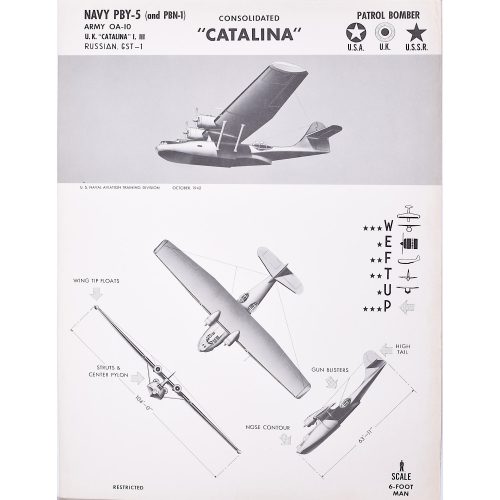
    Consolidated PBY Catalina World War 2 US airplane

    Aeroplane identification poster, 1942 63 x 47 cm A particularly unusual style of aeroplane identification poster, owing to the very arty images. Most such posters rely on very plain silhouettes, this series - and we have several in this series (click here) - have a much more arty approach to the task with shading and an interesting angle view. The PBY Catalina is a flying boat used extensively during World War 2 in anti-submarine patrols, air-sea rescue, patrol bombing and convoy escort. It served militarily until the 1980s and was still being used in the 2010s as a waterbomber for firefighting. The RCAF called it the Canso. If you are interested, please email info@manningfineart.co.uk or call us on 07929 749056.
Go to Top