-

Ronald Fielding Dodd (1890-1958)
St Edmund Hall - 1932 Proposed alterations to 46 & 47 High Street
Architectural Reproduction 55 x 41 cm Ronald Fielding Dodd ARIBA was a Scottish architect and Associate of the Royal Institute of British Architects. After serving as a Second Lieutenant in the British Army’s Machine Gun Corps during the First World War, Dodd was most active as an architect in the 1930s. Over the course of the decade, he contributed designs for St Peter’s College, Oxford; St Edmund Hall, Oxford; Stowe School; the Acland Hospital in North Oxford, where he added a Neo-Georgian frontage; and the 16th-century Chippinghurst Manor in Oxfordshire. To mark his architectural achievements, there is now a Fielding Dodd Prize for “Outstanding Work” involving architecture at Oxford Brookes University. These particular plans date from 1932 and depict the proposed alterations to 46 and 47 High Street, belonging to St Edmund Hall, Oxford. Condition: Generally very good, thin paper with some wear. For other views of St Edmund Hall, click here. -

Ronald Fielding Dodd (1890-1958)
St Edmund Hall - 1933 Proposed Alterations W.C.
Reproduction with hand colouring 33 x 42 cm Ronald Fielding Dodd ARIBA was a Scottish architect and Associate of the Royal Institute of British Architects. After serving as a Second Lieutenant in the British Army’s Machine Gun Corps during the First World War, Dodd was most active as an architect in the 1930s. Over the course of the decade, he contributed designs for St Peter’s College, Oxford; St Edmund Hall, Oxford; Stowe School; the Acland Hospital in North Oxford, where he added a Neo-Georgian frontage; and the 16th-century Chippinghurst Manor in Oxfordshire. To mark his architectural achievements, there is now a Fielding Dodd Prize for “Outstanding Work” involving architecture at Oxford Brookes University. These particular plans date from 1933 and depict the proposed alterations to the accommodation W.C. Hand coloured with vibrant colours, these plans transform their modest subject into something quite beautiful. Condition: Generally very good, thin paper with some wear. For other views of St Edmund Hall, click here. -

Ronald Fielding Dodd (1890-1958)
St Edmund Hall - 1930 Proposed Extensions to Chapel and Library
Reproduction with hand colouring 54 x 40 cm Ronald Fielding Dodd ARIBA was a Scottish architect and Associate of the Royal Institute of British Architects. After serving as a Second Lieutenant in the British Army’s Machine Gun Corps during the First World War, Dodd was most active as an architect in the 1930s. Over the course of the decade, he contributed designs for St Peter’s College, Oxford; St Edmund Hall, Oxford; Stowe School; the Acland Hospital in North Oxford, where he added a Neo-Georgian frontage; and the 16th-century Chippinghurst Manor in Oxfordshire. To mark his architectural achievements, there is now a Fielding Dodd Prize for “Outstanding Work” involving architecture at Oxford Brookes University. These particular plans date from 1930 and depict the proposed extensions to the Chapel and the Library. Condition: Generally very good, thin paper with some wear. For other views of St Edmund Hall, click here. -

Louis Osman
Plans for workshops at Canon's Ashby
Pen, ink and pencil 50 x 38 cm Louis Osman (30 January 1914 – 11 April 1996) was an architect, artist, goldsmith, silversmith and medallist. Few people matched his creations as a goldsmith, and consequently he was chosen to make the crown for the Investiture of the Prince of Wales in 1968. Many of his other works are in public collections in the UK and worldwide. After Hele’s school in Exeter he studied at the Bartlett School of Architecture – part of University College London – from 1931. Also attending the Slade, he left the Bartlett being awarded the top first, which brings with it the Donaldson Medal of the RIBA. ollowing the war he was busy as an architect, works including for Westminster Abbey, and Lincoln, Exeterm, Ely and Lichfield Cathedrals. Staunton Harold Church in Ashby de la Zouch for the National Trust, and of course his own folly, the Grade I listed Elizabethan manor house, Canons Ashby in Northamptonshire – which was given to the National Trust in 1981 when Osman was not able to keep the tenancy any longer. At Canons Ashby, the plans of which are shown here, he established a workshop and had a team of silversmiths and goldsmiths working for him. In 1974 he created the exhibition celebrated by this lavishly illustrated catalogue. His 1969 crown for the Investiture of the Prince of Wales was on display, together with many other items of his own creation, and also by other silversmiths such as Malcolm Green, Philip Noaks and Stephen Nunn, also acknowledging the work of Desmond Clenn-Murphy, Peter Musgrove and Christopher Philipson in his own works. Condition: Very good, on tracing paper; five sheets -

Gavin Stamp (1948-2018) Christmas Card, 1975 - St Martin's Military Church, Delhi
Ballpoint pen and ink 21 x 20 cm Born in 1948, Gavin Stamp was educated on a London County Council Scholarship at Dulwich College and took a degree in history and architectural history at Cambridge. He moved to London in 1972 and worked as an architectural draughtsman and graphic designer, combining this with journalism and cataloguing at the RIBA drawings collection. By the late 1970s he was describing himself as ‘an odd-job man in the vicious cut-throat world of architectural history’. Over the course of his career, his scholarship and enthusiasm promoted the understanding and celebration of several great but neglected architects, while he also succeeded in saving many 19th and 20th century buildings from demolition. Sourced from his estaste, Gavin Stamp designed this Christmas card depicting St Martin's Military Church, Delhi in the winter of 1975. The pared back aesthetic allows us to appreciate the neatness of the parallel dashes and the pleasing pointillist effect created across the trees. -

Joseph Constantine Stadler (1755 - 1828) after Joseph Farington (1747-1821)
Oxford High Street with Queen's College and University College
Engraving with hand colouring 22 x 33 cm Published by J & J Boydell. Joseph Constantine Stadler was a prolific German émigré engraver of images after his contemporaries - here, 18th-century English landscape painter and diarist Joseph Farington. Stadler's engravings are wide-ranging in subject matter and include landscapes, seascapes and portraits, as well as military, sporting and decorative subjects. Stadler was employed by the leading print publisher of the time, John Boydell. Stadler lived in Knightsbridge when he died at the age of 73. Joseph Farington was born in Lancashire and went to study with Richard Wilson in London in 1763. In 1764, 1765, and 1766 he won “premiums” from the Society of Artists for his landscape drawing; he became a member in 1765. He joined the Royal Academy when it was founded in 1769 and was elected an ARA in 1783 and an RA in 1785. Farington contributed works to the Academy’s exhibitions every year until 1801, but only occasionally between 1801 and 1813. He was an active member of the Academy and sat on several important committees, including the one which determined where artworks would be hung during the exhibitions. In 1793 he became a fellow of the Society of Antiquaries and helped establish the British Institution. This particular edition depicts a view down Oxford High Street with Queen's College and University College in the eighteenth century. The hand colouring lends a unique charm to this engraving, where the light colours and calm streets suggest the sereneness of the start of an Oxford summer day. Condition: very good. If you are interested, please email info@manningfineart.co.uk or call us on 07929 749056. For other general views of Oxford, click here. -

William Nicholson (1872 - 1949)
St John's College, Oxford II
Lithograph 21 x 36 cm Signed in ink, illegibly inscribed (by Nicholson), and with Stafford Gallery blindstamp to bottom right. S ir William Nicholson was a British painter and printmaker. He is also known as an illustrator, author of children’s books, stained glass designer, and theatre set designer. Between 1902 and 1904 William Nicholson lived in Woodstock; during this period he made several architectural studies of Oxford's colleges and other University buildings. It was during this period that he produced this lithograph of a bucolic scene at St John's. The grass is green, the trees are blowing in the wind and the charm of this Oxford college radiates throughout. Condition: Generally very good, slight even toning to paper; old tape stain to margin which will be under the mount If you are interested, please email info@manningfineart.co.uk or call us on 07929 749056. Click here for other views of St John's College, Oxford. -

William Nicholson (1872 - 1949)
St John's College, Oxford
Lithograph 39 x 28 cm Signed in ink, numbered 123, and with Stafford Gallery blindstamp to bottom right. Sir William Nicholson was a British painter and printmaker. He is also known as an illustrator, author of children’s books, stained glass designer, and theatre set designer. Between 1902 and 1904 William Nicholson lived in Woodstock; during this period he made several architectural studies of Oxford's colleges and other University buildings. It was during this period that he produced this striking lithograph of St John's College, capturing a dark academic aura through his use of sombre hues. Condition: Generally very good, slight even toning to paper; old tape stain to margin which will be under the mount If you are interested, please email info@manningfineart.co.uk or call us on 07929 749056. Click here for other views of St John's College, Oxford. -

London Underground
'Return Tickets At Single Fare'
20 x 61cm Advertising panel for Metropolitan Line compartment stock 1930s-1950s. Cut down at corners as very often, a sign of being in use on the Metropolitan Line. The simple typography of Edward Johnstone's typeface, developed specially for London Transport, with his absolutely excellent and highly distinctive lower-case 'g' is a joy to behold. In constant use since 1916 it is one of the oldest examples of unchanged corporate branding. Johnstone's pupil Eric Gill adapted the typeface for his own ubiquitous 'Gill Sans'. -

Cyril Kenneth Bird ‘Fougasse’ (1887 - 1965)
Careless Talk Costs Lives (circa 1940)
Lithographic Poster Collection 31 x 40 cm each [62 x 80 cm overall]"Strictly between you and me..."; "...but for Heaven's sake, don't say I told you!"; "Don't forget the walls have ears!" - This collection of posters brings together a series of Fougasse's snappy slogans, all to the backdrop of various Hitlers hiding under tables, melding with the wallpaper, and even replacing the historical figures in the traditional portrait featured. Through this public information messaging, Fougasse aimed to remind his contemporaries not to discuss secrets which may be of use to the enemy. Fougasse was a British cartoonist. He was art editor of Punch between 1937 and 1949, and subsequently editor until 1953. He is best known for his ‘Careless Talk Costs Lives’ series of posters, and the other posters for the Ministry of Information and London Transport. As the Second World War progressed, the Ministry of Information’s poster campaign had become less and less effective. There were posters instructing the population to save old clothes for rags, turn off the lights, save food, dig for victory, watch out for spies, and keep calm and carry on. With this instruction overload, the population had ceased paying attention to the posters. Fougasse noticed this, and offered his services unpaid to the Ministry of Information, with a view to bringing a touch of humour to the posters. His amusing designs with pithy captions, reminiscent of newspaper cartoons, helped to get the Ministry's messages across in a novel way. Fougasse's distinctive poster style, with the red border, was subsequently adopted by other Ministry artists.Condition: Very good; slight age toning. This is the version on thin paper. If you are interested, please email info@manningfineart.co.uk or call us on 07929 749056. Click here for other works by the artist. -

David Loggan (1634-1692)
Prospectus Cantabrigiae Orientalis & Occidentalis
Engraving 32 x 46 cm Loggan was born to English and Scottish parents, and was baptised in Danzig in 1634. After studying engraving in Danzig with Willem Hondius (1598-1652 or 1658), he moved to London in the late 1650s, going on to produce the engraved title-page for the folio 1662 Book of Common Prayer. He married in 1663 and moved to Nuffield in Oxfordshire in 1665. Loggan was appointed Public Sculptor to the nearby University of Oxford in the late 1660s, having been commissioned to produce bird’s-eye views of all the Oxford colleges. He lived in Holywell Street as he did this. The 'Oxonia Illustrata' was published in 1675, with the help of Robert White (1645-1704). Following its completion, Loggan began work on his equivalent work for Cambridge; the 'Cantabrigia Illustrata' was finally published in 1690, when he was made engraver to Cambridge University. The 'Oxonia Illustrata' also includes an engraving of Winchester College (Winchester and New College share William of Wykeham as their founder) whilst the 'Cantabrigia Illustrata' includes one of Eton College (which shares its founder, Henry VIII, with King’s College). Bird’s-eye views from this era required a particular talent as an architectural perspectivist; it was not until 1783 that it became possible for artists to ascend via hot air balloons and view the scenes they were depicting from above. Loggan thus had to rely on his imagination in conceiving the views. Loggan’s views constitute the first accurate depictions of the two Universities, in many ways unchanged today. Whilst the Oxford engravings were produced in reasonable numbers and ran to a second edition by Henry Overton (on thicker paper and with a plate number in Roman numerals in the bottom right-hand corner), those of Cambridge were printed in much smaller numbers. The Dutchman Pieter van der Aa published some miniature versions of the engravings for James Beverell’s guidebook to the UK, 'Les Delices de la Grande Bretagne' (c. 1708). The contemporary artist Andrew Ingamells (b.1956) has produced a highly-acclaimed series of etchings which bring Loggan’s original vision up to date. This particular edition represents a unique view of Cambridge from the east and the west. Notable landmarks including King's Chapel and Great St Mary's Church are visible in this fine David Loggan engraving. Condition: Good; five small invisibly repaired holes to image If you are interested, please email info@manningfineart.co.uk or call us on 07929 749056. For other general views of Cambridge, click here. -

Lance Cattermole (1898-1992)
St John's College, Cambridge
Gouache 37 x 50 cm Lance Cattermole was born in Ireland in 1898 to a long line of artists. At the age of 24, Cattermole began his studies at the Central School of Arts and Crafts (1922-3), before continuing at the prestigious Slade School of fine art (1923–6), under such artists as Henry Tonks and Philip Wilson Steer. As well as various travel posters, notably advertising rail travel in England, he also went on to create numerous paintings of famous military figures, many of which are now on display at the National Army Museum. This vibrant gouache was painted for an unknown purpose, perhaps for a guidebook cover. It presents an idyllic view of the River Cam running through St John's College. The orange-browns of the tree leaves suggest autumn, but the beaming sun and blue water are more evocative of a bucolic summer day: the perfect painting to brighten up any room. Condition: very good. If you are interested, please email info@manningfineart.co.uk or call us on 07929 749056. Click here for other views of St John's College, Cambridge. -
 Harry Charles Beck (1902-1974) London Underground Railways Pocket Map 1936 No. 2 Lithograph 14.5 x 20.5 cm An early edition of Beck's iconic map, precursor to all other similar maps of other transport systems worldwide. The 1936 edition is very similar to the 1933 first published. Beck was a technical draughtsman who worked for the London Metro Signal Office. Following being fired, he created the first diagrammatic Tube map in 1931. Having submitted it to the Publicity Office at London Transport, it was rejected. However an updated proposal was accepted, being published in January 1933 in an edition of 700,000 pocket maps - most of which were consigned to the dustbin within hours, days or weeks. Those that survive are rare. Immediately popular it was adopted and similar maps have been used ever since by London Transport - and indeed many other rail systems worldwide. Beck was inspired whilst creating an electrical circuit diagram to apply the same concept to the Underground system, in the understanding that passengers on the network were more interested in how the lines related to each other, than in how they related to the topography of the city. Beck worked on the map in his spare time, and was - depending on the story you believe - either not paid for his work, or was paid a mere five or ten guineas. These days his work is acknowledged on all published London Transport maps.
 -
 'Zero' Hans Schleger London Underground Railways Pocket Map 1938 No. 2 Lithograph 14.5 x 20.5 cm An early edition of London Transport's iconic map, precursor to all other similar maps of other transport systems worldwide. The 1938 edition was designed by Hans Schleger, unlike the 1933 - first published - edition of Harry Beck. Beck was furious that his design had been given to Schleger and by 1941 responsibility returned to Beck. Hans Schleger was born in Germany. After the First World War, he studied at the Berlin Kunstgewerbeschule. After working in Berlin, he moved to New York in 1924 and began to work as a graphic designer. He returned to Berlin in 1929 and began working for the British advertising agency Crawfords, where he met Edward McKnight Kauffer, who introduced him to Jack Beddington (the head of advertising at Shell Mex BP). He moved to London following the rise of Hitler and produced a series of posters for Shell Mex. During the Second World War he worked for the British Government. He later taught at the Chicago Institute of Design and subsequently designed the trademarks of the John Lewis Partnership, Penguin, Deutsche Bank, and the Edinburgh Festival. Beck, on the other hand, was a technical draughtsman who worked for the London Metro Signal Office. After being fired, he created the first diagrammatic Tube map in 1931. Having submitted it to the Publicity Office at London Transport, it was rejected. However an updated proposal was accepted, being published in January 1933 in an edition of 700,000 pocket maps - most of which were consigned to the dustbin within hours, days or weeks. Those that survive are rare. Immediately popular it was adopted and similar maps have been used ever since by London Transport - and indeed many other rail systems worldwide. Beck was inspired whilst creating an electrical circuit diagram to apply the same concept to the Underground system, in the understanding that passengers on the network were more interested in how the lines related to each other, than in how they related to the topography of the city. Beck worked on the map in his spare time, and was - depending on the story you believe - either not paid for his work, or was paid a mere five or ten guineas. These days his work is acknowledged on all published London Transport maps.
 -

Julian Trevelyan (1910 - 1988)
Ufizzi Gallery (1966)
Etching and aquatint 47 x 34 cm (paper 80 x 57 cm) Trevelyan's vibrant kaleidoscopic depiction of the interior of the Uffizi, Florence. Numbered 61/100 lower left, titled below, and signed lower right, all in pencil. Condition: Excellent - this print is often rather faded; old tape damage to reverse in top centimetre of print. -

Rudolph Ackermann (1764-1831)
Crystal Palace - View from The North Bank of the Serpentine
Tinted Lithograph 31 x 46 cm A nineteenth-century view of Crystal Palace from the north bank of the Serpentine. This unique edition intriguingly captures the stir of movement across the bustling riverside promenade, with well-dressed ladies, horse-drawn carriages and chivalrous gentleman at the fore. Rudolph Ackermann was an Anglo-German bookseller, inventor, lithographer, publisher and businessman. In 1795 he established a print-shop and drawing-school at 96 Strand. Here, Ackermann set up a lithographic press and began a trade in prints. He later began to manufacture colours and thick carton paper for landscape and miniature painters. Within three years the premises had become too small and he moved to 101 Strand, in his own words "four doors nearer to Somerset House", the seat of the Royal Academy of Arts. Between 1797 and 1800 Ackermann rapidly developed his print and book publishing business, encompassing many different genres including topography, caricature, portraits, transparencies and decorative prints. -

Air France Vacances - Espagne
Original vintage poster 100 x 66 cm This Air France poster encourages French tourists to travel to Spain. Pictured is a woman dressed in traditional Spanish dress, holding a flag with the insignia of the airline. Conditi0n: Generally very good; small repaired areas to two top corners, approx 1 sq cm, small old tape stains to reverse at bottom corners. If you are interested, please email info@manningfineart.co.uk or call us on 07929 749056. Click here for other original vintage travel posters. -

British Airways Holidays
Concorde Vacations (1999)
Original Vintage Lithographic Poster 92 x 61 cm Original vintage travel poster, advertising Concorde Vacations by British Airways Holidays and featuring an image of an iconic Concorde plane flying through the night. This unique edition a stunning image of the supersonic passenger plane Concorde, set against a night-time backdrop and framed almost as if a rocket shooting through space. The aircraft was originally developed and manufactured jointly between the British Aircraft Corporation and the French airline company Sud-Aviation. The aircraft was capable of flying at a maximum speed over twice the speed of sound (taking less than 3.5 hours to fly the London to New York route but costing over 30 times more than a regular plane ticket). Although the venture ultimately ended in tragedy, with the fatal crash in July 2000, their speed and luxury distinguished the planes as an icon of modernity. -
Out of stock

Cyril Kenneth Bird ‘Fougasse’ (1887 - 1965)
Jump for Them
Lithographic poster 30 x 22 cm Fougasse was a British cartoonist. He was art editor of Punch between 1937 and 1949, and subsequently editor until 1953. He is best known for his ‘Careless Talk Costs Lives’ series of posters, and the other posters for the Ministry of Information and London Transport. As the Second World War progressed, the Ministry of Information’s poster campaign had become less and less effective. There were posters instructing the population to save old clothes for rags, turn off the lights, save food, dig for victory, watch out for spies, and keep calm and carry on. With this instruction overload, the population had ceased paying attention to the posters. Fougasse noticed this, and offered his services unpaid to the Ministry of Information, with a view to bringing a touch of humour to the posters. His amusing designs with pithy captions, reminiscent of newspaper cartoons, helped to get the Ministry's messages across in a novel way.Fougasse's distinctive poster style, with the red border- as seen in this poster-was subsequently adopted by other Ministry artists. In this poster, taken from The Art of Refereeing, Fougasse depicts a man hurling a book in the direction of a scrum, drawing an intriguing analogy between sports and literary culture.Condition: backed to linen; generally excellent. If you are interested, please email info@manningfineart.co.uk or call us on 07929 749056. Click here for other works by the artist. -

Cyril Kenneth Bird ‘Fougasse’ (1887 - 1965)
The Indispensables
Lithographic poster 30 x 22 cm Fougasse was a British cartoonist. He was art editor of Punch between 1937 and 1949, and subsequently editor until 1953. He is best known for his ‘Careless Talk Costs Lives’ series of posters, and the other posters for the Ministry of Information and London Transport. As the Second World War progressed, the Ministry of Information’s poster campaign had become less and less effective. There were posters instructing the population to save old clothes for rags, turn off the lights, save food, dig for victory, watch out for spies, and keep calm and carry on. With this instruction overload, the population had ceased paying attention to the posters. Fougasse noticed this, and offered his services unpaid to the Ministry of Information, with a view to bringing a touch of humour to the posters. His amusing designs with pithy captions, reminiscent of newspaper cartoons, helped to get the Ministry's messages across in a novel way.Fougasse's distinctive poster style, with the red border- as seen in this poster-was subsequently adopted by other Ministry artists.Condition: backed to linen; generally excellent. If you are interested, please email info@manningfineart.co.uk or call us on 07929 749056. Click here for other works by the artist. -
 Carlos Ruano Llopis (1878-1950) Original Vintage Bullfighting Poster August 1955 107cm x 53cm Carlos Ruano Llopis was born in 1878 in Orba, Spain where he would become a celebrated painter and bullfighting poster artist. He began his career in a fan-making workshop to support his family. In 1909, he won the gold medal at the Regional Exhibition, allowing him to enjoy a scholarship to further his studies in Italy. From here onwards, he began to develop his characteristic bullfighting motif. This obsession with bulls was perhaps borne out of his own desire to pursue glory as a matador, an ambition he only curbed in deference to his beloved mother. The vivacity of his bullfighting posters became his trademark and, on one occasion, the prodigious matador Joselito “Gallo” even proclaimed, ‘the artist who painted this knows how to bullfight, even if he has never fought bulls before.’ Bright colours, movement and a sense of passion bring these posters to life, offering a uniquely Spanish charm. This 1955 edition advertises a bullfighting event in Valencia, featuring Rafael Ortega, Isidro Ortuño Jumillano, and the much celebrated Antonio Chenel Antoñete. This poster is striking in the vibrancy of the colours and the strong sense of movement, as Llopis masterfully captures the force of the bull charging through the matador's cloth.
 -
 Carlos Ruano Llopis (1878-1950) Original Vintage Bullfighting Poster July 1941 107cm x 53cm Carlos Ruano Llopis was born in 1878 in Orba, Spain where he would become a celebrated painter and bullfighting poster artist. He began his career in a fan-making workshop to support his family. In 1909, he won the gold medal at the Regional Exhibition, allowing him to enjoy a scholarship to further his studies in Italy. From here onwards, he began to develop his characteristic bullfighting motif. This obsession with bulls was perhaps borne out of his own desire to pursue glory as a matador, an ambition he only curbed in deference to his beloved mother. The vivacity of his bullfighting posters became his trademark and, on one occasion, the prodigious matador Joselito “Gallo” even proclaimed, ‘the artist who painted this knows how to bullfight, even if he has never fought bulls before.’ Bright colours, movement and a sense of passion bring these posters to life, offering a uniquely Spanish charm. This 1941 edition advertises a bullfighting event in Valencia, featuring Marcial Lalanda, Manuel Rodriguez Manolete - often considered one of the greatest bullfighters of all time -, and Manolo Martín Vazquez.
 -
 Carlos Ruano Llopis (1878-1950) Original Vintage Bullfighting Poster June 1947 107cm x 53cm Carlos Ruano Llopis was born in 1878 in Orbs, Spain where he would become a celebrated painter and bullfighting poster artist. He began his career in a fan-making workshop to support his family. In 1909, he won the gold medal at the Regional Exhibition, allowing him to enjoy a scholarship to further his studies in Italy. From here onwards, he began to develop his characteristic bullfighting motif. This obsession with bulls was perhaps borne out of his own desire to pursue glory as a matador, an ambition he only curbed in deference to his beloved mother. The vivacity of his bullfighting posters became his trademark and, on one occasion, the prodigious matador Joselito “Gallo” even proclaimed, ‘the artist who painted this knows how to bullfight, even if he has never fought bulls before.’ Bright colours, movement and a sense of passion bring these posters to life, offering a uniquely Spanish charm. This 1947 edition advertises a bullfighting event in Granada, featuring Domingo Ortega, Agustin Parra Parrita, and the famous socialite Luis Miguel Dominguin.
 -
 Juan Reus (1912-2003) Original Vintage Bullfighting Poster May 1954 107cm x 53cm Juan Reus was born in 1912 in Valencia, where he became a well-known painter, draftsman and, notably, graphic designer of bullfighting posters. Orphaned at birth, Reus attended school until the age of seven, at which point he began work as an apprentice at a local hardware store, where he met the painter Constantino Gómez, piquing his artistic interests. He later went to work in a decorative fans shop and held his first exhibition in the bazaars of Prats and Collado in Valencia. In the 1940s, he was hired as a graphic designer of bullfighting posters in the lithographic Ortega workshop. These posters are generally characterised by bright colours and fluid, gestural movements, whereby the swish of the matador's cloak is almost palpable. This 1954 edition advertises a bullfighting event in Madrid, featuring Isidro Ortuño Jumillano, Julio Aparicio Martínez and, the famed, Antonio Chenel Antoñete.
 -
 Juan Reus (1912-2003) Original Vintage Bullfighting Poster April 1955 107cm x 53cm Juan Reus was born in 1912 in Valencia, where he became a well-known painter, draftsman and, notably, graphic designer of bullfighting posters. Orphaned at birth, Reus attended school until the age of seven, at which point he began work as an apprentice at a local hardware store, where he met the painter Constantino Gómez, piquing his artistic interests. He later went to work in a decorative fans shop and held his first exhibition in the bazaars of Prats and Collado in Valencia. In the 1940s, he was hired as a graphic designer of bullfighting posters in the lithographic Ortega workshop. These posters are generally characterised by bright colours and fluid, gestural movements, whereby the swish of the matador's cloak is almost palpable. This 1955 edition advertises a bullfighting event in Malaga, featuring Rafael Ortega, Miguel Baez Litri and Cesar Giron.
 -
 Juan Reus (1912-2003) Original Vintage Bullfighting Poster March 1944 107cm x 53cm Juan Reus was born in 1912 in Valencia, where he became a well-known painter, draftsman and, notably, graphic designer of bullfighting posters. Orphaned at birth, Reus attended school until the age of seven, at which point he began work as an apprentice at a local hardware store, where he met the painter Constantino Gómez, piquing his artistic interests. He later went to work in a decorative fans shop and held his first exhibition in the bazaars of Prats and Collado in Valencia. In the 1940s, he was hired as a graphic designer of bullfighting posters in the lithographic Ortega workshop. These posters are generally characterised by bright colours and fluid, gestural movements, whereby the swish of the matador's cloak is almost palpable. This 1944 edition advertises a bullfighting event in Castellón, featuring Pepe Luis Vazquez, Rafael Ortega Gallito and Manuel Alvarez Andaluz.
 -
 Juan Reus (1912-2003) Original Vintage Bullfighting Poster September 1942 107cm x 53cm Juan Reus was born in 1912 in Valencia, where he became a well-known painter, draftsman and, notably, graphic designer of bullfighting posters. Orphaned at birth, Reus attended school until the age of seven, at which point he began work as an apprentice at a local hardware store, where he met the painter Constantino Gómez, piquing his artistic interests. He later went to work in a decorative fans shop and held his first exhibition in the bazaars of Prats and Collado in Valencia. In the 1940s, he was hired as a graphic designer of bullfighting posters in the lithographic Ortega workshop. These posters are generally characterised by bright colours and fluid, gestural movements, whereby the swish of the matador's cloak is almost palpable. This 1942 edition advertises a bullfighting event, featuring Marcial Lalanda, Manuel Rodriguez Manolete - often considered one of the greatest bullfighters of all time -, Pepe Luis Vázquez and Juan Mari Peréz Taberno.
 -
 Harry Charles Beck (1902-1974) London Underground Railways Pocket Map September 1933 Lithograph 14.5 x 20.5 cm An edition from the first year of publication of Beck's iconic map, precursor to all other similar maps globally. This reimagining of the tube map constituted a veritable departure from earlier maps, stripping the sprawling Tube network down to a neat diagram of coloured, criss-crossing lines. Harry Beck was a technical draughtsman who worked for the London Metro Signal Office. Following being fired, he created the first diagrammatic Tube map in 1931. Having submitted it to the Publicity Office at London Transport, it was rejected. However an updated proposal was accepted, being published in January 1933 in an edition of 700,000 pocket maps - most of which were consigned to the dustbin within hours, days or weeks. Those that survive are rare. Immediately popular it was adopted and similar maps have been used ever since by London Transport - and indeed many other rail systems worldwide. Beck was inspired whilst creating an electrical circuit diagram to apply the same concept to the Underground system, in the understanding that passengers on the network were more interested in how the lines related to each other, than in how they related to the topography of the city. Beck worked on the map in his spare time, and was - depending on the story you believe - either not paid for his work, or was paid a mere five or ten guineas. These days his work is acknowledged on all published London Transport maps.
 -
 Harry Charles Beck (1902-1974) London Underground Railways Pocket Map 1936 No. 1 Lithograph 14.5 x 20.5 cm An early edition of Beck's iconic map, precursor to all other similar maps of other transport systems worldwide. The 1936 edition is very similar to the 1933 first published. Beck was a technical draughtsman who worked for the London Metro Signal Office. Following being fired, he created the first diagrammatic Tube map in 1931. Having submitted it to the Publicity Office at London Transport, it was rejected. However an updated proposal was accepted, being published in January 1933 in an edition of 700,000 pocket maps - most of which were consigned to the dustbin within hours, days or weeks. Those that survive are rare. Immediately popular it was adopted and similar maps have been used ever since by London Transport - and indeed many other rail systems worldwide. Beck was inspired whilst creating an electrical circuit diagram to apply the same concept to the Underground system, in the understanding that passengers on the network were more interested in how the lines related to each other, than in how they related to the topography of the city. Beck worked on the map in his spare time, and was - depending on the story you believe - either not paid for his work, or was paid a mere five or ten guineas. These days his work is acknowledged on all published London Transport maps.
 -
 Harry Charles Beck (1902-1974) London Underground Railways Pocket Map 1937 No. 1 Lithograph 14.5 x 20.5 cm An early edition of Beck's iconic map, precursor to all other similar maps of other transport systems worldwide. The 1937 edition is very similar to the 1933 first published, though is distinguishable from other editions of the period by its thinner lines and use of circles instead of diamonds for connecting stations. Beck was a technical draughtsman who worked for the London Metro Signal Office. Following being fired, he created the first diagrammatic Tube map in 1931. Having submitted it to the Publicity Office at London Transport, it was rejected. However an updated proposal was accepted, being published in January 1933 in an edition of 700,000 pocket maps - most of which were consigned to the dustbin within hours, days or weeks. Those that survive are rare. Immediately popular it was adopted and similar maps have been used ever since by London Transport - and indeed many other rail systems worldwide. Beck was inspired whilst creating an electrical circuit diagram to apply the same concept to the Underground system, in the understanding that passengers on the network were more interested in how the lines related to each other, than in how they related to the topography of the city. Beck worked on the map in his spare time, and was - depending on the story you believe - either not paid for his work, or was paid a mere five or ten guineas. These days his work is acknowledged on all published London Transport maps.
 -
 Fred Stingemore (1890-1954) London Underground Railways Pocket Map January 1927 Lithograph, linen-based card Bi-fold pocket map 12.5 x 15 cm (unfolded) Stingemore spent forty years in the London Transport drawing office, but is best known as the artist behind the map that preceded Harry Beck's famous and iconic 1933 new design - the circuit diagram version. The 1927 edition is identical to that of 1926, but features a yellow - rather than green - cover. The twelve editions of Stingemore's map featured different coloured covers. A broadly topographical map, he nevertheless distorted the central London area to make it clearer. His greatest claim to fame is of encouraging Harry Beck to resubmit his own design to London Transport. Beck was a technical draughtsman who worked for the London Metro Signal Office. Following being fired, he created the first diagrammatic Tube map in 1931. Having submitted it to the Publicity Office at London Transport, it was rejected. However an updated proposal was accepted, being published in January 1933 in an edition of 700,000 pocket maps - most of which were consigned to the dustbin within hours, days or weeks. Those that survive are rare. Immediately popular it was adoped and similar maps have been used ever since by London Transport - and indeed many other rail systems worldwide. Beck was inspired whilst creating an electrical circuit diagram to apply the same concept to the Underground system, in the understanding that passengers on the network were more interested in how the lines related to each other, than in how they related to the topography of the city. Beck worked on the map in his spare time, and was - depending on the story you believe - either not paid for his work, or was paid a mere five or ten guineas. These days his work is acknowledged on all published London Tranport maps.
 -
 Genevieve Moreau (French, fl. early Twentieth Century) Three Designs in Blue Gouache 32 x 50 cm c. 1925 Signed in pencil; from a small portfolio of well-executed designs by the artist that we have listed, created in 1925-26. A well-executed design by one of the increasing number of French artists of the time.
 -
 Genevive Moreau (French, fl. early Twentieth Century) Ar - Triangles in Green, Blue and Terracotta (c. 1925) Gouache 22 x 16 cm Signed in pencil; from a small portfolio of well-executed designs by the artist that we have listed, created 1925-26. Sheet size 31 x 24 cm. A well-executed design by one of the increasing number of French artists of the time.
 -
 Лауреаты Государственных Премий [State Prizewinners] Moscow 1971 28 x 44 cm This folio introduces to the population of Soviet Russia the dozen winners of the State Prizes in 1971 for Literature, Art, and Architecture. "The awarding of the State Prizes of the USSR in 1971 to a large contingent of our creative intelligentsia is new evidence of the constant concern of the Communist Party of the Soviet Union for the further development of literature and art."
 -
 KUKRYNIKSY Новый «Болшой Скачок» Пекина [The new Great Leap of Peking [Beijing]] Moscow, Izadetelstvo 'Plakat' 1979 54 x 37 cm, 11 (of 12) posters loosely inserted in a printed paper portfolio featuring two further designs, two short tears to the portfolio spine, else fine. A striking series of posters with an anti-Mao tone, from the time of the Sino-Vietman war. Taking a satirical look at the process of modernization in China, a process that involves embracing imperialism and shunning world socialism and communist, to create a united anti-socialist front. The Kukryniksi - a portmanteau name derived from the names of the three artists, Mikhail Kupryanov (Ku), Porfiri Krylov (Kry), and Nikolai Sokolov (Niks) - are arguably the most successful Russian caricaturists. Favoured by the establishment, they were rarely privileged in being allowed to travel, producing views of Europe as well as a variety of spirited propaganda drawings in support of the Russian war effort, and illustrating many classic Russian texts.
 -
 KUKRYNIKSY Новый «Болшой Скачок» Пекина [The new Great Leap of Peking [Beijing]] Moscow, Izadetelstvo 'Plakat' 1977 54 x 37 cm, 12 posters loosely inserted in a printed paper portfolio featuring one further designs, portfolio lightly worn with numerous short tears, else fine. A dramatic collection of irreverent depictions of Imperialism in inimitable Kukryniksi style, from the 1970s. The posters pillory many prominent motifs of the 20th century, including Hitler, NATO, the BBC, and American civil rights. The Kukryniksi - a portmanteau name derived from the names of the three artists, Mikhail Kupryanov (Ku), Porfiri Krylov (Kry), and Nikolai Sokolov (Niks) - are arguably the most successful Russian caricaturists. Favoured by the establishment, they were rarely privileged in being allowed to travel, producing views of Europe as well as a variety of spirited propaganda drawings in support of the Russian war effort, and illustrating many classic Russian texts.
 -

Ernest Wallcousins (1882-1976) Keep Calm and Carry On (Medium size)
Ministry of Information Lithographic poster, 1939 50 x 37 cm ('Crown' size) Very rare - we have traced copies in the Imperial War Museum collection but no other public collection. Provenance: part of a small stock of posters cleared from a police station in Suffolk in the 1940s. These posters were generally sent out to police stations in groups of six or twelve. Shortly after the war, during a clear-out of the police station, these posters were put aside to be disposed of. A young police constable requested permission to take them home, and permission was granted. They spent the following nearly eight decades, surviving house moves and a long-suffering wife, sitting in a drawer. Following the policeman's death, his family have allowed the posters to be sold. As the small stock of posters at this police station came in all three sizes (small at 38 x 25 cm; medium at 38 x 50 cm; large at 75 x 50 cm) we are able to offer all three for sale today. An instantly-recognisable brand today, this poster was reserved for use in the event of the German invasion. Once it became obvious that they were not going to invade, these posters were sent back for recycling. As they were never used, the survivors are incredibly rare. Of public collections only the Imperial War Museum – which has a very extensive collection of wartime posters – has a copy of this poster. The story of the poster is well known these days, but bears repeating. In 1939, with invasion an ever-present threat, HM Government commissioned three posters with snippets designed to encourage the population. Bearing a crown at the top, it was clearly intended to be a message from the King: “Your Courage, Your Cheerfulness, Your Resolution, Will Bring Us Victory” was displayed widely, with hundreds of thousands being printed; similarly “Freedom is in Peril Defend it with all Your Might.” The third poster – “Keep Calm and Carry On” – was distributed, but was to be held back and only used in the event of invasion. In the event the poster campaign was not a great success, with the people regarding it as an instruction from the powers-that-be that it was the people, not the leaders, who were going to be the ones doing the hard work. As the invasion never happened, Hitler’s armies being otherwise occupied elsewhere in the world, and the Spitfire achieving victory in the Battle of Britain, the Keep Calm posters were never used. Owing to the shortage of raw materials, the paper was recycled and there the story should have ended. However, in 2000, the owner of Barter Books in Alnwick discovered a copy of the poster in the bottom of a box of books. They hung it up in their shop and started producing reproductions, and the poster has become an internationally recognised image, reproduced on mugs, t-shirts, and adapted into such uplifting slogans as “Keep Calm and Drink Tea”. A much more successful series of propaganda was created by ‘Fougasse’ – Cyril Bird. Picture editor of Punch from 1937-1949, then editor until 1953, he noted that the best sort of advertising would make people smile. He worked unpaid for the Ministry of Information during the war, producing cartoons with a short word of advise. His Careless Talk Costs Lives series of posters are amongst the most famous of the propaganda campaigns of the Second World War. -

Ernest Wallcousins (1882-1976) Keep Calm and Carry On (Small size)
Ministry of Information Lithographic poster, 1939 37 x 25 cm ('Crown Folio' size) Very rare - we have traced copies in the Imperial War Museum collection but no other public collection. Provenance: part of a small stock of posters cleared from a police station in Suffolk in the 1940s. These posters were generally sent out to police stations in groups of six or twelve. Shortly after the war, during a clear-out of the police station, these posters were put aside to be disposed of. A young police constable requested permission to take them home, and permission was granted. They spent the following nearly eight decades, surviving house moves and a long-suffering wife, sitting in a drawer. Following the policeman's death, his family have allowed the posters to be sold. As the small stock of posters at this police station came in all three sizes (small at 38 x 25 cm; medium at 38 x 50 cm; large at 75 x 50 cm) we are able to offer all three for sale today. An instantly-recognisable brand today, this poster was reserved for use in the event of the German invasion. Once it became obvious that they were not going to invade, these posters were sent back for recycling. As they were never used, the survivors are incredibly rare. Of public collections only the Imperial War Museum – which has a very extensive collection of wartime posters – has a copy of this poster. The story of the poster is well known these days, but bears repeating. In 1939, with invasion an ever-present threat, HM Government commissioned three posters with snippets designed to encourage the population. Bearing a crown at the top, it was clearly intended to be a message from the King: “Your Courage, Your Cheerfulness, Your Resolution, Will Bring Us Victory” was displayed widely, with hundreds of thousands being printed; similarly “Freedom is in Peril Defend it with all Your Might.” The third poster – “Keep Calm and Carry On” – was distributed, but was to be held back and only used in the event of invasion. In the event the poster campaign was not a great success, with the people regarding it as an instruction from the powers-that-be that it was the people, not the leaders, who were going to be the ones doing the hard work. As the invasion never happened, Hitler’s armies being otherwise occupied elsewhere in the world, and the Spitfire achieving victory in the Battle of Britain, the Keep Calm posters were never used. Owing to the shortage of raw materials, the paper was recycled and there the story should have ended. However, in 2000, the owner of Barter Books in Alnwick discovered a copy of the poster in the bottom of a box of books. They hung it up in their shop and started producing reproductions, and the poster has become an internationally recognised image, reproduced on mugs, t-shirts, and adapted into such uplifting slogans as “Keep Calm and Drink Tea”. The artist, Wallcousins, was an illustrator, official war artist of the Second World War, and painted the official victory portrait of Winston Churchill. A much more successful series of propaganda was created by ‘Fougasse’ – Cyril Bird. Picture editor of Punch from 1937-1949, then editor until 1953, he noted that the best sort of advertising would make people smile. He worked unpaid for the Ministry of Information during the war, producing cartoons with a short word of advise. His Careless Talk Costs Lives series of posters are amongst the most famous of the propaganda campaigns of the Second World War. -
 Orlov, V and Denisenko За успехи в труде [Success Through Work] (1978) Moscow, Izdaltelstvo Plakat Original vintage posters 43 x 56 cm A poster collection comprising twelve leaves loosely inserted in a printed paper portfolio, one plate previously folded, a little light wear to some fore-edges, light wear to portfolio spine, else very good. First edition. A collection of popular Soviet motifs on the enduring theme of Success through Work, created to provide best-practice design templates for artworkers, artists and propaganda designers responsible for the illustration of official Soviet literature and art, mosaics, wall-paintings, and posters. Motifs include Lenin, the distinctive logos of various Soviet bodies including the Young Guard, and medallions commemorating events such as the October revolution. Numerous medal-designs for individual and collective excellence in all kinds of industry, including farming, mining, husbandry, and machine-working also appear. Designed for eminently practical use, with cut-out lines between the individual vignettes, these pattern books rarely survived intact.
 -

Abram Games (1914-1996)
Guinness 5 Million Daily
Original vintage poster 152 x 102 cm This advertising poster dates from the early 1960s. It features a playful use of text, with the correct orientation of the poster varying depending on whether you first read 'Guinness' or '5 Million daily.' In a further act of advertising mischief, it also disguises a simple illustration of a pint of Guinness within the text. This masterful use of typography is typical of his broader practice, as his works are characterised by his use of striking colour, bold graphic ideas, and beautifully integrated typography. Throughout the 20th century, Abram Games distinguished himself as one of the greatest British graphic designers of the time and his oeuvre now offers a scintillating record of social history. Other notable works of his include the 'Blonde Bombshell’ ATS poster of 1941 and the 'Festival Star', designed for the 1951 Festival of Britain. If you are interested, please email info@manningfineart.co.uk or call us on 07929 749056. -
Out of stock

Pieter van der Aa (1659 - 1733), after David Loggan (1634 - 1692)
Gonville & Caius College, Cambridge (1727)
Engraving 13 x 17 cm An eighteenth-century view of Gonville and Caius College, Cambridge, engraved by Pieter van der Aa after David Loggan, the noted engraver, draughtsman, and painter. Pieter van der Aa of Leiden was a Dutch publisher best known for preparing maps and atlases, though he also printed editions of foreign bestsellers and illustrated volumes. He is noted for the many engravings he produced after David Loggan's series of Oxford and Cambridge colleges and costumes. In 1727 Van Der Aa illustrated "Les Delices de la Grande Bretagne & de L'Irelande" by James Beeverell, the book in which this engraving appears. Condition: very good. If you are interested, please email info@manningfineart.co.uk or call us on 07929 749056. Click here for other views of Gonville and Caius College, Cambridge -

Pieter van der Aa (1659 - 1733), after David Loggan (1634 - 1692)
Trinity College, Cambridge (1727)
Engraving 13 x 17 cm An eighteenth-century view of Trinity College, Cambridge, engraved by Pieter van der Aa after David Loggan, the noted engraver, draughtsman, and painter. Pieter van der Aa of Leiden was a Dutch publisher best known for preparing maps and atlases, though he also printed editions of foreign bestsellers and illustrated volumes. He is noted for the many engravings he produced after David Loggan's series of Oxford and Cambridge colleges and costumes. In 1727 Van Der Aa illustrated "Les Delices de la Grande Bretagne & de L'Irelande" by James Beeverell, the book in which this engraving appears. Condition: very good. If you are interested, please email info@manningfineart.co.uk or call us on 07929 749056. Click here for other views of Trinity College, Cambridge -

Pieter van der Aa (1659 - 1733), after David Loggan (1634 - 1692)
Trinity College, Cambridge (1727)
Engraving 13 x 17 cm An eighteenth-century view of the Bishop's Hostel in Trinity College, Cambridge, engraved by Pieter van der Aa after David Loggan, the noted engraver, draughtsman, and painter. Pieter van der Aa of Leiden was a Dutch publisher best known for preparing maps and atlases, though he also printed editions of foreign bestsellers and illustrated volumes. He is noted for the many engravings he produced after David Loggan's series of Oxford and Cambridge colleges and costumes. In 1727 Van Der Aa illustrated "Les Delices de la Grande Bretagne & de L'Irelande" by James Beeverell, the book in which this engraving appears. Condition: very good. If you are interested, please email info@manningfineart.co.uk or call us on 07929 749056. Click here for other views of Trinity College, Cambridge -

Pieter van der Aa (1659 - 1733), after David Loggan (1634 - 1692)
Trinity College, Cambridge (1727)
Engraving 13 x 17 cm An eighteenth-century view of Neville's Court in Trinity College, Cambridge, engraved by Pieter van der Aa after David Loggan, the noted engraver, draughtsman, and painter. Pieter van der Aa of Leiden was a Dutch publisher best known for preparing maps and atlases, though he also printed editions of foreign bestsellers and illustrated volumes. He is noted for the many engravings he produced after David Loggan's series of Oxford and Cambridge colleges and costumes. In 1727 Van Der Aa illustrated "Les Delices de la Grande Bretagne & de L'Irelande" by James Beeverell, the book in which this engraving appears. Condition: very good. If you are interested, please email info@manningfineart.co.uk or call us on 07929 749056. Click here for other views of Trinity College, Cambridge -

Pieter van der Aa (1659 - 1733), after David Loggan (1634 - 1692)
Trinity College, Cambridge (1727)
Engraving 13 x 17 cm An eighteenth-century view of Trinity College, Cambridge, engraved by Pieter van der Aa after David Loggan, the noted engraver, draughtsman, and painter. Pieter van der Aa of Leiden was a Dutch publisher best known for preparing maps and atlases, though he also printed editions of foreign bestsellers and illustrated volumes. He is noted for the many engravings he produced after David Loggan's series of Oxford and Cambridge colleges and costumes. In 1727 Van Der Aa illustrated "Les Delices de la Grande Bretagne & de L'Irelande" by James Beeverell, the book in which this engraving appears. Condition: very good. If you are interested, please email info@manningfineart.co.uk or call us on 07929 749056. Click here for other views of Trinity College, Cambridge -

Pieter van der Aa (1659 - 1733), after David Loggan (1634 - 1692)
Magdalene College, Cambridge (1727)
Engraving 13 x 17 cm An eighteenth-century view of Magdalene College, Cambridge, engraved by Pieter van der Aa after David Loggan, the noted engraver, draughtsman, and painter. Pieter van der Aa of Leiden was a Dutch publisher best known for preparing maps and atlases, though he also printed editions of foreign bestsellers and illustrated volumes. He is noted for the many engravings he produced after David Loggan's series of Oxford and Cambridge colleges and costumes. In 1727 Van Der Aa illustrated "Les Delices de la Grande Bretagne & de L'Irelande" by James Beeverell, the book in which this engraving appears. Condition: very good. If you are interested, please email info@manningfineart.co.uk or call us on 07929 749056. Click here for other views of Magdalene College, Cambridge -

Pieter van der Aa (1659 - 1733), after David Loggan (1634 - 1692)
Emmanuel College, Cambridge (1727)
Engraving 13 x 17 cm An eighteenth-century view of Emmanuel College, Cambridge, engraved by Pieter van der Aa after David Loggan, the noted engraver, draughtsman, and painter. Pieter van der Aa of Leiden was a Dutch publisher best known for preparing maps and atlases, though he also printed editions of foreign bestsellers and illustrated volumes. He is noted for the many engravings he produced after David Loggan's series of Oxford and Cambridge colleges and costumes. In 1727 Van Der Aa illustrated "Les Delices de la Grande Bretagne & de L'Irelande" by James Beeverell, the book in which this engraving appears. Condition: very good. If you are interested, please email info@manningfineart.co.uk or call us on 07929 749056. Click here for other views of Emmanuel College, Cambridge -

Pieter van der Aa (1659 - 1733), after David Loggan (1634 - 1692)
St John's College, Cambridge (1727)
Engraving 13 x 17 cm An eighteenth-century view of St John's College, Cambridge, engraved by Pieter van der Aa after David Loggan, the noted engraver, draughtsman, and painter. Pieter van der Aa of Leiden was a Dutch publisher best known for preparing maps and atlases, though he also printed editions of foreign bestsellers and illustrated volumes. He is noted for the many engravings he produced after David Loggan's series of Oxford and Cambridge colleges and costumes. In 1727 Van Der Aa illustrated "Les Delices de la Grande Bretagne & de L'Irelande" by James Beeverell, the book in which this engraving appears. Condition: very good. If you are interested, please email info@manningfineart.co.uk or call us on 07929 749056. Click here for other views of St John's College, Cambridge -

Pieter van der Aa (1659 - 1733), after David Loggan (1634 - 1692)
St John's College, Cambridge (1727)
Engraving 13 x 17 cm An eighteenth-century view of St John's College, Cambridge, engraved by Pieter van der Aa after David Loggan, the noted engraver, draughtsman, and painter. Pieter van der Aa of Leiden was a Dutch publisher best known for preparing maps and atlases, though he also printed editions of foreign bestsellers and illustrated volumes. He is noted for the many engravings he produced after David Loggan's series of Oxford and Cambridge colleges and costumes. In 1727 Van Der Aa illustrated "Les Delices de la Grande Bretagne & de L'Irelande" by James Beeverell, the book in which this engraving appears. Condition: very good. If you are interested, please email info@manningfineart.co.uk or call us on 07929 749056. Click here for other views of St John's College, Cambridge -

Pieter van der Aa (1659 - 1733), after David Loggan (1634 - 1692)
Corpus Christi College, Cambridge (1727)
Engraving 13 x 17 cm An eighteenth-century view of Corpus Christi College, Cambridge, engraved by Pieter van der Aa after David Loggan, the noted engraver, draughtsman, and painter. Pieter van der Aa of Leiden was a Dutch publisher best known for preparing maps and atlases, though he also printed editions of foreign bestsellers and illustrated volumes. He is noted for the many engravings he produced after David Loggan's series of Oxford and Cambridge colleges and costumes. In 1727 Van Der Aa illustrated "Les Delices de la Grande Bretagne & de L'Irelande" by James Beeverell, the book in which this engraving appears. Condition: very good. If you are interested, please email info@manningfineart.co.uk or call us on 07929 749056. Click here for other views of Corpus Christi College, Cambridge -

Pieter van der Aa (1659 - 1733), after David Loggan (1634 - 1692)
Sidney Sussex College, Cambridge (1727)
Engraving 13 x 17 cm An eighteenth-century view of Sidney Sussex College, Cambridge, engraved by Pieter van der Aa after David Loggan, the noted engraver, draughtsman, and painter. Pieter van der Aa of Leiden was a Dutch publisher best known for preparing maps and atlases, though he also printed editions of foreign bestsellers and illustrated volumes. He is noted for the many engravings he produced after David Loggan's series of Oxford and Cambridge colleges and costumes. In 1727 Van Der Aa illustrated "Les Delices de la Grande Bretagne & de L'Irelande" by James Beeverell, the book in which this engraving appears. Condition: very good. If you are interested, please email info@manningfineart.co.uk or call us on 07929 749056. Click here for other views of Sidney Sussex College, Cambridge -

Pieter van der Aa (1659 - 1733), after David Loggan (1634 - 1692)
Jesus College, Cambridge (1727)
Engraving 13 x 17 cm An eighteenth-century view of Jesus College, Cambridge, engraved by Pieter van der Aa after David Loggan, the noted engraver, draughtsman, and painter. Pieter van der Aa of Leiden was a Dutch publisher best known for preparing maps and atlases, though he also printed editions of foreign bestsellers and illustrated volumes. He is noted for the many engravings he produced after David Loggan's series of Oxford and Cambridge colleges and costumes. In 1727 Van Der Aa illustrated "Les Delices de la Grande Bretagne & de L'Irelande" by James Beeverell, the book in which this engraving appears. Condition: very good. If you are interested, please email info@manningfineart.co.uk or call us on 07929 749056. Click here for other views of Jesus College, Cambridge -

Pieter van der Aa (1659 - 1733), after David Loggan (1634 - 1692)
Christ's College, Cambridge (1727)
Engraving 13 x 17 cm An eighteenth-century view of Christ's College, Cambridge, engraved by Pieter van der Aa after David Loggan, the noted engraver, draughtsman, and painter. Pieter van der Aa of Leiden was a Dutch publisher best known for preparing maps and atlases, though he also printed editions of foreign bestsellers and illustrated volumes. He is noted for the many engravings he produced after David Loggan's series of Oxford and Cambridge colleges and costumes. In 1727 Van Der Aa illustrated "Les Delices de la Grande Bretagne & de L'Irelande" by James Beeverell, the book in which this engraving appears. Condition: very good. If you are interested, please email info@manningfineart.co.uk or call us on 07929 749056. Click here for other views of Christ's College, Cambridge -

Pieter van der Aa (1659 - 1733), after David Loggan (1634 - 1692)
Emmanuel College, Cambridge (1727)
Engraving 13 x 17 cm An eighteenth-century view of Emmanuel College, Cambridge, engraved by Pieter van der Aa after David Loggan, the noted engraver, draughtsman, and painter. Pieter van der Aa of Leiden was a Dutch publisher best known for preparing maps and atlases, though he also printed editions of foreign bestsellers and illustrated volumes. He is noted for the many engravings he produced after David Loggan's series of Oxford and Cambridge colleges and costumes. In 1727 Van Der Aa illustrated "Les Delices de la Grande Bretagne & de L'Irelande" by James Beeverell, the book in which this engraving appears. Condition: very good. If you are interested, please email info@manningfineart.co.uk or call us on 07929 749056. Click here for other views of Emmanuel College, Cambridge -

Pieter van der Aa (1659 - 1733), after David Loggan (1634 - 1692)
Great St Mary's, Cambridge (1727)
Engraving 13 x 17 cm An eighteenth-century view of Great St Mary's, Cambridge, engraved by Pieter van der Aa after David Loggan, the noted engraver, draughtsman, and painter. Pieter van der Aa of Leiden was a Dutch publisher best known for preparing maps and atlases, though he also printed editions of foreign bestsellers and illustrated volumes. He is noted for the many engravings he produced after David Loggan's series of Oxford and Cambridge colleges and costumes. In 1727 Van Der Aa illustrated "Les Delices de la Grande Bretagne & de L'Irelande" by James Beeverell, the book in which this engraving appears. Condition: very good. If you are interested, please email info@manningfineart.co.uk or call us on 07929 749056. Click here for other general views of Cambridge. -

Pieter van der Aa (1659 - 1733), after David Loggan (1634 - 1692)
Cambridge University Library & Auditoriums (1727)
Engraving 13 x 17 cm An eighteenth-century view of Cambridge library and auditoriums, engraved by Pieter van der Aa after David Loggan, the noted engraver, draughtsman, and painter. Pieter van der Aa of Leiden was a Dutch publisher best known for preparing maps and atlases, though he also printed editions of foreign bestsellers and illustrated volumes. He is noted for the many engravings he produced after David Loggan's series of Oxford and Cambridge colleges and costumes. In 1727 Van Der Aa illustrated "Les Delices de la Grande Bretagne & de L'Irelande" by James Beeverell, the book in which this engraving appears. Condition: very good. If you are interested, please email info@manningfineart.co.uk or call us on 07929 749056. Click here for other general views of Cambridge. -

Pieter van der Aa (1659 - 1733), after David Loggan (1634 - 1692)
Clare College, Cambridge (1727)
Engraving 13 x 17 cm An eighteenth-century view of North Court, Clare College, Cambridge, engraved by Pieter van der Aa after David Loggan, the noted engraver, draughtsman, and painter. Pieter van der Aa of Leiden was a Dutch publisher best known for preparing maps and atlases, though he also printed editions of foreign bestsellers and illustrated volumes. He is noted for the many engravings he produced after David Loggan's series of Oxford and Cambridge colleges and costumes. In 1727 Van Der Aa illustrated "Les Delices de la Grande Bretagne & de L'Irelande" by James Beeverell, the book in which this engraving appears. Condition: very good. If you are interested, please email info@manningfineart.co.uk or call us on 07929 749056. Click here for other views of Clare College, Cambridge -

Pieter van der Aa (1659 - 1733), after David Loggan (1634 - 1692)
Clare College, Cambridge (1727)
Engraving 13 x 17 cm An eighteenth-century view of Clare College, Cambridge, engraved by Pieter van der Aa after David Loggan, the noted engraver, draughtsman, and painter. Pieter van der Aa of Leiden was a Dutch publisher best known for preparing maps and atlases, though he also printed editions of foreign bestsellers and illustrated volumes. He is noted for the many engravings he produced after David Loggan's series of Oxford and Cambridge colleges and costumes. In 1727 Van Der Aa illustrated "Les Delices de la Grande Bretagne & de L'Irelande" by James Beeverell, the book in which this engraving appears. Condition: very good. If you are interested, please email info@manningfineart.co.uk or call us on 07929 749056. Click here for other views of Clare College, Cambridge -

Pieter van der Aa (1659 - 1733), after David Loggan (1634 - 1692)
View of Cambridge (1727)
Engraving 13 x 17 cm An eighteenth-century view of Cambridge, engraved by Pieter van der Aa after David Loggan, the noted engraver, draughtsman, and painter. Pieter van der Aa of Leiden was a Dutch publisher best known for preparing maps and atlases, though he also printed editions of foreign bestsellers and illustrated volumes. He is noted for the many engravings he produced after David Loggan's series of Oxford and Cambridge colleges and costumes. In 1727 Van Der Aa illustrated "Les Delices de la Grande Bretagne & de L'Irelande" by James Beeverell, the book in which this engraving appears. Condition: very good. If you are interested, please email info@manningfineart.co.uk or call us on 07929 749056. Click here for other general views of Cambridge. -

Pieter van der Aa (1659 - 1733), after David Loggan (1634 - 1692)
King's College, Cambridge (1727)
Engraving 13 x 17 cm An eighteenth-century view of Pembroke College, Cambridge, engraved by Pieter van der Aa after David Loggan, the noted engraver, draughtsman, and painter. Pieter van der Aa of Leiden was a Dutch publisher best known for preparing maps and atlases, though he also printed editions of foreign bestsellers and illustrated volumes. He is noted for the many engravings he produced after David Loggan's series of Oxford and Cambridge colleges and costumes. In 1727 Van Der Aa illustrated "Les Delices de la Grande Bretagne & de L'Irelande" by James Beeverell, the book in which this engraving appears. Condition: very good. If you are interested, please email info@manningfineart.co.uk or call us on 07929 749056. Click here for other views of Pembroke College, Cambridge -

Pieter van der Aa (1659 - 1733), after David Loggan (1634 - 1692)
King's College, Cambridge (1727)
Engraving 13 x 17 cm An eighteenth-century view of King's College, Cambridge, engraved by Pieter van der Aa after David Loggan, the noted engraver, draughtsman, and painter. Pieter van der Aa of Leiden was a Dutch publisher best known for preparing maps and atlases, though he also printed editions of foreign bestsellers and illustrated volumes. He is noted for the many engravings he produced after David Loggan's series of Oxford and Cambridge colleges and costumes. In 1727 Van Der Aa illustrated "Les Delices de la Grande Bretagne & de L'Irelande" by James Beeverell, the book in which this engraving appears. Condition: very good. If you are interested, please email info@manningfineart.co.uk or call us on 07929 749056. Click here for other views of King's College, Cambridge -

Pieter van der Aa (1659 - 1733), after David Loggan (1634 - 1692)
King's College, Cambridge (1727)
Engraving 13 x 17 cm An eighteenth-century view of King's College, Cambridge, engraved by Pieter van der Aa after David Loggan, the noted engraver, draughtsman, and painter. Pieter van der Aa of Leiden was a Dutch publisher best known for preparing maps and atlases, though he also printed editions of foreign bestsellers and illustrated volumes. He is noted for the many engravings he produced after David Loggan's series of Oxford and Cambridge colleges and costumes. In 1727 Van Der Aa illustrated "Les Delices de la Grande Bretagne & de L'Irelande" by James Beeverell, the book in which this engraving appears. Condition: very good. If you are interested, please email info@manningfineart.co.uk or call us on 07929 749056. Click here for other views of King's College, Cambridge -

Pieter van der Aa (1659 - 1733), after David Loggan (1634 - 1692)
King's College Chapel, Cambridge (1727)
Engraving 13 x 17 cm An eighteenth-century view of the interior King's College Chapel, Cambridge, engraved by Pieter van der Aa after David Loggan, the noted engraver, draughtsman, and painter. Pieter van der Aa of Leiden was a Dutch publisher best known for preparing maps and atlases, though he also printed editions of foreign bestsellers and illustrated volumes. He is noted for the many engravings he produced after David Loggan's series of Oxford and Cambridge colleges and costumes. In 1727 Van Der Aa illustrated "Les Delices de la Grande Bretagne & de L'Irelande" by James Beeverell, the book in which this engraving appears. Condition: very good. If you are interested, please email info@manningfineart.co.uk or call us on 07929 749056. Click here for other views of King's College, Cambridge -

Pieter van der Aa (1659 - 1733), after David Loggan (1634 - 1692)
York Minster (1727)
Engraving 13 x 17 cm An eighteenth-century view of the York Minster, engraved by Pieter van der Aa after an engraving probably by Johannes Kip, the noted engraver, draughtsman, and painter. Pieter van der Aa of Leiden was a Dutch publisher best known for preparing maps and atlases, though he also printed editions of foreign bestsellers and illustrated volumes. He is noted for the many engravings he produced after David Loggan's series of Oxford and Cambridge colleges and costumes. In 1727 Van Der Aa illustrated "Les Delices de la Grande Bretagne & de L'Irelande" by James Beeverell, the book in which this engraving appears. Condition: very good. If you are interested, please email info@manningfineart.co.uk or call us on 07929 749056. -

Pieter van der Aa (1659 - 1733), after David Loggan (1634 - 1692)
King's College, Cambridge (1727)
Engraving 13 x 17 cm An eighteenth-century view of King's College, Cambridge, engraved by Pieter van der Aa after David Loggan, the noted engraver, draughtsman, and painter. Pieter van der Aa of Leiden was a Dutch publisher best known for preparing maps and atlases, though he also printed editions of foreign bestsellers and illustrated volumes. He is noted for the many engravings he produced after David Loggan's series of Oxford and Cambridge colleges and costumes. In 1727 Van Der Aa illustrated "Les Delices de la Grande Bretagne & de L'Irelande" by James Beeverell, the book in which this engraving appears. Condition: very good. If you are interested, please email info@manningfineart.co.uk or call us on 07929 749056. Click here for other views of King's College, Cambridge -

Pieter van der Aa (1659 - 1733), after David Loggan (1634 - 1692)
St Catharine's College, Cambridge (1727)
Engraving 13 x 17 cm An eighteenth-century view of St Catharine's College, Cambridge, engraved by Pieter van der Aa after David Loggan, the noted engraver, draughtsman, and painter. Pieter van der Aa of Leiden was a Dutch publisher best known for preparing maps and atlases, though he also printed editions of foreign bestsellers and illustrated volumes. He is noted for the many engravings he produced after David Loggan's series of Oxford and Cambridge colleges and costumes. In 1727 Van Der Aa illustrated "Les Delices de la Grande Bretagne & de L'Irelande" by James Beeverell, the book in which this engraving appears. Condition: very good. If you are interested, please email info@manningfineart.co.uk or call us on 07929 749056. Click here for other views of St Catharine's College, Cambridge -

Pieter van der Aa (1659 - 1733), after David Loggan (1634 - 1692)
Peterhouse College, Cambridge (1727)
Engraving 13 x 17 cm An eighteenth-century view of Peterhouse College, Cambridge, engraved by Pieter van der Aa after David Loggan, the noted engraver, draughtsman, and painter. Pieter van der Aa of Leiden was a Dutch publisher best known for preparing maps and atlases, though he also printed editions of foreign bestsellers and illustrated volumes. He is noted for the many engravings he produced after David Loggan's series of Oxford and Cambridge colleges and costumes. In 1727 Van Der Aa illustrated "Les Delices de la Grande Bretagne & de L'Irelande" by James Beeverell, the book in which this engraving appears. Condition: very good. If you are interested, please email info@manningfineart.co.uk or call us on 07929 749056. Click here for other views of Peterhouse College, Cambridge -

Pieter van der Aa (1659 - 1733), after David Loggan (1634 - 1692)
Map of Cambridge (1727)
Engraving 13 x 17 cm An eighteenth-century map of Cambridge, engraved by Pieter van der Aa after David Loggan, the noted engraver, draughtsman, and painter. Pieter van der Aa of Leiden was a Dutch publisher best known for preparing maps and atlases, though he also printed editions of foreign bestsellers and illustrated volumes. He is noted for the many engravings he produced after David Loggan's series of Oxford and Cambridge colleges and costumes. In 1727 Van Der Aa illustrated "Les Delices de la Grande Bretagne & de L'Irelande" by James Beeverell, the book in which this engraving appears. Condition: very good. If you are interested, please email info@manningfineart.co.uk or call us on 07929 749056. Click here for other general views of Cambridge -

Pieter van der Aa (1659 - 1733), after David Loggan (1634 - 1692)
Queens' College, Cambridge (1727)
Engraving 13 x 17 cm An eighteenth-century view of Queens' College, Cambridge, engraved by Pieter van der Aa after David Loggan, the noted engraver, draughtsman, and painter. Pieter van der Aa of Leiden was a Dutch publisher best known for preparing maps and atlases, though he also printed editions of foreign bestsellers and illustrated volumes. He is noted for the many engravings he produced after David Loggan's series of Oxford and Cambridge colleges and costumes. In 1727 Van Der Aa illustrated "Les Delices de la Grande Bretagne & de L'Irelande" by James Beeverell, the book in which this engraving appears. Condition: very good. If you are interested, please email info@manningfineart.co.uk or call us on 07929 749056. Click here for other views of Queens' College, Cambridge -

John Bluck (early 19th century) after Frederick Mackenzie (1788 - 1854)
Astronomical Observatory, Oxford (1815)
Aquatint with original hand colouring 30 x 25 cm Published by Rudolph Ackermann (1764 - 1834). An engraving of the Astronomical Observatory in Oxford - that is, the Radcliffe Observatory, now a part of Green Templeton College. The observatory building commenced to designs by Henry Keene in 1772, and was completed in 1794 to the designs of James Wyatt, with a prominent octagonal tower based on the Tower of the Winds in Athens. Its tower is topped with a statue by John Bacon of Atlas holding up the World. Frederick Mackenzie (1788 - 1854) was a British watercolourist and architectural draughtsman. He first exhibited at the Royal Academy in 1804, and contributed eleven drawings between that year and 1828. He contributed to the Society of Painters in Water Colours exhibitions from 1813, becoming an associate in 1822, and a full member the following year. From 30 November 1831 till his death he was treasurer to the society. In later life Mackenzie was no longer commissioned to illustrate books. John Bluck was an aquatint engraver, mainly of topographical views, but also of marine and sporting subjects after his contemporaries. He produced plates for numerous publications. Rudolph Ackermann was an Anglo-German bookseller, inventor, lithographer, publisher and businessman. In 1795 he established a print-shop and drawing-school at 96 Strand. Here Ackermann set up a lithographic press and began a trade in prints. He later began to manufacture colours and thick carton paper for landscape and miniature painters. Within three years the premises had become too small and he moved to 101 Strand, in his own words "four doors nearer to Somerset House", the seat of the Royal Academy of Arts. Between 1797 and 1800 Ackermann rapidly developed his print and book publishing business, encompassing many different genres including topography, caricature, portraits, transparencies and decorative prints. Condition: paper quite toned within platemark. If you are interested, please email info@manningfineart.co.uk or call us on 07929 749056. Click here for other general views of Oxford. -

Exeter College, Oxford (1898)
Watercolour 23 x 27 cm Initialled CP and dated '98 lower right. A well-executed watercolour of Exeter College, after the manner of George Pyne, complete with horse-drawn cab and members of the University in academic dress. Condition: very good. If you are interested, please email info@manningfineart.co.uk or call us on 07929 749056. Click here for other views of Exeter College, Oxford. -

Norman Wade (20th century)
Durham Cathedral (1972)
Silkscreen print 24 x 43 cmNumbered 50/100 and titled lower left, and signed and dated lower right, all in pencil.An imposing view of the cathedral by British artist Norman Wade, who is known for his depictions of Durham Cathedral.Condition: very good. If you are interested, please email info@manningfineart.co.uk or call us on 07929 749056. Click here for other views of St John’s College, Cambridge. -

Frank Wootton (1914 - 1998)
Britain Delivers the Goods Thanks to the British Navy
Original vintage poster 10 x 15 cm Frank Wootton OBE was an aviation artist, famous for his works depicting the Royal Air Force during the Second World War. He studied at the Eastbourne School of Art and created the bestselling book How to Draw Aircraft in 1939. He became a war artist for the RAF and Royal Canadian Air Force, painting RAF subjects from England to France and Belgium before travelling to Southeast Asia at the end of the Second World War. The 1983 inaugural of the National Air and Space Museum featured an exhibition on Wootton's work. Condition: very good. If you are interested, please email info@manningfineart.co.uk or call us on 07929 749056. Click here for other original vintage WW2 posters. -

We Save for Victory
Original vintage poster 38 x 26 cm Issued by the National Savings Committee, London, SW1. Printed for HMSO by Messrs M’Corquodale & Co. Ltd., Glasgow. Saving becomes an act of patriotism in this poster, published to encouraged saving via the National Savings Scheme. Condition: generally very good; two pin holes to each corner; a few tiny edge tears (repaired); and the odd handling crease. If you are interested, please email info@manningfineart.co.uk or call us on 07929 749056. Click here for other National Savings posters. -

John Samuel Agar (1773 - 1858) after John Uwins (1782 - 1857)
Nobleman, Cambridge (1815)
Aquatint with original hand colouring 30 x 25 cm Published by Rudolph Ackermann (1764 - 1834). An engraving of a nobleman studying at Cambridge, from Ackermann's 'A History of the University of Cambridge, Its Colleges, Halls and Public Buildings'. Thomas Uwins RA RWS was a British painter in watercolour and oil, and a book illustrator. He became a full member of the Old Watercolour Society and a Royal Academician, and held a number of high-profile art appointments including the librarian of the Royal Academy, Surveyor of Pictures to Queen Victoria and the Keeper of the National Gallery. In the late 1790s he began producing work for Ackermann's collections. John Samuel Agar was an English portrait painter and engraver, who exhibited his works at the Royal Academy from 1796 to 1806 and at the British Institution until 1811. He was at one time president of the Society of Engravers. Rudolph Ackermann published many of his engravings. Rudolph Ackermann was an Anglo-German bookseller, inventor, lithographer, publisher and businessman. In 1795 he established a print-shop and drawing-school at 96 Strand. Here Ackermann set up a lithographic press and began a trade in prints. He later began to manufacture colours and thick carton paper for landscape and miniature painters. Within three years the premises had become too small and he moved to 101 Strand, in his own words “four doors nearer to Somerset House”, the seat of the Royal Academy of Arts. Between 1797 and 1800 Ackermann rapidly developed his print and book publishing business, encompassing many different genres including topography, caricature, portraits, transparencies and decorative prints. Condition: paper slightly toned within platemark. If you are interested, please email info@manningfineart.co.uk or call us on 07929 749056. Click here for other Cambridge pictures. -

John Samuel Agar (1773 - 1858) after John Uwins (1782 - 1857)
Pensioner, Cambridge (1815)
Aquatint with original hand colouring 30 x 25 cm Published by Rudolph Ackermann (1764 - 1834). An engraving of a pensioner (one who paid a fixed annual fee in order to study) of the University from Ackermann's 'A History of the University of Cambridge, Its Colleges, Halls and Public Buildings'. The student pores over an open book with quill poised nearby. Thomas Uwins RA RWS was a British painter in watercolour and oil, and a book illustrator. He became a full member of the Old Watercolour Society and a Royal Academician, and held a number of high-profile art appointments including the librarian of the Royal Academy, Surveyor of Pictures to Queen Victoria and the Keeper of the National Gallery. In the late 1790s he began producing work for Ackermann's collections. John Samuel Agar was an English portrait painter and engraver, who exhibited his works at the Royal Academy from 1796 to 1806 and at the British Institution until 1811. He was at one time president of the Society of Engravers. Rudolph Ackermann published many of his engravings. Rudolph Ackermann was an Anglo-German bookseller, inventor, lithographer, publisher and businessman. In 1795 he established a print-shop and drawing-school at 96 Strand. Here Ackermann set up a lithographic press and began a trade in prints. He later began to manufacture colours and thick carton paper for landscape and miniature painters. Within three years the premises had become too small and he moved to 101 Strand, in his own words “four doors nearer to Somerset House”, the seat of the Royal Academy of Arts. Between 1797 and 1800 Ackermann rapidly developed his print and book publishing business, encompassing many different genres including topography, caricature, portraits, and decorative prints. Condition: very good; slight paper toning. If you are interested, please email info@manningfineart.co.uk or call us on 07929 749056. Click here for other Cambridge pictures. -

John Samuel Agar (1773 - 1858) after John Uwins (1782 - 1857)
Vice Chancellor, Esquire Beadle, Yeoman Beadle (1814)
Aquatint with original hand colouring 27 x 21 cm Published by Rudolph Ackermann (1764 - 1834). A Vice Chancellor, Esquire Beadle, and Yeoman Beadle of the University of Oxford, apparently en route to a ceremony. Thomas Uwins RA RWS was a British painter in watercolour and oil, and a book illustrator. He became a full member of the Old Watercolour Society and a Royal Academician, and held a number of high-profile art appointments including the librarian of the Royal Academy, Surveyor of Pictures to Queen Victoria and the Keeper of the National Gallery. In the late 1790s he began producing work for Ackermann's collections. John Samuel Agar was an English portrait painter and engraver, who exhibited his works at the Royal Academy from 1796 to 1806 and at the British Institution until 1811. He was at one time president of the Society of Engravers. Rudolph Ackermann published many of his engravings. Rudolph Ackermann was an Anglo-German bookseller, inventor, lithographer, publisher and businessman. In 1795 he established a print-shop and drawing-school at 96 Strand. Here Ackermann set up a lithographic press and began a trade in prints. He later began to manufacture colours and thick carton paper for landscape and miniature painters. Within three years the premises had become too small and he moved to 101 Strand, in his own words “four doors nearer to Somerset House”, the seat of the Royal Academy of Arts. Between 1797 and 1800 Ackermann rapidly developed his print and book publishing business, encompassing many different genres including topography, caricature, portraits, transparencies and decorative prints. Condition: generally very good. If you are interested, please email info@manningfineart.co.uk or call us on 07929 749056. Click here for other Oxford pictures. -

Save for Prosperity - Export and Thrive (c. 1950s)
Original vintage poster 38 x 26 cm Issued by the National Savings Committee, London; the Scottish Savings Committee, Edinburgh, and the Ulster Savings Committee, Belfast. Printed for HM Stationery Office by W R Royle & Son, Ltd. An architecturally accomplished poster: a busy shipyard in red and black, with motion on all fronts. Condition: generally very good; three pin holes to top and a couple of gentle handling creases. If you are interested, please email info@manningfineart.co.uk or call us on 07929 749056. Click here for other original vintage posters. -

Save for Prosperity - Build for the Future (c. 1950s)
Original vintage poster 38 x 26 cm Issued by the National Savings Committee, London; the Scottish Savings Committee, Edinburgh, and the Ulster Savings Committee, Belfast. Printed for HM Stationery Office by W R Royle & Son, Ltd. A schoolboy looks up at a scaffold being raised before him - to build a new school perhaps, or a house in which he might one day live. The boy's upturned, hopeful face encourages us to save via the National Savings scheme, to advance our own prosperity, and the nation's. Condition: generally very good; three pin holes to top and short crease to bottom right hand corner. If you are interested, please email info@manningfineart.co.uk or call us on 07929 749056. Click here for other original vintage posters. -

Save for Prosperity - Building Homes for Heroes (c. 1950s)
Original vintage poster 38 x 26 cm Issued by the National Savings Committee, London; the Scottish Savings Committee, Edinburgh, and the Ulster Savings Committee, Belfast. Printed for HM Stationery Office by W R Royle & Son, Ltd. A stylish, interesting poster: two men are hard at work building a house, and other scaffolded houses-to-be appear in the background. The National Savings Committee tells us that building new homes for war veterans is one of the scheme's priorities. The artist uses the same red of the houses' roofs to colour the men's necks and arms - illustrating, perhaps, the tension and strength of their muscles. Condition: generally very good; couple of old creases and five pin holes to top. If you are interested, please email info@manningfineart.co.uk or call us on 07929 749056. Click here for other original vintage posters. -

Save for Prosperity - The Road Ahead (c. 1950s)
Original vintage poster 38 x 26 cm Issued by the National Savings Committee, London; the Scottish Savings Committee, Edinburgh, and the Ulster Savings Committee, Belfast. Printed for HM Stationery Office by W R Royle & Son, Ltd. An architecturally accomplished poster: a steam train pass over a railway bridge, under which various vehicles progress. The National Savings Committee tells us that our 'road ahead' to prosperity, our means of progress, is saving. Condition: generally very good; a couple of old creases and two pin holes to each top corner. If you are interested, please email info@manningfineart.co.uk or call us on 07929 749056. Click here for other original vintage posters. -

We've Got To Keep On Saving
Original vintage poster 38 x 26 cm Issued by the National Savings Committee, London, the Scottish Savings Committee, Edinburgh, the Ulster Savings Committee, Belfast. Printed for HM Stationery Office by Flemings, Leicester. RAF bomber crews run towards four Short Stirling bomber aircraft, ready on a runway. The poster illustrates how money saved with the National Savings Committee might help to finance the war effort. Condition: generally very good; fold as issued 1cm repared tear to left side; and a couple of old gentle creases. If you are interested, please email info@manningfineart.co.uk or call us on 07929 749056. Click here for other original vintage National Savings posters. -

Savings Are Like the Best Books
Original vintage poster 38 x 26 cm Issued by the National Savings Committee, London. Printed for HM Stationery Office by James Haworth & Brother Ltd., London. Peter Pan, Alice in Wonderland, The Bible - just a selection of the great works of English literature gracing the shelf on the poster. Another book which should be regarded as one of their number is the small National Savings stamp book depicted below - just like the best literature, much improvement might be found within its pages. Condition: very good; pinholes in each top corner. If you are interested, please email info@manningfineart.co.uk or call us on 07929 749056. Click here for other original vintage National Savings posters. -

David Loggan (1634 - 1692)
Christ's College, Cambridge (1690)
Engraving 39 x 48 cm Loggan's view of College, Cambridge from the 'Cantabrigia Illustrate', with later hand colouring. Loggan was born to English and Scottish parents, and was baptised in Danzig in 1634. After studying engraving in Danzig with Willem Hondius (1598-1652 or 1658), he moved to London in the late 1650s, going on to produce the engraved title-page for the folio 1662 Book of Common Prayer. He married in 1663 and moved to Nuffield in Oxfordshire in 1665. Loggan was appointed Public Sculptor to the nearby University of Oxford in the late 1660s, having been commissioned to produce bird’s-eye views of all the Oxford colleges. He lived in Holywell Street as he did this. The 'Oxonia Illustrata' was published in 1675, with the help of Robert White (1645-1704). Following its completion, Loggan began work on his equivalent work for Cambridge; the 'Cantabrigia Illustrata' was finally published in 1690, when he was made engraver to Cambridge University. The 'Oxonia Illustrata' also includes an engraving of Winchester College (Winchester and New College share William of Wykeham as their founder) whilst the 'Cantabrigia Illustrata' includes one of Eton College (which shares its founder, Henry VIII, with King’s College). Bird’s-eye views from this era required a particular talent as an architectural perspectivist; it was not until 1783 that it became possible for artists to ascend via hot air balloons and view the scenes they were depicting from above. Loggan thus had to rely on his imagination in conceiving the views. Loggan’s views constitute the first accurate depictions of the two Universities, in many ways unchanged today. Whilst the Oxford engravings were produced in reasonable numbers and ran to a second edition by Henry Overton (on thicker paper and with a plate number in Roman numerals in the bottom right-hand corner), those of Cambridge were printed in much smaller numbers. The Dutchman Pieter van der Aa published some miniature versions of the engravings for James Beverell’s guidebook to the UK, 'Les Delices de la Grande Bretagne' (circa 1708). The contemporary artist Andrew Ingamells (born 1956) has produced a highly-acclaimed series of etchings which bring Loggan’s original vision up to date. Condition: generally very good; a little staining to margins, a tiny wormhole between tree and coat of arms on left side, a pin hole in the tree on the left, two short old creases in paper below 'Collegium Christi' and a small area of thinning on the extreme right. If you are interested, please email info@manningfineart.co.uk or call us on 07929 749056. Click here for other views of Christ’s College, Cambridge. -

Gladys Williamson (1914 - 2007)
Imperial Stationary
Gouache 23 x 31 cm A design for an Imperial Stationery writing paper box. Gladys Williamson was a Welsh artist best known for her poster designs, for which she received many high profile commissions in the 1930s. Though little is known about the artist's life - indeed, as auctioneer David Roger-Jones noted, "it sadly seems as though she didn't like to talk about how successful she'd been during the 1930s", it is believed she studied at Liverpool Art College in the late 1920s, before working at an exclusive London fashion house. Here she made dresses for the Royal Collection - including garments for Queen Mary and Princess Marina. Regrettably, the artist left behind her successful career to move to the Netherlands around 1936, but the impressive body of work she leaves behind is a testament to, Roger-Jones offers, her "cutting-edge style." Condition: generally very good. If you are interested, please email info@manningfineart.co.uk or call us on 07929 749056. -

David Loggan (1634 - 1692)
Exeter College, Oxford (1675)
Engraving 30 x 42 cm Loggan's view of Exeter College from the 'Oxonia Illustrata'. Loggan was born to English and Scottish parents, and was baptised in Danzig in 1634. After studying engraving in Danzig with Willem Hondius (1598-1652 or 1658), he moved to London in the late 1650s, going on to produce the engraved title-page for the folio 1662 Book of Common Prayer. He married in 1663 and moved to Nuffield in Oxfordshire in 1665. Loggan was appointed Public Sculptor to the nearby University of Oxford in the late 1660s, having been commissioned to produce bird’s-eye views of all the Oxford colleges. He lived in Holywell Street as he did this. The 'Oxonia Illustrata' was published in 1675, with the help of Robert White (1645-1704). Following its completion, Loggan began work on his equivalent work for Cambridge; the 'Cantabrigia Illustrata' was finally published in 1690, when he was made engraver to Cambridge University. The 'Oxonia Illustrata' also includes an engraving of Winchester College (Winchester and New College share William of Wykeham as their founder) whilst the 'Cantabrigia Illustrata' includes one of Eton College (which shares its founder, Henry VIII, with King’s College). Bird’s-eye views from this era required a particular talent as an architectural perspectivist; it was not until 1783 that it became possible for artists to ascend via hot air balloons and view the scenes they were depicting from above. Loggan thus had to rely on his imagination in conceiving the views. Loggan’s views constitute the first accurate depictions of the two Universities, in many ways unchanged today. Whilst the Oxford engravings were produced in reasonable numbers and ran to a second edition by Henry Overton (on thicker paper and with a plate number in Roman numerals in the bottom right-hand corner), those of Cambridge were printed in much smaller numbers. The Dutchman Pieter van der Aa published some miniature versions of the engravings for James Beverell’s guidebook to the UK, 'Les Delices de la Grande Bretagne' (circa 1708). The contemporary artist Andrew Ingamells (born 1956) has produced a highly-acclaimed series of etchings which bring Loggan’s original vision up to date. Condition: very good; a couple of tiny marks to margins. If you are interested, please email info@manningfineart.co.uk or call us on 07929 749056. Click here for other views of Exeter College, Oxford. -

Risch Lau (publisher)
Bregenz am Bodensee, Vorarlberg, Bodensee, Österreich (c. 1960)
Original vintage poster 86 x 60 cm A church in beautiful Bregenz in Vorarlberg in Austria, from the Austrian poster publisher Risch Lau. Condition: very good; odd handling marks as expected. If you are interested, please email info@manningfineart.co.uk or call us on 07929 749056. Click here for other original vintage travel posters. -

Brendan Neiland (born 1941) RA (Expelled)
Newcastle (1991)
Original vintage poster 102 x 64 cm To celebrate the launch of the Intercity 225 from London to Edinburgh, Intercity commissioned five paintings from Brendan Neiland of stations on the line. These paintings were incorporated into poster designs. Neiland is known for his interpretations of city life. His work is widely exhibited in major museums and galleries worldwide including, in Britain, the Victoria and Albert Museum, The Tate Gallery London, The Collections of the British Council and the Arts Council of Great Britain. He is represented by the Redfern Gallery and has had numerous shows internationally, including at the Galerie Belvedere in Singapore, who represent him in Singapore and the Far East. Reflected architecture is one of Neiland’s most recurring themes. Condition: very good. If you are interested, please email info@manningfineart.co.uk or call us on 07929 749056. Click here for other works by Brendan Neiland. -

'Samivel' Paul Gayet-Tancrède (1907 - 1992)
Chamonix - Découvrez la montagne avec un guide (1975)
Original vintage poster 98 x 61 cm Samivel's design sees three men scale an isolated Chamonix peak heavy with snow; one of them must be the guide which the poster recommends.Samivel was a writer, an artist, a photographer, an explorer and more. In 1948 he accompanied Paul Émile Victor on the first French Greenland expedition, making three documentary films in the process. His friends included Théodore Monod and Gilbert André - the latter the mayor of Bonneval-sur-Arc and one of the founders of the Vanoise National Park - and with them and others he spent his whole life aiming for the protection of the imperilled countryside. The graphic artist side of him had a life-long fascination with high mountains, and his illustrated books and series of posters of the French Alps have long been popular.Condition: generally very good; pin holes to corners; a little creasing to edges; and small loss to top right corner, all of which will disappear behind mount/mat; and the odd handling mark. If you are interested, please email info@manningfineart.co.uk or call us on 07929 749056. Click here for other original vintage skiing posters. -

René Gruau (1909 - 2004)
Relax... Compagnie Maritime des Chargeurs Reunis (1961)
Original vintage poster 97 x 62 cm Gruau's design advertises Chargeurs cruise ships, on which one might relax as elegantly and effortlessly as the stylish passenger portrayed by the artist. René Gruau was a fashion illustrator who became one of the best known and favorite artists of the haute couture world during the 1940s and 50s. His first position as artistic director for advertising was for Christian Dior's New Look campaign in 1947. Condition: very good; backed to linen. If you are interested, please email info@manningfineart.co.uk or call us on 07929 749056. Click here for other original vintage travel posters. -

R C Meaux
Les Arcs - Ski de Vitesse (1990)
Original vintage poster 80 x 53 cm An original vintage poster printed in colour in 1990 by L’Avenir Graphic. The poster was designed to promote the 1992 Olympic Winter Games in Albertville. A similar design was also used for a limited edition French postage stamp in 1992. Condition: generally very good; 4cm neatly repaired tear to top right corner. If you are interested, please email info@manningfineart.co.uk or call us on 07929 749056. Click here for other original vintage skiing posters. -

R C Meaux
La Plagne - Bobsleigh (1990)
Original vintage poster 80 x 53 cm An original vintage poster printed in colour in 1990 by L’Avenir Graphic. The poster was designed to promote the 1992 Olympic Winter Games in Albertville. A similar design was also used for a limited edition French postage stamp in 1992. Condition: generally very good; 1cm neatly repaired tear to bottom right. If you are interested, please email info@manningfineart.co.uk or call us on 07929 749056. Click here for other original vintage skiing posters. -

R C Meaux
Les Meunieres - Slalom Homme (1990)
Original vintage poster 80 x 53 cm An original vintage poster printed in colour in 1990 by L’Avenir Graphic. The poster was designed to promote the 1992 Olympic Winter Games in Albertville. A similar design was also used for a limited edition French postage stamp in 1992. Condition: generally very good. If you are interested, please email info@manningfineart.co.uk or call us on 07929 749056. Click here for other original vintage skiing posters. -
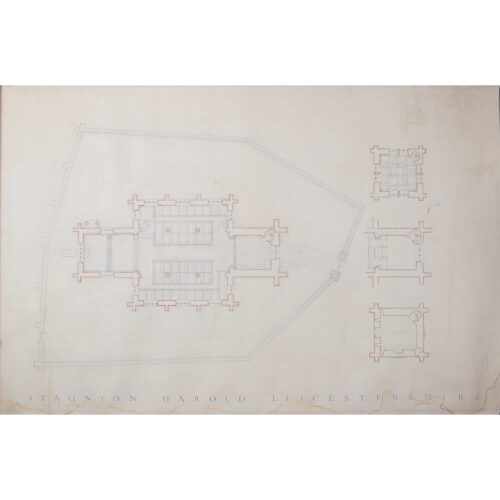
Louis Osman (1914 - 1996)
Drawings of Staunton Harold, Leicestershire
Pencil, pen, watercolour, &c. Varied measurements - see below Provenance: artist's studio sale A collection of six varied drawings, made by Louis Osman, depicting the architecture and decorative details of Staunton Harold House and Church. These are, respectively: A plan of Staunton Harold Church: 97 x 146 cm Miscellaneous figures — statuary from Staunton Harold House: 54 x 74 cm A large drawing of the facades of the House and Church: 77 x 302 cm A design for the restoration of the organ: 64 x 48 cm Miscellaneous figures — a lion, statue, and tree with part of the Church facade in the background: 54 x 74 cm Drawings of armorial tassels: 76 x 127 cm Condition: varied, fair-good; some handling marks, scuffs, and various damage throughout. If you are interested, please email info@manningfineart.co.uk or call us on 07929 749056. Click here for other works by the artist. -
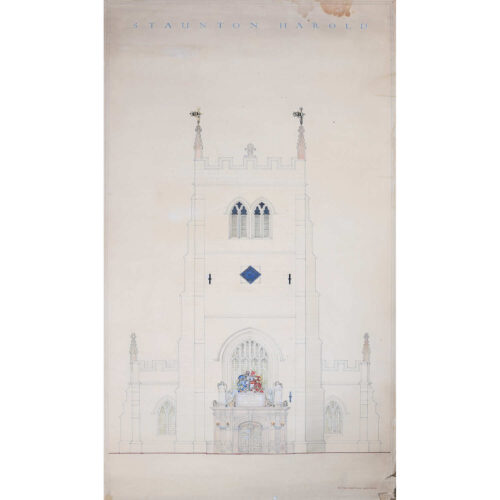
Louis Osman (1914-1996)
West Facade of Staunton Harold Church, Leicestershire
Pencil, pen, watercolour, &c. 152 x 77 cm Provenance: artist's studio sale A charming view of the west facade of Staunton Harold Church, drawn by the architect Louis Osman and signed in red ink at the lower right-hand corner. Parts of the drawing are adorned with watercolour; notable is the armorial detailing above the doors, which is vibrantly rendered in red, blue, and gold. The church, known as the Chapel of the Holy Trinity and a part of the Staunton Harold estate, was built in 1653 in a late expression of Gothic taste. It was commissioned by Sir Robert Shirley, one of a family of Anglicans and Royalists; on this facade, the Shirley coat of arms is impaled with that of Katherine Okeover, whom Sir Robert had married in 1646. A certain connection might be made between the ornate, luxuriant design of the chapel, and Sir Robert’s imprisonment under the austere regime of Oliver Cromwell. The drawing is undated, but probably dates to circa the 1950s or 1960s. Condition: good, with some handling marks, a water stain at the upper right-hand corner, and some damage to the lower right-hand corner (which does not affect the signature). If you are interested, please email info@manningfineart.co.uk or call us on 07929 749056. Click here for other works by the artist.