-

Vivan Bewick German Panzerkampfwagen III
Gouache 6 x 9 cm Signed to the reverse. This striking miniature gouache depicts a German Panzerkampfwagen III, commonly known as the Panzer III, rolling through a desert landscape. Bewick produced this gouache as for the 'tank-recognition' series in Swill-bin. Swill-bin was a wall-newspaper produced by soldiers; it originated in the First World War and was revived once again during the Second World War. Vivian Bewick (1912–1999) was a British artist and educator, notable for his contributions to mid-20th-century art and his role as a tutor at the Buckhurst Hill Community Association (BHCA). He was also a descendant of Thomas Bewick, the renowned 19th-century engraver celebrated for his depictions of birds and animals. While fulfilling his military duties in the Royal Artillery during the Second World War, Bewick maintained his artistic pursuits. He contributed to the wall-newspaper "Swillbin," a tradition from the First World War, and designed army Christmas cards. Additionally, he illustrated technical manuals and conducted art classes and exhibitions, with critiques by James Bateman R.A. After the war, Bewick continued his artistic education and career, spending five years at St. Martin’s School of Art and London University. He also engaged in part-time teaching of adults in art clubs, societies, and colleges and exhibited at the Royal Academy, the Paris Salon, the Royal Institute of Painters in Watercolours, and the Royal Society of British Artists. Condition: Generally very good. If you are interested, please email info@manningfineart.co.uk or call us on 07929 749056. -

Vivan Bewick German Panzerkampfwagen III
Gouache 6 x 9 cm Signed to the reverse. This striking miniature gouache depicts a Soviet T-34/76 powering through a mountainous snowscape. The T-34/76 had a truly long lasting impact on the battlefield, with an impressive balance of firepower, armour protection and mobility. Bewick produced this gouache as for the 'tank-recognition' series in Swill-bin. Swill-bin was a wall-newspaper produced by soldiers; it originated in the First World War and was revived once again during the Second World War. Vivian Bewick (1912–1999) was a British artist and educator, notable for his contributions to mid-20th-century art and his role as a tutor at the Buckhurst Hill Community Association (BHCA). He was also a descendant of Thomas Bewick, the renowned 19th-century engraver celebrated for his depictions of birds and animals. While fulfilling his military duties in the Royal Artillery during the Second World War, Bewick maintained his artistic pursuits. He contributed to the wall-newspaper "Swillbin," a tradition from the First World War, and designed army Christmas cards. Additionally, he illustrated technical manuals and conducted art classes and exhibitions, with critiques by James Bateman R.A. After the war, Bewick continued his artistic education and career, spending five years at St. Martin’s School of Art and London University. He also engaged in part-time teaching of adults in art clubs, societies, and colleges and exhibited at the Royal Academy, the Paris Salon, the Royal Institute of Painters in Watercolours, and the Royal Society of British Artists. Condition: Generally very good. If you are interested, please email info@manningfineart.co.uk or call us on 07929 749056. -

Birth of a Bomber
Photographic reproduction, 12 large plates c. 1940 38 x 40 cm 'This is the story of the production of the Handley-Page "Halifax" heavy bomber. The Air Ministry of Aircraft production tell the manufacturers what kind of aircraft they want, and what they require it to do. First comes the design which has to be worked out in all its details by large numbers of designers and draughtsmen.' Produced by the Ministry of Information, this striking brochure showcases an engineer hard at work designing a Halifax heavy bomber. The Halifax bomber was first introduced to combat in November 1940, three months after the first bombing raid in Germany took place. Throughout the war, both the Halifax and Lancaster bombers proved themselves as steadfast four-engine military planes. This poster goes some way to demystify the processes that went into its design and manufacturing, and the original photo belongs to a larger archive--now at the Imperial War Museum--documenting the production of such aircraft. -
Barbara Jones (1912 - 1978)
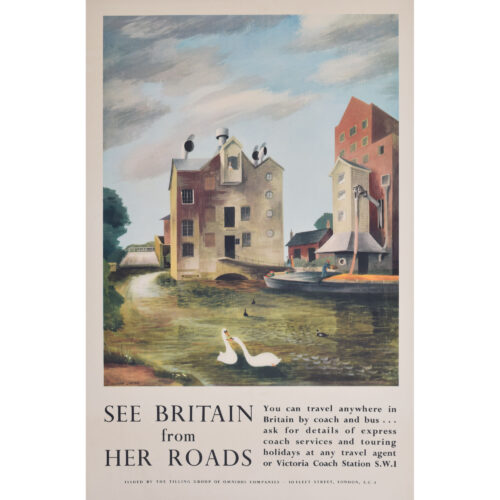
See Britain from Her Roads
Original vintage poster 77 x 50 cm Signed lower left in the plate. Issued by the Tilling Group of Omnibus Companies. Jones' poster, with its two happy swans in the foreground, encourages us to travel Britain via coach (the coach tour was becoming ever more popular in 1950s Britain). The text reads: "You can travel anywhere in Britain by coach and bus ... ask for details of express coach services and touring holidays at any travel agent or Victoria Coach Station S.W.1." Barbara Jones was an English artist and writer. She studied at Croydon High School and then the Royal College of Art (where her contemporaries included John Piper, Edward Bawden, Eric Ravilious and Edward Ardizzone), beginning in the Department of Engraving but transferring to the Department of Mural Decoration in her second year. She illustrated the pamphlet 'Bombed Churches as War Memorials' in 1945. Jones worked on several notable murals after the war, including for the Britain Can Make It exhibition in 1946, and the Enterprise Scotland exhibition in 1947. She also did commercial work for many companies, including P&O Ferries. In 1951 Jones co-curated Black Eyes and Lemonade, an exhibition of craft, folk, and popular objects at the Whitechapel Gallery. She was a Fellow of the Society of Industrial Artists and a member of the Society of Authors. Condition: generally very good; backed to linen; pin holes to corners. If you are interested, please email info@manningfineart.co.uk or call us on 07929 749056. Click here for other original vintage posters. -
Elizabeth Scott
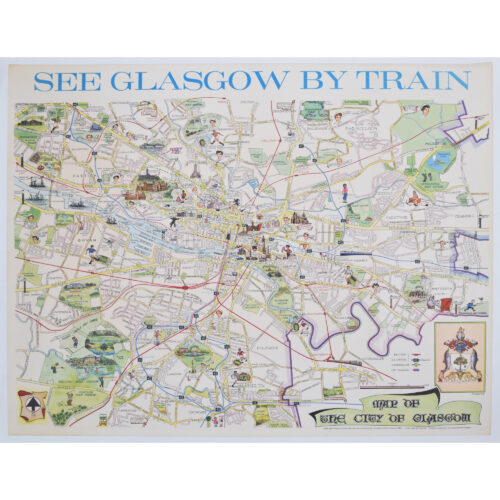
See Glasgow by Train
Original vintage poster 102 x 127 cm Signed lower right in the plate. Printed in Scotland for the Corporation of Glasgow. Based on an Ordnance Survey map, Scott's poster uses added illustrated details to encourage us to explore the riches of Glasgow via rail. The Glasgow City and District Railway was electrified in 1960 and use of the line was encouraged by the city. Condition: generally very good. Backed to linen. If you are interested, please email info@manningfineart.co.uk or call us on 07929 749056. Click here for other original vintage posters. -

M.A. Welch & Brian Harris See London Vintage Style
Original vintage poster Lithograph 76 x 52 cm c.1972 Vintage poster advertising the bus route 100, a unique opportunity for passengers to see the London sights from the classic 1930 ST922 bus model. The poster features a classic typewriter typeface, a lovely coral orange background and a vintage photograph of the ST922, presumably taken during its hayday in the 1930s. Condition: Generally very good, a few very light handling marks.If you would like to know more, please email info@manningfineart.co.uk or call us on 07929 749056.
-
Peter Collins ARCA (1923 - 2001)
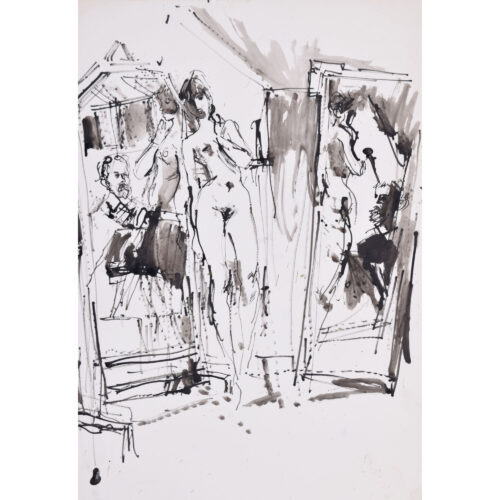
Self-Portrait in Two Mirrors with Nude
Ink and wash 45 x 30 cm Provenance: the artist's studio sale. Collins simultaneously depicts himself painting, and reflected painting - his face is repeated in the two mirrors, and the model's figure appears three times. The picture's perspective leaves us questioning which model, and perhaps which Collins, is the real one. Collins's first job was at an advertising agency, in the commercial studio. World War II interrupted his career and he joined the Royal Artillery (of the British Army), teaching painting and drawing in the Education Corps - whilst simultaneously teaching at St Martin's School of Art, part time. Following the war, Collins studied at the Royal College of Art, winning a scholarship. He then worked as a commercial artist, producing some well-known posters for clients including British Railways and British European Airways. He was the Art Director at Odhams Press and spent time designing for both ICI and Shell. With his wife Georgette, he created the 'Bacombe Galleries' in Sussex, converting a group of buildings into a gallery space. In 1975 they developed the Stanley Studios in Chelsea, which were scheduled for redevelopment, into a combined artists' studio and residence. Moving into the Stanley Studios allowed the Collinses to immerse themselves in Chelsea's art scene, and they proceeded to fill the studios with art, antiques, sculpture, and other curios. Condition: generally very good. If you are interested, please email info@manningfineart.co.uk or call us on 07929 749056. Click here for other nudes. -
Peter Collins ARCA (1923 - 2001)
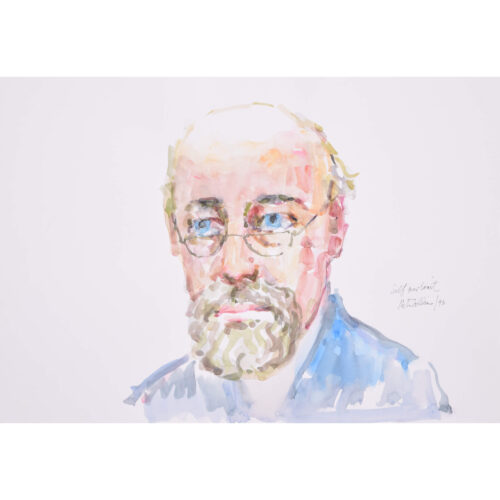
Self-Portrait
Watercolour 32 x 45 cm Provenance: the artist's studio sale. Collins's first job was at an advertising agency, in the commercial studio. World War II interrupted his career and he joined the Royal Artillery (of the British Army), teaching painting and drawing in the Education Corps - whilst simultaneously teaching at St Martin's School of Art, part time. Following the war, Collins studied at the Royal College of Art, winning a scholarship. He then worked as a commercial artist, producing some well-known posters for clients including British Railways and British European Airways. He was the Art Director at Odhams Press and spent time designing for both ICI and Shell. With his wife Georgette, he created the 'Bacombe Galleries' in Sussex, converting a group of buildings into a gallery space. In 1975 they developed the Stanley Studios in Chelsea, which were scheduled for redevelopment, into a combined artists' studio and residence. Moving into the Stanley Studios allowed the Collinses to immerse themselves in Chelsea's art scene, and they proceeded to fill the studios with art, antiques, sculpture, and other curios. Condition: generally very good. If you are interested, please email info@manningfineart.co.uk or call us on 07929 749056. Click here for other works by Peter Collins. -
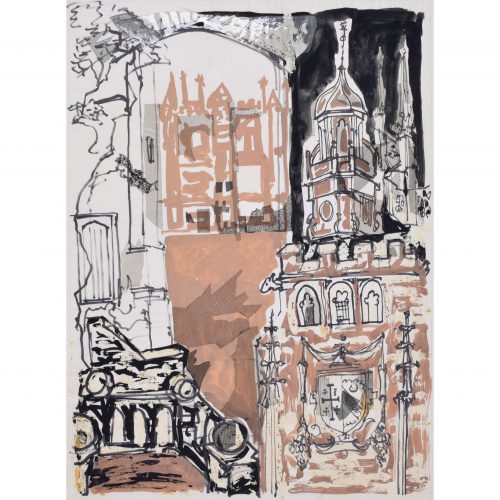
Margaret Souttar (1914 - 1987)
Selwyn College, Cambridge I
Acrylic 70 x 51 cm Souttar was a Scottish painter and printmaker known for her images of town- and cityscapes. In the early 1960s, she was commissioned to produce a series of prints of the Cambridge colleges. She captures the modernity and optimism of 1960s Cambridge; the fact that a female artist was commissioned to create the prints reflects the changing attitudes of the University towards women. These views highlight the layers of history and architectural styles which make up a Cambridge college. Provenance: the artist's studio sale. Condition: generally very good; some crinkling as a result of using water-based paints on thin paper; a little creasing to edges. If you are interested, please email info@manningfineart.co.uk or call us on 07929 749056. Click here for other views of Selwyn College, Cambridge. -
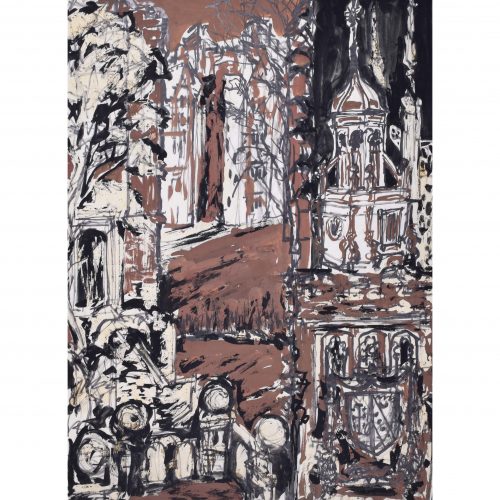
Margaret Souttar (1914 - 1987)
Selwyn College, Cambridge II
Acrylic 71 x 52 cm Souttar was a Scottish painter and printmaker known for her images of town- and cityscapes. In the early 1960s, she was commissioned to produce a series of prints of the Cambridge colleges. She captures the modernity and optimism of 1960s Cambridge; the fact that a female artist was commissioned to create the prints reflects the changing attitudes of the University towards women. These views highlight the layers of history and architectural styles which make up a Cambridge college. Provenance: the artist's studio sale. Condition: generally very good; some crinkling as a result of using water-based paints on thin paper; a little creasing to edges. If you are interested, please email info@manningfineart.co.uk or call us on 07929 749056. Click here for other views of Selwyn College, Cambridge. -
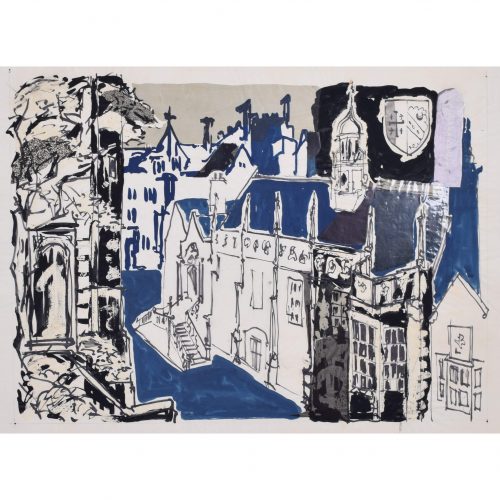
Margaret Souttar (1914 - 1987)
Selwyn College, Cambridge III
Acrylic 51 x 70 cm (image); sheet 67 x 98 cm Inscribed left Selwyn Cambridge '61, with annotations by the artist concerning colour. Souttar was a Scottish painter and printmaker known for her images of town- and cityscapes. In the early 1960s, she was commissioned to produce a series of prints of the Cambridge colleges. She captures the modernity and optimism of 1960s Cambridge; the fact that a female artist was commissioned to create the prints reflects the changing attitudes of the University towards women. These views highlight the layers of history and architectural styles which make up a Cambridge college. Provenance: the artist's studio sale. Condition: generally very good; some crinkling as a result of using water-based paints on thin paper. If you are interested, please email info@manningfineart.co.uk or call us on 07929 749056. Click here for other views of Selwyn College, Cambridge. -
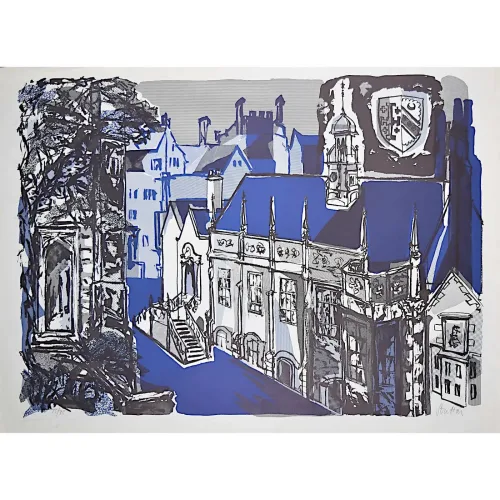
Margaret Souttar (1914 - 1987)
Selwyn College, Cambridge
Lithograph 77 x 56 cm Signed in pencil lower right. Souttar was a Scottish painter and printmaker known for her images of town- and cityscapes. In the early 1960s, she was commissioned to produce a series of prints of the Cambridge colleges. She captures the modernity and optimism of 1960s Cambridge; the fact that a female artist was commissioned to create the prints reflects the changing attitudes of the University towards women. Selwyn College was one of the first Cambridge colleges to admit women as students - it did not do so until 1976. Provenance: the artist's studio sale. Condition: generally very good. If you are interested, please email info@manningfineart.co.uk or call us on 07929 749056. Click here for other views of Selwyn College, Cambridge. -
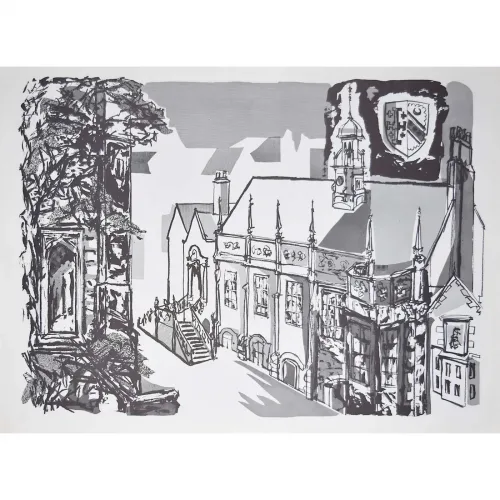
Margaret Souttar (1914 - 1987)
Selwyn College, Cambridge
Lithograph 77 x 56 cm Souttar was a Scottish painter and printmaker known for her images of town- and cityscapes. In the early 1960s, she was commissioned to produce a series of prints of the Cambridge colleges. She captures the modernity and optimism of 1960s Cambridge; the fact that a female artist was commissioned to create the prints reflects the changing attitudes of the University towards women. Selwyn College was one of the first Cambridge colleges to admit women as students - it did not do so until 1976. Provenance: the artist's studio sale. Condition: generally very good. If you are interested, please email info@manningfineart.co.uk or call us on 07929 749056. Click here for other views of Selwyn College, Cambridge. -

Jane Carpanini Selwyn College
Lithograph 30 x 42 cm Born in Bedfordshire, Jane Carpanini studied at Brighton College of Art and the University of Reading. Since the start of her career she has been known for meticulous architectural paintings. Wales has been a favourite subject and she has paintings in the collections of the National Library of Wales and National Museum of Wales. Her renowned series of views of Oxford and Cambridge Colleges were published by Contemporary Watercolours and have since featured regularly in the Oxford and Cambridge Today magazines. Throughout her career, Carpanini has exhibited widely and her work is held by many public and private collections both in the UK and abroad. She was a regular exhibitor with the major Societies and was the first woman officer of the Royal Watercolour Society, serving as the Honorary Treasurer and also as Vice-President. In 2003 she was also nominated for the Presidency of the RWS becoming the first ever female candidate for the post. This lithograph depicts the comings-and-goings of the main entrance at Selwyn College, Cambridge. A student cycles along Grange Road, keeping pace with their walking friend, perhaps on their way to lectures at the nearby Sidgwick Site; another student is wheeling their bike towards the nearby bicycle parking. The weather is sunny and the trees are covered in leaves. This is a lovely representation of everyday life at the university and Selwyn College. Condition: Generally very good, can come with frame.If you would like to know more, please email info@manningfineart.co.uk or call us on 07929 749056.
-
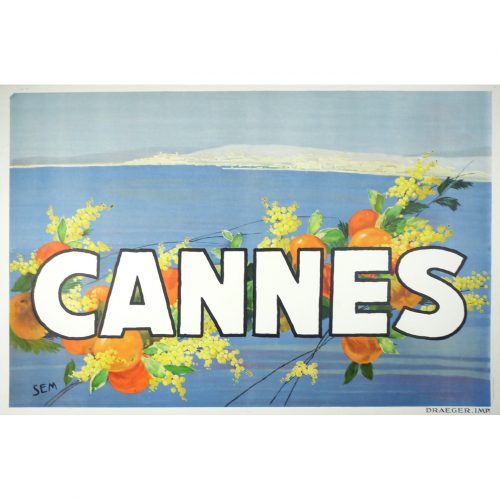
SEM (Georges Goursat) (1863-1934)
Cannes
Lithographic poster in colours, printed by Draeger, Paris c. 1930. 121x81cm (48×32 inches); backed on linen (condition A-) If you are interested email info@manningfineart.co.uk or call us on 07929 749056. -
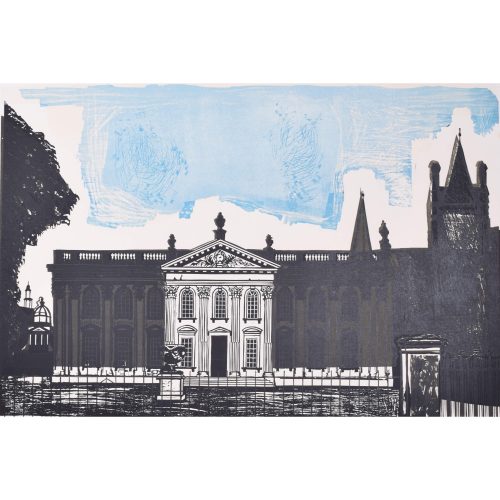
Walter Hoyle (1922 - 2000)
Senate House, Cambridge (Cambridge Series 1956 - 66)
Linocut 46 x 70 cm Trial print aside from the series, with different colourway. Senate House, under a lively blue sky. Hoyle trained at Beckenham School of Art and the Royal College of Art. At the latter he was strongly influenced by Edward Bawden, one of Britain’s greatest linocut printers. Bawden had been commissioned by the 1951 Festival of Britain to produce a mural for the South Bank, and chose Hoyle to assist on account of his great talent. Hoyle moved to Great Bardfield in Essex, becoming a part of the Great Bardfield group of artists; diverse in style, they created figurative work, in stark contrast to the abstract art of the St Ives artists at the opposite end of the country. Hoyle taught at St Martin’s School of Art from 1951-60, the Central School of Arts and Crafts from 1960-64, and the Cambridge School of Art from 1964-1985, during which time he launched Cambridge Print Editions. His work is held in the collections of the Tate Gallery, the Victoria and Albert Museum, The British Museum, Kettle’s Garden and the Fry Art Gallery. Provenance: family of the artist. Condition: generally very good; a few handling marks and areas of discolouration to extreme margins, extraneous ink to right hand side, and a very small brown spot to very top right beyond the blue sky. If you are interested, please email info@manningfineart.co.uk or call us on 07929 749056. Click here for other general views of Cambridge. -

Seven Rules of Health
63.5 x 101cm Lithographic poster Published by HMSO for Ministry of Health and Department of Health for Scotland c. 1950 -
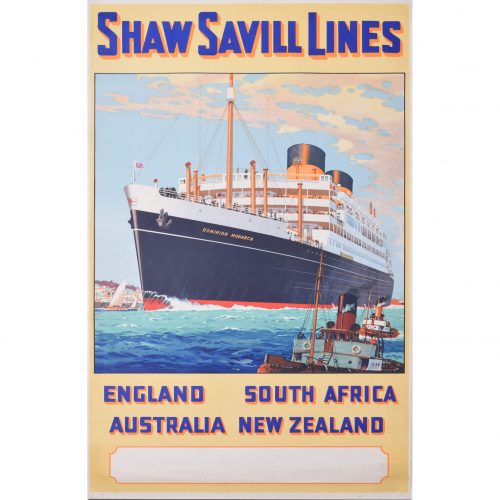
William McDowell (1888 - 1950)
Shaw Savill Lines - Dominion Monarch
Original vintage poster 103 x 64 cm McDowell's poster advertises the magnitude and majesty of the Dominion Monarch, which dwarfs other boats and sails boldly forwards. Dominion Monarch was a UK passenger and refrigerated cargo liner. Her name was a reference to the Dominion of New Zealand, and she was built for Shaw, Savill & Albion Line (the shipping line of P Henderson & Company, a British shipping firm). McDowell was a painter, draughtsman and commercial artist, born in the shipbuilding town of Barrow-in-Furness, Lancashire. After leaving school he was apprenticed in the drawing office of the engineering firm Vickers, and eventually became a member of the Institute of Naval Architects. Shortly after the First World War, McDowell left naval architecture to become a full-time artist, producing murals for the liner Mauretania and other vessels, eventually settling in Wallasey, Cheshire. Many of his own paintings were of historical or maritime subjects, shown at the Walker Art Gallery and elsewhere. In 1919 he had a picture included in the RA Summer Exhibition. During the Second World War he was commissioned in the Royal Naval Scientific Service. Condition: generally very good, occasional repaired short edge tears, a little spotting primarily to blank panel at bottom and slightly creased at edges. If you are interested, please email info@manningfineart.co.uk or call us on 07929 749056. Click here for other original vintage posters. -
Out of stock
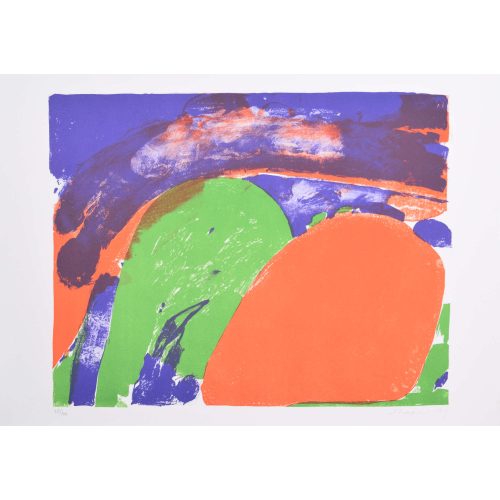
Shmuel Shapiro (1924 - 1983) Two Lovers (1966)
Original lithograph on handmade Barcham Green paper 34 x 44 cm (sheet size 40 x 57 cm) Signed, dated, and numbered 75/100 in pencil. Published and printed at the Curwen Studio, London, in 1966. Shapiro was an American Jewish artist. This typically emotive but unusually colourful work conveys the passion that accompanies true love, with the green and orange forms pressing desperately against one another. An example of this lithograph is held in the Tate Gallery's permanent print collection. Provenance: acquired directly from the Curwen Archive. Condition: excellent. If you’d like to know more, please email info@manningfineart.co.uk or call us on 07929 749056. -
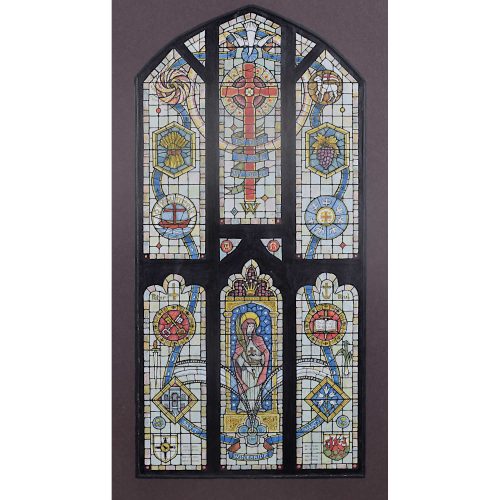
Jane Gray (b.1931)
Shrewsbury Abbey, Design for Stained Glass Window Dedicated to St Winefride (1990)
Watercolour 39 x 19 cmSigned, dated and studio stamp verso.
The red sandstone Abbey that resides over Shrewsbury is a welcoming landmark to visitors entering the town and dates back to the Norman era. Despite many renovations and alterations over the years, the medieval and Victorian elements marry remarkably naturally in this grand yet dignified place of worship. Shrewsbury abbey is home to several notable tombs and monuments as well as the remnants of a medieval shrine to St Winefride who was once venerated there. The central light at the top depicts the Trinity, where the Holy Spirit is represented by a dove, God by a vortex (left) and Christ by a lamb (right). The trinity remain linked throughout the design by a blue ribbon decorated with crosses and water droplets. St Winefride’s spiritual strength is represented by the large, central red cross, and her initial rests at its foot. In the left light, beneath the vortex, is corn, and to the right, grapes, both symbols uniting to form a timeless reference to the Eucharist. Below is the ship, a symbol of thee Ecumenical church, and on the right are seven doves representing the seven gifts of the holy spirit: wisdom, counsel, fortitude, knowledge, piety, and fear of the Lord. Two small roundels with Alpha and Omega (‘I am the beginning and the end’ as God notes in the Book of Revelations) unify the upper and lower windows in the design. The central lower light depicts St Winefride, set against a starry backdrop, holding the Martyr’s Palm and Cross beneath her martyr’s crown. The water that is said to have spewed forth from her decapitated head is symbolically illustrated in the fountain at her feet that flows into the adjacent lights. Further symbols to Saint Winefride adorn both the left and right lights. The crossed keys and inverted cross (left light) represent Saint Peter, and the sword, book, and anchor rounded cross represent Saint Paul, the saints to whom Shrewsbury Abbey is dedicated. The window was installed in 1992.
Provenance: the artist’s studio sale. Literature: Jane Gray, Playing with Rainbows. (Shropshire: Ellingham Press, 2011), pp.47, 81. Condition: very good. If you are interested, please email info@manningfineart.co.uk or call us on 07929 749056. For other works by Jane Gray and more information about her, please click here. -

Keith Vaughan Side Profiles
Ballpoint pen sketch 17 x 13 cm Born in 1912, Keith Vaughan was a British painter known for his modernist and semi-abstract depictions of the male figure. He was self-taught as an artist but during his time as a conscientious objector in the Second World War, he befriended the painters Graham Sutherland and John Minton. Through these contacts, he formed part of the neo-romantic circle of the immediate post-war period. Over time, Vaughan's idiosyncratic style evolved away from the group as he focussed on male nudes and groups, often rendered in a geometric yet lyrical manner. Vaughan was openly gay at a time when homosexuality was criminalised in Britain. As a result, his work often reflected themes of isolation and desire, capturing both the physical and emotional aspects of human existence. He continues to be celebrated today and his works are held in several major galleries, inlcuding the National Galleries of Scotland, the National Portrait Gallery, the Tate and the Victoria and Albert Museum. This sketch was taken from Vaughan's 'Ischia Cheese & Grill' sketchbook. It depicts two sculptures in side profile and an antelope skull. This intriguing combination of sculpture and skulls is suggestive of an ancient civilisation, perhaps indicating that he produced this sketch during a jaunt through a natural history museum while on his travels. Together the drawings in the sketchbook record Vaughan's experimentalism with landscape, abstraction and notably his commitment to the human form. This collection was sold as part of Peter Adam's estate; Adam was not just a close friend of Vaughan but his executor, biographer and the curator of multiple exhibitions of his work after he died in 1977. This sketch represents the unique opportunity to own a small piece of Keith Vaughan's oeuvre as he continues to grow in popularity. Condition: generally very good.If you would like to know more, please email info@manningfineart.co.uk or call us on 07929 749056.
-
Out of stock
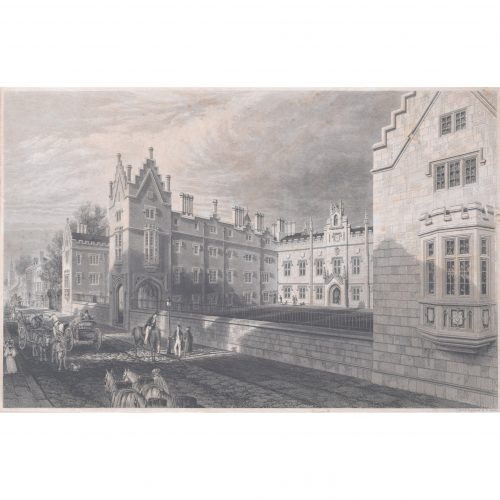
Ebenezer Challis (1806 - 1881)
Sidney Sussex College, Cambridge (1834)
Engraving 27 x 43 cm A 19th century view of Sidney Sussex, complete with Victorian undergraduates in academic dress, horse and cart, and behatted rider. Condition: good. Trimmed. Otherwise generally good with the occasional tiny spot. If you’d like to know more, please email info@manningfineart.co.uk or call us on 07929 749056. Click here for more views of Sidney Sussex. -
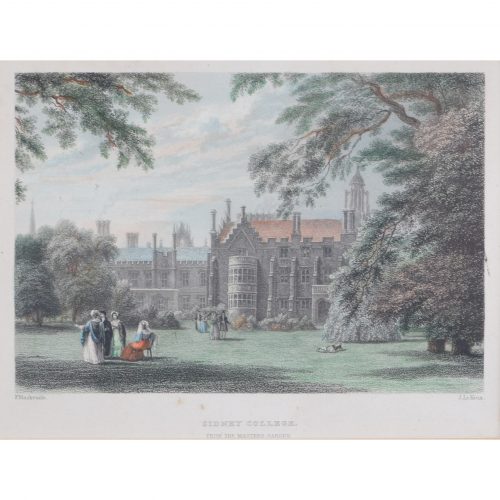
John Le Keux (1783 - 1846) after Frederick Mackenzie (1788 - 1854)
Sidney College from the Master's Garden (1845)
Hand-coloured engraving 12 x 15 cm Published by Rudolph Ackermann (1764 - 1834). An engraving of Sidney Sussex College, Cambridge. The College was founded in 1596 under the terms of the will of Frances Sidney, Countess of Sussex, wife of Thomas Radclyffe, 3rd Earl of Sussex, and named after its foundress. Frederick Mackenzie (circa 1788 - 1854) was a British watercolourist and architectural draughtsman. He first exhibited at the Royal Academy in 1804, and contributed eleven drawings between that year and 1828. He contributed to the Society of Painters in Water Colours exhibitions from 1813, becoming an associate in 1822, and a full member the following year. From 30 November 1831 until, his death he was treasurer to the society. In later life Mackenzie was no longer commissioned to illustrate books. John Le Keux was a British engraver. When working as an apprentice to his father, a pewter manufacturer, he began engraving pewter, and trained as an engraver. He was then apprenticed to the noted engraver James Basire, and went on to produce engravings for the architectural publications of John Britton, Augustus Welby Pugin, John Preston Neale, and others. He produced various engravings of Oxford and Cambridge colleges. Rudolph Ackermann was an Anglo-German bookseller, inventor, lithographer, publisher and businessman. In 1795 he established a print-shop and drawing-school at 96 Strand. Here Ackermann set up a lithographic press and began a trade in prints. He later began to manufacture colours and thick carton paper for landscape and miniature painters. Within three years the premises had become too small and he moved to 101 Strand, in his own words "four doors nearer to Somerset House", the seat of the Royal Academy of Arts. Between 1797 and 1800 Ackermann rapidly developed his print and book publishing business, encompassing many different genres including topography, caricature, portraits, transparencies and decorative prints. Condition: good; a couple of spots and some age toning. If you are interested, please email info@manningfineart.co.uk or call us on 07929 749056. Click here for other views of Sidney Sussex. -

Daniel Havell (1785 - 1822) after Augustus Charles Pugin (1762 - 1832) Hall of Sidney College
Aquatint with original hand colouring 24 x 29 cm Published by Rudolph Ackermann (1764 - 1834). An engraving of the hall of Sidney Sussex College, Cambridge, from Ackermann's 'A History of the University of Cambridge, Its Colleges, Halls and Public Buildings'. Augustus Charles Pugin was an Anglo-French artist and architectural draughtsman. Pugin produced views of London, jointly creating the illustrations for the 'Microcosm of London' published by Rudolph Ackermann in 1811, followed by plates for Ackermann's books about Westminster Abbey, Oxford and Cambridge universities, and Winchester College. His later works included illustrations for Specimens of Gothic Architecture (1821–1823), The Royal Pavilion at Brighton (1826), Architectural Antiquities of Great Britain (1826), Specimens of the Architectural Antiquities of Normandy (1827), Illustrations of the Public Buildings of London (1825 to 1828), Paris and its Environs (1829 to 1831), and Examples of Gothic Architecture (1831). He also produced a book of furniture designs called Gothic Furniture, and assisted architects with detailing for their gothic designs. He ran a drawing school at his house in Bloomsbury. Daniel Havell was a member of the Havell family of Reading, Berkshire, England, which included a number of notable engravers, etchers and painters, as well as writers, publishers, educators, and musicians. Daniel and his brother Robert set up in partnership as aquatint engravers. Soon Daniel began to work independently, engraving plates for Rudolph Ackermann's History of Cambridge (1815) and hid history of various public schools including Eton, Winchester, and Rugby (1816), as well as a celebrated views of St Paul's Cathedral (1818) and various other London landmarks for Ackermann's Repository of Arts. Rudolph Ackermann was an Anglo-German bookseller, inventor, lithographer, publisher and businessman. In 1795 he established a print-shop and drawing-school at 96 Strand. Here Ackermann set up a lithographic press and began a trade in prints. He later began to manufacture colours and thick carton paper for landscape and miniature painters. Within three years the premises had become too small and he moved to 101 Strand, in his own words "four doors nearer to Somerset House", the seat of the Royal Academy of Arts. Between 1797 and 1800 Ackermann rapidly developed his print and book publishing business, encompassing many different genres including topography, caricature, portraits, transparencies and decorative prints. Condition: Paper slightly toned within platemark.If you would like to know more, please email info@manningfineart.co.uk or call us on 07929 749056.
-

Pieter van der Aa (1659 - 1733), after David Loggan (1634 - 1692)
Sidney Sussex College, Cambridge (1727)
Engraving 13 x 17 cm An eighteenth-century view of Sidney Sussex College, Cambridge, engraved by Pieter van der Aa after David Loggan, the noted engraver, draughtsman, and painter. Pieter van der Aa of Leiden was a Dutch publisher best known for preparing maps and atlases, though he also printed editions of foreign bestsellers and illustrated volumes. He is noted for the many engravings he produced after David Loggan's series of Oxford and Cambridge colleges and costumes. In 1727 Van Der Aa illustrated "Les Delices de la Grande Bretagne & de L'Irelande" by James Beeverell, the book in which this engraving appears. Condition: very good. If you are interested, please email info@manningfineart.co.uk or call us on 07929 749056. Click here for other views of Sidney Sussex College, Cambridge -

David Loggan (1634 - 1692) Sidney Sussex College, Cambridge
Engraving 33 x 45 cm An eighteenth-century view of Queens' College, Cambridge, engraved by David Loggan, the noted engraver, draughtsman, and painter. Loggan was born to English and Scottish parents, and was baptised in Danzig in 1634. After studying engraving in Danzig with Willem Hondius (1598-1652 or 1658), he moved to London in the late 1650s, going on to produce the engraved title-page for the folio 1662 Book of Common Prayer. He married in 1663 and moved to Nuffield in Oxfordshire in 1665. Loggan was appointed Public Sculptor to the nearby University of Oxford in the late 1660s, having been commissioned to produce bird’s-eye views of all the Oxford colleges. He lived in Holywell Street as he did this. The 'Oxonia Illustrata' was published in 1675, with the help of Robert White (1645-1704). Following its completion, Loggan began work on his equivalent work for Cambridge; the 'Cantabrigia Illustrata' was finally published in 1690, when he was made engraver to Cambridge University. The 'Oxonia Illustrata' also includes an engraving of Winchester College (Winchester and New College share William of Wykeham as their founder) whilst the 'Cantabrigia Illustrata' includes one of Eton College (which shares its founder, Henry VIII, with King’s College). Bird’s-eye views from this era required a particular talent as an architectural perspectivist; it was not until 1783 that it became possible for artists to ascend via hot air balloons and view the scenes they were depicting from above. Loggan thus had to rely on his imagination in conceiving the views. Loggan’s views constitute the first accurate depictions of the two Universities, in many ways unchanged today. Whilst the Oxford engravings were produced in reasonable numbers and ran to a second edition by Henry Overton (on thicker paper and with a plate number in Roman numerals in the bottom right-hand corner), those of Cambridge were printed in much smaller numbers. The Dutchman Pieter van der Aa published some miniature versions of the engravings for James Beverell’s guidebook to the UK, 'Les Delices de la Grande Bretagne' (c. 1708). The contemporary artist Andrew Ingamells (b.1956) has produced a highly-acclaimed series of etchings which bring Loggan’s original vision up to date. Condition: Generally very good.If you would like to know more, please email info@manningfineart.co.uk or call us on 07929 749056.
For other views of Sidney Sussex, please click here. -

David Loggan (1634 - 1692) Sidney Sussex College, Cambridge
Engraving 33 x 45 cm An eighteenth-century view of Sidney Sussex, Cambridge, engraved by David Loggan, the noted engraver, draughtsman, and painter. Loggan was born to English and Scottish parents, and was baptised in Danzig in 1634. After studying engraving in Danzig with Willem Hondius (1598-1652 or 1658), he moved to London in the late 1650s, going on to produce the engraved title-page for the folio 1662 Book of Common Prayer. He married in 1663 and moved to Nuffield in Oxfordshire in 1665. Loggan was appointed Public Sculptor to the nearby University of Oxford in the late 1660s, having been commissioned to produce bird’s-eye views of all the Oxford colleges. He lived in Holywell Street as he did this. The 'Oxonia Illustrata' was published in 1675, with the help of Robert White (1645-1704). Following its completion, Loggan began work on his equivalent work for Cambridge; the 'Cantabrigia Illustrata' was finally published in 1690, when he was made engraver to Cambridge University. The 'Oxonia Illustrata' also includes an engraving of Winchester College (Winchester and New College share William of Wykeham as their founder) whilst the 'Cantabrigia Illustrata' includes one of Eton College (which shares its founder, Henry VIII, with King’s College). Bird’s-eye views from this era required a particular talent as an architectural perspectivist; it was not until 1783 that it became possible for artists to ascend via hot air balloons and view the scenes they were depicting from above. Loggan thus had to rely on his imagination in conceiving the views. Loggan’s views constitute the first accurate depictions of the two Universities, in many ways unchanged today. Whilst the Oxford engravings were produced in reasonable numbers and ran to a second edition by Henry Overton (on thicker paper and with a plate number in Roman numerals in the bottom right-hand corner), those of Cambridge were printed in much smaller numbers. The Dutchman Pieter van der Aa published some miniature versions of the engravings for James Beverell’s guidebook to the UK, 'Les Delices de la Grande Bretagne' (c. 1708). The contemporary artist Andrew Ingamells (b.1956) has produced a highly-acclaimed series of etchings which bring Loggan’s original vision up to date. Condition: Generally very good.If you would like to know more, please email info@manningfineart.co.uk or call us on 07929 749056.
For other views of Sidney Sussex, please click here. -
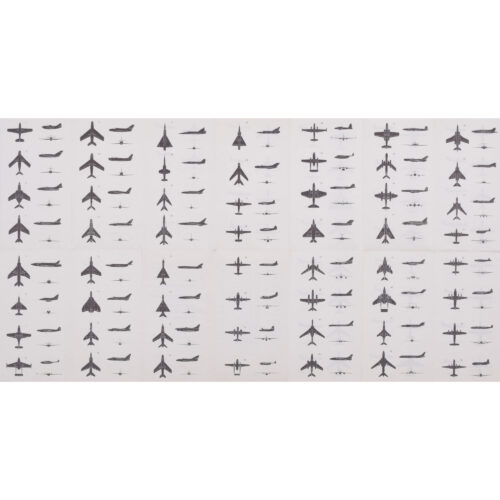
Silhouettes of Aircraft on the Joint Services Aircraft Recognition Training List (1959)
Original vintage pamphlet 41 x 78 cm Air Ministry Pamphlet 326C, Issue 6 (July 1959). Prepared by direction of the Minister of Supply. A pocket folder of aircraft silhouettes. Condition: generally very good; folds as issued. If you are interested, please email info@manningfineart.co.uk or call us on 07929 749056. Click here for other original vintage aircraft posters. -
Sir Albert Edward Richardson K.C.V.O., F.R.I.B.A, F.S.A., P.R.A. (1880-1964)
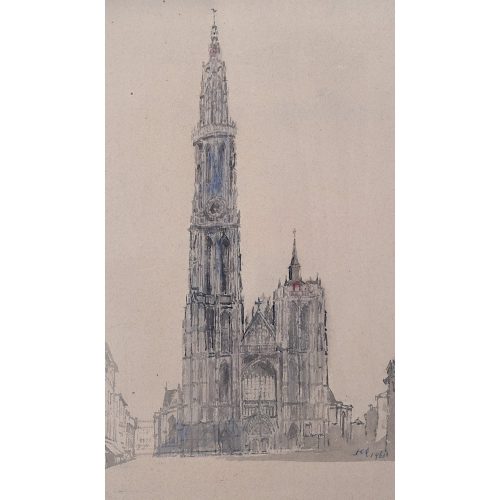
Antwerp Cathedral
33x20cm Watercolour Sir Albert Edward Richardson K.C.V.O., F.R.I.B.A, F.S.A., P.R.A. (1880-1964) was a traditionalist, renowned for his distaste of modern architecture. Rooted firmly in the classical period, he lived a Georgian life, refusing to have electricity in his Georgian house – until his wife finally insisted. Professor of Architecture at UCL’s Bartlett School of Architecture from 1929-1955, this was evacuated to Cambridge during the war and he became a fellow of St Catharine’s College. Amongst his other achievements, Richardson was President of the RA, editor of Architect’s Journal and founder of the Georgian Group. For pleasure he painted architectural fantasies; capriccios of buildings he pictured in his mind. Richardson was recipient of the Architectural Association’s Professor Bannister Fletcher Medal in 1902 which was an award for the study of post-Fire London architecture. Amongst his achievements were Professor of Architecture at University College London, President of the RA, editor of Architect’s Journal and founder of the Georgian Group. Click here for other works by the artist and biographical details. If you are interested email info@manningfineart.co.uk or call us on 07929 749056. -
Sir Albert Edward Richardson K.C.V.O., F.R.I.B.A, F.S.A., P.R.A. (1880-1964)
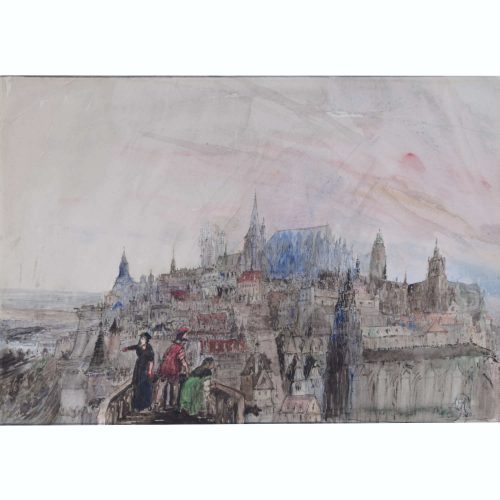
The Dawn of the Renaissance in Central Europe, A Caprice
28x43cm watercolour Signed, with further detail to backboard (title, date etc.) Sir Albert Edward Richardson K.C.V.O., F.R.I.B.A, F.S.A., P.R.A. (1880-1964) was a traditionalist, renowned for his distaste of modern architecture. Rooted firmly in the classical period, he lived a Georgian life, refusing to have electricity in his Georgian house – until his wife finally insisted. Professor of Architecture at UCL’s Bartlett School of Architecture from 1929-1955, this was evacuated to Cambridge during the war and he became a fellow of St Catharine’s College. Amongst his other achievements, Richardson was President of the RA, editor of Architect’s Journal and founder of the Georgian Group. For pleasure he painted architectural fantasies; capriccios of buildings he pictured in his mind. Richardson was recipient of the Architectural Association’s Professor Bannister Fletcher Medal in 1902 which was an award for the study of post-Fire London architecture. Amongst his achievements were Professor of Architecture at University College London, President of the RA, editor of Architect’s Journal and founder of the Georgian Group. Click here for other works by the artist and biographical details. If you are interested email info@manningfineart.co.uk or call us on 07929 749056. -
Sir Albert Edward Richardson K.C.V.O., F.R.I.B.A, F.S.A., P.R.A. (1880-1964)
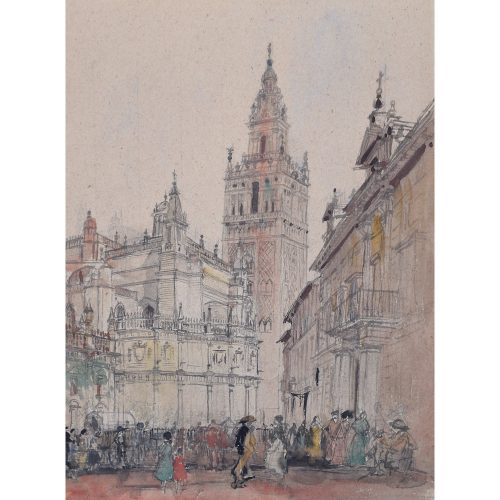
La Giralda Seville
38x28cm Watercolour Sir Albert Edward Richardson K.C.V.O., F.R.I.B.A, F.S.A., P.R.A. (1880-1964) was a traditionalist, renowned for his distaste of modern architecture. Rooted firmly in the classical period, he lived a Georgian life, refusing to have electricity in his Georgian house – until his wife finally insisted. Professor of Architecture at UCL’s Bartlett School of Architecture from 1929-1955, this was evacuated to Cambridge during the war and he became a fellow of St Catharine’s College. Amongst his other achievements, Richardson was President of the RA, editor of Architect’s Journal and founder of the Georgian Group. For pleasure he painted architectural fantasies; capriccios of buildings he pictured in his mind. Richardson was recipient of the Architectural Association’s Professor Bannister Fletcher Medal in 1902 which was an award for the study of post-Fire London architecture. Amongst his achievements were Professor of Architecture at University College London, President of the RA, editor of Architect’s Journal and founder of the Georgian Group. Click here for other works by the artist and biographical details. If you are interested email info@manningfineart.co.uk or call us on 07929 749056. -
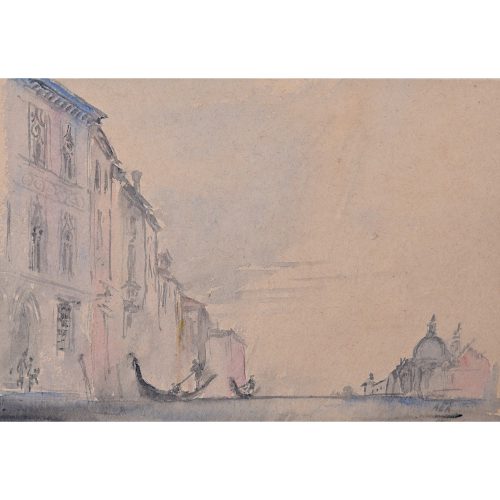
Sir Albert Edward Richardson K.C.V.O., F.R.I.B.A, F.S.A., P.R.A. (1880-1964)
Venice The Grand Canal Looking to the Salute
18x24cm Watercolour Initialled Sir Albert Edward Richardson K.C.V.O., F.R.I.B.A, F.S.A., P.R.A. (1880-1964) was a traditionalist, renowned for his distaste of modern architecture. Rooted firmly in the classical period, he lived a Georgian life, refusing to have electricity in his Georgian house – until his wife finally insisted. Professor of Architecture at UCL’s Bartlett School of Architecture from 1929-1955, this was evacuated to Cambridge during the war and he became a fellow of St Catharine’s College. Amongst his other achievements, Richardson was President of the RA, editor of Architect’s Journal and founder of the Georgian Group. For pleasure he painted architectural fantasies; capriccios of buildings he pictured in his mind. Richardson was recipient of the Architectural Association’s Professor Bannister Fletcher Medal in 1902 which was an award for the study of post-Fire London architecture. Amongst his achievements were Professor of Architecture at University College London, President of the RA, editor of Architect’s Journal and founder of the Georgian Group. Click here for other works by the artist and biographical details. Slight toning to paper. If you are interested email info@manningfineart.co.uk or call us on 07929 749056. -
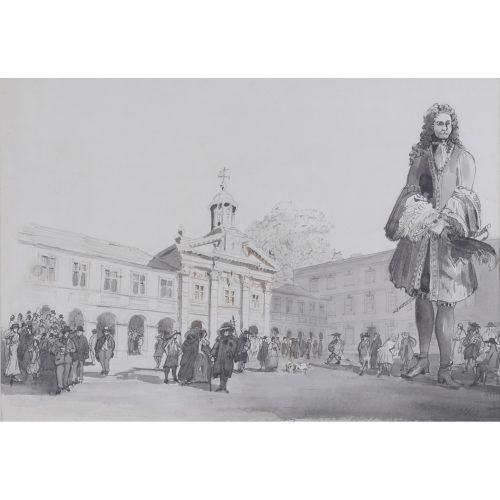
Sir Albert Edward Richardson K.C.V.O., F.R.I.B.A, F.S.A., P.R.A. (1880-1964)
If you are interested, please email info@manningfineart.co.uk or call us on 07929 749056.Cambridge Revisited (1933)
Pen, ink, and wash24 x 35 cmSigned and dated lower right.Renowned for his architectural fantasies, Richardson here depicts Sir Christopher Wren revisiting the chapel he built in 1677. Wren is a Colossus, surveying not only the architecture of the chapel but the fantastical assortment of characters present in the quad. Seventeenth century lords, ladies, and scholars occupy the centre of the picture while 20th century tourists (on the left) watch the scene unfold.Richardson was a leading English architect, teacher and writer about architecture during the first half of the 20th century. He was Professor of Architecture at University College London, a President of the Royal Academy, editor of Architects' Journal, founder of the Georgian Group and the Guild of Surveyors and Master of the Art Workers' Guild. He also received the Architectural Association’s Professor Bannister Fletcher Medal (an award for the study of post- Great Fire London architecture) in 1902. -
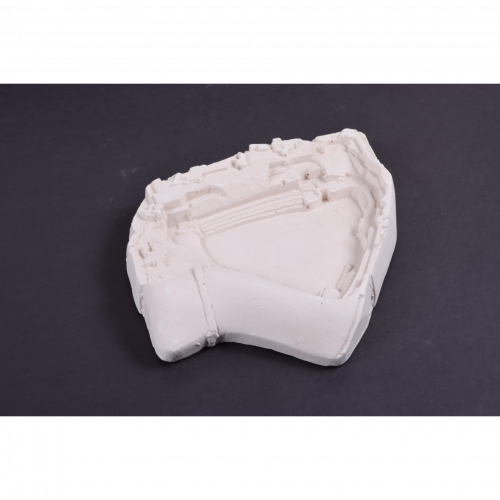
Sir Eduardo Paolozzi CBE RA (1924-2005)
Amphitheatre
Plaster 27 x 22 x 4 cm (max) Paolozzi’s fascination with anatomy, machine parts, and the idiom of classical statuary is evident in his modernist sculptural forms. Amphitheatre blends neoclassicism with 20th-century brutalism, betraying a fascination with the materiality of public architecture. Sir Eduardo Luigi Paolozzi CBE RA was a Scottish artist, known for his sculpture and graphic works. He is widely considered to be one of the pioneers of pop art. Paolozzi studied at the Edinburgh College of Art in 1943, briefly at Saint Martin's School of Art in 1944, and then at the Slade School of Fine Art at University College London from 1944 to 1947, after which he worked in Paris. While in Paris from 1947 to 1949, Paolozzi became acquainted with Alberto Giacometti, Jean Arp, Constantin Brâncuși, Georges Braque and Fernand Léger. This period became an important influence for his later work. For example, the influence of Giacometti and many of the original Surrealists he met in Paris can be felt in the group of lost-wax sculptures made by Paolozzi in the mid-1950s. Their surfaces, studded with found objects and machine parts, were to gain him recognition. He taught sculpture and ceramics at several institutions, including the Hochschule für bildende Künste Hamburg (1960–62), University of California, Berkeley (in 1968) and at the Royal College of Art. Paolozzi had a long association with Germany, having worked in Berlin from 1974 as part of the Berlin Artist Programme of the German Academic Exchange Programme. He was a professor at the Fachhochschule in Cologne from 1977 to 1981, and later taught sculpture at the Akademie der Bildenden Künste in Munich. Paolozzi was fond of Munich and many of his works and concept plans were developed in a studio he kept there, including the mosaics of the Tottenham Court Road Station in London. He took a stab at industrial design in the 1970s with a 500-piece run of the upscale Suomi tableware by Timo Sarpaneva that Paolozzi decorated for the German Rosenthal porcelain maker's Studio Linie. Condition: Generally very good, occasional inclusions etc., as expected. If you'd ike to know more, please email info@manningfineart.co.uk or call us on 07929 749056. -

Sir Eduardo Paolozzi CBE RA (1924-2005) Construction
Plaster of Paris 6 x 4 x 2 cm Paolozzi’s fascination with anatomy, machine parts, and the idiom of classical statuary is evident in his modernist sculptural forms. 'Construction' is an intriguing piece, characterised by clean lines and strong forms. The work seems to feature a round hand hammer surrounded by two other tools. Paolozzi could be alluding to the materials needed to create such sculptures, highlighting the industry behind the art form. Sir Eduardo Luigi Paolozzi CBE RA was a Scottish artist, known for his sculpture and graphic works. He is widely considered to be one of the pioneers of pop art. Paolozzi studied at the Edinburgh College of Art in 1943, briefly at Saint Martin's School of Art in 1944, and then at the Slade School of Fine Art at University College London from 1944 to 1947, after which he worked in Paris. While in Paris from 1947 to 1949, Paolozzi became acquainted with Alberto Giacometti, Jean Arp, Constantin Brâncuși, Georges Braque and Fernand Léger. This period became an important influence for his later work. For example, the influence of Giacometti and many of the original Surrealists he met in Paris can be felt in the group of lost-wax sculptures made by Paolozzi in the mid-1950s. Their surfaces, studded with found objects and machine parts, were to gain him recognition. He taught sculpture and ceramics at several institutions, including the Hochschule für bildende Künste Hamburg (1960–62), University of California, Berkeley (in 1968) and at the Royal College of Art. Paolozzi had a long association with Germany, having worked in Berlin from 1974 as part of the Berlin Artist Programme of the German Academic Exchange Programme. He was a professor at the Fachhochschule in Cologne from 1977 to 1981, and later taught sculpture at the Akademie der Bildenden Künste in Munich. Paolozzi was fond of Munich and many of his works and concept plans were developed in a studio he kept there, including the mosaics of the Tottenham Court Road Station in London. He took a stab at industrial design in the 1970s with a 500-piece run of the upscale Suomi tableware by Timo Sarpaneva that Paolozzi decorated for the German Rosenthal porcelain maker's Studio Linie. Condition: Generally very good, occasional inclusions etc., as expected. If you'd like to know more, please email info@manningfineart.co.uk or call us on 07929 749056. -

Sir Eduardo Paolozzi CBE RA (1924-2005) Fist
Plaster of Paris 6 x 6 x 4 cm Paolozzi’s fascination with anatomy, machine parts, and the idiom of classical statuary is evident in his modernist sculptural forms. This 'fist' is striking, clenched defiantly, it recalls the strength of revolution. Furthermore, Paolozzi's anatomical precision recalls the statues of antiquity, succinctly evoking myth and legend through this severed fist. Sir Eduardo Luigi Paolozzi CBE RA was a Scottish artist, known for his sculpture and graphic works. He is widely considered to be one of the pioneers of pop art. Paolozzi studied at the Edinburgh College of Art in 1943, briefly at Saint Martin's School of Art in 1944, and then at the Slade School of Fine Art at University College London from 1944 to 1947, after which he worked in Paris. While in Paris from 1947 to 1949, Paolozzi became acquainted with Alberto Giacometti, Jean Arp, Constantin Brâncuși, Georges Braque and Fernand Léger. This period became an important influence for his later work. For example, the influence of Giacometti and many of the original Surrealists he met in Paris can be felt in the group of lost-wax sculptures made by Paolozzi in the mid-1950s. Their surfaces, studded with found objects and machine parts, were to gain him recognition. He taught sculpture and ceramics at several institutions, including the Hochschule für bildende Künste Hamburg (1960–62), University of California, Berkeley (in 1968) and at the Royal College of Art. Paolozzi had a long association with Germany, having worked in Berlin from 1974 as part of the Berlin Artist Programme of the German Academic Exchange Programme. He was a professor at the Fachhochschule in Cologne from 1977 to 1981, and later taught sculpture at the Akademie der Bildenden Künste in Munich. Paolozzi was fond of Munich and many of his works and concept plans were developed in a studio he kept there, including the mosaics of the Tottenham Court Road Station in London. He took a stab at industrial design in the 1970s with a 500-piece run of the upscale Suomi tableware by Timo Sarpaneva that Paolozzi decorated for the German Rosenthal porcelain maker's Studio Linie. Condition: Generally very good, occasional inclusions etc., as expected. If you'd like to know more, please email info@manningfineart.co.uk or call us on 07929 749056. -
Out of stock
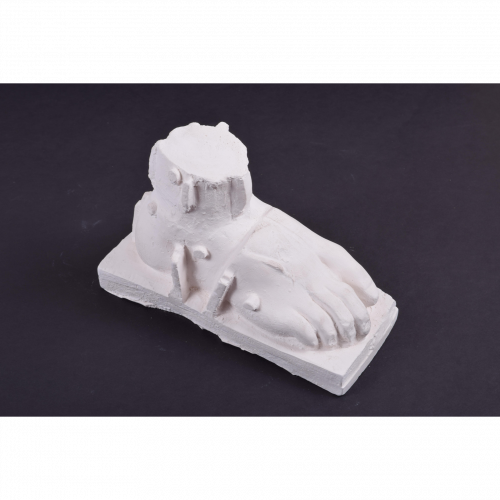
Sir Eduardo Paolozzi CBE RA (1924-2005)
'Foot of a Statue'
Plaster 9 x 19 x 13 cm Paolozzi’s fascination with anatomy, machine parts, and the idiom of classical statuary is evident in his modernist sculptural forms. Foot of a Statue suggests the foot of an ancient Colossus - severed from the rest of the body, it becomes a symbol of fragmentation, of a civilisation’s decline. Sir Eduardo Luigi Paolozzi CBE RA was a Scottish artist, known for his sculpture and graphic works. He is widely considered to be one of the pioneers of pop art. Paolozzi studied at the Edinburgh College of Art in 1943, briefly at Saint Martin's School of Art in 1944, and then at the Slade School of Fine Art at University College London from 1944 to 1947, after which he worked in Paris. While in Paris from 1947 to 1949, Paolozzi became acquainted with Alberto Giacometti, Jean Arp, Constantin Brâncuși, Georges Braque and Fernand Léger. This period became an important influence for his later work. For example, the influence of Giacometti and many of the original Surrealists he met in Paris can be felt in the group of lost-wax sculptures made by Paolozzi in the mid-1950s. Their surfaces, studded with found objects and machine parts, were to gain him recognition. He taught sculpture and ceramics at several institutions, including the Hochschule für bildende Künste Hamburg (1960–62), University of California, Berkeley (in 1968) and at the Royal College of Art. Paolozzi had a long association with Germany, having worked in Berlin from 1974 as part of the Berlin Artist Programme of the German Academic Exchange Programme. He was a professor at the Fachhochschule in Cologne from 1977 to 1981, and later taught sculpture at the Akademie der Bildenden Künste in Munich. Paolozzi was fond of Munich and many of his works and concept plans were developed in a studio he kept there, including the mosaics of the Tottenham Court Road Station in London. He took a stab at industrial design in the 1970s with a 500-piece run of the upscale Suomi tableware by Timo Sarpaneva that Paolozzi decorated for the German Rosenthal porcelain maker's Studio Linie. Condition: Generally very good, occasional inclusions etc., as expected. If you'd ike to know more, please email info@manningfineart.co.uk or call us on 07929 749056. -

Sir Eduardo Paolozzi CBE RA (1924-2005) Steps
Plaster of Paris 10 x 10 x 4 cm Paolozzi’s fascination with anatomy, machine parts, and the idiom of classical statuary is evident in his modernist sculptural forms. The clean lines and gleaming white of 'Steps' evoke the monumental forms and marble of antiquity, constituting an ode to classicism by Paolozzi. Sir Eduardo Luigi Paolozzi CBE RA was a Scottish artist, known for his sculpture and graphic works. He is widely considered to be one of the pioneers of pop art. Paolozzi studied at the Edinburgh College of Art in 1943, briefly at Saint Martin's School of Art in 1944, and then at the Slade School of Fine Art at University College London from 1944 to 1947, after which he worked in Paris. While in Paris from 1947 to 1949, Paolozzi became acquainted with Alberto Giacometti, Jean Arp, Constantin Brâncuși, Georges Braque and Fernand Léger. This period became an important influence for his later work. For example, the influence of Giacometti and many of the original Surrealists he met in Paris can be felt in the group of lost-wax sculptures made by Paolozzi in the mid-1950s. Their surfaces, studded with found objects and machine parts, were to gain him recognition. He taught sculpture and ceramics at several institutions, including the Hochschule für bildende Künste Hamburg (1960–62), University of California, Berkeley (in 1968) and at the Royal College of Art. Paolozzi had a long association with Germany, having worked in Berlin from 1974 as part of the Berlin Artist Programme of the German Academic Exchange Programme. He was a professor at the Fachhochschule in Cologne from 1977 to 1981, and later taught sculpture at the Akademie der Bildenden Künste in Munich. Paolozzi was fond of Munich and many of his works and concept plans were developed in a studio he kept there, including the mosaics of the Tottenham Court Road Station in London. He took a stab at industrial design in the 1970s with a 500-piece run of the upscale Suomi tableware by Timo Sarpaneva that Paolozzi decorated for the German Rosenthal porcelain maker's Studio Linie. Condition: Generally very good, occasional inclusions etc., as expected. If you'd like to know more, please email info@manningfineart.co.uk or call us on 07929 749056. -

Sir Eduardo Paolozzi CBE RA (1924-2005) Striated Construction
Plaster of Paris 5 x 5 x 6 cm Paolozzi’s fascination with anatomy, machine parts, and the idiom of classical statuary is evident in his modernist sculptural forms. 'Striated Construction' is an intriguing piece, characterised by clean lines and strong forms. The work is both architectural and natural, whereby the layers both evoke steps and the geological striations of the natural world. Sir Eduardo Luigi Paolozzi CBE RA was a Scottish artist, known for his sculpture and graphic works. He is widely considered to be one of the pioneers of pop art. Paolozzi studied at the Edinburgh College of Art in 1943, briefly at Saint Martin's School of Art in 1944, and then at the Slade School of Fine Art at University College London from 1944 to 1947, after which he worked in Paris. While in Paris from 1947 to 1949, Paolozzi became acquainted with Alberto Giacometti, Jean Arp, Constantin Brâncuși, Georges Braque and Fernand Léger. This period became an important influence for his later work. For example, the influence of Giacometti and many of the original Surrealists he met in Paris can be felt in the group of lost-wax sculptures made by Paolozzi in the mid-1950s. Their surfaces, studded with found objects and machine parts, were to gain him recognition. He taught sculpture and ceramics at several institutions, including the Hochschule für bildende Künste Hamburg (1960–62), University of California, Berkeley (in 1968) and at the Royal College of Art. Paolozzi had a long association with Germany, having worked in Berlin from 1974 as part of the Berlin Artist Programme of the German Academic Exchange Programme. He was a professor at the Fachhochschule in Cologne from 1977 to 1981, and later taught sculpture at the Akademie der Bildenden Künste in Munich. Paolozzi was fond of Munich and many of his works and concept plans were developed in a studio he kept there, including the mosaics of the Tottenham Court Road Station in London. He took a stab at industrial design in the 1970s with a 500-piece run of the upscale Suomi tableware by Timo Sarpaneva that Paolozzi decorated for the German Rosenthal porcelain maker's Studio Linie. Condition: Generally very good, occasional inclusions etc., as expected. If you'd like to know more, please email info@manningfineart.co.uk or call us on 07929 749056. -

Sir Eduardo Paolozzi CBE RA (1924-2005) Triangular Construction
Plaster of Paris 6 x 4 x 2 cm Paolozzi’s fascination with anatomy, machine parts, and the idiom of classical statuary is evident in his modernist sculptural forms. 'Triangular Construction' is an intriguing piece, characterised by clean lines and strong forms. Sir Eduardo Luigi Paolozzi CBE RA was a Scottish artist, known for his sculpture and graphic works. He is widely considered to be one of the pioneers of pop art. Paolozzi studied at the Edinburgh College of Art in 1943, briefly at Saint Martin's School of Art in 1944, and then at the Slade School of Fine Art at University College London from 1944 to 1947, after which he worked in Paris. While in Paris from 1947 to 1949, Paolozzi became acquainted with Alberto Giacometti, Jean Arp, Constantin Brâncuși, Georges Braque and Fernand Léger. This period became an important influence for his later work. For example, the influence of Giacometti and many of the original Surrealists he met in Paris can be felt in the group of lost-wax sculptures made by Paolozzi in the mid-1950s. Their surfaces, studded with found objects and machine parts, were to gain him recognition. He taught sculpture and ceramics at several institutions, including the Hochschule für bildende Künste Hamburg (1960–62), University of California, Berkeley (in 1968) and at the Royal College of Art. Paolozzi had a long association with Germany, having worked in Berlin from 1974 as part of the Berlin Artist Programme of the German Academic Exchange Programme. He was a professor at the Fachhochschule in Cologne from 1977 to 1981, and later taught sculpture at the Akademie der Bildenden Künste in Munich. Paolozzi was fond of Munich and many of his works and concept plans were developed in a studio he kept there, including the mosaics of the Tottenham Court Road Station in London. He took a stab at industrial design in the 1970s with a 500-piece run of the upscale Suomi tableware by Timo Sarpaneva that Paolozzi decorated for the German Rosenthal porcelain maker's Studio Linie. Condition: Generally very good, occasional inclusions etc., as expected. If you'd like to know more, please email info@manningfineart.co.uk or call us on 07929 749056. -
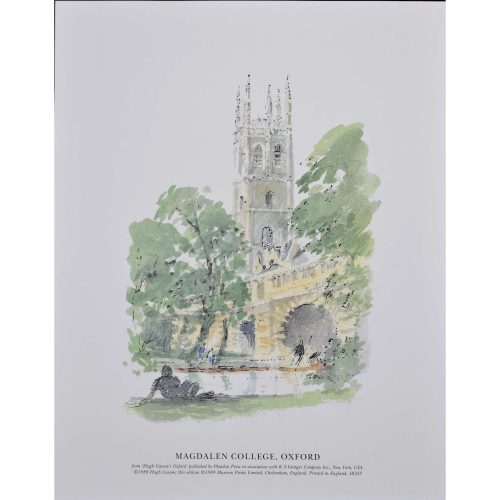
Sir Hugh Casson (1910-1999) Magdalen College Oxford
Unsigned proof print 25x20cm From Casson’s ever-popular Oxford series of prints. Sir Hugh Casson was educated at Eastbourne College, St John’s College Cambridge and the Bartlett School of Architecture. Trained in the 1930s in the early modernist style, he taught at the Cambridge School of Architecture. After employment as a camoufleur during World War 2 by the Air Ministry, in 1948 he was appointed as director of architecture for the Festival of Britain. A close friend of the Royal Family, he undertook designs for the 1953 coronation, designed the interior of the Royal Yacht Britannia (“The overall idea was to give the impression of a country house at sea”), and taught the Prince of Wales to paint in watercolours. Amongst his architectural achievements are the Elephant House at London Zoo, the 1978 redevelopment of Bristol Docks, the Raised Faculty Building for The University of Cambridge, and a building for the Royal College of Art. He published a number of illustrated books, of which Casson’s Oxford and Casson’s Cambridge are probably the best known. A limited edition series of prints was produced from the paintings. If you are interested email info@manningfineart.co.uk or call us on 07929 749056. Condition: Excellent. -
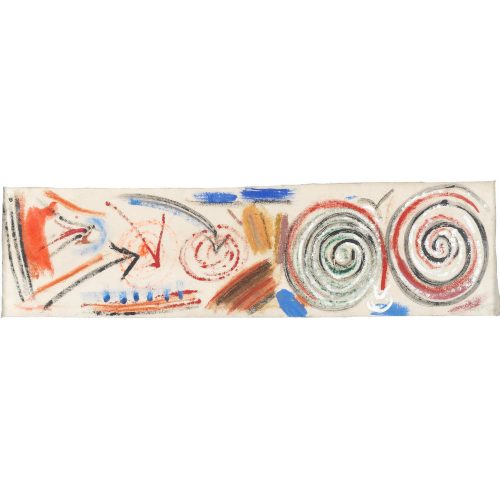
Terry Frost (1915-2003)
'Untitled Landscape'
Oil on canvas, laid on board 22 x 81.5cm Exhibited London, Coram Gallery, Terry Frost: Works on Paper and Small Paintings, 23 September-29 October 1994 Click here for biographical details and other works by the artist. If you are interested email info@manningfineart.co.uk or call us on 07929 749056. -

A. E. Halliwell (1905-1987) Smithfield Cattle Show
Airbrush and gouache 26 x 33 cm c.1930 Provenance: Family of the artist A.E. Halliwell (1905–1986) was a British artist, illustrator, and designer best known for his vibrant poster designs created for British railway companies during the mid-20th century. Born in Southport, Halliwell developed a strong foundation in art and design early in life. He studied at the Southport School of Art from 1923 to 1926 before graduating to the Royal College of Art in London and subsequently practising as a professional designer from the 1930s. Following his studies, Halliwell married Doris Doyle in Strood Kent, and went on to have a significant teaching career himself, most notably as a lecturer at the Central School of Arts and Crafts (later part of Central Saint Martins), where he influenced a new generation of designers and illustrators. Halliwell is perhaps best remembered for his vibrant and engaging poster designs created for British railway companies during the 1930s. His work was characterised by a bright, graphic style that balanced charm with clarity, often depicting idealised scenes of British holiday destinations—from sunny seaside towns to tranquil countryside vistas. Beyond posters, his artistic output included book illustration, commercial design, and stage costume sketches, showcasing his versatility across mediums. His posters continue to remain enduring symbols of a golden age of British travel and design and are displayed in major collections including the London Transport Museum. This striking poster by A. E. Halliwell boldly advertises the Smithfield Cattle Show with a powerful, symmetrical design. At its centre is a stylised, almost regal bull’s head, perfectly aligned and framed by the iconic London Underground roundel. The rich, earthy tones of the bull contrast sharply with the vibrant background of red, yellow, and electric blue, creating a vivid and modern aesthetic. Condition: Generally very good.If you would like to know more, please email info@manningfineart.co.uk or call us on 07929 749056.
-
Out of stock
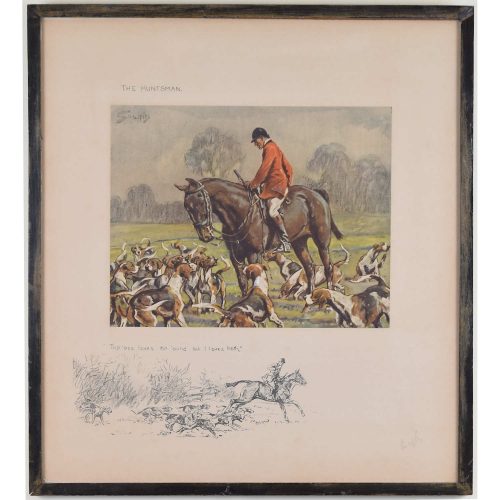
Charles "Snaffles" Johnson Payne (1884-1967)
The Huntsman: "The 'oss loves the 'ound but I loves both"
Lithograph 47 x 43 cm Signed in pencil with Snaffles' bit blindstamp, in original 1/2" frame. Snaffles was one of the foremost sporting artists of his era, publishing many popular prints such as these: hunting pictures, racing scenes, and military subjects. Snaffles' distinctive drawing style is emphasised by his 'remarque' - sketches in the margin - and his witty titles. Condition: very good. Small chip to bottom centre of frame. -

Hubert Finney (1905 – 1991) Soldiers Waiting
Charcoal 37 x 55 cm A reclusive figure whose work has remained largely unseen, Finney studied under Eric Gill before winning a scholarship to the Royal College of Art in the early 1920’s. Finney had the good fortune to attend the RCA as part of a golden generation, many of whom went on to become some of Britain’s best loved artists (amongst them Ravilious, Bawden, Hepworth, Moore, Dunbar, Sorrell, and Piper). After a travelling scholarship to Rome, in 1929, Finney returned to become a teacher at Chelsea School of Art – working alongside Henry Moore who was in charge of the Sculpture Department and Graham Sutherland, the Department of Design. It was during the Second World War, when Finney was working for the Light Rescue Service of the Civil Defence that this charcoal piece was created. Depicting a bomb site during the blitz, Finney's skilful blend of charcoal, coloured pencil and pastel creates pops of colour and conveys the smoky atmosphere of London in the 1940s. -
Out of stock
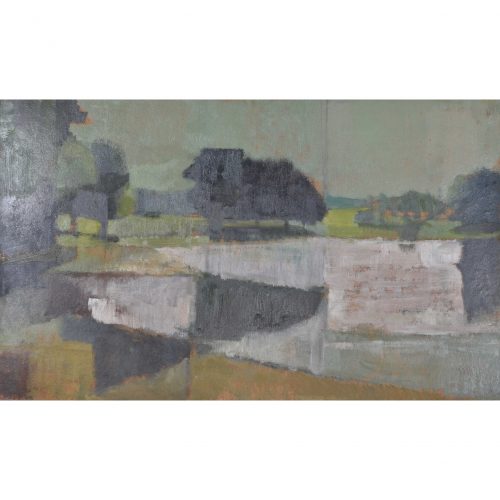
Bernard Myers (1925 - 2007)
South London Park
Oil on board 38 x 64 cm Myers' abstract oil of a London park. Blocks of colour make up the forms of the landscape, textured by the artist's thick, lateral brushstrokes. Bernard Myers was a painter and printmaker who trained at St Martin’s School of Art, the Camberwell School of Arts and Crafts, and the Royal College of Art in the 1940s and 1950s. This painting won the David Murray Landscape Scholarship and was painted while Myers was a student at the RCA. He went on to teach there before moving into a studio in Hammersmith. Condition: very good. Recently cleaned and revarnished. If you’d like to know more, please email info@manningfineart.co.uk or call us on 07929 749056. -
Out of stock
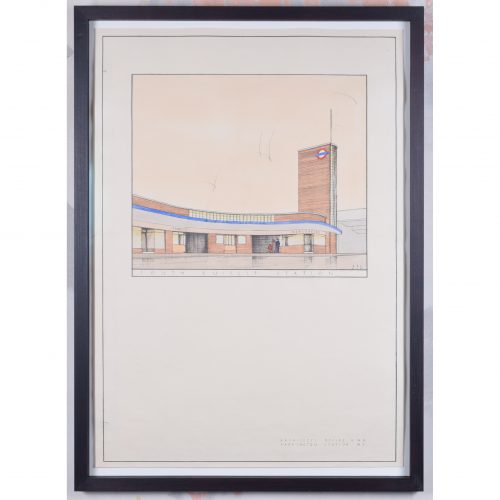
Brian Bannatyne Lewis (1906 - 1991)
South Ruislip Station (1938)
Pen, ink and watercolour 70 x 50 cm Initialled and dated 8 3 38. A 1938 design for the new South Ruislip tube station, commissioned by the Great Western Railway (GWR) for its proposed western extension to the Central Line. The design's Art Deco lettering befits London Transport's aesthetic in the 1930s. Lewis brings his designs to life by including smartly-dressed characters entering and leaving the stations. The Central line opened in 1900, between Shepherd's Bush and Bank; it extended westwards to Ealing Broadway in 1920. Two years after the formation of London Transport in 1933, an extensive New Works Programme began, proposing a westwards extension of the line to Denham. Brian Lewis created designs for nine stations in early 1938, but the Second World War broke out before they could be built. By the time the extension had been built, Lewis was no longer chief architect of the GWR - the stations were modified and completed by Frederick Francis Charles Curtis instead. The extension to Greenford opened in 1947 and finally reached West Ruislip in 1948. Denham never actually became part of the tube line, owing to the establishment of the green belt. Brian Lewis was born in Tasmania, attended school in Melbourne, and subsequently obtained a Diploma in Architecture in 1928 from the University of Melbourne. He then moved to the UK to study at the Liverpool School of Architecture, winning scholarships in each of his three years of study to fund extensive European travel. He married a fellow Liverpool architectural student, Hilary Archer. After moving to London, he took up employment with the GWR in their architects’ office; he also lectured at a local polytechnic, and moonlighted with his wife at home on mainly residential commissions – rather different projects from the hotels and stations which GWR commissioned from him. He exhibited frequently at the Royal Academy of Arts, showing superb measured drawings of historic buildings. In the Second World War he enlisted with the Second Imperial Australian Force, serving in the Middle East, then transferred to the Royal Australian Engineers where he became a Captain. In 1943 he was sent to London to help GWR repair bomb damage. Lewis became Chief Architect of GWR in 1945 (following the retirement of the noted Percy Emerson Culverhouse), and the first Chair of Architecture at Melbourne University in 1947. He also became the consulting architect for the major buildings of the Australian National University in Canberra, producing an imaginative site plan and designing University House, which was awarded the Sulman medal in 1954. He also designed the Risdon Prison Complex in 1960. He retired in 1971 to paint watercolours and write his memoirs. Condition: generally very good; a few handling marks and two holes from filing. Handsomely framed. If you are interested, please email info@manningfineart.co.uk or call us on 07929 749056. Click here to view the other station designs in the set.