-
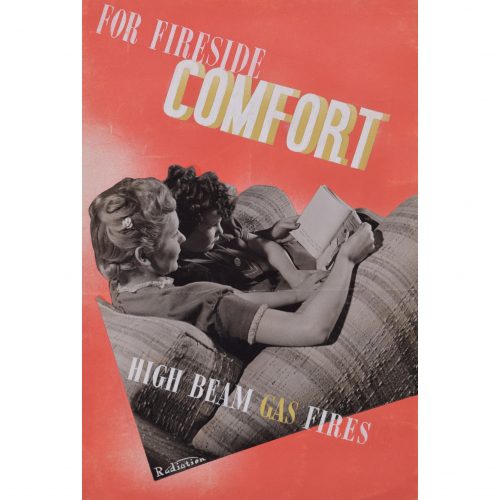
Brownbridge (flourished 1930s - 1940s)
For Fireside Comfort, High Beam Gas Fires brochure design
Gouache, mixed media art, and collage 21.5 x 14 cm From a small archive of works by Brownbridge, a member of the Society of Industrial Artists. A design for a brochure advertising Radiation's high beam gas fires. Brownbridge's design combines a photograph of a mother and child with hand-painted text; the red and yellow colour palette project warmth and cosiness. The mother's hair is fantastically 1930s, and she reads a copy of 'Patsy Ann: Her Happy Times' by Mona Reed King (first published in 1935) to her son. Society of Industrial Artists correspondance (photographed above) is not included; please enquire separately. Condition: generally very good; lacking 'The Serene' collaged photograph. If you are interested, please email info@manningfineart.co.uk or call us on 07929 749056. Click here for other designs by Brownbridge. -
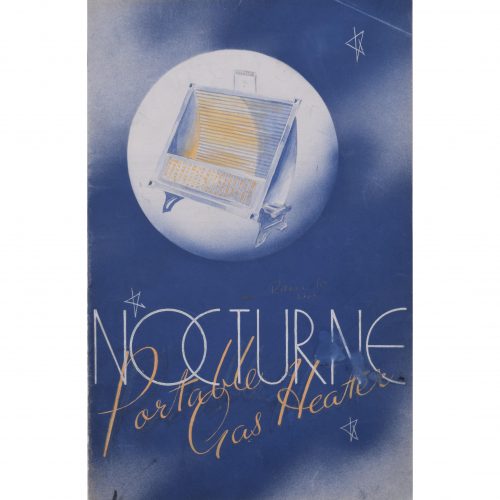
Brownbridge (flourished 1930s - 1940s)
Nocturne Portable Gas Heater brochure design
Gouache and mixed media art 21.5 x 14 cm From a small archive of works by Brownbridge, a member of the Society of Industrial Artists. A marvellous gouache design for a brochure advertising the Nocturne portable gas heater. The art deco text surrounded by stars and image of the innovative gas heater superimposed on the moon combine to make this a thoroughly modern piece of 1930s design. Society of Industrial Artists correspondance (photographed above) is not included; please enquire separately. Condition: generally very good; some damage to reverse. If you are interested, please email info@manningfineart.co.uk or call us on 07929 749056. Click here for other designs by Brownbridge. -
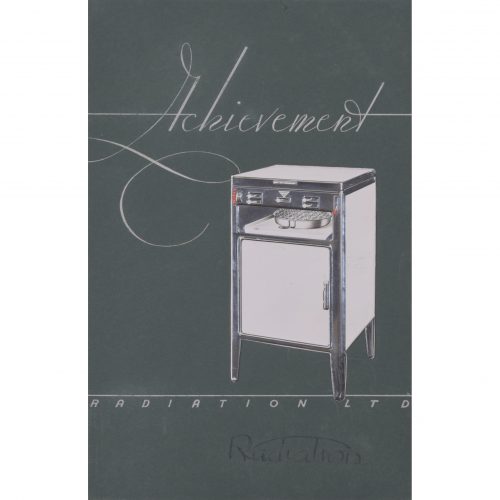
Brownbridge (flourished 1930s - 1940s)
Achievement Radiation gas cookers brochure design
Pen and collage 21.5 x 14 cm From a small archive of works by Brownbridge, a member of the Society of Industrial Artists. Brownbridge's bold design advertises Radiation cookers (innovative gas cookers which were sold in Britain in the 1920s and 1930s). Shiny white against a dark background, the Radiation cooker seems impossibly glamorous and inviting. Society of Industrial Artists correspondance (photographed above) is not included; please enquire separately. Condition: generally very good. If you are interested, please email info@manningfineart.co.uk or call us on 07929 749056. Click here for other designs by Brownbridge. -
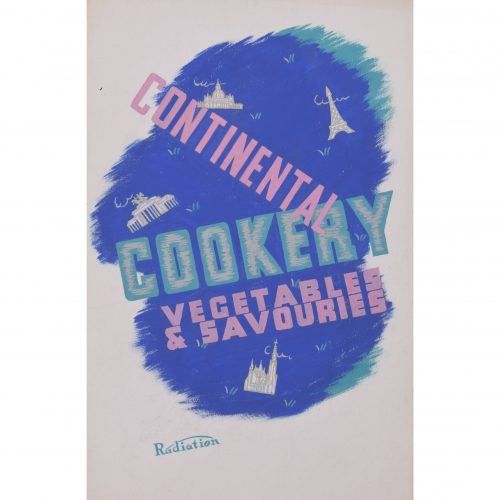
Brownbridge (flourished 1930s - 1940s)
Continental Cookery Radiation cooker brochure design
Gouache 21.5 x 14 cm From a small archive of works by Brownbridge, a member of the Society of Industrial Artists. A beautiful original gouache design for a brochure of continental recipes, created to advertise Radiation cookers (innovative gas cookers which were sold in Britain in the 1920s and 1930s). Brownbridge's brightly-coloured design includes boldly slanted text in pink and turquoise, set over a deep blue background; he also highlights architectural gems of Europe, such as the Eiffel Tower. By cooking with a Radiation cooker, the cover suggests, you too can experience the cultural and culinary delights of Europe from the comfort of your own home. Society of Industrial Artists correspondance (photographed above) is not included; please enquire separately. Condition: generally very good. If you are interested, please email info@manningfineart.co.uk or call us on 07929 749056. Click here for other designs by Brownbridge. -
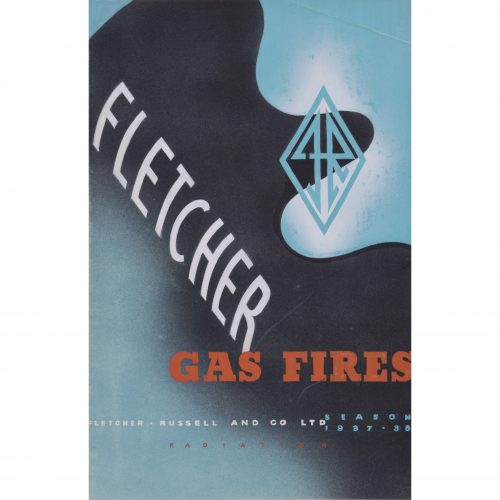
Brownbridge (flourished 1930s - 1940s)
Fletcher Gas Fires brochure design (1937)
Lithographic brochure 21.5 x 14 cm From a small archive of works by Brownbridge, a member of the Society of Industrial Artists. An original gouache design for a brochure advertising Fletcher Russell and Co. gas fires. The futuristic style of the boldly blue-, black-, and orange-coloured poster, as well as the dynamic diamond-shaped badge containing the initials F and R (for Fletcher and Russell) combine to make this a highly modern piece of 1930s design. Society of Industrial Artists correspondance (photographed above) is not included; please enquire separately. Condition: generally very good; gentle crease to top right corner. If you are interested, please email info@manningfineart.co.uk or call us on 07929 749056. Click here for other designs by Brownbridge. -
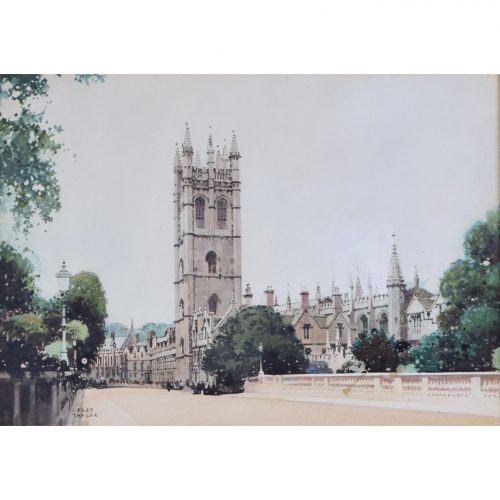
Fred Taylor (1875 - 1963)
Magdalen Tower from Magdalen Bridge
Watercolour 25 x 37 cm Signed lower left. Fred Taylor captures the indomitable features of Magdalen Tower. The spire rises into a pale sky as undergraduates stream past the entrance to the Porter's Lodge. An old-fashioned car drives up the High.This watercolour of Magdalen was a design for the front cover of a guidebook about Oxford.Fred Taylor was a London-born painter and poster designer. He studied at the Académie Julian in Paris, and Goldsmiths’ in London, later travelling to Italy on a scholarship to study art. He produced many poster designs for railway and shipping firms and was an official camoufleur during the Second World War. He exhibited at the Royal Academy.Condition: very good. If you are interested, please email info@manningfineart.co.uk or call us on 07929 749056. Click here for other views of Magdalen College, Oxford. -
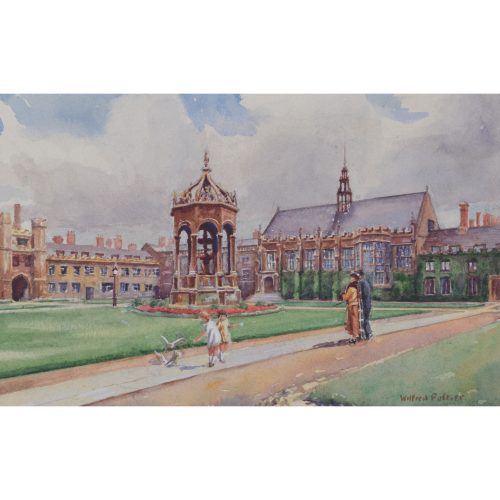
Wilfred Pettitt (1904 - 1978)
Great Court, Trinity College, Cambridge
Watercolour 17 x 27 cm A smartly-dressed couple and their two children enjoy the sunny and immaculately-lawned Great Court of Trinity College, Cambridge. The man and woman admire the ornate fountain which stands sentinel in the middle of the court (it, along with the rest of Great Court, was erected by by Thomas Nevile, master of the college in the early 17th century). Their children, perhaps oblivious to the architectural majesty around them, amuse themselves by playing with the pigeons. Wilfred Stanley Pettitt was born in Great Yarmouth, and studied at the Great Yarmouth School of Art and the Norwich School of Art. In 1928 he showed at the Royal Academy Royal Academy for the first time, and his work was also exhibited by the Royal Society of British Artists and the Royal Cambrian Academy. In 1944 Pettitt became one of the founding members of the Norwich Twenty Group (a group of Norfolk artists who intended to raise the standards of local professional art). He died in Eastbourne in 1978. Condition: mounted to board; otherwise very good. If you are interested, please email info@manningfineart.co.uk or call us on 07929 749056. Click here for other views of Trinity College, Cambridge. -
Out of stock
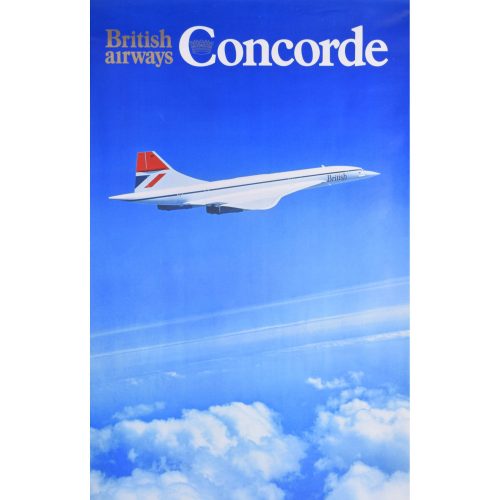
Concorde
Original vintage poster 102 x 64 cm A striking poster advertising the glamorous Concorde aircraft for British Airways. Concorde entered service in 1976 with Air France from Paris-Roissy and British Airways from London Heathrow. Condition: very good. If you are interested, please email info@manningfineart.co.uk or call us on 07929 749056. -
Out of stock
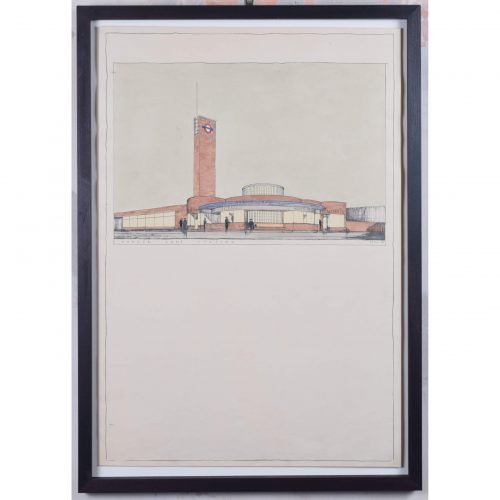
Brian Bannatyne Lewis (1906 - 1991)
Hanger Lane Station (1938)
Pen, ink and watercolour 70 x 50 cm Inscribed 'BB Lewis' lower right. A 1938 design for the new Hanger Lane tube station, commissioned by the Great Western Railway (GWR) for its proposed western extension to the Central Line. The design's Art Deco lettering befits London Transport's aesthetic in the 1930s. Lewis brings his designs to life by including smartly-dressed characters entering and leaving the stations. The Central line opened in 1900, between Shepherd's Bush and Bank; it extended westwards to Ealing Broadway in 1920. Two years after the formation of London Transport in 1933, an extensive New Works Programme began, proposing a westwards extension of the line to Denham. Brian Lewis created designs for nine stations in early 1938, but the Second World War broke out before they could be built. By the time the extension had been built, Lewis was no longer chief architect of the GWR - the stations were modified and completed by Frederick Francis Charles Curtis instead. The extension to Greenford opened in 1947 and finally reached West Ruislip in 1948. Denham never actually became part of the tube line, owing to the establishment of the green belt. Brian Lewis was born in Tasmania, attended school in Melbourne, and subsequently obtained a Diploma in Architecture in 1928 from the University of Melbourne. He then moved to the UK to study at the Liverpool School of Architecture, winning scholarships in each of his three years of study to fund extensive European travel. He married a fellow Liverpool architectural student, Hilary Archer. After moving to London, he took up employment with the GWR in their architects’ office; he also lectured at a local polytechnic, and moonlighted with his wife at home on mainly residential commissions – rather different projects from the hotels and stations which GWR commissioned from him. He exhibited frequently at the Royal Academy of Arts, showing superb measured drawings of historic buildings. In the Second World War he enlisted with the Second Imperial Australian Force, serving in the Middle East, then transferred to the Royal Australian Engineers where he became a Captain. In 1943 he was sent to London to help GWR repair bomb damage. Lewis became Chief Architect of GWR in 1945 (following the retirement of the noted Percy Emerson Culverhouse), and the first Chair of Architecture at Melbourne University in 1947. He also became the consulting architect for the major buildings of the Australian National University in Canberra, producing an imaginative site plan and designing University House, which was awarded the Sulman medal in 1954. He also designed the Risdon Prison Complex in 1960. He retired in 1971 to paint watercolours and write his memoirs. Condition: generally very good; a few handling marks and two holes from filing. Handsomely framed. If you are interested, please email info@manningfineart.co.uk or call us on 07929 749056. Click here to view the other station designs in the set. -
Out of stock
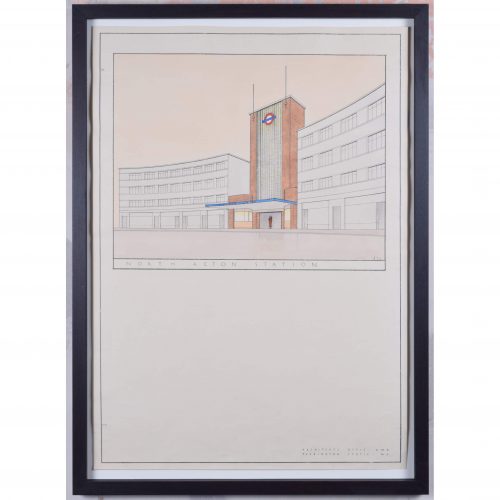
Brian Bannatyne Lewis (1906 - 1991)
North Acton Station (1938)
Pen, ink and watercolour 70 x 50 cm Initialled and dated 26 2 38. A 1938 design for the new North Acton tube station, commissioned by the Great Western Railway (GWR) for its proposed western extension to the Central Line. The design's Art Deco lettering befits London Transport's aesthetic in the 1930s. Lewis brings his designs to life by including smartly-dressed characters entering and leaving the stations. The Central line opened in 1900, between Shepherd's Bush and Bank; it extended westwards to Ealing Broadway in 1920. Two years after the formation of London Transport in 1933, an extensive New Works Programme began, proposing a westwards extension of the line to Denham. Brian Lewis created designs for nine stations in early 1938, but the Second World War broke out before they could be built. By the time the extension had been built, Lewis was no longer chief architect of the GWR - the stations were modified and completed by Frederick Francis Charles Curtis instead. The extension to Greenford opened in 1947 and finally reached West Ruislip in 1948. Denham never actually became part of the tube line, owing to the establishment of the green belt. Brian Lewis was born in Tasmania, attended school in Melbourne, and subsequently obtained a Diploma in Architecture in 1928 from the University of Melbourne. He then moved to the UK to study at the Liverpool School of Architecture, winning scholarships in each of his three years of study to fund extensive European travel. He married a fellow Liverpool architectural student, Hilary Archer. After moving to London, he took up employment with the GWR in their architects’ office; he also lectured at a local polytechnic, and moonlighted with his wife at home on mainly residential commissions – rather different projects from the hotels and stations which GWR commissioned from him. He exhibited frequently at the Royal Academy of Arts, showing superb measured drawings of historic buildings. In the Second World War he enlisted with the Second Imperial Australian Force, serving in the Middle East, then transferred to the Royal Australian Engineers where he became a Captain. In 1943 he was sent to London to help GWR repair bomb damage. Lewis became Chief Architect of GWR in 1945 (following the retirement of the noted Percy Emerson Culverhouse), and the first Chair of Architecture at Melbourne University in 1947. He also became the consulting architect for the major buildings of the Australian National University in Canberra, producing an imaginative site plan and designing University House, which was awarded the Sulman medal in 1954. He also designed the Risdon Prison Complex in 1960. He retired in 1971 to paint watercolours and write his memoirs. Condition: generally very good; a few handling marks and two holes from filing. Handsomely framed. If you are interested, please email info@manningfineart.co.uk or call us on 07929 749056. Click here to view the other station designs in the set. -
Out of stock
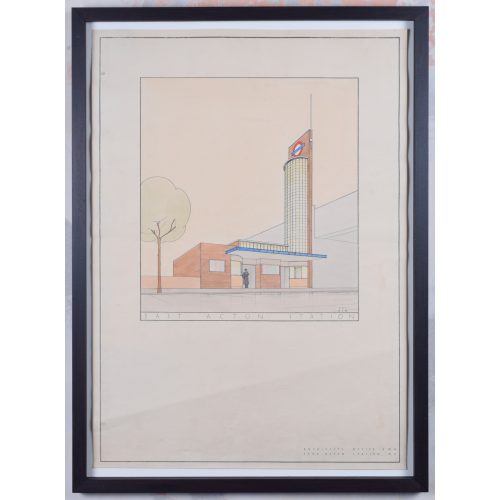
Brian Bannatyne Lewis (1906 - 1991)
East Acton Station (1938)
Pen, ink and watercolour 70 x 50 cm Initialled and dated 28 2 38. A 1938 design for the new East Acton tube station, commissioned by the Great Western Railway (GWR) for its proposed western extension to the Central Line. The design's Art Deco lettering befits London Transport's aesthetic in the 1930s. Lewis brings his designs to life by including smartly-dressed characters entering and leaving the stations. The Central line opened in 1900, between Shepherd's Bush and Bank; it extended westwards to Ealing Broadway in 1920. Two years after the formation of London Transport in 1933, an extensive New Works Programme began, proposing a westwards extension of the line to Denham. Brian Lewis created designs for nine stations in early 1938, but the Second World War broke out before they could be built. By the time the extension had been built, Lewis was no longer chief architect of the GWR - the stations were modified and completed by Frederick Francis Charles Curtis instead. The extension to Greenford opened in 1947 and finally reached West Ruislip in 1948. Denham never actually became part of the tube line, owing to the establishment of the green belt. Brian Lewis was born in Tasmania, attended school in Melbourne, and subsequently obtained a Diploma in Architecture in 1928 from the University of Melbourne. He then moved to the UK to study at the Liverpool School of Architecture, winning scholarships in each of his three years of study to fund extensive European travel. He married a fellow Liverpool architectural student, Hilary Archer. After moving to London, he took up employment with the GWR in their architects’ office; he also lectured at a local polytechnic, and moonlighted with his wife at home on mainly residential commissions – rather different projects from the hotels and stations which GWR commissioned from him. He exhibited frequently at the Royal Academy of Arts, showing superb measured drawings of historic buildings. In the Second World War he enlisted with the Second Imperial Australian Force, serving in the Middle East, then transferred to the Royal Australian Engineers where he became a Captain. In 1943 he was sent to London to help GWR repair bomb damage. Lewis became Chief Architect of GWR in 1945 (following the retirement of the noted Percy Emerson Culverhouse), and the first Chair of Architecture at Melbourne University in 1947. He also became the consulting architect for the major buildings of the Australian National University in Canberra, producing an imaginative site plan and designing University House, which was awarded the Sulman medal in 1954. He also designed the Risdon Prison Complex in 1960. He retired in 1971 to paint watercolours and write his memoirs. Condition: generally very good; a few handling marks and two holes from filing. Handsomely framed. If you are interested, please email info@manningfineart.co.uk or call us on 07929 749056. Click here to view the other station designs in the set. -
Out of stock
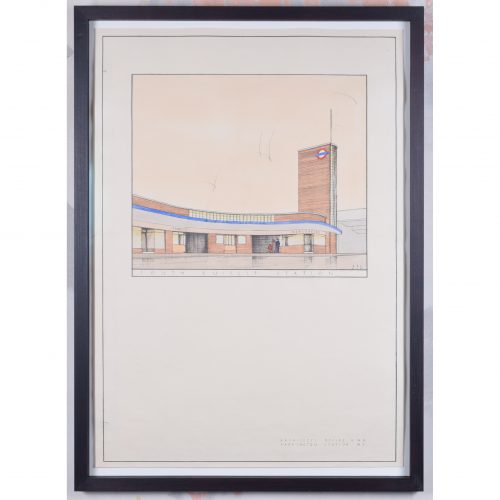
Brian Bannatyne Lewis (1906 - 1991)
South Ruislip Station (1938)
Pen, ink and watercolour 70 x 50 cm Initialled and dated 8 3 38. A 1938 design for the new South Ruislip tube station, commissioned by the Great Western Railway (GWR) for its proposed western extension to the Central Line. The design's Art Deco lettering befits London Transport's aesthetic in the 1930s. Lewis brings his designs to life by including smartly-dressed characters entering and leaving the stations. The Central line opened in 1900, between Shepherd's Bush and Bank; it extended westwards to Ealing Broadway in 1920. Two years after the formation of London Transport in 1933, an extensive New Works Programme began, proposing a westwards extension of the line to Denham. Brian Lewis created designs for nine stations in early 1938, but the Second World War broke out before they could be built. By the time the extension had been built, Lewis was no longer chief architect of the GWR - the stations were modified and completed by Frederick Francis Charles Curtis instead. The extension to Greenford opened in 1947 and finally reached West Ruislip in 1948. Denham never actually became part of the tube line, owing to the establishment of the green belt. Brian Lewis was born in Tasmania, attended school in Melbourne, and subsequently obtained a Diploma in Architecture in 1928 from the University of Melbourne. He then moved to the UK to study at the Liverpool School of Architecture, winning scholarships in each of his three years of study to fund extensive European travel. He married a fellow Liverpool architectural student, Hilary Archer. After moving to London, he took up employment with the GWR in their architects’ office; he also lectured at a local polytechnic, and moonlighted with his wife at home on mainly residential commissions – rather different projects from the hotels and stations which GWR commissioned from him. He exhibited frequently at the Royal Academy of Arts, showing superb measured drawings of historic buildings. In the Second World War he enlisted with the Second Imperial Australian Force, serving in the Middle East, then transferred to the Royal Australian Engineers where he became a Captain. In 1943 he was sent to London to help GWR repair bomb damage. Lewis became Chief Architect of GWR in 1945 (following the retirement of the noted Percy Emerson Culverhouse), and the first Chair of Architecture at Melbourne University in 1947. He also became the consulting architect for the major buildings of the Australian National University in Canberra, producing an imaginative site plan and designing University House, which was awarded the Sulman medal in 1954. He also designed the Risdon Prison Complex in 1960. He retired in 1971 to paint watercolours and write his memoirs. Condition: generally very good; a few handling marks and two holes from filing. Handsomely framed. If you are interested, please email info@manningfineart.co.uk or call us on 07929 749056. Click here to view the other station designs in the set. -
Out of stock
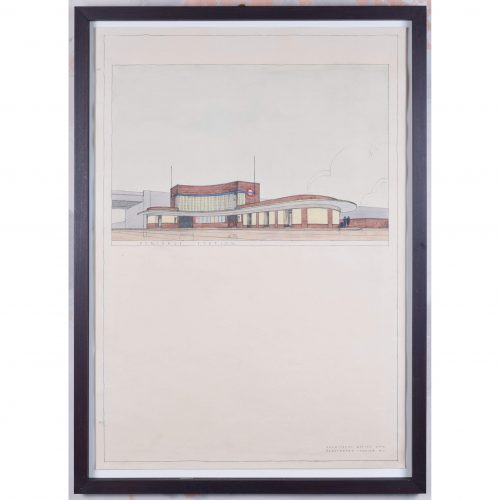
Brian Bannatyne Lewis (1906 - 1991)
Perivale Station (1938)
Pen, ink and watercolour 70 x 50 cm A 1938 design for the new Perivale tube station, commissioned by the Great Western Railway (GWR) for its proposed western extension to the Central Line. The design's Art Deco lettering befits London Transport's aesthetic in the 1930s. Lewis brings his designs to life by including smartly-dressed characters entering and leaving the stations. The Central line opened in 1900, between Shepherd's Bush and Bank; it extended westwards to Ealing Broadway in 1920. Two years after the formation of London Transport in 1933, an extensive New Works Programme began, proposing a westwards extension of the line to Denham. Brian Lewis created designs for nine stations in early 1938, but the Second World War broke out before they could be built. By the time the extension had been built, Lewis was no longer chief architect of the GWR - the stations were modified and completed by Frederick Francis Charles Curtis instead. The extension to Greenford opened in 1947 and finally reached West Ruislip in 1948. Denham never actually became part of the tube line, owing to the establishment of the green belt. Brian Lewis was born in Tasmania, attended school in Melbourne, and subsequently obtained a Diploma in Architecture in 1928 from the University of Melbourne. He then moved to the UK to study at the Liverpool School of Architecture, winning scholarships in each of his three years of study to fund extensive European travel. He married a fellow Liverpool architectural student, Hilary Archer. After moving to London, he took up employment with the GWR in their architects’ office; he also lectured at a local polytechnic, and moonlighted with his wife at home on mainly residential commissions – rather different projects from the hotels and stations which GWR commissioned from him. He exhibited frequently at the Royal Academy of Arts, showing superb measured drawings of historic buildings. In the Second World War he enlisted with the Second Imperial Australian Force, serving in the Middle East, then transferred to the Royal Australian Engineers where he became a Captain. In 1943 he was sent to London to help GWR repair bomb damage. Lewis became Chief Architect of GWR in 1945 (following the retirement of the noted Percy Emerson Culverhouse), and the first Chair of Architecture at Melbourne University in 1947. He also became the consulting architect for the major buildings of the Australian National University in Canberra, producing an imaginative site plan and designing University House, which was awarded the Sulman medal in 1954. He also designed the Risdon Prison Complex in 1960. He retired in 1971 to paint watercolours and write his memoirs. Condition: generally very good; a few handling marks and two holes from filing. Handsomely framed. If you are interested, please email info@manningfineart.co.uk or call us on 07929 749056. Click here to view the other station designs in the set. -
Out of stock
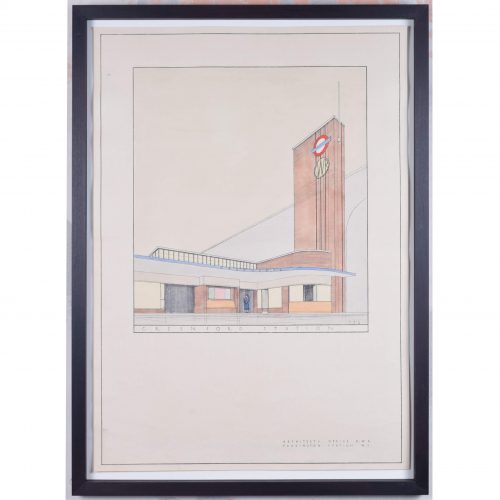
Brian Bannatyne Lewis (1906 - 1991)
Greenford Station (1938)
Pen, ink and watercolour 70 x 50 cm Initialled and dated 7 3 38. A 1938 design for the new Greenford tube station, commissioned by the Great Western Railway (GWR) for its proposed western extension to the Central Line. The design's Art Deco lettering befits London Transport's aesthetic in the 1930s. Lewis brings his designs to life by including smartly-dressed characters entering and leaving the stations. The Central line opened in 1900, between Shepherd's Bush and Bank; it extended westwards to Ealing Broadway in 1920. Two years after the formation of London Transport in 1933, an extensive New Works Programme began, proposing a westwards extension of the line to Denham. Brian Lewis created designs for nine stations in early 1938, but the Second World War broke out before they could be built. By the time the extension had been built, Lewis was no longer chief architect of the GWR - the stations were modified and completed by Frederick Francis Charles Curtis instead. The extension to Greenford opened in 1947 and finally reached West Ruislip in 1948. Denham never actually became part of the tube line, owing to the establishment of the green belt. Brian Lewis was born in Tasmania, attended school in Melbourne, and subsequently obtained a Diploma in Architecture in 1928 from the University of Melbourne. He then moved to the UK to study at the Liverpool School of Architecture, winning scholarships in each of his three years of study to fund extensive European travel. He married a fellow Liverpool architectural student, Hilary Archer. After moving to London, he took up employment with the GWR in their architects’ office; he also lectured at a local polytechnic, and moonlighted with his wife at home on mainly residential commissions – rather different projects from the hotels and stations which GWR commissioned from him. He exhibited frequently at the Royal Academy of Arts, showing superb measured drawings of historic buildings. In the Second World War he enlisted with the Second Imperial Australian Force, serving in the Middle East, then transferred to the Royal Australian Engineers where he became a Captain. In 1943 he was sent to London to help GWR repair bomb damage. Lewis became Chief Architect of GWR in 1945 (following the retirement of the noted Percy Emerson Culverhouse), and the first Chair of Architecture at Melbourne University in 1947. He also became the consulting architect for the major buildings of the Australian National University in Canberra, producing an imaginative site plan and designing University House, which was awarded the Sulman medal in 1954. He also designed the Risdon Prison Complex in 1960. He retired in 1971 to paint watercolours and write his memoirs. Condition: generally very good; a few handling marks and two holes from filing. Handsomely framed. If you are interested, please email info@manningfineart.co.uk or call us on 07929 749056. Click here to view the other station designs in the set. -
Out of stock
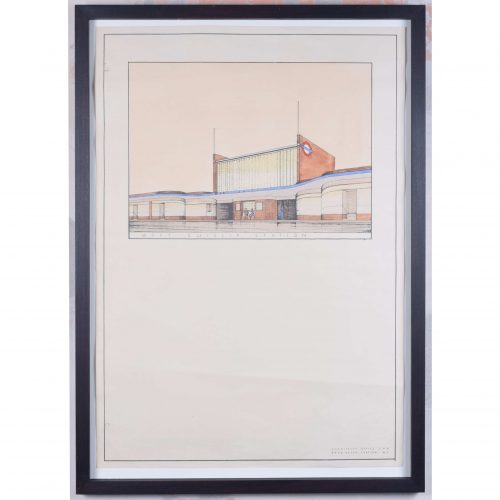
Brian Bannatyne Lewis (1906 - 1991)
West Ruislip Station (1938)
Pen, ink and watercolour 70 x 50 cm A 1938 design for the new West Ruislip tube station, commissioned by the Great Western Railway (GWR) for its proposed western extension to the Central Line. The design's Art Deco lettering befits London Transport's aesthetic in the 1930s. Lewis brings his designs to life by including smartly-dressed characters entering and leaving the stations. The Central line opened in 1900, between Shepherd's Bush and Bank; it extended westwards to Ealing Broadway in 1920. Two years after the formation of London Transport in 1933, an extensive New Works Programme began, proposing a westwards extension of the line to Denham. Brian Lewis created designs for nine stations in early 1938, but the Second World War broke out before they could be built. By the time the extension had been built, Lewis was no longer chief architect of the GWR - the stations were modified and completed by Frederick Francis Charles Curtis instead. The extension to Greenford opened in 1947 and finally reached West Ruislip in 1948. Denham never actually became part of the tube line, owing to the establishment of the green belt. Brian Lewis was born in Tasmania, attended school in Melbourne, and subsequently obtained a Diploma in Architecture in 1928 from the University of Melbourne. He then moved to the UK to study at the Liverpool School of Architecture, winning scholarships in each of his three years of study to fund extensive European travel. He married a fellow Liverpool architectural student, Hilary Archer. After moving to London, he took up employment with the GWR in their architects’ office; he also lectured at a local polytechnic, and moonlighted with his wife at home on mainly residential commissions – rather different projects from the hotels and stations which GWR commissioned from him. He exhibited frequently at the Royal Academy of Arts, showing superb measured drawings of historic buildings. In the Second World War he enlisted with the Second Imperial Australian Force, serving in the Middle East, then transferred to the Royal Australian Engineers where he became a Captain. In 1943 he was sent to London to help GWR repair bomb damage. Lewis became Chief Architect of GWR in 1945 (following the retirement of the noted Percy Emerson Culverhouse), and the first Chair of Architecture at Melbourne University in 1947. He also became the consulting architect for the major buildings of the Australian National University in Canberra, producing an imaginative site plan and designing University House, which was awarded the Sulman medal in 1954. He also designed the Risdon Prison Complex in 1960. He retired in 1971 to paint watercolours and write his memoirs. Condition: generally very good; a few handling marks and two holes from filing. Handsomely framed. If you are interested, please email info@manningfineart.co.uk or call us on 07929 749056. Click here to view the other station designs in the set. -
Out of stock
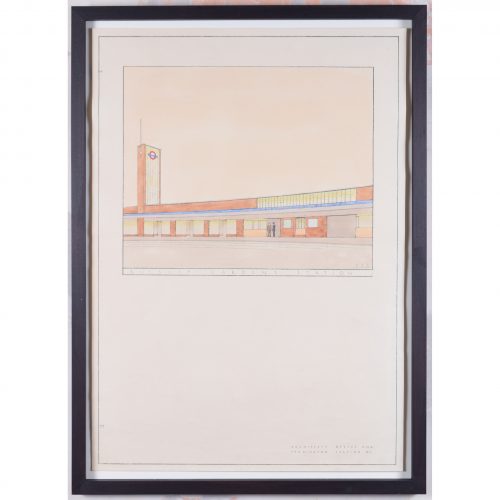
Brian Bannatyne Lewis (1906 - 1991)
Ruislip Gardens Station (1938)
Pen, ink and watercolour 70 x 50 cm Initialled and dated 4 3 38. A 1938 design for the new Ruislip Gardens tube station, commissioned by the Great Western Railway (GWR) for its proposed western extension to the Central Line. The design's Art Deco lettering befits London Transport's aesthetic in the 1930s. Lewis brings his designs to life by including smartly-dressed characters entering and leaving the stations. Ruislip Gardens Station, when built, did not adhere to this design. The Central line opened in 1900, between Shepherd's Bush and Bank; it extended westwards to Ealing Broadway in 1920. Two years after the formation of London Transport in 1933, an extensive New Works Programme began, proposing a westwards extension of the line to Denham. Brian Lewis created designs for nine stations in early 1938, but the Second World War broke out before they could be built. By the time the extension had been built, Lewis was no longer chief architect of the GWR - the stations were modified and completed by Frederick Francis Charles Curtis instead. The extension to Greenford opened in 1947 and finally reached West Ruislip in 1948. Denham never actually became part of the tube line, owing to the establishment of the green belt. Brian Lewis was born in Tasmania, attended school in Melbourne, and subsequently obtained a Diploma in Architecture in 1928 from the University of Melbourne. He then moved to the UK to study at the Liverpool School of Architecture, winning scholarships in each of his three years of study to fund extensive European travel. He married a fellow Liverpool architectural student, Hilary Archer. After moving to London, he took up employment with the GWR in their architects’ office; he also lectured at a local polytechnic, and moonlighted with his wife at home on mainly residential commissions – rather different projects from the hotels and stations which GWR commissioned from him. He exhibited frequently at the Royal Academy of Arts, showing superb measured drawings of historic buildings. In the Second World War he enlisted with the Second Imperial Australian Force, serving in the Middle East, then transferred to the Royal Australian Engineers where he became a Captain. In 1943 he was sent to London to help GWR repair bomb damage. Lewis became Chief Architect of GWR in 1945 (following the retirement of the noted Percy Emerson Culverhouse), and the first Chair of Architecture at Melbourne University in 1947. He also became the consulting architect for the major buildings of the Australian National University in Canberra, producing an imaginative site plan and designing University House, which was awarded the Sulman medal in 1954. He also designed the Risdon Prison Complex in 1960. He retired in 1971 to paint watercolours and write his memoirs. Condition: generally very good; a few handling marks and two holes from filing. Handsomely framed. If you are interested, please email info@manningfineart.co.uk or call us on 07929 749056. Click here to view the other station designs in the set. -
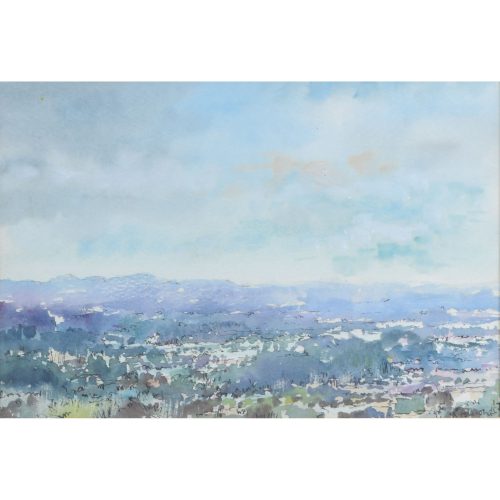
K Edmonds
Countryside Scene
Watercolour 24 x 35 cm Signed lower right. A blue- and green-hued landscape, where earth blends into sky. Condition: very good. If you are interested, please email info@manningfineart.co.uk or call us on 07929 749056. -
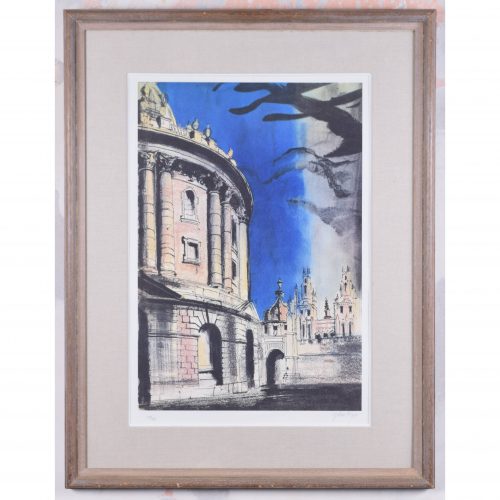
John Piper (1903 - 1992)
Radcliffe Camera
Lithograph 53 x 35.5 cm Numbered 110/1150 lower left and signed lower right in pencil. John Piper's view of the Radcliffe Camera in Radcliffe Square. John Piper CH was an English painter, printmaker, and designer of stained-glass windows. His work often focused on the British landscape, especially churches and monuments, and included tapestry designs, book jackets, screen-prints, photography, fabrics and ceramics. Condition: very good. Attractively framed; frame included for mainland UK shipping only. If you are interested, please email info@manningfineart.co.uk or call us on 07929 749056. Click here for other views of Oxford. -
Out of stock
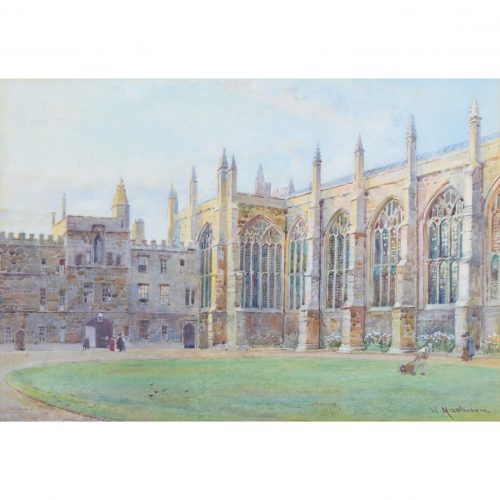
William Matthison (1853-1926)
New College, Oxford: Front Quad
Watercolour 35 x 52 cm Signed lower right. A charming watercolour of New College's Front Quad complete with members of the college in academic dress, wandering birds, and a gardener mowing the grass. William of Wykeham, who founded New College in 1379, was an ambitious builder. His vision for the college was of a Chapel, Hall, Library, and rooms for tutors and students to work and live in, all of which would be built around a quadrangle. This was the first time a college had been set in this way, and it became a model for colleges worldwide. Matthison was born near Birmingham and attended King Edward’s School in the city. He learnt drawing at the Birmingham Central School of Art and then became a pupil of Birmingham artist Edward Watson. He became a professional artist in 1875 and moved to Oxfordshire a few years after; this was where he had the opportunity to produce many of the Oxford views for which he is known today. In 1902 he moved to Park Town in Oxford and was commissioned by Robert Peel to paint more than seventy views of the University of Oxford, which were subsequently made into postcards. Priced at seven for a shilling, they were only available from E Cross of Pembroke Street (a long-since closed business). Raphael Tuck & Sons also commissioned him to produce postcard scenes of Cambridge. Matthison’s views of Oxford were later printed in Fifty Watercolour Drawings of Oxford, published in 1912 by Alden & Co. Condition: generally very good; a few spots to sky. If you are interested, please email info@manningfineart.co.uk or call us on 07929 749056. Click here for other views of New College, Oxford. -
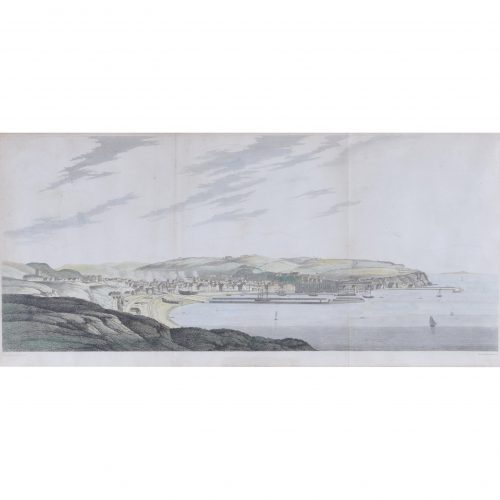
Elizabeth Byrne (1777 - 1849) after Joseph Farington RA (1747 - 1821)
North View of Whitehaven, Cumbria
Hand-coloured engraving 27.5 x 56.5 cm A view of the cliffs and port of Whitehaven in Cumbria. Joseph Farington RA was an 18th-century English landscape painter and diarist. He drew a north and south view of Whitehaven, which were engraved by Elizabeth Byrne in the early 19th century. Byrne was a London-born etcher and landscape painter, who was taught by her father, the etcher William Byrne. She and her father contributed etchings to the 'Magna Britannia' and 'Britannia depicta', books illustrating the most interesting views in various English counties, published by Samuel Lysons in the late 1810s. Condition: good. Two folds and some light age toning. If you are interested, please email info@manningfineart.co.uk or call us on 07929 749056. -
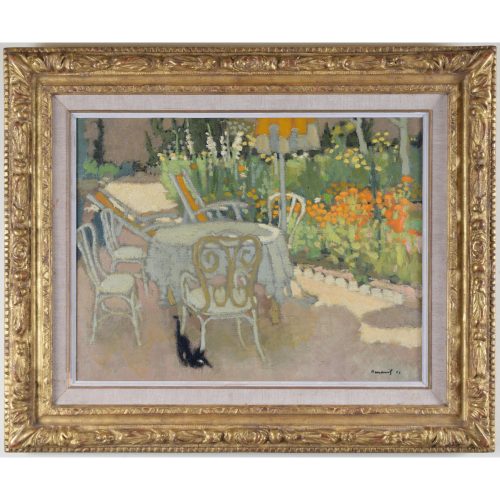
Michel Dureil (1929 - 2011)
La Table du Jardin / Garden Table with a Black Cat
Oil on canvas 35 x 44 cm A black cat stretches beside a typical French table, observed by bright orange flowers. Orange cushions and an orange sun-umbrella complete the scene. Condition: very good. If you are interested, please email info@manningfineart.co.uk or call us on 07929 749056. -
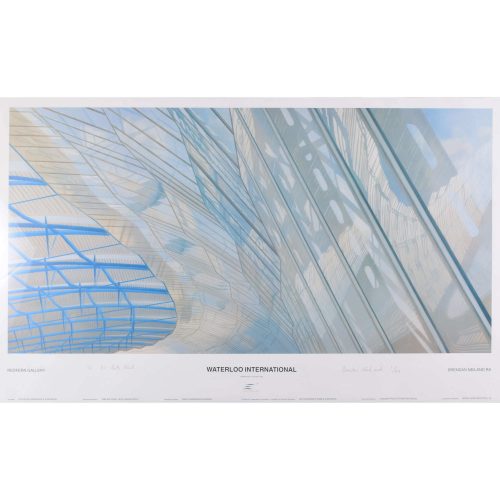
Brendan Neiland (b. 1941) R.A. (Expelled)
Waterloo International (1993)
Lithographic poster 101 x 60 cm Signed 'Brendan Neiland', numbered I/XII, and inscribed 'To Bob Reid' (Reid was Chairman of the British Railways Board from 1990 until 1995; he was present at Waterloo International Station prior to the opening of the Channel Tunnel). Neiland is known for his interpretations of city life. His work is widely exhibited in major museums and galleries worldwide including, in Britain, the Victoria and Albert Museum, The Tate Gallery London, The Collections of the British Council and the Arts Council of Great Britain. He is represented by the Redfern Gallery and has had numerous shows internationally, including at the Galerie Belvedere in Singapore, who represent him in Singapore and the Far East. Reflected architecture is one of Neiland’s most recurring themes. Condition: very good. If you are interested, please email info@manningfineart.co.uk or call us on 07929 749056. Click here for other works by Brendan Neiland. -
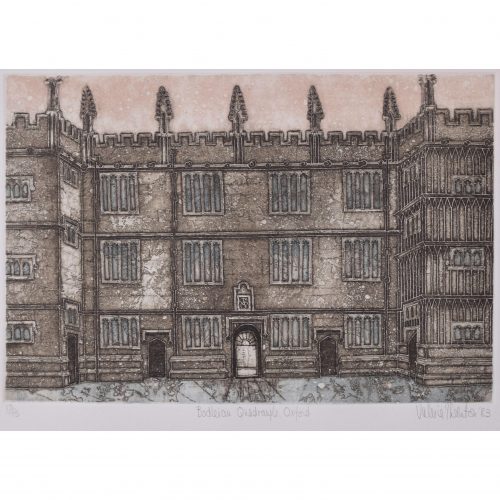
Valerie Thornton (1931-1991)
Bodleian Quadrangle, Oxford (1983)
Etching 24 x 35 cm Numbered 13/75 lower left, titled below, and signed and dated lower right, all in pencil. A very good example of Thornton's recognisable and unusual etching style. Her work is deeply concerned with material, and many of her etchings focus on eroded stone, emotive landscapes, and weathered architecture. Here, Thornton draws out the exceptional texture of the Bodleian Library's local stone. Valerie Thornton was a British etcher and printmaker. She was born in London, but was evacuated to Canada with her two brothers during World War II. She returned to London in 1944 and studied at the Byam Shaw School of Art in 1949. From 1950 to 1953 Thornton studied under P.F. Millard at the Regent Street Polytechnic, then spent eight months at Atelier 17 in Paris. In the early 1960s, she moved to New York and worked at Pratt Graphic Art Centre. In 1955, she succeeded Howard Hodgkin as assistant art teacher at Charterhouse School and in 1965 she became a founding member of the Print Makers Council. In 1970 she became a Fellow of the Royal Society of Painters-Etchers and Engravers. Thornton was a member of The Regent Street Group (a group of nine artists who studied together at the Regent Street Polytechnic in the early 1950s). The group also included Susan Horsfield, Renate Meyer, Michael Lewis, Ken Symonds, Philip Le Bas, and Peter Riches. Thornton's work is included in a number of major public collections including the Victoria and Albert Museum, the British Museum, and the Tate. Thornton died in 1991 in Chelsworth, Suffolk. Condition: generally very good. If you are interested, please email info@manningfineart.co.uk or call us on 07929 749056. Click here for more works by Valerie Thornton. -
Out of stock
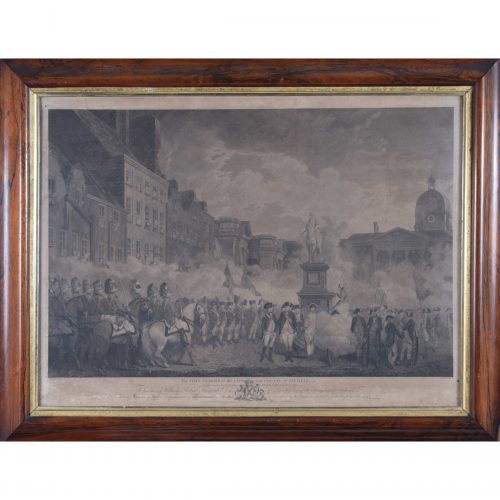
Joseph Collyer (1748 - 1827) after Francis Wheatley (1747 - 1801)
The Volunteers of the City and County of Dublin
Monochrome print 28 x 31 cm A monochrome print depicting Dublin regiments of the Irish Volunteers meeting on College Green. Francis Wheatley depicted the scene in oils in 1779, and Joseph Collyer engraved it in 1781. Wheatley went to Dublin in 1779 and established himself there as a portrait-painter; this view of the Dublin Volunteers became the basis for a best-selling print bought by numerous Irish Patriots. Volunteers were local Irish militias raised by community initiative in Ireland in 1778. Their original purpose was to guard against invasion and to preserve law and order at a time when British soldiers were withdrawn from Ireland to fight abroad during the American Revolutionary War and the government failed to organise its own militia. Taking advantage of Britain's preoccupation with its rebelling American colonies, the Volunteers were able to pressure Westminster into conceding legislative independence to the Dublin parliament. Francis Wheatley was an English portrait and landscape painter who studied at the Royal Academy, and won several prizes from the Society of Arts. He was elected an associate of the Royal Academy in 1790, and an academician in the following year. Joseph Collyer was a British engraver. In 1770 where he exhibited at the Royal Academy for the first time; he was elected an associate engraver of the Royal Academy, and appointed portrait engraver to Queen Charlotte in 1786. Condition: fair. Some browning and staining. In handsome rosewood frame. If you are interested, please email info@manningfineart.co.uk or call us on 07929 749056. -
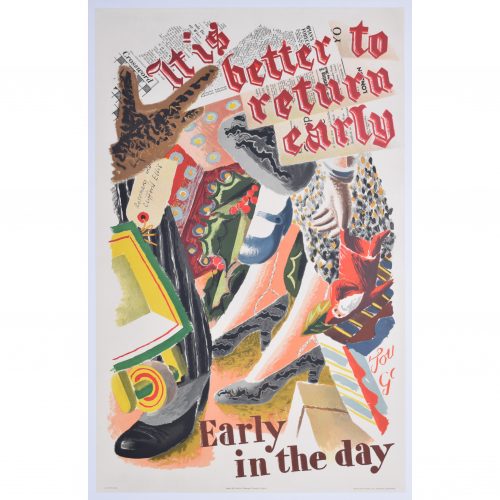
Clifford and Rosemary Ellis
It Is Better To Return Early
Lithographic poster 102 x 61 cm Printed by Waterlow & Sons Ltd for London Transport. This original vintage poster was designed for London Transport and encourages shoppers to head home earlier in the day to avoid congestion on the London Underground and buses. The well-heeled customers in the poster sport smart 1930s shoes, and jostle against their purchases (a Father Christmas puppet and red-berried holly leaves mark the design as published in time for Christmas). The pinstripe-suited gentleman's newspaper serves as the background for the first line of the poster's text, which is slanted in the synthetic cubist style (synthetic cubists were keen to explore collage in their work, often employing collage, especially of newsprint). London Transport was the forerunner of London Underground. During the 1930s London Transport commissioned over forty posters a year from well-known artists such as Laura Knight, CRW Nevinson, Edward Wadsworth, Eric Ravilious, Paul Nash, Graham Sutherland, and Edward McKnight Kauffer – a bold policy that did much to popularise avant-garde artistic styles that stemmed from Cubism, Futurism and Abstraction. Condition: very good, backed to linen. If you are interested, please email info@manningfineart.co.uk or call us on 07929 749056. Click here for other works by Clifford and Rosemary Ellis. -
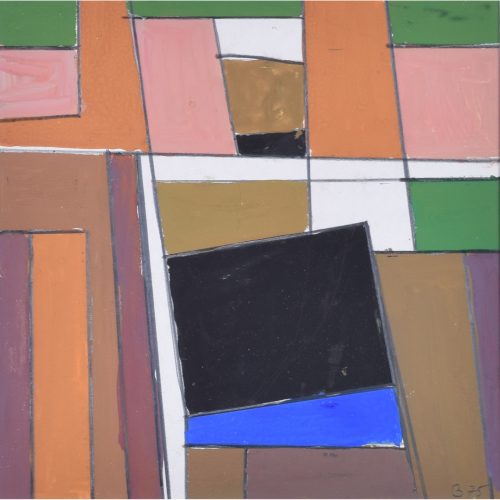
John Barnicoat MA ARCA (1924 - 2013) Harbour (1975)
Tempera on card 26 x 26 cm Initialled B and dated '75. John Barnicoat was a painter of oils and works on paper using tempera, conté, acrylic, pen, and ink. He was brought up in Cornwall and educated at King’s College, Taunton. He joined the Royal Naval Volunteer Reserves and took part in D-Day, aged 29. He went on to read history at Lincoln College, Oxford, and also studied at the Ruskin School of Drawing. He attended the Royal College of Art in the early 1950s, eventually becoming the Senior Tutor at the RCA Painting School between 1976 and 1980. He was the head of Falmouth School of Art 1972 - 1976 and Head of the Chelsea School of Art 1980 - 1989. He wrote 'Posters: a Concise History' in 1972, and organised and curated exhibitions in the UK and Russia on the art of poster design. From 1989 onwards he produced numerous drawings and oils of the bridges of London, women’s heads, acrylic and conté works on paper, and pen and wash drawings of women dressing. His work is represented in both government and private collections, and was recently shown at The Belgrave Gallery, St Ives (2017 - 2022). Provenance: the artist's estate. Condition: generally very good; in hand-finished frame. If you are interested, please email info@manningfineart.co.uk or call us on 07929 749056. Click here for other Modern British original paintings. -
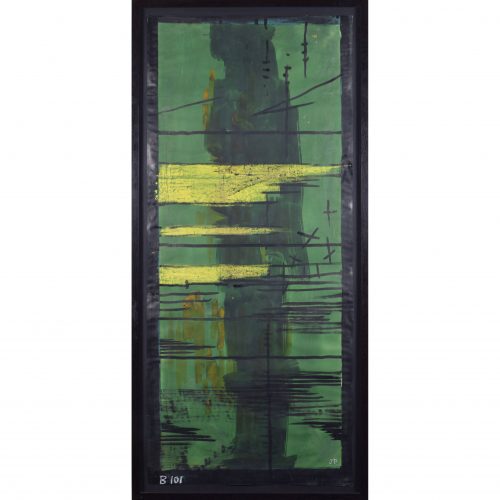
John Piper (1903 - 1992)
Cartoon for Baptistry Chapel Window, Coventry Cathedral
Gouache and mixed media art 127 x 54 cm Labelled B101 by the artist and initialled. A gouache design for one of the Coventry Cathedral Baptistry Window panels. John Piper was commissioned to design the Baptistry Window in 1955, in partnership with glassmaker Patrick Reyntiens. The window is made of 198 panels of stained glass and is 26 metres high.Piper commented in his book “Stained Glass: Art or Anti-Art?” that ‘The function, the flesh and blood and bones of stained glass – its whole being – is to gratify light and to intensify atmosphere in a room or building, not necessarily to provide colour – or a message.’ The ambiguous post-war tenor of the design is striking: the khaki palette, the soldier-like figure, and the landscape evoking a 20th century theatre of war.
John Piper CH was an English painter, printmaker, and designer of stained-glass windows. His work often focused on the British landscape, especially churches and monuments, and included tapestry designs, book jackets, screen-prints, photography, fabrics and ceramics. Condition: very good. Four pin holes and a small handling mark mid left. If you are interested, please email info@manningfineart.co.uk or call us on 07929 749056. Click here for other works by John Piper. -
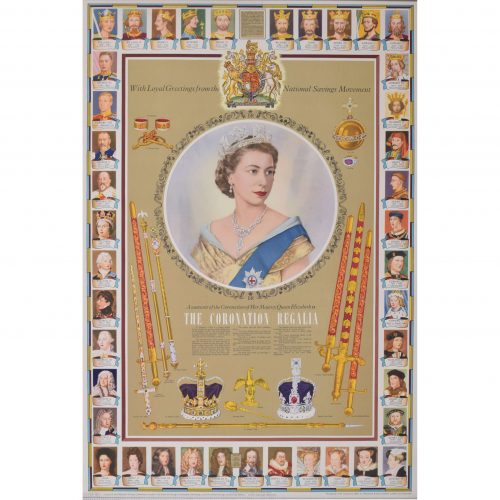
after Dorothy Wilding (1893 - 1976)
The Coronation Regalia (1953)
Original vintage poster 75 x 50 cm Issued by the National Savings Committee, London, the Scottish Savings Committee, Edinburgh, and the Ulster Savings Committee, Belfast. Crown Copyright Reserved. Printed for H.M. Stationery Office by Waterloo & Sons Limited, London and Dunstable. A fantastic piece of royalist British history. The famous portrait photographer Dorothy Wilding captured Queen Elizabeth II at her Coronation in 1952 - the photograph, used as the centrepiece of this poster, was also used on Britain's postage stamps until 1967. This particular poster was designed to be a Coronation souvenir, and features all the regalia and trappings of the United Kingdom's coronation ceremony, including crown, sword, orb, and sceptres, to name a few. The poster's margins are decorated with portraits of Britain's monarchs past, dating back to William the Conqueror. The National Savings Movement was a government-backed savings movement which began during the First World War to finance the government's wartime deficit. Savings products promoted by the movement typically offered a low level of return but the safety of a government guarantee. Various poster designs were issued by the movement to encourage ordinary people to save - we have several different designs in stock. Condition: generally very good. If you are interested, please email info@manningfineart.co.uk or call us on 07929 749056. Click here for other National Savings posters. -
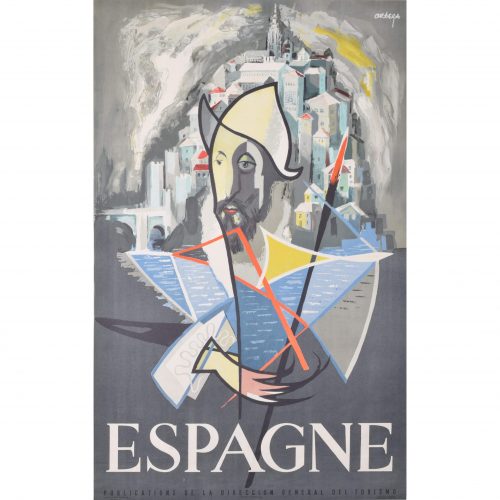
José Ortega (1921 - 1990)
"Don Quixote" Espagne
Original vintage poster c. 1960 99 x 65 cm Printed in Barcelona for the Publications de la Direccion General del Turismo. Ortega's poster is an abstract depiction Don Quixote (the Spanish hero written by Miguel de Cervantes), complete with his distinctive hat and spear. Ortega designed the poster for the Spanish tourist board, using an illustrious figure from Spain's literary heritage to encourage people to visit Spain. José García Ortega was born in Arroba de los Montes and was a member of the Communist Party. He worked as a painter and sculptor, studying at the Círculo de Bellas Artes in Madrid. In 1953 he went to France to study art, funded by a French government scholarship. He returned to Spain throughout the 1950s and 1960s, and became a commercially successful artist. Some of his most famous designs include the posters which the Spanish tourist board commissioned from him circa 1960. Condition: generally very good. If you are interested, please email info@manningfineart.co.uk or call us on 07929 749056. Click here for more original vintage travel posters. -
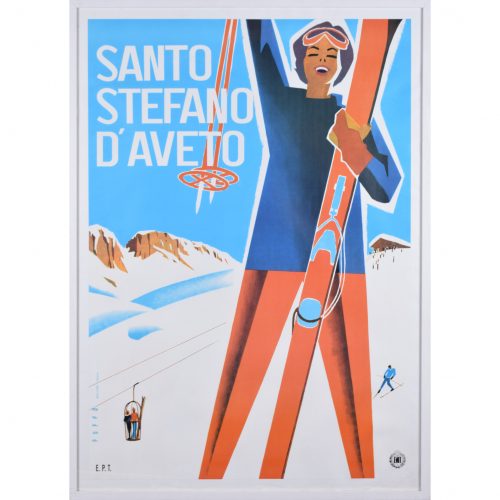
Mario Puppo (1905 - 1977)
Santo Stefano d'Aveto
Original vintage poster 97 x 68 cm Produced circa 1955 for Italian Railways. Mario Puppo's poster advertising the Italian ski resort of Santo Stefano d'Aveto. The figure of a skier reaches upward in triumph; behind her, a vintage ski lift makes its way up the mountain and a blue-clad skier tackles the piste. Mario Puppo was born in Levanto, Italy, and worked in a studio in Chiavari. He designed leaflets advertising skiing and beach resorts, which gained popularity in the 1930s. By the 1940s his poster designs were being featured in the Milan Advertising Graphics show. Throughout the 1940s he designed covers for catalogues, leaflets, playbills, music scores and records, as well as producing more travel posters for public and private Italian companies. Condition: backed to linen; frame included for UK mainland only (excluding Cornwall, Highlands and Islands - where further shipping charges may apply). If you are interested, please email info@manningfineart.co.uk or call us on 07929 749056. Click here for more original vintage posters. -
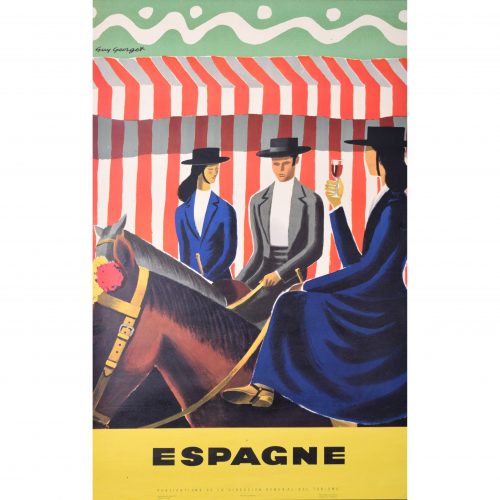
Guy Georget (1911 - 1992)
Espagne - Riders
Original vintage poster 100 x 62 cm One of Georget's fantastic posters designed for the Spanish tourist board. Three riders in traditional dress, with the ladies riding side-saddle, and one with sherry in hand, pose mounted in front of a red and white striped background. The bold, bright colours make the poster typically Georget. Guy Georget was a commercial designer; most of his poster designs were published in the late 1940s. Hired by the tourist boards in their post-war spree of tourism encouragement, Georget designed posters influenced by the styles of Pablo Picasso and Georges Braque. Condition: generally very good; a few tiny repaired edge tears. If you are interested, please email info@manningfineart.co.uk or call us on 07929 749056. Click here for more original vintage travel posters. -
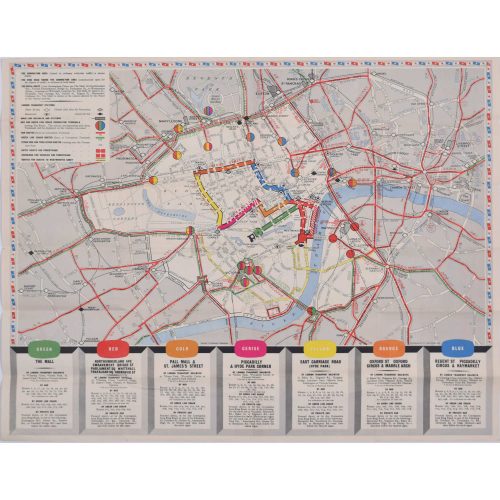
Coronation Arrangements - Map of London (1953)
Lithograph 45 x 60 cm (unfolded) Published by London Transport for the Coronation of Elizabeth II, this delightfully-coloured map illustrates the route taken by the Queen when she was crowned in 1953. Condition: generally very good. If you are interested, please email info@manningfineart.co.uk or call us on 07929 749056. -
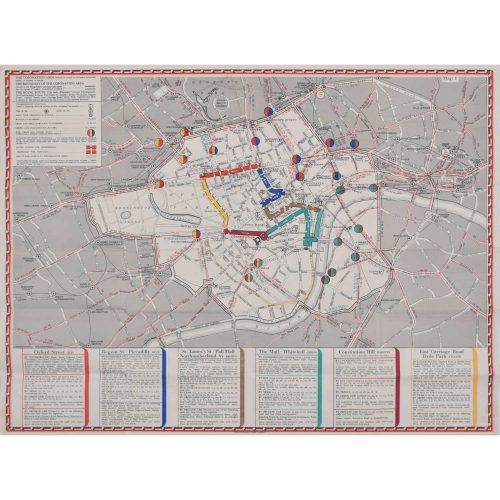
Coronation Arrangements - Map of London (1937)
Lithograph 45 x 60 cm (unfolded) Published by London Transport for the Coronation of George VI, this map illustrates the route the King took in 1936. And best of all, it's just (almost!) as useful in today's London. Condition: generally very good. If you are interested, please email info@manningfineart.co.uk or call us on 07929 749056. -
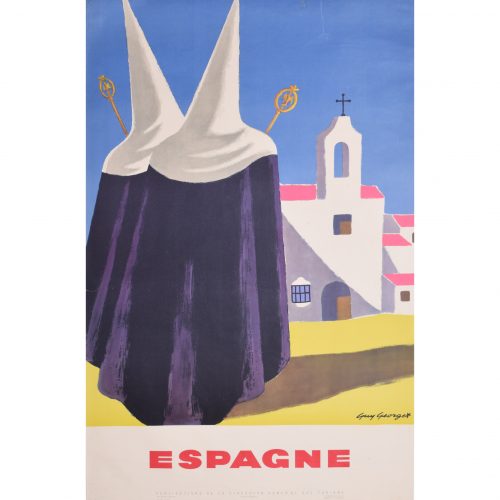
Guy Georget (1911 - 1992)
Espagne - Pilgrims
Original vintage poster 100 x 62 cm One of the fantastic posters Georget designed for the Spanish tourist board. Two pilgrims progress towards a typically Spanish church; Georget makes uses vibrant tones of bright blue, pink, and yellow to illustrate the scene. Guy Georget was a commercial designer; most of his poster designs were published in the late 1940s. Hired by the tourist boards in their post-war spree of tourism encouragement, Georget designed posters influenced by the styles of Pablo Picasso and Georges Braque. Condition: generally very good; a few repaired edge tears including one at the top c. 80mm, one to left side c. 25 mm. If you are interested, please email info@manningfineart.co.uk or call us on 07929 749056. Click here for more original vintage travel posters. -
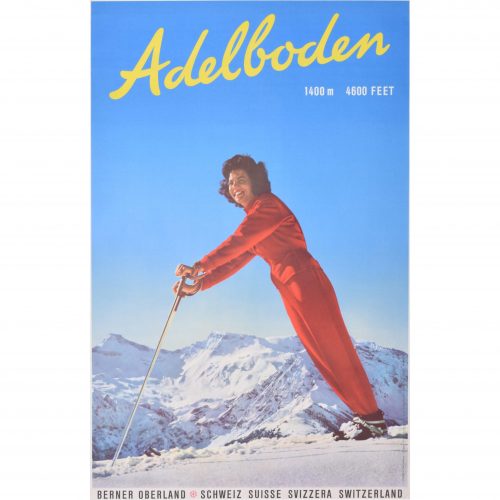
Adelboden
Original vintage poster 104 x 63 cm A fantastic original vintage poster advertising the Swiss ski resort of Adelboden, tucked away in the Bernese Oberland. Printed in Switzerland by Brügger AG. The photograph was taken by the Swiss photographers Emanuel Gyger and Arnold Klopfenstein. The pair were renowned for their captivating skiing images. Condition: generally very good. If you are interested, please email info@manningfineart.co.uk or call us on 07929 749056. Click here for more original vintage skiing posters. -
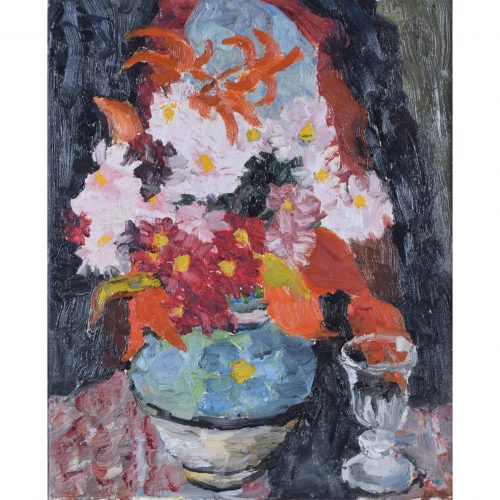
Eva Lucy Harwood (1893 - 1972)
Still Life with Flowers and Glass
Oil on canvas 49 x 40 cm ( 67 x 57 cm framed) A mid-century still life typical of Harwood's impasto style. Lucy Harwood was a British artist who studied art at the Slade just before the outbreak of the First World War. She had initially intended to be a professional pianist, but turned her attentions to visual art after becoming partially paralysed. She was one of the first students to enrol at Cedric Morris' East Anglian School of Drawing and Painting, where she focused on painting Post-Impressionist landscapes, painting just with her left hand. She moved to Upper Layham in Suffolk and is known for her landscapes of the area. Condition: generally very good. Handsome hand-finished frame. Provenance: Louise Kosman, Edinburgh. If you’d like to know more, please email info@manningfineart.co.uk or call us on 07929 749056. Click here to view our other still life pictures. -
Out of stock
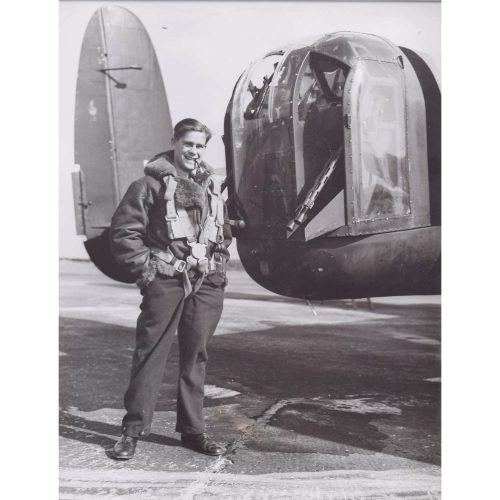
Roberts Dunstan DSO - Tail-end Charlie on Lancaster Bomber
Original Silver Gelatin photograph, c. 1943 20 x 15 cm The sitting-down war played out in the skies suited amputees who wanted to continue killing the enemy. Douglas Bader famously bailed out of his Spitfire over Germany, leaving behind his artificial legs. There were others who flew with artificial legs, including Dunstan. Dunstan was born in 1922, lying about his age (by three years) in order to join up in June 1940. In January 1941, serving with the Royal Australian Engineers, he was injured in one leg near Tobruk (in Libya) on a night reconnaisance raid. After five operations his leg was amputated; after ten more he was returned to Australia and invalided out of the services in February 1942. A few months later, he caught sight of a poster recruiting for the RAAF, and volunteered his services, enlisting on 23 June 1942 - having spent some time convincing the RAAF that there were roles that he could undertake successfully. Following training at the RAAF Bombing and Gunnery School he was soon on his way to the UK, sailing on 24 August from Sydney. He was soon serving at RAF Breighton in Yorkshire with 460 Sqn RAAF as rear gunner in an Avro Lancaster bomber. As he walked to the aircraft he used his crutches; onboard he would crawl to his post in the tail. On the night of 22/23 October 1943, aboard W4927, his Lancaster left Binbrook for a bombing raid over Germany. Above Kassel, the target, a Lancaster bomber above them dropped its bombs. Two incendiary bombs dropped through W4927; one hitting the flight engineer's jump seat - beside the pilot - the other falling through the middle of the aeroplane and severing the oxygen supply to the rear and mid-upper turrets - the former being Dunstan's. A German night fighter chose this moment to attack W4927. Befuddled by lack of oxygen the gunners were unable to shoot, W4927 losing its port elevator and receiving holes in its port wing and fuselage - and one cannon shell went into Dunstan's rear turret. However the pilot nursed the plane back to England, where it crash landed at either RAF Elsham Wold, or Bisham - sources vary. On 3/4 November 1943 Dunstan completed his thirtieth mission, to Dusseldorf, the day before his twenty-first birthday. He was gazetted for his DSO on 7 November. In 1944 he returned to Australia and in 1956 was elected to the Victoria State Parliament where he held ministerial posts for water supply, and subsequently for public works. -
Out of stock
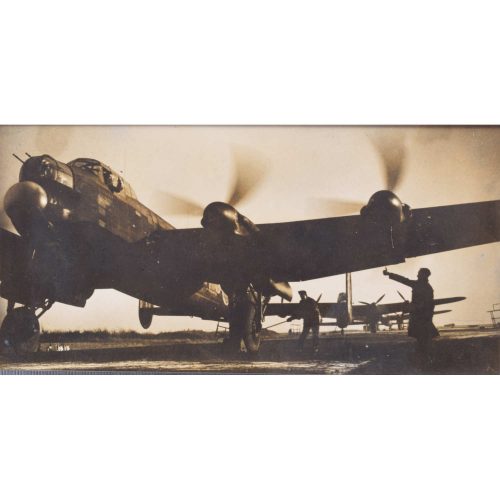
Lancaster bombers preparing for take-off
Original Silver Gelatin photograph, c. 1944 9 x 18 cm Ground crew remove the chocks from the wheel of a Lancaster bomber, prior to take-off. A series of Lancaster bombers are visible in the background, all preparing for a bombing raid, deep into occupied enemy territory. The lead aircraft is the veteran of twenty-six previous raids, as indicated by the bombs painted under the pilot's cockpit window. Condition: Generally very good. Provenance: from the collection of Philip J R Moyes, author of many books on the RAF, most notably The Pictorial History which ran to several volumes. -
Out of stock
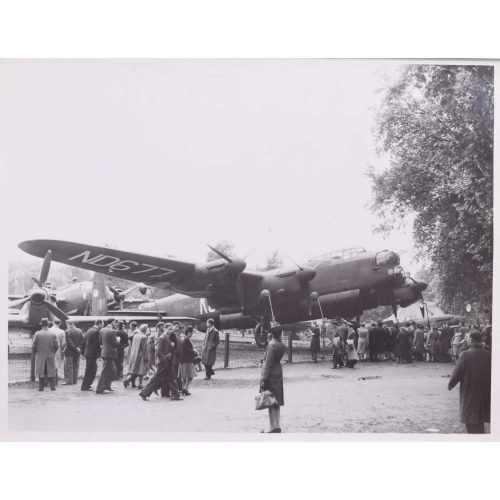
Lancaster bomber in Green Park
Original Silver Gelatin photograph, 1946 18 x 25 cm Stamped to reverse: "Photograph Supplied by The Topical Press Agency Ltd 20-21 Red Lion Court, Fleet Street" Press release label to reverse reads: "XH - RAF PLANES ON VIEW IN GREEN PARK, LONDON "In connection with the Victory Day celebrations in London, a number of RAF planes have been put on view in Green Park, London. "11/6/1946" Further typewritten note reads: "Lancaster B.III ND677/G KO-X of 115 Sqn. First Lancaster to have MONICA airborne tail warning device. Served with 460 Sqn RAAF, during 1944, went to 49 Sqn in April 1945 and finally to 113 Sqn in September 1945. Scrapped July 1946." ND677 was a veteran of 59 missions. The /G suffix - visible in the photograph - indicates that it must have an armed guard at all times. It was unceremoniously scrapped within a month of being on display to the crowds. Monica was a tail-borne radar device, designed to give the bomber crew warning of the approach of a German fighter in their blind spot. However following the crash in February 1943 of a Monica-equipped Lancaster (just seven days into Monica's operational life) the Germans developed equipment called 'Flensburg'. Introduced in early 1944 it was a homing device, a passive radar receiver which enabled Flensburg-equipped night fighters to locate Allied bombers. In July 1944 a Flensburg-equipped Junkers Ju88-G1 mistakenly landed at Woodbridge aerodrome in Suffolk, following which Monica was rapidly withdrawn from service. Condition: Generally very good. Provenance: from the collection of Philip J R Moyes, author of many books on the RAF, most notably The Pictorial History which ran to several volumes. -
Out of stock
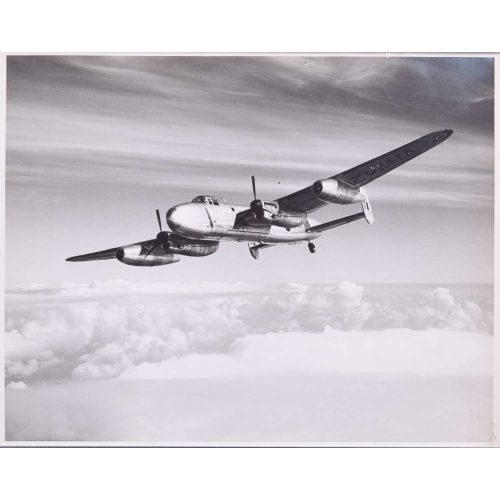
Charles E Brown (1896-1982)
Lancastrian VH742 - The first Jet Airliner
Original Silver Gelatin photograph, 1940s 19 x 24 cm Stamped to reverse 'Charles E Brown' with address and 6140-2 reference number, together with press release reading: "THE FIRST JET LINER "Captain R T Shepherd, Rolls Royce chief test pilot, demonstrating the remarkable performance of the 62,500 lb Avro LANCASTRIAN on the two NENE jets alone. With the two Merlins and their propellors stopped one is struck by the entire absence of visible moving parts. Even more noticeable is the reduced noise and complete lack of vibration." The Lancastrian was developed from the Lancaster bomber with armaments and armour removed, and a new - streamlined - nose. The first batch were made by converting Lancaster bombers, latter batches made from scratch. The Lancaster had been designed to carry bombs rather than passengers, and so the space available meant that whilst the Lancastrian was not suitable for large numbers of passengers it was admirably suited to carrying mail and other perishable goods.First to fly was Lancastrian VH742, delivered to the Rolls-Royce flight development airfield at Hucknall in October 1945. Its outer Merlin engines were removed and the nacelles were also taken away, while the fuel system was completely rebuilt to carry both gasoline for the inner engines and kerosine for the new jets. In the outer positions were added completely new nacelles housing Nene turbojets, then the most powerful jet engines in the world. It flew again on August 14, 1946 with two Merlins and two Nenes.
On September 19, 1946 this aircraft acted as the world's first jet airliner by making three passenger flights carrying representatives of the Press as well as Ministry officials and other passengers (who were all most impressed and suggested that an airline that could offer jet travel would be the talk of the world). Rolls-Royce also flew a second Nene-Lancastrian, VH737, and two Avon-Lancastrians, VM732 and VL970. The latter The first flight of a jet airliner was reported as follows:
"The Nene-Lanc, Flies to Paris "THE flight of the Nene Lancaster from London to Paris last Monday, to play its part in connection with the exhibition, may be said to have marked a historic part in British aircraft development, for it constituted the first time that any jet-powered airliner had flown from one country to another. Moreover, since this particular aircraft has been flying fairly regularly since round about the time of the Radlett exhibition, the flight to Paris was no special performance, but merely one more public demonstration of its inherent reliability. "In the hands of Capt. R. T. Shepherd, chief test pilot for Rolls-Royce, the “Nene-Lanc” landed at Le Bourget at 10.58 a.m., G.M.T., after a 50-minute flight from London Airport, giving an average speed of 247.5 m.p.h. [398.3 kilometers per hour] Two passengers were carried in addition to the crew; they were Mr. Roy Chadwick, the Avro designer, and Mr. R. B. William Thompson, Chief Information Officer of the Ministry of Supply. "Capt. Shepherd said that he was very pleased with the aircraft’s performance and added that, but for having to circle Le Bourget Airport Twice before landing, the flight would have been completed in 43 minutes." FLIGHT and AIRCRAFT ENGINEER, No. 1978. Vol. L., Thursday, November 21st, 1946 at Page 561, Column 2. Charles E Brown was a famous photographer of aircraft whose father was a butcher in Wimbledon, London. Young Charles was given a camera for his 14th birthday and in 1911 photographed an Edwardian gentleman in trouble landing his balloon in neighbouring Southfields. This photograph was published in the Daily Mirror – the fee being half a crown – and Brown was encouraged to join the Daily Mirror’s photography department upon leaving school at 16. Towards the end of the First World War he served with the Royal Air Force at their official London Photographic Centre. Following the war, he took to photographing trains, and captured a famous photograph of a Southern Railway locomotive that was used for the following ten years in railway posters. The income from this allowed him to pursue his passion of aviation photography in the 1920s and 1930s, from which commissions from the Air Ministry and Fleet Air Arm followed. During the war his work included commissions for Aeronautics magazine. Provenance: from the collection of Philip J R Moyes, author of many books on the RAF, most notably The Pictorial History which ran to several volumes. Condition: Generally very good. -
Out of stock
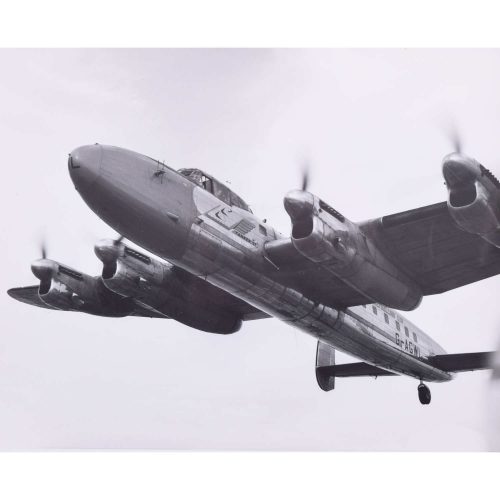
Charles E Brown (1896-1982)
BSAA Lancastrian G-AGWL 'Star Guide'
Original Silver Gelatin photograph, 1940s 19 x 24 cm Stamped to reverse 'Charles E Brown' with address and 6337-13 reference number. The Lancastrian was developed from the Lancaster bomber with armaments and armour removed, and a new - streamlined - nose. The first batch were made by converting Lancaster bombers, latter batches made from scratch. The Lancaster had been designed to carry bombs rather than passengers, and so the space available meant that whilst the Lancastrian was not suitable for large numbers of passengers it was admirably suited to carrying mail and other perishable goods. G-AGWL ‘Star Guide’ was registered 28/11/45. Its first flight was on 1/2/46 for the Ministry of Supply & Aircraft Production (MoSAP), being delivered in February to British South American Airlines (BSAA) as ‘Star Guide’. In January 1949 it was bought by Flight Refuelling Ltd subsequently being used on the Berlin Airlift and was scrapped 26/9/51 at Tarrant Rushton. Charles E Brown was a famous photographer of aircraft whose father was a butcher in Wimbledon, London. Young Charles was given a camera for his 14th birthday and in 1911 photographed an Edwardian gentleman in trouble landing his balloon in neighbouring Southfields. This photograph was published in the Daily Mirror – the fee being half a crown – and Brown was encouraged to join the Daily Mirror’s photography department upon leaving school at 16. Towards the end of the First World War he served with the Royal Air Force at their official London Photographic Centre. Following the war, he took to photographing trains, and captured a famous photograph of a Southern Railway locomotive that was used for the following ten years in railway posters. The income from this allowed him to pursue his passion of aviation photography in the 1920s and 1930s, from which commissions from the Air Ministry and Fleet Air Arm followed. During the war his work included commissions for Aeronautics magazine. Condition: Generally very good. -
Out of stock
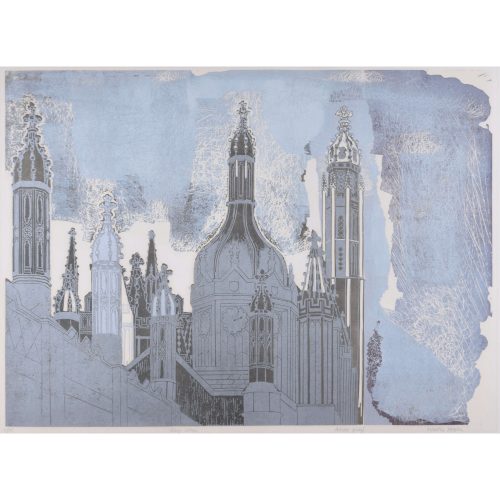
Walter Hoyle (1922 - 2000)
King's College, Cambridge (Cambridge Series 1956 - 66)
Linocut 61 x 80 cm Numbered 37/75 lower left, titled below, marked as artist's proof, and signed lower right, all in pencil. A blue- and grey-hued linocut of King's. A version of this print, owned by the Government Art Collection, hangs in the British Embassy in Tunis. Hoyle trained at Beckenham School of Art and the Royal College of Art. At the latter he was strongly influenced by Edward Bawden, one of Britain’s greatest linocut printers. Bawden had been commissioned by the 1951 Festival of Britain to produce a mural for the South Bank, and chose Hoyle to assist on account of his great talent. Hoyle moved to Great Bardfield in Essex, becoming a part of the Great Bardfield group of artists; diverse in style, they created figurative work, in stark contrast to the abstract art of the St Ives artists at the opposite end of the country. Hoyle taught at St Martin’s School of Art from 1951-60, the Central School of Arts and Crafts from 1960-64, and the Cambridge School of Art from 1964-1985, during which time he launched Cambridge Print Editions. His work is held in the collections of the Tate Gallery, the Victoria and Albert Museum, The British Museum, Kettle’s Garden and the Fry Art Gallery. Provenance: ex the Arthur Andersen collection. Condition: generally very good; some gentle and even age toning to paper. If you are interested, please email info@manningfineart.co.uk or call us on 07929 749056. Click here for other views of King's College, Cambridge. -
Out of stock
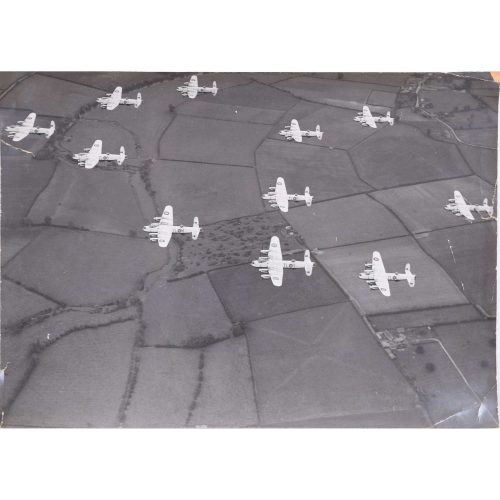
Charles E Brown (1896-1982)
AVRO Lancasters of 35 Sqdn in Flight
Original Silver Gelatin photograph, 1940s 19 x 27 cm Formed in 1916, the Squadron spent 1917 and 1918 in France flying the FK8. In support of the Spring Offensive of March 1918, it dropped 118 25lb bombs - which would have made up one third of the bombing load of a Lancaster. In 1940 the Squadron was reformed as the first Halifax squadron, pilots including Leonard Cheshire and James Brian Tait - both subsequently of 617 'Dambusters' Squadron. In 1944 the Squadron converted to the Lancasters to be seen in this photograph. Sqd Ldr Alec Panton Cranswick DFC DSO was shot down in 1944 on his 107th bombing mission - a record for any British airman. Following the War, the Squadron engaged in both the Victory flypast over London and a goodwill tour of the United States. Subsequently disbanded and reformed several times, it operated the Boeing Washington, the Canberra, and for twenty years the Vulcan. Charles E Brown was a famous photographer of aircraft whose father was a butcher in Wimbledon, London. Young Charles was given a camera for his 14th birthday and in 1911 photographed an Edwardian gentleman in trouble landing his balloon in neighbouring Southfields. This photograph was published in the Daily Mirror – the fee being half a crown – and Brown was encouraged to join the Daily Mirror’s photography department upon leaving school at 16. Towards the end of the First World War he served with the Royal Air Force at their official London Photographic Centre. Following the war, he took to photographing trains, and captured a famous photograph of a Southern Railway locomotive that was used for the following ten years in railway posters. The income from this allowed him to pursue his passion of aviation photography in the 1920s and 1930s, from which commissions from the Air Ministry and Fleet Air Arm followed. During the war his work included commissions for Aeronautics magazine. Provenance: from the collection of Philip J R Moyes, author of many books on the RAF, most notably The Pictorial History which ran to several volumes. Condition: Marginal creases, losses, short tear to left edge, very short tear to right edge, generally good, -
Out of stock
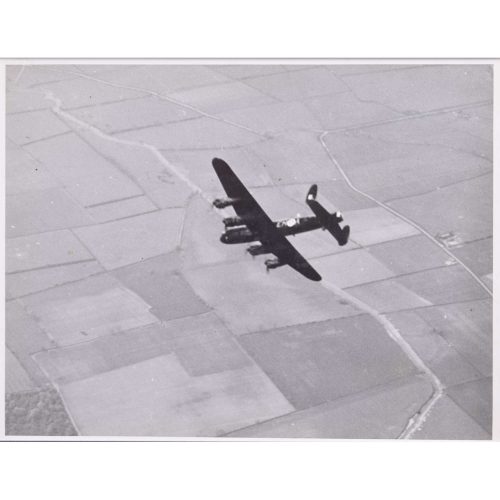
AVRO Lancaster EN-A in Flight
Original Silver Gelatin photograph, 1940s An aircraft of No. 27 Operational Training Unit which was based at RAF Lichfield. The OTUs were the last stage of aircrew training prior to transfer to an operational unit. Crews had already been formed up, and were trained to fly as a crew in the aircraft type they were to fly in combat. Occasionally the OTUs provided aircraft and crews for offensive operations, for example in the first 'Thousand Bomber Raid' on Cologne in May 1942. Loss rates in OTUs were high owing to the combination of the British weather, the crowded airspace, inexperienced crews - and even enemy action. 16 x 21 cm Provenance: from the collection of Philip J R Moyes, author of many books on the RAF, most notably The Pictorial History which ran to several volumes. Condition: Very good. -
Out of stock
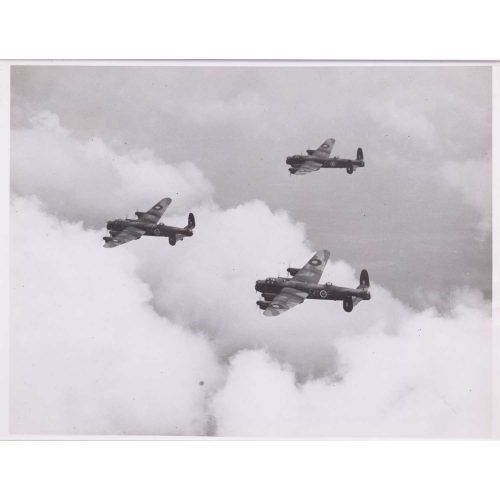
Charles E Brown (1896-1982)
Three AVRO Lancaster Bombers in Flight
Original Silver Gelatin photograph, c. 1944 16 x 21 cm Photograph 20 June 1942 above Cranwell EM-A EM-C and EM-F of 207 Squadron The RAF info website details the various Lancaster bombers of 207 Squadron. EM-C was a Lancaster I with serial number R5695 . It took off on 25 November 1942 from Langar, on a mission to Haselunne. The pilot was an Alfred Parkyn of the RCAF - whose parents lived in New Jersey. The aircraft was lost without trace and the crew are commemorated on the Runneymede Memorial. EM-A was another Lancaster I with serial number ED604. It took off from Langar on 12 March 1943 on a night mission (with 42% moon) to Essen, piloted by the 22-year-old F/O Michael Doble DFC. It crashed near Bottrop on the outskirts of Essen, with the loss of all its crew who are buried in the Reichswald Forest War Cemetery. Doble's DFC was gazetted on 31 July 1942, following an action in which 12 DFCs and one DSO were awarded. The citation reads: "The KING has- been graciously pleased to approve the following awards in recognition of gallantry displayed in flying operations against the enemy: —On 11th July, 1942, a force of bombers was detailed to make an attack on the submarine works at Danzig. The operation, which necessitated a high degree of skill and fortitude, was undertaken in extremely adverse weather. Despite this, the objective was reached by dusk, carefullyidentified and, in the face of strong oppositionfrom the ground defences, subjected to a most determined attack. Bombs were released at varying heights, some as low as 1,000 feet. Many hits were obtained. Searchlight posts were also machine-gunned and many searchlights extinguished. The success achieved reflects the greatest credit on the following personnel who participated in various capacities as leaders and members of aircraft crews." EM-F was a Lancaster I serial number R5694, piloted by Flight Lieutenant Raymund Joseph Hannan DFC which hit high ground in bad visibility at Easton, Lincs, home-bound from Bad Zwischenahn (Vechta) killing all the crew on 25 November 1942. Hannan was a New Zealander who had served for a year with the RNZAF prior to volunteering in September 1939 for the RAF. Following training he undertook a tour of 29 operations with 49 Squadron in the Handley Page Hampden, and after this served as an instructor in 25 Operational Training Unit. His DFC was gazetted on 24 October 1941. In September 1942 he was posted to 207 Squadron, flying four missions prior to that of 25 November 1942. This latter mission lasted only three hours - probably long enough to reach the Dutch coast and return to the UK, and certainly not long enough for the Luftwaffe aerodrome at Bad Zwischenahn. Upon return to base the aeroplane was unable to land owing to bad weather. It crashed near Goadby Marwood, the local history society of which have published an extensive history of the crew members at https://www.goadby-marwood-history.co.uk/the-crew-of-r5694-em-f . Five of the crew, including Hannan, are buried in St Mary's Churchyard in Bottesford. The crash site was discovered in 2021, a full report here: https://www.goadby-marwood-history.co.uk/_files/ugd/bc525f_aedab371f8794f2eab2c0c9ea9721720.pdf The grave sites of the crew members are detailed here https://aviationtrails.wordpress.com/tag/r5694/ Charles E Brown was a famous photographer of aircraft whose father was a butcher in Wimbledon, London. Young Charles was given a camera for his 14th birthday and in 1911 photographed an Edwardian gentleman in trouble landing his balloon in neighbouring Southfields. This photograph was published in the Daily Mirror – the fee being half a crown – and Brown was encouraged to join the Daily Mirror’s photography department upon leaving school at 16. Towards the end of the First World War he served with the Royal Air Force at their official London Photographic Centre. Following the war, he took to photographing trains, and captured a famous photograph of a Southern Railway locomotive that was used for the following ten years in railway posters. The income from this allowed him to pursue his passion of aviation photography in the 1920s and 1930s, from which commissions from the Air Ministry and Fleet Air Arm followed. During the war his work included commissions for Aeronautics magazine. Provenance: from the collection of Philip J R Moyes, author of many books on the RAF, most notably The Pictorial History which ran to several volumes. Condition: Generally very good. -
Out of stock
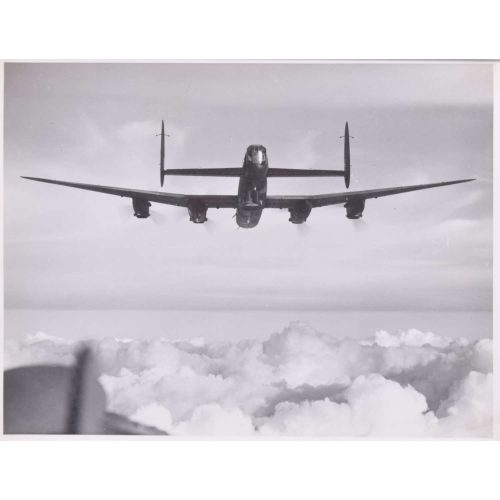
Charles E Brown (1896-1982)
AVRO Lancaster Bomber in Flight from Tail
Original Silver Gelatin photograph, c. 1944 16 x 21 cm Charles E Brown was a famous photographer of aircraft whose father was a butcher in Wimbledon, London. Young Charles was given a camera for his 14th birthday and in 1911 photographed an Edwardian gentleman in trouble landing his balloon in neighbouring Southfields. This photograph was published in the Daily Mirror – the fee being half a crown – and Brown was encouraged to join the Daily Mirror’s photography department upon leaving school at 16. Towards the end of the First World War he served with the Royal Air Force at their official London Photographic Centre. Following the war, he took to photographing trains, and captured a famous photograph of a Southern Railway locomotive that was used for the following ten years in railway posters. The income from this allowed him to pursue his passion of aviation photography in the 1920s and 1930s, from which commissions from the Air Ministry and Fleet Air Arm followed. During the war his work included commissions for Aeronautics magazine. Provenance: from the collection of Philip J R Moyes, author of many books on the RAF, most notably The Pictorial History which ran to several volumes. Condition: Very good, old glue marks to reverse -
Out of stock
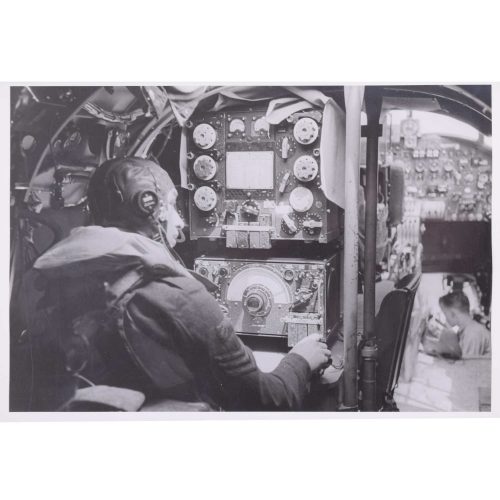
Charles E Brown
AVRO Lancaster bomber Radio Operator
Original Silver Gelatin photograph, c. 1944 Stamped to reverse 'Charles E Brown' with address etc. and serial number 14 x 21 cm Charles E Brown was a famous photographer of aircraft whose father was a butcher in Wimbledon, London. Young Charles was given a camera for his 14th birthday and in 1911 photographed an Edwardian gentleman in trouble landing his balloon in neighbouring Southfields. This photograph was published in the Daily Mirror – the fee being half a crown – and Brown was encouraged to join the Daily Mirror’s photography department upon leaving school at 16. Towards the end of the First World War he served with the Royal Air Force at their official London Photographic Centre. Following the war, he took to photographing trains, and captured a famous photograph of a Southern Railway locomotive that was used for the following ten years in railway posters. The income from this allowed him to pursue his passion of aviation photography in the 1920s and 1930s, from which commissions from the Air Ministry and Fleet Air Arm followed. During the war his work included commissions for Aeronautics magazine. Provenance: from the collection of Philip J R Moyes, author of many books on the RAF, most notably The Pictorial History which ran to several volumes. Condition: Very good