-

Gill Bradley Monkeys Loose in Notting Hill, 1927
Lithograph 100 x 65 cm "The monkey hunt which has been entertaining all but those immediately associated with the fugitives is still proceeding. Yesterday morning three of the thirteen members of a monkey jazz band which escaped from the Notting Hill district of London last Friday were still at large. Two of them had entrenched themselves, so to speak, under the arches which support the platform of Latimer Road Metropolitan Railway Station, South Kensington, while the third, Franko, the leader of the band, had left that locality, having apparently boarded a train for Paddington on Monday. He has been "seen" by various people in districts as far apart as Ealing, Brixton, and Brentford. Late on Tuesday night it was discovered that Bimbo, the drummer, had also left Latimer Road." "Five of them got into my store, and ate 28 lbs of biscuits. Eight of us, including two policemen, caught one, after three hours and after sifting two tons of oats. Then it escaped, and we spent three and a half hours recapturing it." What an eventful day the 24th of November 1927 was... Franco, Bimbo and another unnamed monkey made a break for freedom, tunnelling their way through the London underground, venturing far and wide across the capital. Inspired by this adventure, Gill Bradley painted the chaotic simian scenes in her 2014 entry for the Serco Prize for Illustration. The illustration uses bold colours, exaggerated proportions, and a mix of realism and abstraction to create a chaotic and dynamic scene. The judges of the competition 'were drawn to the evident humour of the image, strong colour palette and the fact that it was a bit bonkers, and felt that commuters would find it very intriguing to look at during their travels.' Condition: Generally very good.If you would like to know more, please email info@manningfineart.co.uk or call us on 07929 749056.
-

M.A. Welch & Brian Harris See London Vintage Style
Original vintage poster Lithograph 76 x 52 cm c.1972 Vintage poster advertising the bus route 100, a unique opportunity for passengers to see the London sights from the classic 1930 ST922 bus model. The poster features a classic typewriter typeface, a lovely coral orange background and a vintage photograph of the ST922, presumably taken during its hayday in the 1930s. Condition: Generally very good, a few very light handling marks.If you would like to know more, please email info@manningfineart.co.uk or call us on 07929 749056.
-

Mervyn Laurence London Transport Posters
Lithograph 76 x 52 cm This poster was produced to promote 'London Transport Posters', a book by Michael F. Levey, first published in 1976 by Phaidon Press. The 80-page volume delves into the rich history and artistic significance of posters commissioned by London Transport, showcasing how these artworks have both reflected and influenced public taste over the years. The book features a diverse collection of posters, highlighting the evolution of design and advertising strategies employed by London Transport. It serves as both a visual celebration of these artworks and an insightful commentary on their cultural impact. The image featured on this poster was originally published on a 1912 London Transport poster: 'Always Warm and Bright', designed by Mervyn Lawrence. The original painting depicts passengers travelling in a underground car. At this time, posters had become a medium for popular commercial interpretation of contemporary avant-garde art. Here, Laurence employs the strident colour of the Fauves and alludes to Matisse's 'The Red Studio', which was produced the previous year. Both paintings are windows onto full, engaging, over-furnished worlds where form is decorative and described in terms of pure colour. The artists invite you into their painting, offering you an empty underground seat, or a place at the artist's table. Condition: Generally very good, some handling marks and some marks on the poster itself.If you would like to know more, please email info@manningfineart.co.uk or call us on 07929 749056.
-
 Kerry Lee (1903 - 1988) London 'The Bastion of Liberty' Original vintage map 46 x 60 cm Published by Pictorial Maps Limited, Kerry Lee's own company c.1965 This edition of the map was produced around 1965. It depicts a number of London's iconic landmarks, including Tower Bridge, St Paul's Cathedral, Westminster and the Houses of Parliament and Buckingham Palace, all of which are distinguishable by the red banners which highlight each London landmark. Lee frames this charming map with illustrations of London boroughs and other landmarks that lie out of the scope of the map, Hampstead, Alexandra Palance, and Greenwich, for example. Well known as a creator of pictorial maps of British cities from the mid 20th century, Kerry Lee generally draws a self-portrait in the bottom corner by his signature - as here, where he is seen painting (mustachioed and bearded, and clad in a green tunic) with his ever-faithful dog Jim. Educated at Reading Schools of Arts and Science, the Slade and the Sorbonne in Paris, he subsequently assisted his step-father, an architect named Mr Harvey, as draftsman. Following the Depression Lee set up 'Associated Artists' at Blandford Studios off Baker Street, with a group of other commercial artists. During World War II he was based in Hertfordshire creating detailed cut-away drawings of German aircraft, and after the war - still at Blandford Studios - published a series of pictorial maps, both those for British Rail and also his own publications.
 -

Sidney Cardew RSMA (1931-2017) High Holborn
Watercolour 30 x 18 cm Sidney Cardew (1931–2017) was a British artist celebrated for his evocative watercolour paintings, particularly those depicting marine and coastal scenes. Born in London, Cardew developed an early passion for drawing and painting during his school years. After completing his national service in the Royal Air Force, he pursued a career as a senior design engineer with the Ford Motor Company. In his early thirties, Cardew began to paint earnestly, initially focusing on oil painting before transitioning to watercolours, attracted by their immediacy and fluidity. Cardew's artistic approach was deeply influenced by renowned artists such as Edward Seago, John Singer Sargent, William Russell Flint, Ted Wesson, and Jack Merriott. He often painted en plein air, employing minimal preliminary drawing and emphasizing wet-into-wet techniques to capture the transient qualities of light and atmosphere. In 1990, after attending sessions with the Wapping Group of Artists as a guest, Cardew was elected as a full member. Two years later, in 1992, he became a member of the Royal Society of Marine Artists (RSMA). Throughout his career, he exhibited with prestigious institutions such as the Royal Institute of Painters in Water Colours (RI) and the Royal Society of British Artists (RBA), and his works are held in various provincial galleries. As well as producing many maritime paintings, as a member of the Wapping Group of Artists Cardew frequently depicted scenes along the River Thames and its surroundings and was adept at capturing the essence of London's architecture and street life. This painting of High Holborn is a particularly fine example of Cardew's cityscapes, featuring splashes of colour, moving cars and a strong architectural focus. Condition: generally very good.If you would like to know more, please email info@manningfineart.co.uk or call us on 07929 749056.
-

Julian Trevelyan (1910-1988) Windsor
Etching and aquatint, signed, numbered 7/75 35 x 48 cm Nephew of the historian G M Trevelyan, he was educated at Bedales and Trinity College, Cambridge, reading English. Moving to Paris and becoming an artist, studying engraving at Stanley William Hayter’s school he worked alongside artists such as Max Ernst, Joan Miro and Pablo Picasso. Marrying the potter Ursula Darwin in 1934, in 1935 they moved to Hammersmith, buying Durham Wharf beside the River Thames which was Trevelyan’s studio – and home – for the rest of his life. His wartime service was – like so many artists – as a camofleur. A Royal Engineer from 1940-43, he served in North Africa and Palestine, forcing the German Afrika Korps to use resources against a dummy army whilst real tanks were disguised as more harmless equipment. In the desert nothing could be hidden, but it could be disguised. On one occasion however the German Luftwaffe flattened a real installation, leaving only a – dummy – railhead the camofleurs had built. The following day they returned and dropped a wooden bomb on the railhead making it clear they had seen through the disguise. Following the dissolution of his marriage in 1950 he married the painter Mary Fedden. Teaching at Chelsea School of Art Trevelyan eventually became head of the Etching Department and his pupils included David Hockney and Peter Ackroyd. This edition is taken from Trevelyan's 'Thames Suite' and depicts a view of Windsor Castle from the river banks. In this unique etching, Trevelyan expertly captures the surface of the water, highlighted in the texture of the aquatint, where the slightly scrubbed appearance is suggestive of the currents and eddies discernible on the surface of the water. Trevelyan also plays with direction in this etching and his classic tugboats disperse in unexpected directions across the surface of the work, signalling his earlier surrealist tendencies. Condition: generally very good. If you are interested, please email info@manningfineart.co.uk or call us on 07929 749056. Click here for other works by Julian Trevelyan. -

Julian Trevelyan (1910-1988) Holland
Etching and aquatint, signed, numbered 30/52 35 x 48 cm Nephew of the historian G M Trevelyan, he was educated at Bedales and Trinity College, Cambridge, reading English. Moving to Paris and becoming an artist, studying engraving at Stanley William Hayter’s school he worked alongside artists such as Max Ernst, Joan Miro and Pablo Picasso. Marrying the potter Ursula Darwin in 1934, in 1935 they moved to Hammersmith, buying Durham Wharf beside the River Thames which was Trevelyan’s studio – and home – for the rest of his life. His wartime service was – like so many artists – as a camofleur. A Royal Engineer from 1940-43, he served in North Africa and Palestine, forcing the German Afrika Korps to use resources against a dummy army whilst real tanks were disguised as more harmless equipment. In the desert nothing could be hidden, but it could be disguised. On one occasion however the German Luftwaffe flattened a real installation, leaving only a – dummy – railhead the camofleurs had built. The following day they returned and dropped a wooden bomb on the railhead making it clear they had seen through the disguise. Following the dissolution of his marriage in 1950 he married the painter Mary Fedden. Teaching at Chelsea School of Art Trevelyan eventually became head of the Etching Department and his pupils included David Hockney and Peter Ackroyd. This particular edition depicts a view down one of the grand canals in Holland, where Trevelyan's monochrome use of blue creates a pleasing sense of contrast across this work. An edition of this work is also notably available in the Tate's collection, making this a unique opportunity to own a piece worthy of the Tate's world-famous art collection. Condition: generally very good, slight age toning to paper. If you are interested, please email info@manningfineart.co.uk or call us on 07929 749056. Click here for other works by Julian Trevelyan. -
 John Piper (1903-1992) Study for the Piper Building Mural Gouache 24 x 20 cm Provenance: Bernard Kelly Collection John Piper CH was an English painter, printmaker, and designer of stained-glass windows. His work often focused on the British landscape, especially churches and monuments, and included tapestry designs, book jackets, screen-prints, photography, fabrics and ceramics. This study forms a striking a part of London's architectural history. It was originally produced by Piper as a study for a larger mural in the Piper Building. Although the abstraction of this painting is, in itself, striking, the pinkish hues and ethereal shapes almost recall Monet's hazy views over the Thames. The Piper Building is a mid-century architectural icon in Fulham. Built in the 1950s as 'Watson House', it was a laboratory complex for the North Thames Gas Board and has an innovative concrete structure. Piper was commissioned to produce the murals surrounding the building. The Gas Board moved out in the mid 1980s. Scheduled for demolition in the 1990s, the building was instead converted into seventy apartments and renamed the Piper Building. With double-height ceilings, the apartments were sold as shells, and purchasers were free to commission their own architects and builders. Condition: Generally excellent; framed. For other works by the artist and biographical details, click here. If you are interested email info@manningfineart.co.uk or call us on 07929 749056.
 -

Cecil King (1881-1942)
The Thames and Tower Bridge
Watercolour 26 x 37 cm Cecil King was a British painter. He studied at the Goldsmiths’ Institute College School of Art, the Westminster School of Art, and in Paris with Jean-Paul Laurens and Théophile Steinlen. King notably competed in the art competition of the 1928 Summer Olympics held in Amsterdam. The 1928 competition went down in Olympic memory as being particularly well celebrated, spanning multiple categories, art competitions were, however, part of the Olympic programme between 1912 and 1948. This particular watercolour depicts London industrial docks with the Thames and Tower Bridge in the background, capturing the unique atmosphere of London in the early 20th century. -

George Leech Victory Procession Down The Mall, 1946
Lithograph For Macmillan's History Pictures, c. 1960 43 x 54 cm This colourful lithograph depicts a momentous parade down the mall, held as part of the London Victory Celebrations of 1946 following the defeat of Nazi Germany and Japan in the Second World War. The celebrations took place in London on the 8th of June 1946, and consisted mainly of a military parade through the city and a night time fireworks display. The parade itself assembled the Chiefs of Staff, a mechanised column stretching 4 miles long and containing more than 500 military vehicles, and a marching column headed by the flags of the Allied nations which took part in the parade, as shown in this lithograph. In this depiction, King George VI can be seen saluting, alongside his wife, Elizabeth, and their two daughters, the queen-to-be Elizabeth and Margaret. Born in 1894, George Leech was a British painter and etcher. He studied both at the Lambeth and Putney Schools of Art and worked for some years as a magazine editor. Alongside this, he also exhibited widely, including at the Royal Academy of Art. -

Anonymous St Paul's Survives, Night Blitz in London - 1940
Lithograph For Macmillan's History Pictures, c. 1960 42 x 54 cm This striking lithograph depicts St Paul's Cathedral in London peaking through the swathes of smoke engulfing the city after a night of bombing during the blitz. The sky is illuminated by floodlights and flames, but the cathedral itself seems to provide its own light source, standing out against the destruction surrounding it. Although the source of this lithograph is unknown, it was likely produced after Herbert Mason's photograph 'St Paul's Survives', taken during the night air raid of the 29th-30th of December 1940, the night of the 'Second Great Fire of London.' The photograph has become a symbol of British resilience and courage, and is considered one of the iconic images of the Blitz. It became "instantly famous", and turned the Cathedral into "a symbol of togetherness, survival and suffering". During the Second World War, Winston Churchill declared that St Paul's must be protected at all costs to preserve morale. As a result, a team of 300 volunteers came together under the name of 'the St Paul's Watch' and, armed with sandbags and hoses, worked to extinguish the incendiaries raining down on the cathedral. -

Hubert Finney (1905 – 1991) Soldiers Waiting
Charcoal 37 x 55 cm A reclusive figure whose work has remained largely unseen, Finney studied under Eric Gill before winning a scholarship to the Royal College of Art in the early 1920’s. Finney had the good fortune to attend the RCA as part of a golden generation, many of whom went on to become some of Britain’s best loved artists (amongst them Ravilious, Bawden, Hepworth, Moore, Dunbar, Sorrell, and Piper). After a travelling scholarship to Rome, in 1929, Finney returned to become a teacher at Chelsea School of Art – working alongside Henry Moore who was in charge of the Sculpture Department and Graham Sutherland, the Department of Design. It was during the Second World War, when Finney was working for the Light Rescue Service of the Civil Defence that this charcoal piece was created. Depicting a bomb site during the blitz, Finney's skilful blend of charcoal, coloured pencil and pastel creates pops of colour and conveys the smoky atmosphere of London in the 1940s. -

Hubert Finney (1905 – 1991) Blitz Site with St Paul's Cathedral
Charcoal, coloured pencil and pastel 35 x 52 cm A reclusive figure whose work has remained largely unseen, Finney studied under Eric Gill before winning a scholarship to the Royal College of Art in the early 1920’s. Finney had the good fortune to attend the RCA as part of a golden generation, many of whom went on to become some of Britain’s best loved artists (amongst them Ravilious, Bawden, Hepworth, Moore, Dunbar, Sorrell, and Piper). After a travelling scholarship to Rome, in 1929, Finney returned to become a teacher at Chelsea School of Art – working alongside Henry Moore who was in charge of the Sculpture Department and Graham Sutherland, the Department of Design. It was during the Second World War, when Finney was working for the Light Rescue Service of the Civil Defence that this charcoal piece was created. Depicting a bomb site during the blitz, Finney's skilful blend of charcoal, coloured pencil and pastel creates pops of colour and conveys the smoky atmosphere of London in the 1940s. -

Julian Trevelyan (1910 - 1988)
Trafalgar Square
Etching & Aquatint 35 x 48 cm Numbered 27/75 lower left and signed lower right, both in pencil. Nephew of the historian G M Trevelyan, Julian Trevelyan was educated at Bedales and then at Trinity College, Cambridge, where he read English. After moving to Paris, Trevelyan studied engraving at Stanley William Hayter’s school, working alongside artists such as Max Ernst, Joan Miro and Pablo Picasso. He married the potter Ursula Darwin in 1934, and in 1935 they moved to Hammersmith, buying Durham Wharf beside the River Thames which was Trevelyan’s studio – and home – for the rest of his life. His wartime service was – like so many artists – as a camoufleur. A Royal Engineer from 1940-43, he served in North Africa and Palestine, forcing the German Afrika Korps to use resources against a dummy army whilst real tanks were disguised as more harmless equipment. In the desert, nothing could be hidden - but it could be disguised. Following the dissolution of his marriage in 1950, he married the painter Mary Fedden. Teaching at Chelsea School of Art, Trevelyan eventually became head of the Etching Department and his pupils included David Hockney and Peter Ackroyd. This particular edition shows a vibrant print of a classic view of Trafalgar Square, notably including Nelson's Column and the iconic fountains. Condition: generally very good. If you are interested, please email info@manningfineart.co.uk or call us on 07929 749056. Click here for other works by Julian Trevelyan. -

Julian Trevelyan (1910 - 1988)
Tower Bridge
Etching & Aquatint 47 x 34 cm Numbered 47/75 lower left and signed lower right, both in pencil. Nephew of the historian G M Trevelyan, Julian Trevelyan was educated at Bedales and then at Trinity College, Cambridge, where he read English. After moving to Paris, Trevelyan studied engraving at Stanley William Hayter’s school, working alongside artists such as Max Ernst, Joan Miro and Pablo Picasso. He married the potter Ursula Darwin in 1934, and in 1935 they moved to Hammersmith, buying Durham Wharf beside the River Thames which was Trevelyan’s studio – and home – for the rest of his life. His wartime service was – like so many artists – as a camoufleur. A Royal Engineer from 1940-43, he served in North Africa and Palestine, forcing the German Afrika Korps to use resources against a dummy army whilst real tanks were disguised as more harmless equipment. In the desert, nothing could be hidden - but it could be disguised. Following the dissolution of his marriage in 1950, he married the painter Mary Fedden. Teaching at Chelsea School of Art, Trevelyan eventually became head of the Etching Department and his pupils included David Hockney and Peter Ackroyd. Condition: generally very good. If you are interested, please email info@manningfineart.co.uk or call us on 07929 749056. Click here for other works by Julian Trevelyan. -

Rudolph Ackermann (1764-1831)
Crystal Palace - View from The North Bank of the Serpentine
Tinted Lithograph 31 x 46 cm A nineteenth-century view of Crystal Palace from the north bank of the Serpentine. This unique edition intriguingly captures the stir of movement across the bustling riverside promenade, with well-dressed ladies, horse-drawn carriages and chivalrous gentleman at the fore. Rudolph Ackermann was an Anglo-German bookseller, inventor, lithographer, publisher and businessman. In 1795 he established a print-shop and drawing-school at 96 Strand. Here, Ackermann set up a lithographic press and began a trade in prints. He later began to manufacture colours and thick carton paper for landscape and miniature painters. Within three years the premises had become too small and he moved to 101 Strand, in his own words "four doors nearer to Somerset House", the seat of the Royal Academy of Arts. Between 1797 and 1800 Ackermann rapidly developed his print and book publishing business, encompassing many different genres including topography, caricature, portraits, transparencies and decorative prints. -

Julian Trevelyan (1910-1988)
Westminster (1969-70)
Etching and aquatint, signed, numbered 29/75 35 x 48 cm Click here for biographical details and other works by the artist. This particular edition shows a stunning, vibrant and beautifully coloured print of a classic view of Westminster, looking notably over the Thames and Big Ben. If you are interested email info@manningfineart.co.uk or call us on 07929 749056. -
 Fred Stingemore (1890-1954) London Underground Railways Pocket Map January 1927 Lithograph, linen-based card Bi-fold pocket map 12.5 x 15 cm (unfolded) Stingemore spent forty years in the London Transport drawing office, but is best known as the artist behind the map that preceded Harry Beck's famous and iconic 1933 new design - the circuit diagram version. The 1927 edition is identical to that of 1926, but features a yellow - rather than green - cover. The twelve editions of Stingemore's map featured different coloured covers. A broadly topographical map, he nevertheless distorted the central London area to make it clearer. His greatest claim to fame is of encouraging Harry Beck to resubmit his own design to London Transport. Beck was a technical draughtsman who worked for the London Metro Signal Office. Following being fired, he created the first diagrammatic Tube map in 1931. Having submitted it to the Publicity Office at London Transport, it was rejected. However an updated proposal was accepted, being published in January 1933 in an edition of 700,000 pocket maps - most of which were consigned to the dustbin within hours, days or weeks. Those that survive are rare. Immediately popular it was adoped and similar maps have been used ever since by London Transport - and indeed many other rail systems worldwide. Beck was inspired whilst creating an electrical circuit diagram to apply the same concept to the Underground system, in the understanding that passengers on the network were more interested in how the lines related to each other, than in how they related to the topography of the city. Beck worked on the map in his spare time, and was - depending on the story you believe - either not paid for his work, or was paid a mere five or ten guineas. These days his work is acknowledged on all published London Tranport maps.
 -
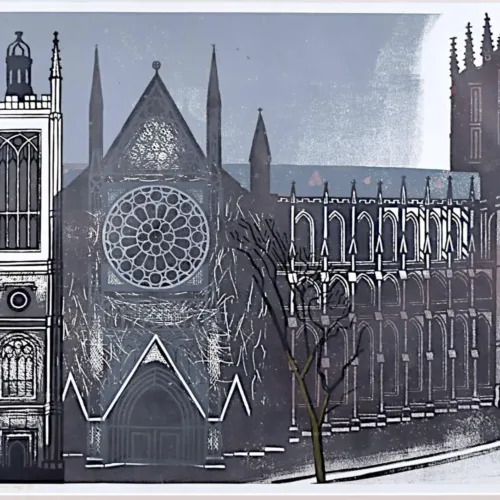
Edward Bawden (1903 - 1989)
Westminster Abbey (1966)
Linocut print 52 x 68 cm (92 x 107 framed) Signed, titled, inscribed 'Artist's Proof' and numbered 42/75 (Bawden inscribed 'Artist's Proof on all of his prints). Bawden's view of Westminster Abbey, cast in shades of blue, grey, and black.Edward Bawden was an English painter, illustrator and graphic artist, known for his prints, book covers, posters, and garden metalwork furniture. Bawden taught at the Royal College of Art, where he had been a student, worked as a commercial artist, and served as a war artist in World War II. He illustrated several books and painted various public murals, and his work and career are often associated with that of his contemporary, Eric Ravilious.Condition: generally very good. Inscription slightly faded. If you are interested, please email info@manningfineart.co.uk or call us on 07929 749056. Click here for other work by the artist. -
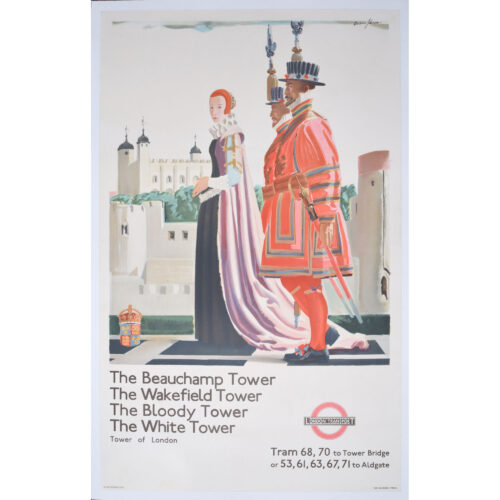
Andrew Johnson (1893 - 1973)
The Tower of London (1935)
Lithograph 102 x 64 cm A copy of this poster is held by the London Transport Museum (1983/4/4178). Queen Elizabeth I, accompanied by two Yeomen Warders, surveys the white stone of the Tower of London. Johnson's design encourages us to use London Transport (now Transport for London) to visit the Tower in all its historic glory. Andrew Johnson was born in Portsmouth and studied at the Central School of Art and Design (now Central St Martin's) in London. He worked as a poster designer for several advertising agencies. He designed posters for BP, Shell, the London and North Eastern Railway, Southern Railway, The Times, and General Motors (to name but a few). He made advertising graphics in New York in the late 1920s and later founded Grainger Johnson (a poster design company) with Tom Grainger. He was a member of the British Society of Poster Designers and several of his designs are held by the London Transport Museum. Condition: backed to linen; excellent. If you are interested, please email info@manningfineart.co.uk or call us on 07929 749056. Click here for other original vintage posters. -
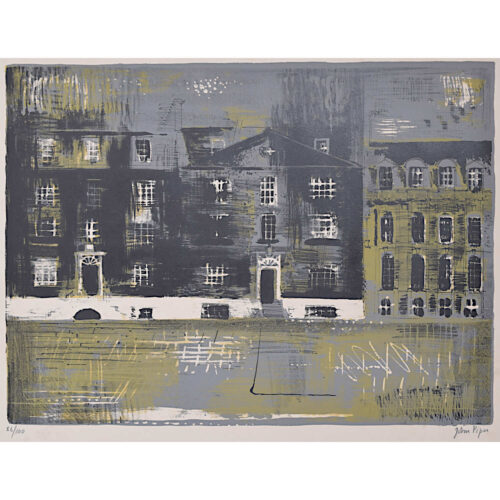
John Piper (1903-1992)
Westminster School II (1961)
42 x 59 cm Signed lower right and numbered 86/100 lower left in pencil. Piper’s second view of Westminster School; both views were commissioned by the school in 1981. Here he depicts Grant's House, with College on the far left and Rigaud’s House on the right. The view is serene and silent, set against a night sky the colour of stone, mimicking the buildings below. John Piper CH was an English painter, printmaker, and designer of stained-glass windows. His work often focused on the British landscape, especially churches and monuments, and included tapestry designs, book jackets, screen-prints, photography, fabrics and ceramics. Condition: generally very good; a little age toning. A few spots to margins. If you’d like to know more, please email info@manningfineart.co.uk or call us on 07929 749056. Click here for other works by John Piper CH. -
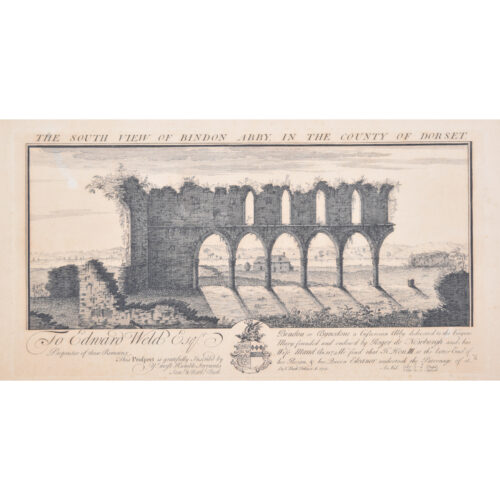
after Samuel Buck (1696 - 1779) and Nathaniel Buck (active 1724 - 1759)
The South View of Bindon Abbey, in the County of Dorset (1733)
Engraving 20 x 37 cm An engraved view of Bindon Abbey, a Cistercian monastery on the River Frome in Dorset. The monastery was founded in 1149 by William de Glastonia on the site since known as Little Bindon near Bindon Hill. In 1172 the monastery moved to a site near Wool, and was supported by the house of Plantagenet. The abbey was scheduled for Dissolution in 1536, and finally dissolved in 1539. Only ruins remain. Samuel and Nathaniel Buck were brothers and notable 18th century architectural artists, best known for their depictions of ancient castles and monasteries entitled 'Buck's Antiquities' and those of townscapes of England and Wales, ''Sea-Ports and Capital Towns''. Little is known about the brothers' lives. Samuel was born in Yorkshire and died in penury in London in 1779, and was buried in the churchyard of St Clement Danes. Nathaniel pre-deceased him, dying between 1759 and 1774. Condition: generally good; some age toning; mounted to board; sheet trimmed outside platemark. If you are interested, please email info@manningfineart.co.uk or call us on 07929 749056. -
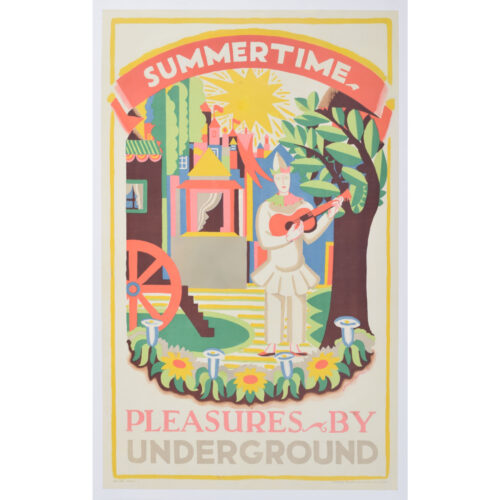
Edward McKnight Kauffer (1890 - 1954)
Summertime - Pleasures by Underground (1925)
Original vintage poster 101 x 63 cm Signed and dated in plate. Issued by the Underground Electric Railways Co. of London, Ltd., 1925. This is one of a series of posters designed by Edward McKnight Kauffer bearing the legend 'Summertime - Pleasures by Underground'. A doleful Pierrot figure (a lovestruck clown character from commedia dell'arte) plays a lute before a castle with streaming pennants; a country caravan, daffodils, leafy trees and a bright yellow sun complete the scene. Other posters from the series include similar traditional folk characters, such as a Jack-in-the-green. Edward McKnight Kauffer was an American artist and graphic designer who lived for much of his life in the United Kingdom. He is mainly known for his work in poster design, but was also active as a painter, book illustrator and theatre designer. He studied art at the California School of Design from 1910 to 1912 and then at the Académie Moderne in Paris until 1914 (via a six month stint at the Art Institute of Chicago). He moved to London upon the start of the First World War and produced 140 poster for London Underground and London Transport. He created posters for Shell Oil, the Great Western Railway and other commercial clients, and also illustrated books and book covers. Later he also became interested in textiles, interior design, and theatrical design. He returned to New York City in 1940 and began designing posters for American Airlines (his primary client until his death) in 1947 .In 1952 he designed the book jacket for Ralph Ellison's novel Invisible Man - arguably Kauffer's most famous work. Condition: generally very good; backed to linen. If you are interested, please email info@manningfineart.co.uk or call us on 07929 749056. Click here for other original vintage London Transport posters. -
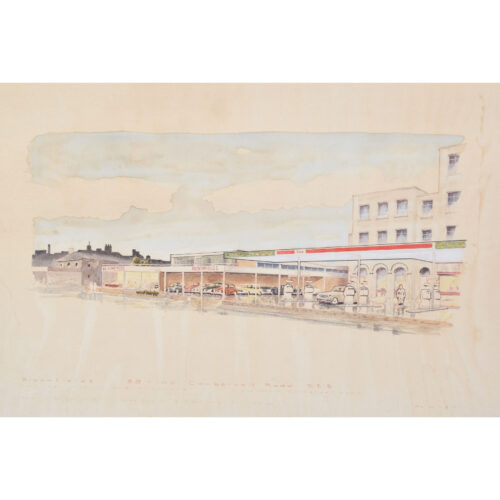
Bloomfields Car Showroom and Esso Garage, 88-106 Camberwell Road, London SE5
Gouache 39 x 52 cm A stylish gouache depiction of the Bloomfields Car Showroom, still extant as a car repair shop at 104-106 Camberwell Road. The artist completes the architectural perspective with brightly coloured mid-century cars and a mackintosh-clad gentleman. Condition: good; some wrinkling to paper and slight discolouration in areas. If you are interested, please email info@manningfineart.co.uk or call us on 07929 749056. Click here for more architectural views. -
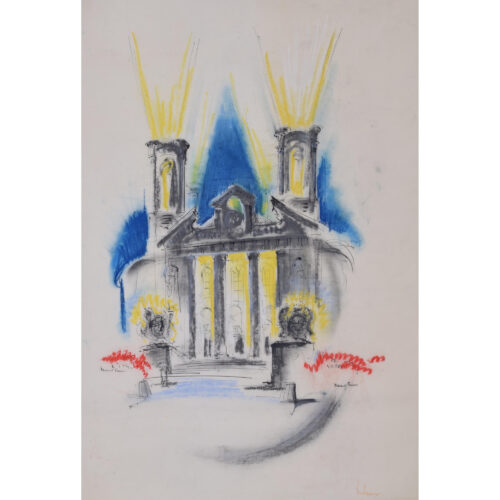
Louis Osman FRIBA (1914 - 1996)
Proposal for St John's Smith Square (1953)
Watercolour 70 x 52 cm Signed in red crayon lower right. Louis Osman's proposal for the post-war, post-bombing redevelopment of St John's church on Smith Square. Osman had envisioned an interior with a ceiling painted by Picasso; sadly, this project was never executed. The church was bombed in 1941 and gutted by fire; subsequently, the church was a ruin open to the sky for over 20 years. It was saved by Lady Parker of Waddington, who formed the Friends of St John's in 1962 to raise money and restore the church to its former glory - a reconstruction in the style of the church's original architect, Thomas Archer. Osman was as much an artist as an architect. This is a piece of architectural history as well as a beautiful Osman design. Osman was awarded a First Class degree and the Donaldson Medal of the RIBA (for the best result in his year group) by the Bartlett where he studied, and then went on to the Slade School of Art. He subsequently trained with Sir Albert Richardson - we also have several Richardson works in our collection. After the war, Osman busied himself as an architect. His work included contributions to Westminster Abbey, and Lincoln, Exeter, Ely, and Lichfield Cathedrals, Staunton Harold Church in Ashby de la Zouch for the National Trust, and of course his folly: the Grade I listed Elizabethan manor house, Canons Ashby in Northamptonshire, now a National Trust property. At Canons Ashby he established a workshop and had a team of silversmiths and goldsmiths working for him. In 1976 he made the gold enamelled coffin that holds the copy of the Magna Carta on view in the United States Capitol, Washington, DC. Condition: generally very good. If you’d like to know more, please email info@manningfineart.co.uk or call us on 07929 749056. -
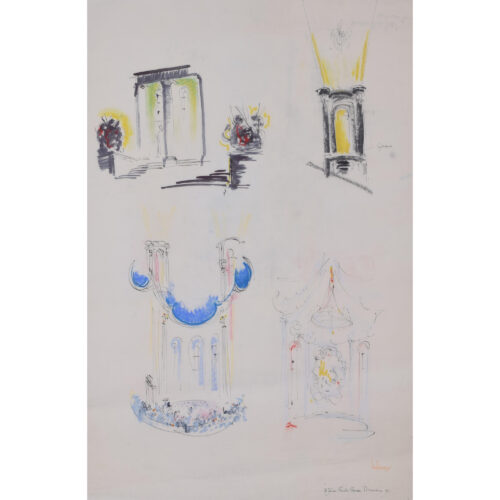
Louis Osman FRIBA (1914 - 1996)
Proposal details for St John's Smith Square (1953)
Watercolour 74 x 46 cm Signed in red crayon lower right. Details from Louis Osman's proposal for the post-war, post-bombing redevelopment of St John's church on Smith Square. Osman had envisioned an interior with a ceiling painted by Picasso; sadly, this project was never executed. The church was bombed in 1941 and gutted by fire; subsequently, the church was a ruin open to the sky for over 20 years. It was saved by Lady Parker of Waddington, who formed the Friends of St John's in 1962 to raise money and restore the church to its former glory - a reconstruction in the style of the church's original architect, Thomas Archer. Osman was as much an artist as an architect. This is a piece of architectural history as well as a beautiful Osman design. Osman was awarded a First Class degree and the Donaldson Medal of the RIBA (for the best result in his year group) by the Bartlett where he studied, and then went on to the Slade School of Art. He subsequently trained with Sir Albert Richardson - we also have several Richardson works in our collection. After the war, Osman busied himself as an architect. His work included contributions to Westminster Abbey, and Lincoln, Exeter, Ely, and Lichfield Cathedrals, Staunton Harold Church in Ashby de la Zouch for the National Trust, and of course his folly: the Grade I listed Elizabethan manor house, Canons Ashby in Northamptonshire, now a National Trust property. At Canons Ashby he established a workshop and had a team of silversmiths and goldsmiths working for him. In 1976 he made the gold enamelled coffin that holds the copy of the Magna Carta on view in the United States Capitol, Washington, DC. Condition: generally very good. If you’d like to know more, please email info@manningfineart.co.uk or call us on 07929 749056. -
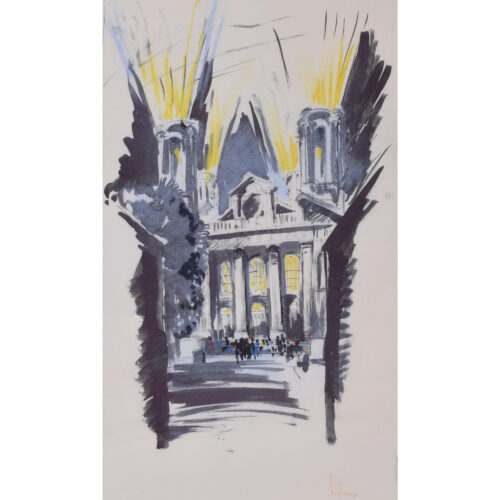
Louis Osman FRIBA (1914 - 1996)
Proposal for St John's Smith Square (1953)
Watercolour 62 x 37 cm Signed in red crayon lower right. Louis Osman's proposal for the post-war, post-bombing redevelopment of St John's church on Smith Square. Osman had envisioned an interior with a ceiling painted by Picasso; sadly, this project was never executed. The church was bombed in 1941 and gutted by fire; subsequently, the church was a ruin open to the sky for over 20 years. It was saved by Lady Parker of Waddington, who formed the Friends of St John's in 1962 to raise money and restore the church to its former glory - a reconstruction in the style of the church's original architect, Thomas Archer. Osman was as much an artist as an architect. This is a piece of architectural history as well as a beautiful Osman design. Osman was awarded a First Class degree and the Donaldson Medal of the RIBA (for the best result in his year group) by the Bartlett where he studied, and then went on to the Slade School of Art. He subsequently trained with Sir Albert Richardson - we also have several Richardson works in our collection. After the war, Osman busied himself as an architect. His work included contributions to Westminster Abbey, and Lincoln, Exeter, Ely, and Lichfield Cathedrals, Staunton Harold Church in Ashby de la Zouch for the National Trust, and of course his folly: the Grade I listed Elizabethan manor house, Canons Ashby in Northamptonshire, now a National Trust property. At Canons Ashby he established a workshop and had a team of silversmiths and goldsmiths working for him. In 1976 he made the gold enamelled coffin that holds the copy of the Magna Carta on view in the United States Capitol, Washington, DC. Condition: generally very good. If you’d like to know more, please email info@manningfineart.co.uk or call us on 07929 749056. -
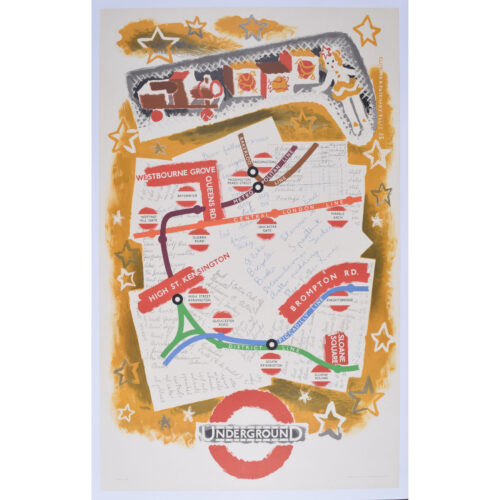
Clifford and Rosemary Ellis
London Underground Map (1935)
Original vintage poster 103 x 64 cm Signed in the plate 'Clifford & Rosemary Ellis '35". Printed by Waterlow & Sons Ltd for London Transport. Provenance: the artists' studio. This marvellous original vintage poster was designed for London Transport and encourages shoppers to use the Tube to do their Christmas shopping. The map of London's streets of shops, including High Street Kensington, Westbourne Grove, and the Brompton Road, are set on the background of Christmas wishlists and shopping lists. The cross-section of a Christmas stocking at the top of the poster includes a doll and a toy train amongst other stocking fillers. London Transport was the forerunner of London Underground. During the 1930s London Transport commissioned over forty posters a year from well-known artists such as Laura Knight, CRW Nevinson, Edward Wadsworth, Eric Ravilious, Paul Nash, Graham Sutherland, and Edward McKnight Kauffer – a bold policy that did much to popularise avant-garde artistic styles that stemmed from Cubism, Futurism and Abstraction. Condition: very good; backed to linen. If you are interested, please email info@manningfineart.co.uk or call us on 07929 749056. Click here for other original vintage London Transport posters. -
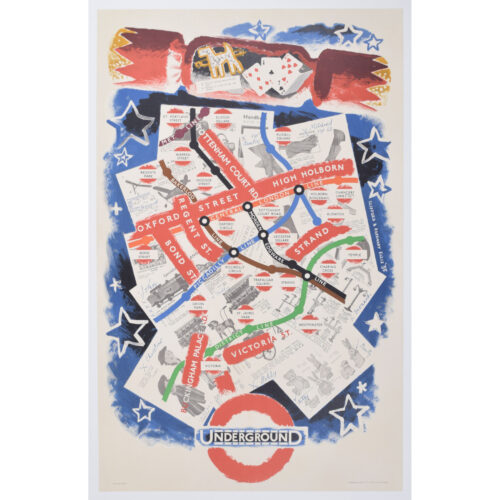
Clifford and Rosemary Ellis
London Underground Map (1935)
Original vintage poster 103 x 64 cm Signed in the plate 'Clifford & Rosemary Ellis '35". Printed by Waterlow & Sons Ltd for London Transport. Provenance: the artists' studio. This marvellous original vintage poster was designed for London Transport and encourages shoppers to use the Tube to do their Christmas shopping. The map of London's streets of shops, including Oxford Street, Regent Street, and Bond Street, are set on the background of a Christmas shopping list and various items to be purchased. The cross-section of a Christmas cracker at the top of the poster includes the joke: 'Why is a railway timetable like life?' - 'Because it is full of ups and downs. London Transport was the forerunner of London Underground. During the 1930s London Transport commissioned over forty posters a year from well-known artists such as Laura Knight, CRW Nevinson, Edward Wadsworth, Eric Ravilious, Paul Nash, Graham Sutherland, and Edward McKnight Kauffer – a bold policy that did much to popularise avant-garde artistic styles that stemmed from Cubism, Futurism and Abstraction. Condition: very good; backed to linen. If you are interested, please email info@manningfineart.co.uk or call us on 07929 749056. Click here for other original vintage London Transport posters. -
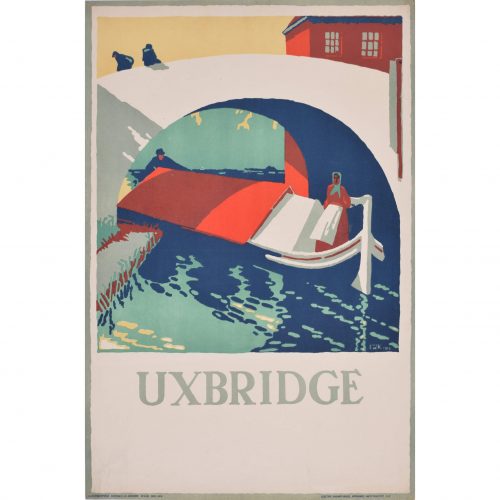
Edward McKnight Kauffer (1890 - 1954)
Uxbridge (1919)
Original vintage poster 76 x 51 cm Designed in 1919 and printed by the Dangerfield Printing Co Ltd on the 12th April 1920. 224/1000. A fantastic 1919 poster illustrating the pleasures of Uxbridge. Another version of this poster, bearing the legend 'Uxbridge by Tram', was released the same year to advertise London United Tramways. A copy of the poster is held by the Victoria and Albert Museum. Edward McKnight Kauffer was an American artist and graphic designer who lived for much of his life in the United Kingdom. He is mainly known for his work in poster design, but was also active as a painter, book illustrator and theatre designer. He studied art at the California School of Design from 1910 to 1912 and then at the Académie Moderne in Paris until 1914 (via a six month stint at the Art Institute of Chicago). He moved to London upon the start of the First World War and produced 140 poster for London Underground and London Transport. He created posters for Shell Oil, the Great Western Railway and other commercial clients, and also illustrated books and book covers. Later he also became interested in textiles, interior design, and theatrical design. He returned to New York City in 1940 and began designing posters for American Airlines (his primary client until his death) in 1947 .In 1952 he designed the book jacket for Ralph Ellison's novel Invisible Man - arguably Kauffer's most famous work. Condition: generally very good; a few short neatly repaired edge tears. Amusing article loosely pasted to reverse. If you are interested, please email info@manningfineart.co.uk or call us on 07929 749056. Click here for other original vintage London Transport posters. -
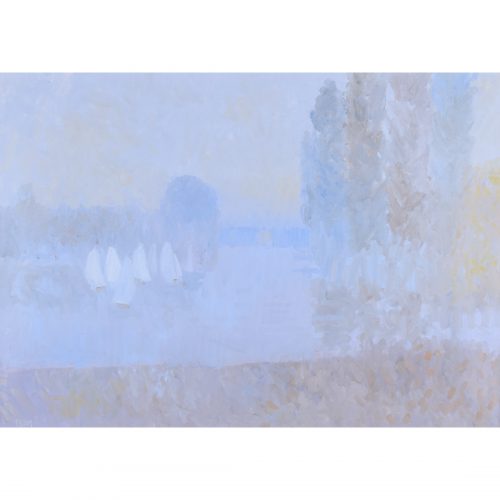
Bernard Myers (1925 - 2007)
Chiswick Reach
Oil on paper 50 x 72 cm Myers' impressionist view of Chiswick Reach (likely painted from his studio, which overlooked the Thames) depicts a hazy morning mist making its way down the river. The artist's sparse and muted palette renders the sky barely discernible from the water; chevron brushstrokes make up trees which cast their shadows over the Thames. A flotilla of boats, ghost-like with their white sails, appear from the blue mist. Bernard Myers was a painter and printmaker who trained at St Martin’s School of Art, the Camberwell School of Arts and Crafts, and the Royal College of Art in the 1940s and 1950s. This painting won the David Murray Landscape Scholarship and was painted while Myers was a student at the RCA. He went on to teach there before moving into a studio in Hammersmith. He lived and painted at 5 Durham Wharf, just off Chiswick Mall and with a view of the Thames, from the 1980s until his death in 2007. Provenance: New Grafton Gallery. Condition: excellent. If you are interested, please email info@manningfineart.co.uk or call us on 07929 749056. Click here for other views of London. -
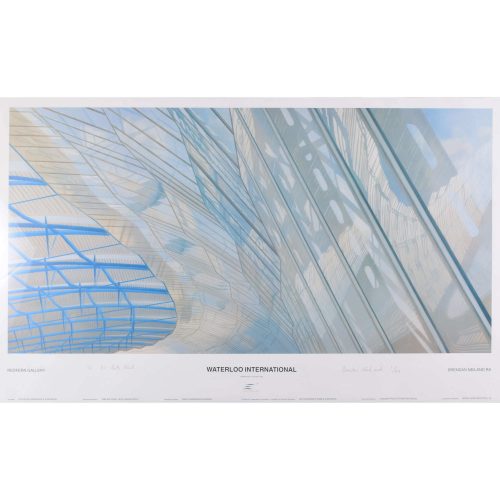
Brendan Neiland (b. 1941) R.A. (Expelled)
Waterloo International (1993)
Lithographic poster 101 x 60 cm Signed 'Brendan Neiland', numbered I/XII, and inscribed 'To Bob Reid' (Reid was Chairman of the British Railways Board from 1990 until 1995; he was present at Waterloo International Station prior to the opening of the Channel Tunnel). Neiland is known for his interpretations of city life. His work is widely exhibited in major museums and galleries worldwide including, in Britain, the Victoria and Albert Museum, The Tate Gallery London, The Collections of the British Council and the Arts Council of Great Britain. He is represented by the Redfern Gallery and has had numerous shows internationally, including at the Galerie Belvedere in Singapore, who represent him in Singapore and the Far East. Reflected architecture is one of Neiland’s most recurring themes. Condition: very good. If you are interested, please email info@manningfineart.co.uk or call us on 07929 749056. Click here for other works by Brendan Neiland. -
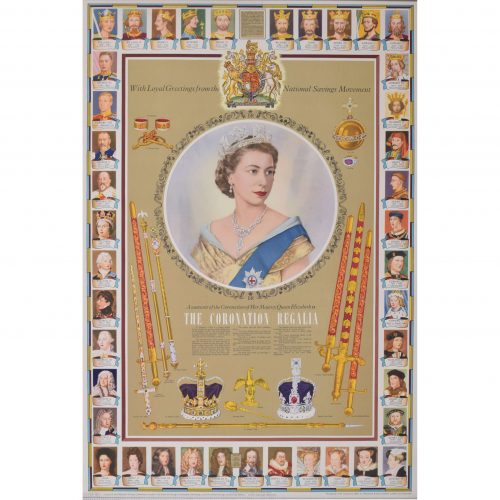
after Dorothy Wilding (1893 - 1976)
The Coronation Regalia (1953)
Original vintage poster 75 x 50 cm Issued by the National Savings Committee, London, the Scottish Savings Committee, Edinburgh, and the Ulster Savings Committee, Belfast. Crown Copyright Reserved. Printed for H.M. Stationery Office by Waterloo & Sons Limited, London and Dunstable. A fantastic piece of royalist British history. The famous portrait photographer Dorothy Wilding captured Queen Elizabeth II at her Coronation in 1952 - the photograph, used as the centrepiece of this poster, was also used on Britain's postage stamps until 1967. This particular poster was designed to be a Coronation souvenir, and features all the regalia and trappings of the United Kingdom's coronation ceremony, including crown, sword, orb, and sceptres, to name a few. The poster's margins are decorated with portraits of Britain's monarchs past, dating back to William the Conqueror. The National Savings Movement was a government-backed savings movement which began during the First World War to finance the government's wartime deficit. Savings products promoted by the movement typically offered a low level of return but the safety of a government guarantee. Various poster designs were issued by the movement to encourage ordinary people to save - we have several different designs in stock. Condition: generally very good. If you are interested, please email info@manningfineart.co.uk or call us on 07929 749056. Click here for other National Savings posters. -
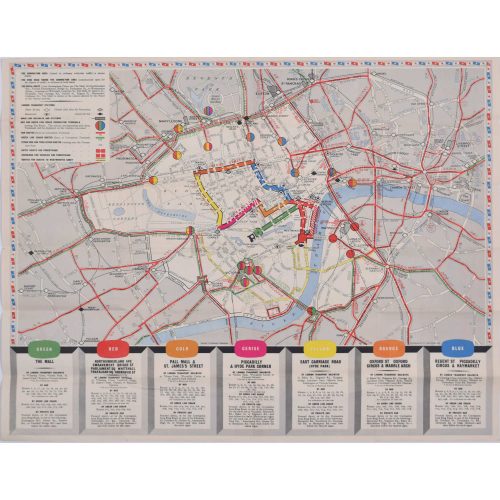
Coronation Arrangements - Map of London (1953)
Lithograph 45 x 60 cm (unfolded) Published by London Transport for the Coronation of Elizabeth II, this delightfully-coloured map illustrates the route taken by the Queen when she was crowned in 1953. Condition: generally very good. If you are interested, please email info@manningfineart.co.uk or call us on 07929 749056. -
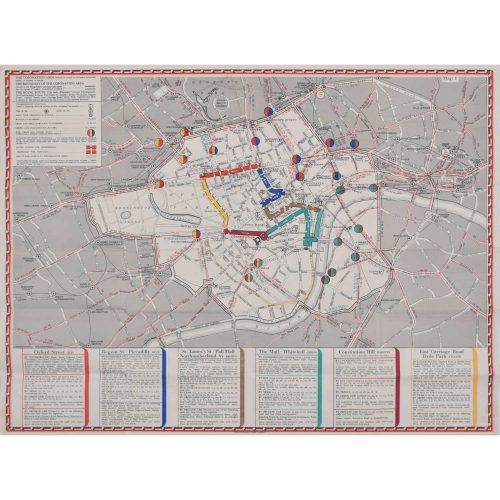
Coronation Arrangements - Map of London (1937)
Lithograph 45 x 60 cm (unfolded) Published by London Transport for the Coronation of George VI, this map illustrates the route the King took in 1936. And best of all, it's just (almost!) as useful in today's London. Condition: generally very good. If you are interested, please email info@manningfineart.co.uk or call us on 07929 749056. -

Colin Moss (1914 - 2005)
The Cedars, Kensington
Watercolour and gouache 57 x 40 cm Signed and dated '50 lower right. Moss' view of the Cedars, complete with passers-by and a stormy, jagged sky. Colin Moss was a noted British painter, draughtsman, printmaker, and teacher who served as a camoufleur during the Second World War. Moss was born in Ipswich but grew up in Plymouth following the death of his father at the Battle of Passchendaele in 1917. Moss studied at the Plymouth Art School from 1930 to 1934 and then went on to the Royal College of Art, where he studied under Gilbert Spencer and Charles Mahoney. He worked on murals for the British Pavilion at the 1939 New York World's Fair. During the war, Moss made a series of watercolours depicting his time as a camoufleur. He had designed the camouflage scheme for Stonebridge Power Station in Wembley, and produced several watercolours of the camouflaged structure. These pictures, as well as several others painted during his WWII deployment, are now held by the Imperial War Museum, having been purchased by the War Artists' Advisory Committee. In 1947 Moss' military service ended, and he became a teacher at the Ipswich School of Art. He had solo exhibitions at the Kensington Art Gallery in 1951 and the Zwemmer Gallery in 1955, and his work began to be acquired by the national collections. He became a founder member of the New Ipswich Art Group in 1958, and the Six in Suffolk Group in 1976. In the 1970s he exhibited at the Royal Academy and the Royal Watercolour Society, and retrospective exhibitions of his work were held at various British art galleries throughout the 1980s. He continued to hold numerous solo exhibitions after his retirement, and taught artists Brian Eno and Maggi Hambling. Provenance: "Britain in Watercolours" exhibition. Condition: excellent. If you’d like to know more, please email info@manningfineart.co.uk or call us on 07929 749056. -
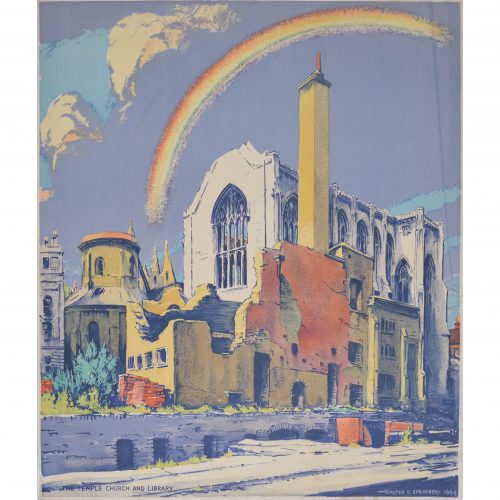
Walter Ernest Spradbery (1889 - 1969)
Temple Church and Library after Bombardment (1944)
Lithograph 66 x 57 cm Walter Spradbery's poster for the London Underground depicting a bombed Temple Church; a rainbow strikes hopefully out of the church's remains, and the sun shines on the golden stone of the building. The full poster bears the legend 'The Proud City' above Spradbery's design, and, beneath it, a quote from Charles Lamb: 'So may the winged horse, your ancient badge and cognisance, still flourish!'. This is a fantastic piece of British and London history, as well as a fantastically designed poster by a notable 20th century artist. The London Transport Museum has a copy of the poster, reference 1983/4/5751. 'The Proud City' was a series of six posters, all designed by Spradbery. They were commissioned by London Transport in 1944 as a defiant celebration of London's surviving the Blitz, and each poster also included a literary quotation. Walter Ernest Spradbery was a designer, painter, and poet who lived through the First and Second World Wars. He produced posters for LNER, Southern Railways, and London Transport, and was noted for his fascination with architecture and landscape. He studied, and later taught, at the Walthamstow School of Art. He was a pacifist and campaigned for nuclear disarmament, serving in the Medical Corps during the First World War and painting scenes of warfare for its duration, as well as during the Second World War. His anti-war stance and the horrors he had witnessed as a medic fed into his post-war poster design, especially 'The Proud City' poster series. Condition: generally very good. If you’d like to know more, please email info@manningfineart.co.uk or call us on 07929 749056. -
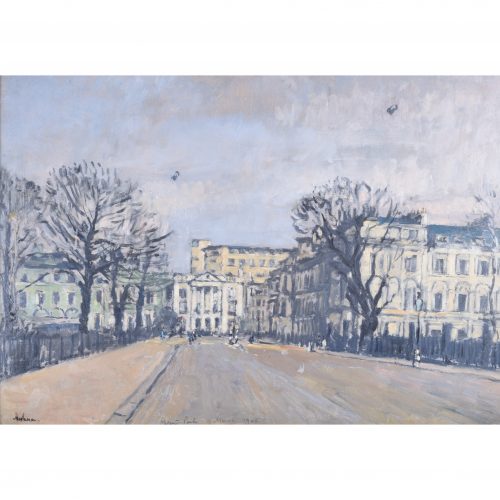
Paul Ayshford Methuen (1886 - 1974)
Barrage Balloons, Regents Park, 9 March 1940
Oil on board 36 x 52 cm Signed lower left and titled and dated lower centre. Lord Methuen's oil painting of Regent's Park on a winter's day, with barrage balloons above. Barrage balloons were set up - stationed at an altitude of around 4,000 ft - as a barrier to enemy aircraft. The steel cables used to tether the balloons would take an enemy aeroplane out of the sky if it were to hit the cable. The UK had thousands of them, filled partly with hydrogen and operated largely by women, to protect significant towns, cities, and military installations. These strange blobs floated over the country, just asking to be captured by artists. Methuen had rejoined his regiment (serving as a Captain) in 1939 but was likely stationed in London for a while, when he might have had the opportunity to capture this scene. When Methuen painted the scene in 1940, Britain was still in the stage of the phoney war. The Battle of Britain did not commence until 10 July, and the Blitz not until 7 September - but Britain's defences were ready. Barrage balloons were important all the way through the War: they defended London against the V2 missiles; they defended the D-Day invasion fleet; and they protected the invasion army for months. Indeed, it was said that the vast amount of material brought into the UK from the States prior to D-Day would have caused Britain to sink under the sea, were it not for the huge number of barrage balloons holding the country up... Condition: excellent. Recently revarnished. If you’d like to know more, please email info@manningfineart.co.uk or call us on 07929 749056. -
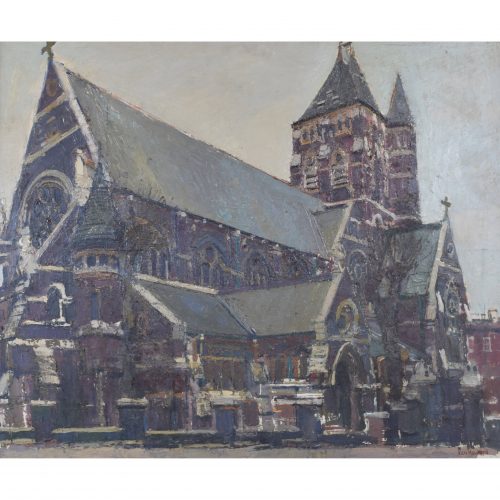
Ken Howard RA (1932 - 2022)
Hampstead Church (St Stephen's Church, Rosslyn Hill)
Oil on board 75 x 91 cm Ken Howard's magnificent view of St Stephen's Church, Hampstead. The artist's rich, deep colour palette and use of impasto underline the neo-gothic style of the church. Howard died in Hampstead and painted several views of the area and its architecture. St Stephen's was designed in the Neo Gothic style by Samuel Sanders Teulon and he considered it the best of the 114 churches he designed, calling it his "mighty church". The building is no longer a church, but wedding ceremonies still take place there; it was made a Grade I listed building in 1974. Kenneth Howard OBE RA was a British artist and painter. He was President of the New English Art Club from 1998 to 2003. He studied at the Hornsey College of Art and the Royal College of Art. In 1958 he won a British Council Scholarship to Florence, and in 1973 and 1978 he was the Official War Artist to Northern Ireland, and 1973 - 80 worked in various locations, including Hong Kong, Cyprus and Canada with the British Army. In 1983 he was elected an Associate of the Royal Academy (ARA). In 1998 he became President of the New English Art Club, a post he held until 2003. In 1991 he was elected a Royal Academician (RA). Howard was given his OBE in 2010. Condition: very good. If you’d like to know more, please email info@manningfineart.co.uk or call us on 07929 749056. -
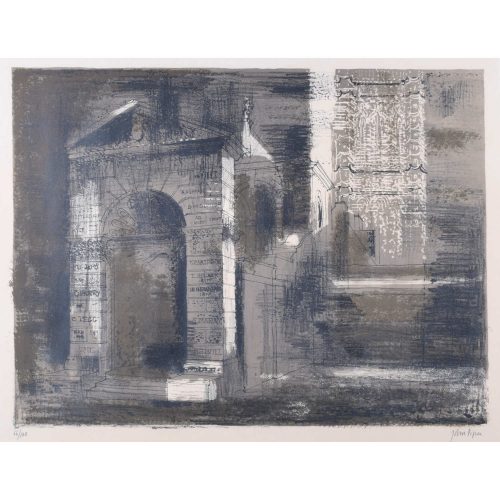
John Piper (1903-1992)
Westminster School I (1961)
49 x 63 cm Signed lower right and numbered 66/100 lower left in pencil. Piper's skilled and characterful rendering of Westminster School's gateway, sometimes known as Burlington's Arch. The historic entrance to the school dates from 1734 and is carved with the names of former pupils. John Piper CH was an English painter, printmaker, and designer of stained-glass windows. His work often focused on the British landscape, especially churches and monuments, and included tapestry designs, book jackets, screen-prints, photography, fabrics and ceramics. Condition: Generally very good, gentle even toning to the paper. If you’d like to know more, please email info@manningfineart.co.uk or call us on 07929 749056. -
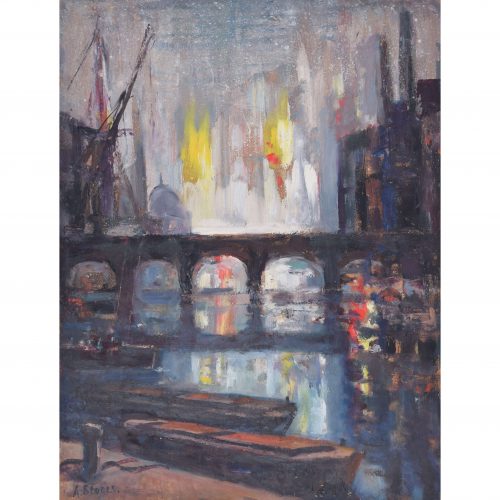
Angela Stones (1914 - 1995)
Old London Bridge Fantasia (1968)
Oil on board 56 x 43 cm Signed lower left. A fantasia inspired by Old London Bridge on the Thames. The grey dome of St Paul's peeps over the bridge; bright lights burn in the background, throwing yellows and red reflections onto the water. Moored boats bob gently in the foreground. Stones was educated at the Chelsea School of Art, and was a member of an artistic dynasty. Her mother Dorothy Bradshaw (1893-1983) studied under Jack Merriott – the artist famous for his British Rail posters, and her son, Christopher Assheton-Stones (1947-1999), was arguably the foremost pastel artist of his time. Provenance: the family of the artist. Condition: very good. If you’d like to know more, please email info@manningfineart.co.uk or call us on 07929 749056. -
Out of stock
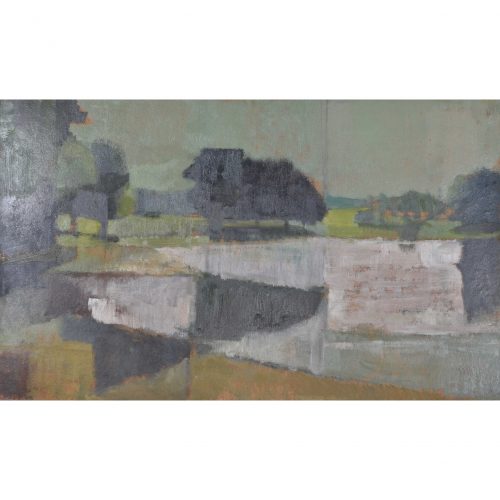
Bernard Myers (1925 - 2007)
South London Park
Oil on board 38 x 64 cm Myers' abstract oil of a London park. Blocks of colour make up the forms of the landscape, textured by the artist's thick, lateral brushstrokes. Bernard Myers was a painter and printmaker who trained at St Martin’s School of Art, the Camberwell School of Arts and Crafts, and the Royal College of Art in the 1940s and 1950s. This painting won the David Murray Landscape Scholarship and was painted while Myers was a student at the RCA. He went on to teach there before moving into a studio in Hammersmith. Condition: very good. Recently cleaned and revarnished. If you’d like to know more, please email info@manningfineart.co.uk or call us on 07929 749056. -
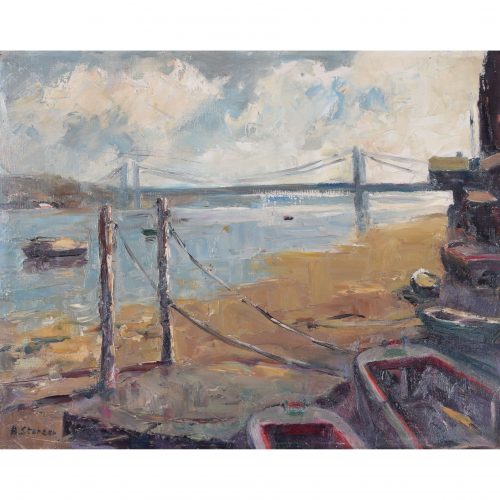
Angela Stones (1914 - 1995)
From Battersea Bridge (before Redevelopment)
Oil on board 40 x 50 cm Stones' view of the Thames and Chelsea Bridge, painted from Battersea Bridge. The artist's use of impasto, particularly evident in her depiction of the rambunctious white clouds above the bridge, lends a liveliness to the painting. Stones was educated at the Chelsea School of Art, and was a member of an artistic dynasty. Her mother Dorothy Bradshaw (1893-1983) studied under Jack Merriott – the artist famous for his British Rail posters, and her son, Christopher Assheton-Stones (1947-1999), was arguably the foremost pastel artist of his time. Provenance: the family of the artist. Condition: very good. If you’d like to know more, please email info@manningfineart.co.uk or call us on 07929 749056. -
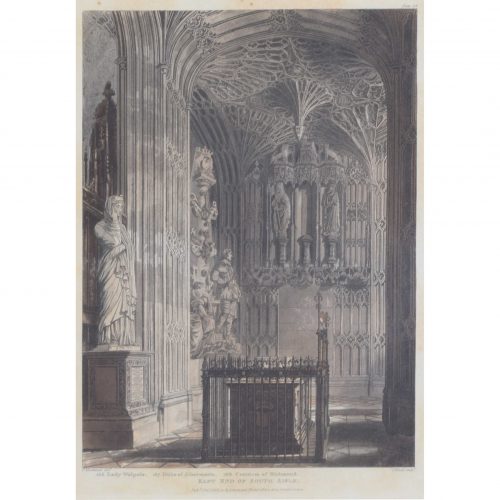
J Black (early 19th century) after Frederick Mackenzie (1788 - 1854)
East End of South Aisle, Westminster Abbey (1812)
Hand-coloured aquatint 31 x 24 cm Published by Rudolph Ackermann (1764 - 1834). An engraving of the East End of Westminster Abbey's south aisle. Mackenzie's drawing was engraved by Black and published by Ackermann in his 1812 "History of Westminster Abbey". Charles II, Queen Anne, Queen Mary II and her husband King William III, and Mary, Queen of Scots are all buried in the south aisle. The Abbey is an historic, mainly Gothic church in the City of Westminster, London, just to the west of the Palace of Westminster. It is one of the United Kingdom's most notable religious buildings and since Edward the Confessor, a burial site for English and, later, British monarchs. Since the coronation of William the Conqueror in 1066, all coronations of English and British monarchs have occurred in Westminster Abbey. Sixteen royal weddings have occurred at the abbey since 1100. According to a tradition first reported circa 1080, a church was founded at the site (then known as Thorney Island) in the seventh century, in the time of Mellitus, Bishop of London. Construction of the present church began in 1245 on the orders of Henry III. Frederick Mackenzie (1788 - 1854) was a British watercolourist and architectural draughtsman. He first exhibited at the Royal Academy in 1804, and contributed eleven drawings between that year and 1828. He contributed to the Society of Painters in Water Colours exhibitions from 1813, becoming an associate in 1822, and a full member the following year. From 30 November 1831 till his death he was treasurer to the society. In later life Mackenzie was no longer commissioned to illustrate books. Rudolph Ackermann was an Anglo-German bookseller, inventor, lithographer, publisher and businessman. In 1795 he established a print-shop and drawing-school at 96 Strand. Here Ackermann set up a lithographic press and began a trade in prints. He later began to manufacture colours and thick carton paper for landscape and miniature painters. Within three years the premises had become too small and he moved to 101 Strand, in his own words "four doors nearer to Somerset House", the seat of the Royal Academy of Arts. Between 1797 and 1800 Ackermann rapidly developed his print and book publishing business, encompassing many different genres including topography, caricature, portraits, transparencies and decorative prints. Condition: good. Some age toning. If you’d like to know more, please email info@manningfineart.co.uk or call us on 07929 749056. -
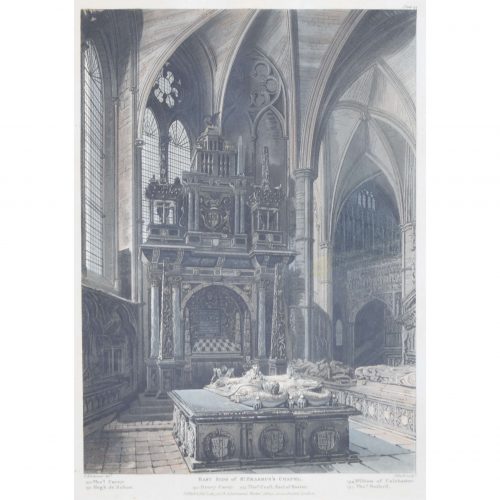
J Black (early 19th century) after Frederick Mackenzie (1788 - 1854)
East Side of St Erasmus' Chapel, Westminster Abbey (1812)
Hand-coloured aquatint 28 x 19 cm Published by Rudolph Ackermann (1764 - 1834). An engraving of the east side of the chapel of St Erasmus in Westminster Abbey. Mackenzie's drawing was engraved by Black and published by Ackermann in his 1812 "History of Westminster Abbey". The chapel was built in the late 15th century by order of Edward IV's wife, Elizabeth Woodville. It would have been used to worship St Erasmus, also known as St Elmo (a Christian saint and martyr venerated as the patron saint of sailors and abdominal pain). The Abbey is an historic, mainly Gothic church in the City of Westminster, London, just to the west of the Palace of Westminster. It is one of the United Kingdom's most notable religious buildings and since Edward the Confessor, a burial site for English and, later, British monarchs. Since the coronation of William the Conqueror in 1066, all coronations of English and British monarchs have occurred in Westminster Abbey. Sixteen royal weddings have occurred at the abbey since 1100. According to a tradition first reported circa 1080, a church was founded at the site (then known as Thorney Island) in the seventh century, in the time of Mellitus, Bishop of London. Construction of the present church began in 1245 on the orders of Henry III. Frederick Mackenzie (1788 - 1854) was a British watercolourist and architectural draughtsman. He first exhibited at the Royal Academy in 1804, and contributed eleven drawings between that year and 1828. He contributed to the Society of Painters in Water Colours exhibitions from 1813, becoming an associate in 1822, and a full member the following year. From 30 November 1831 till his death he was treasurer to the society. In later life Mackenzie was no longer commissioned to illustrate books. Rudolph Ackermann was an Anglo-German bookseller, inventor, lithographer, publisher and businessman. In 1795 he established a print-shop and drawing-school at 96 Strand. Here Ackermann set up a lithographic press and began a trade in prints. He later began to manufacture colours and thick carton paper for landscape and miniature painters. Within three years the premises had become too small and he moved to 101 Strand, in his own words "four doors nearer to Somerset House", the seat of the Royal Academy of Arts. Between 1797 and 1800 Ackermann rapidly developed his print and book publishing business, encompassing many different genres including topography, caricature, portraits, transparencies and decorative prints. Condition: good. Some age toning. If you’d like to know more, please email info@manningfineart.co.uk or call us on 07929 749056. -
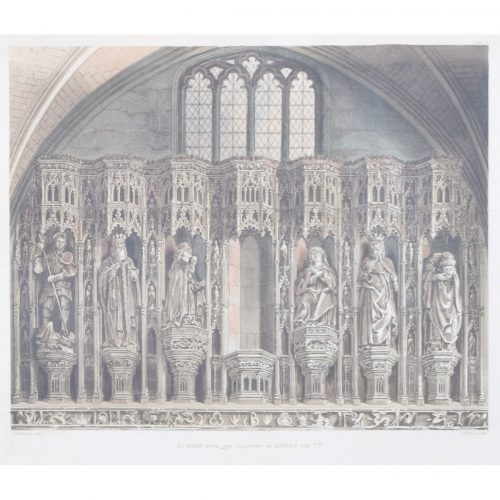
J Black (early 19th century) after Frederick Mackenzie (1788 - 1854)
Screen Over the Chantry of Henry V, Westminster Abbey (1812)
Hand-coloured aquatint 26 x 31 cm Published by Rudolph Ackermann (1764 - 1834). An engraving of the gothic screen of the elaborately carved chantry chapel dedicated to Henry V, and below which lies his tomb, in Westminster Abbey. Mackenzie's drawing was engraved by Black and published by Ackermann in his 1812 "History of Westminster Abbey". The Abbey is an historic, mainly Gothic church in the City of Westminster, London, just to the west of the Palace of Westminster. It is one of the United Kingdom''s most notable religious buildings and since Edward the Confessor, a burial site for English and, later, British monarchs. Since the coronation of William the Conqueror in 1066, all coronations of English and British monarchs have occurred in Westminster Abbey. Sixteen royal weddings have occurred at the abbey since 1100. According to a tradition first reported circa 1080, a church was founded at the site (then known as Thorney Island) in the seventh century, in the time of Mellitus, Bishop of London. Construction of the present church began in 1245 on the orders of Henry III. Frederick Mackenzie (1788 - 1854) was a British watercolourist and architectural draughtsman. He first exhibited at the Royal Academy in 1804, and contributed eleven drawings between that year and 1828. He contributed to the Society of Painters in Water Colours exhibitions from 1813, becoming an associate in 1822, and a full member the following year. From 30 November 1831 till his death he was treasurer to the society. In later life Mackenzie was no longer commissioned to illustrate books. Rudolph Ackermann was an Anglo-German bookseller, inventor, lithographer, publisher and businessman. In 1795 he established a print-shop and drawing-school at 96 Strand. Here Ackermann set up a lithographic press and began a trade in prints. He later began to manufacture colours and thick carton paper for landscape and miniature painters. Within three years the premises had become too small and he moved to 101 Strand, in his own words "four doors nearer to Somerset House", the seat of the Royal Academy of Arts. Between 1797 and 1800 Ackermann rapidly developed his print and book publishing business, encompassing many different genres including topography, caricature, portraits, transparencies and decorative prints. Condition: good. Some age toning. If you’d like to know more, please email info@manningfineart.co.uk or call us on 07929 749056. -
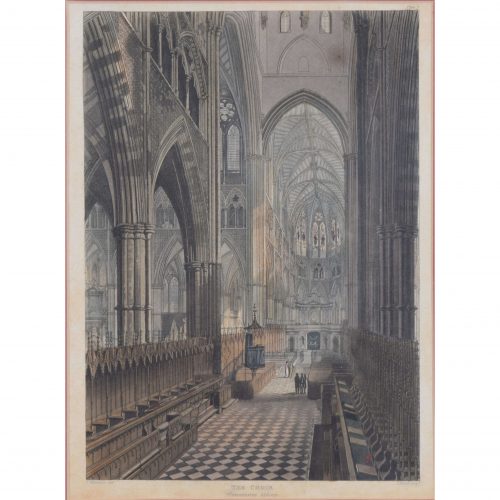
J Black (early 19th century) after Frederick Mackenzie (1788 - 1854)
The Choir, Westminster Abbey (1812)
Hand-coloured aquatint 28 x 19 cm Published by Rudolph Ackermann (1764 - 1834). An engraving of the vast and soaring interior of Westminster Abbey. Mackenzie's drawing was engraved by Black and published by Ackermann in his 1812 "History of Westminster Abbey". The Abbey is an historic, mainly Gothic church in the City of Westminster, London, just to the west of the Palace of Westminster. It is one of the United Kingdom's most notable religious buildings and since Edward the Confessor, a burial site for English and, later, British monarchs. Since the coronation of William the Conqueror in 1066, all coronations of English and British monarchs have occurred in Westminster Abbey. Sixteen royal weddings have occurred at the abbey since 1100. According to a tradition first reported circa 1080, a church was founded at the site (then known as Thorney Island) in the seventh century, in the time of Mellitus, Bishop of London. Construction of the present church began in 1245 on the orders of Henry III. Frederick Mackenzie (1788 - 1854) was a British watercolourist and architectural draughtsman. He first exhibited at the Royal Academy in 1804, and contributed eleven drawings between that year and 1828. He contributed to the Society of Painters in Water Colours exhibitions from 1813, becoming an associate in 1822, and a full member the following year. From 30 November 1831 till his death he was treasurer to the society. In later life Mackenzie was no longer commissioned to illustrate books. Rudolph Ackermann was an Anglo-German bookseller, inventor, lithographer, publisher and businessman. In 1795 he established a print-shop and drawing-school at 96 Strand. Here Ackermann set up a lithographic press and began a trade in prints. He later began to manufacture colours and thick carton paper for landscape and miniature painters. Within three years the premises had become too small and he moved to 101 Strand, in his own words "four doors nearer to Somerset House", the seat of the Royal Academy of Arts. Between 1797 and 1800 Ackermann rapidly developed his print and book publishing business, encompassing many different genres including topography, caricature, portraits, transparencies and decorative prints. Condition: good. Some age toning. If you’d like to know more, please email info@manningfineart.co.uk or call us on 07929 749056.