-
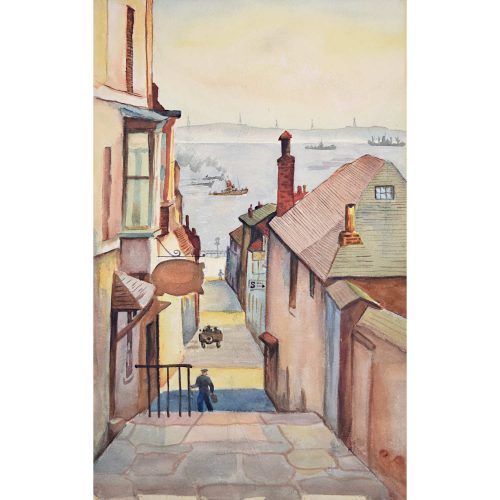
Falmouth, 1944 (unknown Modern British Artist)
Watercolour 46 x 30cm An evocative painting of Falmouth, the Cornish town shaped by its relationship to the sea. The artist leads us from the warm tones of the stone flags and empty buildings down towards a grey sea and a gently smouldering sky. Ships move in to the port, and a unit of pylons, starkly silhouetted, looks out over the bay. Condition: excellent. If you’d like to know more, please email info@manningfineart.co.uk or call us on 07929 749056. -
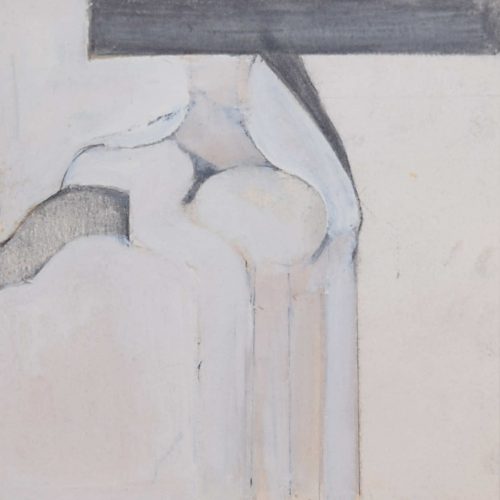
Adrian Heath Abstract Study III (1975)
Acrylic and pencil on paper 22 x 22cm Heath was born in Burma in 1920 and arrived in England aged five. In 1938 he studied art under Stanhope Forbes at Newlyn and later at the Slade School of Art. While serving in WWII, he was captured and placed in a prisoner-of-war camp in Bavaria. Heath attempted to escape from the camp but was recaptured and placed in solitary confinement; this isolation proved crucial to the development of his artistic style, as he spent much of his time there experimenting with abstract forms. When released from confinement, Heath befriended a fellow prisoner of war: Terry Frost. Together they explored the methods of painting which they had developed during their time in the camps, and following the war both became celebrated artists. We have several Terry Frost pieces available too. In 1949 and 1951, Heath returned to Cornwall. He spent time with artists like Ben Nicholson, Victor Pasmore, and Anthony Hill, and became the main link between the emerging St Ives School of artists and the British Constructivist movement back in London. He is further credited with promoting British abstract art through informal exhibitions in his studio on Fitzroy Street, as well as his manifesto-like text entitled 'Abstract Art: Its Origins and Meaning', which was published in 1953. Over time, Heath's paintings of abstract geometry and symmetry became increasingly dynamic and heavily textured, the result of layering paint on paint over the course of several days. This study features a muted colour palette and abstract asymmetric form. If you'd like to know more, please email info@manningfineart.co.uk or call us on 07929 749056. Condition: Good. Signed lower right. -
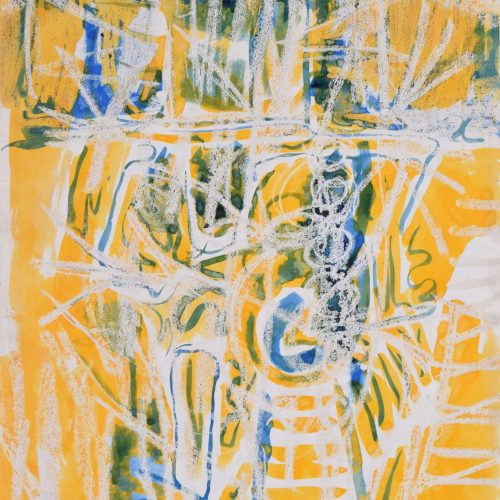
Charles Pulsford ARSA (1912 - 1989)
Abstract Figure in Yellow and Blue
Watercolour and ink 56 x 38 cm Signed lower right. An abstract figure in arresting colours. The artist plays with the intersection of round and lateral mark-making to form a human figure, perhaps reminiscent of a crucifixion. Pulsford's skill as an abstract landscape artist is also evident here, with the form suggestive of natural and industrial topography like fields, rivers, railway tracks, and electric pylons. Pulsford was born in Staffordshire to Scottish parents. His family returned to Dunfermline when he was a child, and he subsequently attended Edinburgh College of Art (ECA) between 1933 and 1937. He, along with other prominent Scottish artists, embraced modernism and abstraction following the end of the war. Alan Davie, William Turnbull, William Gear and Eduardo Paolozzi are the key artists of the group with which he was association, and the National Galleries of Scotland regard Pulsford as the 'fifth man' of the group. Between 1952 and 1960 he taught at ECA and then at Canterbury College of Art. Condition: generally very good, old tape stains to extreme margins. If you are interested email info@manningfineart.co.uk or call us on 07929 749056. Provenance: the artist, the residual stock of William Hardie. -
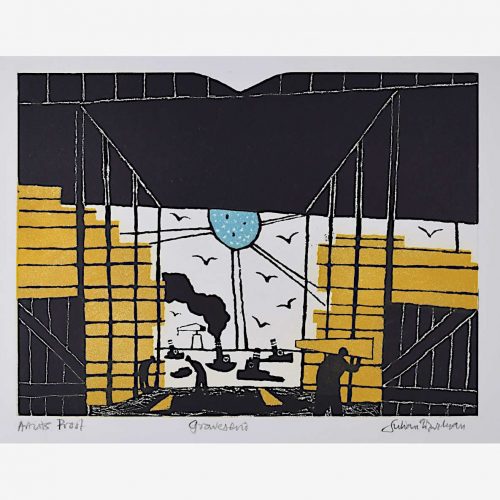
Julian Trevelyan (1910-1988)
Gravesend (1969)
Etching and aquatint, signed, titled, and inscribed 'Artist's Proof' in pencil 35x48cm (sheet size 59x77cm) On J Green paper Condition: generally excellent, never previously framed, see image. Click here for biographical details and other works by the artist. If you are interested email info@manningfineart.co.uk or call us on 07929 749056. -
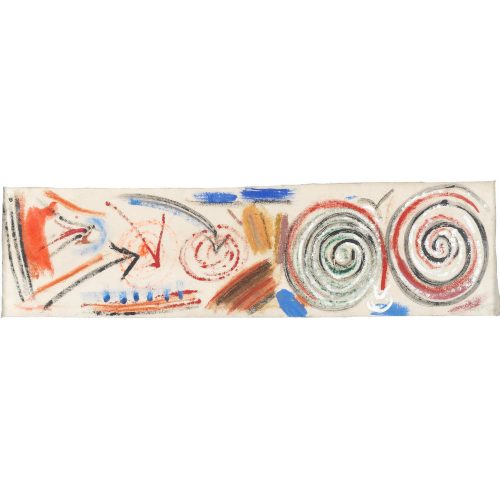
Terry Frost (1915-2003)
'Untitled Landscape'
Oil on canvas, laid on board 22 x 81.5cm Exhibited London, Coram Gallery, Terry Frost: Works on Paper and Small Paintings, 23 September-29 October 1994 Click here for biographical details and other works by the artist. If you are interested email info@manningfineart.co.uk or call us on 07929 749056. -
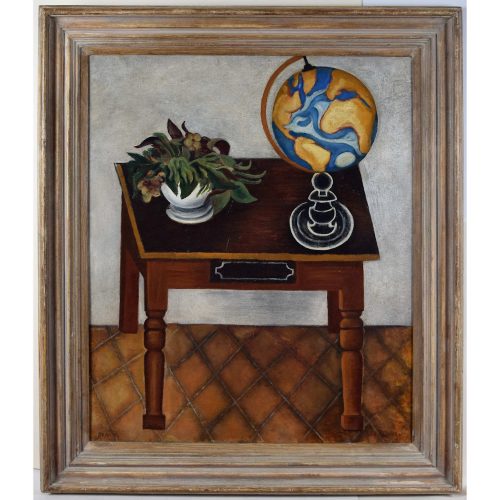
John Aldridge RA (1905 - 1983)
Still Life with Globe Painted at El Porche, Dejà, Mallorca 1932
Oil on Board 74 x 62 cm Signed ‘John Aldridge’ lower right, inscribed 'Deja 32' lower left, and titled to reverse. A British oil painter, designer of wallpapers and textiles, book illustrator, art teacher and enthusiastic plantsman, John Aldridge was born in Woolwich, England, and grew up in a comparatively wealthy military family. After reading Greats at the University of Oxford, Aldridge graduated in 1928 with a Bachelor of Arts degree, settling in London and teaching himself to paint. Invited by Ben Nicholson, Aldridge joined artists such as Hepworth, Moore and Piper in the ‘Seven and Five Society’ with whom he held his first mixed exhibition in 1931. Despite being based in London during this time, Aldridge made excursions to Paris, Germany, Italy, Tenerife and Mallorca. As a dear friend of the poet Robert Graves, the two spent endless holidays together in Mallorca near Deià, Graves having a house there which can be visited to this day. This work is inscribed ‘Deyà 32’ in the lower left corner, thus it is likely that it was painted during one of these periods. Exhibitions held with the ‘Seven and Five Society’ at Leicester Galleries in this period lead to numerous other exhibitions of his work, both with the ‘Seven and Five Society’ and otherwise. Aldridge was elected an Associate of the Royal Academy (ARA) in 1954, then a full member (RA) in 1963. Despite this, during his later years Aldridge’s art went out of fashion, his somewhat nostalgic works out of style with the arrival of the swinging 60s and 70s that treated old England as an abomination that needed to be forgotten. Since then, Aldridge’s art has been brought back into the eyes of the fine arts industry and recognised as it deserves. True to Aldridge’s diverse output, this work reflects the rapid-spreading modernist movement of the early twentieth century. It mimics Cézanne’s dual perspective, looking down yet looking forwards. The technique encapsulates the human experience of multiple viewpoints while simultaneously creating a sense of instability. The globe, often associated with knowledge, exploration and a symbol of human control over the world, is juxtaposed with the wilting pot plant, a motif of the transience and uncontrollability of nature. On account of the unsteadiness, the globe appears precarious, teetering on the edge of the table, while the plant stands firmly in the centre, perhaps signifying that nature is ultimately more dominant that a futile human attempt at control over the world. Although the objects appear simple or mundane, Aldridge uses this altar-like setup, pedestalling them to encourage the viewer to contemplate objects which would otherwise go unnoticed. The objects themselves are traditional, the globe a contemplative symbol shared with Holbein’s ‘The Ambassadors’, yet Aldridge follows in the footsteps of the emerging modernists, breaking the mould through perspective and abstraction, opening an opportunity for reception theory; the meaning of the painting changes and evolves for each new spectator. His art is in major public collections such as the Tate, the British Council, the National Portrait Gallery, the Royal Academy and the Victoria and Albert Museum. The Fry Art Gallery in Saffron Walden, which specialises in East Anglian pictures, has a significant holding of his work. Condition: generally very good. Distressed frame with occasional loss, and board slightly bowed. -
John Piper (1903-1992)
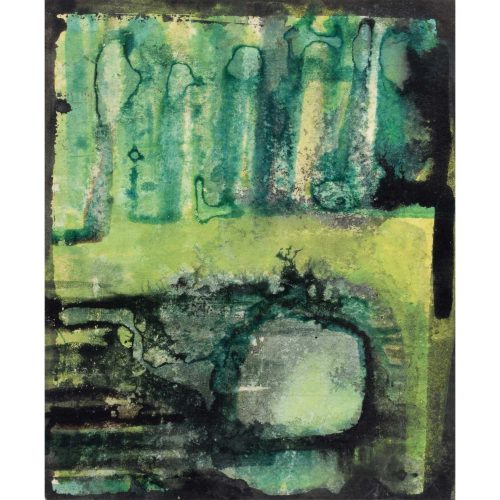
Study for the Piper Building mural
Gouache 14.5x11.5cm Provenance: P Manzareli (who built the fibreglass murals for Piper), gift from the artist; Milne & Moller Fine Art; Katharine House Gallery; private collection, Scotland. This study is a fascinating part of London's architectural history. The Piper Building is a mid-century architectural icon in Fulham. Built in the 1950s as 'Watson House', it was a laboratory complex for the North Thames Gas Board and has an innovative concrete structure. Piper was commissioned to produce the murals surrounding the building. The Gas Board moved out in the mid 1980s. Scheduled for demolition in the 1990s, the building was instead converted into seventy apartments and renamed the Piper Building. With double-height ceilings, the apartments were sold as shells, and purchasers were free to commission their own architects and builders. Condition: Generally excellent; framed. For other works by the artist and biographical details, click here. If you are interested email info@manningfineart.co.uk or call us on 07929 749056. -
John Piper (1903-1992)
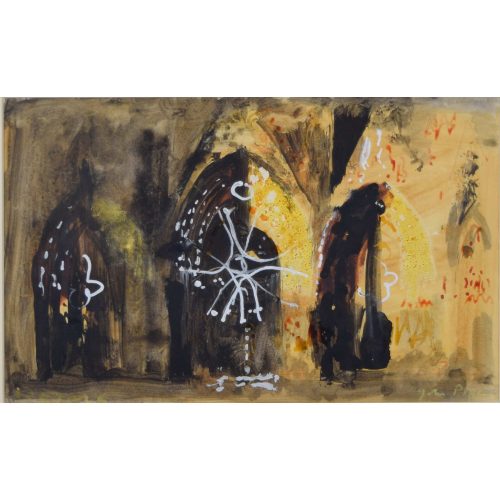
Reims Cathedral (c. 1960)
Ink, watercolour and gouache 21x35cm Inscribed 'Reims' lower left and signed 'John Piper' lower right. Piper loved all things France, and all things Cathedral; in this work, he brings the cathedral of Reims, where France's monarchs were crowned, to life. Piper also produced an aquatint of Reims which was published in 1972. For other works by the artist and biographical details, click here. If you are interested email info@manningfineart.co.uk or call us on 07929 749056. Condition: Generally excellent; framed. -
Bryan Ingham (1936-1997)
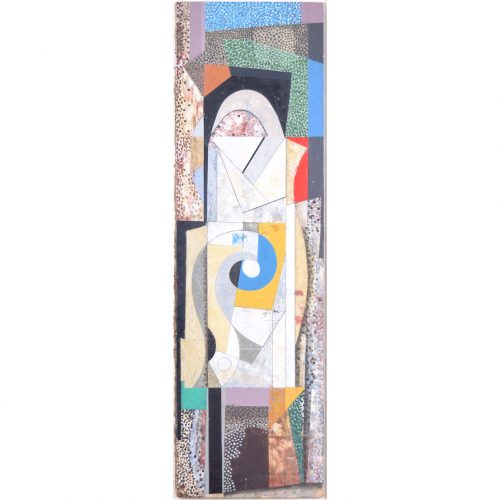
Upright Jug (1993-95)
Pencil and oil on board 64 x 19 cm Provenance: Bohun Galleries, Paintings in Hospitals. Signed, titled and dated 1993-95 (on backboard). Bryan Ingham was born in Yorkshire. For his National Service he joined the RAF, and spent his time in Germany as an airman. After demobilisation, his final report included the statement that "Ingham is an artistic sort of airman." In his spare time he had started painting in oils, and by the time he left the RAF he had completed a large number of paintings. He studied at St Martin's School of Art in London, where he had the tuition of a fine post-war generation of teachers who helped him to hone his draughtsmanship and other skills, and he swiftly showed a capacity for painting that drew the attention of his tutors and peers. On graduating he was offered and accepted a post-graduate place at the Royal College of Art, where in his second year he was awarded a Royal Scholarship and was a contemporary of a number of now better-known names including David Hockney. Ingham applied for and received a Leverhulme travel award to explore the sites of the great Renaissance painters, and spent many happy months engaged in this expedition. He spent time at the English Art school in Rome, where he lived well and busied himself the same studio that Barbara Hepworth had used. At this stage of his career, Ingham consciously rejected the prospect of pursuing a career as an establishment artist, although the RA was open to him, and he went to live in remote cottage in Cornwall. The subsequent years were varied and highly productive, and Ingham's personal artistic voice emerged in his oeuvre in the form of an always-developing dialogue with influences both of landscape and other artists of every age. His preoccupation with etching resulted in several hundred plates, some very large, and the results are as unmistakable as they are varied, but invariably of outstanding quality. He produced a number of sculptures in bronze and in plaster, while his lifelong output of paintings remained small but again of very high quality. He taught etching regularly until about 5 years before his death, latterly at Falmouth Art School, and also at Farnham Art College. During the late eighties he established a relationship with the art dealer Francis Graham-Dixon, who had a London gallery. This meant that his paintings were professionally marketed for the first time, and prices for his work rose steadily in the last ten years of his life, and subsequently. He was able to purchase a cottage in Helston for his parents, who lived there until their deaths. He then moved into a fine set of converted-barn studios with a patch of garden, quietly situated off the High St in Helston, and it was here, on 22 September 1997, that he died, having quietly suffered from cancer for nearly a year. If you'd like to know more, please email info@manningfineart.co.uk or call us on 07929 749056. Condition: Generally excellent; framed. -
Out of stock
Clifford Charman (1910-1993)
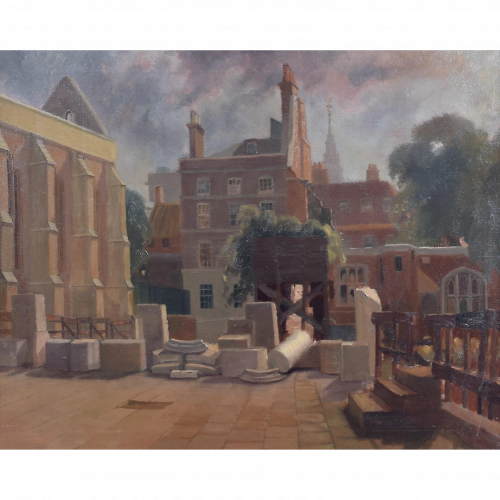
Temple Church, London, after Bombing
Oil on canvas 39 x 49 cm Provenance: The Artist's Studio Sale, Bonhams, London (18 March 1993); Peter Constant Fine Art. Born in Bexleyheath in Kent, Charman studied at Regent Street Polytechnic just before, and just after, the Second World War. He exhibited widely, including at the Royal Academy, the RBA, Chelsea Arts Society, and abroad. Elected in 1954 to the ROI, he also won the James Bourlet Prize in 1982. His work is in collections including that of the Guildhall. If you'd like to know more, please email info@manningfineart.co.uk or call us on 07929 749056. Condition: Generally very good. -
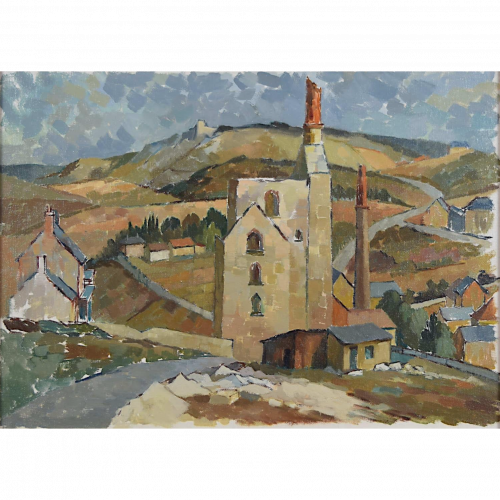
Clifford Charman (1910-1993)
Landscape with Farmhouses
Oil on canvas 38 x 55 cm Provenance: the artist's studio sale, Bonhams, London 1993. Born in Bexleyheath in Kent, Charman studied at Regent Street Polytechnic just before, and just after, the Second World War. He exhibited widely, including at the Royal Academy, the RBA, Chelsea Arts Society, and abroad. Elected in 1954 to the ROI, he also won the James Bourlet Prize in 1982. His work is in collections including that of the Guildhall. If you'd like to know more, please email info@manningfineart.co.uk or call us on 07929 749056. Condition: Generally very good. -
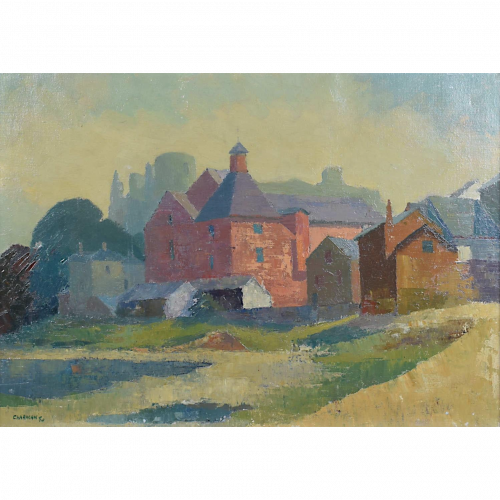
Clifford Charman (1910-1993)
Brewery and Ruined Castle, Cockermouth
Oil on canvas 38 x 55 cm Signed and dated lower left. Provenance: The Artist's Studio Sale, Bonhams, London (18 March 1993); Peter Constant Fine Art. Born in Bexleyheath in Kent, Charman studied at Regent Street Polytechnic just before, and just after, the Second World War. He exhibited widely, including at the Royal Academy, the RBA, Chelsea Arts Society, and abroad. Elected in 1954 to the ROI, he also won the James Bourlet Prize in 1982. His work is in collections including that of the Guildhall. If you'd like to know more, please email info@manningfineart.co.uk or call us on 07929 749056. Condition: Generally very good. Signed lower left. -
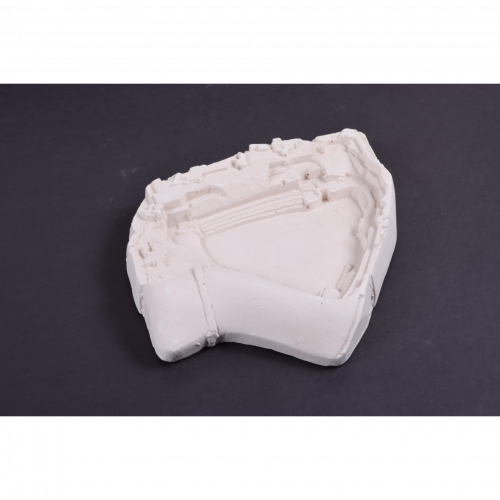
Sir Eduardo Paolozzi CBE RA (1924-2005)
Amphitheatre
Plaster 27 x 22 x 4 cm (max) Paolozzi’s fascination with anatomy, machine parts, and the idiom of classical statuary is evident in his modernist sculptural forms. Amphitheatre blends neoclassicism with 20th-century brutalism, betraying a fascination with the materiality of public architecture. Sir Eduardo Luigi Paolozzi CBE RA was a Scottish artist, known for his sculpture and graphic works. He is widely considered to be one of the pioneers of pop art. Paolozzi studied at the Edinburgh College of Art in 1943, briefly at Saint Martin's School of Art in 1944, and then at the Slade School of Fine Art at University College London from 1944 to 1947, after which he worked in Paris. While in Paris from 1947 to 1949, Paolozzi became acquainted with Alberto Giacometti, Jean Arp, Constantin Brâncuși, Georges Braque and Fernand Léger. This period became an important influence for his later work. For example, the influence of Giacometti and many of the original Surrealists he met in Paris can be felt in the group of lost-wax sculptures made by Paolozzi in the mid-1950s. Their surfaces, studded with found objects and machine parts, were to gain him recognition. He taught sculpture and ceramics at several institutions, including the Hochschule für bildende Künste Hamburg (1960–62), University of California, Berkeley (in 1968) and at the Royal College of Art. Paolozzi had a long association with Germany, having worked in Berlin from 1974 as part of the Berlin Artist Programme of the German Academic Exchange Programme. He was a professor at the Fachhochschule in Cologne from 1977 to 1981, and later taught sculpture at the Akademie der Bildenden Künste in Munich. Paolozzi was fond of Munich and many of his works and concept plans were developed in a studio he kept there, including the mosaics of the Tottenham Court Road Station in London. He took a stab at industrial design in the 1970s with a 500-piece run of the upscale Suomi tableware by Timo Sarpaneva that Paolozzi decorated for the German Rosenthal porcelain maker's Studio Linie. Condition: Generally very good, occasional inclusions etc., as expected. If you'd ike to know more, please email info@manningfineart.co.uk or call us on 07929 749056. -
Out of stock
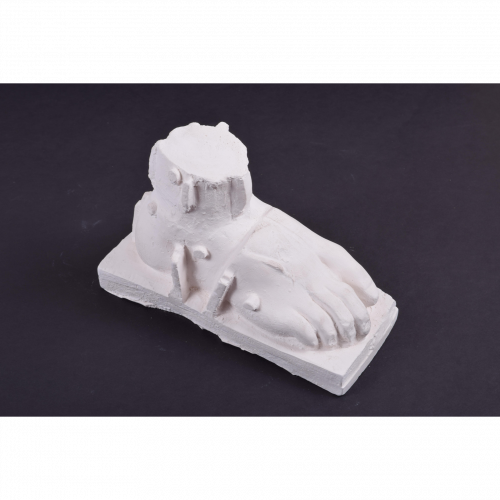
Sir Eduardo Paolozzi CBE RA (1924-2005)
'Foot of a Statue'
Plaster 9 x 19 x 13 cm Paolozzi’s fascination with anatomy, machine parts, and the idiom of classical statuary is evident in his modernist sculptural forms. Foot of a Statue suggests the foot of an ancient Colossus - severed from the rest of the body, it becomes a symbol of fragmentation, of a civilisation’s decline. Sir Eduardo Luigi Paolozzi CBE RA was a Scottish artist, known for his sculpture and graphic works. He is widely considered to be one of the pioneers of pop art. Paolozzi studied at the Edinburgh College of Art in 1943, briefly at Saint Martin's School of Art in 1944, and then at the Slade School of Fine Art at University College London from 1944 to 1947, after which he worked in Paris. While in Paris from 1947 to 1949, Paolozzi became acquainted with Alberto Giacometti, Jean Arp, Constantin Brâncuși, Georges Braque and Fernand Léger. This period became an important influence for his later work. For example, the influence of Giacometti and many of the original Surrealists he met in Paris can be felt in the group of lost-wax sculptures made by Paolozzi in the mid-1950s. Their surfaces, studded with found objects and machine parts, were to gain him recognition. He taught sculpture and ceramics at several institutions, including the Hochschule für bildende Künste Hamburg (1960–62), University of California, Berkeley (in 1968) and at the Royal College of Art. Paolozzi had a long association with Germany, having worked in Berlin from 1974 as part of the Berlin Artist Programme of the German Academic Exchange Programme. He was a professor at the Fachhochschule in Cologne from 1977 to 1981, and later taught sculpture at the Akademie der Bildenden Künste in Munich. Paolozzi was fond of Munich and many of his works and concept plans were developed in a studio he kept there, including the mosaics of the Tottenham Court Road Station in London. He took a stab at industrial design in the 1970s with a 500-piece run of the upscale Suomi tableware by Timo Sarpaneva that Paolozzi decorated for the German Rosenthal porcelain maker's Studio Linie. Condition: Generally very good, occasional inclusions etc., as expected. If you'd ike to know more, please email info@manningfineart.co.uk or call us on 07929 749056. -
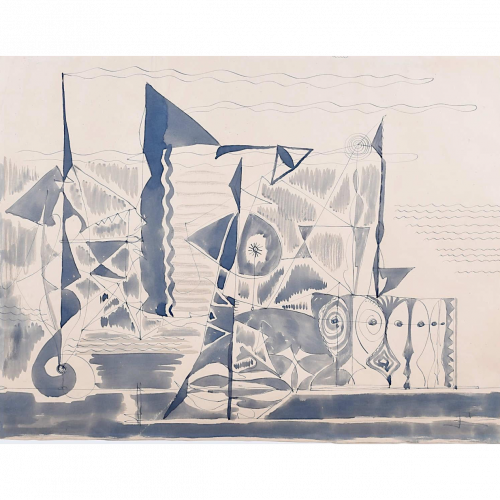
Charles Pulsford ARSA (1912-1989)
Abstract Harbour
Watercolour 36 x 46 cm Signed lower right. Pulsford was born in Staffordshire to Scottish parents. His family returned to Dunfermline when he was a child, and he subsequently attended Edinburgh College of Art (ECA) between 1933 and 1937. He, along with other prominent Scottish artists, embraced modernism and abstraction following the end of the war. Alan Davie, William Turnbull, William Gear and Eduardo Paolozzi are the key artists of the group with which he was association, and the National Galleries of Scotland regard Pulsford as the 'fifth man' of the group. Between 1952 and 1960 he taught at ECA and then at Canterbury College of Art. Provenance: the artist, the residual stock of William Hardie Gallery. Condition: Generally very good, in fine hand-finished frame. If you are interested, email info@manningfineart.co.uk or call us on 07929 749056.