-
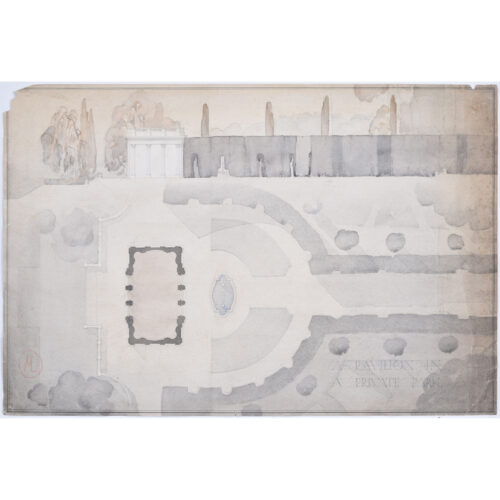
Louis Osman FRIBA (1914 - 1996)
A Pavilion in a Private Park
Pen, ink and wash 67 x 100 cm Provenance: the family of the artist. Signed lower right. Osman was as much an artist as an architect. This is likely a portfolio piece from his time studying at the Bartlett School of Architecture, and is as such a piece of architectural history as well as a beautiful Osman design. Osman was awarded a First Class degree and the Donaldson Medal of the RIBA (for the best result in his year group) by the Bartlett, and then went on to the Slade School of Art. He subsequently trained with Sir Albert Richardson – we also have several Richardson works in our collection. After the war, Osman busied himself as an architect. His work included contributions to Westminster Abbey, and Lincoln, Exeter, Ely, and Lichfield Cathedrals, Staunton Harold Church in Ashby de la Zouch for the National Trust, and of course his folly: the Grade I listed Elizabethan manor house, Canons Ashby in Northamptonshire, now a National Trust property. At Canons Ashby he established a workshop and had a team of silversmiths and goldsmiths working for him. In 1976 he made the gold enamelled coffin that holds the copy of the Magna Carta on view in the United States Capitol, Washington, DC. Condition: generally very good to main central area; loss to top left, creasing, soiling, and edge tears to right (10cm at most). If you’d like to know more, please email info@manningfineart.co.uk or call us on 07929 749056. Click here for other works by Louis Osman. -
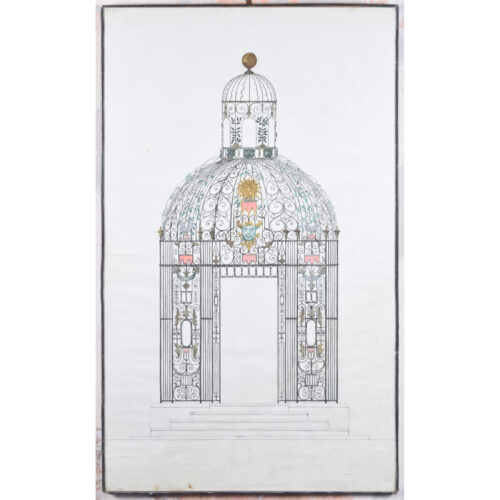
Louis Osman FRIBA (1914 - 1996)
Design for the Restoration of the 'Bird Cage' Arbour, Melbourne Hall, Derbyshire
Mixed media, including pen, ink, watercolour, and gold leaf 108 x 63 cm Provenance: the artist's daughter. In 1958 Osman was commissioned to advise on the restoration of a metal arbour, originally designed in 1708 by Robert Blackwell for the grounds of Melbourne Hall in Derbyshire. The arbour is known as the 'Bird Cage' and was originally painted in a dreamy array of vivid colours; Osman extensively researched Blackwell's work and consulted his original plans for the metalwork in order to restore the arbour to its former glory. The paint was stripped and the iron repainted as per Blackwell's original scheme. The ironwork specialists George Lister & Sons Ltd worked with Osman on the project. This large design features watercolour and gold leaf to illustrate the embellishments Osman had in mind. Osman was as much an artist as an architect. This is likely a portfolio piece from his time studying at the Bartlett School of Architecture, and is as such a piece of architectural history as well as a beautiful Osman design. Osman was awarded a First Class degree and the Donaldson Medal of the RIBA (for the best result in his year group) by the Bartlett, and then went on to the Slade School of Art. He subsequently trained with Sir Albert Richardson - we also have several Richardson works in our collection. After the war, Osman busied himself as an architect. His work included contributions to Westminster Abbey, and Lincoln, Exeter, Ely, and Lichfield Cathedrals, Staunton Harold Church in Ashby de la Zouch for the National Trust, and of course his folly: the Grade I listed Elizabethan manor house, Canons Ashby in Northamptonshire, now a National Trust property. At Canons Ashby he established a workshop and had a team of silversmiths and goldsmiths working for him. In 1976 he made the gold enamelled coffin that holds the copy of the Magna Carta on view in the United States Capitol, Washington, DC. Condition: generally very good; one or two small brown spots to periphery. In artist's original lead-edged frame. If you’d like to know more, please email info@manningfineart.co.uk or call us on 07929 749056. -
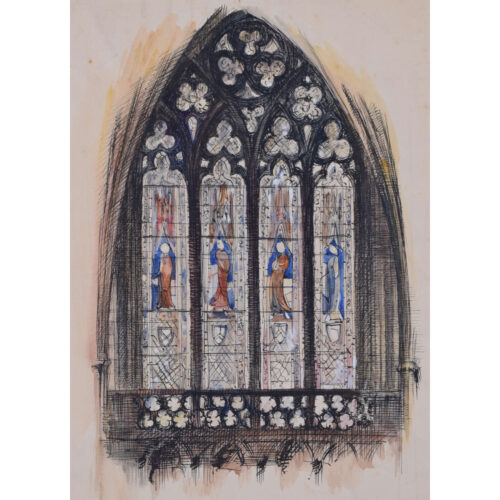
Louis Osman FRIBA (1914 - 1996)
Stained glass window
Watercolour 23 x 16 cm On Pioneer Fine laid paper. An intricately-detailed watercolour of a stained glass window, featuring four Biblical figures. Osman was as much an artist as an architect. This is likely a portfolio piece from his time studying at the Bartlett School of Architecture, and is as such a piece of architectural history as well as a beautiful Osman design. Osman was awarded a First Class degree and the Donaldson Medal of the RIBA (for the best result in his year group) by the Bartlett, and then went on to the Slade School of Art. He subsequently trained with Sir Albert Richardson - we also have several Richardson works in our collection. After the war, Osman busied himself as an architect. His work included contributions to Westminster Abbey, and Lincoln, Exeter, Ely, and Lichfield Cathedrals, Staunton Harold Church in Ashby de la Zouch for the National Trust, and of course his folly: the Grade I listed Elizabethan manor house, Canons Ashby in Northamptonshire, now a National Trust property. At Canons Ashby he established a workshop and had a team of silversmiths and goldsmiths working for him. In 1976 he made the gold enamelled coffin that holds the copy of the Magna Carta on view in the United States Capitol, Washington, DC. Condition: generally very good. If you’d like to know more, please email info@manningfineart.co.uk or call us on 07929 749056. -
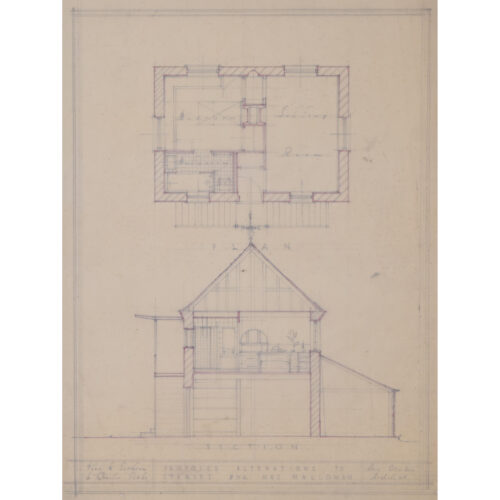
Louis Osman FRIBA (1914 - 1996)
Proposed alterations for Stables for Mrs Mallowan (Agatha Christie)
Pencil on tracing paper 41 x 30 cm Signed in red crayon lower right. A smart architectural design to improve famed author Agatha Christie's stable block. Christie became Lady Mallowan when she married her second husband, Sir Max Edgar Lucien Mallowan. The church was bombed in 1941 and gutted by fire; subsequently, the church was a ruin open to the sky for over 20 years. It was saved by Lady Parker of Waddington, who formed the Friends of St John's in 1962 to raise money and restore the church to its former glory - a reconstruction in the style of the church's original architect, Thomas Archer. Osman was as much an artist as an architect. This is likely a portfolio piece from his time studying at the Bartlett School of Architecture, and is as such a piece of architectural history as well as a beautiful Osman design. Osman was awarded a First Class degree and the Donaldson Medal of the RIBA (for the best result in his year group) by the Bartlett, and then went on to the Slade School of Art. He subsequently trained with Sir Albert Richardson - we also have several Richardson works in our collection. After the war, Osman busied himself as an architect. His work included contributions to Westminster Abbey, and Lincoln, Exeter, Ely, and Lichfield Cathedrals, Staunton Harold Church in Ashby de la Zouch for the National Trust, and of course his folly: the Grade I listed Elizabethan manor house, Canons Ashby in Northamptonshire, now a National Trust property. At Canons Ashby he established a workshop and had a team of silversmiths and goldsmiths working for him. In 1976 he made the gold enamelled coffin that holds the copy of the Magna Carta on view in the United States Capitol, Washington, DC. Condition: generally very good. If you’d like to know more, please email info@manningfineart.co.uk or call us on 07929 749056. -
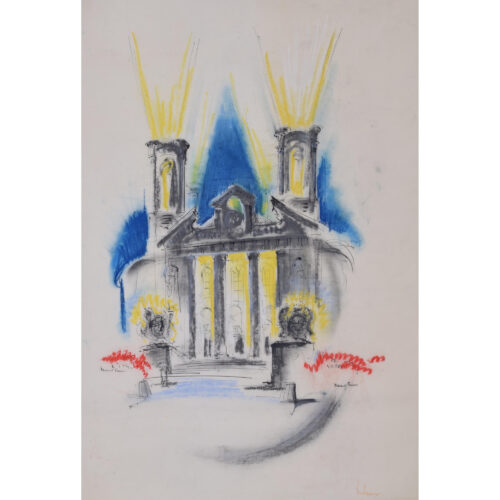
Louis Osman FRIBA (1914 - 1996)
Proposal for St John's Smith Square (1953)
Watercolour 70 x 52 cm Signed in red crayon lower right. Louis Osman's proposal for the post-war, post-bombing redevelopment of St John's church on Smith Square. Osman had envisioned an interior with a ceiling painted by Picasso; sadly, this project was never executed. The church was bombed in 1941 and gutted by fire; subsequently, the church was a ruin open to the sky for over 20 years. It was saved by Lady Parker of Waddington, who formed the Friends of St John's in 1962 to raise money and restore the church to its former glory - a reconstruction in the style of the church's original architect, Thomas Archer. Osman was as much an artist as an architect. This is a piece of architectural history as well as a beautiful Osman design. Osman was awarded a First Class degree and the Donaldson Medal of the RIBA (for the best result in his year group) by the Bartlett where he studied, and then went on to the Slade School of Art. He subsequently trained with Sir Albert Richardson - we also have several Richardson works in our collection. After the war, Osman busied himself as an architect. His work included contributions to Westminster Abbey, and Lincoln, Exeter, Ely, and Lichfield Cathedrals, Staunton Harold Church in Ashby de la Zouch for the National Trust, and of course his folly: the Grade I listed Elizabethan manor house, Canons Ashby in Northamptonshire, now a National Trust property. At Canons Ashby he established a workshop and had a team of silversmiths and goldsmiths working for him. In 1976 he made the gold enamelled coffin that holds the copy of the Magna Carta on view in the United States Capitol, Washington, DC. Condition: generally very good. If you’d like to know more, please email info@manningfineart.co.uk or call us on 07929 749056. -
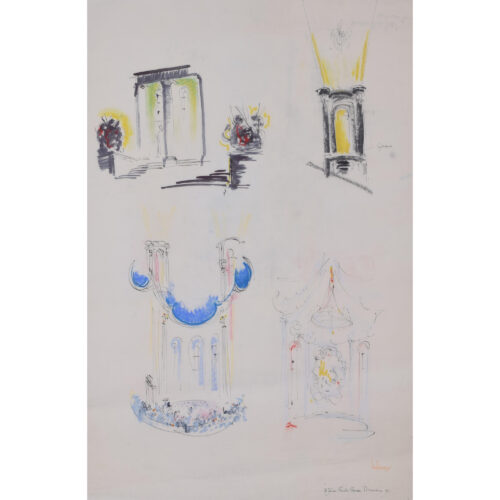
Louis Osman FRIBA (1914 - 1996)
Proposal details for St John's Smith Square (1953)
Watercolour 74 x 46 cm Signed in red crayon lower right. Details from Louis Osman's proposal for the post-war, post-bombing redevelopment of St John's church on Smith Square. Osman had envisioned an interior with a ceiling painted by Picasso; sadly, this project was never executed. The church was bombed in 1941 and gutted by fire; subsequently, the church was a ruin open to the sky for over 20 years. It was saved by Lady Parker of Waddington, who formed the Friends of St John's in 1962 to raise money and restore the church to its former glory - a reconstruction in the style of the church's original architect, Thomas Archer. Osman was as much an artist as an architect. This is a piece of architectural history as well as a beautiful Osman design. Osman was awarded a First Class degree and the Donaldson Medal of the RIBA (for the best result in his year group) by the Bartlett where he studied, and then went on to the Slade School of Art. He subsequently trained with Sir Albert Richardson - we also have several Richardson works in our collection. After the war, Osman busied himself as an architect. His work included contributions to Westminster Abbey, and Lincoln, Exeter, Ely, and Lichfield Cathedrals, Staunton Harold Church in Ashby de la Zouch for the National Trust, and of course his folly: the Grade I listed Elizabethan manor house, Canons Ashby in Northamptonshire, now a National Trust property. At Canons Ashby he established a workshop and had a team of silversmiths and goldsmiths working for him. In 1976 he made the gold enamelled coffin that holds the copy of the Magna Carta on view in the United States Capitol, Washington, DC. Condition: generally very good. If you’d like to know more, please email info@manningfineart.co.uk or call us on 07929 749056. -
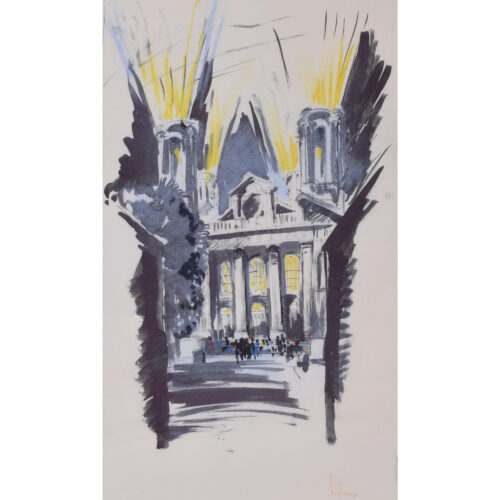
Louis Osman FRIBA (1914 - 1996)
Proposal for St John's Smith Square (1953)
Watercolour 62 x 37 cm Signed in red crayon lower right. Louis Osman's proposal for the post-war, post-bombing redevelopment of St John's church on Smith Square. Osman had envisioned an interior with a ceiling painted by Picasso; sadly, this project was never executed. The church was bombed in 1941 and gutted by fire; subsequently, the church was a ruin open to the sky for over 20 years. It was saved by Lady Parker of Waddington, who formed the Friends of St John's in 1962 to raise money and restore the church to its former glory - a reconstruction in the style of the church's original architect, Thomas Archer. Osman was as much an artist as an architect. This is a piece of architectural history as well as a beautiful Osman design. Osman was awarded a First Class degree and the Donaldson Medal of the RIBA (for the best result in his year group) by the Bartlett where he studied, and then went on to the Slade School of Art. He subsequently trained with Sir Albert Richardson - we also have several Richardson works in our collection. After the war, Osman busied himself as an architect. His work included contributions to Westminster Abbey, and Lincoln, Exeter, Ely, and Lichfield Cathedrals, Staunton Harold Church in Ashby de la Zouch for the National Trust, and of course his folly: the Grade I listed Elizabethan manor house, Canons Ashby in Northamptonshire, now a National Trust property. At Canons Ashby he established a workshop and had a team of silversmiths and goldsmiths working for him. In 1976 he made the gold enamelled coffin that holds the copy of the Magna Carta on view in the United States Capitol, Washington, DC. Condition: generally very good. If you’d like to know more, please email info@manningfineart.co.uk or call us on 07929 749056. -
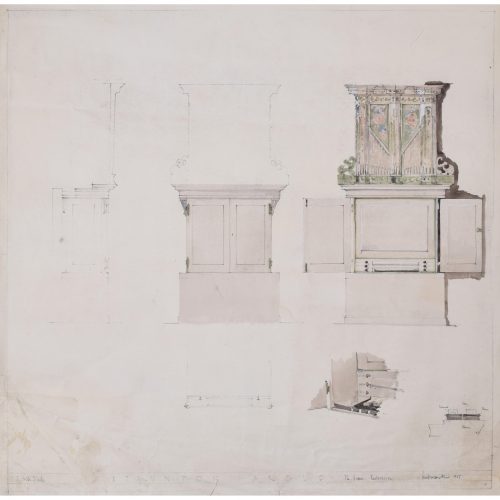
Louis Osman FRIBA (1914 - 1996)
Staunton Harold: Restoration of the Organ (1953)
Pen, ink, and watercolour 63 x 63 cm Titled below, signed lower right, and labelled in Osman's hand. Osman's architectural design for the restoration of the organ at Staunton Harold Church, part of the Staunton Harold estate. The church, known as the Chapel of the Holy Trinity, is a 1653-built Gothic chapel. It was commissioned by Sir Robert Shirley (the Shirley family were Anglicans and Royalists, and the ornate design of the church is likely why Sir Robert was imprisoned under Oliver Cromwell). Osman was as much an artist as an architect. This is likely a portfolio piece from his time studying at the Bartlett School of Architecture, and is as such a piece of architectural history as well as a beautiful Osman design. Osman was awarded a First Class degree and the Donaldson Medal of the RIBA (for the best result in his year group) by the Bartlett, and then went on to the Slade School of Art. He subsequently trained with Sir Albert Richardson - we also have several Richardson works in our collection. After the war, Osman busied himself as an architect. His work included contributions to Westminster Abbey, and Lincoln, Exeter, Ely, and Lichfield Cathedrals, Staunton Harold Church in Ashby de la Zouch for the National Trust, and of course his folly: the Grade I listed Elizabethan manor house, Canons Ashby in Northamptonshire, now a National Trust property. At Canons Ashby he established a workshop and had a team of silversmiths and goldsmiths working for him. In 1976 he made the gold enamelled coffin that holds the copy of the Magna Carta on view in the United States Capitol, Washington, DC. Condition: some age toning, and signs of having been a working drawing. If you’d like to know more, please email info@manningfineart.co.uk or call us on 07929 749056. -
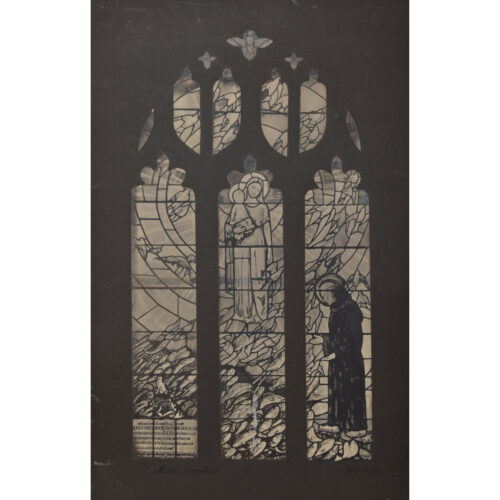
William Nicholson (1872 - 1949)
Mells Window (1930)
Photographic collage 57 x 33 cm Titled below and signed lower right in ink. Nicholson's original photographic collage of his magnificent stained glass window at St Andrew's Church in Mells. It depicts St Francis of Assisi preaching to the fish and the birds, with a Madonna and Child in the central panel. The window was commissioned by Lady Frances Horner as a memorial to her husband Sir John Horner, a barrister whose family seat was Mells Manor, a grand country house and park near Frome in Somerset. Lady Horner was a great patron of the arts and commissioned by artists including Eric Gill, Edwin Lutyens, and Edward Burne-Jones, as well as Nicholson. Nicholson was a regular visitor to Mells from the early 1920s, and designed the window in 1930. Burne-Jones had already designed a memorial in the church (to a different member of the family) in 1886. Sir William Nicholson was a British painter and printmaker. He is also known as an illustrator, author of children’s books, stained glass designer, and theatre set designer. Condition: a small stain to bottom of central panel - otherwise very good. If you are interested, please email info@manningfineart.co.uk or call us on 07929 749056. Click here for more stained glass designs. -
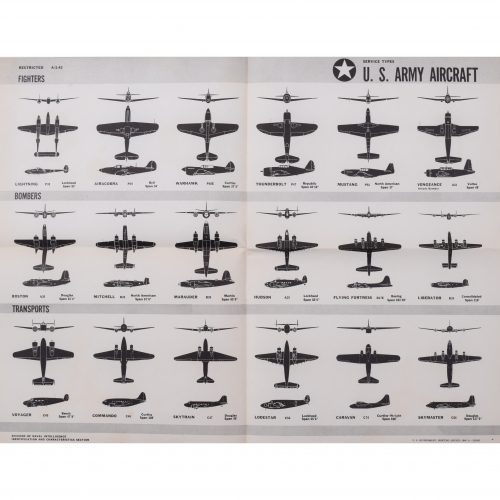
1943 Army World War II USA (1942)
Original aeroplane recognition poster 44 x 59 cm A summary of US aeroplanes from the series of US Navy identification posters that we have in stock. Fighters: P38 Lightning; P39 Airacobra; Curtiss P40E Warhawk; P47 Thunderbolt; P51 Mustang; A31 Vengeance. Bombers: A20 Boston; B25 Mitchell; B26 Marauder; Lockheed Hudson; Boeing B17E Flying Fortress; B24 Consolidated Liberator. Transports: C45 Voyager; C46 Commando; C47 Douglas Skytrain; Lockheed Lodestar; C76 Caravan; C54 Douglas Skymaster. Condition: generally very good, occasional handling marks. Folds as issued. If you’d like to know more, please email info@manningfineart.co.uk or call us on 07929 749056. -
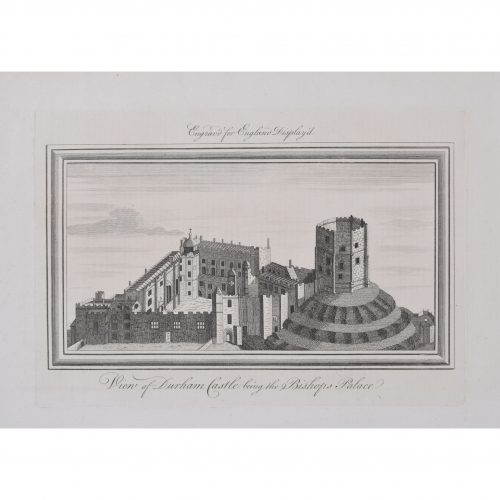
after Samuel Buck (1696 - 1779) and Nathaniel Buck (active 1724 - 1759)
View of Durham Castle being the Bishops Palace (1769)
Engraving 18 x 26 cm An engraved view of Durham Castle, complete with engraved frame in the plate. Empty of any inhabitants, the magnificence of the castle's architecture, is made all the more evident. This engraving was produced for 'England Displayed, published in London in 1769 or 1770 by Adlard and Brown; it was made after the original by Samuel and Nathaniel Buck, originally published in their 'Views of Ruins of Castles & Abbeys in England', created between 1726 and 1742. Durham Castle is a Norman castle in Durham, England, which has been occupied since 1837 by Castle - that is, University College, Durham. Previously, it was the residence of the Bishops of Durham; it stands on top of a hill above the River Wear on Durham's peninsula, opposite Durham Cathedral. Samuel and Nathaniel Buck were brothers and notable 18th century architectural artists, best known for their depictions of ancient castles and monasteries entitled 'Buck's Antiquities' and those of townscapes of England and Wales, ''Sea-Ports and Capital Towns''. LIttle is known about the brothers' lives. Samuel was born in Yorkshire and died in penury in London in 1779, and was buried in the churchyard of St Clement Danes. Nathaniel pre-deceased him, dying between 1759 and 1774. Condition: very good. If you’d like to know more, please email info@manningfineart.co.uk or call us on 07929 749056. -
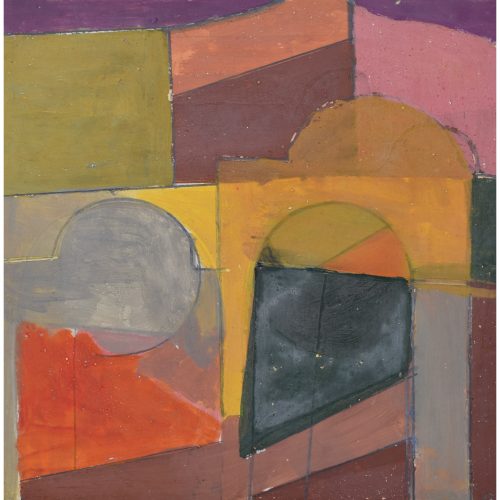
John Barnicoat MA ARCA (1924 - 2013)
Untitled abstract composition (1968)
Tempera on board 27 x 26 cm Initialled and dated lower right. John Barnicoat was a painter of oils and works on paper using tempera, conté, acrylic, pen, and ink. He was brought up in Cornwall and educated at King’s College, Taunton. He joined the Royal Naval Volunteer Reserves and took part in D-Day, aged 29. He went on to read history at Lincoln College, Oxford, and also studied at the Ruskin School of Drawing. He attended the Royal College of Art in the early 1950s, eventually becoming the Senior Tutor at the RCA Painting School between 1976 and 1980. He was the head of Falmouth School of Art 1972 - 1976 and Head of the Chelsea School of Art 1980 - 1989. He wrote 'Posters: a Concise History' in 1972, and organised and curated exhibitions in the UK and Russia on the art of poster design. From 1989 onwards he produced numerous drawings and oils of the bridges of London, women’s heads, acrylic and conté works on paper, and pen and wash drawings of women dressing. His work is represented in both government and private collections, and was recently shown at The Belgrave Gallery, St Ives (2017 - 2022). Condition: very good. If you’d like to know more, please email info@manningfineart.co.uk or call us on 07929 749056. -
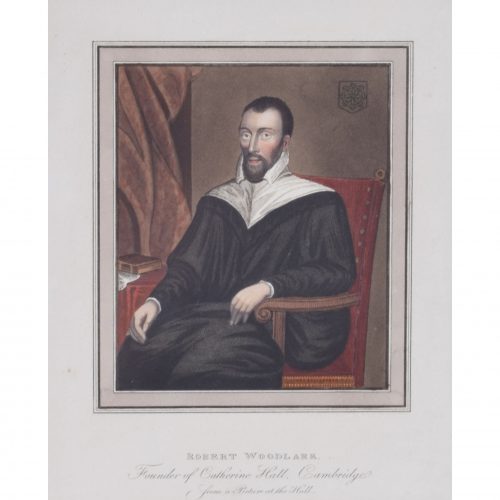
Robert Woodlark, Founder of Catherine Hall, Cambridge from a Picture at the Hall (1815)
Hand-coloured aquatint 24 x 20 cm Published by Rudolph Ackermann (1764 - 1834). A copy of this engraving is held by the National Portrait Gallery, reference NPG D4871. Robert Woodlark (also spelt Wodelarke) was an English academic and priest. He was the Provost of King's College, Cambridge, and the founder of St Catharine's College, Cambridge. He drew up the original statutes for the governance of the college and obtained a charter from Edward IV, 16 August 1475. Woodlark was a professor of sacred theology at the University and served as Chancellor of the University of Cambridge from 1459 to 1460, and again from 1462 to 1463. Rudolph Ackermann was an Anglo-German bookseller, inventor, lithographer, publisher and businessman. In 1795 he established a print-shop and drawing-school at 96 Strand. Here Ackermann set up a lithographic press and began a trade in prints. He later began to manufacture colours and thick carton paper for landscape and miniature painters. Within three years the premises had become too small and he moved to 101 Strand, in his own words "four doors nearer to Somerset House", the seat of the Royal Academy of Arts. Between 1797 and 1800 Ackermann rapidly developed his print and book publishing business, encompassing many different genres including topography, caricature, portraits, transparencies and decorative prints. Condition: good. Some gentle age toning. Handsome gilded frame with elaborate wash line mount. If you’d like to know more, please email info@manningfineart.co.uk or call us on 07929 749056. -
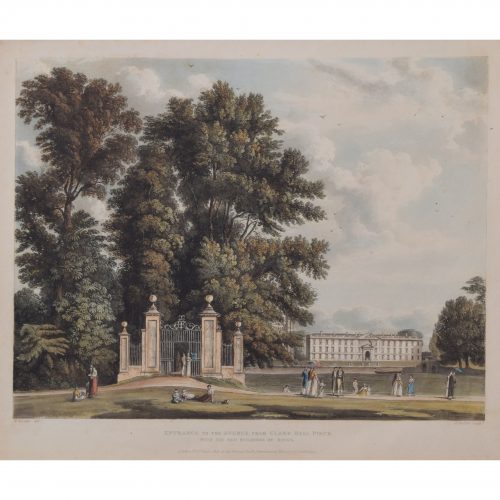
Joseph Constantine Stadler (1755 - 1828) after William Westall (1781 - 1850)
Entrance to the Avenue, from Clare Hall Piece (1815)
Hand-coloured aquatint 25 x 30 cm Published by Rudolph Ackermann (1764 - 1834). An engraving of the gates of Clare College, formerly known as Clare Hall. The River Cam winds its way through the scene; we can see the New Buildings of King's College, Cambridge on the far bank. Victorian figures, several with parasols, picnic or promenade in the foreground. Joseph Constantine Stadler was a prolific German émigré engraver of images after his contemporaries - here, 18th-century English landscape painter and diarist Joseph Farington. Stadler's engravings are wide-ranging in subject matter and include landscapes, seascapes and portraits, as well as military, sporting and decorative subjects. Stadler was employed by the leading print publisher of the time, John Boydell. Stadler lived in Knightsbridge when he died at the age of 73. William Westall was a British landscape artist. He was born in Hertford and enrolled at the Royal Academy schools in 1799. He later became the draughtsman for a voyage to Australia and the South Seas. After being shipwrecked, he travelled to Canton in China and to India, staying in Bombay for several months. He returned to England in 1805 but later set off for Madeira and Jamaica. He became a member of the Society of Painters in Water Colours (1811) and an associate of the Academy (1812). Following a mental breakdown, he regularly visited the Lake District and published ‘Views of the Valley and Vale of Keswick’ (1820). His series of aquatints of the Thames, the great universities, and England's public schools for Ackermann are among his most popular works. Rudolph Ackermann was an Anglo-German bookseller, inventor, lithographer, publisher and businessman. In 1795 he established a print-shop and drawing-school at 96 Strand. Here Ackermann set up a lithographic press and began a trade in prints. He later began to manufacture colours and thick carton paper for landscape and miniature painters. Within three years the premises had become too small and he moved to 101 Strand, in his own words "four doors nearer to Somerset House", the seat of the Royal Academy of Arts. Between 1797 and 1800 Ackermann rapidly developed his print and book publishing business, encompassing many different genres including topography, caricature, portraits, transparencies and decorative prints. Condition: good. Some gentle age toning. If you’d like to know more, please email info@manningfineart.co.uk or call us on 07929 749056. -
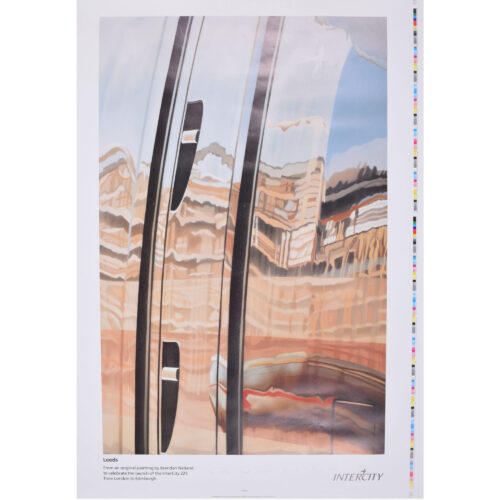
Brendan Neiland (b. 1941) RA (Expelled)
Leeds (1991)
Lithographic poster 101 x 71 cm Signed 'Brendan Neiland 1991' and inscribed 'to Alan best wishes', both in pencil. Proof copy poster complete with large margins and printer's colour bars etc, which can be hidden under mount when framed. Neiland is known for his interpretations of city life. His work is widely exhibited in major museums and galleries worldwide including, in Britain, the Victoria and Albert Museum, The Tate Gallery London, The Collections of the British Council and the Arts Council of Great Britain. He is represented by the Redfern Gallery and has had numerous shows internationally, including at the Galerie Belvedere in Singapore, who represent him in Singapore and the Far East. Reflected architecture is one of Neiland’s most recurring themes. Condition: very good. If you are interested, please email info@manningfineart.co.uk or call us on 07929 749056. Click here for other works by Brendan Neiland. -
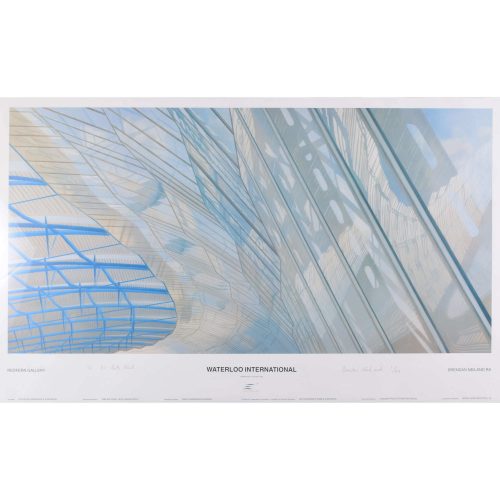
Brendan Neiland (b. 1941) R.A. (Expelled)
Waterloo International (1993)
Lithographic poster 101 x 60 cm Signed 'Brendan Neiland', numbered I/XII, and inscribed 'To Bob Reid' (Reid was Chairman of the British Railways Board from 1990 until 1995; he was present at Waterloo International Station prior to the opening of the Channel Tunnel). Neiland is known for his interpretations of city life. His work is widely exhibited in major museums and galleries worldwide including, in Britain, the Victoria and Albert Museum, The Tate Gallery London, The Collections of the British Council and the Arts Council of Great Britain. He is represented by the Redfern Gallery and has had numerous shows internationally, including at the Galerie Belvedere in Singapore, who represent him in Singapore and the Far East. Reflected architecture is one of Neiland’s most recurring themes. Condition: very good. If you are interested, please email info@manningfineart.co.uk or call us on 07929 749056. Click here for other works by Brendan Neiland. -
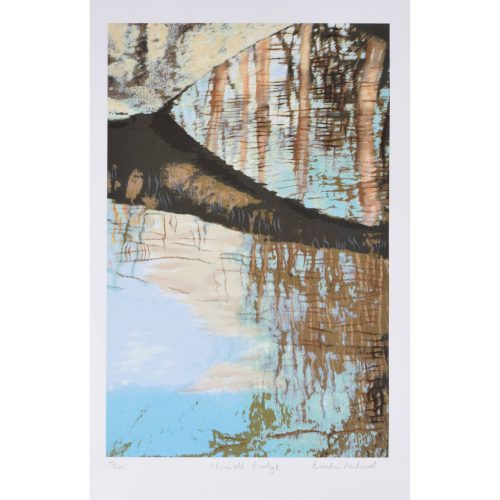
Brendan Neiland (b. 1941) R.A. (Expelled)
Cherwell Bridge
Screenprint 53 x 34 cm Signed, titled, and numbered 43 / 175 in pencil. A screenprint of Oxford’s beauteous Cherwell Bridge in University Parks, reflected in the glassy surface of the river. Reflected architecture is one of Neiland’s most recurring themes. Neiland's work is widely exhibited in major museums and galleries worldwide including, in Britain, the Victoria and Albert Museum, The Tate Gallery London, The Collections of the British Council, and the Arts Council of Great Britain. He is represented by the Redfern Gallery and has had numerous shows internationally, including at the Galerie Belvedere in Singapore, who represent him in Singapore and the Far East. Condition: very good. If you’d like to know more, please email info@manningfineart.co.uk or call us on 07929 749056. -
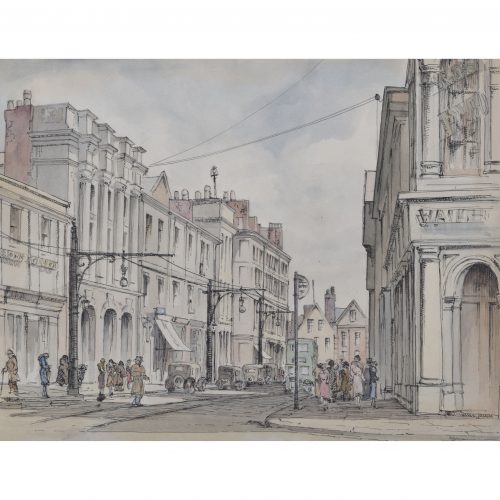
Louis Osman (1914 - 1996)
Queen Street, Exeter
Watercolour 25 x 33 cm Inscribed in Osman's hand on old mount (visible in the gallery of photographs). Osman's view of Queen Street in Exeter, complete with modish pedestrians and vehicles typical of the 1930s. Osman was as much an artist as an architect. This is likely a portfolio piece from his time studying at the Bartlett School of Architecture, and is as such a piece of architectural history as well as a beautiful Osman design. Osman was awarded a First Class degree and the Donaldson Medal of the RIBA (for the best result in his year group) by the Bartlett, and then went on to the Slade School of Art. He subsequently trained with Sir Albert Richardson - we also have several Richardson works in our collection. After the war, Osman busied himself as an architect. His work included contributions to Westminster Abbey, and Lincoln, Exeter, Ely, and Lichfield Cathedrals, Staunton Harold Church in Ashby de la Zouch for the National Trust, and of course his folly: the Grade I listed Elizabethan manor house, Canons Ashby in Northamptonshire, now a National Trust property. At Canons Ashby he established a workshop and had a team of silversmiths and goldsmiths working for him. In 1976 he made the gold enamelled coffin that holds the copy of the Magna Carta on view in the United States Capitol, Washington, DC. Condition: generally very good; some age toning. If you’d like to know more, please email info@manningfineart.co.uk or call us on 07929 749056. -
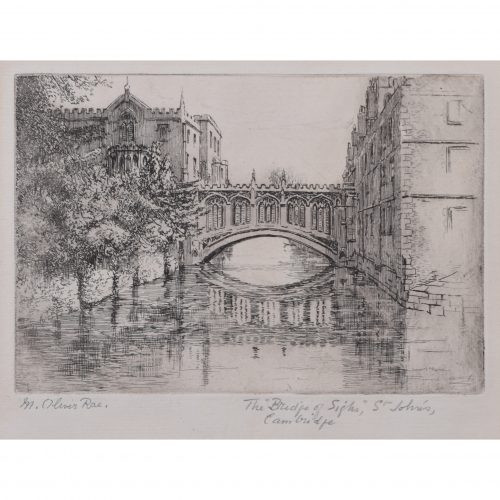
Mabel Oliver Rae (1868 - 1956)
The Bridge of Sighs, St John's College, Cambridge (circa 1920)
Etching 13 x 18 cm Hand-signed in pencil lower left, and titled in pencil lower right. Initialled 'MR' in plate lower left. The Bridge of Sighs is an iconic feature of St John’s College, and one of the most recognisable pieces of architecture in Cambridge. It was built in 1831 by the architect Henry Hutchinson and crosses the River Cam between the college's Third Court and New Court. It is the only covered bridge to cross the River Cam, and the only College bridge built in the Victorian Gothic style. Mabel Oliver Rae was born in Cambridge, Cambridgeshire, and trained at the Slade School of Fine Art between 1888 and 1890. Rae is known for her skilled etchings of various rural scenes and townscapes, particularly those of the colleges of Oxford and Cambridge. She signed works with the pseudonym 'M.Oliver Rae', a ruse to conceal the fact she was a female artist, so as not to reduce her chances with commercial dealers and agents. Condition: even age toning, a little spotting, generally good. If you’d like to know more, please email info@manningfineart.co.uk or call us on 07929 749056. -
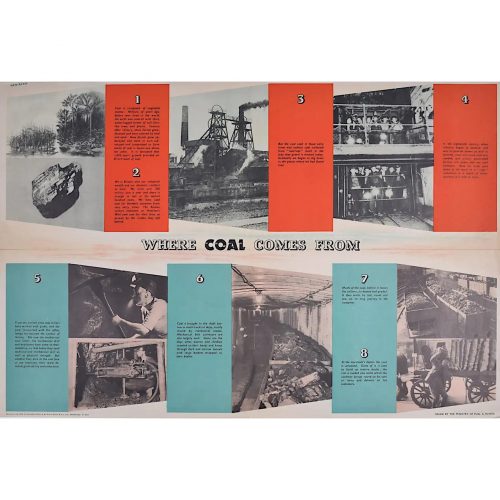
FHK Henrion (1914 - 1990)
Where Coal Comes From (circa 1945)
Original vintage poster 51 x 76 cm Signed in plate. Issued by the Ministry of Fuel and Power; printed for HM Stationery Office by Field Sons & Co Ltd, Bradford. We have been unable to identify any other copy of this poster by this renowned designer in any public collection - it is possibly the only remaining copy. A Ministry of Fuel poster encouraging the public to use less fuel. FHK Henrion was a German graphic designer who moved to Paris after leaving school, studying with the poster designer Paul Colin and then moving to London in 1936. Interned in the Isle of Man during the Second World War, he went on to design posters for the Ministry of Information and the US Office of War Information. After the War he started his own design agency, pioneering the concept of corporate identity. Clients included KLM, Giro, The Post Office, Tate & Lyle. The Ministry of Power and Fuel existed from 1942 to 1957 to control the nation's use of the scarce resources during and after the Second World War. Condition: centre folds as issued with a little wear to the extremities of the folds; generally very good. If you’d like to know more, please email info@manningfineart.co.uk or call us on 07929 749056. -
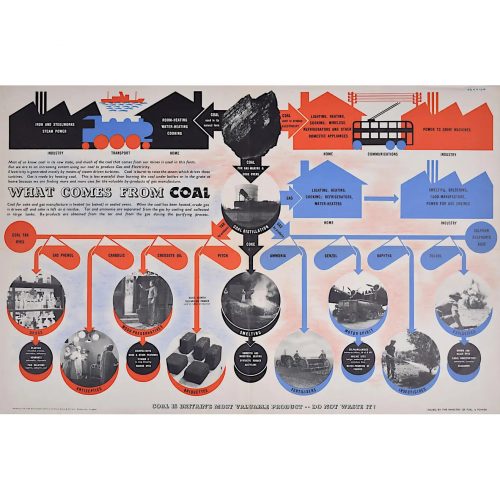
FHK Henrion (1914 - 1990)
What Comes from Coal (circa 1945)
Original vintage poster 51 x 76 cm Signed in plate. Issued by the Ministry of Fuel and Power; printed for HM Stationery Office by Field Sons & Co Ltd, Bradford. We have been unable to identify any other copy of this poster by this renowned designer in any public collection - it is possibly the only remaining copy. A Ministry of Fuel poster encouraging the public to use less fuel. FHK Henrion was a German graphic designer who moved to Paris after leaving school, studying with the poster designer Paul Colin and then moving to London in 1936. Interned in the Isle of Man during the Second World War, he went on to design posters for the Ministry of Information and the US Office of War Information. After the War he started his own design agency, pioneering the concept of corporate identity. Clients included KLM, Giro, The Post Office, Tate & Lyle. The Ministry of Power and Fuel existed from 1942 to 1957 to control the nation's use of the scarce resources during and after the Second World War. Condition: centre folds as issued with a little wear to the extremities of the folds; generally very good. If you’d like to know more, please email info@manningfineart.co.uk or call us on 07929 749056. -
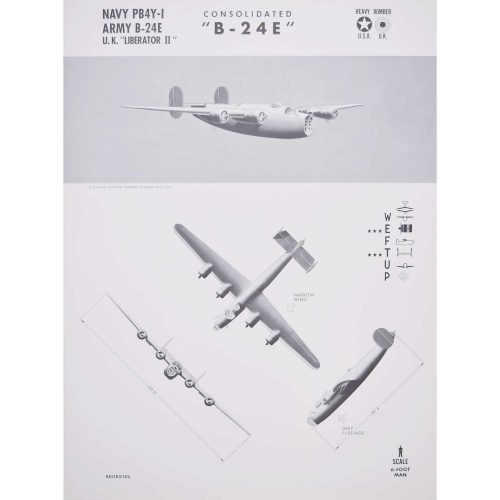
Navy and Army Consolidated Aircraft "B-24E" "Liberator II"
US Naval Aviation Training Division Original aeroplane recognition poster (1942) 63 x 47 cm A particularly unusual style of aeroplane identification poster, owing to the very arty images. Most such posters rely on very plain silhouettes, this series - and we have several in this series; view them here - have a much more arty approach to the task with shading and an interesting angle view. The Consolidated B-24 Liberator is an American heavy bomber, designed by Consolidated Aircraft of San Diego, California. Early RAF Liberators were the first aircraft to cross the Atlantic Ocean as a matter of routine. The B-24 was used extensively in World War II. It served in every branch of the American armed forces as well as several Allied air forces and navies, and was used in every theatre of war operations. In comparison with its contemporaries, the B-24 was relatively difficult to fly and had poor low-speed performance; it also had a lower ceiling and was less robust than the Boeing B-17 Flying Fortress. While aircrews tended to prefer the B-17, General Staff favoured the B-24 and procured it in huge numbers for a wide variety of roles. At approximately 18,500 units – including 8,685 manufactured by Ford Engine Company – it holds records as the world's most produced bomber, heavy bomber, multi-engine aircraft, and American military aircraft in history. Condition: Generally very good, occasional handling marks. If you’d like to know more, please email info@manningfineart.co.uk or call us on 07929 749056. -
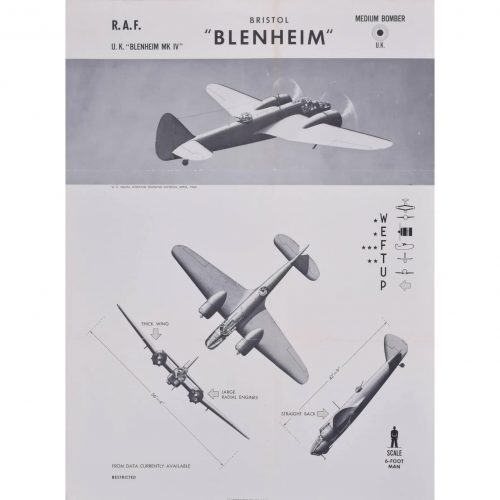
Royal Air Force Bristol Blenheim
US Naval Aviation Training Division Original aeroplane recognition poster (1942) 63 x 47 cm A particularly unusual style of aeroplane identification poster, owing to the very arty images. Most such posters rely on very plain silhouettes, this series - and we have several in this series; view them here - have a much more arty approach to the task with shading and an interesting angle view. The Bristol Blenheim is a British light bomber aircraft designed and built by the Bristol Aeroplane Company which was used extensively in the first two years of the Second World War. Condition: Generally very good, occasional handling marks or folds. If you’d like to know more, please email info@manningfineart.co.uk or call us on 07929 749056. -
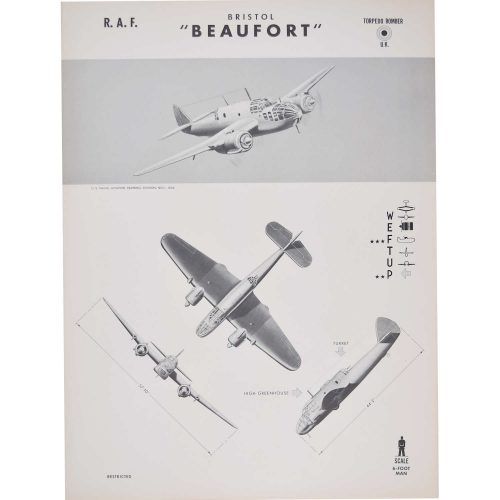
Bristol Beaufort Torpedo Bomber
US Naval Aviation Training Division Original aeroplane recognition poster (1942) 63 x 47 cm A particularly unusual style of aeroplane identification poster, owing to the very arty images. Most such posters rely on very plain silhouettes, this series - and we have several in this series; view them here - have a much more arty approach to the task with shading and an interesting angle view. The Bristol Beaufort (manufacturer designation Type 152) was a British twin-engined torpedo bomber designed by the Bristol Aeroplane Company, and developed from experience gained designing and building the earlier Blenheim light bomber. At least 1,180 Beauforts were built by Bristol and other British manufacturers. The Australian government''s Department of Aircraft Production (DAP) also manufactured variants of the Beaufort. These are often known collectively as the DAP Beaufort. More than 700 Australian-built Beauforts saw service with the Royal Australian Air Force in the South West Pacific theatre, where they were used until the end of the war. Beauforts first saw service with Royal Air Force Coastal Command and then the Royal Navy Fleet Air Arm from 1940. They were used as torpedo bombers, conventional bombers and mine-layers until 1942, when they were removed from active service and were then used as trainer aircraft until being declared obsolete in 1945. Beauforts also saw considerable action in the Mediterranean; Beaufort squadrons based in Egypt and on Malta helped interdict Axis shipping supplying Rommel's Deutsches Afrikakorps in North Africa. Although it was designed as a torpedo-bomber, the Beaufort was more often used as a medium day bomber. The Beaufort also flew more hours in training than on operational missions and more were lost through accidents and mechanical failures than were lost to enemy fire. The Beaufort was adapted as a long-range heavy fighter variant called the Beaufighter, which proved to be very successful and many Beaufort units eventually converted to the Beaufighter. Condition: good. If you’d like to know more, please email info@manningfineart.co.uk or call us on 07929 749056. -
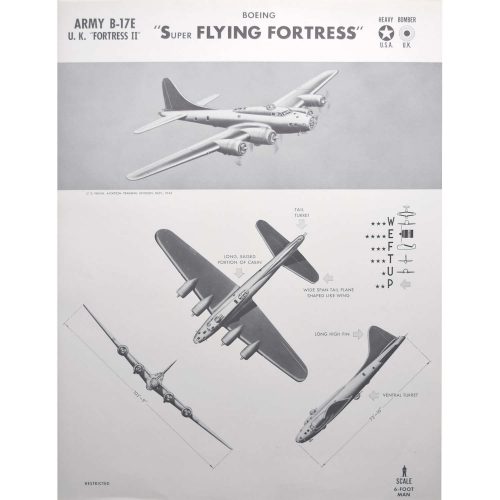
B-17E Boeing "Super Flying Fortress"
World War II US and UK heavy bomber plane Original aeroplane recognition poster (1942) 63 x 47 cm A particularly unusual style of aeroplane identification poster, owing to the very arty images. Most such posters rely on very plain silhouettes, this series - and we have several in this series; view them here - have a much more arty approach to the task with shading and an interesting angle view. The Boeing B-17 Flying Fortress is a four-engined heavy bomber developed in the 1930s for the United States Army Air Corps. From its introduction in 1938, the B-17 Flying Fortress evolved through numerous design advances, becoming the third-most produced bomber of all time. The B-17 was primarily employed by the United States Army Air Forces in the daylight strategic bombing campaign of World War II against German industrial, military and civilian targets. The B-17 also participated to a lesser extent in the Pacific War, early in World War II, where it conducted raids against Japanese shipping and airfields. In 1935 it was simply known as the Model 299. Seattle Times reporter Richard Smith dubbed the new plane, with its many machine-gun mounts, the “Flying Fortress,” and Boeing quickly adopted and trademarked the name. Condition: generally very good, occasional handling marks. If you’d like to know more, please email info@manningfineart.co.uk or call us on 07929 749056. -
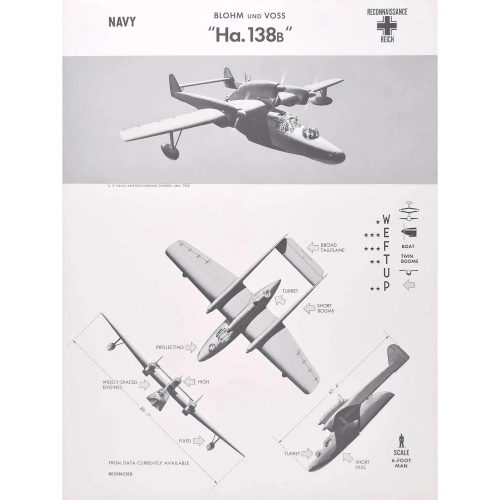
1943 Blohm und Voss "Ha. 138B"
World War II German Reich reconnaissance plane Original aeroplane recognition poster (1943) 63 x 47 cm A particularly unusual style of aeroplane identification poster, owing to the very arty images. Most such posters rely on very plain silhouettes, this series - and we have several in this series; view them here - have a much more arty approach to the task with shading and an interesting angle view. Condition: generally very good, occasional handling marks. If you’d like to know more, please email info@manningfineart.co.uk or call us on 07929 749056. -
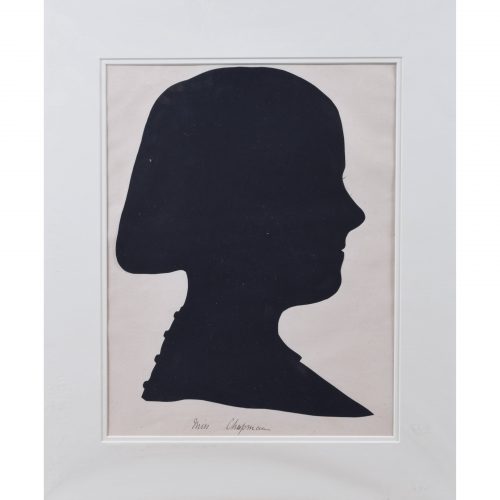
Silhouette (circa 1870)
Miss Chapman
Gouache, pen, and ink 52 x 44 cm One of the daughters of David Barclay Chapman - either Ella Maria or Eugenia Susannah. His other daughter, Adeline Mary, appears in another silhouette from this particular set. David Barclay Chapman was a partner in the bank which in 1896 became the Limited Company Barclay & Co, known today as Barclay's. Prior to photography, silhouettes were the easiest way of recording a person's appearance. This set might record the group present at a country house party, a wedding, or other similar convivial occasion. Condition: generally very good. If you’d like to know more, please email info@manningfineart.co.uk or call us on 07929 749056. -
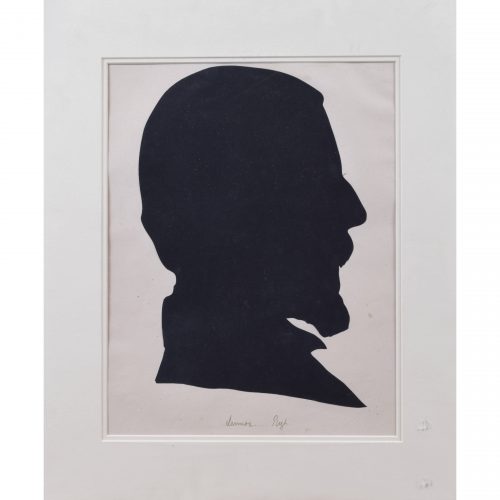
Silhouette (circa 1870)
Lennox
Gouache, pen, and ink 52 x 44 cm Prior to photography, silhouettes were the easiest way of recording a person's appearance. This set might record the group present at a country house party, a wedding, or other similar convivial occasion. Condition: generally very good. If you’d like to know more, please email info@manningfineart.co.uk or call us on 07929 749056. -
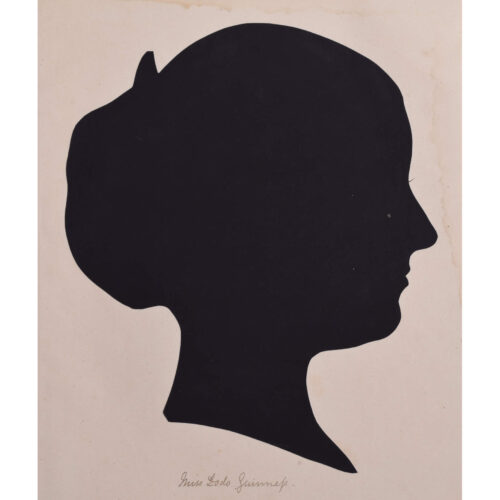
Silhouette (circa 1870)
Miss Dodo Guinness
Gouache, pen, and ink 52 x 44 cm Adelaide Maud Guinness, nicknamed 'Dodo', was descended from the banking line of Guinnesses. Her father was the barrister and MP Richard Samuel Guinness. Dodo married Edward Cecil Guinness, the 1st Earl of Iveagh and her third cousin, in 1873. Edward's father had died in 1868, after which Edward inherited a share of the famous Guinness brewery. The Guinness family seat is Elveden Hall in Suffolk. Prior to photography, silhouettes were the easiest way of recording a person's appearance. This set might record the group present at a country house party, a wedding, or other similar convivial occasion. Condition: generally good; some staining to upper edge. If you’d like to know more, please email info@manningfineart.co.uk or call us on 07929 749056. -
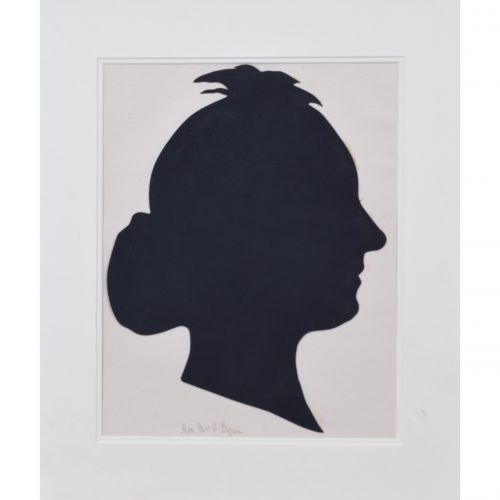
Silhouette (circa 1870)
The Hon Mrs F Byron
Gouache, pen, and ink 52 x 44 cm Likely Mary Jane Wescomb, the daughter of the daughter of Reverend William Wescomb. She married the Hon Frederick Byron in 1851; Byron was a cricketer educated at Westminster and Balliol College, Oxford, and became a fellow at All Souls College in 1843. The couple moved in to Langford Grove together after their marriage. Prior to photography, silhouettes were the easiest way of recording a person's appearance. This set might record the group present at a country house party, a wedding, or other similar convivial occasion. Condition: generally very good. If you’d like to know more, please email info@manningfineart.co.uk or call us on 07929 749056. -
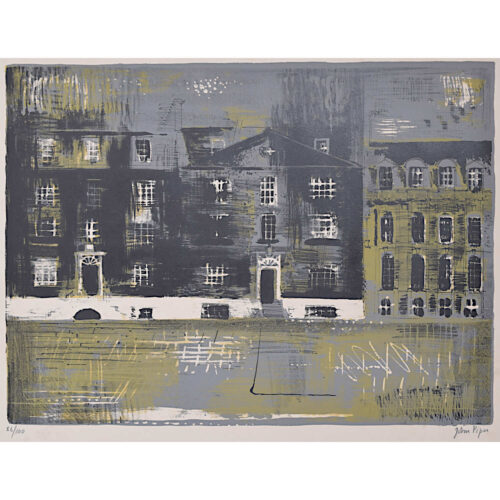
John Piper (1903-1992)
Westminster School II (1961)
42 x 59 cm Signed lower right and numbered 86/100 lower left in pencil. Piper’s second view of Westminster School; both views were commissioned by the school in 1981. Here he depicts Grant's House, with College on the far left and Rigaud’s House on the right. The view is serene and silent, set against a night sky the colour of stone, mimicking the buildings below. John Piper CH was an English painter, printmaker, and designer of stained-glass windows. His work often focused on the British landscape, especially churches and monuments, and included tapestry designs, book jackets, screen-prints, photography, fabrics and ceramics. Condition: generally very good; a little age toning. A few spots to margins. If you’d like to know more, please email info@manningfineart.co.uk or call us on 07929 749056. Click here for other works by John Piper CH. -
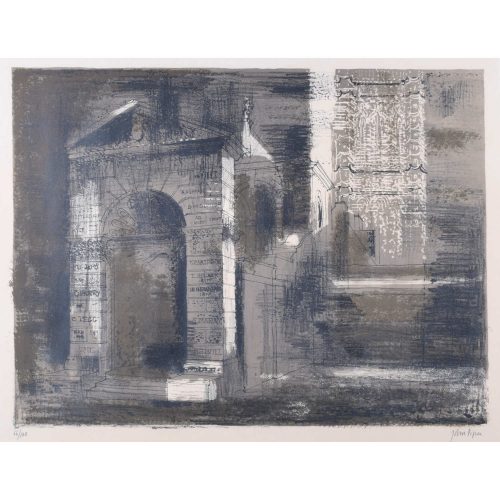
John Piper (1903-1992)
Westminster School I (1961)
49 x 63 cm Signed lower right and numbered 66/100 lower left in pencil. Piper's skilled and characterful rendering of Westminster School's gateway, sometimes known as Burlington's Arch. The historic entrance to the school dates from 1734 and is carved with the names of former pupils. John Piper CH was an English painter, printmaker, and designer of stained-glass windows. His work often focused on the British landscape, especially churches and monuments, and included tapestry designs, book jackets, screen-prints, photography, fabrics and ceramics. Condition: Generally very good, gentle even toning to the paper. If you’d like to know more, please email info@manningfineart.co.uk or call us on 07929 749056. -

Sutton Nichols (1668 - 1729)
Map of Cambridgeshire
Engraving 43 x 36 cm Signed in plate lower left. A beautifully coloured 18th century map engraving of Cambridgeshire. The map was produced by Robert Morden for publication in Edward Gibson's 1695 translation of William Camden's Britannia, a topographical and historical survey of Great Britain and Ireland produced to "restore antiquity to Britaine, and Britain to his antiquity" - a most noble aim. William Camden (1551 - 1623) was an English antiquarian, historian, topographer, and herald, best known as the author of Britannia, the first chorographical survey of the islands of Great Britain and Ireland, and the Annales, the first detailed historical account of the Queen Elizabeth I's reign. Sutton Nicholls was a draughtsman and engraver best known for his panoramic views of the cities of London and Westminster. Almost all of his engravings were commissioned by publishers. Nicholls specialised in topographical and architectural designs; he also produced many maps, notably illustrating John Strype’s edition of John Stowe’s ‘Survey of London’ in 1720. Condition: Generally very good. If you’d like to know more, please email info@manningfineart.co.uk or call us on 07929 749056. -
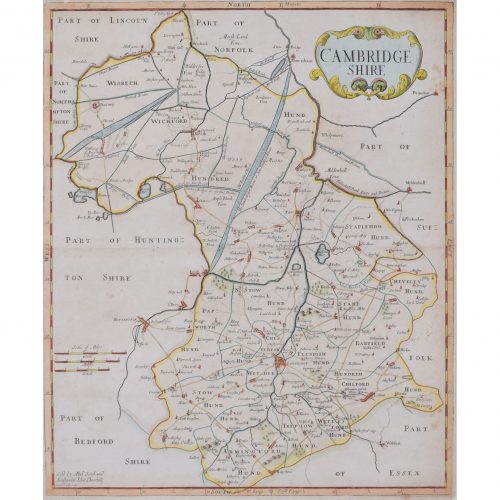
Sutton Nichols (1668 - 1729)
Map of Cambridgeshire
Engraving 43 x 36 cm Signed in plate lower left. A beautifully coloured 18th century map engraving of Cambridgeshire. The map was produced by Robert Morden for publication in Edward Gibson's 1695 translation of William Camden's Britannia, a topographical and historical survey of Great Britain and Ireland produced to "restore antiquity to Britaine, and Britain to his antiquity" - a most noble aim. William Camden (1551 - 1623) was an English antiquarian, historian, topographer, and herald, best known as the author of Britannia, the first chorographical survey of the islands of Great Britain and Ireland, and the Annales, the first detailed historical account of the Queen Elizabeth I's reign. Sutton Nicholls was a draughtsman and engraver best known for his panoramic views of the cities of London and Westminster. Almost all of his engravings were commissioned by publishers. Nicholls specialised in topographical and architectural designs; he also produced many maps, notably illustrating John Strype’s edition of John Stowe’s ‘Survey of London’ in 1720. Condition: good. Mounted to board. If you’d like to know more, please email info@manningfineart.co.uk or call us on 07929 749056. -
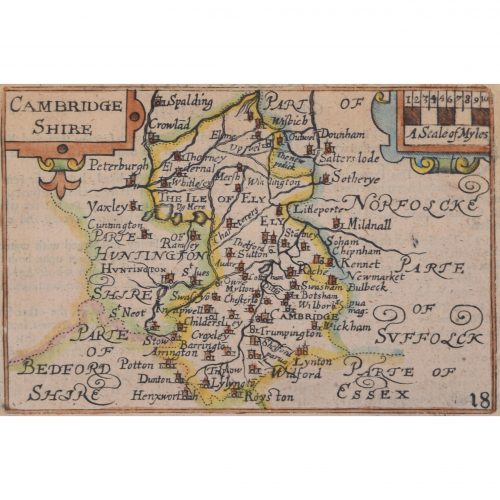
Pieter van den Keere (1571 - circa 1646) after John Speed (1551 or 1552 - 1629)
Map of Cambridgeshire (1627)
Engraving 8 x 12 cm A beautifully coloured map of Cambridgeshire, with an antique description of the county to the reverse. The map, along with many others, was published in Speed's atlas, 'The Theatre of the Empire of Great Britaine', first published in 1611. This particular miniature edition of the 'Theatre' was published in miniature by George Humble in 1627, entitled 'England Wales Scotland and Ireland Described and Abridged With ye Historic Relation of things worthy memory from a farr larger Voulume. Done by John Speed.’ Speed's original map was likely engraved for this edition by Peter van den Keere. van den Keere's maps soon came to be known as "Miniature Speeds". John Speed was an English cartographer, chronologer and historian. The son of a citizen and Merchant Taylor in London, he rose from his family occupation to accept the task of drawing together and revising the histories, topographies and maps of the Kingdoms of Great Britain as an exposition of the union of their monarchies in the person of King James I and VI. He accomplished this with remarkable success, with the support and assistance of the leading antiquarian scholars of his generation. He drew upon and improved the shire maps of Christopher Saxton, John Norden and others, being the first to incorporate the hundred-boundaries into them, and he was the surveyor and originator of many of the town or city plans inset within them. His work helped to define early modern concepts of British national identity. His Biblical genealogies were also formally associated with the first edition of the King James Bible. He is among the most famous of English mapmakers. George Humble (1572 - 1640) was an English publisher, known for his publication of John Speed's 'The theatre of the empire of Great Britaine,' the first comprehensive atlas depicting the British Isles, and his later 'A prospect of the most famous parts of the World,' the first English world atlas. Pieter van den Keere was a Flemish engraver, publisher, and globe maker who worked in England and the Dutch Republic. Condition: generally very good; some age toning. If you’d like to know more, please email info@manningfineart.co.uk or call us on 07929 749056. -
Out of stock
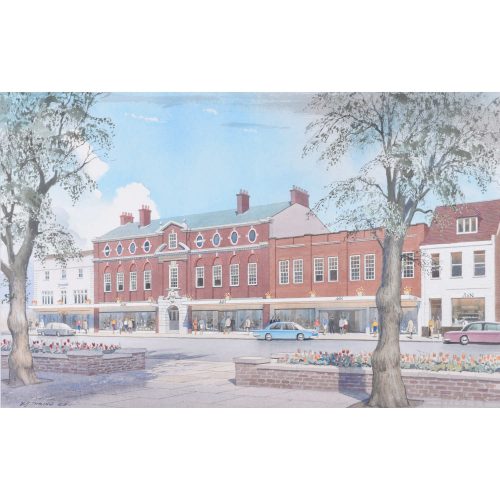
Edmund J Thring (1906-1985)
Architectural Perspective Design for a Building in Salisbury
38 x 60 cm Watercolour / gouache Framed. We are informed that the building still exists on Chichester High Street, though in slightly different form from the way it is painted here. Click here for other works by Thring. -
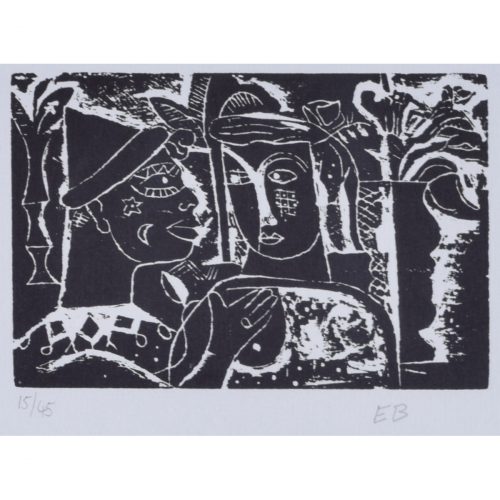
Edward Burra (1905 - 1976)
Café
(1928 - 1929, this edition published 1971) Woodcut 10 x 15 cm; sheet size 24 x 34 cm Numbered 15/45 lower left and initialled EB lower right. Published by the Nicholas Treadwell Gallery in 1971. Burra's woodcut of a male and a female figure, entitled 'Café'. The two figures, seemingly a couple, gaze at one another intensely and intimately, giving the impression of having been interrupted by the viewer. Both figures' faces bear tattoo-like markings: he a star and the moon, she a geometric design resembling a noughts-and-crosses board. The "café" in which they sit is a dreamily abstract landscape full of palms and other plants from the tropics. Edward Burra was an English painter, draughtsman, and printmaker. He travelled to Italy in 1925, the same year he met the noted British Surrealist Paul Nash, and both of these influences are evident in this woodcut. Nash introduced Burra to woodcut-making in 1928, the same year that Burra began this woodcut series. His first solo show was held at the Leicester Galleries in April 1929, and he exhibited with the English Surrealists in the 1930s. Condition: Excellent. If you’d like to know more, please email info@manningfineart.co.uk or call us on 07929 749056. -
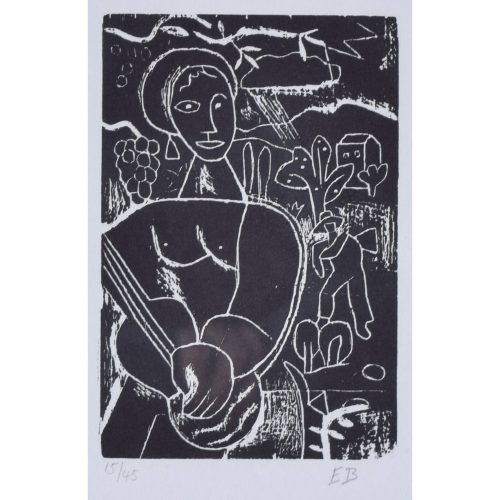
Edward Burra (1905 - 1976)
The Guitar Player
(1928 - 1929, this edition published 1971) Woodcut 15 x 10 cm; sheet size 34 x 24 cm Numbered 15/45 lower left and initialled EB lower right. Burra's woodcut of a female guitar player surrounded by a landscape of cacti. A bunch of grapes is pendent beside her triangular earring, and a male figure in a wide-brimmed hats stands in the field nearby. Edward Burra was an English painter, draughtsman, and printmaker. He travelled to Italy in 1925, the same year he met the noted British Surrealist Paul Nash, and both of these influences are evident in this woodcut. Nash introduced Burra to woodcut-making in 1928, the same year that Burra began this woodcut series. His first solo show was held at the Leicester Galleries in April 1929, and he exhibited with the English Surrealists in the 1930s. Condition: Excellent. If you’d like to know more, please email info@manningfineart.co.uk or call us on 07929 749056. -
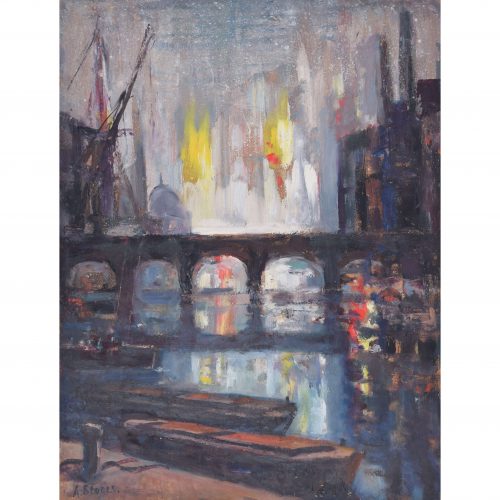
Angela Stones (1914 - 1995)
Old London Bridge Fantasia (1968)
Oil on board 56 x 43 cm Signed lower left. A fantasia inspired by Old London Bridge on the Thames. The grey dome of St Paul's peeps over the bridge; bright lights burn in the background, throwing yellows and red reflections onto the water. Moored boats bob gently in the foreground. Stones was educated at the Chelsea School of Art, and was a member of an artistic dynasty. Her mother Dorothy Bradshaw (1893-1983) studied under Jack Merriott – the artist famous for his British Rail posters, and her son, Christopher Assheton-Stones (1947-1999), was arguably the foremost pastel artist of his time. Provenance: the family of the artist. Condition: very good. If you’d like to know more, please email info@manningfineart.co.uk or call us on 07929 749056. -
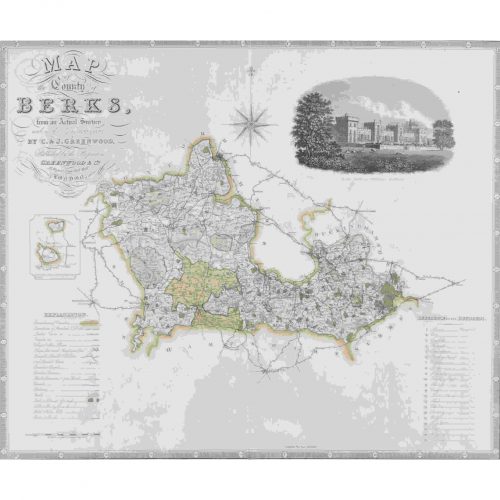
John Dower (1825 - 1901)
Map of Berkshire from an actual survey made in the years 1822 & 1823
Engraving 57 x 69 cm A large antique engraved map of Berkshire. Condition: good; some light staining. If you’d like to know more, please email info@manningfineart.co.uk or call us on 07929 749056. -
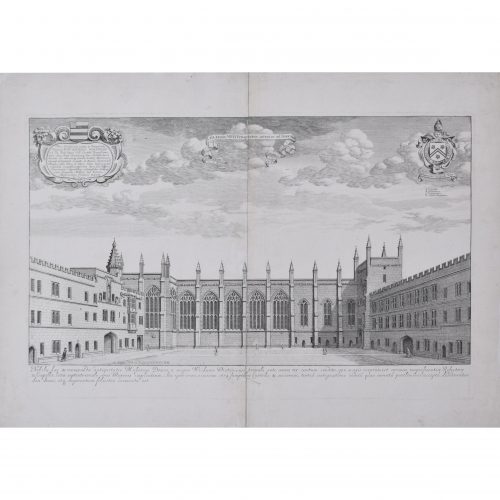
David Loggan (1634 - 1692)
New College, Oxford (1705)
Engraving 31 x 49 cm Loggan was born to English and Scottish parents, and was baptised in Danzig in 1634. After studying engraving in Danzig with Willem Hondius (1598-1652 or 1658), he moved to London in the late 1650s, going on to produce the engraved title-page for the folio 1662 Book of Common Prayer. He married in 1663 and moved to Nuffield in Oxfordshire in 1665. Loggan was appointed Public Sculptor to the nearby University of Oxford in the late 1660s, having been commissioned to produce bird’s-eye views of all the Oxford colleges. He lived in Holywell Street as he did this. The 'Oxonia Illustrata' was published in 1675, with the help of Robert White (1645 - 1704). Following its completion, Loggan began work on his equivalent work for Cambridge; the 'Cantabrigia Illustrata' was finally published in 1690, when he was made engraver to Cambridge University. The 'Oxonia Illustrata' also includes an engraving of Winchester College (Winchester and New College share William of Wykeham as their founder) whilst the 'Cantabrigia Illustrata' includes one of Eton College (which shares its founder, Henry VIII, with King’s College). Bird’s-eye views from this era required a particular talent as an architectural perspectivist; it was not until 1783 that it became possible for artists to ascend via hot air balloons and view the scenes they were depicting from above. Loggan thus had to rely on his imagination in conceiving the views. Loggan’s views constitute the first accurate depictions of the two Universities, in many ways unchanged today. Whilst the Oxford engravings were produced in reasonable numbers and ran to a second edition by Henry Overton (on thicker paper and with a plate number in Roman numerals in the bottom right-hand corner), those of Cambridge were printed in much smaller numbers. The Dutchman Pieter van der Aa published some miniature versions of the engravings for James Beverell’s guidebook to the UK, 'Les Delices de la Grande Bretagne' (circa 1708). The contemporary artist Andrew Ingamells has produced a highly-acclaimed series of etchings which bring Loggan’s original vision up to date. Condition: repaired tear to central fold; has been washed. If you’d like to know more, please email info@manningfineart.co.uk or call us on 07929 749056. -
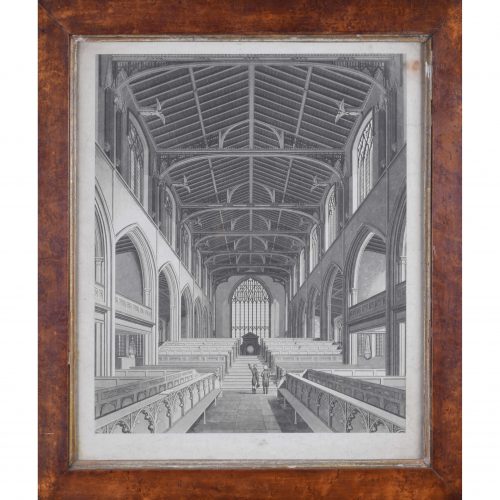
Chapel Interior (circa 1800)
Engraving 49 x 40 cm An engraving of a magnificent chapel interior. Two men tour the chapel, one gesticulating towards the spectacular design of the chancel window. Condition: good. Some gentle discolouration; in faux burr-maple frame. If you’d like to know more, please email info@manningfineart.co.uk or call us on 07929 749056. -
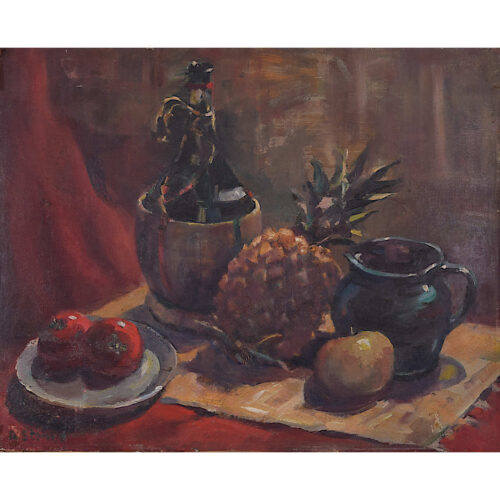
Angela Stones (1914 - 1995)
Still Life with Pineapple
Oil on board 41 x 51 cm Signed lower left. Provenance: the family of the artist. A dark, characterful mid-century still life in oils, characterised by Stones' textured brushwork and rich use of colour. Stones was educated at the Chelsea School of Art, and was a member of an artistic dynasty. Her mother Dorothy Bradshaw (1893-1983) studied under Jack Merriott – the artist famous for his British Rail posters, and her son, Christopher Assheton-Stones (1947 - 1999), was arguably the foremost pastel artist of his time. Condition: very good. If you’d like to know more, please email info@manningfineart.co.uk or call us on 07929 749056. Click here for more still lifes. -
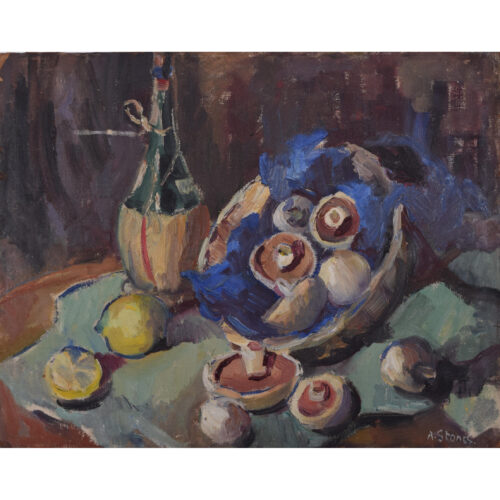
Angela Stones (1914 - 1995)
Still Life with Mushrooms
Oil on board 41 x 51 cm Signed lower right. Provenance: the family of the artist. A dark, characterful mid-century still life in oils, characterised by Stones' textured brushwork and rich use of colour. Stones was educated at the Chelsea School of Art, and was a member of an artistic dynasty. Her mother Dorothy Bradshaw (1893-1983) studied under Jack Merriott – the artist famous for his British Rail posters, and her son, Christopher Assheton-Stones (1947 - 1999), was arguably the foremost pastel artist of his time. Condition: very good. If you’d like to know more, please email info@manningfineart.co.uk or call us on 07929 749056. Click here for more still lifes. -
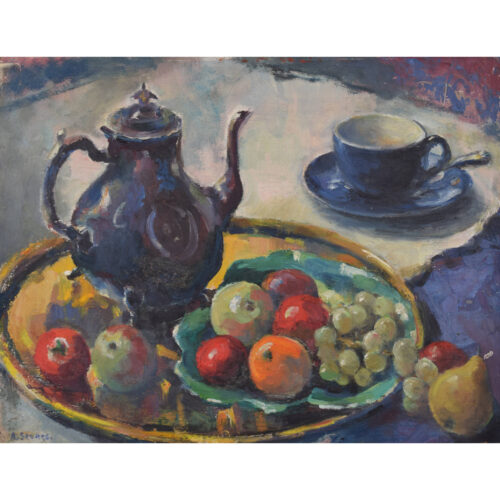
Angela Stones (1914 - 1995)
Still Life with Coffee Pot and Fruit
Oil on board 41 x 51 cm Signed lower right. Provenance: the family of the artist. A mid-century still life in oils, characterised by Stones' textured brushwork, inventive composition, and rich use of colour. Stones was educated at the Chelsea School of Art, and was a member of an artistic dynasty. Her mother Dorothy Bradshaw (1893-1983) studied under Jack Merriott – the artist famous for his British Rail posters, and her son, Christopher Assheton-Stones (1947-1999), was arguably the foremost pastel artist of his time. Condition: very good. If you’d like to know more, please email info@manningfineart.co.uk or call us on 07929 749056. Click here for more still lifes. -
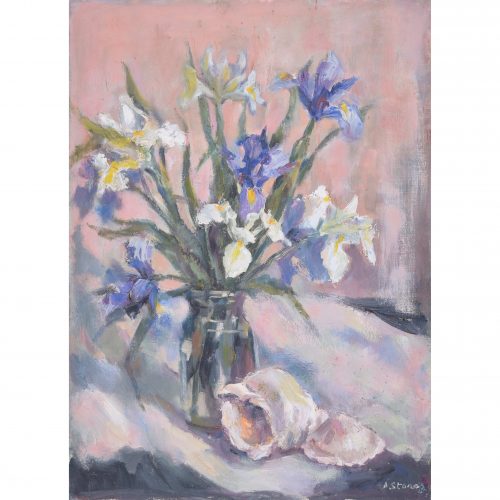
Angela Stones (1914 - 1995)
Irises
Oil on board 56 x 41 cm Signed lower right. A glass jar of irises, with two shells, on a pale pink and peach backdrop. Stones'' impasto technique brings texture to the shells and petals, and shades of purple offset the greens and pinks of the composition. Stones was educated at the Chelsea School of Art, and was a member of an artistic dynasty. Her mother Dorothy Bradshaw (1893-1983) studied under Jack Merriott – the artist famous for his British Rail posters, and her son, Christopher Assheton-Stones (1947-1999), was arguably the foremost pastel artist of his time. Provenance: the family of the artist. Condition: very good. If you’d like to know more, please email info@manningfineart.co.uk or call us on 07929 749056. -
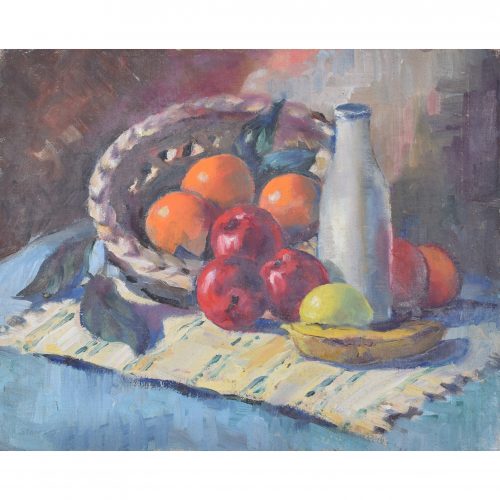
Angela Stones (1914 - 1995)
Still Life with Fruit and Milk Bottle
Oil on board 41 x 51 cm Signed lower left. A mid-century still life in oils, characterised by Stones' textured brushwork and use of vivid colours. Stones was educated at the Chelsea School of Art, and was a member of an artistic dynasty. Her mother Dorothy Bradshaw (1893-1983) studied under Jack Merriott – the artist famous for his British Rail posters, and her son, Christopher Assheton-Stones (1947-1999), was arguably the foremost pastel artist of his time. Provenance: the family of the artist. Condition: very good. If you’d like to know more, please email info@manningfineart.co.uk or call us on 07929 749056.