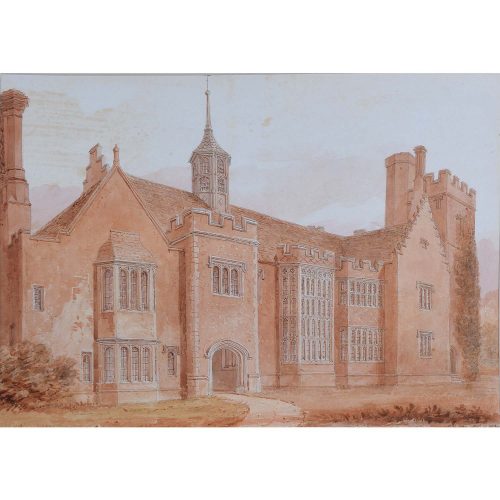
-
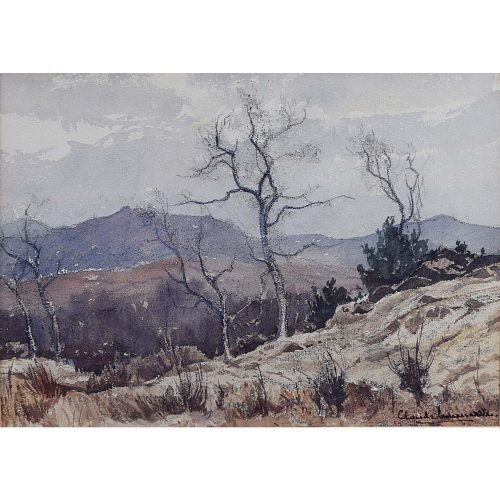
Claude Muncaster Above Finsthwaite, near Newby Bridge 1968
Watercolour 21x26.5cm 46x52cm including frame, UK shipping only Signed lower right Click here for biographical details and other works by the artist. If you are interested email info@manningfineart.co.uk or call us on 07929 749056. Condition: Good. -
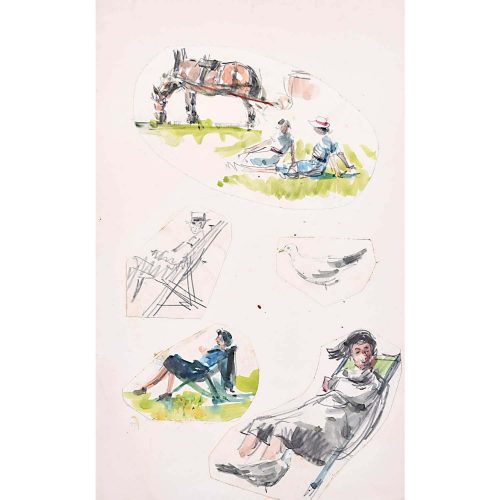
Peter Collins ARCA (1923-200 Elegant Figures in Deckchairs with Boaters and Hats
Mixed Media, Collage, Watercolour, Pencil etc. 29x18cm Provenance: The Artist's Studio As a graphic designer, Collins produced many drawings such as these and we invite you to look at our other drawings and sketches by him. Click here for other items by the artist and for biographical details. If you are interested email info@manningfineart.co.uk or call us on 07929 749056. -
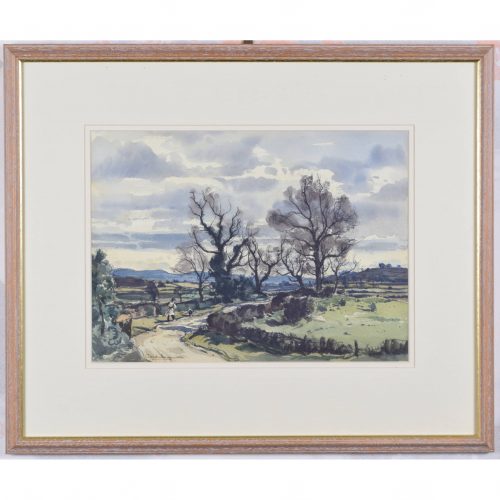
Claude Muncaster Landscape Near Shrewsbury
Watercolour 26 x 36 cm Signed lower left; framed. Click here for biographical details and other works by the artist. If you are interested email info@manningfineart.co.uk or call us on 07929 749056. Condition: Good. -
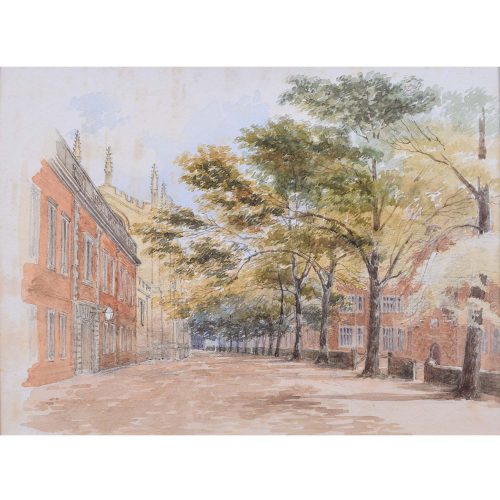
Anonymous Eton College
Watercolour 21.2×28.5cm If you are interested email info@manningfineart.co.ukor call us on 07929 749056. Condition: Good. -
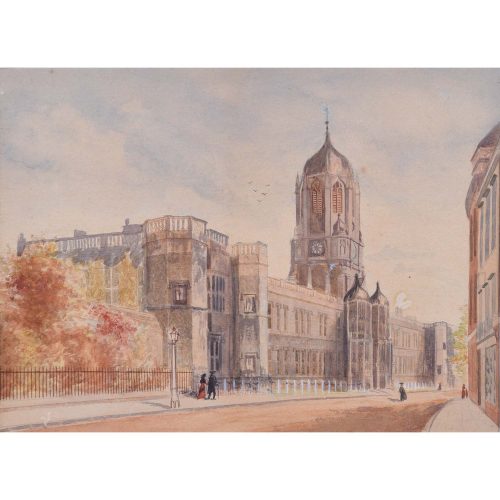
W. H. Hill
Tom Tower, Christ Church, Oxford (1883)
Watercolour 23.7×32.5cm If you are interested email info@manningfineart.co.ukor call us on 07929 749056. Condition: Good. -
Out of stock
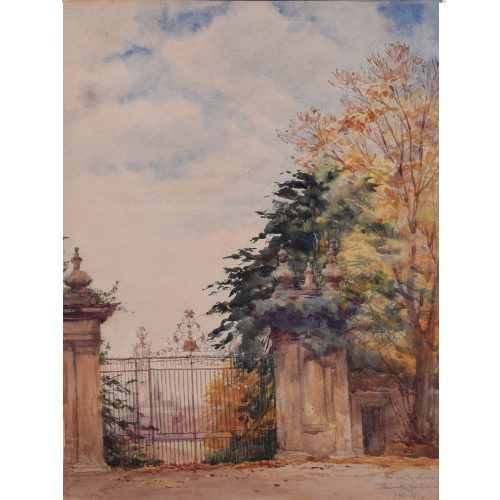
Alan Dashwood
Trinity Gateway Oxford (1914)
Watercolour 33.7×24.5cm If you are interested email info@manningfineart.co.uk or call us on 07929 749056. Condition: Good. -
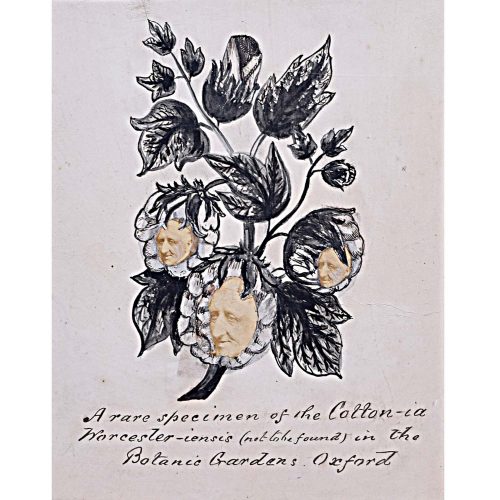
Provost Richard Lynch Cotton Caricature
A rare specimen of the Cotton-ia Worcester-iensis (not to be found) in the Botanic Gardens Oxford
Pen ink watercolour and photographic collage 19.5 x 16 cm By repute, found in the rooms of Keble at the Hermitage Hotel in Eastbourne after his death, together with another watercolour of a ‘Ritualistic Priest’ also for sale. Please contact us for further information. If you are interested email info@manningfineart.co.ukor call us on 07929 749056. Condition: Good. -
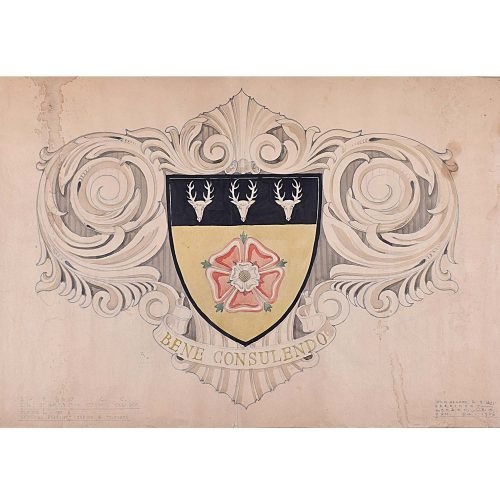
D.L Hadden
Design for Coat of Arms for Council Chambers
Watercolour and pencil 52x74.5cm Signed and dated 1959 A traditional coat of arms design for the city council chambers with directions by the artist that it is to be carved in lime and coloured as depicted. One of the many works Hadden produced during his time as senior designer at Geo M Hammer. For biographical details and other works by the artist click here. If you are interested email info@manningfineart.co.uk or call us on 07929 749056. Condition: Generally good, some water staining as visible in image. -
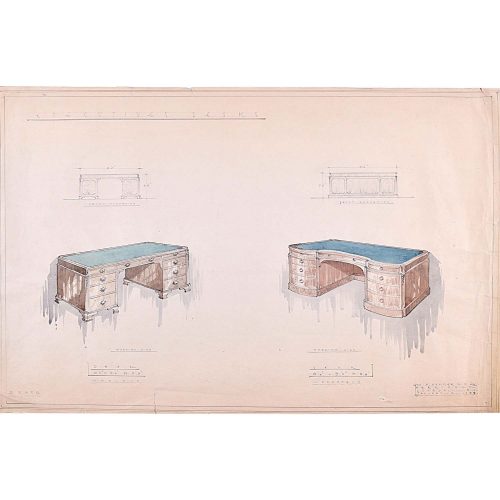
D.L Hadden
Design for Executive Desks Geo.M.Hammer
Watercolour and pencil 41x51cm Signed and dated 1959 Two beautifully detailed executive desks designs with sketches front elevations. Hadden's flair with woodwork design is evident in this masterful drawing. For biographical details and other works by the artist click here. If you are interested email info@manningfineart.co.uk or call us on 07929 749056. Condition: Generally good, some soft creases round the margins. -
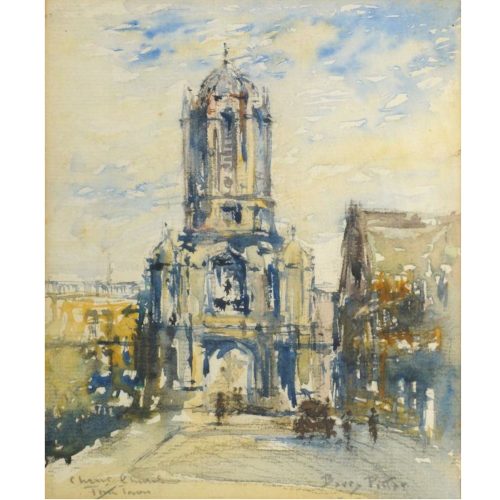
J F Barry Pittar (British 1880-1948) Tom Tower, Christ Church Oxford
Watercolour 15.5x13cm If you are interested email info@manningfineart.co.uk or call us on 07929 749056. Condition: Good. -
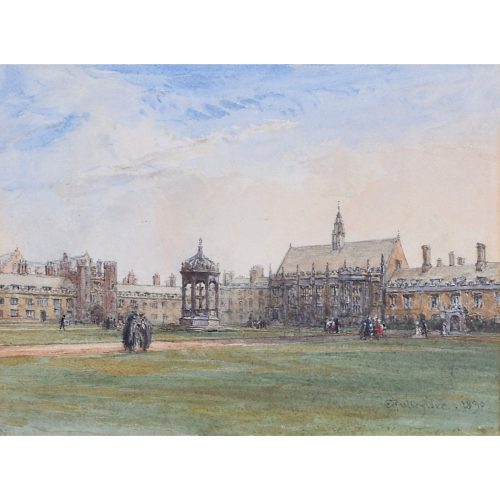
John Fulleylove (1845-1908) Trinity College, Cambridge - Great Court
Watercolour 13x17cm Born in Leicester, John Fulleylove trained as an architect with a Leicester firm before becoming a full-time painter. He exhibited widely in the UK, at such venues as the Royal Academy, the Fine Art Society, and the Royal Society of British Artists. His paintings were the subject of illustrated topographical books, including one on ‘Oxford’ published by the Fine Art Society. If you are interested email info@manningfineart.co.uk or call us on 07929 749056. Condition: Good. -
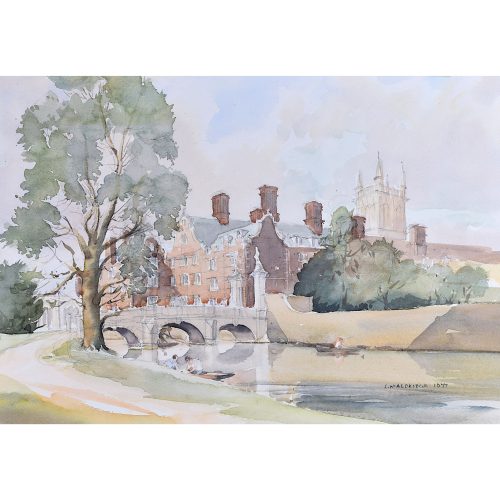
Rowland de Winton Aldridge (1906-1997) The Backs, St John's College Cambridge
34x51cm watercolour Born in Kent he was given 'de Winton' after his grandmother, who was related to the De Wintons of the Welsh engineering company De Winton & Co (1854-1901) that built narrow-gauge railways. He was a protégé of Edward Wesson, one of Britian's most important twentieth century watercolourists, and was a prolific artist of landscapes and urban riverscapes. St John's College Cambridge was one of his favourite views to paint, combining as it does an urban riverscape, a landscape and late 17th century buildings. Aldridge was an authority on 18th century architecture and was adviser to Baron Iliffe during his restoration of Basildon Park. If you are interested email info@manningfineart.co.ukor call us on 07929 749056. Condition: Good. -
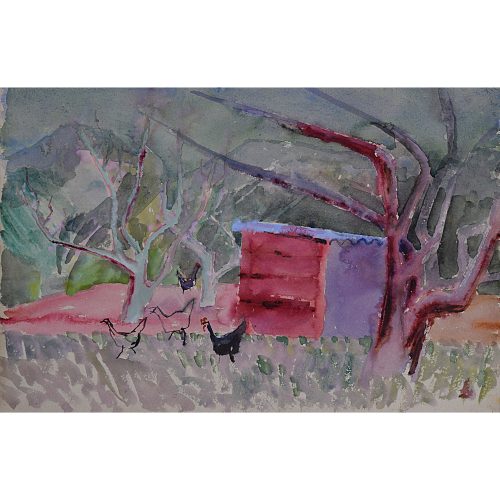
Clifford Ellis (1907-1985) Hens by a chicken shed at Corsham Court
Watercolour 37x56cm Provenance: the family of the artist, by descent. Here Ellis paints the hens at Corsham Court together with their chicken shed. Born in Bognor in Sussex and trained at St Martin’s School of Art and Regent Street Polytechnic, Ellis was a graphic artist and illustrator who is best known for the posters he produced for London Transport during the 1930s. He generally collaborated with his wife Rosemary – whom he married in 1931 – on their posters. The General Post Office, Shell, and The Empire Marketing Board were also clients for their posters. They signed their posters C&RE, their initials being in alphabetical order and they are readily recognisable by their ebullient use of colour and form. Employed during the war as a camoufleur, along with so many other artists, Clifford was also an official war artist, serving with the Grenadier Guards. Rosemary, meanwhile, was an artist for the Recording Britain project. Following the war they trained art teachers at Bath Academy of Art. They also designed a series of nearly one hundred book jackets for Collins New Naturalist series, published between 1945 and 1982. Clifford Ellis studied illustration at the Regent Street Polytechnic, an institution that specialised in ’practical trade classes’, from 1924-27. He went on to design book covers (notably for Collins’ ‘New Naturalist’ series) and posters for London Transport, the General Post Office, Shell-Mex, the Empire Marketing Board and J. Lyons & Co., along with his wife, Rosemary Ellis, whom he married in 1931 while he was teaching at the Polytechnic. The couple’s poster designs combine striking colour with bold typography and depict stylised scenes of the countryside, birds and animals. In the 1930s London Transport commissioned over forty posters a year from well-known artists such as Laura Knight, CRW Nevinson, Edward Wadsworth, Eric Ravilious, Paul Nash, Graham Sutherland and Edward McKnight Kauffer – a bold policy that did much to popularise avant-garde artistic styles that stemmed from Cubism, Futurism and Abstraction. Such an influence is clear in the Ellises poster ‘It’s better to shop early’ (above, 1935) in which arms, hands and parcels are disjointed and angular with the text on a slant, like the collaged newsprint insertions of synthetic Cubism. This strong foundation in graphic art clearly influenced his approach to composition for the rest of his career. Even his later abstract work, though tonally subtle, is based on a simple but powerful linear design. ‘The Coming of the Ice Age’, a series of watercolour and crayon studies (one large finished canvas, ‘Advance of an Ice Age’, exists in the collection of Derbyshire and Derby School Library Services) reduces natural forms to simplified shapes and colour planes, though retaining the texture of brushstrokes and crayon. The Ellises visited the Devon coastal town of Teignmouth to carry out a commission for Lyons for a lithograph in 1947, and the rocky bay with its whitewashed buildings and sailboats (below) caught Clifford’s imagination. He painted numerous preparatory watercolour views for the lithograph, while both the grey-blue colour palette as well as the pleasing repetitive geometry of sails reflected on water might be discerned in later abstract works. During the Second World War Ellis served as a camouflage artist and official war artist with the Grenadier Guards. Roland Penrose was another British artist who worked in this area and wrote ‘The Home Guard Manual of Camouflage’ which effectively adapted modern painting techniques for use in warfare. The tonal colour range of many of Ellis’s post-war paintings and the abstract network of shapes – for instance the pale blue patchwork ‘glacier’ in the ‘Coming of the Ice Age III’ (below) – seem to hark back to the art of the modernist camoufleur. Ellis played another important role during the war, painting and drawing scenes of Bath for the Recording Britain project. This project was conceived by Kenneth Clark, then Director of the National Gallery, alongside the official War Artists scheme; its aim was to document Britain’s landscape and architectural heritage in the face of the imminent threat of invasion and bomb damage. It also had a propaganda motive; the resulting works were exhibited during the war and aimed to boost the nation’s morale (they are now in the collection of the V&A). The paintings were predominantly in watercolour, a traditional British medium that Clark was keen to promote and felt would complement the subject matter. Two of Ellis’ pupils, discussing his watercolour sketch of VE Day in Bath, recall him as quietly observant but also someone who enjoyed life; the painting is spontaneous and full of the movement of dancing figures and waving flags. In particular, Ellis was commissioned to depict examples of Bath’s decorative architectural ironwork before it was removed to help the war effort and he also recorded the effects of bombing raids on the city. Meanwhile Ellis had joined the staff of the Bath School of Art (or Bath Technical College). Its temporary residence was destroyed by bombs in 1942 and Walter Sickert’s house at Bathampton offered as a refuge (Sickert, who had taught at the School, died in January 1942). After the war the School began its transformation into the Bath Academy of Art based at Corsham Court, of which Ellis was the Head from 1937-72, training art teachers and developing a pioneering new syllabus. If you are interested email info@manningfineart.co.uk or call us on 07929 749056. Condition: Excellent. In a conservation mount. -
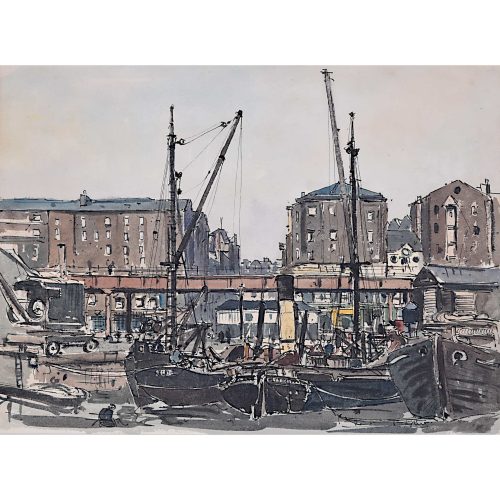
Claude Muncaster (1903-1974) Liverpool Docks
Dated 1928 Inscribed to reverse Watercolour 28x37cm Muncaster's watercolours capture the English countryside feel with great competence and feeling. Here he records the docks at Liverpool, a busy scene with splashes of bright paint enlivening the otherwise dull smoky port. Liverpool Claude Grahame Muncaster, RWS, ROI, RBA, SMA was the son of Oliver Hall RA. At the age of fifteen his career as a landscape painter began, and he soon took to the seas, spending the 1920s and 30s travelling the world with his sketchbook in a series of vessels. With the outbreak of war and he joined the RNVR training as a navigator. Having left school at fifteen his mathematics was very weak and it was a relief for all when his artistic talents meant he was recruited as a camofleur. A master of capturing seascapes he was therefore able to hide huge ships ‘in plain sight’ with clever disguises. After the war he painted for the Royal Family and was a frequent guest at Sandringham. Claude Muncaster was a watercolourist known for his landscapes and maritime scenes. He was born Grahame Hall, the son of the Royal Academician Oliver Hall who taught his son to paint from an early age; Grahame first exhibited his work aged 15 and a few years later was showing at the RA. However, he adopted the name Claude Muncaster in 1922 to dissociate his career from that of his father. Muncaster’s primary choice of subject matter came from a genuine love of the sea. He made several long-distance sea voyages, including one around the Horn as a deckhand in the windjammer Olivebank in 1931, which he described in ‘Rolling Round the Horn’, published in 1933. Armed with a sketchbook, his aim was to be able to ‘paint ships and the sea with greater authority’. This he certainly achieved, perfectly capturing the limpid first light of morning over the Port of Aden, the choppy rain-grey waters of the Bay of Biscay and a streak of sunlight through gathering storm clouds at dusk in Exeter. He became an Associate of the Royal Watercolour Society in 1931 and was a founder member, and later President, of the Royal Society of Marine Artists. During the Second World War, Muncaster served in the Royal Naval Volunteer Reserve (RNVR) from 1940-44, training as a navigator before going on to advise on the camouflage of ships, and also worked as an official war artist. In ‘Still Morning at Aden’ (1944) he depicts Allied warships in this safe anchorage in the Middle East; the back is stamped with Admiralty approval. In 1946-7 he was commissioned by the Queen to produce watercolours of the royal residences at Windsor, Sandringham and Balmoral; the Duke of Edinburgh, in a foreword to a biography of Muncaster, recalls looking at these and considering the artist’s ‘unerring instinct for a subject’, his sense of atmosphere. Other commissions included large panoramas of the Thames and of Bradford. His career also included work as an etcher, illustrator, writer, lecturer and broadcaster, and his paintings can be found in the Royal Academy, Tate, National Maritime Museum Cornwall, National Railway Museum and Royal Air Force Museum. If you are interested email info@manningfineart.co.uk or call us on 07929 749056. Condition: Conservation mounted and wrapped in transparent sleeve for protection; slight toning to extremities and possibly some loss of colour from sky. -
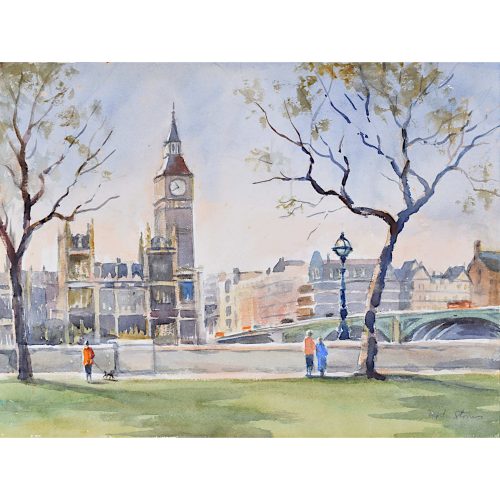
Angela Stones (1914-1995) Westminster Bridge and the Houses of Parliament
Watercolour 31x41 cm Stones was a member of an artistic dynasty. Her mother Dorothy Bradshaw (1893-1983) studied under Jack Merriott - the artist famous for his British Rail posters, and her son, Christopher Assheton-Stones (1947-1999) was probably the foremost pastel artist of his time. If you are interested email info@manningfineart.co.uk or call us on 07929 749056. Condition: Good.