-
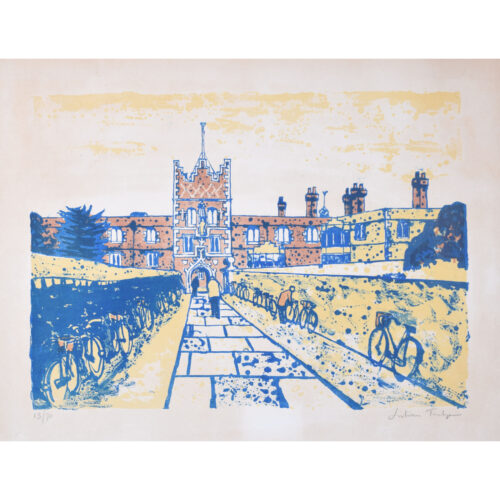
Julian Trevelyan (1910 - 1988)
Jesus College, Cambridge
Lithograph 38 x 53 cm Numbered 13/70 lower left and signed lower right, both in pencil. Nephew of the historian G M Trevelyan, Julian Trevelyan was educated at Bedales and then at Trinity College, Cambridge, where he read English. After moving to Paris, Trevelyan studied engraving at Stanley William Hayter’s school, working alongside artists such as Max Ernst, Joan Miro and Pablo Picasso. He married the potter Ursula Darwin in 1934, and in 1935 they moved to Hammersmith, buying Durham Wharf beside the River Thames which was Trevelyan’s studio – and home – for the rest of his life. His wartime service was – like so many artists – as a camoufleur. A Royal Engineer from 1940-43, he served in North Africa and Palestine, forcing the German Afrika Korps to use resources against a dummy army whilst real tanks were disguised as more harmless equipment. In the desert, nothing could be hidden - but it could be disguised. Following the dissolution of his marriage in 1950, he married the painter Mary Fedden. Teaching at Chelsea School of Art, Trevelyan eventually became head of the Etching Department and his pupils included David Hockney and Peter Ackroyd. Condition: generally very good; some age toning to paper. If you are interested, please email info@manningfineart.co.uk or call us on 07929 749056. Click here for other views of Jesus College, Cambridge. -
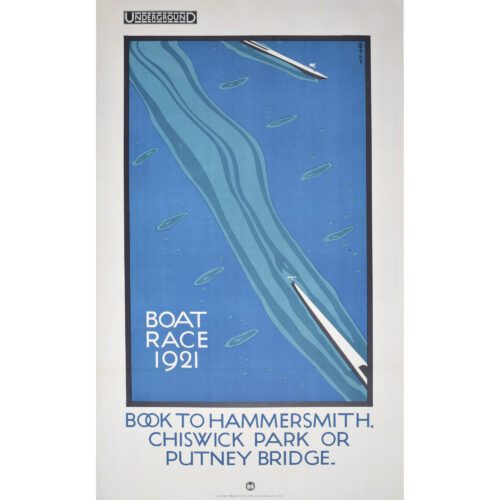
Charles Paine (1895 - 1967)
Boat Race 1921
Lithograph 102 x 64 cm Signed upper right in plate. Charles Paine's iconic 1921 poster encourages the use of the London Underground in order to view the Boat Race. The slick design features one boat’s stern disappearing from the frame and the other boat’s bow entering it (Cambridge won that year), alongside a strikingly Art Deco typeface. Charles Paine was a versatile and prolific designer, who drew on his training in stained glass to create bold, structured and highly stylised lithographs for a variety of companies. This decorative and brightly-coloured map illustrates the various county regiments of Great Britain, with a border of regimental badges. Condition: backed to linen; excellent, two small areas of repair to margin (invisible); hint of old folds. If you are interested, please email info@manningfineart.co.uk or call us on 07929 749056. Click here for other Boat Race pictures. -
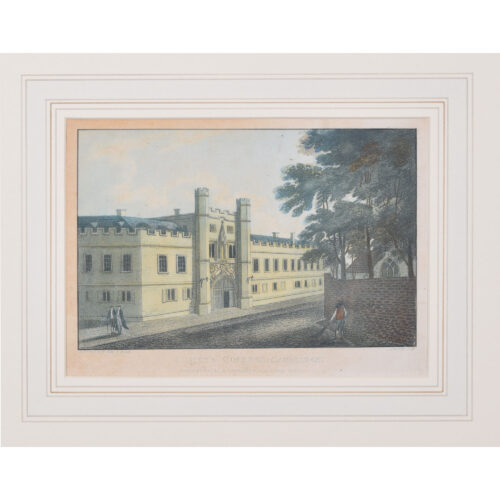
Richard Bankes Harraden (1778 - 1862)
Christ's College, Cambridge
Engraving 15 x 22 cm A nineteenth-century view of Christ's College, Cambridge, complete with two academics and a street-sweeper. Richard Bankes Harraden was a printmaker, painter, and drawing master. He was active in Cambridge, producing many views of the colleges, and subsequently several Oxford colleges. Harraden was an early and exhibiting member of the Society of British Artists in London, which was established in 1823, and remained a member until 1849. He specialised in depictions of landscape, topography and architecture, and was the son of Richard Harraden (1756 - 1838) with whom he published plates as 'Harraden & Son'. Condition: generally very good; a little discolouration to paper; in handsome washlined mount. If you are interested, please email info@manningfineart.co.uk or call us on 07929 749056. Click here for other views of Christ's College, Cambridge. -
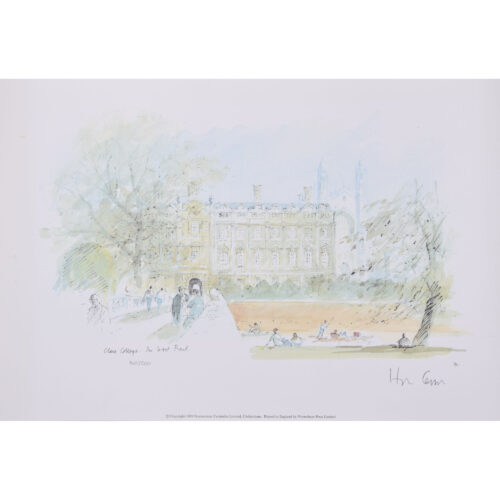
Hugh Casson (1910 - 1999)
Clare College - The West Front
Lithograph 24 x 40 cm Titled in plate lower left; numbered 160/500 lower left and signed lower right, both in pencil. Casson's view of a bustling Clare College, complete with students punting on the Backs. Sir Hugh Casson was educated at Eastbourne College; St John’s College, Cambridge; and the Bartlett School of Architecture. Trained in the 1930s in the early modernist style, he taught at the Cambridge School of Architecture. After employment as a camoufleur during World War 2 by the Air Ministry, in 1948 he was appointed as director of architecture for the Festival of Britain. A close friend of the Royal Family, he undertook designs for the 1953 coronation, designed the interior of the Royal Yacht Britannia (“The overall idea was to give the impression of a country house at sea”), and taught the young Charles III to paint in watercolours. Amongst his architectural achievements are the Elephant House at London Zoo, the 1978 redevelopment of Bristol Docks, the Raised Faculty Building for The University of Cambridge, and a building for the Royal College of Art. He published a number of illustrated books, of which Casson’s Oxford and Casson’s Cambridge are probably the best known. A limited edition series of prints was produced from the paintings. Condition: very good. If you are interested, please email info@manningfineart.co.uk or call us on 07929 749056. Click here for other views of Clare College, Cambridge. -
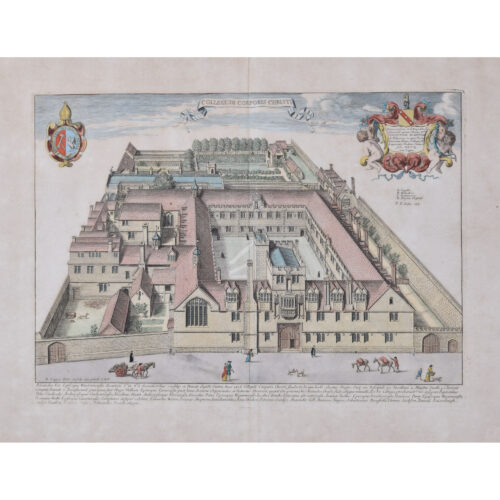
David Loggan (1634 - 1692)
Corpus Christi College, Oxford (1675)
Engraving 30 x 41 cm Loggan's view of Corpus from the 'Oxonia Illustrata', with later hand colouring. Loggan was born to English and Scottish parents, and was baptised in Danzig in 1634. After studying engraving in Danzig with Willem Hondius (1598-1652 or 1658), he moved to London in the late 1650s, going on to produce the engraved title-page for the folio 1662 Book of Common Prayer. He married in 1663 and moved to Nuffield in Oxfordshire in 1665. Loggan was appointed Public Sculptor to the nearby University of Oxford in the late 1660s, having been commissioned to produce bird’s-eye views of all the Oxford colleges. He lived in Holywell Street as he did this. The 'Oxonia Illustrata' was published in 1675, with the help of Robert White (1645-1704). Following its completion, Loggan began work on his equivalent work for Cambridge; the 'Cantabrigia Illustrata' was finally published in 1690, when he was made engraver to Cambridge University. The 'Oxonia Illustrata' also includes an engraving of Winchester College (Winchester and New College share William of Wykeham as their founder) whilst the 'Cantabrigia Illustrata' includes one of Eton College (which shares its founder, Henry VIII, with King’s College). Bird’s-eye views from this era required a particular talent as an architectural perspectivist; it was not until 1783 that it became possible for artists to ascend via hot air balloons and view the scenes they were depicting from above. Loggan thus had to rely on his imagination in conceiving the views. Loggan’s views constitute the first accurate depictions of the two Universities, in many ways unchanged today. Whilst the Oxford engravings were produced in reasonable numbers and ran to a second edition by Henry Overton (on thicker paper and with a plate number in Roman numerals in the bottom right-hand corner), those of Cambridge were printed in much smaller numbers. The Dutchman Pieter van der Aa published some miniature versions of the engravings for James Beverell’s guidebook to the UK, 'Les Delices de la Grande Bretagne' (circa 1708). The contemporary artist Andrew Ingamells (born 1956) has produced a highly-acclaimed series of etchings which bring Loggan’s original vision up to date. Condition: generally very good; a little discolouration to paper. Later hand colouring. If you are interested, please email info@manningfineart.co.uk or call us on 07929 749056. Click here for other views of Corpus Christi College, Cambridge. -
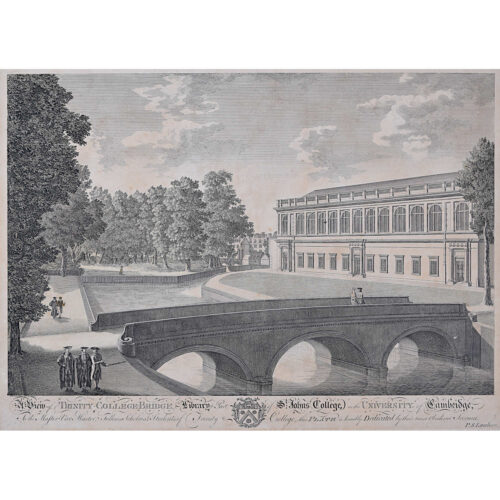
Peter Spendelowe Lamborn (1722 - 1774)
Trinity College Bridge and Library and Part of St John's College, in the University of Cambridge
Engraving 37 x 52 cm Peter Spendelowe Lamborn was an English engraver and miniature painter. He studied engraving under Basire and worked in Cambridge, where he obtained some note as an engraver. Condition: generally good; some discolouration to paper, surface dirt particularly to margins. Mounted to board and previously mounted with plate mark under mount. If you are interested, please email info@manningfineart.co.uk or call us on 07929 749056. Click here for other views of Cambridge. -

M Gerling
St John's College, Cambridge
Pen and ink 15 x 26 cm Titled, dated June 1885, and signed lower right, all in ink. Condition: generally very good; painted on card; slightly toned. If you are interested, please email info@manningfineart.co.uk or call us on 07929 749056. Click here for other views of St John’s College, Cambridge. -

Philip Martin (1927 - 2014)
Free School Lane, Cambridge
Watercolour 38 x 27 cm Signed lower left, titled below, and dated lower right, all in ink. A watercolour of the historic Free School Lane in central Cambridge, where, as in much of the city, architectural styles jostle and bikes nestle against black railings. Philip Martin read Architecture at Cambridge. Condition: generally very good; a little even toning to paper. If you are interested, please email info@manningfineart.co.uk or call us on 07929 749056. Click here for other general views of Cambridge. -

Charles Henri Toussaint (1849 - 1911)
Christ's College, Cambridge (1880)
Etching 21 x 17 cm Signed and dated 1880 in plate. An attractive etching of the Fellows' Garden at Christ's College, Cambridge. Charles Henri Toussaint was a French painter, illustrator and engraver known for his prints of architecture in Paris, historic towns in France, and English cities of architectural interest (including Oxford and Cambridge). He gained recognition at the Paris Salon in 1874. Condition: very good. If you are interested, please email info@manningfineart.co.uk or call us on 07929 749056. Click here for other views of Christ's College, Cambridge. -

Richard Bankes Harraden (1778 - 1862)
Magdalen College
Hand-coloured aquatint 13 x 21 cm A nineteenth-century view of Magdalen College, Cambridge (spelled here as 'Magdalen' - in the 19th century, the spelling of the college's name was fixed as "Magdalene" with a final "e", to avoid confusion with Magdalen College, Oxford). Richard Bankes Harraden was a printmaker, painter, and drawing master. He was active in Cambridge, producing many views of the colleges, and subsequently several Oxford colleges. Harraden was an early and exhibiting member of the Society of British Artists in London, which was established in 1823, and remained a member until 1849. He specialised in depictions of landscape, topography and architecture, and was the son of Richard Harraden (1756 - 1838) with whom he published plates as 'Harraden & Son'. Condition: very good. If you are interested, please email info@manningfineart.co.uk or call us on 07929 749056. Click here for other views of Magdalene College, Cambridge. -
Out of stock

Richard Bankes Harraden (1778 - 1862)
The Library - Magdalen College
Hand-coloured aquatint 13 x 21 cm A nineteenth-century view of the Library of Magdalen College, Cambridge (spelled here as 'Magdalen' - in the 19th century, the spelling of the college's name was fixed as "Magdalene" with a final "e", to avoid confusion with Magdalen College, Oxford). The Pepys Library is the personal library collected by Samuel Pepys, which he bequeathed to Magdalene following his death in 1703. Richard Bankes Harraden was a printmaker, painter, and drawing master. He was active in Cambridge, producing many views of the colleges, and subsequently several Oxford colleges. Harraden was an early and exhibiting member of the Society of British Artists in London, which was established in 1823, and remained a member until 1849. He specialised in depictions of landscape, topography and architecture, and was the son of Richard Harraden (1756 - 1838) with whom he published plates as 'Harraden & Son'. Condition: very good. If you are interested, please email info@manningfineart.co.uk or call us on 07929 749056. Click here for other views of Magdalene College, Cambridge -

Pieter van der Aa (1659 - 1733), after David Loggan (1634 - 1692)
Christ's College, Cambridge (1727)
Engraving 13 x 17 cm An eighteenth-century view of Christ's College, Cambridge, engraved by Pieter van der Aa after David Loggan, the noted engraver, draughtsman, and painter. Pieter van der Aa of Leiden was a Dutch publisher best known for preparing maps and atlases, though he also printed editions of foreign bestsellers and illustrated volumes. He is noted for the many engravings he produced after David Loggan's series of Oxford and Cambridge colleges and costumes. In 1727 Van Der Aa illustrated "Les Delices de la Grande Bretagne & de L'Irelande" by James Beeverell, the book in which this engraving appears. Condition: very good. If you are interested, please email info@manningfineart.co.uk or call us on 07929 749056. Click here for other views of Christ's College, Cambridge -

Mabel Oliver Rae (1868 - 1956)
Queens' Bridge, Cambridge
Etching 13 x 9 cm Titled lower left and signed lower right in plate, and again in pencil outside plate. The college's famed Mathematical Bridge, which reflects in the ruffled waters of the River Cam. Kate Hillman of the Cambridge University Engineering Department notes that: "One of the most recognisable structures on the Cam, Queens' College bridge was originally built in 1749 by James Essex the Younger. Since then it has been rebuilt twice to the original design of William Etheridge, once in 1866 and again in 1905. In 1866 the bridge deck was changed from a stepped design to the current sloped deck. In 1905 a complete rebuild of the bridge was required due to weathering of the original oak structure. stories have suggested that a group of students (or professors, depending on the storyteller) disassembled the bridge to discover how it stood up and then couldn't put it back together. The bridge was supposedly then rebuilt using rather prominent bolts." It seems more likely that the bolts were put in to prevent these notional students from repeating their trick. Mabel Oliver Rae was born in Cambridge, Cambridgeshire, and trained at the Slade School of Fine Art between 1888 and 1890. Rae is known for her skilled etchings of various rural scenes and townscapes, particularly those of the colleges of Oxford and Cambridge. She signed works with the pseudonym 'M.Oliver Rae', a ruse to conceal the fact she was a female artist, so as not to reduce her chances with commercial dealers and agents. Condition: very good; fractional toning to paper. If you are interested, please email info@manningfineart.co.uk or call us on 07929 749056. Click here for other views of Queen's College, Cambridge. -

Pembroke College, Cambridge (1998)
Watercolour 29 x 17 cm Signed lower right illegibly. Five characterful vignettes of Pembroke in bright watercolour. Condition: very good. If you are interested, please email info@manningfineart.co.uk or call us on 07929 749056. Click here for other views of Pembroke College, Cambridge. -

David Loggan (1634 - 1692)
Christ's College, Cambridge (1690)
Engraving 39 x 48 cm Loggan's view of College, Cambridge from the 'Cantabrigia Illustrate', with later hand colouring. Loggan was born to English and Scottish parents, and was baptised in Danzig in 1634. After studying engraving in Danzig with Willem Hondius (1598-1652 or 1658), he moved to London in the late 1650s, going on to produce the engraved title-page for the folio 1662 Book of Common Prayer. He married in 1663 and moved to Nuffield in Oxfordshire in 1665. Loggan was appointed Public Sculptor to the nearby University of Oxford in the late 1660s, having been commissioned to produce bird’s-eye views of all the Oxford colleges. He lived in Holywell Street as he did this. The 'Oxonia Illustrata' was published in 1675, with the help of Robert White (1645-1704). Following its completion, Loggan began work on his equivalent work for Cambridge; the 'Cantabrigia Illustrata' was finally published in 1690, when he was made engraver to Cambridge University. The 'Oxonia Illustrata' also includes an engraving of Winchester College (Winchester and New College share William of Wykeham as their founder) whilst the 'Cantabrigia Illustrata' includes one of Eton College (which shares its founder, Henry VIII, with King’s College). Bird’s-eye views from this era required a particular talent as an architectural perspectivist; it was not until 1783 that it became possible for artists to ascend via hot air balloons and view the scenes they were depicting from above. Loggan thus had to rely on his imagination in conceiving the views. Loggan’s views constitute the first accurate depictions of the two Universities, in many ways unchanged today. Whilst the Oxford engravings were produced in reasonable numbers and ran to a second edition by Henry Overton (on thicker paper and with a plate number in Roman numerals in the bottom right-hand corner), those of Cambridge were printed in much smaller numbers. The Dutchman Pieter van der Aa published some miniature versions of the engravings for James Beverell’s guidebook to the UK, 'Les Delices de la Grande Bretagne' (circa 1708). The contemporary artist Andrew Ingamells (born 1956) has produced a highly-acclaimed series of etchings which bring Loggan’s original vision up to date. Condition: generally very good; a little staining to margins, a tiny wormhole between tree and coat of arms on left side, a pin hole in the tree on the left, two short old creases in paper below 'Collegium Christi' and a small area of thinning on the extreme right. If you are interested, please email info@manningfineart.co.uk or call us on 07929 749056. Click here for other views of Christ’s College, Cambridge. -

John Samuel Agar (1773 - 1858) after John Uwins (1782 - 1857)
Pensioner, Cambridge (1815)
Aquatint with original hand colouring 30 x 25 cm Published by Rudolph Ackermann (1764 - 1834). An engraving of a pensioner (one who paid a fixed annual fee in order to study) of the University from Ackermann's 'A History of the University of Cambridge, Its Colleges, Halls and Public Buildings'. The student pores over an open book with quill poised nearby. Thomas Uwins RA RWS was a British painter in watercolour and oil, and a book illustrator. He became a full member of the Old Watercolour Society and a Royal Academician, and held a number of high-profile art appointments including the librarian of the Royal Academy, Surveyor of Pictures to Queen Victoria and the Keeper of the National Gallery. In the late 1790s he began producing work for Ackermann's collections. John Samuel Agar was an English portrait painter and engraver, who exhibited his works at the Royal Academy from 1796 to 1806 and at the British Institution until 1811. He was at one time president of the Society of Engravers. Rudolph Ackermann published many of his engravings. Rudolph Ackermann was an Anglo-German bookseller, inventor, lithographer, publisher and businessman. In 1795 he established a print-shop and drawing-school at 96 Strand. Here Ackermann set up a lithographic press and began a trade in prints. He later began to manufacture colours and thick carton paper for landscape and miniature painters. Within three years the premises had become too small and he moved to 101 Strand, in his own words “four doors nearer to Somerset House”, the seat of the Royal Academy of Arts. Between 1797 and 1800 Ackermann rapidly developed his print and book publishing business, encompassing many different genres including topography, caricature, portraits, and decorative prints. Condition: very good; slight paper toning. If you are interested, please email info@manningfineart.co.uk or call us on 07929 749056. Click here for other Cambridge pictures. -

John Samuel Agar (1773 - 1858) after John Uwins (1782 - 1857)
Nobleman, Cambridge (1815)
Aquatint with original hand colouring 30 x 25 cm Published by Rudolph Ackermann (1764 - 1834). An engraving of a nobleman studying at Cambridge, from Ackermann's 'A History of the University of Cambridge, Its Colleges, Halls and Public Buildings'. Thomas Uwins RA RWS was a British painter in watercolour and oil, and a book illustrator. He became a full member of the Old Watercolour Society and a Royal Academician, and held a number of high-profile art appointments including the librarian of the Royal Academy, Surveyor of Pictures to Queen Victoria and the Keeper of the National Gallery. In the late 1790s he began producing work for Ackermann's collections. John Samuel Agar was an English portrait painter and engraver, who exhibited his works at the Royal Academy from 1796 to 1806 and at the British Institution until 1811. He was at one time president of the Society of Engravers. Rudolph Ackermann published many of his engravings. Rudolph Ackermann was an Anglo-German bookseller, inventor, lithographer, publisher and businessman. In 1795 he established a print-shop and drawing-school at 96 Strand. Here Ackermann set up a lithographic press and began a trade in prints. He later began to manufacture colours and thick carton paper for landscape and miniature painters. Within three years the premises had become too small and he moved to 101 Strand, in his own words “four doors nearer to Somerset House”, the seat of the Royal Academy of Arts. Between 1797 and 1800 Ackermann rapidly developed his print and book publishing business, encompassing many different genres including topography, caricature, portraits, transparencies and decorative prints. Condition: paper slightly toned within platemark. If you are interested, please email info@manningfineart.co.uk or call us on 07929 749056. Click here for other Cambridge pictures. -

Pieter van der Aa (1659 - 1733), after David Loggan (1634 - 1692)
Queens' College, Cambridge (1727)
Engraving 13 x 17 cm An eighteenth-century view of Queens' College, Cambridge, engraved by Pieter van der Aa after David Loggan, the noted engraver, draughtsman, and painter. Pieter van der Aa of Leiden was a Dutch publisher best known for preparing maps and atlases, though he also printed editions of foreign bestsellers and illustrated volumes. He is noted for the many engravings he produced after David Loggan's series of Oxford and Cambridge colleges and costumes. In 1727 Van Der Aa illustrated "Les Delices de la Grande Bretagne & de L'Irelande" by James Beeverell, the book in which this engraving appears. Condition: very good. If you are interested, please email info@manningfineart.co.uk or call us on 07929 749056. Click here for other views of Queens' College, Cambridge -

Pieter van der Aa (1659 - 1733), after David Loggan (1634 - 1692)
Map of Cambridge (1727)
Engraving 13 x 17 cm An eighteenth-century map of Cambridge, engraved by Pieter van der Aa after David Loggan, the noted engraver, draughtsman, and painter. Pieter van der Aa of Leiden was a Dutch publisher best known for preparing maps and atlases, though he also printed editions of foreign bestsellers and illustrated volumes. He is noted for the many engravings he produced after David Loggan's series of Oxford and Cambridge colleges and costumes. In 1727 Van Der Aa illustrated "Les Delices de la Grande Bretagne & de L'Irelande" by James Beeverell, the book in which this engraving appears. Condition: very good. If you are interested, please email info@manningfineart.co.uk or call us on 07929 749056. Click here for other general views of Cambridge