-
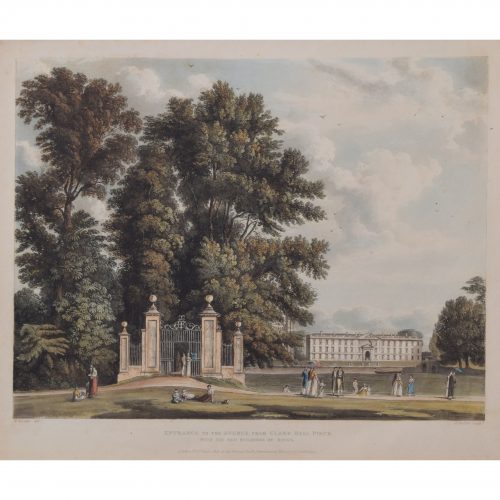
Joseph Constantine Stadler (1755 - 1828) after William Westall (1781 - 1850)
Entrance to the Avenue, from Clare Hall Piece (1815)
Hand-coloured aquatint 25 x 30 cm Published by Rudolph Ackermann (1764 - 1834). An engraving of the gates of Clare College, formerly known as Clare Hall. The River Cam winds its way through the scene; we can see the New Buildings of King's College, Cambridge on the far bank. Victorian figures, several with parasols, picnic or promenade in the foreground. Joseph Constantine Stadler was a prolific German émigré engraver of images after his contemporaries - here, 18th-century English landscape painter and diarist Joseph Farington. Stadler's engravings are wide-ranging in subject matter and include landscapes, seascapes and portraits, as well as military, sporting and decorative subjects. Stadler was employed by the leading print publisher of the time, John Boydell. Stadler lived in Knightsbridge when he died at the age of 73. William Westall was a British landscape artist. He was born in Hertford and enrolled at the Royal Academy schools in 1799. He later became the draughtsman for a voyage to Australia and the South Seas. After being shipwrecked, he travelled to Canton in China and to India, staying in Bombay for several months. He returned to England in 1805 but later set off for Madeira and Jamaica. He became a member of the Society of Painters in Water Colours (1811) and an associate of the Academy (1812). Following a mental breakdown, he regularly visited the Lake District and published ‘Views of the Valley and Vale of Keswick’ (1820). His series of aquatints of the Thames, the great universities, and England's public schools for Ackermann are among his most popular works. Rudolph Ackermann was an Anglo-German bookseller, inventor, lithographer, publisher and businessman. In 1795 he established a print-shop and drawing-school at 96 Strand. Here Ackermann set up a lithographic press and began a trade in prints. He later began to manufacture colours and thick carton paper for landscape and miniature painters. Within three years the premises had become too small and he moved to 101 Strand, in his own words "four doors nearer to Somerset House", the seat of the Royal Academy of Arts. Between 1797 and 1800 Ackermann rapidly developed his print and book publishing business, encompassing many different genres including topography, caricature, portraits, transparencies and decorative prints. Condition: good. Some gentle age toning. If you’d like to know more, please email info@manningfineart.co.uk or call us on 07929 749056. -
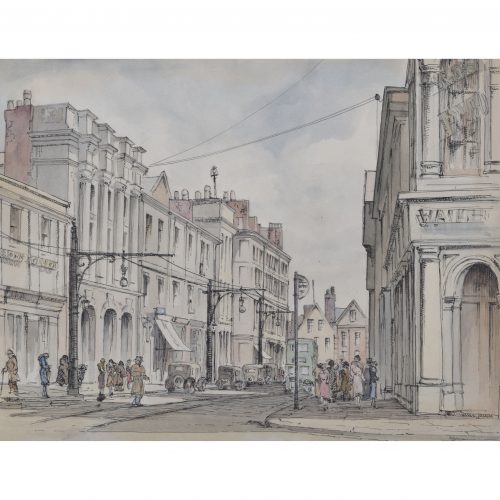
Louis Osman (1914 - 1996)
Queen Street, Exeter
Watercolour 25 x 33 cm Inscribed in Osman's hand on old mount (visible in the gallery of photographs). Osman's view of Queen Street in Exeter, complete with modish pedestrians and vehicles typical of the 1930s. Osman was as much an artist as an architect. This is likely a portfolio piece from his time studying at the Bartlett School of Architecture, and is as such a piece of architectural history as well as a beautiful Osman design. Osman was awarded a First Class degree and the Donaldson Medal of the RIBA (for the best result in his year group) by the Bartlett, and then went on to the Slade School of Art. He subsequently trained with Sir Albert Richardson - we also have several Richardson works in our collection. After the war, Osman busied himself as an architect. His work included contributions to Westminster Abbey, and Lincoln, Exeter, Ely, and Lichfield Cathedrals, Staunton Harold Church in Ashby de la Zouch for the National Trust, and of course his folly: the Grade I listed Elizabethan manor house, Canons Ashby in Northamptonshire, now a National Trust property. At Canons Ashby he established a workshop and had a team of silversmiths and goldsmiths working for him. In 1976 he made the gold enamelled coffin that holds the copy of the Magna Carta on view in the United States Capitol, Washington, DC. Condition: generally very good; some age toning. If you’d like to know more, please email info@manningfineart.co.uk or call us on 07929 749056. -
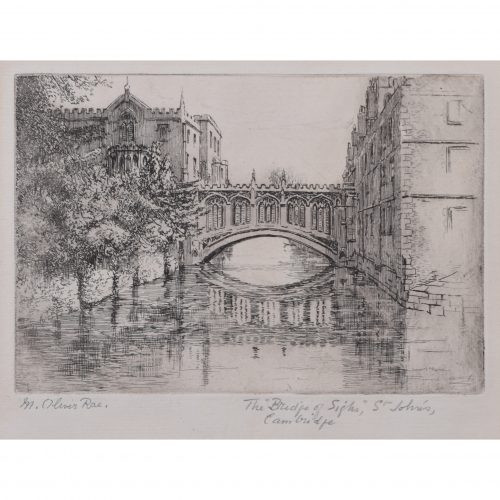
Mabel Oliver Rae (1868 - 1956)
The Bridge of Sighs, St John's College, Cambridge (circa 1920)
Etching 13 x 18 cm Hand-signed in pencil lower left, and titled in pencil lower right. Initialled 'MR' in plate lower left. The Bridge of Sighs is an iconic feature of St John’s College, and one of the most recognisable pieces of architecture in Cambridge. It was built in 1831 by the architect Henry Hutchinson and crosses the River Cam between the college's Third Court and New Court. It is the only covered bridge to cross the River Cam, and the only College bridge built in the Victorian Gothic style. Mabel Oliver Rae was born in Cambridge, Cambridgeshire, and trained at the Slade School of Fine Art between 1888 and 1890. Rae is known for her skilled etchings of various rural scenes and townscapes, particularly those of the colleges of Oxford and Cambridge. She signed works with the pseudonym 'M.Oliver Rae', a ruse to conceal the fact she was a female artist, so as not to reduce her chances with commercial dealers and agents. Condition: even age toning, a little spotting, generally good. If you’d like to know more, please email info@manningfineart.co.uk or call us on 07929 749056. -
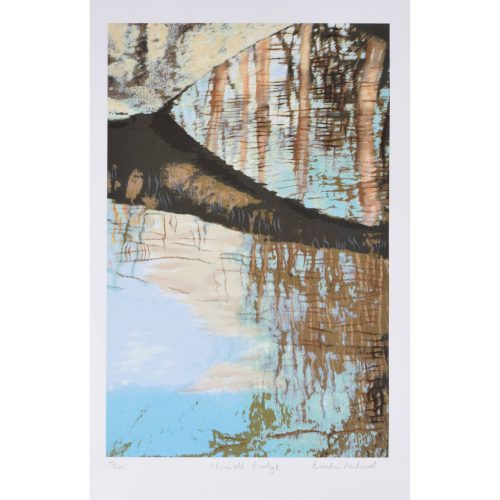
Brendan Neiland (b. 1941) R.A. (Expelled)
Cherwell Bridge
Screenprint 53 x 34 cm Signed, titled, and numbered 43 / 175 in pencil. A screenprint of Oxford’s beauteous Cherwell Bridge in University Parks, reflected in the glassy surface of the river. Reflected architecture is one of Neiland’s most recurring themes. Neiland's work is widely exhibited in major museums and galleries worldwide including, in Britain, the Victoria and Albert Museum, The Tate Gallery London, The Collections of the British Council, and the Arts Council of Great Britain. He is represented by the Redfern Gallery and has had numerous shows internationally, including at the Galerie Belvedere in Singapore, who represent him in Singapore and the Far East. Condition: very good. If you’d like to know more, please email info@manningfineart.co.uk or call us on 07929 749056. -
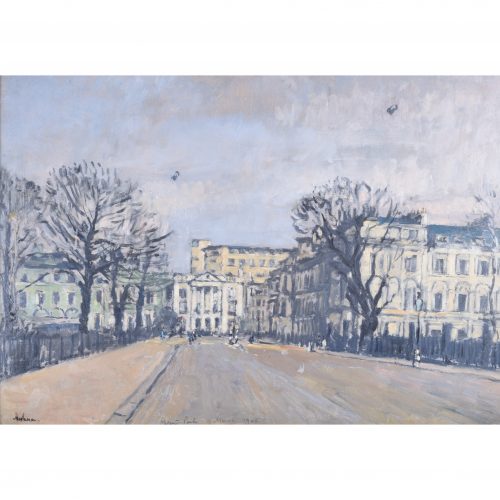
Paul Ayshford Methuen (1886 - 1974)
Barrage Balloons, Regents Park, 9 March 1940
Oil on board 36 x 52 cm Signed lower left and titled and dated lower centre. Lord Methuen's oil painting of Regent's Park on a winter's day, with barrage balloons above. Barrage balloons were set up - stationed at an altitude of around 4,000 ft - as a barrier to enemy aircraft. The steel cables used to tether the balloons would take an enemy aeroplane out of the sky if it were to hit the cable. The UK had thousands of them, filled partly with hydrogen and operated largely by women, to protect significant towns, cities, and military installations. These strange blobs floated over the country, just asking to be captured by artists. Methuen had rejoined his regiment (serving as a Captain) in 1939 but was likely stationed in London for a while, when he might have had the opportunity to capture this scene. When Methuen painted the scene in 1940, Britain was still in the stage of the phoney war. The Battle of Britain did not commence until 10 July, and the Blitz not until 7 September - but Britain's defences were ready. Barrage balloons were important all the way through the War: they defended London against the V2 missiles; they defended the D-Day invasion fleet; and they protected the invasion army for months. Indeed, it was said that the vast amount of material brought into the UK from the States prior to D-Day would have caused Britain to sink under the sea, were it not for the huge number of barrage balloons holding the country up... Condition: excellent. Recently revarnished. If you’d like to know more, please email info@manningfineart.co.uk or call us on 07929 749056. -
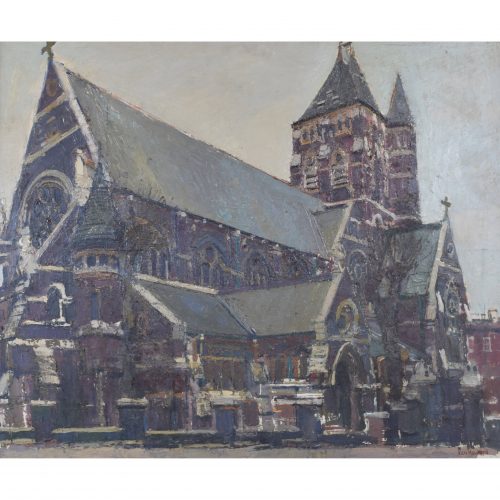
Ken Howard RA (1932 - 2022)
Hampstead Church (St Stephen's Church, Rosslyn Hill)
Oil on board 75 x 91 cm Ken Howard's magnificent view of St Stephen's Church, Hampstead. The artist's rich, deep colour palette and use of impasto underline the neo-gothic style of the church. Howard died in Hampstead and painted several views of the area and its architecture. St Stephen's was designed in the Neo Gothic style by Samuel Sanders Teulon and he considered it the best of the 114 churches he designed, calling it his "mighty church". The building is no longer a church, but wedding ceremonies still take place there; it was made a Grade I listed building in 1974. Kenneth Howard OBE RA was a British artist and painter. He was President of the New English Art Club from 1998 to 2003. He studied at the Hornsey College of Art and the Royal College of Art. In 1958 he won a British Council Scholarship to Florence, and in 1973 and 1978 he was the Official War Artist to Northern Ireland, and 1973 - 80 worked in various locations, including Hong Kong, Cyprus and Canada with the British Army. In 1983 he was elected an Associate of the Royal Academy (ARA). In 1998 he became President of the New English Art Club, a post he held until 2003. In 1991 he was elected a Royal Academician (RA). Howard was given his OBE in 2010. Condition: very good. If you’d like to know more, please email info@manningfineart.co.uk or call us on 07929 749056. -
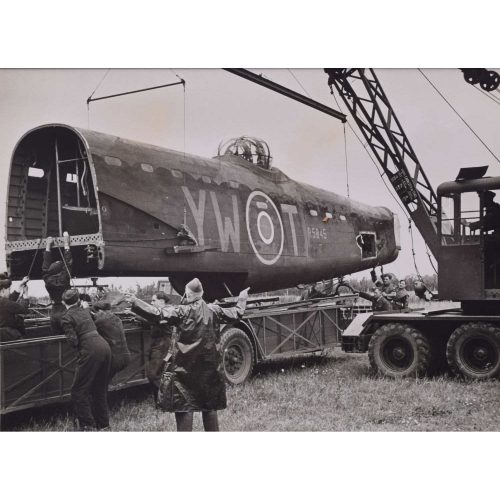
Lancaster Bomber R5845 YW-T
Original Silver Gelatin photograph 19 x 25 cm Stamped to reverse "Copyright Hulton Press Ltd" The RAF Maintenance Unit are recovering R5845 which was on the strength of 1660 Heavy Conversion Unit Winthorpe in October 1943 from the runway. Newark Air Museum have another photograph - included in the attached photographs, but not available for sale - of the entire aeroplane on a string of Queen Mary trailers. R5845 was finally written off on the night of 18/19 July 1944 on a mission to destroy a railway junction at Revigny in France. With 11 x 1000lb and 3 x 500lb bombs nothing was heard of the aircraft after takeoff and it failed to return to base. Following the war it was established that it was intercepted by a night fighter on its way home. Four of the crew evaded capture, and one was made PoW, the Pilot F/O TEW Davis of RAAF being buried in the churchyard at Heiltz-le-Maurupt, Marne, France. Provenance: from the collection of Philip J R Moyes, author of many books on the RAF, most notably The Pictorial History which ran to several volumes. Condition: mostly good. -
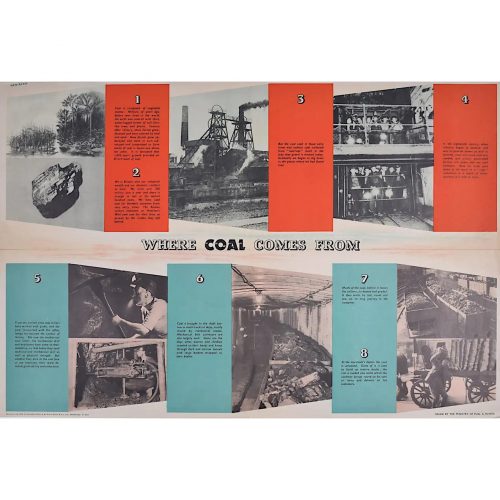
FHK Henrion (1914 - 1990)
Where Coal Comes From (circa 1945)
Original vintage poster 51 x 76 cm Signed in plate. Issued by the Ministry of Fuel and Power; printed for HM Stationery Office by Field Sons & Co Ltd, Bradford. We have been unable to identify any other copy of this poster by this renowned designer in any public collection - it is possibly the only remaining copy. A Ministry of Fuel poster encouraging the public to use less fuel. FHK Henrion was a German graphic designer who moved to Paris after leaving school, studying with the poster designer Paul Colin and then moving to London in 1936. Interned in the Isle of Man during the Second World War, he went on to design posters for the Ministry of Information and the US Office of War Information. After the War he started his own design agency, pioneering the concept of corporate identity. Clients included KLM, Giro, The Post Office, Tate & Lyle. The Ministry of Power and Fuel existed from 1942 to 1957 to control the nation's use of the scarce resources during and after the Second World War. Condition: centre folds as issued with a little wear to the extremities of the folds; generally very good. If you’d like to know more, please email info@manningfineart.co.uk or call us on 07929 749056. -
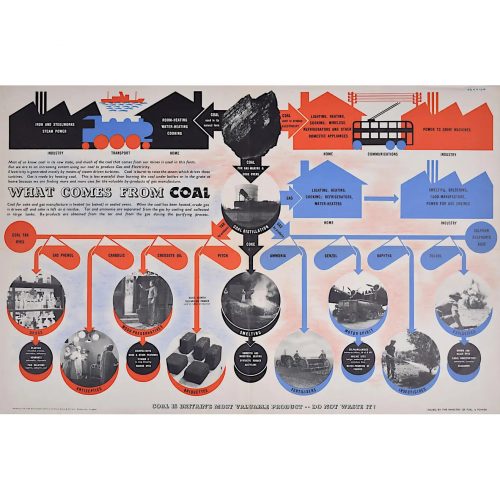
FHK Henrion (1914 - 1990)
What Comes from Coal (circa 1945)
Original vintage poster 51 x 76 cm Signed in plate. Issued by the Ministry of Fuel and Power; printed for HM Stationery Office by Field Sons & Co Ltd, Bradford. We have been unable to identify any other copy of this poster by this renowned designer in any public collection - it is possibly the only remaining copy. A Ministry of Fuel poster encouraging the public to use less fuel. FHK Henrion was a German graphic designer who moved to Paris after leaving school, studying with the poster designer Paul Colin and then moving to London in 1936. Interned in the Isle of Man during the Second World War, he went on to design posters for the Ministry of Information and the US Office of War Information. After the War he started his own design agency, pioneering the concept of corporate identity. Clients included KLM, Giro, The Post Office, Tate & Lyle. The Ministry of Power and Fuel existed from 1942 to 1957 to control the nation's use of the scarce resources during and after the Second World War. Condition: centre folds as issued with a little wear to the extremities of the folds; generally very good. If you’d like to know more, please email info@manningfineart.co.uk or call us on 07929 749056. -
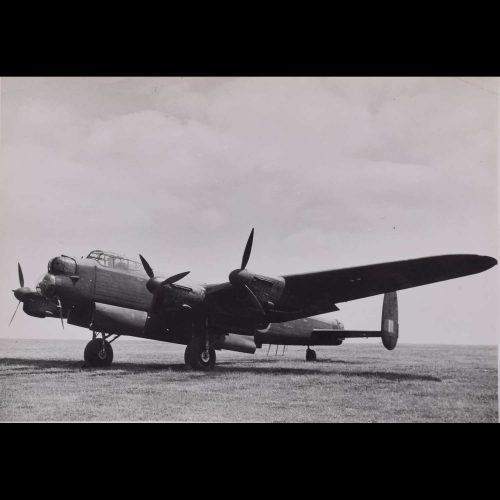
Lancaster HK543
Original Silver Gelatin photograph 19 x 25 cm Stamped to reverse "Copyright 'the Aeroplane'" 23 July 1945 HK543 was a Lancaster III, probably produced in 1943. Here she is shown in July 1945, she was recorded photgraphically on bombing trials from Boscombe Down that month, this photograph may reasonably be assumed to be from that event. Provenance: from the collection of Philip J R Moyes, author of many books on the RAF, most notably The Pictorial History which ran to several volumes. Condition: mostly good. -
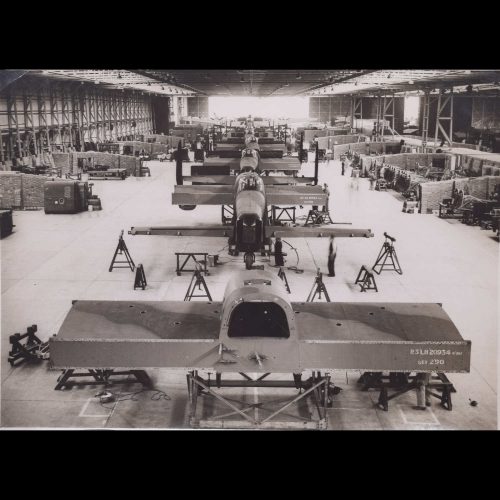
Lancaster Bombers under Construction
Original Silver Gelatin photograph 17 x 21 cm Stamped to reverse 'Certified by Photographic News Agencies Ltd as passed by Censor' '23 Oct 1942' This photograph shows the parts of a Lancaster bomber being assembled. At the back of the photograph, facing away from the viewer, are two nearly or newly completed aircraft, their airscrews visible attached to the wings. The factory buzzes with activity as important war work is undertaken. We have been unable to trace any other copy of this photograph. Provenance: from the collection of Philip J R Moyes, author of many books on the RAF, most notably The Pictorial History which ran to several volumes. -
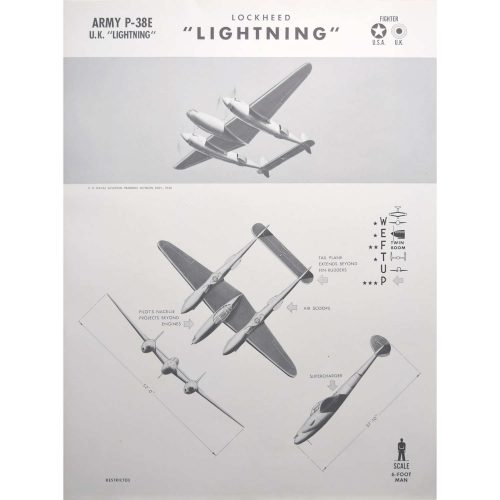
Army P-38E Lockheed "Lightning"
Aeroplane identification poster, published 1942 63 x 47 cm A particularly unusual style of aeroplane identification poster, owing to the very arty images. Most such posters rely on very plain silhouettes, this series - and we have several in this series; view them here - have a much more arty approach to the task with shading and an interesting angle view. The Lockheed P-38 Lightning was an American single-seated, twin piston-engined fighter aircraft that was used during World War II. The Lightning was originally designed as a bomber-interceptor and was never intended to be a fighter. Weight was kept to a minimum and it was far more advanced and faster than its U.S. counterparts, the Bell P-39 Airacobra and Curtiss P-40 Warhawk (original Airacobra and Warhawk posters from the same 1942 series are also available in our storefront). It caught the attention of the US Army Air Corps (USAAC) very quickly. The Lightning shot down more Japanese aeroplanes than any other fighter during World War II. When first introduced in 1939, the Lightning was able to fly a steady course at 413 mph (665 km/h), making it the fastest production aeroplane in the world. It remained one of the fastest climbers right up to the end of the WW II. Condition: generally very good. If you are interested, please email info@manningfineart.co.uk or call us on 07929 749056. -
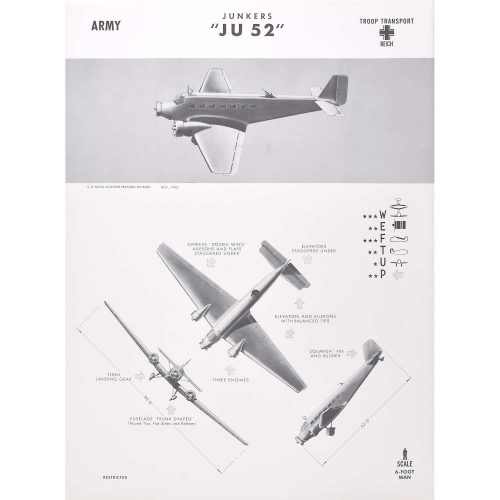
Junkers "JU 52"
Aeroplane identification poster, published 1942 63 x 47 cm A particularly unusual style of aeroplane identification poster, owing to the very arty images. Most such posters rely on very plain silhouettes, this series - and we have several in this series; view them here - have a much more arty approach to the task with shading and an interesting angle view. The Junkers Ju 52/3m (nicknamed Tante Ju ("Aunt Ju") and Iron Annie) was a transport aircraft that was designed and manufactured by German aviation company Junkers. Development of the Ju 52 commenced during 1930, headed by German aeronautical engineer Ernst Zindel. Its maiden flight was on 13 October 1930. Following the rise of Nazi Germany, thousands of Ju 52s were procured as a staple military transport of the nation. The Ju 52 was in production between 1931 and 1952. In a civilian role, it flew with over 12 airlines, including Swissair and Deutsche Luft Hansa, as both a passenger carrier and a freight hauler. In a military role, large numbers flew with the Luftwaffe, being deployed on virtually all fronts of the Second World War as a troop and cargo transport; it was also briefly used as a medium bomber. Additionally, the type was deployed by other nation''s militaries in conflicts such as the Spanish Civil War, the Chaco War, and the Portuguese Colonial War. During the postwar era, the Ju 52 had a lengthy service life with numerous military and civilian operators; large numbers were still in use by the 1980s. Even in the 21st century, several aircraft have remained operational, typically used for purposes such as heritage aviation displays and aerial sightseeing. Condition: generally very good. If you are interested, please email info@manningfineart.co.uk or call us on 07929 749056. -
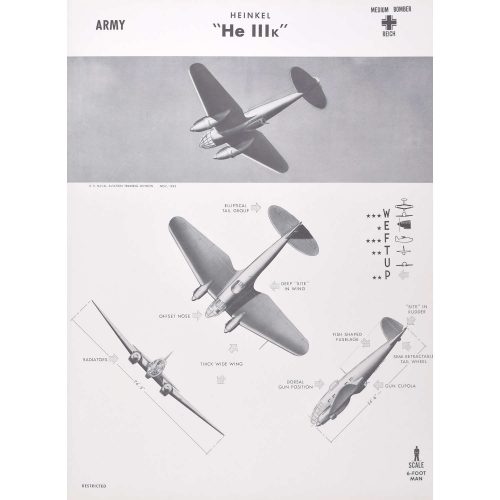
Heinkel "He 111K"
Aeroplane identification poster, published 1942 63 x 47 cm A particularly unusual style of aeroplane identification poster, owing to the very arty images. Most such posters rely on very plain silhouettes, this series - and we have several in this series; view them here - have a much more arty approach to the task with shading and an interesting angle view. The Heinkel He 111 was a German bomber aircraft designed by Siegfried and Walter Günter at Heinkel Flugzeugwerke in 1934. Through development it was described as a "wolf in sheep''s clothing"; due to restrictions placed on Germany after the First World War prohibiting bombers, it masqueraded as a civil airliner, although from conception the design was intended to provide the nascent Luftwaffe with a fast medium bomber. Perhaps the best-recognised German bomber due to the distinctive, extensively glazed "greenhouse" nose of later versions, the Heinkel He 111 was the most numerous Luftwaffe bomber during the early stages of World War II. The bomber fared well until the Battle of Britain, when its weak defensive armament was exposed. Nevertheless, it proved capable of sustaining heavy damage and remaining airborne. As the war progressed, the He 111 was used in a wide variety of roles on every front in the European theatre. It was used as a strategic bomber during the Battle of Britain (and has a prominent role in the film "Battle of Britain"), a torpedo bomber in the Atlantic and Arctic, and a medium bomber and a transport aircraft on the Western, Eastern, Mediterranean, Middle Eastern, and North African Front theatres. The He 111 was constantly upgraded and modified, but became obsolete during the latter part of the war. Condition: generally very good. If you are interested, please email info@manningfineart.co.uk or call us on 07929 749056. -
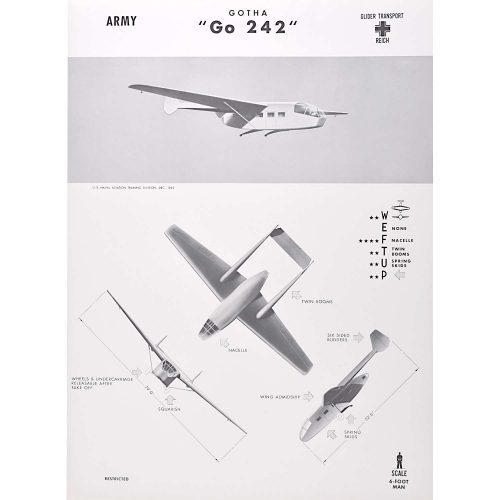
Army Gotha "Go 242"
Aeroplane identification poster, published 1942 63 x 47 cm A particularly unusual style of aeroplane identification poster, owing to the very arty images. Most such posters rely on very plain silhouettes, this series - and we have several in this series; view them here - have a much more arty approach to the task with shading and an interesting angle view. The Gotha Go 242 was a transport glider used by the Luftwaffe during World War II. It was designed by Albert Kalkert in response to the request for a heavy transport glider to replace the DFS 230 which was then in service. The requirement was for a glider capable of carrying 20 fully laden troops, or equivalent cargo. Two prototypes flew in 1941 and the type quickly entered production, with a total of 1,528 being built. In service, Go 242s were towed into the air by Heinkel He 111s or Junkers Ju 52s. Most saw service in the Mediterranean, North Africa and Aegean. Ju 87D-2s had strengthened rear fuselage and combined tailwheel and hook for towing the Go 242. Today, there are two surviving 242s - one in the Musée de la Resistance du Vercors in Valence, France, and the other in the Technik Museum and Luftwaffenmuseum der Bundeswehr in Berlin, Germany. Condition: generally very good. If you are interested, please email info@manningfineart.co.uk or call us on 07929 749056.