-
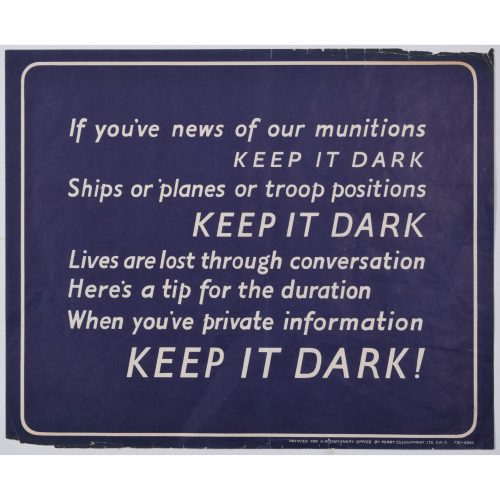
Keep It Dark (1939 - 1945)
Lithographic poster 25 x 31 cm Sponsored by Her Majesty's Stationery Office; printed by Perry Colourprint. A copy of this poster is held by the Imperial War Museum. This poster, bearing lyrics designed to be sung to the tune of "She'll be coming round the mountain", was designed for the Ministry of Information during the Second World War. It urges the population to avoid talking carelessly about details of Britain's operational movements, which might unwittingly end up in the wrong hands. Condition: good. Some small losses to extreme margins. If you’d like to know more, please email info@manningfineart.co.uk or call us on 07929 749056. -
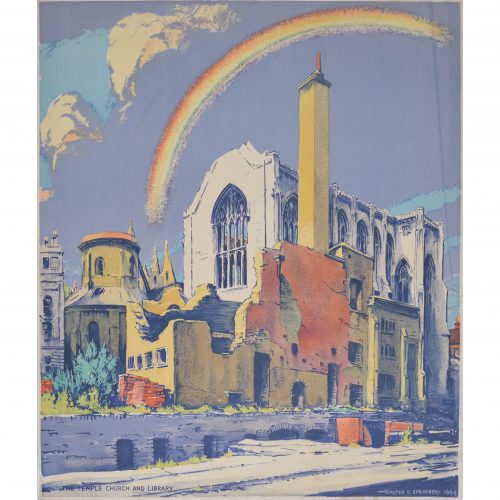
Walter Ernest Spradbery (1889 - 1969)
Temple Church and Library after Bombardment (1944)
Lithograph 66 x 57 cm Walter Spradbery's poster for the London Underground depicting a bombed Temple Church; a rainbow strikes hopefully out of the church's remains, and the sun shines on the golden stone of the building. The full poster bears the legend 'The Proud City' above Spradbery's design, and, beneath it, a quote from Charles Lamb: 'So may the winged horse, your ancient badge and cognisance, still flourish!'. This is a fantastic piece of British and London history, as well as a fantastically designed poster by a notable 20th century artist. The London Transport Museum has a copy of the poster, reference 1983/4/5751. 'The Proud City' was a series of six posters, all designed by Spradbery. They were commissioned by London Transport in 1944 as a defiant celebration of London's surviving the Blitz, and each poster also included a literary quotation. Walter Ernest Spradbery was a designer, painter, and poet who lived through the First and Second World Wars. He produced posters for LNER, Southern Railways, and London Transport, and was noted for his fascination with architecture and landscape. He studied, and later taught, at the Walthamstow School of Art. He was a pacifist and campaigned for nuclear disarmament, serving in the Medical Corps during the First World War and painting scenes of warfare for its duration, as well as during the Second World War. His anti-war stance and the horrors he had witnessed as a medic fed into his post-war poster design, especially 'The Proud City' poster series. Condition: generally very good. If you’d like to know more, please email info@manningfineart.co.uk or call us on 07929 749056. -
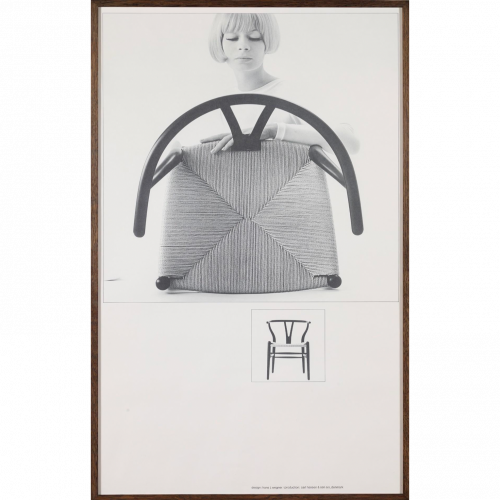
Paul Salomonsen (active 1960s) Y Chair (1964)
Lithographic poster (2014) 99 x 61 cm The poster features Hans J Wegner's famous 'Y chair', also known as the 'Wishbone chair'. Carl Hansen & Søn commissioned the poster from a photograph by Salomonsen, a 1960s photographer. The stylish and typically Danish woman examining the chair marks it as a piece of typically Danish design. The chair was known as "The Chair" when it was used in the TV-transmitted debate between John F Kennedy and Richard Nixon in 1959. The Chair subsequently became an icon of Danish mid-century furniture design. Condition: Excellent. If you’d like to know more, please email info@manningfineart.co.uk or call us on 07929 749056. -
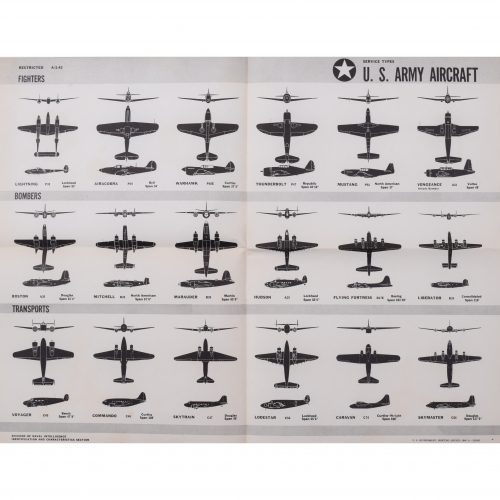
1943 Army World War II USA (1942)
Original aeroplane recognition poster 44 x 59 cm A summary of US aeroplanes from the series of US Navy identification posters that we have in stock. Fighters: P38 Lightning; P39 Airacobra; Curtiss P40E Warhawk; P47 Thunderbolt; P51 Mustang; A31 Vengeance. Bombers: A20 Boston; B25 Mitchell; B26 Marauder; Lockheed Hudson; Boeing B17E Flying Fortress; B24 Consolidated Liberator. Transports: C45 Voyager; C46 Commando; C47 Douglas Skytrain; Lockheed Lodestar; C76 Caravan; C54 Douglas Skymaster. Condition: generally very good, occasional handling marks. Folds as issued. If you’d like to know more, please email info@manningfineart.co.uk or call us on 07929 749056. -
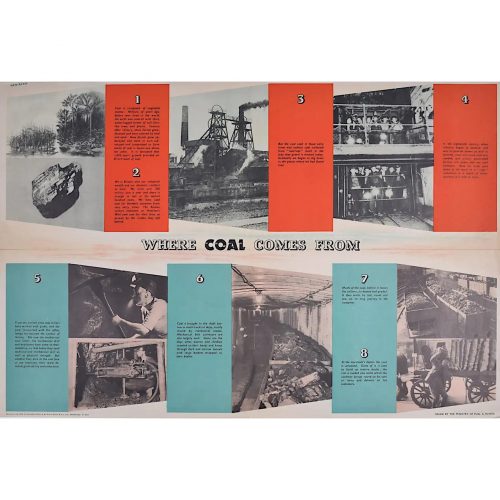
FHK Henrion (1914 - 1990)
Where Coal Comes From (circa 1945)
Original vintage poster 51 x 76 cm Signed in plate. Issued by the Ministry of Fuel and Power; printed for HM Stationery Office by Field Sons & Co Ltd, Bradford. We have been unable to identify any other copy of this poster by this renowned designer in any public collection - it is possibly the only remaining copy. A Ministry of Fuel poster encouraging the public to use less fuel. FHK Henrion was a German graphic designer who moved to Paris after leaving school, studying with the poster designer Paul Colin and then moving to London in 1936. Interned in the Isle of Man during the Second World War, he went on to design posters for the Ministry of Information and the US Office of War Information. After the War he started his own design agency, pioneering the concept of corporate identity. Clients included KLM, Giro, The Post Office, Tate & Lyle. The Ministry of Power and Fuel existed from 1942 to 1957 to control the nation's use of the scarce resources during and after the Second World War. Condition: centre folds as issued with a little wear to the extremities of the folds; generally very good. If you’d like to know more, please email info@manningfineart.co.uk or call us on 07929 749056. -
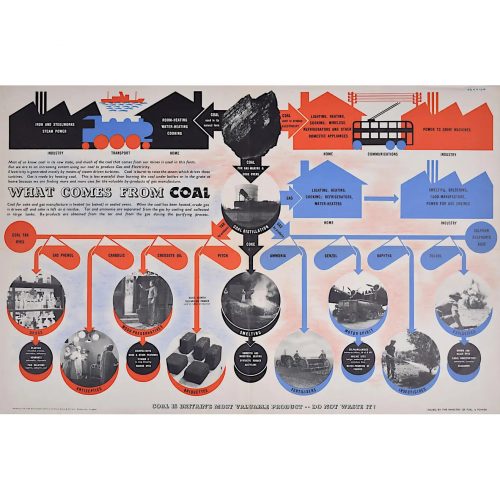
FHK Henrion (1914 - 1990)
What Comes from Coal (circa 1945)
Original vintage poster 51 x 76 cm Signed in plate. Issued by the Ministry of Fuel and Power; printed for HM Stationery Office by Field Sons & Co Ltd, Bradford. We have been unable to identify any other copy of this poster by this renowned designer in any public collection - it is possibly the only remaining copy. A Ministry of Fuel poster encouraging the public to use less fuel. FHK Henrion was a German graphic designer who moved to Paris after leaving school, studying with the poster designer Paul Colin and then moving to London in 1936. Interned in the Isle of Man during the Second World War, he went on to design posters for the Ministry of Information and the US Office of War Information. After the War he started his own design agency, pioneering the concept of corporate identity. Clients included KLM, Giro, The Post Office, Tate & Lyle. The Ministry of Power and Fuel existed from 1942 to 1957 to control the nation's use of the scarce resources during and after the Second World War. Condition: centre folds as issued with a little wear to the extremities of the folds; generally very good. If you’d like to know more, please email info@manningfineart.co.uk or call us on 07929 749056. -
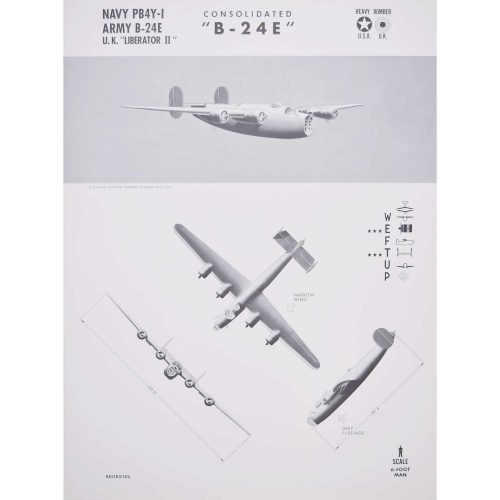
Navy and Army Consolidated Aircraft "B-24E" "Liberator II"
US Naval Aviation Training Division Original aeroplane recognition poster (1942) 63 x 47 cm A particularly unusual style of aeroplane identification poster, owing to the very arty images. Most such posters rely on very plain silhouettes, this series - and we have several in this series; view them here - have a much more arty approach to the task with shading and an interesting angle view. The Consolidated B-24 Liberator is an American heavy bomber, designed by Consolidated Aircraft of San Diego, California. Early RAF Liberators were the first aircraft to cross the Atlantic Ocean as a matter of routine. The B-24 was used extensively in World War II. It served in every branch of the American armed forces as well as several Allied air forces and navies, and was used in every theatre of war operations. In comparison with its contemporaries, the B-24 was relatively difficult to fly and had poor low-speed performance; it also had a lower ceiling and was less robust than the Boeing B-17 Flying Fortress. While aircrews tended to prefer the B-17, General Staff favoured the B-24 and procured it in huge numbers for a wide variety of roles. At approximately 18,500 units – including 8,685 manufactured by Ford Engine Company – it holds records as the world's most produced bomber, heavy bomber, multi-engine aircraft, and American military aircraft in history. Condition: Generally very good, occasional handling marks. If you’d like to know more, please email info@manningfineart.co.uk or call us on 07929 749056. -
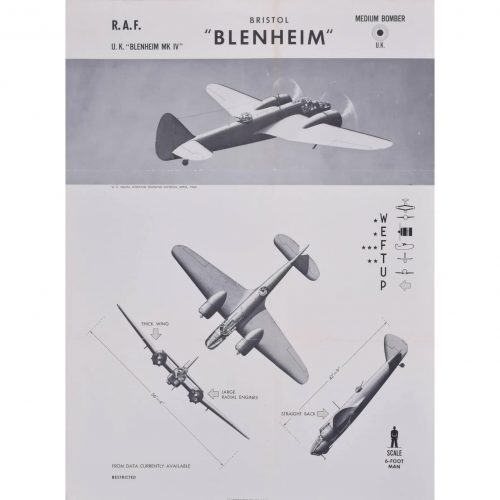
Royal Air Force Bristol Blenheim
US Naval Aviation Training Division Original aeroplane recognition poster (1942) 63 x 47 cm A particularly unusual style of aeroplane identification poster, owing to the very arty images. Most such posters rely on very plain silhouettes, this series - and we have several in this series; view them here - have a much more arty approach to the task with shading and an interesting angle view. The Bristol Blenheim is a British light bomber aircraft designed and built by the Bristol Aeroplane Company which was used extensively in the first two years of the Second World War. Condition: Generally very good, occasional handling marks or folds. If you’d like to know more, please email info@manningfineart.co.uk or call us on 07929 749056. -
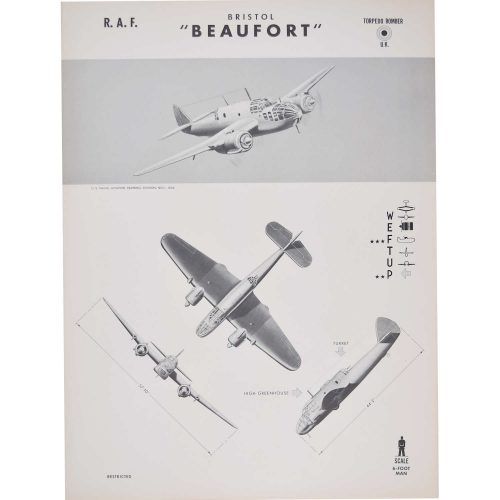
Bristol Beaufort Torpedo Bomber
US Naval Aviation Training Division Original aeroplane recognition poster (1942) 63 x 47 cm A particularly unusual style of aeroplane identification poster, owing to the very arty images. Most such posters rely on very plain silhouettes, this series - and we have several in this series; view them here - have a much more arty approach to the task with shading and an interesting angle view. The Bristol Beaufort (manufacturer designation Type 152) was a British twin-engined torpedo bomber designed by the Bristol Aeroplane Company, and developed from experience gained designing and building the earlier Blenheim light bomber. At least 1,180 Beauforts were built by Bristol and other British manufacturers. The Australian government''s Department of Aircraft Production (DAP) also manufactured variants of the Beaufort. These are often known collectively as the DAP Beaufort. More than 700 Australian-built Beauforts saw service with the Royal Australian Air Force in the South West Pacific theatre, where they were used until the end of the war. Beauforts first saw service with Royal Air Force Coastal Command and then the Royal Navy Fleet Air Arm from 1940. They were used as torpedo bombers, conventional bombers and mine-layers until 1942, when they were removed from active service and were then used as trainer aircraft until being declared obsolete in 1945. Beauforts also saw considerable action in the Mediterranean; Beaufort squadrons based in Egypt and on Malta helped interdict Axis shipping supplying Rommel's Deutsches Afrikakorps in North Africa. Although it was designed as a torpedo-bomber, the Beaufort was more often used as a medium day bomber. The Beaufort also flew more hours in training than on operational missions and more were lost through accidents and mechanical failures than were lost to enemy fire. The Beaufort was adapted as a long-range heavy fighter variant called the Beaufighter, which proved to be very successful and many Beaufort units eventually converted to the Beaufighter. Condition: good. If you’d like to know more, please email info@manningfineart.co.uk or call us on 07929 749056. -
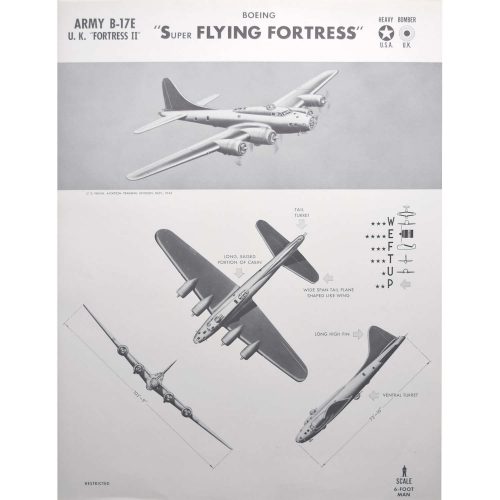
B-17E Boeing "Super Flying Fortress"
World War II US and UK heavy bomber plane Original aeroplane recognition poster (1942) 63 x 47 cm A particularly unusual style of aeroplane identification poster, owing to the very arty images. Most such posters rely on very plain silhouettes, this series - and we have several in this series; view them here - have a much more arty approach to the task with shading and an interesting angle view. The Boeing B-17 Flying Fortress is a four-engined heavy bomber developed in the 1930s for the United States Army Air Corps. From its introduction in 1938, the B-17 Flying Fortress evolved through numerous design advances, becoming the third-most produced bomber of all time. The B-17 was primarily employed by the United States Army Air Forces in the daylight strategic bombing campaign of World War II against German industrial, military and civilian targets. The B-17 also participated to a lesser extent in the Pacific War, early in World War II, where it conducted raids against Japanese shipping and airfields. In 1935 it was simply known as the Model 299. Seattle Times reporter Richard Smith dubbed the new plane, with its many machine-gun mounts, the “Flying Fortress,” and Boeing quickly adopted and trademarked the name. Condition: generally very good, occasional handling marks. If you’d like to know more, please email info@manningfineart.co.uk or call us on 07929 749056. -
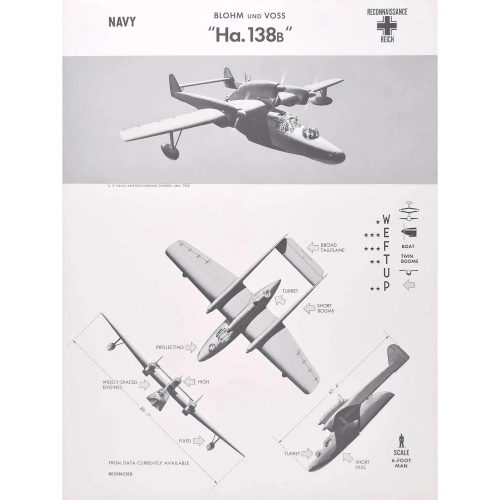
1943 Blohm und Voss "Ha. 138B"
World War II German Reich reconnaissance plane Original aeroplane recognition poster (1943) 63 x 47 cm A particularly unusual style of aeroplane identification poster, owing to the very arty images. Most such posters rely on very plain silhouettes, this series - and we have several in this series; view them here - have a much more arty approach to the task with shading and an interesting angle view. Condition: generally very good, occasional handling marks. If you’d like to know more, please email info@manningfineart.co.uk or call us on 07929 749056. -
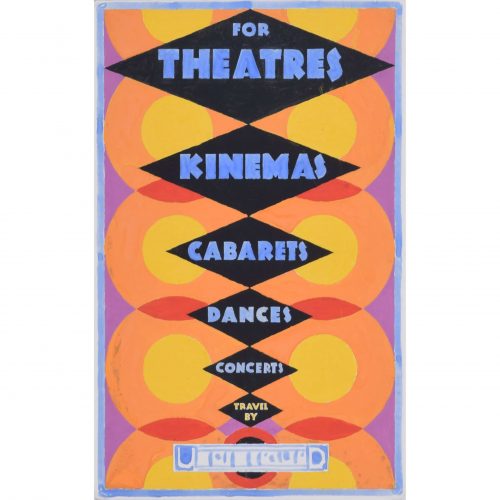
Gerald Mac Spink (flourished 1920 - 1940)
For Theatres, Kinemas, Cabarets, Dances, Concerts, Travel by Underground (c. 1930)
Gouache 30 x 19 cm Original design for a London Transport poster. Framed. A fantastic gouache design by Spink for a London Underground poster. The artist's striking Art Deco design and heady use of colour advertises the glamour of travelling by Tube to various evening entertainments around London. Spink was a skilled artist and designer who produced a series of posters in the inter-war period for companies including the London Underground, Southern Railways, LNER, Hawker Engineering, and British Steel. He won a prize in 1933 from the Imperial Institute for his poster artwork. He also worked as an aeronautical engineer in Kingston-on-Thames for Hawker Engineering; his greatest achievement was the creation of the 'Squanderbug', a 500cc racing car which he built in 1947, and which races even to this day. Provenance: the artist's estate. Condition: good; a few small scuffs to gouache, as visible in photographs. Handsomely framed. If you’d like to know more, please email info@manningfineart.co.uk or call us on 07929 749056. -
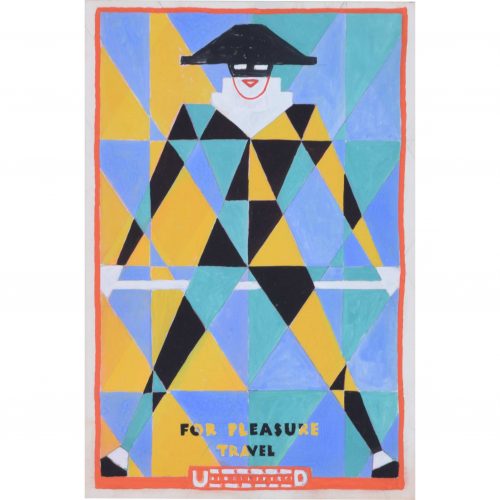
Gerald Mac Spink (flourished 1920 - 1940)
For Pleasure, Travel by Underground (c. 1930)
Gouache 26 x 18 cm Original design for a London Transport poster. Framed. A dynamic Art Deco poster design by Mac Spink. A boldly-coloured harlequin figure encourages travel via the London Underground. Spink was a skilled artist and designer who produced a series of posters in the inter-war period for companies including the London Underground, Southern Railways, LNER, Hawker Engineering, and British Steel. He won a prize in 1933 from the Imperial Institute for his poster artwork. He also worked as an aeronautical engineer in Kingston-on-Thames for Hawker Engineering; his greatest achievement was the creation of the 'Squanderbug', a 500cc racing car which he built in 1947, and which races even to this day. Provenance: the artist's estate. Condition: good; a few small scuffs to gouache, as visible in photographs. Handsomely framed. If you’d like to know more, please email info@manningfineart.co.uk or call us on 07929 749056. -
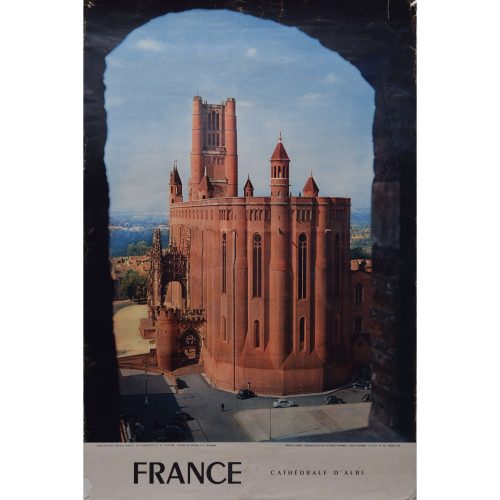
France - Cathedrale d'Albi, Toulouse
Original vintage poster 60 x 40 cm The Basilique Cathédrale Sainte-Cécile d'Albi (Cathedral Basilica of Saint Cecilia), also known as Albi Cathedral, is the seat of the Catholic Archbishop of Albi. First built in the aftermath of the Albigensian Crusade, the grim exterior resembles a fortress, but the interior is lavishly decorated with art and sculpture, a very ornate choir screen, and walls in bright blues and golds, in the Toulousian or Southern French Gothic. It was begun in 1282 and was under construction for 200 years. It is claimed to be the largest brick building in the world. In 2010 the cathedral, along with its episcopal buildings, was designated a UNESCO World Heritage Site because of its unique architecture and the remarkable consistency in its design. Condition: small tear to lower left corner; some wear to corners. If you’d like to know more, please email info@manningfineart.co.uk or call us on 07929 749056. -
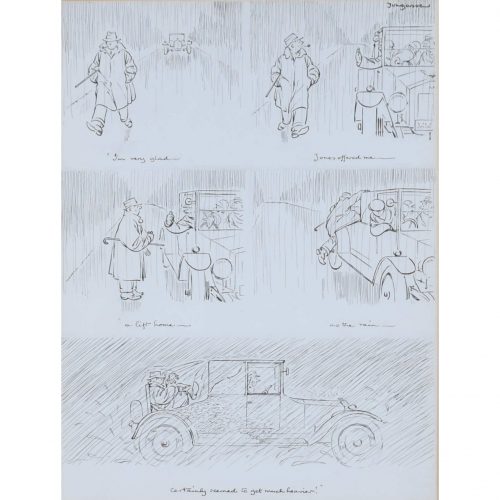
Fougasse (Cyril Kenneth Bird, 1887 - 1965)
'I'm very glad Jones offered me a lift home as the rain certainly seemed to get much heavier!' (1966)
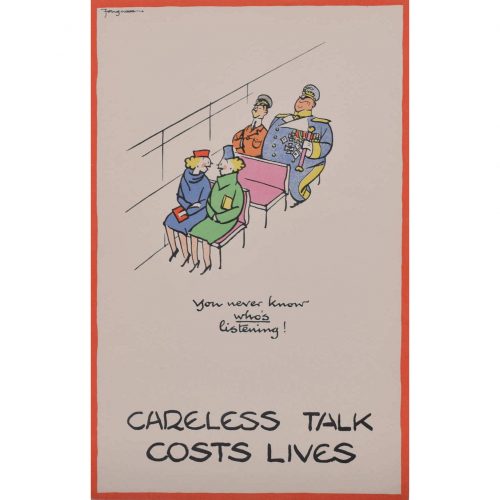
Pen and ink 32 x 24 cm Signed upper right. Cyril Kenneth Bird, under the name Fougasse, was a British cartoonist. He was art editor of Punch 1937 - 1949, and subsequently editor until 1953. He is best known for his ‘Careless Talk Costs Lives’ series of posters, and produced many other posters for the Ministry of Information and London Underground. His pen and ink cartoons for Punch are some of his gentlest and funniest works. Provenance: The Fine Art Society Ltd., 148 New Bond Street, June 1966. If you’d like to know more, please email info@manningfineart.co.uk or call us on 07929 749056.