-
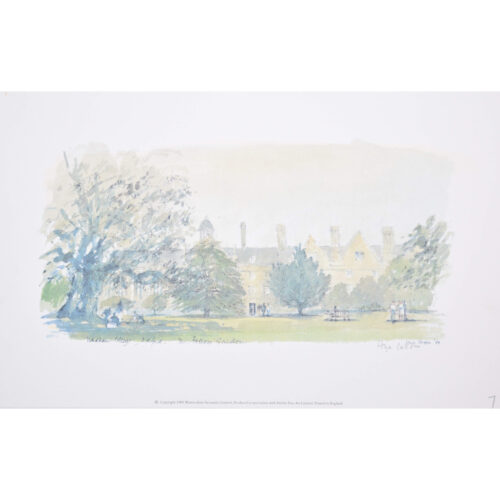
Hugh Casson (1910 - 1999)
Wadham College, Oxford (1989)
Lithograph 22 x 40 cm Proof print aside from the numbered edition. Signed, titled and dated in plate, and signed lower right in pencil. Printed on wove. Casson's peaceful, pastoral depiction of Wadham. Sir Hugh Casson was educated at Eastbourne College; St John’s College, Cambridge; and the Bartlett School of Architecture. Trained in the 1930s in the early modernist style, he taught at the Cambridge School of Architecture. After employment as a camoufleur during World War 2 by the Air Ministry, in 1948 he was appointed as director of architecture for the Festival of Britain. A close friend of the Royal Family, he undertook designs for the 1953 coronation, designed the interior of the Royal Yacht Britannia (“The overall idea was to give the impression of a country house at sea”), and taught the young Charles III to paint in watercolours. Amongst his architectural achievements are the Elephant House at London Zoo, the 1978 redevelopment of Bristol Docks, the Raised Faculty Building for The University of Cambridge, and a building for the Royal College of Art. He published a number of illustrated books, of which Casson’s Oxford and Casson’s Cambridge are probably the best known. A limited edition series of prints was produced from the paintings. Condition: very good. If you’d like to know more, please email info@manningfineart.co.uk or call us on 07929 749056. Click here for other views of Wadham College, Oxford. -
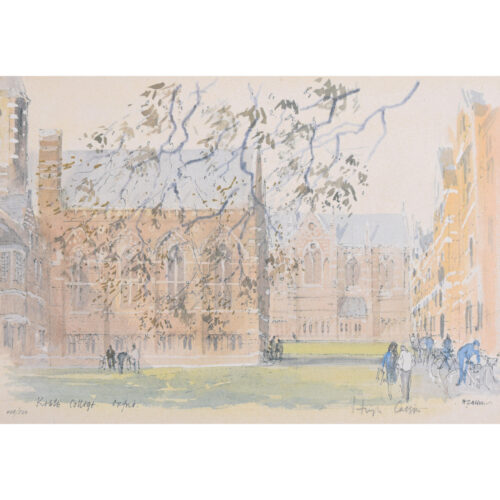
Hugh Casson (1910 - 1999)
Keble College, Oxford
Lithograph 25 x 36 cm Signed and numbered 408/500, both in pencil. Casson's autumnal depiction of Keble, complete with students and ubiquitous bicycles. Sir Hugh Casson was educated at Eastbourne College; St John’s College, Cambridge; and the Bartlett School of Architecture. Trained in the 1930s in the early modernist style, he taught at the Cambridge School of Architecture. After employment as a camoufleur during World War 2 by the Air Ministry, in 1948 he was appointed as director of architecture for the Festival of Britain. A close friend of the Royal Family, he undertook designs for the 1953 coronation, designed the interior of the Royal Yacht Britannia (“The overall idea was to give the impression of a country house at sea”), and taught the young Charles III to paint in watercolours. Amongst his architectural achievements are the Elephant House at London Zoo, the 1978 redevelopment of Bristol Docks, the Raised Faculty Building for The University of Cambridge, and a building for the Royal College of Art. He published a number of illustrated books, of which Casson’s Oxford and Casson’s Cambridge are probably the best known. A limited edition series of prints was produced from the paintings. Condition: generally very good. If you’d like to know more, please email info@manningfineart.co.uk or call us on 07929 749056. Click here for other views of Keble College, Oxford. -
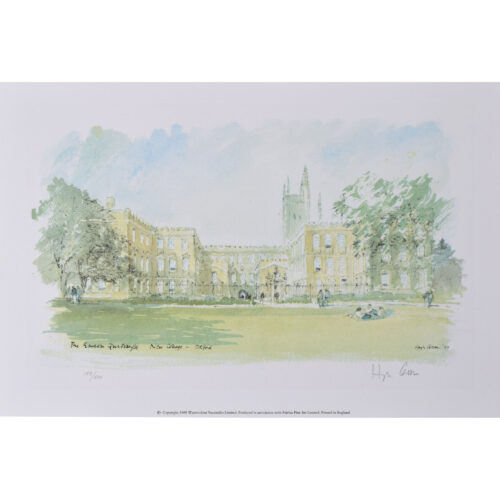
Hugh Casson (1910 - 1999)
The Garden Quadrangle, New College, Oxford (1989)
Lithograph 25 x 39 cm Signed, titled and dated in plate, and numbered 153/500 and signed lower right in pencil. Casson's view of New College's Garden Quad, complete with picnicking undergraduates. Sir Hugh Casson was educated at Eastbourne College; St John’s College, Cambridge; and the Bartlett School of Architecture. Trained in the 1930s in the early modernist style, he taught at the Cambridge School of Architecture. After employment as a camoufleur during World War 2 by the Air Ministry, in 1948 he was appointed as director of architecture for the Festival of Britain. A close friend of the Royal Family, he undertook designs for the 1953 coronation, designed the interior of the Royal Yacht Britannia (“The overall idea was to give the impression of a country house at sea”), and taught the young Charles III to paint in watercolours. Amongst his architectural achievements are the Elephant House at London Zoo, the 1978 redevelopment of Bristol Docks, the Raised Faculty Building for The University of Cambridge, and a building for the Royal College of Art. He published a number of illustrated books, of which Casson’s Oxford and Casson’s Cambridge are probably the best known. A limited edition series of prints was produced from the paintings. Condition: generally very good. If you’d like to know more, please email info@manningfineart.co.uk or call us on 07929 749056. Click here for other views of New College, Oxford. -
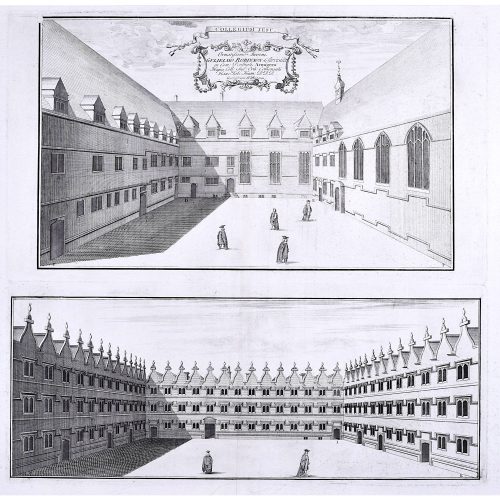
William Williams (Welsh, fl. 1724-1733) Jesus College, Oxford
Engraving c. 1732 for Oxonia Depicta (pub. London 1732-33) 43x44cm If you are interested email info@manningfineart.co.uk or call us on 07929 749056. Condition: Fair, gentle staining towards top and usual handling marks to margins, as illustrated. -
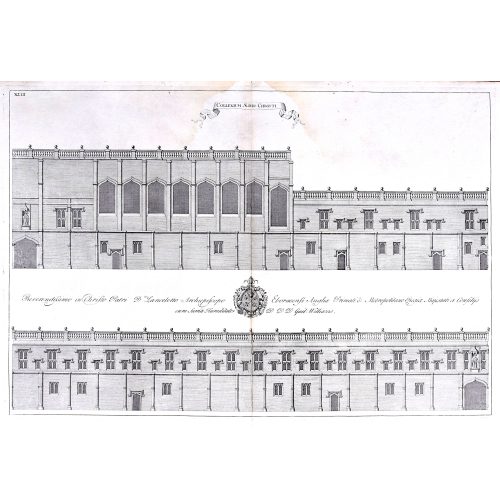
William Williams (Welsh, fl. 1724-1733) Christ Church, Oxford
Engraving c. 1732 for Oxonia Depicta (pub. London 1732-33) 41x60cm If you are interested email info@manningfineart.co.uk or call us on 07929 749056. Condition: Fair, gentle staining towards top and usual handling marks to margins, as illustrated. -
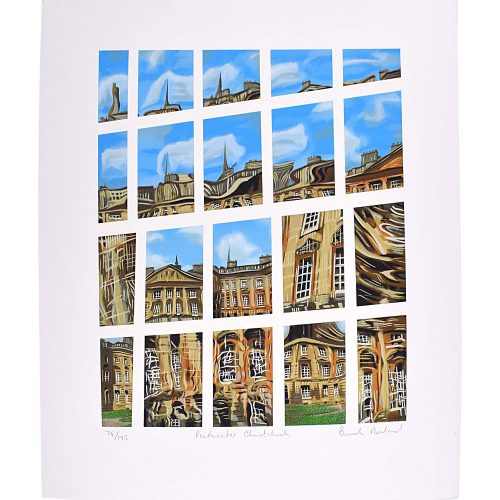
Brendon Neiland (b. 1941) Peckwater Christ Church 74/195
Screen print 68.5x56cm Here he surreally captures Peckwater Quad in Christchurch, experimenting with pictorial structure with vivacious dashes of blue, orange and yellow. It is emblematic of his later work that increasingly uses bold and dynamic colour palettes. For biographical details and other works by the artist click here. If you are interested email info@manningfineart.co.uk or call us on 07929 749056. Condition: Excellent. -
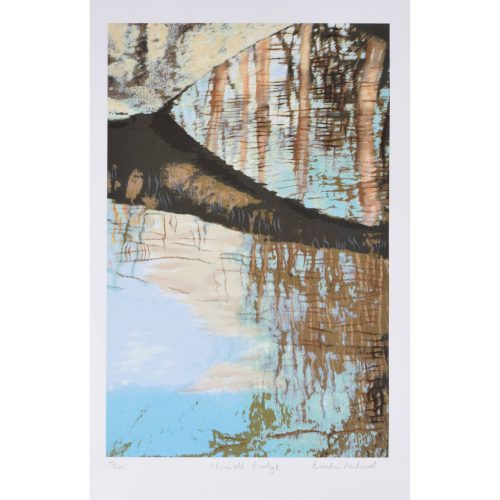
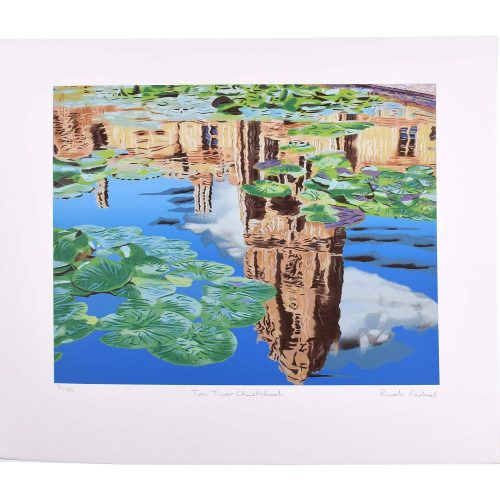 Brendon Neiland (b. 1941) Tom Tower Christ Church 38/195 Screenprint 66x58cm Here he surreally captures rippling reflection of Tom Tower in Christchurch. The style is emblematic of his later work that increasingly uses bold and dynamic colour palettes. For biographical details and other works by the artist click here. If you are interested email info@manningfineart.co.uk or call us on 07929 749056. Condition: Excellent.
 -
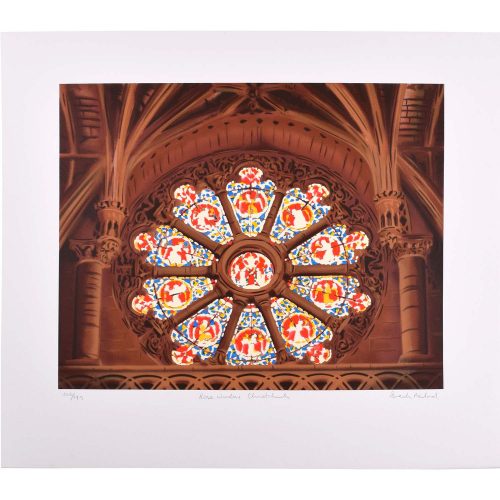
Brendon Neiland (b. 1941) Gilbert Scott's Rose Window Christ Church Oxford 106/195
Screenprint 66x58cm Here Neiland captures the colours of the new window installed in the cathedral by George Gilbert Scott (Junior) c. 1870. The style is emblematic of his later work that increasingly uses bold and dynamic colour palettes. For biographical details and other works by the artist click here. If you are interested email info@manningfineart.co.uk or call us on 07929 749056. Condition: Excellent. -
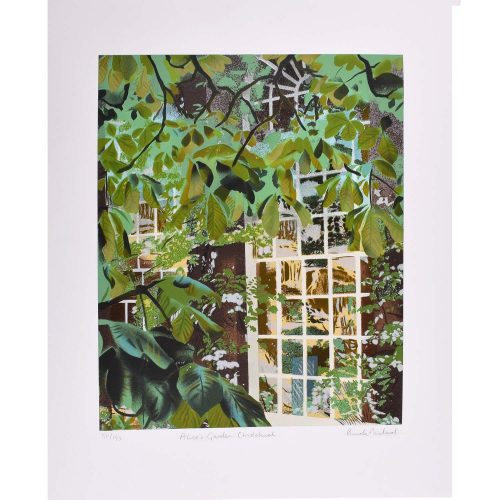
Brendon Neiland (b. 1941) Alice's Garden Oxford 50/195
Screenprint 66.5x57cm Here he surreally captures rippling reflection of Tom Tower in Christchurch. The style is emblematic of his later work that increasingly uses bold and dynamic colour palettes. For biographical details and other works by the artist click here. If you are interested email info@manningfineart.co.uk or call us on 07929 749056. Condition: Excellent. -
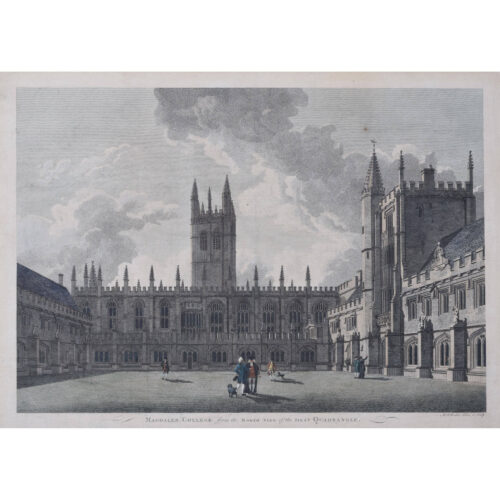
Michael Angelo Rooker (1743/6 - 1801)
Magdalen College from the North Side of the First Quadrangle (1778)
Engraving 32.5 x 46 cm A copy of this print is held by the Wellcome Collection. The Oxford Almanack was an annual almanack published by the Oxford University Press for the University of Oxford from 1674 through 2019 (when printing sadly ceased due to "dwindling interest"). The almanack traditionally included engravings or lithographs of the University and information about the upcoming year. Other almanack artists have included Michael Burghers, J. M. W. Turner, and John Piper. Basire and Dayes collaborated on several views of Oxford during the courses of their careers. Michael Angelo Rooker ARA was an English oil and watercolour painter of architecture and landscapes, illustrator, and engraver. Condition: generally good. Later hand colouring. From an entire Almanac page, cut down. If you are interested, please email info@manningfineart.co.uk or call us on 07929 749056. Click here for other views of Magdalen College, Oxford. -

John Bluck (early 19th century) after Augustus Charles Pugin (1762 - 1832) All Souls - taken from the top of the Radcliffe Library (1814)
Aquatint with original hand colouring 21 x 27 cm Published by Rudolph Ackermann (1764 - 1834). An engraving of serene All Souls from Ackermann's 'History of Oxford'. Augustus Charles Pugin was an Anglo-French artist and architectural draughtsman. Pugin produced views of London, jointly creating the illustrations for the 'Microcosm of London' published by Rudolph Ackermann in 1811, followed by plates for Ackermann's books about Westminster Abbey, Oxford and Cambridge universities, and Winchester College. His later works included illustrations for Specimens of Gothic Architecture (1821–1823), The Royal Pavilion at Brighton (1826), Architectural Antiquities of Great Britain (1826), Specimens of the Architectural Antiquities of Normandy (1827), Illustrations of the Public Buildings of London (1825 to 1828), Paris and its Environs (1829 to 1831), and Examples of Gothic Architecture (1831). He also produced a book of furniture designs called Gothic Furniture, and assisted architects with detailing for their gothic designs. He ran a drawing school at his house in Bloomsbury. John Bluck was an aquatint engraver, mainly of topographical views, but also of marine and sporting subjects after his contemporaries. He produced plates for numerous publications. Rudolph Ackermann was an Anglo-German bookseller, inventor, lithographer, publisher and businessman. In 1795 he established a print-shop and drawing-school at 96 Strand. Here Ackermann set up a lithographic press and began a trade in prints. He later began to manufacture colours and thick carton paper for landscape and miniature painters. Within three years the premises had become too small and he moved to 101 Strand, in his own words "four doors nearer to Somerset House", the seat of the Royal Academy of Arts. Between 1797 and 1800 Ackermann rapidly developed his print and book publishing business, encompassing many different genres including topography, caricature, portraits, transparencies and decorative prints. Condition: Generally very good.If you would like to know more, please email info@manningfineart.co.uk or call us on 07929 749056.
-

John Hill (1770 - 1850) after Augustus Charles Pugin (1762 - 1832) St Aldate's From Carfax (1813)
Aquatint with original hand colouring 27 x 21 cm Published by Rudolph Ackermann (1764 - 1834). An engraving of St Aldate's, overlooked by Christ Church's pale and magnificent Tom Tower. John Hill was born in London in 1770, and was an engraver's apprentice. He worked in aquatint and largely produced book illustration aquatints. He went to America in 1816 and produced the notable Picturesque Views of American Scenery amongst other books of prints. Augustus Charles Pugin was an Anglo-French artist and architectural draughtsman. Pugin produced views of London, jointly creating the illustrations for the 'Microcosm of London' published by Rudolph Ackermann in 1811, followed by plates for Ackermann's books about Westminster Abbey, Oxford and Cambridge universities, and Winchester College. His later works included illustrations for Specimens of Gothic Architecture (1821–1823), The Royal Pavilion at Brighton (1826), Architectural Antiquities of Great Britain (1826), Specimens of the Architectural Antiquities of Normandy (1827), Illustrations of the Public Buildings of London (1825 to 1828), Paris and its Environs (1829 to 1831), and Examples of Gothic Architecture (1831). He also produced a book of furniture designs called Gothic Furniture, and assisted architects with detailing for their gothic designs. He ran a drawing school at his house in Bloomsbury. Ackermann was an Anglo-German bookseller, inventor, lithographer, publisher and businessman. He attended the Latin school in Stollberg, but his wish to study at the university was made impossible by lack of financial means, and he therefore became a saddler like his father. He worked as a saddler and coach-builder in different German cities, moved from Dresden to Basel and Paris, and then, 23 years old, settled in London. He established himself in Long Acre, the centre of coach-making in London and close to the market at Covent Garden. Ackermann then moved to Little Russell Street where he published Imitations of Drawings of Fashionable Carriages (1791) to promote his coach-making. Other publications followed. In 1795 he established a print-shop and drawing-school at 96 Strand. Here Ackermann set up a lithographic press and began a trade in prints. He later began to manufacture colours and thick carton paper for landscape and miniature painters. Within three years the premises had become too small and he moved to 101 Strand, in his own words "four doors nearer to Somerset House", the seat of the Royal Academy of Arts. Between 1797 and 1800 Ackermann rapidly developed his print and book publishing business, encompassing many different genres including topography, caricature, portraits, transparencies and decorative prints. During the Napoleonic wars, Ackermann was an energetic supporter of the Allied cause and made significant contributions to British propaganda through his publication of anti-Napoleonic prints and military manuals. He became a naturalised British citizen in March 1809. As one of the pioneers of modern publishing methods, Ackermann developed an international distribution network for his publications and came to have significant commercial interests in South America. The business he founded in London flourished throughout the 19th century under the management of his descendants. He was buried at St. Clement Danes in the Strand, London. In 2020, the St. Louis Mercantile Library wrote that: "Ackermann excelled in the creation of landscape and architectural engravings. He created beautiful illustrations of the city of London, his adopted home, as well as two volumes of classic views of Westminster Abbey, along with exquisite views of river scenes. One of our favorite collections are four massive volumes of lovingly illustrated exterior and interior landmarks of Oxford and Cambridge Universities created just over two hundred years ago. These publications show Ackermann’s hand at every turn of the page along with the team of assistant designers and engravers he employed to create these works. Perhaps they were a way by which the artist could lay to rest his own regret at not being able to attend [an Oxbridge] college himself in a fondly depicted idyll to learning which these prints so aptly represent." Condition: Generally very good.If you would like to know more, please email info@manningfineart.co.uk or call us on 07929 749056.
-
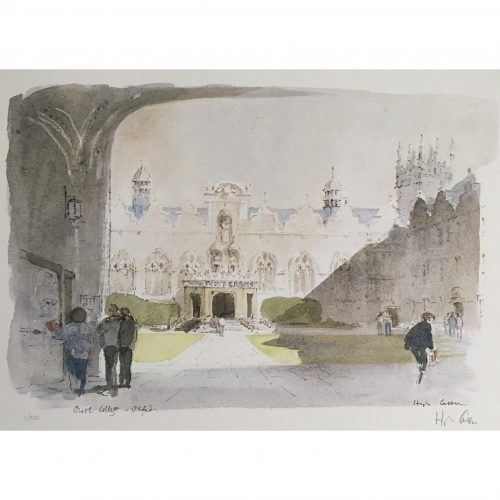
Sir Hugh Casson (1910-1999)
Oriel College Oxford
Lithographic print signed in pencil and numbered 1/500. Provenance: the artist's estate. 28 x 35 cm (11 x 14 in) From Casson's ever-popular Oxford series of prints. If you are interested email info@manningfineart.co.uk or call us on 07929 749056. Click here to see other posters from this series and for more information on Wings for Victory campaigns. -
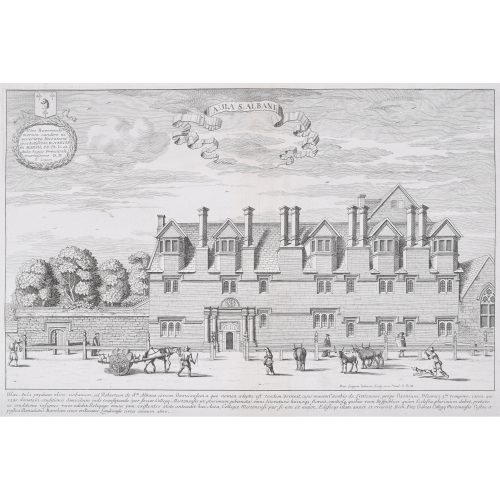
David Loggan (1634-1692) St Alban Hall, Merton College, Oxford
Aula St Albani Engraving (1675) 25x35cm St Alban's Quad was originally St Alban Hall, a medieval student residence that survived as an independent Hall of the University until 1882, when it was incorporated with Merton College. John Henry Newman briefly held the position of vice-principal in 1825. The St Alban's Hall buildings were reconstructed by Basil Champneys in 1905-1910. If you are interested, please email info@manningfineart.co.uk or call us on 07929 749056. -
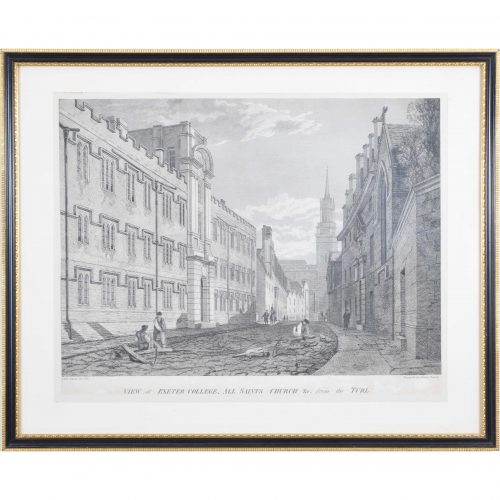
James Basire II (1769 - 1822) after JMW Turner (1775 - 1851)
View of Exeter College, All Saints Church &c. from the Turl
Engraving 35 x 46 cm A view of Exeter College, Oxford from Turl Street. Labourers cobble the road. The spire of what was All Saints Church, now Lincoln College's library, overlooks the scene. Turner's drawing was reproduced as a lithograph in 1800, to be published in the “Oxford Almanack”. The Oxford Almanack was an annual almanack published by the Oxford University Press for the University of Oxford from 1674 through 2019 (when printing sadly ceased due to “dwindling interest”). The almanack traditionally included engravings or lithographs of the University and information about the upcoming year. Other almanack artists have included Michael Burghers and John Piper. Basire and Dayes collaborated on several views of Oxford during the courses of their careers. Joseph Mallord William Turner RA, known in his time as William Turner, was an English Romantic painter, printmaker and watercolourist. He is known for his expressive colouring, imaginative landscapes and turbulent, often violent, marine paintings. He left behind more than 550 oil paintings, 2,000 watercolours, and 30,000 works on paper. He was championed by the leading English art critic John Ruskin from 1840, and is today regarded as having elevated landscape painting to an eminence rivalling history painting. James Basire II was a British engraver, son of James Basire I, also a celebrated engraver. In 1802 he became Engraver to the Society of Antiquaries. Condition: trimmed within plate mark and mounted to paper. If you’d like to know more, please email info@manningfineart.co.uk or call us on 07929 749056. Other views of Exeter College, Oxford are available here.