-
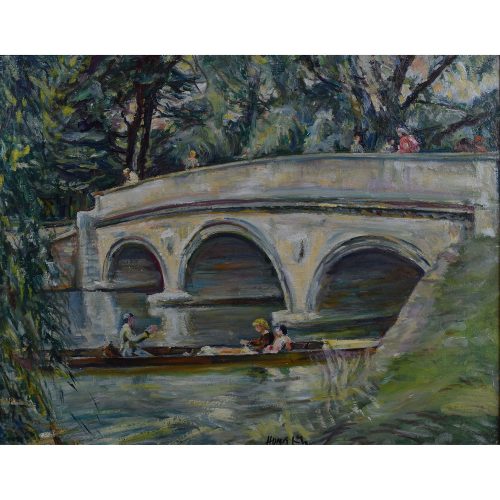
Nancy Weir Huntly (1890-1963)
Trinity College Bridge Cambridge
Oil on canvas; framed in an antique-white-finished frame with gilt slip. Signed 'Huntly' 50x61cm Born in India, in Nusserabad, she studied art at the Royal Academy Schools in Dusseldorf. She lived in Welwyn Garden City, in Hertfordshire, with her daughter, Faith Sheppard, also a painter. She also painted under the name Nancy Sheppard. If you are interested email info@manningfineart.co.uk or call us on 07929 749056. -
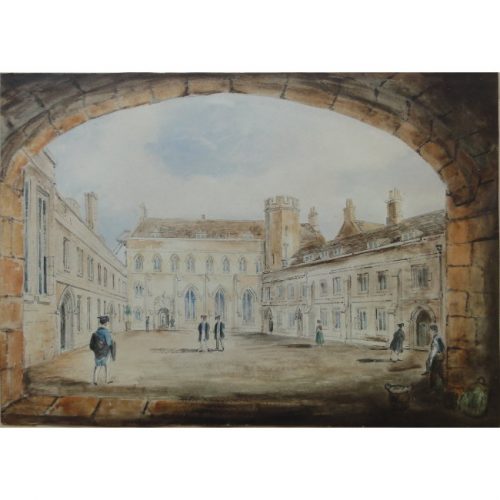
Attributed to Richard Bankes Harraden (1778–1862)
First Court, Pembroke College, Cambridge c1830
Watercolour, unsigned 27.5x39cm Pembroke prior to the demolition of the south range of Old Court in 1874 by Alfred Waterhouse. (His plans for the near-complete rebuilding of the College included the demolition of Wren’s chapel, but the Fellows’ caution prevented this.) If you are interested email info@manningfineart.co.uk or call us on 07929 749056. -
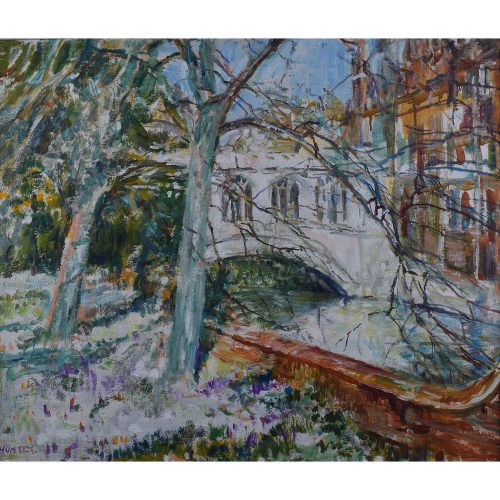
Nancy Weir Huntly (1890-1963)
St John's College Bridge of Sighs Cambridge
Oil on canvas; framed. Signed 'Huntly' 50x61cm Born in India, in Nusserabad, she studied art at the Royal Academy Schools in Dusseldorf. She lived in Welwyn Garden City, in Hertfordshire, with her daughter, Faith Sheppard, also a painter. She also painted under the name Nancy Sheppard. If you are interested email info@manningfineart.co.uk or call us on 07929 749056. -
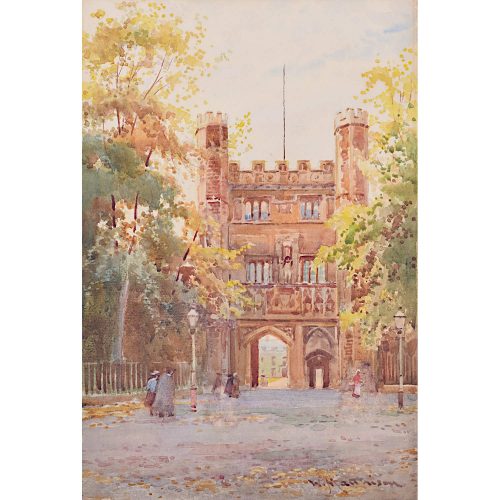
William Matthison (1853-1926)
Trinity College Cambridge Great Gate
Watercolour 36.5 x 26 cm Matthison was born near Birmingham and attended King Edward’s School in the city. He learned drawing at the Birmingham Central School of Art and then became a pupil of Birmingham artist Edward Watson. He became a professional artist in 1875 and moved to Oxfordshire a few years after; this was where he had the opportunity to produce many of the Oxford views for which he is known today. In 1902 he moved to Park Town in Oxford and was commissioned by Robert Peel to paint more than seventy views of the University of Oxford, which were subsequently made into postcards. Priced at seven for a shilling, they were only available from E Cross of Pembroke Street (a long-since closed business). Raphael Tuck & Sons also commissioned him to produce postcard scenes of Cambridge. Matthison’s views of Oxford were later printed in Fifty Watercolour Drawings of Oxford, published in 1912 by Alden & Co. Click here for other works by the artist. If you are interested, please email info@manningfineart.co.uk or call us on 07929 749056. -
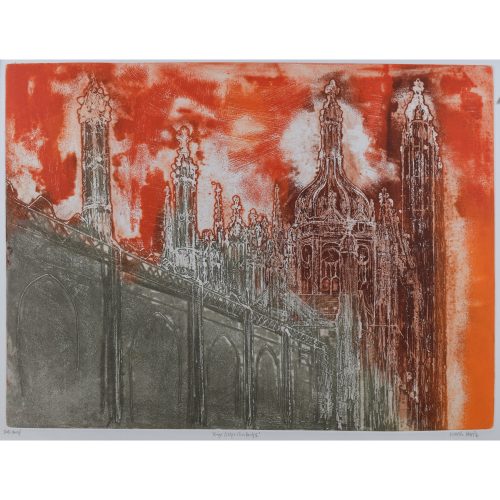
Walter Hoyle (1922 - 2000)
King's College Chapel, Cambridge in red (1965)
Linocut Cambridge Series State Proof, Signed and Titled in pencil. Printed by the artist at Editions Alecto51x69cm Condition: Excellent Click here for biographical details and other works by the artist. If you are interested email info@manningfineart.co.uk or call us on 07929 749056. -

David Loggan (1634-1692)
Prospectus Cantabrigiae Orientalis & Occidentalis
Engraving 32 x 46 cm Loggan was born to English and Scottish parents, and was baptised in Danzig in 1634. After studying engraving in Danzig with Willem Hondius (1598-1652 or 1658), he moved to London in the late 1650s, going on to produce the engraved title-page for the folio 1662 Book of Common Prayer. He married in 1663 and moved to Nuffield in Oxfordshire in 1665. Loggan was appointed Public Sculptor to the nearby University of Oxford in the late 1660s, having been commissioned to produce bird’s-eye views of all the Oxford colleges. He lived in Holywell Street as he did this. The 'Oxonia Illustrata' was published in 1675, with the help of Robert White (1645-1704). Following its completion, Loggan began work on his equivalent work for Cambridge; the 'Cantabrigia Illustrata' was finally published in 1690, when he was made engraver to Cambridge University. The 'Oxonia Illustrata' also includes an engraving of Winchester College (Winchester and New College share William of Wykeham as their founder) whilst the 'Cantabrigia Illustrata' includes one of Eton College (which shares its founder, Henry VIII, with King’s College). Bird’s-eye views from this era required a particular talent as an architectural perspectivist; it was not until 1783 that it became possible for artists to ascend via hot air balloons and view the scenes they were depicting from above. Loggan thus had to rely on his imagination in conceiving the views. Loggan’s views constitute the first accurate depictions of the two Universities, in many ways unchanged today. Whilst the Oxford engravings were produced in reasonable numbers and ran to a second edition by Henry Overton (on thicker paper and with a plate number in Roman numerals in the bottom right-hand corner), those of Cambridge were printed in much smaller numbers. The Dutchman Pieter van der Aa published some miniature versions of the engravings for James Beverell’s guidebook to the UK, 'Les Delices de la Grande Bretagne' (c. 1708). The contemporary artist Andrew Ingamells (b.1956) has produced a highly-acclaimed series of etchings which bring Loggan’s original vision up to date. This particular edition represents a unique view of Cambridge from the east and the west. Notable landmarks including King's Chapel and Great St Mary's Church are visible in this fine David Loggan engraving. Condition: Good; five small invisibly repaired holes to image If you are interested, please email info@manningfineart.co.uk or call us on 07929 749056. For other general views of Cambridge, click here. -
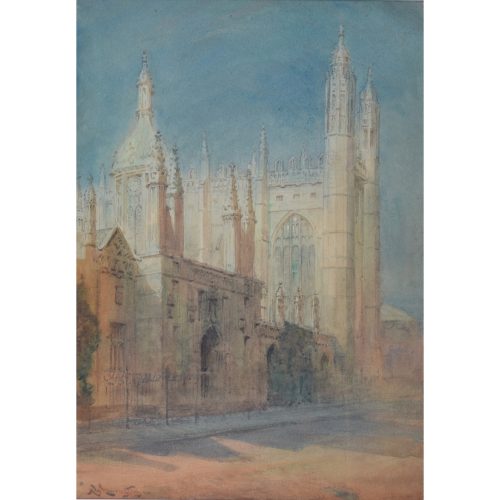
Alexander Wallace Rimington (1854–1918)
King’s College, Cambridge
Signed with initials and dated 1906 Watercolour 33x24cm (12.9×9.4 inches) Alexander Wallace Rimington A.R.E., R.B.A., Hon. F.S.A was Professor of Fine Arts at Queen's College, London. An etcher, illustrator, painter, and author he was most famous for inventing a musical instrument, the 'colour organ' that projected different colours in harmony with music. His first Summer Exhibition at the Royal Academy was in 1880, over subsequent years he exhibited thirty-four works there, mostly topographical works related to his travels around Europe. He had regular shows at the Fine Art Society - seven between 1893 and 1912 - showing a hundred or more watercolours. If you are interested email info@manningfineart.co.uk or call us on 07929 749056. -
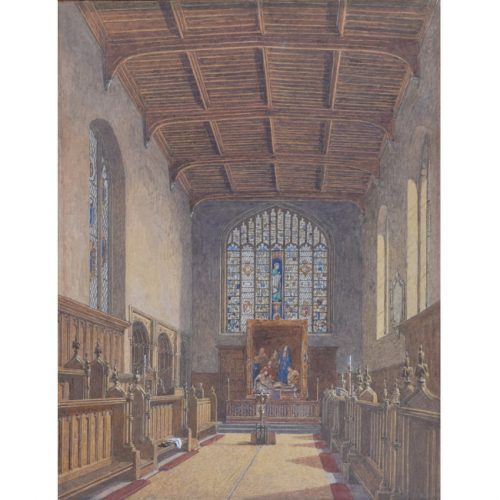
George Pyne (1800 - 1884)
St John's College, Cambridge Old Chapel
Watercolour 35 x 23 cm A view of the Old Chapel of St John’s College, Cambridge before its demolition. In 1861, the Fellows of St John’s agreed to mark the seven hundredth jubilee of their college by building a new chapel. Sir George Gilbert Scott was appointed to carry out the work, and Dr James Wood (a previous Master of the college) bequeathed the huge sum of £20,000 for the purpose of the new chapel. George Pyne was related to two founders of the Society of Painters in Watercolours – William Henry Pyne was his father, and John Varley his father-in-law. Pyne trained as an architectural draughtsman and lived in Oxford from the 1850s until his death in 1884, specialising in views of the city and its colleges. His Oxford pictures are both architecturally-minded and romantically creative, often combining intensely detailed depictions of college buildings with imagined pedestrian scenes. Pyne was also noted for his views of Cambridge and Eton, and for his drawing manuals ‘A Rudimentary and Practical Treatise on Perspective for Beginners’ (1848) and ‘Practical Rules on Drawing for the Operative Builder, and Young Student in Architecture’ (1854); the latter texts offer an insight into his method of depicting architecture and its surroundings. Condition: very good. If you are interested, please email info@manningfineart.co.uk or call us on 07929 749056. Click here for other views of St John's College, Cambridge. -
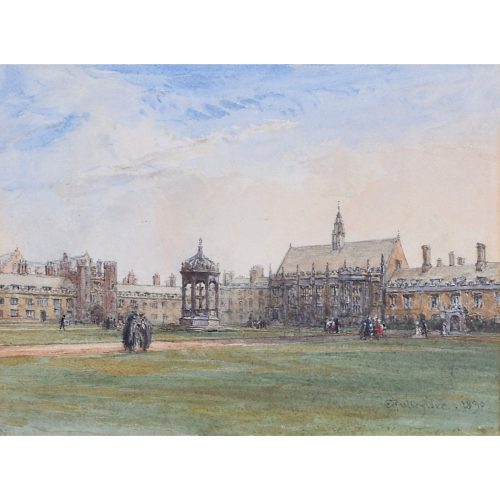
John Fulleylove (1845-1908) Trinity College, Cambridge - Great Court
Watercolour 13x17cm Born in Leicester, John Fulleylove trained as an architect with a Leicester firm before becoming a full-time painter. He exhibited widely in the UK, at such venues as the Royal Academy, the Fine Art Society, and the Royal Society of British Artists. His paintings were the subject of illustrated topographical books, including one on ‘Oxford’ published by the Fine Art Society. If you are interested email info@manningfineart.co.uk or call us on 07929 749056. Condition: Good. -
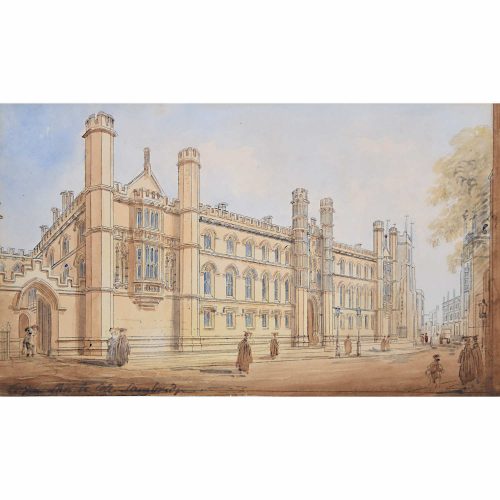
View of Corpus Christi College, Cambridge
Watercolour on paper 13.5 x 23cm A charming view of Corpus Christi College and assorted denizens of Cambridge. The college is notable as the only one founded by Cambridge townspeople; it was established in 1352 by the Guild of Corpus Christi and the Guild of the Blessed Virgin Mary, making it the sixth-oldest college in Cambridge. With around 250 undergraduates and 200 postgraduates, it also has the second smallest student body of the traditional colleges of the University, after Peterhouse. The College has traditionally been one of the more academically successful colleges in the University of Cambridge. It also ranks among the wealthiest Cambridge colleges in terms of fixed assets, being exceptionally rich in silver. Unsigned; labelled 'Corpus Christi Coll. Cambridge' in ink, lower left. If you’d like to know more, please email info@manningfineart.co.uk or call us on 07929 749056. -
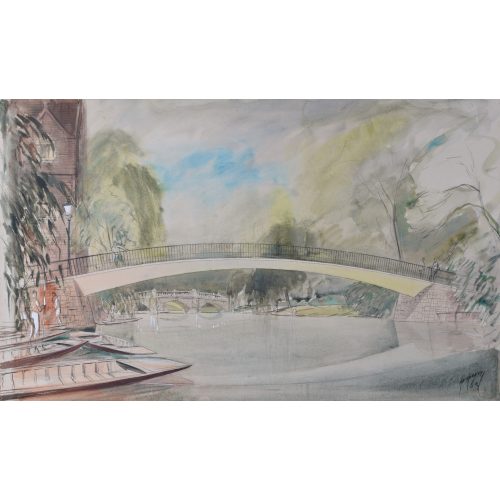
John Dean Monroe Harvey (1895-1978)
Garret Hostel Bridge, Cambridge, Trinity Hall and Clare College behind
38x61cm Watercolour and pencil For biographical details and more works by JDM Harvey, please click here. If you are interested email info@manningfineart.co.uk or call us on 07929 749056. -
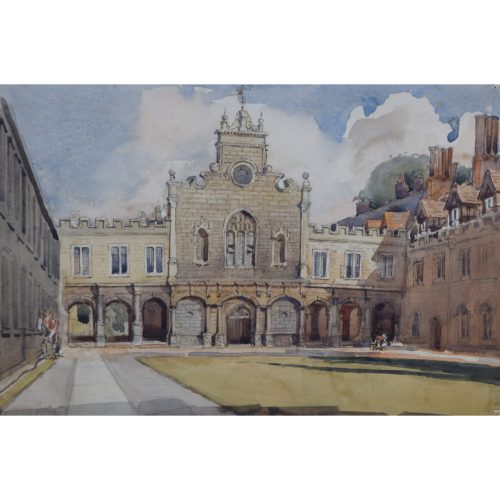
William Thomas Martin Hawksworth (1853-1935)
Peterhouse Cambridge
Watercolour, framed. 17.5 x 26cm. Provenance: with Thomas Agnew & Sons, London A Londoner, Hawksworth was a member of both the RI and RBA. The V&A and British Museum both hold examples of his watercolours. If you are interested email info@manningfineart.co.uk or call us on 07929 749056. -
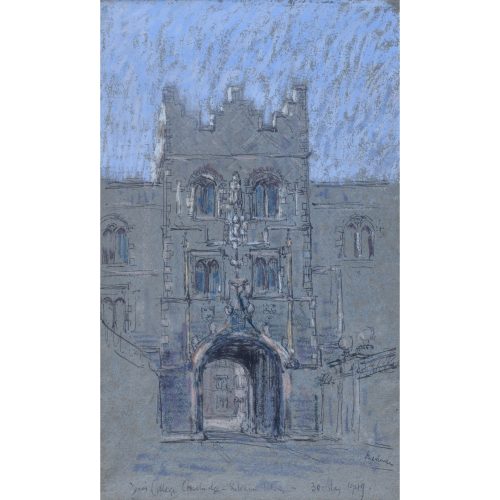
Paul Ayshford Methuen, 4th Baron Methuen of Corsham (1886 -1974)
Jesus College, Cambridge
Ink and pastel Signed and dated 30 May 1949; in artist’s original oak frame. 41x26cm (16.1×10.2 inches) For biographical details and other works by the artist click here. If you are interested email info@manningfineart.co.uk or call us on 07929 749056. -
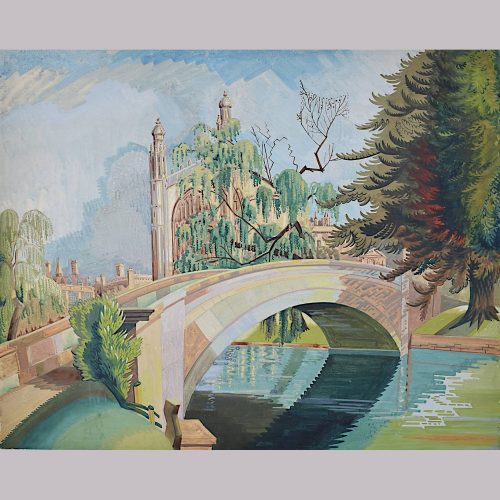
Anonymous King's College Cambridge with the River Cam and Bridge to foreground
51x63.5cm Watercolour Probably 1920s A fine, and large, view of King's College. The artist paints in an art deco style, picking out the stones of the bridge in different colours, the colours all having a heightened sense of reality. Born from cubism, the art deco era is characterised by a fragmented, geometric character particularly evident here. It gives the impression of a shimmering dream. The twenties was an incredible period of change, moving from heavy elaborate styles to a pared back and sleek style expressing more dynamism, an interest in dimension and abstraction. If you are interested email info@manningfineart.co.uk or call us on 07929 749056. -
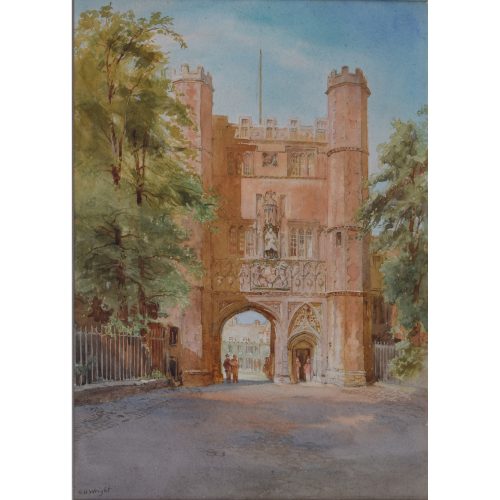
Richard Henry Wright (1857-1930)
Trinity Great Gate, Cambridge
Watercolour 47x39cm (frame) 25x18cm (9.8×7 inches) Originally from Hampshire, Wright was an artist who specialised in topographical views, mostly in Europe and Egypt. He exhibited at the RA from 1885 to 1913. In 1892 he married the artist Catherine Morris Wood, who also exhibited at the RA – but from 1880 until the 1920s. They lived at 2 Harcourt Buildings in the Inner Temple If you are interested email info@manningfineart.co.uk or call us on 07929 749056. -
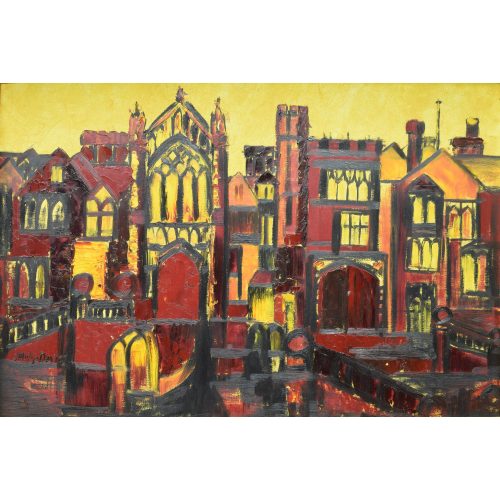
J Phillip Davies (British, 20th Century)
Selwyn College Cambridge
Oil on board c. 1970 60x89cm A rare view of Selwyn College Cambridge, captured here in all the glory of its Victorian red brick. -

Algernon Newton (1880-1968) Study for Clare College, Cambridge
Pencil and chalk on paper, squared for transfer 15 x 28 cm Algernon Newton was a British landscape artist, known informally as the 'Canaletto of the canals.' Newton studied at Clare College, Cambridge in 1899, deciding however at the end of his final year to leave university and pursue a professional career as an artist. He went on to serve in the army during the First World War and began exhibiting at the Royal Academy in 1919. He also enjoyed a successful international career, exhibiting alongside Picasso, Braque and Chagall in the Carnegie International Exhibition of Painting at Pittsburgh in 1938. In 1926 and 1934, he was also one of the esteemed artists chosen to represent Britain at the Venice Biennale of Art. This study was produced in preparation for the artist's 1946 oil painting of the same subject, shown at the Royal Academy Summer Exhibition the following year. It depicts a view of the Backs, looking over Clare College and King's College, with the chapel figuring prominently in the centre of the study. Algernon's work process is intriguing and the piece has been squared for transfer. Condition: Generally very good, squared for transfer, pinholes and short tear in the bottom left hand corner. For other general views of Cambridge, click here. -
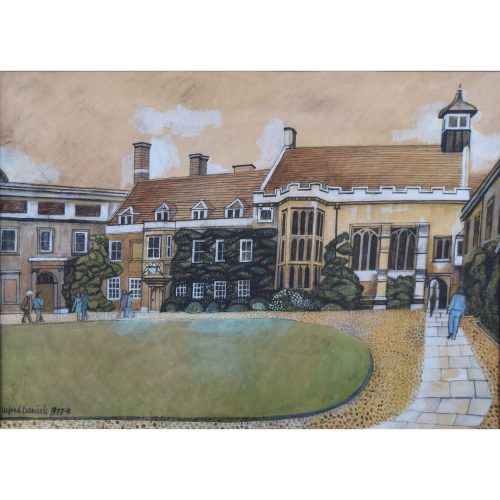
Alfred Daniels RBA RWS (1924-2015)
Christ’s College, Cambridge
Gouache, watercolour and ink on board 40x56cm (15.7×22 inches). In a hand-finished cream frame. Click here for biographical details and other works by the artist. If you are interested email info@manningfineart.co.uk or call us on 07929 749056. -
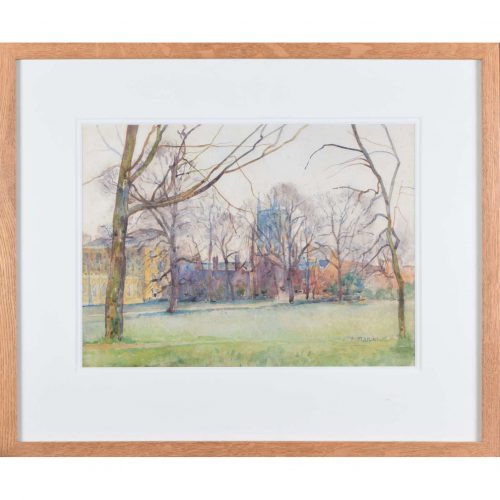
James Bolivar Manson (1879 - 1945) St John's College, Cambridge
Watercolour 29 x 40 cm Signed lower right. A wintry view of St John's College, Cambridge. The chapel tower nestles behind bare trees, set against a white sky. Manson was an artist who worked at the Tate Gallery and was its Director from 1930 to 1938. His time there was clouded by his frustrated ambitions as a painter and his descent into alcoholism. His professional career began as an office boy - leaving Alleyn's School in Dulwich at 16 - with the publisher George Newnes, and then as a bank clerk. He simultaneously studied painting at Heatherley School of Fine Art, commencing in 1890, and then Lambeth School of Art - much encouraged by Lilian Laugher, a violinist who came to stay in the Manson household. He married her in 1903 - the same year he abandoned his bank job. They moved to Paris for a year. Manson shared a studio with Jacob Epstein, who became a lifelong friend. When they returned to London, Manson joined the Camden Town Group, becoming Secretary. Lilian was a close friend of the Director of the Tate and ensured that Manson, aged 33, became Tate Clerk. Manson continued to paint feverishly at the weekend. The Tate website describes Manson as its 'least succesful' director. Kenneth Clark described him with "a flushed face, white hair and a twinkle in his eye; and this twinkling got him out of scrapes that would have sunk a worthier man without trace." His painting continued to show promise, and he joined the London Group in 1914 and showed with the New England Art Club from 1915. His first solo show was at the Leicester Galleries in 1923 and he became a member of the NEAC in 1927. He attended a dinner at the Hotel George V in Paris in 1938 to celebrate the British Exhibition at the Louvre. Clive Bell wrote to his wife, "Manson arrived at the déjeuner given by the minister of Beaux Arts fantastically drunk - punctuated the ceremony with cat-calls and cock-a-doodle-doos, and finally staggered to his feet, hurled obscene insults at the company in general and the minister in particular, and precipitated himself on the ambassadress, Lady Phipps, some say with amorous intent; others with lethal intent." Bell concluded: "The guests fled, ices uneaten, coffee undrunk... I hope an example will be made, and that they will seize the opportunity for turning the sot out of the Tate, not because he is a sot, but because he has done nothing but harm to modern painting." The Director of the Tate was arbiter as to whether imported items amounted to art (which would make them exempt from customs duty). This caused controversy when Peggy Guggenheim imported sculpture by Marcel Duchamp and others. Manson pronounced Constantin Brâncuși's Sculpture for the Blind (a large, smooth, egg-shaped marble) to be "idiotic" and "not art", and therefore subject to duty. Letters were written to the press and the matter reached the House of Commons, where Manson was criticised and eventually had to back down. He retired at the age of 58. By his own account, "my doctor has warned me that my nerves will not stand any further strain... I have begun to have blackouts, in which my actions become automatic. Sometimes these periods last several hours.... I had one of these blackouts at an official luncheon in Paris recently, and startled guests by suddenly crowing like a cock...." His successor was Sir John Rothenstein, who discovered that the staff referred to artwork in the basement as 'Director's Stock'. It transpired that Manson had been selling it to boost his salary. His work now hangs in the Tate, as well as in many other galleries in Britain and abroad. Condition: Good. If you’d like to know more, please email info@manningfineart.co.uk or call us on 07929 749056. Click here for more views of St John's College, Cambridge.