-

Charles Henri Toussaint (1849 - 1911)
Christ's College, Cambridge (1880)
Etching 21 x 17 cm Signed and dated 1880 in plate. An attractive etching of the Fellows' Garden at Christ's College, Cambridge. Charles Henri Toussaint was a French painter, illustrator and engraver known for his prints of architecture in Paris, historic towns in France, and English cities of architectural interest (including Oxford and Cambridge). He gained recognition at the Paris Salon in 1874. Condition: very good. If you are interested, please email info@manningfineart.co.uk or call us on 07929 749056. Click here for other views of Christ's College, Cambridge. -
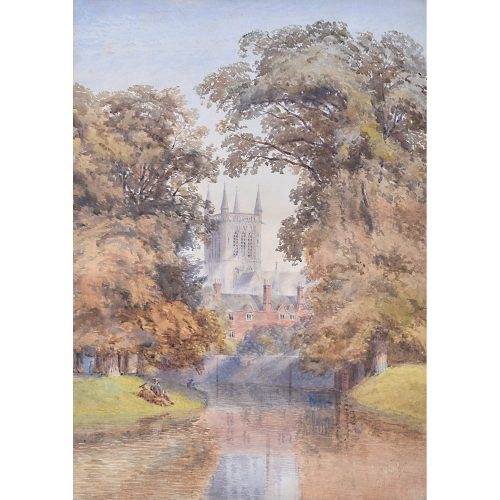
Anonymous (British, c. 1900) St John's College Cambridge from the River, Scholars Before
39x28cm Watercolour Scholars loll on the bank of the River Cam as they do today, and presumably have done ever since the foundation of the college in 1511. A dreamy view of one of the prettiest views in Cambridge. Condition: generally very good, slight staining to very margins, outside mount area. -
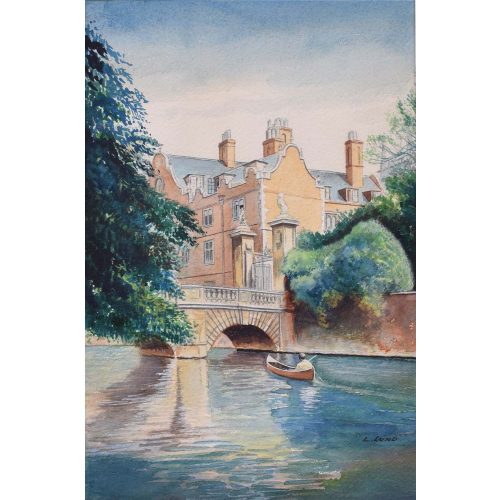
Ludwig Lund (1908-2003)
St John’s College Wren Bridge
Watercolour 26 x 21 cm Click here for biographical details and other works by the artist. If you are interested email info@manningfineart.co.uk or call us on 07929 749056. Condition: Good. -
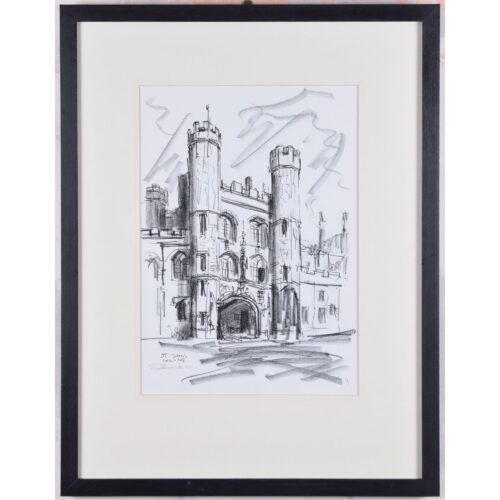
Tony Broderick (late 20th century)
St John's College, Cambridge Great Gate
Conte 38 x 27 cm Signed and dated in pencil lower left. A Lincoln-based artist known for his pictures of Lincoln and also of Cambridge's colleges. Condition: very good. If you are interested, please email info@manningfineart.co.uk or call us on 07929 749056. Click here for other views of St John’s College, Cambridge. -
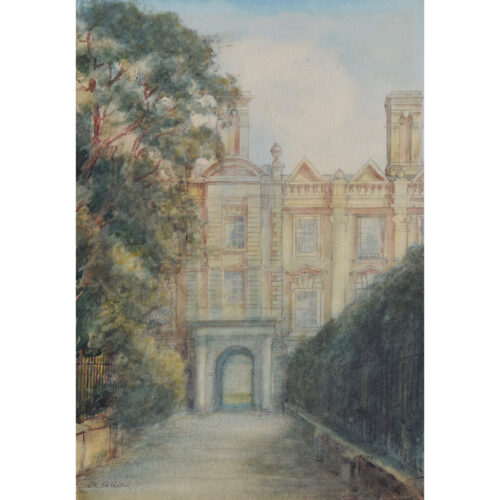
Alfred Allan
Clare College, Cambridge
Engraving 24.5 x 17 cm Signed lower left. An atmospheric watercolour depicting Clare College. Alfred Allan has painted several Cambridge colleges and also specialises in coastal scenes. Condition: generally very good; fractional age toning visible to the sky, top right. If you’d like to know more, please email info@manningfineart.co.uk or call us on 07929 749056. Click here for other views of Clare College, Cambridge. -

Philip Martin (1927 - 2014)
Free School Lane, Cambridge
Watercolour 38 x 27 cm Signed lower left, titled below, and dated lower right, all in ink. A watercolour of the historic Free School Lane in central Cambridge, where, as in much of the city, architectural styles jostle and bikes nestle against black railings. Philip Martin read Architecture at Cambridge. Condition: generally very good; a little even toning to paper. If you are interested, please email info@manningfineart.co.uk or call us on 07929 749056. Click here for other general views of Cambridge. -

Joy Fox (née Hollings) Girton College
Watercolour 24 x 17 cm Signed to bottom right. Little is known about Joy Fox. It seems that she studied at Girton College, Cambridge between 1939 and 1942. This charming watercolour depicting the main gate at the college featured in Douglas de Lacey's book 'Girton's War: the Village 1939-1945.' The work included memories of rationing and the various strategies employed to keep warm and to find clothes for coming up to Girton. There are also descriptions of lectures, college rules, entertainments and war work. Condition: Generally very good.If you would like to know more, please email info@manningfineart.co.uk or call us on 07929 749056.
For other views of Girton College, please click here. -
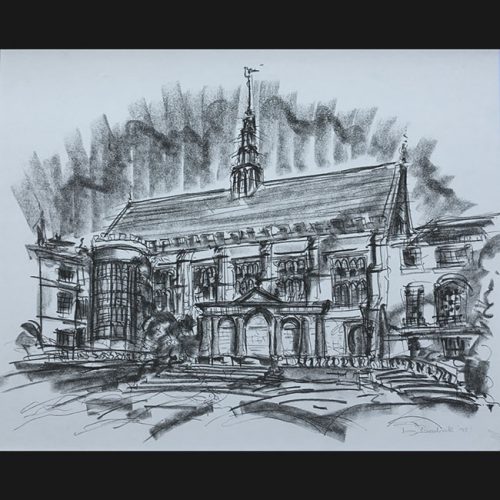
Tony Broderick
Trinity College, Cambridge, Hall from exterior
Conte drawing 37x47cm If you are interested email info@manningfineart.co.uk or call us on 07929 749056. -
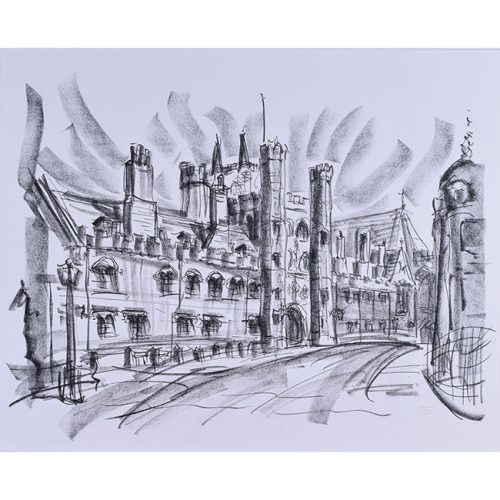
Tony Broderick
St. John's Great Gate, Cambridge
Conte drawing 33x42cm If you are interested email info@manningfineart.co.uk or call us on 07929 749056. -
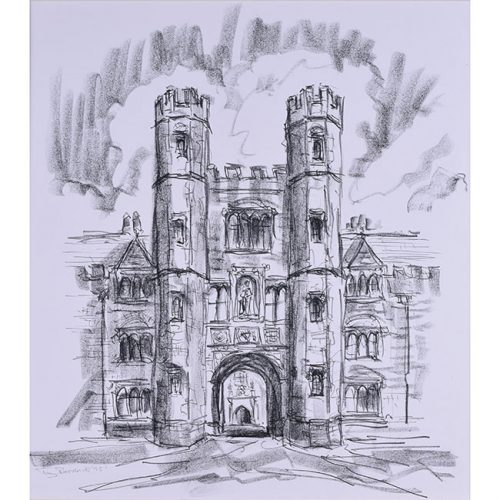
Tony Broderick
Shrewsbury Tower St. John's College Cambridge
Conte drawing 35x32cm If you are interested email info@manningfineart.co.uk or call us on 07929 749056. -
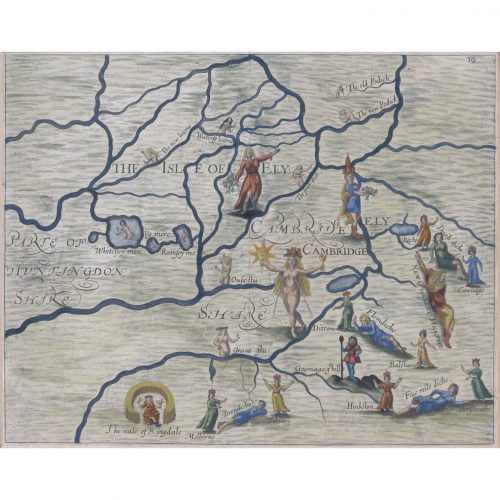
Map of Cambridge and the Isle of Ely (1622) engraved by William Hole for Drayton’s Poly Olbion
London (1622) 24 x 31 cm (9 x 12 in) If you are interested email info@manningfineart.co.uk or call us on 07929 749056. -

David Loggan (1634-1692)
Christ's College, Cambridge
Engraving 40 x 46 cm Loggan was born to English and Scottish parents, and was baptised in Danzig in 1634. After studying engraving in Danzig with Willem Hondius (1598-1652 or 1658), he moved to London in the late 1650s, going on to produce the engraved title-page for the folio 1662 Book of Common Prayer. He married in 1663 and moved to Nuffield in Oxfordshire in 1665. Loggan was appointed Public Sculptor to the nearby University of Oxford in the late 1660s, having been commissioned to produce bird’s-eye views of all the Oxford colleges. He lived in Holywell Street as he did this. The 'Oxonia Illustrata' was published in 1675, with the help of Robert White (1645-1704). Following its completion, Loggan began work on his equivalent work for Cambridge; the 'Cantabrigia Illustrata' was finally published in 1690, when he was made engraver to Cambridge University. The 'Oxonia Illustrata' also includes an engraving of Winchester College (Winchester and New College share William of Wykeham as their founder) whilst the 'Cantabrigia Illustrata' includes one of Eton College (which shares its founder, Henry VIII, with King’s College). Bird’s-eye views from this era required a particular talent as an architectural perspectivist; it was not until 1783 that it became possible for artists to ascend via hot air balloons and view the scenes they were depicting from above. Loggan thus had to rely on his imagination in conceiving the views. Loggan’s views constitute the first accurate depictions of the two Universities, in many ways unchanged today. Whilst the Oxford engravings were produced in reasonable numbers and ran to a second edition by Henry Overton (on thicker paper and with a plate number in Roman numerals in the bottom right-hand corner), those of Cambridge were printed in much smaller numbers. The Dutchman Pieter van der Aa published some miniature versions of the engravings for James Beverell’s guidebook to the UK, 'Les Delices de la Grande Bretagne' (c. 1708). The contemporary artist Andrew Ingamells (b.1956) has produced a highly-acclaimed series of etchings which bring Loggan’s original vision up to date. This particular edition represents an aerial view of Christ's College Cambridge. It was re-engraved by Edinburgh printmakers workshop, published by Christ's College Cambridge in 1997, and features an EPW blindstamp. Condition: Generally very good. If you are interested, please email info@manningfineart.co.uk or call us on 07929 749056. For other views of Christ's College, Cambridge. -
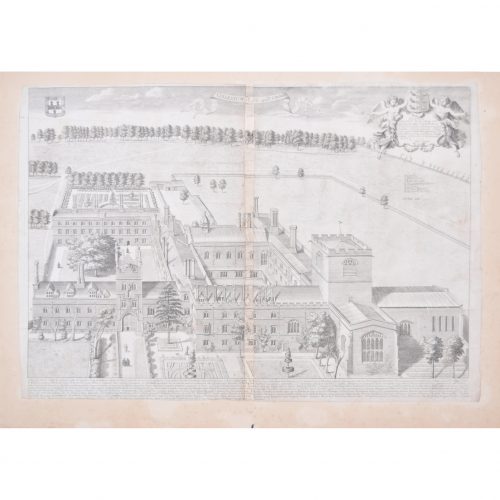
David Loggan (1634 - 1692)
Jesus College, Cambridge (1690)
Engraving 36 x 52 cm Loggan's skilful view of Jesus College from the 'Cantabrigia Illustrata'. Loggan was born to English and Scottish parents, and was baptised in Danzig in 1634. After studying engraving in Danzig with Willem Hondius (1598-1652 or 1658), he moved to London in the late 1650s, going on to produce the engraved title-page for the folio 1662 Book of Common Prayer. He married in 1663 and moved to Nuffield in Oxfordshire in 1665. Loggan was appointed Public Sculptor to the nearby University of Oxford in the late 1660s, having been commissioned to produce bird’s-eye views of all the Oxford colleges. He lived in Holywell Street as he did this. The 'Oxonia Illustrata' was published in 1675, with the help of Robert White (1645 - 1704). Following its completion, Loggan began work on his equivalent work for Cambridge; the 'Cantabrigia Illustrata' was finally published in 1690, when he was made engraver to Cambridge University. The 'Oxonia Illustrata' also includes an engraving of Winchester College (Winchester and New College share William of Wykeham as their founder) whilst the 'Cantabrigia Illustrata' includes one of Eton College (which shares its founder, Henry VIII, with King’s College). Bird’s-eye views from this era required a particular talent as an architectural perspectivist; it was not until 1783 that it became possible for artists to ascend via hot air balloons and view the scenes they were depicting from above. Loggan thus had to rely on his imagination in conceiving the views. Loggan’s views constitute the first accurate depictions of the two Universities, in many ways unchanged today. Whilst the Oxford engravings were produced in reasonable numbers and ran to a second edition by Henry Overton (on thicker paper and with a plate number in Roman numerals in the bottom right-hand corner), those of Cambridge were printed in much smaller numbers. The Dutchman Pieter van der Aa published some miniature versions of the engravings for James Beverell’s guidebook to the UK, 'Les Delices de la Grande Bretagne' (circa 1708). The contemporary artist Andrew Ingamells has produced a highly-acclaimed series of etchings which bring Loggan’s original vision up to date. Condition: extant portions very good; partly trimmed to within platemark; lacking portions of letters in lower left; also missing 1cm-width section down middle, historically replaced in pen and ink. Backed to laid paper. If you’d like to know more, please email info@manningfineart.co.uk or call us on 07929 749056. Click here for other views of Jesus College, Cambridge. -
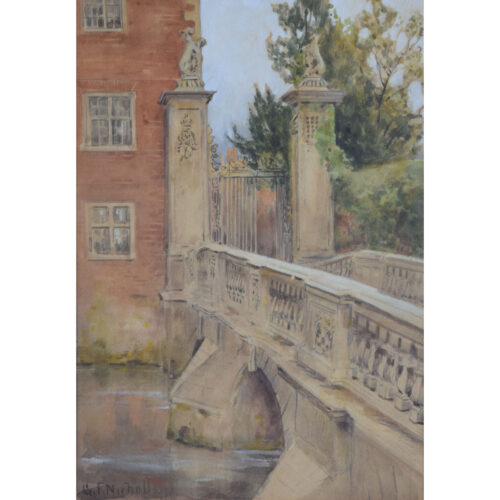
George Frederick Nicholls (1850 - 1935)
Wren Bridge, St John's College, Cambridge
Watercolour 37 x 24 cm Many of Nicholls' paintings are of the Cotswolds and Oxford. He painted the illustrations for a series of county books for A & C Black, including Cornwall (1915) and Cotswolds (1920). Condition: very good. If you are interested, please email info@manningfineart.co.uk or call us on 07929 749056. Click here for other views of St John’s College, Cambridge. -
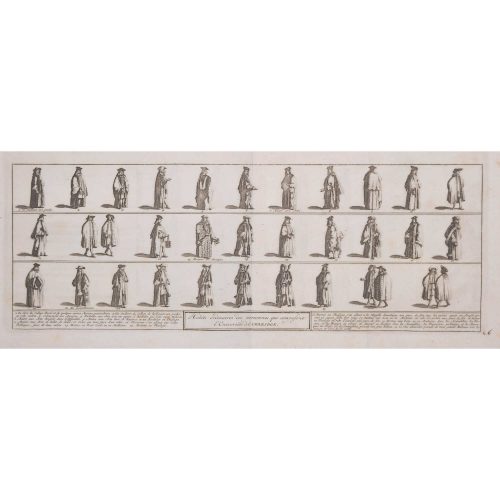
Pieter van der Aa (1659-1733), after David Loggan (1634-1692)
The Costumes of the University of Cambridge
Engraving, 14 x 36 cm Early 18th century This engraving by van der Aa (based on a prior design by David Loggan) illustrates the various forms of academic dress worn by members of the University of Cambridge. Pieter van der Aa of Leiden was a Dutch publisher best known for preparing maps and atlases, though he also printed editions of foreign bestsellers and illustrated volumes. He is noted for the many engravings he produced after David Loggan's series of Oxford and Cambridge colleges and costumes. Condition: Generally very good; slight age toning, and spotting to margins.