-
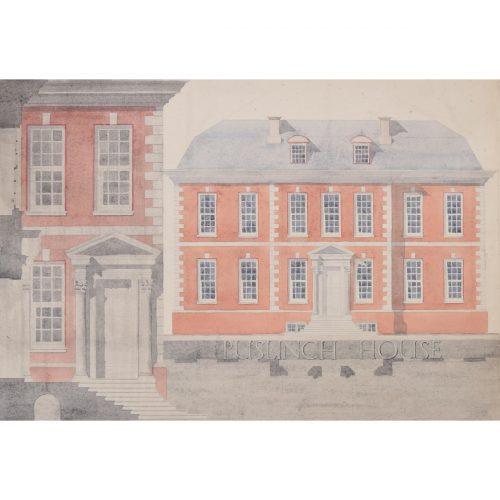
S Clapham (active 1940 - 1960)
Puslinch House
Watercolour 49 x 70 cm A beautifully-coloured watercolour of Puslinch House, a fine Christopher Wren-style Georgian mansion in Devon. The estate was owned by the Poslylinch, Mohun, and Upton families before being taken over by the Yonge family in 1718, following the marriage of John Yonge and Mary Upton. The Queen Anne House mansion was built on the occasion of their wedding and an earlier mediaeval house still exists in the grounds as a country cottage. During the war, the house was used as a voluntary hospital for wounded officers. Clapham was an architect based in Stockwell in London. Condition: generally very good; a little faint spotting to top right corner. If you are interested, please email info@manningfineart.co.uk or call us on 07929 749056. Click here for other works by the artist. -
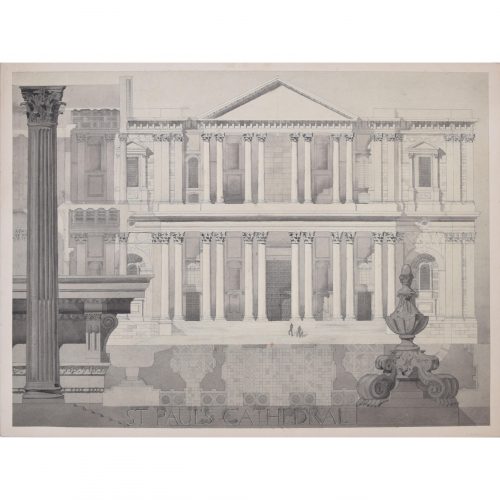
S Clapham (active 1940 - 1960)
St Paul's Cathedral
Watercolour 51 x 68 cm Signed lower right. This architectural watercolour is a panegyric to the English Baroque grandeur of St Paul's Cathedral. Three small figures climb the steps, emphasising the size and magnificence of the architecture around them. St Paul's was built between 1675 and 1711 by Sir Christopher Wren. The foundation stone was laid in 1675 when Wren was 43 years old, and the building works were completed 35 years later by Wren's son. Its construction was part of a major rebuilding programme in the city after the Great Fire of London. Clapham was an architect based in Stockwell in London. Condition: generally very good; a couple of spots. Mounted to board by artist and signed to board. If you are interested, please email info@manningfineart.co.uk or call us on 07929 749056. Click here for other works by the artist. -

Louis Osman
Plans for workshops at Canon's Ashby
Pen, ink and pencil 50 x 38 cm Louis Osman (30 January 1914 – 11 April 1996) was an architect, artist, goldsmith, silversmith and medallist. Few people matched his creations as a goldsmith, and consequently he was chosen to make the crown for the Investiture of the Prince of Wales in 1968. Many of his other works are in public collections in the UK and worldwide. After Hele’s school in Exeter he studied at the Bartlett School of Architecture – part of University College London – from 1931. Also attending the Slade, he left the Bartlett being awarded the top first, which brings with it the Donaldson Medal of the RIBA. ollowing the war he was busy as an architect, works including for Westminster Abbey, and Lincoln, Exeterm, Ely and Lichfield Cathedrals. Staunton Harold Church in Ashby de la Zouch for the National Trust, and of course his own folly, the Grade I listed Elizabethan manor house, Canons Ashby in Northamptonshire – which was given to the National Trust in 1981 when Osman was not able to keep the tenancy any longer. At Canons Ashby, the plans of which are shown here, he established a workshop and had a team of silversmiths and goldsmiths working for him. In 1974 he created the exhibition celebrated by this lavishly illustrated catalogue. His 1969 crown for the Investiture of the Prince of Wales was on display, together with many other items of his own creation, and also by other silversmiths such as Malcolm Green, Philip Noaks and Stephen Nunn, also acknowledging the work of Desmond Clenn-Murphy, Peter Musgrove and Christopher Philipson in his own works. Condition: Very good, on tracing paper; five sheets -

James Basire & John Carter Floor plan of St Albans Cathedral
Engraving 61 x 95 cm This engraving was originally published by the Society of Antiquaries of London, an organisation dedicated to studying and preserving historical monuments. Recognising it as one of England's most significant medieval structures, the society commissioned a series of engravings of St Albans Cathedral by James Basire, based on drawings by the architectural draughtsman John Carter. In doing so, the Antiquaries hoped to preserve and disseminate knowledge of England’s architectural heritage. This particular edition depicts a cross section of St Alban's Cathedral, offering a unique insight into both the architectural features of the building and its finer masonry and design details. Condition: Generally very good, slight spotting to the central fold.If you would like to know more, please email info@manningfineart.co.uk or call us on 07929 749056.
-

James Basire & John Carter Architectural View of Exeter Cathedral
Engraving 61 x 95 cm This engraving was originally published by the Society of Antiquaries of London, an organisation dedicated to studying and preserving historical monuments. The society commissioned a series of architectural engravings by James Basire, based on drawing by the English architect and draughtsman John Carter. In doing so, the Antiquaries hoped to preserve and disseminate knowledge of England’s architectural heritage. This particular edition depicts a side-view of Exeter Cathedral. Basire's creation of contrasts between light and dark creates a strong sense of architectural perspective as the arms of the transept protrude away from the nave. Basire's strong command of the medium also allows him to expertly capture the fine details of the stained glass windows, presenting a lovely view over this majestic building. Condition: Generally very good, slight spotting to the central fold.If you would like to know more, please email info@manningfineart.co.uk or call us on 07929 749056.
-

H S Rogers
St Edmund Hall - 1926 Proposed Alterations No 2
Pen ink and hand colouring 49 x 38 cm Architectural plans for St Edmund Hall, Oxford by esteemed architect H S Rogers. Condition: Very good, on linen-backed paper -

H S Rogers
St Edmund Hall - 1926 Proposed Alterations No 2
Pen ink and hand colouring 49 x 38 cm Architectural plans for St Edmund Hall, Oxford by esteemed architect H S Rogers. Condition: Very good, on linen-backed paper -
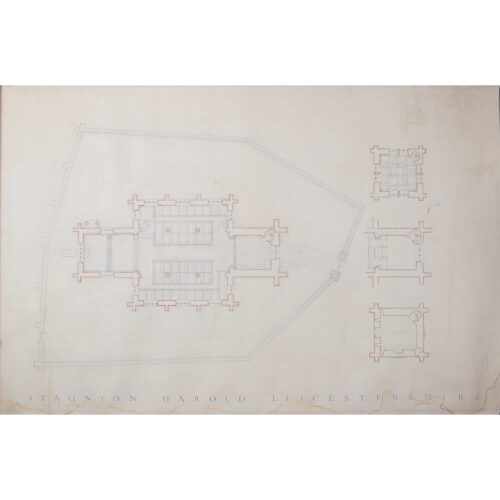
Louis Osman (1914 - 1996)
Drawings of Staunton Harold, Leicestershire
Pencil, pen, watercolour, &c. Varied measurements - see below Provenance: artist's studio sale A collection of six varied drawings, made by Louis Osman, depicting the architecture and decorative details of Staunton Harold House and Church. These are, respectively: A plan of Staunton Harold Church: 97 x 146 cm Miscellaneous figures — statuary from Staunton Harold House: 54 x 74 cm A large drawing of the facades of the House and Church: 77 x 302 cm A design for the restoration of the organ: 64 x 48 cm Miscellaneous figures — a lion, statue, and tree with part of the Church facade in the background: 54 x 74 cm Drawings of armorial tassels: 76 x 127 cm Condition: varied, fair-good; some handling marks, scuffs, and various damage throughout. If you are interested, please email info@manningfineart.co.uk or call us on 07929 749056. Click here for other works by the artist. -
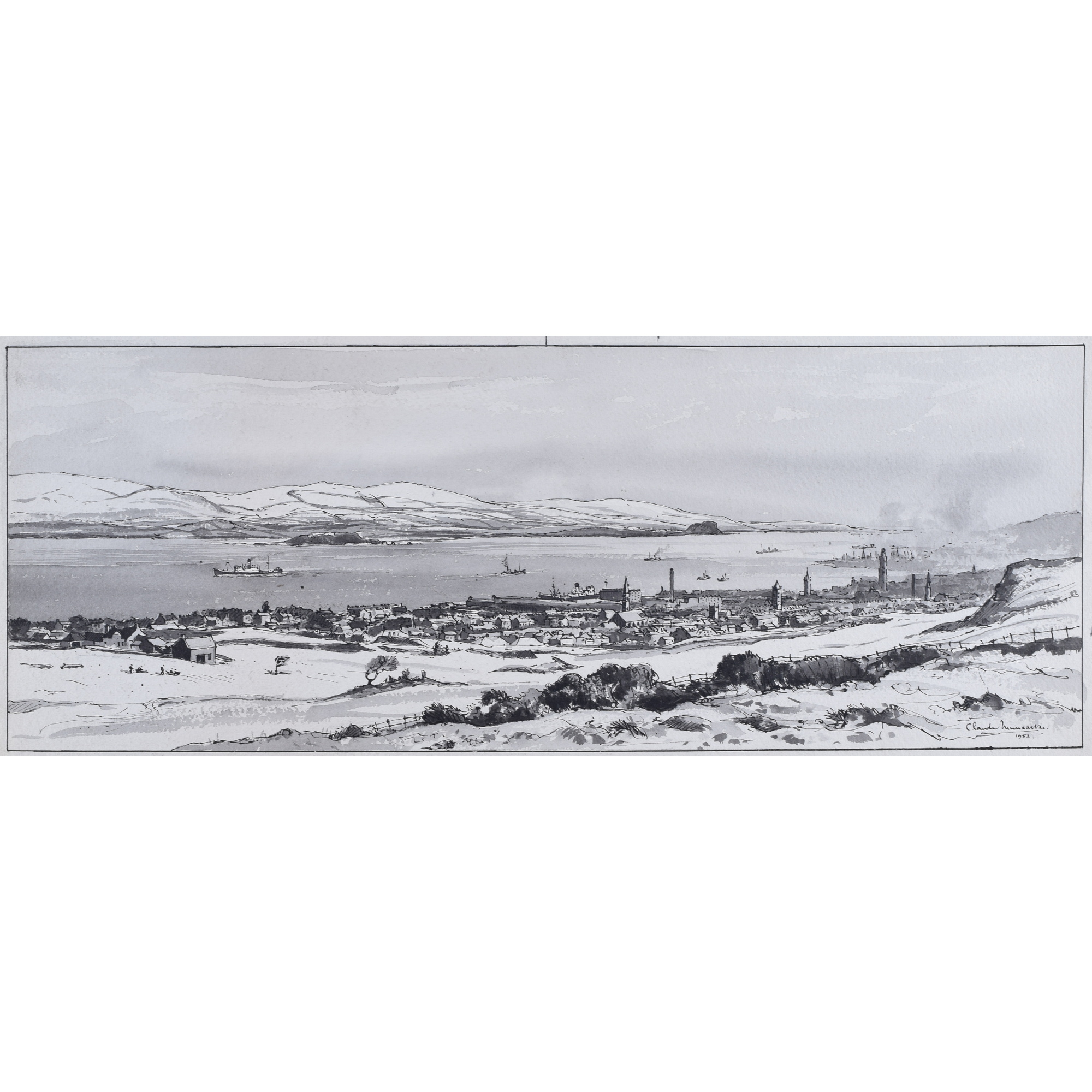
Claude Muncaster (1903-1974)
View of the Clyde from Lyle Hill
Monochrome watercolour with ink Signed and dated 1952, and inscribed 'Sphere' 18x50cm DRAWN FOR 'THE SPHERE' ILLUSTRATED MAGAZINE Click here for biographical details and other works by the artist. If you are interested email info@manningfineart.co.uk or call us on 07929 749056. -
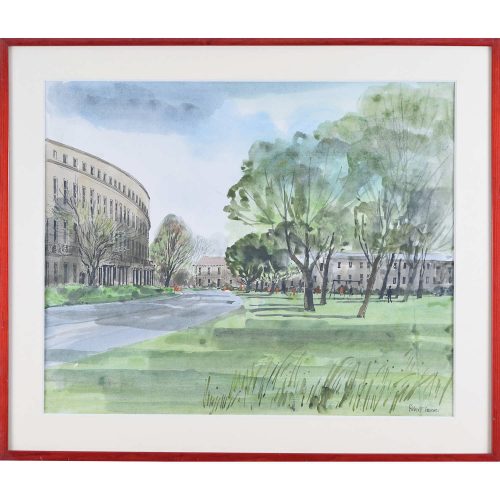
Robert Tavener (1920 - 2004)
Lansdown Parade, Cheltenham
Watercolour and pen 38 x 46 cm Signed lower right. The thin watercolour wash of the lawns and the fine ink pen expression of the college's architecture create a contrast between the natural and the man-made in this picture by Tavener. He painted several views of the city of Cheltenham and its architectural landmarks, including of Cheltenham College (this picture is available here). Condition: generally very good. -
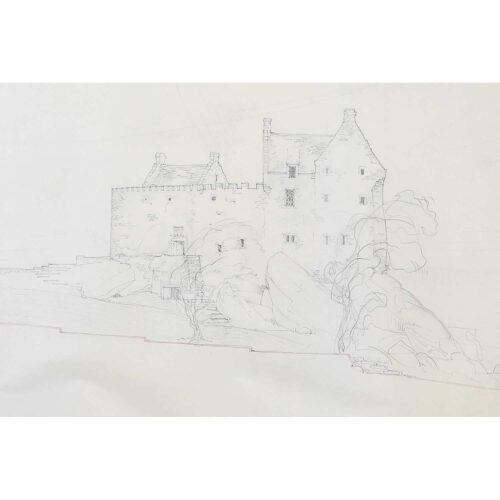
Louis Osman (1914 - 1996)
Architectural Plans for Duntrune Castle
Pencil, watercolour, &c. 70 x 110 cm, plus larger and smaller Approximately 15 original drawings and 15 reproductions Provenance: artist's studio sale Louis Osman was appointed as the architect to oversee important works at Duntrune Castle; the drawings are undated, but likely date to the 1950s. Condition: as the roll comprises a set of working drawings, there are handling marks, scuffs, stains, and other various damage. If you are interested, please email info@manningfineart.co.uk or call us on 07929 749056. Click here for other works by the artist. -
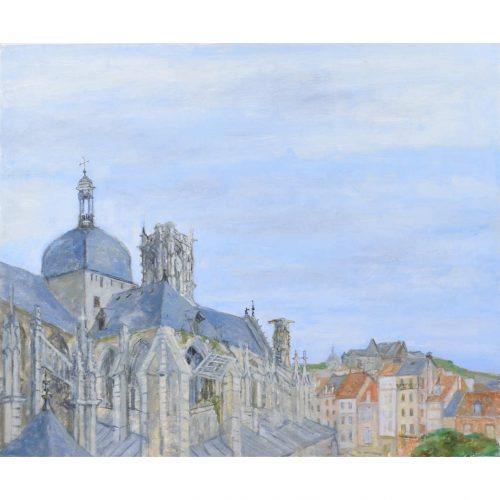
Richard Beer (1928 - 2017)
Dieppe Cathedral
Oil on canvas 66 x 76 cm A mountaintop cathedral and surrounding houses; broad blue sky fills the rest of the canvas. This oil painting is a fantastic example of Beer's focus on architecture, the central and recurring theme of his pictorial idiom. Born in London in 1928, just too late to serve in the Second World War, Richard Beer studied between 1945 - 1950 at the Slade School. Subsequently, a French Government scholarship allowed him to spend time in Paris at Atelier 17, working under Stanley William Hayter (1901 - 1988), one of the most significant print makers of the 20th Century – having spent the War in New York, advising as a camofleur, Hayter only returned to Paris in 1950. Subsequently Beer studied at the École des Beaux Arts, Paris. Working for John Cranko, choreographer for the Royal Ballet, Beer designed the sets and costumes for his The Lady and the Fool at Covent Garden, subsequently working for him following his move in 1961 to Stuttgart Ballet. Additionally he produced book illustrations and designed book jackets. Beer later taught print-making at the Chelsea School of Art, where he was a popular teacher. Probably his greatest work was a collaboration with John Betjeman to produce a portfolio of prints of ten Wren Churches in the City for Editions Alecto, copies of which are in The Government Art Collection. That collection contains a total of 54 prints by Beer, and the Tate Gallery’s collection holds seven. His Oxford series was also produced for Editions Alecto as was a series of predominantly architectural views in Southern Europe. Most of his prints are of architectural subjects. Condition: excellent. If you’d like to know more, please email info@manningfineart.co.uk or call us on 07929 749056. Click here for other views by Richard Beer. -
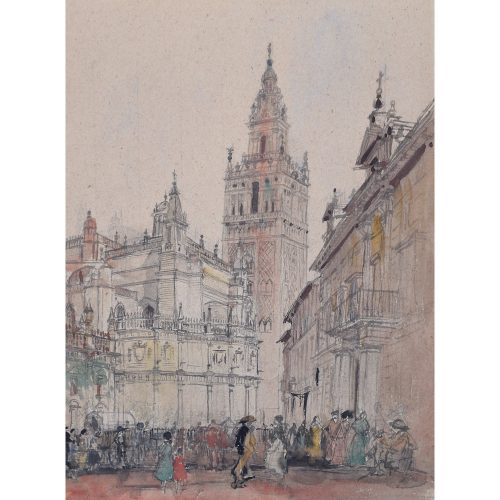
Sir Albert Edward Richardson K.C.V.O., F.R.I.B.A, F.S.A., P.R.A. (1880-1964)
La Giralda Seville
38x28cm Watercolour Sir Albert Edward Richardson K.C.V.O., F.R.I.B.A, F.S.A., P.R.A. (1880-1964) was a traditionalist, renowned for his distaste of modern architecture. Rooted firmly in the classical period, he lived a Georgian life, refusing to have electricity in his Georgian house – until his wife finally insisted. Professor of Architecture at UCL’s Bartlett School of Architecture from 1929-1955, this was evacuated to Cambridge during the war and he became a fellow of St Catharine’s College. Amongst his other achievements, Richardson was President of the RA, editor of Architect’s Journal and founder of the Georgian Group. For pleasure he painted architectural fantasies; capriccios of buildings he pictured in his mind. Richardson was recipient of the Architectural Association’s Professor Bannister Fletcher Medal in 1902 which was an award for the study of post-Fire London architecture. Amongst his achievements were Professor of Architecture at University College London, President of the RA, editor of Architect’s Journal and founder of the Georgian Group. Click here for other works by the artist and biographical details. If you are interested email info@manningfineart.co.uk or call us on 07929 749056. -
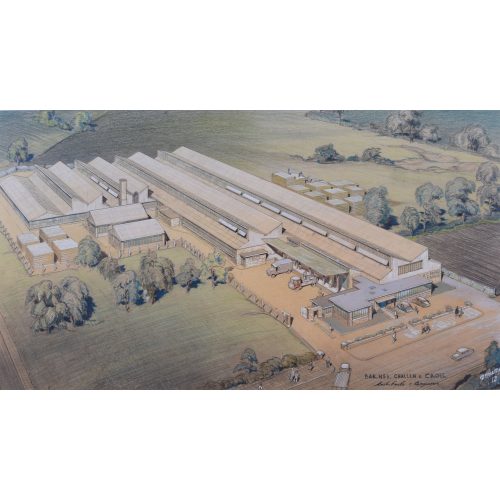
John Dean Monroe Harvey (1895 – 1978) Architectural Drawing: Design for a factory for VC Bond
for Barnes Challen & Cross, Architects and Engineers Mixed Media 38x68cm Even the factory commissioned by the manufacturers of a furniture company deserved the attention of a drawing by the famous JDM Harvey in the Board Room. Unusually, perhaps, for Harvey, here he is drawing fields, carefully catching the texture of a ploughed field with the confident diagonal strokes of his hand. The factory is busily occupied, men are unstacking great piles of timber at the back of the building. A further lorry-load of raw materials enters through the gate and the Directors' fine saloon cars are parked towards the front. Even in this obviously rural environment Harvey draws his usual pedestrians. All these aspects give life to what in the hands of a lesser man would probably be a rather clinical drawing - instead of a picture of which to be proud. Probably unrivalled as an architectural perspectivist working after the second World War, Harvey trained as an architect but after 1944 worked almost solely on drawing architectural perspectives for other architects. “The architectural draughtsman who is equally competent at drawing such incidentals [as landscape and figures] is as rare as the landscape or figure painter who is equally competent at architecture. Harvey was one of those rare men. He would draw a building with a slightly freer hand than an architect would, and his landscape in a slightly more architectural manner than that of a painter.” Perspective in Perspective, Lawrence Wright (Routledge 1983) p234. Harvey was born in Newfoundland, where his father was a railway engineer, and came to England aged 17, studying at St Paul’s School, London and at the School of Architecture, University College London 1914-1918, being awarded the Donaldson medal. In 1920 he went into practice on his own, designing several interiors with J A Bowden. Amongst his works were the reconstruction and interior decoration of 4 Cleveland Place, London (1936-37), and a house – including all furnishings – in Herne Hill for Dr M I Elliot (1938). After 1944 he primarily worked as a perspective artist and illustrator, a role to which he was particularly well suited. During the war he was a member of St Paul’s Watch, a group of over one hundred architects and surveyors and artists who kept watch over St Paul’s Cathedral during the blitz, extinguishing fires and helping St Paul’s to survive the war virtually unscathed. The Watch was described as the ‘Best dining club in London’ on account of its influential members. He retired to Italy, living on the shore of Lake Como, and enjoying the local red wine. If you are interested email info@manningfineart.co.uk or call us on 07929 749056. Condition: Excellent. In original frame (which has been repolished and with new mount). Glass will be removed for overseas shipping, or subject to a significant shipping surcharge. -
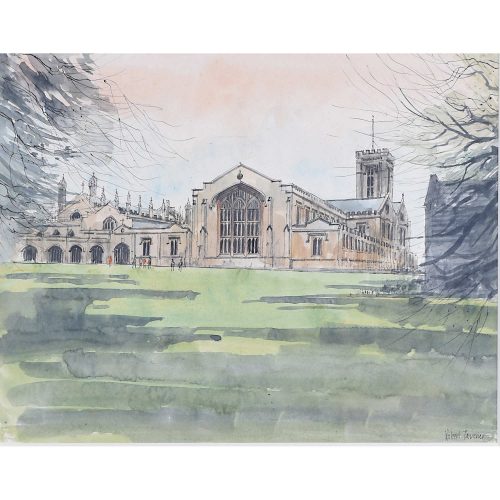
Robert Tavener (1920 - 2004)
Cheltenham College
Watercolour and pen 28 x 35 cm Signed lower right. What is particularly interesting about this picture is the contrast between the rugged watercolour wash of the lawn and the fine pen expression of the college's architecture. Tavener painted several views of the city of Cheltenham and its architectural landmarks; Cheltenham College is a public school just outside the city, and Tavener expertly elicits its mid-nineteenth century architectural style here.